Ask an American Christian what type of church they belong to, and you’re more likely than ever to hear the label nondenominational.
The proportion of Protestants in the United States who don’t identify with a specific denomination doubled between 2000 and 2016, according to a Gallup poll released this week. Now, about 1 in 6 Americans are nondenominational Christians.
The growing popularity of nondenominational identity is the result of two trends: the decline in the number of Protestants overall, as more Americans eschew any religious affiliation (becoming “the nones”), and shrinking denominations themselves.
Not only are the major mainline churches continuing to see their numbers fall, the country’s largest Protestant denomination—the Southern Baptist Convention (SBC)—has lost a million members in the past 15 years.
Prior to 2000, half of all Americans belonged to a specific Protestant denomination. Now, just 30 percent do, Gallup reported.
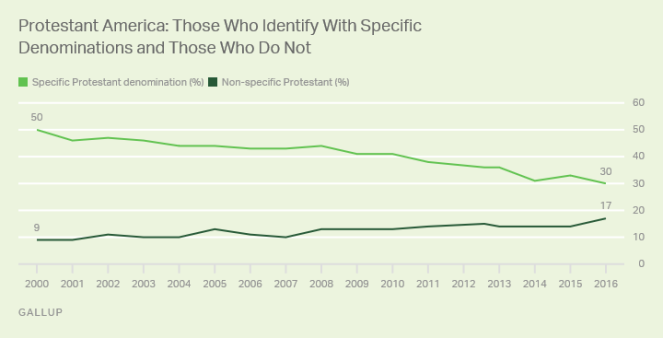
“Churches that adhere to specific and historical denominational affiliations appear to face the biggest challenge in American Protestantism today,” the pollster wrote. “Increasingly, Christian Americans … prefer to either identify themselves simply as Christians or attend the increasing number of nondenominational churches that have no formal allegiance to a broader religious structure.”
Back in 2010, the Hartford Institute for Religion Research tallied more than 35,000 nondenominational churches in the US, comprising more than 12 million attendees. The move away from historic denominations corresponds with a swelling sense of skepticism many Americans have toward institutions overall.
The shift toward nondenominational identity is so strong that even denominational churches downplay their affiliations to avoid the negative connotations now associated with religious hierarchy and structure, suggested Roger Olson, theology professor at Baylor University’s George W. Truett Theological Seminary.
“Very few churches I know anything about are truly, totally, exclusively ‘nondenominational’ in the sense most people think,” he wrote in a blog post last month. “In almost every case where I am asked about a church that declares itself ‘nondenominational,’ I can find some affiliation of that church with some network of similar churches.”
Networks such as Acts 29 have attracted attention for their church-planting, younger leadership, and vision. As CT blogger Ed Stetzer wrote, “networks are reinventing how evangelicals and others cooperate and shaping ministry in many contexts and across various denominational barriers.”
Some consider such groupings—which provide training, resources, and accountability to churches and their pastors—to provide similar structure as denominations. Churches can belong to a network as well as a denomination; for example, Acts 29 president Matt Chandler pastors The Village Church, which belongs to the SBC.
The Gallup poll indicated that some Christians have a tendency to choose a broader Christian designation, even if their church belongs a denomination. With the number of Americans identifying as Southern Baptists dropping from 8 percent to 3 percent since the year 2000, researchers stated, “it may also be those who may actually attend an official Southern Baptist church increasingly identify as just ‘Baptist’ rather than as Southern Baptist, specifically.”
These trends also play out in church names, which are less likely to reference their denominational ties. Among board members of the National Association of Evangelicals, which involves 40 denominations, 63 percent say their church name does not include their affiliation, CT reported in 2015.
Within evangelicalism, the charismatic and Jesus People nondenominational movements of the 1970s (think Calvary Chapel and Vineyard), which “emphasized just being ‘Christian’” and “criticized denominations as divisive,” have had a lasting influence on how people understanding their religious identity, Olson said.
“There is a trend toward what I call ‘generic Christianity’ that is very feeling-centered and pragmatic and somewhat anti-intellectual,” the theologian told CT. “As denominational particularities are ignored or hidden, what’s often left is a ‘lowest common denominator’ spirituality that is often little more than ‘worship’ and ‘discipleship’ devoid of cognitive content. The result is often folk religion rather thanc historic, classic, biblical Christianity.”
Among the exceptional denominations boasting growing membership in recent years is the Assemblies of God, whose total numbers still trail the SBC and the United Methodist Church (UMC), according to Pew Research Center’s 2014 Religious Landscape Study. The survey also showed that nondenominational Christians were on the rise.
Earlier this year, the Department of Defense added hundreds of new religious designations and eliminated “Protestant, nondenominational,” in hopes of obtaining more specific information on military service members.