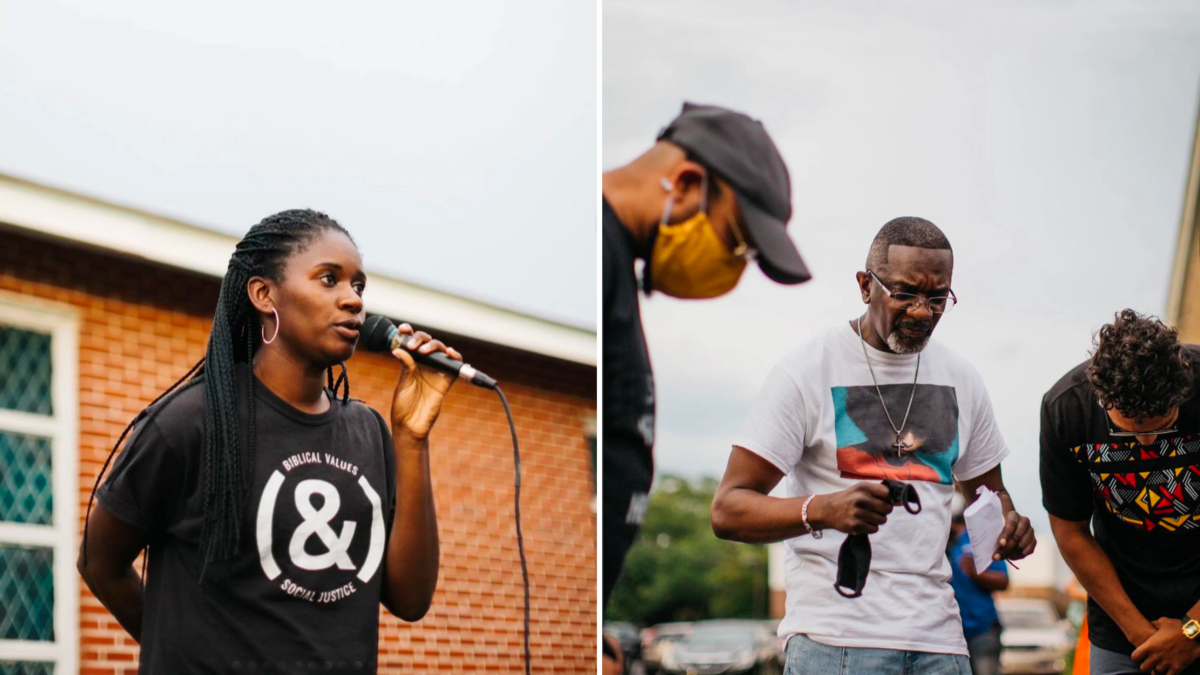
The And Campaign—the organization rallying urban Christians to “faithful civic engagement”—is on track to quadruple its size in the span of a year, with chapters launching in three Southern cities in 2020 and scheduled to launch in another 10 cities in the first half of 2021.
Last year’s convergence of the COVID-19 pandemic and political and racial unrest in the United States catapulted organizations like the And Campaign, which were already addressing these complex issues, to a new level of prominence.
“The pandemic had a huge impact on our growth,” said attorney and political strategist Justin Giboney, who cofounded the And Campaign with pastor Angel Maldonado and hip-hop artist Sho Baraka in Atlanta in 2015.
In May, the group’s Statement on Racialized Violence went viral after the death of George Floyd, tripling its social media following.
“When that racialized violence happened, and everyone had their full attention on it because there was nothing else to pay attention to, our executive committee got together and said, ‘Hey, we need to speak into this,’” said Giboney, referencing the killings of Floyd, Breonna Taylor, and Ahmaud Arbery.
“So many Christians are trying to find a way to process exactly what is going on in biblical terms. Some are ignoring it because their ideology is too far right. Some are getting too caught up in the moment and kind of changing their convictions because they have gotten too caught up on the left. I said we need to speak into this in a real way, and so we created a biblical statement on racialized violence.”
The statement addressed racism and criminal justice reform—one of the core political issues for the And Campaign, which promotes both social justice and moral order as priorities for Christians.
With established chapters in Atlanta, Dallas, Brooklyn, and Chicago, the And Campaign added chapters in Charleston, South Carolina; Raleigh, North Carolina; and Birmingham, Alabama, last summer and fall.
“There was so much conversation about racial reconciliation and injustice, but there were very few on-ramps for Christian action in Charleston,” said Philip Pinckney, pastor of Radiant Church in Charleston, who founded its chapter after connecting with Giboney at a local multiethnic ministry conference called 1Charleston. “In the city where the Civil War was started, that is still reeling from the murder at Emanuel and that probably has more churches per square mile than any other place in the country, we had to mobilize.”
The Charleston chapter held its first event, a Prayer & Action Rally, at Pinckney’s church on Juneteenth. Though the event received local news coverage and drew attention online, Pinckney suspects the pandemic hurt turnout. The chapter continued to engage in issues leading up to the 2020 election. It created its own 17-page guide to local races and interviewed some of the candidates.
The founder of the Birmingham chapter, Danny Brister Jr., also heard Giboney speak at a conference—Just Gospel, put on in Atlanta by The Front Porch. Brister, a former pastor and church planter, said he was “bothered by politicking around the pandemic” and looking for a way to be politically engaged from a Christian perspective following the death of George Floyd.
He established the chapter in October 2020. Its six leaders are split between black and white, men and women, and span progressive and conservative political perspectives. Pandemic permitting, Brister hopes to host a public launch event in the spring. In Birmingham, 2021 is an important election year, with seats for school board, city council, and mayor up for election.
Brister, a community liaison for a local charter school and former employee of the City of Birmingham Mayor’s Office, has engaged Christians who plan to run for local offices in the near future with And Campaign materials. “They really want to talk about how they do this faithfully and if they win, how can they honor God and not capitulate their Christianity,” he said.
Sometimes privacy is sin against the body.
“Pastor, I want to tell you something. But keep it confidential—we don’t want anyone else to know this.”
“Sure, Pete, you know I’ll keep whatever you tell me strictly between us.”
“Well, Pastor, our son is an alcoholic. And he’s only 18. He’s getting treatment and is dried out right now, but you would not believe the agony we’ve been through.”
“Keep it confidential!” That pastor just agreed to keep secret something his entire congregation should know about. He allowed himself to be cornered into keeping private a matter that belongs not to a few individuals, but to the whole body of which they are part.
This is no isolated experience. It is more common than rare. Church members withhold from their fellow members the hurts, fears, burdens—and also the joys and victories—of their private lives.
It may jar some to have this privacy challenged. Since it is such a typical part of parish life, the practice goes on like other sacred traditions. But closer reflection should lead us to question seriously the appropriateness of many confidences in the Christian church.
A body has no privacy from its various parts. The toe cannot keep its pain confidential, secret, from the rest of the body. In fact, the toe’s pain is not its own. It belongs to and is felt by the whole organism. The communication system is very effective. The news gets around very fast in the otherwise healthy body.
Pete’s pain over his son is not his private property if he holds membership in the body of Christ. While Pete is the father, the alcoholic son belongs to the whole congregation, the entire covenant community. At his baptism, Pete’s son was incorporated into that community with promises spoken or implied that he was now the object of their concern. They pledged to take care of him. He was their son, too. But communication to the rest of the body is being thwarted. Both Pete and his pastor are preventing the necessary transfer of information to the other parts.
In the physical body, if the infected toe is not felt by the rest of the body it is likely to go untreated and get worse. Leprosy is like that, for if the diseased part, dead and unfeeling, goes untreated, serious complications usually result. But if the pain is felt through the whole system, all resources can be martialed to help heal it.
Every day pastors and parishioners are innocently conspiring to prevent the body from taking care of its ailing parts. They do it by requesting and agreeing to keeping secret the hurts, concerns, worries, ills, and tragedies that are occurring in various parts of Christ’s body.
John is having conflict with his employer.
Mary is pregnant but unmarried.
Harry left his wife.
Frank and Betty’s baby seems retarded, but too young to tell for sure.
Ann is in the hospital for a hysterectomy.
Jerry is in a psychiatric hospital.
Earl and Kay’s son has run away again.
Gordon may have cancer.
The list could be lengthened with further instances of the kind of information kept secret from the other members of the church. Often the pastor joins in to keep it secret. Sometimes even he is left out.
Privacy of this sort violates the very essence of the church. At the heart of Christian living is membership in a body, a caring community exhorted and pledged to bear each other’s burdens, to weep with those who weep, and to rejoice with those who rejoice. Keeping one’s pain secret short-circuits this spirit and prevents healthy body life. How can others support, challenge, pray for, weep with, give help to, advise, and confront with an aim toward healing if they do not know what is happening?
Fear of the effects of gossip fuels the fires of privacy. It works as a powerful inhibitor to openness. But nothing can take the punch out of gossip like being open about one’s troubles. Gossip feeds on secrecy and dies when the news is published. Secrecy thrives on fear of gossip, but actually produces gossip because people are more likely to spread secrets than common knowledge.
There may be other, even valid, reasons for not wanting everyone to know something. But most are born of fear, habit, tradition, and middle-class independence. Pete’s thinking went something like this: “I do want the help of other people, but I don’t want to bother them with everything that happens. When I really need help, I’m able to ask for it and I will.”
The point against too much privacy is not that Pete cannot handle his load by himself. He can and he will. But if he spread it around to others, he would find it not quite as heavy.
But beyond what Pete himself would get out of it, there is another value: the body is reassured by being in on Pete’s problem. Like white blood cells congregating to fight an infection, members of the church body draw together in caring for a troubled part. Seeing this communicates to each member a new awareness of this caring community as an encouraging bulwark in their lives. They, too, are strengthened while focusing on Pete’s pain. So we also distribute our personal problems because the whole body is built up by knowing about it and helping with it.
The fact remains, however, that Pete will be helped if others know. One man told me how he shared with his fellow church members some problems he was having with his employer. While asking for prayer and support, and receiving it, he also was given valuable advice from experienced business men of the congregation. A group of people have a wide array of additional resources that can also help others in crises.
In one church, a special time is set aside in the worship service for “joys and concerns.” People are given an opportunity and sometimes coaxed to say aloud what is going on in their lives. Right now it is only scratching the surface; but it’s a start. Strangely, it is not easy for people or pastor to accept this use of time as being as important as singing a hymn, taking the offering, or reciting a creed.
For the most part, only the socially acceptable common illnesses receive publicity in church. Anything with the slightest stigma is hushed up or only alluded to in vague generalities like “those struggling with marriage problems, the unemployed, those in prison, those with emotional problems.” Seldom is a problem more specific—unless it’s gall bladder or open heart surgery. Announcements, spoken or in the bulletin, veil most problems with a cryptic note that so-and-so is in such-and-such hospital. They leave the congregation guessing about what it’s all about. The covenant community deserves and needs to know details in order for them to respond appropriately.
JIM KOKMr. Kok is chairman of the Department of Pastoral Services at Pine Rest Christian Hospital, Grand Rapids, Michigan.
Even before national attention turned to racial justice issues, the And Campaign took the lead helping churches in low-income locations during the pandemic. Together with ministry partners, the Churches Helping Churches Challenge raised over $1.3 million and will continue to offer $5,000 grants to continue projects in their communities.
The And Campaign also saw growing interest around its political philosophy ahead of the 2020 presidential election, connecting with believers who felt “politically homeless” in the major parties.
“We articulated that there is this false dichotomy that politics forces you to go all the way to the left or forces you to go all the way to the right,” Giboney said. “A lot of Christians say, ‘That’s me. I care about poverty, I care about voter rights, and I care about the pro-life cause.’”
At a recent Zoom meeting for the And Campaign’s Atlanta chapter, they discussed the Georgia Senate runoffs, which put their city in the spotlight of American politics, as well as the Capitol insurrection, President Joe Biden’s COVID-19 response plan, and Senator Mitt Romney’s Family Security Act.
On a local level, the chapter is planning on advocating for juvenile probation reform—which leaders believe can be a bipartisan issue for Atlanta Christians—and reaching out to Christian state legislators, urging them to apply their principles to their work.
“There’s this idea that in order to be educated in politics, you have to be educated by the world first and then be educated by your faith, but that is backward,” said Abrm McQuarters, an Atlanta chapter leader.
Leaders across the country are looking forward to resuming in-person meetings and events once COVID-19 risks have died down, especially to build on the momentum in the new chapters preparing to launch in 10 cities this year: Akron, Ohio; Houston; Asheville, North Carolina; Richmond, Virginia; Detroit; Denver; Kansas City, Missouri; Austin, Texas; Pittsburgh; and San Diego.