An executive order from US president Donald Trump last month created one of the most discriminatory policies regarding refugees since the US privileged Western Europeans through the Immigration Act of 1924. That act privileged Western Europeans and made entry from the rest of the world difficult.
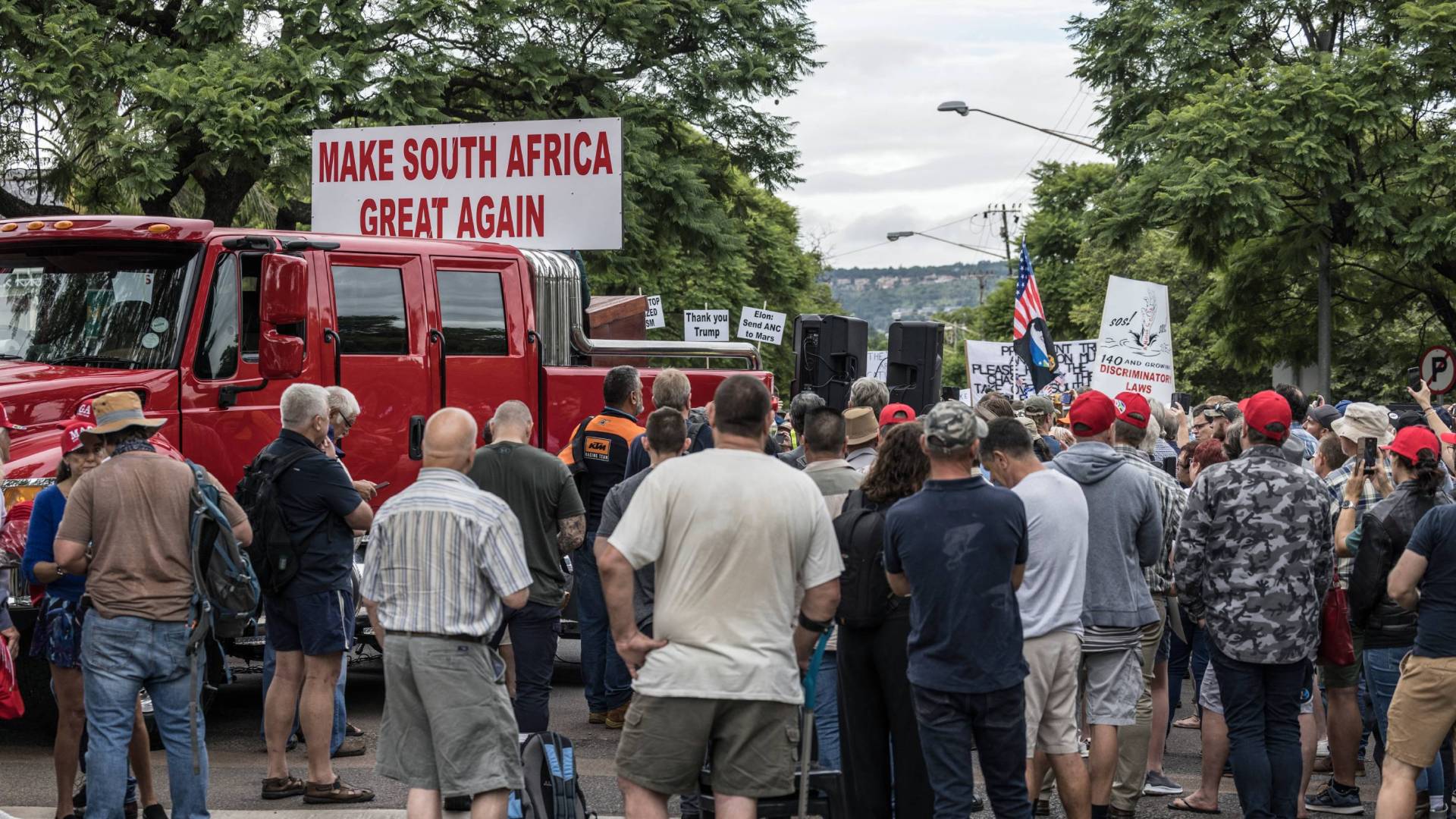
Last month’s directive said the US will “prioritize humanitarian relief, including admission and resettlement through the United States Refugee Admissions Program, for Afrikaners in South Africa who are victims of unjust racial discrimination.” Afrikaner equals white only—at a time when the US is turning away nonwhite refugees from all over the world.
Either because the executive order provoked criticism or maybe just out of confusion, Trump last Friday posted on Truth Social, “South Africa is being terrible, plus, to long time Farmers in the country. … Any Farmer (with family!) from South Africa, seeking to flee that country for reasons of safety, will be invited into the United States of America with a rapid pathway to Citizenship. This process will begin immediately!”
So which is it? White people only, or any farmer with family? Do white farmers have it worse than others? Do black South African farmers have it worse than Latin American immigrants who are now turned away at the border or who have, at best, a very slow path to citizenship? What about “coloured” farmers within South Africa’s complicated racial classification?
To begin answering these questions, we need to know more about South Africa and its northern neighbor Zimbabwe, a country previously known as Rhodesia that in 1965 declared independence from Britian and became a white-minority-governed territory. That declaration made Rhodesia and South Africa brothers in apartheid (racial segregation) and white dominance.
In April 1980, white rule ended when Robert Mugabe gained election as Zimbabwe’s prime minister. He ruled Zimbabwe for 37 years, first as prime minister and then as president from 1987 to 2017. He started off impressively but turned into a cruel dictator who ruined his country by going on a vendetta against white citizens. Mugabe allowed members of his elite to drive white employers and their black employees from farms, which cronies could then seize.
Mugabe died in September 2019. By then, not only white people but also many black people opposed him because he relentlessly persecuted critics, more so if they were black. As a despot, Mugabe was the opposite of Nelson Mandela and jealous of South Africa’s global icon.
The ghost of Mugabe’s legacy hangs over South Africa. For years, the white population has feared murderous, Mugabe-type land grabs in South Africa. Many Afrikaners—the descendants of Dutch settlers—grew up on warnings of the swart gevaar (the “black danger”). Presidents such as Mandela and Thabo Mbeki reassured them that black South Africans would not take retribution for apartheid past. Afrikaners never fully believed them.
In 2004, at a Christian conference in Pretoria, South Africa’s capital, Bennie Mostert stood up. An Afrikaner respected for his sincerity, he haltingly admitted that he didn’t trust black people and was scared of them. Mostert’s vulnerability was an act of reconciliation. Black people immediately reached out to him, embracing him. He spoke for many Afrikaners that day. South Africa’s history is full of profound mistrust, fear, and even hatred between racial groups.
Mandela—who attended a Methodist missionary school and read the Bible regularly during his 27 years of imprisonment—became president in 1994 and led the way to a democratic South Africa, yet the whirlwind of apartheid still has influence.
Race still largely configures communities. Black Africans constitute 81 percent of the population but own 4 percent of farmland, according to a 2017 land audit. White people constitute 7 percent of the population but own 72 percent of cultivatable land. The descendants of the Khoi—South Africa’s Indigenous population, referred to as “coloured”—are 8 percent of the population and own 15 percent of arable land.
A vocal black politician, Julius Malema of the Economic Freedom Fighters, is threatening white farmers, saying he and his followers will grab their land and kill them. Political parties that look to the white part of the electorate for votes based on their fears. Many perceive as weak the current president, Cyril Ramaphosa, and say he does not have the stomach to stand up to Malema.
Ramaphosa’s reluctance to act, along with the ever-present white fear of South Africa sliding into a Zimbabwe, has emboldened Afrikaner civic organizations such as AfriForum and Solidarity. They speak of brazen, violent attacks on farms that end in murder, sometimes preceded by torture.
In 2023, attacks on farms killed 49, AfriForum reports. Murders elsewhere in South Africa number around 27,000, resembling the statistics of a war zone, about seven times greater as a percentage of the population than in the United States.
The statistics suggest that statements about the particular targeting of white farmers—relayed by Trump and South African native Elon Musk—are overblown. In South Africa last month, Western Cape High Court judge Rosheni Allie ruled that “white genocide” in South Africa is “clearly imagined” and “not real.”
What are the deeper problems of South Africa, and can the United States do anything to help and not hurt?
Coming Wednesday: the personal perspective of Dennis Cruywagen, a South African journalist and the author of The Spiritual Mandela. On Thursday: consequences of President Trump’s executive order regarding South Africa.
Related