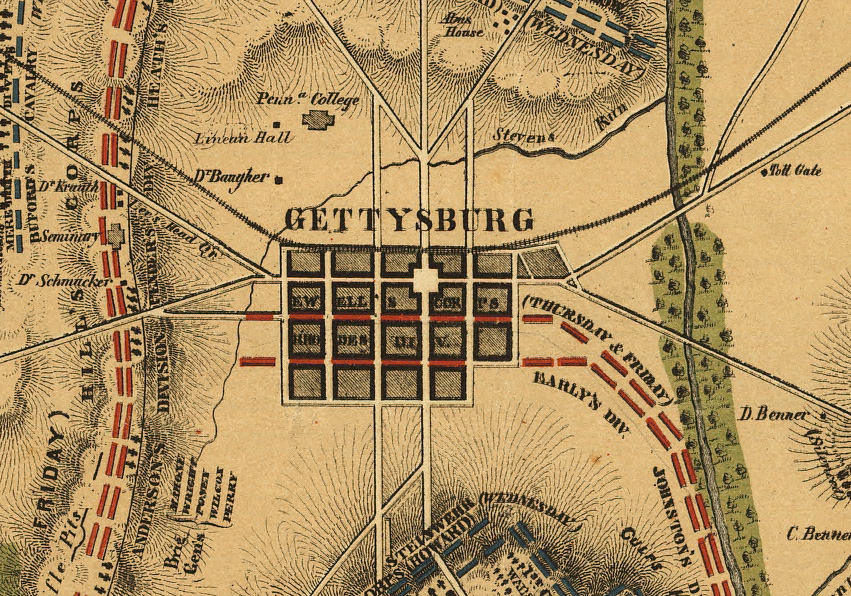
When Confederate soldiers bore down on Gettysburg, Pa., in 1863, a quiet seminary building atop a ridge was transformed—first into a Union lookout, then a field hospital for 600 wounded soldiers.
Now the structure that stood at the center of the Civil War's bloodiest and most pivotal battle is being transformed once again.
Today, the 150th anniversary of the Battle of Gettysburg, Schmucker Hall, located on the campus of Lutheran Theological Seminary at Gettysburg, reopens as a museum reflecting on the epic battle, the costly war and the complex role of faith.
Seminary Ridge Museum will take visitors into the minds of those who fought and explore their conflicting ideas of freedom.
Some 750,000 soldiers died during the Civil War and many of them carried and quoted from the Bible. But they read it in divergent ways that still reverberate in a polarized America.
"People have found it comfortable to find a way to think about the Civil War in terms of valor and heroism," said Barbara Franco, executive director of the museum. "We want to really look at these other parts of it—causes, consequences—and leave people thinking there's more to this than just the simple answers."
Visitors begin with a big view of the battlefields. They gaze out from the cupola where Union General John Buford viewed advancing Confederate brigades. They walk the creaking floors where wounded soldiers built back strength over a course of months. They ponder how soldiers suffered and how they made sense of it.
"Here were these young men, caught up in these events, and trying to be as faithful as they could be as good Christians," said Maria Erling, professor of church history at the seminary. "They were consoled by those faith commitments."
In interactive exhibits, visitors grapple with mid-19th century moral dilemmas: Would you harbor a fugitive slave if it meant you could go to prison? What motivated nurses, such as the Catholic Daughters of Charity, to tend to the injured on both sides?
Exhibits also showcase religious belongings of soldiers who fought at Gettysburg. Example: a 3-inch-by-2-inch Bible carried by Jefferson Coates. A member of Wisconsin's 7th Regiment and recipient of the Medal of Honor, he was blinded on the Gettysburg battlefield but survived.
"The fact that he carried this Bible with him tells me a lot about him and his purpose," said Coates' great-granddaughter, Jean Smith of Kansas City, who donated the Bible to the seminary. "If there hadn't been some sort of a religious context for him, he wouldn't have carried it."
The museum, which cost $15 million to develop, popularizes new insights from recent scholarship, including how clergy on both sides were physically attacked for taking unpopular stands on slavery.
"It's really a war of words that precedes the war of sabers and guns," Franco said. "The slavery debate is very influenced by biblical passages to support one side or the other."
As it turned out, both sides came to interpret Scripture in ways that would support their views on slavery, with literal interpretations hardening in the South and figurative ones gaining favor in the North.
Those interpretive principles still hold sway, Erling added, as the regions differ on social issues from women's ordination to homosexuality.
"The North had its own agenda, its own reasons for reading the Bible the way it did," Erling said. "And the South had its own reasons for reading the Bible the way it did. … That's how we have a Bible Belt."