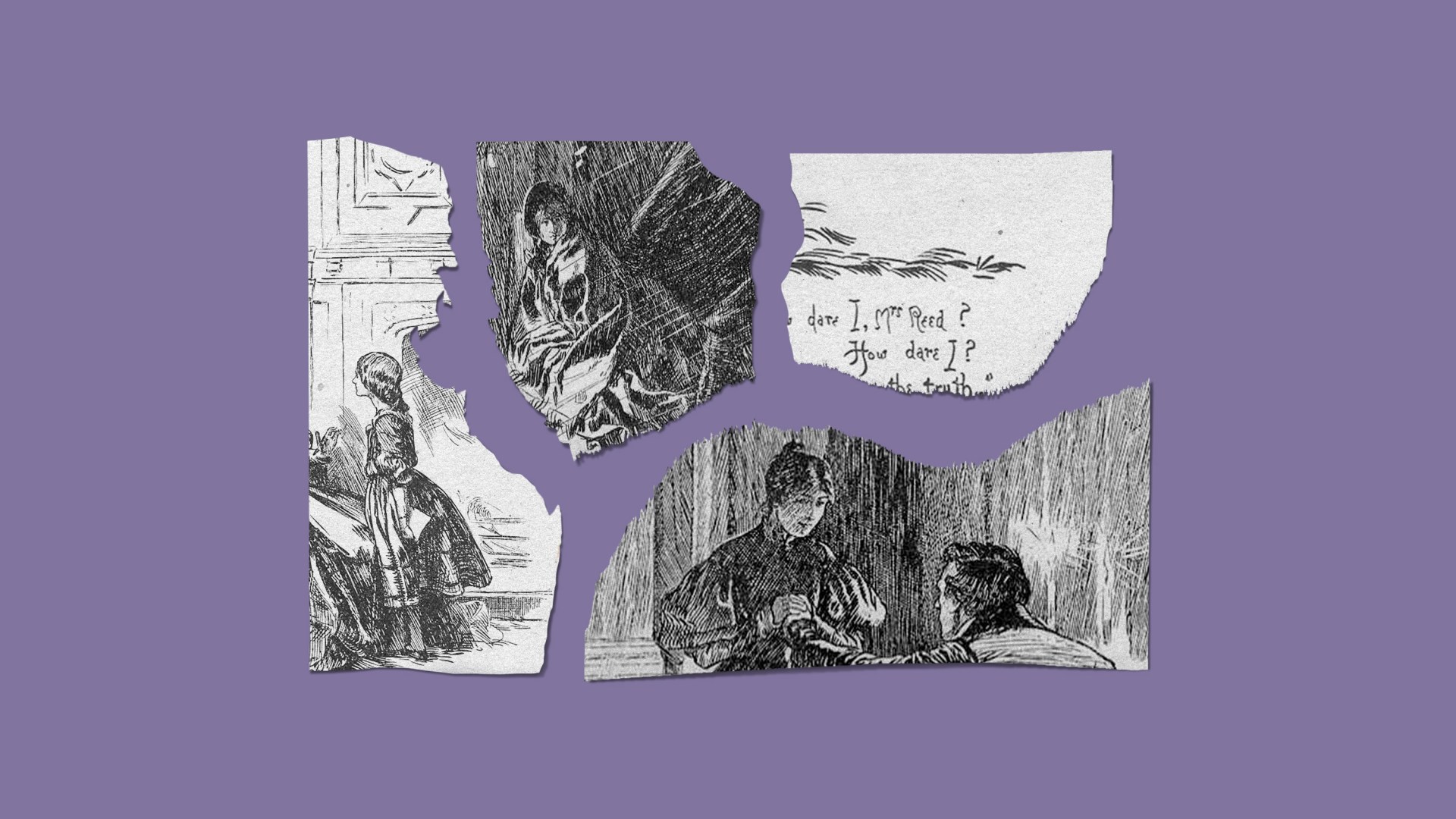
I did not know at that first meeting that Jane Eyre would be my friend for life.
It was in the teen section of the public library that I saw Charlotte Brontë’s 1847 novel on a recommended reading list. Classic fiction, suggested the flyer, could improve my vocabulary and help me score high on the verbal SAT. I found the book and checked it out.
At home, I got out a dictionary and steno notebook for new words and turned to the opening chapter. By the end of the first page, I had made two discoveries. One was that moreen wasn’t in my blue paperback American Heritage Dictionary. The second was that Jane and I were alike: undersized bookworms beset by rain.
Jane is self-conscious about her plain looks and small size, which she calls “physical inferiority.” I was a small kid myself, always outhit in tetherball and blocked in basketball and overcome in any one-to-one contest on the soccer field. My distinctly Japanese features, though unmentioned for the most part, seemed a barrier to easy social interactions with my classmates.
I lived in Oregon, and though I longed to ride the bus to school, it had been my lot always to walk, often alone and in the rain. I occupied myself by watching my sneakers slowly get soaked. Jane’s comings and goings, gains and losses, cares and questions, were strewn about with rain in the same way mine were.
Wet socks were only part of the problem. Constant rain, I felt, laid bare one’s native loneliness. I intuitively understood Jane’s love of books—her pastime was as existential as it was recreational. I had been searching pages for answers my whole life, treading those damp roads, when Jane met me and invited me in.
Jane Eyre is an orphan. Her parents die just after their first wedding anniversary. Uncle Reed, her mom’s wealthy brother, takes baby Jane into his home. He dies too. Aunt Reed reluctantly cares for her niece, often excluding her from family life. This domestic arrangement might be called kinship adoption. But since Jane’s situation has no legal permanency, it might more technically be kinship placement.
When kids lose their parents, other relatives are often the first to look after them. Both of my paternal grandparents had kinship placements as children. Eighteen months after my grandmother was born, right before the First World War, her mother died. Her dad took her to Japan and left her with his dead wife’s family. When my grandfather was 12, he crossed the Pacific from southern Japan unaccompanied. He disembarked in Seattle, where his aunt and uncle met him and raised him as their own.
Sometimes, no relatives are available, as was the case for my children when they first entered foster care. Kinship placement had failed. Social workers had no choice but to place them outside the family, first in one home, then a second, then a third. My husband and I were their fourth placement before we became their adoptive parents.
Ten years later, in the book, Mrs. Reed sends Jane to a boarding school. This means that by age 10, Jane has had three distinct external placements: her uncle, her aunt, and the charity school. (I suppose it’s debatable whether the uncle and the aunt qualify as different placements. Given the tenderness of one and the indifference of the other, I think it counts.)
Jane adapts to the school’s meager conditions, becoming a capable student and then a teacher. At 18, she takes a new job as a governess to a young girl and moves to Thornfield Hall, a country house owned by the wealthy Mr. Rochester. She’s the same age that foster kids are, if they haven’t been adopted, when they “age out of the system.”
Good fiction embodies virtue in two ways, writes literature professor Karen Swallow Prior: by offering “images of virtue in action,” and by providing “vicarious practice in exercising virtue.” For over 30 years, Jane Eyre has given me both.
When Jane refuses to become Mr. Rochester’s mistress, she models civic duty and personal integrity. By her gentle, faithful kindness to the lonely residents of Thornfield, she displays the fruit of the Spirit. When she forgives her Aunt Reed for maliciously preventing her from being adopted by another uncle, she shows the costly beauty of Christlikeness. As she patiently endures her loneliness and longing for family, she exemplifies perseverance and hope.
Jane’s example is noble, but it doesn’t quite explain her hold over me. I have read more edifying books than Jane Eyre for which I have no lasting love. What is so special about her?
I think it’s that Jane manages to befriend her reader. She goes from a heart-hungry, desperate little creature to a self-respecting young woman who knows what it is to be loved. Somehow her reader partakes in the process. That’s what friendship is all about, writes priest Henri Nouwen: “giving to each other the gift of our Belovedness.”
I realize that belovedness is a squishy term. But no other word so effectively describes the conviction that comes from being cherished by the king of the universe. Belovedness, writes Nouwen, is our “chosenness in God,” the personal quality of being seen by him “as precious, as of infinite beauty, as of eternal value.” In Jane Eyre, belovedness is “an inward treasure,” an “indestructible gem” that is as “pure as when it left the Creator to inspire the creature.”
Jane’s belovedness is apparent not in increasing self-regard but in confident self-giving. She spends her affection on her dying school friend Helen, her orphaned pupil Adele, her old nurse Bessie, the lonely housekeeper Mrs. Fairfax, and her cousins Diana and Mary. She loves even and especially people who don’t deserve it, including Mr. Rochester, Mrs. Reed, and her cousins. Each does her significant wrong; each receives Jane’s “full and free forgiveness.”


Yet Jane firmly resists being treated like a means to an end. Mr. Rochester wants her to run away with him; one cousin insists she marry him against her better judgment. Her repudiation of both echoes Jesus’ rebuke to Peter: “Get behind me, Satan!” (Mark 8:33). She listens to God’s voice over other influences. “Do as I do,” Jane tells Mr. Rochester. “Trust in God and yourself.”
Jane may not be much to look at, but her belovedness is irresistible. Hardly anyone is untouched by its healing power. Mr. Rochester is rich and capable, yet he is bowled over by the treasure that is Jane Eyre. Her presence, he says, is “warm and steady”; she would be “grave and quiet [even] at the mouth of hell.” He admires her open-hearted listening. And he delights in her empathy, which he calls “the suffering mother of love,” whose “anguish is the very natal pang of the divine passion.”
Belovedness brings healing. Belovedness is the source of virtue. I think of Jane not as a Christ figure but as a little Christ, someone who has become like him, offers her transformed self to others, and gives her readers vicarious practice in knowing their own belovedness.
Given her history, Jane’s ability to love others and to feel loved herself is extraordinary. The orphans I know, the ones I’m descended from and the ones I’ve raised, have much more trouble with what are vernacularly known as abandonment issues. The clinical term is disordered attachment.
I’ve never liked the word attachment. It seems much too sterile for the intricate way we come to know our preciousness and thereby affirm it in others. Attachment arises from our first and irreplaceable bond with our mother. Any injury to that bond endangers all subsequent relationships.
For my children, poor attachment has been catastrophic. Their belovedness struggles are like lifelong disabilities with no easy remedies. This is heartbreaking but not surprising. Foster kids, even when they have been adopted, remain very vulnerable. They are physically and mentally ill, have low-quality friendships, quit school, commit crimes, and become homeless at much higher rates than other children.


Absent belovedness, children internalize patterns of disconnection that stay with them their whole lives, passed down to their offspring through family dynamics and even DNA. Medical research shows that children feel the attachment stress of their ancestors, even “to the third and fourth generation” (Num. 14:18). I am no orphan, yet disordered attachment within my family meant that I inherited a chronic unease about whether I belong and how lovable I am. Getting a good SAT score was one way to make up the difference.
Jane has every right to feel shame over her broken beginnings and familial rejection, her essential homelessness. She has good reason to think she is unlovable after being duped by a lonely nobleman and coveted as a useful tool by an ambitious, thwarted scholar adventurer. But she does not. Somewhere along the line, Jane has been transformed by the pure love of God.
My three young adult children are very close in age. Between them, they are 18 on average, the same as Jane. I wish Jane could step out of the pages and tell me just how she achieved such secure attachment. But she offers no formula—only her story and her friendship.
On the first Sunday in Advent several years ago, I was late to church. Our children were seriously mentally ill, and we were all in turmoil. Our house wasn’t clean, we weren’t having nice family dinners, and we had no Christmas plans. We also weren’t getting places on time.
I sent the others ahead and walked the long way around, inhaling the damp air and lifting my hood against specks of rain. I was full of dark shame over what seemed like so much weakness and family failure. I wasn’t sure I was up for church at all—the sweetness of Christmas was meant for other people, not for my children with all their losses and certainly not for me.
I slipped between the outer wooden doors into the church vestibule, which was warmer than outside but unlit and dim. I brushed my hood back and stepped forward to pull open the door to the back of the sanctuary.

A tiny bright gleam shot out at me from the Advent candle that had just been lit at the front. Far away it seemed, yet sharp. The single point of light traveled true, as through a long shadow, direct to my heart.
Jane spoke to me then, not in words but in my mind’s eye. She was there, drenched and lost and near death on a rainy night, suddenly seeing a tiny light flicker in the distance and seized by an uncertain hope: “It may be a candle in a house,” she thinks, and struggles on.
The proliferation of orphan narratives in Victorian fiction, writes scholar Roger Lundin, was a way authors like Charlotte Brontë explored the meaning of loneliness, both personal and corporate. Fictional orphans respond to the possibility that we have been abandoned by a God who is “silent, distant, or dead.”
Jane attests that there is no abandonment. The tiny flame leads her not only to shelter but also to belonging. The house is that of relatives she didn’t know existed. She finds that she is personally precious to the one who sets the forsaken in families (Ps. 68:6). In her most desperate moments, God offers loving guidance:
I had risen to my knees to pray for Mr. Rochester. Looking up, I, with tear-dimmed eyes, saw the mighty milky-way. Remembering what it was—what countless systems there swept space like a soft trace of light—I felt the might and strength of God. Sure was I of His efficiency to save what He had made; convinced I grew that neither earth should perish, nor one of the souls it treasured. I turned my prayer to thanksgiving; the Source of Life was also the Saviour of spirits. Mr. Rochester was safe; he was God’s, and by God would he be guarded.
Since our first meeting those many years ago, my story has resembled Jane’s in this: I am not abandoned. The Lord is near, leading me home to his household. Somewhere along the line, I have come into belovedness. It is all I have to offer my children, who seem so very lost. I have no formula. I must entrust them to the Saviour of spirits. By him they will be guarded.
I moved down the aisle toward the candle and, finding the pew with my family, sat down among the worshipers.
Wendy Kiyomi is an adoptive parent, scientist, and writer in Tacoma, Washington, whose work on faith, adoption, and friendship has also appeared in Plough Quarterly, Image, Mockingbird, and The Englewood Review of Books. She is a 2023 winner of the Zenger Prize.