“Only one who has mastered a tradition has a right to attempt to add to it or to rebel against it.” This famous line from Chaim Potok’s novel My Name Is Asher Lev captures the fluency required to speak meaningfully into or against a tradition. A tradition must be known, experienced, and even loved before it can be properly judged. Without that depth of understanding, critiques and contributions tend to ring hollow or even false.

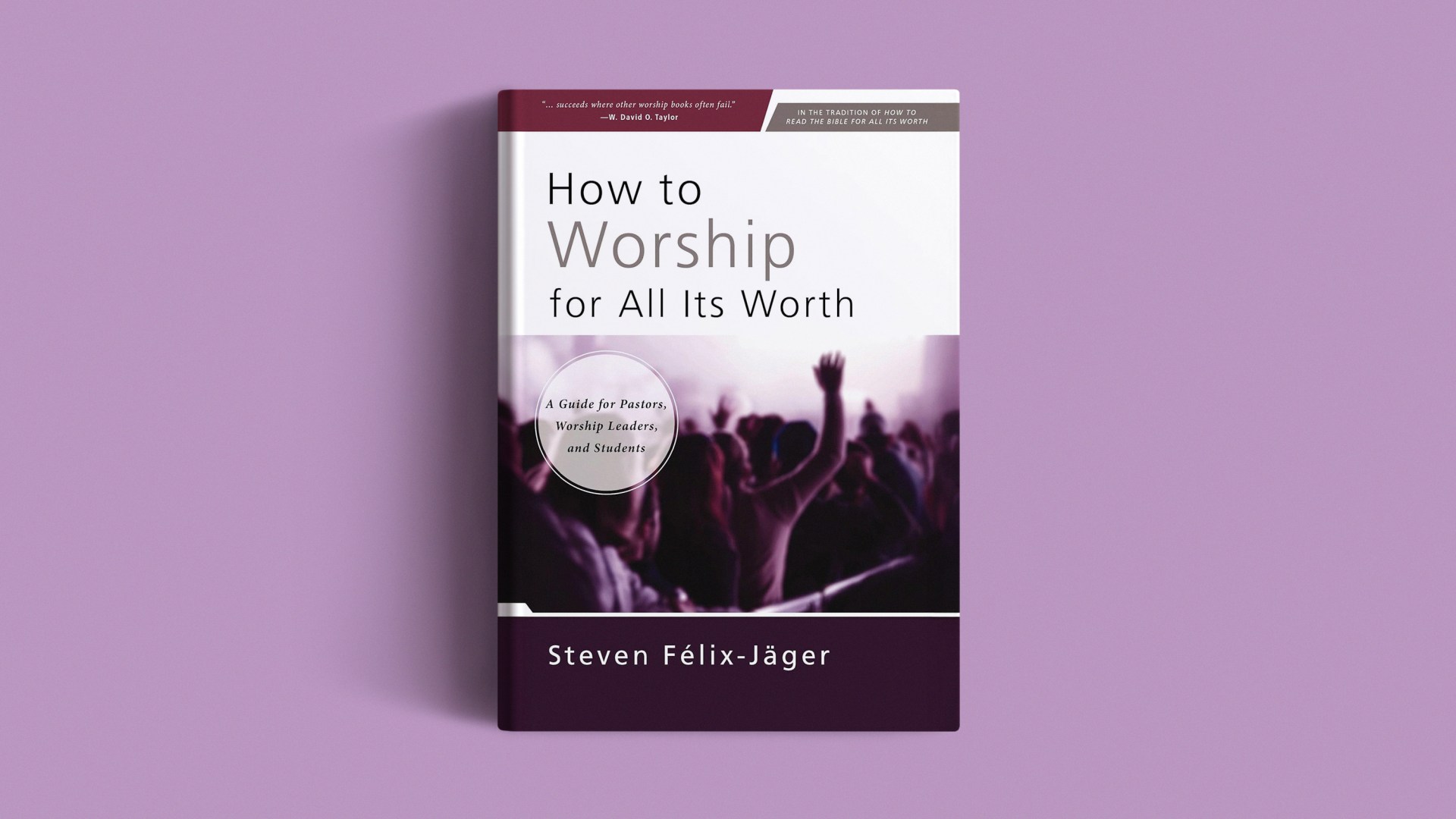
How to Worship for All Its Worth: A Guide for Pastors, Worship Leaders, and Students
HarperCollins Children's Books
320 pages
While few of us can hope to truly master even one Christian tradition, Steven Félix-Jäger’s How to Worship for All Its Worth helps readers grow in both understanding and appreciation for the ways different traditions worship God.
Worship is a vast and sprawling subject, and Félix-Jäger wisely narrows his focus to congregational worship and music. Yet within that frame, he offers a rich, accessible guide for encountering the breadth of worship practices across the church.
As an artist, scholar, minister, and educator, Félix-Jäger is fluent in the fields (biblical studies, philosophy, practical theology, music theory, and more) required to seriously and generously engage with the wide range of authentic Christian worship that exists today. Whether assessing the theological merits of the chorus of a contemporary song or explaining Immanuel Kant’s perspective on aesthetics, Félix-Jäger proves himself a faithful guide. He’s the kind of scholar-practitioner who is uniquely qualified to train the reader in how to make good judgments about congregational worship.
This kind of judgment, he makes abundantly clear, is not a bad thing. To judge in this sense is to critically assess something to determine its value or significance.
Learning how to make good judgments about worship is ultimately what this book is for. It’s a kind of training manual to help Christians, worship leaders, and pastors critically assess different aspects of worship for different worshiping communities so they can help God’s people worship.
The book is divided into two parts. The first outlines four principles for how to faithfully design and evaluate worship. The second applies these principles in five case studies, each focusing on a representative church from the Reformed, Pentecostal, Black gospel, evangelical, and charismatic Catholic traditions, respectively.
The first principle is about how to use biblical judgment to assess fidelity to the Scriptures in worship. Here, Félix-Jäger highlights the communal dimension of biblical interpretation. “While every [church] tradition reads the whole Bible, each tradition comes at the text from a different vantage point,” he notes. “Traditions implicitly apply the insights of certain texts over others and receive biblical texts differently depending on their context.”
These differing approaches to the Scripture make for differing worship practices too. For instance, the Reformed Presbyterian Church of North America relies on the “regulative principle,” which holds that worship must be based on explicit commands or examples in Scripture. That’s why these churches they only sing psalms without musical accompaniment. This principle also explains the prominence of the biblical theme of liberation in the Black gospel tradition.


The worship in these traditions may not be your cup of tea—and fair enough. But not preferring or perhaps even feeling out of place with the style and substance of a worship service isn’t enough to call it unbiblical.
To fairly judge a congregation’s worship in terms of scriptural faithfulness, then, we can’t use our own church as the standard. Some differences in worship are wrong, bad, or heretical—but many are not. If we can understand each tradition’s worship habits in light of its relationship to Scripture, we’ll often be able to honor and appreciate styles of worship we do not prefer. This is a key insight Félix-Jäger develops in all four principles.
The second principle is about using aesthetic judgment to assess the form and fit of worship. Here Félix-Jäger surveys some of the philosophical foundations of art and touches on the formal elements of music, including rhythm, pitch, and timbre. With this, he gives the reader language to talk about the style and substance of worship practices and whether they fit a particular context.
Just as it doesn’t make sense to critique punk because it’s not jazz, it doesn’t make sense to critique a Hillsong anthem because it’s not a traditional hymn. Aesthetic judgment is about assessing forms of worship on their own terms and in the contexts where they’re used.
Next is theological judgment. Here, Félix-Jäger develops Gavin Ortlund’s idea of “theological triage,” which orders theological beliefs according to their significance for the Christian faith. Pinning down what is primary, secondary, and tertiary is often messy in practice, but these are helpful categories for determining which truths should be centered in worship (such as God’s Trinitarian nature) and which are tertiary and should be avoided (like particular views on eschatology).
The last principle is about pastoral judgment for congregational worship. Félix-Jäger discusses the pastoral work of the worship leader and the formative power of worship music to shape individuals and communities—and it’s here that he gets to the heart of this project.
Why does biblical fidelity matter? Why is aesthetic fit important? Why does theological emphasis deserve careful planning? Because worship plays a profoundly pastoral function in shaping a congregation’s understanding of and relationship with God.


In the latter half of How to Worship, Félix-Jäger puts his theory to work, offering ethnographical studies of representative churches from a range of traditions.
Each evaluation follows the same pattern. Drawing on historical research, interviews with church leaders and members, and participation in the worship services, Félix-Jäger describes the history and distinctives of the congregation in question as well as its denomination or tradition. He also outlines the church’s geographic and cultural context along with its architecture, then evaluates all its elements of worship, from the type of instruments played and song selection to the style of the sermon and the overall vibe of the service.
As he does this, he renders biblical, theological, aesthetic, and pastoral judgments about each congregation’s worship, ending with commendations and recommendations. Together, the five case studies give a sense of how to judge worship in a structured and charitable way. Combined with a careful and thoughtful writing style, this practical demonstration helps make the book successful in its aims.
Still, let me close with three judgments of my own. The first is a small and mostly stylistic quibble. Throughout the book, certain words and phrases are bolded and defined. Definitions are helpful for a book like this, but I found myself distracted by the editorial decision to define certain terms and not others. Why “Southern Baptist Convention” but not “Roman Catholic Church”? Why “TULIP” but not “Charismatic Renewal Movement”? Why “Bapticostal” but not “born again”? The execution of this feature didn’t quite make sense in a book so defined by its engagement with a wide range of Christian traditions.
Second, Félix-Jäger has little attention for congregations with a more high-church mode of worshiping—all the smells and bells, so to speak. He does go beyond the Protestant world but chooses to focus on a narrow stream of charismatic Roman Catholicism, which has a good deal of overlap with Pentecostals and Evangelicals. Why not go all-in and evaluate a traditional Catholic parish?


I understand that Félix-Jäger couldn’t be comprehensive in his scope, and I’m biased as a priest at an Anglican church. But many Christians—including many Protestants and even many evangelicals—worship in more liturgical and sacramental churches. More attention to this type of worship would’ve presented a clearer picture of the global church and a more challenging text case for many readers seeking to evaluate worship according to Scripture, aesthetics, theology, and pastoral concerns rather than mere preference.
Finally, though he acknowledges that his descriptions are not comprehensive and are shaped by “cultural insiders,” I was often puzzled by the distinctions Félix-Jäger drew. More than once when he identified a supposed difference, I found myself wondering what tradition would not consider it important.
For instance, he writes that an emphasis on the “now and not yet” reality of the kingdom is a distinguishing feature of Pentecostals. While that theme is certainly central in Pentecostal worship, this kind of inaugurated eschatology is also a major emphasis in many other traditions. In fact, the modern articulation of the “already/not yet” framework is rooted in the work of Reformed and evangelical theologians such as Geerhardus Vos and George E. Ladd. Pentecostals may express this theme in characteristic ways, but it hardly makes them distinct.
Despite these weaknesses, How to Worship for All Its Worth has much to offer as a toolbox for worship practitioners. Its most important tool is a shared vocabulary for talking about worship in ways that rise above personal preference or inherited prejudice. This common language can foster unity and mutual appreciation within the body of Christ.
I found especially helpful Félix-Jäger’s treatment of flow, defined as “the progression of a worship service, where each element of worship naturally leads to the next.” This is a simple but useful idea that draws attention to how the elements of worship join a narrative and emotional arc that facilitates engagement, encounter, and ultimately transformation—or fails to do so. Churches rooted in more liturgical or sacramental traditions, like mine, may need to supplement this approach to service design with resources tailored to their own dynamics, but the core framework is widely applicable and quite helpful.
The book also equips us pastors and worship leaders who plan or lead services to bolster our own traditions and build up our local churches. It would be especially valuable at the beginning of a new pastor’s tenure or during a season when a church is seeking to become more hospitable to newcomers. But in any season, this is a worthwhile guide to shepherding God’s people into his presence more faithfully. Is there any task more central to the church’s life than this?
Kevin Antlitz is a writer and an Anglican priest in Pittsburgh. He previously pastored in Washington, DC, and did campus ministry at Princeton University.