The night before my flight to meet Daniel Nayeri, I happened to catch a lecture by Paul Kingsnorth. On the surface, the two writers have little in common. Daniel was born in Iran, and Paul lives in Ireland. Daniel primarily writes fiction for younger audiences; Paul writes essays, and the few novels he has published are decidedly not kid friendly. Yet in the 36 hours I would spend with one author, I couldn’t stop thinking about what the other had said.
I drove from my Louisville home to Port Royal, Kentucky, to hear Kingsnorth’s lecture, held in one of the only buildings in the small rural town that could accommodate such a large audience—the local Baptist church. Speaking from behind the pulpit, Kingsnorth made a startling claim: The hearths have gone out.
The hearth, Kingsnorth elaborated, is what makes a house a home. It’s a symbol of warmth and community, he writes in Against the Machine, because “staring into the smoky fire with family or neighbours was the genesis of the folk tale and folk song which tied the culture together.” Today, the metaphorical flames that once warmed our living rooms have been replaced by the “digital fires” of smartphones and social media platforms. According to Kingsnorth, when digital hearths flicker into existence, home devolves into a dormitory—stripped of activity and personality, it becomes the place you sleep when you’re not at work.
Kingsnorth’s lecture came at just the right time for me. I’ve been married for a year and a half. My wife and I hope to have children soon, Lord willing. I want our house to be a home, not just a dorm. But how do we keep our hearth burning?
When I got on the plane to Charlotte, North Carolina, to meet Daniel Nayeri, I was traveling in search of warmth.
Daniel and his 13-year-old son picked up my photographer friend and me from the airport in a big ol’ Ram truck. A Texan by birth, I was pleased. But not long after we piled in, Daniel informed us that the truck belongs to his wife. He drives the only vehicle cooler—a motorcycle.
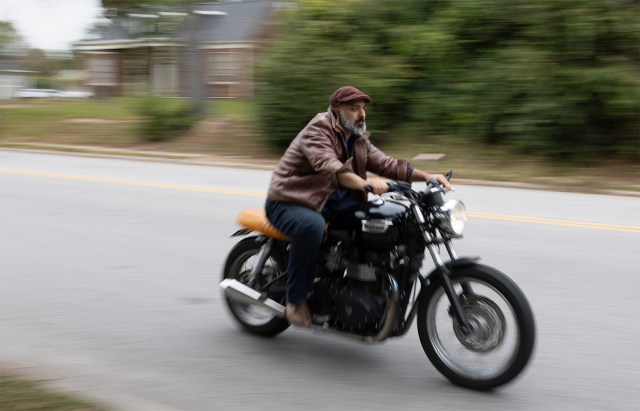 Image courtesy of Leandro Lozada
When we first made plans to profile the novelist, I imagined my friend and I would rent a hotel room for a night. Daniel insisted we stay with him. His house in Rock Hill, South Carolina, is sky blue with copper gutters that adorn it like jewelry. The living room boasts a shelf with dozens of carefully selected picture books. Art hangs on every wall alongside shadow boxes of rocks, shells, and other treasures the family pockets on vacations.
Daniel and his wife, Alexandra, have used their extra space well, a talent they learned by living in much smaller quarters in New York City. Daniel found good work there as a literary agent and then an editor. But after 80-hour weeks in the publishing industry burned him out, he quit and worked as a pastry chef. The (slightly) more reasonable hours and tactile labor were good for Daniel. He started writing again. He knew if he went back to his apartment after early-morning shifts, he would sleep or get distracted, so he sat on park benches and subways instead, typing away on his iPhone. Eventually, he’d write four novellas by this method, compiled into the 2011 collection Straw House, Wood House, Brick House, Blow.
The book is creative, experimental, and strange, each novella set within a different genre: Western, dystopian, hard-boiled detective, and fantasy. Daniel’s love of stories is apparent on every page. Four years after the collection, he published a volume about the craft of writing, How to Tell a Story. The interactive book operates like a game of Mad Libs, offering scenarios for readers to fill in with characters like Dapper Fox, Evil Wizard, and Robot and settings like Coliseum, Heaven, and Mystery Cave, teaching motivation, conflict, and resolution along the way.


After giving me a quick tour of the home, Daniel got to work in the kitchen, with its ginormous fridge and gleaming silver island. (Because of his culinary background, a fitted-out workspace is nonnegotiable. He drinks out of deli containers like characters from The Bear.) That night, we feasted on Korean food—kalbi (beef ribs) marinated for hours before Daniel browned them in the oven and served them with egg-yolk-anointed white rice and sides of kimchi. As we did before every meal, we held hands and prayed.
Making conversation with Daniel and his family is easy. Daniel is a talker. He compares American politics to the theatrical stylings of World Wrestling Entertainment and waxes eloquent about his affinity for the Apostles’ Creed. Alexandra (who has authored two picture books) asks the questions. She asks us what we think heaven will be like. She asks about the “top ten things” to know about me (I think I got to five). She asks which books we’d bring to a desert island.
As wonderful as they are to live in, whole homes rarely make for good literature, and Daniel’s characters mostly grow up in dysfunction. His newest book, The Teacher of Nomad Land: A World War II Story, follows Babak and Sana, two orphaned siblings living in Iran during World War II, with Russia and the UK controlling either side of the nation’s border. The siblings fall in with a group of nomads and, to make himself useful, Babak shoulders a chalkboard and starts teaching. The Teacher of Nomad Land declares the value of learning in times of strife. Last year, it won the National Book Award for Young People’s Literature, and CT’s editor at large, Russell Moore, named the book one of his favorites of 2025.
The next morning, after a breakfast of homemade cherry scones and clotted cream, Daniel showed me his dedicated writing space—a charming backyard shed with mauve walls and doors the same hue of pink as the Sour Patch Kids gum he offered me. The shed has plenty of windows but no internet connection. Daniel has long given up writing on his iPhone. Now he drafts his books by hand in a journal. In fact, he’s abandoned smartphones entirely and uses one of the “dumbphone” alternatives.


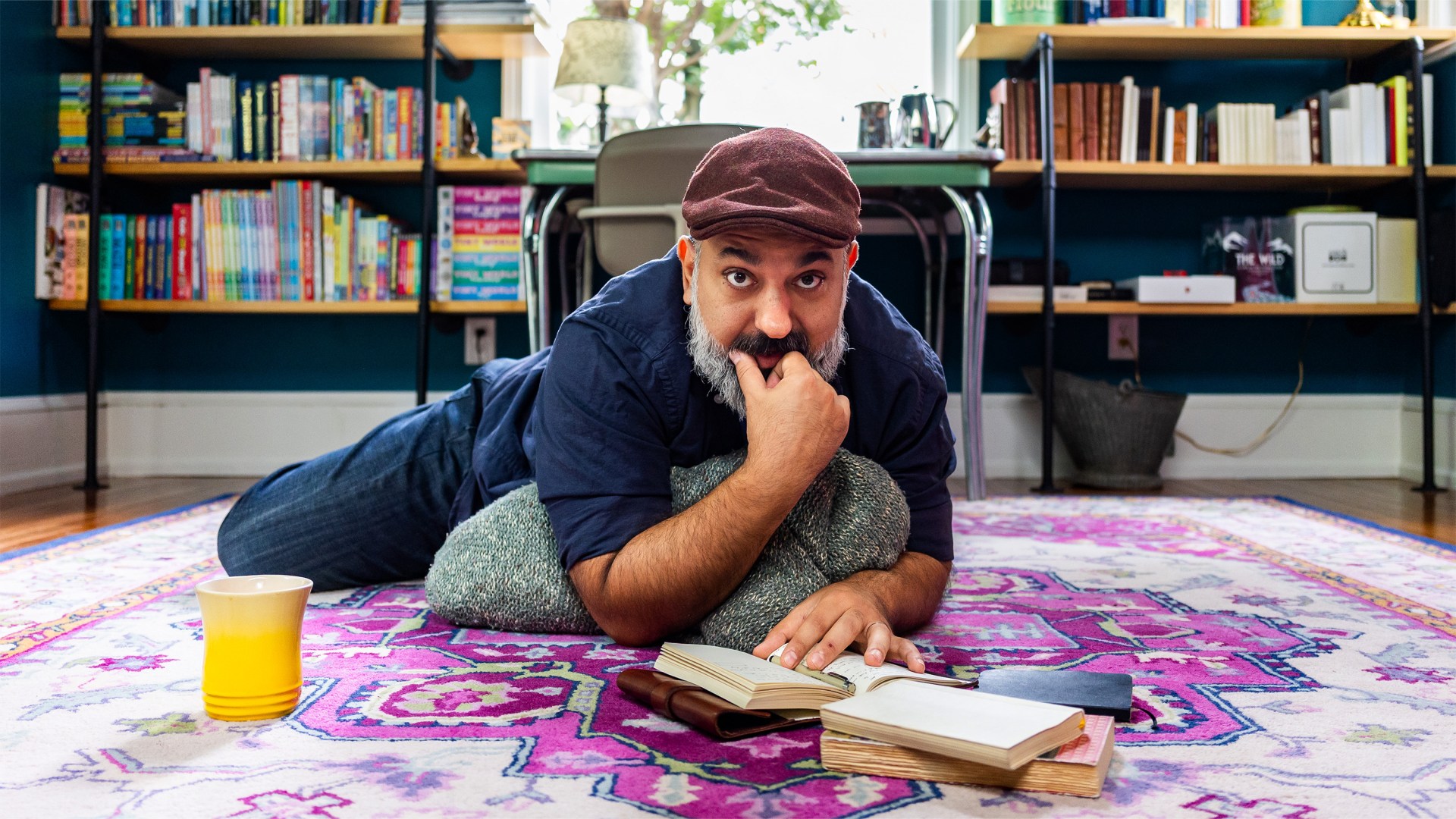
The shed contains a rug, a few chairs, and plenty of books. Juggling sticks sit ready at a desk in case Daniel gets stuck and needs something to do with his hands. That said, Daniel doesn’t usually write at his desk. He writes on the floor.
All writers have their rituals, and this is his—stomach down, a pillow propping up his chest, one leg splayed out behind him. He arranges journals and reference books on the floor just in front of his face. On a typical day, he enters his pink-and-purple shed in the morning, prostrates himself, and writes until lunch, doodling when he gets stuck.
“Iranians work on the rug,” he told me. “I prefer the ground. I’ve always preferred the ground.”
It’s the perfect posture for an author of children’s books and middle-grade fiction. Chairs and desks are the necessities of old age; the floor is the domain of the young. It’s playful. So is Daniel. He talks in silly voices and laughs at puns. Yet as with any kids’ book worth its muster, the playfulness comes with profundity.
After Daniel gets up from the floor, he shows me the journal in which he handwrote the original draft of Everything Sad Is Untrue, his most well-known book. The genre-bending memoir, written from the perspective of Daniel’s 12-year-old self, tells the true story of his family fleeing Iran after his mother’s conversion to Christianity. The title comes from J. R. R. Tolkien’s The Return of the King, when Samwise Gamgee wakes to see the resurrected Gandalf and asks hopefully, “Is everything sad going to come untrue?”

Even with its unapologetic portrayal of faith, the book received high praise from secular publications, including NPR and The Washington Post. “‘Everything Sad’ is a modern masterpiece—as epic as the ‘Iliad’ and ‘Shahnameh,’ and as heartwarming as ‘Charlotte’s Web,’” read the New York Times review.
Tucked into the pages of the writing journal like a bookmark sits a piece of paper printed with a famous quote from The Brothers Karamazov. I recognize it as one of the epigraphs in Everything Sad.
I believe like a child that suffering will be healed and made up for, that all the humiliating absurdity of human contradictions will vanish like a pitiful mirage, like the despicable fabrication of the impotent and infinitely small Euclidean mind of man, that in the world’s finale, at the moment of eternal harmony, something so precious will come to pass that it will suffice for all hearts, for the comforting of all resentments, for the atonement of all the crimes of humanity, of all the blood they’ve shed; that it will make it not only possible to forgive but to justify all that has happened.
Here, agnostic Ivan Karamazov is embroiled in a painful conversation with his brother Alyosha, a steadfast believer. They argue over how God can exist given the world’s suffering. Eventually, Ivan concedes that he believes something profound will appear at the end of time to make sense of all the bloodshed.
The passage has special significance for Daniel. For the two decades he lived in New York City, he attended Tim Keller’s Redeemer Presbyterian Church. On the Sunday after 9/11, Redeemer printed the famous passage from Fyodor Dostoevsky in the bulletin. Daniel cut out the quote with scissors and kept the piece of history. He still has it memorized.
Like a kid at show-and-tell, Daniel displays another of his books. This one, sadly, is now out of print. The Most Dangerous Book: An Illustrated Introduction to Archery really does recount the history of archery—but it’s also a toy that “turn[s] into a bow and shoot[s] paper ammunition.” As the back cover explains, this is “a weapon of mass instruction.” “What about ideas that are less bad?” Daniel asks in an introduction that reads like a manifesto. “Nothing ideas. Boring ones. Tepid ones. How are those dangerous? Reader, believe me, those are the most dangerous.” Boredom is more than a nuisance for Daniel; it’s a threat.
Fear of boredom fits Daniel as naturally as the leather jacket he wears while riding his motorcycle up and down the street for us to take pictures. When Daniel was my age—late 20s—he “wanted nothing more than to be a travel writer,” he said, journeying to exotic locations and penning pieces for Outside Magazine and National Geographic. He wanted to be the Anthony Bourdain of desserts, seeking out the best confections, smiling at the camera. But he doesn’t ride much anymore. When he’s not traveling for work, he’s content to stay home.
The man who longed to live out of a suitcase has become a homebody. He has his fitted-out kitchen, a room full of board games, a space for his son’s homeschooling, his writing shed. Why leave?
In his what-makes-a-house-a-home criteria, Kingsnorth listed “the coming together of man and woman in partnership,” “the education of children,” the “cooking, storing, and eating of food,” and the limiting of technological distractions. Daniel and his family check the boxes of Kingsnorth’s rubric, though they aren’t Luddites. Alexandra has an iPhone, and their son has a Nintendo Switch, but nobody texted during meals. They’ve learned how to keep the hearth burning without completely eschewing technology.
Before my friend and I left, Daniel pulled out puff pastry, spinach, and mushrooms to make lunch. His son put on music full of synth and drums. Someone tossed me an apron. As I helped cook, dancing around the kitchen with Daniel and his family, I was invited into their circle of warmth.
Really, I already had been invited into it, before I even bought my plane ticket. Anyone who has read Daniel’s writing can feel the heat radiating from his words, whether he tapped them into an iPhone in New York or scrawled them in a leather journal in South Carolina. With Daniel’s characters, I’ve traveled the 11th-century Silk Road and navigated a bus ride to school in Edmond, Oklahoma. But the fuel propelling his adventures has always been the desire for home.


Through both his work and our weekend together, Daniel taught me that making a house a home doesn’t mean insularity or avoidance of the world. He’s curious and free-spirited. But when he’s under the copper gutters, he turns his attention not toward a screen but instead toward his family, the blank page, or the mound of flour in front of him. In fact, it’s his rootedness that allows him to write such great adventures. As Kingsnorth observes, sitting in a smoky living room can be the precondition for the best folk tales and songs. And when it comes to pulling chairs around the coals, Daniel isn’t selfish. He extends hospitality physically with his scones and figuratively with his stories.
There’s something else essential to hearth-centered homes—something Kingsnorth, though himself a Christian, didn’t mention in his lecture. Daniel and his family are believers. Along with two millennia of Christians, they believe in God the Father Almighty, in Jesus Christ our Lord, in the Holy Spirit. With Dostoevsky’s characters, they believe like children that all the suffering and absurdity of this life will be justified. And with Samwise Gamgee, they believe that all the sad things will come untrue. That’s the story underneath all the other stories that keeps the embers burning. The church is their spiritual home no matter their geographical location. It’s mine too.
Before I knew it, I was on the plane back to Kentucky, enjoying the grilled cheese sandwich Daniel had packed for me in a brown paper bag. I arrived in Louisville late that night, and my wife picked me up from the airport. After she parked the car in our driveway, I stayed still for a moment, looking at our home in the dark.
Our house is different from Daniel’s. His is old, predating both world wars. Ours was built six years ago. The siding is gray instead of Daniel’s blue, and our gutters are a conventional white. Inside our fridge, instead of blocks of nice cheese and marinating beef, I find dairy-free alternatives for my wife and chicken ready to be tossed in a pot for our favorite soups. Our bookshelves differ from Daniel’s too. Sure, we also own The Brothers Karamazov, The Lord of the Rings, and (recently autographed) books by Kingsnorth. But as bookish Kentuckians, we also own inordinately more Wendell Berry.
As I struggle to find room on the shelves for all the books Daniel gave me, I think of the Kentucky farmer and writer. In an essay called “Family Work,” Berry wrote that all places have the latent possibilities to become homes. To realize these possibilities, all that’s required is “the time and the inner quietness to look for them, the sense to recognize them, and the grace to welcome them in.”
My wife and I have all the ingredients we need: We come together in partnership, we cook and store food, we share stories, and we cling to our beliefs. My time with Daniel was wonderful. Yet I was eager to get back to my house. That’s a good sign. It means our place is more than a dorm. It’s a home.
Jonathon Crump has written for The Gospel Coalition, Common Good, Christ and Pop Culture, and other publications. Follow him on Substack.