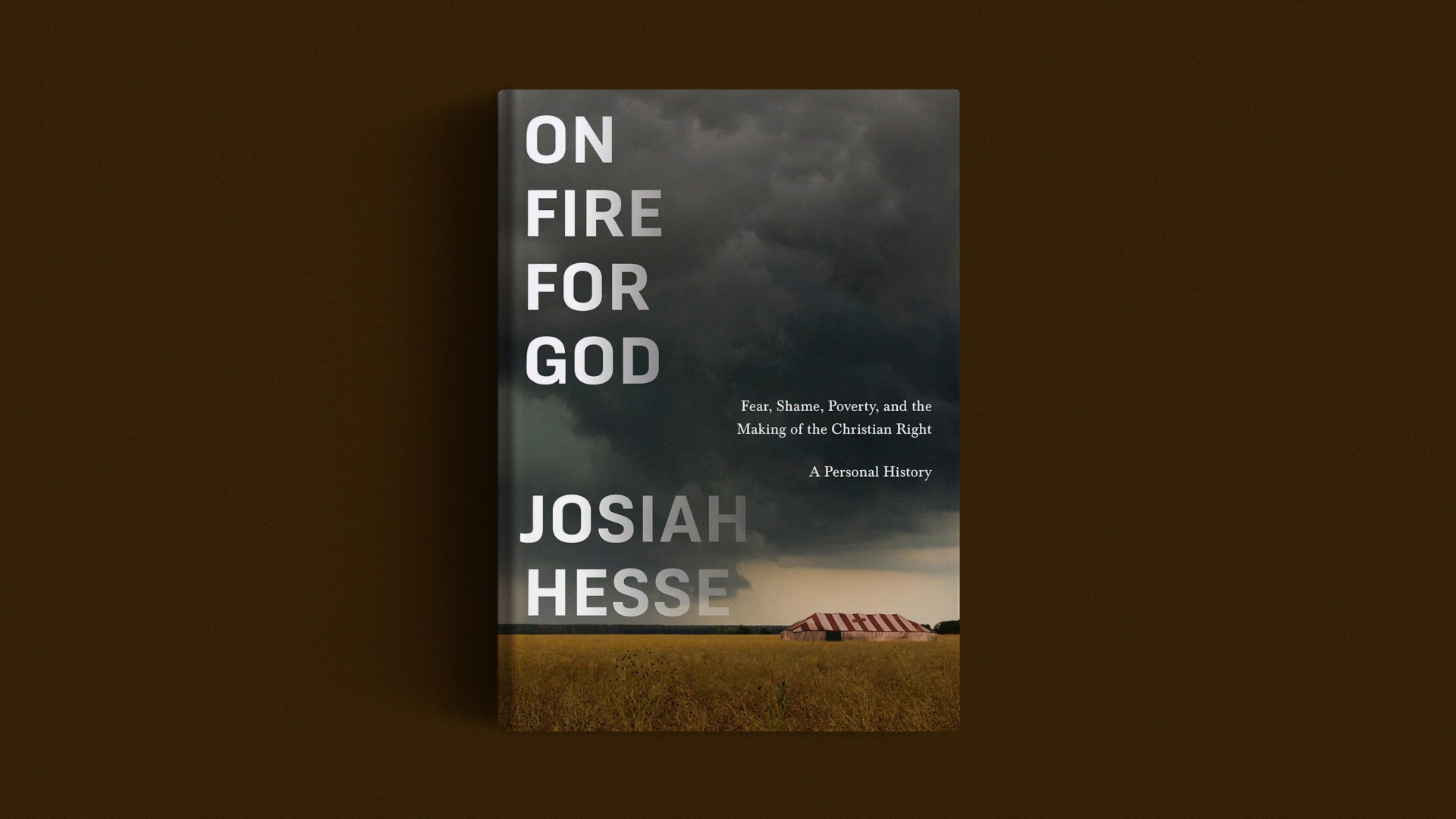
Exvangelical memoirs have multiplied over the last decade, so much so that they begin to blur together in my mind. But a new book from journalist Josiah Hesse, On Fire for God: Fear, Shame, Poverty, and the Making of the Christian Right—a Personal History, caught my eye nevertheless.
Hesse has left Christianity further behind than many memoirists in this class; he speaks frankly of a “desperate yearning for God to not be real, because the Christian God of my youth scared the f—k out of me.” But he also writes with clear affection for his family and his hometown of Mason City, Iowa—a farming community that served as inspiration for the musical The Music Man—and with a poignant sadness about his loss of faith.
Hesse and I spoke over Zoom about his goals for the book, claims about evangelicalism, and objections to certainty. This interview has been edited and condensed.
Let’s start with your elevator pitch for On Fire for God. What’s the book about, and how did you decide to write it—to make public such a personal story?
I’d written about my experiences with the Christian right via both novels and journalism, but I hadn’t done a deep dive on the history and mechanics behind this culture and political movement.
When I went home to Iowa to interview friends and family about my experiences and theirs, I realized that everyone had been guarding a wealth of secrets for years, and there was this assumption that the sin and financial problems they’d been struggling with were their own—that these weren’t universal experiences.
related


People had been putting on a mask to their congregations and neighbors about their struggles with faith, with Scripture, with theology. They were presenting as though they were happy, content, and financially and emotionally stable. There wasn’t the honesty or vulnerability that should be the hallmark of a congregation, of a church experience—the bonding with one another, the authenticity. I wanted to dig into that on a personal level for myself, my family, my community, but then also on a political and sociological and economic level. I wanted to show how all these forces converged to create this state of hiding from the people around you.
You note at the beginning that you’re using terms like evangelical, Pentecostal, and fundamentalist interchangeably. But surely these differences matter for how people in these groups understand themselves and how they see each other. Think of the cultural differences between Pentecostals and Presbyterians: “holy rollers” and “the frozen chosen.” You wrote that understanding the differences between these groups is unnecessary for the purposes of the book, and I’m curious about your reasoning. What are the purposes that make these distinctions irrelevant?
Well, I wouldn’t say they’re irrelevant, but we’re dealing with a large commercial audience with this book, many of whom would understand the difference between Catholic and Protestant, most likely, but probably don’t understand the difference between evangelical and mainline Protestants. There is a difference from an academic viewpoint, but I don’t know if there is an extreme difference on a personal level. We never really use the terms fundamentalist or evangelical or mainline Protestant. A lot of these groups, in my experience, just say, “We’re Christians.”


We often see the phrase the church. It’s one of the most annoying phrases to me, because I don’t really think there is a church—you wouldn’t say the synagogue to refer to Judaism or the mosque to refer to Islam. We are splintered in many different directions, and I didn’t want to get into esoteric language, like premillennial dispensationalism.
In my church, we didn’t use the word theology. We didn’t use the word apologetics. I didn’t grow up in a very intellectually sophisticated community when it comes to faith. So I was more concerned with what it looks like in practice for these people, especially when you’re young. And in my experience, our faith was determined by our belief in the infallibility of Scripture.
I know there’s a lot more flexibility on Scripture or believing in a literal six-day creation or a literal virgin birth when it comes to being a mainline Protestant. But the terminology I didn’t think was as urgent, though it was enough to warrant that author’s note. For most readers, those nuances aren’t really necessary for understanding the takeaways of the book.
This issue of scale is an important one, I think. Your family and hometown history serve as an entry point for broader discussion of political and religious issues. The book is titled as both a “personal history” and a story of “the making of the Christian right.” As a writer, I understand that move, but it seemed to me that the personal history is so distinct that perhaps it’s not as generalizable as you want it to be.
I’m thinking about your mom’s history with “disassociation and depression” and your dad’s record of substance abuse and affairs, including that particularly vivid episode where he has sex with another woman at church while on meth, with pornography projected on the sanctuary screen. This is all before we come to the distinctives of your childhood church, which you describe as a prosperity-gospel, seed-faith congregation. This strain of Christianity certainly has its following, but it’s pretty far outside the norm, not only for mainstream evangelicalism but even for many Pentecostals.
All of this suggests to me—as someone still very much inside American evangelicalism—that your background is pretty atypical of this movement. And so I want to press you on whether your story tells us something fundamental about the tens of millions of people grouped together as “the Christian right” or whether it is compelling and interesting and provocative but ultimately unusual—because the vast majority of evangelical dads are just not having sex on drugs in the sanctuary.
I agree with the premise of your question that there is something very subjective about the story that I’m telling. And I tried really hard to be transparent about that while balancing the history and theology.
I would push back on the suggestion that my story is so atypical, because I’ve known a lot of people who have similar stories. There was so much that I felt had been buried when it came to my family and my community. We saw it with the Hillsong documentaries a couple years ago. We saw it with Jim and Tammy Faye Bakker and the lives they were leading—or Larry Norman.
It was important to me that these secrets be brought to the surface—not to shame anyone or discredit faith. Really just the opposite. So many of my friends who struggled with addiction have found real solace in Alcoholics Anonymous. They can be honest about how bad things have gotten for them and how they’re struggling and confused. They find catharsis through honesty, vulnerability, and connection.
I wanted to bring these salacious details to the surface to show the reality that a lot of people are living with. We need to deal with these problems first by acknowledging them. I don’t want to be too prescriptive or suggest I’ve got all the answers, but I do want to start a conversation about the reality of a lot of evangelicals—particularly poor, working-class evangelicals.


One thing I appreciated about the book was that you came to it as a journalist, doing interviews and seeking the bigger picture with historical research.
If I can take this question of what’s typical a little further, though, you write that as an adult, you realized that your family was not unusual at that seed-faith church, that there were “dirty little secrets” including “substance abuse, violence, [and] affairs” kept “behind the closed door of each family.” In fact, you add that “it would be unfair to single out [your] church for this behavior: such secrets can be found in every church in America, particularly those that espouse ‘family values.’”
And, yeah, of course you can find sin in every congregation. I don’t think anyone would disagree. But the large-scale data I’ve found indicate that religiosity, including church attendance, correlates with lower rates of substance abuse, domestic violence, and infidelity. What’s the basis for your claim that every church in America is characterized by these evils?
Well, I wouldn’t say that they are universal in every Christian’s experience or that every church has an overwhelming amount of skeletons in their closet. I didn’t really apply any specific data to that statement.
But I would push against the data that shows people are happier when they attend church more regularly—or that they’re not having affairs or that they’re not using substances—because those are self-reported polls. A lot of these people are living with secrets, and there are great consequences to revealing those secrets. When you are caught up in the kind of outward-facing, marketing mentality of a lot of these large churches, particularly in the prosperity gospel, there are many incentives to present to the world an image of yourself and your life that isn’t always accurate.
You can lose your ministry if you’re in a leadership position. If you’re a congregant, you can be shunned by your community, lose your job, lose business opportunities. You can be ostracized. And I know because I’ve seen this many, many times.
There is, admittedly, a bias in my mind to maybe assume the worst of people. That’s something I was honest about and questioned myself about when I was writing this book. But I feel pretty confident that my perspective has been validated. I mean, you look at a publication like Julie Roys’s Roys Report, and every day there are horrifying reports about church leadership—people who present themselves as moral models.
And I am just pretty cynical about it, admittedly.
related


I would want to distinguish between what is common and what is too common, and say that things can very much be too common without being common. Not to get into an anecdata battle, but I grew up in many different evangelical churches—we were quite transient—and haven’t experienced anything like this at any of them, across a wide spectrum of denominations and cultures, including self-declared fundamentalists.
But I think part of why that claim about abuse and affairs caught my eye is because it’s so apparent in the book that you have real sympathy for the people in the pews. Even in your disillusion, you still say these are your people, and you reserve a lot of anger for political and religious elites.
I also admired your wrestling with how journalists have treated conservative Christians—H. L. Mencken calling fundamentalists “morons” and some contemporary journalists being incurious about the evangelicals they cover. I appreciated your willingness to ask yourself if sympathy, like that mockery, rests on seeing these people as “brainwashed and ignorant.” To my reading, you didn’t answer that question decisively in the book. Are you still wrestling with it?
To an extent, I think we’re all brainwashed and ignorant on a lot of issues. We all have biases and discomfort with having our worldviews challenged. It’s something that I wrestled with throughout the writing of this book, and the narrative was transparent about these struggles. At one point I asked, Am I the Music Man? Am I coming to town to sell these people a bill of goods, to exploit them? I think that’s something we all need to ask ourselves.
There’s a narrative often echoed back to me by different people in my life and work, and it’s the narrative coming out of right-wing media or evangelical megachurch pulpits. I want to point that out and examine it, but I don’t think that discredits any of these people as human beings who are navigating a confusing world, a confusing human experience. They, like all of us, are worthy of compassion and curiosity and patience and understanding.
related


Toward the end, you write that you’ve “resisted having any ideology, beliefs, or consistent worldview” and have been “reluctant to orient [yourself] around any kind of essential truth.” I don’t mean this as a gotcha about whether truth exists, but that comes after a string of recent stories in which you have quite strong beliefs and moral certainty.
You’re honest about your thinking in these moments, and—particularly on Christianity, sex, and poverty—you strike me as someone with confident beliefs, considered beliefs, that are deeply concerned with essential truths about the world, about humanity, about the nature of justice. So I want to push you on this notion that you’re writing from a position of broad secular neutrality that is avoiding these commitments, whereas Christians hold a more narrow, sectarian worldview.
It’s definitely a fair question. I think I pursue objectivity but know that it is going to be elusive.
In that scene where I’m talking about resisting landing on any specific worldview or ideology, I agree that I have them, but they do feel somewhat ephemeral. I wanted to convey my discomfort with landing on certainty about any given issue.
That’s because of how devastating it was when my faith slipped through my fingers. It wasn’t anything I rebelled against or consciously abandoned. It was something that seemed to disappear on me.
It was so hard to go through that, and that’s not something that I want to put anyone else through. I’ve always maintained that I’m not trying to debate anyone out of their faith. I’m not trying to spread atheism. I don’t think it’s an enviable way to view the world.


But whenever I feel the conviction of certainty and clarity, there’s always a journalist in the back of my mind trying to poke holes: Are you sure about that? Could you do a little bit more research? Could you talk to people who disagree with you and maybe find a little bit more nuance? Maybe you’re half right about this point, but there’s a grander perspective.
I recently watched a movie called Bugonia about a guy who believes the CEO of a company is an alien, so he abducts her. He has these conspiracy theories—but you see that he’s not completely sure. The movie never lets you orient yourself, never lets you settle into a clear narrative of a good guy and a bad guy.
That resonated with me when it comes to the human experience: No matter how much clarity and conviction you have, there will always be new experiences, new information, new people coming into your life to poke holes in that certainty.