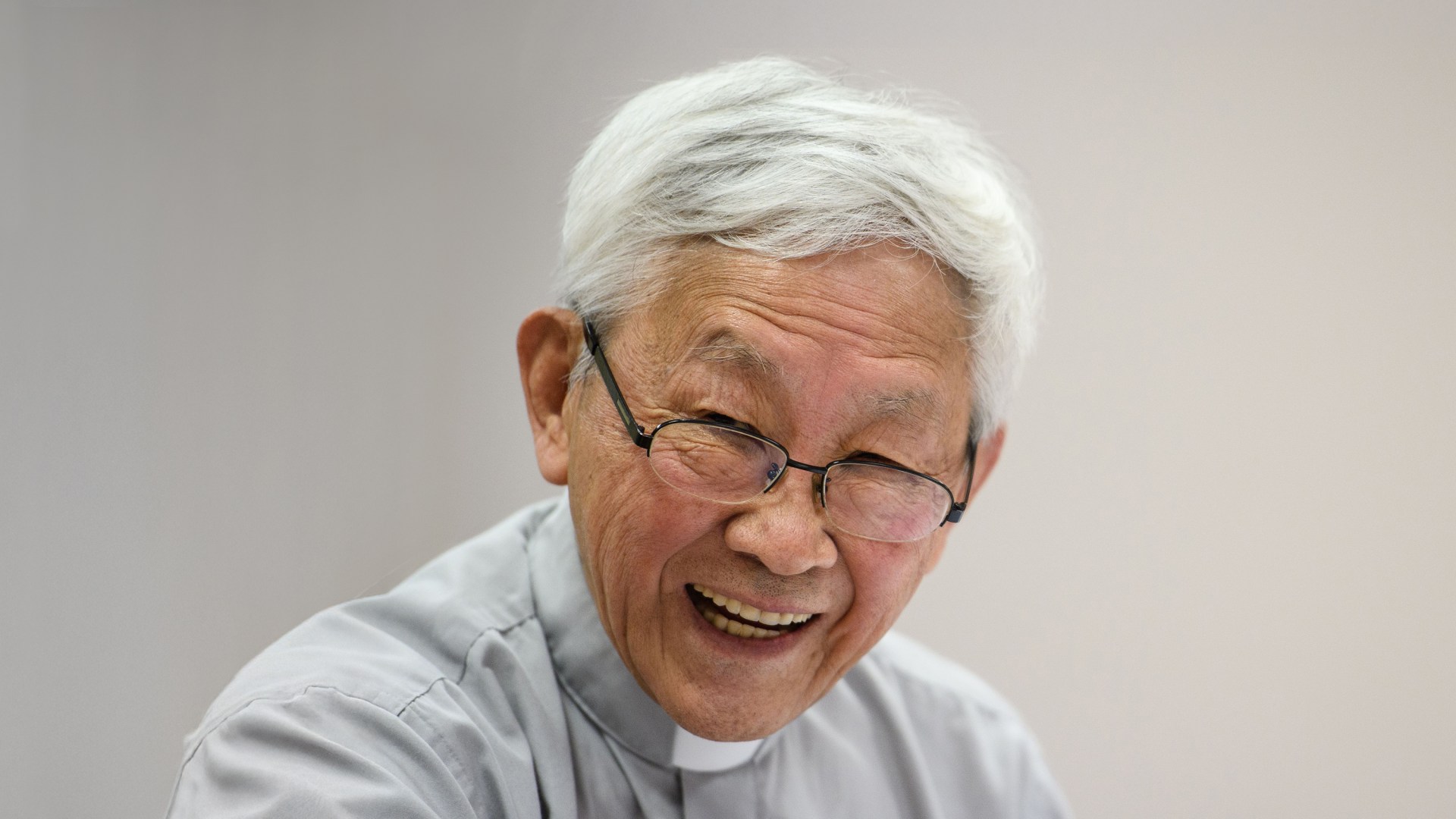
Three years ago in a Hong Kong courtroom, 90-year-old cardinal Joseph Zen Ze-kiun leaned heavily on his cane. Wearing his black clerical robe and white collar, the white-haired bishop emeritus faced charges of failing to register a legal support fund to help arrested activists during the 2019 pro-democracy protest movement.
Despite his advanced age, Zen shows no sign of slowing down. Last June in a Hong Kong parish he leaned heavily on a different kind of cane—a golden ecclesial monstrance bearing the Eucharist inside. He had just finished celebrating the controversial Latin Mass, reinforcing his position on the conservative wing of the Catholic church.
Savvy in public messaging, Zen—who turns 94 today—in both images portrays himself as a quiet rebel, clashing with governmental and religious institutions. Such commitment marked his ministry especially after his appointment as bishop of Hong Kong in 2002. Mindful of the needs of the poor and the oppressed in the underground Chinese church, the Hong Kong faithful welcomed his own elevation as the Vatican’s recognition of his stance on social justice.
“The purpose of life,” Zen said in an interview after his court appearance, is to be a person of integrity, justice, and kindness.
Yet this does not temper his clear words of rebuke. He called the 2018 provisional agreement between the Vatican and Chinese government to jointly appoint bishops as “blatantly evil [and] immoral because it legitimizes a schismatic Church.”
Open Doors ranks China No. 15 on its World Watch List of countries where it is hardest to be a Christian. Because of Chinese Catholics’ international ties to the Vatican, faced even greater persecution than Protestants. In 1951, the Communist government cut diplomatic relations with the Vatican and six year later organized the Chinese Catholic Patriotic Association (CCPA) to oversee the national church.
Zen was born in mainland China in 1932, one year after the Japanese invasion in Manchuria that eventually contributed to the beginning of World War II in Asia. He moved from Shanghai to Hong Kong in 1948, two years after the then-British colony was promoted to a Catholic diocese. His Catholic family left behind endured persecution from Mao Zedong’s regime, which considered the church a counterrevolutionary entity.
In Hong Kong, Zen attended a Catholic school associated with the Salesian order of Don Bosco. The order was founded in 1859 to help poor boys and young men with no education.
Zen became a priest in 1961 and earned a doctorate three years later from the Salesian Pontifical University in Rome. In 1978, he headed the local order as he concentrated on parish ministry. But when Chinese soldiers opened fire on students peacefully protesting at Tiananmen Square in 1989, Zen felt motivated to serve also the mainland church.
Shortly thereafter he secured China’s permission to spend six months every year as a professor in government-run Catholic seminaries. Though he watched the Tiananmen Square massacre with horror, for the next seven years he remained quiet about his opinions to nurture ties with Chinese officials and the underground church.
Zen described his sojourns in China as a warm welcome and wonderful time. The Communist government had earlier closed the seminaries during the Cultural Revolution—now they were full of students whom he could teach what he wanted. Yet he also realized the limitations. Spies infiltrated their ranks; government officials made up half the board of governors, who gave twice-weekly lectures on Marxism; and even the head of the CCPA could not freely make a call to the Vatican.
“In China, everything is fake,” Zen said.
In 1996, when Zen’s time in China ended, Pope John Paul II appointed him assistant bishop of Hong Kong. One year later, the UK agreed to hand over the territory to China on the premise that Hong Kong would create a pathway to democracy while preserving its capitalist economy, judicial system, and legal rights for the next 50 years. In 2002, Zen assumed sole senior leadership in the spiritual care of his flock.
Almost immediately, he joined the cause of freedom. Zen spoke out against laws against political subversion proposed by the government designed to weaken a pro-democratic civil society. A year later he attended a prayer gathering at the annual July 1 march protesting the handover to China. And when the World Trade Organization held its conference in Hong Kong in 2005, he encouraged activists demonstrating against polices believed to weaken the rights of small farmers while strengthening corporate interests.
In 2006, Pope Benedict XVI appointed Zen as a cardinal. In 2009, Zen resigned his position as bishop. With a higher global standing and less local church responsibilities, Zen dove even deeper into advocacy.
In 2011, he held a three-day hunger strike in response to a new Hong Kong policy to appoint outside officials to the boards of Catholic schools. Taking only water and Communion, he accused the government of “brainwashing” students to support the Communist Party. Yet he urged the faithful not to imitate his fast or begin a campaign of civil disobedience, lest the church lose control of the schools altogether.
Zen lost the battle. But in September 2014, he demonstrated solidarity with mass protests to implement a provision of the handover agreement guaranteeing direct election of the chief executive. China had agreed to permit voting only if the country selected the eligible candidates. As the Umbrella Movement filled the streets, heavy-handed police responded with tear gas and arrests. Some churches opened their doors to offer shelter, toilets, and prayer. Three leading activists called to suspend the protests, and Zen joined them in surrendering to the police. All were then released.
On the second anniversary of the incident, he held Mass on the sidewalk outside government headquarters as demonstrators lined up to take selfies with the popular cleric. The government accused the churches of harboring thugs. But individual officials recognized Zen’s stature. After the cardinal rode a public bus 40 minutes to visit an activist in prison, the guard gave up his seat so the then-octogenarian could sit down.
“If you are faithful to your principles, even the enemy has some respect for you,” Zen said. “But once you submit to their demands, you are a slave.”
Again he lost, as government officials maintain oversight of the election process. But Zen’s attention also turned toward Rome. Aware of warming relations between Beijing and the Vatican, he asked Pope Francis not to visit China. Yet in 2018, the nation and church formalized the provisional agreement on bishops, drawing Zen’s criticism. “Pope Francis needs someone to calm him down from his enthusiasm,” the cardinal said.
Overall, Zen kept good relations with Francis. In his 2019 book, For Love of My People I Will Not Remain Silent, he described how after a Mass in St. Peter’s Square the pontiff approached him and pantomimed a slingshot—symbolizing his role as David taking on giants. And at Francis’ funeral last May, he recalled how the pope once asked him about the pledge he made as a Salesian. After Zen repeated the threefold devotion to the Eucharist, the Virgin Mary, and the pope, Francis responded jovially, “Exactly—devotion to the pope! Don’t forget that!”
Despite his populist appeal in political matters, Zen supported traditional Catholic moral and hierarchical values. In 2021, he criticized Francis’ restrictions on the Latin Mass. In 2023, he questioned the pope’s guidance on offering blessings to same-sex couples. And in 2025, he warned against the pontiff’s Synod on Synodality for talk about a “democracy of the baptized” that might wind up including Catholics who do not regularly attend church.
Reform is needed because humans are sinners, Zen said of Francis’ popularity among youth, including among many in Hong Kong. But it is also dangerous and should not undermine the apostolic priesthood. Reform—as in the Protestant Reformation—once cost Catholics a “large part” of the church.
Yet as China and the Vatican renewed the provisional agreement on bishops in 2020, 2022, and 2024, Zen pointed his ire not at Francis but at the pope’s chief adviser, Cardinal Pietro Parolin. The main architect of the accord focused more on diplomacy than faith, Zen said, and even engaged in “willful lies.”
Zen preferred the long game.
“Communist power is not eternal!” he wrote to conclude his 2019 book. “If today they go along with the regime, tomorrow our Church will not be welcome for the rebuilding of the new China.”
Until then, Zen wished to preserve the freedom of Hong Kong. When protests erupted again in 2019 over a law permitting extradition to mainland China, Zen and four other public figures created the 612 Humanitarian Relief Fund to assist the many arrested demonstrators with their legal fees. He was accused of collusion with foreign forces and convicted on the charge of running an unregistered entity.
The court confiscated his passport and issued a $512 fine.
“In this moment, there are the persecutor and the persecuted, the strong oppressors and the weak, suffering people,” Zen said. “We have to be on the side of the weak.”