I was born just a few years after the end of a dictatorship.
As Brazil’s fledgling democracy struggled to its feet in the 1990s, I learned about what had come before in school, in movies, and in songs. But I would also sometimes ask my grandmother what it was like when the Brazilian military seized power in 1964, stamping out dissent for the next two decades. Her answer has always been the same: “I don’t remember very well.”
At the time, my grandmother was a divorced woman, raising three daughters while working grueling hours to provide a decent life for them. It’s entirely understandable why that era is a blur in her mind.
But I’ve been thinking about memory a lot recently after watching The Secret Agent, an unsettling film released late last year and directed by Brazilian filmmaker Kleber Mendonça Filho.
From the country’s northeast, Mendonça Filho often explores an underappreciated region in his work. My own city, Recife, is almost its own character in this film. Born in Recife, the director—nicknamed KMF—has put down deep roots there and, in an act that is both protest and homage, has built his career telling stories set in the region.
It’s a protest because the country’s film and television industries are concentrated along the Rio–São Paulo axis, which often means stories about the Northeast and its people are told from the perspective of outsiders. And it’s an homage because Recife has long been a city of enormous importance to Brazil, especially culturally. The Northeastern capital is shaped by Dutch, Portuguese, Indigenous, and African influences. It is home to the first synagogue in the Americas and was the departure point for some of the first Jews who would later arrive in New York.


The Secret Agent tells the story of Marcelo, who is a technology specialist played by Wagner Moura, a Golden Globe nominee for best actor. And it demonstrates just how far the dictatorship reached, how it left no community untouched.
After moving from Recife to São Paulo for work, Marcelo returns to his home city in 1977, during the years of Brazil’s military dictatorship. The opening scene sets the film’s tone: A corpse lies abandoned at a roadside gas station in the countryside. No one—not even the station attendant—knows exactly what happened. Marcelo stops to refuel and, intrigued, tries to learn more. He fails. Two police officers arrive, notice the body, and do nothing. Instead, they intimidate Marcelo and extort a bribe before he can continue on his way.
Moura’s character continues, walking through Recife’s familiar streets and landmarks. Viewers feel a constant sense that every character is being watched and that everyone harbors secrets that may never come to light. KMF is unafraid of discomfort. His storytelling is not always easy to understand or immediately legible. It challenges audiences. The Secret Agent carries a weight and an uncertainty that resist precise description.
Most eerie, perhaps, is the feeling that The Secret Agent is being told by someone who does not know the entire story—or who, like my grandmother, has forgotten crucial parts of it.
Forgetting, in fact, is one of the film’s central themes. Marcelo retrieves his son in Recife, readying to flee the country as a powerful businessman from the Southeast hunts him. We never learn exactly why Marcelo is being pursued, and he himself seems unsure how his life reached that point. In the film’s final moments, we encounter Marcelo’s son, Fernando, now older and working at a blood donation center.
When asked about his father, he appears resentful—as if he has forgotten everything his father endured to survive.
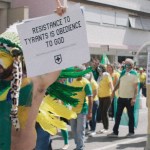
This theme of memory is all too relevant in our world today as democracies around the world seem tempted to slide into dictatorship and autocracy. Here in Brazil, our memories of dictatorship frequently resurface in various ways, especially in recent years. We are a young democracy.
Memory is a powerful defense. The Spanish American philosopher George Santayana wrote in his 1905 book The Life of Reason that “those who cannot remember the past are condemned to repeat it.” Many of us have heard that famous quote at least once, and some of us could quote it from memory. But how many of us know our great-grandparents’ full names? Great-great grandparents? How many of us are willing to pass down the painful stories that don’t reflect ourselves or our societies the way we want them to?
When we lose touch with our own stories, we are in danger. And if we, as individuals and as societies, fail to learn from the mistakes of the past, we will inevitably repeat them—not because we want to but because we are fallen creatures, living in a world that constantly confronts us with our own capacity for evil.
Long before Santayana put those words on the page, God had already said the same.
In Ecclesiastes 12:1, God calls his people to remember him in their youth. In Psalm 105, the psalmist urges them to remember the wonders and mighty acts God performed on their behalf. In Isaiah 46:9, God commands his people to remember the former things of old. Throughout Scripture, remembering is not merely the preservation of memory; it is a command to learn, to allow what has happened in the past to shape how we walk toward the future, striving for what is good, true, and beautiful.
The Christian practice of the Lord’s Supper carries immeasurable spiritual significance, and it is also deeply formative in this respect. By repeating the same ritual again and again, we train our minds to remember that Jesus Christ died, rose again, and will return. “Do this in remembrance of me” (1 Cor. 11:24), Jesus tells his disciples. He knew his followers would have short memories, memories that often reject him and rush toward sin and addiction.


When God’s people forget what he has said or done, they do not simply lose information; they actively reject instruction. In Judges 3, when Israel “forgot the Lord” (v. 7) and worshiped the Baals and the Asherahs, they rejected the very first commandment given in Exodus 20: “You shall have no other gods before me” (v. 3).
We become what we learn and what we fail to learn. We are today the sum of what we have managed to remember and practice, whether consciously or not.
If Walter Salles’ I’m Still Here, another Brazilian film that left its mark in last year’s Golden Globes, places a magnifying glass over the suffering of a family during the military dictatorship, The Secret Agent goes further, removing that lens and forcing us to confront society as a whole, a society that has trouble remembering.
The Secret Agent tells the story of a father who does everything he can to save himself and his son, only to fall into the hands of his persecutors; of a son who moves on with his life and forgets what truly happened; and of a society condemned to face the same villains over and over because it forgets its past. Amid this sea of forgetting, may we as Christians be a people who engage in the radical act of remembering: recollecting both the evil that surrounds and tempts us and the goodness of God, who writes our stories and carries us forward.
Mariana Albuquerque is project manager for CT Translations.
Related