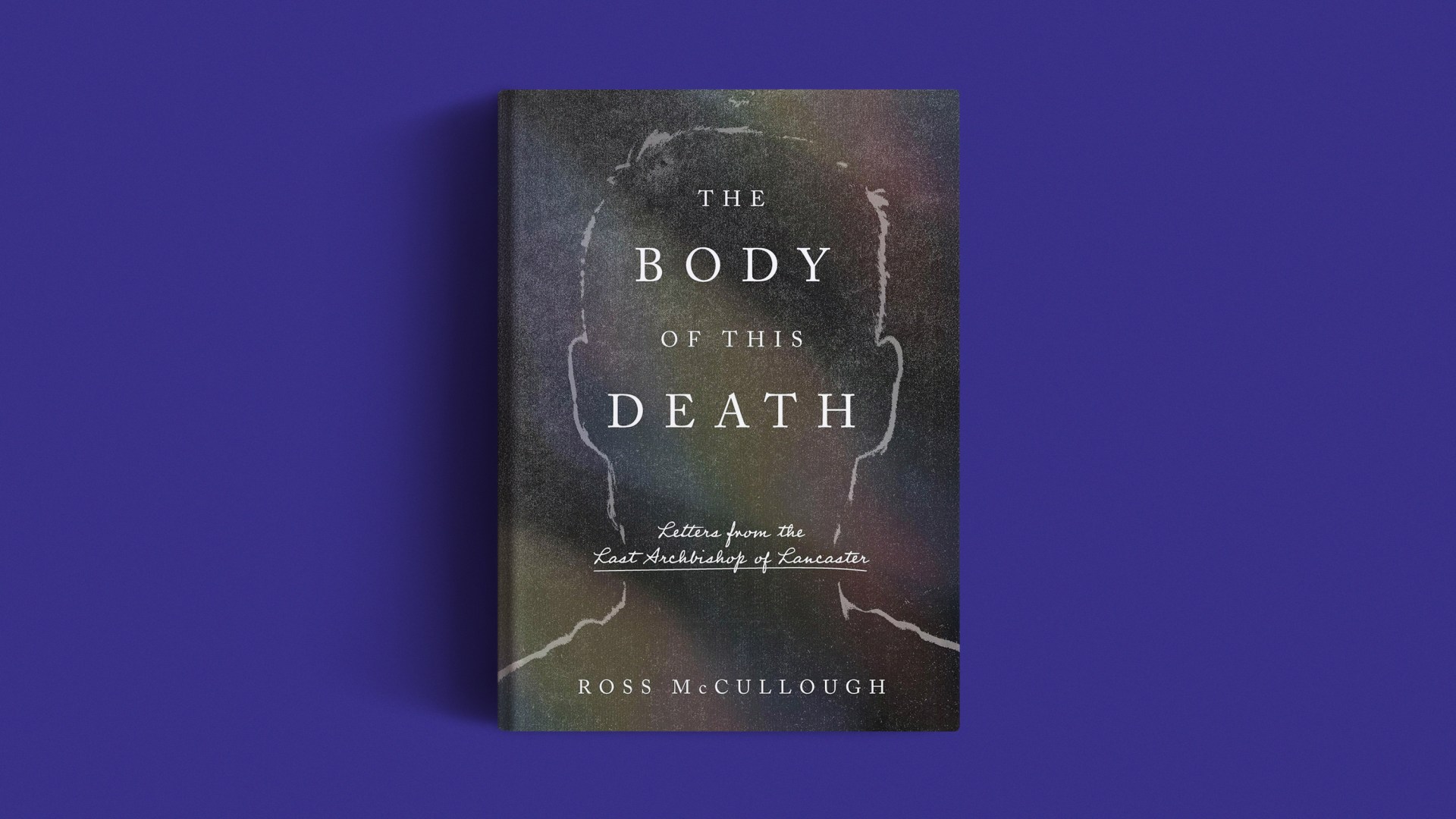
The Body of This Death is difficult to classify. Authored by Ross McCullough, a theologian in the Honors Program at George Fox University, it is almost—but not quite—a novel, a theological treatise, a collection of aphorisms, a series of correspondence, a science fiction dystopia, and a tract for Roman Catholicism. It is also the best new book you’ll read this year.

As its subtitle states, the book consists of a series of “Letters from the Last Archbishop of Lancaster.” This framing device brings to mind other epistolary novels, as evidenced by the endorsement of novelist Jeffrey Eugenides, who calls the book “a Screwtape for our times.” Beyond a likeness of format, though, The Body of This Death is reminiscent of The Screwtape Letters in another way: It too is an instant classic of Christian spiritual writing that deserves a wide audience.
The time in which the book is set is unknown. It’s not the near future, but it’s close enough to be recognizable, perhaps a few centuries from now. There has clearly been some break between old and new orders, and McCullough’s English archbishop finds himself penning letters during a time of seismic transition. As the plot unfolds, you learn why he was the last archbishop of Lancaster and why his name has been preserved for posterity.
But the letters don’t come to us straight from their fictional author. We get them from a French scholar, writing in “Year 20 of the New Common Era.” He’s working with a newly discovered manuscript of the cleric’s writings, a one-sided correspondence with a range of addressees: a priest, a nun, an old friend, a struggling agnostic, a Muslim mother. The scholar arranges these letters in roughly chronological order, and they both recount and react to events happening in the writers’ lives and the world around them. These are followed by “posthumous” letters that could not be inserted smoothly in the ordinary correspondence.
With these epistolary snapshots, McCullough tackles an extraordinary range of subjects: from virtual reality, secular liberalism, and the nature of fatherhood to Islam, infant baptism, and the Incarnation. The result is a tour de force: a postmodern Pascal, an American Chesterton, a Catholic Kierkegaard.
Those three loom large in the book, as do Dante Alighieri, Fyodor Dostoevsky, and T. S. Eliot, along with the writings of both the church fathers and the desert fathers. It isn’t only their ideas that appear, though. It’s their style.
McCullough’s writing is not the kind of academic work which cannot help but cut God down to size, but neither is it popular, reaching readers with simple vocabulary and accessible structure. The Body of This Death is unapologetically literary, and while the payoff is worth it, the book demands much of its readers. If it’s deliberately difficult, it’s in imitation of the way Jesus’ parables confound his listeners. The point is the stubborn provocation—unwillingness to comply with the stories we prefer to tell ourselves. Jesus hasn’t failed when his hearers storm off in anger. His hearers have failed, and his parable has succeeded precisely by exposing their failure.
The letters in The Body of This Death are closer to proverbs than parables. They’re largely aphorisms, for, as the archbishop comments, “Only the aphoristic is adequate to the task” of speaking about the divine mystery, “because only the aphoristic makes plain its [own] inadequacy.” Or, as the German writer Karl Kraus once wrote, “An aphorism never equals the truth. It is a half-truth, or a truth-and-a-half.”

Not for nothing, then, does aphoristic theology have a venerable place in Christian history. Its roots lie in biblical wisdom literature: Proverbs, Ecclesiastes, and Job, books that ask at least as much as they answer. These are not systematic theologies. A proverb is a memorable saying of the wise, sometimes clear, sometimes enigmatic. It pokes and prods the conscience. It resists mastery, summary, and restatement. Its brevity can prove maddening even as it sticks in the mind. As the cow chews the cud, seekers of wisdom grind and suck until the proverb gives up its nourishment.
The desert fathers inherited and continued this tradition with their Apophthegmata, short sayings and anecdotes from the fourth and fifth centuries. These tend to follow a pattern: An abba goes to the desert to pray in solitude and instead attracts all manner of followers eager for his guidance. Some youthful man visits him, hoping to see a miracle, and the miracle he is told to seek is silent prayer alone in a cell.
Sometimes these accounts involve the spectacular, like fighting demons. But more often at issue is something unspectacular, like avoiding fornication or refraining from gossip. The fathers’ comments are usually brief, witty, and unexpected, even deflating. McCullough’s archbishop follows their lead, taking up the mantle of Solomon and the desert fathers by striving with pithy formulations to gesture at truths that cannot be captured by finite minds.
“These letters are aphorisms,” he writes. Whether as a proverb or apothegm, the aphorism is close to the apophatic, a style of theology suspicious of the closure and finality of human speech. Words cannot but limit and bind, whereas the living God is infinite. His freedom breaks our words open—at times like a bud from a seed, at times like a split atom. We need words to know God, and he has given us trustworthy words by which to know him, yet aphorisms are a necessary check on our pretentions. They discipline our pride by curbing our verbal idolatry.
In the words of Blaise Pascal, “I should be honouring my subject too much if I treated it in order, since I am trying to show that it is incapable of it.” God will not submit to our ordering. He will not be tamed.


Like any correspondence, the book’s letters accumulate their themes, arguments, and wisdom over time, by familiarity and repetition and “real-world” events. In that sense, it gets easier as you go—but there’s no handholding in this book.
There aren’t even handholds. You’re set down alone in a labyrinth, and you must proceed until you confront—or rather, are confronted by—Christ. As the archbishop writes in a late letter to the “inquisitors” who have imprisoned him on a trumped-up charge, “Do you know, Christ is not nailed to the cross; the cross is nailed to Christ. It is not the savior that flees the world but the world that flees its salvation. You think you are here to discipline me, but perhaps the nails run the other way.”
If the correspondence has a center, it is the cross of Christ. The letters spiral around it—not only the mystery of salvation but also the vocation of all believers to join the Lord in his passion. At one point the archbishop asks, “Why has Christianity lasted so long?” His answer: “It is a religion of suffering well.” One of the shortest letters is devoted entirely to the topic:
Fr. Rodrigues,
Pain is not the wound; pain is the reaction to the wound. Suffering is not alienation from God but a reaction against alienation, a protest that begins from some inarticulate depth inside of us—the depth from which articulations come. That is why it is holy, because it is always already on the side of the angels. In that sense, the suffering of purgatory and the suffering of hell both tend to their own dissolution: the one by overcoming the alienation, the other by silencing the protest.
Here is another, to the same priest:
The Church too gives us little reason for optimism, I’m afraid. Even the Apostles betrayed Jesus—are betraying him.
But optimism is not hope. Optimism sees history held in the hands of the two centurions: and the one after all is faithful beyond Israel, the other was converted by the cross. Hope on the other hand finds history between the two Judases: Iscariot, lost cause; not Iscariot, patron of lost causes.
This last letter is representative: so compact in its allusions it might as well be spring-loaded. If you don’t know one centurion from another or who the patron of lost causes is, the author is not going to let you in on the secret. (Nor am I.) The aim isn’t to keep you in the dark. It’s to draw you out of it. The saints and authors and poetic references are woven together so inseparably they form a single thread. And as with Ariadne and Theseus, this thread is meant to lead you out of the labyrinth—or perhaps toward its center.
related

The themes and theology of McCullough’s book, combined with how he chose to write it, raise two questions worth pondering for evangelical readers. The first is how, or whether, evangelicals should read Catholic writers. The second is what evangelicals might learn from a book like this: highbrow in style and substance, written in beautiful but stylized prose that is likely to prove unwelcoming, even intractable, to many readers.
I’ve paired the questions together because my answer is the same for both: Evangelicals can become better readers by reading more widely within the church—and not only when authors from outside the fold are safely six feet under.
You know the reading habit I mean. J. R. R. Tolkien, Thomas Merton, G. K. Chesterton, John Henry Newman, even Thomas Aquinas: all widely read by American evangelicals today, and all of them gone on to their reward. Were Chesterton alive today, would evangelicals like him so well? No doubt he’d have racked up quite a few high-profile conversions, much to the chagrin of Protestants wishing he’d quit picking off our best and brightest.
Or even think of C. S. Lewis, who never swam the Tiber but absolutely does not tick the familiar boxes of American evangelicalism. Lewis was an avid smoker who affirmed evolution, denied a young earth, read the early chapters of Genesis as nonhistorical, loved pagan myths and secular literature, and believed in both the priesthood and infant baptism. And yet—rightly—evangelicals celebrate Lewis as a great Christian writer and thinker. Could it be that there are Christians of our own time, in other branches of the family tree, who might instruct and reform us too?
Even if evangelicals remain cautious in their reading habits, The Body of This Death may yet find the readership it deserves. Journalist Arthur Koestler was right to say that “a writer’s ambition should be … to trade a hundred contemporary readers for ten readers in ten years and for one reader in a hundred years.” McCullough writes in that spirit, and I have no doubt this book will outlast our time, just as Lewis’s work has endured.
Writing that lasts is not easy. It is not market-tested by surveys. It is not measured by book sales or median reader taste. It is certainly not vetted by sensitivity readers.
People still read Søren Kierkegaard today—and have their lives overturned by his thought—not because it is digestible but because it is the very opposite. His voice is winding, florid, disorienting, and infuriating. But he speaks to what matters. He is gripped and enthralled by a vision he must communicate to anyone who will listen, with the urgency of life and death. His letters are scrawled in blood, not ink. His work won’t let you go until it’s finished with you.

That’s the kind of book this is. I believe it will prove a classic, but others will be the judge of that. What is indisputable is that McCullough has written a book that aspires to greatness. He sets the terms of encounter, and they are not negotiable. But if you accept the invitation, you won’t be the same again.
Christians need more writing like this—books that aim higher than sales or accessibility. And we need to honor and celebrate them when, in these rare moments, they come along. This is one of those moments. Enter the labyrinth and prepare yourself for the mystery that awaits.
Brad East is an associate professor of theology at Abilene Christian University. He is the author of four books, including The Church: A Guide to the People of God and Letters to a Future Saint.