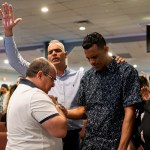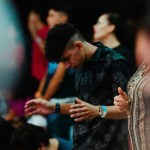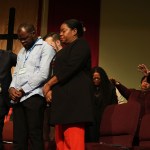
I recently visited multiple congregations across Minnesota, including River Valley Church. As I stood inside each church, what I witnessed was not anecdotal or exaggerated. It was empirical and deeply troubling. As national immigration-enforcement politics evolve, churchgoers across the Midwest are feeling the consequences far from the border.

One of the largest Latino churches in the state, which previously held four Sunday services, is down to one service at roughly 60 percent capacity. Approximately 75 to 80 percent of this church body has stopped attending services altogether.
This is not a story about declining faith or spiritual apathy. It is a story about fear. The Latino church is hemorrhaging, and the cause is increasingly clear.
Pastors repeatedly told me the same story: Families staying home. Parents afraid to drive. Elderly members afraid to leave their neighborhoods. Small-business owners closing early. Mothers sending their children to church, unsure whether they themselves would be able to return home safely.
These are not criminals hiding in the shadows. They are congregants who have lived in the same communities for a decade, two decades, or more. They are hardworking, God-fearing, contributing members of society. They do not depend on government subsidies. They worship faithfully, raise families, and love this country.
Fear has replaced fellowship, and silence has replaced singing. Sadly, the church—especially the Latino church—is paying the cost.
related

I do not write this as an activist or partisan. I write as a pastor who has spent decades on the frontlines of the intersection of faith, immigration, and public policy, in the process advising George W. Bush, Barack Obama, and Donald Trump. Across administrations, parties, and ideologies, one truth has remained consistent: Immigration policy works best when it is guided by both moral clarity and strategic wisdom.
Border security and the rule of law matter. National sovereignty is critical. But broad, indiscriminate, and unfocused enforcement without clear prioritization is not only ineffective but also counterproductive.
Immigration and Customs Enforcement (ICE) should operate with clear targets and disciplined focus, pursuing those who pose real threats and leaving everyone else alone. A targeted, surgical approach would restore trust, protect communities, and avoid unnecessary collateral damage.
When enforcement lacks discernment, everyone loses. Law enforcement loses community cooperation. Churches lose their congregations. Children lose stability. And the nation loses moral credibility.
Faith communities—especially immigrant churches—have historically been among the strongest allies of public safety. Churches teach responsibility, respect for authority, family stability, and civic engagement. When these institutions are destabilized, the social fabric weakens.
This is not theoretical. I saw it with my own eyes: empty sanctuaries, pastors preaching to half-filled rooms, congregations once marked by joy now marked by anxiety.
In recent months, I have argued alongside faith leaders and policy experts that America must resist the temptation to treat all undocumented immigrants as if they are criminals. Scripture does not permit such moral shortcuts. We must remember justice requires discernment, mercy requires wisdom, and order requires precision.
Individuals who have been here for decades, put down roots, raised children, built businesses, and contributed to the common good should not be treated the same as those committing crimes. Conflating the two undermines both justice and public safety.
related


This is why bipartisan solutions deserve serious consideration. One such proposal is the Dignity Act. If passed, it would strengthen border security, mandate verification of work authorization, hold employers accountable, and provide a structured and earned pathway for long-term undocumented immigrants who meet strict criteria.
It is not amnesty. It is accountability with compassion, order with humanity, and law with dignity. These pairings are important.
Under such a framework, criminals are swiftly removed, the border is decisively secured, and long-term residents are given the opportunity to come out of the shadows, pay restitution, work legally, and contribute fully to the nation they already call home.
This approach reflects a biblical ethic that values both truth and grace. Scripture consistently upholds the rule of law while commanding care for the sojourner. The two are not enemies; they are partners.
There is also a political reality we must acknowledge. Indiscriminate enforcement provokes backlash. History teaches us that overreach fuels reaction. And reaction often hands power back to ideologies that undermine public safety, weaken borders, and marginalize faith altogether.
No administration benefits from alienating one of the most faith-driven, family-oriented, and civically engaged communities in the nation.
There is still time to change course.
The goal should not be fear-driven compliance but law-abiding cooperation. In place of mass anxiety, we must strive for measured justice. And instead of pushing for collective punishment, we should seek targeted accountability.
The Latino church is not asking for special treatment; it is asking for fair treatment. It is asking that the line between criminality and community be honored and that faith-filled families not become collateral damage in a debate too often stripped of nuance and humanity.
related


What I witnessed in Minnesota should concern every Christian and every policymaker.
Churches are more than buildings. They are anchors of hope, centers of service, and incubators of virtue. When they empty, the country loses something much deeper than attendance.
America can do better. We must do better.
We can secure the border and preserve dignity. We must enforce the law, protect families, and uphold justice while restoring trust.
The question is not whether immigration enforcement should exist. The question is whether we can be wise enough to distinguish between those who threaten our nation and those who strengthen it.
Right now, the Latino church is sending a clear and painful message.
We should listen.
Samuel Rodriguez is the lead pastor of New Season, a multisite nondenominational church based in California, and president of the National Hispanic Christian Leadership Conference, which represents millions of Christians worldwide. He has written 12 books and produced seven faith-based films.