What is God’s heart? What does he value? What relative importance does he place on the different facets of our flourishing? He certainly cares for our spiritual lives, but what of our physical health, our social connectedness to our communities, our mental health, our economic welfare? The answers to these questions have powerful implications for how we should love our neighbors, both locally and globally.
As a development economist and as a Christian, I find these questions particularly important. A significant part of my research studies the overall effectiveness of international development organizations like World Vision and Compassion International. But to do this, one needs to do two things: (1) Carefully estimate impacts on different human outcomes and (2) assess the relative importance of those impacted areas within a sound framework of human flourishing.
The first of these is more technical in nature, the second more philosophical. It caused me to reflect as a Christian: What constitutes a positively impacted life? Spiritual growth? Higher income? Social harmony? Better physical or mental health? And since a central mission of most Christian development organizations is to follow Christ’s example in his engagement with the poor, it led me to an objective study of how Jesus engaged with human need, a study that in turn deepened my relationship with God.
What first prompted this was an impact evaluation project with Hope Walks, a Christian organization that funds clubfoot interventions for children in low-income countries. As a congenital disability, clubfoot is only vaguely familiar to most Americans. It is so easily and fully treatable in infancy that we rarely see a person living with this untreated abnormality. Indeed, some world-class American athletes like Mia Hamm and Troy Aikman were born with clubfoot.
But in low-income countries, clubfoot often goes untreated. Many people begging on the streets of poor countries were born with congenital abnormalities like clubfoot. Ever wonder who comprises the “least of these” on a global scale? Many of them are people born with congenital abnormalities to poor families in poor countries.
I was stunned at how devastating clubfoot is for various aspects of human flourishing. Our research team—Patrizio Piraino, Gianna Camacho, and I—found that compared to the life outcomes of their nearest-age siblings, the lives of children in Ethiopia who went untreated for clubfoot were shattered by this congenital abnormality. The statistics painted a disheartening picture of being relatively immobile, socially excluded, suffering poor mental health, and failing in school.
These children were also suffering spiritually, according to our interviews with family members and siblings, less likely to believe God cared for them and uninvolved in church and youth activities. Their physical disability bled profusely into their spiritual, social, academic, and emotional lives.
But we found that treating this congenital abnormality in infancy largely restored human flourishing in all of these areas. Because the consequences of untreated clubfoot are so grim in a low-income country like Ethiopia, and because the Ponseti treatment that Hope Walks employs (casting for one to 2 months and then bracing at night until age 5) is so ubiquitously effective, the impacts of this clubfoot intervention on human flourishing were greater than any poverty intervention I have studied.


I wanted people to understand how human flourishing changed so dramatically with clubfoot treatment, even compared to health and poverty alleviation programs offered by other excellent Christian nonprofits. And showing its overall impact on human flourishing led me to my challenge: How are we to assign relative importance to the various facets of our well-being in a way that reflects God’s priorities for his children?
A fascinating concept in economics is called “revealed preference”—the idea that we can infer a person’s values by observing how they allocate their money and time. It’s as if we can peer into a person’s soul by looking at their choices.
Might we also learn something of God’s heart by examining how Jesus devoted his time on earth across different aspects of human need? Jesus in his earthly ministry had to make choices about how to allocate his limited time, just as we do.
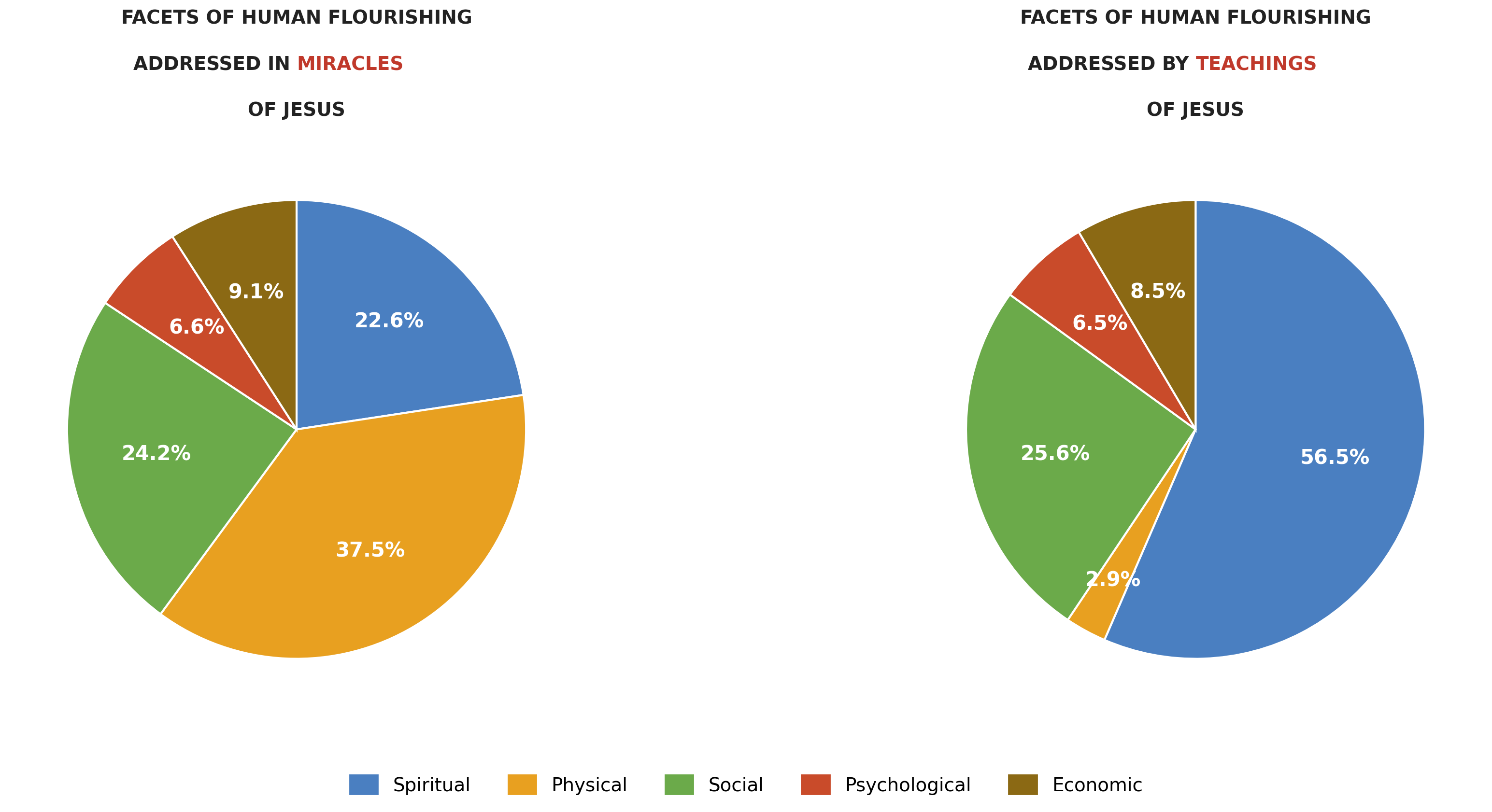
I decided to go through the Gospels’ accounts of Jesus’ interactions with people—conversations, teachings, and healings—and digitally categorize all 171 recorded interactions (as delineated by New International Version subchapter headings) based on which of the following five different facets of human need he was addressing: (1) purely spiritual, (2) physical needs, (3) social inclusion, (4) mental health, and (5) economic needs.
I allowed two categories maximum for each encounter. To ensure these categorizations reflected the consensus of a diverse group of Christian leaders, I assembled a theological team made up of a Presbyterian pastor (Al Tizon), a Catholic theologian (Mark Miller), a Protestant theologian (Kent Annan), and parachurch workers with InterVarsity (Jackie Tisthammer) and Cru (Lori Kepner), all experts in New Testament manuscript studies, to carry out the same exercise. Below are pie charts showing the team’s consensus categorizations of Jesus’ engagement with different human needs:
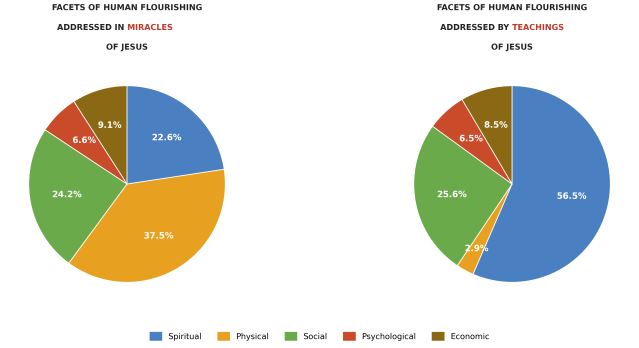
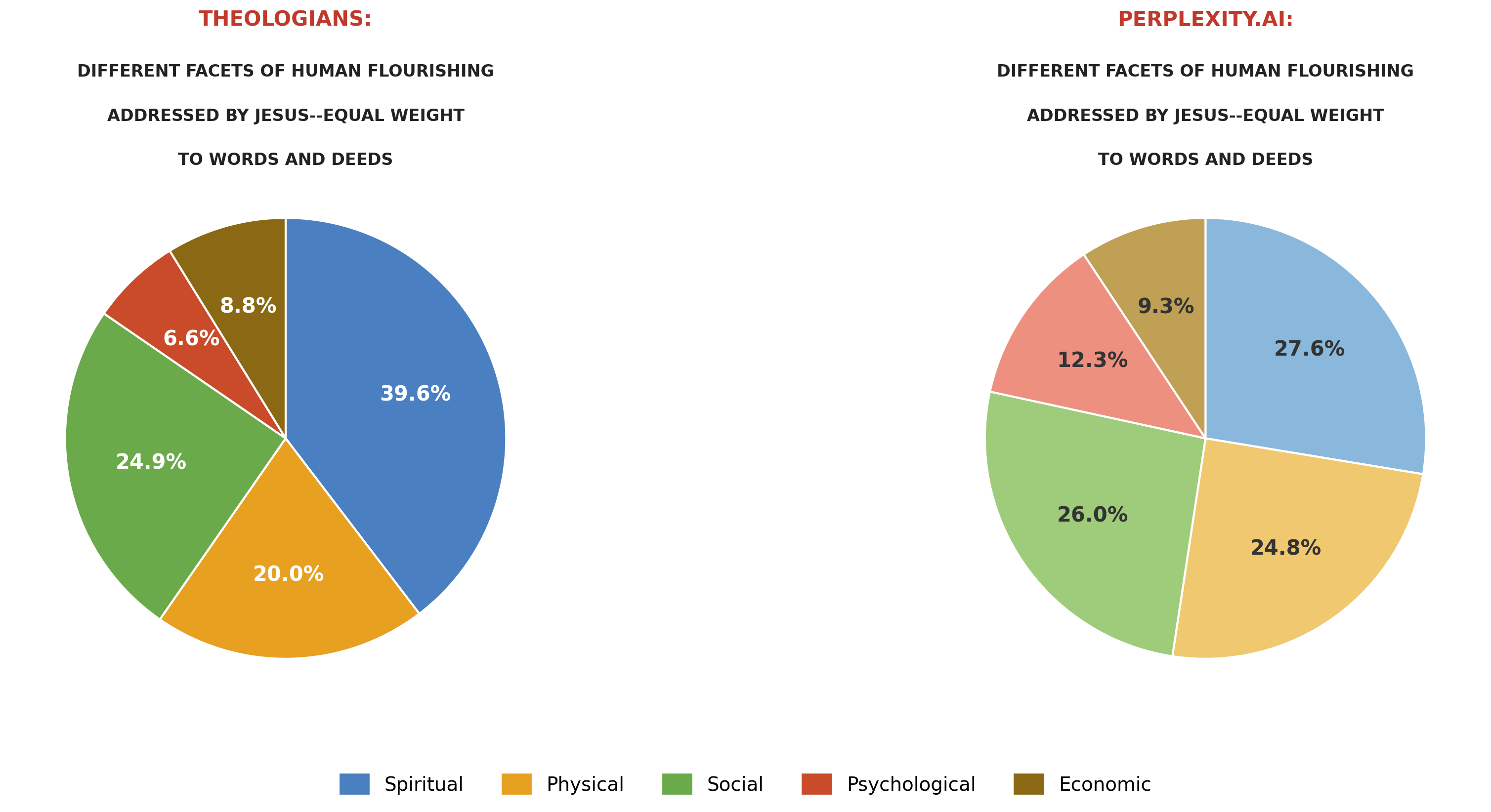
In a quest for maximum objectivity, I brought in Richard Zhang, my friend with a PhD in computer science from Berkeley. Zhang works for Google DeepMind on its Gemini AI platform and leads the organization Christians for AI, a group of wonderfully nerdy believers. I asked Richard to create an optimal AI prompt for me to similarly categorize the 171 human interactions of Jesus into the five bins. He got to work and engineered a gargantuan prompt to carry out the task.
I fed the prompt into Perplexity AI, a large-language model that excels at categorization. Perplexity AI’s categorization of Jesus’ engagement across human needs showed even an even more holistic division of concern than the collective categorizations of the theologians. The result of these exercises is shown in the pie charts below:
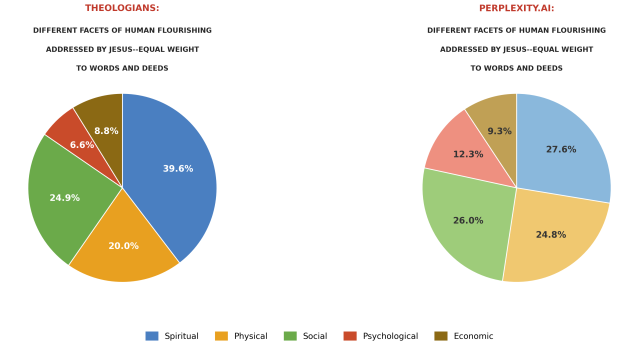
While Christians already know from Scripture and experience that God cares for all of the different facets of our well-being, this analysis provided some statistical insight outside of any possible denominational or ideological slant. It is simply what exists in the New Testament “data.”
It occurred to me during this exercise that, to prove he was God, all of Christ’s miracles could have simply been spiritual displays of power, miracles of the shock-and-awe variety, like calming storms or walking on water. But they weren’t. Instead, most of his miracles involve meeting various human needs: people’s physical ailments (restoring sight, mobility), their social inclusion (healing of lepers), their economic shortages (loaves and fishes), and maybe even their mental health—“Peace be with you,” (John 20:21). His miracles show how much the God of the universe cares about all these different facets of us that make us happy, healthy human beings.
From seeing Jesus’ priorities in action, we know he didn’t come to establish a strictly spiritual gospel, or a merely social gospel, or just an economic gospel, or just a psychologically comforting gospel. Want a one-dimensional religion? Well, it’s not Christianity. Jesus does prioritize more of his time in the Gospels to addressing our relationship to him and his Father than any other single facet of human flourishing. But it’s clear that he cares about all facets of our lives.


Perhaps most importantly to me as a development economist, obtaining some sense of Jesus’ relative concern across these areas of human flourishing is a helpful conceptual tool in assessing the impact of Christian organizations.
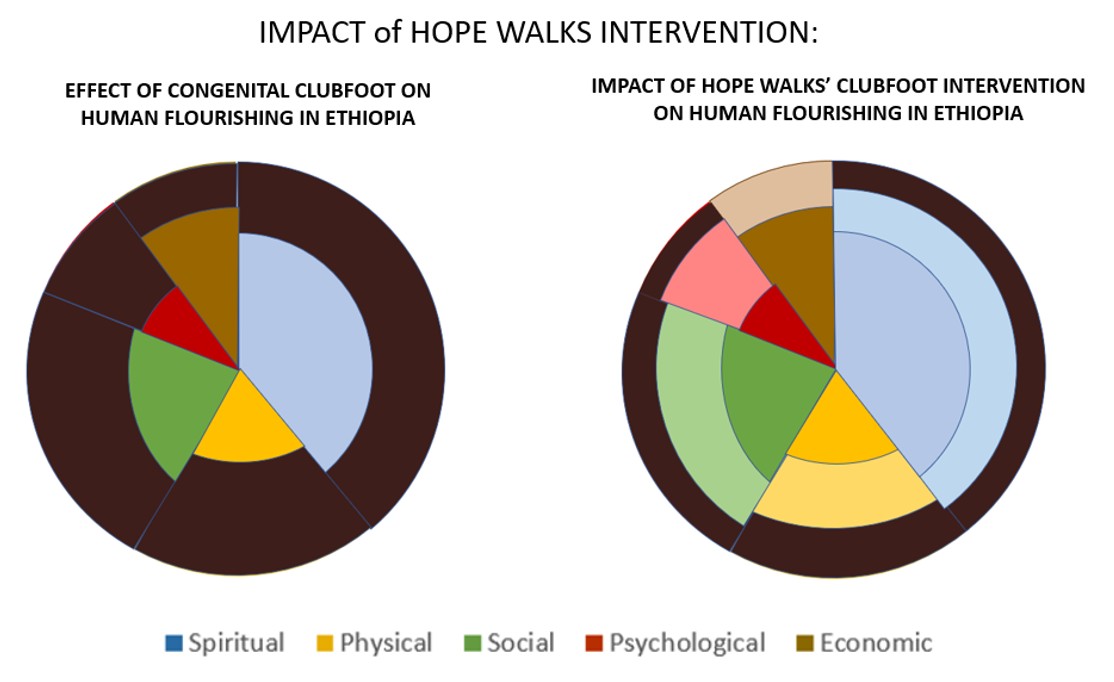
Take Hope Walks, for example. The negative impacts of clubfoot on a person’s life are shown in the diagram as the dark spaces between the colored segments and the outer edges of the chart, compared to data from their nearest-age sibling. The positive impact of Hope Walks’ intervention is then seen to the right in the lighter-colored areas; it reveals substantially restored flourishing to a child born with clubfoot. (The academic article detailing this research appeared in January in the journal Health Economics.)
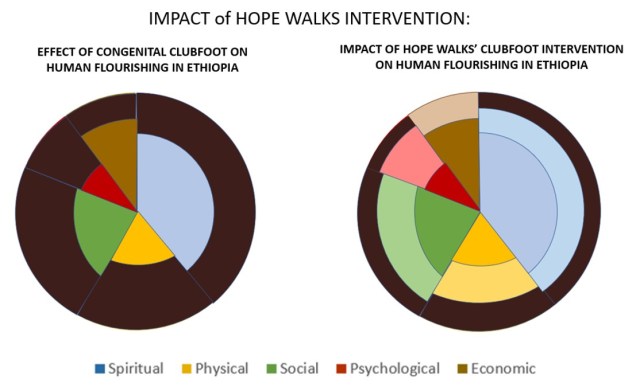
We compared the impacts of the Hope Walks intervention to other celebrated and more well-known development programs using our biblically based index of human flourishing, discovering that the impacts of the Hope Walks intervention were larger than any other Christian intervention for which we could find reliable impact data.
For a mere $500 intervention, its impact on these children born with clubfoot can be described as nothing short of totally transformative. Hope Walks truly packs a punch against poverty, social and spiritual exclusion, and multiple dimensions of human suffering.
Jesus loves all of us, not just every individual person, but all of us, deeply caring for every facet of our lives. He loves us and wants us to flourish completely. Supporting organizations whose work significantly and positively impacts every facet of human flourishing is a great way to show Christ’s love to others across the globe.
Bruce Wydick is professor of economics and international studies at the University of San Francisco, adjunct professor at the University of California at Davis, and distinguished research affiliate at the University of Notre Dame.