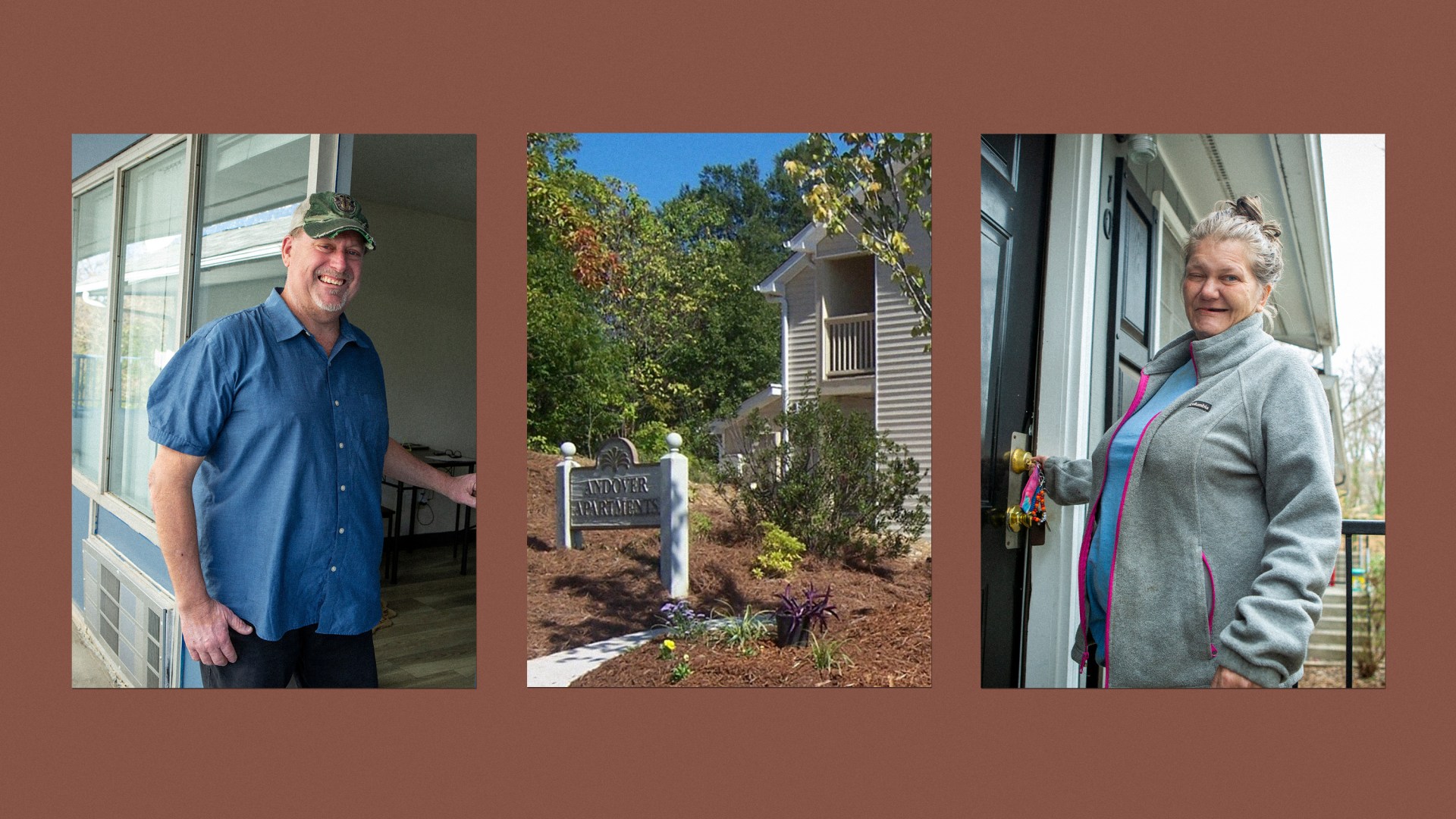
Cassandra Burnette never expected to find herself homeless.
A petite, 57-year-old African American woman who chatters to strangers like they’re old friends, Burnette was a manager at a Wendy’s when she lost her job. And though she’d lived and worked in Durham, North Carolina, for more than 20 years, she wasn’t able to find new work.
Medical history—including neuropathy, chronic pain, and the effects of three past surgeries—complicated her job hunt and made manual labor difficult. “It burns so bad when I walk,” she told me, and the pain has only grown with age. “But I’m getting along.”
When she could no longer pay rent, Burnette was evicted. “I stayed with one of my friends for a while, and they helped,” she said, “and then I went to a shelter.” She spent three months at an emergency shelter run by Urban Ministries of Durham before a case manager there referred her to Housing for New Hope (HNH).
HNH is a local nonprofit focused on providing affordable, sustainable housing to Durham’s homeless population. Beginning with a shelter offering transitional housing for men and gradually expanding its programs and facilities, the organization has been a steady presence in the city since 1992. And there’s been no shortage of housing needs to fill.


Nationally, the Department of Housing and Urban Development (HUD) reported in 2024, homelessness is the highest it’s been in two decades. And here in the Research Triangle—Durham as well as the nearby cities of Raleigh and Chapel Hill—15 years of a boom economy has spiked housing prices. The fair market rent for a two-bedroom unit in Durham County rose from $990 in 2018 to $1,711 in 2026, so high that someone earning minimum wage would need to work more than full-time just to afford rent. Unsurprisingly, homelessness has increased, and more than 40 percent of homeless people in Durham are part of families with children.
Housing for New Hope takes a long-term approach, said Russell Pierce, a bearded and bespectacled former pastor who serves as the organization’s executive director.
Pierce self-describes as a rambler, and my 15-minute conversation with him soon stretched to an hour. His enthusiasm for his work is unmistakable, as is his thoughtfulness. Pierce lights up whenever he considers an innovative way to help Durham’s homeless population.
“You can hear Matthew 25”—Jesus’ exhortation to feed, clothe, and visit those in need—“on a Sunday morning, and you can pretty much knock that whole list out by five o’clock before dinnertime,” Pierce told me. But for more durable work, he added, “I orient around Jesus’ ‘Nazareth manifesto’ in Luke 4. Coming to set the captive free and let the blind see—all those pieces are very long-haul. That is kingdom work in its truest sense.”
Rather than focusing on emergency shelter, then, HNH operates three apartment complexes for people earning less than 50 percent of the area’s median income. Residents can stay for up to two years. The nonprofit also operates two long-term supportive housing complexes for those who have been homeless for at least one year and have a disabling condition (usually a severe, persistent mental illness or substance abuse).
In February 2023, Pierce recalled, HNH had an opportunity to expand those services: Carver Creek, a senior living facility adjacent to an extant HNH property, went up for sale.
related


“There was some land behind us that wasn’t big enough to build on,” Pierce said. “Carver Creek had extra land that wasn’t big enough to build on. But if you put them together, we would have enough room to build another 45 to 50 units. We realized we could make a whole campus on this 11.5 acres.”
County officials were eager to facilitate the sale, which would allow current senior residents to continue living at Carver Creek at below-market rates. As the lead implementer for HUD-related grants dealing with homelessness in Durham, Housing for New Hope—which is about 50 percent government-funded—was already a known quantity. And the organization’s focus on long-term housing meshed with municipal goals too.
“To be able to offer someone their own place, the dignity of their own door they can shut, a window?” said Ryan Smith, director of Durham Community Safety Department, at a city-hosted panel on homelessness last month, which Pierce moderated. “Those kinds of things can make a real difference.”
Durham’s County Commission and City Council each contributed $3 million to HNH to buy the Carver Creek property debt-free in August 2023. The process moved quickly—so quickly that Pierce calls it “a miracle.”
After the sale, private donors contributed to the refurbishment of the existing units and development of a new complex on the combined property. Though HNH is not church-affiliated, many of its most enthusiastic supporters are local churches. Four congregations have backed the nonprofit since the early 1990s, Pierce said, and remain among its largest supporters. In addition to financial donations, churches provide essentials kits for residents—which contain kitchen, bed, bath, cleaning, and hygiene supplies—as well as volunteers for events, landscaping, and other needs.
Refurbishment completed at Carver Creek includes updated flooring, lighting, and paint throughout the complex. “I’d like to say our changes are small, but mighty,” said Shanta Addison, HNH director of client services. “It’s a way to show current residents and our community partners how seriously we are taking this process and how much we value the community we serve,” she said, though “we still have a long way to go with upgrading the units.”
related


After the renovation is finished, Addison and Pierce told me, the next step is determining how to best make use of the additional lot space. Five acres of the combined property will remain a protected forest, but the other acreage could host dozens of new housing units.
“We have this opportunity before us,” Pierce told me. “Do we build up? Do we build tiny home neighborhoods on the site? Because we know that with 100–120 units, we can get more services onsite, and that dramatically increases the likelihood that residents will connect with those services.” Those services include job readiness training, health care assistance, and mental health support.
It’s been 13 months since Cassandra Burnette connected with HNH and moved into an apartment of her own at the organization’s Andover Apartments complex. On move-in day, she was delighted to find her new space already furnished and stocked with basic supplies. Since then, she said, HNH has been an excellent landlord, showing me a recently repaved parking lot as well as the cleanliness of the facility. Earlier that day, she said, an HNH staffer named Renee Holloway had personally driven her to a doctor’s appointment.
“Miss Renee got the van and took me this morning to do that. She’s really good. She’ll do anything for me,” Burnette smiled, saying she hopes HNH can continue its work. “They help you. They talk to you. They give you food and supplies when you need it. It’s wonderful. And the rent is low! You can’t get that treatment anywhere else. I love it here.”
Related