Elon Musk may be the most polarizing figure in our polarized society—or at least Donald Trump’s only credible rival for that crown.

To show my cards at the outset, I’m not a fan. But reading Muskism: A Guide for the Perplexed, by Quinn Slobodian and Ben Tarnoff, gave me a grudging respect for Musk’s real achievements. While venture capitalist Marc Andreessen proclaimed that “software is eating the world,” Musk pivoted to building rockets, cars, robots, tunnel-boring machines, and brain chips. His impressive record of making stuff—real stuff—sets him apart from most other tech titans.
Slobodian and Tarnoff are critical of Musk too, but they demonstrate how Muskism defines our economy much as Fordism shaped America’s 20th-century industrialization. Beneath the madness of Musk’s online trolling is a method we’d do well to understand.
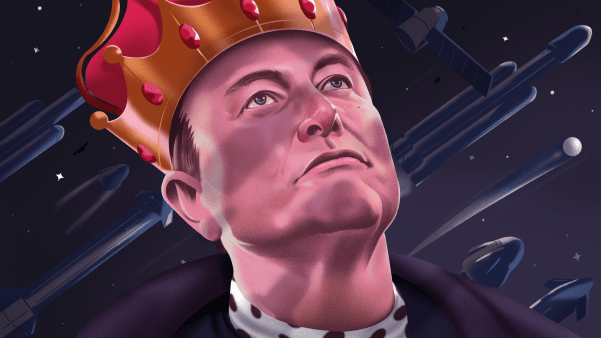
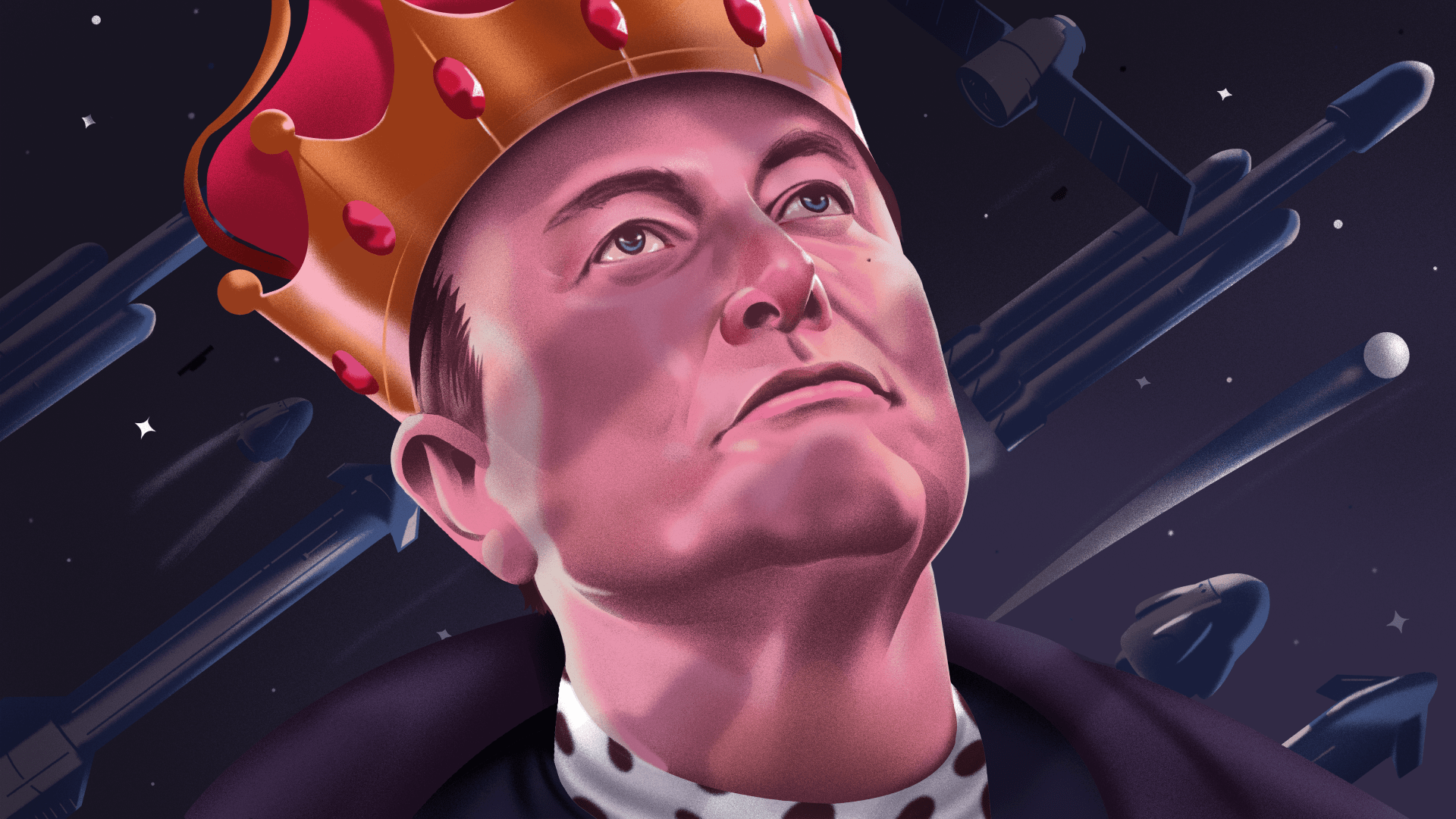
But we should also recognize that, alongside its genuine successes, this method has a heresy at its core. As Christians, we await not a “Techno-king,” Musk’s official title at Tesla, but a Messiah whose kingdom is not of this world.
Muskism opens with its weakest chapter, which considers the motives that led Musk’s maternal grandfather to immigrate to South Africa, implying Elon shares his ancestor’s racism. While the authors acknowledge that Musk has a “conflicted” relationship with his birthplace and was “alienated by the machismo that dominated white South African society,” they still insist, “Apartheid South Africa was the cradle of Muskism.”
The chapter relies mostly on speculation about his childhood, and—given that Musk secured a Canadian passport and left the country at just 17 to avoid military service—it seems unwarranted to saddle him with the evils of apartheid.
related


The next three chapters are better. They chart the early years of Musk’s career and identify key features of his modus operandi.
First, when the dot-com crash led tech companies to consolidate markets to turn a profit, Musk “moved in the opposite direction.” He invested the millions he made selling his first startup into making rockets and colonizing Mars. You can’t disrupt the aerospace and automobile industries simply by spinning up new software; you have to solve difficult engineering and logistical challenges. Mars hasn’t happened (yet), but Musk’s SpaceX drastically reduced the cost to launch satellites and succeeded in ferrying astronauts where legacy giants like Boeing embarrassingly failed.
Second, while libertarian rhetoric is the norm in Silicon Valley, Musk tends to collaborate with the state and often profits by providing platforms for government infrastructure. Musk himself has noted how state investment creates opportunity for private profit, drawing a parallel between tech companies benefiting from federal defense research that led to the internet and aerospace companies benefiting from NASA’s research.
SpaceX got its start fulfilling government contracts, and Tesla survived hard times by landing a large government loan. While Tesla paid back that loan early, it continued to benefit from federal incentives lowering the price of electric cars, and SpaceX has thrived on NASA contracts and on selling its Starlink internet service to governments alongside individual customers.
The US and other governments now pay Musk’s companies for “sovereignty as a service” in the same way they hire private security contractors such as Blackwater or contract with Palantir for information analysis. In 2025, Musk’s xAI signed a $200 million contract to give the US government access to Grok, its AI tool. Muskism doesn’t seek freedom from government; it seeks profit.
related


Third, Muskism combines principles from software development with vertical integration in a model that Slobodian and Tarnoff call “lean Fordism.” Silicon Valley, the land of “move fast and break things,” gave Musk experience with the power of iterating quickly and learning from failure. As Musk has said of SpaceX’s philosophy, “If we’re not blowing up engines, we’re not trying hard enough.” He has adapted elements of Toyota’s “lean production” methods to give Tesla engineers quick feedback.
What makes Muskism distinctive is how it combines the “fail-fast experimentalism” of agile development with the vertical integration championed by Henry Ford. Ford’s own implementation didn’t always succeed, and by the 1990s, globalization made just-in-time supply chains the more popular solution to lowering costs. Musk bucked these trends by bringing more production in-house.
Instead of outsourcing electric batteries for his cars, for instance, he built the “gigafactory” to make components for Teslas. Amid rising tensions between the US and China, the return of tariffs, and the disruptions of COVID-19, Musk’s insistence on controlling the entire production process proved prescient.
The second half of Muskism examines what the authors call Musk’s “cyborg turn”—his growing interest in social media that culminated in his purchase of Twitter (now X); his work on AI and brain-computer interfaces; his concerns about the “woke mind virus”; his crypto boosterism; and his role in Trump’s Department of Government Efficiency (DOGE) program. Yet what the book terms a “turn” obscures the continuity between the various personae that Musk wears. “Carbon Musk” and “Cyborg Musk” share the same DNA.
At its core, Muskism is a response to the disruption and uncertainty of contemporary life. If you want security, you need to control essential infrastructure: cars, factories, rockets, the internet, social media, AI. If the wrong people control them, disaster may ensue, so guarantee that the right people have control.


But this approach doesn’t fundamentally challenge the underlying dynamics set in motion by highly centralized networks. A more radical response to the existential risks posed by our dependence on far-flung, brittle infrastructure would embrace creaturely limits and seek decentralized, resilient forms of exchange. Muskism instead demands access to the “God mode” of total, centralized power. As the authors note, rather than looking to escape from the matrix, Musk wants to control it.
If you squint, you can almost make out a more decentralized road not taken. Widespread batteries and solar panels could make the electrical grid more resilient, and crypto’s promise has always been its peer-to-peer transactions. But Tesla—or any hacker—retains control of all its cars and can use its cameras and microphones to surveil drivers. And crypto remains prone to corruption or to celebrity influencers—like Musk—who manipulate its value.
Twitter is a case in point. Musk became frustrated with its role in spreading “the woke mind virus,” but “instead of seceding from the network, he [determined he] would take control of it,” Muskism’s authors write. The company had plenty of problems when Musk purchased it, and while he may have made it more profitable, it’s hard to argue that Muskism has made X a haven for civil conversation (though it has become a valuable source of training data for Grok). The fundamental problem isn’t the algorithm; it’s the scale.
Musk has also taken this approach with AI. He founded OpenAI out of concern about the damage that a rogue or misaligned AI could cause. When he lost control of that organization, he launched Grok instead. Yet training a reliable, “truth-seeking” AI is proving as impossible as running a large-scale social media platform in a way that serves truth and genuine understanding.
Muskism’s authors chart major Grok missteps, including when it called itself “MechaHitler” after a video-game character. Musk has confessed that “it is surprisingly hard” to guide AI between the Charybdis of (pardon his language) “woke libtard cuck” and the Scylla of “MechaHitler.” It may even be impossible.
related

Slobodian and Tarnoff observe that one approach to security is to airgap a computer, isolating it from any network by which hackers might access it. Musk consistently opts against that kind of solution. Instead, he personally takes control.
This mentality guided DOGE’s efforts to centralize government data across many agencies in a quest for efficiency and power. But as the authors point out, “Silos are not necessarily bad things. . . . The barriers between them can be safeguards—checks against overreach, misuse, and surveillance.” Even when it seems to succeed, Muskism leaves systems hypercentralized and therefore vulnerable to unprincipled tyrants and unforeseen disruptions.
For Musk, this is where Mars comes in: It’s the escape hatch if there’s a critical failure on Earth. If that seems far-fetched, keep in mind that it may, in fact, be easier to fly to Mars than to engineer social harmony and truth-seeking AI. For the rest of us, it’s prudent to know more about the techno-king shaping our society, and Muskism is a perceptive introduction, though the book has plenty of flaws.
Sometimes the authors indulge in dark insinuations or criticize Musk for things outside his control. They focus on his forays into European politics without acknowledging that, in fact, immigration and declining birth rates pose wicked political problems that more centrist and leftist parties have failed to address. They ignore that Musk isn’t responsible for elite failures and rising populist frustrations across the West.
These missteps are a good reminder that we shouldn’t get distracted by Musk’s flamethrowers and memes. Muskism is and will continue to be an influential ideology, and Christians can recognize its genuine accomplishments while rejecting its fundamental heresy.
Our hope does not lie in gaining “God mode” access and controlling essential platforms. If we place our hope in the return of the King who rode into Jerusalem on an ass, we’ll be freed to take up the work of loving our neighbor without fretting about what the future holds or the next Herod who thinks he’s on the throne. Some of us might even be freed to reimagine transportation and energy and communication in radically decentralized, convivial, redemptive ways.
Jeffrey Bilbro is professor of English at Grove City College and editor in chief at the Front Porch Republic. His most recent book is Words for Conviviality: Media Technologies and Practices of Hope.