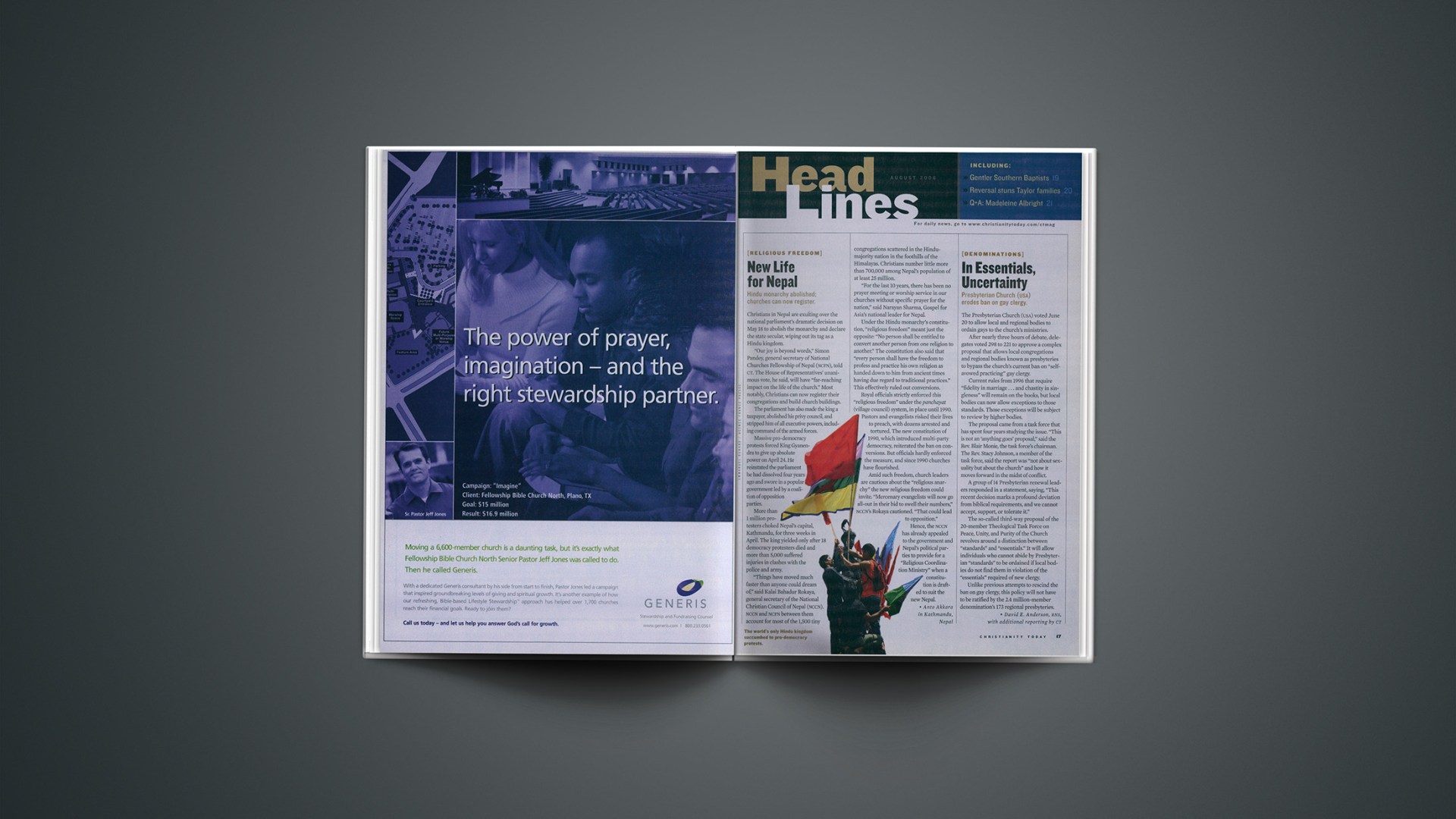

Christians in Nepal are exulting over the national parliament’s dramatic decision on May 18 to abolish the monarchy and declare the state secular, wiping out its tag as a Hindu kingdom.
“Our joy is beyond words,” Simon Pandey, general secretary of National Churches Fellowship of Nepal (NCFN), told CT. The House of Representatives’ unanimous vote, he said, will have “far-reaching impact on the life of the church.” Most notably, Christians can now register their congregations and build church buildings.
The parliament has also made the king a taxpayer, abolished his privy council, and stripped him of all executive powers, including command of the armed forces.
Massive pro-democracy protests forced King Gyanendra to give up absolute power on April 24. He reinstated the parliament he had dissolved four years ago and swore in a popular government led by a coalition of opposition parties.
More than 1 million protesters choked Nepal’s capital, Kathmandu, for three weeks in April. The king yielded only after 18 democracy protesters died and more than 5,000 suffered injuries in clashes with the police and army.
“Things have moved much faster than anyone could dream of,” said Kalai Bahadur Rokaya, general secretary of the National Christian Council of Nepal (NCCN). NCCN and NCFN between them account for most of the 1,500 tiny congregations scattered in the Hindu-majority nation in the foothills of the Himalayas. Christians number little more than 700,000 among Nepal’s population of at least 25 million.
“For the last 10 years, there has been no prayer meeting or worship service in our churches without specific prayer for the nation,” said Narayan Sharma, Gospel for Asia’s national leader for Nepal.
Under the Hindu monarchy’s constitution, “religious freedom” meant just the opposite: “No person shall be entitled to convert another person from one religion to another.” The constitution also said that “every person shall have the freedom to profess and practice his own religion as handed down to him from ancient times having due regard to traditional practices.” This effectively ruled out conversions.
Royal officials strictly enforced this “religious freedom” under the panchayat (village council) system, in place until 1990. Pastors and evangelists risked their lives to preach, with dozens arrested and tortured. The new constitution of 1990, which introduced multi-party democracy, reiterated the ban on conversions. But officials hardly enforced the measure, and since 1990 churches have flourished.
Amid such freedom, church leaders are cautious about the “religious anarchy” the new religious freedom could invite. “Mercenary evangelists will now go all-out in their bid to swell their numbers,” NCCN’s Rokaya cautioned. “That could lead to opposition.”
Hence, the NCCN has already appealed to the government and Nepal’s political parties to provide for a “Religious Coordination Ministry” when a constitution is drafted to suit the new Nepal.
Copyright © 2006 Christianity Today. Click for reprint information.
Related Elsewhere:
News elsewhere includes:
‘Women made anti-king protests successful’ | Women, despite playing a major role in the democracy movement in Nepal, have been excluded from all decision-making processes (The Times Of India, July 18, 2006)
Nepal – the challenges ahead | Maoist rebel leader Prachanda is last known to have set foot in Kathmandu 25 years ago, when the Nepalese capital was a sleepy temple town and political parties were banned. (BBC, June 16, 2006)
Red-faced China rushes to woo Nepal Maoists | With Nepal inching towards a new, interim government where the Maoist rebels would be a key partner, a red-faced China is rushing to mend fences with the guerrillas it once branded as anti-government forces tarnishing the image of late Chinese leader Mao Zedong. (Indo-Asian News Service, India, July 16, 2006)
Erasing the ‘royal’ in Nepal | The declaration issued by Nepal’s reinstated House of Representatives this week on the future of the country is much more than a piece of paper. (BBC, May19, 2006)
Nepal democracy Q&A | Nepal holds controversial municipal elections on 8 February amid tight security. A Maoist insurgency and a poll boycott by all the main opposition parties have raised concerns about the credibility of the polls. (BBC, February 7, 2006)
Previous CT coverage of Nepal includes:
Terror on Top of the World | Maoist threats shut down Nepal’s development work. (July 1, 2004)
Four Christians Released in Nepal | Witnesses who accused the Christians of bribing converts fail to show in court. (Feb. 14, 2001)
The Church at the Top of the World | Nepal’s Christians see unprecedented growth in this Hindu kingdom. (April 3, 2000)