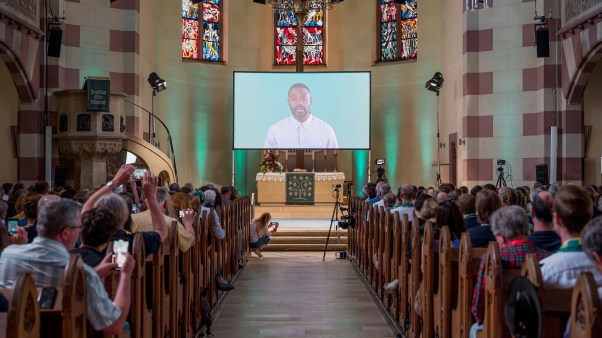
The Reformation of the 16th century was a revolution of mythic proportions. Scholars and pastors with fresh scriptural insights took advantage of revolutionary changes in the arts, science, humanities, politics, travel, and commerce to turn the Western world upside down. It marked both a return to biblical roots and a leap into the future. In the 21st century, what major changes in the church should Christians be hoping and working for? In the final installment of the Global Conversation, four key leaders from four continents reveal their hopes.
A key problem of evangelical churches worldwide is the unilateral emphasis on numerical growth. For the sake of it, the gospel is watered down, church services are turned into entertainment, and Jesus' commandment to make disciples is replaced by a strategy to enroll as many converts as possible. In my frequent travels, I find an increasing number of megachurches with a high rate of numerical growth but a low degree of concern for faithfulness to the whole gospel and the ethical dimensions of whole-life discipleship. One wonders what has happened to the vision of whole-life discipleship projected in 1974 by the First International Congress on World Evangelization (Lausanne I) in its celebrated Lausanne Covenant.
Lausanne I is regarded by many as the most significant world evangelical gathering of the 20th century. It is no exaggeration to say that the main significance of the conference was the rediscovery of the absolute importance of the socio-political dimensions of the gospel for church life and mission. According to paragraph five of the Lausanne Covenant, because "God is both the Creator and Judge of all people," Christians "should share his concern for justice and reconciliation throughout human society and for the liberation of men and women from every kind of oppression." From this perspective, the mission of the church must not be reduced to the oral proclamation of the gospel, as "evangelism and socio-political involvement are both part of our Christian duty." The traditional dichotomy between evangelism and social responsibility is thus practically discarded.
Several consultations organized during the late 1970s and early '80s by the theological commission of the Lausanne Movement—a commission chaired by John Stott—explored in depth the implications of these and similar statements made in the covenant. The various statements that emerged from these consultations provide both a solid basis and a rich agenda for Christian action in the world.
Unfortunately, Lausanne II, held in Manila in 1989, failed to follow up on Lausanne I's holistic understanding of the Christian mission. To a large extent it reaffirmed the traditional separation between evangelism and social action that has so deeply affected Western Christendom, especially in its evangelical expression, for the last couple of centuries.
One big question regarding the Third Lausanne Congress on World Evangelization in Cape Town is whether it will simply rubber stamp Lausanne II, or whether it will allow the Spirit to use God's Word, thus becoming a stepping stone for the urgently needed reformation of the church in the spirit of Lausanne I.
Rene Padilla is president emeritus of the Kairos Foundation and director of Kairos Books. He is a founding member of the Latin American Theological Fellowship, and author of Mission between the Times: Essays on the Kingdom.
Copyright © 2010 Christianity Today. Click for reprint information.