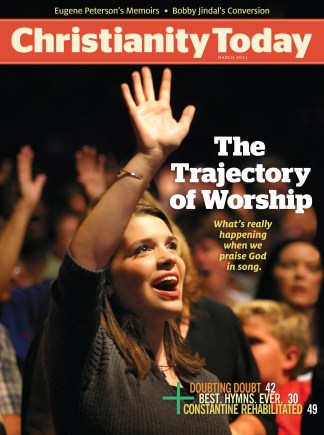
You know something is afoot when in a three-month span you receive five unsolicited manuscripts about worship and music—and all are worth publishing (especially when literally one in a hundred unsolicited manuscripts we receive sees publication). This is what happened last fall, and it didn’t take me long to decide to pull together at least four of the manuscripts into a package, (the fifth will be published in a later issue).
The confluence of articles suggests a few things. First, worship music continues to be a topic that engages us both emotionally and intellectually. I’m not convinced we’re still fighting “worship wars,” but we are still living through a tense truce, if my local congregation is any example. Second, this tense truce continues to prod people into deeper thinking—as evidenced by the pieces in this package. What holds the package together is nothing more than this: arresting thoughts and intriguing ideas about the nature of church music.
As often happens when discussing church music in the pages of Christianity Today, the articles display a bias for traditional music. This is unfortunate, because we at CT happen to also like contemporary worship music. We strove to find an article or conduct an interview that would give more space to exploring the gift of contemporary music, but we came up empty. I’ll be frank: When it comes to contemporary Christian music, I have yet to find authors who are able to probe its uniqueness with the same depth and insight as those who relish traditional music. What I usually find is articles that say, “But people like it!” That’s well and good and nothing to discount, but it’s not enough for a CT article! So admitting my limited exposure to this world, I want to encourage those with a contemporary bias to send us deeper ruminations on the topic.
In addition, we should acknowledge a source that does for worship music what Robert Coote’s article has done for hymns. To find out which contemporary worship songs are the most popular in the U.S., check out ccli.com, and click on “View CCLI Top 25 Worship Songs.” “Mighty To Save” tops the list and is followed by “How Great is Our God.” (CCLI offers licenses to churches to use copyrighted music and videos. Twice a year it compiles a list of the most requested songs.)
In any event, discussions like this are not designed to make the truce tenser, but simply to help us think deeply and faithfully about the music we use in worship.
Next month: Ed Stetzer suggests ways to conduct interfaith dialogue (which more and more evangelicals are engaging in) with love and respect while remaining true to our core convictions; Eric Miller explores our fascination with Amish romance fiction; and one man gives his testimony through the ravages of schizophrenia.
Copyright © 2011 Christianity Today. Click for reprint information.
Related Elsewhere:
Check back all this week for articles from March’s special issue on worship. Previously posted articles include:
The Hymns That Keep on Going | The 27 worship songs that have made the hymnal cut time and again. (March 7, 2011)
Whatever Happened to Amazing Grace? | Why John Newton’s famous hymn failed to win, place, or show. (March 8, 2011)
Pop Goes the Worship | Religion professor T. David Gordon says Muzak has shaped singing in church. (March 9, 2011)
Worship in Black and White | Racial reconciliation happens when we not only sing each other’s songs but learn the stories embedded in those songs. (March 10, 2011)
Also, both Christianity Today and Leadership Journal have special online sections on worship.