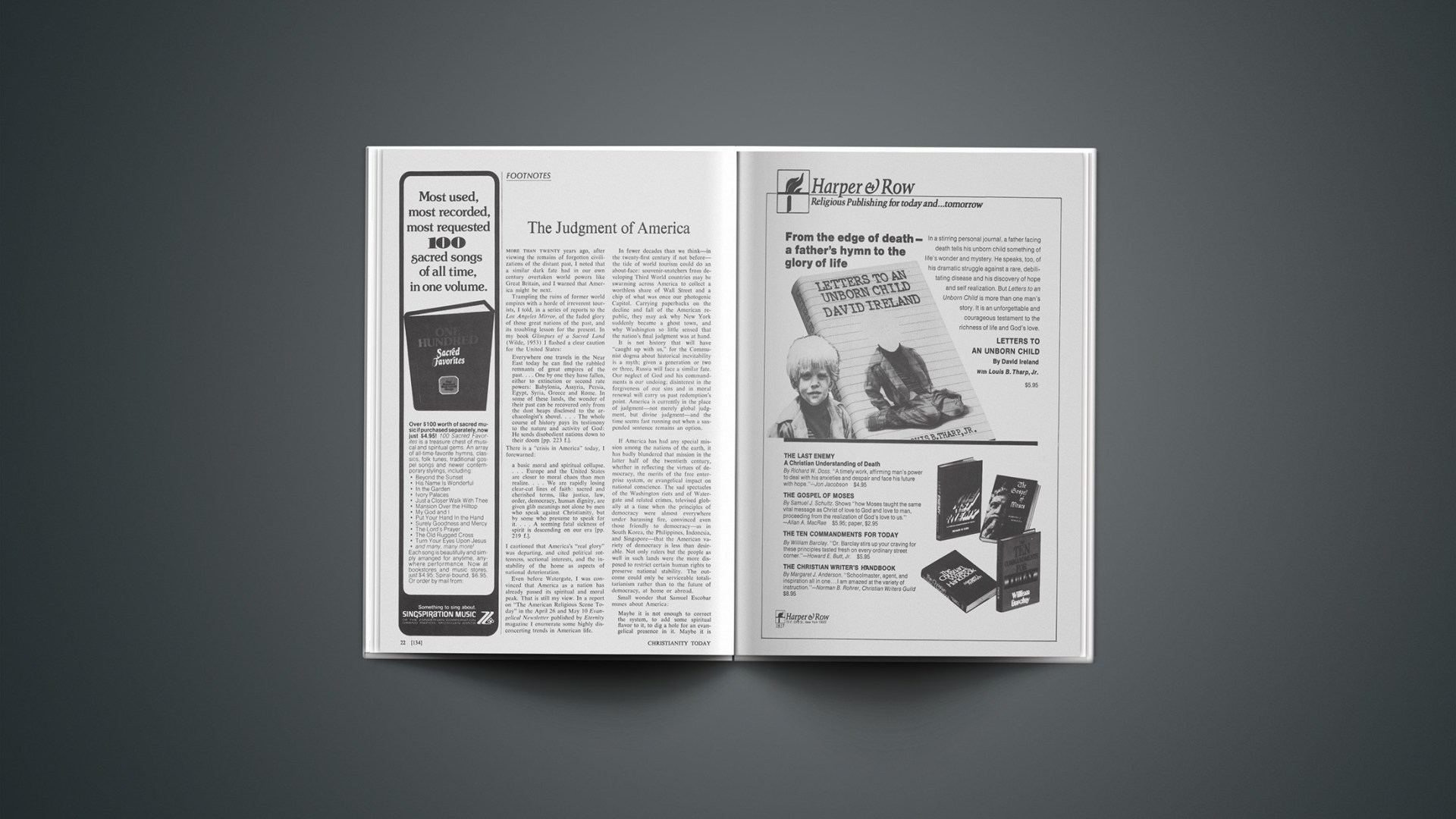

More than twenty years ago, after viewing the remains of forgotten civilizations of the distant past, I noted that a similar dark fate had in our own century overtaken world powers like Great Britain, and I warned that America might be next.
Trampling the ruins of former world empires with a horde of irreverent tourists, I told, in a series of reports to the Los Angeles Mirror, of the faded glory of those great nations of the past, and its troubling lesson for the present. In my book Glimpses of a Sacred Land (Wilde, 1953) I flashed a clear caution for the United States:
Everywhere one travels in the Near East today he can find the rubbled remnants of great empires of the past.… One by one they have fallen, either to extinction or second rate powers: Babylonia, Assyria, Persia, Egypt, Syria, Greece and Rome. In some of these lands, the wonder of their past can be recovered only from the dust heaps disclosed to the archaeologist’s shovel.… The whole course of history pays its testimony to the nature and activity of God: He sends disobedient nations down to their doom [pp. 223 f.].
There is a “crisis in America” today, I forewarned:
a basic moral and spiritual collapse.… Europe and the United States are closer to moral chaos than men realize.… We are rapidly losing clear-cut lines of faith: sacred and cherished terms, like justice, law, order, democracy, human dignity, are given glib meanings not alone by men who speak against Christianity, but by some who presume to speak for it.… A seeming fatal sickness of spirit is descending on our era [pp. 219 f.].
I cautioned that America’s “real glory” was departing, and cited political rottenness, sectional interests, and the instability of the home as aspects of national deterioration.
Even before Watergate, I was convinced that America as a nation has already passed its spiritual and moral peak. That is still my view. In a report on “The American Religious Scene Today” in the April 26 and May 10 Evangelical Newsletter published by Eternity magazine I enumerate some highly disconcerting trends in American life.
In fewer decades than we think—in the twenty-first century if not before—the tide of world tourism could do an about-face: souvenir-snatchers from developing Third World countries may be swarming across America to collect a worthless share of Wall Street and a chip of what was once our photogenic Capitol. Carrying paperbacks on the decline and fall of the American republic, they may ask why New York suddenly became a ghost town, and why Washington so little sensed that the nation’s final judgment was at hand.
It is not history that will have “caught up with us,” for the Communist dogma about historical inevitability is a myth; given a generation or two or three, Russia will face a similar fate. Our neglect of God and his commandments is our undoing; disinterest in the forgiveness of our sins and in moral renewal will carry us past redemption’s point. America is currently in the place of judgment—not merely global judgment, but divine judgment—and the time seems fast running out when a suspended sentence remains an option.
If America has had any special mission among the nations of the earth, it has badly blundered that mission in the latter half of the twentieth century, whether in reflecting the virtues of democracy, the merits of the free enterprise system, or evangelical impact on national conscience. The sad spectacles of the Washington riots and of Watergate and related crimes, televised globally at a time when the principles of democracy were almost everywhere under harassing fire, convinced even those friendly to democracy—as in South Korea, the Philippines, Indonesia, and Singapore—that the American variety of democracy is less than desirable. Not only rulers but the people as well in such lands were the more disposed to restrict certain human rights to preserve national stability. The outcome could only be serviceable totalitarianism rather than to the future of democracy, at home or abroad.
Small wonder that Samuel Escobar muses about America:
Maybe it is not enough to correct the system, to add some spiritual flavor to it, to dig a hole for an evangelical presence in it. Maybe it is necessary to question it and disengage ourselves from it. Maybe developments are calling us evangelicals also to attempt an escape from the Constantinian captivity of the Church—not into Marxism dressed with the rhetoric of liberation theology, but into a New Testament Christianity that takes seriously again what it means to call Jesus, and only Jesus—not Mammon—Lord [“Reflections,” in The Chicago Declaration, edited by Ronald J. Sider, Creation House, 1974, pp. 121 f.].
Socially sensitive evangelicals need to make such musings their own in these dark times. It will be no mark of patriotism to shoot off spectacular bicentennial fireworks and sing “The Star Spangled Banner” with double unction while glossing over the concerns of national righteousness.
Imagine, then, my surprise at finding myself characterized by Post-American editor Jim Wallis, writing in the June 21, 1974, issue of CHRISTIANITY TODAY, as biased “toward the general acceptability of the present American economic and political system” and as holding “a rather paranoid and unbalanced view of socialism.” For reasons of logic and space, let me fix the main issue in debate: Is the Post-American right in its judgment that the structure and exercise of American power must be viewed negatively, that American institutions are past redemption’s point, and that an authentically biblical attitude no longer permits a supra-American but rather demands a post-American perspective? If one takes the Post-American route, it seems to me, he can “observe” the bicentennial only by implementing a new revolution. If American politico-economic structures are inherently corrupt, then the only conscientious course will be to strive not to improve those structures but to overthrow them.
The “Chicago Declaration” adopted by the Thanksgiving/73 Workshop included the phrase “an unjust American society” without elaboration. Is this injustice inherent or contingent? Ronald Sider, editor of the workshop paperback, seems gratuitously to imply that American economic structures are perse “racist and unjust.” If that be the case, would not the only moral course be to renounce one’s citizenship?
It takes an omniscience that the Post-American lacks to suggest that America is the incarnation of politico-economic evil, that God has written off the nation and condemned it to march off the map.
The truth seems to me to lie somewhere between a super-Americanism that adulates our national institutions and Jim Wallis’s post-American requiem.