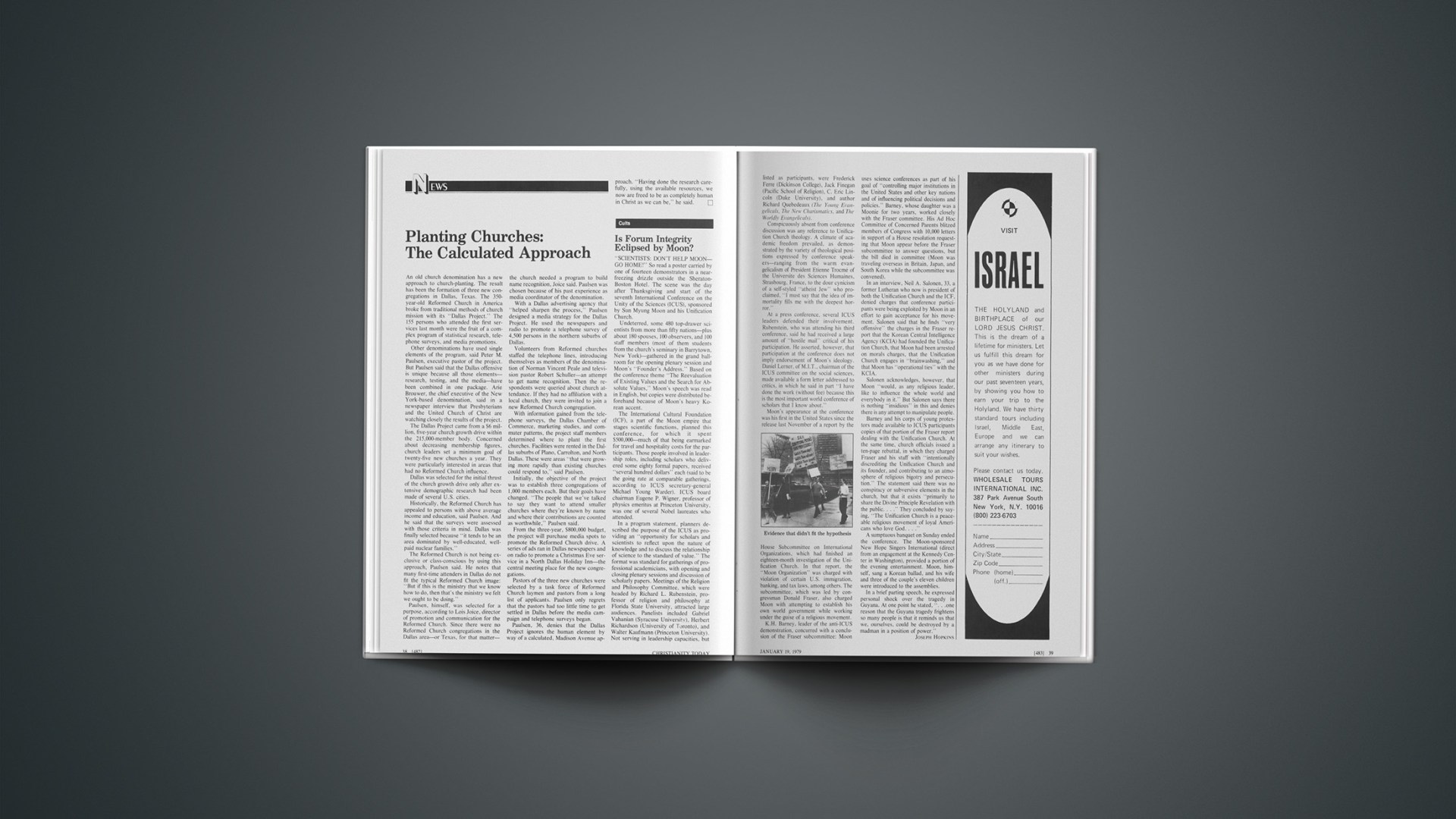

An old church denomination has a new approach to church-planting. The result has been the formation of three new congregations in Dallas, Texas. The 350-year-old Reformed Church in America broke from traditional methods of church mission with its “Dallas Project.” The 155 persons who attended the first services last month were the fruit of a complex program of statistical research, telephone surveys, and media promotions.
Other denominations have used single elements of the program, said Peter M. Paulsen, executive pastor of the project. But Paulsen said that the Dallas offensive is unique because all those elements—research, testing, and the media—have been combined in one package. Arie Brouwer, the chief executive of the New York-based denomination, said in a newspaper interview that Presbyterians and the United Church of Christ are watching closely the results of the project.
The Dallas Project came from a $6 million, five-year church growth drive within the 215,000-member body. Concerned about decreasing membership figures, church leaders set a minimum goal of twenty-five new churches a year. They were particularly interested in areas that had no Reformed Church influence.
Dallas was selected for the initial thrust of the church growth drive only after extensive demographic research had been made of several U.S. cities.
Historically, the Reformed Church has appealed to persons with above average income and education, said Paulsen. And he said that the surveys were assessed with those criteria in mind. Dallas was finally selected because “it tends to be an area dominated by well-educated, well-paid nuclear families.”
The Reformed Church is not being exclusive or class-conscious by using this approach, Paulsen said. He notes that many first-time attenders in Dallas do not fit the typical Reformed Church image: “But if this is the ministry that we know how to do, then that’s the ministry we felt we ought to be doing.”
Paulsen, himself, was selected for a purpose, according to Lois Joice, director of promotion and communication for the Reformed Church. Since there were no Reformed Church congregations in the Dallas area—or Texas, for that matter—the church needed a program to build name recognition, Joice said. Paulsen was chosen because of his past experience as media coordinator of the denomination.
With a Dallas advertising agency that “helped sharpen the process,” Paulsen designed a media strategy for the Dallas Project. He used the newspapers and radio to promote a telephone survey of 4,500 persons in the northern suburbs of Dallas.
Volunteers from Reformed churches staffed the telephone lines, introducing themselves as members of the denomination of Norman Vincent Peale and television pastor Robert Schuller—an attempt to get name recognition. Then the respondents were queried about church attendance. If they had no affiliation with a local church, they were invited to join a new Reformed Church congregation.
With information gained from the telephone surveys, the Dallas Chamber of Commerce, marketing studies, and commuter patterns, the project staff members determined where to plant the first churches. Facilities were rented in the Dallas suburbs of Plano, Carrolton, and North Dallas. These were areas “that were growing more rapidly than existing churches could respond to,” said Paulsen.
Initially, the objective of the project was to establish three congregations of 1,000 members each. But their goals have changed. “The people that we’ve talked to say they want to attend smaller churches where they’re known by name and where their contributions are counted as worthwhile,” Paulsen said.
From the three-year, $800,000 budget, the project will purchase media spots to promote the Reformed Church drive. A series of ads ran in Dallas newspapers and on radio to promote a Christmas Eve service in a North Dallas Holiday Inn—the central meeting place for the new congregations.
Pastors of the three new churches were selected by a task force of Reformed Church laymen and pastors from a long list of applicants. Paulsen only regrets that the pastors had too little time to get settled in Dallas before the media campaign and telephone surveys began.
Paulsen, 36, denies that the Dallas Project ignores the human element by way of a calculated, Madison Avenue approach. “Having done the research carefully, using the available resources, we now are freed to be as completely human in Christ as we can be,” he said.