
People in the pew are reluctant to offer critical advice.
Good preaching—we hear much analysis of it. But many people ignore one of its important components: delivery. Everyone who speaks in church constantly needs to review the “p’s and q’s” of oral communication. Inattention to this matter jeopardizes the effectiveness of sermons that may otherwise be excellent.
While completing degrees in public address, some graduate students recorded a number of preachers from the community. The speakers were told that the project included a phonetic analysis of their voices.
The students discovered that several speakers could have vastly improved their delivery. For example, one man enunciated inadequately. Another simply needed to open his mouth wider and stop talking through his teeth. More vigorous use of tongue and lips could have improved the articulation of others. Nasalities could have been reduced. Squeaky or raspy voices with proper exercises could have been moderated.
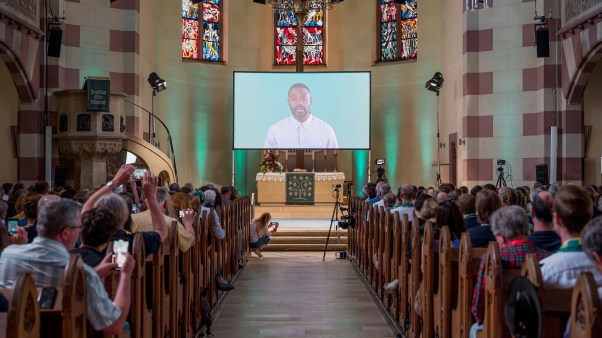
Neither the people in the pew or in the classroom criticize our delivery, fellow church speaker. If your voice, gestures, or idiosyncracies of delivery grates on the listeners’ ears, they will patiently bear it. Or they may transfer to another church, or even stop listening to any preacher.
A study of graduates of Yale College from 1702 to 1779 shows that 79 per cent of the ministers served one congregation all their lives. How longsuffering these congregations must have been if they were subjected to a ministerial monotone, an insipid manuscript shuffler, a prancer, a bombastic shouter, a nose twitcher, or maybe a two-hour scowler. Outstanding content could hardly have compensated for badly delivered sermons.
If the pulpit pounder needs advice on how to more effectively communicate, the church members will rarely suggest it. Even preachers are reluctant to advise their colleagues. The possible price of ruined fellowship is too much. We must, if necessary, “heal ourselves.” Egotism, out of the way.
What are some of the more obvious manners of church speakers that keep them from being effective proclaimers of God’s Word?
Overuse of particular words or phrases is one. For example, you may overuse such phrases as, “We know,” “Certainly we believe,” “It is true,” “We see,” or “We believe.” People like variety. Try to use synonyms. Vary the words or phrases you use to make transitions.
You will lose people’s attention when you never use the rhetorical pause, vary your rate of speaking, or change your volume. No one pays attention to a droning airplane engine. But when that engine slows down, speeds up, roars and purrs, sputters, and even stops and starts during operation, it rivets the attention of all its hearers.
A continuous procession of “ah’s” to cover your search for the correct word or phrase is also nerve racking. Better to use a manuscript skillfully than to exhaust people’s patience. You may be producing teenagers who stay alert just to count the number of “ah’s” in your address.
“Bodily exercise profiteth little,” said Paul. On the other hand, some exercise is beneficial. Here the golden mean is true for the speaker when it involves gestures. Pacing back and forth like a sentry on quick-time duty may lose significance when you do it fifty-two times a year.
At the same time people do not want to gaze at a public statue, particularly one that depends on the pulpit to keep it upright. Variety is the word. Overuse of any particular gesture makes it ineffective. Remember that familiarity fosters boredom.
Nervous idiosyncracies are another detriment to the speaker addressing the same assembly week after week. Don’t pull an ear, straighten a necktie, toss back hair that is falling over your forehead. However, these mannerisms do make the speaker human. And no one wants to listen to a robot of mechanical perfection. Despite his imperfections, each speaker has a distinctive personality that God can use.
Although the Lord can and sometimes does use the person careless or ignorant about his sermon delivery, God might be able to multiply his use of that person if more attention were given to the task. Public speaking is a learned art. Forgotten skills can be improved. The needs of the church demand it.
Here are some suggestions to help you: Reread textbooks and look for ideas in new books. Use the tape recorder at least once a month. Count the “ah’s.” Note your rate and pitch. Do you speak so rapidly that some people can’t follow you? What about your enunciation? How’s your English? Do you read the Bible in a mechanical, lifeless manner, never noticing the setting, the conversation?
Ask an objective person who has nothing to gain by flattering you to periodically “check you out.” Perhaps there is a speech teacher in the congregation or community who, if asked, would be thoroughly candid about your delivery.
The ancient Greeks and Romans lavished time, effort, and money on public speaking—this in honor of the gods and for the praise of men. Don’t our reasons for being effective communicators surpass theirs?—RICHARD HOSTETTER, Winston-Salem Bible College, Winston-Salem, North Carolina.