In October 312, Constantine and his forces marched toward Rome. Arrayed against them were the armies of Maxentius—four times greater. At stake was control of Rome and sole rule of the Western Empire.
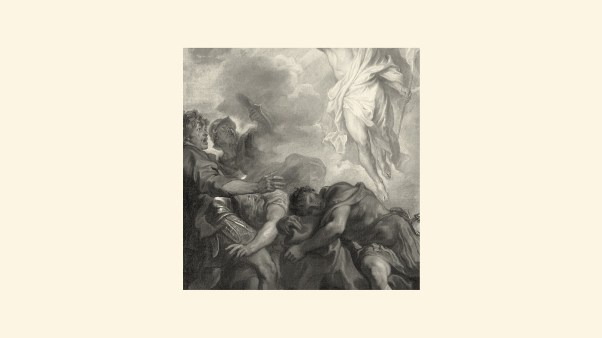
According to Christian historian Eusebius, the troubled Constantine sought help in prayer to his father’s god. Constantine then had a vision of a cross of light emblazoned against the sun and saw the words In hoc signo vinces: “In this sign you will win.” Constantine ordered the monogram of Christ to be painted on his soldiers’ shields. When he later engaged Maxentius, Constantine won a decisive victory. What was this emblem? Where did it originate? Historian David F. Wright offers this brief history.
The military standard or ensign carried by the Roman legions was normally a metal pole surmounted by a figure of an eagle and often bearing other decorative features. The name labarum (a word of disputed origin—perhaps Celtic) may already have designated such a standard, but it became the distinctive name of the form Constantine gave it—the eagle displaced by a sign based on the chi-rho monogram, i.e., the first two letters (C, R) of “Christ” in Greek.
Later this symbol itself came to be known as the labarum, even when blazoned not on a standard but on shields or helmets. The emblem was thought of as incorporating a cross. Antecedents for the chi-rho monogram have sometime been suggested. What matters, however, is that Constantine incontrovertibly adopted it as a token of his Christian allegiance.
Accounts of Constantine’s later military campaigns show him using the labarum as a kind of talisman against his enemies. This is one illustration of what modern Christians might describe as the superstitious character of his Christianity.
David F. Wright is dean of the Faculty of Divinity at the University of Edinburgh.
Copyright © 1990 by the author or Christianity Today/Christian History magazine.Click here for reprint information on Christian History.