In this series

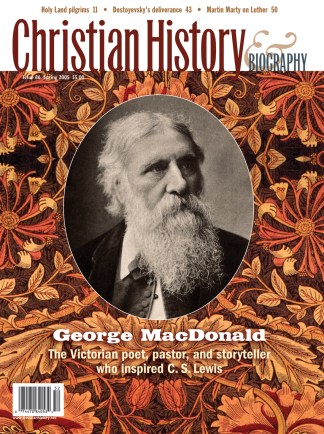
Like many people, I owe my discovery of George MacDonald to C. S. Lewis. I met him first in Surprised by Joy as the author of the book that marked a crucial turning point in Lewis’s pilgrimage to faith. I met him again in The Great Divorce as the narrator’s gentle Scottish guide through heaven. From there I found my way to The Princess and the Goblin, Phantastes, and Sir Gibbie. Many books later, I realized the full truth of Lewis’s statement: “I have never concealed the fact that I regarded him as my master; indeed I fancy I have never written a book in which I did not quote from him.” So many of the theological ideas and emphases I associated with Lewis were there waiting for me in MacDonald—the same abundant imagination, the same longing for something beyond, the same pervasive sense of joy at the center of existence.
So it is very fitting, as Christian History & Biography prepares a new C. S. Lewis issue for Fall 2005, to look first at the man whose writings shaped him more than any other’s. And when we do so, what we find is not just a preface to Lewis but a fascinating story in its own right. Though 20th-century readers have focused on MacDonald as a writer of fantasies and fairy tales with unique symbolic depth, he was a man of wide interests and gifts. Poet, pastor, popular novelist, lecturer on English literature, literary critic, translator, humanitarian, actor, mystic, theorist of the imagination, friend of theologians, artists, and orphans, father of 11 children—he is a window into the Victorian period in all its dizzying diversity.
MacDonald was not a systematic theologian, and it is impossible to fit him into a neatly defined box. He attracts (and sometimes offends) Protestants and Catholics, evangelicals and liberals. He combines a Calvinist’s rock-solid assurance of God’s sovereignty with a Romantic’s love of nature and a hope for the salvation of all people that is reminiscent of the early church father Origen. He was enormously popular among the Unitarians of his era because of his sensitivity to the humanity of Christ, yet he insisted on preaching a firmly Trinitarian faith when he visited their churches. “The Divine Sonship is the key-conception which unites all the different elements of his thought,” wrote Lewis of this paradoxical man. “I dare not say that he is never in error [italics mine]; but to speak plainly I know hardly any other writer who seems to be closer, or more continuously close, to the Spirit of Christ Himself. Hence his Christ-like union of tenderness and severity. Nowhere else outside the New Testament have I found terror and comfort so intertwined.”
Another of MacDonald’s early admirers, G. K. Chesterton, believed that it was precisely MacDonald’s ability to bridge different traditions that made him historically significant: “And when he comes to be more carefully studied as a mystic, as I think he will be when people discover the possibility of collecting jewels scattered in a rather irregular setting, it will be found, I fancy, that he stands for a rather important turning-point in the history of Christendom, as representing the particular Christian nation of the Scots. As Protestants speak of the morning stars of the Reformation, we may be allowed to note such names here and there as morning stars of the Reunion.”
There is always the danger that in studying the religious perspective of any writer or artist, we reduce his or her art to simply a roadmap of ideas. But a work of art—even one made of words, like a novel or a fairy tale—is more than the sum of its individual theological or moral parts. It also stands on its own. And so I encourage you to read MacDonald’s works, and to read other works of fiction, through the lens he recommends: the lens of the imagination, by which we are lifted beyond merely what is to what could be. As MacDonald himself reminds us, we live by faith and not by sight.
Special thanks go to Chris Mitchell, Heidi Truty, and the staff of the Marion E. Wade Center for their assistance in preparing this issue.
Copyright © 2005 by the author or Christianity Today/Christian History & Biography magazine.Click here for reprint information on Christian History & Biography.