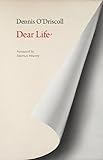
On dull Friday nights back in college, a friend and I sometimes played a game we called "Cliché." One of us lobbed a cliché, the other responded in kind, and back and forth we went until one of us came up empty. Anyone who picks up Dear Life, the ninth and last book of poems by Irish poet Dennis O'Driscoll, will immediately understand why it made me think of Cliché for the first time in many years. Some people do miraculous things with chicken. In Dear Life, O'Driscoll works magic with clichés.
Many of the poems explore business and consumer culture, and the characteristic cliché of each. The narrator of "Compo" tells us to "Be absolutely apoplectic. / Fuming mad," at the outset of a litany of complaints that concludes:
Someone has to take the rap.
You're fed up to the teeth.
Won't stand their crap one minute longer.
Heads must roll.
In a marvelously funny and wise poem called "Sub," the narrator asks whether, if "life were touted / like a magazine subscription, would you—/ knowing what you do now—sign up?" No we wouldn't, he concludes. We surely would check the box saying "Send no further offers" or the one "marked 'No, thanks.' "
The decline of faith in Ireland as it morphed into a fast-paced, secular Celtic Tiger (until tamed by the recent recession) comes in for similar treatment. "Our Father" recounts the long history (as the narrator sees it) of God's silence. We "upp[ed] the ante" in the face of God's "[s]tony silence," "[c]old shoulder," and "[f]urther snubbing ," the narrator says, finally rolling out "our nuclear option, / proffering our ace card: / the heart-on-sleeve / one intimating 'love.' " In "Imago," Jesus is described as "[s]ome showman, up to his god-like tricks, on tour for a limited run only," who "mesmerized audiences with his antics: sea striding, lacing tap water with best vintage, then genetically modifying the wine into his blood." This "smooth talker" promised "a further coming," but "we have been stood up, palmed off with this mystifying no-show."
Dear Life's other recurring theme is death and the fragility of life. In the book's long title poem, life is "dear" in both senses of the word: it is both precious and costly. The poem's 20 sections are at once wistful and shot through with gallows humor. The narrator reminds himself and us that "Life gives / us something / to live for"; admits that he "Cannot imagine / living without it"; and warns himself and us that "you will not escape [life] with your life."
O'Driscoll lost his parents early (both died when he was 20), an experience that surely contributed to the preoccupation with mortality in his poems, and perhaps to his questions about God and religion. With the workaday world of business, too, O'Driscoll was the rare poet who knows whereof he speaks. At the tender age of 16, he took a job with Ireland's taxing authority. Although he completed a law degree a few years later, O'Driscoll continued to work in the tax department for nearly 40 years, starting in death duties (the estate or "death" tax, as Americans would call it), moving to customs, and working his way into management. For a time, he was the editor of Tax Briefing, a technical tax publication. Unlike Wallace Stevens, the poet and insurance man whose working career most closely resembled his, O'Driscoll often incorporated the business world explicitly into his poetry.
My favorite example here is "Revenue Customs," an elegy in three sections for the tax office from which the narrator is about to retire. The second section imagines the tax office as if it were a museum celebrating the activities of "dexterous drafters / of sub-sections, pluggers of loopholes." With the exception of David Foster Wallace, it is hard to imagine another contemporary writer who would attempt to tackle the daily lives of tax collectors, much less write movingly about them. "Revenue Customs" loses none of its strangeness and odd poignancy when we learn that the tax office where O'Driscoll worked, which was housed in Dublin Castle, actually was turned into a museum, an occasion for which O'Driscoll was commissioned to write a poem in 2008.
Earlier this year, a prominent law professor who's become interested in the remarkable absence of serious poems about law and the other infrastructure issues of our culture asked me if I could point to any exceptions. (His favorite is "The Sons of Martha" by Rudyard Kipling.) Happily, I had Dear Life in my book bag. I immediately pulled it out, and will continue to do so whenever someone asks why there are so few fine poems about that vast stretch of experience non-poets call the "real world."
O'Driscoll, a frequent radio commentator and poetry reviewer, is nearly as well known in Ireland for Stepping Stones, a superb, biography-length collection of interviews of his long-time friend Seamus Heaney (who wrote a lovely, discerning foreword for Dear Life), as for his own poems. (Two superb volumes of his critical essays and memoirish pieces have been published in Ireland by the Gallery Press, the second book posthumously: Troubled Thoughts, Majestic Dreams: Selected Prose Writings; and The Outnumbered Poet: Critical and Autobiographical Essays.) Many are the commentators who have marveled that O'Driscoll cast his eyes toward Eastern Europe for inspiration—toward poets like Wislawa Szymborska and Miroslav Holub—rather than echoing the ornate music of Heaney and others in the Irish tradition. Even more than his earlier books, the poems of Dear Life do share the clear syntax, relaxed lines, and refreshing readability of the Eastern European poets O'Driscoll admired. They go down easy. But the distance from Heaney shouldn't be exaggerated. These poems are full of music, and there are hints too of Heaney's fondness for heaping up appositional clauses, each of which echoes and modulates the ones that came before. The narrator of "Snow," which is full of these effects, compares a newly fallen snow to a baked Alaska cake, each "[t]oo good to last, too huge a con-job / to sustain, too false a façade / to maintain."
A few poems in Dear Life fall flat, usually for lack of sufficient strangeness or surprise. A poem called "Synopsis," for instance, strings together clipped clichés testifying to our excessive busyness ("Life passes at a breakneck rate. / Brisk as text messages"), but never quite gets off the ground.
The best of the poems juxtapose seemingly incongruous elements. In "Admissions," which will remind some readers of William Carlos Williams' classic "Spring and All," a narrator who had "badmouth[ed] a world that never lives up / to its billing" recounts how everything he passed as he was being driven to a hospital for admission "gleamed with some ameliorating feature" and "demonstrate[d] its best case scenario." The poem closes with the moving admission, drawn from the famous words of Genesis 1, "and he saw that it was good."
In December 2012, Dennis O'Driscoll died suddenly, at the age of fifty-eight. Although he had mused about the fragility of life and the prospect of death for decades, his death nevertheless came as a great shock to many.
After reading Dear Life, I often find myself wondering what O'Driscoll was like in person and regretting I did not come across his poems while he was still living. A mixer of seemingly unmixable talents, he must have been a marvelous person to have a beer with—even if he, unlike almost any other Irish poet, was a complete teetotaler. In photos, there is an unmistakable twinkle in his eye.
The poems twinkle too, with a unique combination of light-hearted ebullience and tragic sensibility. These lines from "Memoir" capture the effect. As with so much of this fine, final book, they now seem prescient:
Now my
whole life
lies ahead
of you.
No thanks
at all are
called for,
I assure you.
The pleasure
is all mine.
David Skeel is a law professor at the University of Pennsylvania. His new book True Paradox: How Christianity Makes Sense of Our Complex World will be published by InterVarsity Press in October.
Copyright © 2014 by the author or Christianity Today/Books & Culture magazine. Click here for reprint information on Books & Culture.