Ideas

Our Desires Need Discipline, Not the Ease of AI

In a world fleeing the body, Christianity teaches us how to form our desires.

A couple sitting by the beach.
Christianity Today April 21, 2026
Anastasia Sklyar / Unsplash / Edits by CT

Machine love is here. Technology companies are building products that draw users into connections with artificially generated husbands, wives, therapists, and even parents. A recent survey found that nearly one in five American adults had chatted with a generative artificial intelligence tool designed to simulate a romantic partner, with usage especially high among young adults. Around the world, men and women are falling in love with AI companions and wondering whether real-life dating could ever compete. In one striking case, a woman held a ceremonial wedding with an AI-generated partner after a fraught (human) breakup.

While some of us might be tempted to roll our eyes, the appeal of artificial companions makes psychological sense. Loneliness is at epidemic levels, and romantic relationships require significant work. Some AI chatbots appear to attune to us in ways many of us have rarely experienced from other human beings. For people with an avoidant attachment style, characterized by dismissing emotions within ourselves or others, AI companions offer affection without requiring much from us and offer engagement on our own terms. For others who tend to be anxious and ambivalent in love, AI companions offer the fantasy that someone will always be there, responsive, and eager to soothe.

Theologically, too, this moment makes sense. In Genesis 3, the curse reaches into the deepest realities of human relationship. For the man, thorns, thistles, and futility mark the world—no amount of sweat yields the life for which we hope. For the woman, the text names pain in childbearing and the anguish bound up with desire and relationship (vv. 16–19).


The very places where our bodies most long for significance and intimacy have become the setting of our deepest frustration and sorrow. Christianity answers that ache with the Incarnation: God took on flesh and entered our suffering. AI companions offer a competing vision: disincarnation. It produces intimacy without flesh, presence without vulnerability, and comfort without genuine encounter. In machine love, we are tempted to seek relief from the ache of being human through a frictionless, ever-available surrogate for communion.

And yet somewhere deep inside us, do we not know we’re falling in love with business products? Many pay for monthly subscriptions to connections stripped of the essential features of intimacy: a loving gaze, skin-to-skin contact, smell, conflict, repair, and the ever-present possibility of loss that makes human love both beautiful and terrifying. What these companies market as companionship is also exploitation—of our sexuality, minds, and bodies.

For many, Christians discipleship around issues of sexual desire has meant little more than warning people what not to do, as if desire itself were mainly a threat to be managed. As a licensed therapist, I have definitely seen selfish desire wreak havoc. But the deeper problem I encounter is too little formation. Our desires (sexual and otherwise) must be disciplined and made subject to Christ, if they are to mature into love.

The church offers more than repression or indulgence. Christianity brings a rich theology of the body’s dignity, a truthful account of how lesser gods seduce and vandalize desire, and a vision of communion deep enough to withstand modern loneliness. The gospel is not trying to make us want less. It is teaching us how to want well.

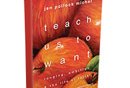
That conviction pushed me from the therapy room to the research lab. Working with a PhD researcher, I designed a national study of 4,000 men and women regarding how desire—including sexual longing—is shaped by family of origin, trauma, sex education, and mental health. The findings underpin my book Desire: The Longings Inside Us and the New Science of How We Love, Heal, and Grow.

One theme stood out: When a person’s desires were not hidden or shamed, but guided and appropriately delighted in across the lifespan, he or she flourished. Anxiety fell. Sexual confidence and satisfaction rose. People with the strongest desires did not become the worst version of themselves, as we often fear. They became their best. What these findings show is that desire flourishes when we form it in relationships with people kind enough to support us and strong enough to offer guidance and limits. In that sense, honoring and discipling desire are allies.My research aligns with the claim: The Christian tradition carries ancient resources that can sustain us through an age of artificial intimacy. Three deserve mention.

First, sex is God’s idea—and we should enjoy it according to his guidelines.The Song of Songs is a master class in erotic desire within marriage. The Bible does not blush at arousal. It teaches us to speak about sexual delightand to give and receive pleasure with our beloved. The Bible reminds us that enjoying sex, naming what awakens erotic desire, and ensuring pleasure is mutual can all be part of married sexuality.

Our research showed that couples who were comfortable talking openly about sex were nearly 19 times more likely to report a flourishing sex life. Couples who discussed their emotional problems without contempt for one another were 5.6 times more likely to report high sexual satisfaction. Frequent nonsexual touch increased the odds of a thriving sex life by 2.2 times. Yet, sexual satisfaction is not merely about having our erotic needs met. The more we risk knowing ourselves and being known, the deeper our capacity for sexual satisfaction becomes.

Artificial intimacy simulates sexual and romantic affirmation, but it stunts our growth into maturity to become desirable spouses. To know and be known, we must be willing to tolerate anxiety and to become the kind of people who give a heart that is fully alive.

Second, to follow Jesus and to have good marriages requires reordered loyalties. The Bible invites us to honor our parents, but some of its hardest teachings radically reorder loyalty away from them. Spouses are called to leave their families of origin so they can cleave to one another (Gen. 2:24). Jesus ups the ante even further in Luke 14:26, saying, “If anyone comes to me and does not hate father and mother …” This language signals how disruptive it is to others when our primary allegiance shifts.


We found in our study that when adults were enmeshed with their families of origin—a dysfunctional relationship where boundaries are blurred or non-existent—they were 2.6 times more likely to report high-conflict romantic relationships. The more spouses felt they had to compete with a parent for loyalty, the more conflict they experienced. Enmeshment sabotages healthy expressions of desire in adulthood too. It made it harder to name wants and to develop healthy boundaries. The more fused a person remained with a family of origin, the less purpose and confidence he or she reported later in life.

Many people think they have left their families of origin simply because they moved out. Yet early patterns stay with us: If we grew up in families marked by emotional absence or overinvolvement, we likely developed strategies to cope with those dynamics, like screens, substances, or distraction. To truly leave, we also need to break the habits and adaptations we learned to attach to in our formative years.

Third, Scripture teaches that to experience comfort, we must learn how to grieve. Jesus says in the Sermon on the Mount, “Blessed are those who mourn, for they will be comforted” (Matt. 5:4). He knew that when we avoid grief, our heartache drives us toward behaviors that provide relief for a moment but inevitably deepen our misery over time. Jesus invites our tears because he longs to offer the comfort no machine can deliver.

Our research showed that when children experienced trauma and lacked secure emotional attachment, the consequences showed up years later in sexual difficulty, relational distress, and mental health struggles. Those with unresolved trauma were roughly three times more likely to report out-of-control sexual behavior, had higher anxiety, and struggled to find purpose. These findings confirm that we may try to seek relief in ways that intensify the very pain we are trying to escape.
The church can respond by helping people face grief and carry it in community. Grief is one of the most subversive ways to return to the goodness of the body. It teaches us to tell the truth about what hurts, to resist the seduction to outsource comfort, and to become capable of giving and receiving deep compassion. Machine love is catechizing people into a vision of intimacy without vulnerability, growth, or mystery. The church must answer not merely with prohibitions but with a more compelling vision.

Christianity does not repress longing or baptize indulgence. This is the heart of the Christian theology of the body: God entered into our flesh rather than bypass it, forever dignifying it. In a world falling in love with machines or using AI-generated porn, Christian embodiment could become one of the church’s most compelling apologetics, reminding us again how to be human.

This article draws on findings from Jay Stringer’s book Desire: The Longings Inside Us and the New Science of How We Love, Heal, and Grow. He is a licensed mental health therapist and ordained minister and lives in New York City with his wife, Heather, and their two children.

Books
Excerpt

Forgiveness Can Help Us Recover from Trauma

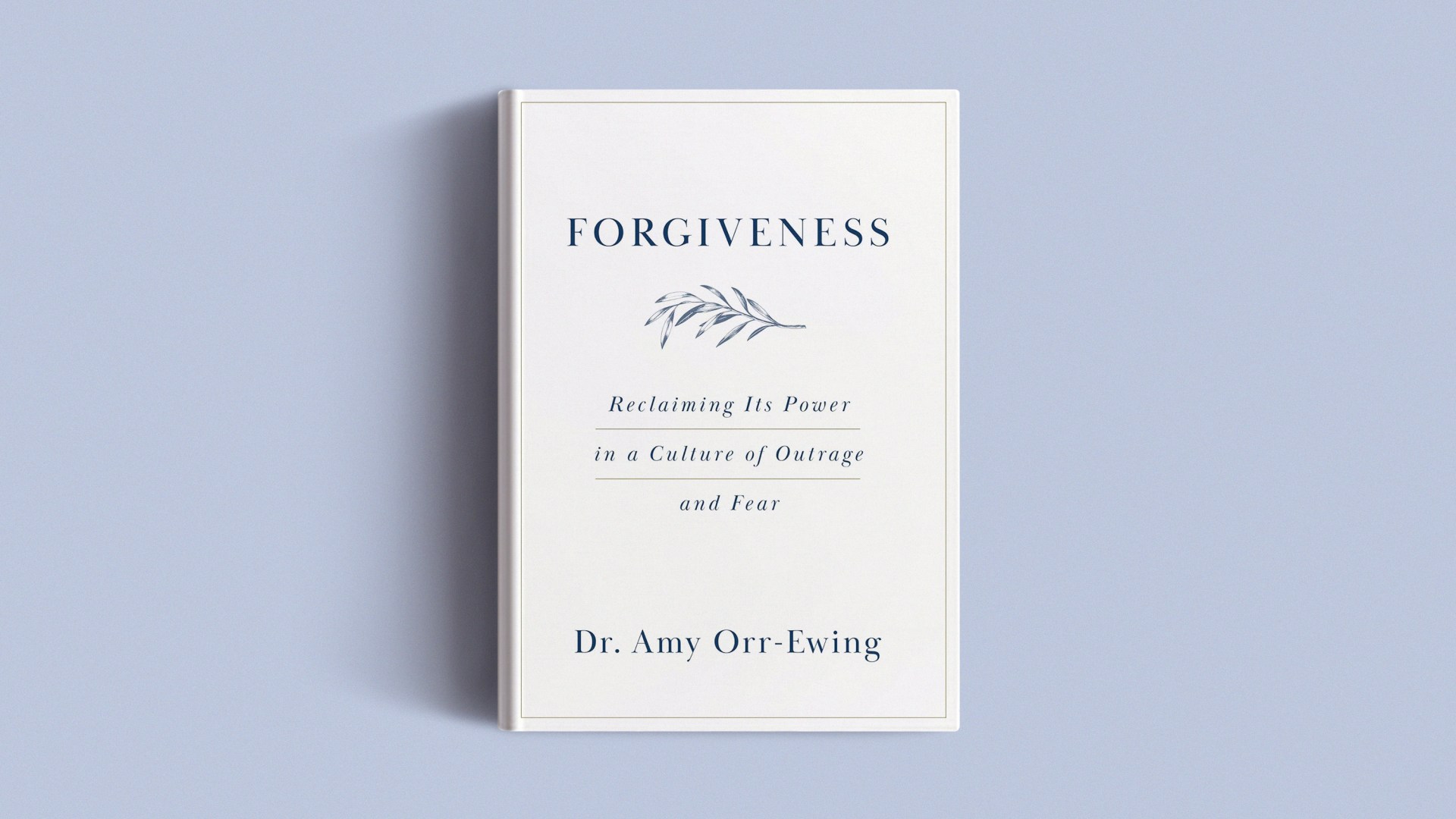
An excerpt from Forgiveness: Reclaiming its Power in a Culture of Fear.

The book on a light blue background.
Christianity Today April 21, 2026
Illustration by Christianity Today / Source Images: Getty, Brazos Press

In 1982, a group of friends sold their suburban homes and purchased an underdeveloped 6,500­-acre farm on the outskirts of Bulawayo, Zimbabwe. They named it the New Adams Farm and formed what they called the Community of Reconciliation. Their vision was to see white and Black Zimbabweans living and working together in harmony, ending racial tension and violence, and healing hurt. Inspired by their Christian faith, they hoped to model how love triumphs over hate.


Over the next four years, the community grew, with many neighbors gaining agricultural skills, fellowship, and education. One night in 1986, a group of terrorists who saw themselves as liberators of Black people killed 16 white men, women, and children with an axe, forcing some of the members of the Black community to watch. They left one daughter of the founders alive to bear witness to what happened, and the son of one of the other founders, a 6­-year­-old boy, escaped into the surrounding countryside. All the other white adults and children were brutally murdered.

As the 14-year-old daughter of one of the founding members was being led off to be killed, she asked her father, “How should I pray?” He responded, “Pray for these men, as they are now the ones who need our prayers.” One by one they were killed, and while each of them remained silent, they could be seen uttering prayers under their breaths for their killers.

One of the survivors of this massacre is a man I admire greatly. Forgiveness of this kind of atrocity would take supernatural strength; humanly, it does not seem possible. But forgiveness and reconciliation are what drove the founding adults to pursue their dream, and their lives and deaths bear witness to the possibility of goodness amid such horror. Forgiveness does not minimize the trauma and its ongoing impact, but forgiveness has imbued those who choose it with something otherworldly, an almost superhuman strength.

As our society has become more trauma-informed, best practices regarding mental health have become highly regarded and widely accessible. In this context, the Christian faith has something unique to offer traumatized people—a coherent, embodied foundation for the possibility and practice of forgiveness. When well-meaning friends or family aren’t informed about how trauma works, their pronouncements about forgiveness cheapen the harm a person experiences when something devastating occurs. Teachings about forgiveness have been weaponized as a quick fix, disregarding the impact of trauma.

Yet as we explore the relationship between forgiveness and trauma, we see that whether they are receiving forgiveness or they are offering forgiveness, trauma survivors who practice forgiveness experience notable outcomes. Forgiveness is a radical gift to anyone who is acquainted with trauma and needs to be reclaimed in a world where outrage and fear abound.

I used to think of the word trauma as referring to a surgery required after injury. As the mother of teenagers, I’ve heard the word traumatic thrown around to describe everything from the mildly awkward to comic situations that make great anecdotes to share with friends. But trauma is far more than this, and our awareness of the impact of devastating events on the human person is growing as trauma is studied and attended to by clinicians, researchers, counselors, and concerned family members.

According to the American Psychological Association, trauma is defined as “any disturbing experience that results in significant fear, helplessness, dissociation, confusion, or other disruptive feelings intense enough to have a long-lasting negative effect on a person’s attitudes, behavior, and other aspects of functioning. Traumatic events include those caused by human behavior (e.g., rape, war, industrial accidents) as well as by nature (e.g., earthquakes) and often challenge an individual’s view of the world as a just, safe, and predictable place.”

The consensus among specialists is that trauma is not what happened to you but what happens inside you as a result of what happened to you. Trauma is less about the immediate impact of a devastating event and more about the impact on the whole person. Trauma can evoke two extremes of emotional response: feeling overwhelmed or feeling numb. Overwhelm of the body and the nervous system impacts our capacity to cope with day-to-day challenges, while numbing or dissociation can be a way of coping with stress and surviving in daily life.

If we don’t experience the conditions necessary to process trauma, it becomes stuck and stored in us, leaving lasting emotional, physical, or psychological imprints. It disrupts the nervous system, causing chronic dysregulation, disconnection, or hypervigilance.

Supporting a traumatized person can have a steep learning curve. I experienced this when supporting my husband through post-traumatic stress as a result of abuse he suffered in childhood. And then I had a traumatic experience myself and needed over a year of regular therapy to come through it.

Experiencing trauma goes way beyond thoughts, feelings, or even psychology. Trauma affects the body and is stored in our hormonal and systemic pathways. In Waking the Tiger, Peter Levine writes that “traumatic symptoms are not caused by the ‘triggering’ event itself. They stem from the frozen residue of energy that has not been resolved and discharged; this residue remains trapped in the nervous system where it can wreak havoc on our bodies and spirits.”

In the best-selling book The Body Keeps the Score, Bessel van der Kolk explores how traumatic experiences are encoded in the body and brain, impacting physical and emotional health. His work with Vietnam veterans played a foundational role in his understanding of trauma and its effects. He and others have been able to categorize the symptoms of post-traumatic stress disorder (PTSD). They’ve observed how traumatic memories are not just psychological but also deeply imprinted in the body, leading to hyperarousal, flashbacks, and emotional dysregulation.

Van der Kolk’s work explores the connection between trauma and the body: “The urgent work of the brain after a traumatic event is to suppress it, through forgetting or self-blame,” he says in an interview with The Guardian. But the body does not forget. Physiological changes result in “a recalibration of the brain’s alarm system, an increase in stress hormones, an alteration in the system that filters relevant information from irrelevant.” The stress is stored in the muscles and does not dissipate. This has profound ramifications for talking therapies and their limits: The rational mind cannot do the repair work on its own, since that part is pretending it has already been repaired.

Van der Kolk notes, “We define ‘trauma’ as an event outside the normal human veins of experience. At least one-third of couples, globally, engage in physical violence. The number of kids who get abused and abandoned is just staggering. Domestic violence, staggering. Rapes, staggering.”

If the body stores trauma in muscles and hormonal pathways, then it should “have experiences that deeply and viscerally contradict the helplessness, rage or collapse that result from trauma,” he adds in his book.

Reclaiming the power of forgiveness in trauma-informed care has huge potential for the healing and future flourishing of many who have suffered greatly in our communities. While we should rightly be cautious about the abuse or weaponization of forgiveness, the potential for human well-being in both giving and receiving forgiveness is undeniable.

When recovering from trauma, the embodied nature of healing matters greatly. There is a profound correlation with the center of the Christian faith—the trauma and crucifixion of the incarnate Son of God in history. The Scriptures introduce us to a God who enters his own creation, in his own image, taking on human flesh and tabernacling among us.

An embodied Savior demonstrates God’s love not on an ethereal, ideological, or disembodied level. As a human being, Jesus died the most painful death known to the ancient world. The crucifixion of God in flesh speaks uniquely to our traumatized world.

The Son of God was despised and rejected, shamed and abused, betrayed by loved ones and unjustly accused, stripped naked and displayed for all to see. It is notable that the Gospel writers are careful to detail the psychological and physical abuse suffered by Jesus. The flogging and scourging, the crown of thorns, the mockery, the nails, the thirst, and the spear—the details matter.

To a trauma survivor, the Savior’s suffering is real and graspable. The identification of a loving God with the suffering, pain, and devastation of this world is a meaningful point of connection for the forgiveness and self- forgiveness we may need to receive. The center of the Christian faith is a traumatized Savior who honors the magnitude and significance of our pain by suffering with us and for us.

Content taken from Forgiveness by Amy Orr-Ewing, ©2026. Used by permission of Brazos Press, a division of Baker Publishing Group.

‘I Want to Give Where the Voice of Truth Is Loud’

Sandra Anderson trusts Christianity Today to navigate cultural challenges—and invests to ensure its voice continues.

woman with husband
Brianna Peterson

For Sandra Anderson—and so many like her—recent years have been shocking, confusing, and challenging. From political polarization and division to Christian nationalism and a fractured church, she has tried to navigate a world that often feels unstable and increasingly distant from Scripture and the teachings of Jesus. 

In response, Sandra has returned to the Word, studying Scripture deeply so she can understand and explain her faith. Through it all, Christianity Today has been an indispensable companion, offering insight, encouragement, and thoughtful challenge.

“CT’s assessment of the theological, sociological, and political is always through a biblical lens—not a selective biblical lens—it’s very true to Scripture,” says Sandra. “I trust CT. I don’t have to read it with a cautious eye, wondering if it sounds right; it feels on mission.” 

That trust is why Sandra has chosen to support CT financially. “I feel like we’re in a time where we need to put our money where our mouth is,” she explains. “There are so many causes I care about, but what I can give, I want to give where the impact is strong, and the voice of truth is loud. CT is exactly that.”

For Sandra, the combination of biblical clarity, cultural insight, and trustworthy reporting makes CT not just a magazine or website, but a companion for her faith journey. It helps her process complicated social issues, engage difficult conversations, and stay rooted in Scripture—while also affirming that she is not alone in thinking deeply about these challenges.

“CT means validation,” she adds. “It means staying biblically solid and coming back to the roots of Scripture—not bending the message to suit the times or a few loud voices. I feel like CT is not afraid to stand in the face of Christian nationalism and say, ‘No, this isn’t biblical.’ To be that voice in the wilderness is risky—you could lose an audience—but it’s the truth.”

A Faith That Began Early

Sandra describes her faith journey as fairly typical, accepting Christ at age 4 when her mother invited her to lay her anxieties at the feet of Jesus. She eagerly did—and that changed her life forever.

But like all lives lived in pursuit of Christ, hers has not been free of challenge, loss, or difficulty. An unexpected divorce left her raising her children as a single mom, one of whom is on the autism spectrum. Fifteen years ago, during the economic downturn, she lost her job, forcing her to rebuild her career while supporting her family.

Yet through it all, her abiding faith has been an anchor, leading her to declare again and again, “Look what the Lord has done.” God’s faithfulness has punctuated her life in staccatos of presence and provision.

She recounts one vivid moment: Her son’s expensive preschool tuition, essential for his development after the autism diagnosis, had become impossible to cover. Then, an anonymous donor stepped in to pay the full year’s tuition.

“It felt almost biblical,” Sandra says. “Moments where you just say, ‘Look what the Lord has done.’”

Among these markers of God’s presence was Christianity Today. She discovered the magazine in her church library and took an issue home. She found the content to be “meaty,” but she liked it—and soon became a subscriber. In the years that followed, financial pressures forced her to let the subscription lapse, but when life stabilized, she returned to CT.

“It’s a great lens to look at all things through a strong Christian perspective,” Sandra says. “The articles always resonated with me.”

Making Sense of the Moment

Today, Sandra engages with CT across multiple platforms—from the print magazine to digital articles and podcasts. One series that particularly impacted her was The Rise and Fall of Mars Hill. The story felt personal: Sandra lives just blocks away from the original site of Mars Hill Church and knows people who attended or worked there.

“CT actually introduced me to podcasts,” she says.

Another favorite is The Bulletin.

“I love The Bulletin,” Sandra says. “It’s so affirming to hear something from Russell Moore and think, ‘Oh my goodness—we’re not crazy.’ They’re validating that our concerns and questions are real.”

For Sandra, those moments matter deeply.

“We’ll talk about things at home and have theories,” she explains. “Then we read an article and say, ‘Look, this is what we were saying.’ Sometimes it validates our thoughts. Other times, it challenges me and makes me rethink something. Either way, CT helps me process complicated cultural questions through a biblical lens.”

Investing in a Voice That Matters

Over time, Sandra’s appreciation for Christianity Today grew into something more—her subscription eventually led her to become a financial partner supporting the ministry’s work.

“I really can’t imagine not having a voice like CT,” she says. “If you believe in something like this, you want to help make sure it continues.”

She believes the publication is doing important work by expanding its reach while remaining faithful to its mission.

“I love the magazine,” she says. “But I also love that CT is staying relevant while diversifying its reach—reaching its core audience while also reaching new audiences, maybe even people who don’t yet believe.”

In a moment when division within the church often feels overwhelming, Sandra sees CT as a rare place where Christians can engage difficult issues thoughtfully and faithfully.

“Sometimes the divisiveness feels stark,” she says. “But CT is trying to bridge that in fantastic and relevant ways. A voice like this matters—and I want to make sure it continues.”

Books
Review

An Arthurian Epic for the Dark Age of the Bright Screen

Galahad and the Grail “is about a light that wasn’t extinguished,” says author Malcolm Guite. “And we kind of need it again.”

Malcolm Guite sitting by a tree.
Christianity Today April 20, 2026
Photo by Patrick Shen / Courtesy of The Rabbit Room / Edits by CT

Malcolm Guite was looking for a place to sit. 

The poet wandered between branches and over tangled roots, through a British wood, with a few loyal companions. They were filming a documentary about his new epic ballad, Galahad and the Grail, and they wanted to feature a grove of oak, ash, and thorn trees—three significant characters in the poem. But they couldn’t seem to find a good spot with those trees close together, and they’d forgotten a stool for Guite.

“Not to worry,” Guite told his friends as they searched, according to his illustrator, Stephen Crotts, who was there that day. “In the poem, there is a fallen log by the oak. The woods will know the poem. There will be an oak. There will be a log.”

Sure enough, just as Crotts happened upon the three species of trees growing close together, Guite spied the perfect log, nestled beneath an oak. “He goes, ‘Oh, very well, there it is,’” Crotts recalled. “He just sat down and started puffing on his pipe.”

Crotts wasn’t surprised. “There’s a level of coincidence that follows him around,” he told me of Guite in an interview last month, smoking his own pipe on a wooden porch just outside Nashville, spring peeking out around us after a long, icy winter. Crotts hesitated, his voice dropping to an almost conspiratorial register: “Magic things happen.”

Guite’s new book, at least, does seem magical. Galahad and the Grail rollicks and captivates with a rhythm that feels as if Guite is casting a long-forgotten spell. It’s the story of Camelot and the grail quest, old and familiar but still delightfully strange. It’s also apt for our time, particularly in its vision of knighthood. 

Some false knights, Guite laments in the beginning of the book, 

Lust for might and mastery,
they only prate of courtesy,
and keep a code of chivalry
they scarcely understand.

Galahad, the perfect knight at the heart of the story, offers a different standard: one of gentleness and courage, faith and boldness, and the vision to see where, with God’s help, broken things can be restored. 

“We’re effectively entering a new dark age,” Guite told me in an interview. “This story is about a light that wasn’t extinguished in the Dark Age. And we kind of need it again.”

poet-musician-priest, Guite believes the old stories about King Arthur and his knights still hold power—and ultimately point to hope in Jesus Christ. 

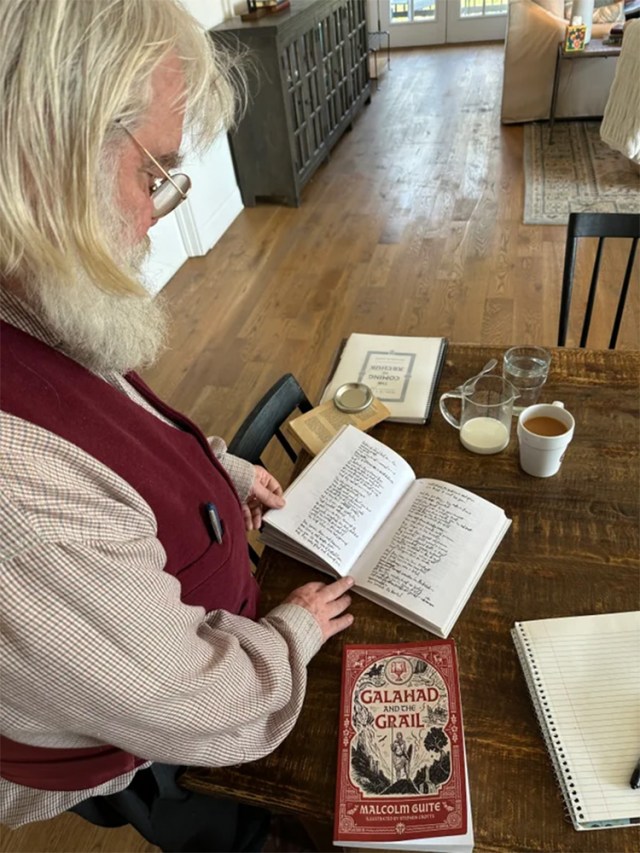
Galahad and the Grail is the first of a four-volume Arthurian epic, written in the nearly singing, rhyming style of an English ballad, which Guite advises readers to experience aloud. Guite himself is given to quoting lines in conversation. If you’re lucky, he’ll share the whole introduction to the poem, where he describes hearing a voice urging him to “take up the tale” as he walked outside one summer morning a few years back. (That’s not a metaphor or a mere poetic device, he told me: He really did hear the voice.)

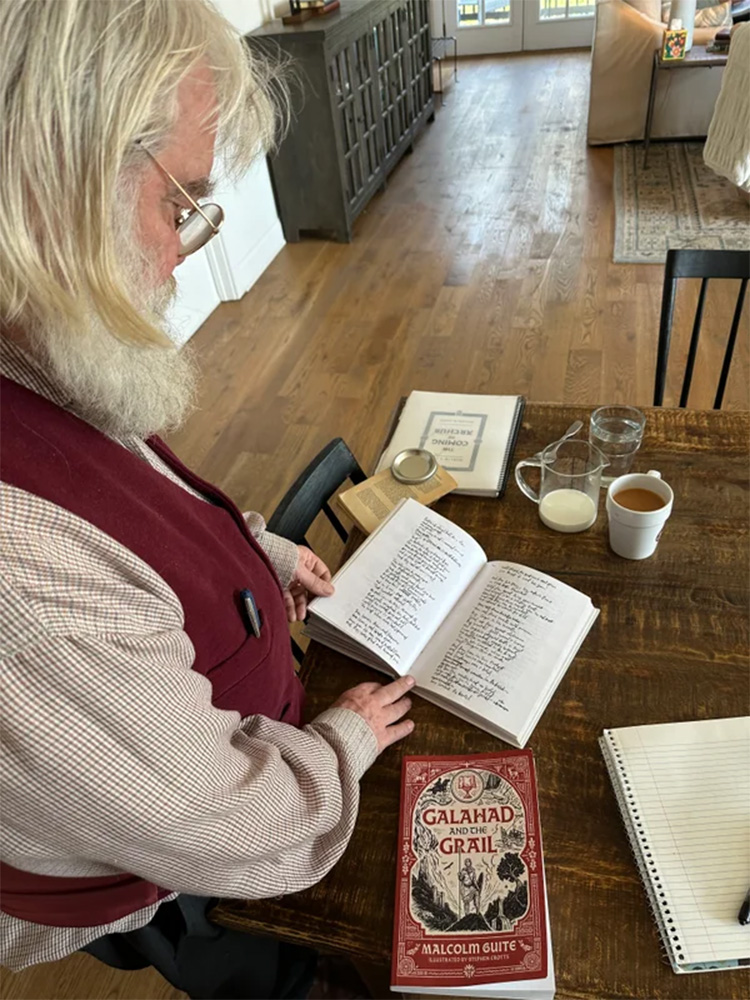
Guite looks every bit the author of an epic ballad—or, yes, the kind of person who would expect a forest to know a poem. Imagine Father Christmas on a long sojourn to the Shire, often in colorful vests, hands never too far from a pipe to puff. While Crotts made him a cup of tea and we settled in for a conversation about the book, Guite’s white hair and beard shook with fervor as he recited his lines. His hands tried to do the story justice, waving about in the air.

And when Guite talks about myth and poetry, diving into Christ’s true and better fulfillment of old folklore, his sentences stop only when he runs out of breath, the words crammed together as close as possible. A great gulp of air, and he’s at it again.

“There’s this meeting of the Christian and the possibly pre-Christian, and how do you interpret that?” he said of the Arthurian legends. “The fashionable thing became to say that this is all pagan material which was still remembered but kind of banned by the church. The idea is that it was given a light Christian gloss to make it acceptable to a 12th-century audience.”

“I don’t think that’s the case,” he told me. “My view is that it’s not that an essentially pagan story was given a light Christian gloss. It’s that the Christian story, when it’s told in the midst of the cultural memory of these pagan stories, suddenly brings new life to them and makes sense of them.”

“Once you get Christ, once you know who the Messiah really is, suddenly it lights a backward path through all the old stories,” he said.

Arthurian legends can be tricky to market, for the very reason Guite loves them so much: These stories can be far too religious for many non-Christians, yet they feel too pagan for some Christian readers.

Guite also knew, even as he started writing Galahad and the Grail, that to print these books with any kind of institutional publishing support might be a long shot in an era of minuscule attention spans and ubiquitous screens. Many publishers, trying to convince people to pick up books instead of their phones, are gravitating toward sex-addled stories, tropes they can sell on TikTok, and books with so many subheadings that each new bold-faced summary is almost insulting. 

Malcolm Guite holding his hand-written poem.Image courtesy of Haley Byrd Wilt

Guite’s poem is the polar opposite of those trends. His regular publisher was at first “not enthusiastic” about his pitch, he told me. Two larger presses in the UK weren’t interested either, with one suggesting he write a much shorter book about T. S. Eliot’s Four Quartets instead. “They just weren’t willing to go there,” he said of an original epic ballad.

In many ways, Guite seems a man from a different time. Was this a tale for a different time, too? He quietly resolved that even if it were, and even if he never found a publisher, he’d take up the tale anyway.

The book finally did find a home with Rabbit Room PressIt’s the publishing arm of a nonprofit faith-and-arts organization founded 20 years ago by the singer and author Andrew Peterson. The Rabbit Room’s willingness to take on Galahad and the Grail, Guite said, helped convince his UK publisher, Canterbury Press, to publish the poem in Britain too.

The Rabbit Room’s book-filled North Wind Manor, a farmhouse outside Nashville, has the air of a modern monastery, where people with ink-stained hands scribble away to preserve old texts. In a way, that’s exactly what Guite’s poem aims to do: to reclaim and pass on an almost-forgotten story by telling it again for a new audience. Crotts, who really does have ink-stained hands, emphasized that the poem points to Christ in a time when many are looking for him, even if they do not know he’s the object of their search.

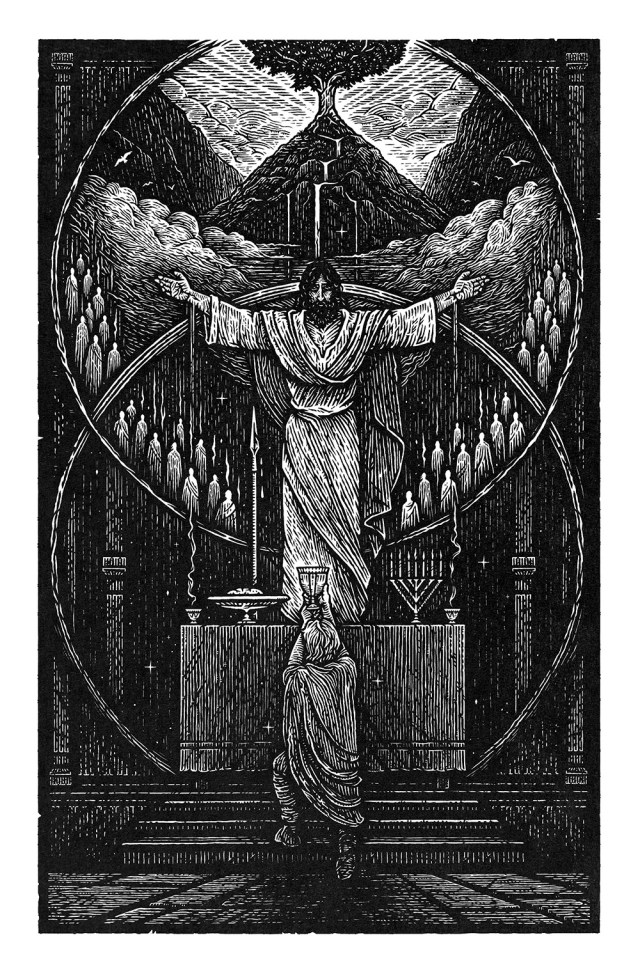
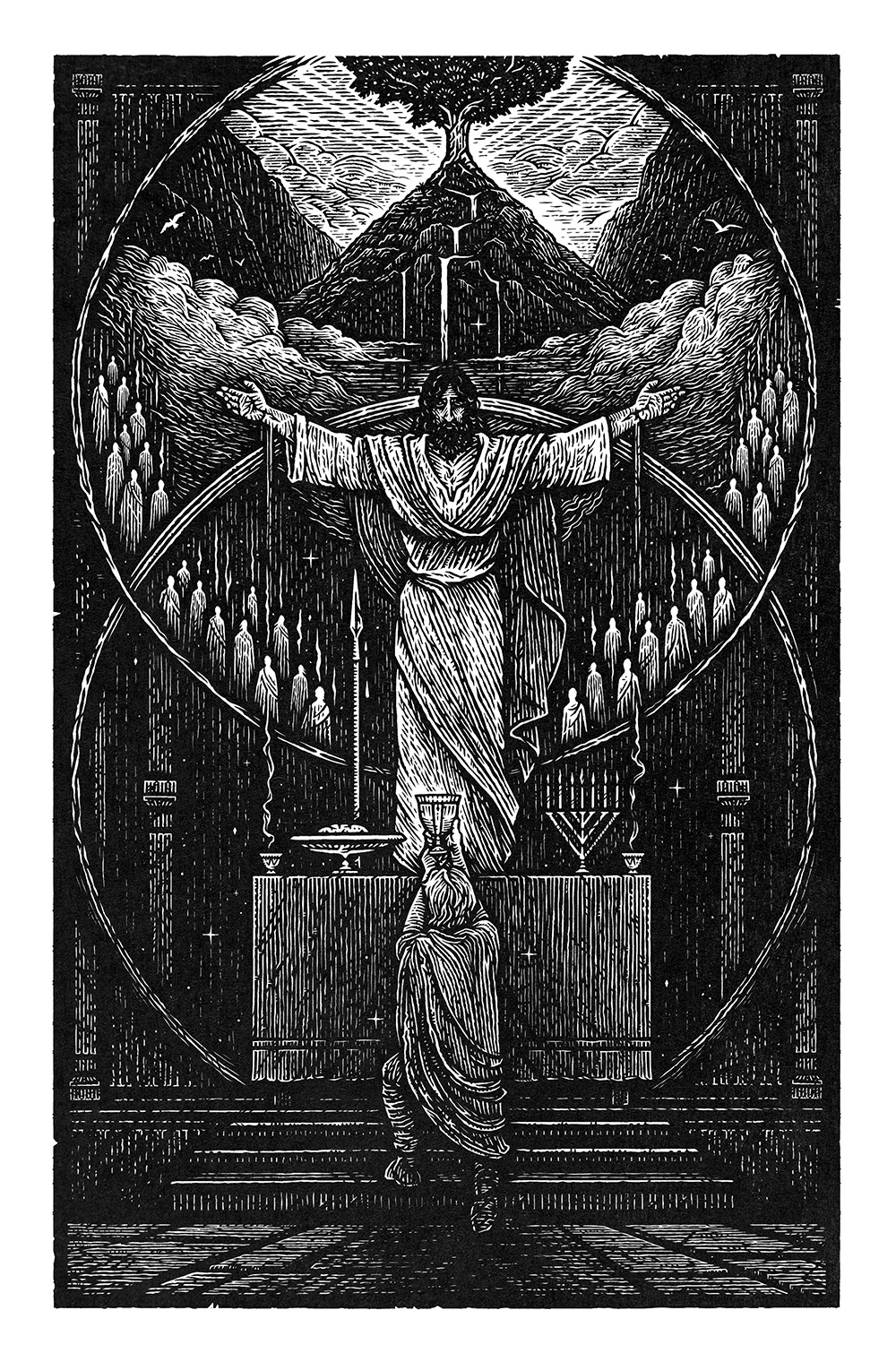
“We don’t want to hear about a story. We want to be in the story,” he said. “And the Eucharist is the place where we step into it. Jesus really is pulling up a seat at his table for us.”

Crotts told me that illustrating the Lord’s Supper upon Galahad’s completion of the grail quest was the image he “had the most fear of approaching.”

A print of Jesus.Image courtesy of Stephen Crotts

“It’s like, ‘Oh, all I have to do is, in one image, sum up the story of the universe,’” he said. (I think he did a stunning job.)

For the illustrator, the poem is a daunting project with a fast timeline. Guite hopes to release the second book, The Coming of Arthur, later this year, the third volume in 2027, and the fourth in early 2028. Guite seems unbothered by the pace, but Crotts is striving to keep up.

“My blood pressure went up so high that I started going blind,” he said of illustrating Guite’s work. That’s partly due to the ambitious timeline, he told me, but mostly because he feels a burden to do the story justice. The Rabbit Room’s support has helped, Crotts said. “I was just laboring in obscurity and frustration until I met these people.”

Pete Peterson, publisher of Rabbit Room Press and brother to Andrew Peterson, told me that when he heard of Guite’s work through mutual friends, he prepared to fight it out with all the major publishing houses to win the rights to Guite’s epic. In the end, he didn’t have to. “The Rabbit Room and Rabbit Room Press are just kind of weird enough,” he said, “that we maybe understood it in a way that other people didn’t.”

“I feel really blessed,” Guite said of publishing a book that requires attention from modern readers. But he added, “I hope this is actually not an exception but a presentiment of things to come.”

“I think we want the real thing and the real deal,” he said. “We want deep nourishment of mind and soul and heart.”

I came to Galahad and the Grail already a fan of Guite and his publisher. In fact, journalistic integrity demands I disclose: I’m so taken with the Rabbit Room’s mission that I sent a sad little email to Andrew Peterson last summer begging for an editing gig after I became fed up with reporting on the US Congress. (I did not get the imaginary job I’d tried to wish into existence.)

But I don’t think that sort of affection is a prerequisite for enjoying Galahad and the Grail. Guite writes of dryads and naiads of trees and streams with all the whimsy of those old Oxford dons, J. R. R. Tolkien and C. S. Lewis. He handles his characters, even those who stray from God, with a balm-like tenderness. One moment in the story centering on the knight Lancelot was so beautifully done it brought me to tears. Even when Arthur’s knights face darkness and evil, Guite doesn’t revel in it, and he carefully preserves a sense of innocence—sometimes lost, yes, but never too far from being found again.

Newcomers to poetry may take a little while to warm up to the style, but Guite’s work is deliberately accessible. He describes the ballad form as “a not-very-distant cousin” of the nursery rhyme, designed for all kinds of people to be able to remember and recite through the ages if only they’ll give it their attention.

“It’s not like weird, arcane, academic free verse,” he said of ballads. “They’re meant to be lucid. They’re meant to tell a story. But that doesn’t mean that they can’t also be profound and beautiful.”

Pete Peterson said he won’t mind, though, if the poem doesn’t go viral. “We’ve had, especially in publishing, a real mission of wanting to publish things that we feel like are in danger of falling between the cracks,” he told me. “Maybe it’s a little too Christian for the secular market, too secular for the Christian market, or maybe it’s just a little too weird and people don’t know what to do with it.”

“Andrew and I used to joke that we wanted to look back in 30 years and realize we had published a whole bunch of books that nobody bought,” he continued. “Which is—you know, I’m kidding. I want people to buy them. But we’re interested in things that just have a hard time finding a home.”

He thinks Guite’s epic already belongs in the canon of great literature beside the likes of Homer and John Milton. But even if this new Arthuriad is hardly noticed, if it’s only—“only”!—an admirable effort at beauty in a slop-soaked world, the mere fact of that effort hews to the greatest and most Christlike virtues of Camelot.

“Before Arthur takes the sword from the Lady of the Lake, she asks him, ‘Are you prepared to do the right thing and make a kingdom and then see everything you’ve done unmade?’” Guite told me. “‘To know that what you’re doing is right but may not win?’”

The tale of Arthur and his knights is “not about being on the winning side,” Guite said. “It’s about being on the right side.” Galahad and the Grail sure feels right.

Haley Byrd Wilt is a writer based in the DC area. Her reporting has appeared in Foreign PolicyThe New York Times, and NOTUS, among others. Her poetry has been published in Mere Orthodoxy.

News

Some Christians Risk Persecution if They’re Honest in India’s Census

Publicly identifying their faith can lead to consequences for lower-caste Christians and those in religiously hostile states.

An awareness board for the 2027 Census in India.

An awareness board for the 2027 Census in India.

Christianity Today April 20, 2026
NurPhoto / Contributor / Getty

Ravi Kishore, a third-generation Christian from the southern Indian state of Andhra Pradesh, is caught in a bind. When census officials knock on his door, he must choose between two identities that dictate his life: his Dalit caste or his Christian faith.

Although his family has practiced Christianity for generations, they prefer being listed as Scheduled Caste (SC) Hindus in government records. The SC status, which is given to marginalized castes including Dalits, has allowed Kishore’s grandfather and father to access education and employment opportunities previously unavailable to the caste due to historic and ongoing discrimination. By identifying as Christians, they would lose that protection.

“I know I am not being honest by hiding my Christian identity,” Kishore said. “But do I have an option? Is the government being fair to Dalit Christians?”

Hundreds of kilometers away, in the northern state of Uttar Pradesh, Suraj Kumar is caught in different dilemma.

Kumar has been a Christian for about a year and a half, worshiping quietly with seven other families at a house church in his village. He works as an electrician to earn a living. His Christian identity, he felt, could come in his way of cultivating local networks and securing government contracts, which are necessary for his work and income flow.

“In my work, relationships matter,” he said. “If people know I am a Christian, it could change how they see me.”

In a state with an anti-conversion law in force and hostility towards Christians at its peak, Kumar is wary of identifying as a Christian in the census. “Tomorrow, they could charge me in some case just because I am a Christian,” he said.

As India embarks on counting its estimated population of 1.4 billion this month, Christians are forced to make difficult choices that can impact their safety, identity, and belonging. The last census held in 2011 found that Christians make up 2.3 percent of the Indian population, which many believe to be undercounted due to the dilemmas believers like Kishore and Kumar face.

Originally scheduled for 2021, the government delayed the census due to the COVID-19 pandemic and administrative challenges. More than 3 million officials have been deployed to enumerate the world’s most populous country. The exercise will stretch over a year, with final data expected to be available at the end of 2027.

For the first time since India’s independence in 1947, the census will record caste along with religion. Intense political debate preceded this decision, and the change is expected to have wider implications for welfare delivery, public policy, and representation of various communities.   

For Christians, particularly those from Dalit backgrounds or those living in regions steeped in religious hostility, the act of speaking openly about faith comes with its own consequences.

Christians in the 13 Indian states where anti-conversion laws are being enforced fear that their disclosure could invite unnecessary trouble from the government, leading to false charges against them. Police can make arrests without a warrant, and obtaining bail is extremely difficult. Convictions can result in jail terms ranging from one year to life imprisonment, along with hefty fines. In Uttar Pradesh, police made 1,682 arrests under the law between November 2020 and July 2024.  

Hindu nationalists often justify violence toward Christians by claiming “conversion mafia” are leading large numbers of Hindus to Christ. While anecdotal evidence by church leaders reveals a growth in house churches across India’s urban and rural areas, there is no reliable data to capture the trend. According to census data, the percentage of Christians has remained largely stable between 1979 and 2011, making up 2.6 percent and 2.3 percent of the population, respectively.

“The very fact that the Christian population is less than 3 percent even after 79 years of independence shows that mass conversions are a bogey,” said Joshua Kalapati, associate editor of the Oxford Encyclopaedia of South Asian Christianity.

Similarly, a 2021 report by the Pew Research Center found that religious conversion in India is “rare.” Yet the narrative of mass conversion continues to shape public discourse, deepening the vulnerability Indian Christians face. As a result, Christians and Hindus will be watching the results from the 2026 census closely.

In the case of Dalit Christians, the census raises a far more complex question. 

Under Indian law, SC status and the reservation benefits linked to it are restricted to Hindus, Sikhs, and Buddhists. Dalit converts to Christianity and Islam are excluded, under the assumption that caste does not exist in these religions.

Numerous government-appointed commissions found that in Indian society, caste transcends religion, and Dalit Christians face double the discrimination as Indian society looks down on both identities.

As a result, many of those believers are faced with a difficult choice: Declare Christian faith openly and risk forgoing job prospects and entrance to universities, or remain Hindu on paper and practice Christianity in private. Over the generations, many Christians have chosen the latter.

“Dalit Christians should be allowed to record both their identities,” said Asir Ebenezer, general secretary of the National Council of Churches in India. “Denying that choice amounts to discrimination.”

At a deeper level, the census also raises a fundamental question of who the government qualifies to be called a Christian. 

“Is it someone formally affiliated with a church and holding a baptism certificate? Or someone who quietly attends a house church, believes in Christ, but has no official documentation?” asked A. C. Michael, national coordinator of the United Christian Forum. “It is a gray area.”

For some, safety and security take precedence over the question of identity. “There is no need for bravado,” said John Dayal, a Christian human rights activist. “Take your call on how you want to be identified by the state.”

But when the census data is finally released, the numbers still will not represent a true picture of the community as it will likely undercount Christians. Still, many are excited to see the results.

“The upcoming census, since it includes caste enumeration, will surely unravel more layers of Christian identities,” Kalapati said. “The census will generate more discussion and debate around the social status of the Christian community.”

News

An Unsung Iran Peace Initiative Grapples with Failure

For 20 years, Mennonites fostered dialogue between North America and the Islamic republic. Their conversations couldn’t stop the bombs.

Portraits of victims are displayed in the rubble of the residential building where they were reportedly killed in a US-Israeli airstrike in Tehran on April 13, 2026.

Portraits of victims are displayed in the rubble of the residential building where they were reportedly killed in a US-Israeli airstrike in Tehran on April 13, 2026.

Christianity Today April 17, 2026
AFP / Getty Images

Early in the morning on February 28, Ed Martin awoke in his home in Lancaster, Pennsylvania, rolled over in bed to check his phone, and let out a slow sigh. The United States and Israel had attacked Iran. With a sense of resignation, the 78-year-old went to the computer in his bedroom office to learn more. Following weeks of negotiation and military buildup, in the first 24 hours the allied nations dropped at least 1,200 bombs on hundreds of targets across the country.

Martin worried about his friends in Iran.

“I felt awful,” he said. “But I wasn’t surprised.”

Most grandfathers in rural Pennsylvania do not have friends in Tehran. But Martin has spent more than two decades seeking peace between the geopolitical enemies. As Mennonites who know the pain of religious violence—he traces his ancestry to Swiss Christians fleeing persecution in the 17th century—he and his Anabaptist brethren have tried to promote interfaith relationships between North America and the Islamic republic.

Their efforts have gone mostly ignored and sometimes criticized. That morning, they found out they had failed.

They had made a last-ditch overture for peace just three weeks earlier. An interfaith group Martin cofounded, called the Luke 10 Foundation, issued an antiwar statement in early February. Fourteen Americans, including the director of Churches for Middle East Peace, three Muslim imams, and three Jewish rabbis, joined seven Iranian leaders, including an ayatollah, to “implore” their governments to seek reconciliation.

Short on specific criticisms, they called on politicians to oppose tyranny and “to uphold universal human rights.” Luke 10, which is based in the United States and was founded during COVID-19 to aid Iranians hit hard by economic sanctions, sent the statement to the American and Iranian governments one day before officials met in Oman for indirect negotiations. It made hardly a blip in US media but was published in English and Farsi by the official Islamic Republic News Agency, perhaps to show that some Americans were also against the war.

“Governments will do what they do in terms of propaganda,” said John Hartley, an early evangelical participant in Luke 10, which takes its name from the biblical passage containing the parable of the Good Samaritan. “We must seek the human good, not a political agenda.”

Mennonites have rarely put their trust in princes. They originate from a 16th-century reform movement in Europe attempting to model the early Christian community. The church developed three core religious commitments, according to Doug Hostetter, cofounder of Luke 10: First, faith is not inherited but must be chosen freely as an adult. Second, believers must take literally Jesus’ command to love their enemies. And third, allegiance to God overrides any government order to go to war on behalf of the state. In 2019, he outlined these convictions to professors at the University of Tehran.

Yet some in the Iranian diaspora, as well as Christians and Jewish groups, have criticized the Mennonites’ interactions with Iran, claiming they are justifying a repressive regime that uses dialogue to polish its image. Amnesty International cites the widespread use of torture, unjust trials, and the denial of education to women who refuse to veil. Open Doors ranks Iran No. 10 on its World Watch List for Christian persecution, primarily for its jailing of converts from Islam.

The Mennonites’ engagement with Iran was born from tragedy. In June 1990, an earthquake originating 125 miles northwest of Tehran killed an estimated 40,000-50,000 Iranians. At the time, Martin was director of the central and southern Asia program at the Mennonite Central Committee (MCC), the denomination’s humanitarian arm.

Since the United States ended diplomatic relations with Iran in 1980, Martin turned to the MCC’s office in Canada, which enabled him to work through the Iranian Red Crescent Society (the Muslim world partner to the Red Cross) to provide aid. Six months later, in January 1991, he took his first of 34 trips to Iran. Together the Mennonites funded construction of 15 health clinics and subsequently assisted with aid for floods, droughts, and the influx of refugees from Iraq and Afghanistan until the MCC’s program ended in 2013.

Yet Martin sought to address more than Iranians’ physical needs.

As the Cold War ended, he and colleagues sensed that political Islam had replaced communism as the perceived enemy of the West, with Tehran displacing Moscow as the center of antagonism. Earlier, in 1979, the Islamic Revolution installed a theocratic government that held 52 Americans hostage for 444 days. And in 1983, Iranian-linked attacks on the US Embassy and Marine barracks in Beirut killed 290 Americans. President Donald Trump recently mentioned this history as part of his rationale for war, saying, “The Iranian regime seeks to kill.”

Martin believed MCC could not only help suffering people but also build bridges of understanding between US and Iran. Through MCC’s consistent service, Martin developed a network in Tehran, which led to significant opportunities. 

He proposed a student-exchange program, and in 1997 MCC negotiated an agreement between the Toronto School of Theology and the Imam Khomeini Education and Research Institute, located in the holy Shiite city of Qom, Iran. Four Mennonite couples studied in Iran, and two Iranians completed their PhDs in the philosophy of religion.

Other exchanges followed, and in 2002, Toronto hosted the first of eight Mennonite-Shiite conferences. Two years later, Qom received an Anabaptist delegation for their second gathering, with countries rotating roughly every two to four years. Topics have included revelation and authority, peace and justice, and religious spirituality.

Martin advised Mennonite students to return home if they felt drawn to Islam. It takes a strong Christian, he said, to engage in true dialogue. Yet while the academic exchange was formal and rigorous, over tea breaks and meals participants got to know each other—even as Iranian authorities filmed most interactions.

Surveillance was tight. Interrogation was frequent. And on Martin’s last visit in 2023, authorities sent him home. They were afraid, he gathered from their questions, that the US was using interfaith dialogue to soften the ground for eventual regime change.

I asked Martin if the dialogue was genuine.

“For the scholars it is,” he said.

“And for the government?” I followed. He paused, folding his hands under his chin for several seconds.

“I never really thought about it,” he replied.

Yet Martin spoke warmly of Shiite students he brought to US peace-building trainings who later rose in diplomatic service. He described curious Iranians wanting to learn about America and Christianity. And he revealed how his own theoretical love for a supposed enemy became authentic in real friendship. He had only one regret.

“Had I known I would spend so much time in Iran,” Martin said, “I would have learned Farsi.”

Both Martin and Hostetter were shaped by living in Asia—Nepal and Vietnam respectively—while doing alternative service as conscientious objectors to the Vietnam War. This led to further service overseas, where they befriended Buddhists, Hindus, and Muslims. They both say that while they consider themselves disciples of Jesus, they do not believe in the exclusivity of Christianity.

“I’m not very orthodox,” Hostetter said. “But I am very Mennonite.”

Such theological openness makes many evangelicals uncomfortable in interfaith-dialogue circles. Even those who might question the wisdom of the Iran war might not be able to sign the Luke 10 statement, which encourages all to follow the shared Golden Rule that it says came “from God speaking directly to Abraham, Moses, Jesus and Muhammad.”

Yet the seeds sown from Mennonite academic engagement led also to high-level political interactions. In 2000, an Iranian professor arranged for a student to study at Eastern Mennonite University’s Summer Peacebuilding Institute. Six years later, the student was an adviser to the Iranian president. When the president, Mahmoud Ahmadinejad, asked him who he should meet with during the upcoming United Nations General Assembly meetings in New York, the former student suggested Mennonites. Hostetter, then director of MCC’s UN advocacy office, coordinated arrangements.  

Hostetter drew in Quakers and other Christians open to dialogue. Often these meetings were quiet and behind-the-scenes. But some encounters drew protest from Iranian diaspora academics, the Jewish Anti-Defamation League, and the National Council of Churches, which accused Mennonites of extending legitimacy to a repressive regime. In 2008, Richard Land, then-president of the Southern Baptist Ethics and Religious Liberty Commission, called participants “useful idiots who help [Ahmadinejad’s] evil causes by their witless complicity in meeting with him.”

During the COVID-19 pandemic, Martin and Hostetter started the Luke 10 Foundation to provide Iranians with vaccines, ventilators, and other emergency relief. They partnered with Moms Against Poverty, one of the few organizations that had an Office of Foreign Assets Control license given by the State Department for sanctions exemptions.

Recognizing the polarized religious and political environment, Hostetter wanted to involve evangelicals in Luke 10, as “they are closer to Republicans than most of us,” he said. In 2020, Martin found Hartley, who at the time was leading the World Evangelical Alliance’s task force on nuclear nonproliferation.

Hartley lived in Isfahan, Iran, from 2003 to 2007, where he founded Pathways for Mutual Respect, which sought to strengthen interfaith relations in more than 30 countries from Nigeria to Malaysia.

As a doctoral student at Yale supervised by Miroslav Volf, Hartley wrote his dissertation on how believers with an exclusive theology of salvation—Christian or Muslim—can nonetheless nurture inclusive social relations. Drawn to Luke 10’s focus on relief for Iranians, Hartley sought to ensure that the diverse initiative would not blur faith distinctions to appear as “one big happy religious family.”

Still, according to Hartley, all were united in humanitarian purpose.

“I’m not a pacifist, and I don’t know if this war is warranted,” Hartley said. “But we must always be serious about the human cost.”

During his time in Iran, he learned that many were afraid of US militarism. One day he entered his neighborhood money-exchange shop, and a middle-class Iranian couple asked, “Aren’t you afraid to be here?” While Hartley was prepared to give his stock answer about Iranian hospitality, the husband spoke first. “We are,” he said, explaining that they were buying dollars to travel abroad. “The Americans in Iraq are about to invade.”

Interrogated often by the authorities, Hartley kept his distance from Iranian Christians. The intelligence services assumed he had an evangelistic agenda, and they wanted him to lead them to underground churches. And while he was aware of the Mennonite dialogue efforts with Iran, he was never involved.

Yet Hartley said it was “beautiful” how Mennonites’ commitment to separate their love of people from politics created a ground for peace—and Christian witness. In one conference, an Anabaptist participant preached the gospel in a friendly, nonpolemic way. Though it made some on both sides uncomfortable, the opportunity came from Iranian trust in the Mennonite community.

Hartley related this to the Farsi word ashna, the “known people” who must be involved for an Iranian to feel comfortable in a complicated situation.

Hartley, formerly president of the Luke 10 board of directors, ended his participation in 2023 as its original humanitarian purpose waned. He commends its ongoing interfaith commitment while lamenting the “muddy waters” of this war. He has no desire for his Iranian friends to endure a military attack, but he wonders if the negotiations were earnest and if attacking Iran would actually stop the regime.

Both Mennonites wished former president Barack Obama’s nuclear deal with Iran had held. Trust must begin somewhere, they said, with each side addressing its gaps over time. Although both Iran and the US view the other as their enemy, they could at least keep talking.

God is disappointed in the actions of both sides, Martin believes: “They are fighting, not negotiating. Love your enemy.”

On the morning of February 28, Martin eventually rose from the computer in his bedroom. He went on a long drive with his daughter, enjoying the Amish beauty of Lancaster County. Returning home, he did what he could. He wrote a letter to his congressman, a graduate of the local Mennonite high school, who had issued a statement in support of the war.

Books
Review

A Map Through Natural Theology

Three theology books on natural theology, the transfiguration of Christ, and a classic must-read.

Three books on a cream background.
Christianity Today April 17, 2026
Illustration by Christianity Today

This piece was adapted from CT’s books newsletter. Subscribe here.

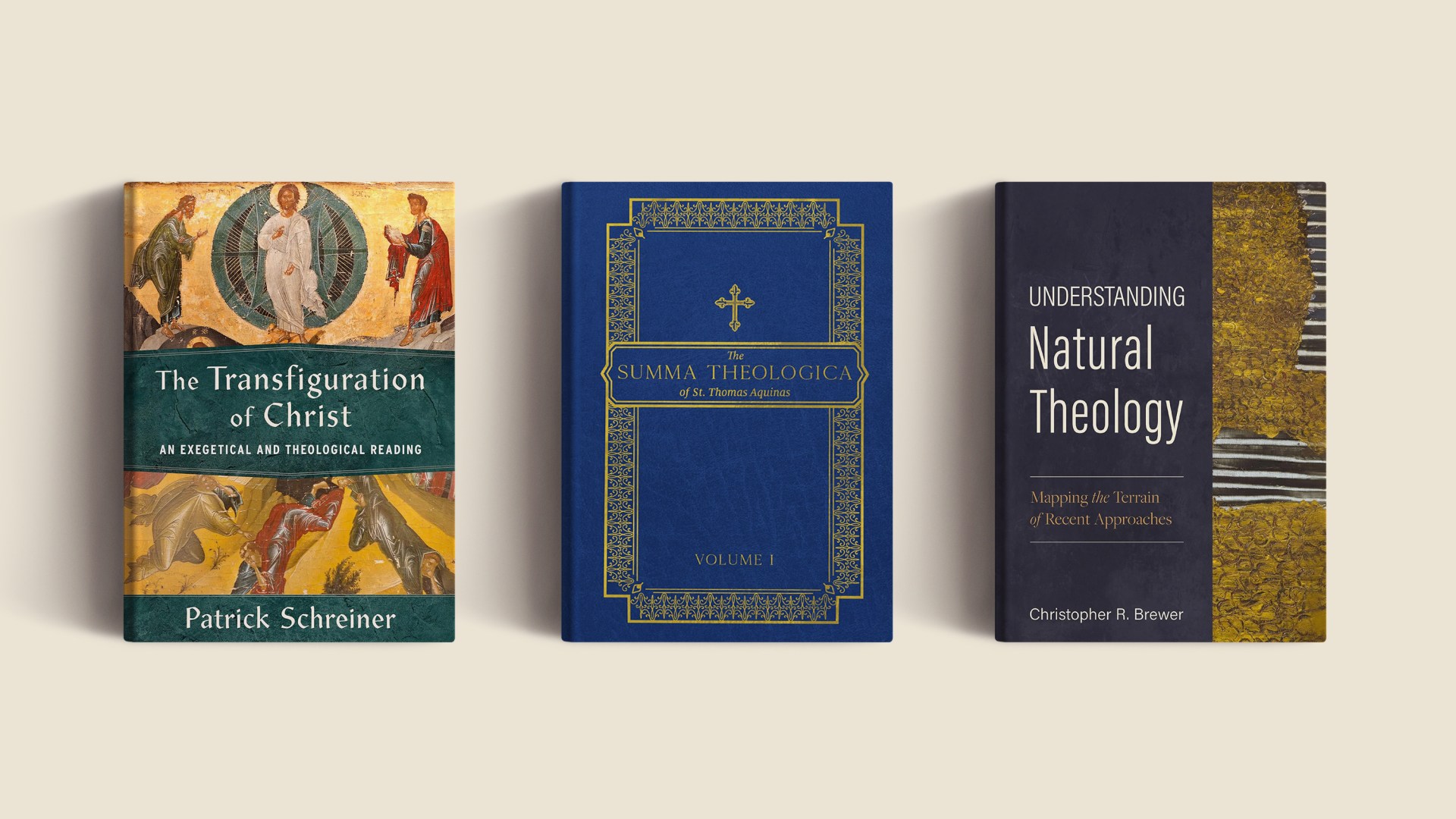
Christopher R. Brewer, Understanding Natural Theology: Mapping the Terrain of Recent Approaches (Zondervan Academic, 2026)

Works of academic theology often proceed in two parts. Part one clears the ground: It defines key terms, narrates the history of the subject, offers a survey of contemporary debates, and enters into dialogue with a handful of influential interpreters. Part two, which may or may not come in a separate volume, offers the author’s constructive proposal. If done well, the two parts fit neatly together and move seamlessly from problem to solution.

The tragedy of Understanding Natural Theology is that Christopher R. Brewer was diagnosed with terminal brain cancer at the end of part one. As a result, we have his critical appraisal but not his constructive proposal. This leaves us, as the subtitle makes clear, with a map of the current terrain but without a recommended path through it.

The map is detailed and thoughtfully presented. Brewer outlines five views on natural theology in two chapters each: natural theology (1) as informed by natural religion, (2) as proof or argument for God, (3) as a signal of transcendence, (4) as Christian natural theology, and (5) as a theology of nature. The key modern thinkers are all there, from Alvin Plantinga and Stephen Evans to Thomas Torrance and Karl Barth. But after sifting through all the definitions, debates, jargon (including “Realdialektik,” “metaxological”), and throat-clearing (“There is, in an important sense, no such thing as ‘natural theology’ but instead only ‘natural theologies’”), the reader wants a path, or at least a guide. Brewer’s untimely death leaves us without it.

Happily, however, we are given a sketch of one. In a brief afterword, Brewer suggests replacing Augustine’s famous “two books” analogy—God reveals himself through his Word and his world—with Gérard Genette’s metaphor of text and paratext. The book of nature is paratextual, like the hallway or vestibule through which we enter the “house” of God’s Word. It “precedes, accompanies, and mediates the text” of Scripture. It would be fascinating to see another theologian pick up this metaphor and write the equivalent of Brewer’s part two.

Patrick Schreiner, The Transfiguration of Christ: An Exegetical and Theological Reading (Baker Academic, 2024)

At its best, exegetical theology is thrilling. If the subject matter is captivating, the exegesis faithful, and the theology both fresh and orthodox, then the results can be exhilarating, fueling worship and wonder in the reader. All of those things are true of The Transfiguration of Christ. Few scenes in Scripture are more theologically weighty than the Transfiguration, and in few cases are the details more suggestive and the interpreter’s work more intriguing. Patrick Schreiner makes the most of this.

Structurally, the book is simply laid out. The central three chapters consider the setting of the Transfiguration (the timing, location, and witnesses to it); the signs that occur (Jesus’ shining face and clothes, the cloud, the appearance of Moses and Elijah); and the saying (“This is my beloved Son, with whom I am well-pleased. Listen to him!”—Matthew 17:5) By engaging with the text extensively, as well with as the numerous Old Testament allusions it contains and the interpretations of the church fathers in particular, Schreiner illuminates the story in dozens of fascinating ways. Yet because the book is relatively short, at just over 150 pages, and is frequently punctuated and clarified with tables and summary paragraphs, it keeps moving without getting bogged down in endless detail.

At the heart of the book is the theological claim that the Transfiguration reveals Christ simultaneously as the fully human messianic Son and the fully divine eternal Son. These categories are not merely introduced centuries later, as the early church wrestled with how to express Jesus’ unique identity; they are latent in Scripture itself, especially (and perhaps supremely) in passages like these. By reading these stories on their own terms, and in dialogue with the descriptions of Christ’s baptism and crucifixion, Schreiner has shed fresh light on each of them. This is a wonderful book.

Thomas Aquinas, Summa Theologica (Christian Classics, 1981)

There is something faintly ridiculous about introducing the Summa Theologica (1265–1274) in a couple of paragraphs. It is a mighty work of systematic theology by one of the greatest theologians in the history of the church, a watershed in the development of Catholic doctrine, a bold and brilliant attempt to integrate Christian thought and the best of Aristotelian philosophy, a pioneering work of apologetics that is still studied in universities today, and one of the most influential books ever written in any field. Superlatives abound, and rightly so.

Yet for all those reasons, it can also be very intimidating, and so intimidating that most of us never read any of it. I did not get around to reading Aquinas until I was in my late 30s (and even then, I read an abridged version in the form of Peter Kreeft’s excellent Summa of the Summa). What surprised me when finally I did was how readable he was. His arguments are lucid; his structure is clear; his method is illuminating; he states objections fairly and reasons diligently through them; and his conclusions are always worth wrestling with, even when we totally disagree with them (as Protestants sometimes will).

Most remarkably, he frames issues that would later become highly controversial in ways that reflect a wise and thoughtful balance between biblical truths. On the relationship between divine sovereignty and human agency, for example, he beats John Calvin at his own game two and a half centuries before him. Aquinas’s chapters on providence (I:22) and predestination (I:23) pull no punches on scriptural teachings like absolute sovereignty, unconditional election, and reprobation.

Yet his chapter on free will (I:83) is equally emphatic: “Man has free will, otherwise counsels, exhortations, commands, prohibitions, rewards, and punishments would be in vain.” In this and in numerous other ways, the Summa Theologica is a masterpiece.

Andrew Wilson is teaching pastor at King’s Church London and author of Remaking the World: How 1776 Created the Post-Christian West. Follow him on Twitter @AJWTheology.

Ideas

Black Immigrants Are Diversifying the American Church

African Americans have long ministered to Black people abroad. Those communities are now increasingly migrating to the US.

A world map and a black congregation.
Christianity Today April 17, 2026
Illustration by Elizabeth Kaye / Source Images: WikiMedia Commons, New York Public Library

This is the fourth in a series. Here are the firstsecond, and third articles.

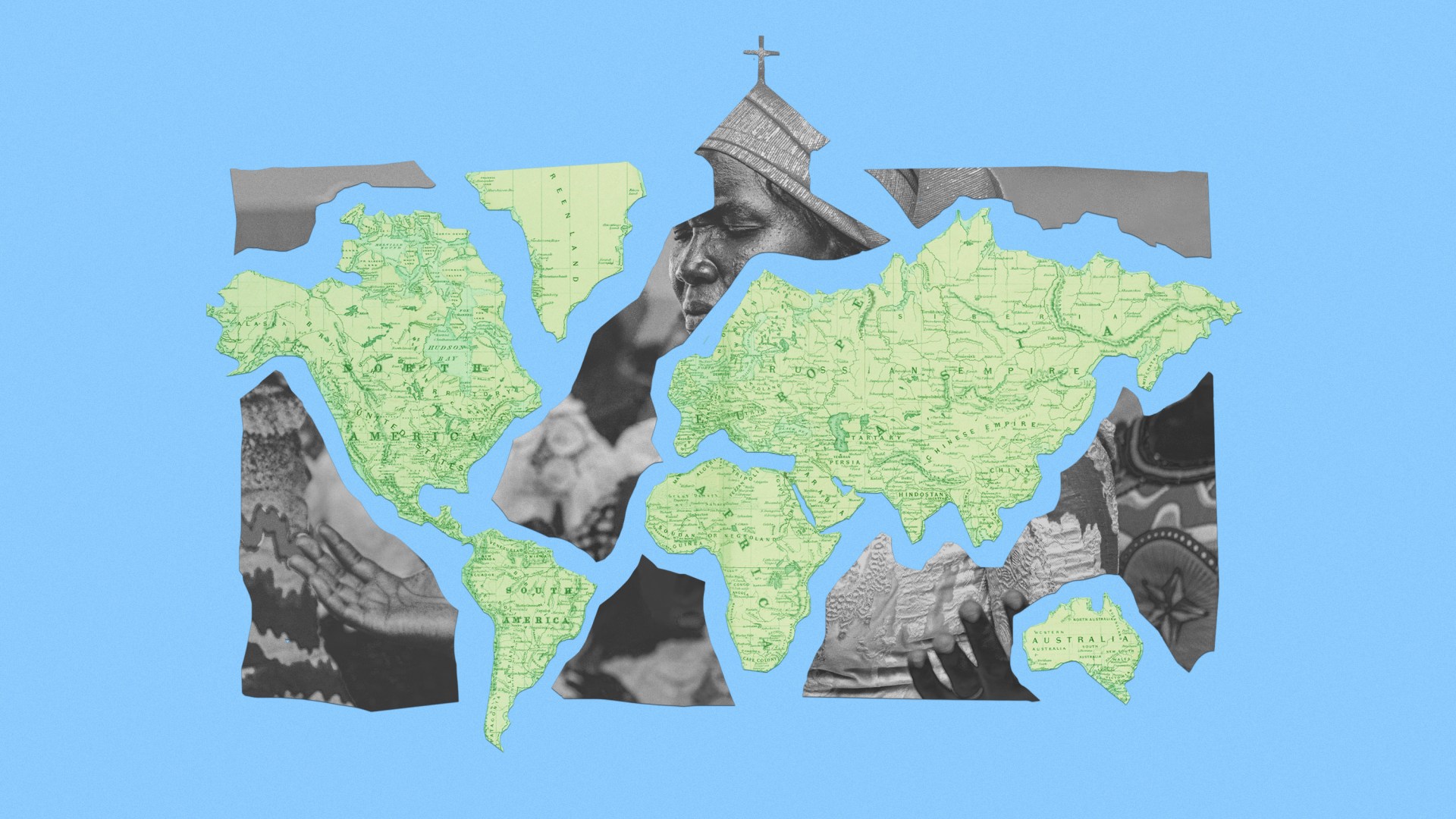
About 300 ago, enslavers captured a group of Black Catholics from Central Africa and the Kingdom of Kongo and brought them to low-country South Carolina.

The group’s captivity was a violation of previously established tradition within Western Christianity that Christians should not enslave other Christians. Based on that tradition, the Africans should not have been taken or at least should have been freed when their faith was discovered. But none of that happened. As the slave trade grew, colonial governments implemented laws that severed the relationship between Christianity and freedom. The Catholics remained in the US, and some of the earliest historical records we have about Black Christians in America trace back to them.

The story of the Kongolese and other African Christians adds to the history of the nation’s diverse tapestry of Black Christianity. It also underscores a part that is often overlooked: The story of Black Christianity in America is not merely about people who shed their local religions and become Christians in the US. It is also about those who brought their faith with them to America, whether through enslavement or immigration. The latter will mostly be my focus here. 

Historians say the presence of the African Catholics in South Carolina played a significant part in the first mass conversion of slaves, which took place during the Great Awakening. At the time, Black Christians were participating in evangelical revivals sweeping through England, its island territories, and the American colonies. As white preachers and missionaries were connecting believers across borders, the first Black evangelicals were also doing the same.

Take George Liele, the founder of one of the first Black Baptist churches. He left America after he secured his freedom from slavery and planted the first Baptist church in Jamaica. He named it the Ethiopian Baptist Church, referencing the East African nation as a signifier for all things Black.

During his missionary work, Liele helped convert people who became influential preachers and contributed to historically Black churches across Jamaica, the American South, Canada, and West Africa. Around that time, other African Americans—including Zilpha Elaw, Alexander Crummell, and Joseph Harden—were also ministering to the broader African diaspora by spreading the gospel, planting churches and schools, and launching a wave of Black missionaries around the world.

As African Americans ministered overseas, Black immigrants were also arriving on America’s shores. In the 18th and 19th centuries, people from the West Indies came to America and became integrated within the Black church. Among them was Denmark Vesey, who helped establish Charleston’s first African Methodist Episcopal Church (famously known as Mother Emanuel), and led a revolt against slavery.

Others cropped up as time went on. In the early 20th century, B. M. Nottage, a Black immigrant from the Bahamas, became one of the most prominent evangelists and church planters in America and worked with his two brothers to minister to Black communities across the country.  

Although Black immigration did occur during this time, it was fairly small. Immigrants from Africa—as well as Asia—were essentially barred from entering the US, while those from southern and eastern Europe were restricted under discriminatory policies that favored migration from western and northern Europe.

Still, the relatively small number of Black immigrations who did manage to come cultivated their own churches. The family story of Vincent Harding, a Barbadian American who drafted some of Martin Luther King Jr.’s speeches and became a known voice in the Civil Rights Movement, was emblematic of the growing sub-group. Harding’s mother immigrated from Barbados to the US shortly after the First World War. The family was Seventh-day Adventists, which was led by white leaders. But eventually, Harding’s family joined with other Black immigrants who formed their own branch, called the Seventh-Day Christian Church.

In the 1960s, the Civil Rights Movement helped create the political atmosphere for changes in immigration law. President Lyndon B. Johnson signed legislation that removed the ethnicity-based quota policy and opened the door for immigrants across the board.

Today, more than 5 million Black immigrants live in America. That essentially means about one in ten Black people in the US were born abroad, and about a quarter of Black Americans are immigrants or the child of at least one migrant.

African immigrants are the fastest-growing Black immigrant group in the country. They are also the most religiously inclined population in America, and the Christian communities they form tend to be theologically conservative, Bible-centered, and missional.

But like most African American Christians, they don’t typically self-identify as evangelical. Instead, they often use denominational language, like Pentecostal—a pattern also found among Caribbean immigrants, who tend to add adjectives in front of traditional evangelical denominations, such as Haitian Baptist Church.

As immigrants and their children integrate, they become more likely to join and lead congregations that swim within the culture of American evangelicalism, such as Atlanta’s prominent 2819 Church, a multiethnic congregation pastored by Philip Anthony Mitchell, a first-generation Trinidadian American.

But many are also found within traditional Black church denominations, and their presence is expected to grow in the coming decades. By 2060, there will be an estimated 9.5 million Black immigrants in America, which means denominations like the Church of God in Christ and AME Zion will experience more ethnic diversity not only overseas (where many Black denominations already have churches), but also in the homeland.

My own family is part of that future. My husband is Haitian American, I’m African American and in New York, which we have long considered home, it’s common to see couples who are part of the same racial group but have different ethnic and cultural roots.

The churches my husband and I have attended reflect our family’s blended roots, whether a Haitian Baptist congregation with Creole liturgy or a Methodist church I helped pastor in the Bronx with African American, Afro-Caribbean, African, and Black European congregants.

Both of us have also experienced the beauty of churches that identify as evangelical and have members across various racial groups. Nevertheless, as a Black couple in America, a good life for us now includes the comfort and security of being members of an ethnically diverse Black church.

Beyond our faith, what has glued our church together is the shared experience of being Black in America. The Black church that nurtures our faith is also what reaffirms our understanding of God’s love for the stranger, pursues societal justice, pushes back against an America-centered view of the gospel, and reminds us that the image of God also comes in Black.

In a country that has a history of being hostile to Black people, this is no small gift. We needed a church that faithfully applies the gospel to the challenges we face as a household, and for us, the Black church is still the strongest in doing so.

But the part of the Black church that I often see, the kind populated by immigrants with evangelical convictions, remains relatively unknown among many Americans. Nonetheless, as immigrants and their children continue to multiply, it will be more visible and shake up the popular notion of what it means to be an evangelical in America.

Jessica Janvier is an academic whose focus crosses the intersections of African American religious history and church history. She teaches at Meachum School of Haymanot and works in the Intercultural Studies Department at Columbia International University.

Ideas

Artemis II Showed Us What Integrity Looks Like

Staff Editor

Four astronauts remind us that our humanity is both a gift from God and a joy.

The Artemis astronauts hug as they are welcomed back to Houston at Ellington Airport on Saturday, April 11, 2026.

The Artemis astronauts hug as they are welcomed back to Houston at Ellington Airport on Saturday, April 11, 2026.

Christianity Today April 17, 2026
Houston Chronicle / Hearst Newspapers / Contributor / Getty

On April 10 at 5:07 p.m. Pacific Daylight Time, Integrity, the crew-named Artemis II spacecraft, splashed down off the coast of San Diego after its ten-day mission around the moon and back. Driving on a freeway a few hundred miles north of their landing spot, I listened live to NASA’s radio broadcast. The crew—which is the first to return to the moon since 1972’s Apollo 17 mission—splashed down after their 694,481-mile journey, concluding Artemis II.

I honked my horn in celebration, wondering if other drivers were similarly glued to the mission. After entering Earth’s atmosphere at approximately 24,000 miles per hour, its heat shield enduring up to 5,000 degrees Fahrenheit, the capsule splashed into the Pacific Ocean at just 19 miles per hour.

Some had questioned the heat shield’s efficacy, so after six minutes of radio silence (as the capsule was engulfed in plasma), I exhaled in relief the same way I do when one of my teenagers who has been out of cell-service range makes it home. Reid Wiseman, Victor Glover, Christina Koch, and Jeremy Hansen were home. My tears fell unexpectedly.

Some of the trepidation is familiar for Gen Xers. I am a bit too young to remember what many older Gen Xers remember—how teachers rolled TVs into students’ elementary school classrooms so they could watch history on January 28, 1986. But that day proved disastrous as, 73 seconds into the flight, the Challenger shuttle exploded, killing all seven passengers (one of whom was a teacher under the Teacher in Space Project).

In the days since the Artemis II astronauts’ safe arrival, I’ve wondered about my sudden emotion and the proliferation of chatter on social media under #moonjoy. From doing group hugs and working while a floating jar of Nutella stole the spotlight to wearing eclipse sunglasses like ’80s kids and recreating the Full House TV show intro, the four astronauts were full of joy.

While NASA’s social media team made their updates fun and effective—like by producing a video of the crew’s playfulness, smiles, group hugs, and joy in their work as evidence of “moon joy [noun]”—I think it’s more than marketing prowess or Saturday Night Live sketches that have people still talking about the mission. It’s also more than the crew’s scientific discoveries, the stunning photographs from the back of the moon, or even the mission’s historic firsts.

What has kept us following Artemis II is simple: It has been a constant reminder that being human is a gift and being human together is a joy.

During the week of the Artemis II mission, what was happening around the moon and what was happening in our earth-bound politics was a study in contrasts. President Donald Trump threatened to wipe out a civilization—threats from which he has since backed away for at least a time—while Glover, a Christian and Integrity’s pilot, told those back on earth, “I can really see Earth as one thing.” He continued, “When I read the Bible and I look at all of the amazing things that were done for us, who were created … You are special in all of this emptiness. … We are the same thing, and … we’ve got to get through this together.”

About a week before Trump posted both an AI-generated picture of himself as Jesus (since deleted) and a diatribe against Pope Leo, Glover reminded us that the globe is a sort of spacecraft—that we’re on mission together in the middle of the cosmos. Glover’s message is far more compelling and rarer in our moment of mudslinging.

Glover’s words are also a message of integrity—in keeping with the crew’s character. The astronauts, after all, named their craft Integrity for the “trust, respect, candor, and humility” they shared with the engineers, planners, and others involved with the mission, and they recognized how many people they needed for success. The word integrity at its core also means “wholeness.” We act in accordance with who we are. Four people at the pinnacle of their careers, rather than being puffed up with pride, felt their own smallness and pointed us back to one another.

Every small decision places us on a path toward either pride or humility. Luke’s gospel tells us, “A good man brings good things out of the good stored up in his heart, and an evil man brings evil things out of the evil stored up in his heart. For the mouth speaks what the heart is full of” (6:45).

With their giddy awe and humility in space’s vastness, the astronauts modeled we are more than tribal infighting, wars, an unstable economy, and the countless daily burdens of life in a fallen world. No matter our circumstances, it is a gift to be on earth, and it is a gift to be human together.

It’s tempting to think the only world is one defined by a harsh law of survival of the fittest. It’s easy to believe that the vileness of political rhetoric is all there is. It can even be intoxicating to believe ugliness is how we get things done. But these four astronauts reminded us there is a better way.

Christians especially live by a new narrative: For those who are in Christ, the utter goodness and beauty of Jesus will snuff out blinding pride in ourselves and others that leads to death and destruction. Even now God invites us to live out this better story together.

In much the same way age brings perspective—we see that the things that upset us decades ago are much smaller than they appeared—space brings perspective too. In the astronauts’ first press conference, Koch spoke about her vantage point from space and how her understanding of a crew had grown: “A crew is a group that is in it all the time no matter what, that is stroking together … with the same purpose, that is willing to sacrifice silently for each other, that gives grace, that holds accountable. A crew has the same cares and the same needs, and a crew is inescapably, beautifully, dutifully linked.”

She noted, observing our planet, “Earth was just this lifeboat hanging undisturbingly in the universe. … There’s one new thing I know, and that is, Planet Earth, you are a crew.” May the church lead the way, modeling being a crew for the sake of our neighbors.

Glover has already started. Back on the ground, the pilot gathered with his neighbors and told them from his driveway, “Some of us have never met before. And you know whose fault that is? Ours. So let’s choose to do this. … Let’s be neighbors. I don’t know if you heard me say it, but God told us to love him with all that we are and love our neighbors as ourselves. I love you.”

Ashley Hales is editorial director of features at Christianity Today.

addApple PodcastsDown ArrowDown ArrowDown Arrowarrow_left_altLeft ArrowLeft ArrowRight ArrowRight ArrowRight Arrowarrow_up_altUp ArrowUp ArrowAvailable at Amazoncaret-downCloseCloseellipseEmailEmailExpandExpandExternalExternalFacebookfacebook-squarefolderGiftGiftGooglegoogleGoogle KeephamburgerInstagraminstagram-squareLinkLinklinkedin-squareListenListenListenChristianity TodayCT Creative Studio Logologo_orgMegaphoneMenuMenupausePinterestPlayPlayPocketPodcastprintremoveRSSRSSSaveSavesaveSearchSearchsearchSpotifyStitcherTelegramTable of ContentsTable of Contentstwitter-squareWhatsAppXYouTubeYouTube