Attendees of a news conference walked past boxes of donated clothes and worn-out leather couches to the back room of a dreary building where homeless men spend their nights. The mayor of Gary, Indiana, Eddie Melton, was there announcing his latest plan to revitalize a city that was once an emblem of America’s industrial might. And local residents, reporters, pastors, and city officials had gathered to hear what he would share.
Flanked by nearly two dozen empty twin beds, Mike Dotson, a local pastor whose predominantly Black church owns and operates the shelter, opened the conference in prayer. He thanked God that the facility has been used to serve thousands for decades and asked for blessings for its future. In this case, Melton would soon share, its future is that it’s being rebuilt. But Gary has hemorrhaged residents for decades and can’t easily afford this type of major project. The city is using $3 million in federal funds, some of which came through the government’s COVID-19 relief package, to construct a new shelter.
“We know the Scripture in Genesis 4:9 when the question was asked, ‘Am I my brother’s keeper?’ And today we want to answer that question and say, ‘Yes, we are our brothers’ keeper,’ ” Melton, who came into office about two and a half years ago, said in February. He noted the new facility would essentially double the number of beds in the building to 50. The shelter, however, still needs support from the community—including churches, which are needed to provide furniture, bedding, and other supplies for housing people.
The new shelter is one of many projects underway to beautify and revive downtown Gary, a once-bustling commercial corridor that’s now filled with dilapidated buildings, shuttered businesses, and empty lots. The city, located on the south shore of Lake Michigan just a 45-minute drive from Chicago, is seeking to turn over a new leaf and shed its reputation for poverty and crime. To do so, it needs to permanently reverse its steep population decline, clean up blight, and attract businesses that provide good-paying jobs and serve as a stable source of revenue for the city’s coffers.
The task is primarily one for Melton. But in this heavily churched area, congregations, pastors, and Christian-run nonprofits are an integral part of the effort. “This is an all-hands-on-deck approach,” the mayor told me during an interview.
The city can feel churches’ impact in many areas. About two miles north of the men’s shelter, another pastor, Dennis Walton, has spent the past few years renovating an old Salvation Army building and converting it into a community center. Walton, who pastors a dual-location church called Faith Temple of Christ, purchased the building using his own money. He called it Faith Community Center North and offered the space to nonprofits that train residents in construction and trade—including carpentry, roofing, and HVAC systems—and provide mental health counseling to residents battling drug and alcohol addiction.
Inside the building, his team is developing a gym, and they also plan to create a service that delivers fresh produce to nearby residents. During the holidays, they host a Toys for Tots giveaway, which usually draws enough people to create a ten-block line outside.
When I toured the building, Walton told me the city gave his organization some funding last year to set up emergency shelters for women with children. His team now runs five homes in the city. In another part of Gary, they work with nonprofits to operate a six-acre community garden, on which they farm honey and grow spinach, cucumbers, tomatoes, squash, and other vegetables they plan to sell and give away.
However, funding for projects is typically bleak, even for Walton, who chairs a city subcommittee on economic vitality. There’s not enough money for everything that needs to be done. But he meets regularly with pastors and business leaders to see what they can do with what they have. “Our goal is to give the city a lift,” he said.
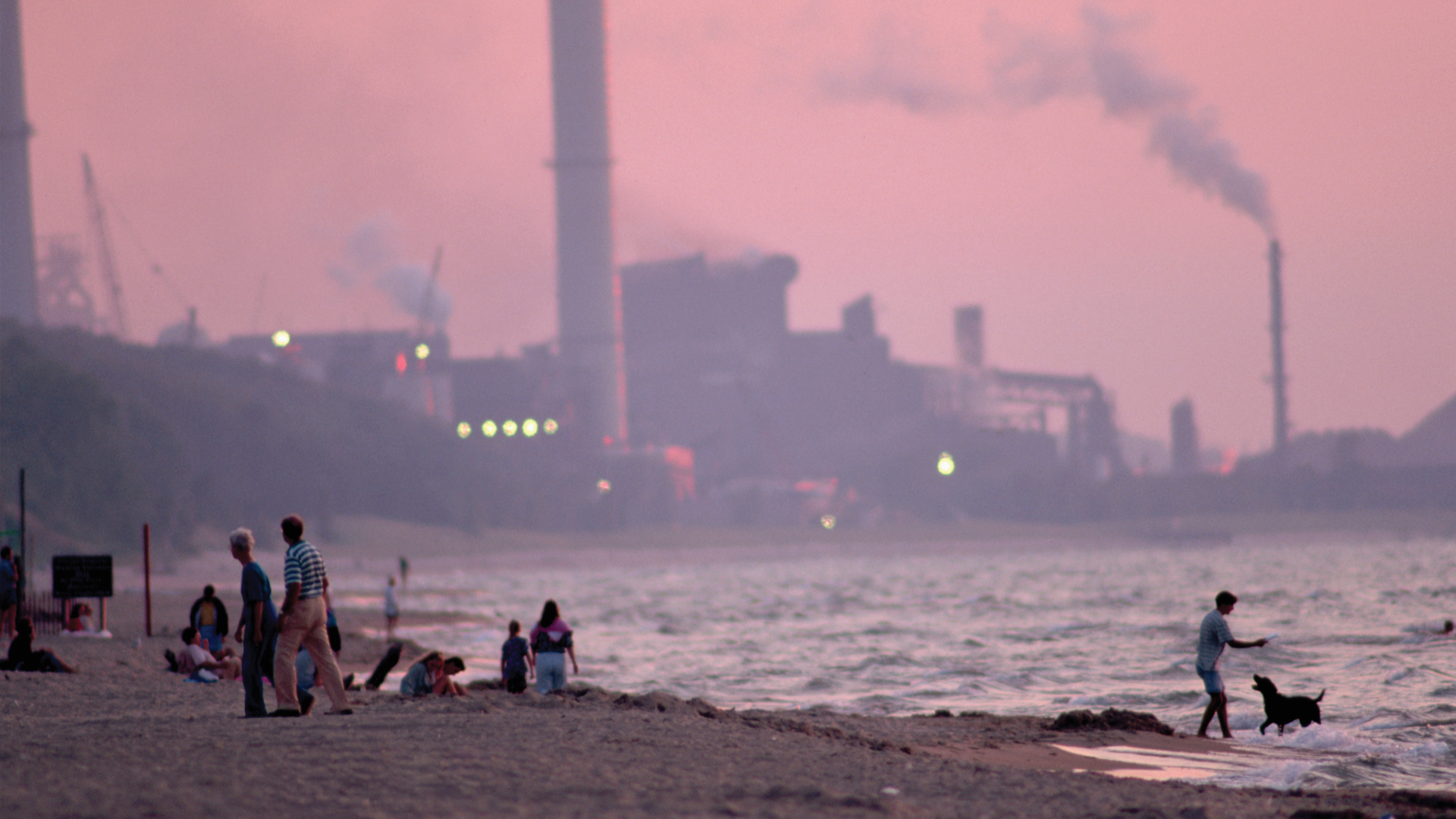
Gary has always been an industry town. The city was established in the early 1900s by U. S. Steel Corporation, a steel manufacturer that became the world’s first billion-dollar company. At the time, the industrial giant controlled more than half of the country’s production of steel. It owned not only massive steel mills but also iron ore mines, coal fields, shipping lines, and railroads.
By 1905, U. S. Steel was looking to expand, and the Gary area offered major benefits. The land was sparsely populated and conveniently located near Lake Michigan and rail transportation, which made it easier to serve regional customers. The company purchased thousands of acres on the southern shore of the lake and built a massive steel plant, known as Gary Works, on top of swampland and sand dunes. They named the new city after the company’s founding chairman, Elbert Henry Gary.
recommended


Gary was soon promoted as the “Magic City.” Its population boomed as people came to work in the steel plant. The city was filled with white Americans, European immigrants, Mexican laborers, and African Americans, many of whom migrated from the South.
The jobs were plenty, but discrimination was rampant. Many schools were racially segregated, and Black workers in the steel mills had the most-dangerous and lowest-paying jobs. Immigrant and Black workers lived in overcrowded, dilapidated boarding houses on the south side.
The Great Depression brought an economic downturn to Gary before wartime efforts helped the steel industry roar back to life. After World War II, Gary’s mills continued to churn out the steel needed for skyscrapers, bridges, dams, and appliances. Pubs, coffee shops, clothing stores, and local theaters lined the city’s vibrant downtown neighborhoods. By 1960, more than 178,000 people lived in the city.
But like other Rust Belt towns, Gary was too dependent on the steel industry for jobs and tax revenue. What happened next is the familiar story of disastrous industrial decline. Foreign competition and automation wiped out thousands of steel jobs, and Gary went into free fall. But unlike many other towns that suffered a similar fate, race played a significant role in Gary’s story.
In 1967, Gary’s growing Black population elected Richard Hatcher, a Democrat, as one of the nation’s first Black big-city mayors. At that point, Hatcher was a well-known civil rights figure. When he was on the city council, Hatcher helped pass a local law that ended racially restrictive property covenants and allowed Black residents to live wherever they wanted in Gary. His mayoral victory gave him national recognition. A few years after he won, Gary hosted the National Black Political Convention, which drew figures like Jesse Jackson and Coretta Scott King to the city.
White residents were already moving to nearby suburbs before Hatcher was elected. But the stream of white flight “became a flood” after his win, The New York Times described in one article published in the early ’90s. In the 1997 documentary The Magic City of Steel, former residents said they left Gary because of growing crime, which coincided with job losses. But the exodus was also tied to changing racial politics. “White fear caused people to leave,” historian James B. Lane bluntly told The Trace, an independent media outlet.
As residents fled, many stores, banks, and businesses closed up shop and moved to nearby Merrillville, Indiana, a newly incorporated town just south of Gary. As the number of jobs in the city declined, homeowners couldn’t afford to pay their mortgages. Houses were abandoned and boarded up. Schools closed. The city lost tax revenue, leaving it unable to provide the most basic services, such as trash pickup and road repairs. The loss of funds made it challenging to hire new police officers. Drugs and violence increased, and crime soared.
Different mayors attempted to revive Gary, but the city never turned a corner. Hatcher’s successor, Thomas Barnes, sent thousands of businesses a promotional pamphlet to entice them to set up shop in Gary, all with no luck. In the ’90s, Michael Jackson and his family agreed to a sprawling Jackson-themed amusement park that could attract visitors to their hometown of Gary, but the project failed without the then-mayor’s sign-off.
Gary suffered another setback when the Indiana state legislature in 1999 allowed U. S. Steel, still a top employer in the city, to self-assess its own property value. That move, coupled with the state’s decision to cap property taxes nearly a decade later, took millions of dollars out of the city’s budget.
Casino gambling and a new baseball stadium were eventually brought in to boost the town. But to this day, Gary depends on external funding to revitalize its neighborhoods. About 67,000 people now live in the city, and roughly three-fourths are Black.
Three years ago, a multiethnic church called Flourish opened in Gary. Multiethnic churches are rare in the area, and Flourish could be unique, Dexter Harris, the lead pastor, told me. The church began as the Gary campus of a predominantly white nondenominational congregation, which purchased an old Boys & Girls Club in the heart of the city’s downtown and planted its third campus there.
After the Gary site and the mother church butted heads over leadership issues, the third campus split off and became independent. The leaders subsequently named the new church with hope. “We want to see the city of Gary flourish again,” Harris said.
When Flourish got off the ground, Harris decided to reach out to local nonprofits to try to bring them together. He saw there was already a lot of good work being done, but many organizations were working in silos and didn’t know what others were doing. Harris, a native of nearby Chicago, created a nonprofit hub and invited organizations that mentor girls, offer high school diploma classes, and provide other services in Gary. He hosted dinners and allowed groups to use church space to run health classes or even teach karate.
Shine Recovery Café, one of the Christian-run nonprofits in the Flourish hub, operates four-hour activity sessions every week for nonviolent offenders on work release. The café aims to help participants overcome substance abuse and to connect them with resources to reorient their lives. Some might need help finding an employer who won’t throw out an application that mentions a criminal record. Others might have been in jail for so long that they don’t know how to use basic technology, like a computer or an email account, and need training. Shine hosts sessions in Gary as well as nearby Griffith.


Daveed Holmes, a staffer, told me the organization wants to be a place where people feel that they’re more than a case, an approach that informs much of what they do. During a recent event, a few participants trickled into a church lobby, where they did puzzles before a cook prepared dinner. Afterward, they observed a moment of silence and split up to do activities. Some drew portraits. Others drummed on stability balls for cardio.
Shine Recovery and other nonprofits in the Flourish hub are also trying to support local businesses. One day, 20 people might visit a neighborhood coffee shop to help it stay afloat, and a few days later, they might eat at a nearby restaurant. Last year, some of the organizations partnered with residents to revitalize four lots in the city. A national nonprofit offered funding to put up murals in a new gated park and set up a playground, which the mayor christened.
Harris oversaw much of that work. After a few years in Gary, the pastor, who is Black, told me he’s built some trust with residents. Flourish tries to worship with six other churches in the area every few weeks. Sometimes, the congregations collaborate on grants that could finance new projects. Flourish also operates resource closets, which contain suitcases, diapers, school supplies, and other materials for foster children, and has spurred more than a dozen other churches to do similar work.
Soon, Flourish plans to take over a nearby warehouse in Gary and convert it into an indoor playground, gym, and retail space. “Our hope is that this building will be an extension of the hub,” Harris told me.
U. S. Steel remains a behemoth of an institution, barricaded from intrusions. Last year, Japan’s Nippon Steel took over the company after a prolonged negotiation that was the subject of intense presidential politics. Despite its history of job losses, the plant in Gary is still one of the largest steel mills in North America, drawing in about 4,300 workers from across the region. About 10 to 15 percent of its workers live in Gary, one company representative previously told The New Yorker. The steel plant wants to hire 1,000 new employees for a multiyear project, and it has been advertising its plans downtown.
When they’re not on the clock, some steel workers come to a retro ’50s-style café across the street from the plant. They walk past the pro-union sign posted on the door of Great Lakes Café and sit at red-and-white booths for a quiet lunch break.
The owner, Cindy Klidaras, opened the café about 30 years ago and seems to know almost everyone. After she accurately detected me as a first-time visitor, I told her I was a visiting journalist working on a story. She sat across from me, telling me the changes she hoped to see in the city: One, for Gary to embrace tourism. Two, for the city to clean up its downtown area. “I want to see it like Chicago,” she said, mentioning how that city revitalized some of its neighborhoods.
If you talk to Gary officials, they will tell you the city has a lot going for it. It’s near a major metro area. And if city plans work out, the cheaper cost of living will attract workers who choose to make their home in Gary and commute to Chicago. Gary also has an airport, a lakefront that landlocked cities covet, a national park, and a small affluent neighborhood called Miller Beach, located far from its struggling downtown. With the number of highways and rail lines that go through the city, Melton often says it could be a logistical hub not just for Indiana but also for North America.
recommended

Making that a reality, however, is a long and layered work. It involves the hard task of changing the city and its image. It also requires pushing back against the malaise of pessimism that has crept in over the decades. Melton told me his priority, first and foremost, is to give people hope. “It took Gary 50 to 60 years to get to this point. It’s not going to happen overnight. But you have a mayor that believes in God,” he told a local crowd during his annual address last year, leading to cheers.
Some of the revitalization efforts—financed through COVID-19 relief dollars—are kindling hope. When Melton came into office, the city hired its first engineer in more than a decade. Afterward, government workers discovered that nearly half of the city’s 2,000 streetlights were broken. The city is using federal funds to fix the lights and some traffic signals in the city that don’t work well, the mayor told me.
At the same time, abandoned buildings are continually being demolished, some as a result of a local company that’s offered to do it for free. More demolitions means more empty lots, but the city’s goal is to clear the decks for potential investors.
Then there’s public safety, which Melton told me makes up more than 50 percent of Gary’s budget. Managing crime is a must to attract new residents, but the city is simultaneously attempting to free some of that money for other uses. Case in point: Instead of buying new vehicles for its police department, it’s leasing them with the help of a grant from a local Hard Rock Casino. There has been some good news. In February, Gary’s police department said the city’s homicide rate last year dropped to its lowest level since 1970.
One report showed that home prices in Gary increased sevenfold between 2014 and 2024—which normally wouldn’t cause celebration, but for Gary, it’s a sign that homebuyers are investing. Last October, FedEx broke ground on a new distribution center that’s expected to create 600 jobs for residents by 2027. A few other companies are also making investments.
Charles Hughes, a former city councilman who leads Gary’s Chamber of Commerce, told me a lot of these investments could have happened a long time ago. “But this is God’s chosen moment,” said Hughes, who is also a Christian.
Gary still faces significant obstacles. By the end of this year, it must complete all projects financed by federal relief funds and look for new sources of revenue for revitalization. And Indiana’s state legislature passed a new law last year that would cut property taxes for homeowners, in turn creating less local revenue for city governments. Then there’s the question of how exactly Gary can thread the needle of attracting new businesses and residents while making sure life in the city remains affordable for those who already live there.
Almost everyone I spoke with is clear-eyed about the challenges. But the Christians God has placed in the Steel City are seeing sparks of hope as they pray for Gary’s resurrection. Hughes summed up this longing during a conversation in his office: “We just want to come back.”
Haleluya Hadero is Black church editor at Christianity Today.