Church Life

Enduring All Things for the Gospel

Two centuries ago in Burma, Adoniram Judson modeled evangelistic zeal and missionary resilience.

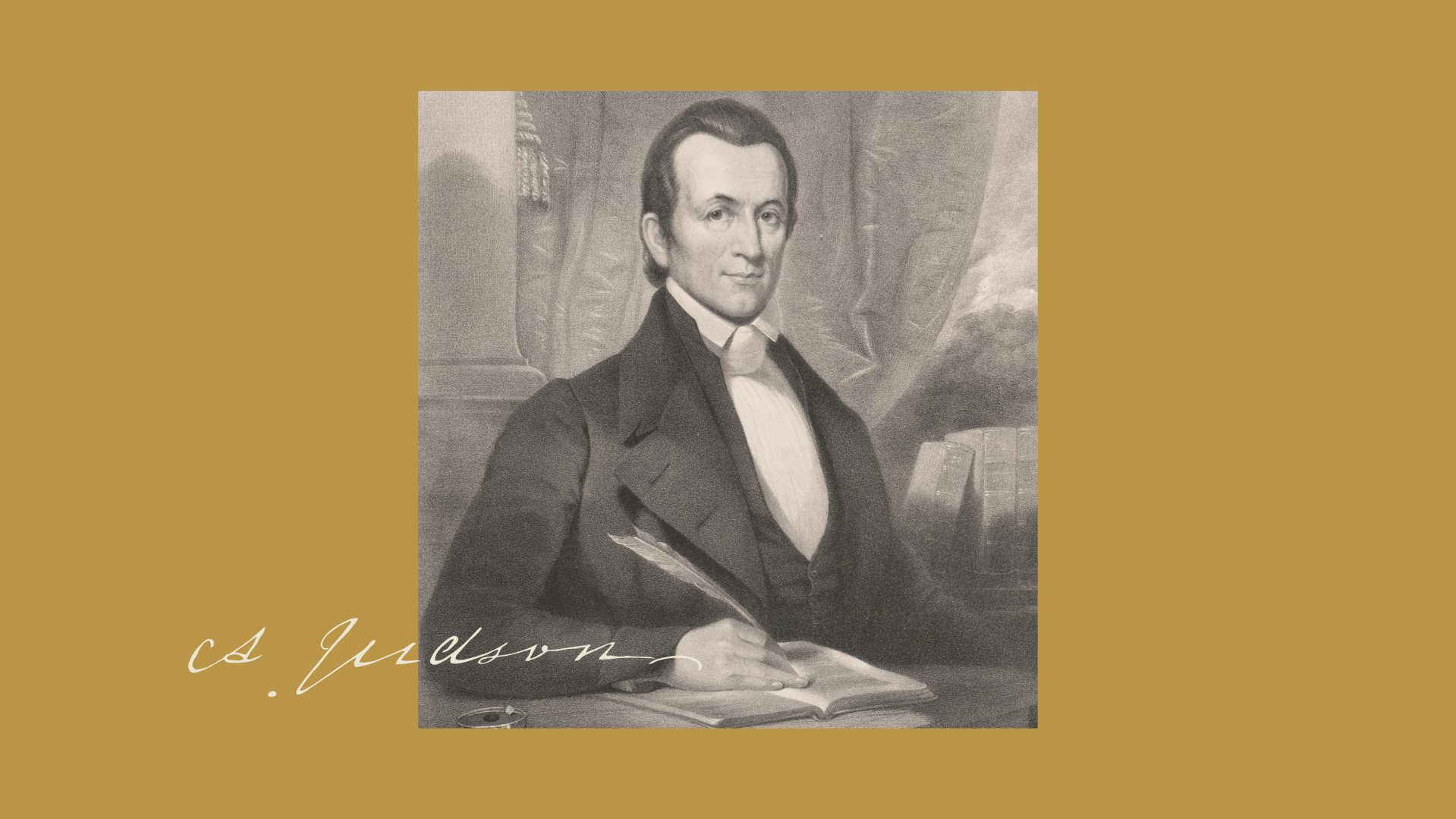
Engraved portrait of pioneer missionary Adoniram Judson seated at a desk with a quill pen, set against a gold background with his cursive signature.
Library of Congress.

Adoniram and Ann Judson were among the first formally commissioned American missionaries. Arriving in Burma (today’s Myanmar) in 1813, the Judsons labored for six years before they saw anyone convert to Christianity. Determined and diligent, they made extraordinary progress in learning native languages. Then, 11 years into their Burmese ministry, the Judsons’ world collapsed.

In 1824, long-simmering tensions between the British Empire and the Burmese king exploded in the First Anglo-Burmese War (1824–1826). The Judsons themselves sometimes had a difficult relationship with British authorities in South Asia. But in 1824, all English speakers in Burma fell under suspicion as possible spies. Judson knew plenty of British diplomats and merchants, but he was no spy.

Burmese authorities did not believe him. On June 8, 1824, police in the royal city of Ava arrested Judson, marched him to a judge, and convicted him without a trial. The Burmese committed him to the “death prison,” a small, dank building with about a hundred prisoners. The death prison had little ventilation and teemed with rats, roaches, and rotten smells.

During the day the prisoners languished in chains, but at night their captors devised additional means of preventing escape. These measures amounted to unremitting torture. Jailers passed a long bamboo stick between Judson’s legs and those of a lineup of prisoners. They chained the prisoners’ legs to the pole and lifted their bodies in the air, while the men’s shoulders remained on the ground. They left them in that excruciating position all night. Ann frantically sought to secure Judson’s release, but he remained in prison for 17 months.

The history of missions is a history of suffering. From the apostle Paul’s dangers, beatings, and imprisonments to the 1956 deaths of Jim Elliot, Nate Saint, and the other “Auca martyrs” in Ecuador, Christians rightly memorialize their best-known missionaries as people called to endure all things for the gospel. The Judsons knew trials lay ahead when they sailed away from Salem, Massachusetts, in 1812. But they never envisioned the horrors of the death prison or the compounding sufferings yet to come.

Familiarity with missions history is one of the best antidotes to the prosperity gospel—the idea that God will surely bless the faithful with health, wealth, and safety. Missionaries have routinely endured terrible hardships as they obeyed God’s call in the Great Commission (Matt. 28:18–20).

The call to missions—and the call to ministry generally—is also a call to resilience. To be sure, many missionaries have chosen to terminate their missions for good reasons, sometimes before the scheduled end of their service. This can happen when God permits circumstances that make it impossible for them to operate without grave threats to themselves or their families’ lives.
Some missionaries, such as the Judsons’ British contemporary William Carey in India, probably stayed longer in the field than godly wisdom would have dictated. Carey watched as his wife, Dorothy, suffered a protracted slide into violent mental illness. She finally died in India in 1807, after more than a decade of delusions and torment.

Any well-prepared missionary anticipates seasons of deprivation, loneliness, and other stresses. Counsel and prayer are required to know whether God is simply allowing his servants to encounter the normal travails of ministry or is definitively closing a door.

The missionary impulse is fundamental to biblical faith, as seen in the Great Commission and the Book of Acts. However, following the Reformation of the early 1500s, Protestants generally trailed Catholics in efforts to evangelize outside North America and Europe. Protestants often thought more about their churches’ survival than evangelistic expansion.

Meanwhile, Catholic powers such as Spain and France mobilized missionary orders such as the Jesuits in imperial endeavors in Asia and South and Central America. Certain Protestants, such as the Puritan John Eliot in the mid-1600s and Jonathan Edwards’s protégé David Brainerd in the 1740s, made evangelistic inroads among Native Americans.

More evangelicals professed their faith and planted churches as they moved, without being sent by any particular church or missions organization. These travelers included the Baptist pastor and former slave George Liele, who was a key leader in Black churches in Georgia and South Carolina before moving to Jamaica in the 1780s. There he became one of the founding fathers of Jamaica’s multiplying Baptist churches. But overall, organized Protestant missions were limited until the 1790s.

A turning point in Protestant missions came with Carey’s Enquiry into the Obligations of Christians to Use Means for the Conversion of the Heathens, published in 1792. Carey was one of the first Protestants to cite Christ’s “commission” (in Mark 16:15) to “go into all the world and preach the gospel to every creature” (NKJV). He insisted that this command applied to contemporary churches and believers. Carey was also instrumental in the founding of England’s Baptist Missionary Society (BMS). Arguably the first formal Protestant missionary organization, the BMS sent Carey and other missionaries to work in Serampore, near Calcutta (now Kolkata).

Carey’s work and writings inspired a generation of evangelicals, including the Judsons, to consider overseas missionary work. In 1806, students from Williams College in Massachusetts held an impromptu prayer meeting in the shelter of a haystack, consecrating themselves to the missionary cause. The Haystack Prayer Meeting led to the creation of a zealous missionary cohort amid the fervent atmosphere of the Second Great Awakening.

Engraved portrait of a young Ann Judson.The National Library of Wales. Engraving by Richard Woodman.

That cohort in 1810 founded the American Board of Commissioners for Foreign Missions (ABCFM), America’s first national missionary organization. The ABCFM was the Judsons’ first sending agency. Meanwhile, Judson himself converted in 1808 after a dalliance with religious skepticism as a student at Brown University. In 1812, the ABCFM sent the newly married Adoniram and Ann to South Asia as part of its first group of overseas missionaries.

The Judsons initially thought they might settle in India. At a minimum, they knew they would meet Carey and other British Baptists there. The problem was that the Judsons were Congregationalists and therefore paedobaptists. With plenty of time for study on the journey to India, the Judsons began to research the scriptural issue of baptism. Not long after arriving, they announced that they had become Baptists. This decision effectively cut them off from the ABCFM, their source of funding. Another Congregationalist turned Baptist missionary, Luther Rice, returned to the US and helped form the Triennial Convention, the first national Baptist organization in America.

Judson may have viewed Burma as a likely sphere of operations when they left America, but he and Ann considered several other destinations once it became clear that officials in British India would not allow them to remain. The ongoing War of 1812 made Americans unwelcome in British India.

The Judsons knew the Burmese were, in Ann’s words, “a people who have never heard the sound of the Gospel, or read, in their own language, of the love of Christ.” The prospect of operating among this unreached people was intriguing but intimidating. Certain Catholic and Protestant workers had already made brief forays into Burma, but overall it was a Buddhist kingdom with virtually no Christian influence.

The Judsons moved to Rangoon (Yangon), the main Burmese seaport. Rangoon was physically dominated by Buddhist shrines such as the great Shwedagon Pagoda. The dazzling pagoda held venerated relics, including several strands of hair claimed to be from Siddhartha Gautama, the Buddha himself.

It is difficult to overstate the resolve required for a young married couple from America to settle in South Asia, halfway around the world from friends and family. In Rangoon, they knew almost no English speakers or Christians of any kind. In the era before electronic communication, correspondence with America was achingly slow. In 1815, they received letters from US supporters for the first time in two years.

Perhaps the most daunting aspect of the work was that they knew nothing about the Burmese language. It uses a writing system called an “abugida,” which to Westerners looks like a jumble of squiggly lines. In addition, Judson needed to learn Pali, a traditional language that profoundly colored the type of Buddhism practiced in the country. Many religious terms a Christian translator in Burma needed to know were rooted in Pali, not Burmese.

Today’s missiologists would regard it as utterly irresponsible to send missionaries into a foreign culture with no knowledge of the country’s language. But that’s exactly what the Judsons faced. There were no courses on Burmese in American colleges, and the Judsons did not set out with the express intention of going to Burma anyway. They were pioneers in the most extreme missiological sense. Some American missionaries who followed the Judsons to Burma made little progress in language study, to Judson’s irritation. But the Judsons were incredibly diligent students of the language, and with the help of Burmese instructors they made phenomenal progress.

What purpose did their study serve? First, the Judsons planned to form Burmese-language churches when God blessed the mission with enough converts. Thus, Judson needed to be able to preach in Burmese.

The longer-term goal of studying Burmese and Pali was that Judson intended to translate the whole Bible into Burmese. Some in the missionary community wanted to focus on English-language instruction for natives, who then would read the Bible and hear sermons in English. But modeling the great Protestant principle of Scripture in the vernacular, Judson insisted that a vibrant Burmese church needed a Bible in its own language.

Sepia-toned illustration of the golden Shwedagon Pagoda rising above palm trees and lush vegetation.Wikimedia, Joseph Moore (engraved by T. Fielding, G. Hunt, H. Pyall)

Because of books such as Courtney Anderson’s classic biography To the Golden Shore: The Life of Adoniram Judson (1956), people familiar with Judson see him as an exemplar of missionary courage. And that he was. But he was also one of the brightest and most disciplined Christian scholars ever. We may miss this fact because he applied his scholarship in a foreign mission instead of in the relative comfort of an American church, college, or seminary.

Judson’s imprisonment and the other dangers he faced are compelling stories for readers. But what he did most days—studying and translating Burmese—is not so exciting. Once the Judsons settled in Rangoon, Judson worked on Burmese and Pali 12 hours a day, six days a week, for years on end. If you stopped by their home, Ann wrote, you would invariably find Judson “bent over his table, covered with Burman books, with his teacher at his side.” This steady labor took a toll on Judson’s eyesight, and headaches constantly tormented him. Language study was almost all the Judsons could report in their early years in Burma. The fact that there were no converts caused concern among impatient supporters back home. But Judson’s diligence resulted in a translation of the Gospel of Matthew by 1817.

Ann was no slouch in languages either. She focused more on conversational Burmese than Judson did, and soon she also began to study “Siamese,” or the Thai language. (Thailand is Myanmar’s neighbor to the southeast.) Judson slowly began to produce tracts and books of the Bible in Burmese, works that Ann and her Siamese teacher then translated into Thai.


Judson began more public-facing ministry in the late 1810s. In 1819, he finally baptized his first Burmese convert, a man named Maung Naw. But there was tremendous cultural and legal pressure for ethnic Burmese people not to abandon Buddhism. Judson approached the emperor in 1820 to request greater latitude for evangelizing the Burmese, but to no avail.

Death constantly shadowed the Judsons’ lives, even before his scourging confinement in prison. Their first child was stillborn and died before they arrived in Burma. In 1815, Ann gave birth to Roger Williams Judson (named for the great American Colonial champion of religious liberty). But little Roger lived only eight months. Parents in the 1800s often lost children to disease, but the Judsons had almost no one except themselves and God with whom they could share their grief.

Despite their constant difficulties, by 1823 Judson had completed a draft of the whole New Testament in Burmese, and the Rangoon church had more than a dozen baptized members. Then in 1824 came the horrors of war, prison, and torture.

In addition to appealing for Judson’s release and bringing whatever supplies she could to the prisoners, Ann cared for their baby Maria, conceived just before Judson went to jail.

In 1826, the Burmese finally released Judson, but the bitterest times of his life were yet to come. Just when the reunited couple thought they might resume their ministry, Ann suddenly died. Judson was not even with her at her death, as he had been called away to negotiate a commercial agreement between the British and Burmese. Little Maria died six months later. Judson buried them both in Amherst, Burma, under a large hopea tree that became a pilgrimage site for Western missionaries and Burmese Christians.

Judson had long practiced ascetic Christian disciplines, but Ann’s and Maria’s deaths sent him into a bitter spiral of self-denial and introspection. Emaciated and ill, he on many days ate only a bit of rice. At one point, he dug his own grave and sat on its edge, contemplating the day when his own body would molder there too.

Though his asceticism seemed extreme to some, it was Judson’s way of spiritually coping with his intense losses and grief. At his new mission headquarters at Moulmein, Burma, he plodded away on the full Bible translation, a draft of which he finished in 1834. The next year he married Sarah Boardman, another American missionary who had lost her own husband to death several years earlier.

Judson was not easily satisfied with his translation work, but in 1840 he published a revised version of the complete Bible. Then he turned his attention to a Burmese–English dictionary. The latter project seemed dull even to the bookish Judson, but he knew it was essential for future Anglo-American missionaries to have a reliable guide.

Death stalked his marriage to Sarah too. In 1845 they left Burma for America in hopes of getting health treatment for her. But en route to the US, Sarah died. Judson went on to America, returning to his homeland for the first time in more than three decades. But he found his native country unpleasant. Judson saw many Christians there complacent and morally compromised. He wanted to return quickly to Burma, but before he left, he married a young Christian writer named Emily Chubbuck, who agreed to give up her burgeoning career to become a missionary.

Back in Burma, he and Emily sought to rejuvenate the church in Rangoon, which had effectively ceased operations during and after the First Anglo-Burmese War. But the country’s authorities remained unfriendly to Christians and especially hostile toward Burmese Buddhists who converted. So the Judsons were forced to retreat to Moulmein, which was under British rule.

Judson thought of going to the royal capital of Ava to appeal for religious liberty again, but the Baptist mission board back in the US couldn’t provide the necessary funds to send him. It pained Judson that after all these years, the Baptists in America weren’t able to cover even the basic expenses of his work.

The long-suffering Judson had already outlived two wives, as well as many colleagues and children. But death finally caught up with him in 1850. Doctors suggested a sea voyage to alleviate symptoms of a lung disease, but he died on the trip and was buried at sea. Although there is a memorial in his hometown of Plymouth, Massachusetts, his admirers and descendants have no grave to visit.

Before he died, he told Emily, “I am not tired of my work, neither am I tired of the world yet when Christ calls me home, I shall go with the gladness of a boy bounding away from his school.” Judson’s long missionary career saw no spectacular ingathering of converts. Most converts in Burma during his lifetime came from the Karen (pronounced Ka-REN) tribe, not the ethnic Burmese majority to whom he devoted the most time.

Judson did receive praise in America for his Bible translation, but of course only the Burmese could read it, so few Americans ever read any of his work. He spent most of his adult life toiling in relative obscurity in Burma and primarily spent the last ten years composing a dictionary. As a missionary, he was not sensational. But he was extraordinarily disciplined and resilient.

And what great fruit his ministry bore! Most obviously, he left a translation of the whole Bible that, for Burmese Christians, was definitive. It remains the default Bible in Burmese churches today. It is not unusual to see portraits of Adoniram and Ann in Burmese churches.

Rarely has a missionary ever become so closely linked with a nation’s churches and Bible as Judson was in Burma. But one obvious disappointment for him was the lack of conversions among the Burmese. This pattern has persisted through to the present day. According to the World Christian Database, less than 1 percent of the ethnic Burmese in Myanmar identify as Christian.

Where the gospel really caught fire was among often-persecuted minority groups, especially the ethnic Karen and Chin. Judson was aware of the surprising conversions among non-Burmese ethnicities, but he didn’t evangelize much among them. Some of his American colleagues did, though, and conversions escalated when native Karen evangelists preached to their own people in the 1830s and ’40s.

Today, about half of the people with a Karen background in Myanmar profess Christian faith. Baptists are the largest Christian denomination in Myanmar, reflecting Judson and his missionary colleagues’ affiliation. Substantial émigré communities from Myanmar have also moved to the US, particularly to Midwestern cities such as Indianapolis and the Twin Cities in Minnesota. Christian immigrants from Myanmar commonly plant churches in America, especially Baptist congregations.

Judson left a profound legacy in Burma, but he did not always see the fruit he initially expected. As one Burmese Christian commented more than 150 years after the publication of Judson’s translation, “Whenever someone mentions the name ‘Judson’ great tears come to our eyes because we know what he and his family suffered for us. . . . Today, there are [millions of] Christians in Myanmar, and every one of us traces our spiritual heritage to one man—the Reverend Adoniram Judson.”

Judson possessed little money at the end of his life. Like the apostle Paul, he poured himself out for the sake of the gospel. More specifically, he endured countless trials to make God’s Word known in a nation with no Bible translation. Judson was not a perfect man. Among other faults, he easily became exasperated with colleagues who didn’t meet his exacting standards for hard work.

But in addition to his brilliance and courage, perhaps his greatest Christian virtues were resilience and hope. He endured profound suffering and spent years on translation work that was the opposite of glamorous. His long years of toil and loss forged a foundation for Burma’s churches, built on the perfect Word of God.

Thomas S. Kidd is research professor of church history at Midwestern Baptist Theological Seminary. He and Midwestern’s provost, Jason Duesing, are writing a biography of Adoniram Judson.


Culture

Can the City of Steel Rise Again?

Gary, Indiana, has struggled for decades. A coalition of Christians is working to bring it back to life.

People walk along a sandy beach at dusk while a smokestack-laden industrial plant looms in the background under a pink, hazy sky in Gary, Indiana.
Getty, Patrick Bennett.

Attendees of a news conference walked past boxes of donated clothes and worn-out leather couches to the back room of a dreary building where homeless men spend their nights. The mayor of Gary, Indiana, Eddie Melton, was there announcing his latest plan to revitalize a city that was once an emblem of America’s industrial might. And local residents, reporters, pastors, and city officials had gathered to hear what he would share. 

Flanked by nearly two dozen empty twin beds, Mike Dotson, a local pastor whose predominantly Black church owns and operates the shelter, opened the conference in prayer. He thanked God that the facility has been used to serve thousands for decades and asked for blessings for its future. In this case, Melton would soon share, its future is that it’s being rebuilt. But Gary has hemorrhaged residents for decades and can’t easily afford this type of major project. The city is using $3 million in federal funds, some of which came through the government’s COVID-19 relief package, to construct a new shelter. 

“We know the Scripture in Genesis 4:9 when the question was asked, ‘Am I my brother’s keeper?’ And today we want to answer that question and say, ‘Yes, we are our brothers’ keeper,’ ” Melton, who came into office about two and a half years ago, said in February. He noted the new facility would essentially double the number of beds in the building to 50. The shelter, however, still needs support from the community—including churches, which are needed to provide furniture, bedding, and other supplies for housing people.

The new shelter is one of many projects underway to beautify and revive downtown Gary, a once-bustling commercial corridor that’s now filled with dilapidated buildings, shuttered businesses, and empty lots. The city, located on the south shore of Lake Michigan just a 45-minute drive from Chicago, is seeking to turn over a new leaf and shed its reputation for poverty and crime. To do so, it needs to permanently reverse its steep population decline, clean up blight, and attract businesses that provide good-paying jobs and serve as a stable source of revenue for the city’s coffers. 

The task is primarily one for Melton. But in this heavily churched area, congregations, pastors, and Christian-run nonprofits are an integral part of the effort. “This is an all-hands-on-deck approach,” the mayor told me during an interview. 

The city can feel churches’ impact in many areas. About two miles north of the men’s shelter, another pastor, Dennis Walton, has spent the past few years renovating an old Salvation Army building and converting it into a community center. Walton, who pastors a dual-location church called Faith Temple of Christ, purchased the building using his own money. He called it Faith Community Center North and offered the space to nonprofits that train residents in construction and trade—including carpentry, roofing, and HVAC systems—and provide mental health counseling to residents battling drug and alcohol addiction. 

Inside the building, his team is developing a gym, and they also plan to create a service that delivers fresh produce to nearby residents. During the holidays, they host a Toys for Tots giveaway, which usually draws enough people to create a ten-block line outside. 

When I toured the building, Walton told me the city gave his organization some funding last year to set up emergency shelters for women with children. His team now runs five homes in the city. In another part of Gary, they work with nonprofits to operate a six-acre community garden, on which they farm honey and grow spinach, cucumbers, tomatoes, squash, and other vegetables they plan to sell and give away.

However, funding for projects is typically bleak, even for Walton, who chairs a city subcommittee on economic vitality. There’s not enough money for everything that needs to be done. But he meets regularly with pastors and business leaders to see what they can do with what they have. “Our goal is to give the city a lift,” he said.

Gary has always been an industry town. The city was established in the early 1900s by U. S. Steel Corporation, a steel manufacturer that became the world’s first billion-dollar company. At the time, the industrial giant controlled more than half of the country’s production of steel. It owned not only massive steel mills but also iron ore mines, coal fields, shipping lines, and railroads. 

By 1905, U. S. Steel was looking to expand, and the Gary area offered major benefits. The land was sparsely populated and conveniently located near Lake Michigan and rail transportation, which made it easier to serve regional customers. The company purchased thousands of acres on the southern shore of the lake and built a massive steel plant, known as Gary Works, on top of swampland and sand dunes. They named the new city after the company’s founding chairman, Elbert Henry Gary. 

Gary was soon promoted as the “Magic City.” Its population boomed as people came to work in the steel plant. The city was filled with white Americans, European immigrants, Mexican laborers, and African Americans, many of whom migrated from the South. 

The jobs were plenty, but discrimination was rampant. Many schools were racially segregated, and Black workers in the steel mills had the most-dangerous and lowest-paying jobs. Immigrant and Black workers lived in overcrowded, dilapidated boarding houses on the south side. 

The Great Depression brought an economic downturn to Gary before wartime efforts helped the steel industry roar back to life. After World War II, Gary’s mills continued to churn out the steel needed for skyscrapers, bridges, dams, and appliances. Pubs, coffee shops, clothing stores, and local theaters lined the city’s vibrant downtown neighborhoods. By 1960, more than 178,000 people lived in the city. 

But like other Rust Belt towns, Gary was too dependent on the steel industry for jobs and tax revenue. What happened next is the familiar story of disastrous industrial decline. Foreign competition and automation wiped out thousands of steel jobs, and Gary went into free fall. But unlike many other towns that suffered a similar fate, race played a significant role in Gary’s story. 

In 1967, Gary’s growing Black population elected Richard Hatcher, a Democrat, as one of the nation’s first Black big-city mayors. At that point, Hatcher was a well-known civil rights figure. When he was on the city council, Hatcher helped pass a local law that ended racially restrictive property covenants and allowed Black residents to live wherever they wanted in Gary. His mayoral victory gave him national recognition. A few years after he won, Gary hosted the National Black Political Convention, which drew figures like Jesse Jackson and Coretta Scott King to the city. 

White residents were already moving to nearby suburbs before Hatcher was elected. But the stream of white flight “became a flood” after his win, The New York Times described in one article published in the early ’90s. In the 1997 documentary The Magic City of Steel, former residents said they left Gary because of growing crime, which coincided with job losses. But the exodus was also tied to changing racial politics. “White fear caused people to leave,” historian James B. Lane bluntly told The Trace, an independent media outlet. 

As residents fled, many stores, banks, and businesses closed up shop and moved to nearby Merrillville, Indiana, a newly incorporated town just south of Gary. As the number of jobs in the city declined, homeowners couldn’t afford to pay their mortgages. Houses were abandoned and boarded up. Schools closed. The city lost tax revenue, leaving it unable to provide the most basic services, such as trash pickup and road repairs. The loss of funds made it challenging to hire new police officers. Drugs and violence increased, and crime soared. 

Different mayors attempted to revive Gary, but the city never turned a corner. Hatcher’s successor, Thomas Barnes, sent thousands of businesses a promotional pamphlet to entice them to set up shop in Gary, all with no luck. In the ’90s, Michael Jackson and his family agreed to a sprawling Jackson-themed amusement park that could attract visitors to their hometown of Gary, but the project failed without the then-mayor’s sign-off. 

Gary suffered another setback when the Indiana state legislature in 1999 allowed U. S. Steel, still a top employer in the city, to self-assess its own property value. That move, coupled with the state’s decision to cap property taxes nearly a decade later, took millions of dollars out of the city’s budget.

Casino gambling and a new baseball stadium were eventually brought in to boost the town. But to this day, Gary depends on external funding to revitalize its neighborhoods. About 67,000 people now live in the city, and roughly three-fourths are Black.

Three years ago, a multiethnic church called Flourish opened in Gary. Multiethnic churches are rare in the area, and Flourish could be unique, Dexter Harris, the lead pastor, told me. The church began as the Gary campus of a predominantly white nondenominational congregation, which purchased an old Boys & Girls Club in the heart of the city’s downtown and planted its third campus there. 

After the Gary site and the mother church butted heads over leadership issues, the third campus split off and became independent. The leaders subsequently named the new church with hope. “We want to see the city of Gary flourish again,” Harris said. 

When Flourish got off the ground, Harris decided to reach out to local nonprofits to try to bring them together. He saw there was already a lot of good work being done, but many organizations were working in silos and didn’t know what others were doing. Harris, a native of nearby Chicago, created a nonprofit hub and invited organizations that mentor girls, offer high school diploma classes, and provide other services in Gary. He hosted dinners and allowed groups to use church space to run health classes or even teach karate. 

Shine Recovery Café, one of the Christian-run nonprofits in the Flourish hub, operates four-hour activity sessions every week for nonviolent offenders on work release. The café aims to help participants overcome substance abuse and to connect them with resources to reorient their lives. Some might need help finding an employer who won’t throw out an application that mentions a criminal record. Others might have been in jail for so long that they don’t know how to use basic technology, like a computer or an email account, and need training. Shine hosts sessions in Gary as well as nearby Griffith. 

Daveed Holmes, a staffer, told me the organization wants to be a place where people feel that they’re more than a case, an approach that informs much of what they do. During a recent event, a few participants trickled into a church lobby, where they did puzzles before a cook prepared dinner. Afterward, they observed a moment of silence and split up to do activities. Some drew portraits. Others drummed on stability balls for cardio. 

Shine Recovery and other nonprofits in the Flourish hub are also trying to support local businesses. One day, 20 people might visit a neighborhood coffee shop to help it stay afloat, and a few days later, they might eat at a nearby restaurant. Last year, some of the organizations partnered with residents to revitalize four lots in the city. A national nonprofit offered funding to put up murals in a new gated park and set up a playground, which the mayor christened. 

Harris oversaw much of that work. After a few years in Gary, the pastor, who is Black, told me he’s built some trust with residents. Flourish tries to worship with six other churches in the area every few weeks. Sometimes, the congregations collaborate on grants that could finance new projects. Flourish also operates resource closets, which contain suitcases, diapers, school supplies, and other materials for foster children, and has spurred more than a dozen other churches to do similar work. 

Soon, Flourish plans to take over a nearby warehouse in Gary and convert it into an indoor playground, gym, and retail space. “Our hope is that this building will be an extension of the hub,” Harris told me. 

U. S. Steel remains a behemoth of an institution, barricaded from intrusions. Last year, Japan’s Nippon Steel took over the company after a prolonged negotiation that was the subject of intense presidential politics. Despite its history of job losses, the plant in Gary is still one of the largest steel mills in North America, drawing in about 4,300 workers from across the region. About 10 to 15 percent of its workers live in Gary, one company representative previously told The New Yorker. The steel plant wants to hire 1,000 new employees for a multiyear project, and it has been advertising its plans downtown. 

When they’re not on the clock, some steel workers come to a retro ’50s-style café across the street from the plant. They walk past the pro-union sign posted on the door of Great Lakes Café and sit at red-and-white booths for a quiet lunch break. 

The owner, Cindy Klidaras, opened the café about 30 years ago and seems to know almost everyone. After she accurately detected me as a first-time visitor, I told her I was a visiting journalist working on a story. She sat across from me, telling me the changes she hoped to see in the city: One, for Gary to embrace tourism. Two, for the city to clean up its downtown area. “I want to see it like Chicago,” she said, mentioning how that city revitalized some of its neighborhoods. 

If you talk to Gary officials, they will tell you the city has a lot going for it. It’s near a major metro area. And if city plans work out, the cheaper cost of living will attract workers who choose to make their home in Gary and commute to Chicago. Gary also has an airport, a lakefront that landlocked cities covet, a national park, and a small affluent neighborhood called Miller Beach, located far from its struggling downtown. With the number of highways and rail lines that go through the city, Melton often says it could be a logistical hub not just for Indiana but also for North America. 

Making that a reality, however, is a long and layered work. It involves the hard task of changing the city and its image. It also requires pushing back against the malaise of pessimism that has crept in over the decades. Melton told me his priority, first and foremost, is to give people hope. “It took Gary 50 to 60 years to get to this point. It’s not going to happen overnight. But you have a mayor that believes in God,” he told a local crowd during his annual address last year, leading to cheers. 

Some of the revitalization efforts—financed through COVID-19 relief dollars—are kindling hope. When Melton came into office, the city hired its first engineer in more than a decade. Afterward, government workers discovered that nearly half of the city’s 2,000 streetlights were broken. The city is using federal funds to fix the lights and some traffic signals in the city that don’t work well, the mayor told me. 

At the same time, abandoned buildings are continually being demolished, some as a result of a local company that’s offered to do it for free. More demolitions means more empty lots, but the city’s goal is to clear the decks for potential investors. 

Then there’s public safety, which Melton told me makes up more than 50 percent of Gary’s budget. Managing crime is a must to attract new residents, but the city is simultaneously attempting to free some of that money for other uses. Case in point: Instead of buying new vehicles for its police department, it’s leasing them with the help of a grant from a local Hard Rock Casino. There has been some good news. In February, Gary’s police department said the city’s homicide rate last year dropped to its lowest level since 1970. 

One report showed that home prices in Gary increased sevenfold between 2014 and 2024—which normally wouldn’t cause celebration, but for Gary, it’s a sign that homebuyers are investing. Last October, FedEx broke ground on a new distribution center that’s expected to create 600 jobs for residents by 2027. A few other companies are also making investments

Charles Hughes, a former city councilman who leads Gary’s Chamber of Commerce, told me a lot of these investments could have happened a long time ago. “But this is God’s chosen moment,” said Hughes, who is also a Christian. 

Gary still faces significant obstacles. By the end of this year, it must complete all projects financed by federal relief funds and look for new sources of revenue for revitalization. And Indiana’s state legislature passed a new law last year that would cut property taxes for homeowners, in turn creating less local revenue for city governments. Then there’s the question of how exactly Gary can thread the needle of attracting new businesses and residents while making sure life in the city remains affordable for those who already live there. 

Almost everyone I spoke with is clear-eyed about the challenges. But the Christians God has placed in the Steel City are seeing sparks of hope as they pray for Gary’s resurrection. Hughes summed up this longing during a conversation in his office: “We just want to come back.” 

Haleluya Hadero is Black church editor at Christianity Today.

Photograph of Paige Lohman
Church Life

I Sold My Body and Couldn’t Quit Heroin. But God Pursued Me.

Some faithful Christian women visited the dressing room at my strip club and showed me the love of Christ.

Photography by Aaron Wojack for Christianity Today

I grew up in Las Vegas, and my mom took me to church a few times a year. She even enrolled me in Sunday school and a Christian high school. But the stories, skits, and sermons never turned into a relationship with God. I didn’t know that was possible—or that he would ever love someone like me.

When I was 8, my mom was diagnosed with breast cancer. My parents tried to hide it, but I could tell something was wrong—the endless doctor visits, her beautiful black hair falling out, her decision to step away from a job she loved. I prayed to this God everyone talked about, bargaining with him: If you make her better, I’ll be the best daughter ever. I’ll get straight A’s. I’ll never talk back. But she didn’t get better. Watching her fade away, I wondered if God was real and, if he was, why he let our family crumble.

When everyone’s attention turned to my mother’s illness, I felt lost in the shadows. I looked to my peers for love and connection I couldn’t find at home. That search led me into the grip of anorexia and bulimia. I’d starve myself, binge, then purge—over and over. Eventually, my aunt and my dad admitted me into an inpatient program. My heart rate dropped so low that I had to be fed through a tube. I’ll never forget the feeling of that tube being shoved down my throat.

While I was still at the facility, my dad walked in one day to tell me that Mom was gone. Something inside me shut off. I didn’t cry. I just felt numb. That was the day my world went silent.

After I lost my mom, I craved escape. My best friend invited me to a party one night. “Sure,” I said. My dad worked nights at a casino, so from 8 p.m. to 4 a.m., I was on my own.

That first party wasn’t what I expected. There were older strangers, along with weed, cocaine, and acid. That’s where I tried OxyContin for the first time. A friend showed me how to smoke it to feel the full effect. 

By 18, I was addicted to black tar heroin. Somehow, I still graduated from high school. After a string of car wrecks and violent outbursts, my family realized I needed help. I went to college, hoping that burying myself in books and goals would fix everything. But you can’t outrun demons. I carried every wound, every trauma, right into that next chapter.

In college, I had moments of sobriety. But every clean streak ended in a relapse worse than the last. It was during one of my sober stretches that I met Katy. She was a senior like me. Katy was smart, mysterious, and a writer for the campus feminist column. She was also addicted to opiates. Looking back, I see how the Enemy set that up. Katy sat down next to me in the library one night as I was studying. She couldn’t stay awake, and I ended up helping her get home. Later, I looked her up on Facebook. Her bio said she was an exotic dancer at a club called the Spice House.

I had grown up in Las Vegas, but I’d never been inside a strip club. My only knowledge of that world came from music videos—the money, the lights, the girls who appeared powerful and adored. They look happy, I thought. That’s what I want. I just want to feel like I matter. So one night, I decided to check it out. I told myself it was just for research, but the moment I got a taste of fast money, I was hooked. Stripping became a gateway to darker forms of exploitation. I started responding to ads promising $1,000 a night. Some were for escort services. Others were covert trafficking schemes. One boundary after another fell until I didn’t recognize myself.

I remember spending a night in a cheap motel room and looking at my reflection in the mirror. I saw a hollow shell of a woman staring back at me. A thought pierced through the haze. What if you die this way? If heaven and hell are real, I wondered, where would my soul go? I decided to take a bath. As the tub filled, I remembered that I had just taken several hits of heroin. Then another thought hit me: Remember how Whitney Houston died? She drowned in the bathtub. It was as if God had whispered, If you don’t change, this is where you’re headed. That night, I had a spiritual awakening. My soul woke up before my body.

A week later, I dragged myself back to the strip club. I went into the locker room, lit up my foil, and took a few puffs. Suddenly, laughter filled the room—not fake, empty laughter but sounds of real joy. It sliced through the darkness like a beam of light in a cave. I peeked around the corner and saw a few older women walking in with bright smiles and plates of warm food.

They sat with the dancers, talking with them like friends. I realized they’d been there before, but I’d never noticed them. They were talking about Jesus. And it wasn’t the judgmental “turn or burn” Christianity I’d heard shouted through megaphones on the Vegas strip. These women came to tell us that we were loved—that God had a plan, even for girls like me. Something shifted. For the first time in years, I felt seen. I felt valued. I felt hope. Those women didn’t wait for me to find my way into a church. They brought church to me. That night, I wrote on one of their prayer cards, “God, help me.”

Those Christian women planted precious seeds that night, but it took time for them to grow. I spent several more years in addiction and abuse. 

Eventually, my dad called with an ultimatum. He said I needed to go to rehab or he would have to step back from being in my life. “I can’t watch you kill yourself,” he told me. “We already lost your mom.”

Something in me finally shifted. I agreed to enter a 30-day treatment program in Florida. There, with a clear mind for the first time in years, I started to picture my life without drugs. What could it look like?

Even though it was a secular rehab program, the staff offered to take us to church on Sundays if we wanted to go. I went every time, and I could sense God tugging at my heart. After the program, I moved into a sober living home in Covina, California. I started going to meetings again and even got accepted into law school.

But I wasn’t free yet. I slipped back once more—this time working for a manipulative escort agent. He was cunning and controlling, and when the shame hit, I couldn’t numb it anymore.

One night, I dropped to my knees in my bedroom and cried out, “God, I know what I’m doing is wrong. Jesus, I know you’re real. Please forgive me.” I felt his presence flood the room. It felt like heat, peace, love, forgiveness. The gospel finally made sense: While we were still sinners, Christ died for us (Rom. 5:8). Even when I was dancing in clubs or getting high, Jesus loved me. He never stopped pursuing me.

I called my agent from a grocery store parking lot and said, “I’m done.” Then I blocked his number. That day, I finally chose freedom. After that, God began rebuilding my life piece by piece. He sent godly women my way—like one I met at an Alcoholics Anonymous meeting who introduced herself not as an alcoholic but as “a child of God.” She invited me to Bible studies and coffee.

Another woman invited me to church, where I nervously walked up to the altar and gave my heart fully to Jesus. I was baptized and joined a discipleship class. After a sermon on purity, I broke down at the altar, repenting and surrendering everything to God. In that moment, God removed my desire to use drugs—and my desire to exploit my body in any way.

Today, I’m free from heroin. I’m married to a man of God, I’m a mother of three and a law school graduate, and I work in the anti-trafficking field. I still go to the strip club, but this time, I’m the one sharing the gospel of Jesus Christ. Over the years, we’ve reached hundreds of women, and many have given their lives to Jesus.

My life is not without trials. In 2020, I was diagnosed with cancer. Recently, I learned that it’s back. I’m battling breast cancer and brain cancer, which has caused temporary partial blindness. But as I walk through treatment again, I’m not alone. My faith is my anchor. The Word of God is my medicine. Romans 5:3–5 says, “We also glory in our sufferings, because we know that suffering produces perseverance; perseverance, character; and character, hope. And hope does not put us to shame, because God’s love has been poured out into our hearts through the Holy Spirit.”

I hold on to that truth every day. The same God who reached me in a strip club dressing room is still with me now. He hasn’t failed me yet, and he never will. 

Paige Lohman is a digital content creator and founder of Girl Redeemed. She lives in California with her husband and three children.

Church Life

Men Should Bear the Brunt of Contraception

Sterilization should never be done carelessly, and it should be the man’s burden.

Abstract collage-style illustration of overlapping silhouetted figures in orange, teal, and pink hues suggesting connection, embrace, or emotional struggle.
Illustration by Shonagh Rae

In this series

I vividly remember crying in the kitchen with my wife, Lauren. I was doing some dishes when Lauren put a pregnancy test on the counter next to me. That moment was totally unlike the others, where there was waiting, joy, and celebration. This one felt like a punishment and a total surprise. We already had three rambunctious boys under the age of 5. What’s more, the pregnancies had been hard on Lauren’s health. Her midwives had recommended against having another pregnancy for a while.

A year later, two things were true. First, we did what many faithful people of God have done before us when faced with unexpected children. We wrestled with God. We fought with each other. We talked with friends. And we changed. We made our peace with God’s plan. That fourth boy is now 7, and we love him with that indescribable love that is the blessing of parenting. He is a gift unlike any other.

The second truth is I got a vasectomy. Lauren scheduled it for me. We didn’t need to talk about it. It never occurred to me to pray about it. I never consulted a friend about it. I did not research it. I just tied off my ability to reproduce. But that way of making such a morally fraught decision was a mistake.

T. S. Eliot called contraception the suicide of civilization. Theodore Roosevelt called it “the one sin for which the penalty is national death.” G. K. Chesterton was even more blunt: “I despise Birth-Control because it is a weak and wobbly and cowardly thing.” Birth control did change the world. Contraception pulled the plug, and American sexual ethics fell swiftly down the drain. The right to privacy emerged from access to contraception; Roe v. Wade and the sexual revolution followed closely behind, including a rampant pornography industry.

When I ran to the doctor to get a vasectomy in my mid-30s, I had no idea I was standing in a world created by such chaos. I was just trying to care for my family. Having now learned much more about the history of sex ethics and a theology of the body, here is what I would recommend as a primer:

First, I have come to believe that Christians should have a strong preference for natural family planning. Even my Catholic brothers and sisters admit and allow for natural family planning through abstinence at certain times of the month. I used to find their arguments cheeky: Don’t ever separate the unitive and procreative aspects of sex (unless you want to separate them by natural family planning, wink, wink). But I give it much greater respect now.

Submitting to the natural rhythms of our bodies is a far healthier—and far less ethically fraught—means of family planning. Natural family planning requires we adjust our lives to our bodies, not our bodies to our lives. A century ago, there was relative consensus in the church that our culture should be very cautious of birth control.

Second, male contraception should be cautiously permissible. While natural family planning seems the wisest and safest choice, I find condoms or vasectomies permissible for a few reasons.

To start, they put the burden on the male and require him to take initiative to control himself and alter his life when it comes to sex. This is healthy for men. When sex is offered to men with no responsibilities or restrictions attached, men, women, and children suffer. When men are required to be responsible for sex, men, women, and children benefit.

Male contraception also helps a man care for his family by allowing good and beautiful intimacy to flourish while stewarding his family’s stage of life. But it should not be encouraged outside marriage, since according to Scripture there is no place for sex outside of marriage. I also believe this should not be used lightly to delay children for a long period of time or to create a culture where children are optional in marriage.

But when you are in a committed marriage with children and having more would create unwise health or mental health issues, I stand by the idea of male contraception as a possibly wise option for a man to care for his wife and family.

These are admittedly narrow circumstances for male contraception to be used discerningly. This is why I believe the church should move from a default posture of “What is wrong with this?” to asking instead, “What is right about this?”

It is not a simple answer. The industry of contraception almost inevitably leads to a culture that is interested in not family planning but untethered sex. So I admit that making exceptions for wise use in marriage is a very difficult ethical dilemma. Evangelicals can and should put much more theological work into these questions.

Third, female contraception should be strongly avoided. It is simply wrong for men to put the burden of family planning on altering more complex female biology. It may even be evil when it is driven largely by a willingness to complicate or damage the female body to simplify and increase the pleasures of the male body.

The world of pill-based birth control and intrauterine devices (IUDs) has created a world where women are almost expected to put their bodies through wild hormonal changes for the sake of sex without consequence.

Of course, some women use birth control for medical, hormonal, and health reasons. But the default assumption that women should be altering their bodies to give men sex with no side effects puts the burden in the wrong place. Men and women are better off when men are held to the very highest responsibility for sex.

Further, some IUDs and birth control pills work as abortifacients, since they don’t allow an already-created embryo to implant and grow. In vitro fertilization, too, often leads to discarded or forgotten embryos. As Christians, we must challenge our consciences and advocate on these personal topics as much as we speak out on abortion.

If I could go back seven years ago, I would make the same choice, but for entirely different reasons. And I would do it in an entirely different way. I would weigh the fact that I would be taking a step of incredible moral and physical significance. I would ask for counsel and prayer. I would read and think. I would act the same, probably, but with sobriety and reverence.

But I did not. I simply got a vasectomy. That puts me in a long line of modern men and women who casually use all kinds of birth control with no serious consideration.

We must reckon with our conscience, with church history, with the devastating impact of sterilization’s common use, and with the hard ethical choices that accompany reproductive technologies. If we cannot find better practical ethics, then we may have to admit the historical church was right.

Justin Whitmel Earley is a lawyer, speaker, and author of numerous best-selling books, including Habits of the Household and, most recently, The Body Teaches the Soul.

Ideas

What the Awkwardness of Sterilization Tells Us

Our instinctive discomfort reveals something about the unnaturalness of these procedures.

Stylized illustration of a lone silhouetted figure standing at the intersection of multiple converging paths in an orange and green landscape.
Illustration by Shonagh Rae

In this series

The day my fourth child was born was the first time I came face to face with the reality that my ability to bear children is temporary. For one full day, at the age of 30, I was precariously close to needing a hysterectomy, as my postpartum hemorrhage simply didn’t want to subside. 

The question of whether hysterectomies are morally permissible is fairly straightforward, since they’re almost always done out of medical necessity to help preserve life or perhaps quality of life. (There is no cure for endometriosis, and the debilitating pain it causes can sometimes be relieved only by hysterectomy.) In these cases, Christians need not debate.

For life-threatening or debilitating medical conditions, then, hysterectomies are licit and, while tragic, can be good: True medicine always seeks to restore the body to its natural function or, when restoration is impossible, preserve it. The procedure renders a woman unable to bear children, but it is not the intended aim. And intention matters.

Like most people, I am not particularly fond of the idea of one of my organs being taken out of my body. The uterus isn’t considered a vital organ like the heart or the lungs since the female body can survive without it. It seems to me that it’s probably there for a reason, though, and perhaps for more reasons than we yet fully understand. The ovaries, for example, are integral to regulating the hormone balances of the entire body, and hormones affect or facilitate many vital bodily functions scientists don’t yet fully appreciate. 

On the other hand, sterilization through tubal ligations (or the male counterpart, vasectomies) is more ethically fraught. These types of permanent elective procedures are done not to preserve health but to prevent life. They involve cutting into an otherwise healthy human body and destroying a natural function, a process that in earlier times might have been called “bodily mutilation.” And they are wildly popular. Ninety-nine percent of evangelicals use some form of contraception: most commonly, sterilization and hormonal methods. 

There are some seemingly good, perhaps even compassionate reasons to pursue sterilization. The best reason I can think of is to preserve the health of a woman or a future child, such as when a woman is terminally ill or on chemotherapy. And examples like these are not the primary reason I hear from couples who say they want to be sterilized. Usually, it’s from a sense that their families “are complete” or that they don’t think they could handle more children. 

I have a strong suspicion, even a conviction, that hormonal methods of birth control, which can cause unintended abortions, and sterilization, which is destructive to the body, are both wrong (though I recognize that position is rather unpopular). 

Despite its popularity, sterilization still seems to make people feel, well, weird. I’ve never met a man, for example, who says with unreserved excitement, “Sign me up for a vasectomy!” Other times, it’s joked about, as if in order to handle our deep discomfort with its strangeness, we simply make light of it. I’ve seen many men visibly recoil when the topic comes up. Yet approximately half a million men undergo the procedure each year in the United States alone (and more women than that undergo tubal ligation). 

Weirdness—repugnance, “ick” as Gen Z would say—isn’t always meaningful, like when my toddler conveys her disgust for the green stuff on her dinner plate. But other times, when things seem weird, it’s because they are. A sense of unease or even disgust might indicate something beneath the surface worth examination. Weirdness should lead to deeper moral reflection. 

Leon Kass, the George W. Bush–appointed chair of the presidential council on bioethics, once wrote that “repugnance is the emotional expression of deep wisdom, beyond reason’s power fully to articulate it.” 

In his essay “The Wisdom of Repugnance,” Kass took seriously the public reactions of disgust to the then-novel cloning of Dolly the sheep. We often speak about “knowing something in our gut.” Kass, a Harvard-educated scientist, asked people to pay attention to that. Feeling deep, perhaps even physical unease about something can be a moral guide, a knowing what reason knows not. 

So what if we channel Kass and examine this sense of weirdness about sterilization as an invitation to consider its morality?

Let’s start first with the most obvious: It is weird that we use medicine as a tool to incapacitate. The purpose of medicine should be to restore the body’s natural function, to help it flourish as God intended. Sterilization intentionally frustrates God’s design for the human body and for sex, which he created for both unity and procreation. Depending on the type of sterilization, tubes are cut, tied, burned, or blocked.

It’s strange that a practice that harms and permanently alters the human body in order to prevent the potential for new human life is as widely practiced and less widely debated than a similarly permanent, much less consequential practice: tattooing.

Next, consider the strangeness of treating children as if they’re a choice or even superfluous to marriage. Reproductive technologies give us an illusion of choice and control, when in reality all life is a pure gift from God. Having children and avoiding them are frustratingly elusive endeavors. Until quite recently, welcoming children into a marriage was not a choice but a God-ordained norm and a biblical command. It is only modern advances in biotechnology—namely, hormonal birth control, abortion, and sterilization—that have let us think about sex apart from procreation, or even marriage apart from procreation. 

Now, our culture sees sex as a right, an inevitability, something we deserve without context and without consequence. And children suffer for it. It’s easier now than ever to treat children like a commodity, just one choice among many, rather than a gift and a natural outflowing of covenantal love. 

Scripture talks about focusing on today since it has enough trouble of its own. Yet we worry about the future and take life-altering actions. I have heard families say after undergoing sterilization that they wanted more children and wished they hadn’t acted so rashly. What if God changes your desire for children in a year? Or three? You cannot know what tomorrow holds, how your family or your desires or your financial situation may change. 

And finally, though certainly not exhaustively, it’s strange that we opt for such a drastic measure when other means of stewarding family size—means that often also produce virtue and augment health—are available. Fertility awareness-based methods work with the body rather than against it. Fertility is a sign of health that can help some doctors diagnose underlying health conditions, like endometriosis or even cancer.

Instead of shutting down a man or woman’s reproductive capacity, these methods help identify a woman’s small fertile window each month so couples can avoid pregnancy if desired. Contrary to popular belief, chastity and self-control are virtues to be had within marriage in addition to before it. A marriage license is not a license for sex on demand. 

Perhaps all matters of sex and bodily function are weird. But God did create us as embodied creatures and took on flesh himself. And that fact alone should substantially raise our consideration of these imperfect, fleshly bodies that will one day die and be remade perfectly by him.

Acknowledging the strangeness of sterilization should prompt us to wonder if it might be wrong, to wonder why we are so deeply uncomfortable with something that is so culturally pervasive. The longer we ignore this sense of weirdness, the more likely we are to be desensitized to it. 

Katelyn Walls Shelton is a visiting fellow at the Ethics and Public Policy Center’s Bioethics and American Democracy Program and a women’s health policy consultant.

Ideas

Christians Need Clearer Thinking About Sterilization

The wide and easy acceptance of vasectomies shows the weakness of our moral and biblical reasoning.

Textured illustration of a family silhouetted on a hillside at sunset, with one small figure running ahead toward distant mountains.
Illustration by Shonagh Rae

In this series

In 2022, pastor Jonathan Moynihan described entering what he called the “ ‘chop chop’ phase of life,” in which he and his buddies were “doing what is necessary to make sure we don’t keep having kids. … AKA, we’re all getting vasectomies.” Moynihan’s transparency is telling, as is his church’s willingness to broadcast his sterilization to the internet.

Vasectomies somehow became thoroughly mainstream inside evangelicalism without anyone either noticing or resisting. Even John Piper’s counsel about permanent sterilization is representative of many evangelicals’ central thesis: After strongly endorsing the goods of marriage and procreation, Piper does little more than caution against a vasectomy because of the future possibilities it cuts off. 

It does not matter for Christian ethics whether one can marshal a Bible verse for or against vasectomies. Christian moral judgments must be shaped by the whole canonical witness; they are practical determinations that arise from a thick description of the reality of God’s creation and its end and goal in Jesus Christ. The advent of new medical and military technologies in the 20th century presented humanity with new moral questions that require more robust, stable answers than “It depends.”

Christian churches must develop those answers by carefully reflecting on the way the entire canonical witness to God’s revelation of his life shapes our understanding of what it means to be human. A Christian response to vasectomies will, in that way, be “biblical,” even if it makes use of no single Bible verse. 

It is striking, in that light, that Piper’s response to vasectomies makes no mention of the body. Piper is by no means alone in this view. Many pastors’ default assumption in addressing vasectomies seems to be that their only distinguishing feature is permanence. There are certainly ways in which the moral questions vasectomies raise—and they do raise moral questions—are generally about contraception.

If nothing else, though, a vasectomy (or tubal ligation) is a more invasive intervention that impedes a healthy reproductive system from functioning. Other forms of contraceptives might do the same, but the surgical character of sterilization and the resulting need to heal makes the intrusion into the body’s organic functioning even more transparent. Effectively, a vasectomy takes what is healthy and breaks it for the sake of some social or communal end, and it does so without any medically indicated reason for the patient. 

It is hard to see what grounds Christians might have for endorsing such a practice. There are, after all, less invasive ways of preventing conception. Evangelicals have long demanded schools teach “abstinence education” and have expressed outrage at the idea of distributing condoms in high schools. Yet when the moral question comes about sex within marriage, they have had few concerns about adopting contraceptives. The good of sexual congress has often been transformed within this context to a “need,” a position that has absolutely no scriptural warrant whatsoever. The only “need” that Scripture knows of regarding sex is the need that undergirds conception. 

Christian medicine historically has been aimed at healing the body and caring for the dying when there was nothing left to be done. Sterilization serves neither of those ends. When pregnancy might threaten a wife’s life, a husband honors her body and nature by remaining abstinent—rather than surgically contravening her body so that they can continue to have the pleasures of sex without its potentially deadly fruits. 

Fundamentally, the Christian imagination on vasectomies bottoms out in whether we think it possible for us to “possess our vessel in sanctification and honor,” to borrow from 1 Thessalonians 4:4 (KJV). There are two paths for the body: One path is that which Paul lays down here, namely, the cultivation of restraint and self-control from within so that our bodies might become a genuine gift in freedom to each other.

Chastity is the freedom that comes from understanding and honoring the body’s intrinsic sexual powers by delighting in their use when the time permits and by cheerfully refraining when the season does not—even if that season is a permanent one for married couples. The path Paul offers involves not being held captive to our sexual passions because we have turned our lives and our bodies over to God. 

The other path parodies this gracious self-possession of our bodies by allowing us to dominate them, turning them into instruments and tools for the gratification and pleasure of ourselves or others. On this path, the body with its organic functioning has no intrinsic authority to which we are responsible. It is instead subject to our modification, manipulation, or what has classically been called “mutilation”—of which sterilization remains a form.

The domination of the body enables us to transcend its immanent ends—not by seeking higher ones but by blocking or preventing certain aspects or dimensions of its lower ends while trying to hold on to the pleasures that accompany them. Vocationally celibate people make no use of their reproductive organs while devoting themselves to serving the church, but they also do not damage them; those who dominate their bodies attempt to have the pleasure without its fitting ends. 

The Christian position on vasectomies is not especially complicated and, from the standpoint of Christian
history—including the Protestant Reformation and into the evangelical revival—not especially controversial. That it has become complicated among evangelicals is indicative of how far we have become detached from standard Christian convictions about the body and its ends and how willing we are to fight to protect the sexual gratification and pleasure we think is “necessary” within our own marriages while denying the same to everyone else.

Perhaps it is time for evangelicals to contemplate anew Paul’s radical and strange exhortation in 1 Corinthians 7:29–31 (ESV) that, in light of the eschaton, those who have wives might “live as though they had none, and those who mourn as though they were not mourning, and those who rejoice as though they were not rejoicing, and those who buy as though they had no goods, and those who deal with the world as though they had no dealings with it. For the present form of this world is passing away.” 

Matthew Lee Anderson is an assistant research professor of ethics and theology at Baylor University’s honors program.

Books
Review

Gen Z Women Are Not Commodities

Freya India’s book Girls wants to fix young women’s consumption habits—and the way our culture consumes us.

The book on a pink background.
Christianity Today May 5, 2026
Illustration by Christianity Today / Source Images: Getty, Henry Holt and Co.

Scrolling through Instagram a few months ago, I came across a reel that made me stop and stare. A woman with a full face of makeup and an unnaturally small waist held up a Ziplock bag of bones. She said she had gotten a rib-removal surgery—and these were her ribs.

Plastic surgeons later debunked the video, saying it was “Photoshop + barbecue takeout.” But how many girls saw only the original post and thought this surgery was the next body modification trend?

Young women like me see short-form videos like this every day, along with carefully curated selfies and digitally modified shots of girls in bikinis. The most extreme posts rise to the top of our feeds, and if we’re not careful, we come to think that plastic surgery is a normal way to accept the parts of our bodies we don’t like and that women should have 22-inch waistlines.

This is the type of problem Gen Z women and girls face regularly—problems to which Freya India draws our attention in Girls: Generation Z and the Commodification of Everything.

India is a British writer in her late 20s who works with social psychologist Jonathan Haidt. Friendly to the social benefits of Christianity, she offers proverbial wisdom and insight into how life usually works. Despite that, she has not publicly discussed her personal beliefs, and her proposed solutions stop short of Christ’s good gospel.

Her basic argument is that modern technology amplifies and exploits the “age-old anxieties” of teen girls. “Every worry a girl has can be monitored, categorized, and monetized,” India writes, and “our despair and disempowerment are worth billions.” India writes from a secular perspective, but her assessment repeatedly affirms and encourages Christian values. Though occasionally repetitious, her well-researched book compellingly points to what our generation has lost—core aspects of our humanity—and how we can get it back.

India writes to Gen Z girls and women like me (born between 1996 and 2011), as well as older adults in our lives, to help us understand the challenges resulting from “the mass commodification of girls.”

Girls includes six chapters on the areas of our lives that have been commodified: physical appearance, emotions and mental health, the details we document and share online, friends and family, romance, and a sense of fulfillment.

Each chapter opens with a story to illustrate the main concept—often a description of a short-form social media video—and asks some version of “How did we get here?” Then, India gives an inside look at the world of young women: information about apps, data from research centers, and quotes from social media. She intersperses this deep dive with her own analysis and ends each chapter with commentary and encouragement. “We are both the consumers and the consumed,” she says in her introduction, hitting on a theme that continues throughout the book.

Porn, dating apps, social media, artificial intelligence, family breakdown, hookup culture, materialism, photo editing and filters, influencers, vlogs, smartphones, even normalization of mental illness—India argues each of these developments has turned girls into products. And many of these features have confused us as well. Girls often compare themselves to inhuman standards: beauty ideals that “can only be bought, surgically sculpted, or generated out of pixels,” as well as “porn stars, sexualized influencers, and even AI-generated women.”

What we’ve lost is our humanity, India writes. She concludes with a summary and a set of solutions and pulls her research together by talking about how we lost “a sense of belonging,” “moral guidance,” and “ourselves” by chasing an inhuman vision of what we think we should look like. One of her core solutions is “remembering what makes us human”—real relationships, emotions, and flaws, for example—“and holding on to that.”

Occasionally the book feels repetitive. India makes the same points in different forms, and the first part of the conclusion summarizes what readers have already processed without adding much new insight. Several times I got a sense of déjà vu. (Didn’t I just read this?) Though organized, the book sometimes feels stiff, as if India were following a template.

Most worryingly, I wonder if it is too data-heavy for the youngest segment of her audience. The book contains a whopping 85 pages of endnotes! Though many of India’s sources are TikToks and YouTube videos, not academic tomes, I would hesitate to hand this book to the girls who most need to hear it, unsure the average 16-year-old is prepared to dig through her mountain of data.

But the strengths of the book far outweigh its weaknesses. For one, though I may not give this book to the youngest Gen Z girls, I would easily recommend it to their parents. To older readers, all that research illuminates what girls are seeing on TikTok, which apps their friends tell them to download, and how they might cope with their anxieties.

Gen Z readers can use the book to acknowledge the issues we faced in our childhoods and the repercussions we’re dealing with now: We waved away bad habits in the name of mental health, manufactured our lives to make them fit for social media, compared ourselves to each other’s curated images, and shrank back from friendships and romance, confused by conflicting advice. Now, some of us are prone to be lazy, jealous, lonely, and afraid, India argues, and her book helps us understand why.

India’s research also builds on and confirms many biblical truths. For example, she commends in-person community, including church, as a safe place for girls to learn morality and grow under the mentorship of others. And she writes disapprovingly about the idolatry many girls have fallen into in a therapeutic culture:

We are the divine; we are the deity. We have become the omniscient, omnipotent, and omnibenevolent beings in our lives. Loving ourselves is the ultimate commandment, and our positive affirmations are about how powerful we are. … We mocked faith only to mimic it.

As India laments our self-centeredness, she points to a type of gospel: naming our mistakes and moving on to new life. Maybe too much freedom isn’t good, she writes. Maybe we need to look outside ourselves to find meaning. Maybe that’s where we find true life. In an urge to help girls wake up and see their own humanity, she even writes, “You are alive!” echoing the language of resurrection.

At the end of the book, I felt more confident of the goodness of Christ’s gospel, the way God set up the world—and the consequences of refusing it. But there’s still a hole in India’s solutions.

Ultimately, India wants girls to believe in something and some moral values bigger than themselves. But faith in “something” doesn’t produce moral certainty. Girls being “empowered by who they are on the inside” is not empowering; that’s what led us to lose our moral compass in the first place.

We need external guidance, a strong and steady voice from the God who designed the world, knows everything, and never lies. And sadly, India’s encouragement to get involved with any religious institution misses the reasons someone would sincerely do so.

There are many smaller things to love in this book. India has an authoritative, calm, and empathetic voice. Her readability and storytelling are a must for a younger audience that’s used to chatty social media posts. She’s personal without oversharing, like the influencers she critiques for spilling too many gossipy confessions into public forums. And her argumentation is smooth, with one thought leading naturally to the next. In the weeks since reading the book, I’ve already found myself referencing it in conversations with friends.

When I try to remember what the world was like before influencers encouraged us girls to treat ourselves like products, I think of my favorite class at my Christian university: Outdoor Living.

A week before finals during my sophomore year, I spent a few days in the woods with my classmates—no phones or laptops, just tents, packs, and journals. It was the first and only time in my adult life when I spent an extended amount of time with a group that had no phone access. We cooked, canoed, and—most importantly—shared many awkward and vulnerable moments. We couldn’t hide tiredness, sore limbs, colds, social discomfort, or anxiety. And we didn’t need to.

I expected it to be exhausting to take three days off school right before final exams—it was anything but. We rediscovered our humanity. Instead of restless scrolling and comparing, we consumed foil-wrapped camp food and dad jokes. We rested outdoors and discovered friendship like we’d never known. It felt more real, more grounding than almost all my daily interactions.

As we drove home, noise, color, and marketing surrounded us in the form of billboards and phone notifications and the rumble of our van over the interstate. Behind the wheel, my professor said, “After a camping trip, I’m never sure whether I’m leaving the real world or entering it.”

India’s book provides comfort and clarity to girls who are straddling two worlds and want to know which one is real.

Elise Brandon is a copy editor at Christianity Today.

Books
Excerpt

5 Ways to Forge Male Friendships That Last

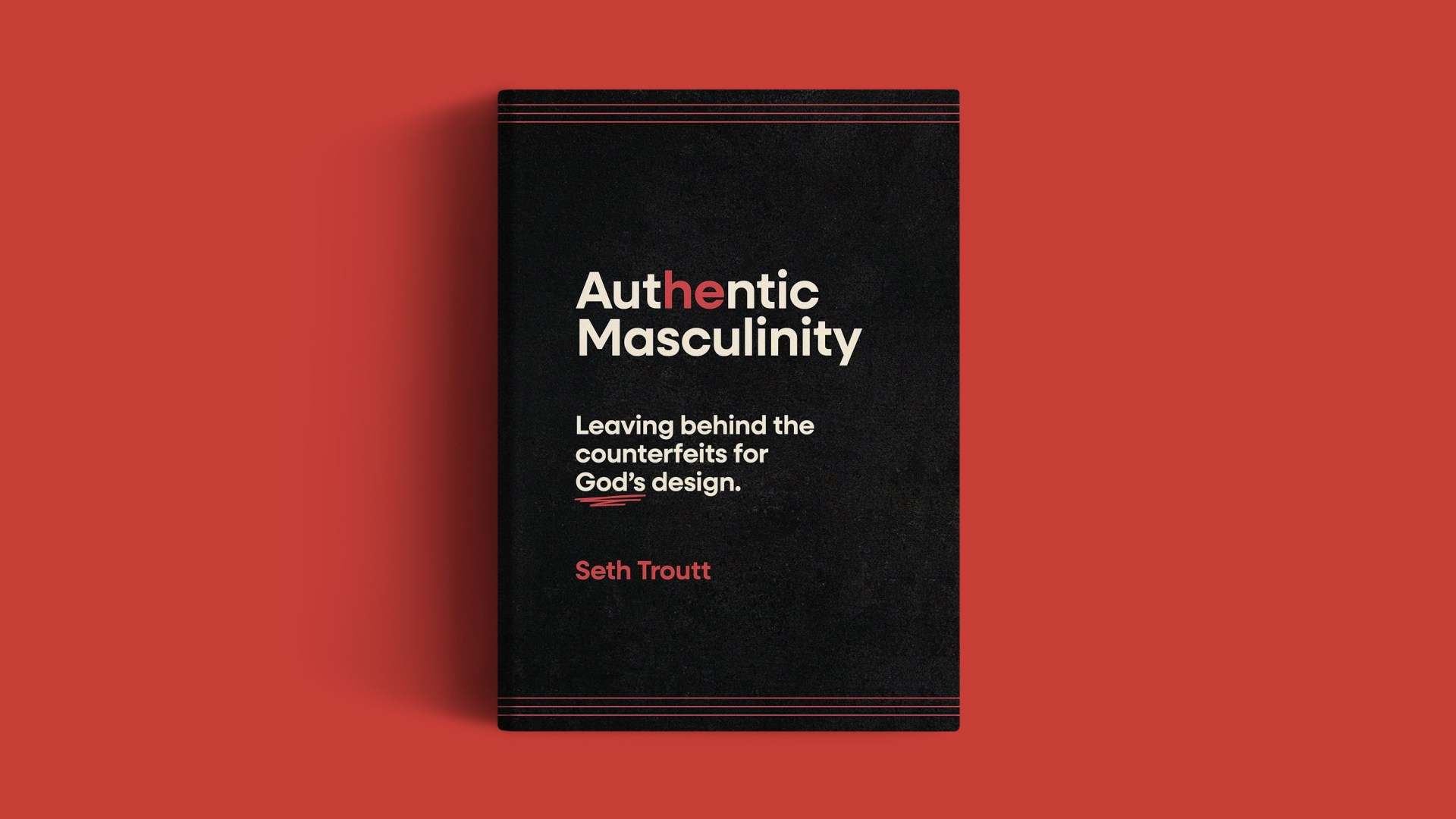
An excerpt from Authentic Masculinity: Leaving Behind the Counterfeits for God’s Design.

The book on an orange background.
Christianity Today May 5, 2026
Illustration by Christianity Today / Source Images: Getty, Moody Publishers

Men often desire more and better friends. A man in his 40s with five kids will have a harder time with this than a man in his 20s who’s a college student, just on the basis of competing priorities and responsibilities.

There’s a reason Billy Baker wrote in The Boston Globe that “the biggest threat facing middle-age men isn’t smoking or obesity. It’s loneliness.” The fraternal connection of the college fraternity turns into an impersonal connection with your supervisor and an adversarial relationship with your teenagers and their need to be driven all over town. Taking the next step toward being and feeling known and loved feels like you have to give less time either to your family or to your work.

Yes. You might have to do that.

Here are some ways to do this that won’t waste your efforts.

RAILS is an acronym that stands for Rhythm, Affinity, Intensity, Longevity, and Spirituality.

These are the ingredients of high-quality friendships. When looking to make friends or increase the quality of your friendships, looking in these five categories for opportunities is the key.

Rhythm

Who do you already see in the flow of your life? It could be a neighbor you regularly bump into, a colleague at work you enjoy seeing at the water cooler, or a fellow dad you see at soccer practice. When your schedule is full, you have to capitalize on the rhythms that are already there.

Another way to consider rhythm—how might you create a rhythm that doesn’t exist with a friend or a group of friends?

Sometimes trying to make plans one at a time is exhausting and annoying. Why not make a batch of plans all at once? A Thursday night soccer league, a Friday morning Bible study, a Tuesday afternoon weightlifting appointment, or a once-a-month poker night are each an activity that, once everyone buys in, is a gift that keeps on giving.

Sometimes the decision to create a new rhythm can change the trajectory of a friendship for the long haul.

Affinity

What do you have in common with some other men? Connecting where there is preexisting overlap is a major blessing. Why not have a friendship that starts out as shared appreciation for the Pittsburgh Steelers, or baking sourdough pizza crust, or watching all of the Oscar-winning movies? Why not connect over the fact that you both have a son and are, thus, facing similar choices and obstacles?

In The Four Loves, C. S. Lewis described the beginning of friendship as the moment when one person says to another, “What? You too? I thought I was the only one.” Sometimes the obscure points of overlap are springboards into a broader mutual appreciation.

Affinity is about laughing and playing together. It’s about enjoying creation together. It’s about being friends like 5-year-olds make friends at the park: “Hey! You wanna play with me?”

Intensity

Intensity has to do with severity—that is, how much in each other’s business you are, your ability to interact on an emotional level. While the other categories here could be mostly understood as “shoulder to shoulder”—that is, doing things together or talking about external things together—intensity is the “face-to-face” aspect of friendship. Unpacking motivations, questioning each other’s assumptions, and facing each other’s darknesses are all the stuff of intensity.

Sometimes intensity is thrust upon us—someone faces a diagnosis, a divorce, or a disruption, and all of a sudden, a friendship that was amicable is forced into intensity by circumstances. It might be awkward, but sometimes intensity is a product of deliberate intentionality: Someone asks another, “I’d like to develop a higher degree of intimacy with the men in my life. Could we go to coffee? I enjoy spending time with you, but I’d like to get to know you and your story in a different and deeper way.”

Longevity

There’s a sign that hangs outside at my grandma’s house: “It takes a long time to grow old friends.” This is the only ingredient of RAILS you can’t just “decide” to have. The other four you could create with good intentions and intentionality in a matter of weeks or months.

At my church I have friends I’ve had since I was in diapers; our mothers were friends. That isn’t something you can control. I have other friends I see weekly I’ve known since middle school and high school.

There’s something grounding about a friend you’ve known since middle school, when you were at your most insecure and awkward. It’s humanizing to have friends that go back further than your résumé.

Some of this is just how the Lord has chosen to write our stories, but some of it is the conscious choice to live within proximity to people who matter to you, the choice to build rhythms that overlap, and the choice to work through our issues instead of avoiding them and starting fresh with new friends on a regular basis.

I once met three guys in their 70s who had been friends for 60 years. Back when they were teenagers, they “covenanted” together to be friends for life. They built rhythms, maintained affinities, and have supported one another through tremendous lows and highs. They’ve processed divorce, death, disease, and disaster as brothers truly who were “born for a time of adversity.” They also still laugh at one another’s jokes. The bond they’ve forged over a lifetime was inspiring to me.

I know not where my life will take me, but I know one of the ingredients I’ll consider giving attention to is the reality that old friends cannot be found; they must be made and maintained.

Spirituality

If all men are made in God’s image, then their relationship to God is a driving factor, positively or negatively, in their life. Not only that, but nobody knows you like God, and nobody knows your friends as closely as God does. In fact, there is a form of friendship that God displays to us that necessarily trickles down into the highest quality of friendships we can have.

The central fear of friendship is fear of rejection or abandonment. Pastor Tim Keller said it like this: “To be loved but not known is comforting but superficial. To be known and not loved is our greatest fear. But to be fully known and truly loved is, well, a lot like being loved by God.”

Similarly, he says elsewhere that “prayer is the only entryway into genuine self-knowledge.” Because God knows us, and our friends, better than we even know ourselves, prayer—talking to and with God about our friends—is one of the key ways that we’ll actually get to know someone. You can’t really know someone until you begin to see them through God’s eyes and feel for them like God’s heart does. To pray for your friends is a key ingredient in maturing your view of them. To pray with your friends is like pouring gasoline on the fire of friendship.

So, you want to make or improve your friendships?

Find someone you have affinity with and add rhythm or intensity.

Find someone you’ve had intensity with and add affinity.

Find someone you have longevity with and add spirituality.

Find someone you have any connection with and commit to longevity.

Seth Troutt is the teaching pastor at Ironwood Church in the Phoenix metro area. Excerpted from Authentic Masculinity by Seth Troutt (© 2026). Published by Moody Publishers. Used by permission.

Ideas

Not Everything Is Christian Nationalism

Contributor

Automatically hurling this accusation at believers who raise questions about Islam or other issues is intellectually lazy.

Supporters praying during a rally to keep the Mt. Soledad Cross on Saturday, January 15, 2011 in San Diego, California.

Supporters praying during a rally to keep the Mt. Soledad Cross on Saturday, January 15, 2011 in San Diego, California.

Christianity Today May 5, 2026
Sandy Huffaker / Contributor / Getty

US Congressman Chip Roy recently introduced a piece of legislation called the “MAMDANI Act.” The bill was named as a jab against New York City mayor Zohran Mamdani, a democratic socialist who is Muslim. It proposes deporting, denaturalizing, or denying entry to any migrant who “advocates” for socialism, communism, Marxism, or “Islamic fundamentalism.” The language in it is sweepingly broad, targeting anyone who distributes, circulates, prints, displays, possesses, or publishes written materials supporting such ideologies.

Roy’s bill arrives amid a broader surge of religious rhetoric in the US framing America’s wars and conflicts in explicitly Christianity-versus-Islam terms.

President Donald Trump and his allies have increasingly deployed biblical language to rally evangelical support for the unpopular Iran war, which is currently under a shaky ceasefire. Some conservative leaders have cast the conflict as a battle between good and evil, emphasizing biblical prophecies about Israel and depicting Iran as a spiritual threat. Defense secretary Pete Hegseth has prayed at a Pentagon service for “overwhelming violence of action against those who deserve no mercy,” and likened the rescue of a downed US airman to an Easter miracle.

Against this backdrop, Philip Anthony Mitchell, the pastor of 2819 Church, one of the fastest-growing congregations in the US, faced backlash after saying on a podcast recently that Islam was a “radical ideology that is hostile to Christianity” and that people shouldn’t perform “ignorant inclusion” that might lead to a “hostile takeover.” Mitchell, whose congregation is largely made up of young Black adults, also said that Islam is “incompatible with Western values,” prompting some politically progressive Christians to accuse him of preaching white Christian nationalism.

I want to set Mitchell aside for a moment and discuss a larger issue: how we talk about Christian nationalism. Upholding the Constitution’s religious liberty protections, which also safeguard our own faith, precludes the government targeting Islam for legal discrimination. And as Christians, we’re commanded to love and care for our neighbors of every religion, Islam included. But insisting on that freedom of conscience does not mean leveling all religions or pretending there is no conflict of belief between Christianity and Islam—or between extremist expressions of Islam and our values, including freedom of religion. It’s not “Christian nationalism” to recognize that fact.

That said, the way a lot of politicians talk about Islam and Muslims is no doubt abhorrent. Just a few weeks before Roy, a Southern Baptist, introduced his far-fetched legislation, he posted on social media that there should be “No more Muslims,” revealing that the desired endpoint for his legislation is the removal of an entire faith group.

Similarly, Hegseth’s crusader theology represents a dangerous rejection of the fundamental gospel view that no person (and certainly not an entire society) is beyond the reach of God’s mercy and love. This is not a minor theological error but rather a fundamental distortion that reduces the Savior of all mankind to a mascot for foreign policy.

But the fact that Roy is being discriminatory or that Hegseth is embracing bad theology does not mean that every question about Islam’s growth in America is illegitimate or that every Christian raising such questions, as Mitchell did, is a Christian nationalist. There are actual Christian nationalists who have appalling ideas about religious pluralism that need to be debated. And likening Mitchell, one of the most prominent contemporary pastors in evangelicalism, to a Christian nationalist is intellectually lazy and leads to a muddled public witness.

The issue here is not whether Mitchell’s specific claims about Islam are correct. I have serious questions about whether the term Western values, which he mentioned during the podcast, provides the right framework for assessing religious pluralism. The concept often conflates the Christian faith with Enlightenment liberalism and other cultural preferences.

But it similarly is not helpful to weaponize Christian nationalism as a conversation-ender on this or any other topic instead of substantively engaging with genuine questions and concerns posed by brothers and sisters in the faith.

I have been on the record talking about the detrimental ways our political culture is forming us, and this is just another example that shows how. As our politics have become more bifurcated, public discourse has also become increasingly centered on one’s opponents. Political candidates have built successful campaigns talking about whom they’re against, and fear has become a major motivator for both sides of the aisle.

In this environment, the charge of “white Christian nationalism” has become a rhetorical escape hatch.

I’ve experienced this firsthand in my own advocacy work. Someone raising concerns about educational freedom is accused of advancing the white Christian nationalism’s agenda of school privatization. Any questions on immigration, sovereignty, and the asylum system are often lumped in with nativist fearmongering. For some inside and outside the church, concerns about unrestricted abortion access become part of a theocratic project to impose Christian values on a pluralistic society.

The pattern is consistent: Label the concern as white Christian nationalism, and you’ve absolved yourself of the responsibility to engage the underlying question seriously.

In the long run, this approach to dealing with political dissent is designed to fail. When Christians refuse to create space for serious conversations about pluralism, cultural integration, and theological difference, they won’t eliminate bad ideas. They simply push them into spaces where they calcify without theological correction or moral constraint.

Most Christians who have negative things to say about Islam don’t want religious minorities to be second-class citizens. But they do have questions that, regardless of what we think about their intellectual heft, should not be met with dismissal.

We can defend people’s rights to practice their faith freely, help communities embrace religious pluralism, and still ask hard questions about how to maintain shared civic values amid deep religious divides.

Roy’s bill will likely fail, but the impulse behind it won’t disappear. Neither will the legitimate questions people have about how diverse religious communities do life together. American Christians can either lead this conversation with theological depth and pastoral wisdom or keep lobbing accusations at each other across partisan lines while watching our public witness crumble.

The gospel calls us to something better than a fear-driven politics focused on attacking opponents at every turn. It calls us to a witness grounded in Christ’s lordship, expressed through sacrificial love and practiced with independence from partisan capture. It’s the only witness worth offering in a fractured moment that desperately needs the church to lead with both truth and grace.

Chris Butler is a pastor in Chicago and the director of Christian civic formation at the Center for Christianity & Public Life. He is also the co-author of  Compassion & Conviction: The And Campaign’s Guide to Faithful Civic Engagement

Discover a New Way to Read, Reflect, and Connect

The Christianity Today app is a curated, personalized, and mobile-friendly way to stay informed on faith, culture, and the world.

Stay informed and inspired with Christianity Today—trusted news, theology, and cultural insight for a faithful perspective on the world.

Christianity Today has served the global church for decades with trustworthy journalism that helps believers think deeply about faith, culture, and current events. The CT app brings that experience directly to your mobile device.

At the center of the app is a curated, personalized homepage that keeps you informed and grounded each day, helping you make sense of the world through a biblical lens. You’ll also get notified when the CT Daily Briefing goes live with the day’s top headlines and stories.

Inside the CT app, you can:

  • Read the latest Christian news and analysis
  • Explore articles on faith, theology, and culture
  • Access devotionals and spiritual reflections
  • Listen to podcasts and discover multimedia stories
  • Stay updated on issues shaping the global church

Designed for daily use, the CT app combines trusted journalism, thoughtful commentary, and curated storytelling in a mobile experience built to fit your rhythm of life.

Whether you’re commuting, taking a break, or winding down at home, the CT app helps you stay connected to what matters—anytime, anywhere.

ANDROID USERS
iOS USERS

addApple PodcastsDown ArrowDown ArrowDown Arrowarrow_left_altLeft ArrowLeft ArrowRight ArrowRight ArrowRight Arrowarrow_up_altUp ArrowUp ArrowAvailable at Amazoncaret-downCloseCloseellipseEmailEmailExpandExpandExternalExternalFacebookfacebook-squarefolderGiftGiftGooglegoogleGoogle KeephamburgerInstagraminstagram-squareLinkLinklinkedin-squareListenListenListenChristianity TodayCT Creative Studio Logologo_orgMegaphoneMenuMenupausePinterestPlayPlayPocketPodcastprintremoveRSSRSSSaveSavesaveSearchSearchsearchSpotifyStitcherTelegramTable of ContentsTable of Contentstwitter-squareWhatsAppXYouTubeYouTube