History

Attempts at Cultural Crossover

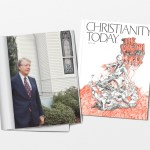
From Pat Robertson’s soap opera to creation science, CT reported evangelical efforts to go mainstream in 1982.

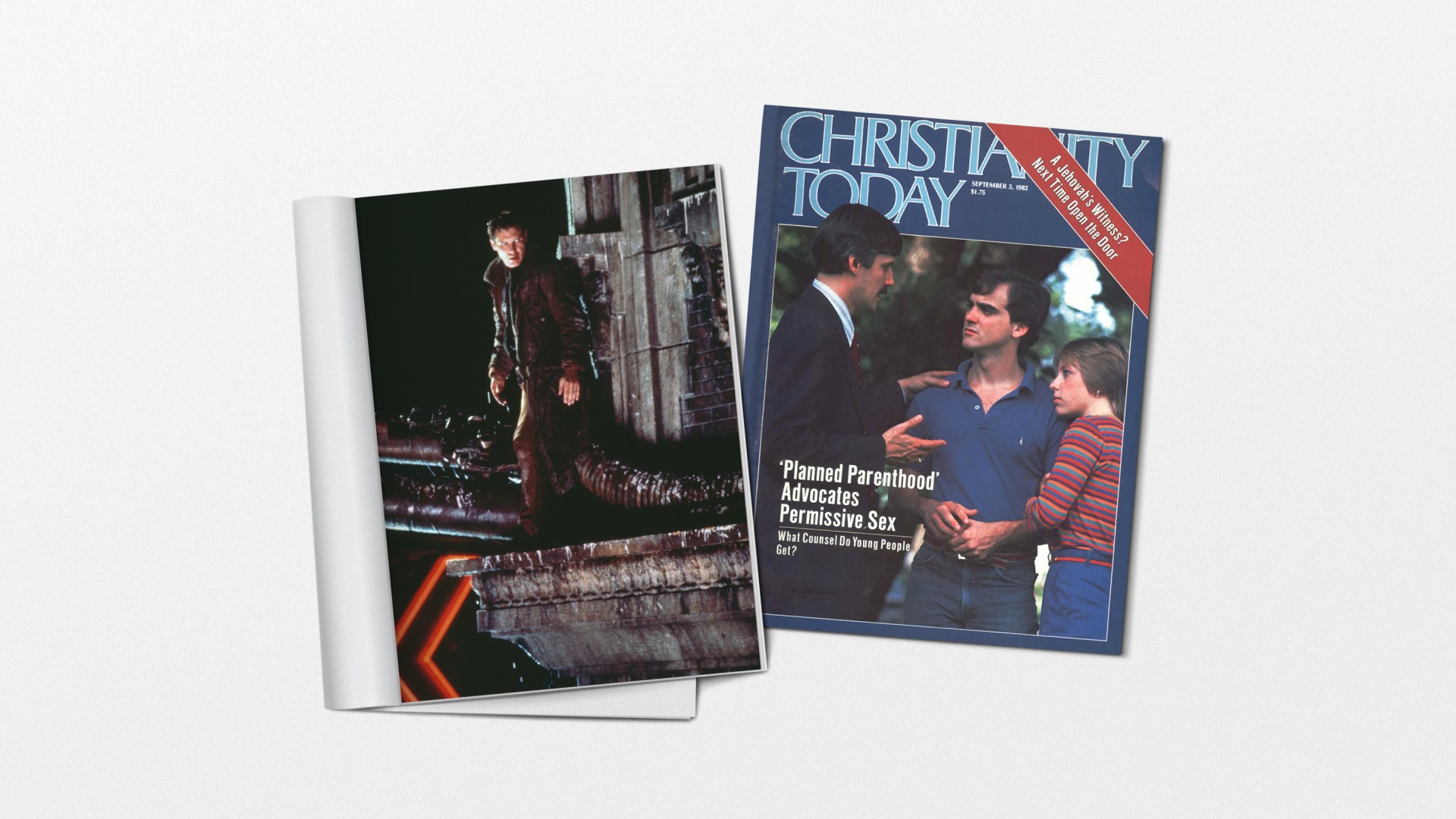
A CT magazine cover and an film still from Blade Runner.
Christianity Today April 22, 2026
Illustration by Christianity Today / Source Images: Getty, CT Archives

CT greeted 1982 with a big profile of a televangelist trying break out of “the Christian ghetto.” The magazine reported that Pat Robertson’s Christian Broadcasting Network (CBN) was developing programming designed to attract nonreligious viewers. 

Posing a prime-time threat to ABC, CBS, and NBC is little more than a distant hope, but CBN’s momentum is unmistakable, attracting widespread notice in broadcast trade publications. By this month CBN will have nudged its way into the industry’s Nielsen ratings by gaining nationwide access to nearly 14 million households able to receive cable television programs. … 

By presenting a smorgasbord of shows with the whole family in mind, CBN is bucking a trend toward “narrow-casting”—a term for cable broadcasters and networks that opt for a single specialty such as all-news, all-sports, or R-rated movies. CBN’s leap of faith is a high-risk venture, and it has never succeeded before.

But, as Robertson sees it, the time is right. … CBN’s splashiest attempt to communicate a Christian alternative is “Another Life,” a soap opera that attracts 100,000 viewers in New York City alone, according to Arbitron, an industry rating service.

The daily half-hour drama stars a happy, intact Christian family whose members pray their way through difficulties.

Entertainment with overtly religious themes could please wide audiences—and even win best-picture at the Academy Awards in 1982. CT praised that year’s Oscar winner, Chariots of Fire

In conversation among many intelligent people, the mention of Jesus Christ often brings an awkward silence. In film, it is even worse. Attempts to grapple with truth, Scripture, or God are regularly greeted with hoots of derision. But there may be hope.

The British Chariots of Fire is a work of restraint and intensity that offers the Christian moviegoer a variety of admirable cinematic and real-life achievements. … 

In other hands, the film would easily have taken sides—after all, each man represented a certain different approach to life—but their spirit of competition is peripheral to the real drama. It is to the film makers’ credit that they centered on the internal struggles and aspirations of the pair. In so doing they created a work that allows these two people to be just that—two real people and not idealized figures in a calculated, contrived sports or religious story. It is this integrity that is the film’s transcending strength.

Other popular films were not so sympathetic to Christianity. CT reviewers worried one of the year’s biggest box-office hits, E.T.: The Extra-Terrestrial, promoted a counterfeit of Christianity

Spiritual metaphors abound in E.T., a captivating tale of a seemingly timid, misshapen creature from outer space, and Elliott, the young boy with whom E.T. develops a psychical relationship after he is marooned on earth. E.T. is no ordinary fantasy, but a sophisticated production by Hollywood’s foremost director, Steven Spielberg. …

Spielberg intends for his audience to have a spiritual experience. Even the movie’s newspaper ad invites a direct comparison to Michelangelo’s creation scene—only the hand arching downward is not God’s, but E.T.’s.

The relationship of Elliott to E.T. is a “type” of the Christian’s relationship to Christ. In a touching scene, Elliott says to E.T., “I’ll believe in you all my life.” And we, too, want to place ourselves in E.T.’s hands and believe. As E.T. prepares to leave earth, he lifts his glowing finger to Elliot’s forehead and cryptically states, “I’ll be here.” A new Pentecost?

A review of the film Blade Runner was more positive, even though director Ridley Scott cut a significant Christian subplot when he adapted Philip K. Dick’s novel, Do Android’s Dream of Electric Sheep? 

The film is a chilling allegory about man’s relationship to God. But more disturbing is the fact that Deckard himself, unlike his targets, has no Maker to confront. … This isn’t a family film, and it’s not for the squeamish. But of all the summer’s releases, only Blade Runner is truly adult in its thoughtfulness and complexity. If you enjoy science fiction, by all means see this.

CT reported Christian publishers were trying to adapt a popular new exercise trend for evangelical audiences, faith-based versions of best-selling aerobic workout videos such as Jazzercise, Jane Fonda’s Workout Record, and fitness celebrity Richard Simmons’s Reach.

Word discussed the concept a year and a half ago, according to Director of Public Relations Walt Quinn. But, wary of adverse reaction, Word decided to put the project on hold. When the New Benson Company, a competitor of Word, Inc., discussed an aerobics project, similar concerns surfaced. 

“There were some questions within the company,” said Don Klein, Benson’s public relations director. “But enthusiasm began to build. There were those who had an ear for what was needed. And we became convinced that the idea was right for the time. I think that’s been proven by the fact that it has worked.” 

By “worked,” Klein means “sold.” Since the release of Aerobic Celebration in May, the Benson Company has moved 130,000 copies, which by any standards is respectable; by Christian standards it’s very respectable. The market: fitness-conscious women, ages 18 to 30.

In response to Benson’s success with Aerobics Celebration and the recent release of its sequel, Word, Inc., has unveiled Firm Believer, “a complete exercise program featuring today’s finest Christian music.” …

But as the Christian music machine turns out fitness products and as the religious public buys them, the questions of skeptics and critics persist: At what point does giving people what they want become crass commercialism? Does it cheapen sacred music to have it obscured with exercise instructions on the toning of thighs, abdomens, and buttocks? 

Keith Green, an established Christian music icon with a record of being critical of commercialization, died in a plane crash in July at age 28. The tragedy seemed to mark the end of the Jesus People era. 

For Keith Green—whether he was singing in concert or on his five albums, writing in the newsletter, or pastoring at Last Days—the message was “get right with God.” …

His stand against the commercialism of contemporary Christian music was unique and radical. He once told Contemporary Christian Music magazine, “The central reason there are record companies is for corporations to make money. Anybody who honestly believes that a record company is there as a service is grossly mistaken.” After making two strong-selling albums for Sparrow, Green had his contract suspended so he could put Matthew 10:8 (“Freely you have received, freely give”) into practice. …  

Green didn’t charge for his concerts either, and said, “I repent of ever having recorded one single song, and ever having played even one concert if my music and, more importantly, my life has not provoked you in godly jealousy to sell out completely to Jesus!”

CT told readers of another evangelical attempt at adaptation happening in Oregon: the country’s first Christian bank.

What separates this bank from the rest of the crowd is that it gives 10 percent of its profits to Christian schools and organizations. Furthermore, its 350 stockholders tithe their dividends, sending more money into Christian work. The idea has caught on, say bank officials, and not only has the bank attracted depositors from around the world, it has received a shower of press coverage. … 

The idea does appear to be catching. Similar banks are organizing in Wheaton, Illinois; Billings, Montana; and in the Los Angeles area.

The pace of cultural change seemed to be speeding up in 1982. Only a year after CT reported on churches adopting VCRs, the magazine announced more new technology was on the way.

Americans use computers at work, at play (with video games), and finally, irresistibly, at church.

In the church? Very much so, according to Jack Gunther, vice-president of Church Growth Data Services, one of the many rapidly proliferating firms that provide computer hardware and software (programs) for churches.

“The computer in the church is an idea whose time has come,” said Gunther, who formerly worked for IBM. “Five years from now virtually every church is going to have a computer.” The machine, Gunther and others predict, will soon be as commonplace in churches as typewriters and telephones. …

There are obvious applications, such as using the machines for financial record keeping. Less obvious—and requiring special programming—is the use of computers to help congregations grow.

For example, a church might have a computerized membership profile with categories such as the member’s name, address, and marital status when he joined the church, his health, talents, interests, and spiritual gifts. The pastor of a large church, unable to know each member personally, can use the computer to match persons of similar interest in a Bible study or arrange a block party for members living in one area.

Some Christians fought efforts to force change, as CT reported in “Bob Jones versus Everybody.” 

Bob Jones University in Greenville, South Carolina, citing a biblical injunction against mixing of races … still prohibits dating and marriage between races. …

The Bob Jones doctrine holds that joining of races contributes to “one-worldism,” which it says is man’s attempt to unite against God, and that God intended the races to remain separate when he dispersed the people at the Tower of Babel. …

Bob Jones III, the school’s president (his father and grandfather preceded him as president), testified in detail on the school’s beliefs during a federal trial in 1978.  

Evangelical scholars disagree with nearly every point Jones makes. … 

For the last 12 years, Bob Jones University has battled the Internal Revenue Service to retain its tax exemption, with the IRS contending the school cannot qualify as a charitable institution eligible for tax exemption because its practice violates public policy. 

Evangelist Billy Graham, meanwhile, was in the Soviet Union, preaching the gospel and warning about the dangers of nuclear war. CT defended its founder against what editors described as “a roar of disapproval.” 

He thought he could accomplish more through quiet diplomacy and public preaching of the gospel than by openly denouncing the Soviet government for lack of religious freedom. Was that price too great? Billy Graham thought not. We agree. …

Those of us who believe the gospel of Jesus Christ is the dynamite of God, able to blast away sin and the sinful structures of an unjust society, may indeed regret any slips and the unfortunate infelicities of unplanned spontaneous comments. But we rejoice at the opportunity to preach the gospel—actual and potential—with the hope that the power of the gospel can change the hearts of men, as well as the evil structures of even a Communist society.

Some evangelicals tried to get creation science taught in public schools. CT reported on a legal battle in Arkansas

In many public schools, evolution is taught explicitly as the rational alternative to the biblical teaching about creation held by uneducated fundamentalists!

All evangelicals resent this. It is a violation of their constitutional right to the free exercise of their religion. They will make laws to secure their rights, and they will battle them through the courts and beyond. Eventually they will win—if America is to remain a free nation.

But evangelicals are equally committed against any infringement of the religious rights of others. For conscience’s sake they support separation of church and state and reject the establishment of any particular religion, including their own.

CT asked theology professor Norman Geisler to make “a case for equal time.” Historian George Marsden opposed the legislation:

The law institutes a false choice. As evangelicals are well aware, there is a variety of views, even among conservative, Bible-believing Christians, relating the biblical and the scientific accounts of origins. … I am convinced that it is a great disservice to evangelical Christianity to identify it with one very narrow argument from science.

CT published a special issue on the topic in 1982 with four different authors taking different views and answering questions. An editorial established “guideposts for the current debate over origins.” 

There is no general agreement as to precisely what Scripture teaches about evolution. …

The principle for the evangelical Christian is clear: When the Bible speaks, he must stand firmly by what it says; but when the Bible is silent, he must be silent as to what he believes on biblical authority. 

Church Life

Will the Church Enter the Guys’ Group Chat?

Young men are looking for online presence. The church needs to offer more than weekly breakfasts.

Blue message bubbles and one gold glowing one.
Christianity Today April 22, 2026
Illustration by Elizabeth Kaye

Despite the loneliness, mistrust, and anger coursing through American social life, young men have at least one institution they can still rely on: the male group chat.

I am 23 years old, and I am in seven of them: one with my closest friends, a porch night scheduling chat, a music chat, a workout chat, a family chat, a fantasy football chat, and one more—my small group chat, where the guys from my Wednesday-night Bible study send prayer requests, memes, check-ins, and the occasional theological question. Each one serves a different function, but together they constitute something like a social ecosystem, the scaffolding of my relational life.

I’m not unusual in this. The group chat is shaping more than we think. And to be sure, not all of it is pretty. When a college student slides into a gambling addiction, it often starts in a sports chat. When a lonely boy tumbles into the abyss of conspiracy theories, he may do it surrounded (virtually, at least) by other lonely boys. When a young man gets radicalized, it often happens in the slow drift of the chat thread. 

But there’s another side of the group chat—one that headlines on digital isolation rarely capture. In my own life and the lives of many young men I know, the group chat has become a powerful force for binding us together. My small group chat, for example, has made me a better member of my small group, a more committed member of my church, and, most importantly, a more faithful follower of Christ. 

It hasn’t always carried this kind of weight. For six years, my small group’s thread was little more than a logistics hub. We started it as college freshmen primarily to coordinate where we were meeting for Bible study each week. For a long time, the notifications were purely utilitarian—address pins, time changes, and the occasional “see you there” thumbs-up.

But as our friendships deepened, our digital space matured with us. In the last year, the frequency has shifted from a weekly check-in to an almost-daily dialogue. Thus, on a typical Tuesday, the notifications might start around noon with a link to a podcast episode someone found encouraging, followed by a flurry of thumbs-up emojis and reactions. By 5 p.m., the tone might shift as someone asks for prayer before a high-stakes job interview.

But the value of the chat runs deeper still. A few months ago, the chat was a lifeline for me. My mom was waiting on the results of an MRI scan for a tumor, and the silence was heavy. I didn’t feel like I needed to wait until Wednesday to ask for support—I just sent a quick text to the guys. Within minutes, my phone was buzzing with prayers and private check-ins that stayed steady until the results arrived with good news. Cue the “praise God” texts. 

The digital thread captures these “middle spaces” of our lives—the majority of our lives—that a weekly meeting can’t reach. It allows us to be present for the Monday-morning anxieties and the Friday-afternoon wins, turning a structured program into a constant, lived-in brotherhood. The Wednesday-night program now feels more like a reunion, just picking up where we left off.

Throughout its history, Christ’s church has always brought men together, with Jesus teaching his disciples to care for and even to die for one another. This kind of self-sacrificial friendship remains radical in today’s world. Men’s ministries have long sought to foster friendships like that, and the traditions of early-morning breakfasts at diners and weekend retreats have borne good fruit in recent decades. Promise Keepers stadium rallies in the ’90s, too, drew hundreds of thousands of men to weep and pray together. These moments allowed men to show up at church in large numbers, confess things they’d never said out loud, and find brothers.

But for my generation, these mountaintop experiences aren’t enough. We live in a world of constant, fragmented noise, where the spiritual momentum of a weekend retreat often evaporates by the first Monday-morning commute. A Passion conference, a college retreat, or even a weekly Bible study can provide a powerful spark, but it rarely provides the daily heat necessary to survive a digital culture designed to isolate us. To reach young men today, to bind them together, the church needs more than these periodic pulses. It needs to enter the “middle spaces” of our lives. The church needs to enter the chat.

Growing communities like this is slower than hosting a one-time stadium rally or retreat, and it requires greater willingness to engage outside regularly scheduled meetings. It asks the pastor or layperson who leads it to model honesty, to stay in the room when it gets uncomfortable, and to check in midweek. Whether that happens over a thread of text messages, a shared workout, or a quick phone call on a commute, the goal is a faith that isn’t cordoned off to a Sunday morning.

Community growth also means creating spaces where men have permission to be honest about every part of life. In the anonymity of the internet—often behind the shield of a frog profile picture, or some other senseless meme—men feel free to voice their darkest anxieties, their political frustrations, or the conspiracy theories they’ve stumbled upon in the digital swamp. If the church doesn’t provide a place where men can speak those thoughts aloud without immediate condemnation, they will keep taking them to the corners of the web where they are never challenged. We need to be the kind of brothers who listen to unfiltered thoughts, stay in the room, and then point each other toward the truth.

Tightly knit communities are, of course, not new to the church’s imagination. Early Christians met in houses, often under threat, in intimate groups where everyone knew each other’s name (Acts 2:42–47). What made those early communities formative was precisely their smallness, their dailiness, and their shoulder-to-shoulder quality. The modern church must build communities that have the same texture: private, persistent, particular, and low on performance. Men are hungry for brothers who know them personally.

What the church can offer that no algorithm can is genuine presence, accountability, and a shared story bigger than any of its individual members. We need men who are on mission together, who know what they stand for, and who have chosen each other for the long work of discipleship. 

That is what the early church was. That is what the group chat, at its best, is trying to be.

Luke Simon is the codirector of student ministries at The Crossing in Columbia, Missouri, and an MDiv student at Covenant Theological Seminary. He has written on Gen Z, technology, masculinity, and the church. You can follow him on X.

Ideas

Just War Theory Is Supposed to Be Frustrating

Contributor

The venerable theological tradition makes war slower, riskier, costlier, and less efficient—and that’s the point.

Smoke billows from a fire next to Azadi Tower following strikes near Mehrabad International Airport in Tehran on March 7, 2026.

Smoke billows from a fire next to Azadi Tower following strikes near Mehrabad International Airport in Tehran on March 7, 2026.

Christianity Today April 22, 2026
Atta Kenare / Contributor / Getty

Once upon a time I was a pacifist, and some days I still am. Although I’m a theologian, which means it pays to pretend to know everything about everything, there are still some topics about which I remain uncertain. War is one.

Two factors called my pacifist confidence into question. The first was the weight of Christian tradition. No believer is an island unto himself, and discipleship is not a DIY project. So while the tradition can err, and the church has always had a pacifist strand, the burden of proof falls to the dissenter. The bulk of Christian writing on war is not pacifist, and that shouldn’t be cavalierly dismissed.

The second factor is related to the first: I actually read those writings. And when you take them seriously, not as the faithless baptism of pagan bloodlust but as an honest attempt to interpret the Scriptures for political practice, you walk away impressed. I certainly did. 

Just war theory is, roughly, the majority view of Christian teaching across the centuries about (1) the moral conditions that might justify a nation going to war and (2) how a nation might prosecute such a war with righteousness. It’s an extraordinary ethical and political achievement. There’s a reason that its wisdom has seeped into contemporary laws of war, both in America and elsewhere. These laws may be secular, but their theological roots run deep.

In recent weeks, the principles of just war theory have been raised for all to consider as politicians, pastors, laypeople, and members of the military debate the war in Iran. Even many supporters of this administration and of this war repudiated President Donald Trump’s reckless and immoral statement on April 7: “A whole civilization will die tonight, never to be brought back again. I don’t want that to happen, but it probably will.” Such rhetoric, a casual threat of genocide, is beyond the pale.

Sometimes it’s hard to convince my students that Christian theology matters. But this month, as my Christian ethics class turned to exploring just war theory, all I had to do was point to the news.

Yet as much as this venerable tradition has shaped our thinking and laws, most believers aren’t conscious students of just war theory. Among those who are, my impression is that, for Protestants and Catholics alike, the balance of the debate has fallen against the idea that this war was justified by the theory’s standards. As much as it has been misused to approve unjust conflicts in the past, then, the theory still has teeth. It is not merely an academic artifact. And whether they know the theory’s terminology or not, American Christians are still capable of saying that while some wars might be justified, this one is not. 

At its best, therefore, just war theory gives Christians a moral and political toolkit for discernment, and the last two months have shown this toolkit at work. But set aside the particulars of the argument about Iran for a moment, if you can. I want to step back and draw our attention to a feature of the political debate above and beyond the intra-Christian debate.

Here’s what I mean. The Christian debate, when conducted by believers who are not pacifists, is about whether or not this conflict is justified according to the standards of just war theory. If the answer is no, the necessary conclusion—whatever else one thinks of the conflict and the oppressive regime in Tehran—is that the war shouldn’t have been started and ought to be brought to an end as soon as possible. In other words, the shared premise is that just war theory calls the shots.

The political debate is different. Since pressure mounted for the United States to strike Iran earlier this year, it’s been clear that many Americans who support the war don’t accept the principles of just war theory at all. They seem frustrated by its role in the debate, befuddled by Catholics and evangelicals raising concerns and proposing policies that would hamstring the president and the military.

In a recent piece at National Review, commentator Noah Rothman articulates this frustration with admirable openness:

the theological principles [of just war theory] may be beyond me, but those principles appear to be in tension with elementary best practices in statecraft. Surely, the American public would regard the lethargy apparently prescribed by dogma as unacceptable if that lethargy led to an Iran that could not be disarmed with the speed and efficacy that has so far typified this war. Righteous or not, asking any American president to observe that kind of passivity would be asking quite a lot.

Rothman seems surprised and alarmed to discover that just war theory is meant to make war slower, riskier, costlier, and less efficient. No nation, he supposes, could tolerate that, so Washington should prosecute its war without your precious principles, thank you very much.

I find this frankness deeply clarifying. It makes unmistakable both the “elementary best practices in statecraft” and the ineradicably Christian substance of just war theory. The former is about global strategy, national interest, and realpolitik. The latter is about the will of God for upright human action no matter the consequences

Following just war principles might well leave a nation less secure, for they are not designed to maximize security. They are designed to avoid evil even if good might come from it. The whole point of just war theory is to make war slower, riskier, costlier, and less efficient. Strategic advantage has no traction here.

Consider the question of a surprise strike. “Surprise is a substantial military asset,” Washington Post columnist George Will wrote last month. “If the Trump administration had briefed legislators in advance, could it have achieved the targeted killings crucial to its regime decapitation objective—an objective intended to economize violence?”

The context of these comments is the lack of both formal public debate and congressional authorization of the war. Will’s argument is that, had there been a long run-up to a formal declaration of war on Iran, the United States would have lost a key advantage. The possibility of a surgical strike decapitating key political and military Iranian leaders would have been lost.

Maybe, although the weeks of rumor and anticipation before bombs began dropping meant that the war itself was not a surprise, even if a particular strike was. Yet even if Will were right, he is working from a mistaken premise: namely, that the end justifies the means. It does not. 

Will self-describes as an “amiable, low-voltage atheist,” but no Christian can think this way. Questions of speed, efficiency, advantage, and “economize[d] violence” simply have no place in a Christian approach to war. If justice requires that we shoulder greater risk or cost in the prosecution of a war, then we have no other choice. Utilitarian calculations promise an end run around what we owe to God and neighbor, but this is a temptation we must resist. Just ends cannot excuse unjust means.

This is a vital principle of politics in issues well beyond war. “The structures and ceremonies of self-government certainly do take away some initiatives from one-man rule and impose burdens on the imperial presidency,” the Catholic writer Michael Brendan Dougherty observed in his response to Will, with more than a little irony. “That’s the point.”

Yes, involving the American people and our representatives in the process of democratic deliberation over going to war—or any policy proposal—is burdensome. Yes, it takes time. Yes, as a result, it is likely to lessen certain strategic advantages. So be it. This is a price worth paying, given the gravity of war and the importance of self-governance. It is exactly why declaring war is the prerogative of the nation’s representative body: to slow it down.

Beware the exhilaration of war, which perennially threatens to override our reason with its own seemingly irresistible logic. That is why just war theory exists: to help us think when thinking is the last thing we feel capable of doing. Its claims on us are not detached from reality. Rather, it is we who lose touch with reality in times of war.

It may feel unfair to have to negotiate an ancient theological theory designed to make war harder. But subjecting efficiency, lethality, and even victory to higher principles is precisely its purpose. It reminds us that even—especially—in wartime, God and God alone is our judge.

Brad East is an associate professor of theology at Abilene Christian University. He is the author of four books, including The Church: A Guide to the People of God and Letters to a Future Saint.
News
Wire Story

Young, Educated, and Urban Pastors Are Most Likely to Use AI

A survey found denominational differences in pastors’ use of the technology, as well as widespread skepticism about its reliability.

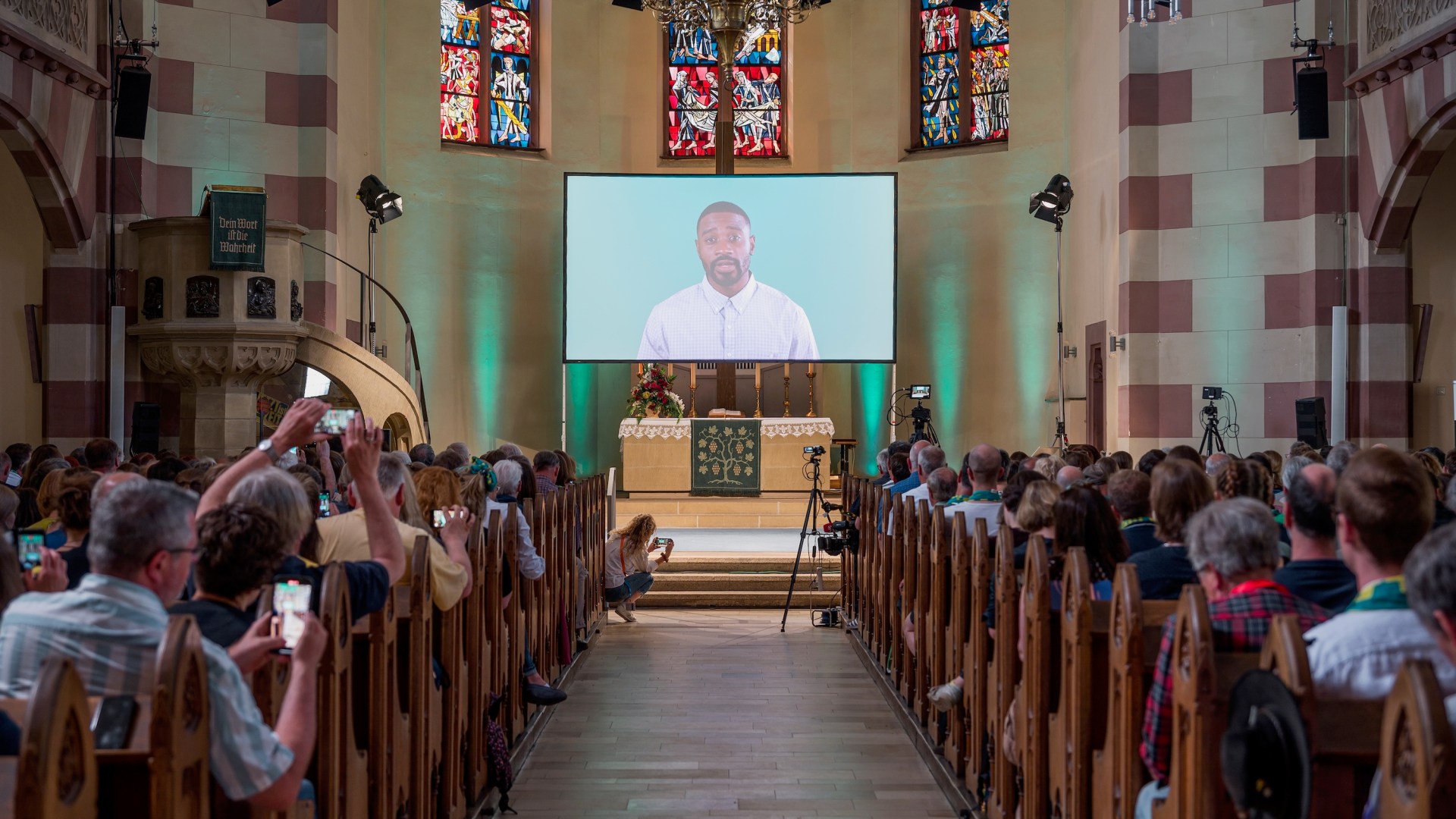
Churchgoers attend a worship service created entirely by ChatGPT in Bavaria.

Churchgoers attend a worship service created entirely by ChatGPT in Bavaria.

Christianity Today April 21, 2026
Photo by Daniel Vogl / picture alliance via Getty Images

As the prevalence of artificial intelligence (AI) grows in the broader culture, some within the church are skeptical of downloading AI into the ministry.

Both US Protestant pastors and churchgoers have a mixed view of artificial intelligence, according to a Lifeway Research study. They aren’t completely opposed to it, but they have concerns about how AI is implemented and its potential influence on Christianity.

“Caution is an instinctive reaction to new things, and pastors and churchgoers share some concerns around AI,” said Scott McConnell, executive director of Lifeway Research. “The majority of younger churchgoers would welcome hearing biblical principles applied to AI in a sermon to help them shape their perspective on it.”

Less than half of US Protestant pastors say they are using AI, but fewer are actively avoiding or ignoring the technology.

One in 10 pastors (10%) say they are regular users of artificial intelligence, while a third (32%) are experimenting with it. Almost 1 in 6 (18%) say they are waiting to see better examples of how AI could help them.

On the other end of the AI adoption spectrum, close to 2 in 5 pastors are either intentionally avoiding it (18%) or simply ignoring artificial intelligence (20%).

“AI is embedded in many tools we use every day, so some pastors may be using AI technology without even knowing they are,” McConnell said. “Pastors’ use of AI for ministry reflects a typical spread of technology adoption with a few avid users and plenty testing it out in different ways.”

In general, younger pastors, those in urban settings, those with more formal education and those leading larger churches are more likely to be AI adopters.

Pastors ages 18 to 44 (40%) and those 45 to 54 (37%) are more likely than those 65 and older (23%) to say they are experimenting with AI. Meanwhile, those 65 and older (4%) are the least likely to say they are regular users of artificial intelligence.

Those at churches in urban areas are more likely than those in rural areas to say they are regular users of AI (11% compared to 5%), while those at rural churches are more likely than those at urban churches to say they are ignoring the technology (27% to 18%).

Pastors with a master’s (10%) or doctoral degree (14%) are more likely than those with no college degree (5%) to say they are regular users of AI. Those without a college degree (25%) are among the most likely to say they are ignoring it.

Denominationally, Lutherans and Baptists are the most skeptical of AI, while holiness pastors are among the most likely to be adopters. Lutherans and Baptists are among the most likely to say they are ignoring it (22% each) and intentionally avoiding it (24% and 20% respectively). Holiness pastors are among the most likely to say they are experimenting with AI (43%) and are regular users (18%).

Pastors of congregations with 250 or more in attendance are among the most likely to say they are experimenting with AI (43%) and are regular users (15%). Those at churches with fewer than 50 are the most likely to say they are ignoring the technology (28%).

Even with most pastors either being current users of artificial intelligence or open to it in the future, almost all US Protestant pastors have some clear concerns about implementing the technology in their work.

When presented with six potential issues with using AI tools in their ministry, most pastors are concerned about each.

More than 4 in 5 pastors say they’re worried AI-generated content must be edited, assuming it contains errors (84%). A similar percentage (81%) believe it is hard to ensure AI tools only use reliable sources. Three in 4 (76%) say biases may exist in the programming of how the AI makes its decisions.

Three in 5 (62%) worry AI users are not disclosing the technology as a collaborator in their work. Slightly fewer say they’re concerned AI-created content from other sources is plagiarism (59%); and God has always shared his Word through people, and AI isn’t a person (55%).

Few (4%) selected none of these or that they aren’t sure (1%).

“Pastors’ highest concerns are tied to how trustworthy AI’s information is, but the majority of pastors are also concerned with honesty in the use of AI content and potential weakening of personhood especially in handling God’s Word,” said McConnell.

Evangelical pastors are more likely than their mainline counterparts to raise concerns about God sharing his Word through people and AI not being a person (58% to 51%). Meanwhile, mainline clergy are more likely than evangelical pastors to worry about AI-created content from other sources being plagiarism (65% to 56%).

US Protestant churchgoers are split over AI and sermons. Pastors won’t find a consensus among churchgoers on using artificial intelligence to help with sermon preparation. More than 2 in 5 (44%) don’t see anything wrong with pastors using it in sermon prep, but 43% disagree, including 24% who do so strongly. Around 1 in 8 (13%) aren’t sure.

Those who attend less frequently, one to three times a month, are more likely than those who attend four times a month or more to support AI-assisted sermon prep (48% to 42%). Churchgoers without evangelical beliefs are also more likely than those with such beliefs to be supportive (49% to 40%).

Not only are churchgoers divided on hearing a sermon prepared with the help of AI, but they’re also divided on hearing a sermon about AI. While 42% would value a sermon about applying biblical principles to AI, 43% disagree, including 25% who strongly disagree. Almost 1 in 7 (15%) aren’t sure.

Younger churchgoers are most likely to find this beneficial. Those 18–29 (50%) and 30–49 (53%) are more likely than those 50–64 (38%) and 65 and older (33%) to say they would value hearing a sermon that taught how biblical principles can be applied to artificial intelligence.

“Churchgoers are evenly split on whether it is right or wrong to use AI in sermon preparation. While only a quarter strongly reject this use, more than 5 in 6 have some pause on whether pastors should have a free pass on its use. The caution may be from a desire to limit its use to certain activities or from not yet giving its morality much thought,” said McConnell.

US Protestant churchgoers find consensus in their AI concerns. Three in 5 (61%) say they’re concerned about the technology’s influence on Christianity. Fewer than 3 in 10 (28%) disagree, while 11% aren’t sure.

Churchgoers with evangelical beliefs are more likely than those without such beliefs to express concern (67% to 55%). Baptists (62%) and Presbyterian/Reformed churchgoers (64%) are more likely than Methodists (48%) to have those worries.

On the other end, men are more likely than women to disagree and say they aren’t concerned (31% v. 25%). Middle-aged churchgoers, those 30 to 49 (33%) and 50 to 64 (29%), are more likely than those 65 and older (23%) to disagree.

Additionally, those who attend one to three times a month are more likely than those who attend more frequently to say they don’t have concerns about AI’s influence on Christianity (31% to 26%).

“While both the availability and use of AI are spreading rapidly, several surveys have shown many Americans have concerns about it. Churchgoers are no exception as they think of its influence on Christianity,” said McConnell. “Just as every new technology requires some investigation to use it well, Christians have the opportunity to investigate AI’s uses biblically.”

Ideas

Our Desires Need Discipline, Not the Ease of AI

In a world fleeing the body, Christianity teaches us how to form our desires.

A couple sitting by the beach.
Christianity Today April 21, 2026
Anastasia Sklyar / Unsplash / Edits by CT

Machine love is here. Technology companies are building products that draw users into connections with artificially generated husbands, wives, therapists, and even parents. A recent survey found that nearly one in five American adults had chatted with a generative artificial intelligence tool designed to simulate a romantic partner, with usage especially high among young adults. Around the world, men and women are falling in love with AI companions and wondering whether real-life dating could ever compete. In one striking case, a woman held a ceremonial wedding with an AI-generated partner after a fraught (human) breakup.

While some of us might be tempted to roll our eyes, the appeal of artificial companions makes psychological sense. Loneliness is at epidemic levels, and romantic relationships require significant work. Some AI chatbots appear to attune to us in ways many of us have rarely experienced from other human beings. For people with an avoidant attachment style, characterized by dismissing emotions within ourselves or others, AI companions offer affection without requiring much from us and offer engagement on our own terms. For others who tend to be anxious and ambivalent in love, AI companions offer the fantasy that someone will always be there, responsive, and eager to soothe.

Theologically, too, this moment makes sense. In Genesis 3, the curse reaches into the deepest realities of human relationship. For the man, thorns, thistles, and futility mark the world—no amount of sweat yields the life for which we hope. For the woman, the text names pain in childbearing and the anguish bound up with desire and relationship (vv. 16–19).

The very places where our bodies most long for significance and intimacy have become the setting of our deepest frustration and sorrow. Christianity answers that ache with the Incarnation: God took on flesh and entered our suffering. AI companions offer a competing vision: disincarnation. It produces intimacy without flesh, presence without vulnerability, and comfort without genuine encounter. In machine love, we are tempted to seek relief from the ache of being human through a frictionless, ever-available surrogate for communion.

And yet somewhere deep inside us, do we not know we’re falling in love with business products? Many pay for monthly subscriptions to connections stripped of the essential features of intimacy: a loving gaze, skin-to-skin contact, smell, conflict, repair, and the ever-present possibility of loss that makes human love both beautiful and terrifying. What these companies market as companionship is also exploitation—of our sexuality, minds, and bodies.

For many, Christians discipleship around issues of sexual desire has meant little more than warning people what not to do, as if desire itself were mainly a threat to be managed. As a licensed therapist, I have definitely seen selfish desire wreak havoc. But the deeper problem I encounter is too little formation. Our desires (sexual and otherwise) must be disciplined and made subject to Christ, if they are to mature into love.

The church offers more than repression or indulgence. Christianity brings a rich theology of the body’s dignity, a truthful account of how lesser gods seduce and vandalize desire, and a vision of communion deep enough to withstand modern loneliness. The gospel is not trying to make us want less. It is teaching us how to want well.

That conviction pushed me from the therapy room to the research lab. Working with a PhD researcher, I designed a national study of 4,000 men and women regarding how desire—including sexual longing—is shaped by family of origin, trauma, sex education, and mental health. The findings underpin my book Desire: The Longings Inside Us and the New Science of How We Love, Heal, and Grow.

One theme stood out: When a person’s desires were not hidden or shamed, but guided and appropriately delighted in across the lifespan, he or she flourished. Anxiety fell. Sexual confidence and satisfaction rose. People with the strongest desires did not become the worst version of themselves, as we often fear. They became their best. What these findings show is that desire flourishes when we form it in relationships with people kind enough to support us and strong enough to offer guidance and limits. In that sense, honoring and discipling desire are allies.My research aligns with the claim: The Christian tradition carries ancient resources that can sustain us through an age of artificial intimacy. Three deserve mention.

First, sex is God’s idea—and we should enjoy it according to his guidelines.The Song of Songs is a master class in erotic desire within marriage. The Bible does not blush at arousal. It teaches us to speak about sexual delightand to give and receive pleasure with our beloved. The Bible reminds us that enjoying sex, naming what awakens erotic desire, and ensuring pleasure is mutual can all be part of married sexuality.

Our research showed that couples who were comfortable talking openly about sex were nearly 19 times more likely to report a flourishing sex life. Couples who discussed their emotional problems without contempt for one another were 5.6 times more likely to report high sexual satisfaction. Frequent nonsexual touch increased the odds of a thriving sex life by 2.2 times. Yet, sexual satisfaction is not merely about having our erotic needs met. The more we risk knowing ourselves and being known, the deeper our capacity for sexual satisfaction becomes.

Artificial intimacy simulates sexual and romantic affirmation, but it stunts our growth into maturity to become desirable spouses. To know and be known, we must be willing to tolerate anxiety and to become the kind of people who give a heart that is fully alive.

Second, to follow Jesus and to have good marriages requires reordered loyalties. The Bible invites us to honor our parents, but some of its hardest teachings radically reorder loyalty away from them. Spouses are called to leave their families of origin so they can cleave to one another (Gen. 2:24). Jesus ups the ante even further in Luke 14:26, saying, “If anyone comes to me and does not hate father and mother …” This language signals how disruptive it is to others when our primary allegiance shifts.

We found in our study that when adults were enmeshed with their families of origin—a dysfunctional relationship where boundaries are blurred or non-existent—they were 2.6 times more likely to report high-conflict romantic relationships. The more spouses felt they had to compete with a parent for loyalty, the more conflict they experienced. Enmeshment sabotages healthy expressions of desire in adulthood too. It made it harder to name wants and to develop healthy boundaries. The more fused a person remained with a family of origin, the less purpose and confidence he or she reported later in life.

Many people think they have left their families of origin simply because they moved out. Yet early patterns stay with us: If we grew up in families marked by emotional absence or overinvolvement, we likely developed strategies to cope with those dynamics, like screens, substances, or distraction. To truly leave, we also need to break the habits and adaptations we learned to attach to in our formative years.

Third, Scripture teaches that to experience comfort, we must learn how to grieve. Jesus says in the Sermon on the Mount, “Blessed are those who mourn, for they will be comforted” (Matt. 5:4). He knew that when we avoid grief, our heartache drives us toward behaviors that provide relief for a moment but inevitably deepen our misery over time. Jesus invites our tears because he longs to offer the comfort no machine can deliver.

Our research showed that when children experienced trauma and lacked secure emotional attachment, the consequences showed up years later in sexual difficulty, relational distress, and mental health struggles. Those with unresolved trauma were roughly three times more likely to report out-of-control sexual behavior, had higher anxiety, and struggled to find purpose. These findings confirm that we may try to seek relief in ways that intensify the very pain we are trying to escape.

The church can respond by helping people face grief and carry it in community. Grief is one of the most subversive ways to return to the goodness of the body. It teaches us to tell the truth about what hurts, to resist the seduction to outsource comfort, and to become capable of giving and receiving deep compassion. Machine love is catechizing people into a vision of intimacy without vulnerability, growth, or mystery. The church must answer not merely with prohibitions but with a more compelling vision.

Christianity does not repress longing or baptize indulgence. This is the heart of the Christian theology of the body: God entered into our flesh rather than bypass it, forever dignifying it. In a world falling in love with machines or using AI-generated porn, Christian embodiment could become one of the church’s most compelling apologetics, reminding us again how to be human.

This article draws on findings from Jay Stringer’s book Desire: The Longings Inside Us and the New Science of How We Love, Heal, and Grow. He is a licensed mental health therapist and ordained minister and lives in New York City with his wife, Heather, and their two children.

Books
Excerpt

Forgiveness Can Help Us Recover from Trauma

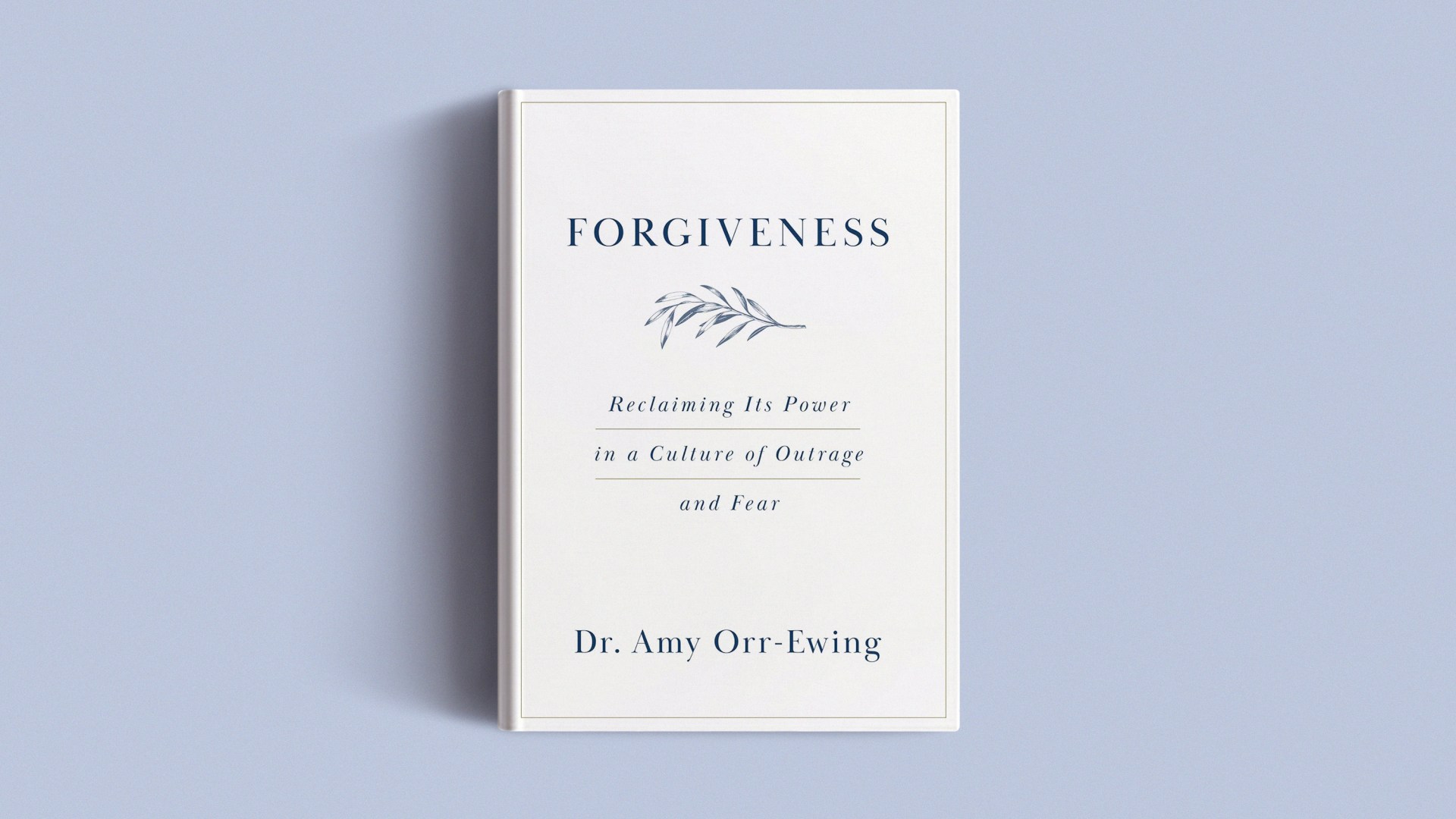
An excerpt from Forgiveness: Reclaiming its Power in a Culture of Fear.

The book on a light blue background.
Christianity Today April 21, 2026
Illustration by Christianity Today / Source Images: Getty, Brazos Press

In 1982, a group of friends sold their suburban homes and purchased an underdeveloped 6,500­-acre farm on the outskirts of Bulawayo, Zimbabwe. They named it the New Adams Farm and formed what they called the Community of Reconciliation. Their vision was to see white and Black Zimbabweans living and working together in harmony, ending racial tension and violence, and healing hurt. Inspired by their Christian faith, they hoped to model how love triumphs over hate.

Over the next four years, the community grew, with many neighbors gaining agricultural skills, fellowship, and education. One night in 1986, a group of terrorists who saw themselves as liberators of Black people killed 16 white men, women, and children with an axe, forcing some of the members of the Black community to watch. They left one daughter of the founders alive to bear witness to what happened, and the son of one of the other founders, a 6­-year­-old boy, escaped into the surrounding countryside. All the other white adults and children were brutally murdered.

As the 14-year-old daughter of one of the founding members was being led off to be killed, she asked her father, “How should I pray?” He responded, “Pray for these men, as they are now the ones who need our prayers.” One by one they were killed, and while each of them remained silent, they could be seen uttering prayers under their breaths for their killers.

One of the survivors of this massacre is a man I admire greatly. Forgiveness of this kind of atrocity would take supernatural strength; humanly, it does not seem possible. But forgiveness and reconciliation are what drove the founding adults to pursue their dream, and their lives and deaths bear witness to the possibility of goodness amid such horror. Forgiveness does not minimize the trauma and its ongoing impact, but forgiveness has imbued those who choose it with something otherworldly, an almost superhuman strength.

As our society has become more trauma-informed, best practices regarding mental health have become highly regarded and widely accessible. In this context, the Christian faith has something unique to offer traumatized people—a coherent, embodied foundation for the possibility and practice of forgiveness. When well-meaning friends or family aren’t informed about how trauma works, their pronouncements about forgiveness cheapen the harm a person experiences when something devastating occurs. Teachings about forgiveness have been weaponized as a quick fix, disregarding the impact of trauma.

Yet as we explore the relationship between forgiveness and trauma, we see that whether they are receiving forgiveness or they are offering forgiveness, trauma survivors who practice forgiveness experience notable outcomes. Forgiveness is a radical gift to anyone who is acquainted with trauma and needs to be reclaimed in a world where outrage and fear abound.

I used to think of the word trauma as referring to a surgery required after injury. As the mother of teenagers, I’ve heard the word traumatic thrown around to describe everything from the mildly awkward to comic situations that make great anecdotes to share with friends. But trauma is far more than this, and our awareness of the impact of devastating events on the human person is growing as trauma is studied and attended to by clinicians, researchers, counselors, and concerned family members.

According to the American Psychological Association, trauma is defined as “any disturbing experience that results in significant fear, helplessness, dissociation, confusion, or other disruptive feelings intense enough to have a long-lasting negative effect on a person’s attitudes, behavior, and other aspects of functioning. Traumatic events include those caused by human behavior (e.g., rape, war, industrial accidents) as well as by nature (e.g., earthquakes) and often challenge an individual’s view of the world as a just, safe, and predictable place.”

The consensus among specialists is that trauma is not what happened to you but what happens inside you as a result of what happened to you. Trauma is less about the immediate impact of a devastating event and more about the impact on the whole person. Trauma can evoke two extremes of emotional response: feeling overwhelmed or feeling numb. Overwhelm of the body and the nervous system impacts our capacity to cope with day-to-day challenges, while numbing or dissociation can be a way of coping with stress and surviving in daily life.

If we don’t experience the conditions necessary to process trauma, it becomes stuck and stored in us, leaving lasting emotional, physical, or psychological imprints. It disrupts the nervous system, causing chronic dysregulation, disconnection, or hypervigilance.

Supporting a traumatized person can have a steep learning curve. I experienced this when supporting my husband through post-traumatic stress as a result of abuse he suffered in childhood. And then I had a traumatic experience myself and needed over a year of regular therapy to come through it.

Experiencing trauma goes way beyond thoughts, feelings, or even psychology. Trauma affects the body and is stored in our hormonal and systemic pathways. In Waking the Tiger, Peter Levine writes that “traumatic symptoms are not caused by the ‘triggering’ event itself. They stem from the frozen residue of energy that has not been resolved and discharged; this residue remains trapped in the nervous system where it can wreak havoc on our bodies and spirits.”

In the best-selling book The Body Keeps the Score, Bessel van der Kolk explores how traumatic experiences are encoded in the body and brain, impacting physical and emotional health. His work with Vietnam veterans played a foundational role in his understanding of trauma and its effects. He and others have been able to categorize the symptoms of post-traumatic stress disorder (PTSD). They’ve observed how traumatic memories are not just psychological but also deeply imprinted in the body, leading to hyperarousal, flashbacks, and emotional dysregulation.

Van der Kolk’s work explores the connection between trauma and the body: “The urgent work of the brain after a traumatic event is to suppress it, through forgetting or self-blame,” he says in an interview with The Guardian. But the body does not forget. Physiological changes result in “a recalibration of the brain’s alarm system, an increase in stress hormones, an alteration in the system that filters relevant information from irrelevant.” The stress is stored in the muscles and does not dissipate. This has profound ramifications for talking therapies and their limits: The rational mind cannot do the repair work on its own, since that part is pretending it has already been repaired.

Van der Kolk notes, “We define ‘trauma’ as an event outside the normal human veins of experience. At least one-third of couples, globally, engage in physical violence. The number of kids who get abused and abandoned is just staggering. Domestic violence, staggering. Rapes, staggering.”

If the body stores trauma in muscles and hormonal pathways, then it should “have experiences that deeply and viscerally contradict the helplessness, rage or collapse that result from trauma,” he adds in his book.

Reclaiming the power of forgiveness in trauma-informed care has huge potential for the healing and future flourishing of many who have suffered greatly in our communities. While we should rightly be cautious about the abuse or weaponization of forgiveness, the potential for human well-being in both giving and receiving forgiveness is undeniable.

When recovering from trauma, the embodied nature of healing matters greatly. There is a profound correlation with the center of the Christian faith—the trauma and crucifixion of the incarnate Son of God in history. The Scriptures introduce us to a God who enters his own creation, in his own image, taking on human flesh and tabernacling among us.

An embodied Savior demonstrates God’s love not on an ethereal, ideological, or disembodied level. As a human being, Jesus died the most painful death known to the ancient world. The crucifixion of God in flesh speaks uniquely to our traumatized world.

The Son of God was despised and rejected, shamed and abused, betrayed by loved ones and unjustly accused, stripped naked and displayed for all to see. It is notable that the Gospel writers are careful to detail the psychological and physical abuse suffered by Jesus. The flogging and scourging, the crown of thorns, the mockery, the nails, the thirst, and the spear—the details matter.

To a trauma survivor, the Savior’s suffering is real and graspable. The identification of a loving God with the suffering, pain, and devastation of this world is a meaningful point of connection for the forgiveness and self- forgiveness we may need to receive. The center of the Christian faith is a traumatized Savior who honors the magnitude and significance of our pain by suffering with us and for us.

Content taken from Forgiveness by Amy Orr-Ewing, ©2026. Used by permission of Brazos Press, a division of Baker Publishing Group.

‘I Want to Give Where the Voice of Truth Is Loud’

Sandra Anderson trusts Christianity Today to navigate cultural challenges—and invests to ensure its voice continues.

woman with husband
Brianna Peterson

For Sandra Anderson—and so many like her—recent years have been shocking, confusing, and challenging. From political polarization and division to Christian nationalism and a fractured church, she has tried to navigate a world that often feels unstable and increasingly distant from Scripture and the teachings of Jesus. 

In response, Sandra has returned to the Word, studying Scripture deeply so she can understand and explain her faith. Through it all, Christianity Today has been an indispensable companion, offering insight, encouragement, and thoughtful challenge.

“CT’s assessment of the theological, sociological, and political is always through a biblical lens—not a selective biblical lens—it’s very true to Scripture,” says Sandra. “I trust CT. I don’t have to read it with a cautious eye, wondering if it sounds right; it feels on mission.” 

That trust is why Sandra has chosen to support CT financially. “I feel like we’re in a time where we need to put our money where our mouth is,” she explains. “There are so many causes I care about, but what I can give, I want to give where the impact is strong, and the voice of truth is loud. CT is exactly that.”

For Sandra, the combination of biblical clarity, cultural insight, and trustworthy reporting makes CT not just a magazine or website, but a companion for her faith journey. It helps her process complicated social issues, engage difficult conversations, and stay rooted in Scripture—while also affirming that she is not alone in thinking deeply about these challenges.

“CT means validation,” she adds. “It means staying biblically solid and coming back to the roots of Scripture—not bending the message to suit the times or a few loud voices. I feel like CT is not afraid to stand in the face of Christian nationalism and say, ‘No, this isn’t biblical.’ To be that voice in the wilderness is risky—you could lose an audience—but it’s the truth.”

A Faith That Began Early

Sandra describes her faith journey as fairly typical, accepting Christ at age 4 when her mother invited her to lay her anxieties at the feet of Jesus. She eagerly did—and that changed her life forever.

But like all lives lived in pursuit of Christ, hers has not been free of challenge, loss, or difficulty. An unexpected divorce left her raising her children as a single mom, one of whom is on the autism spectrum. Fifteen years ago, during the economic downturn, she lost her job, forcing her to rebuild her career while supporting her family.

Yet through it all, her abiding faith has been an anchor, leading her to declare again and again, “Look what the Lord has done.” God’s faithfulness has punctuated her life in staccatos of presence and provision.

She recounts one vivid moment: Her son’s expensive preschool tuition, essential for his development after the autism diagnosis, had become impossible to cover. Then, an anonymous donor stepped in to pay the full year’s tuition.

“It felt almost biblical,” Sandra says. “Moments where you just say, ‘Look what the Lord has done.’”

Among these markers of God’s presence was Christianity Today. She discovered the magazine in her church library and took an issue home. She found the content to be “meaty,” but she liked it—and soon became a subscriber. In the years that followed, financial pressures forced her to let the subscription lapse, but when life stabilized, she returned to CT.

“It’s a great lens to look at all things through a strong Christian perspective,” Sandra says. “The articles always resonated with me.”

Making Sense of the Moment

Today, Sandra engages with CT across multiple platforms—from the print magazine to digital articles and podcasts. One series that particularly impacted her was The Rise and Fall of Mars Hill. The story felt personal: Sandra lives just blocks away from the original site of Mars Hill Church and knows people who attended or worked there.

“CT actually introduced me to podcasts,” she says.

Another favorite is The Bulletin.

“I love The Bulletin,” Sandra says. “It’s so affirming to hear something from Russell Moore and think, ‘Oh my goodness—we’re not crazy.’ They’re validating that our concerns and questions are real.”

For Sandra, those moments matter deeply.

“We’ll talk about things at home and have theories,” she explains. “Then we read an article and say, ‘Look, this is what we were saying.’ Sometimes it validates our thoughts. Other times, it challenges me and makes me rethink something. Either way, CT helps me process complicated cultural questions through a biblical lens.”

Investing in a Voice That Matters

Over time, Sandra’s appreciation for Christianity Today grew into something more—her subscription eventually led her to become a financial partner supporting the ministry’s work.

“I really can’t imagine not having a voice like CT,” she says. “If you believe in something like this, you want to help make sure it continues.”

She believes the publication is doing important work by expanding its reach while remaining faithful to its mission.

“I love the magazine,” she says. “But I also love that CT is staying relevant while diversifying its reach—reaching its core audience while also reaching new audiences, maybe even people who don’t yet believe.”

In a moment when division within the church often feels overwhelming, Sandra sees CT as a rare place where Christians can engage difficult issues thoughtfully and faithfully.

“Sometimes the divisiveness feels stark,” she says. “But CT is trying to bridge that in fantastic and relevant ways. A voice like this matters—and I want to make sure it continues.”

Books

An Arthurian Epic for the Dark Age of the Bright Screen

Galahad and the Grail “is about a light that wasn’t extinguished,” says author Malcolm Guite. “And we kind of need it again.”

Malcolm Guite sitting by a tree.
Christianity Today April 20, 2026
Photo by Patrick Shen / Courtesy of The Rabbit Room / Edits by CT

Malcolm Guite was looking for a place to sit. 

The poet wandered between branches and over tangled roots, through a British wood, with a few loyal companions. They were filming a documentary about his new epic ballad, Galahad and the Grail, and they wanted to feature a grove of oak, ash, and thorn trees—three significant characters in the poem. But they couldn’t seem to find a good spot with those trees close together, and they’d forgotten a stool for Guite.

“Not to worry,” Guite told his friends as they searched, according to his illustrator, Stephen Crotts, who was there that day. “In the poem, there is a fallen log by the oak. The woods will know the poem. There will be an oak. There will be a log.”

Sure enough, just as Crotts happened upon the three species of trees growing close together, Guite spied the perfect log, nestled beneath an oak. “He goes, ‘Oh, very well, there it is,’” Crotts recalled. “He just sat down and started puffing on his pipe.”

Crotts wasn’t surprised. “There’s a level of coincidence that follows him around,” he told me of Guite in an interview last month, smoking his own pipe on a wooden porch just outside Nashville, spring peeking out around us after a long, icy winter. Crotts hesitated, his voice dropping to an almost conspiratorial register: “Magic things happen.”

Guite’s new book, at least, does seem magical. Galahad and the Grail rollicks and captivates with a rhythm that feels as if Guite is casting a long-forgotten spell. It’s the story of Camelot and the grail quest, old and familiar but still delightfully strange. It’s also apt for our time, particularly in its vision of knighthood. 

Some false knights, Guite laments in the beginning of the book, 

Lust for might and mastery,
they only prate of courtesy,
and keep a code of chivalry
they scarcely understand.

Galahad, the perfect knight at the heart of the story, offers a different standard: one of gentleness and courage, faith and boldness, and the vision to see where, with God’s help, broken things can be restored. 

“We’re effectively entering a new dark age,” Guite told me in an interview. “This story is about a light that wasn’t extinguished in the Dark Age. And we kind of need it again.”

poet-musician-priest, Guite believes the old stories about King Arthur and his knights still hold power—and ultimately point to hope in Jesus Christ. 

Galahad and the Grail is the first of a four-volume Arthurian epic, written in the nearly singing, rhyming style of an English ballad, which Guite advises readers to experience aloud. Guite himself is given to quoting lines in conversation. If you’re lucky, he’ll share the whole introduction to the poem, where he describes hearing a voice urging him to “take up the tale” as he walked outside one summer morning a few years back. (That’s not a metaphor or a mere poetic device, he told me: He really did hear the voice.)

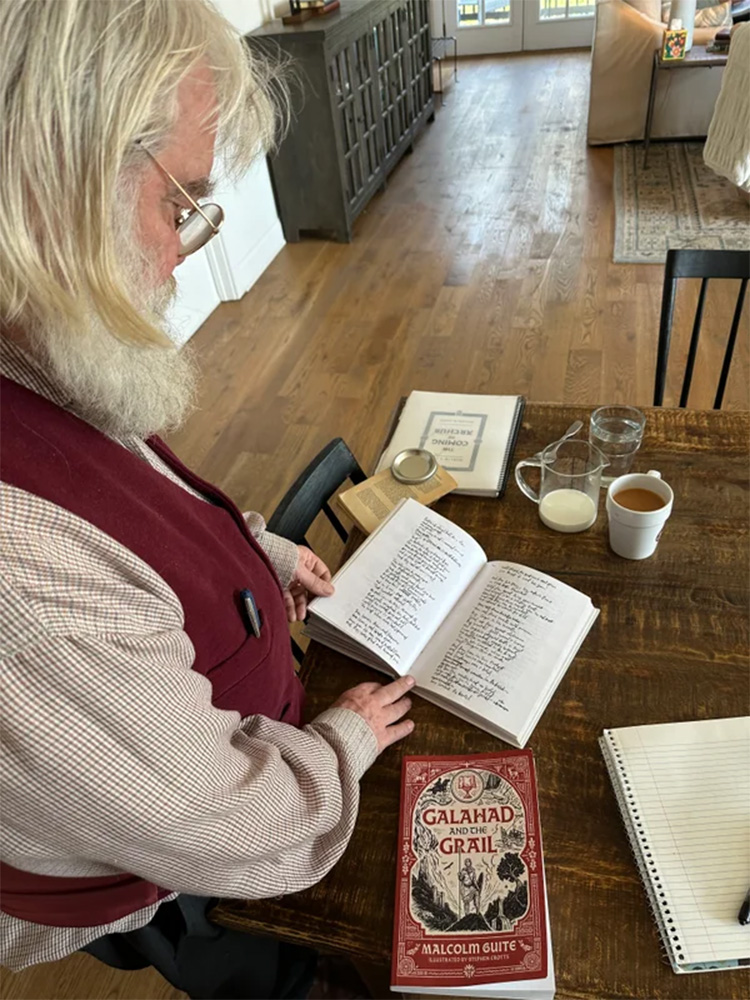
Guite looks every bit the author of an epic ballad—or, yes, the kind of person who would expect a forest to know a poem. Imagine Father Christmas on a long sojourn to the Shire, often in colorful vests, hands never too far from a pipe to puff. While Crotts made him a cup of tea and we settled in for a conversation about the book, Guite’s white hair and beard shook with fervor as he recited his lines. His hands tried to do the story justice, waving about in the air.

And when Guite talks about myth and poetry, diving into Christ’s true and better fulfillment of old folklore, his sentences stop only when he runs out of breath, the words crammed together as close as possible. A great gulp of air, and he’s at it again.

“There’s this meeting of the Christian and the possibly pre-Christian, and how do you interpret that?” he said of the Arthurian legends. “The fashionable thing became to say that this is all pagan material which was still remembered but kind of banned by the church. The idea is that it was given a light Christian gloss to make it acceptable to a 12th-century audience.”

“I don’t think that’s the case,” he told me. “My view is that it’s not that an essentially pagan story was given a light Christian gloss. It’s that the Christian story, when it’s told in the midst of the cultural memory of these pagan stories, suddenly brings new life to them and makes sense of them.”

“Once you get Christ, once you know who the Messiah really is, suddenly it lights a backward path through all the old stories,” he said.

Arthurian legends can be tricky to market, for the very reason Guite loves them so much: These stories can be far too religious for many non-Christians, yet they feel too pagan for some Christian readers.

Guite also knew, even as he started writing Galahad and the Grail, that to print these books with any kind of institutional publishing support might be a long shot in an era of minuscule attention spans and ubiquitous screens. Many publishers, trying to convince people to pick up books instead of their phones, are gravitating toward sex-addled stories, tropes they can sell on TikTok, and books with so many subheadings that each new bold-faced summary is almost insulting. 

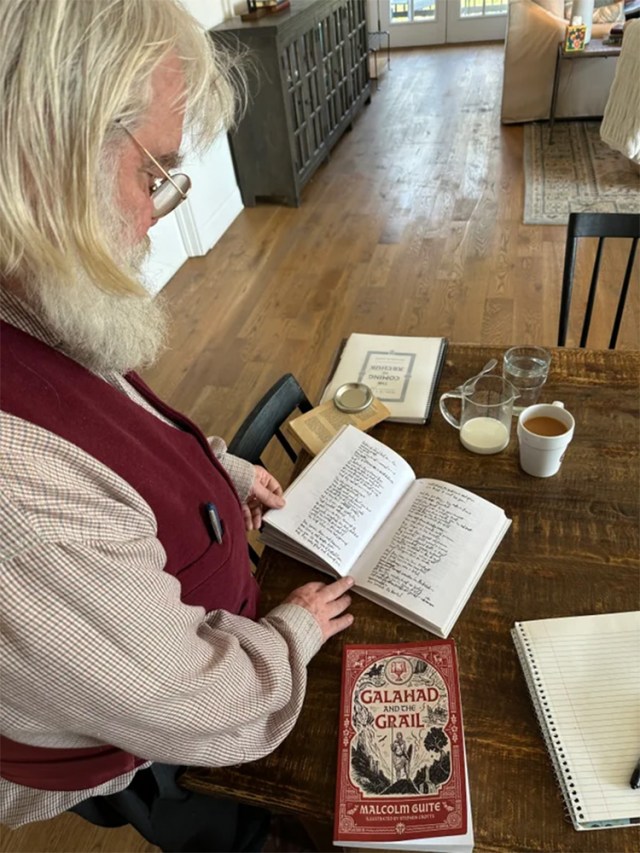
Malcolm Guite holding his hand-written poem.Image courtesy of Haley Byrd Wilt

Guite’s poem is the polar opposite of those trends. His regular publisher was at first “not enthusiastic” about his pitch, he told me. Two larger presses in the UK weren’t interested either, with one suggesting he write a much shorter book about T. S. Eliot’s Four Quartets instead. “They just weren’t willing to go there,” he said of an original epic ballad.

In many ways, Guite seems a man from a different time. Was this a tale for a different time, too? He quietly resolved that even if it were, and even if he never found a publisher, he’d take up the tale anyway.

The book finally did find a home with Rabbit Room PressIt’s the publishing arm of a nonprofit faith-and-arts organization founded 20 years ago by the singer and author Andrew Peterson. The Rabbit Room’s willingness to take on Galahad and the Grail, Guite said, helped convince his UK publisher, Canterbury Press, to publish the poem in Britain too.

The Rabbit Room’s book-filled North Wind Manor, a farmhouse outside Nashville, has the air of a modern monastery, where people with ink-stained hands scribble away to preserve old texts. In a way, that’s exactly what Guite’s poem aims to do: to reclaim and pass on an almost-forgotten story by telling it again for a new audience. Crotts, who really does have ink-stained hands, emphasized that the poem points to Christ in a time when many are looking for him, even if they do not know he’s the object of their search.

“We don’t want to hear about a story. We want to be in the story,” he said. “And the Eucharist is the place where we step into it. Jesus really is pulling up a seat at his table for us.”

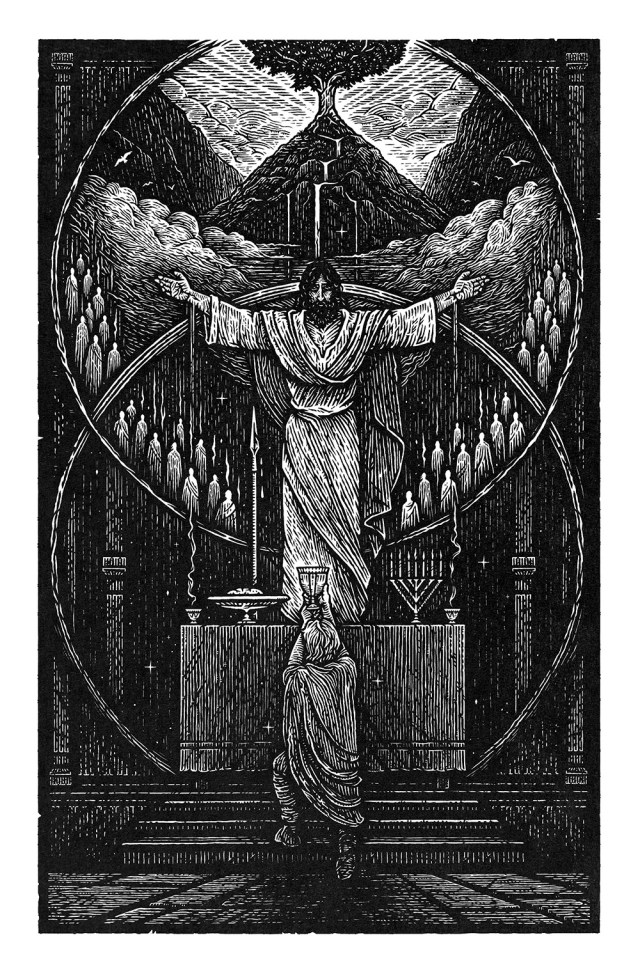
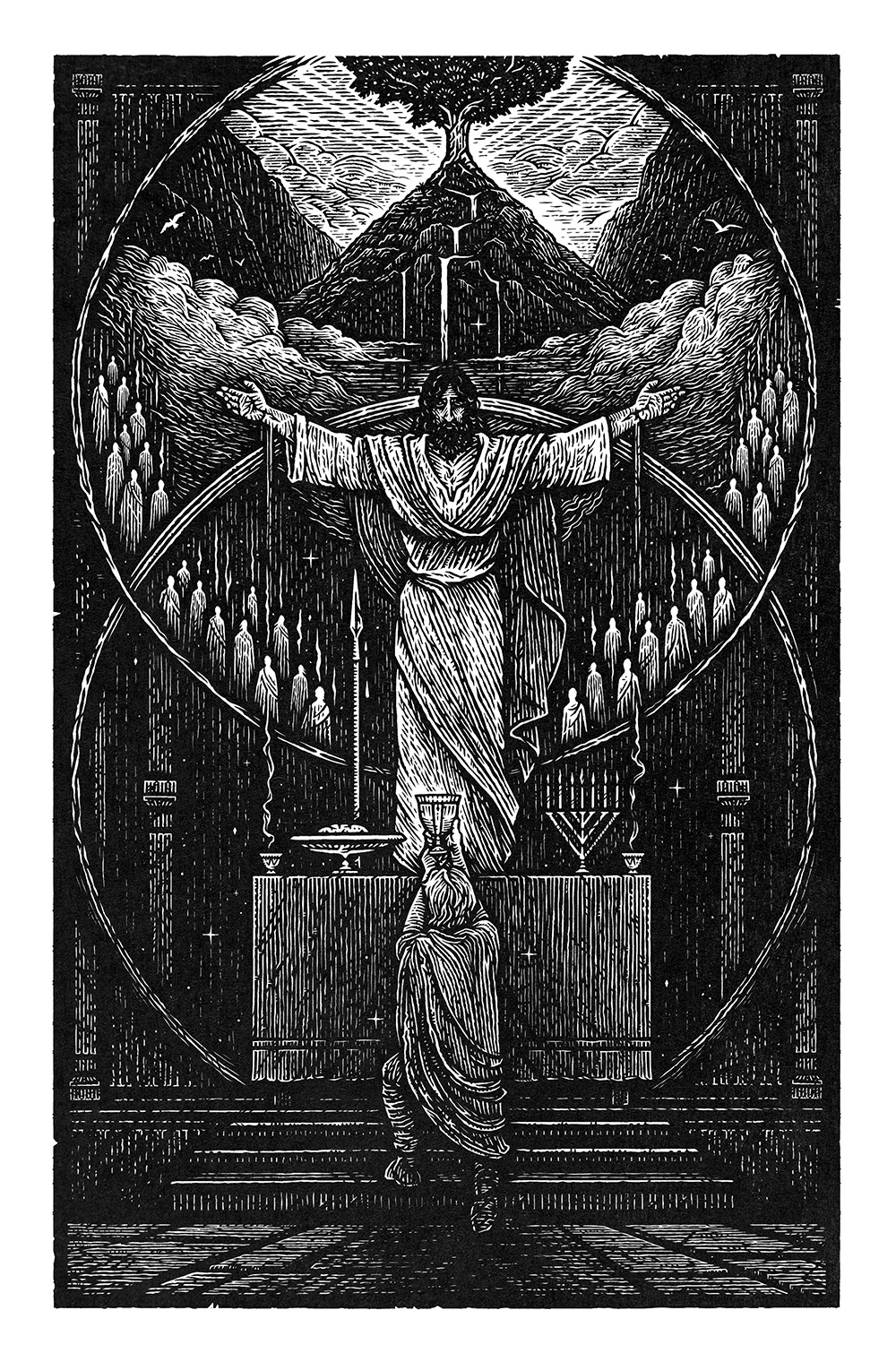
Crotts told me that illustrating the Lord’s Supper upon Galahad’s completion of the grail quest was the image he “had the most fear of approaching.”

A print of Jesus.Image courtesy of Stephen Crotts

“It’s like, ‘Oh, all I have to do is, in one image, sum up the story of the universe,’” he said. (I think he did a stunning job.)

For the illustrator, the poem is a daunting project with a fast timeline. Guite hopes to release the second book, The Coming of Arthur, later this year, the third volume in 2027, and the fourth in early 2028. Guite seems unbothered by the pace, but Crotts is striving to keep up.

“My blood pressure went up so high that I started going blind,” he said of illustrating Guite’s work. That’s partly due to the ambitious timeline, he told me, but mostly because he feels a burden to do the story justice. The Rabbit Room’s support has helped, Crotts said. “I was just laboring in obscurity and frustration until I met these people.”

Pete Peterson, publisher of Rabbit Room Press and brother to Andrew Peterson, told me that when he heard of Guite’s work through mutual friends, he prepared to fight it out with all the major publishing houses to win the rights to Guite’s epic. In the end, he didn’t have to. “The Rabbit Room and Rabbit Room Press are just kind of weird enough,” he said, “that we maybe understood it in a way that other people didn’t.”

“I feel really blessed,” Guite said of publishing a book that requires attention from modern readers. But he added, “I hope this is actually not an exception but a presentiment of things to come.”

“I think we want the real thing and the real deal,” he said. “We want deep nourishment of mind and soul and heart.”

I came to Galahad and the Grail already a fan of Guite and his publisher. In fact, journalistic integrity demands I disclose: I’m so taken with the Rabbit Room’s mission that I sent a sad little email to Andrew Peterson last summer begging for an editing gig after I became fed up with reporting on the US Congress. (I did not get the imaginary job I’d tried to wish into existence.)

But I don’t think that sort of affection is a prerequisite for enjoying Galahad and the Grail. Guite writes of dryads and naiads of trees and streams with all the whimsy of those old Oxford dons, J. R. R. Tolkien and C. S. Lewis. He handles his characters, even those who stray from God, with a balm-like tenderness. One moment in the story centering on the knight Lancelot was so beautifully done it brought me to tears. Even when Arthur’s knights face darkness and evil, Guite doesn’t revel in it, and he carefully preserves a sense of innocence—sometimes lost, yes, but never too far from being found again.

Newcomers to poetry may take a little while to warm up to the style, but Guite’s work is deliberately accessible. He describes the ballad form as “a not-very-distant cousin” of the nursery rhyme, designed for all kinds of people to be able to remember and recite through the ages if only they’ll give it their attention.

“It’s not like weird, arcane, academic free verse,” he said of ballads. “They’re meant to be lucid. They’re meant to tell a story. But that doesn’t mean that they can’t also be profound and beautiful.”

Pete Peterson said he won’t mind, though, if the poem doesn’t go viral. “We’ve had, especially in publishing, a real mission of wanting to publish things that we feel like are in danger of falling between the cracks,” he told me. “Maybe it’s a little too Christian for the secular market, too secular for the Christian market, or maybe it’s just a little too weird and people don’t know what to do with it.”

“Andrew and I used to joke that we wanted to look back in 30 years and realize we had published a whole bunch of books that nobody bought,” he continued. “Which is—you know, I’m kidding. I want people to buy them. But we’re interested in things that just have a hard time finding a home.”

He thinks Guite’s epic already belongs in the canon of great literature beside the likes of Homer and John Milton. But even if this new Arthuriad is hardly noticed, if it’s only—“only”!—an admirable effort at beauty in a slop-soaked world, the mere fact of that effort hews to the greatest and most Christlike virtues of Camelot.

“Before Arthur takes the sword from the Lady of the Lake, she asks him, ‘Are you prepared to do the right thing and make a kingdom and then see everything you’ve done unmade?’” Guite told me. “‘To know that what you’re doing is right but may not win?’”

The tale of Arthur and his knights is “not about being on the winning side,” Guite said. “It’s about being on the right side.” Galahad and the Grail sure feels right.

Haley Byrd Wilt is a writer based in the DC area. Her reporting has appeared in Foreign PolicyThe New York Times, and NOTUS, among others. Her poetry has been published in Mere Orthodoxy.

News

Some Christians Risk Persecution if They’re Honest in India’s Census

Publicly identifying their faith can lead to consequences for lower-caste Christians and those in religiously hostile states.

An awareness board for the 2027 Census in India.

An awareness board for the 2027 Census in India.

Christianity Today April 20, 2026
NurPhoto / Contributor / Getty

Ravi Kishore, a third-generation Christian from the southern Indian state of Andhra Pradesh, is caught in a bind. When census officials knock on his door, he must choose between two identities that dictate his life: his Dalit caste or his Christian faith.

Although his family has practiced Christianity for generations, they prefer being listed as Scheduled Caste (SC) Hindus in government records. The SC status, which is given to marginalized castes including Dalits, has allowed Kishore’s grandfather and father to access education and employment opportunities previously unavailable to the caste due to historic and ongoing discrimination. By identifying as Christians, they would lose that protection.

“I know I am not being honest by hiding my Christian identity,” Kishore said. “But do I have an option? Is the government being fair to Dalit Christians?”

Hundreds of kilometers away, in the northern state of Uttar Pradesh, Suraj Kumar is caught in different dilemma.

Kumar has been a Christian for about a year and a half, worshiping quietly with seven other families at a house church in his village. He works as an electrician to earn a living. His Christian identity, he felt, could come in his way of cultivating local networks and securing government contracts, which are necessary for his work and income flow.

“In my work, relationships matter,” he said. “If people know I am a Christian, it could change how they see me.”

In a state with an anti-conversion law in force and hostility towards Christians at its peak, Kumar is wary of identifying as a Christian in the census. “Tomorrow, they could charge me in some case just because I am a Christian,” he said.

As India embarks on counting its estimated population of 1.4 billion this month, Christians are forced to make difficult choices that can impact their safety, identity, and belonging. The last census held in 2011 found that Christians make up 2.3 percent of the Indian population, which many believe to be undercounted due to the dilemmas believers like Kishore and Kumar face.

Originally scheduled for 2021, the government delayed the census due to the COVID-19 pandemic and administrative challenges. More than 3 million officials have been deployed to enumerate the world’s most populous country. The exercise will stretch over a year, with final data expected to be available at the end of 2027.

For the first time since India’s independence in 1947, the census will record caste along with religion. Intense political debate preceded this decision, and the change is expected to have wider implications for welfare delivery, public policy, and representation of various communities.   

For Christians, particularly those from Dalit backgrounds or those living in regions steeped in religious hostility, the act of speaking openly about faith comes with its own consequences.

Christians in the 13 Indian states where anti-conversion laws are being enforced fear that their disclosure could invite unnecessary trouble from the government, leading to false charges against them. Police can make arrests without a warrant, and obtaining bail is extremely difficult. Convictions can result in jail terms ranging from one year to life imprisonment, along with hefty fines. In Uttar Pradesh, police made 1,682 arrests under the law between November 2020 and July 2024.  

Hindu nationalists often justify violence toward Christians by claiming “conversion mafia” are leading large numbers of Hindus to Christ. While anecdotal evidence by church leaders reveals a growth in house churches across India’s urban and rural areas, there is no reliable data to capture the trend. According to census data, the percentage of Christians has remained largely stable between 1979 and 2011, making up 2.6 percent and 2.3 percent of the population, respectively.

“The very fact that the Christian population is less than 3 percent even after 79 years of independence shows that mass conversions are a bogey,” said Joshua Kalapati, associate editor of the Oxford Encyclopaedia of South Asian Christianity.

Similarly, a 2021 report by the Pew Research Center found that religious conversion in India is “rare.” Yet the narrative of mass conversion continues to shape public discourse, deepening the vulnerability Indian Christians face. As a result, Christians and Hindus will be watching the results from the 2026 census closely.

In the case of Dalit Christians, the census raises a far more complex question. 

Under Indian law, SC status and the reservation benefits linked to it are restricted to Hindus, Sikhs, and Buddhists. Dalit converts to Christianity and Islam are excluded, under the assumption that caste does not exist in these religions.

Numerous government-appointed commissions found that in Indian society, caste transcends religion, and Dalit Christians face double the discrimination as Indian society looks down on both identities.

As a result, many of those believers are faced with a difficult choice: Declare Christian faith openly and risk forgoing job prospects and entrance to universities, or remain Hindu on paper and practice Christianity in private. Over the generations, many Christians have chosen the latter.

“Dalit Christians should be allowed to record both their identities,” said Asir Ebenezer, general secretary of the National Council of Churches in India. “Denying that choice amounts to discrimination.”

At a deeper level, the census also raises a fundamental question of who the government qualifies to be called a Christian. 

“Is it someone formally affiliated with a church and holding a baptism certificate? Or someone who quietly attends a house church, believes in Christ, but has no official documentation?” asked A. C. Michael, national coordinator of the United Christian Forum. “It is a gray area.”

For some, safety and security take precedence over the question of identity. “There is no need for bravado,” said John Dayal, a Christian human rights activist. “Take your call on how you want to be identified by the state.”

But when the census data is finally released, the numbers still will not represent a true picture of the community as it will likely undercount Christians. Still, many are excited to see the results.

“The upcoming census, since it includes caste enumeration, will surely unravel more layers of Christian identities,” Kalapati said. “The census will generate more discussion and debate around the social status of the Christian community.”

addApple PodcastsDown ArrowDown ArrowDown Arrowarrow_left_altLeft ArrowLeft ArrowRight ArrowRight ArrowRight Arrowarrow_up_altUp ArrowUp ArrowAvailable at Amazoncaret-downCloseCloseellipseEmailEmailExpandExpandExternalExternalFacebookfacebook-squarefolderGiftGiftGooglegoogleGoogle KeephamburgerInstagraminstagram-squareLinkLinklinkedin-squareListenListenListenChristianity TodayCT Creative Studio Logologo_orgMegaphoneMenuMenupausePinterestPlayPlayPocketPodcastprintremoveRSSRSSSaveSavesaveSearchSearchsearchSpotifyStitcherTelegramTable of ContentsTable of Contentstwitter-squareWhatsAppXYouTubeYouTube