Culture
Review

‘The Christ’ Audio Drama Testifies to Easter

You can’t ‘come and see’ this depiction of Jesus, but you can definitely come and hear.

The recording studio for The Christ podcast.

The recording studio for The Christ podcast.

Christianity Today April 3, 2026
Used with permission from Faith Media

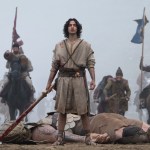
The story of Jesus has been told many times in print, in art, and on film. Now it’s been turned into a full-scale audio drama, The Christ, which is being released as a four-part podcast this week during the lead-up to Easter.

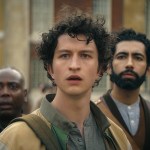
The podcast features some fairly big names, several of whom are veterans of the Bible-movie genre. David Oyelowo, who played Joseph of Arimathea in BBC’s The Passion and John the Baptist in The Book of Clarence, now plays Pontius Pilate, while Paul Walter Hauser, who recently voiced a sheep in The Chosen Adventures, plays John the Baptist. Patricia Heaton (The Star) hosts the show, while John Rhys-Davies, whose credits include One Night with the King and Peter: The Redemption (and, yes, a Bible-adjacent Indiana Jones movie or two), provides the narration. Jesus himself is played by Tom Pelphrey (Task, Ozark), who as far as I can tell is new to the genre but has spoken quite openly about his faith.

Listening to the podcast is a fascinating experience. When you read the Gospels, you can imagine how it all played out for yourself, and when you watch a movie or TV show about Jesus, the sights and sounds are provided for you. But listening to the drama—getting the sounds but not the sights—focuses the mind in different ways. It’s a little like watching an old silent movie about Jesus, except instead of showy facial expressions and hand gestures compensating for the lack of audio cues, you’ve got theatrical voices and precisely-timed laughter compensating for the lack of visuals (particularly when the villains are mocking Jesus). Even if the performances are a bit exaggerated to fit the medium, they can also be quite bold and effective, engaging the listener.

The producers of The Christ make good use of the form, from the hard-hitting sound effects when Jesus is crucified to the various storms and crowds in the background of other scenes. When Jesus goes into the desert after his baptism, his prayers overlap with flashbacks to his birth and childhood, and it feels like we’re listening to his thoughts and memories.

And just as Cecil B. DeMille’s silent classic The King of Kings showed Jesus healing a blind person from the person’s point of view, with a dark screen fading into an image of Jesus’ face, so too the podcast dramatizes the healing of the deaf-mute man by dropping the sound and muffling Jesus’ voice just before he says “Ephphatha!” (Mark 7:34).

The writing goes beyond the Gospels in interesting ways. In two of the Gospels, Jesus quotes a single line from Psalm 22—“My God, my God, why have you forsaken me?”—but in The Christ, he continues further, quoting even more of that psalm, while the narrator explains how another line from it was fulfilled when the soldiers cast lots for Jesus’ clothes. Sometimes the podcast makes its own connections to the Old Testament, as when Rhys-Davis quotes Jeremiah 17:9 (The heart of man is “desperately wicked”) while describing Jesus’ treatment on the road to Calvary. 

The script also has a strong apologetic thrust. One of the disciples states that Jesus is either the biggest charlatan who ever lived or the sole supreme God; Heaton says Jesus fulfilled more than 300 prophecies; Rhys-Davies explains how Jesus was different from the false gods of his time; and the apostle John emphasizes the importance of deciding to believe that Jesus is the Christ.


Some of the creative choices are a little puzzling. Pilate’s wife keeps calling him “Marcus,” and only later do we learn the writers have expanded his name to “Marcus Pontius Pilate.” A historical basis seems to exist for creating a first name: Pilate’s personal name is not known, only his family names, and it stands to reason that his wife wouldn’t have called him by one of those, so the writers may have felt they had to invent another name for him. But because they don’t introduce him by his new name, his wife’s repeated use of it pulls us out of the drama just when it’s getting started.

Also, some of the plot points have been moved around in ways that might feel disjointed to listeners familiar with the story of Christ’s life. For example, when the disciples go fishing in Galilee after the Resurrection (John 21:1–4), they still haven’t seen the resurrected Jesus for themselves, and they grumble (or at least Thomas does) that Jesus has already appeared to pretty much everyone but them. They mention the women at the tomb, his mother, and the people on the road to Emmaus, among others. Jesus seemingly doesn’t appear to the disciples in Jerusalem (Luke 24:36–49; John 20:19–29) in this version of the story.

The dialogue is a mix of modern and archaic. Sometimes it’s very casual and familiar: When one of the disciples asks Jesus to teach them how to pray, Jesus replies, “All right, all right, maybe this should have been my first sermon.” Other times it falls back on the more stilted thees and thous of the King James Version.

Some of the other creative decisions are more intriguing than puzzling. When John the Baptist says the Messiah will baptize “with fire,” he’s speaking to Herod, in this production, and it sounds like a threat. I always assumed the biblical John, who spoke of Jesus baptizing “with the Holy Spirit and fire” (Matt. 3:11; Luke 3:16), was alluding to the tongues of fire that alighted on the disciples’ heads when the Spirit came upon them at Pentecost (Acts 2:3), but maybe he did mean it in a more apocalyptic way. Also, the rather sweet-voiced angel who appears to Jesus in Gethsemane (Luke 22:43) makes yet another allusion to the Old Testament that carries its own hint of menace aimed at someone else—not Jesus!—but still, it’s not what I expected.

The show has effective moments, too, conveyed through sensitive performances. The portrayals of Joseph and Mary, and their awareness of the suffering that awaits both them and their son, stand out in particular. Mary alludes to the sorrows ahead of her when she asks Jesus to intervene at the wedding in Cana. Even at a time of joyous celebration, she knows what she’s setting in motion, and you can feel her preparing herself for it.

The brief exchange between the 12-year-old Jesus and the elders in the temple (Luke 2:41–52) is also quite good. Many films simply show Jesus standing or sitting in front of the elders when Mary and Joseph find him, but an audio drama can’t take that shortcut. It has to give you a sense of what Jesus was saying, and this gives you a good sense of the public speaker that he will go on to become.

At the heart of it all, of course, is Pelphrey’s performance as the adult Jesus. Equal parts warm, compassionate, vulnerable, and sincere, his interpretation of Jesus is a pleasure to listen to, from his recitation of the Beatitudes to his playful exchanges with his mother and his forgiveness of Peter. You can’t exactly “come and see” his version of Jesus, but you can definitely come and hear.

Peter T. Chattaway is a film critic with a special interest in Bible movies.

Theology

The Scandal and Grace of Christ’s Saturday in the Grave

How Fyodor Dostoevsky saw the whole story of redemption in Holbein’s painting of the dead Jesus.

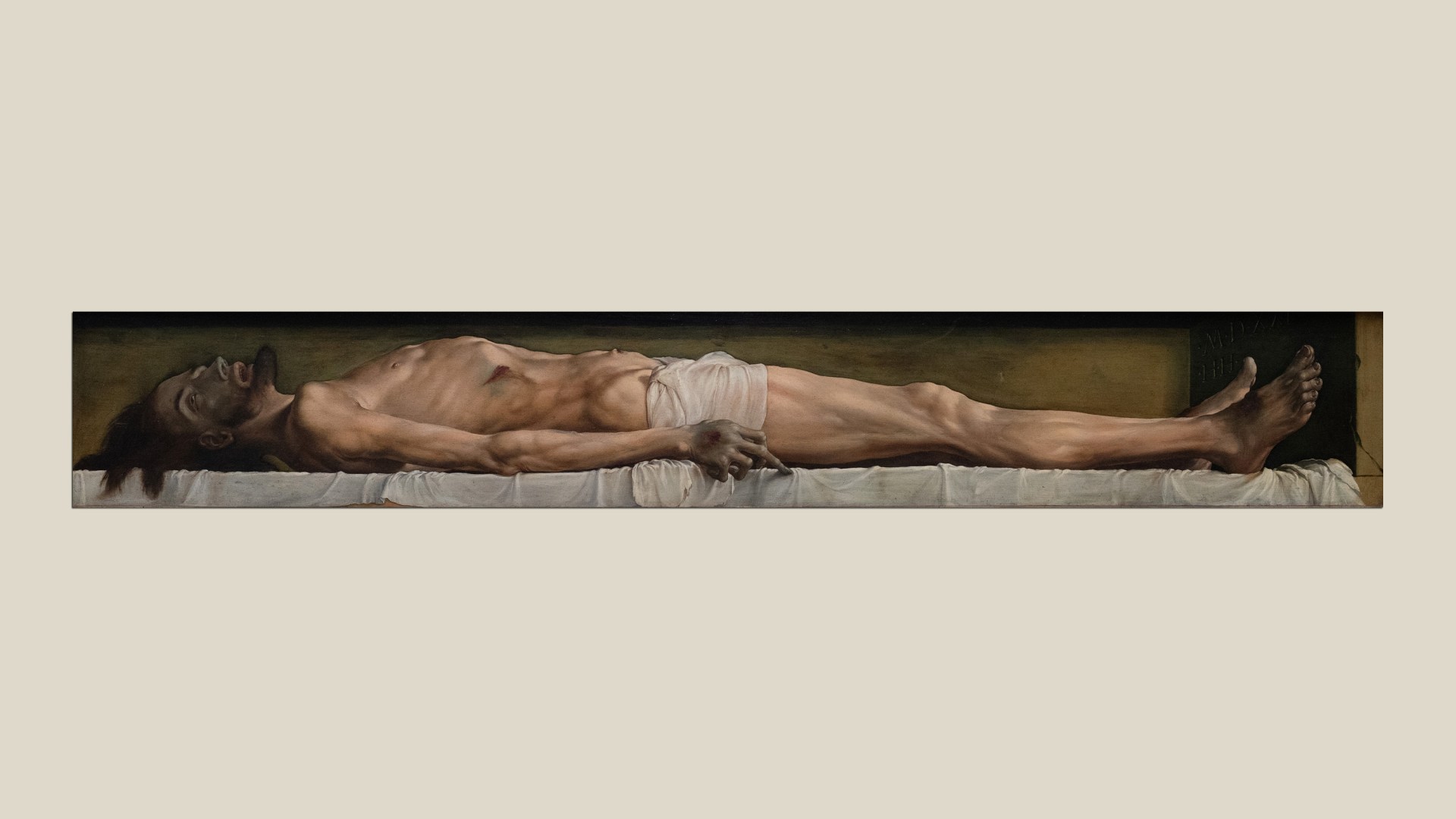
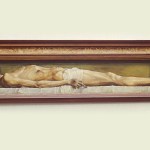
The Body of the Dead Christ in the Tomb by Hans Holbein the Younger.

The Body of the Dead Christ in the Tomb by Hans Holbein the Younger.

Christianity Today April 3, 2026
WikiMedia Commons / Edits by CT

If we are honest, many of us do not know what to do with Holy Saturday.

Good Friday is terrible, but it is also dramatic and full of passion. Easter Sunday is triumphant, radiant, and full of song. But Holy Saturday is quieter and thus harder for us to inhabit. It asks us to remain near the tomb and to resist the urge to hurry toward resurrection before we have reckoned with the weight of Christ’s death and burial .

The Apostles’ Creed confesses that Jesus “was crucified, died, and was buried; he descended to the dead,” while the Nicene Creed declares that the eternal Son “became man” and, for our sake, “suffered death and was buried.” We should not mistake these as spare liturgical phrases placed between cross and resurrection merely to mark the passage of time between Friday and Sunday. They are the church’s way of insisting that the gospel is anchored in history, with a real flesh and blood body in a real tomb.

From the beginning, Christians have had to answer those who tried to make Christ’s humanity into a phantom thing. Docetists claimed that Jesus only seemed to have a real body and only appeared to suffer and die. Basilides taught that Simon of Cyrene was crucified in Jesus’ place. Even Apollinaris, seeking to protect Christ’s divinity, diminished Christ’s full humanity by denying him a rational human soul. Each heresy originated as an attempt to escape the reality of the Son of God lying dead in a tomb. Yet, against all such evasions, the creeds teach the church to say plainly what Scripture declares: The Son of God truly took our nature, truly entered our sorrow, truly passed through death, and truly lay in the grave.

Even so, this is the part of the story we are often tempted to rush past. We move quickly from the agony of Good Friday to the alleluias of Easter morning, as though the silence of the tomb were only an inconvenience between sorrow and joy. We prefer resurrection in full bloom to the hard fact that our Savior lay in the grave. But the church, at its best, lingers here.

On Holy Saturday, the church confesses that the Lord of life entered death itself, so that by going all the way down into our mortal condition, he might raise us up with him. It teaches us not to avert our eyes from the burial of Christ, because only those who have learned to keep watch at the tomb on Saturday will feel the full wonder of the stone rolled away on Sunday.

That instinct to rush from cross to empty tomb helps explain why Hans Holbein the Younger’s painting The Body of the Dead Christ in the Tomb struck the Russian writer Fyodor Dostoevsky so deeply. Holbein was a 16th-century German painter of the Northern Renaissance, remembered for his striking realism and unsparing eye for detail. Dostoevsky, the great 19th-century novelist, was famous for his exploration of themes of suffering, doubt, guilt, and the hard-won hope of Christian faith.

When Dostoevsky saw Holbein’s painting in 1867, according to the later recollection of his wife Anna, he stood before it as if transfixed, and she feared the shock might provoke one of his epileptic seizures. This story has been told and retold so often that it now feels almost legendary. But the deeper point is not that Holbein nearly destroyed Dostoevsky’s faith but that this painting forced Dostoevsky to look straight at one of Christianity’s hardest claims: that God entered death fully before conquering it.

I believe that is why Holbein’s painting impacted Dostoevsky so deeply. The painting does not soften the death of Jesus. It offers no halo of serenity, no early hint of Easter radiance. Art historians and theologians alike have noticed the same thing: Holbein refuses the pious instinct to make death look already defeated. Christ’s face is not peaceful. It is lifeless and spent. Holbein does not preserve what scholar Mia Mochizuki calls the “comfortable fiction of sleep.” Rather, he chooses to present Christ as unmistakably dead, and the painting’s long, narrow format makes the tomb feel claustrophobic, almost coffin-like. Christ’s body is gaunt, wounded, discolored, and hemmed into the narrow confines of the tomb. Put plainly, Holbein paints what Christian confession requires, though Christian sentiment sometimes resists: If Christ truly took our nature, then he truly entered our mortality. When Holbein paints Christ in the tomb, he paints a corpse.

Dostoevsky was never interested in a Christ sheltered from the raw conditions of human life. He was drawn instead to the God-man who entered them fully. J. I. Packer captured something essential about Dostoevsky’s imagination when he described its recurring burden as “the nightmare quality of unredeemed existence and the heartbreaking glory of the incarnation.” Holbein seems to hold both in a single frame. That is what made the painting so important to Dostoevsky. He had little patience for sentimental religion. He distrusted every version of faith that tried to speak of redemption without grief, repentance, suffering, or grace. Ernest Gordon put it well, too, when he said that Dostoevsky’s “hosanna of faith was hammered out on the anvil of doubt.” Holbein’s dead Christ belongs on that anvil. The painting gave visible form to one of the most searching questions a believer can face: What can faith say when the eye sees only death and defeat?

Dostoevsky returned to that question repeatedly, but nowhere more memorably than in The Idiot, his novel of innocence, suffering, and belief in a world too damaged to know what to do with goodness. At the center of the novel stands Prince Lev Myshkin, a man whose gentleness, honesty, and almost childlike openness make him seem foolish in the eyes of a society schooled in vanity, calculation, and appetite. He enters a world of damaged souls, restless desires, and spiritual confusion, and one of the clearest signs that this is no mere social novel is Dostoevsky’s decision to place a copy of Holbein’s dead Christ in the house of Parfyon Rogozhin, Myshkin’s dark rival and double. Rogozhin is wealthy, obsessive, and possessed by a destructive love that draws much of the novel’s violence into itself. As the publishers of The Gospel in Dostoevsky note in their introduction to this work, in such a house, the painting feels like a silent theological challenge, fittingly lodged in a place shadowed by jealousy, possession, and despair.

Again and again, the image radiates outward through the novel’s spiritual atmosphere. When Myshkin sees it, he recognizes at once the danger it poses. Myshkin sees right away that this is not a pious image that gently leads the soul upward. It is an image that presses the viewer down into the scandal of the tomb. The image depicts a Christ in the stark humiliation of death itself, stripped of even the dignity of sacred sorrow. In this way, it is a perfect foundational image for the novel, because in the fictional world of The Idiot, Dostoevsky is exploring the idea of what happens when goodness enters a world that has lost the capacity to receive it. As Sarah J. Young argues, Holbein’s Christ is not incidental in The Idiot. It is central to the novel’s theological architecture.

The protagonist, Myshkin, for all his tenderness and pity, moves through the story almost as a Christ-haunted presence, yet again and again his goodness seems only to expose the sickness around him. In that sense, Holbein’s painting becomes an emblem of the novel’s deepest tension: Can holiness survive contact with a world bent on deforming whatever is pure?

Then comes the meditation of Ippolit, a brilliant and bitter young man dying of illness, who speaks with the desperation of someone already staring into the grave. Looking at Holbein’s Christ, he sees in it only “nature,” only the body of a man crushed by torture and subjected to physical decay. And from that sight comes the dreadful question: “If Christ’s disciples had seen such a body, how could they possibly have believed he would rise again?” It is one of the sharpest statements of the modernist spiritual crisis that plays out in so many of Dostoevsky’s works. If nature is all, then beauty is crushed, innocence is crushed, and Christ himself is crushed. In Ippolit’s imagination, Holbein’s painting becomes a picture of a world ruled by impersonal force, a world in which even the best and holiest life can be broken and thrown aside.

Dostoevsky lets that possibility speak in all its bitterness because he knew how plausible it had become. He does not silence the modern voice of despair with quick religious slogans. He allows it to speak fully, and then he places it within a novel where pity, innocence, guilt, longing, and love continue to bear witness to realities that nature alone cannot explain. That is part of what makes Holbein’s painting so important across The Idiot. It hangs over the whole book like the atmosphere of Holy Saturday, teaching the reader how to inhabit the terrible interval between death and resurrection, between the collapse of visible hope and the possibility that grace has not yet said its last word.

Holy Saturday is the day between promise and sight. Good Friday has done its work. Easter morning has not yet dawned. The body of Jesus lies in the tomb, and the church waits in silence. It is the day when believers must reckon with the full weight of Christ’s death before they can speak of resurrection. Holbein paints that day with unnerving severity. And Dostoevsky understood, perhaps better than most modern writers, that many people live much of their lives there.

People rarely lose faith first in the seminar room. More often they lose it at the graveside, in the hospital room, in the prison cell, in the long aftermath of betrayal, in the spectacle of innocent suffering, or in the slow realization that the world does not seem arranged for justice. Holbein gave Dostoevsky an image for that crisis. Dostoevsky, in turn, made it part of his lifelong witness that Christian faith must be sturdy enough to stand before the tomb and still confess Christ.

That is why the painting did not make Dostoevsky less Christian. It made him less sentimental. It drove him toward a sterner, deeper theology of incarnation, passion, and resurrection. It confirmed that Christianity cannot be an anesthetic, an ideology, or a moral improvement program for the already capable. It is the announcement that the Son of God has entered the grave itself and come out the other side in victory.

In the end, Holbein’s dead Christ did not drive Dostoevsky away from the gospel. It drove him deeper into it. The painting stripped away every religious nicety and forced him to reckon with the awful realism of redemption: The Son of God truly took our flesh, truly bore our griefs, truly suffered under the curse, and truly entered the darkness of death.

But that is not the end of the Christian story. Holy Saturday gives way to Easter. The body Holbein painted so starkly is the body that did not remain in the tomb. The one who lay there cold and lifeless is the same Lord who rose in glory on the third day. That means the gospel speaks not only to the tasteful and the composed but also to the guilty, the grieving, the doubting, and the undone.

Christ has gone all the way down into the worst we fear, and he has come back with death’s keys in his hand. Because he truly died, sinners can truly live. Because he entered the grave, the grave is no longer the end. And so, even in a world that often looks as bleak as Holbein’s painting, the church still dares to say that Jesus Christ is risen, mercy is stronger than judgment, and the light shines in the darkness, and the darkness has not overcome it.

Hardin Crowder is pastor of Dover Baptist Church in Manakin-Sabot, Virginia. He writes regularly on art and faith on his Substack, This Blessed Plot.

News

Churches Try Drones and Skydiving Bunnies for Easter Outreach

“We want to make it about Jesus and getting people excited about the Easter season and going to church somewhere.”

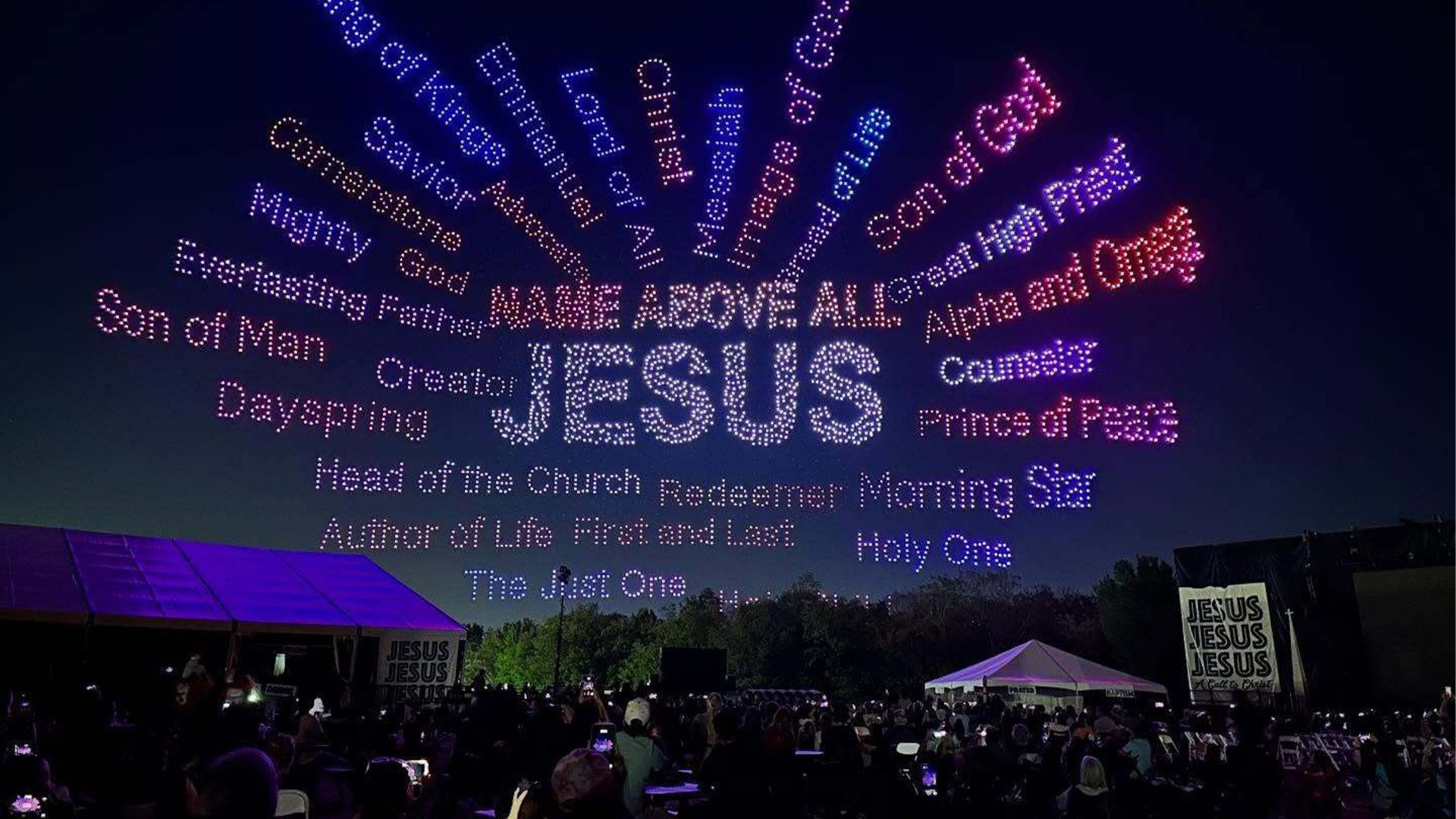
People attend the Easter drone show at The Church on Masters Road in Manvel, Texas.

People attend an Easter drone show at The Church on Masters Road in Manvel, Texas.

Christianity Today April 2, 2026
Dan Davis / Facebook / Courtesy of Megan Fowler

As Americans open their wallets to spend a projected $24.9 billion on Easter this year, some churches are thinking beyond Easter eggs and Passion plays, budgeting for helicopter rentals, skydiving Easter bunnies, and record-setting drone shows.

Many churches see Holy Week as an opportunity for community outreach, in some cases the bigger the better. Church leaders say they hope the spring-themed fun will serve the community, glorify God, and attract new Easter-weekend visitors to worship.

Compass Church in Monterey County, California, hosted its Easter egg drop at a local sports complex on March 28. A helicopter dropped 100,000 eggs on Rabobank Stadium in two separate egg drops, and the event also included a skydiving Easter bunny.

At Cultivate Church in Alabaster, Alabama, leaders expect their April 4 Easter outreach event to draw around 20,000 people. A helicopter will drop 20,000 eggs in three cycles for children of various ages while church members grill thousands of hot dogs to give away. They’ll also provide bounce houses for children. The event is scheduled the day after Cultivate Church holds a Good Friday night of worship.

Cultivate Church’s senior pastor, Brandon Matthews, told Christianity Today that the church began the community Easter egg drops in 2012, when it first launched.

Though the COVID-19 pandemic and occasional bad weather have forced the church to cancel the event, he says the community looks forward to it every year. “We do this to let the community know we want something for them, not something from them,” he told CT.

Though Matthews would love for unchurched attendees to find their way to Cultivate, he said the goal is ultimately for them to attend any church on Easter and beyond.

The River Community Church in Cookeville, Tennessee, will be the site of another big event: an Easter drone show sponsored by the local Christian radio station, 107.7 Grace FM. The church’s property includes a 100-plus-foot white cross visible from nearby Interstate 40, and on Good Friday, hundreds of illuminated drones will soar above the cross, creating a visual display that tells the story of the Resurrection. Viewers can tune in to Grace FM to hear narration accompanying the lights. The event will conclude with a fireworks display.

In a message on Facebook, Steve Tiebout, lead pastor of The River Community Church, said over 20 area churches had joined together to put on the event. He urged congregants to invite unchurched friends to join in watching the drone show and to tell them about God’s work.

“Bring people that never go to church. This will be something they’ll want to see, and then you can have those conversations afterward to share with them what Christ has done in your life,” he said.

In Manvel, Texas, The Church on MastersRoad has led a coalition of churches in putting on another drone light show telling the Easter story. Beginning on March 27, the nightly gatherings have drawn between 6,000 and 10,000 people per day and feature a rotation of worship leaders and speakers. The evening ends with a narrated drone display telling the story of each day in Holy Week. Each night’s show is bigger, starting with 5,000 drones. By Easter evening, the display will have 10,000 drones.

Manvel mayor Dan Davis announced on Facebook that the drone show broke the record for the largest drone show in North America. Jason Lee, pastor of The Church on MastersRoad, said the event is not about promoting specific churches. Ministers from 30 churches and about 300 volunteers are on hand each night, but visitors will not see a sign for any one congregation even though the event takes place in a field adjacent to four churches.

Lee said getting visitors to attend The Church on MastersRoad is “not even an objective” of the event. He said if visitors want to learn more about local churches, they can scan a QR code to find a church list.

“It’s not about the church and making one church more important than other churches,” Lee said. “We want to make it about Jesus and getting people excited about the Easter season and going to church somewhere.”

Lee challenged church members to rack up 10,000 cumulative miles of walking on the field to pray for the event. One lap around the perimeter of the property is about one mile, and as of March 31, participants had walked 4,500 miles, he said. Visitors could also stop by the testimony tent to record stories of God’s faithfulness in their lives.

“We defeat the enemy by the blood of the Lamb and the word of the testimony,” Lee said in a video posted to Facebook.

Matthews of Cultivate Church said when the community sees the congregation serving its neighbors, it makes those neighbors curious about church.

“We have found these events make it attractive for people to want to know more,” he said. “As long as we are pointing them to Jesus when they want to know more, then we see life change out of it.”

Culture

The Evangelical Roots of North Korea’s Kim Family

Q&A with Jonathan Cheng on how the Christian gospel can be twisted for political aims.
Christianity Today April 2, 2026
Illustration by Rick Szuecs / Source images: Catherine Field / Eric Lafforgue / Art in All of Us / Getty


Last month, North Korean president Kim Jong-Un said in a speech that the war in Iran highlights his country’s need to continue its nuclear program to protect against potential American threats. Christians living in this Communist country daily encounter their nation’s aggressive defense of its sovereignty on all fronts: geopolitical, ideological, and religious. To better understand North Korea’s commanding presence over its people and its posture toward the rest of the world, The Bulletin‘s Mike Cosper sat down with Jonathan Cheng, China bureau chief at The Wall Street Journal and author of Korean Messiah: Kim Il Sung and the Christian Roots of North Korea’s Personality Cult. Here are edited excerpts from episode 262.

What did the emergence of evangelical Christianity look like in North Korea and in the Kim family?

When Kim Il-Sung, the founder of North Korea, and his family first encountered the faith over 100 years ago, it was brand new in Korea. It was almost like the Book of Acts: There wasn’t even a fully translated Scripture that they could turn to. The Bible was being translated as they were encountering the faith, so there were deviations from orthodoxy because they were bringing their own context and traditional Korean folk religions. 
The Koreans were really taken by Christianity. It was revolutionary. At that time, Korea was loosely divided into northern Korea and southern Korea. The official division of Korea into North and South came after World War II. In 1948, the capital of South Korea was Seoul, but the capital of Christianity was in the North in Pyongyang. 

Early missionaries were northern Presbyterians primarily, but also Methodists. They arrived in Seoul—but didn’t succeed—in the late 1880s. Missionaries in Pusan (now Busan) at the very south of the Korean Peninsula had even less success.

But then one missionary, Samuel Austin Moffett from Indiana, arrived in Korea at age 26 in January 1890. He headed to Pyongyang, and before long, he found that he couldn’t keep the inquirers away. Koreans were queuing out his door to hear the gospel Moffett was preaching. It got to the point where he didn’t have time to eat or to sleep. This is how Pyongyang became the center of Christendom in the East. It was so Christian it was known as the Jerusalem of the East. Pyongyang had the largest Presbyterian seminary in the world and this vast missionary compound with high schools, hospitals, and seminaries. Billy Graham’s wife, Ruth Bell Graham, went to high school there.

By the time Kim Il-Sung was born in 1912, the Christian missionaries and the Christian gospel had been in Pyongyang for about two decades. His grandfather had constructed a Christian missionary school attached to a church in the village where Kim Il-Sung grew up. His parents were both very devout—his father a Christian teacher, and his mother what they called a “Bible woman,” effectively equivalent to a deacon. She would go around to the villages with Bibles and talk to other women, spreading the gospel.

Though Kim Il-Sung followed his parents to church, he claimed in his memoirs after he became the supreme leader of North Korea that he didn’t find it particularly interesting. He said he went because the pastors would give away pencils, notebooks, candy, and other things. He would fall asleep in the pews. He even claimed that his dad was an atheist and that his mother went to church only because she was so tired from her workweek that she needed somewhere to rest on Sunday morning, and a pew provided a place to sleep. However, all evidence points to the contrary. 

I think he deeply absorbed the power of the Christian message and saw the power and respect American missionaries commanded at the pulpit. He also recognized the power of faith in perhaps a more nefarious sense: to inspire but also to control. 

Kim Il-Sung became the leader of North Korea at the end of World War II. Joseph Stalin and the Red Army of the Soviets took North Korea, stopping at what is now the 38th parallel. The Soviets backed Kim Il-Sung for various reasons, and the Americans came and took the southern half of the peninsula. 

How did this personality cult evolve around the family that is now running the country?

Kim Il-Sung ruled North Korea for almost half a century. Stalin and Hitler were at the peak of their powers for a fraction of that time. Stalin attended one year of seminary, and he built his cult of personality and helped Kim Il-Sung do the same. From the very beginning, it was, in many respects, a classic Soviet bloc cult to personality. In the early years in North Korea, you would frequently see their portraits hanging side by side. 

Very quickly, though, Kim surpassed Stalin. The first statues were erected in North Korea for Kim Il-Sung in 1948. Today, there are thousands of them. Very early on, he was deliberate about making sure the education system was built around him. History was rewritten for him. Poems, songs, and hymns were written for him. He instilled in his people what you and I might call a faith in this 30-something-year-old Korean messiah. 

The difference with the USSR and Communist China was that, after Mao’s and Stalin’s deaths, successors said they shouldn’t have allowed that to happen, and the statues came down. Kim Il-Sung was challenged, but he was never taken down. Stalingrad was renamed, but that sort of thing never happened in North Korea. 

Not only did Il-Sung last for almost half a century as the leader; he was able to designate his son as the successor, Kim Jong-Il. Then Kim Jong-Il designated his son, Kim Jong-Un, the current leader, as his successor. 

Three generations of Kims is completely antithetical to orthodox socialism or communism. You never saw Stalin or Mao try to cultivate his son. Eighty years into this cult of personality, it’s only continued to grow. There was never a period where they decided they’d gone too far and ought to dial it back a little bit. Never has there been a period in which, like with China over the last 20 or 30 years, you saw more interaction between the country and the rest of the world.

What is it about North Korea—whether it’s the governance or the culture—that allows it to pull this off so completely? 

Often, you hear Koreans say that the Korean people don’t do things by halves. You hear colloquially that the Koreans were, in some ways, more soviet than the Soviets, more Communist than the Communists were. They were more capitalist than the capitalists were. So when they embraced Christianity, it was to a degree that just floored the missionaries.

Many times in early missionary literature, you find missionaries exclaiming, We thought we were coming to Korea to spread the gospel. I did not realize I would find my faith challenged here. Their fervency puts me to shame. I can’t stand next to these people that I’m supposedly here to minister to. They’re ministering to me! 

Many of the Christians from the North fled to South Korea, and South Korea is now the second-largest missionary-sending nation in the world. It has one-seventh the population of the US. The biggest megachurch in the world today is in South Korea. Those who embraced Christianity weren’t lukewarm. These Christians were there for Sunday-morning worship, for Wednesday-evening prayer meeting, for spreading the gospel, for itinerating through the countryside distributing tracts. They were all in.

When Kim Il-Sung rose to power, he understood that if you get people’s hearts and souls, you have them completely. You could call it a grotesque insight, but I think that’s what he knew intuitively. He never articulated this, but I think that’s at work here. On a certain level, he took the Trinity and sort of replaced it. He said, What if I’m the father? What if my son is the Son? What if my ideology is the Holy Spirit? He set himself up successfully as a Korean messiah. 

How did the transition take place from a country shaped by the evangelical world to a nation of personality cult?

Kim Il-Sung was able to redirect the passions of some of his subjects. While many Christians fled to the South, of those that remained, some were more conservative and some more left leaning. He was setting up a socialist state, and there has been, throughout socialism’s history, a strain of Christian socialism that persists to this day. It’s usually not been the mainstream, but there is a strong current there that traces itself to the Book of Acts, where the disciples shared everything together. Christian socialists interpret that as a socialist Jesus. 

As Kim Il-Sung set up his nascent state, he tapped into this and recruited enough pastors to his cause. For example, his distant uncle was a conservative, revivalist pastor. Kim Il-Sung brought him on board, and this Reverend Kang became his ambassador to the Christians. He introduced Kim Il-Sung as a Moses who would lead North Korea to the Promised Land. Kim Il-Sung said he’d bring justice and equality. That’s the socialist promise, but that’s also an ideal that many Christian socialists have had for centuries.

Life today in North Korea is miserable because of this corrupt regime. It’s heart-wrenching to learn that this comes from a certain kind of Christian framing.

This evangelical history is so incongruous with the image of North Korea that we have today. I made two trips there in 2013 and 2017. You see people bowing before the statues, the portraits of the great leader everywhere. You see North Koreans memorizing his scripture and singing his praises. There are so many of these echoes of faith that you see in North Korea—the religiosity and the construction of an all-consuming kind of religious society. It’s unmistakable where this all comes from.

When you come to research like this, you pinch yourself. Sometimes it’s hard to believe. Billy Graham visited Kim Il-Sung twice, in 1992 and 1994, and he was stunned at how Christian it felt in so many ways, even though he knew on so many other levels it was the antithesis of everything that he stood for. When Graham visited Pyongyang, the North Koreans took him to Kim Il-Sung’s birthplace. It’s this little thatched hut on the edge of the city. Billy Graham turned to one of his companions and said, All they’re missing are the manger and the three wise men.

A Renewed Subscription and a Broadened Perspective

How one Texan lawyer found himself reading CT again and supporting the One Kingdom Campaign.

man being interviewed
Scott Ball

In 2017, Brent Perry received a message from a friend with a link to a Christianity Today article, an open door welcoming Brent back to CT after several years away. Brent had ended his CT subscription, as well as all other subscriptions, around 2010. Online news had become more accessible, and he wanted to focus his time on reading more books. Now he found himself reading CT again online weekly. 

“It was a thoughtful reflection on current events from a Christian perspective,” Brent recalled as he considered what had kept him reading CT after his friend’s message. “[It] would make some points or give me a perspective that I didn’t have.” The thoughtful reflection and different perspectives Brent found in CT became increasingly important to him as he—and the rest of the world—dealt with the COVID-19 pandemic and the deepening of political divides. 

Many of the difficulties Brent faced at the beginning of the pandemic seemed to be taking place within the walls of the church his family was attending at the time. “The church wasn’t really much of a refuge at that point,” he said as he described helping a friend in a difficult position while the rest of his church seemed to complain and bicker and spread misleading information about the situation. 

He found in CT examples of reasonable people dealing with similar things. “Having a place to read about what pastors were going through during that time and the stresses of it helped me understand what I was dealing with better,” he said. “To be outside of [my own church’s situation] a little bit was helpful. … CT became a reliable place to read about what’s happening in the Christian community.” 

Outside the church walls, Brent dealt with divisive litigation as a lawyer and watched his law partner suffer from COVID-19 early in 2021, for weeks in the hospital on the brink of death. Not only was CT a hub of information and reflection on current events, it was also an encouragement. “You need some positive input in your life, some way to get away and think,” Brent added after explaining that CT was a place he could center himself. 

Brent also found early in his consistent reading that CT was working to further God’s kingdom by sharing about the broader church. “The One Kingdom Campaign is really trying to enlighten us on what’s going on around the world and remind us that the Church is a lot bigger than what we perceive it,” he said. Because of this, Brent and his wife, Carole, decided to start supporting CT: “I thought I ought to contribute some to [CT] because [CT] was trying to further the kingdom.” 

“Most of what we experience with the kingdom is through our local church,” he said. Having seen such divisiveness in the church in the past, it was helpful for Brent to read CT and get “a bigger picture than just what you’re dealing with on a weekly basis.” He said, “[Reading CT] helps keep you focused on the kingdom instead of on the turmoil. This is a global faith, and I’ve let the American lens kind of create turmoil for me.”

Brent was encouraged to read about the Church globally and see examples of good things happening elsewhere, like the growth of the Church in Africa. It was also helpful for him to read about the global Church for the sake of things closer to home. 

Brent teaches a class at his church for parents of teenagers who represent different nationalities, many of whom are immigrants. In the group is a Hungarian chemistry professor, a couple from Mexico, a Russian–Ukrainian couple, an Ethiopian immigrant, an Indian couple, and a Nigerian nurse who’s a single mom to triplets. Because he works with this group, Brent intentionally reads broadly and pays attention to what’s happening in their home countries. “It’s really affecting them,” he said. “It’s affecting their families.” CT’s global reporting has helped Brent connect with the people in his church from different places. 

Similarly, CT’s reporting has aided Brent in his work. In reference to Andy Olsen’s “An American Deportation” and his own work with a Latino congregation on a governance dispute, Brent said, “Articles like this one give me a real sensitivity to the issues these churches face. [The Latino congregation] want me to speak calmly about their members’ fears of a government that many of them voted for less than two years ago.”

CT’s content has also helped Brent and the parents he teaches connect with people from a different generation: their own kids. As a parent, Brent has been encouraged by the work of Jonathan Haidt, author of The Anxious Generation. Haidt has been a guest a few times on CT’s podcast The Russell Moore Show, and Brent has shared what he’s learned with the parents in his class. “Everybody is just so concerned about ‘What are we going to do so we don’t screw up with our kids?’” he said. But Brent added that what he’s learned from Haidt “has given [him] the courage to encourage [the parents] to loosen their reins and trust God a little bit more with their kids.”

“I really appreciate the broad range of people that [Russell Moore] interviews … the breadth of voices that he brings to speak to the Christian community,” Brent shared when discussing The Russell Moore Show. In so much of CT’s content—across podcasts and the magazine—Brent has found a place that broadens his perspective through a variety of high-quality contributors and content. He said, “CT encourages us, all of us, to think and participate and give more broadly than we otherwise would.” 

“CT helps define [evangelicalism], but it also keeps us informed of all the currents within it and where God is acting around the world,” Brent said about CT’s role in the broader church. “Evangelical Christianity needs [a voice], and [CT] is becoming a more important voice by the work it’s doing now, at a time when it’s really needed.” 

Almost ten years into his renewed subscription, Brent’s go-to reading materials for flights now include CT’s print magazine: “If I’m going on a trip where I don’t want to work on the plane, I pick up the magazine and read it almost from cover to cover.”

Theology

Easter Is Not a Zombie Story

Columnist

Jesus joined us in death—and defeated it.

An image of Jesus coming out of the tomb.
Christianity Today April 1, 2026
Illustration by Christianity Today / Source Image: WikiMedia Commons

This piece was adapted from Russell Moore’s newsletter. Subscribe here.

Most unbelievers are civil or even curious when we talk together about the Christian faith, with less than a handful of exceptions. One of those was on a university campus when a man said, “The 21st century is not the time for a zombie story, and that’s what Easter is.” His jab was that, by believing a previously dead man is now alive, we worship a reanimated corpse. “Ah,” I said. “The 21st century is a zombie story, and that’s what Easter undoes.”

My questioner was not stupid. He was right, of course, that we expect dead things to stay dead. That was true in the first century too. And he was right that we have an uncanny dread when we hear stories of things that are supposed to be dead but don’t stay that way. That was also true in the first century.

Even before his death, Jesus had to reassure his own followers that he was not an apparition. When the disciples saw his figure walking on the sea, “they thought it was a ghost, and cried out, for they all saw him and were terrified” (Mark 6:49–50, ESV throughout). When he appeared after the Resurrection, the disciples were again “frightened and thought they saw a spirit,” to which Jesus replied, “See my hands and my feet, that it is I myself. Touch me, and see. For a spirit does not have flesh and bones as you see that I have” (Luke 24:37–39).

A zombie is kind of a ghost in reverse: A ghost is a soul disconnected from a body, and a zombie is a body disconnected from its soul. Both ideas are rooted in our fear of death and of the mysteries of what’s beyond. Ghost stories are usually about some sort of unresolved business—a grievance unavenged or a love unrequited. The concept of presence without embodiment is scary to us. Zombie stories are about corpses that are essentially just meat animated by appetite. There are bodies but no reason or imagination or love, just craving.

Zombies and ghosts are stories we tell about two sides of the same dilemma. Even those who do not recognize the authority of the Bible can see some truth in the ancient account that “the Lord God formed the man of dust from the ground and breathed into his nostrils the breath of life, and the man became a living creature” (Gen. 2:7). We intuitively know that we are made of the same matter that’s in the cosmos around us. At the same time, we can reflect on that reality with a consciousness that transcends our biological makeup.

As Walker Percy wrote a half century ago, we feel sundered from ourselves because we seem to be neither organisms reacting to an environment nor intelligences standing apart from it. So we try to resolve the tension by thinking we are either merely animals, spurred on by conditioning or instinct or repressed sexual urges, or angels, potential gods who can transcend human limits. Our attempt to be all one or the other leads us to be neither: History has shown repeatedly that the refusal to be a creature turns a person into a monster.

And so here we are, over a quarter of the way through the 21st century, and we seem to have the worst of both stories.

We move like ghosts in this digital world—connected but disembodied, present but lonely. Many of us do not know our friends or acquaintances. We merely haunt them, lurking over their Instagram photos or their posts on X.

At the same, we feel like zombies. Our biological appetites are intact, but they are tossed to and fro by algorithms that tap into our limbic responses. Pornography can give the sensation of sexuality without intimacy. Online gambling can give the rush of earning without working. Even shopping can feel like the serendipity of finding exactly what you’ve been wanting—until you realize companies have only made it seem that way.

And what is the end result? Many people feel dead inside, hollowed out. When that gets intolerable, we have ways to try to go all in and become wholly ghosts or zombies. We can get addicted to drugs that speed us up or numb us down. We can become occultists seeking spiritual escape from the world or materialists trying to merge with it. And none of it works. That’s because the forces that offer solutions are the same ones driving the problems.

Zombies, after all, are devoid of reason or reasonableness, imagination or imaginativeness. All that moves them is what they want. And what they want is to feed off the life of others, to bite and devour what they cannot experience. And they are easy to command. All one must do is to find out what they want and drive them toward more of it, making sure there’s never enough.

The Bible actually has a zombie story, or at least a preemptive attack on one. The Serpent of Genesis 3 appeals to both aspects of the human makeup: zombie and ghost. We can act like animals, driven by appetite: “The woman saw that the tree was good for food, and that it was a delight to the eyes, and that the tree was to be desired to make one wise” (v. 6). We can act like gods, free from the created limits of morality (“Did God actually say?” v. 1) or mortality (“You will not surely die,” v. 4). The aftermath the account describes is one of disconnection—from each other, from God, from the world around us, even from our own bodies.

Fallen humanity was then driven from the garden. What most of us do not think about, though, is why:

Then the Lord God said, “Behold, the man has become like one of us in knowing good and evil. Now, lest he reach out his hand and take also of the tree of life and eat, and live forever”—therefore the Lord God sent him out from the garden of Eden to work the ground from which he was taken. He drove out the man, and at the east of the garden of Eden he placed the cherubim and a flaming sword that turned every way to guard the way to the tree of life. (vv. 22–24)

To leave a dying people with access to ongoing life would be leave them in a zombie existence that we can perhaps best describe as hell. Exile from the garden was judgment, yes, but it was also grace.

In the Gospels, the tomb of Jesus is described as being in a garden (John 20:15). Angelic beings are there, but the swordsmen—soldiers Pilate hired to guard the grave—fled the scene. Clothes are shed and folded in the crypt. Jesus approaches a weeping woman and calls her by name. And he tells her to “go to my brothers and say to them, ‘I am ascending to my Father and your Father, to my God and your God’” (v. 17).

In the resurrected Jesus, everything that was pulled apart now holds together—dust and breath, matter and spirit, heaven and earth, humans and God. The curse of death has ended. The covenant promises hold true. And Jesus’ message goes to the very ones who broke from him and fled at the arrest. He is “the firstborn from the dead” (Col. 1:18), whom we cannot follow now but will later.

And follow him where? As a pioneer, he is leading us into the very presence of God. All things are put back together there. And the Tree of Life is there (Rev. 22:2), unguarded and unharmed. It’s with a people who can eat of it, not as mere animals and not in limitless autonomy but as those who can say, “Behold, the dwelling place of God is with man. He will dwell with them, and they will be his people, and God himself will be with them as their God” (21:3).

Jesus is no ghost—and he is no zombie. He’s a living man standing in the presence of God, and his life flows backward to us. We feel the first twitches of life, just enough to make us want to join him where he is. He joined us in our human nature and reconnected it to God. He joined us in our curse and undid it. And he joined us in the sentence of death and reversed it. We hide in the bushes, trembling in shame, when we sense the presence of God. He steps forward and says, “Here am I, and the children God has given me” (Heb. 2:13, NIV).

Easter is no zombie story. It’s the end of one.

Russell Moore is editor at large and columnist at Christianity Today as well as host of the weekly podcast The Russell Moore Show from CT Media.

History

What $18 Would Get You

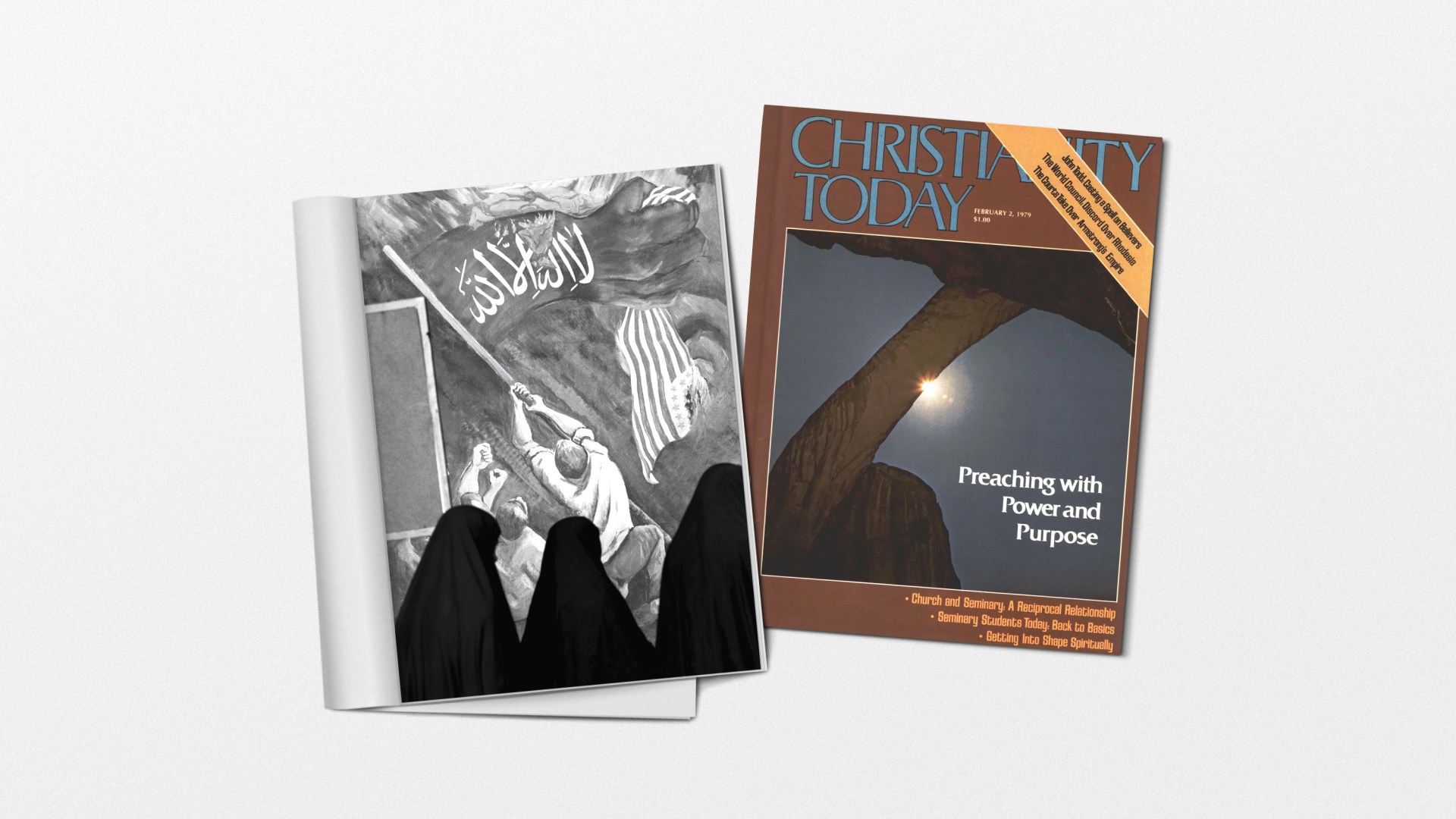
In 1979, CT investigated deceptive Christians, made the case for psychology, and watched Islam with concern.

An image of Iran and a CT magazine cover.
Christianity Today April 1, 2026
Illustration by Christianity Today / Source Images: Getty, CT Archives

CT made the tough decision to hike subscription prices in 1979. The cost of 22 issues per year increased from $15 to $18. 

We’ve all been hit by inflation—25 per cent since 1975. But in that same period, the printing and paper costs for putting out Christianity Today have increased even faster. Postage has gone up an incredible 120 per cent! That’s a per unit cost; it has nothing to do with our circulation growth.

But the worst is yet to come. The post office has decided to greatly increase nonprofit publications’ rates. Talk about planned inflation. In the next three years alone, postage (second class) for mailing the magazine will increase another 160 per cent and for promotional mailings (third class postage) 190 per cent! The figures are so large one feels like rubbing one’s eyes or tossing the papers skyward.

The magazine also put more resources into investigations of conservative Christians. CT reported on ongoing questions about televangelist Jim Bakker’s financial management of PTL (Praise the Lord) Network. CT dug deep into the twisty stories of traveling minister John Todd, who said before he was saved that he was a Grand Druid high priest in the Illuminati. CT found his account didn’t match the facts, and the facts suggested he couldn’t be trusted.

Todd pleaded guilty to contributing to the unruliness of a minor and served two months of a six-month sentence in a county institution.

Todd’s police record shows that a felony warrant was issued against him in New Mexico for passing a bad check. He was arrested in Columbus in 1968 for malicious destruction of property. He was treated for drug overdose at an army installation in Maryland in 1969. A warrant for his arrest awaits him in Ohio, as does a judgment against him for $22,000 in a defamation case. 

Todd claims many of the police are associated with Freemasonry, an Illuminati organization, and therefore should be considered enemies. … 

Todd was given psychiatric examinations twice while in the army. His records indicate evidence of an unstable home background and possible brain damage as a result of beatings. The second examination a few months later labeled his malady “emotional instability with pseudologica phantastica.” Todd finds it difficult to tell reality from fantasy, says a medical report.

Editor in chief Kenneth Kantzer said it was “embarrassing” to have to report on such things, but  necessary as part of  CT’s mission to serve the church.

Several Christian leaders who travel the nation … tell us that Todd is the most talked-about topic of these days. Letters continually land on editorial desks, asking in effect, “Is what John Todd is saying true?” 

No, it is not. …

We can learn too from the response to Todd. Some of us are altogether too gullible—too quick to believe negative reports about those with whom we disagree, and not quick enough to believe substantiated negative reports about people who tell us what we were already inclined to accept. Many unscrupulous individuals take advantage of gullible Christians who would not be duped by a Jim Jones, but then give credence to the claims of a John Todd.

The magazine also profiled several prominent Christian leaders who would go on to shape American evangelicalism in the 1980s, including Francis Schaeffer. CT introduced many readers to James Dobson, reporting his decision to prioritize time with his children.

Men should give their families first priority, said James Dobson last month at the Roman Catholic Religious Education Congress in Anaheim, California. “If the family is going to survive,” he challenged the males in his audience, “it will be because husbands and fathers again begin to assume the lead in the family.”

That being said, the noted pediatrician revealed that he would be taking his own advice. Dobson, who has been making public appearances for the last fifteen years, said this would be his last speaking engagement. He wanted to spend more time with his 10-year-old son and 13-year-old daughter.

On the staff of the University of Southern California School of Medicine and author of such child-rearing books as Dare to Discipline and The Strong-Willed Child, Dobson cited a Cornell University study showing that fathers of preschool children on the average spend 37.7 seconds per day in real contact with their youngsters. In contrast, the study indicated that children watch television approximately fifty-four hours per week.

CT encouraged readers to be open to Christian psychologists, such as Dobson, and listen to their professional advice, as long as Scripture informed it.

Just as truth about God’s created universe may come through natural sciences like medicine, or physics, or philosophical logic, or the insights of students in the humanities, so can truth come by way of psychology, psychiatry, and other social sciences. 

There is, of course, much within psychology that the Christian cannot accept. Some psychological conclusions about man’s nature, for example, some techniques used by professional counselors, and some proposals for altering our future are clearly contrary to Christian ethics and the teaching of Scripture. If we test our psychological conclusions empirically, logically, and against the inspired Word of God, however, we will discover that the psychological sciences contain much of practical value to the Christian seeking to serve Christ both inside and outside the church.

CT tackled marriage-and-family issues facing Christians in 1979, including dealing with singleness, divorce, and second marriages. A counselor wrote about pastoral care for divorced Christians struggling to follow biblical teachings about sex outside of marriage in “Sex and Singleness the Second Time Around.” 

Based on 203 participants (146 women and 57 men), only 9 percent of the men and 27 percent of the women were celibate, although many noted the intimacy had been with only one partner and/or in a “serious” relationship. It is worth noting that 67 percent of the men and 58 percent of the women reported a conflict between their faith and sexual experiences. …. 

The absence of clear, precise teaching frustrates most formerly married Christians. The large numbers of undisciplined Christians and the misuse of Scripture (by foes and advocates alike) fuels the debate between unbelieving realists and unrealistic believers.

If Paul did not flinch in addressing the behavior and attitudes toward sex, why are we so timid?

The magazine also reported a government study on the ethics of in vitro fertilization and research on “test tube babies.” 

Since 1975, the government has banned any new grants for in vitro fertilization research because of the ethical and moral questions involved. … Some observers fear Huxleyan possibilities: manipulation of the reproduction process that would include surrogate mothers for hire. Prolife groups condemn in vitro fertilization as abortion, since fertilized eggs are often discarded in the experimentation process that leads to a successful pregnancy.

With these arguments in mind, the board suggested safeguards for in vitro research: that in vitro fertilization be made available only to married couples who volunteer (scientists promote in vitro fertilization as a means of enabling women with blocked fallopian tubes to have children); that research be funded only if it provides important information that otherwise cannot be obtained; and that research be limited to human embryos in their first fourteen days of development after fertilization—the period before implantation. The ethics board noted that in light of limited government funds more pressing health matters might take precedence over in vitro fertilization research.

Evangelicals were worried about Islam in 1979. CT asked a professor of Islam and world religions to write about the “renaissance of the Muslim spirit.”

The subject is of considerable importance to both the world and the church. Economically, the world is virtually dependent on Arab oil. Politically, many of the world’s trouble spots are Muslim areas: Iran, the Middle East, and much of sub-Saharan Africa. Religiously, Muslims represent one of the great unreached peoples for Christian missions. Certainly, for the church of God, the world’s 700–800 million Muslims are one of the greatest challenges with which it must deal. Let us therefore try to catch a glimpse of the main developments of the fourteenth Islamic century, and their implications for Muslims today. 

The last hundred years of Islamic experience have been the most startling and decisive ones since the religion’s founding. … A powerful mix of internal and external stimuli have brought about this Muslim revival. Granting that the influence of these factors is complex, I would like to suggest three major ones: (1) the influence of modern education, (2) the recovery of economic and political power, and (3) the pressure of Muslim laity for social reform. …. 

It is the task of the church in the days ahead to achieve such a relation with Muslims and to communicate well his powerful message of love. 

An old Arab proverb says: “What comes from the lips reaches the lips; what comes from the heart reaches the heart.” I hope that Christians in the coming century will be able to convey, from their heart to the Muslim heart, God’s message for all people everywhere, in every condition.

The collapse of the government of Iran and success of a radical Muslim revolution grabbed headlines. CT checked in with Christian leaders and missionaries with long experience in the Persian Gulf

Syngman Rhee, missions official in the U.S. office of the United Presbyterian Church, said his denomination had no plans to evacuate its dozen U.S. personnel from Iran. Henry Turlington, a Southern Baptist who pastors an English-speaking church in Teheran, had sent word to his home office that he and his wife would stay. Other Southern Baptist couples, who were outside Iran during the worst of the violence early last month, were advised not to return. 

No Western missionaries had been physically harmed. (An American oil executive was killed in Ahwaz in late December, however.) For the most part, anti-American reaction surfaced in “Yankee Go Home” graffiti on city walls, telephone threats, and letters of warning. But it was enough to send packing 20,000 of 41,000 Americans living in Iran, with more waiting to depart.

Anti-American, rather than anti-Christian sentiments, were behind most problems facing U.S.-based missions agencies and U.S. missionaries. “Although there has been a feeling of anti-Americanism expressed in various ways,” said Rhee in a news release, “there have not been any specific feelings expressed against the church or the presence of missionaries.”

Like many international observers, CT did not know what to expect from the new regime.

The role of religion in the overthrow of the Shah and the perhaps temporary rise of Ruhollah Khomeini is of particular interest to Christians. Our feelings are mixed. On the one hand it is good to see that belief in the transcendent is still very influential in human affairs. On the other hand, ideologically-based governments (whether rooted in a traditional religion or in communist faith) have been notoriously hostile to evangelistic ministries and even to the proper range of shepherding ministries for believers. The fact is that the record of predominantly secular governments, such as most of those in the Western world, is notably better than that of governments that have a close link with some Christian or non-Christian faith. … 

Whether the successor to the Shah’s government in the long run proves less corrupt, less given to torture, less restrictive of certain personal and political liberties remains to be seen. As Christians concerned about freedom to evangelize and to shepherd the relatively few disciples of Christ in that overwhelming Muslim land, we certainly hope so.

At the end of the year, Iranians took 66 Americans hostage at the US embassy in Tehran. The crisis lasted 444 days and became a major issue in the 1980 presidential election.

CT failed to comment on President Jimmy Carter’s big address on what he called a national spiritual and moral crisis. (Critics called it the “malaise speech”). At the end of 1979, though, CT expressed general disappointment in his presidency

Candidate Jimmy Carter, who publicly identified himself as an evangelical, won the nation’s highest office. He was the first evangelical in this century to do so. Yet thus far, to some observers, Carter has failed to demonstrate any significant Christian influence on the federal administration, in spite of his noble-minded human rights campaign and unquestioned personal integrity. The disillusionment of many over the President’s performance has cast a shadow on evangelical hopes of influencing American life from the top down.

While evangelicalism was thus failing to win the leadership of America’s political institutions, despite its momentary appearance of success, America’s political machinery was beginning to make definite challenges to evangelicals and their religious institutions. Indeed, the new evangelical involvement in politics sometimes furnishes the pretext for an expanded governmental interference with religion and the churches. 

Theology

The Eternal Meaning of the Cup

Across the church, our Communion practices reveal a broken world and anticipate the one to come.

Still Life With Grapes by Edith White.

Still Life With Grapes by Edith White.

Christianity Today April 1, 2026
WikiMedia Commons / Edits by CT

Communion, also known as the Eucharist and the Lord’s Supper, is the most central Christian sacrament, yet it is celebrated quite differently in our churches. Setting aside theological debates about its meaning and the matter of frequency, we might examine the different beverages we consume: Some of our church traditions use wine, and others use grape juice (or a nonalcoholic wine).

Rather than seeking uniformity in practice, let’s more deeply reflect on this difference. If Communion is significant to the Sunday gathering, what is a good theological framework that accounts for the diversity in our common practice?

The presence or absence of wine in Communion does not simply reflect a church’s attitudes to drinking alcohol generally. Instead, I find it more helpful to think about this difference in terms of eschatology (or the “end times”). When Jesus instituted the Lord’s Supper, he did so by directly linking it to a time of feasting in the coming kingdom when he will drink wine anew (Matt. 26:29; Luke 22:15–16, 18). If Communion is a foretaste of that future messianic banquet, then it is like an appetizer before the main course arrives.

Communion, as a present experience of the future banquet, occurs in a context mired with sin, evil, and death. Although the coming feast will celebrate the end of those things, the Lord’s Supper is a practice that communicates the tension between the two ages—what theologians call “inaugurated eschatology,” or “the already and the not yet.” The messianic banquet is already experienced in the present, but the celebration is not yet in full swing.

In this sense, both wine and grape juice are important aspects of our common practice as Christians, because together, in their discrete ways, they are witnesses to the promised banquet to come. When some traditions use wine in Communion, they are participating in the foretaste of the wine stored away for us all when God restores all things (Isa. 25:6; Amos 9:13–14; Joel 3:18). To do this is to lean into the “already” of the banquet.

When other traditions use grape juice, by contrast, they are saving up their appetites. They are compelled by the “not yet” of the banquet as reflected in the enduring brokenness of our world. Things are not as they should be (and will be), and so the forces of corruption continue to drag us toward death by way of addiction, abuse, and alcoholism.

Through this lens, one of these Christian practices is not better than the other, since the kingdom is both here and not yet fully here. Indeed, both practices together can offer us a balanced perspective so that we don’t mistakenly err on one side or the other. In both practices, we can see elements of celebration and lament when we come to the table amid our broken world and in anticipation of the one to come.

A dual posture toward the kingdom’s presence and absence is even mirrored in the diets of Jesus and John the Baptist. The crowds perceived both to be approaching food and drink inappropriately. They thought John was demon-possessed because he didn’t eat and drink like Jesus, but they also thought Jesus overdid it and so called him a glutton and a drunkard (Matt. 11:18–19; Luke 7:33–35).

Yet Jesus doesn’t say that his way was better than John’s. Instead, he says, “Wisdom is proved right by her deeds” (Matt. 11:19). In other words, there is wisdom in both approaches, and what demonstrates the wisdom of their respective approaches, even though they’re not identical, is the results that come from them (the “deeds,” or “children” in Luke). Both can be legitimate positions to hold with respect to alcohol.

But the wisdom of abstinence and the wisdom of moderation are not an inherent given. Both can be folly, if folly results from their approach. In context, these two positions also suggest an attitude toward the future messianic kingdom. John the Baptist abstained because the kingdom was near; Jesus feasted because the kingdom was here. They demonstrate the already-and-not-yet tension.

Although John the Baptist is not divine, the diverging choices of John and Jesus suggest that we should expect and allow for a similar diversity of expression when it comes to wine consumption in the light of the kingdom’s simultaneous presence and absence. And so, why wouldn’t that also apply to the use of wine in the Christian ritual that calls for it?

Some might protest that we should all try to imitate the earliest Christian practice, but the problem is that just about every contemporary Communion cup contains something very different from the earliest ones that Christians passed around.

Neither of our Communion practices precisely replicates the earliest Christian practices, because “grape juice” could only be made once a year at harvest in late summer and it would ferment very quickly. Nor was ancient Communion wine like the fortified wines deployed today by traditions that practice a common cup, because distilling spirits hadn’t been developed yet. In other words, we must acknowledge that our Communion practices do not precisely replicate the past (for more on the historical development of wine, see Paul Lukacs, Inventing Wine; Patrick McGovern, Ancient Wine; Hugh Johnson, The Story of Wine).

Wine was the primary Communion practice until pasteurization was invented in the 19th century, but even so, some early Christians used water or refrained from a cup altogether.  

Andrew McGowan of Berkeley Divinity School at Yale University has written the best treatment of this phenomenon in his book Ascetic Eucharists. Most of the groups known for wineless Communions were deemed heretical on other theological grounds, but they share the impulse against using an intoxicant in Communion with many contemporary Christians. Presumably, if those early Christians had access to today’s grape juice, they may have been happy to make use of it in Communion like many churches do today.

As we more deeply consider the practices of the cup, we can look toward Christ’s return. The fact that we practice Communion diversely as the global church with respect to wine and grape juice can be seen as two sides of our witness to each other and our common witness to the world.

John Anthony Dunne (PhD, University of St Andrews) is associate professor of New Testament at Bethel Seminary (Saint Paul, MN) and the author of The Mountains Shall Drip Sweet Wine: A Biblical Theology of Alcohol.

News

Palestinian Christians Prepare for Easter amid War and Settler Violence

Many in the community have moved abroad. Those who stay are barred from visiting holy sites.

Christians attend Palm Sunday mass at the Catholic Church of Saint Catherine in the occupied West Bank city of Bethlehem on March 29, 2026.

Christians attend Palm Sunday mass at the Catholic Church of Saint Catherine in the occupied West Bank city of Bethlehem on March 29, 2026.

Christianity Today April 1, 2026
Hazem Bader / Contributor / Getty

Looking east on a clear day, Usama Nicola can see Amman, Jordan, from his balcony in Bethlehem. Since Israel and the US jointly attacked Iran on February 28, the father of three has been able to trace the white smoke of incoming Iranian missiles during the daytime. At night, barrages streak across the sky like menacing shooting stars. Every morning, Nicola finds that the decorative letters spelling out L-O-V-E lining a shelf on his balcony have shifted from the impact of missile interceptions.

By the war’s second week, Nicola had deleted the Israeli early warning app on his phone since he could hear the air raid sirens installed in Israeli settlements surrounding Bethlehem. During an incoming barrage, all he and his family can do is shelter in their home. Unlike many Israelis, most Palestinians in the West Bank do not have safe rooms in their homes, and the Palestinian Authority has not provided public shelters for citizens.  

“We are totally in the hands of God,” said Nicola, a Roman Catholic.

Now in its second month, the war has claimed at least 4,500 lives in more than a dozen countries and has sent global energy markets spiraling. President Donald Trump said that talks aimed at ending the conflict are progressing, though Iran denies any direct negotiations. Israel and the US continue to target military and nuclear sites in Iran, while Israelis and Palestinians shelter from an average of 10 Iranian missiles daily, a 90 percent reduction since the beginning of the war.  

Palestinian Christians living in the West Bank, Gaza, and East Jerusalem number fewer than 47,000 and make up just 1 percent of the population. As they prepare for Easter, they find themselves under immense pressure as they face war alongside tightened movement restrictions and continual cycles of settler violence.

At this time of year, Nicola usually leads locals and tourists on hiking tours in the desert east of Jerusalem and Bethlehem. He finds the quiet of the desert healing. Small wildflowers remind him that even in harsh conditions, life continues. Especially during Lent, he enjoys walking in this wilderness—the same one in which Christ was tempted for 40 days—to listen for the voice of God.

This year as the Bethlehem governorate’s 23,000 Christians anticipate Easter celebrations, Nicola cannot go to the desert to relieve stress. Since October 7, 2023, the Israeli government closed more of the desert to Palestinians, he says. New barriers and heavy fines deter them from entering previously accessible areas—though the land is technically part of the West Bank and still open to Israelis. Nicola says that Bethlehemites feel caged.

In addition to the Israeli-built security wall, checkpoints, and roadblocks, about 20 settlements and outposts built on the West Bank’s Area C confine Bethlehem’s residents. Bypass roads, which can only be used by Israelis, connect these communities. Nicola describes this system as a vast net thrown over the West Bank.

Israeli settlements in the West Bank and East Jerusalem house around 737,000 settlers, with 100,000 in the Bethlehem governorate alone. Though the Israeli government legally approves of the settlements, claiming they are necessary for Israel’s national security and are built on “legitimately acquired land,” international law considers them illegal. The UN describes them as built on expropriated land belonging to the future Palestinian state.

For many, life in the West Bank, which Israel occupied in 1967, has become unbearable. Nicola says that every day, he hears about another Palestinian preparing to leave. In the last two and a half years, he estimates that Bethlehem has lost 10 percent of its Christians. Hundreds of families with centuries of history in the Holy Land have emigrated, seeking freedom, better economic opportunities, and a future for their kids.

“I know, personally, leaving is better for me and for my children,” Nicola said. “But I decided to stay because I feel that I am connected to the town of my faith because of the history of my family in this place, because of my church, because of my deep roots. Yes, we lose freedom … but my faith makes me stronger. I need to stay human under all these pressures.”

The steady stream of Christians leaving the Palestinian territories is not new. Statistics show that Bethlehem’s population was more than 80 percent Christian in 1947. By 2017, due to emigration and much lower birthrates in Christian families than in their Muslim counterparts, it was around 10 percent.

Fares Abraham left Beit Sahour, a town east of Bethlehem, in 1998 to study at Liberty University. He committed his life to Christ at a Rick Warren conference, then worked as a contractor for the US government.

Three years later, his family followed him to the United States amid heavy fighting between the Israel Defense Forces and Palestinian armed groups during the Second Intifada. Many nights, his parents and siblings had slept on the floor to avoid the bullets whizzing through their windows. Hours after they left Beit Sahour—temporarily, they said, until things cooled down—Abraham’s uncle called his father to say their home had been shelled by an Israeli tank.

In 2013, Abraham founded Levant Ministries, an international organization that disciples young Arab Christians and mobilizes them to reach their communities with the transforming love of Jesus.

Levant Ministries works with young people in Bethlehem, many of whom feel trapped. “When they can’t find a good paying job, when they can’t find land to build a house on, when they can’t access roads, when they can’t travel freely—that creates a huge vacuum and it creates … a sense of desperation caused by the Israeli military occupation,” Abraham said.

Abraham, who now lives in Orlando, Florida, with his wife and three kids, describes Christian Palestinians as the salt of the earth and the life of Christ’s body in the Holy Land. He believes Christians are poised to speak life and embody biblical principles and values in a conflict-ridden region. Therefore he finds the diminishing Christian presence in Palestine alarming.

A 2020 survey by the Palestinian Center for Policy and Survey Research and the Philos Project found that 60 percent of Palestinian Christians left the region for economic reasons. In Bethlehem, more than half of the city’s Christians work in the tourism industry, which was crippled first by COVID-19 and then the Israel-Hamas war. After October 7, 2023, the Israeli government revoked work permits for nearly 100,000 West Bank Palestinians working in Israel and Israeli settlements. As of July 2025, only 11 percent of those permits had been renewed.

But Palestinians’ concerns are more than economic. More than 80 percent of those surveyed fear settler attacks, deprivation of their civil rights, and expulsion by Israelis from their homes and lands. About 70 percent are concerned about “the endless Israeli occupation.”

“If you want to bless Israel, then bless them with Jesus, and the way you bless them with Jesus is by strengthening the Christian presence,” Abraham said. “For me it’s counter-gospel, it’s anti-gospel, if we support policies that diminish the Christian presence.”

Buthina Khoury, a filmmaker and Greek Orthodox Christian living in Taybeh, describes how some of these policies manifest in her village. With a population of around 1,300, Taybeh, located north of Jerusalem in the Ramallah and Al-Bireh governorate, is considered the last completely Christian village in the West Bank.

As Khoury spoke with CT, an Iranian missile exploded overhead. The war with Iran does not frighten her, she says, especially after watching Palestinians die daily in Gaza during the Israel-Hamas conflict. For her, the real fear comes from radical settler attacks and from Israeli forces controlling movement in and out of Taybeh.

As in Bethlehem, IDF checkpoints and road closures make travel in and around Taybeh extremely difficult. Before her father’s death, Khoury regularly drove him 11 miles to Ramallah for kidney dialysis, frequently getting stuck on the roads for hours. Her nieces and nephews who attend Ramallah schools must leave home at 5:30 a.m. to arrive for classes at 8.

Radical settler violence has pummeled Taybeh as well. Khoury says that sometimes armed settlers raid the village at night, shooting windows and breaking into homes. They’ve set fire to cars and graffitied racist messages on walls. In the fall, settlers shot at Taybeh residents trying to harvest olives in their orchards. Early in the Iran war, they stole her cousin’s horse and pony, which she said were valued at close to $10,000.

On the night of March 21, settlers launched a coordinated attack on Palestinians in 20 locations across the West Bank after a Palestinian-owned truck hit an ATV and an 18-year-old settler in it died. In Taybeh, Khoury says that around 30 settlers occupied a factory at a quarry a few kilometers from her home. They raised an Israeli flag and expelled the owner, telling him he could move to Egypt or Jordan.

Settler violence has skyrocketed since October 7. In 2025, there were 867 recorded incidents of settler violence toward Palestinians, according to The Times of Israel. The IDF and Shin Bet, Israel’s security agency, believe that a group of around 300 radical settlers are responsible for most of the violence. Under far-right security minister Itamar Ben-Gvir, settlers are usually protected by the IDF or the Israeli police, and their crimes usually go unprosecuted.

Palestinians who try to defend themselves or their property against settlers are “shot at, killed, detained, injured, beaten,” Khoury said. Last month, Israeli settlers beat and sexually assaulted a 29-year-old Bedouin shepherd. They also attacked his children, relatives, and an American staying with the family, stealing their valuables and 400 sheep.

Khoury believes in living out Jesus’ commands to love her neighbor, love her enemy, and turn the other cheek. Yet she admits that the amount of violence she has witnessed in the last two and a half years makes her long for the injustice of occupation to be lifted.

“We cannot endure any more violence,” Khoury said. “We cannot endure any more humiliation. We cannot endure to be treated like animals, as they describe us. We cannot accept that anymore. We have paid a high price throughout the years.”

In the meantime, Khoury deals with stress by providing physical and emotional support to other Palestinians—Christian and Muslim—in Gaza and in northern West Bank cities like Jenin, Tulkarem, and Nablus, which have borne the brunt of IDF incursions in recent years.

“To be close to Christ, I have to be close to all those fellow Palestinians who lost their dear ones,” she said.

Traditionally, Khoury says that Taybeh’s Orthodox, Catholic, and Melkite Christians gather on Easter to pray in the ruins of St. George’s Church, built in the fifth century to commemorate Jesus’ visit to the town, then known as Ephraim. After a Lenten fast, Orthodox Christians wait to receive what they claim to be a miraculous holy fire from Jerusalem’s Church of the Holy Sepulchre.

Khoury has not been able to visit the traditional location of Jesus’ crucifixion, burial, and resurrection since 2019. She laments that she cannot get an Israeli permit to go to Jerusalem and pray in the church, though tourists visit with ease.

Nicola’s visit to the Holy Sepulchre on Easter weekend last year turned traumatic. Israel granted Nicola and his then-eighth-grade son Yazan permits to enter Jerusalem, but not his wife and two other children. When the two returned to Bethlehem that evening, Nicola said his return was recorded but his son’s was not. Consequently, authorities blacklisted Yazan, barring him from returning to Jerusalem for months. 

Nicola will not be able to worship at the Holy Sepulchre this year, though he considers visiting Jerusalem inextricably linked with Easter. After the war with Iran started, Israeli authorities closed the holy sites of Al-Aqsa Mosque, the Western Wall, and the Church of the Holy Sepulchre indefinitely.

On Palm Sunday, Israeli police prevented Cardinal Pierbattista Pizzaballa, head of the Catholic Church in the Holy Land, and Francesco Ielpo, the guardian of the Church of the Holy Sepulchre, from entering the church. In response to international uproar, the police and church leaders reached an agreement on Monday that will allow Holy Week services to be broadcast to Christians worldwide—though access to the church will be given only to “representatives of the Churches.”

With shrapnel falling in the Old City recently, Israel calls these restrictions a security precaution. At the same time, Palestinian Muslims and Christians fear these closures set a dangerous precedent of restricting access to holy sites.

“I feel that we Palestinian Christians are still on the Via Dolorosa, at the stations of the cross,” Nicola said. “But we know that in the end, there is an empty tomb, there is a resurrection.”

addApple PodcastsDown ArrowDown ArrowDown Arrowarrow_left_altLeft ArrowLeft ArrowRight ArrowRight ArrowRight Arrowarrow_up_altUp ArrowUp ArrowAvailable at Amazoncaret-downCloseCloseellipseEmailEmailExpandExpandExternalExternalFacebookfacebook-squarefolderGiftGiftGooglegoogleGoogle KeephamburgerInstagraminstagram-squareLinkLinklinkedin-squareListenListenListenChristianity TodayCT Creative Studio Logologo_orgMegaphoneMenuMenupausePinterestPlayPlayPocketPodcastprintremoveRSSRSSSaveSavesaveSearchSearchsearchSpotifyStitcherTelegramTable of ContentsTable of Contentstwitter-squareWhatsAppXYouTubeYouTube