Alexander Maclaren: Monarch of the Pulpit

Maclaren of Manchester, as he was generally called, died just over half a century ago, after fifty-seven years as a British minister. During that long period he was twice elected president of the Baptist Union, and he was the first president of the Baptist World Alliance when it was founded at the turn of the century. The first twelve years of his ministry were spent in obscurity, in what was then the little town of Southampton; from there he went to Union Chapel, Manchester, where he reigned as a pulpit monarch for forty-five years. Maclaren often spoke of the twelve years of obscurity as having been of immense value as a preparation for what afterwards became his great period. “The trouble with you young men,” he said to a group of seminary students, “is that on graduation you get pitch-forked into a prominent position, and you cannot resist the temptation to attend this tea-meeting, serve on that committee, when you ought to remain in your study and do there the work that is of first importance in serving your day and generation according to the will of God.” The preacher certainly took his own advice in Southampton and did not stray far from it during his great ministry in Manchester.

Maclaren was first, foremost, and always a preacher of the Eternal Word of God, “mighty in the Scriptures” and pre-eminent as an expositor of biblical truth. Indeed, it is easy to see why Maclaren came to be known as the “Prince of Expositors.” He has been described as “the supreme example, the perfect type, of the classic Protestant tradition of expository preaching.” How true that statement is may be judged from his many sermon volumes, especially the three series of Sermons Preached in Manchester (containing some of his best efforts), and from his many volumes of Expositions of Holy Scripture (in which that on Genesis and that on Colossians are regarded as outstanding), as well as from his several contributions to The Expositor’s Bible (especially his three volumes on the Psalms).

John Brown, in his Yale Lectures on “Puritan Preaching in England,” offers a penetrating analysis of Maclaren’s preaching. He stresses the fact that Maclaren spoke with “crystal clearness” and that the preacher’s “great intellectual and literary qualities” were “suffused with intense spiritual earnestness.” But the qualities he emphasizes most of all about Maclaren are these:

1. His teaching is firmly based upon, and is a careful exposition of, the revelation God has given to us in the Scriptures.

2. His intelligent reverence for the Scriptures is accompanied with, or rather grows out of, his firm belief in the historical facts related in Scripture.

3. His preaching is intensely practical in character, not in the sense of ethical instruction in the duties of daily life, though that is not absent, but of clear and definite instruction as to the rationale of the divine life in the souls of men—its nature, its beginnings, its after-developments, and the spiritual forces by which it is begun and carried on. In this teaching the contrast between the natural and spiritual man is emphasized; and the need for faith in Christ for the change from the one to the other is asserted.

In a general way this was true of most of his contemporaries, but Maclaren’s preaching had the stamp of genius upon it (as did that of Spurgeon and Parker). In fact, these men all did their work at a time when the task of the man in the pulpit was just that—the interpretation and application of God’s truth as found in the Scriptures. They regarded their task as that of opening the treasures of Holy Writ to the saints and to the sinners, if the latter would hear (as they did then in greater numbers than they do today). It was usual in the morning service to edify the believer by recounting and illustrating the precious promises of God’s Word, and in the evening it was the solemn task of the preacher to urge the sinner to realize his lost condition and to “flee from the wrath to come.” But in a very real sense the Bible itself was the preacher; the function of the man in the pulpit was to extract from the Sacred Volume, and exhibit for all to see, the inexhaustible riches of divine truth which otherwise might go unappreciated and unappropriated.

The Monarch And The Bible

Underlying this view of preaching was a very definite theory of the nature and purpose of the Bible as God’s message of redemptive love to mankind. Despite the impact of the scientific naturalism and the influence of the emerging higher criticism of the Scriptures, much in evidence in the latter half of the last century, most Christian people believed in the full inspiration of every part of Holy Writ and had no doubts of the Bible’s divine authority. Maclaren shared this fundamental conviction. To him the Sacred Volume was the divinely provided source of man’s knowledge of spiritual things.

That was the foundation of his preaching, and every sermon had this vital principle as its suppressed major premise. He used the whole Bible—indeed, in view of the paucity of his extra-biblical references and illustrations, we may almost say that he used only the Bible—and any suggestion of a “Shorter Bible for Schools and Colleges” (an idea scarcely heard of in his time) would have got no support from him. As Ernest Jeffs puts it in his Princes of the Modern Pulpit:

All Scripture was for edification: the sternness of God’s judgments, the wrath of the prophets, the philosophy of Paul. Christ was central, and the Cross was central in one’s thought of Christ; but the whole Bible had its rich and profound lessons for the human heart.… The charm of Maclaren’s preaching was intellectual and artistic. It lay in the logical closeness and firmness of his exposition, the architectural culmination of proof and argument, the warmth and richness of his metaphor and illustration; and under all this was the stern challenge to righteousness and repentance, breaking into sunshine, so to speak, when the emphasis changes from the God who judges to the Jesus who redeems.

The great Joseph Parker once said to an audience of preachers: “I haven’t written a sermon for years,” and his hearers began to applaud. Parker impatiently signaled for silence and then thundered, as only he could: “But, remember, for years I did little else save write sermons.” It is difficult to believe, but many of Maclaren’s best sermons were not written until after they were preached. Like Spurgeon, the Manchester preacher would put a few notes on a single sheet of paper and from this brief skeleton would deliver a discourse having on it all the marks of the most careful preparation. And it was carefully prepared, but indirectly rather than directly. He would write reams and reams of theological essays, many of which would be thrown into the wastepaper basket. But such strenuous toil and hard self-discipline paid handsome dividends. He did not need to write every sermon before delivery, and yet every discourse had on it all the marks of the finished literary and homiletic creation. Either by deliberate intention or by happy circumstance (perhaps a mixture of both), Maclaren was able to escape the ecclesiastical odd-jobbing in which so many American ministers of today have to engage. He was essentially a student. His study was a study, not a lounge, certainly not an office. He had no telephone to interrupt his “adventure of ideas” and thus was able to escape unnecessary calls upon his time.

Maclaren used to say, referring to an older contemporary: “Binney taught me how to preach.” Thomas Binney is hardly a name to ministers today. He was pastor of the King’s Weigh House Church in West London (in more recent years the scene of the ministry of the brilliant and erratic William E. Orchard) and may be remembered by some as the author of the hymn “Eternal Light.” In the year that Binney was chairman of the Congregational Union of England and Wales, Maclaren preached the annual sermon of the London Missionary Society. His theme was “The Secret of Power,” on the text: “Then came the disciples to Jesus apart, and said, Why could not we cast him out? And Jesus said, Because of your unbelief” (Matt. 17:19, 20a). Binney said afterwards: “I went home and wept, for not only had I failed to live up to the ideal Maclaren set before us, I had not even tried to live up to it.” Another comment had reference to the preacher’s expressive and impressive pulpit gestures. Said Binney: “Never before did I understand the Old Testament text, ‘The Lord said by the hand of Moses.’ ”

Clothing A Sermon Skeleton

A few years later Maclaren preached the Congregational Union sermon, the first time an outsider had been asked to do so. He spoke on “The Exhortation of Barnabas,” from Acts 11:23: “Who, when he came, and had seen the grace of God, was glad, and exhorted them all, that with purpose of heart they would cleave unto the Lord.” Most preachers would probably regard his divisions as threadbare:

1. What He Saw

2. What He Felt

3. What He Said

In Maclaren’s skillful hands, however, they became the framework of a most moving sermon on the work of the ministry.

One of the best of Maclaren’s earliest Manchester sermons is entitled, “Sons and Heirs,” on the text: “If children, then heirs; heirs of God, and joint-heirs with Christ” (Rom. 8:17a). The divisions are:

1. No Inheritance without Sonship

2. No Sonship without Spiritual Birth

3. No Spiritual Birth without Christ

4. No Christ without Faith

Could anyone improve on that outline? One more sermon may be mentioned, that on “The Obscure Apostles” based on Matthew 10:5a: “These twelve Jesus sent forth.” The opening sentence would stab any lethargic spirit “broad awake”: “And half of these twelve are never heard of again as doing any work for Christ.” Then follows a most useful and encouraging discourse on the great worth of the forgotten and unrecorded work of the great number of humble believers.

Maclaren’s sermons were not short; most of them ran to about 4,000 words, and some were longer. Every one must have taken at least forty minutes to deliver. But so intense and skillful was the preacher in presenting his message that when he finished, his hearers were disappointed that the sermon was ended.

Nor were Maclaren’s sermon titles striking—at least, they would not be thought so today. They have the virtue of keeping close to the biblical passages on which the sermons are based. It is interesting to speculate on the titles that might be used today by the preacher who wished his press advertising to catch on. Maclaren’s sermon on “The Obscure Apostles” might be captioned: “The Importance of Being a Nobody”; the one on “The Exhortation of Barnabas” could be called: “Give Your Visitor a Break”; and that on “Sons and Heirs” might be headed: “You’ve Got a Fortune—Spend It.” He has a striking sermon on “Anxious Care” (Matt. 6:24, 25) in which, after pointing out the difference between foresight and foreboding, he affirms that anxiety is (1) unnecessary, (2) heathenish, and (3) futile. It is difficult to think of Maclaren giving this sermon the title: “How to Handle Your Anxiety Neurosis.”

Maclaren was a gospel preacher in the highest sense of the phrase, and he rejoiced in the description. But he is better described as a Bible scholar than as a biblical scholar. His biblical scholarship was, of course, more than adequate. He was familiar with the literary and historical problems of Holy Writ, and he was a first-class Greek and Hebrew scholar. But he never allowed consideration of the problems to spill over into the pulpit; and though he believed in sound exegesis, he would not permit exegesis to overpower exposition. He believed that it was his sole business in the pulpit to expound the Word of God, and that this was something more than explaining the meaning of a scriptural passage: it meant the application of divine truth to the spiritual needs of the hearer.

It may also be said of Maclaren that he was more of a Bible scholar than a theologian. Of course, he knew his theology. But he was not a theologian in the technical sense. He could not have preached a series of sermons like those contained in Dale’s Christian Doctrine, nor written a book on the Atonement like Denney’s The Death of Christ. But he knew the great truths of the Gospel, and it was his joyous task to set forth those truths in the context of the Sacred Word.

He was certainly not interested in the philosophical type of sermon. He knew the philosophies, knew how they came and went; but he could never be accused of “hanging on to the skirts” of any philosopher, no matter how distinguished or how well disposed to the Christian faith. He used to tell with great gusto of the old verger of St. Mary’s Anglican Church, Oxford (the university church in which the Bampton Lectures are given), who said to a party of visiting tourists: “I’ve heard every sermon and every lecture given in this ere church for the past forty years, and thank God I’m a Christian still.”

There is much of permanent value to the contemporary preacher in Maclaren’s sermons and expositions, even though it might be inadvisable to imitate his style. As William Robertson Nicoll put it in his obituary notice of his friend:

It is difficult to believe that his Expositions of the Bible will be superseded. Will there ever be again such a combination of spiritual insight, of scholarship, of passion, of style, of keen intellectual power? He was clearly a man of genius and men of genius are rare. So long as preachers care to teach from the Scriptures they will find their best guide and help in him.

Exaggeration? A little, it may be! But Robertson Nicoll was no mean judge of greatness in preaching, or of the essentials of the Christian faith. At any rate, there is enough truth in what he said of Alexander Maclaren for us preachers today—even though we live in a very different world—to “read, mark, learn, and inwardly digest.”

A Prayer In Bed

Dear Lord, one day

I shall lie thus and pray

Stretched out upon my bed,

Within few days or hours

Of being dead.

And I shall seek

Then for the words to speak,

And scarce shall find them,

Being very weak.

There shall be hardly strength

To say the words if they be found, at length.

Take, then, my now clear prayer,

Make it apply when shadowy words shall flee;

When the body, busy and dying,

May eclipse the soul.

I pray Thee now, while pray I can,

Then look, in mercy look,

Upon my weakness—look and heed

When there can be no prayer

Except my need!

SAMUEL M. SHOEMAKER

John Pitts has held pastorates in London and Liverpool, England; Montreal, Canada; Bloomfield, New Jersey; and Nassau, Bahamas. A minister of the United Presbyterian Church in the U.S.A., he now lives in Fort Lauderdale, Florida. He holds the B.A., M.A., and Ph.D. degrees from the University of London and is a graduate in theology from Spurgeon’s College, London.
A Layman Speaks to the Pulpit

Speaking is so important to us that we often tolerate an abundance of nonsense to get a few specks of substance. Yet our tolerance has limits, and he who questions, doubts, or wonders aloud whether what is said is worth saying, or said well, often exposes himself to censure.

I shall nonetheless raise my voice. Here in a public way, using an extension of the gift of language, I make my protest against the superficialities, the inanities, and the irrelevance of much that we must tolerate in preaching today.

This is not the first such protest. Others have expressed some of my own dismay at the state of Christian education, and perhaps some—such as those whose pastor “can’t preach” and whose Sunday school teachers “can’t teach”—have even more reason to despair than I.

For their sake, and partly for my own, I attempt this analysis of the crisis in Christian communication.

I write as a layman. This makes a difference. After twenty years of Christian service—as Sunday school teacher, youth director, assistant pastor, missionary—I now find myself “retired” to the benches. Week after week I make up part of the audience for whose benefit sincere preachers preach, dedicated teachers teach, and diligent writers write.

What are they telling me?

What they mean to tell me, of course, is what God has revealed in the Bible. They want me to know all the riches of God’s grace and to experience his power. They want me to demonstrate the fruit of the Spirit and be a living vessel of the Spirit of God.

To do all this they must use language.

Language is a strange and marvelous phenomenon. It is one of the most distinctly human characteristics. By it men interact and accomplish things that make them think they are gods. It is a tool that permits the formulation of profound and exquisite thoughts. It is the vehicle to sublimity.

The cost of sublimity is, however, inanity. To achieve the heights, we must tolerate the pedestrian. Like a trout swimming in the pool, we await the chance speck of nourishment. With a great tolerance, we wait for an instructive word or heart-touching challenge. All this is part of the human situation.

But we ask more than the stray blessing. The Church is an institution committed to the most efficient utilization of the faculties God gave to his children. We expect more from our prophets than a chance remark. Life is too short and they confront us too rarely for us to depend on a random blow to hit its mark in our souls.

The “schools of the prophets” abound in such great numbers that we justly expect more than we get. There are seminaries, Sunday school conferences, teacher-training programs—not to count the Sunday school quarterlies, monthly magazines, and other literature—that exist to assure us of our nourishment.

Famine In The Churches

Why then a “famine of the Word”—for there is indeed a famine. Will it take a “peasants’ revolt” to awaken the clergy to our predicament? Not all parts of the United States have the blessing of a few “good churches.” More common are the areas where one would have to drive for several hours, if not a day, to find a preacher who makes God talk to men in direct, authentic, and quotable sermons. Were it not for denominational loyalties, family traditions, and practical considerations too numerous to mention, many a preacher would certainly find himself with only a handful of the undiscriminating faithful.

There are, however, more discriminating laymen than one can imagine. They know when they are truly being fed. Why then are their voices not more often heard?

One reason is that in places that really count, they are not given the opportunity to speak. They cannot influence the teaching of homiletics or the writing of Christian literature. Only in the local church is there a possibility of contributing to better communication. They do, after all, participate in the selection of their church personnel.

A second reason is that too many laymen do not fully understand the nature of the problem that leaves them feeling so helpless and unhelped in their Christian experience. Everything sounds right, but very little hits hard. Unless they have deliberately visited many a church, of every shade of Protestantism, they know only what is characteristic of their own kind.

A third reason for the silence of laymen is that, without a carefully reasoned evaluation of the problem and without the high-level means of dealing with the fundamental issues, they must resort to only one means of response: the occasional demurrer in class or conversation. Taken seriously, these comments would have some impact; but they are ignored and even suppressed. Who would dare to tell the pastor that his sermon was poorly structured or that his statements were superficial or inaccurate? Such comments are interpreted as criticisms, as are comments made in the church class. True dialogue is unwelcome. Answers to questions—the expected answers, of course—are always sought; but questions from the class seem to challenge orthodoxy. This is why laymen feel intimidated.

The sheep, more discriminating than they are often given credit for being, are not responsible for the present situation. Why then this famine? Here is the answer, or part of the answer: too much evangelical preaching is irrelevant today because, although biblicistic, it fails to be truly and powerfully biblical.

From Texts To Themes

At the root of the problem, as I see it, is the arbitrary association of biblical texts with generalized propositions. (The use of the word “arbitrary” is important, as will soon be seen.) These propositions are the themes of the messages. Almost anything can be represented, of course; but as a matter of fact, the themes are somewhat predictable, once the age of the speaker, his denomination, and his theological training are known.

One Sunday school quarterly I once used for a seventh-grade class dealt with such subjects as: the study of God’s Word, the importance of following Christ, witnessing by word and life, daily cleansing from sin, times of testing in a Christian’s life, and the like (the reader can make his own list), all under the major theme of the Christian’s “walk.” (Sermons could just as easily have been used as an illustration, but the quarterly has the advantage of being anonymously written.)

These themes are unassailable. But because of their generality and their predictability, they have no punch. In linguistic terminology, these themes have no, or very little, “information.” (The sentences “This man sings” and “These men sing” mark number, singular or plural, three times. One could more efficiently say “This man sing” and “This men sing”; marking number two extra times has no information value.)

Because these themes are formulated in grammatical utterances, we unthinkingly assume that they are informative propositions. In actual fact, they are mere clichés. Some of them are like slogans; they hardly do more than arouse assent and group identification.

Other such formulations are ritualistic. Don’t we have a fairly good idea what the pastor is going to say at the sick-bed, or the prayer meeting, or the evangelistic meeting? It is less important, one feels, that he say something of value than that he say something. The moment demands speech, and the clergyman, equipped with a repertory of appropriate themes, is prepared for it.

Such a ministry is by no means shorn of scriptural allusions. Any message may be replete with documentation. The impression given, moreover, is that Scripture is the source of the propositions. This may be far from the truth. Rather than being derived from Scripture, the propositions have only the most tenuous relationship to Scripture. For this reason the relationship was described above as arbitrary.

When preachers reject logic for the questionable purpose of getting their point across, they do an injustice to the Word of God, insult the intelligence of the audience, and fail in what they sought to do. When I lose the train of thought, it isn’t just that my mind has wandered: I can’t see how the preacher got where he is from where he started.

Improvement in Christian communication can come, but it will come, first, only to the degree that truth is drawn from the Word of God. The problem is, of course, that such preaching—expository preaching—is impossible without profound understanding of the biblical text. It requires a depth of theological learning and a real sense of living and of being human that far too few spokesmen for Christianity have.

Secondly, improvement will come when communications are made with a keen sense of vulnerability. This is a characteristic that is absent from cliché-ridden, slogan-proclaiming, hortatory messages. When I agree with all my preacher has said, he has taught me nothing. True preaching (apart from some aspects of the declaration of the Gospel), like true teaching, engages the hearer in a dialogue. This dialogue involves the active investigation of a subject, “active” because two parties contribute. My part in the pew is to challenge the truthfulness and the appropriateness of what I am told. “Does it hold water? Does it ring a bell?” These are the tests of vulnerability.

There are preachers who shrink from exposing themselves. They make themselves invulnerable by taking up the armor of bombastic histrionics, obfuscating illogicality, and oft-strained, dogmatized tradition. Their voice cries out through the armor’s helmet—but it is muffled.

Only a few feet separate the pew from the pulpit. A muffled voice from the pulpit hardly spans even this small distance; unmuffled, it would ring out over space and through time unmeasured.

William J. Samarin, assistant professor of linguistics at the Hartford Seminary Foundation, holds the degrees of B.Th. (Biola) and B.A. and Ph.D. (University of California). He served as a missionary in the Central African Republic (1951–60) under the Brethren Church.

What’s My Line?

Any game that can last fifteen years on national television with panel members guessing the vocations of such people as a jelly-bean polisher, false-eyelash fitter, pretzel bender, sausage stuffer, and mosquito counter must surely have the interest of the public. “What’s My Line?” has just this, and the experts are stumped approximately two-thirds of the time with such contestants as these and others, like the ladybug salesman, the beehive inspector, and the manufacturer of false teeth for cows.

Ask any congregation what the preacher’s vocation is and the answers will entertain even if they do not edify; ask any pastor’s conference or convention committee to define the pastor’s task and you have the promise of an entertainment beyond television’s wildest dreams.

This was not the case with Paul. To the question “What’s my line?” he made a constructive answer; in fact he devoted almost half a chapter in his second Corinthian epistle to discussion of it (2 Cor. 5:14–20). What’s our line? His answer is clear and concise: We are ambassadors! We are ministers of highest rank and privilege, responsible for the delivery of a message. We are in the business of publishing, proclaiming, revealing, announcing, preaching the Good News of God. This means that we are ambassadors and not diplomats. The ambassador’s responsibility is to declare policy, not debate it. But part of our problem in the ministry today is that while we are called to be ambassadors, we tend to behave like diplomats.

We become negotiators, artful at managing compromise and skilled at securing advantages in the meeting of terms, tending to bring the New Testament demands of discipleship down to those that people are willing to meet. We become spiritual hucksters offering salvation on the bargain counter, cheapening the dynamic revelation of God in Christ in order to swell our church’s membership or to appease it.

In this same passage (vss. 18 and 19) we are told our charge is to deliver the ministry of reconciliation. We are called to declare the terms of forgiveness made possible through the atonement rendered at Calvary. We are to bring souls to face sin and judgment and to beseech them to accept the God-provided way of redemption. This is an ambassador’s function, but in our diplomacy we so often fall prey to the ministry of rationalization. Over-influenced by some facets of modern psychiatry, we view sin as a product of the social matrix of civilization. We help shelve personal responsibility for sin in the individual by shifting its burden to the environment. We forget that the end of such a line is the destruction of the essential freedom of individual personality and the abandonment of the self to the pressures of evil. This is not our line! We are ambassadors, not diplomats. Christ always faced his hearers with sin and its consequence, and then with his forgiveness. We are called, not to negotiate terms of surrender or to win others into the Kingdom by subtle subterfuge, but to be clear ambassadors bearing the truth of reconciliation by grace.

To be consistent, some of us ought to send a memo to our membership committee along the following lines:

In nineteen hundred sixty-four

We must enlist three hundred more

And every one a tither!

By nineteen hundred sixty-five

Some may be dead and some alive

We don’t care if they’re either!

In nineteen hundred sixty-six

Our records we can surely fix

The more we have the better!

For nineteen-hundred sixty-seven

Will show a group removed to heaven

We can transfer each letter!

By nineteen hundred sixty-eight

Another crowd will make the Gate

And some may be remoter!

Then if we drop them from our list

No one will even note them missed

But we’ll have made our quota!

What’s our line? Paul says further: We are representatives! “Ambassadors for Christ … in Christ’s stead … (vs. 20). He confronts the world through us; we stand, for the world, in the place of Christ. We represent, that is, we re-present, him! This means we are representatives and not salesmen! Our calling is not to smooth-talk people into faith; our commission is not to handshake them into fellowship, to rib-tickle them into good humor, or even to coerce them into cooperative action. We are not leaders of local clubs for the morally minded, the ethically interested, or the biblically orientated. Despite our churches’ demands, we are called not to be salesmen but to be representatives, to serve in the place of Christ as under-shepherds, to re-present him to others. Deep down our congregations hunger for the prophetic voice.

There is no substitute for the representation of Christ in the ministry. We must model our line upon his, preaching the Gospel, healing the broken-hearted, delivering captives, recovering sight for the blind, setting at liberty the bruised, and proclaiming the acceptable year of the Lord. It is good for an ambassador to know his age and his people. It is well for a representative to be thoroughly aware of factors of communication and interpretation. But each must be certain of his commission, aware of his authority and of his reservoirs of power, before he begins to have relevance. R. W. Dale once made this response to a young English preacher who declaimed how essential it was to preach to the times and to serve a menu of current relevance in preaching: “Young man, don’t preach to the times! Go and preach to broken hearts and you will preach to the eternities!” The same word came from the lips of a man of great distinction found regularly in a little New England church in the early nineteenth century. Asked why he was so regular in worship at the village when he paid scant attention to the great churches and distinguished preachers of Washington, he replied, “In Washington they preach to Daniel Webster the statesman and orator; here in this village this man preaches to Daniel Webster the sinner.” The people of the world want representatives, not salesmen. They need to meet the challenge of a living Christ, and this they can do only through transformed personalities.

God’S Sword Thrusts

AFTER I LEFT HOME to gain an education in this education-minded society, many problems confronted me. A conversion experience of 2½ years before had been the genesis of the motivating power causing me to prepare for the ministry. It was at this period of time, which was dominated by the fact that few funds were available, that the Spirit of God brought to my attention Romans 8:31b: “If God be for us, who can be against us?” Frequently circumstances returned me to this promise for direct assurance.

God’s providence led, not to the ministry of the pastorate nor to the ministry of missions, but to the ministry of education. This involved tedious years of graduate study during which time I was forced to question my Christian faith. Security of mind and faith was again supplied by promisese such as Romans 8:31b. By these continual “shots in the arm” God led me into the ministry of training men’s minds.—GEORGE GIACUMAKIS, JR., assistant professor of history, Orange State College, Fullerton, California.

What’s our line? Paul says again: We are servants! Constrained by love we no longer live unto ourselves but serve Christ and others for his sake (vss. 14–16). The undeserved love of the Cross thrusts us into service. We love because He first loved us. The ministry is not only ambassadorial declaration and representative introduction; it is also work for others. We deal in a service, and we are not self-employed. We are servants and not masters. It is easy to be a master and hard to be a servant. A master marches far in advance of his company and often loses touch with those he is trying to lead. A true leader is a true servant, always near enough to be in sight, to help a wounded comrade, to share the group burden, to participate in the total service; always ready to abandon the special privilege of his office to render essential help. A true leader is a true servant. When a pastor hands a cross of discipleship to a congregation, they may cry, “Away with him!”—unless he has first taken up the cross himself.

How much our Leader was a Servant. He faced the errors of those he sought to lead. He said they were sheep without a shepherd, chickens without a mother; but he wept for them as he said it, not for himself, and he took the servant’s part of suffering from the cradle to the Cross to win them back and gather them in. No critical, arrogant word was ever wrung from him. There was no trace of self-pity, though all forsook him and he was left to serve alone.

Through his service he won them. He sat at night with Nicodemus. At the dawn he rescued a ship sinking in the lake. In the noon-hot sun he paused to talk with a fallen woman by a well. In the evening he was at Capernaum with the lame, the halt, and the blind pressing him and making demands upon him; and he loved and served them all. Though exhausted he made the disciples return the children to his knee. He climbed no ivory tower. His ministry was great because it revolved around great identification and was applied in great service.

Then let me be like him: a true leader; servant, not master; representative, not salesman; ambassador, not diplomat. Let me be like Paul! That’s my line! Let me be like poor William, whom everyone in the village thought mad because he cobbled to live and starved to read, but whom God used in a ministry that generated modern missions. Let me feel as he felt when, after forty years in India without furlough and seven years without a convert, he said in death, “Speak little of William Carey, but much of William Carey’s Saviour.” Let me take as my charge that which he regarded as the proper objective of every missionary, “to set an infinite value on the souls of men.” Let me place no boundary to service, no limit to love. Let me pass the Cross and its redemption as the point of no return; for if God thought enough of the gospel ministry to put the blood of his Son into its foundation, then dare I leave this line?

Craig Skinner is pastor of the Fortified Hills Baptist Church of Atlanta, Georgia. He graduated from the Sydney Baptist Seminary, Australia, and holds the Th.M degree from Northern Baptist Theological Seminary.

Current Religious Thought: May 22, 1964

The subject of “early Catholicism” has become one of the more interesting and important themes of current theological discussion. The phrase is used to suggest that given elements of the life and structure of the Roman Catholic Church were present in the very early days of the Church, even in the New Testament period. What makes the notion of special interest is that it is not limited to Roman theologians. It would seem that Protestants are coming to the defense of Rome in this respect.

E. Käsemann, a Protestant who has written a good deal about the early Church, has discerned an important aspect of Catholicism in the development of church practice in New Testament areas not directly influenced by Paul. He is not the first to have seen such tendencies in Second Peter, for example. It has been said before that Peter opened the door for authoritative, churchly exegesis of Scripture (e.g., “no prophecy of Scripture is a matter of one’s own interpretation,” 2 Pet. 1:20). But beyond this Käsemann sees catholicizing influences wherever offices play a large role in church life. He sees in the offices a divergence from the Pauline emphasis on the charismatic gifts of the Spirit. Each believer, in Paul’s terms, received the Spirit and his gifts at baptism. But as time went on, believers no longer dared trust in the charismatic gifts. And so the established offices became increasingly important. (For Käsemann’s most recent writing on the subject, see “Paulus und der Frü-Katholicismus” in Zeitschrift für Theologie und Kirche, 1963.)

Käsemann’s view has been discussed extensively by such Roman scholars as Hans Küng. This famous young Catholic theologian expresses gratitude for Käsemann’s insight that Catholic tendencies are indeed present in the New Testament. This Küng sees as an advantage, since Protestants have on the whole refused to recognize anything of a Roman Catholic nature within the Scriptures. But what Käsemann sees as a corrupting influence, Küng is glad to accept as an essential factor in Christ’s Church. Anyone who accepts the entire New Testament as normative for the Church, rather than critically dissecting a canon within the canon, will have no trouble with the catholicizing tendencies in the New Testament. Küng then pleads for letting the entire New Testament speak with the same authority. By doing that we shall open the way for a discussion in new depth, for we shall then cease our talk of a “Romanizing” or an “institutionalizing” tendency and begin asking whether there is not a direct line that leads from within the New Testament to the Catholic Church. This is the way Küng responds to Käsemann.

One can certainly object to Käsemann on the score of a false antithesis between office and Spirit. The distinction is not new, nor is it novel to see the terms placed in opposition to each other. The notion that the institutional church is an unbiblical development is known to any reader of Harnack and Sohm. Emil Brunner, more recently, has also argued (both in his The Misunderstanding of the Church and in Vol. III of his dogmatics) that the Church began as a purely pneumatic-charismatic movement and then hardened into the organized institution with its ordered offices.

This thesis has not gone unchallenged within Protestant circles, of course, as has been seen in von Campenhausen’s warning against a too simplistic view of the early Catholic developments in the New Testament and against a fear of the institutional elements in the New Testament Church. He demonstrates that the Church was not driven by exigencies to develop an organization, but rather used the offices in the service of the Spirit. The institution with its regular offices can be taken up in service of the Spirit on behalf of the congregation. This view was also held by the Reformers, who never seemed to have trouble with the rise of offices in the New Testament Church. Obviously, the problem of early Catholicism has changed form since the Reformation, and one must conclude that the Rome-Reformation controversy has been only confused by the introduction of an antithesis between Spirit and institution.

The real question is not whether the offices of the Church arc legitimate or not. There is no real difference of opinion between Rome and the Reformation here. And when Küng objects that Käsemann recognizes early Catholic elements in the New Testament but then rejects them, he speaks in a way we can understand. But Küng is not winning a point against the Reformation with this objection, for the Reformers did not reject the offices. He does emphasize Luther’s theology of the priesthood of believers. But he knows that Luther did not reject the special offices in the name of the universal office. And he knows that Calvin, like Luther, declined vigorously any suggestion of an antithesis between Spirit and office (cf. Institutes, IV.iii).

The discussion between Roman Catholic and Reformation theology can be very meaningful in our day if it is confined to the real issues that separate them. Käsemann’s argument has only an appearance of improving the Roman Catholic position; it has really done Rome no service. And it surely has not made the Protestant position any clearer. Rome would never wish to prove its legitimacy by demonstrating a tension between Pauline Spirit theology and Petrine institution theology. And Protestantism will not be served by accepting a tension or contradiction between the two. The real issue between Rome and Protestantism concerning the structure of the Church will be discussed fruitfully only if both sides move out from the witness of the entire New Testament.

About This Issue: May 22, 1964

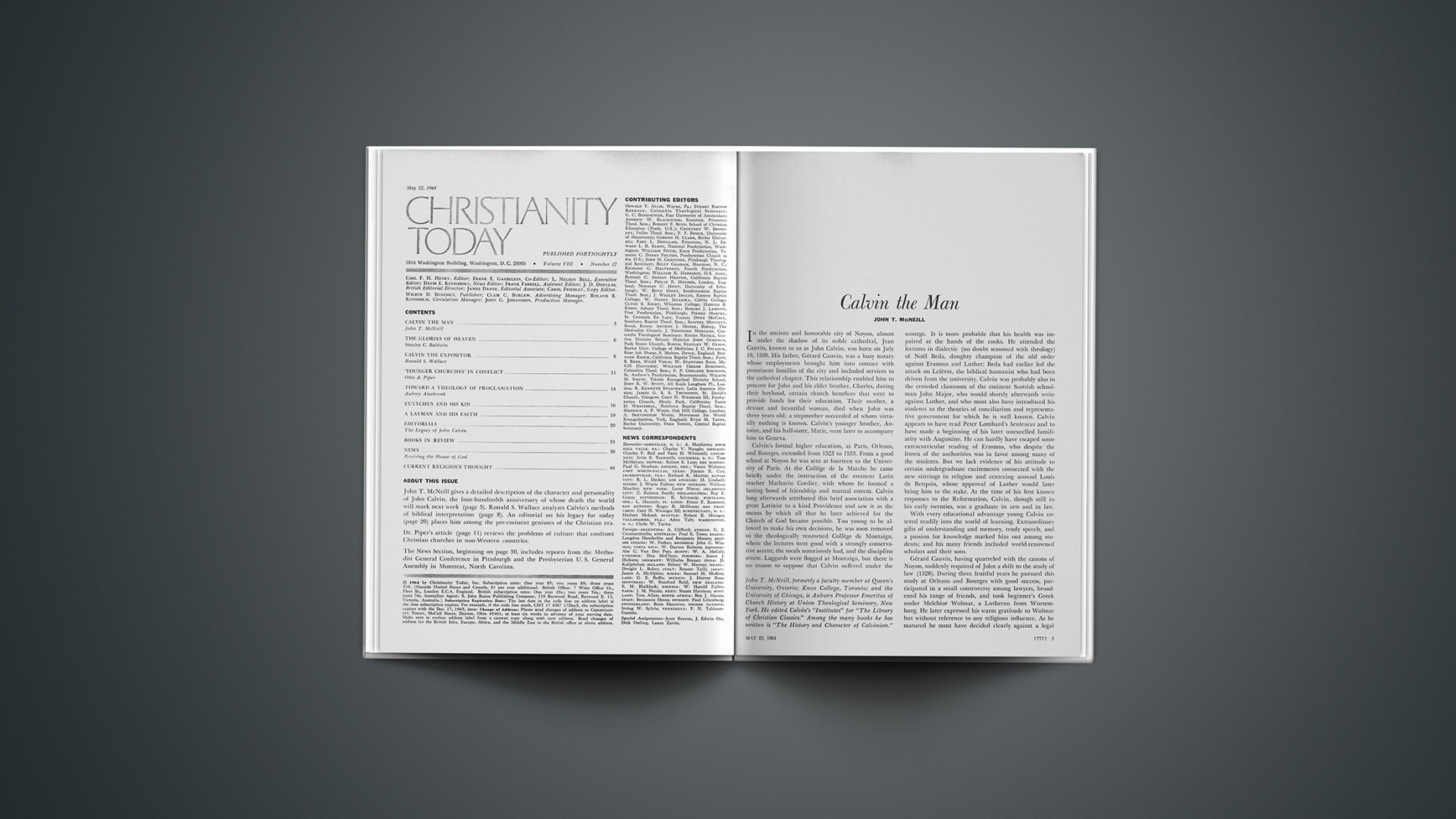
John T. McNeill give a detailed description of the character and personality of John Calvin, the four-hundredth anniversary of whose death the world will mark next week (page 3). Ronald S. Wallace analyzes Calvin’s methods of biblical interpretation (page 8). An editorial on his legacy for today (page 20) places him among the pre-eminent geniuses of the Christian era.

Dr. Piper’s article (page 11) reviews the problems of culture that confront Christian churches in non-Western countries.

The News Section, beginning on page 30, includes reports from the Methodist General Conference in Pittsburgh and the Presbyterian U. S. General Assembly in Montreat, North Carolina.

The Debate on Devotions

The House Judiciary Committee has discovered that prayer can be a controversial subject.

Not long after the committee began hearings on a proposal to overrule the Supreme Court’s ban on prayers and Bible readings in public schools, it became evident that churchmen were divided on the issue.

But some congressmen have said that their mail is overwhelmingly in favor of some kind of amendment to the Supreme Court’s ruling, and they are making sure that their constituency knows that they are “for” God and prayer.

Some have used the hearings as an occasion to lecture Congress and the Supreme Court. One of the most recent examples was Governor George Wallace of Alabama, who “left off campaigning for the presidency for a spell to warn Congress to get with God,” as one reporter wrote.

The intent of the bill (widely known as the “Becker Amendment”) is to overrule a 1963 Supreme Court decision that no state or locality may require recitation of the Lord’s Prayer or Bible verses in public schools.

Dr. Robert Cook, representing the National Association of Evangelicals, told the committee that prayer and Bible reading had been a “tried and proven” custom ever since the inception of public schools, when “ministers were the teachers.”

“While the good that has come from the practice cannot be measured, we believe that it has been considerable and provided a stabilizing influence greater than many realize,” said Dr. Cook. “The adverse effects have been insignificant. We know of none.”

The NAE has come out with a formal statement in favor of an “amendment to the Federal Constitution which will strengthen the present provision for the free exercise of religion in our national life and allow reference to, belief in, reliance upon, or invoking the aid of God, in any governmental or public document, proceeding, activity, ceremony, school or institution.”

A representative of the National Council of Churches took a different position. Dr. Edwin H. Tuller, who is also general secretary of the American Baptist Convention, told the committee:

“Neither the church nor the state should use the public school to compel acceptance of any creed or conformity to any specific religious practice.”

Dr. Tuller cited a resolution adopted by his denomination in 1963, which stated, “In the light of the recent Supreme Court decisions, we affirm our historic Baptist belief that religion should not be a matter of compulsion, and that prayers and religious practices should not be prescribed by law or by a teacher or public school official.”

Bishop Fulton J. Sheen suggested to the committee that the controversy could be resolved constitutionally and adequately by permitting the use of the motto “In God We Trust” in public schools.

The leading proponent of the amendment, Rep. Frank J. Becker (R-N. Y.), has charged that committee hearings on the subject have been “loaded” with witnesses who oppose the amendment. He has also threatened to press a petition to transfer the debate to the House floor.

The amendment has been opposed by an ad hoc committee composed of Jews, Episcopalians, Baptists, Presbyterians, and members of the United Church of Christ.

C. Stanley Lowell, associate director of Protestants and Other Americans United for Separation of Church and State, said that if the bill were passed it might mean that “Catholic, fundamental Protestant, liberal Protestant or Buddhist or Moslem” prayers or religious ceremonies could be imposed in areas where these groups predominate.

A Catholic professor, the Rev. Robert G. Howes, said that the Supreme Court’s decisions in 1962 and 1963 “explode a bomb with a deadly fallout.”

Others maintained that non-sectarian school prayers, if adopted, would be devoid of spiritual content.

Protestant Panorama

The Swedish State Lutheran Church will study the possibility of revising a 1951 pronouncement that branded pre-marital sexual relations as a sin.

A plan to unite three regional conferences of the United Church of Christ—one of them all-Negro—was approved last month by representatives of the three groups at a meeting in Greensboro, North Carolina.

President Johnson was given a life patron membership in the Disciples of Christ Historical Society last month and was presented with a special membership certificate by the Disciples’ Council on Christian Unity.

Miscellany

Roman Catholics of the United States now claim a church membership of 44,874,371. The figure, recorded as of January 1, 1964, is reported in the newly released Official Catholic Directory and represents an increase of 1,026,433 over the previous year.

The American Association of Pastoral Counselors was formally launched as a professional organization at its second annual conference in St. Louis last month.

A Protestant Episcopal bishop was deported from Haiti last month. Bishop C. Alfred Voegeli, 60, was given only a few hours to prepare for his departure. He had served in the Negro republic for twenty-one years.

Chicago’s Board of Education voted 7 to 3 to undertake a four-year experiment in shared-time education.

The evangelism commission of the American Lutheran Church recommended that the call to one of its evangelists, the Rev. A. Herbert Mjorud, be terminated because he allegedly promoted glossolalia.

Deaths

THE RT. REV. JOSEPH GILLESPIE ARMSTRONG, 63, Episcopal bishop of Pennsylvania; in Bryn Mawr, Pennsylvania.

DR. DANA DAWSON, 72, retired Methodist bishop; in Shreveport, Louisiana.

DR. E. D. HEAD, 71, retired president of Southwestern Baptist Theological Seminary; in San Angelo, Texas.

HARRY HOLT, 59, founder of an adoption program for placing Korean orphans in American homes; near Seoul, Korea.

The Kenya government lifted a ban on a religious sect whose announced aim is to establish an All-African Christian Church, according to Ecumenical Press Service. A government decree said the ban was rescinded because the activities of the sect, known as Dini Ya Msambwa, were “no longer harmful to the state.”

The fourth in a series of unity consultations between Eastern Orthodox and Protestant Episcopal Church representatives took place in New York last month. No conclusions were divulged.

Delegates to the American convention of the YWCA voted to eliminate the pledge of Christian faith as a prerequisite to voting in “Y” affairs. Officers, however, are still expected to affirm Christian faith.

At its annual meeting last month, the American Council of Christian Churches, founded by Dr. Carl McIntire, adopted a statement reading, “We openly criticize the President for calling upon and using churchmen to help press for the passage of [the civil rights] bill.”

J. D. Salinger’s The Catcher in the Rye has been removed from high school libraries in Orange County, Florida. The Orlando Baptist Conference objected to the book on the grounds that it is obscene.

The Supreme Court will hear three cases next year on conscientious objection to service in the armed forces. It must decide whether it is constitutional to require a person to believe in God or a Supreme Being to be eligible for exemption as a conscientious objector.

Archbishop Joseph T. McGucken has criticized articles and statements in the Catholic press and elsewhere implying an imminent change in the church’s position on birth control. He called such opinions “unwarranted and false.”

Personalia

The Rt. Rev. Robert F. Gibson, Episcopal bishop of Virginia, elected chairman of the Consultation on Church Union.

The Rev. William Hamilton Nes will retire as professor of homiletics at Seabury-Western Theological Seminary at the end of the current academic year.

Dr. Roswell P. Barnes announced he will retire as executive secretary of the New York office of the World Council of Churches by October 1.

Dr. John Wesley Casey named academic dean of Pacific Christian College.

Dr. Raymond B. Brown appointed professor of New Testament at Southeastern Baptist Theological Seminary.

Harold Schachern, religion editor of the Detroit News, elected president of Religious Newswriters Association.

Dr. Benjamin E. Mays, noted Negro Baptist leader and president of Morehouse College, announced that he will retire in 1966.

Dr. Lowell E. Roberts is resigning as president of Friends University, Wichita, Kansas, to join the Malone College faculty as chairman of the Division of Religion and Philosophy.

Dr. J. Wesley Hole elected secretary of the Methodist General Conference to succeed Dr. Leon T. Moore upon his retirement in 1965.

Presbyterians U.S. Nail the Door Open

Amid rising mountains and falling rains the 104th General Assembly of the Presbyterian Church in the United States convened last month in Montreat, North Carolina. While the nation struggled on Capitol Hill with civil rights, 456 commissioners of what is popularly known as the Southern Presbyterian church struggled at the church’s Conference Center in the Blue Ridge Mountains to grant the Negro religious rights within their churches. The mountains were blue, the days gray, the issues critical. Although only one-tenth of 1 per cent of the church’s membership is Negro, many of the assembly’s decisions concerned race, and many others were haunted by a racial specter that played a real but unspoken role in the assembly’s decisions.

In what may prove to be a historic assembly, the commissioners faced the problem of Negro presbyteries “which occupy the same district as that of other presbyteries,” and “instructed” these latter presbyteries “to bring their procedures into line with the constitution of our church, and to take into their membership and under their care all of the ministers and churches … within the district for which they bear particular responsibility.” Each of these presbyteries was also instructed “to present a report of its progress to the General Assembly at its next meeting.” The Rev. J. Reed Miller of Jackson, Mississippi, decried this as “enforced integration” and moved that “instruct” be changed to “request.” The motion was rejected. There were indications that the action to “instruct” will be challenged as being contrary to Presbyterian polity.

The synods of Alabama, Georgia, and Louisiana were also instructed “to take steps to dissolve” the denomination’s three Negro presbyteries. Some commissioners feared that the order to integrate might cause some local churches to leave the denomination.

The assembly adopted the “policy of holding its annual meetings only in churches willing to accept all persons for worship and membership in the congregation … and further, that this policy become effective with respect to the 1967 meeting of the Assembly.” A strong attempt to make this policy apply to the 1965 assembly meeting failed. Had it succeeded, it would have necessitated cancellation of plans to meet in the Second Presbyterian Church of Memphis in 1965.

Later a letter was adopted to request the Memphis church, whose pastor, Dr. Henry Edward Russell, is a brother of Senator Richard B. Russell of Georgia, to bring its practice in line with the denomination’s position. The decision to send the letter was later withdrawn.

The assembly voted to add to its Directory of Worship the statement, “No one shall be excluded from participation in public Worship in the Lord’s House on grounds of race, color or class.” To become part of the denomination’s Book of Church Order, this action must be approved by a majority of the church’s eighty presbyteries.

A pastoral letter to the local session of each congregation was also adopted. It deals with ways of solving racial problems on the local level. One Southern minister told the meeting that if he read the letter to his sessions, some of his elders would ask, “What is wrong—don’t you want to live here any more?” The letter was adopted unanimously.

Dr. Felix B. Gear, professor of theology at the church’s Columbia Seminary at Decatur, Georgia, was chosen as moderator of the assembly. At a press interview, he asserted that the country “needs something in the way of a civil rights bill.” He also declared he had no objection to members of the church engaging in the proper kind of civil rights demonstrations. He added, “I don’t think it’s the business of the church to tell legislators how to secure justice, but it’s our business to say justice should be secured.”

In one resolution the assembly asserted that it “does hereby deplore the unlawful manipulation and use of children of juvenile age by adults in the advancement of local or national programs regardless of the nature or purpose of such programs.”

By an overwhelming vote the commissioners rejected a recommendation of the Standing Committee to participate in the NCC-sponsored Church Assembly for Civil Rights in Washington, D. C.

In his “State of the Church” report Dr. William H. McCorkle, retiring moderator, called the racial problem the “paramount issue of our Church.”

The assembly adopted a record benevolence budget of $9,968,380, an increase of $155,200 over the 1964 figure.

Recommendations were adopted urging that the religious training of children is the “primary responsibility” of church and home and that school authorities should permit students to engage in some form of “voluntary” devotional activity. For the rest, the assembly took the position that the recent Supreme Court decisions on prayer and Bible readings are “theologically sound.”

Plain Words On Civil Rights

The Interreligious Convocation on Civil Rights in Washington, D. C., last month was considered an impressive show of support by the major faiths of the civil rights bill.

Protestants, Catholics, and Jews, whites and Negroes, were on the platform and in the audience at the convocation, held in the gymnasium of Georgetown University. Senator Hubert Humphrey sat almost directly in front of the pulpit in the front row, and four other congressmen were in the audience.

The three main speakers were the Most Rev. Lawrence Shehan, Archbishop of Baltimore; Rabbi Uri Miller, president of the Synagogue Council of America; and Dr. Eugene Carson Blake, chairman of the Commission on Religion and Race of the National Council of Churches.

After the meeting, leaders of the convocation were invited to the White House for a talk with President Johnson.

The audience was attentive throughout, but when Dr. Blake rose to speak with revivalist fervor, it burst into repeated applause.

“The crisis of the nation is no more severe than the crisis in our churches and synagogues,” said Dr. Blake. “How can any of us ministers, priests or rabbis, stand safely eloquent behind our pulpits, reflecting the moral confusions of American culture in our tactful, balanced prose when God is thundering at his people, calling them to repent and be saved? Never in the life of the nation have the churches and synagogues through their best leadership been so fully united intellectually on any moral issue confronting the American people. But such intellectual unity will reveal the weakness and irrelevance of our pulpits, unless from them we speak.…

“Our task as churchmen is not to be expert in legislation or to tell the Congress how to legislate. But it is our task and it is our competence to cut through the fog of immorality that threatens every American home and every church and synagogue, and to say so that everyone can hear and heed—‘Thus saith the Lord’—‘Let justice roll down like waters and righteousness like an ever flowing stream.’ ”

Archbishop Shehan said in his address, “Through its Congress, this nation is laboring to give a more complete expression in terms of law to our original vision and commitment. Only in an order of justice shall we have peace. Only in peace shall we have national unity. Only in national unity can we accomplish our difficult tasks.”

Rabbi Miller said, “The American people have been delinquent for a hundred years in putting into practice the principles of the emancipation declaration. We cannot tolerate intolerance either morally or practically.”

The crowd that filed out of the gymnasium was unaware that a few students had tried unsuccessfully to stage a protest against the terms of the present civil rights bill. Nor did many in the crowd see police remove a wooden cross found near the gym. The charred remains of cloth fastened to it indicated it had been burning.

GEORGE WILLIAMS

The commissioners were faced with six overtures requesting withdrawal from the National Council of Churches. Most of the objections to continued affiliation opposed the actions of the NCC’s Commission on Religion and Race. The assembly expressed concern that “some of the activities” are “ill advised, and that in the future the Commission consider the conscience of local ministers and sessions and consult with and seek to work more closely with local ministers.” The final vote to remain in the NCC was substantial; some observers thought it was the strongest ever registered. The vote was preceded by three special speakers, allotted fifteen minutes each to provide the assembly with what was termed a “full objective educational program concerning the National Council of Churches.”

Another decision in the area of church union reaffirmed the conviction of the 103rd Assembly, “that ultimately the Presbyterian and Reformed communions in the United States should present a united life and witness according to the Reformed faith and Presbyterian order.” On the basis of this, the General Assembly instructed its “Ad Interim Committee on conversations with the General Synod of the Reformed Church in America to investigate with the like committee of the Reformed Church the advisability of expanding conversations to include the U.P.U.S.A. Church and other Reformed Churches looking toward ultimate union.” Some observers felt that this candid desire to merge with the so-called Northern Presbyterians, from whom the Southern Presbyterians divided over the issue of the Civil War, would hinder merger possibilities with the Reformed Church in America. An adopted report declared that there seem to be no essential “impediments” to union with the Reformed Church in America, and many resolutions were adopted to express by means of various acts of fellowship and cooperation the unity of the one faith of the two churches.

The church’s Committee on Christianity and Health, concerned with the emotional health of ministers and their wives, urged that “presbyteries take with great seriousness their responsibility to be a bishop or pastor to the ministers who may have particular need, making use of retreats, Bible study, and other proven ways of deepening supportive friendships.”

The same committee urged the adoption of a resolution asserting that it would be “contrary to our theological position if we as an Assembly of the Church of Christ should pronounce, in terms of research in tobacco, that an individual in our denomination shall not smoke.… Very moderate smoking, especially of cigars and pipes, so far as current research indicates, is not in itself injurious to health. The same applies to other oral intakes under attack.” Dr. Paul T. DeCamp, a chest surgeon, commented on the resolution, concluding his remarks with the advice that the assembly should “stick with religion and you may be right; get into medicine and you are almost sure to be wrong.” Thereupon the assembly immediately tabled the resolution of its Committee on Christianity and Health.

Reduction of nuclear stockpiles is desirable, according to a report adopted by the assembly, but it should occur multilaterally; unilateral action by the United States is unthinkable because of its obligations to itself and to the free peoples of the world.

By a vote of 240 to 145, the assembly took the final step permitting women to hold the offices of elder and minister in the denomination. An overture requesting that elders be permitted to administer the sacraments was, however, rejected.

O.P.C. Debates Separation

The Orthodox Presbyterian Church was preparing this year to send its sister church in Holland a detailed statement containing the biblical arguments for “separation from unbelief,” but after lengthy debate, the General Assembly sent the statement back to the drafting committee.

The church, founded in 1936 by J. Gresham Machen and several other Presbyterian ministers, is concerned about the indirect connection between De Gereformeerde Kerken and the World Council of Churches (through the church’s missionary agency) and has already expressed its disapproval.

In March of this year, the Holland church announced that it saw “no decisive hindrance” to full-fledged membership in the World Council. This precipitated a heated debate in the General Assembly of the OPC last month.

In the end, the assembly voted to approve the “general thrust” of the committee’s report but sent it back for redrafting. Some wording was viewed as extreme.

Though interpretations on separation and other questions varied, the commissioners at the General Assembly were united in their emphasis on scriptural support for their positions. Dr. Edward J. Young, in an evening address, noted the church’s “one desire—to act in accordance with the Scriptures.”

In other business, the General Assembly:

—Voted to “go on record as indicating its conviction that the work of medical missions is a proper work of the church.” This means that the church will proceed with plans to build a 22-bed hospital in Ghinda, Eritrea (Ethiopia).

—Went over the expenditures of its Committee on Christian Education with minute scrutiny but passed the committee’s budget, along with the others. (The committee had gone into debt in order to begin publishing its own Sunday school material. Its senior quarterly has been well received and is used in as many churches outside the denomination as within it.)

The host church this year was the Knox Orthodox Presbyterian Church of Silver Spring, Maryland, where the Rev. Charles H. Ellis is pastor. A former pastor of the church, the Rev. Glenn R. Coie, was named moderator.

GEORGE WILLIAMS

The Church Immovable

“We have been communicating with the Presbyterians for thirty years, yet we haven’t apparently moved an inch. This is disgraceful.” The speaker was an archdeacon at the Convocation of Canterbury last month. History had earlier been made when the gathering was addressed by Dr. J. W. C. Dougall, chairman of the Church of Scotland panel engaged in the current Anglican-Presbyterian conversations. Other participants in the latter, apart from the two national churches, are the Presbyterian Church of England and the Episcopal Church of Scotland. The most significant, and to some evangelicals the most disappointing, feature of Dr. Dougall’s address was his assertion that “so far as Scotland is concerned, the central, practical problem of Anglican-Presbyterian relations will be the relation of the Church of Scotland to the Episcopal Church in Scotland.”

What this means, in effect, is that the Church of Scotland (1,281,000 communicants) must negotiate with the Episcopal Church (55,000 communicants), which largely represents the “Higher” wing of Anglicanism, before progress is possible with the Church of England. Some years ago the editor of the Scottish Episcopal Church Year Book, in discussing Anglicans who come to Scotland, said: “It has always been a matter of regret that so many, especially from England, have joined themselves in ignorance to the Presbyterians and Established Church in our land.… It is hoped that skillfully directed publicity (without rancor) may be successful in damming this avoidable and unnecessary leakage.” It might perhaps have been more happily put in the interests of ecumenicity, but it got across a viewpoint not uncommon in his denomination.

J. D. DOUGLAS

Baptists And Beatles

Baptist church membership reached its peak in 1906, and is today back where it was eighty years ago despite the increased population, said the report presented last month to the annual assembly of the Baptist Union of Great Britain and Ireland. “Christian doctrines and standards,” it acknowledges, “are criticized and even repudiated, in a way unknown to this country during the past two centuries.”

The report is oddly equivocal, however, when, turning from the general to the particular, it mentions Honest to God, and welcomes the fact that doctrine and theology “have once more become subjects of eager discussion in the newspaper, the market-place and the studio.” The Profumo affair is mentioned disapprovingly, but then follows a quaint reference to the honors paid to, and the mass hysteria caused by, the Beatles, “a group of Liverpool young men.” The presidential address was given by Dr. L. G. Champion. The union’s statistics show a membership of 310,437.

J. D. DOUGLAS

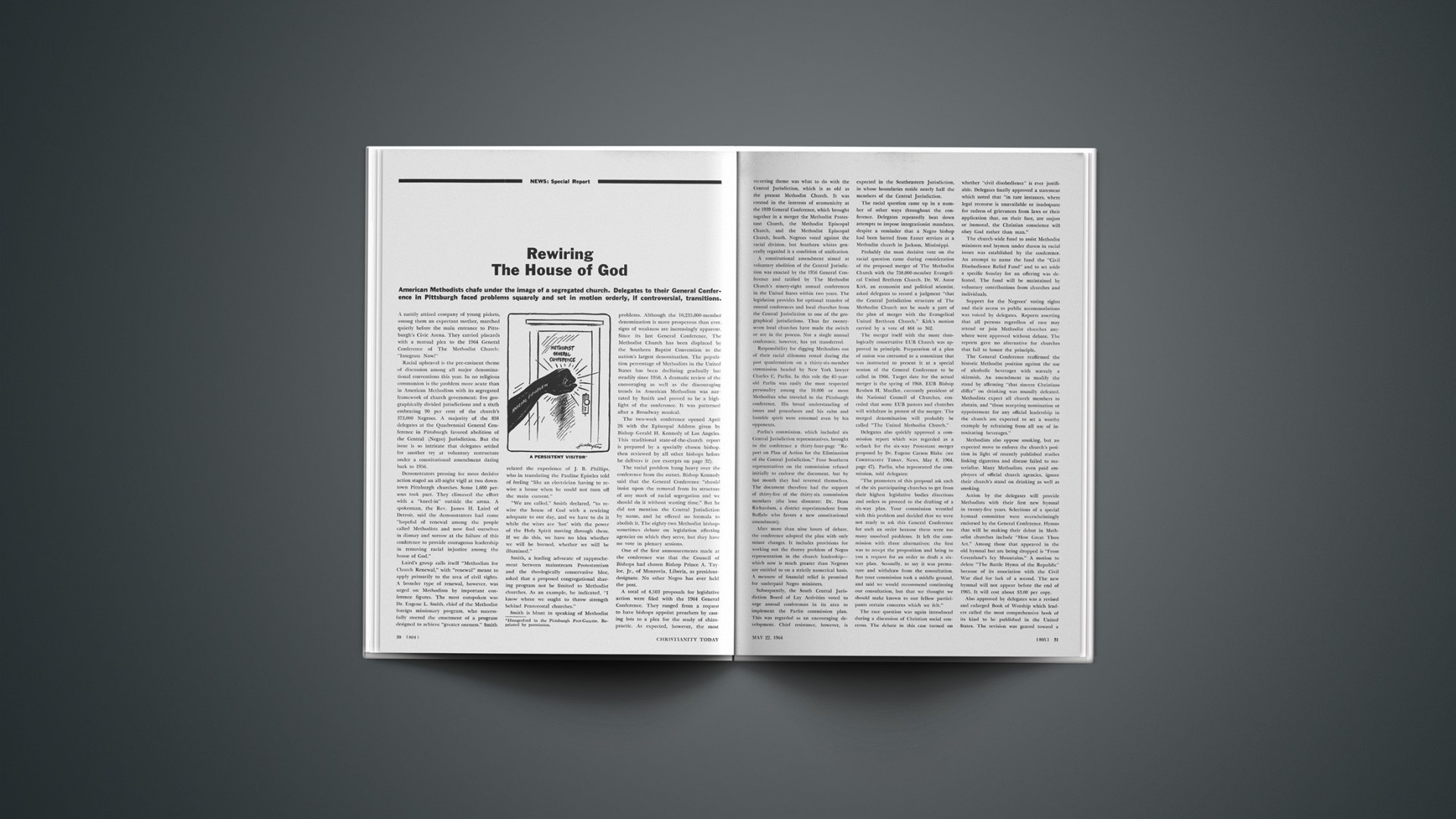
Rewiring the House of God

American Methodists chafe under the image of a segregated church. Delegates to their General Conference in Pittsburgh faced problems squarely and set in motion orderly, if controversial, transitions.

A nattily attired company of young pickets, among them an expectant mother, marched quietly before the main entrance to Pittsburgh’s Civic Arena. They carried placards with a mutual plea to the 1964 General Conference of The Methodist Church: “Integrate Now!”

Racial upheaval is the pre-eminent theme of discussion among all major denominational conventions this year. In no religious communion is the problem more acute than in American Methodism with its segregated framework of church government: five geographically divided jurisdictions and a sixth embracing 90 per cent of the church’s 373,000 Negroes. A majority of the 858 delegates at the Quadrennial General Conference in Pittsburgh favored abolition of the Central (Negro) Jurisdiction. But the issue is so intricate that delegates settled for another try at voluntary restructure under a constitutional amendment dating back to 1956.

Demonstrators pressing for more decisive action staged an all-night vigil at two downtown Pittsburgh churches. Some 1,600 persons took part. They climaxed the effort with a “kneel-in” outside the arena. A spokesman, the Rev. James H. Laird of Detroit, said the demonstrators had come “hopeful of renewal among the people called Methodists and now find ourselves in dismay and sorrow at the failure of this conference to provide courageous leadership in removing racial injustice among the house of God.”

Laird’s group calls itself “Methodists for Church Renewal,” with “renewal” meant to apply primarily to the area of civil rights. A broader type of renewal, however, was urged on Methodism by important conference figures. The most outspoken was Dr. Eugene L. Smith, chief of the Methodist foreign missionary program, who successfully steered the enactment of a program designed to achieve “greater oneness.” Smith related the experience of J. B. Phillips, who in translating the Pauline Epistles told of feeling “like an electrician having to rewire a house when he could not turn off the main current.”

“We are called,” Smith declared, “to rewire the house of God with a rewiring adequate to our day, and we have to do it while the wires are ‘hot’ with the power of the Holy Spirit moving through them. If we do this, we have no idea whether we will be burned, whether we will be illumined.”

Smith, a leading advocate of rapprochement between mainstream Protestantism and the theologically conservative bloc, asked that a proposed congregational sharing program not be limited to Methodist churches. As an example, he indicated, “I know where we ought to throw strength behind Pentecostal churches.”

Smith is blunt in speaking of Methodist problems. Although the 10,235,000-member denomination is more prosperous than ever, signs of weakness are increasingly apparent. Since its last General Conference, The Methodist Church has been displaced by the Southern Baptist Convention as the nation’s largest denomination. The population percentage of Methodists in the United States has been declining gradually but steadily since 1950. A dramatic review of the encouraging as well as the discouraging trends in American Methodism was narrated by Smith and proved to be a highlight of the conference. It was patterned after a Broadway musical.

Hungerford in the Pittsburgh Post-Gazette. Reprinted by permission.

The two-week conference opened April 26 with the Episcopal Address given by Bishop Gerald H. Kennedy of Los Angeles. This traditional state-of-the-church report is prepared by a specially chosen bishop, then reviewed by all other bishops before he delivers it (see excerpts on page 32).

The racial problem hung heavy over the conference from the outset. Bishop Kennedy said that the General Conference “should insist upon the removal from its structure of any mark of racial segregation and we should do it without wasting time.” But he did not mention the Central Jurisdiction by name, and he offered no formula to abolish it. The eighty-two Methodist bishops sometimes debate on legislation affecting agencies on which they serve, but they have no vote in plenary sessions.

One of the first announcements made at the conference was that the Council of Bishops had chosen Bishop Prince A. Taylor, Jr., of Monrovia, Liberia, as president-designate. No other Negro has ever held the post.

A total of 4,503 proposals for legislative action were filed with the 1964 General Conference. They ranged from a request to have bishops appoint preachers by casting lots to a plea for the study of chiropractic. As expected, however, the most recurring theme was what to do with the Central Jurisdiction, which is as old as the present Methodist Church. It was created in the interests of ecumenicity at the 1939 General Conference, which brought together in a merger the Methodist Protestant Church, the Methodist Episcopal Church, and the Methodist Episcopal Church, South. Negroes voted against the racial division, but Southern whites generally regarded it a condition of unification.

A constitutional amendment aimed at voluntary abolition of the Central Jurisdiction was enacted by the 1956 General Conference and ratified by The Methodist Church’s ninety-eight annual conferences in the United States within two years. The legislation provides for optional transfer of annual conferences and local churches from the Central Jurisdiction to one of the geographical jurisdictions. Thus far twenty-seven local churches have made the switch or are in the process. Not a single annual conference, however, has yet transferred.

Responsibility for digging Methodists out of their racial dilemma rested during the past quadrennium on a thirty-six-member commission headed by New York lawyer Charles C. Parlin. In this role the 65-year-old Parlin was easily the most respected personality among the 10,000 or more Methodists who traveled to the Pittsburgh conference. His broad understanding of issues and procedures and his calm and humble spirit were esteemed even by his opponents.

Parlin’s commission, which included six Central Jurisdiction representatives, brought lo the conference a thirty-four-page “Report on Plan of Action for the Elimination of the Central Jurisdiction.” Four Southern representatives on the commission refused initially to endorse the document, but by last month they had reversed themselves. The document therefore had the support of thirty-five of the thirty-six commission members (the lone dissenter: Dr. Dean Richardson, a district superintendent from Buffalo who favors a new constitutional amendment).

After more than nine hours of debate, the conference adopted the plan with only minor changes. It includes provisions for working out the thorny problem of Negro representation in the church leadership—which now is much greater than Negroes are entitled to on a strictly numerical basis. A measure of financial relief is promised for underpaid Negro ministers.

Subsequently, the South Central Jurisdiction Board of Lay Activities voted to urge annual conferences in its area to implement the Parlin commission plan. This was regarded as an encouraging development. Chief resistance, however, is expected in the Southeastern Jurisdiction, in whose boundaries reside nearly half the members of the Central Jurisdiction.

The racial question came up in a number of other ways throughout the conference. Delegates repeatedly beat down attempts to impose integrationist mandates, despite a reminder that a Negro bishop had been barred from Easter services at a Methodist church in Jackson, Mississippi.

Probably the most decisive vote on the racial question came during consideration of the proposed merger of The Methodist Church with the 758,000-mcmber Evangelical United Brethren Church. Dr. W. Astor Kirk, an economist and political scientist, asked delegates to record a judgment “that the Central Jurisdiction structure of The Methodist Church not be made a part of the plan of merger with the Evangelical United Brethren Church.” Kirk’s motion carried by a vote of 464 to 362.

The merger itself with the more theologically conservative EUB Church was approved in principle. Preparation of a plan of union was entrusted to a committee that was instructed to present it at a special session of the General Conference to be called in 1966. Target date for the actual merger is the spring of 1968. EUB Bishop Reuben H. Mueller, currently president of the National Council of Churches, conceded that some EUB pastors and churches will withdraw in protest of the merger. The merged denomination will probably be called “The United Methodist Church.”

Delegates also quickly approved a commission report which was regarded as a setback for the six-way Protestant merger proposed by Dr. Eugene Carson Blake (see CHRISTIANITY TODAY, News, May 8, 1964, page 47). Parlin, who represented the commission, told delegates:

“The promoters of this proposal ask each of the six participating churches to get from their highest legislative bodies directions and orders to proceed to the drafting of a six-way plan. Your commission wrestled with this problem and decided that we were not ready to ask this General Conference for such an order because there were too many unsolved problems. It left the commission with three alternatives: the first was to accept the proposition and bring to you a request for an order to draft a six-way plan. Secondly, to say it was premature and withdraw from the consultation. But your commission took a middle ground, and said we would recommend continuing our consultation, but that we thought we should make known to our fellow participants certain concerns which we felt.”

The race question was again introduced during a discussion of Christian social concerns. The debate in this case turned on whether “civil disobedience” is ever justifiable. Delegates finally approved a statement which noted that “in rare instances, where legal recourse is unavailable or inadequate for redress of grievances from laws or their application that, on their face, are unjust or immoral, the Christian conscience will obey God rather than man.”

The church-wide fund to assist Methodist ministers and laymen under duress in racial issues was established by the conference. An attempt to name the fund the “Civil Disobedience Relief Fund” and to set aside a specific Sunday for an offering was defeated. The fund will be maintained by voluntary contributions from churches and individuals.

Support for the Negroes’ voting rights and their access to public accommodations was voiced by delegates. Reports asserting that all persons regardless of race may attend or join Methodist churches anywhere were approved without debate. The reports gave no alternative for churches that fail to honor the principle.

The General Conference reaffirmed the historic Methodist position against the use of alcoholic beverages with scarcely a skirmish. An amendment to modify the stand by affirming “that sincere Christians differ” on drinking was soundly defeated. Methodists expect all church members to abstain, and “those accepting nomination or appointment for any official leadership in the church are expected to set a worthy example by refraining from all use of intoxicating beverages.”

Methodists also oppose smoking, but an expected move to enforce the church’s position in light of recently published studies linking cigarettes and disease failed to materialize. Many Methodists, even paid employees of official church agencies, ignore their church’s stand on drinking as well as smoking.

Action by the delegates will provide Methodists with their first new hymnal in twenty-five years. Selections of a special hymnal committee were overwhelmingly endorsed by the General Conference. Hymns that will be making their debut in Methodist churches include “How Great Thou Art.” Among those that appeared in the old hymnal but are being dropped is “From Greenland’s Icy Mountains.” A motion to delete “The Battle Hymn of the Republic” because of its association with the Civil War died for lack of a second. The new hymnal will not appear before the end of 1965. It will cost about $3.00 per copy.

Also approved by delegates was a revised and enlarged Book of Worship which leaders called the most comprehensive book of its kind to be published in the United States. The revision was geared toward a more contemporary approach to most of the services, rights, and sacraments of the church. The Book of Worship is recommended for Methodist churches, but its use is not mandatory.

Other action by the conference: establishment of a maximum retirement age for bishops of 72 instead of 74 (a move to reduce the mandatory retirement age for ministers from 72 to 70 was defeated); an almost unanimous vote of continued support of and participation in the National and World Councils of Churches despite numerous rank-and-file protests; anti approval of a budget of $18 million for the worldwide work of thirteen national and international Methodist agencies for each of the next four years, a 20 per cent increase over the past quadrennium.

An unexpected guest at the conference whose appearance was announced only a few hours in advance was Roman Catholic Bishop John J. Wright of Pittsburgh, a leading voice for the liberals at the Second Vatican Council. Wright’s presence marked the first time a Roman Catholic bishop had ever spoken to a Methodist General Conference.

“We welcome one another as Christians and the first business of Christians is to give thanks, so let me come today to say a few thank-yous,” he said, whereupon he expressed gratitude for the nice things Methodists have said about Popes Pius, Paul, and John. He also cited Bishop Fred P. Corson, president of the World Methodist Council, and Dr. Albert C. Outler, of Perkins School of Theology, for their perceptiveness as observers at recent Vatican Council sessions in Rome.

“There are many and deep and basic differences between us,” Bishop Wright said. But he declared that “precisely as Christians we share a difference. We share a radical difference also involving everything that is important in time and eternity, a difference from the world and the spirit of the world that must keep and bring us ever closer together as the spirit of the world becomes more and more secularist, inspired by a certain atheism frequently practical and often ductile, a secularism, a scientism, an atheistic humanism that constitutes the grounds of a difference between the world and us as Christians, whatever difference is among us, which is total.”

Religion At The Fair

Spokesmen for religious pavilions at the New York World’s Fair say they are encouraged and gratified at the interest their exhibits have generated among fairgoers. A total of 300,000 leaflets were distributed at the Vatican Pavilion in less than two weeks. At the Billy Graham Pavilion and the Protestant and Orthodox Center, visitors are streaming through at a rate of 15,000 or more a day.

The Graham building features hourly showings of Man in the Fifth Dimension, a 28-minute Todd-AO color evangelistic film. Graham narrates the film, which includes testimonies from Dr. Elmer W. Engstrom, RCA president, Dean Calvin Linton of George Washington University, and a Harvard University psychiatrist. The film is climaxed by an appeal for commitment to Christ. Inquirers are invited to meet with specially trained counsellors who are on hand at all times.

Excerpts From The Episcopal Address

Here are excerpts from the Episcopal Address delivered by Bishop Gerald Kennedy at the Methodist General Conference:

While our fathers were good organizers, they regarded organization as a means to fulfill the evangelistic purpose. Their success was a testimony to the power of witnessing to Christian experience and another example of how the preaching of the Word of God saves men by faith.

In our fascination with subjective analyzing we have reduced the awful catastrophe of sin to a disease, and man’s moral betrayals become mere sickness.

We believe in spiritual and physical discipline and we do not believe there is anything pious about inefficiency. But it is our opinion that we spend too much time at the General Conference tinkering with our machinery. The president of the Carnegie Foundation has reminded us that almost always the last act of a dying corporation is to issue a new and enlarged edition of the rule book. An excessive attention to rules and laws may be … a sign of sickness.

We stand for the truth that nothing is any good for any people unless it brings them closer to God and makes them more aware of the spiritual foundations of their being.

We believe that this General Conference should insist upon the removal from its structure of any mark of racial segregation and we should do it without wasting time.

We rejoice in the growth of the ecumenical movement and in the development of the ecumenical spirit.… But we are not sure that God wills the churches of the Reformation to become one organic union. We believe that our pluralism has produced much good fruit, not the least of which has been freedom. We doubt seriously that eliminating our denominations would solve all our problems. We have no intention of apologizing for our own heritage or slowing down our evangelistic efforts until some proposed merger has been accomplished. The final goal for any Church is not necessarily merger but how to use its resources to serve Christ better.

The connection between cigarette smoking and disease is now so clear that no Church can be neutral regarding this habit.

We do not share the current pessimism which speaks of a “post-Protestant era.” … Let The Methodist Church proclaim that so far as it is concerned, we are not post-anything, and the best is yet to be.

The coming of the Holy Spirit in power demands human preparation.… The time has come for us to ask ourselves what precisely we believe.… The spirit of expectancy must possess us anew.

The biggest religious attraction at the fair is Michelangelo’s “Pieta,” on display in a dramatic setting at the Vatican Pavilion. The pavilion itself surprises many Protestants with its profuse display of Scripture. Immediately inside the main entrance is a ten-foot square mosaic with the inscription: “God sent his son into the world that the world may be saved through him. John 3:17.” Outside, in gold letters, are the words of Pope Paul: “Let the world know this church looks at the world with profound understanding, with sincere admiration and with a sincere attention not of conquering it but of serving it, not of despising it but of appreciating it, not of condemning it, but of strengthening and saving it.”

The Protestant and Orthodox Center is getting a late start. Its chapel, its theater, and a number of its exhibits were not ready on opening day. The showing of the controversial film Parable was therefore delayed for several weeks. Among unfinished exhibits were those planned by the governments of Israel (an aquarium with fish front the Sea of Galilee) and Jordan (olive wood and mother-of-pearl carvings).

In a pavilion operated by the government of Sudan is displayed a recently discovered fresco of the Madonna and Child painted between 1,000 and 1,200 years ago.

The large Mormon Pavilion features a fourteen-minute color film purporting to answer such questions as “where we came from, why we are here, and where we are going.” One scene shifts to a hospital delivery room and shows a newborn infant. Other scenes attempt to depict souls in pre-creation existence and in the hereafter (bleached blondes with flip hairstyles predominate in both).

A Menacing Backwash

The Greek Orthodox Ecumenical Patriarchate at Istanbul has been threatened repeatedly in a backwash of the Cyprus crisis. Hostile moves against the patriarchate by authorities in traditionally Muslim Turkey have been denounced in Christian circles throughout the world.

There has been much talk of the possibility of ousting the patriachate from its ancient seat in Istanbul, formerly Constantinople. This is a long-standing threat, dating from the time several years ago when Turkish newspapers first began accusing the patriarchate of political agitation in favor of the Greek attitude on Cyprus.

Religious News Service quoted Athens Radio as saying that the Ankara government is planning to raze the patriarchate on the pretext that this is necessary for city planning and improvement.

The report was confirmed in London by Metropolitan Athenagoras, the Ecumenical Patriarch’s representative in Britain. He said the government also ordered two senior members of the Istanbul hierarchy to leave the country, forced the patriarchate to cease printing its official publication, and banned a film showing the meeting between Patriarch Athenagoras and Pope Paul VI that took place during the Pontiff’s Holy Land pilgrimage in January.

At Buck Hill Falls, Pennsylvania, Dr. O. Frederick Nolde told the U. S. Conference of the World Council of Churches that he had received assurance from the foreign minister of Turkey that both the Ecumenical Patriarchate of Constantinople and “the person of the Patriarch will remain inviolate.”

The foreign minister also said, “I hope that you have also drawn the attention of Archbishop Makarios, who is the president of Cyprus as well as being a man of the doth, in connection with the planned massacre of defenseless Turks—including women, children, and old people in Cyprus since Christmas of 1963.”

The World Council has not made public any communications with Archbishop Makarios.

Books

Book Briefs: May 22, 1964

A Secular Version Of Jesus Christ

The Secular Meaning of the Gospel: An Original Enquiry, by Paul M. Van Buren (Macmillan, 1963, 205 pp., $4.95), is reviewed by James Daane, editorial associate, CHRISTIANITY TODAY.

This book reinterprets the Gospel to make it meaningful to the Christian who, because he lives in the twentieth century, is a secular man who thinks in secular categories. Reinterpretation is demanded, says Paul Van Buren, associate professor of theology at Episcopal Theological Seminary of the Southwest in Austin, Texas, because “the whole tenor of thought of our world today makes the biblical and classical formulations of this Gospel unintelligible” (p. 6). What the secular tenor of thought cannot accept, to say it all at once, is the assertion that Jesus Christ is both God and man.

Van Buren thinks that if we really take history seriously and make use of linguistic analysis, we can discover what the New Testament writers and the Church Fathers intended to say, and did say within the thought modes of their day: and we can thus retain the real essence of the Gospel while eliminating those elements of the biblical and classical formulations that are offensive to the modern, secular man.

Once an admirer of Karl Barth, the author now rejects Barth’s theological method. Barth seeks to understand faith front within faith; to this Van Buren does not object, for he does the same. But Barth thinks that if one exegetes the Scriptures he will hear God’s Word, and that nothing more needs to be done except repeat that Word to modern man. Van Buren thinks this is not enough; the intended meaning of the biblical writers and of the Fathers must be dug out and expressed in modern modes of thought and speech. What Van Buren wants is more than merely a new technique of communication, or a modern idiom. He is disturbed that Barth is not bothered by the fact that the confession that Jesus is very God of very God “may be literally nonsense to men today” (p. 8). Van Buren, in his introduction to his translation of Barth’s new book God Here and Now, expresses his amazement that Barth should be so concerned with what is said and so unconcerned about how it is said. Barth’s reply would doubtless be that Van Buren’s concern about the how has lost the what that should be proclaimed.

Van Buren wants to retain a historical Jesus of Nazareth to escape pure subjectivity; it is a historical Jesus that is seen, he says, within the Easter perspective. He therefore also rejects Bultmann’s existential theological method; for as Fritz Buri in Europe and Schubert M. Ogden (Christ Without Myth) in the United States have shown, Bultmann’s method, if consistently applied, cannot retain the need for a historical Jesus. The Easter perspective, urges Van Buren, is not sheer subjectivity; what is seen in this perspective is the actual Jesus of history.

Van Buren then views the gospel writers in terms of their concrete historicity—men living at a certain time, thinking in terms of the then current categories, using words and language in the peculiar mode of their time. He then applies linguistic analysis to their thought, particularly to their statements, “The Word became flesh,” and “Jesus is Lord.” In the process of analysis Van Buren makes many astute observations, for he is a competent theological thinker and a good writer.

A full-dress review of his analysis cannot be given here. Van Buren concentrates on Christology; he shares the historical concerns of Ritschl and Harnack and their criticisms that Hellenistic terms like “substance” and “nature” are too static or too materialistic to do service to the verb “became” in the statement “the Word became flesh,” and to the verb in the assertion “Jesus is Lord.” Chalcedon must go; modern secular man is too aware of the nature of history to accept Chalcedon.

What is the essence of the Gospel? What were the Fathers trying to say in their time? From the perspective of Easter, they saw Jesus as the one man who was wholly free for others; and they experienced that his freedom was contagious, for they caught it, too, and found themselves so free as to be able to live for others. What they saw from the blik of Easter was a unique man, God’s man, God’s Elect, his Servant, but nothing more than a man. What indeed, asks Van Buren, could the “more” possibly mean?

The Incarnation, traditionally interpreted as God’s entrance into history, is nothing more than a pointer that points toward history. The Virgin Birth is not factually true. If it were, Jesus would not be historical in the sense in which we are, that is, wholly historical. The doctrine simply indicates that Jesus is unique, the one truly free man. An actual Virgin Birth would be open to all the same objections as is an actual Resurrection. For Easter is only the experience of discernment in which we come to see Jesus as the man who is wholly free to live in love for others. This, says Van Buren, is what Chalcedon meant when it said “God of very God”; and this, he says, is what he has said in his own way.

He then shows how his reinterpretation relates to other Christian truths. I mention only two. The mission of the Church is to live in the way of freedom to love and serve others, and “not the way of trying to make others Christians.” He concedes that Christian prayer has been in the language of address, but for the modern man prayer is not speaking to God; it is rather a contemplation of a situation in the perspective of Easter. The twentieth-century adult Christian concerned, for example, about the weather is “as much inclined as the next man to consult the weather map and the meteorologist for the answer to a question about a change in the weather, rather than to ‘take it to the Lord in prayer.’ ”

One may doubt the accuracy of many of Van Buren’s historical and theological judgments, but not his personal honesty. He explicitly says what he believes and as explicitly says what he rejects. There is no need to wonder about his theological position. He frankly admits that he has reduced the Gospel to historical and ethical dimensions and has eliminated the religious and metaphysical dimensions. He says plainly with reference to prayer, “Our secular thinking leaves us puzzled if we are asked to posit ‘someone’ to whom to speak in prayer” (p. 188). His admitted reduction of the Gospel, he says, is no more a loss than was the reduction of astrology to astronomy, and of alchemy to chemistry. “Theology cannot escape this tendency if it is to be a serious mode of contemporary thought, and such a ‘reduction’ of content need no more be regretted in theology than in astronomy, chemistry, or painting” (p. 198); and he adds, “We would also claim that we have left nothing essential behind” (p. 200).

If we think his reinterpretation too radical, we are told that the alternatives are few and even less attractive. One of them is “a very orthodox but meaningless faith which refuses to enter the secular world” (p. 200). The question we must face—and Van Buren does not—is whether the orthodox are not after all more committed to a secular world in their belief that God enters it than is Van Buren, who keeps God outside.

Few theologians, I think, will be moved by Van Buren’s linguistic analysis, for it does not convincingly support his reinterpretation of the Gospel. It is the weakest point in his book. All too evidently, his reinterpretation of the Gospel rests rather on the modern mind, which insists that an incarnation, a virgin birth, a resurrection, or indeed any transcendent miraculous act just is not possible. Consequently, what he in his subtitle calls “an original enquiry” is nothing more, except for surface differences, than a re-echo of an old theological modernism. But even so, the Church ought not to ignore Van Buren’s reinterpretation of Jesus Christ, for he can rightfully say, “This interpretation of Jesus and the Gospel is an example of the kind of Christology which is being developed in many quarters by men influenced by biblical theology, and it is intended to be faithful to the concerns evident in the Christology of the Fathers” (p. 55).

It is not permitted to us to judge Van Buren’s intentions as he seeks to establish his sonship. But since we have equal right to exercise “linguistic analysis” we may, on the basis of what the son and the Fathers have written, issue the judgment that this is a son the Fathers would not recognize as their own. Van Buren’s theology comes not from the Fathers but from his twentieth-century neighbors.

JAMES DAANE

A View On History

History, Archaeology and Christian Humanism, Vol. I, by William Foxwell Albright (McGraw-Hill, 1964, 342 pp., $6.95), is reviewed by John Wm. Wevers, professor of Near Eastern studies, University of Toronto, Toronto, Ontario.

This book is divided into three parts: “General Surveys,” “Special Areas,” and “Some Scholarly Approaches.” The last section evaluates the work of James Breasted, Gerhard Kittel, Arnold Toynbee, Eric Voegelin, Rudolf Bultmann, and Albright himself. These as well as the five chapters of the middle section have all appeared in other publications. Only the three chapters in the first section appear here for the first time. These three are also the most informative for probing Albright’s approach to historical synthesis.

The first study, “A Theistic Humanism,” is Albright’s attempt to define his approach to history. He accepts Dawson’s understanding of humanism as “a tradition of culture and ethics founded on the study of humane letters.” Three main types are analyzed: classical, atheistic, and theistic. Under the last-named he discusses Dawson, Toynbee, Butterfield, Daniélou, and de Lubac appreciatively but critically. In spite of such writers as Reinhold Niebuhr, Tillich, and Bultmann, he maintains that Germans and Americans do not take history seriously.

Albright classifies historical judgment as follows: typical occurrence, particular facts, cause and effect, value and personal reactions. The first two are scientifically objective, and the last two, though subjective, necessary. Historical cause and effect is the most tendentious because it is difficult to be fully objective. Archaeological studies are of tremendous value to the ancient historian precisely because “they deal almost entirely with judgments of fact and typical occurrence”—a statement that the reviewer suspects to be more true of archaeology than of archaeologists. It is this faith in archaeology that has led Albright to a greater conservatism regarding the historical accuracy of Old Testament traditions.

In the author’s view of the impact and analysis of cultures, he rejects both the instrumentalist and the functionalist approach, though he takes certain elements of both approaches for his own. It is correct neither to view Hebrew culture as so completely interlocking that it can be understood by and in itself, nor to understand it simply as the product or amalgam of surrounding cultures.

The second chapter is entitled “The Human Mind in Action: Magic, Science, and Religion,” the subtitle having been borrowed from Bronislaw Malinowski. Albright’s view of the kind of thinking underlying these three is strongly influenced by Lévy-Bruhl’s famous division: prelogical vs. logical mentality. Albright quite rightly prefers the term “protological,” since “prelogical” wrongly introduces the concept of chronological priority. To these forms of thinking he adds empirical logic. Formal logic began with the Greeks, thus does not characterize the Old Testament. Primitive man thought empirically (in his everyday living) as well as protologically (in his higher culture, where experience was no guide since history actually did not exist).

In Chapter 3 Albright discusses “The Place of the Old Testament in the History of Thought”; he defends the thesis that the Old Testament contains next to no evidence of protological, but rather of empirical logic. To this reviewer, this is his most important contribution. The ancient Israelites had a sense of historical movement. Salvation was a series of redemptive acts in history: the Exodus, Crossing the Waters, the Wilderness Journey, and the Promised Land. This is diametrically opposed to myth, which is timeless and static, and the sooner Old Testament theologians abandon the notion of myth the better. Israel, in contrast to Egyptians, Mesopotamians, Hittites, and Canaanites, could and did view religious experience empirically, i.e., in the light of a historical faith. Albright may not be as separate from the views of Alt, Noth, and von Rad as he pretends.

JOHN WM. WEVERS

Panel On Peace

Biblical Realism Confronts the Nation, edited by Paul Peachey (Fellowship Publications, 1963, 224 pp., $4), is reviewed by C. Gregg Singer, chairman, Department of History, Catawba College, Salisbury, North Carolina.

This symposium, with contributions by nine scholars in company with Paul Peachey of the Church Peace Mission, is an effort to arouse the Christian conscience to the perils involved in nuclear warfare and to encourage the churches to take a strong stand against any national policies in domestic or foreign affairs that might lead to such a cataclysm.

In his introductory chapter Peachey sets forth the problem in a compelling manner and offers a real challenge to his panel of scholars, who originally gave these chapters as papers at a conference held in June, 1962, near Washington, D. C. But the panel never actually meets the challenge. Although the title of the book conveys the idea that biblical realism must be the basis for any solution to the problem of nuclear warfare, it is exactly at this point that these writers fail to meet the challenge. There is in this volume no consistent biblical theology or realism with which to confront the American people. There is frequent reference to biblical passages, but the general thrust of the book is fragmented by the lack of agreement in appeal to the Scriptures. In his conclusion Peachey himself reveals a vague awareness that somewhere his panel has failed him.

The failure lies in the fact that all the panel members are in the liberal camp; some are strictly neo-orthodox in their approach to the Scriptures while others are existentialist. In every chapter it is obvious that the writer does not hold to the inspiration and infallibility of the Scriptures and that the acceptance of higher criticism has so vitiated the message that there is little biblical realism. Most of the authors fall into difficulty because they have no doctrine of common grace; at the same time, they try to create some kind of a substitute. This predicament is clearly expressed in the chapter by Lionel Whiston, who struggles manfully with his assignment and comes very close, only to miss the goal.

The fact that the Church Peace Mission was apparently unable to find conservative scholars to espouse the cause of Christian pacifism should raise some profound questions among its leaders. The value of this volume is that it presents the thinking of sincere liberals on one of the most serious issues of the day, and their failure to find a biblical answer for it.

C. GREGG SINGER

The Early Baillie

Faith in God and Its Christian Consummation, by D. M. Baillie (Faber & Faber [London], 1964, 308 pp., 30s.), is reviewed by W. R. Forrester, emeritus professor of practical theology and Christian ethics, St. Andrews University, St. Andrews, Scotland.

The great success of Donald Baillie’s later book, God Was in Christ, has revived interest in this earlier work (1927), out of print for many years but now given a second edition with an admirable and penetrating foreword by Professor John McIntyre. The latter rightly claims that Faith in God has a relevance and an importance for contemporary thought far beyond its mere historical value in giving him a “fix” at the end of the Kantian and at the beginning of the Barthian era. Though Baillie was acquainted with the earlier work of Barth and with some of Kierkegaard, there is no trace here that either had influenced him, cast as his thought had already been in the mold of idealist philosophy.

To show how dated some of the book may be, one of his earliest illustrations is of the poor but pious charwoman whose simple faith owes nothing to theological speculation. It would be necessary, to make this illustration comprehensible to the young and to our American brethren, to explain that a pious charwoman is not a medieval martyred saint but a spiritual entity of some importance, especially in the Victorian era!

The theological world has moved a very long way since 1927, and Donald Baillie too moved beyond many of the positions he takes up here. But the secular world has moved even further and faster, and in disconcerting directions. Thirty-seven years ago it was still possible to speak of Christendom and be more or less understood. It was also possible to get fairly general agreement that Christian morality was a good thing, not a series of mistakes. Many of the questions with which Donald Baillie wrestled have ceased to interest even thoughtful people. Not that we, or he, can claim to have found the answers. We no longer ask the same questions, or expect any answer to the questions we may ask.

Faith did not come easily to Donald Baillie, and he was plagued all his life by chronic ill health; yet students the world over found he spoke to their condition. In this book, as in all his others, we see abundant evidence that here was no arid theologian peeping at the world, surrounded with books in some ivory tower, churning out intellectual exercises, but a spiritual athlete of no mean stature. The faith of which he speaks he won with toil and thought and discipline and prayer. Can there be any higher recommendation?

W. R. FORRESTER

Mental Stimulant

New Meanings for New Beings, by Richard Luecke (Fortress, 1964, 267 pp., $3.50), is reviewed by Alvin L. Hoksbergen, pastor, Ann Arbor Christian Reformed Church, Ann Arbor, Michigan.

Joseph Sittler of the University of Chicago makes these comments on Dr. Luecke’s book: “This is a sober, faithful book for the hour. The book is as good as we need, better than our lethargy deserves. I wish I could say that pastors and teachers will exult in it. That will not be true—which is a judgment. But not about the book.”

These are challenging words. If true, they indict today’s pastors and teachers, making the book even more important. In this reviewer’s opinion, the indictment has more truth than many of us would like to admit.

The author is not concerned with theology as such, nor with a careful analysis of the Christian religion. Neither is he interested in giving easy answers to perplexing questions. His concern is to stimulate thought on the relevance that the Christian faith should have for many crucial areas of life.

The first three chapters are concerned with the problems of language and innocent suffering. The religious language of our day must be re-examined in the light of the new world in which we live. The Church is too often busy answering questions that are no longer being asked. When this happens, the “point of contact” with modern man is lost, and we are left with a suffering mankind to which the mercy and love of God are meaningless, empty words.

The next four chapters deal with the concept of the “self” in psychological and biblical language, the corporate society made up of persons with different gifts and abilities, the relation between law and love, and the relation between church and state.

The final three chapters treat the relevance faith has for the world of physical things, for the world of learning, and for the combination of things and ideas in artistic expression.

Each chapter begins by listening to some of the “secular” and traditional “religious” language of the day concerning the subject under discussion. The author then seeks the meaning that the words and deeds of Jesus and the prophets have for that topic. Toward the close of the chapter he takes a part of the Church’s liturgy and shows how our life of worship applies to the subject of the chapter.

Dr. Luecke has a rich background of knowledge and a keen understanding of problems. A refreshing sense of humor flows easily from his pen. This book is well suited for group studies by church or campus groups.

ALVIN L. HOKSBERGEN

Written For Whom?

Palestinian Judaism in the Time of Jesus Christ, by Joseph Bonsirven, S.J., translated by William Wolf (Holt, Rinehart and Winston, 1964, 271 pp., $5.50), is reviewed by Jakob Jocz, professor of systematic theology, Wycliffe College, Toronto, Ontario.

The author, who died in 1958, was New Testament professor at the Pontifical Biblical Institute in Rome and a well-known authority on rabbinic Judaism. An earlier work, On the Ruins of the Temple (England, 1931), was greatly admired by the present reviewer. It is therefore with reluctance that he exercises the prerogative of criticism in reviewing the present book.

First a word about the translation. Granting that no translator can ever reproduce the original, still with greater care many mistakes could have been avoided. There are some clumsy sentences, some grammatical mistakes, and an occasional misunderstanding of meaning. The reviewer was puzzled by the statement concerning oral law which the sages held to have been revealed to Moses “including all the decisions of the rabbis, grammatical minutiae, and even all the reflections a pious student will show his teacher.…” We suspect, without the original text before us, that this ought to read: “a pious teacher will show his students.” But on the whole the book reads easily, and the language is not the problem.

The real problem lies elsewhere.

No one can write a book on Judaism based on rabbinic sources without exposing himself to some criticism. In the case of this work there is much to criticize. The first mistake committed by the author is to treat occasional rabbinic utterances as if they were dogmatic statements. Judaism knows nothing of dogmatic formulation as is traditional with Christianity. Except for halakha, which lays down obligatory practice, Judaism is not a dogmatic religion. No rabbi can speak for the whole of Jewry, only for himself. Sentiments on the part of certain rabbis recorded in Talmud and Midrash are not statements of doctrine but views of individuals. These views were colored by the circumstances of the times, the needs of the people, the economic and political condition of the community. In his extensive bibliography Bonsirven quotes the book by C. F. Montefiore, Rabbinic Literature and Gospel Teachings (1930). This erudite work by a famous Jewish scholar was occasioned by the publication of Strack and Billerbeck’s Commentary to the New Testament from Talmud and Midrash. Montefiore was able to show how Christian writers are mistaken in treating rabbinic texts as authoritative utterances.

It is a fact that for every quotation from rabbinic sources Bonsirven uses to make a point, another quotation could be cited to prove the opposite. The author knows Judaism well enough not to feel uneasy about it, and he occasionally wonders how seriously he can treat a text.

But the book suffers from an even greater defect. The title reads: Palestinian Judaism in the Time of Jesus Christ. This is an audacious title full of promise but impossible to accomplish. There are no written rabbinic sources prior to A.D. 70. The author to some large extent depends upon the Apocrypha Pseudepigrapha for evidence, but the question immediately arises to what extent these writings represent traditional Judaism. The fact that the synagogue has eliminated these books from the Canon ought to be given full consideration. Neither Josephus nor Philo is a representative of rabbinic Judaism. The rabbinic texts are of a much later date, some very late indeed.

This brings us to the next point. Bonsirven works on the assumption that the defeat suffered at the hands of the Romans and the disappearance of the temple brought no “real revolution in matters relating to doctrine” (p. IX). But this is an utterly unwarranted assumption. Two major events changed the whole structure of Judaism: the disappearance of the priestly cultic religion and the rise of the Christian Church. When Bonsirven refers in his text to “rabbis” and “laymen,” he imports a Roman Catholic concept foreign to the synagogue: all Jews are “laymen,” rabbis included. We mention this only to show the distance from a temple-oriented to a synagogue-oriented faith. The assumption therefore that “Judaism” prior to A.D. 70 was the same as it was after the Destruction rests upon a misunderstanding.

Although the author has tried to be fair to Judaism, he has not succeeded. We are assured by the publishers that “the constant purpose of this study is objectivity, not apologetics,” but this is not borne out by the text. The author assesses Judaism, or what he calls “Judaism,” from his own theological position, and this creates an unusual situation. There is a hidden irony in that Bonsirven finds fault with Judaism in the very points that are characteristic features of his own church. It is somewhat startling to have a Roman Catholic, and a Jesuit at that, criticize Judaism for its legalism; for its “arithmetic rule of commutative justice”; for its “rigorous principle of retribution”; for the practice of superstition such as the use of “amulets” (sic); for its teachers’ giving the appearance of being better informed than anyone else about “other-worldly mysteries” (sic); for its misunderstanding of the “gratuitousness of grace”; for its emphasis upon the immortability of the soul over against the resurrection. Only once does the author admit that the Jews excel “Catholics”: in their concept of the works of charity, which is superior to the giving of alms (p. 153).

The author has not managed to hide a certain hostility, which becomes most evident in his treatment of relations between Jews and Gentiles. It is obvious that the text was prepared before the changed attitude on the part of the Vatican toward the Jewish people. On this subject the book is most misleading and even dangerous.

It leaves the reader with the impression that the Jews harbor everlasting enmity toward all non-Jews: the heathen are God’s enemies; one is allowed to profit from their errors; Israelites may keep an object stolen from a pagan; the nations will be annihilated when Messiah comes; and the like. The extent of this lack of objectivity can be seen from the following sentence: “Another idea, formulated after the third century but suggested earlier, is that Israel will possess the wealth of the nations” (p. 222). But anyone who has read Isaiah knows that this is not an “idea” formulated by the rabbis (!). It is hardly fair to blame rabbinic Judaism for a biblical text (cf. Isa. 61:5 f).

The paramount question is: For whom is this book written? This abridged edition of a larger work is not a book for scholars. It can be no rival to G. F. Moore’s Judaism, nor to Montefiore’s Rabbinic Anthology. As a popular work, it is misleading by its bias and pretense. It lacks a glossary to explain rabbinic terms, provides no historical background, and takes too much for granted for the ordinary reader. It is also puzzling: how can Judaism be blamed for “an excessive respect for God” (p. 27)? Frequently the author both castigates and praises Judaism for one and the same thing. This is not a book we can easily recommend.

JAKOB JOCZ

Paperbacks

The Heidelberg Catechism for Today, by Karl Barth, translated by Shirley C. Guthrie, Jr. (John Knox, 1964, 141 pp., $2). First English translation of Barth’s Die christliche Lehre nach dem Heidelberger Katechismus, and Einführung in den Heidelberger Katechismus. It presents a brief view of Reformed theology in the sixteenth century, and glimpses of Barth’s own.

The Teen-ager You’re Dating, by Walter Riess (Concordia, 1964, 127 pp., $1). Sound counsel in language youth will read.

The Christian Faith and War in the Nuclear Age (Abingdon, 1963, 108 pp., $1). A report of the Methodist Church’s special study commission on nuclear war. Worthy of study.

Unity in the Dark, by Donald Gillies (Banner of Truth Trust [London], 1964, 128 pp., 3s. 6d.). A conservative look at the ecumenical movement that is critical of conservative evangelicals as well as of the ecumenical movement. It says many things that should be said, and others with which many evangelicals themselves will disagree.

Tell el Amarna and the Bible, by Charles F. Pfeiffer (Baker, 1963, 75 pp., $1.50). One in the series of “Baker Studies in Biblical Archaeology,” written in such form as will appeal to the non-expert but serious laymen. This study, by a competent writer, deals specifically with Egypt in the Amarna Age (fourteenth and fifteenth centuries B.C.).

Ideas

The Legacy of John Calvin

“On this day, with the setting sun, the brightest light in the world and he who had been the strength of the Church was taken back to heaven.” So wrote Theodore Beza of the passing of John Calvin four hundred years ago, on May 27, 1564.

Who was this man who, though one of the greatest men of his age, was buried, in accordance with his own express desire, without any outward ceremonial in a grave unmarked by tombstone or epitaph? Some have made him out to be a monster and a tyrant, a hater of his fellow men and a perverter of the truth—so much so that still today in certain religious circles his name is regarded with abhorrence. This judgment of Calvin cannot be reconciled with the facts of history, and it is a cause for satisfaction that our own age is increasingly coming to a more just appreciation of the true worth of this remarkable man.

Calvin was not the ruthless dictator of religion and morals of the republic of Geneva. The faith of the Reformation and a strict moral code had been formally adopted by civic rulers and people before Calvin arrived in their city; nor was it of his own will and design that he settled in their midst. In 1536, Calvin, then a young man of twenty-seven, spent a single night in Geneva en route to Strasbourg. He had no thought of lingering in Geneva, let alone spending the rest of his life there. Indeed, his clear ambition was to pass his days in scholarly retirement, untroubled by the problems that beset the man who is a public figure, writing the books he felt it was God’s will for him to write. But the fiery William Farel, to whom Calvin’s presence in Geneva had been reported, had other ideas. He sought out the young scholar in his inn and, when pleadings proved fruitless, uttered an imprecation that God would curse his scholarly retirement if he refused to stay and labor in Geneva, where his help was much needed. In this way Calvin’s purpose was turned, and he became bound to the city and people of Geneva.

But he never ceased to long for release from the demands and controversies of public life, though there was never anything perfunctory about his self-giving. “The welfare of this church,” he said of Geneva, “lay so near to my heart that for its sake I would not have hesitated to lay down my life.” In this spirit he served it, working incessantly for its well-being and progress, a natural leader because of his phenomenal powers of personality and intellect. Despite the handicap of physical frailty and almost unremitting ill health, he never spared himself but gave himself freely and fully to the service of God and his fellow men.

Calvin’s life is one of the outstanding examples in church history of the strength of God being made perfect through weakness. Each day of every other week he preached in Saint Pierre, and three times a week he lectured in theology. Far from abandoning his literary projects, he labored constantly with his pen, preparing his commentaries on the books of Holy Scripture, composing handbooks on Christian doctrine and treatises on important theological issues that were before the Church, and revising his Institutes. His other activities included corresponding with a host of persons of both noble and humble birth, known and unknown to him, in many lands; visiting the sick and those in trouble; making himself available to the stream of callers from far and near who sought him out; giving himself in wholehearted fellowship to his friends; instructing the clergy; guiding the affairs of the consistory; and willingly, when requested (remember that he had had a brilliant career in the law school of Paris prior to his conversion), allowing the civic leaders to benefit from the wisdom of his counsel—though, because of his clear conception of the distinct spheres of jurisdiction of church and state, he always did this in his capacity as a private person. Incidentally, some may be surprised to learn that this supposed tyrant did not even enjoy the privilege of citizenship during the greater part of his life in Geneva; this was not conferred on him until 1559, some five years before his death. Not only was his manner of living always unpretentious and frugal, but his whole life was one of single-minded devotion to the cause of Christ. At a time when he was severely weakened by sickness his friends pleaded with him to relax his labors and spare himself, but he replied: “What, would you have the Lord find me idle?”

Calvin’s compassion is seen in his tender devotion to his wife and his grief at her death in 1549, after ten years of happy married life together during which they had had the sorrow of burying their infant son; in his spontaneous love for his friends; and in his touching solicitude for fellow Christians who were suffering persecution for their faith in various places. At the same time, the forcefulness of his character is seen in his inflexibility of purpose when he discerned that the truth of the Gospel was at stake. He would rather die than dishonor Christ by compromising his Gospel. He hated controversy, but it was only God, never man, whom he feared. The extreme logicality of his mind led him at times to decisions and formulations that we might consider unduly harsh or rigorous, though we must beware of tearing him out of the context of his age. But the record of his achievement, as also of his personality, is there for all to study, and there can be only one verdict: that intellectually, spiritually, morally, and magisterially John Calvin has his place among the preeminent geniuses of the whole Christian era. And his influence did not die with him; on the contrary, it is greater today than it has ever been and shows every sign of becoming greater still.

There is something else to be said about this amazing man. Although his name is indelibly associated with the city of Geneva, his interest was by no means confined to the territory of Geneva. It is probably not generally realized to what an extent the Geneva of Calvin’s day was the hub of a wheel from which radiated the spokes of missionary activity. One of the outstanding characteristics of the Genevan church under Calvin was precisely its missionary-mindedness. This fact alone should silence the glib and oft-repeated assertion that Calvin’s theology spells death to evangelism and missionary activity. Geneva, it is true, became a refuge for many who were fleeing from the terrors of persecution, and this influx was a source of strength and enrichment to the church there. But that church was not content merely to receive and give shelter; it was intent on the advancement of the Gospel in territories far beyond its own limits. Accordingly, suitable men were constantly prepared for this vital ministry and sent out to preach and to teach the doctrine of Jesus Christ.

The men sent out were tried and trusted, and they were men of vision and courage; for this was no simple operation that they were undertaking, but one of the greatest hazardousness. The enemies of the Reformation were ruthless, and discovery might well mean (and in numerous cases did mean) torture and death. Not surprisingly, then, these messengers of the Gospel were sent out in secret, often covered by the cloak of an assumed name. On reaching their destination, after a journey by dangerous mountain tracks across the Alps, they ministered to those whom they could muster behind closed doors or in the shadows of the woods. The mission field to which these men were sent out comprised, in the main, France and Northern Italy; but in 1561 two pastors were sent as far afield as Brazil to serve among the members of a French expedition and to bring the Good News to the South American Indians. (That the venture proved abortive does not detract from its significance.) Thus year after year men were sent out from Geneva with their Bibles and their doctrine. The number of missions reached a peak of some 150 in 1561—a remarkable testimony to the outward-looking, unselfish effect of Calvin’s theology when it is properly understood.

John Calvin has much to say to us today. There is first of all the theological legacy he left us, which, thanks to the enterprise of publishers and translators, is readily accessible to all who wish to study it. Foremost in this is his Institutes of the Christian Religion, the finest systematic presentation of biblical theology in the history of the Christian Church. As for his commentaries on Holy Scripture, these should certainly not be neglected, 400 years old though they are; for they and the Institutes were intended to supplement each other, and with their sane explanation of the natural sense of the sacred text they form a landmark in the history of exposition. His other writings, too, will be found to be full of treasures. Through his writings, then, Calvin speaks to us and instructs us.

But again, the whole of Calvin’s life speaks powerfully to us today. How can we fail to be challenged by such a man? Indeed, a consideration of his life is likely not only to challenge us but also to cause us to blush with shame, for his ardor, his dedication, his singleness of purpose, which we regard as so phenomenal, should surely be characteristic of every follower of the Master. Calvin shows us what God can do with a single, frail servant who is willing to put aside personal preferences; to abandon the funk hole of religious respectability; to go, if need be, against the ecclesiastical tide; to denounce error; to proclaim the truth without apology and without ambiguity; to labor ceaselessly for Christ’s cause, regardless of personal cost; and to have but one ambition: the glory of God.

And Calvin challenges the Church of our day to repent of its introversion and to cease “playing it safe”; to return to its missionary task, which after all is its main task both at home and abroad; to be not merely a haven but also, in the power of the Holy Spirit, a dynamic centrifugal force penetrating with the message of life to the uttermost parts of the earth.

Finally, John Calvin says to us all as we lounge in the luxury of complacency and unconcern: “What, would you have the Lord find you idle?”

Premature Obituary

“Historically speaking, the age of the missionary is drawing to a close.” With this sentence C. L. Sulzberger began a recent New York Times column in which he assumed the imminent demise of the foreign missions movement. On the basis of missionary difficulties in Burma, India, and Africa, and quoting Prime Minister Milton Obote of Uganda (“White missionaries have done good work, but their era is finished”), Mr. Sulzberger concluded that the complex problems of emerging nations and the historic link between missions and colonialism have made the foreign missionary enterprise obsolete.

But this judgment is premature. That missionaries are now working under changing conditions is undeniable. The passing of colonialism has indeed affected those missions that at one time rode on its crest. Like every enterprise in which men are engaged, Christian missions have made mistakes. When school systems and hospitals have been built by government subsidies, problems have multiplied. Sometimes the headship of the missionary leader has tended to obscure the headship of Christ. There are problems of recruitment, although there are still missionaries eager to go to nations to which doors are now closed.

Yet the Great Commission still stands. Despite mounting opposition, there will always be Christians obedient to their Lord’s command to go and make disciples of all nations. While the Iron and Bamboo Curtains seem well-nigh impenetrable and while there may be hostility to missions among new nations, the gospel outreach is being pioneered in the jungles of Amazonia, in the hinterlands of New Guinea and Borneo, and in other areas where men have never heard the name of Christ. Missions are changing; die indigenous church is far more important than it was a generation ago. But the message and the commission continue unchanged and unchanging.

No, the missionary’s era is not over. It will continue until the consummation of the Kingdom at the glorious appearing of the great God and our Saviour Jesus Christ. In the foreign missionary enterprise the Church moves forward; therefore no opposition, not even Communism or nationalism, shall prevail against it.

The Forgotten American

The United States’ unjust treatment of the American Indian is unfortunately not yet a matter of bygone history. The latest chapter is being considered in Congress, where a Senate-House conference committee is considering the Seneca Indian reparations bill. On October 1, the 700 members of the Seneca tribe in western New York must leave their homes as a result of government action that has taken a large part of their lands for the Kinzua water-storage project. The 1794 treaty, which was backed by George Washington, recognized these lands as belonging to the Senecas forever. But neither Congress nor the Supreme Court saw fit to uphold the treaty. The takeover was justified on grounds that the displaced persons would be granted generous reparations. The House accordingly approved a fund of $20.2 million for a reasonable program of rehabilitation that would include relocation, housing, educational and industrial projects.

But in the Senate, this fund was spectacularly slashed to $9.1 million. Seemingly topping the injury with insult, the upper house also approved an amendment “terminating” the relationship of the Seneca Nation to the United States.

We believe that the conference committee should accept the House version of the bill. Economy in government is exemplary, but not when it is at the expense of justice. The Indian vote is not a large one, and this has bred a certain callousness in handling the affairs of the “forgotten American.”

Senators should ponder well the $20 million our government awarded the Pennsylvania Railroad for twenty-eight miles of right-of-way acquired for this same water-storage project. And while considering economies, they may ponder as well the purpose of the House bill: to render the Senecas self-supporting, despite loss of their treaty-guaranteed lands. But over and above such considerations is the fact that congressional consideration of the fate of 700 people has become a crucible for American integrity.

Public Schools And De Facto Segregation

The Supreme Court did the sensible thing when it refused to review a decision of the Seventh Circuit Court of Appeals which ruled that children need not be transferred to schools across town to overcome the tie facto segregation in many cities that occurs because children attend their neighborhood school. The right of a child to go to a public school in his own neighborhood ought to be honored. To sacrifice this right in order to achieve an artificial pattern of school integration of checkerboard consistency is as much a violation of civil rights as it is illogical.

No child should be banned from any public school for reasons of color. This cuts both ways as does any just law. No Negro child living in a predominantly white neighborhood should be excluded from the neighborhood’s predominantly white school. For the same reason, neither should a white child be transported across town to attend school in a Negro neighborhood in order to overcome de facto neighborhood segregation.

Civil rights means equality before the law; it does not mean the mixture of races beyond the demands of the law. In the long run, only the removal of housing barriers will eliminate de facto segregation.

Francisco Lacueva: Nothing Sinister

Despite some misguided smoke-screening, a clearer view is now possible in the case of the vanishing ex-priest, Francisco Lacueva (see “Missing in Action,” CHRISTIANITY TODAY, News, March 27). Dark hints at skullduggery, made by an official of the evangelical society that employed Lacueva and publicly reiterated by the missing man’s twenty-three-year-old wife, have proved to be unfounded with the emergence of a more mundane explanation. “I was overworked and homesick,” he is reported to have said when finally traced to a Spanish Jesuit retreat in Tortosa. The latter destination can be connected with a visit he paid to a London Jesuit priest on the morning of his disappearance, but without the sinister interpretation put upon it. The English evangelical society concerned now announces that Mrs. Lacueva has joined her husband in Spain, and that he proposes to work there in collaboration with a Protestant pastor.

A peculiar responsibility attaches to those who undertake the rehabilitation of former Roman Catholic priests. A man transported suddenly from one world to another is particularly vulnerable. He is often assumed to be suitable for work for which he has in fact no natural aptitude, a fallacy perhaps encouraged by his own quite understandable eagerness to tell of the great change God has wrought in him. Even against the demands of Protestant propaganda a wise restraint may be prudent at first. This would guard against his becoming involved in meeting after meeting, particularly when (as in this present case) a necessarily incomplete grasp of Reformed doctrine is further complicated by a tenuous command of the English language.

Francisco Lacueva, newly converted after fourteen years as a theological professor in Spain, had barely arrived in England in 1962 when he was taken to an evangelical convention to witness before several thousand people. His name and his story became known. Thereafter the glare of constant publicity and the merciless pressure on his time and energies could not have contributed to an atmosphere in which a man could compose his soul. The cumulative effect was physical weariness and a confusion of mind that compelled him to get away from it all. Where else should he go but to his homeland? If English Jesuits encouraged him in this, would not we have done the same in their position?

Those of us who knew this man loved him and mourn the circumstances that have permanently inhibited his ministry in Britain—circumstances that may now, however, in the mercy of God, prove a blessing to the evangelical cause in Spain. At the same time one is left pondering whether it is not a dubious kindness and a dubious Christianity that hustle new converts from one public platform to the next before they have time to attain even a human adjustment.

The Church And The Mission Hospital

Is a ministry of mercy a legitimate part of the missionary work of the Church? Most would immediately ask, “Is this debatable?” Yet last month the General Assembly of the Orthodox Presbyterian Church debated the question whether or not to build a hospital in Eritrea (now Ethiopia).

In a minority report of the Committee on Foreign Missions, Dr. Meredith G. Kline wrote, “The precise question that requires study is whether there is biblical warrant for the church as church institution to administer the affairs of a medical establishment.…” He answered the question with an emphatic No. Christ’s healing miracles, which served as “attendant witnesses to divine revelation,” could not be adduced as an argument for medical missions or medical missionaries, Dr. Kline maintained. “On the contrary, those healings were such as to obviate the need for medical establishments,” he wrote. “The church finds itself in conflict with the most important principles of biblical ecclesiology as soon as it adopts the traditional approach to medical missions.…”

The Rev. Herbert Bird, an Orthodox Presbyterian missionary to Ethiopia, took issue with Dr. Kline in a biting rebuttal in which he said: “It is not written that when the leper sought cleansing, Jesus said to him, ‘I will now perform a special sign in this special period of redemptive history, serving as an attendant witness to divine revelation.…’ It is written, ‘And Jesus, moved with compassion, put forth his hand and touched him and said unto him, Be thou clean’.… If we should agree that official appointments to a ministry of mercy as part of missionary work are unwarranted, we really have no choice but to instruct the evangelist at Ghinda [Ethiopia] to cease and desist from such [medical] work.… Or if this should seem unrealistic, we may decide that the Orthodox Presbyterian Church should withdraw completely from the area, and send its missionaries to some less contaminated region, to some place where the pure preaching of the Word will not be complicated by the demands of human wretchedness.…”

As is reported elsewhere in this issue (page 36), the Orthodox Presbyterian Church, far from deciding to withdraw, agreed on a statement that medical missions are properly a work of the Church. It is going ahead with plans to build its hospital.

We cannot endorse this decision strongly enough. Evangelicals, who have deplored movements within the Protestant church that would have converted it into “a kind of literary and social club, devoted vaguely to good works,” as H. L. Mencken once wrote, have often tended in the direction of neglecting good works for fear of exposing themselves to the social gospel. The result is that those who have looked to the Church to do something, or at least say something, about social evils (need we remind ourselves that they are also moral evils?) have sometimes looked in vain in the direction of evangelicals. Yet that this need not be so is shown by the trend toward greater social concern among many evangelicals today.

It is incredible that in 1964 the matter of setting up a hospital under the auspices of a mission should be the subject of debate; but it is heartening that, in this case at least, the issue was faced and realistically settled.

Only A Beginning

The adoption of a self-imposed advertising code by the companies that manufacture 99 per cent of American cigarettes is at least a step in the right direction. The promise of the code to abandon the virility appeal may help deliver youth from the notion that they must smoke cigarettes to be adult. A similar promise not to associate cigarettes with health claims may make the manufacturers look more honest. No doubt it filtered through the industry’s prudence that the belated move to police itself might also forestall more severe regulations by the Federal Trade Commission and governmental health agencies. Yet the moral problem of the continued making and marketing of a product harmful to the consumer remains. The code in no way relieves government of its duty to keep on informing the public of the dangers of cigarettes to life and health. And it does not lessen the Christian obligation to judge and to react to the cigarette habit in the light of the stewardship of the body.

addApple PodcastsDown ArrowDown ArrowDown Arrowarrow_left_altLeft ArrowLeft ArrowRight ArrowRight ArrowRight Arrowarrow_up_altUp ArrowUp ArrowAvailable at Amazoncaret-downCloseCloseellipseEmailEmailExpandExpandExternalExternalFacebookfacebook-squarefolderGiftGiftGooglegoogleGoogle KeephamburgerInstagraminstagram-squareLinkLinklinkedin-squareListenListenListenChristianity TodayCT Creative Studio Logologo_orgMegaphoneMenuMenupausePinterestPlayPlayPocketPodcastprintremoveRSSRSSSaveSavesaveSearchSearchsearchSpotifyStitcherTelegramTable of ContentsTable of Contentstwitter-squareWhatsAppXYouTubeYouTube