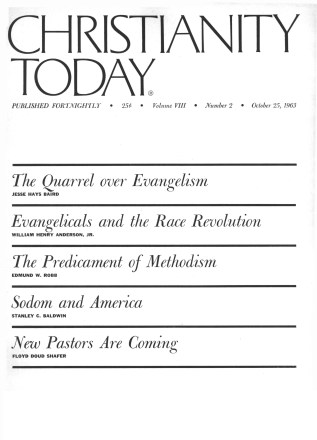
New Pastors Are Coming

In 1956 Life magazine startled us with its article: “Why More and More Ministers Crack Up.” Since then pastors have been critically analyzed by a battery of self-appointed experts. Today, pastors are no longer hypochondriacally obsessed with themselves, as their evaluators imply. The open season on the ministry is over. Pastors are beginning to resist being told that they are sick, aimless, stupid, and irrelevant. They are starting to stand up and speak out in their own right—the pastor’s right.

It was a sore time when we fell flat on our backs at the insistence that we looked bad. Humility forced us to listen to what the experts said. We were shown filmstrips of our dark interiors: hastily hidden guilts, ill-concealed hostilities, and easily detected illusions of grandeur. We paid our humiliating homage to psychology and its sometimes facile documentation of guesses.

We were warned to expect a crack-up around every comer. We thought it wise to learn to dance on eggs. We probed our souls, irrigated our minds, and put our blown-up problems in the showcase for public view. A groan floated across the land: “Oh, those poor sick ministers.”

Our critics erred when they immobilized us on our backs. That position permits only one line of vision: up. We saw towering above us one known of old as the Good Physician. His prescription penetrated our fevered ears: “Take up your bed and walk.” Enfeebling obsession with possible ailments fled, and a long-tested formula, “My grace is sufficient,” became an exhilarating challenge. The wrong people were put to bed, and we are standing up to say so. The macerating surgeons of our souls stand aghast, and they should!

With gnawing remorse we heard proof that nothing justified our existence as ministers of the Word. We were dared to show our accomplishments, produce our credentials, and parade our results. When we couldn’t, or wouldn’t, we were told to quit, tear up the dream, and strive no more. We were badgered into choosing between false alternatives: either produce results or quit. We didn’t want to be in this business of ministering in the Word, or caring for souls, in the first place. Why not quit? Maybe our stance was just a self-induced trance. On that dimension, quitting was the only sensible decision.

Dour ones came to preside over our demise: some brought flowers and some brought black crepe. We were finished. We smiled at the flowers and wept at the crepe.

The Call To Obedience

But life is tenacious and God insistent. Men began to reconsider the matter. Questions flew from manse to manse and parsonage to parsonage. Who told us we were to have success in the first place? Who promised us that working with the Word would immediately produce worth in the world? Who said the care of souls would terminate with all souls cured?

A suspicion knifed its way to a new conviction: our job was to be faithful to the Word and loyal to souls: results were not ours to expect, or receive. We are not at the quitting point of either failure or success. We’ve been forced back on Christ, and he proffers the cross coupled to the command, “Follow me.” Recommitted men don’t go around their problems: they go through them. They will give, but not give up.

Many spoke of our stupidity. We were made sensitive to our ignorance and perceptive of our errors. Experts counseled us to consider the course of culture under their benign guidance.

We were students all, and from long to late we poured over volumes of profane and sacred lore. We knew something of how much we didn’t know. Some said we were too busy to have a grasp of essentials, and others said we were so barricaded from life that we could not know existentials. Our guilt was obvious, one way or the other.

What could we do? We called for the man with the wheelbarrow full of books. Maybe the angels do laugh, but we didn’t. We hung on the gems of truth issuing from the professorial wise ones. We could scarcely wait for the next volume, either from dialectical divinity or from pornographic deviltry, to tell us which way God was going in our culture. The wheels spun, the paper flew, and publishers flooded the land with wisdom. Savants promised to translate it into neat systems for us: plain, easy, quick—just the ticket for not-too-bright pastors. And administrators promised multi-colored, turn-over charts. The pulpit was to have wisdom again!

A Fresh Breeze Appears

That won’t go down. What is this appearing in the land? Here are pastors who can think, ministers who have read avidly for decades, men who are critical of those who profess to know all, pastors who can use words well, and ministers long since alert to the wisdom of a Book that somewhat antedates the cerebrations of the lately wise. Here are ministers who measure men’s wisdom against the true Man. They have discovered that knowing Him in love and serving him in devotion are parts of wisdom not likely to be altered by the next theological discovery. These men will not cease to love books, but they know they will find their truths, if they have them, in the light of Him who is Truth. Pastors are weary of being treated like nincompoops, and the intelligent resistance they are asserting comes as a fresh breeze across a musty room stifling with stale assumptions.

The final blow fell when pastors were told that they were a detriment to laymen, that their position made laymen second-class Christians, and that laymen resented the leadership of pastors. The critics said pastors were irrelevant and that an informed, sensitive, and expert laity was anxious to enthrone itself on the issues and decisions of existence. We heard that an ineluctable progress had ground out its ways leaving us behind as its useless dust.

Rumor had it that pastors could keep their positions within the church building, play around with liturgics, and amuse themselves with administrative tiddlywinks. In the real world, however, where living is live and words useless, the new layman would bring Christ into the market, the office, the parlor, and the arena.

Our antagonists spoke learnedly of the final blossoming of the universal priesthood of all believers. Pastors had worked for that goal across many centuries. When we were told that the goal was reached, we agreed to step aside.

We listened to hear report of Christ’s being enthroned in politics, play, businesses, and highways. But the old staccato of bitter words, the old sway of selfish ways, the old greed and graft, and the old shrieking crashes shot up from life like flames from a fiery furnace.

When laymen began to ask why we had withdrawn, we became suspicious. We assumed they wanted freedom from us. It turned out that the only group more surprised than we about this independent laity was the laity itself. The clergy-laity squabble was not the invention of laymen: it was the brain-child of ivory-towered men discoursing before captive audiences. The laity neither thought of it, nor approved it when told about it.

Then the laymen, with that instinctive wisdom that has been theirs across the years, called, not for the ivory-towered ones or the executive trouble-shooters, but for their own pastors. That call jerked us back to reality.

Heeding The Right Voices

Too long did we listen to the wrong voices. Too long did we take generous advice from poorly informed sources. Now men of the Word are aroused, and who will blame them for the claim of urgency in their coming, or for the flame of impatience in their voices?

Watch them coming now. See them ready to give and give again, in Christ’s name. Observe a divine love bursting through the muscles of men who have no life but love. Hear them raise up the challenges of brotherhood, and walk in its ways till felled. Hear them speak the truth in love, neither muting the truth nor sentimentalizing the love. Watch them strike out against the filth from the depths. See them grapple with whatever destroys the purity of homes. See them come not as buddies to be coddled or as boys to be bossed but as men to mediate the causes of eternity in the midst of time. Watch them at the head of companies striving toward the throne of grace, struggling to recapture reason’s citadel, going knee-bent to Calvary’s brow where they live. See them stand with little ones, the last refuge of hope against a hell that will pander their little souls for a dollar’s gain. Hear them tell men bound under the quaking, fear-shrouded cities of earth about a city with foundations, whose builder and maker is God. See them, world, and mark them well. Their love for their own, and all Christ’s own, knows no limits. Of course they fail, make errors, and falter—but still they come, heralds loved of God and men and sacred to both. No banners proclaim their coming and no placards boast their names, but in the chill of the night, when feet grate on the cold gravel, these men of the Word come with a warmth from God.

The debunking of the ministry of the Word fails, and the cultural kick backfires: the sophisticated theological esthetes have had their day. Now a goodly company of disciplined ministers rises in the land. Their heads are high, their minds are alert, and their hearts reach out to brethren. These men are talking back; they are contesting error’s sway and disputing wrong’s rule. They are not afraid to fail and are less concerned to succeed: they are bound only to be found serving in the name of the Son of Man.

They shall continue to come—borne, trained, and sustained by the people of God. A Saviour sends them, a people supports them, and a world needs them. They seek to be true though all else prove false. They come not alone—they come as Christ’s own.

Floyd Doud Shafer is pastor of Salem Presbyterian Church, Salem, Indiana. Ordained in 1941, he holds the A.B. degree from Hanover College, B.D. from Louisville Presbyterian Seminary, and S.T.M. from Union Theological Seminary, New York. From 1943 to 1946 he served as chaplain (major) in the United States Army.

Sodom and America

I feel like Lot. A few weeks ago, I was an Abraham, neither of the world nor in it. My contacts, primarily within the context of the churches, were rather limited and on a high plane. “There are a great many Christians about,” I thought, “and society in general is pretty decent.” Then the bubble burst. Appointed to chair a committee to investigate obscene literature in our nice little town, I began to probe. What at first seemed to be a minor blemish on our Christian complexion proved to be an ever-widening cancer of corruption.

And so, today, I feel like Lot, “vexed with the filthy conversation of the wicked: for that righteous man, dwelling among them, in seeing and hearing, vexed his righteous soul from day to day with their unlawful deeds” (2 Pet. 2:7, 8).

Sodom was a place where all restraint in matters of sex was gone. Certainly our society has not reached that state? No, but our literature well-nigh has! And unless the trend changes, our society, no doubt, will follow. For just as a man’s physical characteristics are determined eventually by what he eats, a people’s moral nature is shaped by what they read and think. And much of America’s literary diet today is just plain poison.

While I will not stoop to quote the trash nor name titles (lest I contribute to the plague), let me state plainly and positively that detailed, stimulating, lust-provoking accounts of sex acts, including all sorts of perversions, are readily available all across America in grocery stores, drug stores, malt shops, or wherever paperbacks are sold.

“First the thought, then the act” is a basic law of human experience. Authorities like J. Edgar Hoover of the Federal Bureau of Investigation state plainly that “sex crimes and obscene and vulgar literature often go hand in hand. It is also a grievous fact that drug stores and ‘sweetshops,’ pleasant meeting places for past generations, now display publications which a few years ago would have a place only in the bawdiest of gathering places. These signs of moral decay, tolerated by adults, cannot help but debase the thinking of our impressionable teen-agers” (FBI Law Enforcement Bulletin, January, 1960).

Again, a basic premise of literature is that the reader must be able to identify with the characters in the story. Thus, vicariously at least, our young people and adults who read these books take part in all kinds of sex escapades and orgies. Sociologist Albert J. McAloon, executive secretary of the official Rhode Island Commission on Youth, has been in this battle for six years, with the case going all the way to the United States Supreme Court. He says, “From my studies in psychology, literature, history, and mental hygiene, I am convinced that this assault on impressionable young minds through distorted human actions is causing grave problems in mental hygiene. To my mind, a child has enough to do just growing up, especially in adolescence, and is deeply hurt down deep in the psyche when he reads, views, and indulges in stories, films, or photographs which ridicule honesty, chastity, continence, or those values which keep us above animal living. It is also important to note that in the past year great stress has been laid upon homosexuality in paperback books; this and the undue prominence given over to violence certainly threatens our mental health.”

There is no doubt in my mind that one thing alone stands between our country and complete moral decay, with an accompanying divine judgment. That one thing is the Church of Jesus Christ. God would have spared Sodom if there had been but ten righteous there. And God is sparing America today because of Christians and their influence on morality.

However, the voice of the Church needs to be raised today against smut. When they see the scope of this problem, too many Christians say in discouragement, “I just do not see how we can do anything about it. I’m afraid it’s a losing battle.” I hardly think this attitude is worthy of Him who said, “All power is given unto Me in heaven and in earth.” I believe there is a great deal that we can and must do.

For one thing, Christians need to commit themselves anew to sharing the good news of Christ, which is God’s power unto salvation to everyone who believes. No one who is committed to Christ can continue to have any part with the production, sale, or use of smutty literature.

Another thing Christians can do is to form “watchdog” committees, perhaps sponsored by local ministerial or Christian businessmen’s associations, to work with law-enforcement agencies in keeping out smutty literature. In our own county, such a committee simply passes its findings on to the district attorney, who then notifies wholesale magazine and paperback distributors to remove the objectionable material. In some cases wholesalers may desire to cooperate; in others they may be afraid not to do so.

Still there are many problems in seeking measures of control that might not at first appear. For one thing, this is a national problem. To remove the trash in one city or county leaves the problem untouched in countless others. Furthermore, continual vigilance is required to spot the many new publications as they appear (or the same old ones as they reappear under new covers and titles). This requires a great deal of time-consuming and mind-contaminating reading by the investigators. Moreover, by the time bad publications are spotted, reported, and removed, many copies have been sold.

Probably nothing short of wide-spread, grass-roots, public indignation will bring a lasting solution to the problem. Perhaps if mothers across our land would picket every outlet where salacious literature is sold, if they would boycott every publisher that produces the trash, if they would raise a determined cry for adequate laws and law enforcement against the filth peddlers, we would see results!

These are drastic measures. They should be undertaken only after the most careful consideration. But cancer requires drastic measures, and, so far, the cancer of immoral literature has not responded to milder treatment.

In any case, ought we not to purpose that we will do something about this destroyer? that we will seek and find whatever measures are required to do the job? that we will fight this corroding blight until it is defeated?

May God grant that the day will dawn on this fair land when poisonous literature will be as rare as the poisonous tuna that recently claimed two lives in our nation. And may action against soul-poison come at last to be as quick and effective as the measures taken then, when every possible suspect tin of tuna was removed from grocers’ shelves. Pure food and drug laws are good, but we need pure food for our minds, too.

After all, Sodom was destroyed by moral poison.

Stanley C. Baldwin founded Calvary Community Church of Albany, Oregon, and served for seven years as its pastor. He was ordained by the Conservative Baptist Association and is now a full-time evangelist.

Apostolic Preaching in Los Angeles

An Episcopal rector of Hollywood was quoted by Time (September 6, 1963) concerning Billy Graham’s Los Angeles crusade, “I believe he’s putting the Church back fifty years.” At the ministers’ breakfast during the closing week of the crusade, Dr. Graham referred to the remark with kindness and humor: “I’m afraid I have failed. I had hoped to put the Church back 2,000 years.”

Actually, this is what the discerning observer noticed about the crusade. There was something of Acts 2 about it: prophetic preaching of the Lordship of Christ, the coming of the day of judgment, conviction of sin, repentance and faith, and an invitation to “save yourselves from this crooked age.”

Homiletically, some seminary senior might have preached a better sermon than Peter’s, but the powerful plus is that God used it. Billy Graham’s homiletics could be criticized; as someone on the sponsoring committee remarked, “Whatever his text, he really has only one sermon.” But it is a sermon plus God. Its content is simple, its application direct, and the amazing thing is that people of all classes, races, and educational backgrounds are moved to Christ.

I saw this in 1957 at Cambridge, where undergraduates, graduates, and professors alike were crowded into Great St. Mary’s 3,000-capacity church and hundreds of them made commitments to Christ. At a luncheon in Dr. Graham’s honor given by the faculty, I talked with men whose names were world-famous in their various disciplines. At first they were curious, then interested; then as I watched their heads nodded unconsciously in agreement with Billy’s simple message of sin, judgment, grace, and salvation.

At Yale in 1957 I was eating with some students in one of the colleges before the first meeting of a week’s preaching mission by Dr. Graham. A rather flip senior, who was proud of his agnosticism, said to all of us at the table that he knew what Billy’s secrets were—his good looks and his magical speaking ability. I suggested that we go to the meeting and that he give me his opinion afterward. When the message was finished and scores of his peer group had remained to make commitments to Christ, the young man turned to me quietly and said, “I was wrong. This must be God speaking through him.”

This was true again in the Los Angeles crusade. People from all walks of life became inquirers and, we trust, converts—among them five psychiatrists, a number of motion picture and television personalities, society notables, and many young people. Well dressed and poorly dressed, educated and uneducated, all colors and backgrounds responded.

Personally, my one disappointment was with his sermon on the eve of the March on Washington. Although it is true that his calling is to preach the “Good News” and invite people to believe in Jesus Christ for salvation, an announced sermon on the “Race Issue” could, in my opinion, have applied the Gospel specifically in this area, as he did in his sermon on the Christian home. But here I remember that for years his crusades, in both organization and attendance, have been integrated in every section of the country. From a pastor’s desk or a theologian’s classroom it is easy to criticize, whereas Dr. Graham has continued to have a hearing on the basic evangel and at the same time has put Christian love into practice in the social dimension. It should also be noted that he does not claim to give the complete answer, nor does he make any claim to be a theologian; his charismatic gift is to be an evangelist. A specialist in obstetrics does not try to be a pediatrician or a surgeon.

In the crusade in Seattle in 1951, one who refused support and urged the ministers responsible to him to do the same was Bishop Gerald Kennedy. He sincerely felt that the crusade would set the Church back. Later, he heard Dr. Graham preach, and then met him personally. When the organizing group looked for someone to head the general committee in charge of the Los Angeles crusade in 1963, they asked Bishop Kennedy, now in charge of the Los Angeles Area of The Methodist Church, and he was glad to accept. Before 1,500 ministers at the close of the crusade he said he had learned three things:

“First, if we are going to be successful evangelists (a great word—says more than any other word to me) it involves preparation. When 10,000 or more are praying, something has to give. Some of our young ministers want to be free, but it is often an excuse to do nothing. As Augustine said, ‘Without Him we cannot, but without us He will not.’

“Second, the great expectancy there is in these meetings. I have sat out in the audience and have sensed this expectancy, and it is because of the great expectancy of the preacher. People come to our churches not expecting much and are not disappointed. We need a re-creation of expectancy.

“Third, we had a preacher who believes something. We need to find this again in the Word of God. This is not the end of a crusade, but the beginning, because we believe something. My life has been enriched, and I am grateful.”

Seventeen Years Ago In Kansas City

The Los Angeles Memorial Coliseum meetings are now history. As I saw the vast throngs of a total of 930,340 people, or an average of more than 44,000 per service, with almost 40,000 inquirers, my mind went back to our Kansas City, Missouri, Linwood Presbyterian Church, and a “Youth Nite” service on Sunday, February 3, 1946. The speaker was not important enough for the morning service, so about 300 turned out in the evening to hear Billy Graham. Our church bulletin said, “Around Charlotte, North Carolina, his home, and throughout the South, he is known as the Boy Preacher, because he started preaching shortly after his conversion at the age of 17. He is the director of ‘songs in the Night,’ one of Chicago’s most popular radio broadcasts and also the director of West Suburban Men’s Fellowship, a most unique gathering of business men from all over the western suburbs of Chicago, featuring outstanding speakers, and drawing large crowds. Billy Graham is one of the few evangelists who possesses a message for today’s youth. He was the first speaker at the rally of ‘Chicagoland Youth For Christ.’ He is immensely popular among the young people wherever he goes, and has spoken to audiences numbering upwards of five thousand in many of our large cities. Linwood will be indeed privileged to have this inspirational speaker.”

Since that time over 33 million people have heard him personally, plus uncounted millions over radio and television. His clothes are now more conservative, his poise more pronounced; but basically he is the same Billy: a simple, direct, genuinely sincere person dedicated to God in the closest thing to true humility I have ever encountered. I have seen him, through the years, damned by fundamentalists, stabbed in the back by liberals, mocked by ministers, harried by the press, heckled by students, yet maintaining a calm and loving attitude which became irresistible as a vehicle of God’s grace and which changed attitudes simply because his ego never became the issue.

One Of The Critics

One who was sincerely critical of him because of honest differences was Dr. Helmut Thielicke, professor of systematic theology and social ethics of the Theology Faculty of the University of Hamburg, Germany. At Dr. Graham’s invitation, he attended the Los Angeles crusade and sat on the platform one evening. As a result, he wrote the following letter, which he graciously gave me permission to quote, and I do so in full:

“August 23, 1963

“Dear Dr. Graham:

Now that I am back at Forest Home again, I feel myself warmly constrained to thank you very much for your friendly invitation and for the warmth and sincerity of your greeting. Even though the pedestal upon which you elevated me is certainly not appropriate, I have sensed your very friendly intention, and I should like to thank you for that.

“How different it is when men encounter each other face to face, rather than just hearing about each other! I am ashamed that we Christians—including myself—are always susceptible to the preconceived opinions, which belong to the precursors of death and murder, as Jesus said in the Sermon on the Mount. It is indeed a part of the style of the fellowship willed by God that it not be mediated by printer’s ink, but rather requires physical nearness and directness. Even the Kingdom of God has its laws of style. You have another form of proclamation than I do; Tillich and Bonhoeffer have others again. The evening beneath (or better, behind!) your pulpit was a profound ‘penance’ experience (poenitentia) for me in this and in another respect:

“We German theologians are in our tendency to criticism truly charismatic, and it has always been very easy for me to determine what was wrong or lacking in the other person. When I have been asked now and again about your preaching (which I of course know from the literature written about it), I have certainly not been too modest to make one or two more or less profound theological observations. My evening with you made clear to me (and the Holy Spirit will have helped in doing so!) that the question should be asked in the reverse form: What is lacking in me and in my theological colleagues in the pulpit and at the university lectern, that makes Billy Graham so necessary? And it became suddenly clear to me that this question is much more correct and corresponds much more to the pleroma of the Body of Christ and its gifts. For in the light of this question we learn to understand our mutual relationship as that of a complementary or mutually expanding relationship; we learn to see ourselves as various dabs of paint upon the incredibly vivid and colorful palette of God; we are led to humility and to gratitude that everything is not required of us, but that there is another one with his gifts at our side.

“Of course, this can only be said, when the other one is not a teacher of error. But it became unforgettably clear to me on this memorable evening that you, my dear Dr. Graham, are passing out Biblical bread and not intellectual delicacies and refined propaganda. I wish to thank you for that.

“The second offensive aspect which I had always noted as far as your ministry was concerned was also removed. I am speaking of the way in which you call people to come forward and to confirm their decision. It all happened without pressure and emotionalism (contrary to the reports which I received up until now). It was far more the shepherd’s voice, calling out in love and sorrow for the wandering ones. And it was in this respect that the undeserved place of honor I had, became truly meaningful, the place which you assigned me in your great kindness.

“Now I saw them all coming towards us, I saw there their assembled, moved and honestly decided faces, I saw their searching and their meditativeness. I confess that this moved me to the very limits. Above all there were two young men—a white and a Negro—who stood at the front and about whom one felt that they were standing at that moment on Mount Horeb and looking from afar into a land they had longed for. I shall never forget those faces. It became lightning clear that men want to make a decision, and that the meditative conversation, which we have cultivated in Germany since the war, is only a poor fragment. I shall have to draw from all this certain consequences in my own preaching, even though the outward form will of course look somewhat different.

“The consideration that many do not remain true to their hour of decision can contain no truly serious objection: the salt of this hour will be something they will taste in every loaf of bread and cake which they are to bake in their later life. Once in their life they have perceived what it is like to enter the realm of discipleship. And if only this memory accompanies them, then that is already a great deal. But it would certainly be more than a mere memory. It will remain an appeal to them, and in this sense it will maintain its character indelibilis.

“And so I am deeply indebted to you for this evening, and owe you great thanks.

“I cannot be thankful enough for this my second visit to America. It is the source of great joy to see how the books translated into English have not been limited to certain denominations, but they do their service in the most varied of church areas and theological directions. This was especially demonstrated for me in Los Angeles where I was together for two days with a large gathering of pastors from all confessions.

“God bless you and keep you, my dear Dr. Graham!

“With hearty greetings, Yours,

Helmut Thielicke”

Today I talked for forty-five minutes with the Episcopal rector who felt the crusade had put the Church back fifty years. How different it is, as Dr. Thielicke says, when men encounter each other face to face! I think the friendly conversation today has helped me to understand this brother in the ministry. He has never met Billy Graham, nor heard him except over radio or television. He came from a hyper-fundamentalistic background, and held two unhappy campaigns as an evangelist himself. His experience caused him to turn to liberalism, then, unsatisfied, to the theology and liturgy of the Episcopal Church. “I was looking for something that had its roots in the early Church,” he told me.

He laughed with real appreciation when we talked about Dr. Graham’s good-natured reply in wishing he had been able to put the Church back 2,000 years. “I’m not fighting him—I’ve always admired him,” he said. “But my early experience of people making new decisions every year makes me feel that is not the way to grow.” Yet two of the nine persons in his church who went forward in the crusade are for the first time teaching in his church school. I suggested that personality is not like a city hall, dedicated once for all, but is a living thing that could use periodic rededication.

I believe this, for I was one of the 40,000 who went forward during the crusade. I now believe that I find my roots more firmly planted in the early Church—and in Christ.

Spiritual Riddle

Not according to the deeds

that I have done,

but according to

the mercy more abundant

of my God.

This is the message

that my life must show

in gift conferred

by His own power on those

from sin’s destruction saved.

In mundane view,

prosaically involved

with things called

everyday,

I have been born to show

not for some distant scene

but now

just as I am

and where,

a wonder all improbable

of weaknesses and sin,

that in things so despised

God never hides from view

what He by grace can do!

RUTHE T. SPINNANGER

Dr. L. David Cowie, pastor of the Brentwood Presbyterian Church of Los Angeles, is a member of the Commission on Ecumenical Mission and Relations of the United Presbyterian Church. He was formerly the pastor of the University Presbyterian Church of Seattle.

The Predicament of Methodism

The Methodist Church may no longer be the largest denomination in America. Its rate of growth not compare well with that of Protestantism in general. For the past six years there has been a decided decrease in additions on profession of faith. Methodism needs to examine itself.

The Methodist Church has this poor evangelistic record despite the fact that it has a General Board of Evangelism led by capable, concerned, and dedicated men. Under the leadership of this fine board, the church has an evangelistic program unsurpassed in Protestantism. The board supplies the church with excellent materials, well-trained resource personnel, and proven methods for the evangelistic program. Despite this, the church continues to show a poor evangelistic record.

The National Council of Churches annually releases stewardship figures of forty-six denominations. Last time The Methodist Church was forty-third. Of course, the massive membership of the church must be considered. The larger the membership, the more difficult it is to keep a high per-capita record. However, when it is remembered that The Methodist Church has become a middle-class church, the low per-capita figure indicates lack of commitment on the part of a great portion of her membership.

Poor attendance is another sign of the sickness in Methodism. While the morning worship services continue to be well attended, the Sunday evening service has been abandoned in most areas and is just barely alive in the Bible Belt. The mid-week prayer service is a forgotten experience. Discontinuance of the Sunday evening service and prayer meeting might be accounted for by changing conditions, and some would contend that these needs are being met in other ways. But there seems to be no answer for the decline in Sunday school attendance. At a time when there are more children than ever before, Sunday school enrollment is down in Methodism. Admittedly, this is a national trend. However, many conservative evangelical denominations have growing Sunday schools.

Neglect Of Personal Righteousness

Historically Methodism has been concerned with social righteousness. The church of the Wesleys has always believed in the social application of the Gospel. While The Methodist Church, when at her best, has had a prophetic social voice, she did not neglect in the past personal righteousness. Today we find the situation changing. The church has become so preoccupied with social concerns that she is failing in her quest for personal righteousness. Methodism has been alarmed about the atom bomb but strangely quiet about the moral deterioration of our people. We are rightly concerned about the sex crimes that plague our land but feel that Tennessee Williams is a prophet. We are worried about the direction of our youth but say little about the suggestive and repugnant movies and books that are filling their minds with filth. We are alarmed by the increasing number of illegitimate pregnancies but say nothing about immodest dress and sensual entertainment. We are concerned about war among nations but are doing little about the war in the soul of man. We are rightly concerned about racial injustice but are failing to bring men into the great Christian brotherhood. We are anxious that the alcoholic be accepted as a sick man but are silencing the prophetic voice against the liquor traffic and saying little about total abstinence. We are seeking to reform the world rather than convert the individual. Christianity has become synonymous with our social viewpoint, and personal morality is overlooked or given scant attention.

Methodism has a heritage that is unequaled in American Protestantism. In her founder, John Wesley, she has a noble example to follow. Wesley was an evangelist who did not neglect the social implications of the Gospel. While he believed in depth evangelism, he did not neglect the needy masses. He realized the high value of education but knew men must be born again to enter the kingdom of heaven. Under Wesley’s leadership the mightiest revival since Pentecost took place, and Methodism was born.

The Methodist Church in America was formally organized December 24, 1784, in Baltimore, Maryland. At this Christmas Conference some sixty preachers were reported in the connection, and there were 14,988 Methodists in America. The conference was conducted in Lovely Lane Chapel; although it was the dead of winter they could not afford a stove to warm the building. These preachers, whose annual salary was $64, did not represent wealth or social position.

They considered evangelism their main work. They were “now” preachers, and they preached for decision. Their stated purpose was “to reform the continent and spread scriptural holiness over these lands.” Wherever others went for money these went for love of souls.

This humble group of insignificant, despised Methodists grew to be the largest denomination in America. In 1860 one-third of all U. S. Protestants were Methodist.

With this kind of heritage we are amazed to see the church of the Wesleys on the defensive and in retreat. What is her present predicament? I believe that Methodism has a theological, administrative, and liturgical predicament.

A Theological Calamity

Until World War II classical liberalism dominated the Methodist seminaries and the thinking of the church leadership. Much of the literature was humanistic and naturalistic, rather than theistic and evangelical. The social gospel with its resolve to build the Kingdom through reform was the predominant message. The inevitability of progress was the prevailing philosophy. Sermons were often little more than ethical essays.

Following this a reaction set in against rationalism and humanism. Along with most of the rest of Protestant Christianity, Methodist theologians began to see the weakness of liberalism. In seeking a way out of the theological predicament they were influenced by Barth and Brunner, and this led to a more biblical faith. However, there is much about neoorthodoxy that conflicts with the traditional Methodist message. Barth emphasizes the transcendence of God to the neglect of Christian experience. He stresses the holiness of God but has little to say about holiness of life.

With all of its shortcomings, neoorthodoxy was a healthy reaction. Methodist theologians began to study their Bibles seriously.

However, the reaction went past Barth, and instead of following the path of neo-evangelical Christianity, it followed left-wing existentialism. Now Bultmann is the inspired prophet and Tillich is his echo, and almost all of the Methodist seminaries have disciples of these men on the faculty.

Existentialism with its lack of authority and objectivity has worsened the theological predicament of Methodism.

This left-wing theology is eating the very vitals out of historic New Testament Christianity. One of the exponents of this thought has boldly declared in the national magazine for Methodist ministers that the birth of Jesus is historical but the narrative of the Virgin Birth is not; the Crucifixion is historical but the Resurrection is not. Is this not just an intellectual way of saying, “I do not believe”?

Methodism is in theological crisis, and if she does not return to the faith of Paul and Luther and Wesley and Clarke she shall cease to be a vital influence.

The Organizational Predicament

The organizational predicament of The Methodist Church is not as basic as the theological, but it is one that must be solved.

The episcopal form of church government with its power of appointment and itinerant ministry was ideal for a pioneering frontier church. Undoubtedly the connectional system of The Methodist Church contributed greatly toward her success in the early days of American life. Just as the organizational genius of Wesley conserved and spread revival, so American Methodism with its unique system of church government conquered a frontier for Christ.

Today there is much to be said for the appointive system. A church is never without a pastor, and a pastor is never without a church. The episcopal system offers security for the minister. For older men, conscious of the demand for younger preachers, this is important.

There are also many liabilities. For the most part appointments are made on the basis of salary and seniority. This is frustrating for the vigorous young men of ability and devotion, who must wait for the older men to retire before they can hope to have a church of any size. It also encourages inefficiency. The men know that if they will bide their time, promotion will come. If they have to move they will be taken care of. Seldom is a preacher demoted.

The system also encourages power blocks. While the bishops are sincere and dedicated men, there is nevertheless too great a temptation to succumb to prejudice and show favoritism.

Many ministers who do not have friends in the cabinet have difficulties in moving favorably. Of course the more talented, dedicated men will eventually advance, but slower than necessary. Many men serve churches that they are not qualified to serve and get promotions that they would never have if the congregations were calling their own pastors. There are many instances in which a strong church has requested an able man who was fully qualified. The cabinet and bishop have refused the request and have sent a man who would not be called to a church half that size under a congregational form of government.

The appointive system has another disadvantage: it limits personal freedom. The individual minister cannot decide what God’s will is for him. His whole destiny is in the hands of eight or nine men who, though they are good men, are making a decision that only the individual should make. The system also limits freedom in that the power of appointment stifles free speech. Seldom is a bishop voted down on the conference floor. Many men in The Methodist Church are unhappy with theological trends and social and political statements by various church boards. However, they remain silent; to speak out will brand them, and they won’t get that next promotion.

Stagnation will occur if a way is not found out of the organizational predicament. In my opinion, the way out is not to abandon the episcopal system but to reform it. The churches should be given greater voice in making appointments. The bracket system of salaries and seniority should be greatly relaxed, and ineffective men should be demoted.

The Liturgical Crisis

The last predicament of Methodism that we will consider is the liturgical.

From its inception Methodism was revivalistic in its emphasis and free in its worship. Written prayers and set forms of worship were almost unknown in early American Methodism. The worship consisted of joyful congregational singing and sincere Bible preaching. It was not unusual to hear shouts of joy and praise or sobs of conviction and repentance. Altar calls were the natural sequence to a sermon, and the number of conversions determined the success of the service. Early Methodists knew and experienced vital worship.

With the advent of liberalism, worship lost its glow. The choir sang the proper anthems, and the congregation remained silent during the singing of unknown and often unsingable hymns. The preacher gave a discourse on his current social concern. Worship became dull, and the congregation became spectators. Reform was needed.

Because of the evident need of vital and joyful worship the advocates of formal, ritualistic, liturgical worship sought to reform Methodist worship along their lines of thinking. They have been remarkably successful. The divided chancel, unknown in Methodism a generation ago, is being planned in 90 per cent of the new sanctuaries. Vestments and the clerical collar are quickly becoming accepted. The modern creed, the collect, the confession, the proper responses, the candle lighters, and unsingable hymns are a part of more and more Methodist churches.

And we are losing the common man. These things simply do not speak to the average church member. He is not a seminary or conservatory graduate. Besides, he can see through the pride, pretense, and sham of substituting form for experience.

There are those advocates of worship who want to go back to Wesley. They are thinking of the rigid high-church priest before Aldersgate. Wesley reached the masses not with his high-church prejudices but when he renounced them and went to the people with the Gospel. Where in Christian history has excessive liturgy brought revival? Who has been converted by the proper collect and confession? The characteristics of revival are spirit-filled singing and great gospel preaching.

It is true that we are living in a different culture and are seeking to reach a more sophisticated people. It is also true that we need form and dignity in our worship. But this should be done in simplicity and by means that will bring the congregation to experience God. That which speaks to a seminary worship professor or the more aesthetic member of the ministry may not speak to the majority of the people. We should not confuse aesthetics with spirituality. “Amazing Grace” will lift the masses to spiritual heights as much as the great masters will lift the musician. Our primary concern must be not to do things properly but to do that which will reach people and inspire true worship.

Where the Word of God is central and faithfully proclaimed, true worship will be experienced.

Methodism has a historic and living message to proclaim. May she reclaim that message and go forth to the people in the power of the Spirit, testifying to the redeeming grace that is in Christ.

Edmund W. Robb is minister of St. Paul Methodist Church in Midland, Texas, which in fifteen months has received 275 members into its congregation, now numbering 830. He is a member of the North Texas Conference of The Methodist Church and serves that conference as chairman of its Board of Evangelism.

Evangelicals and the Race Revolution

The September 13, 1963, issue of CHRISTIANITY TODAY on page 28 quoted “one top evangelical leader” as saying of the March on Washington, “Our folks are sympathetic with solving the race problem, but we feel that this wasn’t the Way to go about it.” If this remark is indicative of evangelicals, then evangelicals have forfeited any voice in a Christian solution of the greatest domestic crisis our nation has faced in a century. This article will (1) examine the present Negro situation to show the inadequacy of the evangelical attitude, (2) seek to explain why evangelicals are so out of touch with present reality, and (3) propose some ways of beginning to rectify the situation.

Look at the Negro. The advancement of America’s colored people has been dishearteningly slow. For centuries Negro groups and leaders have petitioned whites for relief from injustice with so little success as to make the Negro lose faith in this method. One of these petitions, the Niagara Declaration of Principles of 1905, may be summed up under five heads: the right to vote, the end of discrimination in public accommodations, the right of free association with any man, equal enforcement of laws, and adequate education. None of these goals has begun to be fully implemented in the United States of America. Many appeals had preceded this statement and many have followed it, but as far as Negroes can observe, they are disregarded. Moral and spiritual appeals do not move Christian white America.

This disillusionment with the white people is not just at a national level, but also at the individual level. The white has a picture of a typical Negro: shiftless, dumb, dishonest, sensual. The Negro has also developed a stereotype for the white; cruel, dishonest, selfish, lustful. The fact that both stereotypes are proven untrue in individual contacts never seems to destroy their power; rather, these stereotypes have a devastating effect on community relations.

The Negroes during the time of petition and disillusionment were also developing a plan of action. They feel that the hundred years since emancipation have been terribly slow in yielding results, but considering the debilitating effects that slavery had on the Negro and the persistent destructive opposition of whites, the situation is coming along about as fast as may be expected. The Negroes learned that a sense of guilt over the father’s sin of holding his fellow man in slavery was not going to be expiated by the sons in many acts of while charity to the Negroes. After the first flush of enthusiasm following the Civil War, the whites forgot and neglected the Negroes, and life has become a bootstrap sort of operation for the Negro people. Pulling themselves up has been and will be a terrible struggle for the Negroes; but the end result will be a people prepared to hold their own in the rough and tumble of modern American economic and cultural life.

The Negro’s plan of action is based on observation of the American scene, of which the basic factor is materialism. A threat to profit or property can move a white Protestant a lot faster and further than any appeal to spiritual ideals. An economic boycott or a bit of destructive civil disorder brings the whites to the conference table ready to bargain in good faith faster than any other method. Also, Americans respect the successful man no matter what his means of success. Therefore since the Ten Commandments are not the absolute, the Negro must have a power base. Americans respect the man who is acquisitive, competitive, and ruthless in his activities; and so the Negro is quite willing to trade the little affection some whites might have for him for the respect of the white man. The methods of the revolution of 1963 are based partially on the pacifist doctrines of Ghandi, and partially on these considerations.

The means used by the Negro were summed up by the escaped slave and Negro leader, Frederick Douglas, as assimilation through self-assertion. If the Negro stands up as a man, the white must accept him. W. E. B. DuBois propounded the system to use: selected Negroes would be educated; then they would raise their fellows to their level. The system has worked and produced a remarkable group of leaders. King, Lewis, Young, Farmer, Wilkins, and others are brave, tough, and trained; idealistic, yet realistic in their tactics.

Today’S Common Ground

The idea of the white evangelicals doing something about race relations might have been useful a half century ago. Now the white churchman must get out and meet the Negro on the common ground of the community. The Negro is no longer coming to the white churchman’s ground; he is standing on his own ground. Some of the denominational leadership, led by Dr. Eugene Carson Blake, have understood this and have met and helped the Negro as asked. Evangelical leadership completely missed the point of the March on Washington and was not represented. The March on Washington was an act of self-assertion by the Negro—a standing up. The robes of the evangelicals may be unstained by contact with the Negroes; but these robes show a tinge of yellow from not being cleansed and bleached by a bit of travail and blood.

The evangelicals should do some soul-searching to discover how they got themselves into such a predicament. A biblical sense of the importance of men’s souls should have brought them close to the Negro. Also, the Negro churches are very conservative in their theology. Evangelicals pride themselves on affirming the oneness of man in their support of foreign missions. But conservative American churches and churchmen have done little in meeting the Negro problem. The little that has been done has been rather patronizing, and this the Negro considers an insult.

Evangelicals have often allied themselves with the conservative social and political forces in the United States, especially in the South. Observers ask whether conservative Christianity really has much value or is just part of a conservative attitude of mind. The identification of conservative religious leaders with conservative social and political attitudes has become a strong indictment of the evangelical position. Christianity at its inception and at certain great points in its history has been extremely radical. The usual conservative exaltation of property rights as the basic right sounds strange from those who profess to uphold the spiritual and downgrade the material.

Conservatives have a strong sense of identification with the past because God acted in history, revealing himself both in Christ and in Scripture. But evangelicals must understand God’s present and future workings in history. Attachment to the past should not blind one to the realities of the present and the possibilities of the future. Some values have to be reinterpreted in new situations if they are to remain Christian.

What can evangelicals do? First, they can become biblical and assert the oneness of all believers in Christ. They can also discourage the misuse of Scripture to further segregation. The story of Noah’s sons has nothing to do with race. The curse of Babel was for sin, and we should be overcoming rather than compounding the curse. The Bible separates only on the basis of faith—Jew and Gentile in the Old Testament, believer and nonbeliever in the New. Even the famous passage about unequal yoking (2 Cor. 6:14 ff.) applies only to believers and nonbelievers. Race, national origin, wealth, or education as the basis of separation is not scriptural. The presence or absence of living faith in Christ is the only biblical criterion for separation among people. In Christ all believers are to be one, and this without qualification (John 17:22).

If a congregation refuses or qualifies worship and membership for any reason other than lack of profession of faith in Christ Jesus and willingness to live a Christian life, it does not deserve to be called a church. Many churches have never had the opportunity to accept or reject a Negro member, but the attitude of willing acceptance must be present. And Negroes must be fully accepted into all activities of the church, for second-class membership is not membership. The Negro pew does not fit in the modern American church.

Evangelical ministers must identify themselves with the aspirations of the Negro. In some communities some of these aspirations may seem very unrealistic; but they are very real to the Negro, and the white leadership must accept them. The white clergy must not identify themselves only with the benevolent whites of good will but must stand on occasion with the Negro to show understanding of the Negro aspirations. The Negro feels the struggle for rights too desperate and betrayals too frequent for him to believe words any more. Actions are needed.

Duties Of The Laymen

Lay leaders of evangelical churches also have certain duties. First, they must, if occasion demands it, be willing to support full integration of their church. Secondly, they must support their pastor in his efforts to integrate the community. The pastor is acting as their representative to make their community more Christian.

The members of evangelical churches need to learn the disciplines of the love of Christ. The virtue of professing love for a man of different race who is continents away is mocked by the refusal to love a fellow American Christian because of his race. The essence of stewardship is the heart. A racist’s giving to missions makes a joke of Christ. Believers in Christ cannot ridicule the love of Christ by refusing to love the American Negro.

If anyone considers these words too strong and the recommended action too radical, may I refer him to almost any daily newspaper on any given day. The Negro revolution is on its way and must be a revolution in the name of Christ. Read James Baldwin’s collection of essays under the title Nobody Knows My Name to understand present Negro attitudes. Read the New York Times’s résumé (August 29, 1963) of the speeches at the Lincoln Memorial during the March on Washington to learn the Negro’s goals. Read A Documentary History of the Negro People in the United States to learn why the Negro distrusts the benevolence and good will of the whites.

We may find it impossible to become unconscious of race. We may never be able to rid ourselves of the consciousness that the man to whom we are speaking is a Negro. But we can stop hurting our fellow in Christ. We have to love him as ourselves. We have to make sure his life is realized in its potential alongside ours. At best we communicate little with our fellow Christians and walk so lonesomely. But if we shut a fellow believer in Christ out of what we can give to one another in love, denying fullness of life as it might be ours to give, we deny our Christian profession.

The Church in the national crisis of the Revolution did quite well; in the national crisis of the Civil War it brought up the rear post facto; but in the present national crisis the Church has not distinguished itself. Some clergymen have distinguished themselves as heroes of faith, and some denominational agencies have testified of the love of Christ. The United Presbyterian Church has done better than others, though largely as a leadership project, not at the level of the rank and file.

Evangelicals have developed a habit of bland disregard of the social questions which have excited our nation. As it turned out in the past, they got away with it. But this integration question is a different matter. The twentieth century, as DuBois said at its beginning, is the century of race. Disregard of this problem could so discredit the evangelical cause as to bring it to disrepute and oblivion. The evangelicals have adopted a pooh-pooh, hands-off, none-of-our-business attitude. The Negro has gotten this far without any vigorous evangelical help, and so he probably will not need it in the future. Therefore the evangelicals are hurting only themselves. The conservative Protestant church had better get involved in this Negro revolution or face inevitable judgment by the Negroes and youth of today and the historians of tomorrow.

William Henry Anderson, Jr., is pastor of The United Presbyterian Church of the Redeemer in Pittsburgh. He holds the B.A. degree from Wheaton College, B.D. from Pittsburgh-Xenia Seminary, and Ph.D. from New York University. He is an Air Force Reserve chaplain.

How Resolve the Quarrel over Evangelism?

The Presbyterian denomination has always believed in evangelism, but it has had a continuously difficult time making up its corporate mind about it. It has split and nearly split over evangelism several times in its history, notably during the Great Awakening of early colonial times and on the Cumberland frontier about a century later. These controversies over evangelism have a way of dissolving themselves after time enough has passed for cooling off and clearer thinking. The reunions have been happy occasions with elaborate testimonials of regret over the unfortunate misunderstandings. Subsequent history is replete with thanksgiving over the reunions. But recurrently there are rumblings along the line of this same old earthquake fault. And again there are some rumblings today. Why is it so?

Somewhat in parallel, other denominations of Christians have also had their debates over evangelism. In some cases they have taken on distinguishing characteristics from their attitudes toward it. With some, evangelism has become almost their entire concern and program. With others, evangelism has been entirely or almost entirely eliminated—something considered of little or no value.

Why is this? Any activity which causes so much division in the “Body of Christ” should be investigated with concern. If evangelism is merely a bone of contention, a peculiar activity which is of interest to some Christians but distasteful to many others, should we not eliminate it once and for all? But if, on the other hand, evangelism’s constant resurgence and recurring demand for attention is indicative that it is a basic and indispensable part of a full-fledged Christian program, then we should study it in a comprehensive way and give it its proper place.

From The Early Years

Because I find myself “existentially” involved, I have been compelled during my half century of ministry to give this whole matter considerable thought. I happen to be one of those who love the word evangelism. It has played a considerable role in my Christian experience. At nineteen years of age I was first brought to a wholehearted consideration of the claims of Jesus Christ upon my life by what called itself evangelism. I was attracted by the changes I observed in the lives of some of my young contemporaries when they accepted the call of the evangelist and, as they said, “gave their hearts to Christ.”

During the days of my theological education in Chicago I set myself the task of observing and evaluating the different types of Christian service which were being carried on in that laboratory of human life. Along with other on-going Christian programs, I investigated the rescue missions and tabernacle evangelistic ventures. I saw and heard much—some that I liked and some that I did not like—but there deepened within me a sense of awe before what happens in a human personality, even a degraded personality, when the person is brought face to face with Jesus Christ and led to a genuine decision for Him. When I became a pastor I found myself turning at times to so-called evangelistic methods, and I have had many exciting experiences in “life changing,” as it has been called by one group of zealots. Through the years my heart has frequently been warmed when I have seen evident victories for godliness brought about by the “evangelists,” even those on the so-called “fringe” of the Christian enterprise.

Causes Of Timidity

It has not been hard for me to understand why some of my friends have decided they do not like “evangelism.” When they have backed up their attitudes with the reasons for them I have usually agreed in large measure. I have shuddered many a time on hearing of some of the methods employed and of some of the behavior which has gone on in so-called “evangelistic meetings.” My “shudder” has evidently been magnified in the feelings of these friends, to the point where they have denounced the whole affair as improper, irreverent, and worse than useless. The reason in depth for the negative attitudes toward evangelism has usually been some embarrassing experience when someone was taken advantage of by aggressive and obtrusive methods employed in “evangelistic meetings.” I confess there have been times when I have studied myself and asked whether I might be doing wrong by encouraging evangelism, because whereas my experiences with it have been largely happy ones, it seems to have been otherwise with many. But the end result with me has always been a still deeper conviction that evangelism rightly conceived and properly practiced is as basic as Christianity itself. The complex of negative attitudes toward it which exists today is, I believe, the result of flagrant misuse of the term evangelism. Charlatans have sometimes posed as “evangelists” and made easy money out of the deepest aspirations of trusting people. Other “evangelists” of obvious sincerity and noble intentions have dealt with sacred things in blundering and hurtful ways because they have not been properly trained to understand the things with which they were dealing.

The Evangelist’S Task

The “evangelist” in this specialized sense of the word is one who proves to have a God-given talent to “tell the good news” so effectively as to bring his hearers to understand and assent to it, for the good news must win a verdict of assent in the heart of the hearer before it becomes good news to him. Philip was selected by the early Church to be a deacon, but he turned out to be an evangelist. He had a heaven-born power to evangelize. Down through the Christian centuries there has been a notable procession of “evangelists” who have been used of God to turn multitudes of sinners from the error of their ways: Augustine, Savonarola, Whitefield, Wesley, Moody, and innumerable others. Sometimes, as in the case of Wesley (according to sober historians), the fruits of their evangelism have been so tremendous as to change the destiny of nations.

Thank God for these specialized “evangelists”; but there is no evidence that they have been the only preachers who have won converts to the Christian religion. Other more quiet servants of Christ, mostly unknown to fame, have done most of the evangelizing of the world, by methods and programs which were not so sensational. The fact to get hold of is that all of Christ’s ministers are “evangelizing”; only some are doing so in the more specialized sense of the term. It has been so from the beginning and so it is today. A faithful pastor who is making his whole church a life-changing force in the community is an evangelist par excellence, though he may never attempt “meetings.” But a zealot who is carrying the good news into the slums with his rescue mission or building a tabernacle to reach out to people who are church-shy is also at least trying to be an evangelist, and I hasten to confess that many of them function in areas where I am helpless. I never heard a more sincere and eloquent sermon than one by “Lucky Baldwin,” delivered in gutter slang to a congregation of human derelicts gathered in the State Street Mission of Chicago. They hung on his every word and knew what it meant. They knew that Lucky knew what ailed them, and they were almost persuaded to accept the medicine which he was recommending.

Jesus’ fishermen must fish in many different kinds of pools and use different lures according to the need. Their admonition from Him is to “catch men.” Once “caught,” it is amazing how even the lowest of the low will change from what they were to what God wants them to be. No method which is not honest, sound in doctrine, in keeping with Christian culture, and in the true spirit of Jesus Christ, should be tolerated, but within those limits the methodology of evangelism should be as varied as human nature is varied.

An Objectionable Dichotomy

I have listened in on arguments, especially among young Christians, which have pitted Christian education against evangelism. “I believe the way to make a Christian is to educate him in Christian truth,” says one side. “No, you must get him converted,” says the other side. According to Paul, John, Peter, and the other authors of the New Testament, both sides are correct. It takes both to make a Christian. Accept Christ; then grow up in Christ to spiritual maturity. Christian nurture is of supreme importance. But you must be born before you can grow up. There must be conversion. It may happen suddenly or gradually. Usually the latter. It may be a matter of crisis experience, or it may be so gradual and normal that the person is not aware of what is happening. But it must happen. You must be converted from sin to Christ Jesus.

It is because they believe so strongly in the reality of “conversion” and the necessity of it that some Christians become “evangelistic,” according to current usage of the term. They pursue “evangelistic” projects hoping for the conversion of people—as many as possible. They feel they owe it to their Lord and to all who do not know him as Lord and Saviour to encourage them to give Christ a hearing—yes, and to come to a decision for him. They feel that the supreme fact of Christianity’s impact upon the human race is that men must be converted, one by one, and then transformed by divine grace from what they are to what they ought to be. Therefore, to them the most exciting “good news” centers in “miracles of grace”: Saul the persecutor changed to Paul the chief of apostles; Jerry McAulay the crook transformed into God’s missionary to the down-and-outers; Toyohiko Kagawa, the confused son of an aristocratic Japanese polygamist family, converted to become the great Japanese evangelist, a blessing to the whole world. Allowing for all of the varieties of Christian experience, do we still believe in the reality and desirability of Christian conversion?

The final word which should be clarified and agreed upon in our study is “decision”—or shall we go back to John the Baptist and call it “repentance”? Whatever we call it, there is a human side to the sublime drama of conversion. God calls, but man must respond. Granted that salvation is of God; it is his Holy Spirit working within us that awakens us to newness of life and gives us the impulse to say “yes” to the call of the Christ. But however we explain it theologically, man must say “yes.” Man must decide for Jesus Christ and the Christian way. Otherwise nothing happens. “Whosoever ‘will,’ let him come.” Man must “will” to come. God, out of his infinite love, calls us, but he will not force us into the kingdom of heaven. We must decide for Jesus Christ and the Christian way of life against all of the varicolored alternatives which stand in opposition. It is within our power to say “no” to God, and if we do, the whole matter ends there. The Spirit departs. “Choose ye—whom ye will serve” is God’s challenge not only to Israel in Joshua’s time but to every generation and to every individual of the human race. It is almost impossible to say too much for the importance of Christian education, but Christian education must consummate in decision or it is a failure. The well-raised child of a Christian home, a pupil in a fine church school, may know much about the Christian religion; but it is only when, as an act of his own will, he accepts Jesus Christ as his Lord and Saviour that Christianity becomes vitally effective in his life. A Christian (“Christ-one”) is a person who not only knows about Christ but has chosen Christ as his Lord and Saviour.

The Burden For Souls

It is because my enthusiastic “evangelistic” friends believe these things—tremendously—that they act the way they do. They are trying to get “sinners” to “surrender” to God, “to make a decision for Christ”—in order that a “miracle of grace” may happen, the miracle called “conversion.” They know that the miracle is God’s work, but they believe that God respects human freedom and waits for human decision.

They also believe that God has chosen to use human witnesses to set up the conditions under which “decisions” are likely to be made. So they pray and work and experiment as John the Baptist did to prepare the way of the Lord into human hearts. Sometimes they fail; the answer is often “no” instead of “yes.” But sometimes they succeed. Multitudes of people have been thus led through “evangelism” to “taste and see that the Lord is good.” Whether the decisive “evangelistic service” was held in a cathedral or a barn or under the trees at a frontier camp meeting does not matter. Isaiah suddenly burst through the familiar temple ritual and for the first time saw the Lord high and lifted up in the old temple in Jerusalem. Billy Sunday sat on a curbstone in Chicago and heard the testimonies of the evangelizing zealots of Pacific Garden Mission. A group of young people in camp in the hills or huddled about a campfire on the lakeshore find a Pentecost transpiring in their midst. Peter Marshall tells of a solitary spot among the hills of Scotland where “God tapped him on the shoulder.” What matters the place or the method? God has appointed us who know him to serve as his witnesses to those who do not know him. We are his agents to perform the human acts which will lead people to be still before him until they know that he is God. Methods are of necessity varied, but whatever will impel human personalities to be still before the divine personality of Jesus Christ while they ponder his claims is evangelism.

William Booth, founder of the Salvation Army, at the close of a career which had gathered an army of human derelicts from the gutters of London and turned them into near saints, was asked how he did it. He said, “I don’t know; all I know is that Jesus Christ has had all there is of me.” That explained William Booth, and it also explained what he was striving to bring to pass in the lives of others. In fact, Booth gives us here a correct definition of the whole business of evangelism. Whether the participants be at the bottom or the top of the social ladder, it remains true that if Jesus can have all there is of them, wonderful things will happen—for them, in them, and through them. The key to it all, we repeat again, is decision. A discerning Negro preacher was asked to define the doctrine of election. He answered: God is holding an election to choose candidates for heaven. There are two votes to be cast—man’s vote and God’s vote. God always votes “yes.” When man votes “yes” the election is unanimous.

How can we set up conditions which will induce people to be still before God and give attention to his good news? That is the whole problem of evangelism. In my experience, when you do succeed in bringing a group of people, old or young, to be still before God, giving their wholehearted attention to his Gospel, they are likely to respond. Whatever methods are conducive to such stillness are worthy to be called evangelism.

Let there be more of it. “I heard a voice saying, ‘Cry—Whom shall I send and who will go for us?’ ” “The harvest is plenteous but the laborers are few.” And while we hesitate and argue among ourselves over methods, the preachers of atheism and despair fill the earth with their raucous propaganda.

We may be born again. Has it been so with us? All of us? We may grow up into the image and stature of Jesus Christ. Are we so growing up? That is the challenge of the Evangel. What a privilege it is to be an Evangelist!

Jesse Hays Baird is president emeritus of San Francisco Theological Seminary, San Anselmo, California. He served as moderator of the 160th General Assembly of what was then the Presbyterian Church in the U.S.A.

The Minister’s Workshop: Sermons about the Deity of Christ

While preaching from an Old Testament book, make ready to deal with John’s Gospel. Here good commentaries abound. I prefer Westcott, either the one based on Greek, or the one on English. After a devotional study, dodging no difficulties, prayerfully select from the gathered riches the paragraphs most certain to meet local needs today.

In December have the layman read Isaiah 28–35. Then preach on “The Repose of a Settled Faith” (28:16), and “The Christ of the Old Testament” (35:1). On the third Sunday, introduce “The Greatest Book in the Bible” (John 20:31). Then “The Christ Before the First Christmas” (1:1). In this wondrous verse let the stress fall on the nouns. Next, “The Heart of the Christmas Gospel” (1:14). At the National Museum in Cairo the curator once took up an inconspicuous vase with no historic value. Reaching inside he turned on a light that caused the alabaster vessel to shine with glory from God. So do here with the Incarnation.

“The Glory of Christ’s Personality” (2:11). At a wedding feast: The Glory of Christ’s Human Nature—Social Sympathies—Transforming Power. Glory here means the outshining of God’s goodness and grace. At the start waste no time in telling what the layman has prayerfully read at home, and has heard the pastor read. Preach about the Lord in present tenses. Not a post-mortem! “The Golden Text of the Bible” (3:16). Most ministers shy away from preaching about such a supreme text. Is this fair to the Book, or the hearer? Always choose the noblest text at hand, and treat it royally.

“The Eloquence of Christian Experience” (4:42). “Eternal Life Here and Now” (6:47). Our Lord says that life everlasting begins when a man is born again. “The Way to Know the Will of God” (7:17, first ten words). As in “Every Man’s Life a Plan of God,” by Horace Bushnell, stress the divine more than the human. Keep to the singular. “The Sinlessness of Our Saviour” (8:46a). A theme as neglected today as it is vital forever. This Gospel truth has been set to music: “There was no other good enough to pay the price of sin.”

“The Creed of Christian Experience” (9:25). “The Secret of Christian Usefulness” (10:10b, Moffatt). The translator once told a young friend never to read his version from the pulpit. Too colloquial! “Christ’s Concern for the Sick” (11:3b), a timely message in late winter. “The Christ of Magnetic Power” (12:32). Already too many suggestions for the time in view! Save Sundays for the still more important half of the Gospel (13–20), with an inspired postscript (21) by the Apostle John.

“The Gospel in a Towel” (13:4). Our Lord delighted to preach in terms of common things at home, such as bread, salt, and a towel. “The Secret of the Untroubled Heart” (14:1). Or else, “The Peace that Christ Bestows” (14:27). Be careful about the order here: Peace with God—With Others, One by One—With Yourself. The most important first, as the cause. What does first mean? As for climax, which of the three persons most interests the average man? In a group picture, which person do you look at first? Yourself! Human nature! For the average man, interesting, more interesting, most interesting. Climax! It is difficult to improve on Holy Writ!

“The Blessing of Friendship with the Lord” (15:15). “The Holy Spirit as Our Teacher” (16:13). “The Meaning of Life Eternal” (17:3). As in Deuteronomy and Hosea, in St. John to know God means to have had a transforming experience. Here, ideally, life everlasting has already begun, at least a little. Increasingly it ought now to mean knowing Him better, loving him more, and becoming more like him day by day, so as later to be with him where beyond these voices there will be everlasting peace in the presence of our God.

On Palm Sunday, “The Coming of Christ to Our City,” or community (12:13b). On this day preach about him as he appears in the Passion Play at Oberammergau. There the action all begins on Palm Sunday, under the deepening shadows of the Cross. Locally, some persons will not again appear in church until Easter. When will they hear the Gospel as it centers in Golgotha? As at the Passion Play, on Palm Sunday show the deepening shadows of the Cross. Then have five week-night sermons about the Christ of the Cross. Is there salvation and life everlasting in any other?

“The Gospel of Easter Triumph” (1 Cor. 15:57). So preach that everyone present will hear the sound of the trumpet in the morning, and live all day in the light of the blessed hope, with joy looking forward to the resurrection and the life everlasting.

After Easter, like Robert William Dale at Birmingham, preach in the afterglow of this triumphant day. All the while remember that as with the heat and the light of the sun, no one can separate the Resurrection glory from the Death of our Redeemer.

Review of Current Religious Thought: October 11, 1963

Protestants will do well, in their concern for and preoccupation with ecumenism, to bear in mind that Roman Catholic thinkers are devoting the most serious thought to the means by which they can unify Christendom under the banner of Rome. There is of course a new effort to present the claims of the church in a “best foot forward” manner; but there are also deeper currents flowing in Romanism. Several of these merit our most careful consideration.

First, some of the younger Roman Catholic scholars are lifting into prominence the more ecumenical elements in the papal pronouncements of the past. There is a tendency, for example, to discover a change in attitude upon the part of the papacy, notably in the case of Leo XIII vis-à-vis the Eastern Orthodox Church. It is noted, further, that Pius XI, in his Rerum Orientalium, admitted that the Roman church shares in the responsibility for occurrence and for maintenance of the schism.

Expressive of this same spirit of humility is the willingness to recognize the extreme nature of some of the historic pronouncements, notably those made in the time of the Counter Reformation and in connection with the Vatican Council of the nineteenth century. Not all of these “explanations” are satisfactory; some impress the discerning Protestant as being simple disclaimers, designed to soothe the hearers. But the more capable writers in this field, such as Father Gregory Baum of Toronto, treat these problems with real candor.

Most of us have noted the manner in which such terms as “schismatics” and “heretics” have been replaced by the name “separated brethren.” Indeed, there has been little use of the term “heretic” for nearly a century now in responsible Roman Catholic circles, the milder adjectival form “heretical” taking its place. This reviewer has not discovered in the statements of any accredited Roman Catholic writer that the church is prepared to disavow the formula ex ecclesia nulla salus est. Perhaps this would be asking too much. But there is a tendency to soften the proclaimed danger which accrues to those remaining outside the Roman church by the statement that a Protestant may be such in good faith, as long as he does not knowingly reject the claims and authority of the church.

Another trend in Roman Catholic ecumenism is toward granting permission to more liberally minded men (as, for example, Father Hans Küng) to speak with considerable forthrightness in criticism of the churchly status quo. One is tempted to wonder whether a proposal, for example, to abandon the ante-nuptial agreement (which implies an insult of the most unpleasant sort to the non-Catholic party) will in reality be approved by the Holy Office. Similarly, the freedom with which certain Roman Catholic laymen in the medical profession write concerning family limitation and responsible parenthood leads the reader to wonder whether there may be coming a recognition, at the top, of a genuine problem in regard to world population within two generations or so.

Generally speaking, Roman Catholic ecumenism does not seek to achieve unity at the price of the obscuring of theological differences. Its writers make it clear that they are as aware as ever of the root differences between the teachings of the Roman church and those of much of Protestantism. They seek, rather, to expose the areas of vital opposition, to see whether these may be bridged. Incidentally, such writers respect least those Protestant ecumenists who try to minimize the importance of doctrine, and regard most highly those who are willing to face radical differences. The former they regard as religious traitors, the latter as worthy of recognition and respect.

Noticeable also is a desire upon the part of some Roman Catholic ecumenists to turn with new interest to the Scriptures. Recognizing that since the Counter Reformation the Bible has largely been used for proof-texts to support tradition, these younger writers seem intent upon making the Christian Scriptures more than a manual for supporting traditional doctrines of the church, or for refuting Protestant heresies. Father Baum, in his volume Progress and Perspectives, goes further. He demands (although without using Luther’s language) that the Gospel be preached as Good News, designed to “elicit from readers an act of faith which makes them cling to divine Truth as a source of eternal life.”

In all of this there appears to be a genuine concern for charity and integrity in dealing with opponents. The newer ecumenism seems to seek to understand the Protestant position, and even to appreciate the “Christian elements in it,” as one writer states it. If we understand its advocates correctly, we see that at least some of them recognize that the “separated brethren” can, insofar as they are sincerely devoted to Christ, derive from him faith, hope, and charity in a very real sense. Instead of taking the position that “we are the only true Church, and thus we possess the entire truth,” some of the younger writers appear to manifest a genuine willingness to look at opposing positions with fairness and charity. Such an exposure to Protestant doctrine would, at the very least, lead to a modification of the older fear of (and sometimes contempt for) non-Roman Catholic teaching.

Finally, it needs to be noted with discernment that Roman Catholic ecumenism is relying heavily upon the growth of the liturgical movement in Protestantism to support the process of the return of Protestantism to Rome. That is to say, the growth of liturgy in Protestant churches is expected to bring their adherents to the point at which they will be prepared to accept the position that the Eucharist as solemnized by the Roman Catholic Church is an absolute necessity for the ongoing of the Christian life. Protestants should ponder this with the utmost seriousness.

The Basis of Our Redemption

Behold the Lamb of God, who taketh away the sin of the world (John 1:29b).

This word is the Evangelist’s contribution toward the solution of the biggest problem in history—who is Jesus Christ? It is not enough to say. “Behold the Man,” “the Teacher,” “the Martyr.” We do not reach reality till we say, “Behold the Redeemer.” We do not see him clearly till we see him in relation to sin. It was sin that crucified Christ. The Lamb of God means sacrifice; it foreshadows the Cross. How then does the sacrifice of Christ take away sin?

I. The Cross Awakens Men to the Reality and the Consciousness of Sin. That is the first step toward taking it away. The lurid forms of sin are not the worst. Such sins as pride, jealousy, greed, hatred, and envy keep life from its power and peace, and at last may wreck the world. These things coming to a head crucified the Son of God. There was no other way of awakening the world but for him to die, to let sin take its full course and come to its tragic culmination in the cross of Calvary. “Behold the Lamb of God”!

II. The Crucified Christ Sets Us Free from Sin. Christ thus reveals the utter love and forgiveness of God, and enables us to make forgiveness ours. In the heart awakened to the fact of sin there is something that makes it terribly hard to realize and accept the forgiveness of God. But the vision of the One on the Cross brings home the amazing reality of God’s forgiveness. Before that vision of love sin cannot survive. Before that vision of love sin cannot endure.

Just here many people fall short of full salvation: the deliverance that would set them free from sin. “Take away” is the same verb that John uses about the stone that hid the Lord and held him in the grave. The taking away of sin is nothing if it be not the beginning of a new life and a recovered fellowship with God. On the faces of the early Christians there was “a wonderful sort of gladness, the look of men in whom some all-subduing experience had wrought heroically, men who still remembered a great deliverance.” Here is the dynamic of all great service. There is no life except through death, no Resurrection save through Calvary.—From The Victory of God, 1921.

When he, the Spirit of truth, is come, he shall guide you in to all the truth (John 16:13a, ARV).

Our Lord is drawing to the end of the wonderful outpouring of teaching and consolation with which he soothes the pain of parting. Here he contrasts his own teaching—partial and to an extent not yet intelligible—with the complete, universal teaching of the Holy Spirit, in all things pertaining to salvation.

I. The Promised Teacher. By our growing clearness of understanding of the truth wrapped up in Christ the Spirit imparts to believers the best strength of God, with power for service. Note here that the Spirit is a Person, not merely an influence.

II. The Spiritual Lesson. The whole subject matter of this teaching is the life and work, the Person and the death of Jesus Christ. In a sense he is our lesson book. The history of our Lord cannot be unfolded at once. He thus clearly anticipates that after his death there will be a development of Christian doctrine, never by getting beyond Christ, but by getting into him more fully.

III. The Christian Scholars. The text refers, first of all, to the apostles, and after them, to ministers, missionaries, and Bible teachers. But every believing soul also has the Holy Spirit for his Teacher. The humblest of us may learn of Him and be led by him into profounder knowledge of our Lord. Herein lies the secret of Christ-like power, joy, and hope.

Jesus is the Christ for every age and for every soul. So amid the babble of tongues and the surges of controversy rest assured that all change will but make more clear the inexhaustible meaning of the infinite Christ, and that the humble and obedient heart will ever have the promised Teacher, and never cry in vain: “Teach me to do Thy will, for Thou art my God. Thy Spirit is good; lead me in the paths of uprightness.”—From The Holy of Holies, 1890.

God so loved the world, that he gave his only begotten Son, that whosoever believeth in him should not perish, but have everlasting life (John 3:16).

This great word of Scripture is the lens of the whole revelation. As the lens gathers up converging rays and blends them into a single stream of intense brightness, so this verse gathers up the prophecies and foregleams of the Gospel, and focuses them into a pure white beam of eternal light. If we take home to our hearts the truth of this text, no question will vex our minds and no sorrow will overwhelm our spirits. So let us look at this text through the eyes of Paul, with his daring imagination. He views the love of God in four dimensions. (Here quote Ephesians 3:18 f.: “[that ye] may be able to comprehend with all saints what is the breadth, and length, and depth, and height; and to know the love of Christ.…”)

I. The Breadth: “God so loved the world,” the world of sinning, suffering, sorrowing men and women. To love the world of men and women with their mean and sordid natures, their foul and degraded thoughts—that is the breadth of love. Robert Moffatt’s quick and tender heart beat for South Africa with an undying passion, but he confesses that he was almost moved to loathing by the brutal and sunken minds of the heathen villagers among whom he labored. This low and sunken state, this shameless evil and rebellion, God sees and knows and feels, as we do not, and yet God loves the world. Such love “passeth knowledge.”

II. The Length: “He gave his only begotten Son.” The test of love: to what length will it go? When God loves, he loves the world. When he gives, he gives his son. There is nothing more that even God can do to show his love. Before you can comprehend the length of his love, come and stand beneath the cross of Christ, and accept him as your Lord.

III. The Depth: “That whosoever believeth in him should not perish.” Whether the breadth or the length be the greater we do not know, but the depth most fills me with adoring wonder. God bestows his love on those whose wickedness he abhors. Such depths of love we can begin to understand only in the light of the Cross. “God commendeth his love toward us, in that, while we were yet sinners, Christ died for us.”

IV. The Height: “But have everlasting life.” What is everlasting life? Not merely length of days. Christian life is energy, blessedness, love, begun here and to be perfected hereafter. In glory we shall have our powers exalted and enlarged, with a service noble and full of delight, while we enter into a fellowship that shall raise us from glory to glory. As Paul says, “We shall be filled with all the fulness of God.”

Are these mighty certainties and immortal hopes anything to you? In our text a single word lifts the truth out of the sphere of things heard into the realm of things accepted by the heart. That word is “believeth.” Let each of you now give himself up to an adoring sense of God’s love. It is trust in God that makes a man a Christian. With all your burdens and sorrows, all your needs and sins, cast yourself on the love of him who knows them all, and yet loves you with an everlasting love, in the cross of Christ.—From The Cross in Christian Experience, 1909.

These are written, that ye might believe that Jesus is the Christ, the Son of God (John 20:31a).

The greatest book in the Bible was written mainly to present Christ’s Deity. Deity here means in part that we worship him as we worship no one but God. The same truth we gladly believe about the Holy Spirit as the Third Person of the Trinity.

One year in Columbus, Ohio, many pastors engaged in verbal battles about such beliefs. Our own congregation took no part in these battles. But we began reciting the Apostles’ Creed after the hymn preceding the sermon. During the period between mid-December and Easter all the morning sermons came from John. After a message about the Deity of our Lord we began to witness more professions of faith, often with adult baptism, than at any other stage of my pastoral experience. A good sermon on a great theme! A good sermon here means one that does good.

The next day after that simple message, it appeared word for word in the city morning newspaper. For the only time in its history the Ohio State Journal ran the first part of a Protestant message in the right-hand column on the front page, and the remainder elsewhere. While on a different text, and with another framework, that message, like this one, was simple enough for a boy or girl of ten or twelve to follow in the main, and thoughtful enough to hold the attention of many students and some professors from the Ohio State University nearby. What then are some such facts about Christ’s Deity as the doctrine appears in the Fourth Gospel? (In this sermon and the next, one purpose, revealed near the end, is to guide the hearer in reading at home the Gospel, both as a whole and by paragraphs.) The Fourth Gospel teaches the Deity of our Lord in at least three ways:

I. By Direct Statements: A Sevenfold Testimony. I should deal only with the first text, and ask the lay reader to single out at home six others, and then commit the seven to memory. “In the beginning was the Word” (1:1). In part the Word here means God’s way of making himself known in Christ. In him we have today the heart of the spoken Word, the written Word, and the Living Word. (The other six, not in the sermon: 1:14, 1:29; 3:16; 14:9; 20:28, 20:31.) Each might call later for a sermon.

II. By Indirect Statements: The Sevenfold I AM, all from the lips of our Lord. Here, indirectly, our Lord claims to be, to say, and to do what God alone can say, and be, and do. Here refer to I AM as a name of God (Ex: 3:14).

“I am the bread of life” (6:35): “The Gospel in Terms of Bread.” He alone can satisfy the heart-hunger of humanity, and he does so, here and now, for every person who becomes a believer. Note the practical stress on one person, one of an untold multitude. (The other six, not in the sermon: 8:12; 10:7, 10:14; 11:25; 14:6; 15:1.) In each of the seven note the lack of anything abstract; Bread—Light—Door—Shepherd—Life—Way—Vine. What an opportunity for an evening series: “The Gospel of the Sevenfold I AM”!

III. By Visible Teaching: The Sevenfold Demonstration. Here one might deal with seven miracles, but leave them for another evening series (2:1–11; 4:43–54; 5:1–9; 6:1–14, 6:15–21; 9:1–12; 11:1–44). In the sermon ask the home reader to look out for the beauty of Christ’s character—the perfection of his life—the wisdom of his teachings—the wonder of his miracles—the saving power of his death—the glory of his resurrection, with only enough comment in each item to increase the desire for reading at home.

Near the end, before a word of invitation to accept Christ now as Redeemer and King: “Starting today, and continuing until Easter, the morning sermons will all come from this Gospel, each time drawing nearer to the Day of the Cross. It will help me much in my study and help each of you far more in living if at home in private devotions and at the family altar you read this Gospel. Every week the bulletin will suggest which portions to read most often, ever in the spirit of prayer. Every Lord’s Day the suggested passages will include the one for the sermon the following Sunday morning.”

Pastor, if you spend months in making ready for this opening sermon, you will be more and more delighted with the number of laymen who do these home readings, and then come to church eager to learn more about Christ. Among Christians today what do we need more than a return to the reading of the Bible with understanding and joy?

These are written, that … ye may have life in his name (John 20:31b).

The Fourth Gospel was not written to prove the Deity of Christ. The Gospel provides us with the facts, but the proof, as with the early disciples, comes through personal experience; it may be after a person has been born again. So let us look at the latter half of the key verse in the Fourth Gospel. This part of the verse has to do with doctrine in the experience of us men and women, older boys and girls, one by one. When the apostle here says life, he means much the same as Paul means when he writes about salvation.

I. In the Day of His Flesh Our Lord Saved Men and Women Like You and Me. When Peter and John, Mary and Martha first knew the Lord, no one of them dreamed of his Deity. But little by little, each of them knew him better, loved him more, and grew more like him. At last every one of the apostolic band, except Judas, looked on him as we do today. If any one of us did not believe in Christ’s Deity, that one ought to read and pray over what the early believers wrote about Christ as the Son of God. In the Bible, to be God’s Son means that the latter belongs to the same divine family.

II. In the History of the Church Christ Has Continued to Save. In every age minority groups have refused to accept his Deity, perhaps because of the way the doctrine has been presented, harshly and belligerently, not with “sweet reasonableness.” Kindly but clearly let us note certain facts. For example, former President Eliot of Harvard, a Unitarian, used to deplore the absence of foreign missionary effectiveness among those who refused to worship Christ as God.

In the history of Christendom thus far every mighty soul-winning movement, such as that under John Wesley, has been among those who believed and sang and preached the Bible teaching about Christ’s Deity. So with every mighty people’s movement, as among our Baptist friends in the South, and every mighty movement for world missions, as among the Moravians or the Free Church of Scotland. “By their fruits ye shall know them.”

III. Throughout the World Today the Lord Jesus Still Redeems and Transforms. In the South Pacific certain islands that a hundred years ago were peopled by cannibals have now been changed into most Christlike communities. So testifies one of our ministerial sons, who during World War II served out there as a chaplain among the Marines. In the most nearly “God-forsaken communities” here at home Christ has saved and transformed. In Kansas I knew a community that formerly had been no fit place to rear a growing boy. In ten years, because of a small home missions church, that community was transformed into a God-fearing, law-abiding district worthy of praise for its lofty ideals. Perhaps best of all, Christ now waits to redeem and transform the weakest and worst of men and women here at home, even one by one. How can this be so? Because He loves the sinner with the grace of Almighty God.

“Very well,” someone says, “but what practical difference does Christ’s Deity make to me?” Thank you, sir, for the question. Let the reply also be frank and kind. Because of Christ’s Deity he is able and ready to save and rule, to comfort and bless. And if not, then not! He will also be able some day to serve as our Judge, a colossal task that no created being ever would dare to undertake.

Never argue or quarrel about this holy truth. Never throw stones or slime at any one who does not yet believe. Rather pray for such a person, that the Lord will open his eyes and his heart. All the while hold fast to this Gospel truth until at last in the other world you behold the Redeemer face to face. Then you will join with the angelic throng while they sing praises to the Lamb of God who taketh away the sin of the world. Hallelujah, Amen!

About This Issue: October 11, 1963

The opening of the Vatican Council’s second session is prodding many Protestant thinkers to review Roman Catholic history and theology. Several essays in this pre-Reformation Day issue point to the relevance of such recollections.

Twenty-five religious scholars contribute to the news department’s annual symposium.CHRISTIANITY TODAYpolls participants on a significant question, and tries to hold the answers to fifty words. For the results, see page 30.

Dr. Frank E. Gaebelein’s timely arrival as co-editor coincides with the beginning of Editor Carl F. H. Henry’s sabbatical leave. Dr. Henry and his wife fly to Lisbon October 13, spend six weeks in Africa, visit the Holy Land at Christmas, and then proceed to Europe, returning in mid-summer.

addApple PodcastsDown ArrowDown ArrowDown Arrowarrow_left_altLeft ArrowLeft ArrowRight ArrowRight ArrowRight Arrowarrow_up_altUp ArrowUp ArrowAvailable at Amazoncaret-downCloseCloseellipseEmailEmailExpandExpandExternalExternalFacebookfacebook-squarefolderGiftGiftGooglegoogleGoogle KeephamburgerInstagraminstagram-squareLinkLinklinkedin-squareListenListenListenChristianity TodayCT Creative Studio Logologo_orgMegaphoneMenuMenupausePinterestPlayPlayPocketPodcastprintremoveRSSRSSSaveSavesaveSearchSearchsearchSpotifyStitcherTelegramTable of ContentsTable of Contentstwitter-squareWhatsAppXYouTubeYouTube