A Free Ministry and the Church’s Consent

Almost from the beginning of organized religious worship God has had a problem with what we today call ecclesiasticism. Amaziah, priest of Bethel 850 years before Christ, tried to stop Amos from proclaiming the Word of the Lord in Samaria. For all time Amos gave the answer of men who are consumed by a passion to speak God’s truth to the people: “The Lord took me from following the flock … and said to me ‘Go, prophesy to my people Israel’ ” (7:15, RSV). Two hundred and fifty years later Jeremiah accused both prophet and priest of proclaiming a false word (6:13; 14:18). The word of the true prophet, more often than not, has been a word of controversy and hardness.

The “doctors” in the temple whom Jesus questioned as a boy were in all likelihood learned rabbis rather than priests. His dispute with the organized religion of his day went back to the very beginning of his public ministry, when he identified himself with the protest ministry of John the Baptist by submitting to baptism. Out Lord was fully conscious that his proclamation of the free grace and forgiveness of God would lead him into conflict with the highest religious authorities. “Jesus began to show his disciples that he must … suffer many things from the elders and chief priests and scribes” (Matt. 16:21, RSV). He even accused them of being twofold children of hell because they kept others out of God’s kingdom while not being willing to enter themselves (Matt. 13–15).

In the Apostle Paul’s dealings with the leaders in the early Church we have somewhat of the same struggle, but now there is a notable difference. Even though Paid had once bitterly persecuted the Christians, Ananias of Damascus was ready to receive Paul because of the guidance of the Holy Spirit (Acts 9:10–17). Some years later at the Jerusalem conference (Acts 15) the ministry of Paul and Barnabas was confirmed, again through the Holy Spirit’s guidance (Acts 15:28). It is instructive that the Jerusalem church leaders had certain standards which they enjoined upon Paul and Barnabas (Acts 15:28, 29). The church was exerting some “control,” and Paul accepted this in the best of spirit.

The New Testament Church was not a church of anarchy, with every man doing that which was right in his own eyes. The evidence indicates that there were standards for the ministry. The pastoral epistles are filled with injunction and instruction for the faithful minister of Jesus Christ. Not every claimant to apostolic witness or power was to be accepted; Peter’s controversy with Simon Magus in Acts 8 is clear proof. Christians were enjoined to “try the spirits” to see if they were of God. Early Christians were peculiarily open to the guidance of the Holy Spirit. Those established in the ministry wished to be assured that ministers following them would pass on as they had received “the faith once for all delivered to the saints.” Paul warned against those who were perverting his Gospel (Phil 3:19). Ordination procedures with the laying on of hands from the older to the younger minister were a part of the process of “confirming” what the Holy Spirit had been doing in the life of the candidate.

The problem the Church has had in the past, has at the present moment, and certainly will have in the future is to find the happy medium between “control” and anarchy, between authoritarianism that denies the freedom of the Spirit of God in choosing whom he will to do his work and individual license in proclaiming every vagary that a fertile imagination or frustrated ambition can conceive. The latter type of “freedom” has led to various types of pseudo-Christianity in Africa. Standards are necessary, but they must be held in a creative tension that does not bind the Spirit. Factors certainly involved are: (1) the teachings of the New Testament; (2) the mind of Christ; and (3) God given intelligence. Some Christian thinkers would add the findings of the first four councils of the church, especially the Nicene and Chalcedonian confessions of faith.

In connection with number three above, I remember vividly an incident in the 1920s connected with the ministry of my father, John Roach Straton, who had a reputation in that day as a defender of the faith. A young man had come to him and said, “I want to preach.” My father in questioning him discovered that he had not finished high school, much less college or seminary. So his advice was to complete all three. The fellow replied, “But I believe that God will fill my mouth.” Father responded, “Yes, God will fill your mouth if you fill your head first.” Yet father did more to back the evangelistic efforts of Uldine Utley in New York City and environs than any other minister of that decade. To him as well as many others the Holy Spirit had “confirmed” the witness of Uldine, and this was the final touchstone.

The problem of “consent” arose in the recent meeting of Faith and Order in Montreal, and the writer had a small part in standing for freedom. A section report on “The Redemptive Work of Christ and the Ministry,” although acknowledging the guidance of the Holy Spirit, contained the words: “In any case the exercise of the special ministry requires the consent of the Church” (italics mine). This seemed a dangerous constriction of the work of the Holy Spirit. Roger Williams was driven into the wilderness because he would not bow to the “consent” of a local church in Massachusetts. Under such control John Wesley would never have been able to make his witness that has so blessed the church universal, nor could Dwight L. Moody have carried his Gospel message around the world.

There is no easy answer to the problem save eternal vigilance on the part of the people of God, who surely is on the side of freedom. There must be a place in the Church for those who will make their witness in unusual ways. It behooves Christian leaders to keep themselves open to the divine Spirit. While there must be standards, still the ultimate test is: “by their fruits you will know them.” When fruits are evident the church can “confirm” to its own blessing a ministry upon which God has already put his benediction.

FACING DEATH

Over the Red Sea going,

Tomorrow, or probably Monday;

Over the Red Sea going

God takes care of his own.

Over the Red Sea blowing,

The way may open on Sunday;

Over the Red Sea blowing

God makes way for his own.

Be it today or tomorrow

Moses raises his rod,

Stand we ready on this side,

Stands on the other sideGod.

Safe is the watery pathway,

No one treads it alone;

Over the Red Sea going

God takes care of his own.

EARL L. DOUGLASS
Outburst of Tongues: The New Penetration

In ancient Corinth today, seven Doric columns look down upon the tumbled debris of a once great city. At Caesarea marble pillars lie desolate on the shore of a formerly magnificent harbor, waves gently washing the marks of the erosive eons. Above the ghostly streets of Ephesus soar the skeletal remains of a tremendous theater. Seats and stage are empty. No Greek drama disturbs the silence. Rather, the silence is the drama. Not far away the base of a column protrudes above swamp water just enough to whisper the transient glory of Diana of the Ephesians and her mighty temple.

The three cities slumber on in the deep, dreamless sleep of the ages, sharing a common silence which is broken only by the sounds of nature. The tongues of men have been stilled. But the cities share something else, which centuries after their death is causing men to look to them once more. In striking contrast to their noiseless present, each of them, with Jerusalem, holds a common memory of that strange and lively phenomenon of the early Church—the practice of speaking in tongues other than those commonly heard in their streets. And today Bible scholars, theologians, ministers, and laymen are scrutinizing the New Testament passages dealing with these occurrences. Not many months ago these same people showed relatively little interest in the subject despite a half-century of aggressive promotion on the part of the Pentecostal movement. For the movement was outside the historic, main-line denominations. Now it is within, and clergy and laity have been driven to a probing of the Scriptures and church history for answers to questions and explanations of phenomena pressed hard upon them by fellow ministers and parishioners. And assessments are about as varied as the phenomena.

Ecumenical leaders have shown increasing interest in the Pentecostal movement, known as the fastest-growing segment of Protestantism in the Western Hemisphere, where approximately one of every three Latin American Protestants is Pentecostal. While many of these churchmen have favored courting Pentecostal churches on behalf of ecumenism, they had never dreamed of the possibility of considerable numbers within their own denominations incorporating Pentecostalist experience and doctrine. They are reacting quite gingerly to this—the new penetration.

Nearly all the major denominations have been affected by what is called the charismatic revival, Episcopalians and Lutherans preeminently so. Greatest strength of the new penetration is in Southern California, but in past months reports of developments have come in from across the nation:

Two ends of the ecclesiastical-cultural spectrum come together in Springfield, Missouri, as officials of the Protestant Episcopal Church and the Assemblies of God (largest of the Pentecostal bodies) converse on the work and ministry of the Holy Spirit in the Church today; some 2,000 Episcopalians are said to be speaking in tongues in Southern California (these Episcopal developments calculated to give fits to Vance Packard’s status-seekers); also speaking in tongues are upwards of 600 folk at the First Presbyterian Church of Hollywood, world’s largest Presbyterian church; James A. Pike, Episcopal Bishop of California, confronts the practice in the Bay Area to the accompaniment of front-page headlines in San Francisco newspapers; a journal relates that in the entire state of Montana only one American Lutheran pastor has not received the experience of speaking in tongues; Dr. Francis E. Whiting, director of the Department of Evangelism and Spiritual Life of the Michigan Baptist Convention (American Baptist) speaks in support of present charismatic works of the Spirit at a Northern Baptist Seminary evangelism conference, declaring the choice is Pentecost or holocaust; a Minneapolis Evangelical Free Church splits over the issue: a United Presbyterian minister who wishes to ask youth to repent and receive the Holy Spirit at the First North American Reformed and Presbyterian Youth Assembly is stopped by a church officer before he reaches the Purdue University stage and is escorted out by a campus policeman; members of the Inter-Varsity Christian Fellowship at Yale speak in tongues, as does also a Roman Catholic student, a daily communicant at St. Thomas More chapel; and echoes of penetration come from evangelical institutions and organizations such as Fuller Seminary, Wheaton College, Westmont College, Navigators, and Wycliffe Bible Translators.

In the midst of all this, the question is increasingly heard: Do we confront a new Pentecost or a new Babel? Most common response is: Neither one.

On the day of Pentecost when the assembled disciples were filled with the Holy Spirit, they “began to speak with other tongues [“lalein heterais glossais”—cf. the term “glossolalia”], as the Spirit gave them utterance.” Jews of the Dispersion who were then gathered in Jerusalem were amazed to hear God’s praises in the languages and dialects of their own lands (Acts 2:1–12).

In Caesarea, tongues accompanied the outpouring of the Holy Spirit upon the first Gentile converts (Acts 10:44–46; 11:15) (and was perhaps one of the external manifestations of the receiving of the Spirit by the earliest Samaritan believers [Acts 8:17, 18]).

In Ephesus, the phenomenon appeared again among a group of disciples who had apparently not heard of Pentecost (Acts 19:6).

Protestants often interpret this visible evidence of the giving of the Holy Spirit after Pentecost as an endorsement of the reception of new classes of believers into the distinctly cautious young Jewish-Christian church. Most commentators, though not all, believe that the tongues spoken at Pentecost were foreign languages. And many believe this to be so in the other references in Acts because of parallels in terminology.

But when it comes to the Pauline treatment of the subject in relation to the Corinthian church (1 Cor. 12–14), the weight of biblical scholarship favors identification of tongues not as foreign languages but rather as ecstatic (“glossolalics” themselves differ as to the propriety of this word) and unintelligible utterances: “For if I pray in an unknown tongue, my spirit prayeth, but my understanding is unfruitful.… Yet in the church I had rather speak five words with my understanding, that by my voice I might teach others also, than ten thousand words in an unknown tongue” (14:14, 19). Thus for instruction, tongues were valueless apart from interpretation (v. 13)—an added gift which was not required at Pentecost. In Acts the phenomenon appeared to be an irresistible, initial experience which was temporary, while at Corinth its nature was that of a continuing gift which was controlled by the recipients, not all Corinthian Christians possessing it (14:27, 28; 12:10, 30).

Paul spoke in tongues himself and valued the practice as a gift of the Spirit, primarily for worship but also for a sign to unbelievers and, when interpreted, for edification of believers (14:5, 18, 2, 14–17, 28, 22).

But commentators have generally concluded that the total effect of Paul’s instructions in chapters 12 through 14 is to play down the relative importance of this gift, despite vital appeals to this passage of Scripture by Pentecostals. For the Corinthian church was in trouble—spiritually, theologically, and morally. Its very setting was a serious handicap, for the name of Corinth had become synonymous with vice. A wealthy commercial center, its pleasures and high cost of living were famed across the Mediterranean and beyond. The summit of Acro-Corinth behind the city bore a temple of Aphrodite served by a thousand priestesses. To describe an evil life, the ancients coined a new word: “Corinthianize.”

The church at Corinth had not risen heroically to the challenge of its environment, nor had it fully withstood the pervasive temptations. And though rich in gifts (1:5–7), the saints there had indulged themselves in the more spectacular of these, notably tongues. Their excesses perhaps echoed a pagan background wherein Greek oracles made ecstatic utterances with consciousness of priest or priestess in complete abeyance and subsequent explanation being needed. A gift of the Spirit could thus be abused by the immature Christians of Corinth to serve as a vehicle for their divisiveness, pride, and self-glorification, the result being confused scenes of profit neither to believer nor to unbeliever.

So the great Apostle to the Gentiles lays down guidelines for use of the gift that “all things be done decently and in order” (14:40): Not more than three are to speak in tongues at a single service; they are to speak not simultaneously but in turn; in the absence of an interpreter, they are to remain silent; women are not to speak tongues in the church (14:26–36).

Paul’s deemphasizing procedure does not stop there, for he compares the gift of tongues and the gift of prophecy to the disadvantage of the former (14:1–6). He seems to strike at Corinthian axiology as twice he puts tongues last in his listings of the charismata, the “grace-gifts” (12:4–10, 27–30; in a similar listing in Romans 12:6–8, he omits tongues completely). And soaring above all the gifts of the Spirit is agape, celebrated by Paul in his great hymn to love which is First Corinthians 13—introduced by the words: “… covet earnestly the best gifts: and yet shew I unto you a more excellent way.…” He speaks of the fruit of the Spirit (see Gal. 5:22, 23—love is first named), which has precedence over the gifts of the Spirit. Love remains even when the gifts pass away (13:8).

Duration Of The Gifts

The question being echoed and re-echoed today, as in every period of glossolalic manifestations, is: How long do the gifts remain? Answers vary greatly, and explanations of the same answer also vary. Perhaps the most common view relates the gifts of the Spirit to the founding of the New Testament Church, their cessation during the fourth century taking place after it was well established under the authority of the completed New Testament canon. Presbyterian theologian B. B. Warfield believed the charismata to be given for authentication of the apostles as God’s messengers, a sign of apostleship being possession of the gifts and the ability to transmit them. Gradual cessation of the gifts thus came with the death of those who had received the gifts through the apostles (see his Miracles: Yesterday and Today). For W. H. Griffith Thomas, the charismata constituted a testimony to Israel of Jesus’ Messiahship and thus ceased at the end of Acts with the Jewish rejection of the Gospel (The Holy Spirit of God, 1913, pp. 48, 49).

Other scholars respond that these theories fly in the face of history. But then to darken matters further, commentators duly remind us that the degree of similarity between the New Testament phenomenon of glossolalia and later manifestations (e.g., current ones) is uncertain. New Testament scholar Leon Morris points to the obscurity of present-day understanding of the exact nature of some of the gifts, such as “helps” and “governments” (1 Cor. 12:28): “We may make … conjectures.… But when we boil it all down, we know nothing about these gifts or their possessors. They have Vanished without leaving visible trace.” On tongues he says: “Despite the confident claims of some, we cannot be certain of exactly what form the gift took in New Testament days. We cannot feel that the Spirit of God would have allowed this state of affairs to develop and to continue if the gift were so important” (Spirit of the Living God, 1960, pp. 63, 65, 66). Even as early as the fourth century, Chrysostom (A.D. 345–407) expressed puzzlement at Paul’s account of the Corinthian situation: “The whole passage is exceedingly obscure and the obscurity is occasioned by our ignorance of the facts and the cessation of happenings which were common in those days but unexampled in our own.”

Any tracing of tongues phenomena through church history faces the hazard of the common lack of clear-cut distinctions between tongues and prophecy, and between use of foreign languages and ecstatic utterances. Before the apparent cessation which Chrysostom mentions, Irenaeus in the second century makes reference to some who speak “in all kinds of languages,” and there is evidence of glossolalia among Montanists in the same period, when the practice was attacked by Celsus. This Platonist wrote of Christians who spoke gibberish and claimed to be God. In the third century, Origen associates the phenomenon with the Gnostics.

Some occurrences are reported in the Middle Ages, but to G. B. Cutten the surprising thing in “this age of wonders” was their infrequency (Speaking with Tongues, Historically and Psychologically Considered, 1927, p. 37). It is recorded that Francis Xavier and others possessed the gift of languages, used in missionary labors.

In the modern era, prophecy and languages are claimed for persecuted French Huguenots called the Little Prophets of Cevennes—very young children sharing the gifts. There were also outcroppings among Jansenists and Shakers. Mother Ann Lee, founder of the latter sect, which regarded her as the “female principle in Christ” with Jesus being the “Male principle,” is said to have testified in seventy-two different languages before Anglican clergymen who were also noted linguists. Certain emotional phenomena among early Methodists and Quakers have been linked to glossolalia. In contrast to the twentieth century, with its fast-expanding Pentecostal movement, the nineteenth century was relatively quiescent, presenting only the Irvingites and the Mormons, the latter tending to discourage tongues because of ridicule thus provoked.

The trail of glossolalia through church history is slender and broken. It is generally absent from the mainstream churches, but rather tends to be found in enthusiastic sects particularly in times of persecution. An apocalyptic aura is often present, and the trail leads frequently to heretical byways.

Glossolalia is not to be thought confined to Christian groups and offshoots. This emphasizes the fact that the practice is not self-authenticating. It occupied an important place in ancient Greek religion. Plato discourses on the phenomenon. Many Asian and African cultures afford examples of the practice.

Origins And Growth Of Pentecostalism

The modern Pentecostal movement is often traced from an eruption of tongues in a mission on Los Angeles’ Azusa Street in 1906, though Pentecostals also point to origins in revivals of the late nineteenth century. Due to common emotional excesses, Pentecostals were frequently made unwelcome by the old-line denominations and formed their own groupings which often fragmented. Their virility, in recent years particularly, has aroused the wonder of the church world, and they form the largest segment of what has become known as the “Third Force in Christendom.” Apart from Pentecostalism’s largest group, the Assemblies, the movement encompasses such bodies as the numerous independent Churches of God, and the International Church of the Foursquare Gospel—founded by Aimee Semple McPherson. (There are well over a hundred sects in America which practice glossolalia, not all Pentecostal, e.g. Father Divine’s Peace Missions.)

Common to all Pentecostals is the one basic belief that “the baptism in the Holy Spirit” is an experience subsequent to conversion—all believers should have it, and the initial physical evidence of this baptism or infilling is the speaking of tongues. For proof, one is pointed back to Jerusalem, Caesarea, and Ephesus. Tongues as initial evidence is distinguished from the gift of tongues (1 Cor. 12:10), which was not granted to all.

Exponents of classical Protestantism counter that: (1) The few historical accounts of tongues in Acts, in comparison with the other Scriptures, provide a flimsy foundation indeed upon which to erect a doctrine of the Christian life; no directives for normative Christian experience are contained in these passages. (2) Not all references in Acts to the outpouring of the Holy Spirit speak of an accompaniment of tongues. (One could as well argue from the accounts the necessity of laying on of hands of an apostle, as recorded in Acts 8:17 and 19:6.) (3) Pentecostal use of the terms “infilling” and “baptism” of the Spirit in connection with tongues is unsupported by the texts cited. Only one of nine references to the terms “filled with” or “full of the Holy Spirit” in Acts (not to mention four references in Luke’s Gospel) is directly connected by Luke with the expression “speaking with (other) tongues.” This referred to Pentecost, where the tongues were apparently foreign languages. Key passage for baptism of the Spirit is First Corinthians 12:13: “For by one Spirit are we all baptized into one body, whether we be Jews or Gentiles, whether we be bond or free; and have been all made to drink into one Spirit.” All Christians are thus by definition baptized into the body of Christ, being thus constituted members of the body regardless of race or social status. Unlike the filling of the Spirit (Acts 4:31), there is no second baptism. (4) There are indications that tongues are associated with spiritual immaturity (see 1 Cor. 13:11; 14:20). Those recorded as speaking in tongues were recent converts. Paul possessed the gift in great measure but stated his preference for intelligible words (14:18, 19), and there is no record of a specific instance when he used the gift. (5) New Testament tests of the Spirit’s presence are the glorification of Christ (12:3) and the ethical fruit of the Spirit, preeminently love. (6) Dearth of Pentecostal biblical scholarship highlights an overshadowing of exposition by experience.

Traditional Pentecostal fears regarding higher education are slowly waning in some quarters. For example, evangelist Oral Roberts has announced the opening in 1965 of the Oral Roberts University, a $50 million liberal arts institution in Tulsa, Oklahoma, for 3,000 students. Some observers cite the difficulty of getting enough Pentecostal scholars with earned doctorates, especially since the Assemblies are divided in their views on Roberts.

Of significance to current discussion of Pentecostalism is the presence in the United States of a single copy of an M.D. dissertation, Glossolalia, by L. M. Van Eetveldt Vivier for the University of Witwatersrand, South Africa. Temporarily in possession of New York’s Union Seminary, the sympathetic treatment contains results of a number of psychological tests taken by a test group of Pentecostals who had spoken in tongues. Two control groups of similar educational and vocational standing took the tests as well. One was comprised of Pentecostals who had not spoken in tongues, the other of Reformed Church members whose pastor believed tongues had ended with apostolic times. Psychologically the latter group ranked highest, followed by the Pentecostals who had not spoken in tongues. The glossolalics were discovered to have had, psychologically, a poor beginning in life characterized by insecurity, conflict, and tension, which led to a turning from the orthodox and traditional to “an environment of sensitiveness for emotional feeling and a group of people … clinging to each other for support” toward the goal of being freed from themselves.

But what of the new Pentecostals who remain within their main-line denominations and purpose to make these Pentecostal in experience? They are generally recognized as standing on a much higher plane intellectually and culturally than the old Pentecostals. Spearheading the new penetration is The Blessed Trinity Society, whose leaders travel indefatigably to spread the message of charismatic revival. Chairman of the Board is Dutch Reformed minister Harald Bredesen of Mt. Vernon, New York, who testifies to a transformation through a Pentecostal camp meeting. He has spoken in tongues over California television and claims to have witnessed to foreigners in their own languages, unknown to him (such as Polish and Coptic Egyptian). But he believes most of the current glossolalia is unknown languages. A group of government linguistic experts sought to analyze for CHRISTIANITY TODAY a tape of his glossolalia but found it unrecognizable, though one said it sounded like a language structurally. A Christian expert states that it is usually impossible to identify a given utterance as a language inasmuch as there are 3,000 languages, many of them unknown.

A director of The Blessed Trinity Society is David J. du Plessis, Pentecostalist from South Africa who believes he has a call to take the message to ecumenical leaders. In his opinion, the “Pentecostal revival” within the ecumenical movement may become greater than that outside it. His ecumenical activities have led to a severing of his ministerial relationship with the Assemblies, by the latter.

Personable Jean Stone, wife of a Lockheed Aircraft executive, is a board member and the editor of the society’s attractive, Episcopal-tinted quarterly, Trinity (paid circulation: 4,000; print order: 25,000, many of which go to churches by the hundred), published in Van Nuys, California. Episcopalian Stone contrasts the new penetration with the old Pentecostal movement as follows: less emotion in receiving the gift of tongues after which they are spoken at will—their private use more important than public, more oriented to clergy and professional classes, more Bible-centered as against experience, not separatist, more orderly meetings with strict adherence to Pauline directives, less emphasis on tongues.

The new penetration as a definitive movement is usually traced to Sunday, April 3, 1960, when the Rev. Dennis J. Bennett, rector of St. Mark’s Episcopal, Van Nuys, told his congregation of his Pentecostal experience which had its roots in the October previous. He was asked to resign, did so, and the event gained national publicity which drew attention to beginnings of the penetration already under way.

But apart from tongues, leaders cite evidence to support their claim that all nine of the gifts of the Spirit listed in First Corinthians 12:8–10 are manifest in the movement, including miracles and healing. Episcopal leaders are divided in their response to the penetration, but the general mood is one of caution and forebearance, which is generally true of most other denominational leadership—there being little desire to force the new wave of Pentecostals from the churches as was done half a century ago. Yet they are somewhat fearful of divisiveness resulting from glossolalia.

Conservative Protestant reactions range from participation in the movement to warnings that tongues can be Satanic. Some tell of the love, joy, and peace found in meetings, and the increased zeal for Bible study and power in witnessing manifest in those who have “received” the manifestation of glossolalia. Accounts multiply of nominal Christians, casual churchgoers, being transformed into vital believers, many experiencing conversion. Christian Life magazine is actively promoting the charismatic revival.

Some approve of the tenor of the movement in certain places, Yale for example, but speak of excesses in others, along with divisiveness and pride of possession. Criticism has been directed at the commonly used method to induce tongues in after-meetings: those wishing to receive the fullness of the Spirit are told to offer their voices and make noises, during the laying on of hands. It is feared that the physical sign is unintentionally given priority over the infilling of the Spirit.

Critics point also to self-confessed spiritual immaturity of the majority of those heard from by way of testimony. Prior to their experience of tongues, many were formalistic Anglo-Catholics, church members in name only, or backslidden evangelicals lacking a warm devotional life. Echoes of Corinth?

There is also a confessed lack of theological leadership, and evangelicals have been disappointed to note a resultant drift to the Pentecostal doctrine that tongues are the outward manifestation of the baptism of the Spirit. Possibly the majority in the movement now believe that non-glossolalics have yet to receive the baptism or fullness. When one reflects upon the work of such non-glossolalics as Calvin, Knox, Wesley, Carey, Judson, Hudson Taylor, Jonathan Edwards, Moody, Spurgeon, Torrey, Sunday, Graham, he would perhaps, if desiring to do a great work, ask the Lord to excuse him from the baptism of the Spirit—which is of course unthinkable save on Pentecostal terms.

Probably most evangelicals who are informed on the subject are sympathetically waiting to see the fruit of the new movement, not wishing to quench the Spirit, but sensing a need to try the spirits. They generally believe God is working in and through the movement but are questioning how close it may be to the biblical ideal. They are grateful for spiritual awakening.

And a salutary facet of the whole phenomenon is renewed and widespread study of the doctrine of the Holy Spirit—if His ministry is properly fathomed, the issue is the exaltation of Jesus Christ, glorious fruition indeed.

Review of Current Religious Thought: August 30, 1963

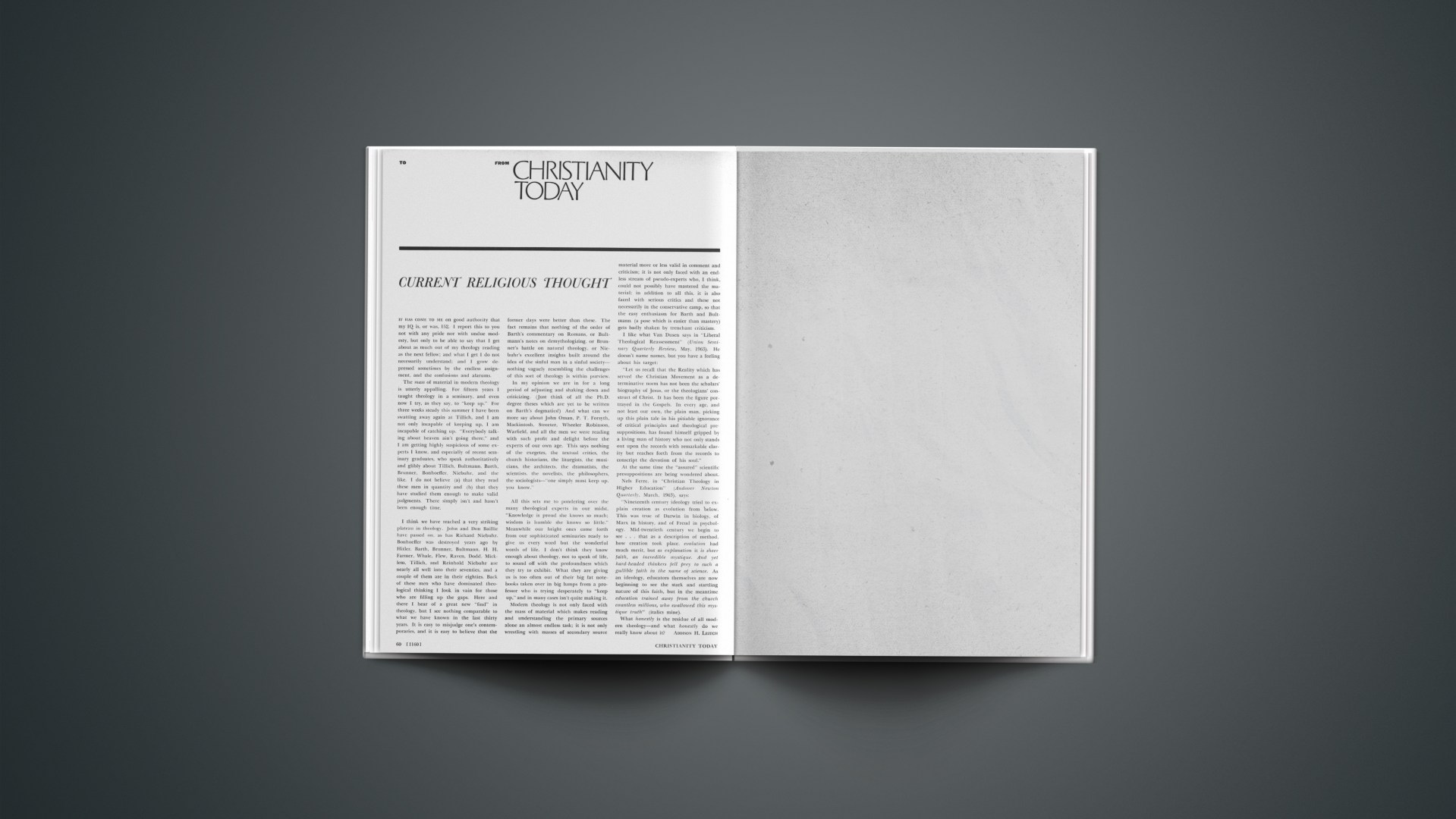
It has come to me on good authority that my IQ is, or was, 152. I report this to you not with any pride nor with undue modesty, but only to be able to say that I get about as much out of my theology reading as the next fellow; and what I get I do not necessarily understand; and I grow depressed sometimes by the endless assignment, and the confusions and alarums.

The mass of material in modern theology is utterly appalling. For fifteen years I taught theology in a seminary, and even now I try, as they say, to “keep up.” For three weeks steady this summer I have been swatting away again at Tillich, and I am not only incapable of keeping up, I am incapable of catching up. “Everybody talking about heaven ain’t going there,” and I am getting highly suspicious of some experts I know, and especially of recent seminary graduates, who speak authoritatively and glibly about Tillich, Bultmann, Barth, Brunner, Bonhoeffer, Niebuhr, and the like. I do not believe (a) that they read these men in quantity and (b) that they have studied them enough to make valid judgments. There simply isn’t and hasn’t been enough time.

I think we have reached a very striking plateau in theology. John and Don Baillie have passed on, as has Richard Niebuhr. Bonhoeffer was destroyed years ago by Hitler. Barth, Brunner, Bultmann, H. H. Farmer, Whale, Flew, Raven, Dodd, Micklem, Tillich, and Reinhold Niebuhr are nearly all well into their seventies, and a couple of them are in their eighties. Back of these men who have dominated theological thinking I look in vain for those who are filling up the gaps. Here and there I hear of a great new “find” in theology, but I see nothing comparable to what we have known in the last thirty years. It is easy to misjudge one’s contemporaries, and it is easy to believe that the former days were better than these. The fact remains that nothing of the order of Barth’s commentary on Romans, or Bultmann’s notes on demythologizing, or Brunner’s battle on natural theology, or Niebuhr’s excellent insights built around the idea of the sinful man in a sinful society—nothing vaguely resembling the challenges of this sort of theology is within purview.

In my opinion we are in for a long period of adjusting and shaking down and criticizing. (Just think of all the Ph.D. degree theses which are yet to be written on Barth’s dogmatics!) And what can we more say about John Oman, P. T. Forsyth, Mackintosh, Streeter, Wheeler Robinson, Warfield, and all the men we were reading with such profit and delight before the experts of our own age. This says nothing of the exegetes, the textual critics, the church historians, the liturgists, the musicians, the architects, the dramatists, the scientists, the novelists, the philosophers, the sociologists—“one simply must keep up, you know.”

All this sets me to pondering over the many theological experts in our midst. “Knowledge is proud she knows so much; wisdom is humble she knows so little.” Meanwhile our bright ones come forth from our sophisticated seminaries ready to give us every word but the wonderful words of life. I don’t think they know enough about theology, not to speak of life, to sound off with the profoundness which they try to exhibit. What they are giving us is too often out of their big fat notebooks taken over in big lumps from a professor who is trying desperately to “keep up,” and in many cases isn’t quite making it.

Modern theology is not only faced with the mass of material which makes reading and understanding the primary sources alone an almost endless task; it is not only wrestling with masses of secondary source material more or less valid in comment and criticism; it is not only faced with an endless stream of pseudo-experts who, I think, could not possibly have mastered the material; in addition to all this, it is also faced with serious critics and these not necessarily in the conservative camp, so that the easy enthusiasm for Barth and Bultmann (a pose which is easier than mastery) gets badly shaken by trenchant criticism.

I like what Van Dusen says in “Liberal Theological Reassessment” (Union Seminary Quarterly Review, May, 1963). He doesn’t name names, but you have a feeling about his target:

“Let us recall that the Reality which has served the Christian Movement as a determinative norm has not been the scholars’ biography of Jesus, or the theologians’ construct of Christ. It has been the figure portrayed in the Gospels. In every age, and not least our own, the plain man, picking up this plain tale in his pitiable ignorance of critical principles and theological presuppositions, has found himself gripped by a living man of history who not only stands out upon the records with remarkable clarity but reaches forth from the records to conscript the devotion of his soul.”

At the same time the “assured” scientific presuppositions are being wondered about.

Nels Ferre, in “Christian Theology in Higher Education” (Andover Newton Quarterly, March, 1963), says:

“Nineteenth century ideology tried to explain creation as evolution from below. This was true of Darwin in biology, of Marx in history, and of Freud in psychology. Mid-twentieth century we begin to see … that as a description of method, how creation took place, evolution had much merit, but as explanation it is sheer faith, an incredible mystique. And yet hard-headed thinkers fell prey to such a gullible faith in the name of science. As an ideology, educators themselves are now beginning to see the stark and startling nature of this faith, but in the meantime education trained away from the church countless millions, who swallowed this mystique truth” (italics mine).

What honestly is the residue of all modern theology—and what honestly do we really know about it?

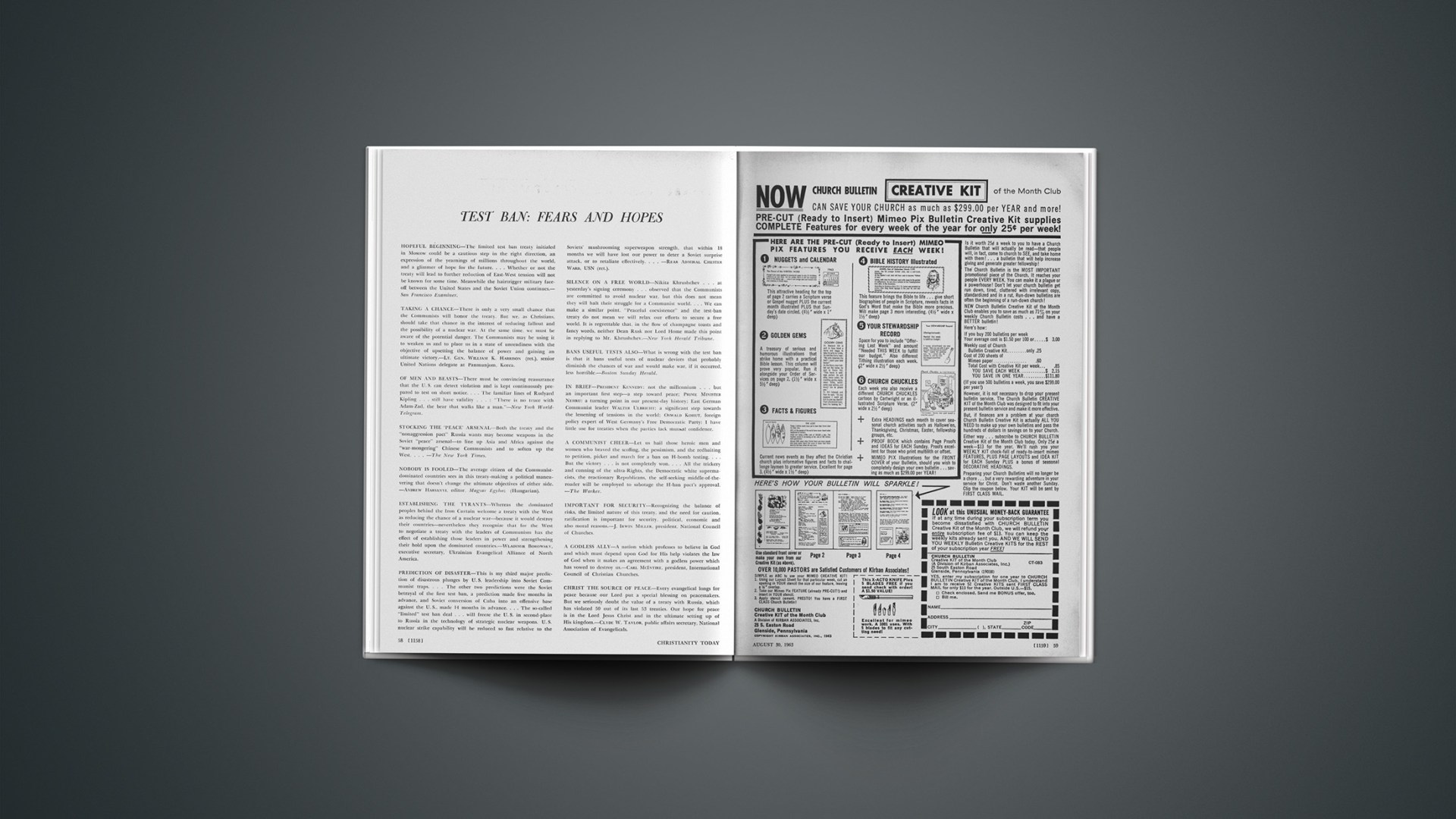
Test Ban: Fears and Hopes

HOPEFUL BEGINNING—The limited test ban treaty initialed in Moscow could be a cautious step in the right direction, an expression of the yearnings of millions throughout the world, and a glimmer of hope for the future.… Whether or not the treaty will lead to further reduction of East-West tension will not be known for some time. Meanwhile the hairtrigger military face-off between the United States and the Soviet Union continues.—San Francisco Examiner.

TAKING A CHANCE—There is only a very small chance that the Communists will honor the treaty. But we, as Christians, should take that chance in the interest of reducing fallout and the possibility of a nuclear war. At the same time, we must be aware of the potential danger. The Communists may be using it to weaken us and to place us in a state of unreadiness with the objective of upsetting the balance of power and gaining an ultimate victory.—LT. GEN. WILLIAM K. HARRISON (ret.), senior United Nations delegate at Panmunjom, Korea.

OF MEN AND BEASTS—There must be convincing reassurance that the U. S. can detect violation and is kept continuously prepared to test on short notice.… The familiar lines of Rudyard Kipling … still have validity …: “There is no truce with Adam-Zad, the bear that walks like a man.”—New York World-Telegram.

STOCKING THE ‘PEACE’ ARSENAL—Both the treaty and the “nonaggression pact” Russia wants may become weapons in the Soviet “peace” arsenal—to line up Asia and Africa against the “war-mongering” Chinese Communists and to soften up the West.…—The New York Times.

NOBODY IS FOOLED—The average citizen of the Communist-dominated countries sees in this treaty-making a political maneuvering that doesn’t change the ultimate objectives of either side.—ANDREW HARSANYI, editor, Magyar Egyhaz (Hungarian).

ESTABLISHING THE TYRANTS—Whereas the dominated peoples behind the Iron Curtain welcome a treaty with the West as reducing the chance of a nuclear war—because it would destroy their countries—nevertheless they recognize that for the West to negotiate a treaty with the leaders of Communism has the effect of establishing those leaders in power and strengthening their hold upon the dominated countries.—WLADIMIR BOROWSKY, executive secretary, Ukrainian Evangelical Alliance of North America.

PREDICTION OF DISASTER—This is my third major prediction of disastrous plunges by U.S. leadership into Soviet Communist traps.… The other two predictions were the Soviet betrayal of the first test ban, a prediction made five months in advance, and Soviet conversion of Cuba into an offensive base against the U. S., made 14 months in advance.… The so-called “limited” test ban deal … will freeze the U. S. in second-place to Russia in the technology of strategic nuclear weapons. U. S. nuclear strike capability will be reduced so fast relative to the Soviets’ mushrooming superweapon strength, that within 18 months we will have lost our power to deter a Soviet surprise attack, or to retaliate effectively.…—REAR ADMIRAL CHESTER WARD, USN (ret.).

SILENCE ON A FREE WORLD—Nikita Khrushchev … at yesterday’s signing ceremony … observed that the Communists are committed to avoid nuclear war, but this does not mean they will halt their struggle for a Communist world.… We can make a similar point. “Peaceful coexistence” and the test-ban treaty do not mean we will relax our efforts to secure a free world. It is regrettable that, in the flow of champagne toasts and fancy words, neither Dean Rusk nor Lord Home made this point in replying to Mr. Khrushchev.—New York Herald Tribune.

BANS USEFUL TESTS ALSO—What is wrong with the test ban is that it bans useful tests of nuclear devices that probably diminish the chances of war and would make war, if it occurred, less horrible.—Boston Sunday Herald.

IN BRIEF—PRESIDENT KENNEDY: not the millennium … but an important first step—a step toward peace; PRIME MINISTER NEHRU: a turning point in our present-day history; East German Communist leader WALTER ULBRICHT: a significant step towards the lessening of tensions in the world; OSWALD KOHUT, foreign policy expert of West Germany’s Free Democratic Party: I have little use for treaties when the parties lack mutual confidence.

A COMMUNIST CHEER—Let us hail those heroic men and women who braved the scoffing, the pessimism, and the redbaiting to petition, picket and march for a ban on H-bomb testing.… But the victory … is not completely won.… All the trickery and cunning of the ultra-Rights, the Democratic white supremacists, the reactionary Republicans, the self-seeking middle-of-the-roader will be employed to sabotage the H-ban pact’s approval.—The Worker.

IMPORTANT FOR SECURITY—Recognizing the balance of risks, the limited nature of this treaty, and the need for caution, ratification is important for security, political, economic and also moral reasons.—J. IRWIN MILLER, president, National Council of Churches.

A GODLESS ALLY—A nation which professes to believe in God and which must depend upon God for His help violates the law of God when it makes an agreement with a godless power which has vowed to destroy us.—CARL MCINTIRE, president, International Council of Christian Churches.

CHRIST THE SOURCE OF PEACE—Every evangelical longs for peace because our Lord put a special blessing on peacemakers. But we seriously doubt the value of a treaty with Russia, which has violated 50 out of its last 53 treaties. Our hope for peace is in the Lord Jesus Christ and in the ultimate setting up of His kingdom.—CLYDE W. TAYLOR, public affairs secretary, National Association of Evangelicals.

Evangelicals and the World Council

Two of the most significant recent developments in the life of the World Council of Churches center in relations with Orthodoxy and Roman Catholicism. A third relationship of major importance is that with the “conservative evangelicals.”

Few religious groupings are more difficult to define. In the United States it includes bodies as divergent as the Assemblies of God and the Wycliffe Bible Translators, the Free Methodists and the Christian Reformed Church, the Southern Baptists and the Missouri Lutherans. Its members generally hold in common a conservative theology; a concern for “purity” in the Church; a vivid missionary interest; and a profound distrust of the ecumenical movement. Perhaps the most precise definition, for the purpose of this article, is organizational: those Protestant Christians who refuse membership in councils of churches—city, state, national, or world.

The importance of this group in the United States is great. It includes the fastest-growing religious bodies in the nation. Membership of Protestant churches belonging to the National Council of Churches of Christ is about forty million; of churches who do not belong about twenty-four million.

The number of foreign missionaries of all agencies related to the Division of Foreign Missions of the National Council increased from 1952 to 1960 by 4.5 per cent; those of the conservative evangelicals by 149.5 per cent; the income for “foreign missions” of the former by 50.5 per cent; of the latter by 167.3 per cent. “Foreign mission” giving within member churches of the National Council in 1960 was $91,979,000; of those outside $71,700,000. Foreign missionaries of the former numbered in 1960, 10,324; of the latter 16,066.

Highly symptomatic of the situation in the United States today is the development of CHRISTIANITY TODAY. It was founded in 1955 as a voice for the conservative evangelicals. Its paid subscriptions now outnumber those of The Christian Century. Its influence is great.

A factor as deeply disturbing to many responsible conservative evangelicals, as to us, is the increasing radio influence of Carl McIntire. He is now heard weekly over 373 radio stations in forty-six states. While many leaders among the conservative evangelicals deeply reject his methods, he continues effectively to influence persons in their churches. This article deals not with him or his movement, but with leaders among the conservative evangelicals who are thoroughly responsible and deeply committed Christians of irenic spirit. To us in the conciliar movement they are a particularly important group. They share with us an intense concern for unity in the body of Christ, but approach that concern from a different perspective. Upon us is laid an inescapable obligation to understand their theological orientation, and the situations in which they make their witness. In approaching these brethren in Christ we must be guided by certain facts.

The Relationship Exists

Many of our congregations and ecclesiastical leaders seem to act as though there were no relations between them and the conservative evangelicals. The fact is, however, that the relationship exists. Many of the members of these rapidly growing groups are drawn from the “established” churches. Factors drawing our members to these groups often are a warmer fellowship; a more vivid sense of certainty in belief; stronger emphasis upon scriptural guidance and the discipline of prayer; greater assurance of the power of the Holy Spirit; emphasis upon the factors of faith healing and the second coming of Christ. We are related to these groups, moreover, by the very fact that so often they are able to reach many people whom we do not—in the inner city, in rural slums, in the labor class, in student groups. On not a few university and college campuses the Inter-Varsity Fellowship is both a larger and more disciplined group than the Student Christian Movement, though the latter often has stronger institutional and financial support. If we tend to forget the conservative evangelicals, they do not forget us. Relationships with the “established churches” and the conciliar movement are often a matter of passionate concern with them—though it be one of rejection. Moreover, the gulf between these two groups has been and is being exported around the world. It has become a major problem for the churches of Asia, Africa, Latin America, and the islands of the sea. Where Christians are a small minority of the population, the depth of the distrust which these groups feel toward councils of churches and the Christians who compose them becomes enormously expensive to the witness of the Church. For us to ignore the relationship worsens it, for thus we seem to give additional evidence of indifference to the very matters of spiritual vitality which they feel to be the reason for their separate existence.

Approaches Must Be Personal

The primary responsibility for seeking to bridge this gulf rests with us in the conciliar movement. Our churches are the older. Weaknesses in our churches are frequently the reason in the first instance for the development of these groups. If truly effective approaches are to be made they will have to come from us. Moreover, they will have to be made on a personal and entirely unofficial basis.

Some concerns of the World Council, and local councils, can usefully be handled by organizing a committee and delegating action to staff. Not here! In this relationship and at this stage, organizational action is doomed to failure. Distrust of the conciliar movement is so keen among many of the conservative evangelicals that organizational approaches only intensify the problem. Responsibility for seeking fellowship and understanding with these brethren in Christ rests upon us as individuals.

Approaches Must Be In Humility

It is not unusual in conciliar circles to hear persons concerned with this relationship saying that we must seek out these brethren because “they need us,” “they are endangered by their isolation,” “their neglect of the wider fellowship leads them into theological imbalance.” Such a condescending attitude, however disguised, is an effective disqualification for this task.

It is altogether appropriate that the approach we make to those conservative evangelicals who are willing to meet us even part way be made in real humility. Such should be the stance of a Christian in any case. In this case, however, there are special reasons. First is the fact that the very existence of these groups is a sign of spiritual failure in the older, established churches we represent. Second is the patent fact that they do have something to teach us—about missionary zeal; about the invasive power of the Holy Spirit; about some areas of Christian stewardship; about the practice of expectant evangelism; about communal prayer; as well as other elements in Christian discipleship.

A third reason for humility is the embarrassing fact that there will be no full reconciliation with these groups until, for one thing, many of our “settled” congregations become divinely unsettled by the movement of the Holy Spirit and begin to find their true life in Christ by losing it in glad witness to him. If we begin such approaches by fixing our gaze upon the mote in our brother’s eye we will be blinded indeed by the beam in our own.

A fourth reason for deep humility in our approach is the fact that most of us seek such fellowship in a situation of security, while they often meet us at real risk. It is probably almost impossible for most of us to realize the intensity of pressures under which the irenic persons in these groups live. The risks they run in consenting to meet with persons from the conciliar movement include in some instances loss of missionary money and candidates; in others severe and scathing criticism; in others dangerous division within their own groups. We will be freed from temptation to pride for taking initiative in such relationships if we realize the dangers which our initiative may involve for those whose fellowship we seek.

Their Concerns Have Validity

The following attempt to articulate the concerns of the conservative evangelicals, in relationship to the conciliar movement, may seem highly presumptuous. How does one, especially one not of that persuasion, generalize about the attitudes of persons who differ so widely themselves about so many things? One makes the attempt only because the need for understanding is so great. The background for these generalizations is a series of personal experiences of enormously rewarding fellowship in discussion and prayer with individuals and with groups including individuals from a number of the conservative evangelical bodies. Admittedly, the very persons whom one is able to meet in such fellowship from these groups are the most irenic of their leaders. To this degree of course, they are not typical. One prayerfully hopes that this attempt to compress many statements from widely differing persons in their fellowship is fair to them, and revealing to us.

To each of the concerns listed below there are certain almost predictable responses from the conciliar group. The obvious fact about such responses is that if we feel driven to make them we have missed the point. At this stage our basic concern ought to be neither to defend ourselves nor criticize our brethren. Of such response there is already much too much. Our need now is to understand. Therefore, what follows is an attempt to state the case from their point of view as persuasively as one is able. To affirm as in the heading above, that these concerns have validity, does not mean the writer believes they are entirely valid, or that they represent the full range of concerns with which the Christian must deal in this relationship. It does mean they have an important element of truth which deserves our serious and sustained attention.

‘Pure’ Versus ‘Inclusivist’ Church

The conservative evangelicals are deeply conditioned by the fundamentalist-modernist controversy. The feeling that a “modernist” is truly an enemy of the Church is widely felt. We are to love our enemies, but the enemy of the Church has no place within the Church. “The wisdom from above is pure …” (James 3:17). “Anyone who goes ahead and does not abide in the doctrine of Christ does not have God.… If any one comes to you and does not bring this doctrine, do not receive him into the house or give him any greeting …” (2 John 1:10). These verses are quoted with deep feeling. The conservative evangelicals are, in the great majority, committed to the doctrine of the “pure” Church. By that they mean one having in its fellowship only those who have had a genuine conversion experience. None of those the writer has met would claim their groups are “pure.” They do believe they have a greater concern than the major denominations have for purity of doctrine and of practice, and that such concern is both valid and necessary. They believe this understanding of the Church is much closer to the New Testament than the parochial orientation of the state churches of Europe, or of the sacramentarian orientation of the Catholic tradition.

An opinion survey of Protestant clergy recently conducted in the United States reported that 74 per cent would be classified as “fundamentalist” or “conservative,” 14 per cent as “modernist,” and 12 per cent as “neo-orthodox.” The willingness of churches to ordain “modernist” clergy—with the implied doubt as to the deity of Christ and the authority of Scripture—is a major source of distrust for the conservative evangelicals. They believe the New Testament enunciates a pattern of discipline for the maintenance of doctrinal purity, and that the abandonment of such discipline is a sign of indifference toward truth. They feel that such indifference is manifest in the practices of many “inclusivist” churches comprising the World Council of Churches, and in the WCC itself by its willingness to receive into membership churches of such a wide spectrum of theological persuasion. It is this “inclusivist” nature of the World Council and some of its member churches which makes many conservative evangelicals skeptical about the real meaning of the sound theological statements issued by the WCC.

Distrust Of Mechanical Unity

A significant number of the leaders of conservative evangelical groups were raised in churches committed to the conciliar movement. Some of them came into transforming experience of Jesus Christ in other religious circles than their own churches. Some found their new enthusiasm greeted with distrust in the churches of their birth. They believe that many in the established churches are either indifferent to or doubtful of the necessity of a new birth in Christ. They feel the true unity of Christians is based only upon the common experience of that new birth. Union to them has meaning only in “the bonds of the Spirit,” interpreting that phrase always in terms of their interpretation of “being born again.” Apart from the sharing of that experience, they feel there can be no spiritual unity. They see many in our churches who have no knowledge of such a rebirth. Church union among such groups therefore seems to them a mechanical matter, devoid of spiritual unity.

This seeming lack of real spiritual unity is to them a problem not only in plans for organic union but in the existence of the WCC itself. There is an uncritical tendency to assume that the World Council is responsible for the various plans of church union, and to blame the council for defects they see in such plans. Even were this misunderstanding to be cleared away, however, a serious reservation would remain about the basis of fellowship in the council. Definition of this reservation is not easy, but illustration is possible in regard to the questions of leadership, pronouncements on social issues, and “independency.”

They feel that a council of churches has no right to speak on any issue in the name of any more persons than just the individuals in attendance. The tendency to speak in the name of the churches seems to them a deliberate overriding of the convictions of the conservative minority. That tendency seems to them a vivid illustration of what they believe a basic problem in the conciliar movement, as well as in several of the churches constituting it. They feel that these churches and councils of churches are controlled by leadership which superimposes its will upon the council and upon the churches, and is not responsive to “the grass roots.”

There is a deep feeling that decisions in the conciliar movement are imposed from the top down, while those in the conservative evangelical bodies arise from “the grass roots.” They acknowledge fully that tyranny can exist in small groups, but believe that their groups are more protected from dictatorship by their greater emphasis upon shared Bible study, mutual intercession, group prayer, and intimate personal fellowship.

To them, of course, the principle of “independency” is essential. They feel the necessity of that principle is illustrated by the frequent action of the Holy Spirit in calling special Christian bodies into being, and refer to the Protestant movement from Rome: the Methodist movement from Anglicanism; the Holiness movement out of Methodism; the Pentecostal movement; the faith missions; and many others. The fact that the National and World Council admit to membership only recognized churches seems to them a clear denial of this principle of “independency.” The “monolithic character” of the National and World Council—to use a phrase often on their lips—is evidenced to them by the fact that neither has a place in its full membership for individuals, independent congregations, or faith mission boards.

Universalism

Related closely to the distrust of the World Council as being “inclusivist” is a fear of universalism in conciliar theology. Because some of the churches in this conciliar movement, and the World Council itself, admit persons of such widely differing viewpoints, they believe there is almost inescapably a latent universalism in “world council theology.” Their suspicions in this regard are powerfully reinforced by the fact that many of their ablest theologians: Jewett, Berkouwer, Van Til, Carnell, Kantzer, and others, believe that such influential men as both Brunner and Barth are at points “universalist” in theology. This criticism is presented with knowledgeable quotations from the original writings. This dangerous heresy seems to them even more discernible in the statements of many who are prominent in World Council discussions.

Ecclesiological Significance

In discussions with conservative evangelicals one is struck with the frequency with which the World Council is considered as though it were a church itself, and is criticized as such. They recognize that many in the council, as notably the Orthodox, insist that the council has no ecclesiological significance. Nevertheless, they believe it has. Their pre-existent distrust of the council is augmented by what they feel is the failure of the council to admit as yet the degree of ecclesiological significance which it undeniably has.

At this point one is impelled to comment on the alarming degree to which some of these friends let the World Council become for themselves a focus for a great deal of what might be called “floating anxiety.” One feels at times that they are not talking about the World Council at all, but about a shadow called the World Council of Churches in which they find dark confirmation of all the disappointments they have felt for years about the member churches of the council, from which so many of them have separated themselves. They seem to find it much easier to accept at face value any negative rumour about the conciliar movement than to give credence to any report of positive achievement. Thus many attribute to the council an ecclesiological significance which the council itself would deny. This practice obviously will not be terminated by the present study in the council on the subject.

Our Guiding Concern

Our guiding concern in this relationship and at this stage must be with the truth. Perhaps the point is more sharply made to say that our first concern must be truth rather than unity.

One reason is that these Christian brethren feel deeply that their own overriding concern is, and has to be, the truth. They insist that unity can only come on the basis of truth. They fear, deeply, that we subordinate truth to unity—and thus find neither. If we are to meet them on their own ground, we can do so only in consideration of the nature of Christian truth.

A second reason is that at this stage to let unity be our major concern may be for us a spiritual danger. We must keep our motives entirely free from even a hidden desire that in the name of unity we should seek to bring them into our organizational structure. To that desire and its slightest manifestation they are hyper-sensitive. They feel, deeply, that they are not approached by “ecumenicals” as brothers in Christ, but as people to be used for our organizational purposes.

A third reason is the obligation upon us to preach the full Gospel of Jesus Christ. The fullness of that Gospel we affirm in words. However, some points are more congenial than others; some points are easier for us to understand than others; some points are more pleasant to proclaim in our culture than others. Every one of us entrusted with the proclamation of the Gospel needs to be in continuing and deep fellowship with Christians who apprehend in depth some of the truths which have seemed to us remote. The more one has real communication with the irenic leaders of the conservative evangelicals the more one realizes that at certain significant points they have much to teach most of us who are called “ecumenicals” about some elements of the Gospel.

In closing, consider a haunting question stated recently by several conservative evangelicals. They said, “We know there are many true evangelicals in the World Council of Churches. There are more in the World Council circles than outside. We have to ask, therefore, why they have accomplished so little.” When one sees the futility of our churches in face of so many problems of our time, one finds no easy answer to their question. Perhaps the first requisite for fellowship with Christians who criticize us so deeply is not self-defense, but repentance that our witness is so limited. It may be that in such shared repentance we will find that given unity in which the truth of Christ is fully manifest, and whereby the world may be led to saving faith.

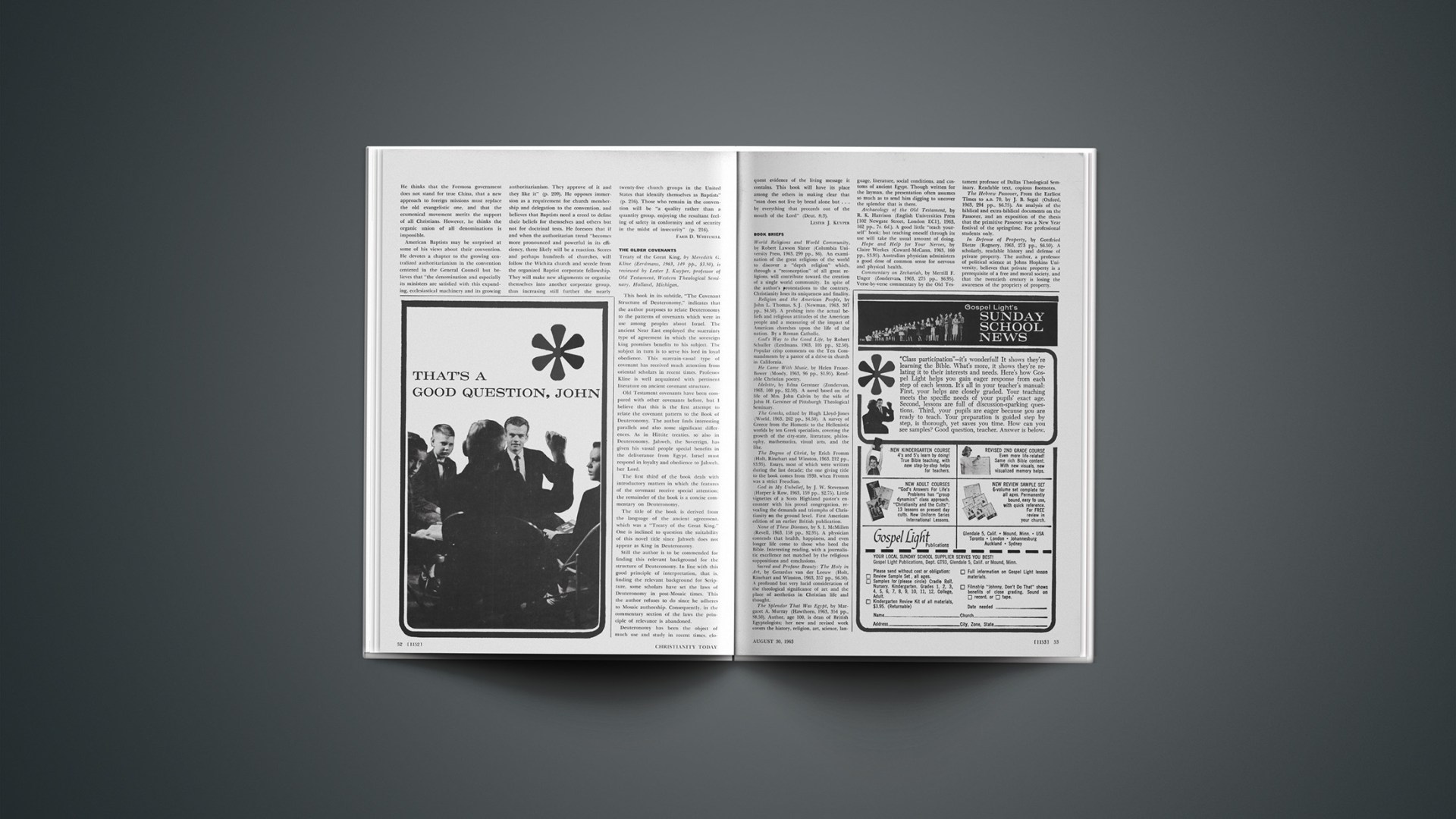
Book Briefs: August 30, 1963

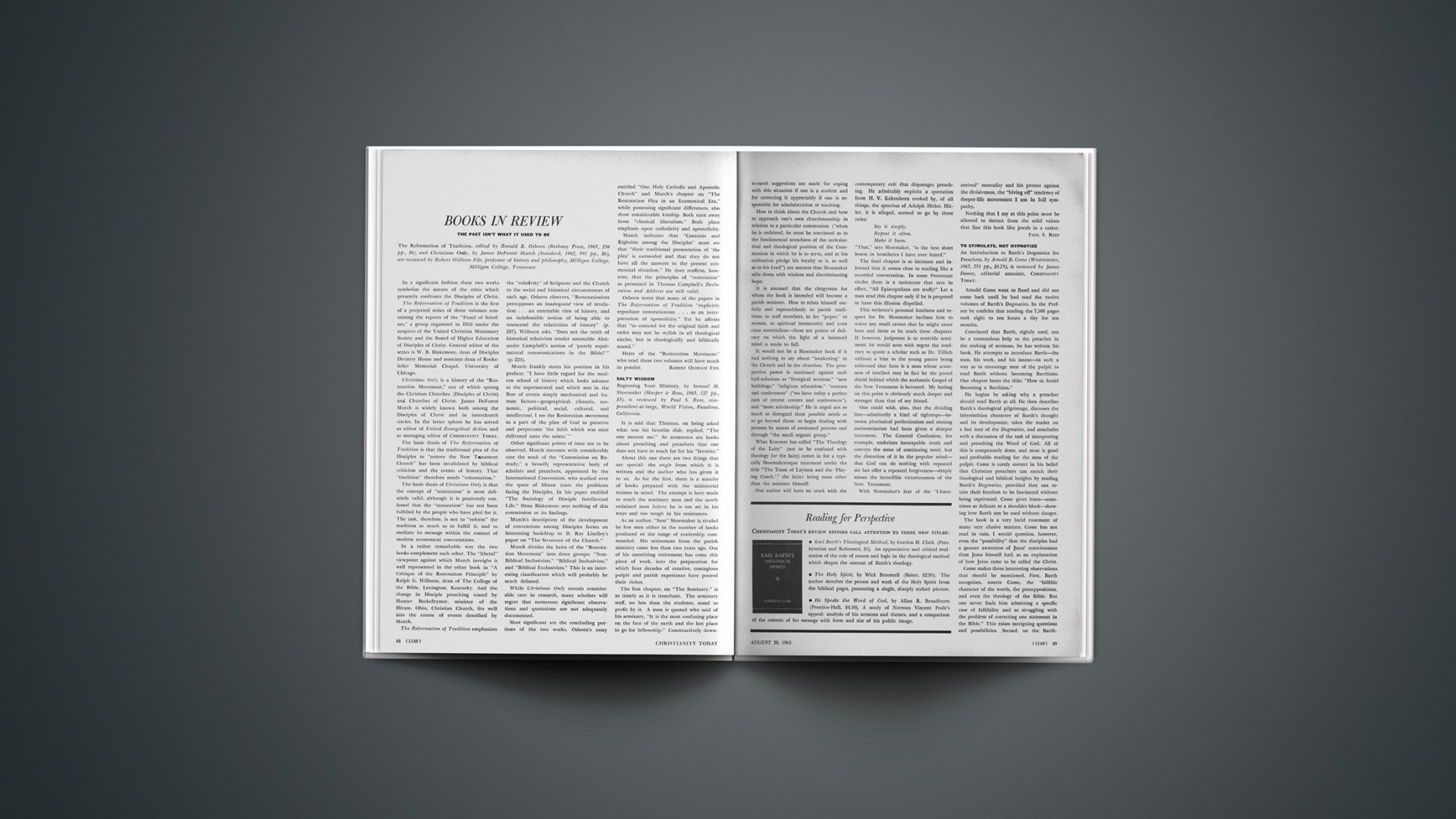
The Past Isn’T What It Used To Be

The Reformation of Tradition, edited by Ronald E. Osborn (Bethany Press, 1963, 336 pp., $6), and Christians Only, by James Deforest Murch (Standard, 1962, 393 pp. $6), are reviewed by Robert Oldham Fife, professor of history and philosophy, Milligan College, Milligan College, Tennessee.

In a significant fashion these two works symbolize the nature of the crisis which presently confronts the Disciples of Christ.

The Reformation of Tradition is the first of a projected series of three volumes containing the reports of the “Panel of Scholars,” a group organized in 1956 under the auspices of the United Christian Missionary Society and the Board of Higher Education of Disciples of Christ. General editor of the series is W. B. Blakemore, dean of Disciples Divinity House and associate dean of Rockefeller Memorial Chapel, University of Chicago.

Christians Only is a history of the “Restoration Movement,” out of which sprang the Christian Churches (Disciples of Christ) and Churches of Christ. James DeForest Murch is widely known both among the Disciples of Christ and in interchurch circles. In the latter sphere he has served as editor of United Evangelical Action and as managing editor of CHRISTIANITY TODAY.

The basic thesis of The Reformation of Tradition is that the traditional plea of the Disciples to “restore the New Testament Church” has been invalidated by biblical criticism and the events of history. That “tradition” therefore needs “reformation.”

The basic thesis of Christians Only is that the concept of “restoration” is most definitely valid, although it is penitently confessed that the “restoration” has not been fulfilled by the people who have pled for it. The task, therefore, is not to “reform” the tradition so much as to fulfill it, and to mediate its message within the context of modern ecumenical conversations.

In a rather remarkable way the two books complement each other. The “liberal” viewpoint against which Murch inveighs is well represented in the other book in “A Critique of the Restoration Principle” by Ralph G. Wilburn, dean of The College of the Bible, Lexington, Kentucky. And the change in Disciple preaching traced by Hunter Beckelhymer, minister of the Hiram, Ohio, Christian Church, fits well into the course of events described by Murch.

The Reformation of Tradition emphasizes the “relativity” of Scripture and the Church to the social and historical circumstances of each age. Osborn observes, “Restorationism presupposes an inadequate view of revelation … an untenable view of history, and an indefensible notion of being able to transcend the relativities of history” (p. 287). Wilburn asks, “Does not the truth of historical relativism render untenable Alexander Campbell’s notion of ‘purely supernatural communications in the Bible?’ ” (p. 224).

Murch frankly states his position in his preface: “I have little regard for the modern school of history which looks askance at the supernatural and which sees in the flow of events simply mechanical and human factors—geographical, climatic, economic, political, social, cultural, and intellectual. I see the Restoration movement as a part of the plan of God to preserve and perpetuate ‘the faith which was once delivered unto the saints.’ ”

Other significant points of issue are to be observed. Murch recounts with considerable care the work of the “Commission on Restudy,” a broadly representative body of scholars and preachers, appointed by the International Convention, who studied over the space of fifteen years the problems facing the Disciples. In his paper entitled “The Sociology of Disciple Intellectual Life,” Dean Blakemore says nothing of this commission or its findings.

Murch’s description of the development of conventions among Disciples forms an interesting backdrop to D. Ray Lindley’s paper on “The Structure of the Church.”

Murch divides the heirs of the “Restoration Movement” into three groups: “Non-Biblical Inclusivists,” “Biblical Inclusivists,” and “Biblical Exclusivists.” This is an interesting classification which will probably be much debated.

While Christians Only reveals considerable care in research, many scholars will regret that numerous significant observations and quotations are not adequately documented.

Most significant are the concluding portions of the two works. Osborn’s essay entitled “One Holy Catholic and Apostolic Church” and Murch’s chapter on “The Restoration Plea in an Ecumenical Era,” while possessing significant differences, also show considerable kinship. Both turn away from “classical liberalism.” Both place emphasis upon catholicity and apostolicity.

Murch indicates that “Centrists and Rightists among the Disciples” must see that “their traditional presentation of ‘the plea’ is outmoded and that they do not have all the answers to the present ecumenical situation.” He does reaffirm, however, that the principles of “restoration” as presented in Thomas Campbell’s Declaration and Address are still valid.

Osborn notes that many of the papers in The Reformation of Tradition “explicitly repudiate restorationism … as an interpretation of apostolicity.” Yet he affirms that “to contend for the original faith and order may not be stylish in all theological circles, but is theologically and biblically sound.”

Heirs of the “Restoration Movement” who read these two volumes will have much to ponder.

ROBERT OLDHAM FIFE

Salty Wisdom

Beginning Your Ministry, by Samuel M. Shoemaker (Harper & Row, 1963, 127 pp., $3), is reviewed by Paul S. Rees, vice-president-at-large, World Vision, Pasadena, California.

It is said that Thoreau, on being asked what was his favorite dish, replied, “The one nearest me.” So numerous are books about preaching and preachers that one does not have to reach far for his “favorite.”

About this one there are two things that are special: the angle from which it is written and the author who has given it to us. As for the first, there is a scarcity of books prepared with the ministerial trainee in mind. The attempt is here made to reach the seminary man and the newly ordained man before he is too set in his ways and too tough in his resistances.

As an author, “Sam” Shoemaker is rivaled by few men either in the number of books produced or the range of readership commanded. His retirement from the parish ministry came less than two years ago. Out of his unretiring retirement has come this piece of work, into the preparation for which four decades of creative, contagious pulpit and parish experience have poured their riches.

The first chapter, on “The Seminary,” is as timely as it is trenchant. The seminary staff, no less than the students, stand to profit by it. A man is quoted who said of his seminary, “It is the most confusing place on the face of the earth and the last place to go for fellowship.” Constructively down-to-earth suggestions are made for coping with this situation if one is a student and for correcting it appreciably if one is responsible for administration or teaching.

How to think about the Church and how to approach one’s own churchmanship in relation to a particular communion (“when he is ordained, he must be convinced as to the fundamental soundness of the ecclesiastical and theological position of the Communion in which he is to serve, and at his ordination pledge his loyalty to it, as well as to his Lord”) are matters that Shoemaker salts down with wisdom and discriminating hope.

It is assumed that the clergyman for whom the book is intended will become a parish minister. How to relate himself usefully and reproachlessly to parish traditions, to staff members, to lay “popes,” to women, to spiritual immaturity and even crass materialism—these are points of delicacy on which the light of a balanced mind is made to fall.

It would not be a Shoemaker book if it had nothing to say about “awakening” in the Church and in the churches. The prospective pastor is cautioned against such half-solutions as “liturgical revision,” “new buildings,” “religious education,” “retreats and conferences” (“we have today a perfect rash of retreat centers and conferences”), and “more scholarship.” He is urged not so much to disregard these possible needs as to go beyond them: to begin dealing with persons by means of awakened persons and through “the small organic group.”

What Kraemer has called “The Theology of the Laity” (not to be confused with theology for the laity) comes in for a typically Shoemakeresque treatment under the title “The Team of Laymen and the ‘Playing Coach,’ ” the latter being none other than the minister himself.

Our author will have no truck with the contemporary cult that disparages preaching. He admirably exploits a quotation from H. V. Kaltenborn evoked by, of all things, the speeches of Adolph Hitler. Hitler, it is alleged, seemed to go by three rules:

Say it simply.

Repeat it often.

Make it burn.

“That,” says Shoemaker, “is the best short lesson in homiletics I have ever heard.”

The final chapter is so intimate and informal that it comes close to reading like a recorded conversation. In some Protestant circles there is a caricature that says in effect, “All Episcopalians are stuffy!” Let a man read this chapter only if he is prepared to have this illusion dispelled.

This reviewer’s personal fondness and respect for Dr. Shoemaker inclines him to waive any small caveat that he might enter here and there as he reads these chapters. If, however, judgment is to override sentiment, he would note with regret the tendency to quote a scholar such as Dr. Tillich without a hint to the young pastor being addressed that here is a man whose acuteness of intellect may in fact be the proud shield behind which the authentic Gospel of the New Testament is betrayed. My feeling on this point is obviously much deeper and stronger than that of my friend.

One could wish, also, that the dividing line—admittedly a kind of tightrope—between pharisaical perfectionism and sinning antinomianism had been given a sharper treatment. The General Confession, for example, enshrines inescapable truth and conveys the sense of continuing need, but the distortion of it in the popular mind—that God can do nothing with repeated sin but offer a repeated forgiveness—simply misses the incredible victoriousness of the New Testament.

With Shoemaker’s fear of the “I-have-arrived” mentality and his protest against the divisiveness, the “hiving off” tendency of deeper-life movements I am in full sympathy.

Nothing that I say at this point must be allowed to detract from the solid values that line this book like jewels in a casket.

PAUL S. REES

To Stimulate, Not Hypnotize

An Introduction to Barth’s Dogmatics for Preachers, by Arnold B. Come (Westminster, 1963, 231 pp., $4.75), is reviewed by James Daane, editorial associate,CHRISTIANITY TODAY.

Arnold Come went to Basel and did not come back until he had read the twelve volumes of Barth’s Dogmatics. In the Preface he confides that reading the 7,500 pages took eight to ten hours a day for ten months.

Convinced that Barth, rightly used, can be a tremendous help to the preacher in the making of sermons, he has written his book. He attempts to introduce Barth—the man, his work, and his intent—in such a way as to encourage men of the pulpit to read Barth without becoming Barthians. One chapter bears the title: “How to Avoid Becoming a Barthian.”

He begins by asking why a preacher should read Barth at all. He then describes Barth’s theological pilgrimage, discusses the labyrinthian character of Barth’s thought and its development, takes the reader on a fast tour of the Dogmatics, and concludes with a discussion of the task of interpreting and preaching the Word of God. All of this is competently done, and most is good and profitable reading for the man of the pulpit. Come is surely correct in his belief that Christian preachers can enrich their theological and biblical insights by reading Barth’s Dogmatics, provided they can retain their freedom to be fascinated without being captivated. Come gives hints—sometimes as delicate as a shoulder-block—showing how Barth can be used without danger.

The book is a very lucid treatment of many very elusive matters. Come has not read in vain. I would question, however, even the “possibility” that the disciples had a greater awareness of Jesus’ consciousness than Jesus himself had, as an explanation of how Jesus came to be called the Christ.

Come makes three interesting observations that should be mentioned. First, Barth recognizes, asserts Come, the “fallible character of the words, the presuppositions, and even the theology of the Bible. But one never finds him admitting a specific case of fallibility and so struggling with the problem of correcting one statement in the Bible.” This raises intriguing questions and possibilities. Second, on the Barth-Bultmann question (how can one hear the Word of God unless one can understand the words), Come presents an analysis of what it means to understand, and then asserts that he does not believe the issue between Barth and Bultmann is as large as commonly thought. He seems to suggest not that Barth is as bad as Bultmann, but Bultmann is almost as good as Barth. Third, Come believes the most pervasive and determinative principle of Barth’s theology is that of analogia relationis, i.e., as the Father is related to the Son, so God is related to man, and man to his fellow man. This principle is also, says Come, the “most debatable.”

Come writes to make Barth available to preachers, but wants the latter stimulated, not hypnotized. I think he succeeds. If some find the reading of Barth too heady, it will not, I think, be Come’s fault.

JAMES DAANE

Fresh, Really!

Passion, by Karl A. Olsson (Harper & Row, 1963, 121 pp., $2.75), is reviewed by David A. Redding, minister, First United Presbyterian Church, East Cleveland, Ohio.

Dr. Karl A. Olsson is one president of a theological seminary who has lost touch neither with the Gospel nor with the religiously illiterate intellectuals. His approach to the passion of Christ is fresh and exciting. Really, this author is a literary wonder and restores the classic proportions to the Good News with academic dignity and elegant taste. He covers the eternal vastnesses in Scripture that keep getting lost in the shallows of convention and the cheap stereotype. This book offers a disturbingly bright blessing for any reader, but I believe it is particularly the kind of eloquent devotional writing required to rescue the attention of our generation from its determined materialistic fixations.

DAVID A. REDDING

Christian: Do It Yourself

The Outbursts That Await Us: Three Essays on Religion and Culture in the United States, by Arthur Hertzberg, Martin E. Marty, and Joseph N. Moody (Macmillan, 1963, 181 pp., $4.50), and Second Chance for American Protestants, by Martin E. Marty (Harper & Roiv, 1963, 175 pp., $3.50), are reviewed by John Warwick Montgomery, chairman, Department of History, Waterloo Lutheran University, Waterloo, Ontario, Canada.

A single, exceedingly important contemporary problem provides the backdrop and immediate occasion for these two works: the increasing tension between religion and society in America, as evidenced by the Supreme Court decision in June of last year (Engle vs. Vitale) forbidding the use of the so-called Regents’ Prayer in the public schools of New York State. In The Outbursts That Await Us, sophisticated theological representatives of Protestantism, Roman Catholicism, and Judaism present their reactions to an apparently growing “secularism” in the United States; in Second Chance for American Protestants, one of these writers virtually sets forth a theology for the new age in which the Reformation faith can less and less rely upon support from its social environment.

At first glance the alignments appear incongruous: Hertzberg and Marty are far closer to each other on the basic issue than are Moody and Marty. To Moody, representing enlightened American Catholicism, the Supreme Court decision marked a tragic decline in the generalized Christian values characteristic of American life; but to Rabbi Hertzberg and to the Lutheran Church—Missouri Synod’s Rev. Dr. Marty, Engle vs. Vitale can by no means be regarded as a tragedy. Hertzberg sees the court decision as a consistent attempt to separate church and state on the basis of the First Amendment, and as a Jew he rejoices to see that “only in America” Jews are finding a land in which religious “establishment”—even in general sociological terms—is less and less allowed to discriminate against minorities. He suggests darkly that the Roman Catholic reaction to the Supreme Court decision was motivated not simply by natural-law doctrine, but more especially by “the great problem of the future financing of the parochial schools”! Marty regards the court action as a clear indicator that the days of “placed,” secure, safe Protestantism in America are over, and that now, like Abraham and the saints described in the eleventh chapter of Hebrews, American Christians will have to seek “a better country, that is, a heavenly one”; no longer will they be able to rely on the culture to support a polite and innocuous faith—their “second chance” lies solely in “drawing on resources not wholly captive to this environment.” namely, the resources of God’s Word.

This reviewer finds the Marty thesis solidly biblical and eminently relevant to the present cultural situation. Evangelicals especially should ponder the fact that the most articulate Protestant objections to the Engle vs. Vitale decision came from theologians of the stamp of Bishop James Pike, John C. Bennett, and Reinhold Niebuhr; Niebuhr characteristically asserted that “the prayer seemed to be a model of accommodation to the pluralistic nature of our society.” In point of fact, the Gospel cannot be pluralized or accommodated without distortion, and the clear Reformation distinction between Law and Gospel has as its proper corollary a clear distinction between politics and religion.

The present review is being written on shipboard in the mid-Atlantic, and the “displaced” nature of the environment is hospitable for analyzing a proposal for “displaced” vs. “placed” Christianity. Two events aboard ship have added weight to Marty’s argument. The first was the front-page news article in Cunard’s Ocean Times informing us that the Supreme Court has now banned as unconstitutional any required use of the Lord’s Prayer or devotional Bible reading in public schools; thus Marty’s prophecy is further validated, and Protestants should be thankful that they now have no other recourse than to introduce young people to Christ through solid church teaching—that they can no longer lamely rely upon generalized moralistic “Bible reading” in the public schools to do a poor-at-best job for them. Second was the marked contrast between the “official,” “established” Sunday worship service (Anglican Morning Prayer, with lengthy petitions for the Queen, conducted with painful self-consciousness by a Ship’s Officer and attended by a pluralistic, equally uncomfortable congregation), and an almost spontaneous witness-by-songfest initiated by an anonymous passenger with a fine voice who played such numbers as “How Great Thou Art” on the lounge piano and soon had a crowd around him. In a pluralistic post-Christendom, believers had better wake up to the absolute necessity of serving as lights of the world by living and preaching the Gospel, not by expecting any form of generalized social or official establishment to do it for them.

JOHN WARWICK MONTGOMERY

As Seen From Deskside

Fifty Years an Editor, by William B. Lipphard (Judson, 1963, 256 pp., $3.95), is reviewed by Faris D. Whitesell, professor of preaching, Northern Baptist Theological Seminary, Chicago, Illinois.

Setting a record in fifty years of editorial service to one magazine, Missions of the American Baptist Convention, Dr. Lipphard gives us seventeen chapters of depth insights into his life and thought, rather than a formal autobiography. In flowing and gripping style, he puts the reader in a ringside seat to view the religious movements of the past half century.

Trained in Yale and the old Rochester Seminary, the author has upheld the liberal approach in his independent, hard-hitting editorials. He believes that churches should be more concerned about world poverty, the population explosion, the danger of nuclear war, and denominational rivalry.

He thinks that the Formosa government does not stand for true China, that a new approach to foreign missions must replace the old evangelistic one, and that the ecumenical movement merits the support of all Christians. However, he thinks the organic union of all denominations is impossible.

American Baptists may be surprised at some of his views about their convention. He devotes a chapter to the growing centralized authoritarianism in the convention centered in the General Council but believes that “the denomination and especially its ministers are satisfied with this expanding, ecclesiastical machinery and its growing authoritarianism. They approve of it and they like it” (p. 209). He opposes immersion as a requirement for church membership and delegation to the convention, and believes that Baptists need a creed to define their beliefs for themselves and others but not for doctrinal tests. He foresees that if and when the authoritarian trend “becomes more pronounced and powerful in its efficiency, there likely will be a reaction. Scores and perhaps hundreds of churches, will follow the Wichita church and secede from the organized Baptist corporate fellowship. They will make new alignments or organize themselves into another corporate group, thus increasing still further the nearly twenty-five church groups in the United States that identify themselves as Baptists” (p. 216). Those who remain in the convention will be “a quality rather than a quantity group, enjoying the resultant feeling of safety in conformity and of security in the midst of insecurity” (p. 216).

FARIS D. WHITESELL

The Older Covenants

Treaty of the Great King, by Meredith G. Kline (Eerdmans, 1963, 149 pp., $3.50), is reviewed by Lester J. Kuyper, professor of Old Testament, Western Theological Seminary, Holland, Michigan.

This book in its subtitle, “The Covenant Structure of Deuteronomy,” indicates that the author purposes to relate Deuteronomy to the patterns of covenants which were in use among peoples about Israel. The ancient Near East employed the suzerainty type of agreement in which the sovereign king promises benefits to his subject. The subject in turn is to serve his lord in loyal obedience. This suzerain-vassal type of covenant has received much attention from oriental scholars in recent times. Professor Kline is well acquainted with pertinent literature on ancient covenant structure.

Old Testament covenants have been compared with other covenants before, but I believe that this is the first attempt to relate the covenant pattern to the Book of Deuteronomy. The author finds interesting parallels and also some significant differences. As in Hittite treaties, so also in Deuteronomy, Jahweh, the Sovereign, has given his vassal people special benefits in the deliverance from Egypt. Israel must respond in loyalty and obedience to Jahweh, her Lord.

The first third of the book deals with introductory matters in which the features of the covenant receive special attention; the remainder of the book is a concise commentary on Deuteronomy.

The title of the book is derived from the language of the ancient agreement, which was a “Treaty of the Great King.” One is inclined to question the suitability of this novel title since Jahweh does not appear as King in Deuteronomy.

Still the author is to be commended for finding this relevant background for the structure of Deuteronomy. In line with this good principle of interpretation, that is, finding the relevant background for Scripture, some scholars have set the laws of Deuteronomy in post-Mosaic times. This the author refuses to do since he adheres to Mosaic authorship. Consequently, in the commentary section of the laws the principle of relevance is abandoned.

Deuteronomy has been the object of much use and study in recent times, eloquent evidence of the living message it contains. This book will have its place among the others in making clear that “man does not live by bread alone but … by everything that proceeds out of the mouth of the Lord” (Deut. 8:3).

LESTER J. KUYPER

Book Briefs

World Religions and World Community, by Robert Lawson Slater (Columbia University Press, 1963, 299 pp., $6). An examination of the great religions of the world to discover a “depth religion” which, through a “reconception” of all great religions, will contribute toward the creation of a single world community. In spite of the author’s protestations to the contrary, Christianity loses its uniqueness and finality.

Religion and the American People, by John L. Thomas, S. J. (Newman, 1963, 307 pp., $4.50). A probing into the actual beliefs and religious attitudes of the American people and a measuring of the impact of American churches upon the life of the nation. By a Roman Catholic.

God’s Way to the Good Life, by Robert Schuller (Eerdmans, 1963, 105 pp., $2.50). Popular crisp comments on the Ten Commandments by a pastor of a drive-in church in California.

He Came With Music, by Helen Frazee-Bower (Moody, 1963, 96 pp., $1.95). Readable Christian poetry.

Idelette, by Edna Gerstner (Zondervan, 1963, 160 pp., $2.50). A novel based on the life of Mrs. John Calvin by the wife of John H. Gerstner of Pittsburgh Theological Seminary.

The Greeks, edited by Hugh Lloyd-Jones (World, 1963, 262 pp., $4.50). A survey of Greece from the Homeric to the Hellenistic worlds by ten Greek specialists, covering the growth of the city-state, literature, philosophy, mathematics, visual arts, and the like.

The Dogma of Christ, by Erich Fromm (Holt, Rinehart and Winston, 1963, 212 pp., $3.95). Essays, most of which were written during the last decade; the one giving title to the book comes from 1930, when Fromm was a strict Freudian.

God in My Unbelief, by J. W. Stevenson (Harper & Row, 1963, 159 pp., $2.75). Little vignettes of a Scots Highland pastor’s encounter with his proud congregation, revealing the demands and triumphs of Christianity on the ground level. First American edition of an earlier British publication.

None of These Diseases, by S. I. McMillen (Revell, 1963, 158 pp., $2.95). A physician contends that health, happiness, and even longer life come to those who heed the Bible. Interesting reading, with a journalistic excellence not matched by the religious suppositions and conclusions.

Sacred and Profane Beauty: The Holy in Art, by Gerardus van der Leeuw (Holt, Rinehart and Winston, 1963, 357 pp., $6.50). A profound but very lucid consideration of the theological significance of art and the place of aesthetics in Christian life and thought.

The Splendor That Was Egypt, by Margaret A. Murray (Hawthorn, 1963, 354 pp., $8.50). Author, age 100, is dean of British Egyptologists; her new and revised work covers the history, religion, art, science, language, literature, social conditions, and customs of ancient Egypt. Though written for the layman, the presentation often assumes so much as to send him digging to uncover the splendor that is there.

Archaeology of the Old Testament, by R. K. Harrison (English Universities Press [102 Newgate Street, London EC1], 1963, 162 pp., 7s. 6d.). A good little “teach yourself” book; but teaching oneself through its use will take the usual amount of doing.

Hope and Help for Your Nerves, by Claire Weekes (Coward-McCann, 1963, 160 pp., $3.95). Australian physician administers a good dose of common sense for nervous and physical health.

Commentary on Zechariah, by Merrill F. Unger (Zondervan, 1963, 275 pp., $6.95). Verse-by-verse commentary by the Old Testament professor of Dallas Theological Seminary. Readable text, copious footnotes.

The Hebrew Passover, From the Earliest Times to A.D. 70, by J. B. Segal (Oxford, 1963, 294 pp., $6.75). An analysis of the biblical and extra-biblical documents on the Passover, and an exposition of the thesis that the primitive Passover was a New Year festival of the springtime. For professional students only.

In Defense of Property, by Gottfried Dietze (Regnery, 1963, 273 pp., $6.50). A scholarly, readable history and defense of private property. The author, a professor of political science at Johns Hopkins University, believes that private property is a prerequisite of a free and moral society, and that the twentieth century is losing the awareness of the propriety of property.

Paperbacks

Man’s Search for Meaning, by Viktor E. Frankl (Washington Square Press, 1963, 216 pp., $.60). During, and out of, years of experience in Nazi concentration camps, a Vienna professor developed his theory of logotherapy, i.e., the will to give meaning to one’s life. First published in 1959.

The Bible as Literature, by Buckner B. Trawick (Barnes & Noble, 1963, 182 pp., $1.25). A recital of Old Testament history and biography which never demonstrates the claim of the title, though its liberal theological position is on constant review.

A History of Religion on Postage Stamps, Vol. I, by F. Harvey Morse (American Topical Association [3306 N. 50th Street, Milwaukee 16, Wis.], 1963, 98 pp., $4). Religion as reflected on postage stamps from early times until the Reformation. With many illustrations.

Twentieth Century Christianity, edited by Stephen Neill (Doubleday, 1963, 432 pp., $1.45). Ten men describe the trends and events that have altered Christianity in the fast-moving twentieth century. Superbly done; fascinating reading for anyone who loves the whole church of Christ. First printed in 1961.

History and Future of Religious Thought: Christianity, Hinduism, Buddhism, Islam, by Philip H. Ashby (Prentice-Hall, 1963, 171 pp., $1.95). With charity for all and no evident preferential love for any, a teacher of religion at Princeton University summons four of the major world faiths to show the significance of their central tenets for all men.

Christian Doctrine, by J. S. Whale (Cambridge, 1963, 197 pp., $1.25). A presentation of the basic beliefs of Protestant Christianity with an unobtrusive erudition and a clarity that will be a joy to the average reader. A work of quality. First printed in 1941.

The Century of the New Testament, by E. M. Blaiklock (Inter-Varsity, 1962, 158 pp., $1.25).

The Gospel Miracles and Many Things in Parables, by Ronald S. Wallace (Eerdmans, 1963, 379 pp., $1.95). Sound perceptive interpretations of parable and miracle that echo their meanings for today. Reprints.

Mister/Madam Chairman …, by Edmund B. Haugen (Augsburg, 1963, 65 pp., $1.75). A brief, clear explanation of the basic rules governing parliamentary procedure.

Make Your Preaching Relevant, by Jack D. Sanford (Broadman, 1963, 93 pp., $1.50). A simple but fine discussion about preaching that will goad and summon the preacher to really preach.

Kierkegaard’s Way to the Truth, by Gregor Malantschuk (Augsburg, 1963, 126 pp., $2.50). A brief lucid introduction not to the writings but to the thought of Kierkegaard, particularly as expressed in his analysis of the aesthetic, ethical, and religious stages of life.

Zechariah Speaks Today, by A. A. Van Ruler (Association, 1963, 79 pp., $1). The thought of a difficult prophet rendered clear, devotional, and relevant, by a Dutch professor.

Peace on Earth (Pacem in Terris), encyclical letter of Pope John XXIII (Daughters of St. Paul [50 St. Paul’s Avenue, Boston 30, Mass.], 1963, 64 pp., $.25).

News Worth Noting: August 30, 1963

Church Night

Public school officials in the Harrisburg, Pennsylvania, area are being asked to set aside a “church night” in scheduling their weekly programs. John M. Staz, president of the United Churches of Greater Harrisburg, suggested that Wednesday evenings be set aside by school officials so that students will be free to attend services.

Protestant Panorama

The first Protestant university in the Congo will open at Stanleyville in the fall. Classes will be conducted in both English and French. Although an intensive financial campaign is under way in the Congo, most of the financing of the university must come from American and European churches.

Southern Baptists are reorganizing their home mission program. A special department of survey and special studies is being created. In all, the home missions board’s projects will be increased from seven to fourteen.

Christian Churches (Disciples of Christ) plan two special offerings in October to raise $300,000 for an emergency program in moral and civil rights. Some of the money will be given to Negroes hit by economic reprisals and some to ministers evicted from pulpits because of their stand on race.

Delegates to the annual conference in Rome of the Evangelical Methodist Church of Italy voted to support the calling of an Italian Evangelical Conference. Church officials anticipate that such an assembly will be held in the fall of 1964.

Scofield Memorial Church of Dallas, Texas, will inaugurate a “Southland Keswick Convention” next year. The first of the conventions will be held January 19–26. It will be directed by Dr. Harlin J. Roper, pastor of the Scofield Memorial Church.

Miscellany

The crash of a single-engine plane in Guatemala claimed the life of missionary pilot Joel Paul Robertson of Air Crusade, Inc. A fellow missionary said the engine failed during a Scripture-distribution flight.

The Post Office Department unveiled its design for the 1963 Christmas stamp. The special five-cent stamp features a three-color reproduction of the nation’s Christmas tree with the White House in the background.

There were 373 Protestant churches which sponsored credit unions as of the end of 1962, according to a report by the Credit Union National Association.

Columbia Pictures signed a $20,000,000 agreement with Italian movie producer Dino de Laurentis to film The Bible, a screen epic concentrating mostly on the Old Testament.

More than 100 business and professional men in the Southeastern United States are forming a national foundation for “broadening the audience” of evangelist Tom Haggai. A Southern Baptist, the 32-year-old Haggai has been in increasing demand as a speaker on a national scale.

UNESCO’s annual bibliography of translations says the Bible once again ranks as the world’s most-translated book.

Personalia

Five Years Meeting of Friends elected a Whittier, California, housewife, Mrs. Helen Walker, as presiding clerk, top post in the Quaker organization. She is the first woman ever named to the office.

Dr. Joseph R. Washington, Jr., Negro scholar and a Methodist minister, named dean of the chapel at Dickinson College.

Peter Day, editor of The Living Church, appointed “ecumenical officer” of the Episcopal National Council.

The Rev. Eli F. Wismer named general director of the National Council of Churches’ Commission on General Christian Education.

The Rev. J. H. Quiring appointed president of Mennonite Brethren Bible College.

Dr. Douglas B. MacCorkle elected president of Philadelphia College of Bible.

The Rev. Roger Goodman elected moderator of the Baptist General Conference.

The Rev. William J. Reseigh elected to the newly created office of executive secretary of the Primitive Methodist Church.

Dr. James H. Hunter appointed editor of The Evangelical Christian.

The Rev. Youngve R. Kindberg elected general secretary of the New York Bible Society.

Dr. Helen Kim, noted Korean Christian educator, awarded the $10,000 Ramon Magsaysay prize of public service.

Worth Quoting

“We want to show that Christianity does not permit a person to organize life like Time magazine—a place for politics, a page for business, religion in its section in the back. The Gospel must permeate every area of life.”—Paul A. Schreivogel, associate director of the Lutheran Church—Missouri Synod’s Walther League, at a press luncheon prior to the league’s convention in Washington.

“I was asked to bring a request for more missionaries.”—Jean-David Mukeba, press secretary to Congo President Joseph Kasa-vubu, in an address to members of the Presbyterian U. S. Board of World Missions.

DEATHS

DR. ARNOLD T. OHRN, 74, retired general secretary of the Baptist World Alliance; in Oakland, California.

DR. F. FISHER SIMPSON, 76, retired editor of The Texas Methodist; in Fort Worth.

FRANK MILLARD, 66, general secretary of the Scripture Union of South Africa; in Bideford Devon, England.

The European Scene: Modern Man and Justification by Faith

The fourth congress of the Lutheran World Federation, largest church meeting ever convened in Helsinki, opened with a service of worship which was attended by Dr. Urho Kekkonen, president of the Finnish Republic, and televised via Eurovision and Nordvision to an estimated twenty million viewers. In his sermon, seventy-year-old Archbishop Ilmari Salomies of the Church of Finland warned: “Christian faith which by its worldliness loses its connection with eternity, has signed its own spiritual death sentence.” The offering at this service was earmarked for relief work in the devastated Yugoslav city of Skoplje.

With the general theme of “Christ Today,” the assembly had as its chief task a thorough examination of the Reformation doctrine of justification by faith and how this doctrine is still relevant in a modern world. It was just here that the congress became bogged down. To an incredibly involved report on the subject (prepared by a theological commission over several years) was added an incredibly confused discussion. This provoked one professor in a press conference to refer to justification as “this horrible word.” Finally, the assembly could not agree even on the wording of a “contemporary statement” on the doctrine, and in what seemed an admission of defeat, referred the matter to its new commission on theology “for refinement.” No document ever had less need of added refinement. One journalist hit the nail squarely when at a press conference he expressed surprise at finding differing conceptions of Lutheran doctrines at a Lutheran gathering. He pointed out also that some of the federation leaders who were pressing for a restatement of Lutheran teachings in down-to-earth modern terms were themselves speaking a language that the ordinary man does not understand. Confronted with something like half a million words of reports, documents, and news releases, the ordinary journalist could feelingly echo the comment of a boy who, given a detailed book on penguins, complained:

“This tells me more about penguins than I want to know.”

At a visitors’ program, Professor Charles K. Woltz of Charlottesville, Virginia, saying that the Church has not found a way to talk to modern man, outlined the latter’s plight thus: “Made too arrogant by his new knowledge of science … he exploits and despoils a creation he cannot explain.… He is brought by modern communication face to face with his brothers throughout the world, but sees in them only potential, if not actual, enemies. He lives amid terrible stresses. But worst of all he lives in the shadow of the lunatic fear that there is no purpose or meaning to his living. For such a one Christ is indeed the only hope.” Lawyer Woltz’s main point was that laymen have an essential ministry which the clergy are ill-equipped to perform.

THE WORLD AND GOD

A study document submitted in Helsinki by the Lutheran Church of Hungary noted that a relevant witness cannot be attained by discarding “the ‘theological’ terminology of our confessional writings” and replacing them with “an apparently more modern and ‘theologically unencumbered’ vocabulary.”

“It has become a fashion to speak about the secularized condition of modern humanity: the man of today is not interested in salvation, he does not care for the transcendent dimensions of his existence, he does not ask for the reality of God, still less does he know the primary question of the Reformation doctrine of justification about the gracious God. From this observation some conclude that the problems of the doctrine of justification have had their day and are pointless for our contemporaries.

“In view of the relevant teachings of our confessions, we have no reason to be surprised, if men today do not care for God, neither believe in Him, do not know Him and do not seek His grace.… Man is unable of himself to believe in Jesus Christ, or to come to Him.… It could be only on the grounds of an anthropology alien to our doctrine of justification that we may expect something else of the modern world.…”

Dr. Clifford E. Nelson of St. Paul, Minnesota, suggested that one of the sad facts of Lutherans’ history was that they have more often been drawn together by common disaster than by common doctrine. He urged that Lutherans should put their own household of faith in order by entering into immediate fellowship with other Lutherans.

Meanwhile philatelists were commenting on what they regard as the first stamp in the world having a likeness of the face of Christ. Commemorating the LWF gathering, it was one of two stamps issued; both had the assembly’s motto, “Christ Today,” in Finnish and Swedish, the two official languages of the country.

Dr. Sigurd Aske, general director of LWF’s “Voice of the Gospel” radio station in Addis Ababa, said that “the Christian church is doing a far better job talking to itself than in proclaiming Christ to the world. Being aware of that weakness may help us to avert the danger of Radio Voice of the Gospel degenerating into an extremely expensive international Christian house-telephone.”

The assembly was told baptized membership of world Lutheranism totaled more than fifty-six million; called on its member churches not in pulpit and altar fellowship with other member churches to justify their position; accepted eleven applications for membership, including the Lutheran Churches of Latvia and Estonia (these countries, with Lithuania, are represented also by churches-in-exile, with respective headquarters in the United States, Sweden, and Germany). Some tension was evident in the assembly at this latter point, and thirteen delegates voted against acceptance of the Latvian and Estonian churches.

The assembly employed forty-one translators, and the extremely detailed proceedings taxed their resources. At the close of one meeting a tiring interpreter heard a speaker say in English, “And now to finish, ladies and gentlemen …” and translated into the German the words, “And now two Finnish ladies and gentlemen.…”

Father Johannes Witte, S.J., one of two official Roman Catholic visitors, said in answer to a press question: “Roman Catholics cannot acknowledge the Lutheran church as the true church, because Jesus Christ founded one church and this one church is guaranteed by Jesus Christ himself until the end of time.” He added that the most crucial question facing both sides is the nature of the Church. Said Dr. Peter Blaeser, the other Roman Catholic: “I feel that I really belong.” He said that while he had found a variety of opinions in Protestant theology, the “extremes” of Protestant theology were not represented at the assembly. Somewhat enigmatically he continued: “There is much more piety in the Lutheran churches than Lutheran theology shows.”

A burning issue in world Lutheranism centers on ordination of women. While German churches have several hundred ordained women pastors (Vikarinnen), Norway has only one, Sweden has seven (against continued opposition), and Denmark and Finland have not ordained any so far, though women are serving a number of congregations. The Church of Finland faces a curious situation in that 44 per cent of all enrolled students in Finnish theological seminaries are women. Said one woman theologian in Helsinki: “At the assembly we expected to welcome American sisters in our profession. But we could not find any.” (All American Lutheran bodies oppose ordination of women.) Differences of opinion on the subject were cited at the congress, ranging from “how can a woman preach—was it not a man who was crucified?” to “a pastor’s office is nowadays so different from New Testament times—so why can’t a woman pastor work in her profession just as a woman doctor or woman engineer?”

An American churchman was named to succeed an American as president of LWF. Dr. Fredrik A. Schiotz of Minneapolis, president of the American Lutheran Church, was elected as the fourth head of the federation at the closing plenary session. Dr. Schiotz, 62, will assume leadership of the international church organization from Dr. Franklin Clark Fry of New York, president of the Lutheran Church in America, who has just completed a six-year term in office.

The LWF brought its assembly to a close with a colorful outdoor festival in Helsinki’s Olympic Stadium. By proclamation of Archbishop Ilmari Salomies, church bells of local parishes throughout Finland rang out promptly at 3 P.M. as the meeting (estimated attendance in excess of 20,000) got under way. An address of welcome in four languages was given by Bishop E. G. Gulin of Tampere (Finland’s second largest city), and Martin Luther’s triumphant Reformation hymn fittingly concluded the congress.

The Lutheran Church—Missouri Synod is not a member of the LWF because of the latter’s position on church fellowship. Telling this to a press conference in Helsinki, the president of the 2,600–000-member U. S. Lutheran church body, Dr. Oliver R. Harms, added that this did not close the door on the possibility of future Missouri Synod membership in the LWF. In reply to a reporter’s question, Dr. Harms said the synod’s observers regarded some of the present congress’ statements on justification as “unclear.”

Eight African and three European churches were accepted into LWF membership. Largest among them were the Latvian Evangelical Lutheran Church (400,000 members) and the Estonian Evangelical Church (350,000 members). Also welcomed were the East German Evangelical Lutheran Church of Eutin (104.466 members), the Evangelical Church in North-West Tanganyika (60,170 members), and the Lutheran Church of Southern Tanganyika (96,000 members).

The Development Of Splendor

On the eve of the resumption of Vatican Council II more than one Protestant observer is pondering the possibility of doctrinal and ecclesiastical reform within the Roman Catholic Church. Will Rome’s talk of reform pass into reformation? Is the Holy Spirit beginning to revive the theologically delinquent and traditionally rigid Church of Rome? World Council ecumenics find hope for an affirmative answer to these questions in Rome’s cordial reception and informal consultation of non-Roman delegate observers at the first session.

But the outlook of the WCC is misleading, says theologian Karl Barth in a current issue of the World Council’s Ecumenical Review. In the first place, increased Roman Catholic interest in the views of non-Roman ecclesiastics is motivated not by the wish to discuss, doctrine with them, but by the desire to know them better and more ably to present to them the true essence of the Roman church. “Its ultimate goal … is the development of its own splendor.”

This is not to say that reformation of Roman theology is not already under way, says Barth. The preoccupation of the World Council with broadening dialogue with Rome has largely overshadowed the “spiritual movement actually taking place” within the Roman fold. Barth sees an industrious and fruitful concern for biblical studies on the part of Roman clerics, an exaltation of the Gospels, surprisingly new interpretations of Tridentine theology. Is all this not “the beginning of a reorganization … around the Gospel?” Through this renewed concern for Scripture, Barth asks “has not Jesus Christ inevitably stepped anew into the center of faith of the Roman Christians and the thought of Roman theologians?”

If this is true, suggests Barth to the leaders of the WCC, then “we should direct our attention far more to what is beginning to appear as a movement of renewal ‘within’ the Roman Church, to what in fact has partially already been set in motion, rather than to the possibilities of a loyal correspondence between us …”

But not all ecumenical leaders agree. “Barth talks as if these things have happened,” WCC General Secretary W. A. Visser ’t Hooft comments. “There is a schema, but we must wait for the realities to come to pass.”

Ecclesiastical Coexistence

In Moscow, the Russian Orthodox Church announced formation of a new Committee on Questions of Christian Unity.

Named to head the committee was the articulate 33-year-old priest, now Metropolitan Nicodim, whose rise to ecclesiastical fame in the Soviet Union has been so meteoric as to arouse wide suspicion.

The committee was set up to replace a commission on relations between Christian churches which had been headed by Metropolitan Pitirim of Krutitsky and Kolomna. It has been instructed to work “thoroughly and attentively on the problems of Christian unity,” said a statement issued by the church’s Holy Synod.

The statement stressed that the committee was being organized in response to the “vivid demonstration of the bonds between the churches” witnessed when representatives of “almost all the Christian denominations, including Roman Catholics and Protestants,” attended celebrations in Moscow last month marking the fiftieth anniversary of Patriarch Alexei’s episcopal consecration.

The bearded Nicodim, easily the best known of all Soviet clergymen, was given the title Metropolitan of Rostov and Yaroslavl only a few weeks ago. It makes him the second-ranking figure in Russian Orthodoxy. Only once before—in the seventeenth century when Archbishop Peter Mogila of Kiev was given the title of Metropolitan at the age of thirty-two—had a prelate in his thirties been raised to that rank.

How to Live with Conflicts

The following report was prepared forCHRISTIANITY TODAYby Dr. Harold B. Kuhn, professor of philosophy of religion, Asbury Theological Seminary:

Meeting in Dortmund July 24–28, the eleventh Deutscher Evangelischer Kirchentag (All-German Protestant Congress) continued the eighteen-year attempt by German Protestantism to make itself vitally effective in the life of the German Federal Republic. To a significant degree, the tone of the congress was set by its location. Reminded by Dortmund of the energetic quality of life in the massive industrial complex of the Ruhr valley, the Kirchentag was led to an emphasis upon the practical qualities of Christian living and of Christian responsibility within the Church.

In addition to the standing issues which face the German Protestant church, this year’s congress faced some specific issues with a new vigor. The problems of life in the industrialized society were far more urgent this year than at Munich (1959) or Berlin (1961). The complexities of life for the “industrial man” have brought German Protestantism face to face with the question: Will Christianity continue to exist as a force in German life in the half-century ahead? Many church leaders fear that Christianity may become little more than a pious hobby of the very young and the very old. This sombre possibility entered in some way or other into most of the discussions.

At a time when the chairman of the Montreal Faith and Order Conference of the WCC was calling for increased attention to the Bultmannian theology, surprisingly little was said about “demythologizing” or “communication.” Instead, emphasis lay on the quality of Christian life which will make the Gospel relevant to the complexities of the modern age. In this connection, the speakers and discussion leaders were at times surprisingly blunt. No effort was made to bypass painful subjects. Deep concern was expressed lest the German church continue to be merely culture-conforming and culture-affirming. Sharp criticism was offered of the practical, creeping type of materialism which infects the West. Predictably, Dr. Martin Niemoeller reminded the Kirchentag that the “practical atheism” of the free world is spreading more rapidly (and certainly more insidiously) than the “official atheism” of the Communist empire.

Two major concerns seemed to trouble a number of German leaders. First, some of the presentations were haunted by the manner in which large segments of the Church had capitulated to the totalitarian state from 1933 to 1945. Second (and even more noticeable), the genocidal attack of the Nazi state upon Jewry seemed a continuing burden upon the German conscience. Most encouraging was the emphasis upon projects for reparation and reconciliation in areas outside Germany where the decimation of the Jewish community was so great during Germany’s “great apostasy.”

The major thrust of the Kirchentag in the area of the individual Christian life was toward a realization of personal responsibility. Over and over the speakers and group leaders laid emphasis upon the necessity for responsible individual action—upon sincere participation in public life at all levels. In this connection the programming included evening street-preaching missions in blighted districts and youth witnessing in one of the nearby cabarets.

The role of Protestantism in a pluralistic society seems at first glance to be the same everywhere, but the discussions of the relation of the Church to education in West Germany indicated that the problem has different dimensions here than in the United States. In this area, too, German Protestantism is trying to find her way.

Most encouraging to this reporter was the manner in which several of the speakers faced the problem of maintaining a vital Christianity in a situation in which 95 per cent of the population are, almost by virtue of birth, members of some church. With great forthrightness the speakers called the congress to face the fact that when the Church becomes “naturalized” in the world, the world in turn loses interest in her message and her ministration. How can the Church be “not of the world” and yet effective in the world? The answer proposed—and this with much emphasis—was a responsible, personal relationship of the individual to the Lord of the Church by which the resources of his life are brought into the Church’s service.

It is scarcely necessary to note that the Kirchentag is a movement whose basic thrust comes from the laity. While clergy were in evidence, Christian laymen from all walks of life were vocal at all planes of the congress’ activity. Unfortunately, no representatives were present from Eastern Germany, despite every effort to secure the necessary permits for delegates from the Soviet zone. To maintain some contact with the “separated brethren,” leaders of the Kirchentag have during past weeks encouraged East German Christians to hold brief Kirchentag-like meetings at Erfurt, Zwickau, and Goerlitz.

With respect to the physical arrangements for this year’s Kirchentag, it was laudable that mammoth crowds were handled with typical efficiency and great courtesy. As of Saturday morning, there was an enrollment for the congress of nearly 14,000, with an equal number of single day-registrations for the day preceding. The opening gathering numbered 50,000. Attendance was reported to be 300,000 at the mass, open-air meeting on the closing Sunday afternoon. At this final assembly—with such noted leaders in attendance as Heinrich Luebke, president of the German Federal Republic, Bishop Otto Dibelius, Kurt Scharf, and D. Ernst Wilm—the overall theme of the Kirchentag, Mit Konflikten Leben (“How to Live with Conflicts”), received dramatic presentation.

Happily the Kirchentag was not smothered by masses of registrants or by statistics. Careful planning served to distribute the participants in such a way that none needed to feel lost in the totality of the congress. But this effect was produced quite as largely by the emphasis of the Kirchentag upon the element of individual responsibility.

There was relatively little of the “Let us, therefore … and much of the “Accept therefore your own obligation for …”

To this reporter this was the sign and token of hope for a renewed effectiveness of German Protestantism in her land.

There were discussions which obviously concerned the German participants most deeply. Other efforts dealt with issues which are meaningful to Christians as a whole. Several scores of visitors from other lands, including this reporter and his wife, found not only a deep warmth of welcome but also a time of spiritual uplift and intellectual stimulation. One got the feeling that the Kirchentag contains many deeply earnest persons—predominantly lay persons or clergymen who are lay-minded. Having lived under gray political and spiritual skies for some decades, these persons now deeply feel that Jesus Christ has something to say through them to a nation which is obviously taking a large place in the world. These thousands of persons profoundly hope that this new place in the sun may be informed by the Sun of Righteousness.

The Illusion Of Silence

Bishop Otto Dibelius charged that the Kirchentag in Dortmund deliberately bypassed the conflicts and problems caused by Germany’s political situation, although the theme of the congress was “How to Live with Conflicts.”

The plight of millions of Christians in Communist East Germany is one on which attention must be continuously focused, he declared in a radio broadcast.

“While it was understandable,” said the head of the Evangelical Church of Berlin-Brandenburg, “that the congress wanted, as far as possible, to keep out of politics … it was hardly appropriate that the distress of our Eastern brothers was mentioned only marginally.”

Dibelius declared that “if we talk about conflicts, the conflicts which pose themselves because of the political situation of millions of Christians must be given greater expression than they received in Dortmund.”

“Otherwise,” he added, “the world might believe the German Christians are prepared to put up with just about everything, including the Berlin Wall and the unprecedented fact that of some fourteen million East German Protestants not a single one was allowed to attend the congress.”

Warning against “the illusion that one can serve peace by keeping silent,” Dibelius noted that “the Communists attacked the Dortmund congress with the same vigor as they had done in the case of earlier congresses, although they knew it was entirely non-political.”

Faith and Order: The Feminine Bid for the Pulpit

The place of women in the Church is not a new problem, and it has seldom been an easy one. But during the last few decades, especially in Europe, it has cropped up in a new and urgent way, bringing with it questions of deep and practical significance. Should women undertake the responsibilities of a pastor in the Church? Should women be ordained? Does the present status of women in church circles adequately reflect the biblical affirmation that “in Christ … there is neither male nor female”? Not a few churches are puzzled by these questions, and many are moving to face them in the light of pressing organizational and sociological demands.

That the problem should arise in this new way is due to many factors—the emancipation of women in the nineteenth century, the subsequent promotion of women to positions of responsibility, the crying need for leadership within the Church. But this problem has also been aggravated by the ecumenical movement, in which many women have played leading roles. As a result, it is singularly appropriate that the question of female ordination should be raised within the ecumenical movement itself.

As far back as the first world Conference on Faith and Order in 1927, six women issued a statement calling for a careful consideration of “the right place of women in the Church.” And at New Delhi in 1961, a committee dealing with theological questions expressed an urgent request to the Working Committee on Faith and Order “to establish a study of the theological. Biblical and ecclesiological issues involved in the ordination of women.” To this request many troubled churches of the WCC gave hearty endorsement.

Last month the Department on the Cooperation of Men and Women in Church. Family and Society reported to the Faith and Order Conference in Montreal, and the results were disappointing to all but historians. For despite a series of papers presented to a subsection of the general committee, the final document merely returned the issue to the churches, urging “real ecumenical dialogue” in the area of female ordination and specifying church law and practice, biblical and doctrinal criteria, and sociological and psychological factors for consideration. Also presented to the committee was a summary report of answers to a questionnaire dealing with the ordination of women in sixty-seven member communions of the WCC.

In this report lay the interest of the Faith and Order proceedings. The first of five questions dealt with present custom governing the ordination of women. To this inquiry twenty-two churches answered that they ordain women to the pastoral office. Three churches reported partial or occasional ordination. Four churches declared the ordination of women permissible according to present law but not practiced. And thirty-eight churches answered that the privilege of ordination is denied to women. Although the line broke unevenly, most of the Anglican, Lutheran, and Orthodox churches affirmed that ordination is denied to women. And most of the Baptist churches (those which are members of the WCC) as well as many independent churches stated that female ordination is condoned. The Salvation Army considers that it has over 15,000 ordained women within its various constituencies.

In 1958, according to a document published by the Faith and Order Department on Cooperation of Men and Women, forty-eight churches admitted women to full ministry, nine to partial or occasional ministry, and ninety churches did not permit the ordination of women at all. This earlier document involved the total 168 member churches of the WCC, twenty-one of which did not reply to the questionnaire.

Another question on the current report dealt with the status of women in those communions in which they are ordained. Nineteen of the twenty-two churches which ordain women stated that ordained women are given equal status and privileges with male ministers.

Other questions dealt with ministries to which women are “set apart” or which they are encouraged to perform if denied ordination to a pastoral or priestly ministry. Nearly all pointed out that some forms of service were open to women. Six churches did not ordain women to any other ministry. Twenty-five churches ordained women to service as deaconesses or nuns. And six churches occasionally ordained women to various other forms of service.

On the whole, answers to the Faith and Order questionnaire only betrayed the divergence of opinion which the Department on Cooperation of Men and Women had failed to help resolve. There were several indications that the question of the ordination of women might result in serious ecumenical barriers in the months and the years to come. Already the decision of the Lutheran Church of Sweden in 1958 to introduce the ordination of women has led to serious upheavals within the Swedish church, and it has raised troublesome questions relating to the intercommunion between the Church of Sweden and the Church of England. Similar obstacles may also hinder the contemplated merger of the Church of Scotland and the Congregational Union of Scotland.

Observers of the World Council of Churches see several areas in which the Faith and Order Commission must move to be effective. There must be a scholarly reassessment of the biblical teaching concerning the ministry of all believers and of the place within that ministry for a special ministry of ordination. To fail in such an investigation would be to lose the significance of ordination entirely. Attention must be given to the biblical understanding of the proper relationship between men and women in general. Not all observers would admit that this is subject to modification on the basis of changes within society. Finally, study must be made of the traditions of the churches. It is certainly to be asked if the causes which raise the question of female ordination anew in the present day are valid grounds for departing from the leading of Jesus Christ and from the practice of the early and medieval Church.

As indicated by the report on the committee’s questionnaire, some communions have already proceeded to ordain apart from the requested guidance of the WCC commission. Many observers will be asking if the Department on Cooperation of Men and Women in Church, Family and Society can regain the initiative and assume a position of responsible leadership. To do so might lead the churches toward a more validly theological and less superstructural union.

Bultmann Encounters The Orthodox

The following report was prepared forCHRISTIANITY TODAYby Dr. W. Stanford Reid of McGill University, Montreal:

The role of Scriptures in the World Council of Churches has long raised anxious questions among evangelicals. It was hoped that the Faith and Order Conference in Montreal might shed some light on this matter, since “Scripture, Tradition and Traditions” formed one phase of the conference’s area of special study, but the results were disappointing.

Now that the Eastern Orthodox churches are vigorous participants in the World Council, the question of Scripture and tradition has become even more pressing. In the interpretation of the Scriptures as well as in their institutional organization, the Orthodox stress the place and authority of the traditions of their church. Since the World Council is no longer a Protestant body, as some speakers emphasized at the conference, it must now make up its mind on the issue of ultimate authority.

Section II of the conference dealt with this matter. Debates carried on in section and subsection reflected the fundamental problem facing the council. Since many professing Protestant leaders have thrown over the older ideas of the Bible as an inspired revelation, they too are seeking some way of “accepting the Bible” while at the same time escaping from its final and unlimited authority.

The dominant, or at least most vocal, groups in Section II represented the positions of Rudolf Bultmann and of the Eastern Orthodox churches.

While conceding that the ecumenical movement must necessarily probe the subject of Scripture and tradition, not a few Protestants voiced dissatisfaction over the final report. Dr. Floyd V. Filson found its threefold use of the word “tradition” needlessly complicated, and predicted it would prove confusing to the churches generally. He contended that the term “Gospel” is still preferable to the term “Tradition” as a synonym for Gospel, and he insisted that all tradition stands under the corrective judgment of Scripture in a clearer way than the report indicates.

The followers of Bultmann declared that the “Christ-event,” by which they mean Christ’s life, death, and resurrection, forms The Tradition. With a Teutonic play on words, they described Christ as The Tradition about which the Apostles spoke in transmitting The Tradition to others. At this point Latin and Greek expressions were freely invoked to elucidate what apparently was inexpressible in English, French, or German. Besides The Tradition (the “Christ-event”) one also—so it was argued—finds “tradition” in the New Testament. Pauline tradition, representing Paul’s understanding of the Christ-event, assertedly differs from and even conflicts with that of John, James, and Peter. Thus the Reformation principle of Scripture alone as the ultimate authority is dissolved for the scholar. By means of what ultimately appears as “demythologizing,” he must rediscover The Tradition and its significance.

At first this Protestant stress upon tradition sounded like sweet music in Eastern Orthodox ears. But before long, Orthodox delegates discovered that the Bultmannian approach differs from that of their church, since it does not identify The Tradition as the Eastern Orthodox tradition. Both in subsections, sections, and plenary sessions the Orthodox repeatedly asserted the fact that they alone have the true Tradition, for they alone constitute the Catholic and Apostolic Church. Therefore the Holy Spirit has assertedly given them, above and beyond all others, a true knowledge and understanding of the Scriptures.

Those who represented the Bultmann school of thought could not entertain the idea that God could give revelation which interprets the Christ-event or that he would inspire his apostles to write truths. The New Testament simply contains the various traditions which the apostles handed down to posterity as their witness or tradition. Thus the New Testament is but a special form of tradition recognized by the Church as containing The Tradition.

MARRIAGE WITHOUT HESITATION

The hesitant step of the bride toward the altar and the wedding march have “had it” as far as the United Church of Canada is concerned, according to the United Church Observer.

“Here Comes the Bride” is being sent back to Hollywood, and the hymnary is being used more and more, wrote the Rev. A. C. Forrest, editor.

He declared that the pausing between steps “was popularized in the gay nineties, had its vogue and now should be abandoned, we are told, for the sake of a slow, dignified, unhesitating march toward the expectant bridegroom.”

One might think that such an interpretation would have interested the Orthodox representatives. But they insisted much more firmly upon the Scriptures as revelation and as the criterion of tradition. They insisted, moreover, that the Scriptures were inspired by the Holy Spirit, who also inspired their tradition.

In this dialogue between Bultmannians and Orthodox various other points of view made themselves heard, but with little real effect. Usually when any outside “the charmed circle” raised the issues of revelation or inspiration, they received relatively summary treatment or were ignored.

Throughout the dialogue one noticed that the speakers made much reference to the guidance and direction of the Holy Spirit. But they seemed to reject the idea that the Holy Spirit speaks to man finally and authoritatively through the Holy Scriptures. The result is that the Bultmann school seeks for The Tradition through the guidance of the Holy Spirit in critical scholarship, while the Orthodox hold that the Spirit guides them through the tradition of their church.

This tension appears in the final report which the conference sent to the churches for study and referred to the Faith and Order Commission for appropriate action. But what does it mean? It would seem quite clear that the Faith and Order Movement as “the theological side” of the WCC has made very clear that it does not hold to the historic Protestant doctrine of the Bible as the inspired record of divine revelation. While the report tries to circumvent this by stating that “the very fact that Tradition precedes the Scriptures points to the significance of tradition, but also to the Bible as the treasure of the Word of God,” it in fact does not modify in any respect the departure from the view of an authoritative canon of Scripture.

Although the final report attempted something of a compromise between the Bultmannian and Orthodox positions, it eventually came out more fully on the side of the existential German theologians. Consequently, churches whose confessions hold to the Bible as the Word of God in the historic sense are now called to do some deep study and hard thinking. Nor is the outcome wholly irrelevant to WCC’s objective of church union. For if, after all, Christ’s prayer “that they all may be one” comes merely from an apostolic “tradition,” and is not The Tradition, external Church unity would not seem mandatory.

addApple PodcastsDown ArrowDown ArrowDown Arrowarrow_left_altLeft ArrowLeft ArrowRight ArrowRight ArrowRight Arrowarrow_up_altUp ArrowUp ArrowAvailable at Amazoncaret-downCloseCloseellipseEmailEmailExpandExpandExternalExternalFacebookfacebook-squarefolderGiftGiftGooglegoogleGoogle KeephamburgerInstagraminstagram-squareLinkLinklinkedin-squareListenListenListenChristianity TodayCT Creative Studio Logologo_orgMegaphoneMenuMenupausePinterestPlayPlayPocketPodcastprintremoveRSSRSSSaveSavesaveSearchSearchsearchSpotifyStitcherTelegramTable of ContentsTable of Contentstwitter-squareWhatsAppXYouTubeYouTube