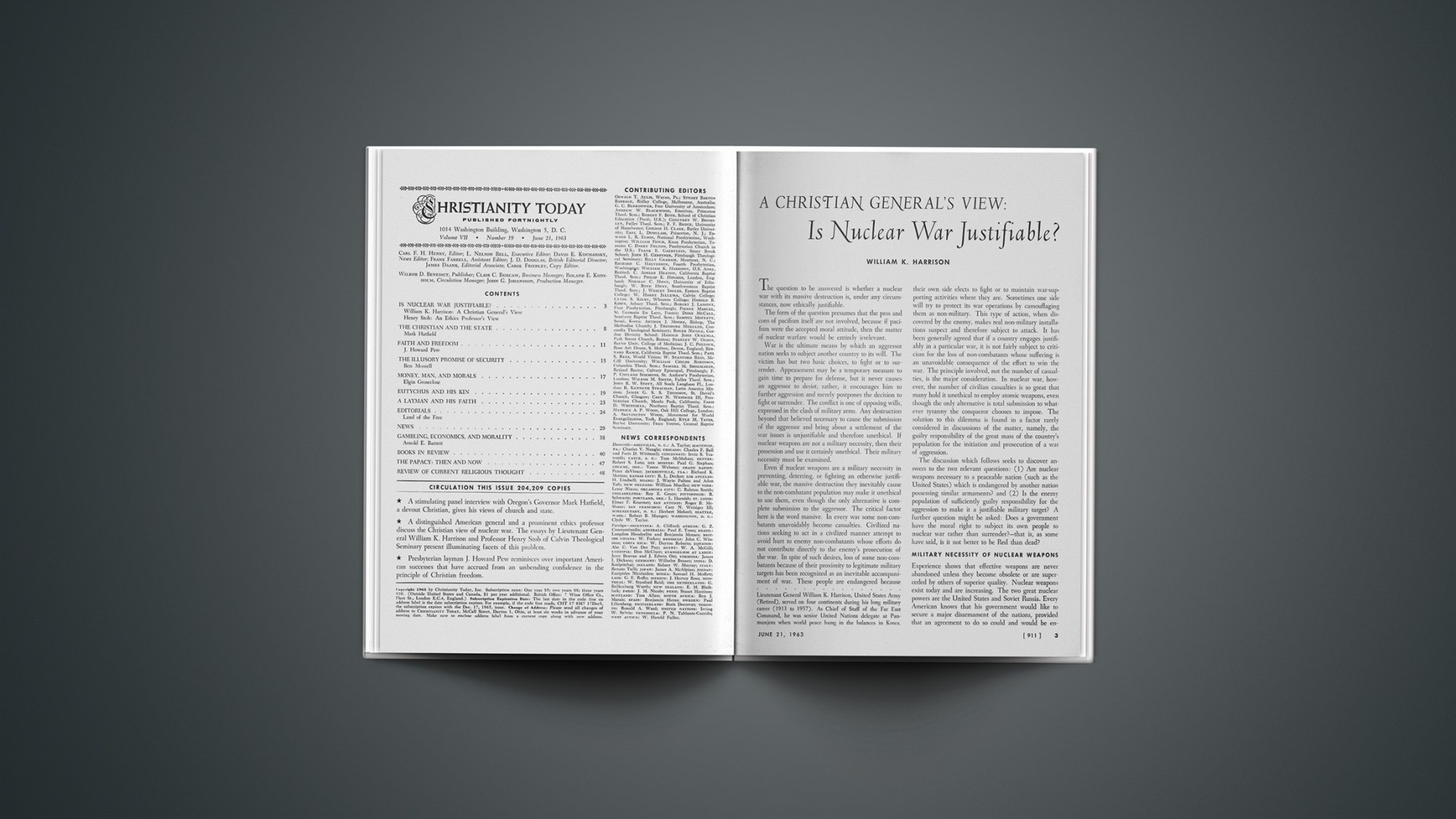
A Christian General’s View: Is Nuclar War Justifiable?

The question to be answered is whether a nuclear war with its massive destruction is, under any circumstances, now ethically justifiable.

The form of the question presumes that the pros and cons of pacifism itself are not involved, because if pacifism were the accepted moral attitude, then the matter of nuclear warfare would be entirely irrelevant.

War is the ultimate means by which an aggressor nation seeks to subject another country to its will. The victim has but two basic choices, to fight or to surrender. Appeasement may be a temporary measure to gain time to prepare for defense, but it never causes an aggressor to desist; rather, it encourages him to further aggression and merely postpones the decision to fight or surrender. The conflict is one of opposing wills, expressed in the clash of military arms. Any destruction beyond that believed necessary to cause the submission of the aggressor and bring about a settlement of the war issues is unjustifiable and therefore unethical. If nuclear weapons are not a military necessity, then their possession and use it certainly unethical. Their military necessity must be examined.

Even if nuclear weapons are a military necessity in preventing, deterring, or fighting an otherwise justifiable war, the massive destruction they inevitably cause to the non-combatant population may make it unethical to use them, even though the only alternative is complete submission to the aggressor. The critical factor here is the word massive. In every war some non-combatants unavoidably become casualties. Civilized nations seeking to act in a civilized manner attempt to avoid hurt to enemy non-combatants whose efforts do not contribute directly to the enemy’s prosecution of the war. In spite of such desires, loss of some non-combatants because of their proximity to legitimate military targets has been recognized as an inevitable accompaniment of war. These people are endangered because their own side elects to fight or to maintain war-supporting activities where they are. Sometimes one side will try to protect its war operations by camouflaging them as non-military. This type of action, when discovered by the enemy, makes real non-military installations suspect and therefore subject to attack. It has been generally agreed that if a country engages justifiably in a particular war, it is not fairly subject to criticism for the loss of non-combatants whose suffering is an unavoidable consequence of the effort to win the war. The principle involved, not the number of casualties, is the major consideration. In nuclear war, however, the number of civilian casualties is so great that many hold it unethical to employ atomic weapons, even though the only alternative is total submission to whatever tyranny the conqueror chooses to impose. The solution to this dilemma is found in a factor rarely considered in discussions of the matter, namely, the guilty responsibility of the great mass of the country’s population for the initiation and prosecution of a war of aggression.

The discussion which follows seeks to discover answers to the two relevant questions: (1) Are nuclear weapons necessary to a peaceable nation (such as the United States) which is endangered by another nation possessing similar armaments? and (2) Is the enemy population of sufficiently guilty responsibility for the aggression to make it a justifiable military target? A further question might be asked: Does a government have the moral right to subject its own people to nuclear war rather than surrender?—that is, as some have said, is it not better to be Red than dead?

Military Necessity Of Nuclear Weapons

Experience shows that effective weapons are never abandoned unless they become obsolete or are superceded by others of superior quality. Nuclear weapons exist today and are increasing. The two great nuclear powers are the United States and Soviet Russia. Every American knows that his government would like to secure a major disarmament of the nations, provided that an agreement to do so could and would be enforced. Apart from such enforcement, only disaster could be expected. A nation not possessing weapons is necessarily at the mercy of one that does possess them. Protracted negotiations have shown that the Soviet government will not agree to any form of disarmament inspection or security which will provide the United States adequate safety after our country honorably keeps its own part of the disarmament agreement. Experience shows without the slightest fear of contradiction that the Soviet government cannot be relied on to keep any agreement or treaty if it becomes expedient not to do so. Its imperialistic aggressions, cruelties, and treacheries are known to all who follow world events. Apart from abject surrender, there is no military alternative to the possession of nuclear weapons and the determination to use them if that becomes a last resort.

Since the United States is non-aggressive in its foreign policy, its nuclear policy is that of retaliation against a nuclear attack by Russia. Apart from our country’s ability and readiness to use nuclear weapons, the world would undoubtedly have been engaged already in major wars caused by Russian efforts to seize Berlin and the Near and Middle East (where the oil is). The Soviet backdown in Cuba was clearly the result of America’s nuclear power and its declared readiness to use this power if necessary. The dispatch of American troops to Lebanon in the middle fifties and the presence of allied forces in Berlin, backed up by American nuclear power, committed the United States both to fight for those localities and to use nuclear weapons if necessary. As far as non-nuclear forces were concerned, the Russians might have launched wars without serious risk, but the devastation to Russia itself to be expected from nuclear attack made the cost too great to risk. To date, nuclear weapons have been the major preventive of a Soviet military effort to take over localities of great importance to the security of the so-called free world. There seems to be a reasonable expectation that as long as the United States is armed with nuclear weapons, is ready to use them if necessary, and remains peaceable in its intentions, there will be no major war. The cost to Russia if it should launch such a war would overwhelmingly outweigh any advantage it could gain by victory. It is possible, of course, that some mistake or malfunction at a lower military level might fire a missile and trigger a war, but this danger is so obvious that both governments have undoubtedly taken every precaution to prevent such a disaster. It is also possible that the United States might lose its alertness and, in a Pearl Harbor attitude, invite a sudden devastating surprise blow that would defeat it at once. This, however, is only a contingency to be avoided. It is concluded that nuclear armament is a military necessity for the United States, unless it is prepared to make with finality the decision that it is better to submit to Soviet aggression and tyranny for ourselves and other nations than to risk nuclear war. Such a policy would be the result of fear, and fear has never been a good method of dealing with tyranny and aggression. Militarily, nuclear weapons are a necessity.

Guilty Responsibility Of The Aggressor

Every nation is a corporate society, the only alternative to chaos and anarchy. Since the government is corporate, its decisions are binding on the entire nation unless the nation is to disintegrate in civil strife. In relations with other nations the nation is an entity.

It is the ruler of the state who decides to launch a war of aggression, but the people fight the war. In reaching his decision the ruler considers many factors, one of the most important being whether the populace will support the war. He uses all the means available to secure such support in preparing for the war, in non-military aggression, and finally in the war itself. Unless he is confident of popular support he will not risk the war, because not only would the war be lost, but he himself would be purged from his exalted office. He would gain nothing and lose everything.

Admittedly, no one, including the Russians, wants a nuclear war. But this does not mean that moral righteousness motivates this desire. Instead, it is fear for self, not love and mercy toward the enemy. History seems to show clearly that a populace is not at all averse to a war of conquest if it foresees gain at little cost. The same lusts dominate John Citizen as dominate his sovereign (Rom. 1:18–32; 3:10–18; Jas. 4:1, 2). Peaceable nations differ from aggressors in that they may be too weak vis-à-vis their potential enemies, they may be relatively so well off that they are satisfied with the status quo, they may be involved in internal difficulties, or they may be strongly influenced by strictly New Testament Christianity. The particularization of the type of Christianity is necessary because over the centuries there have been many departures from the original precepts and doctrines of the faith, and many of the worst international crimes have been perpetrated by states which call themselves Christian. The willingness of nations to engage in conquest is demonstrated by the unremitting frequency of wars during the centuries, the greatest of them coming in this present age of science, enlightenment, and reason.

In the absence of the restraints mentioned above, it appears that all that is needed to start a war of conquest is to stimulate the human lusts adequately, giving assurance of victory at acceptable cost. In the past this has not been difficult to do, because no ruler would undertake conquest unless it appeared to him that the desired results could be obtained. If it appeared so to him, it was not too difficult to convince the mass of the people. Often, too, hatred of the intended victim would be aroused, motivated by fear of being attacked at some future time. It is true, of course, that the ruler often uses false propaganda to deceive his own people as to his real ambitions, but this does not alter the fact that they are only too ready to be deceived. A great nuclear war could not begin without ample indication of aggressive intentions. War is a last resort, and nuclear war is certainly the last of the last. Aggression and occupation of other countries cannot be concealed from the aggressor people. Soldiers and other persons in those countries tell their own families, and the word spreads. The declared reasons for aggression may be false, but the fact of aggression cannot be concealed. In a nation preparing for and carrying out aggression, only a small minority oppose their government’s policy, and even fewer do so for moral reasons. And of these, fewer still are willing to suffer for their convictions; principle succumbs to expediency. Generally most persons are indifferent to the government’s policies. A police state does exercise a certain power in this respect in that by coercive means it prevents active opposition. But such coercion actually need be applied only to those who are sufficiently determined to express their opposition actively. If the stability of the police state requires excessive coercion of its citizens, then it is highly unlikely that the sovereign will risk a war of aggression. It is safe to conclude that wars of conquest are launched by the ruler with the active or passive support of the nation, without which he would not dare to start military action. The people therefore are not innocent; they share the guilt of aggression. The true innocents—incompetents, children, and non-conformists—are exposed to danger by their own nation. In regard to these enemy non-combatants the defending state faces the same problem that it has in the past; the only difference is that the numbers are greater, the problem more obvious.

Since the bombings of World War II, and now nuclear weapons, the entire aggressor nation, guilty as it is, no longer is shielded by its armies and navies. It, the real force, the real will behind the military weapons, can be attacked directly instead of only after the defeat of its military forces. By supporting the ambitions of its ruler it shares his guilt and accepts the same risks as do the military forces themselves. Therefore such loss as it does sustain can be laid to its own aggression, not to its innocence. It is only the risk of loss that has deterred and does deter a criminal ruler like Khrushchev from launching a major war of conquest. The guilty role of the entire nation in nuclear war shows that the massive destruction to non-combatants is not the morally determining factor in the decision to resist aggression or to surrender.

Conclusion: The massive destruction caused by nuclear weapons is not an ethical bar against their use in a war justifiable by other moral considerations.

Postscript: The utter horror of nuclear war and the demonstrated inability of men to stop human crime (including military aggression) should convince all Christians that there is no hope of enduring peace until Christ shall establish his kingdom at the Second Advent.

END
Review of Current Religious Thought: June 07, 1963

I have just returned from a series of meetings of the National Council of United Presbyterian Men. These area meetings, held in New York, Pittsburgh, Wichita, Chicago, and Sacramento, were attended by eight to ten thousand men (the exact total being uncertain since there were both full-and part-time attendants). It was an interesting, satisfying, and in many ways a thrilling experience, and it gave opportunity to sample the sort of thing that has been taking place among Presbyterian Men for over fifteen years.

The format of the meetings was the same in each of the five cities. Study materials on the chosen theme—this year “Stand Your Ground” (Eph. 6:14)—were sent out to chapters of United Presbyterian Men throughout the church. Selected men did special studies on the theme and were brought in before the area meetings for briefing sessions. At the meetings themselves the theme was presented in the keynote address and variously emphasized in inspirational addresses at the close of luncheons and dinners. There were also morning, afternoon, and evening study sessions under the leadership of the men previously selected and briefed. The series closed with a communion service and an address which gathered together the in-inspiration and content of the meetings. The men took back with them a small study booklet with the summation of the meeting topics, for later use in chapter meetings. Speakers included seminary presidents, chaplains, statesmen, industrialists, ministers, and representatives from other denominations.

This kind of thing which has been going on these years among United Presbyterian Men is matched by similar lay groups in other denominations. The so-called Southern Presbyterians (U.S.) have a single meeting of the same type every year, rather than area meetings. The Methodists also have a single meeting, with tremendous attendance. And so it goes. It is difficult to evaluate these meetings: so many things happen in so many different ways to so many different people. Moreover, effectiveness among the local chapters varies greatly because of widely different leadership, because of the pastor’s help or hindrance, and because of vital (and worthy) competition for time and energy by Mariners, entrenched Bible classes, athletic or musical groups, and the like. The ideal is to have the local chapter of men lose themselves in the total service of the church and so find their lives by losing them.

One thing is certain: there is tremendous inspiration in such meetings. All the speakers direct themselves toward this goal, each with his own approach. Group singing, under carefully selected leaders, is magnificent and moving. Great things come to pass in the give-and-take of small group discussions. The meetings, both large and small, are undergirded and interlaced with prayer, and many of the men come to crises marked by high resolve and decision.

It is hard to measure how a man is nurtured in his faith, but such nurture does occur. Perhaps the greatest help is gained by those who come from a lonely and frustrating local church scene to find themselves in the midst of hundreds of men from all segments of life, who are all deeply concerned with the same high dedication to Jesus Christ. Pastors slip in at the edges of the meetings and are encouraged by what they see. One layman, under the inspiration of such meetings, left a high position in industry to give his life to Christian education; another offered himself, with all his useful talents, to a mission board. A doctor and a television director have made the formation and support of chapters in their state their second vocation. Such effects are endless and endlessly varied. Meetings this year were marked by the attendance of younger men, some of whom are now headed for the ministry.

Other things are stirring among the laymen. Most of the major denominations have encouraged lay participation through studies and increased lay responsibility. But the Holy Spirit works “when, where, and how he pleases,” and no one is wise enough to guess what may come to pass out of all this. We should continually remind ourselves that although John Calvin was always a layman, never an ordained minister, “Calvinism saved Europe” (Fairbairn in the Cambridge Modern History is authority for this).

While seminaries reflect their confusions by endless tampering with curricula and are more than a little desperate about the drying up of the sources of new students, and while boards of Christian education simply do not know what they want to do, or should do, about making all their colleges church-related or even Christian and try desperately to satisfy Christ and high school sophistication in summer camps and conferences—while all this goes on, I say, laymen, with their stubborn simplicities about right and wrong, are slowly working their way out of the theological mists and the gray areas of modern ethics. They think that the Bible is true (or that it isn’t) and that a man can know enough (even if he can’t know everything) to move ahead in Christian living and holy obedience. Laymen, having been encouraged by the clerics, are now enthusiastically taking heart, and they regard some theological subtleties as highly interesting—and highly irrelevant.

Another thing: are you aware of the emergence of lay prayer and Bible study groups all over the country? Samuel Shoemaker had things going in the Pittsburgh Experiment, and now offshoots of that lay movement are everywhere. As Elton Trueblood moves across the country, disciplined cells of Yokefellows appear. One can follow the trail of happy results left by Billy Graham, also. During a week in Tulsa, Oklahoma City, Omaha, and Cincinnati, I sat in on lay groups of men who meet each week for prayer and study. These groups arose spontaneously in these cities, reflecting the movement everywhere—and they all seem to be playing for keeps.

Order in the Schoolroom

CLASSROOM JUNGLE—Day by day and term by term … the problem of District of Columbia school discipline worsens. It is in the Capital City of the United States that the public school system is called a blackboard jungle. And an act of Congress is deemed necessary to provide that principals and teachers “may use reasonable force in the exercise of lawful authority to restrain or correct pupils and maintain order.” Within hollering distance of the Peace Corps headquarters, that agency could find some work to do without traveling halfway around the world for the exercise of its civilizing activities.—Nashville (Tenn.) Banner.

CONGRESSMEN APPROVE WHIPPING—We hope the Senate will promptly follow suit.… The House did a good day’s job in asserting the right of [District of Columbia school principals and teachers] to “use reasonable force in the exercise of lawful authority to restrain or correct pupils and to maintain order.” Its clarification, by another bill, of the right of school officials to suspend or dismiss incorrigibles also is useful. These bills ought to become law.—The Evening Star (Washington, D.C.), May 15.

THE INDISPENSABLE TOOLS—Give Mr. Hansen and his teachers all the tools they need, paddle included—New York Herald Tribune (European Edition).

REMEDY AGAINST INSOLENCE—Teachers must have more authority than they have now. This represents a change in the point of view, so far as I am concerned.… I now believe that the Board of Education rule prohibiting the use of corporal punishment should be eliminated; and that while teachers do not want extensive use of corporal punishment and probably many would never use it, they want to be relieved of the insolence of the pupil who can say to that teacher, as has been said: “You don’t dare to touch me. You don’t dare to lay a hand on me.”—CARL F. HANSEN, superintendent of schools of the District of Columbia.

PSYCHIATRISTS, NOT PADDLES—In the District of Columbia schools, where discipline is said to be a serious problem, mild paddling is not likely to be very efficacious.… Some of these youngsters—the most troubled and troublesome among them—have never known anything but beating all their lives—beating not with a lightweight paddle but with a fist, a strap, a crowbar. They will respond to “paddling” either with derision or with a blow in return.

The community cannot solve the problems of these young toughs by resorting to the techniques that made them what they are. If Congress wants to help the schools deal with them, let it clear the slums that spawned them and provide decent, low-cost housing instead, let it erase the racial discrimination that keeps them and their parents from getting jobs that offer hope and a chance to get ahead, and, above all, let it equip the schools with teachers and counselors and psychiatrists instead of with “paddles.”

Call it what you will—“beating” or “paddling” or “whipping” … or any of the other circumlocutions which mask the crude reality—corporal punishment involves a renunciation of the teacher’s real superiority over a pupil, an intellectual superiority. It means an abdication of the rule of reason. It is an abandonment of teaching.—The Washington Post.

THE COMMON LAW—Under common law the teacher has the legal status of a conditionally privileged person standing in loco parentis to the pupil.… This principle has been enacted into law. For example, the Oklahoma statute states: “The teacher of a child attending a public school shall have the same right as a parent to control and discipline such a child during the time the child is in attendance … [at school].”—“The Teacher and the Law,” Research Monograph 1959-M3, NEA Research Division, September, 1959.

SPARING THE ROD—My experience as a judge in juvenile matters further convinced me that punishment … is most necessary in many cases of juvenile violations of the rules of our society.

“Spare the rod and spoil the child” may seem ancient and barbaric to many of our modern psychologists and sociologists. And I will quickly agree that many of our fine young citizens have grown to manhood or womanhood without being subjected to physical punishment in their childhood, but I have also come in contact with numerous youngsters who understand nothing less than physical punishment.

How well prepared can any person be for the trials of adult life in our modern world if their wrongful acts in childhood have been answered with nothing more than a sympathetic verbal chastisement? To me, a vital part of our educational process is the lesson that violations of the rules of our society must be punished.… How can they believe that punishment will be meted out by society if school officials can take no action against them except a lecture?… Will they feel that adult society will protect them from crimes against them when they see violations go unpunished in their youth? How can we expect to retain our good school instructors when they have no means of effectively maintaining discipline in their classes?—Representative GRAHAM PURCELL (Dem., Texas).

OTHER METHODS WILL WORK—I taught for forty years, and I never felt it necessary to administer corporal punishment. I do not say I never punished children for disobedience.… There are other methods of punishing than using corporal punishment.—ELLIS HAWORTH, chairman, Legislative Committee, D.C. Congress of Parents and Teachers.

HOT SEAT, WARM HEART—Disciplinary measures are justified only when the child experiences in that discipline the love of the disciplinarian. Every punishment given in a hot temper, every chastisement administered in a fit of anger … has the wrong effect, and is, in fact, not Christian discipline.—Jan Waterink, Basic Concepts in Christian Pedagogy, 1955, pp. 67, 68.

THE HICKORY SWITCH—A request by Washington, D.C. public schools for return of the hickory switch brought nods of approval from Brevard educators. Reasonable, supervised corporal punishment has never been forbidden in Florida schools.—Brevard Sentinel.

THE ODDS ARE HIGH—More than two in three elementary school teachers and almost three in four secondary school teachers favored the use of corporal punishment in elementary schools.—NEA Journal, May, 1961, p. 13.

Seeing God in Bible History

Seeing God In Bible History

During the summer prepare to preach from I Kings, the early half of a Hebrew book. Another summer, from II Kings. To us this double book relates history; to the Hebrew believer it consisted of prophecy, or “teaching-preaching” (W. E. Sangster). Make ready here, not to teach Bible history, but to declare the will of God for his nation, then and now. To help get started read Unger’s Bible Dictionary, 1957: “Kings, Books of”; “Solomon”; “Elijah.”

To show the layman what to look for: “The Hand of God in Bible History” (8:57). I. God’s Blessing on a Golden Era. A. A brilliant beginning for a ruler.

B. An opportunity to erect a church edifice. II. God’s Judgment on His People. A. Their disloyalty to God. B. Their division of the land. III. God’s Message through His Prophet. A. A call for a revival. B. A plea for restoration of God’s rule. This is not an outline of the book but a working guide.

In each case that follows, the Bible materials all come from the context. “God’s Plan for a Young Man’s Life” (3:5). I. The Lord Grants Him Freedom of Choice. II. Blesses for Choosing Wisely. III. Gives Much More than He Asks. Any young man here today has a still larger opportunity. “God’s Blessing on a Church Builder” (5:5). Chapter 8 abounds in riches for the pulpit. Plant all sorts of seed-thoughts now, and use them in later years. Let a sermon grow.

“God’s Blessing on Our Public Prayers” (8:27). I. God’s Presence in This Church. II. The Prayers of God’s Leader. III. The Petitions of His People. Many a layman needs pulpit guidance so as to pray in church. So does every boy or girl. No exhortation or scolding! Teach in love!

“God’s Blessing on Our Nation” (8:56a). Save this for Thanksgiving time. “God’s Blessing on Our Fathers” (8:57). I. Give Thanks for the Fathers and Mothers. II. Pray for Like Faith in God. III. Train the Young for Such Precious Faith. After a brief prayer of dedication, the hymn, “Faith of Our Fathers.”

“God’s Anger with a Brilliant Ruler” (11:9). “The dark line in God’s face.” Perhaps the most brilliant man in the Bible. A noble beginning, with a later decline, and a final eclipse. With Solomon began the disaster that darkens later Old Testament pages. (Cf. our Aaron Burr; 1 Cor. 10:12.) “God’s Ideal for a Public Official” (12:7). A passage for the Sunday before Election Day! A minister must not stoop to engage in partisan politics, or truckle by refusing to declare the will of God for our country.

The records about God’s use of Elijah afford opportunities for all sorts of practical sermons about affairs civic and national. Some of these are thrilling. “How God Makes a Good Man Useful” (17:5). As often elsewhere, the inspired record here is “the gift of God to the imagination.” So let living by the brook mean a good man’s experience of hard times. The drying up of the brook, his opportunity to share the experiences of God’s suffering poor. Indirectly, a message about God’s providence in preparing a future leader, the seer who later will represent his people on the Mount of Transfiguration. How God trains a minister!

“God’s Call for a Revival Today” (18:21). “God’s Gentleness with a Good Man’s Blues” (18:12c). Think of Elijah as the best man of his day, the foremost of all the seers, but preach here mainly about God. I. The Prophet of Fire Thinks of God as Spectacular, making Himself known chiefly in the earthquake, wind, and fire. But these are not his usual ways of speaking to his child. In Bible history one man came to God because of an earthquake, another because of a blinding flash from above, and a few because of some rushing, mighty wind. But ten thousand times ten thousand saints keep climbing the steep ascent to heaven now because the Lord has whispered: “This is the way, walk in it now, the old, old way of the Cross.” II. God Prefers the Ways of Gentleness. III. His Leader Learns to Listen for the still small voice of love. So does every saint.

“God’s Appeal to a Strong Man’s Conscience.” “Thou hast sold thyself to work evil in the sight of the Lord” (21:20c). One feels tempted to turn aside and praise the seer for doing his duty boldly. But stress what he stressed, and for the same reason: the sin against God, and the resulting day of judgment. I. God’s Concern About a Poor Man’s Dwelling. II. God’s Rebuke of a Poor Man’s Oppressor. III. God’s Judgment on a Royal Sinner. James Stalker rightly says that the minister who cannot at times preach to the conscience cannot preach God’s way.

At least in printed messages, this kind of preaching seems rare today. According to perhaps the ablest liberal theologian of our day, Paul Tillich at Harvard, many of us conservatives preach little the First Person of the Trinity. If so, even unintentionally, why not now begin to preach from the Bible? With present tenses, stress what the preaching passage stresses. What a pity if either pulpit or pew fails to see God in Bible history! In this respect, as in many another, pray for a present-day Protestant Reformation such as no one of us has witnessed since the outbreak of World War One.

ANDREW W. BLACKWOOD

Hast thou found me, O mine enemy? (1 Kings 21:20a).

The sermon begins with a contrast between the force of Elijah, the man of God, and Ahab, the king, guilty of murder, unconfessed. The main stress falls on the consequences of such an unforgiven sin. Under God—

I. Sin’s Pleasure Leads to Loss of Peace. A. There is no sin that is not the purchase of pleasure at the price of peace. B. This holds true of every evil a man commits. C. The silence of a seared conscience is not peace. D. Sin is not only a crime; it is a mistake. The thing you buy is not worth the price you pay—loss of peace with God.

II. Sin’s Blindness to Real Friends and Foes. Elijah was Ahab’s best friend, and back of the seer was God. A. The worst enemy of the sinful heart is the voice that tempts to sin, and lulls into self-complacency. B. God sends us a Gospel full of dark words about sin. C. Sin makes one fancy that God is his enemy. D. Conviction of sin is the work of the Comforter. An enemy or a friend, which is God to you?

III. Sin’s Laying Up a Terrible Retribution. Where Ahab did the wrong, there he died, unforgiven. A. God’s warning should have led Ahab to repent. B. The man who sells himself to sin lays up for himself an awful futurity of judgment. The voice that rebukes swells into the voice of final condemnation.

My friend, picture to yourself a human spirit shut up forever with its dead transgressions. Think what it will be for a man to sit surrounded by that ghastly company, the ghosts of his own sins. As each forgotten fault and buried badness comes into that awful society, silent and sheeted, and sits down there, think of Ahab’s greeting each ghost with the question: “Hast thou found me, O mine enemy?” From each bloodless specter tolls out the answer: “I have found thee, because thou hast sold thyself to work evil in the sight of the Lord.”

My friend, if that were all I had to say, it might stiffen into stony despair. Thank God, such an issue is not inevitable. Christ is your friend. He loves you. He speaks to you now, speaks of your danger, speaks of your sin, that you may say to him: “Take it away, O merciful Lord!”—From Sermons Preached in Manchester, first series, 1883, pp. 222–34.

Naaman was wroth, and went away, and said, Behold, I thought, he will surely come out to me, and stand, and call on the name of the Lord his God, and strike his hand over the place, and recover the leper (2 Kings 5:11).

The Bible looks on leprosy as a symbol of sin, and on pride as the chief barrier to salvation. Naaman here serves as an object lesson. In the eyes of the world he was a great man; in the eyes of God, a leper. [Since the hearer at home has read the passage prayerfully, omit a long introduction.]

I. God’s Indifference to Human Distinctions. Naaman wants to be treated as a great man who is a leper. Elisha treats him as a leper who happens to be a great man. A. The Gospel deals with all sinners on the same level. B. Such treatment accords with our condition as lepers. C. Here God shows his mercy, in Christ.

D. For this reason the proud man turns away. There is the narrow gate! Plenty of room for you! No room for the human distinctions that you bear on your shoulders! Naaman was wroth, and went away in a rage. So do proud men now refuse to accept the Gospel that proclaims all men under sin, and brings the equal remedy for the highest and the lowest, the wisest and the most foolish. What a Gospel, and what a God!

II. God’s Insistence on Simplicity. A great man wants to do some great thing. In this respect Christianity cannot compete with pagan displays. A. The seeming antagonism between God’s ways and man’s wants. B. The proud feel not at home in a realm purely spiritual and immaterial. C. To wash and be clean serves now as a symbol of God’s cleansing from sin. D. So give thanks for the simplicity of the Gospel as it centers in the Cross.

III. God’s Independence of Our Help. Like many a proud man today, Naaman wanted to help save himself. A. Salvation by faith does not mean salvation by words. Only God can save. B. Faith means forsaking reliance on self, and trusting solely in God to save. C. Since there is not a crevice where self-trust can creep through, proud hearts rebel. D. Christ’s work for us must be all in all, or not at all.

It is the glory of the Gospel that it proclaims a salvation in which the sinner has no share except to receive.—From Sermons Preached in Manchester, third series, 1881, pp. 255–72.

After the fire a still small voice (1 Kings 19:12c).

After his mighty victory for God on Mt. Carmel, the “prophet of fire” fell a victim to despondency. The cure came from God, chiefly through a vision of his gentleness. Not by such marvels as that on Carmel was the work of regenerating Israel to be accomplished, but by the quiet influence of love. The earthquake, the whirlwind, and the fire were but the out-riders of the divine majesty. That majesty itself appears in the gentleness that makes men great. In our day this vision reminds us that in God’s government—

I. The Quietest Influence Is Often the Most Powerful. In nature God carries on his noblest works silently. A. A vision for our sensation-loving time, a generation of fuss and bustle, trumpet-blowing and advertising. Sometimes this spirit even invades the church and the pulpit. B. Today the Lord still chooses to speak through the still small voice of Gospel grace. Would that we had less reliance on noise and more on the most Godlike thing on earth, a gentle character molded after the example of Christ, and created and sustained by the Holy Spirit.

II. The Force of Love Is Always Greater than That of Sternness. In Elijah’s dealings with men there had been little of love. Soon he must initiate a successor, to go about among the people with love and fellowship and helpfulness. Later, the highest manifestation of this truth comes in the work of Christ. By love he attracts us to himself at the first, and keeps us with himself to the last.

Is any pastor under the juniper tree, bewailing his lack of effectiveness? Let him ask himself whether he has not been trying to win men by sternness rather than by love. So with the Bible school teacher, and the parent in the home. You say that you have resorted to everything. Have you tried gentleness like that of God?

III. The Apparently Insignificant Is Often the Most Important. Despise not the small things. One does not need to be great in order to do good work for God. He uses the weak things of this world to confound the mighty.

When John Wesley began his work he never dreamed of anything so great as the Methodism of today. In this he was not alone. If we examine any one of the institutions that are radiating influence around the world, we discover that it had its commencement in something apparently as insignificant as the still small voice of our text.

Courage, then, my brother! Wait not for some great opportunity. The golden year is now. The accepted time is today. The appointed sphere is where you are. Do not quarrel with your call. Here is the answer to every possible objection: “Certainly I will be with thee.”—From Contrary Winds, 1883, pp. 107–20.

… How long halt ye between two opinions? If the Lord be God, follow him; but if Baal, then follow him. And the people answered him not a word (1 Kings 18:21).

God is calling for a revival today. A revival the world around, and above all here at home. By the term revival let us agree to mean the quickening and strengthening of vital godliness among professed followers of God now in our churches. An evangelistic ingathering ought to follow today, as in former seasons of revival.

I. God’s Call in Time of Crisis. In many an hour of crisis God has made such a call. A. In the days of Elijah (ninth century B.C.) a choice between the true God and Baal, a foul, false substitute imported from the homeland of Queen Jezebel, abetted by King Ahab. B. In the days of the Protestant Reformation, a choice between the New Testament church and that of Rome.

C. Today the choice is far more critical. Between the true God, and no-God. The Russian alternative would leave no room for God or Christ, Bible or soul, heaven or hell. Never in history has any responsible party demanded that believing men make such a choice. (See T. S. Eliot, “The Rock,” VII.)

II. God’s Call through a Challenge. A. At least 7,000 stood ready to come out and out on the side of God, and so with a host today. B. Including the Queen and her subservient husband, many others stood out and out against God. C. The vast majority, then as now, seemed not to care. On no vital moral issue of our day can God today count on a majority of our voters (Rev. 3:15). The indifferent still answer not a word!

III. God’s Call for Conflict. Today “not with swords loud clashing,” but “in deeds of love and mercy.” A. A conflict as decisive as that on Mt. Carmel. After that day the cause of Baal was as dead in Israel as dueling is with us in America now. B. A conflict between right and wrong. C. A conflict decisive for years to come. Never again in Hebrew history did any responsible person propose giving up the God of his fathers.

IV. God’s Call for Conquest, as in our own revival of 1857–58. A. Through preparation, in rebuilding God’s altar. Every revival in history has been preceded by preparation. God never does for us from heaven what we can do for him on earth. B. Through preaching. What preaching! Clear, strong moving words for God. C. Through prayer. Only after the prayer of God’s leader did the fire from God fall and consume the waiting sacrifice, causing the multitude to cry out: “The Lord, he is the God! The Lord, he is the God!”

Hearer of God’s message today, how do you respond? Well do you reply: “What can I do?” You can come out and out for God, and for him take your stand. You can help to repair the local altar that that has been broken down. Best of all, you can pray. Now as of old prayer releases the power of God, who alone can send the old-time fire.

Book Briefs: June 7, 1963

Baillie Answers The Half-Men

The Sense of the Presence of God, The Gifford Lectures, 1961–62, by John Baillie (Scribner’s, 1962, 269 pp., $3.95), is reviewed by Paul K. Jewett, professor of systematic theology, Fuller Theological Seminary, Pasadena, California.

Before laying down his pen for the last time, Dr. Baillie, principal emeritus of New College and dean of the Faculty of Divinity at Edinburgh University, meticulously revised the manuscript for his Gifford Lectures. Though never delivered, they have been given full status by the Gifford Committee in recognition of their intrinsic merit, and published without further editing under the title The Sense of the Presence of God. Though there is no direct evidence that Dr. Baillie wrote under a sense of impending death, his work has about it the aura which often surrounds the last words of a learned and good man.

The primary purpose of his work is to submit to a critical analysis our knowledge of God and the certainty which attaches to that knowledge. Dr. Baillie’s thesis is that we can know God only by his self-revelation, but since it is we who know him, there is always the human element to be reckoned with in any judgment about what God has revealed. This diffraction of revealed truth by human thought, this finite reflection on the infinite, means there will always be antinomies in our theological statements which complement one another. (The author cites his brother Donald’s illustration of the two types of maps in an atlas, Circular and Mercator’s projection, on page 11.) Dr. Baillie does not seek, therefore, to ground the Christian view of God and the world on any arguments that would compel the theoretical reason to assent. The certainty which “pulsates through all our thinking” (Tillich) about God is of another order.

In elaborating and defending this position, Dr. Baillie is at considerable pains to answer the Analysists and Positivists who say that no one “has a right to any conviction unless he is able to define some possible evidence which, if it should emerge, he would accept in disproof of it, so obliging him to surrender it” (p. 25). Dr. Baillie does not refuse this challenge, but argues that the evidence on which the Christian relies and the failure of which would indeed compel the Christian to surrender his belief, is of a different order than that furnished by the senses. Since our bodily senses clearly do not inform us that there is no other kind of evidence than this, the reductive empiricist cannot affirm this negative proposition without denying his own premises.

The author proceeds to show what difficulty a thorough empiricist has in the realms of aesthetics and especially ethics. He quotes Lord Russell: “I for one find it intolerable to suppose that when I say ‘Cruelty is bad,’ I am merely saying, ‘I dislike cruelty,’ or something equally subjective” (p. 79). In the final chapter, entitled “Retrospect,” Dr. Baillie puts aside some of his dignified reserve and confesses to some righteous indignation: “… it is with the half-men who know nothing but the reductive naturalism in which it issues, that my present argument has been concerned; and I confess that in my heart of hearts my impatience with them knows no bounds” (p. 254).

In contrast to the Analysists, Dr. Baillie contends that the human spirit possesses sensitivities which go beyond the bodily senses. There is a sense of duty, of the holy, of the presence of God. While mediated to us through experience gained by bodily senses, these higher sensitivities open to us aspects of reality which cannot be perceived by the bodily senses (pp. 52, 53). Faith is born in us “through our deriving a profounder meaning in certain encountered events than is evident to our ordinary senses. Through the impact of these events, we find ourselves apprehending a reality which evidences itself as such by setting a restraining limit to the free expansion of our own desires, constraining us to a recognition of its sovereign claim.… That distinguished sociologist, the late Karl Mannheim, has taught us to speak of such highly significant encounters as ‘paradigmatic experiences’.… The faith of Israel in the prophetic period had its focus in the paradigmatic events of the Exodus or the paradigmatic constellation of events represented by the Exodus, the journey through the wilderness and the entry into the Promised Land. Christian faith finds its focus in the paradigmatic event of Christ’s Advent or in the paradigmatic constellation of His Advent, Passion, Cross, Resurrection and Exaltation, and the coming of the Spirit at Pentecost” (pp. 73, 75).

To follow the elaboration of this central argument through an analysis of Kant and the liberals would carry us beyond the scope of this review. The Bible, of course, plays a unique role in mediating this paradigmatic Christ event to us. Dr. Baillie frankly admits that theology has the task of discriminating between that aspect of biblical content which can be tested and sometimes refuted by the use of the scientific method, and the authentic message of revelation intertwined therewith (pp. 78, 79). His own use of the Scriptures reflects a conservative appropriation of higher critical results. John 17 contains “Christ’s own word” (p. 208), and the Matthean account of the Magi is sober history (p. 210).

Even those who have no Scripture, according to Dr. Baillie, have some knowledge of God. While acknowledging a great debt to Karl Barth, Dr. Baillie disagrees emphatically with his thesis that there is no knowledge of God save in Jesus Christ. There is, indeed, no salvation save in Christ, but Barth’s doctrine goes against the whole Bible (cf. pp. 177–200; 254–56). There is a natural theology; all men have some sense of the presence of God by his creation and providence. It is only by grace, however, which overcomes our sinful rebellion against divine revelation, that man can achieve that gratitude which is the dominant note of all Christian worship and the mainspring of Christian service.

The book ends with a beautiful prayer of Henry Vaughan for the abiding presence of our most blessed and merciful Saviour.

PAUL K. JEWETT

For Better Pulpit

Expository Preaching Without Notes, by Charles W. Koller (Baker, 1962, 132 pp., $2.50), is reviewed by Clarence S. Roddy, professor of homiletics, Fuller Theological Seminary, Pasadena, California.

Another book on preaching! Yes, another—and one worth reading, or rather bringing to the aid of your pulpit ministry. Dr. Koller, president emeritus of Northern Baptist Theological Seminary at Chicago, has given us a rather small book which is really “large.” The title of the book is a bit misleading, for the thrust of the book seems to be: adequate preparation for any type of sermon, of which the expository is the ideal. It is in fact a very concise, yet comprehensive course in homiletics.

Its contents range from “The Scriptural Conception of Preaching,” through methods of gathering material, through the important matter of structure and delivery (free from notes), to a filing system. Dr. Koller writes with clarity, brevity, and force. A goodly number of charts and examples enhance the effectiveness of the book. The chapters on “The Advantages of Preaching without Notes,” “The Analysis of the Scripture Passage,” and “The Structural Components of the Sermon” are strikingly helpful. The first chapter mentioned above I would state to be as fine a discussion of the subject as I have read in recent years.

Here is a refresher course in homiletics for the busy pastor and a good stimulus for the student—all in all a book that should make for better preaching!

CLARENCE S. RODDY

St. Paul’S Donne

John Donne: Preacher, by William R. Mueller (Princeton, 1962, 257 pp., $6), is reviewed by G. Hall Todd, pastor, Arch Street Presbyterian Church, Philadelphia, Pennsylvania.

The roster of deans of St. Paul’s, London, contains some of the mightiest names in the history of the English-speaking pulpit. One recalls some: the polished Puritan preacher John Tillotson, celebrated by a contemporary as the best preacher of his age, one who seemed to have brought preaching to perfection; Joseph Butler, author of the celebrated Analogy; Henry Longueville Mansel, “the keenest metaphysician of his time,” as William M. Sinclair pronounces him in his Memorials of St. Paul’s Cathedral (1909); Richard W. Church, whose sermons and essays gave him a high position in nineteenth-century literature; Henry Hart Milman, editor of an edition of Gibbon’s History and remembered every Palm Sunday by his hymn, “Ride On, Ride On in Majesty”; William Ralph Inge, described in the recent A History of St. Paul’s Cathedral by Mathews and Atkins as “a great scholar, a profound philosopher, and a figure of national and international fame”; and Walter R. Mathews, the venerable and erudite incumbent, indubitably one of the greatest, most intellectually keen and thoughtful preachers in the contemporary pulpit.

Modern literature is indebted to an earlier dean of St. Paul’s. Ernest Hemingway turned to a sermon by him for the title of perhaps his most famous novel, For Whom the Bell Tolls. John Gunther, writing a panegyric for a son taken in youth by cancer, turned to the same preacher for “Death Be Not Proud.” That poetic homiletic source is John Donne, appointed dean of St. Paul’s in 1622.

Professor William R. Mueller of Goucher College has afforded us an able and careful analysis of Donne’s genius as a preacher. Canon Carpenter of Westminster Abbey, writing in the most recent history of St. Paul’s, declares that the life of Donne belongs more properly to the history of English literature than to the chronicles of St. Paul’s. He speaks of him as one who felt acutely the burden of his own finite existence, the anguish of doubt, yet the craving to live life fully and freely, and who gave voice to these intense inner feelings in his tempestuous poetry.

Reading for Perspective

CHRISTIANITY TODAY’S REVIEW EDITORS CALL ATTENTION TO THESE NEW TITLES:

Luther’s Works, Volume 26: Lectures on Galatians, Chapters 1–4, tr. by J. Pelikan (Concordia, $6). Lectures often hailed as Luther’s Magna Charta of Christian liberty, on the epistle he lovingly called “my Katie von Bora.”

A Man Spoke, A World Listened, by Paul L. Maier (McGraw-Hill, $4.95). A son tells the life story of the late Walter A. Maier, whose voice on the Lutheran Hour for many years sent the Gospel around the world.

Christ and History, by George A. Buttrick (Abingdon, $3). A quite popular, provocative, somewhat existential and nwthical view of history, which the author “had to write” to counter current non-Christian views.

Mueller gives us a sketch of this dramatic figure, who like an Old Testament prophet histrionically arrayed himself in a shroud as he stood in his cathedral pulpit, and whose singular merit was detected by that theological dilettante whose contributions to our religion and culture far surpassed the quality of his life, King James I.

Professor Gilbert Highet of Columbia in his The Powers of Poetry (p. 141) holds that Donne’s poems are best understood as the prelude to the wisdom of his meditations and sermons. His sermons in themselves are rich in the poetry of their phrasing. It is somewhat difficult to dissociate the poet from the preacher in Donne.

Mueller recounts some of the details of Donne’s biography. Wealth and culture were in his background. He was a recent though ardent Protestant, his family connections having been staunchly Roman Catholic and his granduncle none other than Sir Thomas More. As was true of America’s Albert Barnes and many another illustrious pulpit figure, his early associations were in law. Donne’s call to the Gospel remains a matter of controversy. Izaak Walton, his earliest biographer, is careful to relate that his voracious reading of religious literature had begun in his nineteenth year. Mueller affirms that Donne’s was an honest response to his call, adding that few other clergymen have been so aware of the precise nature of their vocation. There is an anticipation of Bushnell in Donne’s accent on the fact that it is God’s will that every man should embrace his calling and walk therein. By the same token he argues that the man who chooses to do nothing in this world will do nothing in the next—adding that he who withdraws from his calling commits spiritual suicide.

Mueller gives an able and meticulous study of Donne’s abilities and charms in the pulpit. Richard Busby, among others, pronounced him a second Chrysostom; yet it must always be remembered that there are no “seconds,” no replicas in human personality. There are resemblances, but no exact reproductions. God breaks the mold once he has produced an individual.

Mueller finds the secret of Donne’s power in his “astounding control of language, his mastery of rhythm and change of pace, of tone, and of the concrete drawing of a scene,” the aptness of his analogies, the richness of his imagery. “Donne,” affirms the author, “is always an exciting writer.” There was his skill in analyzing sin, and there was the impressiveness of his delivery, which prompted a contemporary man of letters to exclaim that he preached like an angel from a cloud and carried his auditors to heaven in holy rapture. There was “his profound understanding of the working of man’s mind and heart”: “In all the whole history of preaching few men have known so much about the ways of mankind as Donne.” Above all there were his keen, perceptive interpretations of Scripture texts and his singular capacity to relate the great and deep themes of Christian faith to the daily lives of the congregation, causing hearers to feel involved with the issues discussed.

All his sermons are marked by careful, scholarly preparation. Despite conspicuous gifts and seldom equaled powers, Donne was not exempt from criticism. Sidney Dark in his Five Deans is probably not amiss in saying that Donne is not one of the saints. One of his most extravagant eulogists told how his critics “hummed against him with face most sour.” He was the target for the threadbare, banal accusation that much of his preaching was a bit too intellectual to reach the heart of the common man.

Opinions have long varied about Donne as a preacher. T. S. Eliot asseverates that the sermons, which have undergone an unexpected recrudescence in our time, will disappear as suddenly as they have appeared. Sir Arthur Quiller-Couch, prone to disparage Donne’s poetry, gives his unqualified endorsement to the sermons.

More of us will concur with Mueller that Donne’s eloquence in his preaching is for all time. What Andrew Lang remarked of Donne as a poet could be spoken with equal significance of him as a preacher: “He is a poet by flashes which are very brilliant with strange coloured fires.”

This book will be a very valuable guide to the study of Donne, from the standpoint of both homiletics and English literature.

G. HALL TODD

Good At The Last

The Sermon on the Mount, by James Wood (Geoffrey Bles, Ltd., 1963, 128 pp., 10s. 6d.), is reviewed by P. W. Petty, deputy warden, St. Ninian’s Training Centre, Crieff, Scotland.

Non-kinking electric flex is a great blessing; you can get the power where you want it without having to disentangle anything. There is power in the closing chapters of this book, but there are various kinks along the way. This is a pity because there is so much information and sound discussion all through it.

The different ways in which the Sermon has been understood are listed, perhaps too meticulously; the traditions behind it are discussed; the possible influence of the Qumran community is considered and dismissed as insignificant. Then comes a treatment of what the Sermon is about, and it is here that the thread of the discourse gets kinked. Everything is discussed and usually thoroughly—somewhere. The difficulty is to see just where we are going and where we have got. Maybe if the chapter on the Kingdom and eschatology had been brought forward, it could have provided a clue—for the writer sees in the ethics of the Sermon a present challenge of the Kingdom as present, and he sees that challenge as obedience to Christ, to the Christ with whom the Kingdom came in a new way.

The latter chapters on the practical application of the Sermon are lucid, helpful, and persuasive, and include some realistic suggestions on the nuclear threat which are a gratifying change from the usual passionate denunciation or despairing acceptance.

P. W. PETTY

Wide On The Range

Dictionary of the Bible (James Hastings, ed.), revised edition by Frederick C. Grant and H. H. Rowley (Scribner’s, 1963, 1059 pp., $15), is reviewed by Carl F. H. Henry, editor, CHRISTIANITY TODAY.

In much the same length as the original, the revised edition of this famous one-volume work updates the essays by the labor of some 150 scholars directed by Frederick C. Grant, formerly professor of biblical theology, Union Theological Seminary, New York City, and H. H. Rowley, emeritus professor of Hebrew, University of Manchester, England. The result is a useful reference tool, albeit of considerable theological diversity in view of the wide range of conviction represented by the participants. Some influential scholars (W. F. Albright, for example) are missing among the contributors, and participating evangelical scholars are greatly outnumbered. But the panorama of modern scholarship supplies a wealth of information about contemporary theological and biblical perspectives.

There are rewarding essays, such as Floyd V. Filson’s “Resurrection.” James Barr’s article on “Atonement” approves sacrificial expiation but balks at propitiation. The article on the “Anger of God” is carried over from the first edition; while it avoids dissolving divine wrath in grace, it asserts that God’s wrath is “a real Divine attribute, complementary, not antithetic to the Divine mercy.” W. Förster supports the genuineness of First Peter but rejects that of Second Peter; the Johannine authorship of the Fourth Gospel is left in doubt and the authorship of the Revelation unsure.

Dr. Grant’s article on “Scripture” is less than adequate. H. F. D. Sparks’s essay on the Old Testament canon favors a late date and questions the historical reliability of the Pentateuch. Bruce M. Metzger’s essay on the canon of the New Testament holds that the New Testament books were distinguished by inherent merit and gradually acquired their authoritative significance. Dr. Metzger’s article on inspiration, while deviating in some respects from B. B. Warfield’s position, is nonetheless refreshingly higher than those of many other contributors.

Many articles are still predicated on the archaic J-E-P-D premise of Wellhausen (so John Bright, “Abraham”). S. H. Hooke’s revision of Genesis reflects the Scandinavian revolt against the documentary hypothesis, but allows the influence of Babylonian mythology to dominate Genesis 1–11. “The inspiration of the biblical narrators is seen in the fashioning of the floating mass of legend and folklore and historical reminiscences into an expression of their Divinely given apprehension of religious truth.…”

CARL F. H. HENRY

Sermonic

Triumphant in Trouble, by Paul S. Rees (Revell, 1962, 144 pp., $3), is reviewed by Ray Summers, professor of New Testament, Southern Baptist Theological Seminary, Louisville, Kentucky.

The subtitle of this book is definitive: Studies in First Peter. The total work can best be described as a “devotional commentary” on First Peter. It is divided into five chapters: (1) An Epistle Under the Microscope (a most inappropriate title), (2) The Obligations of Privilege (a so-called “over-view” sketching the content of the epistle), (3) Behavior That Wins Through, Part I, (4) Behavior That Wins Through, Part II, (5) Alerted Against Danger.

The work is clearly the outgrowth of an extensive preaching and lecturing ministry. The thesis is that First Peter furnishes the Christian with positive arms for meeting every trial of life and every test of faith. The approach is more “sermonic” than expository. From the viewpoint of exegesis and exposition the volume adds nothing to the field ably represented by Cross, Cranfield, Barclay, Beare, and the exhaustive commentary by Selwyn. The author is acquainted with these works but makes little use of them.

The great value of the book is to be found in the sermons and/or lectures in chapters 3, 4, and 5. Here Christian behavior as the only way of life is set out for believers as “Pilgrims,” “Citizens,” “Servants,” “Married Partners,” and “Sufferers.” Strong warnings are voiced in the last chapter against the perils of complacency, consternation, covetousness, conceit, and compromise. Illustrations from literature, life, hymns, and so on add to the effectiveness of the treatment.

RAY SUMMERS

Correction Precluded

The Spirit of Holiness, by Everett Lewis Cattell (Eerdmans, 1963, 103 pp., $3), is reviewed by Peter Van Tuinen, minister, Trinity Christian Reformed Church, Artesia, California.

The author of this practical treatise on the “surrendered” life undertakes the worthy task of correcting some of the excesses he has observed in the Holiness movement as he “tried to live the sanctified life.” His greatest contribution is to point out and illustrate the need of self-discipline in the Christian life.

The book reflects the inner contradictions found in much “Holiness” literature. We receive cleansing and purity of heart when we surrender our wills to God (p. 13), yet it is “jealousy, bitterness … and the like” which stand in the way of such surrender (p. 22). In other words, we can have the cleansing of the Spirit as soon as we present to the Spirit a cleansed life for him to occupy. The Spirit controls the sanctified life (p. 51)—so completely, in fact, that “He becomes our intelligence, our heart, our will, our very life” (p. 59)—yet in that life feelings arise which “must be subjected to rigid discipline” (p. 45), and we are in constant danger of “crossing the line” back into the carnal life (pp. 39 ff.).

These and other inconsistencies are bound up with Cattell’s use of Scripture. The fact and significance of regeneration is ignored to the point of denial (p. 24). Romans 5:5, in the passage in which Paul insists on the inseparability of justification and sanctification, is cited as showing the need of a second crisis (p. 21). Similar misconstruction is built on Colossians 3:3 (pp. 26 ff.). These two texts and their misconstruction are basic to his main argument.

The author, who is president of Malone College (Society of Friends) in Canton, Ohio, set out to correct the weaknesses in the Holiness movement. What he has achieved is to demonstrate that these weaknesses do not yield to correction within the context of Holiness doctrine.

PETER VAN TUINEN

Lost And Found

The Historical Jesus, by Heinz Zahrnt (Harper & Row, 1963, 159 pp., $3.50), is reviewed by James Daane, editorial associate, CHRISTIANITY TODAY.

Heinz Zahrnt is the theological editor of Sonntagsblatt, Germany’s leading Protestant newspaper. With deft and decisive strokes he sketches what happened to the “historical Jesus” at the hands of the historical critical method. The panorama moves from the picture of Jesus as ethical teacher and example, to Schweitzer’s eschatological Jesus, to the Jesus who is the highest achievement in the history of religions, to the portrait of Jesus drawn by the school of “form criticism,” and lastly to the Jesus of the kerygma theology. In the latter nothing remains of the Jesus of history, and we are left with nought but Jesus as portrayed by the faith of the original believing community. This for Zahrnt is too much—or rather, too little. He insists that Christianity is a historical religion, or it is nothing—at least nothing distinctive or unique. He also insists that as a historical religion it is not exempt from investigation by the historical critical method. Insisting that a mere Easter-Christ is not enough, he sets about to rediscover the historical Jesus of Nazareth. Faith in Jesus as the Christ must rest finally, says Zahrnt, in the real Jesus of Nazareth. It is not the authority of Jesus which is the ground of faith. “No one still thinks of starting with the affirmation that Jesus was the ‘Messiah’ or the ‘Son of God’ and of using it as a framework for thought and belief in setting out the mission and message of Jesus.”

Nor can faith rest on the Gospel’s assertion of his authority; this is itself a christological interpretation, says Zahrnt. The historical reality behind such interpretations is the “directness” of the sovereign presence of Jesus and of his works and words. He quotes Günther Bornkamm with approval: “This directness, if anything, is part of the picture of the historical Jesus.” The messianic truth about Jesus does not lie in his messianic claims or consciousness, but “in his words and deeds and in the un-mediatedness of his historic appearance.” Thus while Jesus made no messianic claims for himself, we do have a “Christology in the making.”

Did the death of Jesus mean the end of the truth that the kingdom of God is near? Easter is said to be the answer. Although the Easter Event is not accessible to historical investigation, such investigation can show the limits in which faith must make its decision. In spite of contradictions the witness of an actual resurrection rings through the New Testament stories. To faith, Easter reveals what Jesus also was—the Christ, the reality of God in our world. “With Easter, Jesus enters the proclamation of the community and himself becomes its content.” Thus there is kerygma in the history, and history in the kerygma.

Does this rediscover the historical Jesus? Zahrnt asserts that neither the “virgin birth” nor the term “Son of God,” describes Jesus; on the contrary the latter term must be so understood that it in no way affects the wholly historical character of Jesus. Jesus is the Son of God “through his special attitude within history”; “he alone allows God really to be his Father.” Again, “Jesus is the believer.”

From this it is clear that the cost of finding the “historical Jesus” by means of the historical critical method is the loss of Jesus as “God of very God.”

There would seem to be something wrong with this historical critical method: first it reduces Jesus to a man, then it loses him altogether (Schweitzer’s “one unknown”), and then when rediscovered, he is only a unique man. But if so—if the reality of Jesus “involves nothing ‘suprahistorical,’ ‘supranatural,’ or even unnatural”—what is all the “historical-critical” fuss about? I for one refuse to worship a mere man who acts and talks as though he were God. Of such I have seen too many. And I thought Germany had, too.

JAMES DAANE

Book Briefs

The Miracle of Dialogue, by Reuel L. Howe (Seabury, 1963, 154 pp., $3.50). Although one can honestly take issue with some of the theology that on occasion breaks through, the book is a highly provocative analysis of the role of dialogue in interpersonal relationships.

The Harvest of Medieval Theology, by Heiko Augustinus Oberman (Harvard University Press, 1963, 495 pp., $9.25). A detailed analysis of the thought of Gabriel Biel (d. 1495), who, as a disciple and interpreter of the nominalism of William of Occam, had considerable influence on Martin Luther, on the Counter-Reformation, and on the Council of Trent.

News Worth Noting: June 07, 1963

ON THE SCREEN—Scheduled for release early next year by United Artists is a film chronicling the life of Dr. Norman Vincent Peale. Don Murray will play the leading role in the movie, based on the biography of Peale, Minister to Millions. Producer Frank Ross promises to “cast new light upon the ministry as a profession.”

PROTESTANT PANORAMA—A total of 22,214 decisions for Christ were recorded during a five-week Japan Baptist New Life Movement, according to crusade leaders. Joint sponsors were the evangelism division of the Baptist General Convention of Texas, the Southern Baptist Convention Foreign Mission Board, and the Japan Baptist Convention.

Lutheran Church—Missouri Synod is stepping up its program of religious education for the mentally retarded. A new bulletin will be published and study conferences scheduled to stimulate interest and provide exchanges of information.

Christian leaders of the Ami tribe in Formosa made history by organizing their own presbytery. The Ami tribe, one of eleven aboriginal tribes on the island, is now the largest with a population of 50,000. There are some 100 churches.

Christian Churches (Disciples of Christ) will conduct their first lay school of theology this summer. Fifty men and women will participate in the six-day study at Texas Christian University.

Council of the Evangelical Church in Germany plans a Protestant “repentance church” on the grounds of the notorious Nazi concentration camp at Dachau, near Munich, Germany.

United Presbyterian General Assembly authorized development of a National Presbyterian Center in Washington, D. C., and construction of a new church building by the National Presbyterian Church.

MISCELLANY—American Bible Society will erect a new world headquarters building near New York’s Lincoln Center. Scripture distribution last year reached a new high of 31,509,821 copies of Bibles, testaments, and other selections. The ABS has now published at least one book of the Bible in more than 1,200 languages.

The shared-time program of public-parochial education began to gain momentum in Congress. A House committee will hold hearings this month. In the Senate a bill was introduced which would enable public financing of shared-time arrangements if a general aid to education bill were passed.

The crisis in Haiti prompted evacuation of a number of foreign missionary personnel, particularly women and children.

The Standing Conference of the Canonical Orthodox Bishops in the Americas approved a study aimed at more uniformity in the worship and administrative procedures of its eleven member bodies.

Concise, a bimonthly edited by Glendon E. Harris, is the latest effort to introduce a mass-appeal Protestant periodical to the nation’s newstands. First issue for June includes an inspirational article by actress Donna Reed.

Police in Grand Rapids, Michigan, said a fire which caused $110,000 damage to the Eerdmans printing plant was set by a disgruntled employee. The man was also charged with setting a fire in his own home the same day. Eerdmans is one of the nation’s largest publishers of religious books.

The organization which operates a shrine for the war dead at Yasukuni, Japan, says it will dissolve its religious incorporation and create a non-religious framework to make itself eligible for government subsidy.

Catholic University of America will establish a Division of Space Sciences and Applied Physics, the first on any U.S. campus.

Bob Jones University purchased an AM and FM radio station in Atlanta-Decatur, Georgia, from the Great Commission Gospel Association.

House of Representatives passed two bills giving District of Columbia school principals and teachers greater power to discipline unruly pupils. One allows the use of “reasonable force”; the other grants authority to suspend or dismiss from school. (See “Order in the Schoolroom,” p. 47.) The hills have been referred to the Senate District of Columbia Committee.

Religion in American Life organization chose Salt Lake City as “Community of the Year” for conducting the best worship attendance program in 1962 among some 500 cities and towns.

Joseph Cardinal Ritter, Archbishop of St. Louis, was invited to address the General Convention of the Protestant Episcopal Church in the fall of 1964. There was no immediate indication whether he would accept the invitation.

Members of the First Baptist Church of Raleigh, North Carolina, voted 367 to 147 against accepting the membership application of a young Jamaican Negro. A secret ballot supported the board of deacons, which had voted 42 to 19 against acceptance.

PERSONALIA—The Venerable Ian White-Thomson, Anglican Archdeacon of Northumberland, named to succeed Dr. Hewlett Johnson as Dean of Canterbury.

Dr. Eugene Carson Blake reelected to a five-year term as stated clerk of the United Presbyterian Church in the U.S.A. The Rev. Silas G. Kessler elected moderator.

Dr. Raymond M. Olson, director of stewardship of The American Lutheran Church, appointed president of California Lutheran College.

The Rev. James Scott Sessions appointed chaplain of the Drew University College of Liberal Arts.

The Rev. Paul J. Emery named president of Northeast Bible Institute.

Walter L. Seaman named executive vice-president of the Methodist Publishing House.

Dr. Maynard P. Turner, Jr., resigned as president of the American Baptist Theological Seminary, Nashville.

Anglican Archbishop A. H. O’Neil of Fredericton, New Brunswick, installed as Metropolitan of the Ecclesiastical Province of Canada.

The Rev. L. E. Deens of Belfast elected president of the Baptist Union of Ireland.

Stewart M. Doss, religion writer for the Dallas Times-Herald, awarded the Religious Newswriters Association’s James O. Supple Award for 1963 for the “greatest degree of excellence in religious reporting in the secular press” in 1962.

Douglas Tomlinson, founder and board chairman of the All-Church Press, the nation’s largest publisher of local church newspapers, honored with a bronze medallion by Columbia University Graduate School of Journalism.

Neil Mellblom named Protestant editor for Religious News Service.

Jack Thomas fired from his job as head football coach at Hardin-Simmons University for failing “to follow administrative directives in the conduct of the athletic program.” The nature of the neglected directives was not disclosed. The Baptist school’s footballers won one game and lost nine last season. The single victory broke a 27-game losing streak, longest in the school’s history.

WORTH QUOTING—“We take it as an axiom that totalitarianism stifles creative genius, and we disapprove of the Roman Catholic Index, yet we countenance arbitrarily fixed patterns in Protestant publishing which are governed by artificial taboos.”—Grace Irwin, novelist.

“The churches have failed and we must turn away from them.”—Dick Gregory, Negro comedian, at an integrationist “freedom rally” in Chicago.

Deaths

THE VERY REV. GEORGE DOREY, 79, former president of the Canadian Council of Churches and moderator of the United Church of Canada’s General Council; in Toronto.

DR. A. W. TOZER, 66, editor of The Alliance Witness, official organ of the Christian and Missionary Alliance; in Toronto.

THE REV. PIERRE BENIGNUS, 51, a director of the Paris Mission Society; one of fifty-four killed in an airliner crash at Douala, Cameroun.

United Presbyterians Offer Church-State Policy

The most comprehensive church-state study document ever to come out of an American church was adopted by the 175th General Assembly of the United Presbyterian Church in the U.S.A. last month.

Dr. Elwyn A. Smith, professor of church history at Pittsburgh Theological Seminary and chairman of a special committee that drafted the report, described it as a “guideline” for local action. He regarded the report as an expression of the traditional Presbyterian principle, “God alone is the lord of the conscience.”

In adopting the report the assembly declared that “Bible reading and prayers as devotional acts tend toward indoctrination or meaningless ritual and should be omitted for both reasons.” It is “completely appropriate,” the report added, to introduce Bible reading “in connection with courses in the American heritage, world history, literature, the social sciences, and other academic subjects.” This part of the report aroused the greatest excitement of any of the assembly’s meetings, and extended debate. The Rev. Nevin Kendall of North Tonawanda, New York, told the 840 commissioners that they should not “let our public schools be part-time churches. I submit that we dare not identify ourselves with those people who insist upon using their majority position to cram this position down their neighbors’ throats. We want our children to hear the Word of God, but we will find other times and other places.”

Objection was registered also against the report’s theological basis: “The sole ground for the church’s critique of the state is that in Christ, God and the world are reconciled.” The Rev. Thomas P. Lindsay of Haddonfield, New Jersey, charged that the statement contained an implicit universalism, was contrary to fact, and was not a faithful transcript of Paul’s language.

The various recommendations of the church-state report rested on the theological foundation that since “in Christ, God and the world are reconciled” the Church lives on “a new level of freedom” which enables her to pursue her “overriding purpose” to witness to Christ under any circumstances, but prohibits the use of public schools to force the Gospel on a captive audience.

NEWS / A fortnightly report of developments in religion

‘THE RACE ASSEMBLY’

This year’s meeting, said a denominational publicist, “will be remembered as ‘the Race Assembly’ of the United Presbyterian Church.”

That may be an exaggeration, but the civil rights issue did prove to be a dominant concern at the week-long conclave in Des Moines.

The assembly sent to its 196 presbyteries for ratification a series of constitutional changes which would make integration mandatory in all United Presbyterian churches. The proposed changes would require the denomination’s 9,202 congregations to accept persons into fellowship and membership without regard to “color, origin, or worldly condition”; refusal is declared “a rejection of Christ himself.”

In related action, the assembly petitioned President Kennedy to call a White House conference on civil rights “at the earliest feasible time.” The assembly also established its first Commission on Religion and Race and with an allocation of $500,000.

Dr. Martin Luther King declined a last-minute invitation to address the assembly because he was busy elsewhere.

The remainder of the report was adopted after one speech and two minutes. The assembly quickly urged United Presbyterians not to push for Sunday closing laws, “to seek discussion with Roman Catholics … with a view to finding new and creative solutions to the present public-parochial school dilemma,” and to oppose federal, state, or local grants to elementary and secondary schools, including such indirect grants as “tax forgiveness or exemptions” to parents sending children to private schools.

In a move toward repudiating tax exemption for churches, the assembly urged the church “to begin the process of extricating itself from the position of being obligated, or seeming to be obligated, to the state by virtue of special tax privileges.” Actual instances of this real or seeming obligation were not cited.

Also adopted was the report’s recommendation that “the state grant a divorce when, and only when, there is an irretrievable human failure within the area of marriage.” Inasmuch as existing legal grounds for divorce in almost every instance concern criminal actions, the assembly declared “specific grounds for divorce should be that the family has been so broken that it is no longer socially desirable to maintain.”

On the question of a political candidate’s religious affiliation the assembly asserted: “A candidate’s religious conviction is relevant to the question of his competence to govern.” The question of religious affiliation should not “be sharply focused,” however, since “religious affiliation may not accurately reflect a candidate’s conviction.”

The 840 commissioners of the 3.2 million-member church called upon the United States government and its appropriate agencies “to encourage and support programs of research designed to provide improved means and techniques for dealing with the problems of overpopulation; and to be willing and prepared to provide, upon request, the medical assistance, the popular education, supplies and equipment necessary for adequate programs of responsible family planning in underdeveloped countries where economic and social development is seriously limited by uncontrolled population growth.”

A series of resolutions projected by the church’s Standing Committee on Church and Society were adopted. They included support of the United Nations and efforts toward “the goal of general and complete disarmament … realizing that general and complete disarmament would require the establishment of a world-wide authority …”

The assembly and its Permanent Judicial Commission upheld the New York Presbytery’s ouster of Dr. Stuart H. Merriam as minister of Broadway Presbyterian Church but ordered the session reinstated. The San Francisco Presbytery was overruled in its removal of the Rev. Floyd R. Waddell as minister of the First Presbyterian Church of Pittsburg, California. The commission said the presbytery had failed to establish its authority for Waddell’s removal.

Baptists In Detroit: Religion And Politics

The young waitress looked toward the river and confessed that although she had lived in Detroit all her life, she had never found time for the six-minute tunnel ride into Ontario. But no such parochialism marked the fifty-sixth annual meeting of the American Baptist Convention, which this month brought some 10,000 delegates and visitors from forty states to the new, strikingly handsome Cobo Hall convention center on the Detroit River, “world’s busiest waterway.” With a Canadian flag waving in the distance, the Baptists moved to a climactic final night of mission emphasis featuring a parade of flags of twenty-two nations where American Baptists have missions. The flags were followed by missionaries themselves, clad in native costumes. And later, some 10,000 candles were lighted in a service of consecration for thirty-three new missionaries.

Just prior to the processional, the international theme was sounded in the presentation of newly elected president (not of his country but of his denomination) Harold E. Stassen, in 1948 a drafter of the United Nations Charter, who now pledged to his fellow Baptists that he would “work to: bring the arms race under control …; lift the foreign policy of our country to policy of ‘Humanity First on this earth under God’; establish the complete respect for the dignity and worth and human rights of each man … without discrimination or segregation or classification for race or color or creed.”

Later in the convention, lifelong Baptist Stassen, a former deacon and currently a member of the Convention’s policy-making General Council, urged that the arms race be brought under control of the U. N. and suggested the establishment of a “beginning zone of arms limitation” along the Bering Strait in Alaska and Siberia.

During the convention, some seventy-five breakfasts, luncheons, and dinners dotted the heavy program. Speakers on hand for these and major convention sessions read like a who’s who in United States political and ecclesiastical life. The roster included names like Ralph Bunche, Franklin Clark Fry, Elton Trueblood, Roy McClain, and Edith Green.

Indeed, the addresses overshadowed business sessions, and concern was registered over the sparse attendance as resolutions were being passed. It was somehow reminiscent of the old parson who termed denominational resolutions “the most harmless form of amusement ever devised by the human mind.” But on the other hand, delegates could point wearily to an exhausting 8 A.M. to 9:30 P.M. (or later) daily schedule.

Several of the addresses contained implicit reference to debate which has in past months been carried on within the Convention over emphases in the evangelism department, which some feel tend toward Barthianism. universalism, and excessive preoccupation with political and social issues. These charges are resisted by other American Baptists. Evangelism is a particularly touchy subject within this denomination these days due to great concern over lagging numerical growth in comparison with other major church bodies. The title of the convention sermon, delivered by Dr. Clifford C. Medeen of First Church, Haverhill, Massachusetts, was “It’s Time to Grow Again.” He pointed to a decline in American Baptist church membership from 1,561,000 in 1950 to 1,544,000 in 1962 despite a number of denominational programs for growth. In outlining a prescription, he referred to the current debate and said: “We Baptists ought to know that any theology which smacks of universalism cuts the nerve of evangelistic zeal and world missionary endeavor.”

Timber Survey

Newspaper men covering the American Baptist Convention had sensitive ears tuned in for any whispers of presidential politics. Newly elected convention president Harold E. Stassen, former Eisenhower assistant and onetime Minnesota governor, now practices law in Philadelphia, but he is an announced candidate in next year’s New Hampshire presidential primary. Though unopposed in Detroit for his church office, he can hardly expect so smooth a road in New England.

A possible primary opponent also spoke at the Detroit convention. Michigan’s Governor George Romney, a Mormon, reminded his Baptist listeners that if they were interested in conversions, Michigan had 11,000 lakes handy for total immersion. The press was quick to note that, in outlining signs of internal U. S. “weakness,” Romney headed the list with divorce.

Retiring Baptist President Ben Browne was asked in a press conference to comment on Baptist Nelson Rockefeller’s recent marriage. Said he: “I do feel one of the great issues today is the stability, the sanctity of the home. It adds nothing to the high standards of American life for any of our great leaders to break up two homes, declare themselves happy, and disregard the children. Those who aspire to leadership cannot dismiss this as matters that are private.”

Other addresses revealed varying concepts of the relationship between salvation and social concern. After praising the evangelistic work of Walter Rauschenbusch and Harry Emerson Fosdick, Dr. Jitsuo Morikawa, secretary of the division of evangelism, spoke of the need for personal regeneration and also for demonstration of the doctrine in love for the world: “We cannot individually be neighbors to the world but through action of Congress, support of the United Nations, Church World Service, Home and Foreign Missions, support of urban housing, Federal aid to education, slum clearance and emergency aid to depressed areas, support of the Negro’s struggle for civil rights, we can identify ourselves and enter into solidarity with the world. The singular mark of a Christian, the one identifying mark of a man born again, is that the world is the arena of his concern, he belongs to the whole human family, he thinks … and acts with the whole human race in view.”

On this general subject, Harold Stassen cautioned: “The great teachings of our church should be brought always to the issues and situations of everyday life and of our modern world in the space atomic age; but the political considerations and daily differences should never be brought into our church.” Results of a survey were announced which revealed that 92.5 per cent of American Baptist pastors contacted believe that evangelization of the individual is their major concern, while 29 per cent include also the regeneration of man in his social relations.

In action which could have far-reaching results, the convention approved creation of a council on theological education for “implementation” of recommendations made by a special committee. This committee had indicated the advisability of relocating and merging some of the denomination’s eight seminaries.

Convention condemnation of racial discrimination was reflected in the collection of nearly $4,500 to rebuild the bomb-damaged Birmingham, Alabama, home of the Rev. A. D. King, brother of Martin Luther King. After Dr. Ralph Bunche’s address, which was critical of Birmingham city officials, Dr. Benjamin P. Browne, the Convention’s seventy-year-old dynamo of a president whose charm was a considerable convention asset, called on a Birmingham white for the benediction. Quickly explained Dr. Browne: “Our brother is from Birmingham, Michigan.”

F. F.

Celebrating Life

When the Unitarian Universalist Association assembled for its annual convention in Chicago last month, Gordon Cooper’s orbital flight was the only heavenly topic in conversation. To these liberals, orthodox terms are fuzzy, though a Wisconsin minister quipped, “If I use the word ‘God’ hyphenated with ‘damn,’ everybody knows what I mean.” But with deists, mystics, humanists, naturalists, existentialists, and perhaps atheists in UUA, rare reference to the supernatural speaks of an impersonal “being” or “force.”

Some UUA members still consider themselves Christians, but most of them don’t worry about it anymore. UUA President Dana McLean Greeley, a clean-cut diplomat with a Harvard accent, says the century-old debate has been “transcended.”

The only convention speaker who stressed the word “God” was Rabbi Maurice N. Eisendrath, leader of America’s more than one million Reform Jews. While echoing UUA’s concern with a nuclear test ban and racial understanding, the rabbi was realistic about man’s part in these moral crises. Just as Isaiah called Syria “the rod of God’s anger,” he said, so Communism may carry rods of judgment for the sins of the West.

This didn’t exactly coincide with UUA’s optimistic outlook on man and belief in a never-wrathful deity, though the rose-colored glasses of nineteenth-century liberalism have been taken off forever. Before the two liberal denominations joined two years ago, there was an old saw that “Universalists believe God is too good to damn men; Unitarians believe man is too good to be damned.”

There are many factions in UUA, but schisms don’t bring animosity here. Outspoken UUA members revel in a good argument, and their spirit was usually as jovial on the General Assembly floor as in the downstairs cocktail lounge. With emphasis on the here-and-now, 2,000 delegates felt most at home in the political-convention atmosphere of business sessions. Above the low hum of voices, heated debate, microphone cables and lights sat moustached, grev-maned Moderator Marshall Dimock, steering proceedings with a political scientist’s objective hand.

The deepest conflict was over an attempt to graft UUA’s anti-bias belief to the constitution by requiring open-membership policy for a church to vote in the UUA. But this humanitarian goal smacked head-on with congregational autonomy, perhaps the only long-standing tradition left in the organization. The amendment was proposed by ten Southern churches to stimulate Negro membership, but the few Negroes present debated on both sides. Conservatives won by preventing the necessary two-thirds majority, though a simple majority favored the change. A day later, liberal wounds were salved with a resolution affirming UUA’s advocacy of open membership and establishing a commission on religion and race. But on another issue, a delegate commented, “These resolutions come and go; it’s the constitution that counts.”

In other constitutional issues, a group wanted to gain recognition of the former Universalist canon of faith in “the spiritual leadership of Jesus, and the teachings of Buddha, Moses, Mohammed and all the God-men of all the ages.” An alternate proposal would have mentioned no specific creeds. But by a wide margin, the assembly retained its present affirmation of the universal truths of all ages “immemorially summarized in the Judeo-Christian heritage as love to God and love to man.”

The social stand of primary concern was for legalization of abortions if there is grave impairment of the mother’s health, if the child will be defective, if pregnancy results from rape or incest, or if “there exists some other compelling reason: physical, psychological, mental, spiritual or economic.”

Other resolutions adopted at the meeting opposed released-time for religious education of public school students, opposed Bible readings or religious observances in public schools, advocated comprehensive training in American history and government in schools, and called for liberalized immigration policies by the United States government.

Despite some strong anti-Catholic feeling, a last-minute resolution praised Pope John XXIII’s encyclical “Peace on Earth” as a “wise and noble utterance.”

Art is important to the UUA religion, and in a lobby display an Indiana minister turned even the lowly collection plate into an object of creative joy. But music has been a problem, since much of the good religious music available carries an orthodox Christian message. The delegates previewed “the first new denominational hymnal in twenty-five years,” expected to be in common use by November. “Hymns for the Celebration of Life” uses traditional melodies, but draws heavily on secular poets for texts. (Sample, from Vachel Lindsay: “Let not young souls be smothered out before they do quaint deeds and fully flaunt their pride.…”)

UUA draws upon a history of strong individuals, including many of America’s founding fathers, and presently claims the allegiance of Albert Schweitzer. Today, UUA is small (250,000 members), but fast-growing (70 per cent in the past four years) and well-financed ($1.6 million annual budget).

Interestingly enough, some members asked themselves in bull sessions if liberalism could ever relate to the common man. Some worried about UUA’s being an intellectual, middle-class movement. Others felt UUA just passes resolutions, while the Quakers and Salvation Army actually go out and do something. One delegate had become disenchanted with the adoration of non-Western religion: “We talk about the beautiful Hindu temples, but if the religion makes people slaves, to hell with it.”

Such was the self-examination of the UUA members, a cerebral corps of strong individualists, concerned with the world around them, vaguely aware of a spirit above them. With the movement’s indefinite creeds, congregational autonomy, and glorification of dissent, it has more variety than any other group within Protestantism. So Unitarian Universalists display little unity and hold to few universals. And apparently they like it that way.

Through The Valley

If the church in the second half of this century is to recover from the injuries she suffered in the first half, there must be a new type of preacher.

—A. W. Tozer

Aiden Wilson Tozer regarded the man for the hour as an “old prophet type” who would “stand in flat contradiction to everything our smirking, smooth civilization holds dear.” The prophet would be profoundly loving, yet fearless, unpopular, lean, rugged, blunt-spoken, “and a little angry with the world.” Many who knew him felt that Tozer fit the description himself. He was one of evangelicalism’s leading essayists and the most influential figure in the Christian and Missionary Alliance.

Tozer was rushed to a Toronto hospital two hours before he was to take his pulpit at Avenue Road Church (where former evangelist Charles B. Templeton won considerable attention during the forties). He died the same night at the age of 66.

An immediate effect of Tozer’s death, attributed to a heart ailment, was to cast a cloud of gloom over the opening three days later of the sixty-sixth CMA General Council in Phoenix, Arizona. Last month’s six-day meeting climaxed a diamond jubilee year observance, but delegates seemed in no mood for rejoicing. Their dejection was implicitly rebuked by the effervescent F. H. Lacy, 72-year-old survivor of the famed Cleveland Colored Quintet, whose wife had died only a month before. She would not have wanted him to be long-faced, he said, whereupon he launched into a witty-creed1“We are a Christian organization saved from condemnation through old-fashioned salvation. We’ve made our consecration and have the blessing of sanctification, and we sing with inspiration, without hesitation, to any congregation, color, race or nation, providing their qualifications meet with God’s approbation, and we trust God for our remuneration. We have the joy and consolation that in spite of sin’s temptation, souls can be lifted from degradation, and have a conscious realization of Christ the solid rock foundation, and at the final consummation, when we have reached our destination, on that day of our translation, we with joy and acclamation will join in the coronation of Christ our King with adoration with all the saved of God’s creation from Genesis to Revelation throughout eternity and its endless duration.” while delegates roared.

PRAYER MEETING IN SPACE

America had itself another devout hero in astronaut L. Gordon Cooper, who named his space capsule “Faith 7” and uttered a 170-word prayer during his 22-orbit tour through space last month.

Cooper’s outlook was in contrast to that of John Glenn, who, though devout in his own way, thought it smacked of “fire engine religion” to pray in flight.

Cooper’s mother disclosed that “some of them wanted him to change the name of his capsule,” perhaps wary of the satisfaction it might bring Communists if the flight ended tragically.

The astronaut said he named his spacecraft “Faith 7” for three reasons:

“First, because I believe in God and country; second, because of the loyalty to organization, to the two organizations, actually, to which I belong, and, third, because of the confidence in the entire space team.”

A life-long Methodist, Cooper told Congress that “I am not too much of a preacher, but while on the flight on the seventeenth orbit I felt so inclined to put a small prayer on the tape recorder in the spacecraft—it was over the middle of the Indian Ocean in the middle of the night.” This was his prayer:

“I must take this time to say a little prayer for all the people, including myself, who are involved in this operation. I wanted to thank You especially for letting me fly on this flight. Thank You for the privilege of being able to be in this position; to be in this wondrous place, seeing all these startling, wonderful things that You have created. Help, guide and direct all of us that we may shape our lives to be much better Christians—so that we help one another and work with one another rather than fighting and bickering. Help us to complete this mission successfully. Help us in future space endeavors to show the world that democracy really can compete and still is able to do things in a big way, and are able to do research, development, and can conduct new scientific and technical programs. Be with all our families. Give them guidance and encouragement and let them know that everything will be okay. We ask in thy name. Amen.”

Vice-president Kenneth C. Fraser’s keynote address reminded delegates that although the CMA “packs a wallop in this world,” they were not assembled “to flex muscles but to see why we are coughing and wheezing.” He warned of the danger of an attitude wherein one feels he is getting ahead by holding his own.

Speakers repeatedly cited the need of a fresh anointing from God if witness is to be expanded. President Nathan Bailey expressed virtual frustration in view of worldwide spiritual needs. Said he:

“It’s like trying to climb Niagara Falls to meet these needs.”

If the CMA was passing through the valley of the shadow of death, the business sessions failed to reflect it. Delegates confidently took steps to put the CMA domestic outreach on a par with foreign advances. A motion was unanimously adopted urging local churches “to initiate programs or special meetings for the purpose of extension emphasis to the end that our constituency be made aware of this personal and individual responsibility to the same degree as now prevails toward our foreign missionary effort.”

A committee surveying domestic work noted that “if such proven means of extension as home Bible study, extension Sunday School and the ‘mother church’ concept were implemented throughout our society, each and every Alliance church could give birth to a new self-supporting extension church as often as once each seven years.”

The year 1961 produced a record number of 10,818 baptisms on CMA mission fields, 6,070 of them in New Guinea and Viet Nam. The Alliance now has 876 active missionaries and a foreign membership of some 140,000.

CMA North American membership climbed 3.4 per cent during 1962, to 71,548.

In other action: Delegates voted to recognize the Graduate School of Theology at Wheaton College as the official CMA seminary until the Alliance is able to establish its own.

Bailey, reelected president, also was named to fill Tozer’s unexpired term as editor of The Alliance Witness. The action was a stop-gap measure pending selection of a permanent successor.

‘Crisis Theology’

Evangelical editors assembled for their annual convention in Chicago last month were treated to a theological critique by Dr. W. C. Fields, chief of public relations for the Southern Baptist Convention.

“We are now accepting rapid change as normal,” Fields told a record number of 171 delegates at the fifteenth meeting of the Evangelical Press Association. He said this recognition affects so-called “crisis theology”—“we are seeing things in a slightly different light.”

Commission, monthly organ of the Southern Baptist Foreign Mission Board, was named EPA “Periodical of the Year.” The general magazine award was shared by Decision and Eternity. Tie, a quarterly published by the Council of Evangelical Churches of St. Paul, Minnesota, was honored for having “most improved format.” Other winners: His (youth magazine), Team (denominational magazine), Teach (Sunday school magazine), and High (Sunday school take-home paper).

In EPA’s “Higher Goals in Christian Journalism” competition, which selects outstanding editorial and picture content, these were the winners: Cover, The Evangelical Beacon and The Message ofthe Cross; original art, Eternity; title-page layout, Eternity and Venture; photo feature, The Missionary Tiding; single photo, Abundant Life. “I Recruited Wally Wakefield,” a story in His by Robert Adams, won in the fiction category. “A. D. 1962,” by Gloria MacKenzie in The Pentecostal Testimony, was honored in the poetry category. Also cited were the news page of Moody Monthly, a standing feature by U. Milo Kaufmann in Teen Time, and “Who Is Ministering to Ministers?,” an article in CHRISTIANITY TODAY by George C. Anderson.

The Ransom Price

Drug supplies for Protestant medical missionaries are being drastically curtailed because of the Cuban ransom deals.

Drug manufacturers in the United States normally donate thousands of dollars in medicine to missionary suppliers, such as the Christian Medical Society. In recent months, however, these firms have had to divert these donations to Cuba as the price paid by the United States for the return of captives.

The result is that the amount of drugs available through the Christian Medical Society to medical missionaries has been cut by as much as 75 per cent, according to J. Raymond Knighton, executive secretary.

Meanwhile, says Knighton, CMS is putting into effect a program—in the planning stage for several years—to broaden its financial base.

Until now, the organization has drawn its resources chiefly from member doctors. Knighton states the plan is to appeal for lay support, too. A new, profusely illustrated publication for laymen is being designed as part of the broadening process. It will concentrate on reporting Protestant medical missionary activities from around the world.

Faith Versus Work?

The United States Supreme Court will decide whether a Seventh-day Adventist who refused to work on Saturdays is entitled to unemployment benefits.

Adell Sherbert worked a five-day week at a textile mill in Spartansburg, South Carolina, for thirty-five years. The mill went to a six-day work week, and she was fired for refusing to work on Saturday, her Sabbath day. A commission denied her unemployment benefits on the ground she was not “available for work.”

The woman then filed suit to overturn the commission’s ruling, but the courts declined. South Carolina’s Supreme Court said the unemployment compensation law, in requiring unemployed persons to be available for work, does not prevent anyone’s free exercise of religion.

She then appealed to the United States Supreme Court, arguing that a state cannot require surrender of religious beliefs to qualify for unemployment benefits. She maintains she is available on a five-day basis for work in the textile industry, the only work she is able to do.

The state argued that it does not ask anyone to give up religious beliefs but only to be available for work. If religion disqualifies a person for work in an industry operating on Saturdays (all textile mills in the area are said to be on a six-day basis), he must be available for work in other industries.

The state points out that other Seventh-day Adventist families in the same community are employed without giving up any of their religious beliefs.

Sports And Morals

A Sports Illustrated writer asserted last month that recent scandals in professional athletics notwithstanding, “there is less outright dishonesty today than there was in the ‘good old’ days which, a dispassionate review would show, were not only not good but often sensationally crooked.”

The writer, John Underwood, said that “in an important sense, unless it is a sin to enjoy oneself, there is no crisis.”

“Yet beneath the surface of seeming morality there lurks a true crisis,” he added. “It is, instead, a subtle erosion of the quality of sport.”

Underwood declared that the men who control sport in the United States today are courting the risk of failing to cope with success.

“Sport will retain its character, its unique quality as sport, only so long as the player and the fan and the kid who stands three hours in the rain to get Willie Mays’s name on a crumpled program believe in its sacrosanctity.”

He added that “there is an almost spiritual quality to sport. Man and boy identify with the sports hero; the hero must therefore be the quintessence of his sport.”

‘No Ecclesiastical Tycoon’

When news reached his students last fall that Professor J. S. Stewart had been nominated moderator of the 1963 General Assembly, they carried him around the quadrangle of New College, Edinburgh. As was only fitting, the professor contrived to get one hand free in order to lift his hat to the statue of John Knox as he passed. No nomination in recent years has met with the same degree of warm approval in every section of the Kirk.

At the annual meeting of the National Bible Society of Scotland last month, the sixty-six-year-old moderator-designate said: “We are living in a generation when the Bible is under attack from many sides, and many church people say we should leap to its defense against those who wish to de-supernaturalize it, de-ethicize it in favor of a new morality, and those who would de-personalize it in favor of a ‘new image of God.’ ”

He added that it is not our task to rush to the defense of the Bible, but rather to unchain it and let it go “ranging through the world to take the hearts of men by storm.” The Bible not to be regarded as a dull compendium of man-made thought and ideas; to a “disheveled, disturbed and burdened generation” seeking some sure word from God, this is the answer.

Professor of New Testament in a historic college since 1947, Dr. Stewart is perhaps better known for his continuing preaching ministry. “Here is no ecclesiastical tycoon, but a modest, almost painfully shy man, with a profound concern for people,” said the Baptist Times, adding quaintly, “and little time for the garish occasions he is sometimes expected to share in.”

J.D.D.

English-Style Mutiny

A peculiarly English scene was enacted last month in the ancient cathedral town of Wells, near Bristol. An ecclesiastical court presided over by the diocesan chancellor, Mr. Walter Wigglesworth, and the bishop, Dr. E. B. Henderson, met to discuss the state of war which existed in the village of Spaxton between a rector and his churchwarden. Said the latter’s wife: “The trouble arose because he refused to be a yes-man to the rector.”

The couple complained that they had been pelted with eggs one evening on their way home from a parish meeting. It was not suggested that the rector had a hand in this; indeed, it never did become clear what the rector was accused of. The court neither discussed specific allegations nor announced any findings.

The churchwarden, on the other hand, according to one newspaper which gave the confident impression of understanding the whole mystifying business, had been accused of mutiny, perjury, false pretenses, hatred, malice, envy, breaking an oath to the bishop, and misbehavior. In a woman’s inimitable way the accused man’s wife had the last word: “These are terrible things to say against a good churchman—and one of the few regular attenders at the rector’s services.”

J.D.D.

Reaching France

More than 10,000 Frenchmen swarmed into a German-made tent last month for the closing meeting of an eight-day Paris crusade by evangelist Billy Graham.

“The Graham crusade has reached more unchurched people than any effort we have ever undertaken in France,” said Pastor Andre Thobois, president of the French Baptist Federation. “Two-thirds of the people who responded to the appeal to receive Christ had no previous religious background.”

Altogether, Graham preached to more than 60,000 persons while in Paris. Some 1,200 of them responded to his appeal to receive Christ.

Confusion On Faith

Professor Albert Geyser was restored to the ministry last month by the Dutch Reformed Church of South Africa. Heresy charges against him were dropped.

Announcement of the reconciliation was made as the Pretoria Supreme Court resumed hearings of Geyser’s appeal against the decision of a church commission on May 8, 1962, which convicted him of teaching doctrines that amounted to a denial of Christ’s divinity and deposed him as a clergyman.

Reversal of the commission’s verdict was reported in a joint statement by the commission and Geyser. It said a “brotherly discussion” had cleared up the situation.

Geyser presently occupies the chair of divinity at the predominantly English University of Witwatersrand in Johannesburg. He had previously taught theology at the strongly Afrikaans University of Pretoria.

Geyser’s attorney had maintained that the crux of the dispute was in divergent attitudes toward racial matters in the church. Geyser had insisted that the Scriptures do not uphold segregation.

The joint statement said “it appeared there was confusion at the time of the trial as to whether Professor Geyser accepted all the articles of faith.”

Buddhists In Revolt

Eight persons were killed in the Vietnamese city of Hue last month in a massive demonstration protesting discrimination against Buddhists by the Roman Catholic government.

Subsequently, an eight-man delegation of Buddhist priests and laymen called on President Ngo Dinh Diem in Saigon, demanding that the government of Viet Nam be given the same legal standing as Roman Catholicism. The president is a brother of Roman Catholic Archbishop Ngo-Dien-Thuc of Hue.

Protestant missionaries in Viet Nam are reluctant to speak out against Roman Catholic domination of Viet Nam because of fear of reprisals. They are known to be irked, however, because Roman Catholic government officials repeatedly discriminate against Protestant believers.

Touch with Glory!: An Approach to an Urban Ministry

Urban work in the Church today is marked by baffling contradictions. One difficulty with the Church’s perspectives on urban work is perhaps inherent. The Gospel itself has been said to be agrarian, filled with rural imagery and ostensibly addressed to those unaccustomed to city ways and city situations. The complexities of our present-day cities, with their increasingly mobile populations, their detached dormitory communities, and their massive construction and renewal booms, present the Church with problems hitherto unknown. Urban work thus cannot be looked upon strategically from old blueprints. The world of a century and a half ago differed less from that of Christ’s time than does our world from that of our nation’s founding fathers.

What is needed in the Church today, if its urban work is to be accomplished in a way consistent with its presumed master-plan, is a recognition and recovery of essentials. The unhappy fact is, however, that we are not clear concerning essentials and not agreed upon a master-plan. Is the Church basically to seek for numerical growth, and this in areas of easy access? the extension of its influence in public life, and this primarily among the supposedly influential? the establishment of a solid business-like base of financial support, resting most comfortably upon the charity of the affluent? If the answers to these questions are given in positive terms, then our current course in urban work—involving, as it does, a holding of the line or patchwork here, and spasmodic, daring efforts elsewhere—is realistic and should be continued.

Further, and more fundamentally, if the direction of what we are doing is right, then the theology of identification, stemming from a currently fashionable approach to the fact of God’s gracious condescension to identify with frail and sordid human nature, should be continued and extended in our urban work. In the same way in which the Lord of the heavens felt a relationship with the whole of human life, so suburbia’s Church with its means and wisdom and power should help and become at one with its unfortunate feebler brethren in the inner city. So the logic of a theology of identification would run.

Identification, it must be said, does have its transparent values. But the historical reality of the Incarnation was not an end in itself. It was only a part of the means of redemption. A new theological emphasis clearly must be found and made.

Add a Touch of Beauty

Immediately we recognize that what is to be found must already be inherent in the theological groundwork of the Church. Fortuitously, from the new orientation of the ecumenical and liturgical movements which look creatively at the theological syntheses and outlook of the early fathers of the Church there has appeared a possible key to our current theological need. The answer which has been at hand is given broadly in terms of redemption, and this in its ultimate sense as the uplift and glorification of the whole of human life. This is held to be our basic, all-pervading religious purpose in every area and aspect of the Christian personal and corporate enterprise. It has potential validity for urban work also.

There could scarcely be a clearer statement of this point of view than that provided some fifty years ago by the Roman Catholic Abbot Ildefons Herwegen in an address on the Christian liturgy given to a German university audience—a statement which subsequently has had a revolutionary effect upon the development of the lay apostolate in the Roman church on the European continent. The heart of the abbot’s thesis—drawn from the writings of the ancient fathers—was that the transcendent purpose of the Christian religion is that of transfiguration. This same idea may be expressed as conversion, redemption, exaltation, salvation, glorification, or fulfillment. “I, if I be lifted up, will draw all things unto me”: this dominical decree gives substance to the Christian hope for the ultimate uplift of all of life to the plane where God would have it be. The abbot declared: “The purpose of the Christian religion is to assimilate man to God through Christ; to form mankind, therefore, in the likeness of Christ.” He added: “The purpose of the liturgy is the transfiguration of human souls,” and suggested significantly that this transfiguration is, indeed, the key to the whole programming of the Christian enterprise.

Might not the abbot’s approach to the role of liturgy be suggestive of a theological orientation to urban work which not only is perhaps sounder in theory than the current theology of incarnation, but (what is more important) promises far greater practical fruits as well? Herwegen’s turning to the ancient sources of Christian tradition, common to the whole of Christendom, led him to this conviction: that the Christian life is a life united with and lived in Christ, and so, while experienced in the here-and-now on earth, it is nonetheless invested continuously with a sense of the heavenly glory.

What greater need for the depressing sameness of the inner city streets than here and there a touch of Something Other? Whether in the form of the greenness of some spot of grass, the cleanliness of some place of refuge, or the welcome hand of concern and complete acceptance in the face of isolation or of loss, the something other brought into touch with the drab coldness of the urban scene may bring near the wanted touch of the transfigured life.

There could scarcely be a more flagrantly apparent scandal to the Christian cause within our inner cities than the often unseemly appearance of vast numbers of our depressed-area urban churches. The theology of identification suggests, at least in some quarters, the store-front type of church—“Meet the people where they are!” But the situation which those who walk the dark streets of our inner city depressed areas find themselves in is to be discerned not in an apparent, unattractive disarray, but in their hunger and thirst for the redemptive uplift which light and beauty bring.

The principle of transfiguration is at work perhaps even unconsciously in the Church’s great suburban pastures; there it suggests that the lovely hills which crown the landscape be further crowned with churches which bespeak God’s beauty. The churches’ handsome, wholesome spires and other aspects of crisp cleanliness further suggest that beyond the supposedly safe havens in which people live there is an even holier, happier place in which the human heart may find its super-native home. Here, intentionally or not, is expressed the Christian concept of transfiguration, the lifting of life above the immediacies and configurations of the here-and-now and the prefiguring of man’s experience in an area of life beyond the finite horizons.

First Order of Business

The first and possibly most immediate order of business for consideration in our inner city church life may well be to restore or create a sense of dignity and holiness for its temples. That we cannot teach people about heaven in a place that looks like something quite different than it should, ought to be recognized as axiomatic. For we learn really by sense, by an introduction into experiences which prefigure and foreshadow the realities which we would know. Thus it was that St. John in the Book of Revelation is said to have projected into the heavens a glorified and transfigured picture of the worship life of the Christian community which he knew. It might be said that he believed heaven would be like the local church in which he worshiped.

How far short of even a remote suggestion of the eternal ramparts fall so many of our inner city churches! And here—where in the midst of the dreary and the drab, the disorder and the dislocated, some witness must be shown for the peaceful and the purposeful, for harmony and grace—our church structures should speak most eloquently of and point most clearly to the realities which they represent. Not a lavishness which points attention to itself, but a sense of transcendent loveliness and order which seems inherently to uplift and sanctify should characterize the temples of the inner city’s Church.

Closely associated to this is the atmosphere of unreality in the Church’s orientation to the social needs of the inner city. Life in the raw, stripped of all pretense and encrustations, is seen most clearly, perhaps, in our inner cities. The inner city’s social needs are deep, its problems the most critical, and the Church’s meeting with the city’s social situation doubtless barometers most precisely the quality and intensity of the Church’s care for human life.

How characteristic, for example, it has been for us to lock out or freeze out these urban poor, these “different” people, from our churches—until our pews are nearly empty. And then, out of a newfound pious care and holy concern the Church (as symbolized by its professionals)—now wounded in its pride from faded glory, its people moved away—rushes in with impassioned zeal and bright-eyed righteousness to identify with life within its buildings’ neighborhoods. But is the Church within our inner cities truly identifying? The Church is not its isolated, no-longer-used or perhaps half-useful buildings. The Church is (we shrink at the thought!) … Christ’s Body, the extension of God’s life in and through time.

The theology of identification has given encouragement to clergy to come and live, in Christ’s and the Church’s name, among those who in the wild rush to suburbia of the affluent and the acceptable are so unfortunate as to be left behind or disqualified by economics, by color, or by ancestry. The key fiction here is our thinking that we can truly minister to those whom we have rejected or left behind by returning to them a remnant.

A New Perspective

The principle of transfiguration would not have the Church first isolate and then patronize, but would have the Church’s people, out of an imperative sense of vital urgency, be so deeply conscious of the divine and indeed otherworldly nature of its true and inner life that the social situation would be cast in a completely new, different perspective. “You are the Body of Christ,” says St. Paul, “and individually members thereof.” Our life “is hid with Christ in God.” Christ is “our life.” We are “in him,” and he is “in us.” What and where Christ is, to the extent that we enter into our rightful heritage, such also do we find ourselves to be.

The Church has faced the urban situation chiefly with its all-too-human resources and from an all-too-human perspective. Not until the Church studiously takes the step of first teaching and believing itself to be what by God’s decree it is—Christ’s life—will the Church be enabled to bring to the city’s situation redemption or release. After all it is only God who can redeem; his hand alone can bring order, fulfillment, and a sense of God-willed glory to the urban situation.

Is it too radical to suggest from the implications of a theology of transfiguration that the Church’s task in the contemporary world may not be to promote in its present manner Christian social relations or to construct, implement, and assist in the development of broad plans of social renewal until the Church has become—within itself—somewhat more of what it should be? May not it be unrealistic or simply escapist for the Church to give witness to racial, ethnic, and cultural unity before it actualizes this more fully within its own life?

Let the Church Begin with Herself

The correction or adjustment of housing patterns, for example, may be—as I believe—of no immediate concern to the Church’s organic life. What is of first and immediate concern to the Church is its own corporate life. Racial and ethnic segregation patterns—in elementary, practical terms—would receive the impact of the Church most forcibly if the Church did no more than simply integrate what most nearly belongs to itself, that is, if it lifted the well-nigh iron-clad bars to professional assignments outside of their own ethnic groups of its large segment of minority-group clergy. It is at rock bottom a denial of economy, a fictitious approach to the utilization of its manpower, and no less than a false representation of the Body of Christ to persist in an arbitrary and outmoded pattern which almost universally assumes that the Church’s task, in almost any area outside the South today, can be performed better by fourth-rate men of majority-group complexion than by even a first- or second-rate priest of darker hue. The Church’s task is always and everywhere simply to present, and not to deny, the Gospel. It is to bring into every situation something of the glory of its own transfigured life. Yet the Church remains the last bulwark of a rejected way in American and democratic life; by this clear sign will discerning men who in our day seek desperately for a sure instrument of divine guidance increasingly reject the Church.

Our National Council top staff positions, almost all of our diocesan and active cathedral staffs, and the rectorships of our great urban and suburban churches should—for the sake both of an image which may speak effectively to our contemporary world and of an organic life consistent with the idea of transfiguration—should, with a promptness alone consistent with a holy imperative, be opened to the Church’s hitherto “excluded” and capable minority-group clergy, and this with a wise, creative, disciplined, and massive encouragement.

Fresh Possibilities

Here in the immediately foregoing the principle of transfiguration may be seen to reject the notion of a “going forth” to identify, in favor of an “enfolding within” to bring fulfillment to the Church’s total corporate life. A transfigured Church knows no social or economic cleavage within Christ’s Body. It sees its situation, as indeed itself, as a unity. There is, after all, no earthly situation but the human situation in need of and imminently standing in the presence of redemption.

Other areas afford illustrations of the refreshing possibilities of the theology of transfiguration. In stewardship, for example, if the purpose is fulfillment, our direction will be oriented toward helping people to help themselves and others. In this sense, the aim of every mission would be to foster missions, thus enabling the seemingly destitute to become themselves benefactors, bringing to their inner city life some measure of fulfillment. In the area of parochial care, the priest would make the parish vital not by carrying out an exhausted and footsore professional ministry, but by encouraging and implementing the total ministry of lay discipleship.

In the liturgy most clearly we see our role in life which we perform each day, as members of Christ, “in whom we live, and move, and have our being.” The Christian life is a life in the world, though not of it. “Christians,” wrote the author of the Epistle to Diognetus in the second century, “are not distinguished from the rest of mankind either in locality or in speech or in customs.… Their existence is on earth, but their citizenship is in heaven.” Liturgy is the exercise of a holy function whereby the Christian life is renewed in Christ. It is the Christian life bringing along with itself its world and placing it into the hands of its transfigured priest in glory.

Liturgy transfigures life; and when liturgy is exercised in its primitive understanding in the context of our situation today, the Church—in urbia and suburbia, among the fields, in far-away areas, in every place—will find itself sharing in an exalted life which, while on earth, prefigures the actuality of heaven. It is of this that the theology of transfiguration both speaks and gives promise.

NATHAN WRIGHT, JR.

Rector

Saint Cyprian’s Church

Roxbury, Massachusetts

Men No Longer Lend Their Ears

One early problem of communication in the American pulpit was the immigrant preacher who spoke some version of Yankee-Dutch to an audience who knew the English language better than he. This problem is largely a thing of the past. But a new problem of pulpit communication has taken its place. Men of the pulpit are now forced to compete with those highly refined and effective forms of modern communication which today are commonplace.

David Susskind’s program “Open End” was dropped from a television station recently when he described the station’s evening programming as a “heap of garbage.” While some people at times might be tempted to use such overly strong language, no one is complaining that television is short on technological expertness. No cost is spared and every technical resource is employed to catch the eye and ear and mind of viewers. From a technical point of view television is great. This is so true that many people find the disparity between technical excellence and the ofttime inconsequential content painful; others are annoyed with themselves because they watch against their wills and better judgment, and sometimes even enjoy the commercials because they are so skillfully done. And here lies the problem of communication for the modern pulpit. Today’s preacher of sermons must compete with the expert technical quality of television, movies, radio, newspapers. The man of the pew is conditioned—no doubt largely unconsciously, but nonetheless powerfully—by this constant exposure to the best in modern communications. He finds it increasingly difficult to be interested in the average sermon. How rarely he listens to the preacher in spite of himself; on the contrary, and this is especially true of teen-agers, listening becomes an effort, something he must work at.

One may indeed sympathize with the preacher as he competes with television, movies, and radio. His hearers are all week long bombarded with messages. They no longer lend their ears—they protect them! Unlike the modern communications expert, the preacher is not a member of a team. He works alone. He must write his sermons without a staff of script writers and editors. If he is an average minister, he has had no special training in the highly competitive field of communications. Left to his own resources, crowded for time, he faces the task of delivering his one, perhaps two, sermons on Sunday to a congregation which throughout the week is subjected to the most highly developed and persuasive means of communication the world has ever known. How indeed can a busy pastor successfully compete for the attention of people who are exposed to a world of communications which will spend hundreds of man-hours and thousands of dollars to get a just-right picture of a breakfast cereal falling from a box into a dish?

For all their polite restraint, telling criticisms are heard in this issue about what is going on in the pulpit of today. Thankfully they come from preachers themselves. One writer urges that many laymen cripple pulpit performance by inordinate demands upon the minister’s time. Another goes so far as to offer to return to the pulpit if he ever finds a congregation that will give him ample time for sermon preparation. Still another urges that much of the pulpit’s communication potential is lost because of hasty, shoddy sermon preparation—a quite devastating criticism since preaching is nothing if not communication.

Yet even the busiest preacher need not despair if he cannot compete technically with MGM and NBC. The Word of God is not bound—not even by our faltering, not-always-expert presentations. Moreover, that which he conveys is news, the best news the world ever heard, news about the origin, life, death, and future of men, news about Jesus Christ and God’s love for us. And even NBC does not spend large amounts of either time or money to broadcast its most exciting news. A hasty newsflash does it. Let the men of the pulpit do their best and very uttermost to communicate the Gospel—and then rest in peace.

END

The Ambiguity Of Theology In Tillich’S Version

On his way to Time magazine’s recent fortieth anniversary party (honoring 284 distinguished past cover-story guests), Paul Tillich, the main speaker, remarked that CHRISTIANITY TODAY “is not very friendly toward me.” We consider Tillich an intriguing personality. We are unenthusiastic about his religious philosophy, however, and expect that its influence will soon pale. The reason should be apparent even from Dr. Tillich’s address to the Time celebrities on “The Ambiguity of Perfection.” There was no reference whatever to Jesus Christ, the sinless Redeemer, no word about the Incarnation and Atonement and Resurrection. Professor Tillich’s brand of religion finds reference to Jesus of Nazareth unnecessary and in turn disregards Christ’s church as the one divinely created and commissioned task force for man’s ultimate rescue (“churches … are not the … exclusive vehicle of the mystery of being”). Thought-provoking and of value is Tillich’s emphasis on the ambiguity of man’s achievements. But surely only judgment awaits his and any theology whose main ambiguity centers about Jesus of Nazareth.

END

Two Different Worlds Americans Live In

Two items have come to our desk—one focusing on Los Angeles, the other on Hollywood—and their concerns are worlds apart.

Los Angeles: The Billy Graham Southern California Crusade will open in Memorial Coliseum Thursday, August 15. Counselor-training classes began this month with an enrollment of almost 30,000—by most evangelistic standards an exceedingly good crowd in itself. Approximately 5,000 persons attended a series of choir rehearsals. There seems to be a widening impression that if a major revival is once again to sweep the United States with more than regional effect, it will come out of the West. There is a growing prayer burden that this crusade may be it.

Hollywood: Darryl F. Zanuck, president of Twentieth Century-Fox Film Corporation, has disclosed that besides her $1.7 million salary for Cleopatra, Elizabeth Taylor is to get 10 per cent of the film’s gross rentals after Fox gets the first $7.5 million. Should the picture gross $60 million (without which it won’t break even), Miss Taylor’s 10 per cent share would be $5,250,000, news which made some Fox shareholders quite unhappy.

The sums involved in Hollywood spectaculars are truly staggering. Queries persist whether the industry’s sickness is one unto death. Europeans marvel that Americans can spend so much money to produce a generally mediocre product. And Christians, seeing in films a powerful medium for the Gospel, devoutly wish they had greater financial means to pursue the project.

Should we take comfort in the fact that Americans gave approximately 100 times Miss Taylor’s prospective Cleopatra income for Protestant missions in 1961? But it is cold comfort indeed, particularly when we remind ourselves that Miss Taylor’s income rises phoenix-like from the wreckage of a ruined home.

America, this face is not a comely one. The Egyptian look does not reflect your highest aspirations. But it is a reminder that for you, for us, the choice is an ancient one: Christ or Egypt. In the face of Jesus Christ we see the glory of God. We may hope that it is toward this face Los Angeles will turn, and Hollywood too. For hope’s fruition, it is time we all begin praying for the Graham meetings in Memorial Coliseum. There is to be a battle there for the souls and bodies of men, and it has already begun.

END

Reconciling Church Polities While Facing Realities Of Power

A closing statement of the recent Oberlin meeting of the Consultation on Church Union (“Blake-Pike proposal”) maintained that the group had reached “an important consensus on the crucial question of authority in the church.” The reference was to an adopted statement on Scripture and tradition. The consultation is now ready “to grapple with the sharp issues that in our history have been causes of division and walls of separation between us”:

1. The place and authority of the ordained ministry including the historic episcopate in a united church and its relationship to Word and Sacrament and its measure of responsibility for keeping the church true to the apostolic witness to Jesus Christ as set forth in the Bible and for leading the church in effective and renewed relevance to the true needs of men and nations.

2. The place in the living tradition of the church of creeds, liturgical practices, and confessions of faith in relation to Holy Scripture, which we have agreed has central and unique authority under Jesus Christ, the Head of the Church.

3. The doctrine of the Sacraments.

To undertake such a tremendous task as here envisaged is almost to demand a monument for courage. We say “almost,” for this is no longer a day when churchmen expect theology to be taken seriously and theological differences therefore no longer loom as large as they once did. This situation is reflected by the University of Chicago’s Markus Barth in his criticism of the proposed union, which appears in McGraw-Hill’s new symposium, The Challenge to Reunion (edited by Robert McAfee Brown and David H. Scott):

The basis of the proposed union appears to be a property and trade agreement to be made for the benefit of visitors, stockholders, and a wider public, rather than a confession of faith, of repentance, and praise. The age-old conflict over historic episcopacy and presbytero-synodical church government is to be solved by swapping bishops against ruling elders, and by retaining both.…

It is clear that a church union is more than an administrative problem only. In both the Anglican-Episcopal and the Reformed traditions it is stolidly upheld that matters of church order and discipline are as spiritual as problems of right doctrine and true preaching. If they are spiritual, they need be informed by the contents of the Gospel and by obedience to it.… If a future church union were to be built upon the elements of this proposal (or of even shrewder arrangement of compromise and exchange), it might bear impressive testimony to the good will of honest and competent men. But any union that is not born out of a new hearing and a better understanding of the word of God will certainly fail to give glory to God.

United Presbyterian minister A. Culver Gordon of Paterson, New Jersey, has commented on the proposed union: “In history, we should note that the Presbyterian church in Scotland fought a long battle to preserve the parity of the clergy and to resist the placing of bishops over them. Are we willing to give away what they are willing to die for?” Some hark back to Calvinist-Arminian differences, among others, which are historically resident in the consulting churches.

On the other hand, in Oberlin the consultation voted to receive a report dealing with a sociological “Analysis of the Participating Communions,” which, delegates declared, “in its analysis of function” points to the possibility of combining in a united church episcopal, presbyterial, and congregational polities. Episcopalians were not too happy with this, even though they had succeeded in removing the term “historic episcopate” from the statement, for they did not believe the report pointed to the possibility of combining this with the other polities.

The report, written by Professor Paul M. Harrison of Princeton University’s religion department, was startlingly frank in distinguishing between legitimated authority and actual power in church government. On “religious establishments” it set forth the following hypotheses:

Given the disparate nature of authority and power in the participating communions it can be reasonably hypothesized that one of the most effective instruments for sustaining the denominations and formulating denominational polity is also one of the most difficult to define. In secular political literature it has been called “the establishment.” Rovere, in his perceptive and amusing article on the American Establishment, points out that experts disagree on what the Establishment is and how it works, but he further observes that the experts also disagree on the nature and operation of the Kingdom of God without denying its existence.

The Establishment appears to be a functional necessity in each of the denominations. The first order of business of every informal Establishment meeting is to deny the existence of the Establishment. The leaders of the Establishment maintain that real denominational power rests with the people, the local congregations, the regional officers, the national executives, the General Assembly, the General Council, or the Presiding Bishop.

The Establishment consists of businessmen and bishops, professional priests and professional laymen, ecclesiastical executives, and theologians of every persuasion, although the Fundamentalists will be sparsely represented. It consists largely of people from the Northeast. These are supported by a handful of affluent folks from the midwestern states, two or three big men from Dallas, and a generous helping from the Pacific Coast élite.

The Establishment, a very modest group in size, will hold the balance of power on most crucial issues irrespective of who holds the formal seat of authority. The group consists of an alliance of near-conservatives and almost-radicals who are cooperating in their common search for a non-irritating approach to controversial issues.

It is not exceedingly difficult to identify at least the principal members of the Establishment within a denomination. Any person who possesses an intimate knowledge of denominational politics can name at least a few members of the Establishment’s Executive Committee.

One effective way of determining who are some of the members of a denominational Establishment is to examine the lists of the American Ecumenical Establishment. A good start at discovering who these people are can be gained by culling the board members of the National Council of Churches.

The Establishment can marshall considerable positive support behind a policy which they favor, but they can generate even greater power to curtail what they describe as “idiotic non-Establishment deviations.” When the Establishment is divided by geographical, professional, or institutional interests, “idiocy” can and sometimes has prevailed. This was the case with the Fundamentalist Controversy which swept some of the denominations but was eventually bridled by Establishment powers.…

The Establishment does not work effectively at the state and local level. A seminary dean and his bishop, both of whom may be Charter Members of the Establishment, can lock in mortal combat at the diocesan level and at the same time be most congenial brothers on national issues.…

As in secular American politics there is an unwritten rule that the national powers do not violate the autonomy of diocesan or presbyterial affairs. This situation is gradually changing as denominational authority is increasingly centralized. Conversely, the local, non-Establishment bishop may exercise unquestioned authority in his diocese, but may be superceded at the national level by one of his laymen who is an Establishment Man.

Little wonder if the average churchman, when confronted with the face of political power in the church, questions the necessity for long, drawn-out wrangling over reconciliation of details of church polity.

END

Vaccination

The use of vaccine to prevent the development of smallpox in individuals was one of the great achievements in the long history of preventive medicine. With the passing of the years more and more vaccines and antigens have become available, not, as a rule, to cure, but to enable the human body to develop antibodies or other resistant factors against a host of diseases.

The use of “religion” to vaccinate individuals against Christianity is one of the tragedies of the modern age.

As far as the Christian faith is concerned, there can be no substitute for Christ crucified, dead, buried, and risen again. Anything which comes between this basic truth and men can be regarded as an enemy of Christianity itself.

Today the vaccines and antitoxins which prevent a true Christian experience are legion. Homeopathic doses of “religion” are a deadly enemy to a vital experience of and relationship to Jesus Christ, the Son of God and our Redeemer. This confusing of generalities for the Specific of Christ can render young people—indeed all of us—immune to a vital experience with Him as Saviour and Lord.

The Apostle Paul speaks of a time when men will have a form of godliness but deny the power thereof, or, as Phillips translates this: “They will have a facade of ‘religion,’ but their conduct will deny its validity” (2 Tim. 3:5).

Are we in this number? Are we permitting our children to be vaccinated against a true Christian faith? A study of much of the material offered young people in their youth programs suggests that this very thing is happening.

The variations of human means of immunization against God’s love and mercy are many. Many of these vaccines have so much in common that their individual characteristics are lost beneath their central ability: to keep man from capitulation to the Son of God.

There is always the danger of being inoculated with humanism, so that we look at the world in terms of physical and material need, forgetting that man does not live by bread alone.

One can be vaccinated through ritual, so that worship is lost in form, the spiritual rejected for the sensuous.

One of the most effective vaccines against Christianity is substituting “doing” for “done,” striving for that which Christ has achieved for us, being concerned with works rather than grace.

There is also the vaccine of “morality,” which leads to the substitution of man’s righteousness for the righteousness of God in Christ Jesus. This makes the one vaccinated proud of his own filthy rags of good deeds when he desperately needs the robe of Christ’s righteousness, imputed by faith.

One of the more common vaccines is labeled “activity,” the preoccupation of being busy to escape being still before the Lord.

One phase of this vaccine is the substitution of programs for a personal walk with the Lord. Its reaction is also expressed in the attempt to do God’s work with the arm of flesh.

Another vaccine is the substitution of human wisdom for divine revelation. This inevitably makes the one inoculated more interested in what man says than in what God has said, causing him to give priority to the opinions of the “wise men” of our day rather than to truths expressed by the holy men of old who spoke as they were moved by the Spirit.

In this same category is the inoculation of individuals with books about the Bible while the Holy Scriptures are themselves neglected.

These and many other vaccines—and new ones are appearing all the time—have one ultimate effect. They come between man and his God, between man and a vital, personal relationship with the living Christ.

The writer is deeply concerned about the impact of these immunizations on our young people. We find so many of them eager but confused, anxious but not satisfied, amazingly informed about science and space and woefully ignorant about the Creator of all.

That this vaccination against a vital Christian experience occurs only too often in the Church itself is the supreme tragedy. We have before us an official publication of a major denomination, one for the college-age group. From beginning to end it is existentialists in its concept—its art, poetry, dialogue, and impact. In one fragment of dramatic presentation a biblical scene is depicted by characters whose language is profane and degraded. This erudite magazine was put aside with the feeling that “they have taken away my Lord, and I know not where they have laid him.”

The vaccine of relativity is constantly used to inoculate against God’s absolutes. The statement that “there are no absolutes” is obviously absurd, for the one who utters it is himself voicing an absolute. But consistency is not a shining virtue, and one inoculated with the doctrine that the divine attributes, as well as the way to God, may be discarded in favor of new “concepts” of truth, is rarely receptive to the Gospel.

Just as infants have a natural immunity against most diseases for a few months, so all mankind seems to have an ever-present tendency to project itself above God. True, “man is incurably religious,” but only too often this is centered in self, in man and his imagination—and the creature of that imagination is his god.

To overcome both natural and acquired immunities there is needed a confrontation with self in the light of a confrontation with Jesus Christ. When we see ourselves as we are, and the Son of God as he is, our own need is exposed. When we sense something of what God has done to supply that need, we are in a position to make the greatest transition possible in life—the transition from death to life, from darkness to light, from time to eternity.

That unregenerate man should resent and resist God’s proffered love is not amazing. There is needed a work of the Holy Spirit which can completely change the situation.

On the other hand, that man should be inoculated with the virus of religiosity which, in the name of “religion,” makes him resistant to Christ and his claims is a major tragedy.

That this condition is not hopeless is due to the love and mercy of God and the work of the Holy Spirit. But as far as Christians and the Church are concerned, we must at all times be alert to those emphases which at any point attempt to bypass the Cross and all that is implied in that event at the center of all history.

We must have cisterns of living water, not broken reservoirs. We must have Christ presented in terms of divine intervention where man is himself helpless. We must have truth illuminated by the Holy Spirit, not dimmed by the rationalization of man.

addApple PodcastsDown ArrowDown ArrowDown Arrowarrow_left_altLeft ArrowLeft ArrowRight ArrowRight ArrowRight Arrowarrow_up_altUp ArrowUp ArrowAvailable at Amazoncaret-downCloseCloseellipseEmailEmailExpandExpandExternalExternalFacebookfacebook-squarefolderGiftGiftGooglegoogleGoogle KeephamburgerInstagraminstagram-squareLinkLinklinkedin-squareListenListenListenChristianity TodayCT Creative Studio Logologo_orgMegaphoneMenuMenupausePinterestPlayPlayPocketPodcastprintremoveRSSRSSSaveSavesaveSearchSearchsearchSpotifyStitcherTelegramTable of ContentsTable of Contentstwitter-squareWhatsAppXYouTubeYouTube