Wintertime in European Theology

Last in a Series

German theology has not wholly lacked significant criticism of neo-orthodoxy. From a quite biblical perspective, such criticism strikes two blows: first, it deplores the theological deviation of the dialectical theologians, and second, it laments the evangelistic sterility resulting from their arbitrary conceptions of divine love. Largely, although not entirely, the burden of constructive theological criticism has been borne by the confessional churches; the evangelistic concern has been kept alive mainly, although not exclusively, by the German Evangelical Alliance.

THEOLOGICAL CRITICISM

We often forget that classic liberal theology never really enlisted an overwhelming number of the German clergy. Even before Barth, liberal theologians were a small minority, but a minority that wielded great influence, even among and over the “positive” theologians. The latter, in their support of the state church’s Bund von Thron und Altar, unwittingly tended also to adopt liberalism’s leading thesis, that religion is simply the crown of cultural life. In this ambiguous situation dialectical theology could voice a necessary criticism of both liberal and positive theologies.

Certain conservative forces have nonetheless exercised a long and significant influence to the right of Barth and Brunner. In university cities, of course, the prevalent theological fashion, whatever its mood, often comes swiftly to dominate the local ministerial outlook. But elsewhere the theological perspective of the German clergy often is quite diversified, and frequently more biblically oriented than ecumenical discussions indicate, and than contemporary analyses of theological trends acknowledge.

In the main, the Bible-centered emphasis reaches back to Philipp Spener (1635–1705) and August Francke (1663–1727), founders of the Pietistic movement. This emphasis was best carried forward by Johann Albrecht Bengel (1687–1752), who aimed to unite Pietism with scientific theology. Johann Tobias Beck (1804–1878), who sought to base all doctrine on the Bible, became probably the most important representative of this strictly biblical school of theology in the nineteenth century. Adolf Schlatter (1852–1938), who championed a Scripture-controlled point of view (even if sometimes shaded by personal notions), aggressively extended this tradition’s influence.

Even in the heyday of twentieth century liberalism, the evangelical view was here and there vigorously championed. Theodore Zahn (1838–1933), spokesman for the conservatives in New Testament criticism, completed his great study of the New Testament Canon after retirement from Erlangen, regarded as Germany’s conservative Lutheran faculty. Hermann Sasse, from 1933 to 1948 professor of church history, left Erlangen in theological protest and joined the Lutheran Free Church. One might also mention Wilhelm Oesch of Oberursel, whose Theologischer Rundblick (“Theological Review”) has been directed against neo-orthodoxy and liberalism with equal force.

Grounded in such conservative history, pietistic clergymen have circumvented the dialectical and existential positions. Instinctively shying from critical theories, and relying directly upon biblical sources rather than upon contemporary theological conviction, small groups of devout believers maintain an existence in almost all denominations—in the so-called official or territorial churches no less than in the free churches.

Conservative theological leadership today comes less from Pietistic than from Lutheran and Reformed sources. At the present time Adolph Koeberle of Tuebingen, Ernst Kinder and Karl Rengstorf of Muenster, Edmund Schlink of Heidelberg, and Otto Weber of Goettingen, are among those influential in a conservative direction. While Helmut Thielicke of Hamburg is perhaps not as conservative in his views, his opposition to Barthianism nonetheless is well known, and he has taken an increasingly conservative course.

THE PIETISTIC MOOD

In many cases “the faithful remnant” in the Protestant churches has adopted a pietistic outlook alongside its simple devotion to the Bible. It is this remnant that retains a live concern for personal soul-winning and evangelism which contemporary theology seems to dissolve in many of the so-called “dogmatically alert” churches. These pietistic fellowships demand a “theology of decision” centering in biblical evangelism. The life of the Christian community is “immediately related to Christ and the Bible” as its source; a quite secondary role (and sometimes an attitude of disdain) is reserved for schematic theology. It is held that the Church “lives by faith, not by theology,” and that theology is “the product of faith.”

The Pietists therefore think that, by constantly urging personal decision for Christ, they overcome the deviations from biblical doctrine of Barth, Brunner, and Bultmann before such influences register. But this deliverance is accomplished more by the Pietistic movement’s theological isolationism than by its theological strength. The movement still perpetuates a tendency given it already in Spener’s time—the shift of emphasis from orthodox doctrine to the practical life, from the objective validity of Christian revelation to the subjective conditions of regeneration. By their one-sided recognition and emphasis that regenerating faith in Christ and some serious doctrinal errors may co-exist side by side, some Pietists unwittingly tolerate the perversion of theology.

VIEWS OF THE BIBLE

In discussions of the theological presuppositions that now govern their preaching, German ministers soon disclose their dissatisfaction over any reduction of these tenets to the views of Barth, Brunner, or Bultmann. In German preaching as a whole, one finds greater loyalty to biblical teaching than might be expected either from the ecumenical dialogue, the theological standpoint of the divinity schools, or from current religious literature. For many Protestant clergymen, Karl Barth’s word to a World Council of Churches conference in January, 1947, at Bossey, still bristles with relevance: “The ecumenical unity of the churches and of their theologians is either a truth or an illusion, according to whether or not they accept the authority of the Bible.”

This is not to say that the German pulpit is consciously Bible-controlled; far from it. In fact, sometimes the clash with Bultmann no less than with Barth and Brunner is softened by a disposition to regard the modern scientific world-view as authoritative, and scriptural references to the cosmic order as fallible. That is, some Bible-preaching pastors simply assume that Scripture deals only with salvation and has no significance whatever for science. The legitimate emphasis that the authority of the Bible rests only on Jesus Christ himself is so twisted by others as to deprive the Bible as such of authoritative significance; the declaration Thus saith the Scripture! is used merely to introduce its “witness.” In such circumstances, the uneasiness of the clergy over an emphatic Thus saith the Lord! is not surprising. While the emphasis of Martin Kahler (1835–1912) is reiterated that Holy Scripture has its authority as the source of the preaching through which the apostles founded the Church, the fact that Scripture also supplied an authoritative basis of their preaching is neglected. The plight of German theology and preaching alike relates directly to this compromise of an authoritative Bible.

Theological faculties attached to the universities provide scant support for the high theory of the Bible’s divine inspiration still accorded considerable scholarly approval both in England and in America. For a high view of Scripture one must usually turn to seminaries of the German free churches or to Bible institutes sponsored mainly by American missions. Nonetheless, university professors outside the divinity faculties here and there may be ranked with the conservative forces in opposing higher criticism. From all fields of learning the German Inter-Varsity movement has banded together a company of biblically-oriented scholars firmly dedicated to evangelical positions.

THE BURDEN FOR EVANGELISM

The European continent is today in transition not only in theology but, equally urgent, in evangelism. Earlier in this century, evangelistic ministries had left a mark upon both the German state church and upon the free churches. Names like Fritz Binde (the socialist-atheist converted around 1900), Samuel Kellar, Jacok Vedder, Johannes Warns, Wilhelm Busch, and others are unknown to most Americans; it is such men, however, who have made signal evangelistic contributions to the religious life of the Continent.

The practical consequences of neo-orthodox theology are under searching scrutiny. Except for its courageous stand against National Socialism, for which the old liberalism lacked spiritual resources, the consequences of dialectical theology for both evangelism and social ethics in the main have been disappointing. In the social sphere, Barth’s and Brunner’s divergent views of the relationship of love and justice have led more to spirited debate over questions of law and order than to concerted action. Some technical discussions among élite lay leaders have grappled with theoretical aspects of the problem of social justice, but this hardly adds up to a demonstration of Christian social ethics in the practical arena.

DULLING THE URGENCY OF DECISION

In any event, the neo-orthodox approach to the social dilemma has not issued in a renewed sense of responsibility for evangelism by the Church. Barthian theology, with its universalistic tendency of viewing all men as already included in Christ, dissolves the necessity for personal decision as a condition of salvation. Simultaneously, Brunner’s dogmatics, with its thesis of universal grace that creates a “second chance” of forgiveness after death, destroys the absolute necessity of receiving Christ in this life.

The secular press has commented that the spectacular mass interest in Evangelist Billy Graham’s crusades demonstrates the spiritual hunger of the multitudes. Of this vacuum many professional theologians and clergymen are only now becoming aware. Graham’s proclamation of the utter indispensability of the new birth, and of this life as the only arena of decision for man’s destiny in eternity, has rallied hundreds of thousands to a fresh hearing of the Gospel, has attracted many thousands in personal response to the call to repentance and faith, and is promoting a new sense of evangelistic urgency among the German clergy. While contemporary theologians pursue theological discussions at abstruse technical levels, promote a critical stance toward Scripture, and shape arbitrary conceptions of divine agape, countless German laborers, businessmen, housewives, and young people have heard the Gospel in simple New Testament dimensions and have experienced new life in Christ.

What happened in Graham’s 1960 crusades in Switzerland and Germany was far more significant than the secular press could possibly proclaim. In Graham’s Berlin meeting for students that attracted 25,000 young people, governmental leaders had evidence that German youth is searching the moral and religious dimension in new depth. Police in Hamburg, Germany’s second city, night after night estimated an overflow congregation outside that equalled the capacity throng inside the huge crusade tent. No longer could the Protestant clergy shun the comments of laymen who deplored the aridity of the churches, and the unintelligibility of much preaching, as contrasted with the vitality of the crusades and the power of the simple Gospel to win the lost. As more or less of a permanent reservoir in the churches, the Graham crusades left behind thousands of soul-winners and counselors alive with spiritual concern.

CONCERN IN BOTH CAMPS

It was the loose-knit German Evangelical Alliance which carried much of the evangelistic burden for Germany. This movement has solidified evangelical forces while resisting the dissipating effect of theologically inclusive programs. One observer assesses the ecclesiastical situation thus: “The Ecumenical Movement tries to get the churches together; the Evangelical Alliance tries to get the believers together.” Its leaders describe the Alliance as “a unity of the awakened Christians who believe in John 3:3.” It was this Alliance, without benefit of structural organization or salaried staff, that invited Graham to Germany for the 1960 crusades. Three of the movement’s leaders in fact pledged themselves personally to cover the 600,000 marks required to underwrite the huge tents for the meetings. Success of the 1960 crusades, however, disclosed far more than simply surprise of the territorial churches over the vitality of the Alliance. Evident was a growing burden for evangelism by “second generation” clergy who are more and more convinced that baptism and confirmation as outward acts are not determinate for Christian identification. As a result, the debate over the necessity for evangelistic decision does far more than simply demarcate the free from the territorial churches, for evangelistic concern now runs through both groups. The 1960 Graham crusades, in fact, had strategic personal support even at the bishops’ level in the territorial churches, including Bishop Hanns Lilje and Bishop Otto Dibelius.

THE THEOLOGY OF EVANGELISM

The need for a theology of evangelism, or put another way, for a genuinely and thoroughly evangelical theology, stems from the crisis facing evangelism in Germany. The emphasis on personal decision finds resistance for diverse reasons. Even where arbitrary views of agape are not propounded, some ministers regard the call to open or public decision as objectionably weighted with emotional appeal; or as schematizing religious decision too much in accord with mass techniques; or as ignoring the invisibility of faith and thereby inviting to potentially harmful psychological response.

Doubtless such objections can be leveled also against other types of evangelism, and even against evangelism as such, if not against fervent preaching. Most evangelists do not, however, insist that mass evangelism is the only or even the best means of soul-winning. Rather they declare that lack of local church evangelism has made mass evangelism necessary. At long last, even the World Council of Churches has recognized mass evangelism as legitimate. Where evangelism is absent at the local level, the impression can only grow that objections spring not merely from a criticism of mass evangelism, but from a lack of enthusiasm for evangelism as a whole. The liberal theology of the forepart of the century shaped a distrust of regeneration as a social change agent, and the reliance instead on political dynamisms has carried over into some expressions of neo-orthodoxy.

Whatever potential dangers may accompany any form of organized soul-winning, multitudes unquestionably are finding Christ through the avenue of mass evangelism. A hunger to make open commitment to Christ exists among many persons now denied such opportunity in their local church services. Lost in throngs and masses, the modern man looks to the Church both to sharpen his sense of personal responsibility and to confront him with the necessity for personal decision. Is it too much to expect the Church to provide opportunity for such decision? In the aftermath of the 1960 Graham crusades, many German ministers are asking this very question.

Samuel M. Shoemaker is the author of a number of popular books and the gifted Rector of Calvary Episcopal Church in Pittsburgh. He is known for his effective leadership of laymen and his deeply spiritual approach to all vital issues.

Dilemmas of Deep South Clergy

Of recent articles concerning the clergy of the Deep South, some have been instructive and informative, others have been neither. Even the most helpful of articles have shown little appreciation of the real situation that is faced by the clergy of the Deep South.

A historian who has devoted his life to the history of the South remarked recently that it was difficult for him to read the southern daily papers and remember that he was reading contemporary newspapers, so closely did they resemble papers of Richmond in 1844. Unless we appreciate the mood of the South in these days, we can hardly evaluate accurately the crisis facing the clergy there.

Both liberals and conservatives in the South are facing dilemmas that call for basic revaluation of ideas which in another generation seemed sound. It should not be assumed that the liberal is the only one meeting new and soul-searching problems amidst the bombings, boycotts, and court rulings. (It seems that most of the clergy of the Deep South are facing winds that put new parts in their hair.) As one who assumes that the clergy of the Deep South are no better and no worse than the other clergy of America, I should like to share some of the conclusions I have drawn from a study of the situation in Alabama, before the Deep South clergy are read out of the Church as “liberals who have no concept of sin” or as “hopeless mossbacks.”

CHURCH AND STATE

The relationship of Church and State poses the most agonizing situation which the southern clergy of any theological stripe have to face. In their present attitudes toward the problem of Church and State, conservatives and liberals have switched camps. Fortresses formerly manned by the liberals are now defended by the conservatives. Ideas long considered hallowed by conservatives are now given new life by liberals, but for a different reason. Confusion is enhanced by the fact that the federal government and the local government are making demands of the citizens of the Deep South which are diametrically opposed. The federal government says to the South “integrate,” and sends troops to show that it means business. State and local governments say “remain segregated,” and send police to show that they mean business. Religion, which is theoretically a cohesive agent in a state, must now decide for whom it will be a cohesive agent.

Southern Baptist and other more conservative groups have long and ceaselessly advocated the absolute separation of Church and State, particularly as it relates to public education. Yet when the public schools were closed in Arkansas, it was the Southern Baptist churches that first allowed their church buildings to be used for schools. Although it seems that the Baptists have accepted no state money for their schools, they have accepted money which was in part raised by the pleas of state officials. Methodists, who have long defended the public schools, now find themselves, in Alabama at least, in the school business open to the public. Most clergy of the Deep South recognize that local church budgets and solicited gifts are not sufficient to operate good schools. Moreover, they recognize that the end of public schools in the South is a very real possibility. The natural reserve which the clergy feel about the church entering an area it has historically considered the domain of the state is intensified because they are aware that Roman Catholics in the South already have in operation schools that would take the Protestants years and millions of dollars to match. It seems, at least in theory, that any attempt to provide state funds for church schools would be opposed by every major Protestant group. Yet, so far as I know, there have been few if any significant protests from the clergy concerning the possibility of the church expanding its function in public education. Both traditionally and presently, the clergy of the Deep South have advocated the separation of Church and State. It seems that in these tense days there has been no significant change in sentiment, and yet the clergy face pressure from lay groups requesting the use of churches for schools—or, in other words, the assumption by the church of a function historically ascribed to the state. This is one dilemma the clergy of the Deep South face in their theoretical conception of the state.

CONCEPT OF LAW

Another perplexing problem for southern clergy is the necessity for change in the concept of law by both liberals and conservatives. Liberals who vigorously fought segregation when it was the “law of the land” are now pressing for integration on the ground that it is the “law of the land.” Liberals who once opposed the use of the Justice Department to prevent unions are now in sympathy with the use of the Justice Department to bring about integration. Some who have disobeyed and encouraged others to disobey the draft laws are now commending to people the “law of the land.” Furthermore, the plea to obey the law of the land is complicated in that the South faces two laws of the land—that of the federal government and that of the local government. Liberals are faced with the dilemma that their plea to obey the law of the land per se makes the claim of state laws as legitimate as the claims of federal government. Liberals also realize that violence is the order of the day if federal laws are to be enforced in the South. They seem increasingly aware that they have developed no concept of law to meet the present crisis, and yet they feel that the federal law has a claim on the South in the segregation-integration controversy.

When the conservatives have faced the problem of two laws that are diametrically opposed, they too have offered their allegiance without reference to a philosophy of law. Thus, without a philosophy of law, both liberal and conservative face a predicament when confronted by the necessity for practical decision in a section where the social core is being threatened.

PROFESSIONAL ASPIRATION

When an able man such as Representative Brooks Hays, congressman, and president of the Southern Baptist Convention, is defeated by a “write-in” vote by a man whose major qualification for office is his claim to be “an ardent segregationist,” the situation indicates the professional insecurity that even moderates face in the political arena. The clergy’s position is equally precarious. Men of every denomination have been forced to leave the South in recent months to find work in less tense areas. Not long ago, ministers of two of the largest congregations of their denomination, one a Methodist and the other a Presbyterian, were forced to leave Alabama because of their comments about segregation. An interracial group which only a short time ago had an attendance of 150, mostly clergy, is reported to have had at a recent meeting an attendance of ten, none of whom were white clergy. Though professional aspiration was only one factor involved in this decline in attendance, it seems to have been an important one.

One must realize that the background and education of many of the clergy of the Deep South make it impossible for them to compete at a significant level for pastorates in other parts of the country. Even those with superior education and ability do not qualify to join the caste of “conference jumpers.” Marx had his Engels to support him and his family. Winstanley could rely upon his “diggers.” Lilburne could count on the support of the small merchants of London. Martin Luther could rely upon the support of the princes. Martin Luther King can rely upon the Negroes of Montgomery and interested parties all over America. But the average minister of the Deep South would be forced to leave the ministry if he became “undesirable.”

Many of the clergy of the South face the dilemma of providing for families acquired long before the present crisis precipitated. Therefore, it is a dilemma for those who both feel they should take part in the revolution but also have professional aspirations as well as the practical necessity of providing for a family.

The quest for professional security also poses acute problems for conservatives who sincerely believe that integration is not only undesirable but wrong. Many of them seem to feel that the freedom of the pulpit is threatened when clergy are punished for their preaching. And few who sympathize with segregation seem willing to use the pulpit to enhance their status. Conservatives face the problem of defending the freedom in the pulpit without being identified with integration.

INSTITUTIONAL MAINTENANCE

The recent failure of the two largest Presbyterian groups in America to unite, and the persistent efforts of southern churchmen to maintain the jurisdictional system in the Methodist Church, offer some indication of the deep-seated sympathy for segregation among southern clergy and laity. That the largest Baptist body in America is still labelled the Southern Baptist Convention further indicates this sympathy.

Clergymen of the Deep South are faced with the task of preaching the Gospel in such a climate and ministering to the people who compose the culture of the South. Furthermore, they face the task important in some circles, of adding members and raising money. Many of the clergy must maintain the church and yet preach a gospel which they feel has something to say about the social order. That they may have to choose between the church they love and the Gospel which called them poses a serious predicament for many.

Where there is tension, there is power. How the Deep South clergy will react in the face of these dilemmas, only God knows.

Samuel M. Shoemaker is the author of a number of popular books and the gifted Rector of Calvary Episcopal Church in Pittsburgh. He is known for his effective leadership of laymen and his deeply spiritual approach to all vital issues.
With All Its Faults

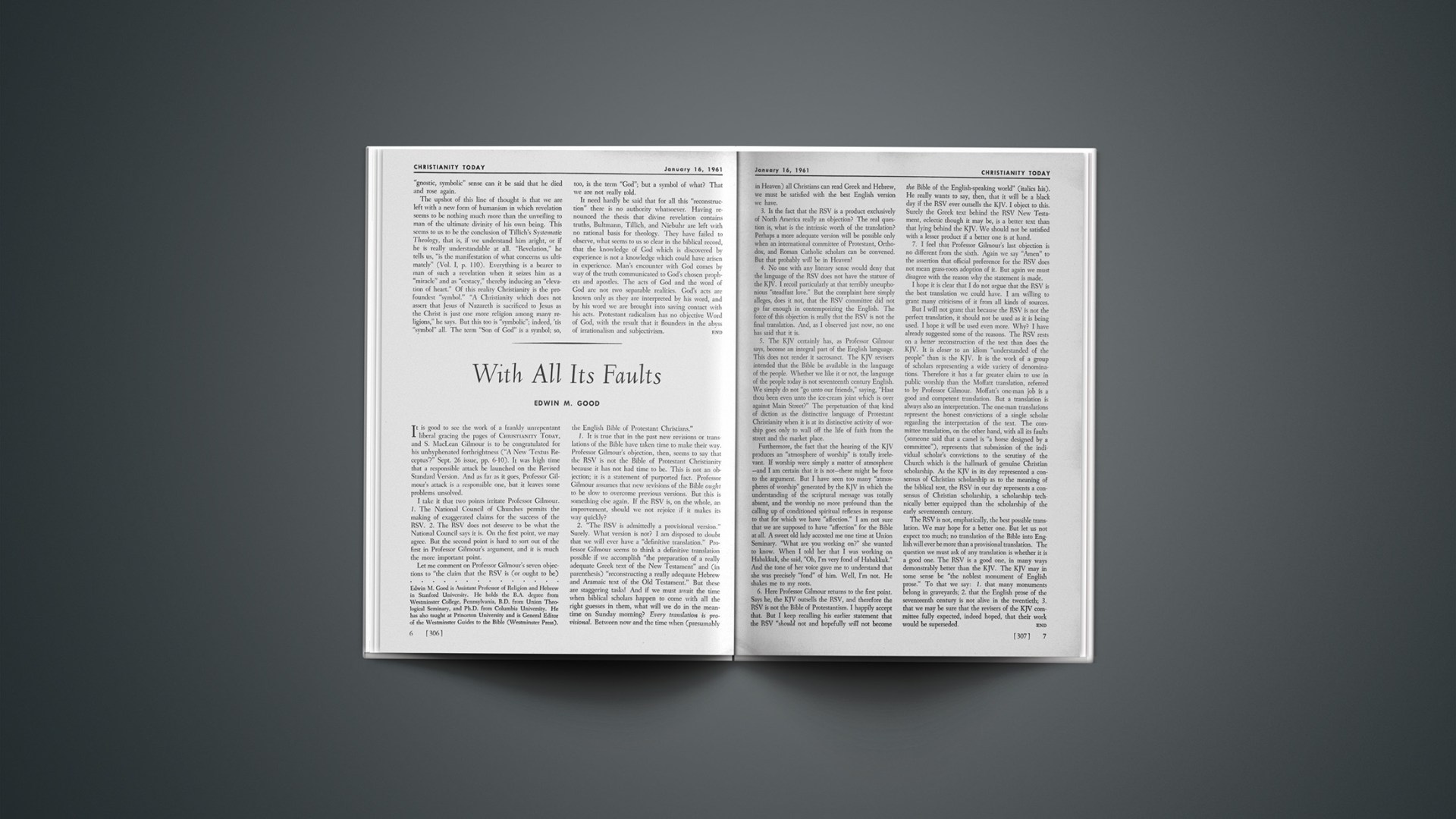
It is good to see the work of a frankly unrepentant liberal gracing the pages of CHRISTIANITY TODAY, and S. MacLean Gilmour is to be congratulated for his unhyphenated forthrightness (“A New ‘Textus Receptus’?” Sept. 26 issue, pp. 6–10). It was high time that a responsible attack be launched on the Revised Standard Version. And as far as it goes, Professor Gilmour’s attack is a responsible one, but it leaves some problems unsolved.

I take it that two points irritate Professor Gilmour. 1. The National Council of Churches permits the making of exaggerated claims for the success of the RSV. 2. The RSV does not deserve to be what the National Council says it is. On the first point, we may agree. But the second point is hard to sort out of the first in Professor Gilmour’s argument, and it is much the more important point.

Let me comment on Professor Gilmour’s seven objections to “the claim that the RSV is (or ought to be) the English Bible of Protestant Christians.”

1. It is true that in the past new revisions or translations of the Bible have taken time to make their way. Professor Gilmour’s objection, then, seems to say that the RSV is not the Bible of Protestant Christianity because it has not had time to be. This is not an objection; it is a statement of purported fact. Professor Gilmour assumes that new revisions of the Bible ought to be slow to overcome previous versions. But this is something else again. If the RSV is, on the whole, an improvement, should we not rejoice if it makes its way quickly?

2. “The RSV is admittedly a provisional version.” Surely. What version is not? I am disposed to doubt that we will ever have a “definitive translation.” Professor Gilmour seems to think a definitive translation possible if we accomplish “the preparation of a really adequate Greek text of the New Testament” and (in parenthesis) “reconstructing a really adequate Hebrew and Aramaic text of the Old Testament.” But these are staggering tasks! And if we must await the time when biblical scholars happen to come with all the right guesses in them, what will we do in the meantime on Sunday morning? Every translation is provisional. Between now and the time when (presumably in Heaven) all Christians can read Greek and Hebrew, we must be satisfied with the best English version we have.

3. Is the fact that the RSV is a product exclusively of North America really an objection? The real question is, what is the intrinsic worth of the translation? Perhaps a more adequate version will be possible only when an international committee of Protestant, Orthodox, and Roman Catholic scholars can be convened. But that probably will be in Heaven!

4. No one with any literary sense would deny that the language of the RSV does not have the stature of the KJV. I recoil particularly at that terribly uneuphonious “steadfast love.” But the complaint here simply alleges, does it not, that the RSV committee did not go far enough in contemporizing the English. The force of this objection is really that the RSV is not the final translation. And, as I observed just now, no one has said that it is.

5. The KJV certainly has, as Professor Gilmour says, become an integral part of the English language. This does not render it sacrosanct. The KJV revisers intended that the Bible be available in the language of the people. Whether we like it or not, the language of the people today is not seventeenth century English. We simply do not “go unto our friends,” saying, “Hast thou been even unto the ice-cream joint which is over against Main Street?” The perpetuation of that kind of diction as the distinctive language of Protestant Christianity when it is at its distinctive activity of worship goes only to wall off the life of faith from the street and the market place.

Furthermore, the fact that the hearing of the KJV produces an “atmosphere of worship” is totally irrelevant. If worship were simply a matter of atmosphere—and I am certain that it is not—there might be force to the argument. But I have seen too many “atmospheres of worship” generated by the KJV in which the understanding of the scriptural message was totally absent, and the worship no more profound than the calling up of conditioned spiritual reflexes in response to that for which we have “affection.” I am not sure that we are supposed to have “affection” for the Bible at all. A sweet old lady accosted me one time at Union Seminary. “What are you working on?” she wanted to know. When I told her that I was working on Habakkuk, she said, “Oh, I’m very fond of Habakkuk.” And the tone of her voice gave me to understand that she was precisely “fond” of him. Well, I’m not. He shakes me to my roots.

6. Here Professor Gilmour returns to the first point. Says he, the KJV outsells the RSV, and therefore the RSV is not the Bible of Protestantism. I happily accept that. But I keep recalling his earlier statement that the RSV “should not and hopefully will not become the Bible of the English-speaking world” (italics his). He really wants to say, then, that it will be a black day if the RSV ever outsells the KJV. I object to this. Surely the Greek text behind the RSV New Testament, eclectic though it may be, is a better text than that lying behind the KJV. We should not be satisfied with a lesser product if a better one is at hand.

7. I feel that Professor Gilmour’s last objection is no different from the sixth. Again we say “Amen” to the assertion that official preference for the RSV does not mean grass-roots adoption of it. But again we must disagree with the reason why the statement is made.

I hope it is clear that I do not argue that the RSV is the best translation we could have. I am willing to grant many criticisms of it from all kinds of sources.

But I will not grant that because the RSV is not the perfect translation, it should not be used as it is being used. I hope it will be used even more. Why? I have already suggested some of the reasons. The RSV rests on a better reconstruction of the text than does the KJV. It is closer to an idiom “understanded of the people” than is the KJV. It is the work of a group of scholars representing a wide variety of denominations. Therefore it has a far greater claim to use in public worship than the Moffatt translation, referred to by Professor Gilmour. Moffatt’s one-man job is a good and competent translation. But a translation is always also an interpretation. The one-man translations represent the honest convictions of a single scholar regarding the interpretation of the text. The committee translation, on the other hand, with all its faults (someone said that a camel is “a horse designed by a committee”), represents that submission of the individual scholar’s convictions to the scrutiny of the Church which is the hallmark of genuine Christian scholarship. As the KJV in its day represented a consensus of Christian scholarship as to the meaning of the biblical text, the RSV in our day represents a consensus of Christian scholarship, a scholarship technically better equipped than the scholarship of the early seventeenth century.

The RSV is not, emphatically, the best possible translation. We may hope for a better one. But let us not expect too much; no translation of the Bible into English will ever be more than a provisional translation. The question we must ask of any translation is whether it is a good one. The RSV is a good one, in many ways demonstrably better than the KJV. The KJV may in some sense be “the noblest monument of English prose.” To that we say: 1. that many monuments belong in graveyards; 2. that the English prose of the seventeenth century is not alive in the twentieth; 3. that we may be sure that the revisers of the KJV committee fully expected, indeed hoped, that their work would be superseded.

Samuel M. Shoemaker is the author of a number of popular books and the gifted Rector of Calvary Episcopal Church in Pittsburgh. He is known for his effective leadership of laymen and his deeply spiritual approach to all vital issues.
The Conflict over Special Revelation

For several decades the subject of special revelation has been focal in theological discussion. The basic issue, implied or stated, in recent theological structures is precisely the question, how are we to understand God’s specific self-disclosure? Those who have rejected the historic evangelical position, with its sola scriptura, sola fides, solus Christus, despite varying degrees of dogmatism, betray an astonishing degree of fluctuation and hesitancy, gyratings and revisions.

Some have commended modern theology for its “dynamic” nature in contrast with the “static” doctrine of the “traditionalists.” The emphasis on new “insights” into truth frequently recurs in modern theologies. But it is one thing to move, another to be sure where you are going. Much modern theology is restless and lacks a fixed center; it is on the march, but unsure of its destination.

It is difficult to describe some contemporary views on revelation with exactness, not only because these newer theological reconstructions insistently deny all finality but because of the delight expressed by exponents over the disagreements among each other. The basic differences between Barth and Brunner are well known. Brunner accused Barth of inconsistency. Although Barth professes to repudiate intellectualism in theology, his writings are vitiated, Brunner insists, by an unconscious philosophy which ends in biblical monism. Barth retorts that Brunner welcomes at the back door (in the form of general revelation) the intellectualism he has cast out at the front door. With both and between themselves Tillich and Niebuhr disagree. Tillich writes of the “many theological disputes” he has had with his “great friend” Niebuhr. Niebuhr maintains that an indebtedness to Greek intellectualistic thought was necessary so that Christianity might convincingly adapt itself to prevailing views. This was a missionary requisite. Tillich denies the legitimacy of this type of intellectualism and insists, in opposition, that Greek thought was not in fact rationalistic but mystical.” Brunner states that the label “neo-orthodox” is unfortunate and really inapplicable to Niebuhr since “there is nothing more unorthodox than the spiritual volcano Reinhold Niebuhr.” He prefers therefore to call him a “radical-Protestant.” Then there is Bultmann, the new monarch in the theological arena, who, according to Brunner, “thins out the Gospel too much.” In the midst of such cross discussion, the student of contemporary theology must be forgiven if he finds agreement in high places hard to discover.

One thing, however, is certain. Behind these modern ideas of revelation stand a deliberate renunciation of the “traditional” doctrine and a departure from what the Church has from the first believed concerning special revelation. From time to time, assuredly, advocates of one or other of the current ideas seek to justify the newer position by claiming that theirs is the historic teaching of the Church. Such a claim, made by Gore in his day and by Hebert at the present, need not be taken seriously. To call their opponents “traditionalists” and then to castigate them as modern is, to say the least, very inconsistent.

As the late John Baillie says in the opening of his book The Idea of Revelation in Recent Thought, the fundamental question of all theological reconstructions is “What do we mean by revelation?” This, he says, “is a question to which much hard thinking and careful writing are being devoted in our time, and there is a general awareness among us that it is being answered in a way that sounds very different from traditional formulations.”

THREE MODERN PRONGS

Broadly, those who take up positions opposed to “traditional formulations” fall into three groups. There are the older theological liberals, the neo-orthodox, and the modern Protestant radicals.

In some quarters a surprising number of thinkers adhere still to the first of these ideas. The view, deriving from Schleiermacher, puts emphasis upon the immanence of God and upon personal experience as the method of revelation and as the ground of religious authority. In the context of these notions God is sought in the depths of man’s consciousness and he is regarded as the “near Ally,” not as the “great Alien.” In his fundamental nature, man is not cut off from the Infinite. Clouded and strained by man’s folly and ignorance though the divine may be, yet it still subsists and persists. The native God-consciousness needs but to be awakened and then man will rise upon the steppingstones of his awakening self to heights divine.

This was the basic idea of which Schleiermacher was the father and liberal Protestantism the offspring. Schleiermacher proclaimed and liberal Protestantism reiterates the thrilling and tremendous possibility belonging to man as man, “of taking up the divine just as it did happen in Christ.” This is religious experience: here are special revelation and religious authority. The Bible is demeaned into mere testimony to this human reality. It is a record of and a witness to religious experience as a continuing possibility. The Bible is a book of abiding value because herein is collected the evidence of man’s growing experience of God and his progressive response to him. And of this experience Jesus is for us the supreme example and the chief inspiration. But to be so it must be the real Jesus, the genuine historic Figure, recovered from the debris of dogmatism under which the Church has buried him. It was found necessary therefore to reconstruct the gospel record and to discover the essential human character of the story whose genius for religion has been so creative and decisive for all following generations. It fell to Harnack to lead in this reconstruction. “The Christ that Harnack sees,” said George Tyrrell, “looking back through nineteen centuries of Catholic darkness, is only the reflection of a Liberal Protestant face, seen at the bottom of a deep well.”

Against such a view of revelation, the neo-orthodox entered the most vigorous protest. Brunner saw it as an attempt to get rid of the idea of special revelation by seeking to make all history revelational. It failed altogether to take account of the fact that Christianity is decisively connected “with a real event in time and space, which, so it affirms, is the unique, final revelation for time and eternity, and for the whole world” (Mediator, p. 30).

So neo-orthodoxy came with its message of sharp opposition to liberalism’s attempt to build theology on human experience, even if designated as “religious” and “Christian” experience. In contrast, emphasis was placed upon the transcendence of God and his difference from man. He is the Wholly Other and there is no natural unity (says Barth especially) between God and man. The cult of the historic Jesus is therefore firmly repudiated. Special revelation is located in the Word of God, God the Son. It has nothing to do with a figure of human history. The revealing events are not “historical” happenings at all. They fall in the realm of Geschichte (which denotes that which is above history). Here, it is said, is the locale of revelation in which and for which the human Jesus has no significance. “Faith presupposes, as a matter of course, a priori, that the Jesus of history is not the same as the Christ of faith,” says Brunner (Mediator, p. 184). Thus faith is not in the least concerned with critical investigation into the records. In fact, the most radical biblical criticism, of which Brunner is an ardent adherent, does not affect the issue in the slightest. Indeed, it may well be that the Synoptic Gospels do less than justice to the stark literal humanness of Jesus (cf. Barth, Church Dogmatics, Vol. I, Part 1, pp. 151 ff., 1955). “Not Christ after the flesh, the Christ who is tractable to historical and critical enquiry, but the Christ after the Spirit is the subject of revelation” (Camfield, Revelation and the Holy Spirit, p. 64).

We cannot enter into the implications of all this now. It could be shown that despite all their emphasis upon “objective” revelation the neo-orthodox have really returned to the Kierkegaardian subjectivity, a subjectivity which in their respective criticisms of Schleiermacher they have professed to renounce. And, eliminating the historical Jesus from account, they readily entertain the most radical critical conclusions regarding the gospel records. But they are left, it appears to us, with a Christ who merely has the “value” of God for us, since he is who he is by the interpretation of the Church. It is when I am “convinced in my conscience” that “Christ is the truth” that I can believe in the Scripture testimony to Christ (Brunner, Dogmatics, Vol. I, p. 110). The truth is, of course, that this repudiation of the historic Jesus is false and fatal. It is the whole Christ of the whole New Testament who is the source and the object of faith. Faith presupposes, as a matter of course, a priori, that the Jesus of history is the same as the Christ of faith.

Modern radical Protestantism, it seems to us, sets out from the neo-orthodox conclusion and develops into a “reconstruction” theory which is reactionary indeed. Bultmann (the Strauss of the twentieth century) arrives at what we may call a form of skeptical romanticism. We are told that we can now know almost nothing concerning the life and person of Jesus (Jesus and the Word, p. 8). The whole Gospel has come to us “legend-tinted,” overlaid with ideas derived from a primitive supernaturalism. It is the task of theology today not be content with the neo-orthodox, super-historical Christ but to reconstruct the whole by “demythologizing” the “myths.” It is therefore maintained frankly, for example by Niebuhr, that such ideas as the Trinity are mere symbolic expressions, quite meaningless if read literally. Since it would be absurd to assert that the finite can be the infinite, we are told that Jesus was not really, literally divine. Only in a “gnostic, symbolic” sense can it be said that he died and rose again.

The upshot of this line of thought is that we are left with a new form of humanism in which revelation seems to be nothing much more than the unveiling to man of the ultimate divinity of his own being. This seems to us to be the conclusion of Tillich’s Systematic Theology, that is, if we understand him aright, or if he is really understandable at all. “Revelation,” he tells us, “is the manifestation of what concerns us ultimately” (Vol. I, p. 110). Everything is a bearer to man of such a revelation when it seizes him as a “miracle” and as “ecstacy,” thereby inducing an “elevation of heart.” Of this reality Christianity is the profoundest “symbol.” “A Christianity which does not assert that Jesus of Nazareth is sacrificed to Jesus as the Christ is just one more religion among many religions,” he says. But this too is “symbolic”; indeed, ’tis “symbol” all. The term “Son of God” is a symbol; so, too, is the term “God”; but a symbol of what? That we are not really told.

It need hardly be said that for all this “reconstruction” there is no authority whatsoever. Having renounced the thesis that divine revelation contains truths, Bultmann, Tillich, and Niebuhr are left with no rational basis for theology. They have failed to observe, what seems to us so clear in the biblical record, that the knowledge of God which is discovered by experience is not a knowledge which could have arisen in experience. Man’s encounter with God comes by way of the truth communicated to God’s chosen prophets and apostles. The acts of God and the word of God are not two separable realities. God’s acts are known only as they are interpreted by his word, and by his word we are brought into saving contact with his acts. Protestant radicalism has no objective Word of God, with the result that it flounders in the abyss of irrationalism and subjectivism.

Samuel M. Shoemaker is the author of a number of popular books and the gifted Rector of Calvary Episcopal Church in Pittsburgh. He is known for his effective leadership of laymen and his deeply spiritual approach to all vital issues.

To Recover a Crown

“Theology: the Queen of the Sciences.” For many today, such a concept is reminiscent of times when knighthood was in flower. The man on the street may have difficulty comprehending that doctrinal differences involved in “that crash of light over Europe known as the Reformation played a mighty role in shaping the face of that continent. He cares little whether theology abdicated or was dethroned. He is more interested in the twentieth century monarch: natural science.

And natural science, or better, scientism, indeed seems regnant. But it wears its crown uneasily, its scepter twitches in a sweaty palm. For it threatens its dominion with destruction, its subjects with genocide. This is not out of character, for the youthful sovereign usurped the throne with a suddenness akin to violence. Indeed, of those performing the task of midwifery, of all the scientists and engineers produced by the human race, the majority are still alive. Their rushing flood of discoveries, by almost annihilating time and distance, has forced a reconstruction of geography. While the Industrial Revolution removed many of man’s muscular burdens, the current swift extension of electronics data-processing techniques, coupled with automation, will relieve him of many mental and decision-making functions. The unfolding of scientific discovery has been greater this past century than in all the others put together, and the acceleration shows no sign of slackening.

All of this promises man a golden age, but it has brought him into an era of mortal peril. His ability to cope with new forces matures slowly and is hopelessly outdistanced by the remorseless pace of his monarch-captor. The new discoveries, applied to weaponry and timed to the ideological division of the world into two armed camps, have propelled him into a balance of terror, with no guarantee of stability.

There are scattered cries for some word from the old Queen, but many theologians speak in uncertain accents (see editorial, “The Predicament of Modern Theology”). Their faltering words are often muffled by the blast of rocketry and echo meaninglessly in a yawning chasm of disaster. The world hears no clear warning of doom or promise of regeneration.

In such an hour, CHRISTIANITY TODAY begins with this issue a series of studies of the great Bible doctrines, in the classical tradition of biblical and systematic theology. The world hungers for such. Sometimes it takes a scientist like R.C.A. Vice President Dr. Elmer W. Engstrom to remind mankind, as he did government officials recently, that we need to develop faith and wisdom “more nearly the equivalent of our technical prowess.” These he finds in Christ.

Men outside of Christ are becoming more aware of their impotence. The illusory ideal of humanistic self-sufficiency is being seen more for what it is. But men cannot agree as to the proper source of aid. They seem lost in a never-ending war of ideas as they fight behind an armor of fluctuating notions which vanish with the polishing. Lacking are the transforming power of true doctrine, eternal principles, the certainty of a personal relationship with God.

What kind of God? Could evangelical theologians know whereof they speak as they tell us of the attributes of God? And what could have more thunderous relevance for the besetting uncertainties of our day than the providence of God? What of the enigma of man—his great capacity for good coupled with his stunning aptitude for evil? We have surely heard of God’s image in man and also of man’s fall, of his original sin. What is the present significance of these realities?

Explanations without solutions are surely inadequate. But how pale seem other messages beside the proclamation of Jesus Christ as Prophet, Priest, and King. How futile, solutions other than the gigantic Cross, its head reaching heaven, its foot piercing the bowels of hell, its arms encircling the world. How frustrating the quest for fullness of life apart from the emptiness of The Tomb. Where is there salvation apart from atonement? Where is completeness apart from mystical union with the Son of Man? Where is hope apart from faith? Where is satisfaction apart from justification? Where is purpose apart from sanctification? Where is confidence apart from assurance concerning the last things? And where is fellowship apart from God and his Christ?

But how may we know these matchless truths unless God tell us in ways we can understand and dare not evade? This is revelation. And it is at this point that Pittsburgh Seminary’s Addison H. Leitch begins our pilgrimage back to Jerusalem, treading with sure step as he avoids the common pitfalls of sacrificing either general or special revelation.

Review of Current Religious Thought: January 02, 1961

I am not sure whether such opportunities have been present in other places, but in Holland personal contacts between Roman Catholic and Reformed theologians since the last war have been highly instructive. During the occupation, we came together frequently because we felt a strong need of one another. After the war, we tried to continue something of the same spirit, and a series of conversations was carried on between Roman and Reformed theologians. In the conversations we attempted to review in an open and cordial way the great questions involved in the Rome-Reformation conflict.

There was voiced concern on the part of some lest in such conversations Reformed theologians would tend to minimize the depth of the gulf between us. But those who took part in the discussions know that within the cordial personal relationships, the profound differences of faith were continually manifest. Subjects as mariology, the primacy of the pope, the nature of the church, justification and good Works, all of which were repeatedly discussed, kept us from ever forgetting our tragic differences.

Misunderstandings were frequently cleared up. But even as we came to understand each other better, the differences between us became all the more marked. At the same time, it often struck us that misunderstandings of Rome from the side of Protestants are many and frequently form part of a long tradition of misunderstanding. But it struck us even more deeply that Roman Catholic thinkers carry on a persistent misinterpretation of the Reformation.

It is recognized by Roman scholars that a profound religious motivation was involved in the Reformation. Catholic apologists talk of the profound faith observable in Luther and Calvin, and speak appreciatively of the Reformers’ great respect for the Word of God. But the charge that the Reformation was basically a revolution still is heard. Karl Adam, who often has a good word for Luther, says that Luther committed the great sin, which Augustine called the worst, namely, the sin of raising an altar against an altar. Luther, says Adam, lost the vision of the reality of the body of Christ in the ecclesia catholica.

Of special interest is the fact that Roman polemicists still charge the Reformers with an unwarranted one-sidedness in regard to the doctrine of sola fide, salvation by faith alone. Catholic writers have coined the word solism for this aspect of the Reformers’ theology: sola fide, sola scriptura, sola gratia. The tendency to see things in terms of only this or that forced the Reformers, we are told, to ignore other sides of the truth.

Criticism is directed especially against the sola fide doctrine. Salvation by faith alone tended to remove necessity for good works or sanctification. The Reformation is thus seen as a kind of antinomianism which relied on a perverse interpretation of Paul with no eye for the urgent call to holiness in the Christian life.

Now it is obvious that the Bible puts much emphasis on the necessity of sanctification and good works. It could hardly be said more strongly than in the book of Hebrews which tells us that without consecration it is impossible to see God (Heb. 12:14). Then there is Matthew who recalls that it is the pure in heart who shall see God (Matt. 5:8). Why then do Roman apologists suggest that the Reformers, who were theologians of the Word, had no eye for the biblical urgency of sanctification?

If we recall the sixteenth century, we remember that many, in reaction to Roman ideas of man’s meriting salvation, were hesitant even to talk about good works with any emphasis. Yet it is surely clear that the Reformers without exception never lost sight of the importance of sanctification in their attack on the idea of the merit of sanctification as part payment for salvation.

Calvin probably had Roman criticism in mind when he wrote that salvation by faith alone cannot mean that faith remains alone. Like Luther, he would have no part of the thought that, since justification is by faith and not by works, good works were unnecessary and even harmful. Their protest was in no wise against sanctified living; rather, it was against the notion that a man earned salvation in part by sanctified living. They wanted to maintain sanctification in its biblical perspective.

Roman Catholic theology made a tradition of accusing the Reformers of losing sight of the urgency of the moral and spiritual life. This is parallel with their charge that the Reformers’ rejection of papal primacy meant they were not Reformers but revolutionaries. Such Catholic writers often suggest that the Reformers blazed the trail that led to the French Revolution and the nihilism of our own day. The discouraging aspect of this understanding is that it is seen in the most irenic Catholics, those who want most sincerely to understand the Reformation.

Surely, it is the duty of those who look at the Reformation as a return to the Bible, to make clear in word and deed that such interpretation of the Reformed life is a serious misunderstanding. We cannot rest with saying that the writings of Luther and Calvin make it abundantly clear that they were not enemies of sanctified living and not antagonists of good works. We must make it manifest in our persons and in our congregations that faith does not remain alone, that it is informed with love and holiness, that the faith which alone saves is a source of spiritual life, a power which makes for holiness. If we wish to dispel the Catholic argument that Protestants believe only faith is important and sanctification unimportant, then we must together seriously live the Christian life in the seriousness of the Bible.

The deepest intention of the Reformation was to preach the significance of the Atonement as the redemption of life. Antinomianism is a thrust against the real meaning of the Reformation, the call to life in Christ with all its urgency to holiness. Salvation is through faith alone: this is the Reformation truth. But faith does not remain alone, it is joined by works. This also is Reformation truth.

Book Briefs: January 2, 1961

The Finished Work Of Christ

The Nature of the Atonement, by J. MacLeod Campbell (Clarke, 1959, 464 pp., 17s 6d. and The Christian Doctrine of Reconciliation, by James Denney (Clarke, 1959, 339 pp., 17s. 6d) are reviewed by R. A. Finlayson, Professor of Systematic Theology, Free Church College, Edinburgh.

When the older theologians were explicit in their reference to “the finished work of Christ,” it was in order to distinguish between the objective work completed on the Cross, and the unfinished or progressive work of Christ carried on through His Holy Spirit to the end of the age in the regeneration and sanctification of men. And they were equally clear and insistent on the fact that the objective work of Christ was the basis of man’s subjective experience. It is found that historical deviations from the orthodox view of the atonement tended to neglect this distinction and to view the atonement of Christ mainly, if not altogether, in its ethical implications. This can be more clearly seen towards the close of the eighteenth century when, with the disintegration of the Satisfaction Theory under the impact of Rationalism, there arose the school in theology identified with Schleiermacher and Ritschl in Germany and MacLeod Campbell in Scotland, which labored to place the meaning of atonement purely on a basis of history and experience.

Campbell’s theology was so heretical that in 1831 he was deposed from the ministry of the Church of Scotland. Evidently, the mood of the present generation of theologians is more hospitable to his theology since his book has been republished after the lapse of a full century.

MacLeod Campbell’s theory of the atonement is listed even by so discriminating a conservative theologian as Warfield as among the “Vicarious Theories,” though he places it lowest in the group. The vicarious element in the atonement Campbell regards as Christ’s repentance for us. It was a representation and identification with us on the part of Christ which involved no element of imputation on the part of God. In this identification with us, Christ in His great love was able to make our sins His own to such an extent that He could confess them and render to God an adequate repentance for them. This completely satisfied the demands of God and secured for all men the basis on which they could be forgiven. Thus Christ’s vicarious repentance rendered an unlimited atonement that was as extensive in its scope as the whole of mankind. And now the experience of salvation consists in Christ bringing us into the very experience in which our sin involved Him, and then into His experience of the Father’s love and grace. In short, Christ’s atonement for us guides us to the making of a similar atonement for ourselves.

The two questions that arose immediately, to which Campbell offers no satisfying answer, are: Can there be a vicarious repentance, or repentance, in any true sense of the term, on the part of one who has no consciousness of personal sin? And: Is repentance all that is necessary for forgiveness?

The answer to these questions can be found in James Denney’s classic work reissued at the same time. His estimate of Campbell’s book is, from one point of view at least, very high: “Of all books,” he writes, “that have ever been written on the atonement, as God’s way of reconciling men to Himself, MacLeod Campbell’s is probably that which is most completely inspired by the spirit of the truth with which it deals” (p. 120). One is, somehow, accustomed to these testimonials from Denney to positions that he is about to demolish! And his exposition of the New Testament doctrine of reconciliation, and of reconciliation as achieved by Christ, is a complete answer to MacLeod Campbell. Denney’s own position with regard to the basis of forgiveness is crystal clear in such statements as these: “God forgives our sins through Him who died for them: this is the real basis in the New Testament for such a formula as that Christ by the sacrifice of Himself for sin satisfied divine justice” (p. 161). And again: “If we are to stand on New Testament ground, propitiation is a word which we cannot discard and propitiation can never be defined except by reference to God.” Once more: “Its reference is to sin, and what it signifies is that in the very processes through which God’s forgiveness comes to sinners, justice is done and must be done, to the divine order in which sin has been committed. It is divinely necessary,” he adds, “necessary not only with a view to impressing men, but necessary in order that God may be true to himself, and to the moral order He has established in the world, that sin, in the very process in which it is forgiven, should also, in all its reality, be borne. This is what is done by Christ in His blood.”

Denney’s book, written with all the mental acumen and in the brilliant style that characterize all his works, is a valuable corrective to present-day easy views on sin and forgiveness.

R. A. FINLAYSON

East German Witness

A Christian in East Germany, by Johannes Hamel, edited with an introduction by Charles C. West (Association Press, 1960, 126 pp., $3), is reviewed by Carl F. H. Henry.

Here is an exciting window on the Christian witness in East Germany, that heartland of Luther’s Reformation now in the lap of Communism. Johannes Hamel has a message for Christians in the West as well as in the East: that Communists are not simply to be damned, but are to be addressed as sinners for whom Christ died. The reader will note the Barthian stamp on his view of the Bible (pp. 60 ff.), his downgrading of dogmatics (p. 63) and his view of truth (pp. 91, 97 ff.), but he must not escape the force of his plea that the Christian community has a missionary obligation as much to Khrushchev’s world as to Nero’s.

CARL F. H. HENRY

Evangelical Archbishop

Archbishop Mowll, by Marcus L. Loane (Hodder and Stoughton, 1960, 262 pp., 21s.), is reviewed by Noel S. Pollard, formerly Precentor, St. Andrew’s Cathedral, Sydney, New South Wales.

Billy Graham said during his Crusade in Australia that he had “never been in a city where he was so conscious of the influence of one man, who had walked with God, as he was in Sydney, where the influence of the Archbishop was still everywhere evident” (p. 253). This estimate made almost a year after Howard Mowll’s death explains why a biography of him should interest Christians all over the world. The fact that Marcus Loane is the author of this work will be a further recommendation to those who have read his other biographical writings. For those interested in the fortunes of the Evangelicals in the Church of England and in the part played by a fine Evangelical leader in the affairs of the world church, this is a rich storehouse. Dr. Loane has abundantly demonstrated that Archbishop Mowll was the rightful successor to the great Evangelical leaders such as Bishops Ryle, Moule, Knox, and Taylor Smith.

Most valuable of all, Bishop Loane has given us a wonderfully detailed picture of Mowll’s work in the four countries where his influence was greatest. First, in England during his student days, he played an important part at one of the most difficult times in the recent history of Evangelicalism. His name is still remembered and honoured in Cambridge today. Then, during the years of the Great War, he exercised a far-reaching pastoral ministry in Canada among the clergy of that dominion. During the 1920s he was made bishop in West China and he assisted at the birth of the indigenous church there. Finally, in the fourth period of his ministry as Archbishop of Sydney and Primate of Australia, he did much to lay the foundation of a strong and virile Evangelical witness in that vast continent over a period of twenty-five years.

A complete estimate of the man and his work can only come when we can look back over a longer period and see his life in perspective. But for the present here is a most valuable and detailed guide to his career and achievements. Those who know the Diocese of Sydney and who knew the man himself can only give God the praise for all we read in this book.

N. S. POLLARD

Pioneer In Education

J. M. Price: Portrait of a Pioneer, by Clyde Merrill Maguire (Broadman, 1960, 138 pp., $2.95), is reviewed by James DeForest Murch.

Southern Baptist churches are noted for their great Sunday Schools and their progressive ideas about Christian education at the local church level. Much of this accomplishment is due to the pioneer work of John Milburn Price.

Price came from the hills of Fair Dealing, Kentucky, but as a young college student he caught the vision of an educated church, earned doctorates with honors in eastern universities, and founded the School of Christian Education in Southwestern Baptist Theological Seminary—one of the most advanced institutions of its kind in the world.

Maguire pays a much-deserved and inspiring tribute to this true scholar who achieved greatly but never lost the common touch.

JAMES DEFOREST MURCH

Unique Phenomenon?

The Prophets of Israel, by Curt Kuhl. Translated from the German. (John Knox Press, 1960, 199 pp., $3.50). Reviewed by Oswald T. Allis, formerly Professor of Old Testament at Westminster Theological Seminary.

The author of this short but meaty volume justifies his choice of subject by describing it as “the unique phenomenon of Israelite prophecy, unparalleled among any other people or in any other literature.” This encourages the reader to expect a rich repast. Unfortunately, when he has completed his examination of the volume, the reader finds that very much of the uniqueness has disappeared. For one of the main results of that “critical” movement which the author represents has been to decrease or destroy that uniqueness. In religious matters Israel, according to Kuhl, “was profoundly influenced by its surroundings”; and its “two essential elements,” the mantic and the ecstatic, are both derived from her neighbors.

One of the distinctive features of biblical prophecy is prediction. In proof of this the reader is referred to Isaiah 40–48. But according to Kuhl 2 Samuel 7:8–17 “has no messianic character whatsoever”; and the same view is taken of Isaiah 7:14 (“the mediaeval Jewish opinion … that the reference is probably to the prophet’s wife, is probably nearest the truth”) and of 9:7. With especial reference to Isaiah 53 he tells us that we must be “content with the inadequate solution that the central figure in the songs is Deutero-Isaiah himself.” The significant thing about this solution is that it is admittedly “inadequate.” According to Kuhl there are three Isaiahs. But to call the third “Trito-Isaiah” is a “misnomer” because Trito is himself composite. There are three Zechariahs, three hands to be distinguished in Obadiah. Ezekiel did not write chapters 34–48. Joel, Jonah, and Daniel belong to the late-post-exilic period.

If Dr. Kuhl really holds that biblical prophecy is so “unique” and so “unparalleled,” he owes it to himself and to his readers to treat it with the respect which such an amazing phenomenon deserves.

OSWALD T. ALLIS

Congregational Way

The Congregational Way of Life, by Arthur A. Rouner, Jr. (Prentice-Hall, 1960, 182 pp., $3.50), is reviewed by Henry David Gray, Minister, South Congregational Church, Hartford, Connecticut.

Arthur Rouner writes a Word for today which is warmly evangelical and profoundly Christian. I can testify, as Chairman of the Committee on Congregational Polity for four years and as one of the nine members of the Constitutional Commission of the General Council during the biennium of its existence (1954–56), that Mr. Rouner’s descriptions are accurate concerning the ministry, the sacraments, the worship, the association, the conferences, the councils and the covenants of our traditional Congregational Way of life.

The value of the book lies in its cogent imposition of the life and work of a Spirit-commanded fellowship. The principle of ‘the gathered Church’ here breathes a commitment to Christ founded on the twofold recognition that Christ is “Lord and King of His Church” (p. 46) and that “His presence gives authority to our order … validity to our sacraments … and … power” (p. 46).

‘Freedom’ is seen to be ‘freedom in Christ’, “the freedom of a voluntary agreement with Christ and with our fellow Christians to walk together in love—to obey the Lord … (p. 64). “Because of this direct line of authority to churches from their Lord, our Way is known as ‘Independency,’ and our churches as ‘free’ churches” (p. 65). In a penetrating and often soul-disturbing manner Mr. Rouner unfolds the theme that “a Congregational Church lives or dies by the dedication and devotion of its people” (p. 68), with special concern for individual and corporate searching of the scriptures and with an enunciation of the principle that all church bodies beyond the local church are “formed to serve” the churches and are “in no sense their masters” (p. 75).

With considerable eloquence Mr. Rouner pleads for a “high ground of faith (which we) can stand on together” (p. 85). The New Testament testimony “Jesus is Lord” is proclaimed as the center of “a free, creative fellowship” (p. 91) with the overwhelming conviction that “God was in Christ reconciling the world to Himself.” A Bible faith which “springs from the deep wells of human experience” (p. 95) in living personal relationship to God—this is the transforming reality which needs no creed when conviction leads a man to the personal confession of faith “Jesus is Lord.”

There is also a definitive plea for a consecrated, care-for-each other, expectant, lay-led, adventurous, believing and serving fellowship which radiates “the apostolic joy” (p. 116).

Simplicity, directness and spiritual power characterize the claim that the uniqueness of the Congregational Way is “a whole people worshipping together, working together, and led by God together: a people who bear responsibility as a whole church and not just by delegated committees or representatives” (p. 124).

The church itself is directly and immediately responsible for the nurture, training, ordination, life and work of the minister as one giving full time to the Christian work which is the concern and responsibility of the whole worshipping community. The call is God’s call; education is for service rather than to gain a position of deference, and ordination is at the call of a particular church, by the people of that church.

Mr. Rouner’s book is inadequate in two chief ways. First, he idealizes certain aspects of English Congregational life, particularly the Church Meeting and the Lay Preacher. Possibly he intends a call to us to use these valid ideas in vigorous ways. Second, even the splendid section on “The Way of the Spirit” does not quite come to grips with the nature and power of theology of Christian experience unveiled in Acts and in the Congregational Way at its best.

Despite minor defects this volume is the clearest trumpet-call which Congregationalism in America has heard in more than a quarter century. For the Congregationalist, it is an accurate, reverent and soul-searching call to commitment. It is the best one-volume introduction to the Congregational Way published in many decades.

HENRY DAVID GRAY

The Jew And Christ

The Church Meets Judaism, by Otto A. Piper, Jacob Jocz and Harold Floreen. (Augsburg, 1960, 98 pp., $1.75), reviewed by Victor Buksbazen, Vice President International Hebrew Christian Alliance.

In this small volume three Christian theologians confront the Church with the challenge of contemporary Judaism.

Jakob Jocz, Professor of Systematic Theology at Wycliffe College, Toronto, gives a penetrating analysis of Israel’s spiritual crisis, from the vantage point of a Hebrew Christian. His conclusion: “The modern Jew is a split personality without deep convictions and definite faith in God. The church must help the Jew find his way back to the source of spiritual life.”

Professor Piper of Princeton Theological Seminary analyzes chapters 9–11 of Paul’s epistle to the Church in Rome and decides, “Our task is not to make the Jew a Gentile Christian but a true Jew, a Jew who sees what Christ actually means for the historical mission which his people have in the world.”

Perhaps the most thought-provoking and even embarrassing challenge to the Christian conscience occurs in Professor Floreen’s contribution to the symposium: “The most direct defiance of Christ’s lordship is the refusal to include Jews or others in our evangelism because of prejudice.”

A stimulating and challenging book for all those who take their Christian responsibility to the Jew earnestly.

VICTOR BUKSBAZEN

Christian Dictionary

The Vocabulary of the Church, edited by Richard C. White (Macmillan, 1960, 178 pp., $3.50), is reviewed by Faris D. Whitesell, Professor of Practical Theology, Northern Baptist Theological Seminary.

If you have ever been confused by the phonetic markings and diacritical signs in standard dictionaries and reference works, you will appreciate this book. In one alphabetical index of over ten thousand word entries, it gives the correct pronunciation of words in a simplified form. Avoiding all diacritical markings, the author uses a system of capitalization, syllabylization, and italicizing to indicate at a glance the right pronunciation of any word. His index includes all Bible names and places, the most used Bible words, and the common names and terms from church history, theology, music, psychology, and philosophy—truly the vocabulary of the Church!

Here are examples of his system: Aaron is ER uhn; Barth is BAHRT; Bethphage is BETH fuh jee; Bezalel is BEZ uh lel; Caiaphas is KAY yuh fuhs; Frelinghuysen is FRAY ling high z’n; Geoffrey is JEF ri; Pharoah is FER o, or FAY ro; Nicanor is nigh KAY nawr; Philistine is fi LIS tin, or FIL uhs teen.

This volume will easily prove worthy of a place alongside the dictionary on the desks of pastors and vocational Christian workers.

FARIS D. WHITESELL

Sunday School Lesson Commentaries

Standard Lesson Commentary, edited by Orrin Root (Standard, 1960, 440 pp., $2.95); The Douglass Sunday School Lessons, by Earl L. Douglass (Macmillan, 1960, 494 pp., $3.25); Broadman Comments, by H. I. Hester and J. Winston Pearce (Broadman, 1960, 458 pp., $2.95); The International Lesson Annual, by Charles M. Laymon and Roy L. Smith (Abingdon, 1960, 448 pp., $2.95); Tarbell’s Teachers’ Guide, by Frank S. Mead (Revell, 1960, 384 pp., $2.95); Peloubet’s Select Notes, by Wilbur M. Smith (Wilde, 1960, 423 pp., $2.95); are reviewed by Milford Sholund, Director of Biblical and Educational Research, Gospel Light Publications, Glendale, California.

The 1961 outlines of the International Sunday School Lessons and International Bible Lessons for Christian Teaching include four areas of biblical subject matter. The first quarter plus one extra lesson in the second quarter (14 lessons) includes a comprehensive study of the entire Gospel of John. The second quarter is titled Biblical Wisdom and Ethical Problems. Biblical selections are taken from Proverbs, Job, Ecclesiastes, Luke, Ephesians, and James. The third quarter is devoted to personalities of the New Testament. They are Mary, the mother of Jesus, Andrew, Matthew, Mary and Martha, Thomas, Dorcas, John, Mark, Silas, Lydia, Timothy, Aquila and Priscilla, Titus, and Gaius. The last quarter is on the subject of Christian Growth.

The editors and publishers of comments on the International Uniform Lessons are going to the grass roots constituency to find out how to improve these volumes. Last year (1960) Tarbell’s volumes inserted a return post card asking for certain information. Editor Frank S. Mead learned that the principal concern of the teacher-users was for more application of the lessons to daily living. Sunday School teachers and students not only want to know what the Bible teaches but what this teaching means for their daily lives. Within the volume of a book of about 400 pages, the authors seek to make each biblical passage relevant to contemporary life.

A good illustration of the effort to help the teacher do a better job is shown in the format and organization of the lessons in the Standard Lesson Commentary. Orrin Root works with a larger volume with three columns per page. There is the skillful use of art work, layout, and attractive headings. The typical teacher will be fascinated by the book as he works through it for his weekly assignment. One of the unusual features of this edition is the cumulative index of all the biblical passages used in the Standard Lesson Commentaries from 1954 to 1961, listed on six pages. This should be a handy reference for Sunday School teachers and pastors.

Peloubet’s Select Notes for 1961, edited by Wilbur M. Smith, prince of biblical bibliographers, contains an enormous amount of information on the biblical text and related items. Undoubtedly, faithful users of Peloubet’s Select Notes will have become accustomed to the form of the lesson layout well enough that they know almost where to look for what they want. Dr. Smith has the unusual capacity of finding out what the best expositors of Scripture have to say on a given passage. The teacher who spends the time that he should in meditating and thinking about the compilation of truth that Dr. Smith has condensed for each lesson will be full of his subject. He should know what to teach. He may not get all the help he needs on how to relate this knowledge to the class.

The finest example of applying biblical truth to contemporary life is found in Douglass’ Sunday School Lessons. Earl L. Douglass is a master at compiling facts and presenting them in cogent, incisive language that the Sunday School teacher and pastor can use. There is a modernity about Douglass’ presentation of biblical truth that is appealing. Douglass is as certain as the sun rises that the Bible has the answer to man’s dilemma, but the way he brings the Word of God into contemporary language is fascinating and satisfying.

Broadman Comments has a distinctly Southern Baptist flavor, with a healthy emphasis on the all-sufficiency of the Holy Scriptures in faith and practice. H. I. Hester furnishes the exposition of the text. J. Winston Pearce applies the lesson to life. Teaching outlines and helpful visual aid suggestions add to the practical value of the volume.

Abingdon’s International Lesson Annual, edited by Charles M. Laymon, is prepared in more of the traditional format of the lesson exposition verse by verse with departments featured by well-known writers. For the typical Sunday School teacher there probably is more help in this volume on how to proceed to teach the lesson than is found in the other books. This is an important feature because Sunday School teachers too often are simply “talkers” rather than teachers. The King James Version and the Revised Standard Version are printed in parallel columns for those who prefer to use either one or both of these texts. It is interesting to observe that the King James Version continues to remain the popular text in the exposition of the International Uniform Lessons.

All six volumes abound with suggestions for illuminating the truth by audio-visual aids including films, filmstrips, flat pictures, object lessons, and oral illustrations.

Sunday School teachers and pastors who use these Sunday School lesson helps will find more than they can use each week in their Sunday classes. Undoubtedly much of the material published in these volumes will be useful outside of the Sunday School hour. There is a wealth of biblical material, and fortunately the editors are giving more time each year to teaching the Word of God.

MILFORD SHOLUND

Youth Ministry

The Jack Wyrtzen Story, by George Sweeting (Zondervan, 1960, 151 pp., $2.50), is reviewed by Ted W. Engstrom, President, Youth for Christ International.

The life of Jack Wyrtzen is a flesh and blood commentary on the promise of God in 1 Samuel 2:30—“For them that honor me, I will honor.” Wyrtzen and his Word of Life program have been true to the Word of God through many years of faithfully giving out the gospel of Jesus Christ to the youth of the world.

The Jack Wyrtzen Story is an unusual blending of twentieth century biography and solid biblical teaching. The Christian worker cannot help but be encouraged as he sees what God has done through one dedicated life. Teen-agers will also benefit from reading this book.

TED W. ENGSTROM

Word And Worship

Word and Sacrament: A Preface to Preaching and Worship, by Donald Macleod (Prentice-Hall, 1960, 164 pp., $4.65), is reviewed by C. Ralston Smith, pastor of the First Presbyterian Church, Oklahoma City.

This interesting little book by the Professor of Homiletics at Princeton Theological Seminary might better have been named “Word and Worship” because it has to do with these areas more particularly than with “sacrament” as that word is generally understood. It is written with clarity and persuasiveness. The last third of the book is taken up with several examples of meditations and sermons which purport to illustrate ideas of the author’s thesis.

The volume is especially well documented, perhaps too much so, with two hundred references to at least that many authors in its brief compass. Pastors should be helped much by the reading. My only point of real disagreement was in the unwarranted and unnecessary criticism of the ministry of music in the churches. Our own experiences reveals none of the hazards expressed, and I feel the situation described to be the unusual (p. 111).

C. RALSTON SMITH

Mission Surveys

Safe in Bondage, by Robert W. Spike (Friendship, 1960, 165 pp., $2.75) and One World, One Mission, by William Richey Hogg (Friendship, 1960, 164 pp., $2.95), are reviewed by Harold Lindsell, Dean of the Faculty, Fuller Theological Seminary.

These two books are written, the first about home missions and the second about foreign missions. In the first book the author successfully identifies and isolates the various strands which go to make up the complexity of modern American life. Each in itself is a mission field and the Church has not always witnessed successfully to the people who are caught in the web of circumstances. He deals with the big city and its problems of housing, minority groups, the flight to suburbia, and juvenile delinquency. He touches on regionalism, leisure, youth, TV, and industrial problems. Some solutions are offered for increasing the effectiveness of the Church’s witness. It is a searching, thoughtful, and well written book deserving of attention.

Hogg’s book is an elementary treatment or survey of missionary endeavor in terms of the modern ecumenical movement. The background material is synthetic and helpful to the ordinary reader. He shows the comparative strength of the National Council’s Division of Foreign Missions in relation to the IFMA, and the EFMA of the NAE. Having begun with a consideration of the various groups which make up the Church’s witness to the world the latter part of the book is unfortunately devoted only to illustrations of the effectiveness of the National Council’s Division of Foreign Missions witness.

HAROLD LINDSELL

Religious Makeup of the 87th Congress

No major realignments are evident in a comparison of religious affiliations of members of the 86th Congress with the 87th Congress, which convenes January 3.

Roman Catholics again are the most numerous in some two dozen religious affiliations represented in the Senate and House, but not by much. In both houses, Protestants as a group still outnumber those of other faiths.

In the 86th Congress, there was an initial total of 103 Roman Catholics, 91 in the House and 12 in the Senate.

In the 87th Congress, there are 98 Roman Catholics, including 86 in the House and 12 in the Senate. Here is the makeup of the House according to religious affiliation (for similar details on the Senate, see CHRISTIANITY TODAY, December 5, 1960 issue):

ROMAN CATHOLIC

Addabbo (D.-N.Y.)

Addonizio (D.-N.J.)

Anfuso (D-N.Y.)

Barrett (D.-Pa.)

Bates (R.-Mass.)

Becker (R.-N.Y.)

Bennett (R.-Mich.)

Blatnik (D.-Minn.)

Boggs (D.-La.)

Boland (D.-Mass.)

Buckley (D.-N.Y.)

Burke (D.-Ky.)

Burke (D.-Mass.)

Byrne (D.-Pa.)

Byrnes (R.-Wisc.)

Cahill (R.-N.J.)

Carey (D.-N.Y.)

Clancy (R.-O.)

Conte (R.-Mass.)

Cook (D.-O.)

Daddario (D.-Conn.)

Daniels (D.-N.J.)

Delaney (D.-N.Y.)

Dent (D.-Pa.)

Derwinski (R.-Ill.)

Dingell (D.-Mich.)

Donohue (D.-Mass.)

Dooley (R.-N.Y.)

Dulski (D.-N.Y.)

Fallon (D.-Md.)

Feighan (D.-O.)

Finnegan (D.-Ill.)

Fino (R.-N.Y.)

Flood (D.-Pa.)

Fogarty (D.-R.I.)

Gallagher (D.-N.J.)

Giaimo (D.-Conn.)

Mrs. Granahan (D.-Pa.)

Green (D.-Pa.)

Healey (D.-N.Y.)

Hebert (D.-La.)

Hoffman (R.-Ill.)

Holland (D.-Pa.)

Mrs. Kelly (D.-N.Y.)

Keogh (D.-N.Y.)

Kilday (D.-Tex.)

King (R.-N.Y.)

Kirwan (D.-O.)

Kluczynski (D.-Ill.)

Kowalski (D.-Conn.)

Lane (D.-Mass.)

Lesinski (D.-Mich.)

Libonati (D.-Ill.)

McCormack (D.-Mass.)

McDonough (R.-Calif.)

Macdonald (D.-Mass.)

Machrowicz (D.-Mich.)

Mack (D.-Ill.)

Madden (D.-Ind.)

G. P. Miller (R.-Calif.)

Monagan (D.-Conn.)

Montoya (D-N. Mex.)

Murphy (D.-Ill.)

O’Brien (D.-N.Y.)

O’Brien (D.-Ill.)

O’Hara (D.-Ill.)

O’Hara (D.-Mich.)

O’Konski (R.-Wisc.)

O’Neill (D.-Mass.)

Philbin (D.-Mass.)

Price (D.-Ill.)

Pucinski (D.-Ill)

Rabaut (D.-Mich.)

Rodino (D.-N.J.)

Rooney (D.-N.Y.)

Rostenkowski (D.-Ill.)

St. Germain (D.-R.I.)

Santangelo (D.-N.Y.)

Shelley (D.-Calif.)

Mrs. Sullivan (D.-Mo.)

Thompson (D.-N.J.)

Thompson (D.-La.)

Vanik (D.-O.)

Willis (D.-La.)

Young (D.-Tex.)

Zablocki (D.-Wisc.)

METHODIST

Abemethy (D.-Miss.)

Adair (R.-Ind.)

Albert (D.-Okla.)

Arends (R.-Ill.)

Aspinall (D.-Colo.)

Avery (R.-Kan.)

Ayres (R.-O.)

Bass (D.-Tenn.)

Belcher (R.-Okla.)

Mrs. Blitch (D.-Ga.)

Boykin (D.-Ala.)

Brademas (D.-Ind.)

Brooks (D.-Tex.)

Broomfield (R.-Mich.)

Brown (R.-O.)

Mrs. Church (R.-Ill.)

Collier (R.-Ill.)

Colmer (D.-Miss.)

Corman (D.-Calif.)

Cramer (R.-Fla.)

J. C. Davis (D.-Ga.)

Denton (D.-Ind.)

Devine (R.-O.)

Dole (R.-Kan.)

Dowdy (D.-Tex.)

Elliott (D.-Ala.)

Flynt (D.-Ga.)

Frazier (D.-Tenn.)

Grant (D.-Ala.)

Haley (D.-Fla.)

Halleck (R.-Ind.)

Hardy (D.-Va.)

Herlong (D.-Fla.)

Inouye (D.-Hawaii)

Jennings (D.-Va.)

Jonas (R.-N.C.)

Jones (D.-Ala.)

Kilbum (R.-N.Y.)

Kilgore (D.-Tex.)

Komegay (D.-N.C.)

McSween (D.-La.)

McVey (R.-Kan.)

D. Magnuson (D.-Wash.)

Mahon (D.-Tex.)

Meader (R.-Mich.)

Merrow (R.-N.H.)

Mills (D.-Ark.)

Moore (R.-W.Va.)

Morgan (D.-Pa.)

Murray (D.-Tenn.)

Olsen (D.-Mont.)

Mrs. Pfost (D.-Ida.)

Pilcher (D.-Ga.)

Randall (D.-Mo.)

Rhodes (R.-Ariz.)

Riley (D.-S.C.)

Robison (R.-N.Y.)

Rogers (D.-Fla.)

Schenck (R.-O.)

Sheppard (D.-Calif.)

Shriver (R.-Ken.)

Sikes (D.-Fla.)

Smith (D.-Miss.)

Smith (R.-Calif.)

Smith (D.-Ia.)

Staggers (D.-W.Va.)

Steed (D.-Okla.)

Stubblefield (D.-Ky.)

Thomas (D.-Tex.)

Thornberry (D.-Tex.)

Trimble (D.-Ark.)

Tupper (R.-Me.)

Vinson (D.-Ga.)

Wallhauser (R.-N.J.)

Wharton (R.-N.Y.)

Whitener (D.-N.C.)

PRESBYTERIAN

Alexander (D.-N.C.)

Auchincloss (R.-N.J.)

Baker (R.-Tenn.)

Baldwin (R.-Calif.)

Barry (R.-N.Y.)

Bell (R.-Calif.)

Mrs. Bolton (R.-O.)

Bow (R.-O.)

Bromwell (R.-Ia.)

Chelf (D.-Ky.)

Clark (D.-Pa.)

Corbett (R.-Pa.)

Dague (R.-Pa.)

J. W. Davis (D.-Ga.)

Derounian (R.-N.Y.)

Edmondson (D.-Okla.)

Fountain (D.-N.C.)

Fulton (R.-Pa.)

Glenn (R.-N.J.)

Gross (R.-Ia.)

Gubser (R.-Calif.)

Harsha (R.-O.)

Harvey (R.-Mich.)

Hays (D.-O.)

Hemphill (D.-S.C.)

Henderson (D.-N.C.)

Hoeven (R.-Ia.)

Horan (R.-Wash.)

Jarman (D.-Okla.)

Johnson (D.-Calif.)

Karth (D.-Minn.)

Knox (R.-Mich.)

Kyl (R.-Ia.)

Laird (R.-Wis.)

Lindsay (R.-N.Y.)

MacGregor (R.-Minn.)

McCulloch (R.-O.)

McDowell (D.-Del.)

Martin (R.-Neb.)

Matthews (D.-Fla.)

C. W. Miller (D.-Calif.)

Milliken (R.-Pa.)

Moorehead (R.-O.)

Morris (D.-N.Mex.)

Norblad (R.-Ore.)

Pillion (R.-N.Y.)

Poff (R.-Va.)

Scott (D.-N.C.)

Scranton (R.-Pa.)

Slack (D.-W.Va.)

Springer (R.-Ill.)

Stephens (D.-Ga.)

Stratton (D.-N.Y.)

Thomson (R.-Wis.)

Ullman (D.-Ore.)

Utt (R.-Calif.)

Weaver (R.-Neb.)

Westland (R.-Wash.)

Whaley (R.-Pa.)

Whitten (D.-Miss.)

Wright (D.-Tex.)

BAPTIST

Abbitt (D.-Va.)

Andrews (D.-Ala.)

Ashbrook (R.-O.)

Ashmore (D.-S.C.)

Bailey (D.-W.Va.)

Beckworth (D.-Tex.)

Cannon (D.-Mo.)

Chenoweth (R.-Colo.)

Cooley (D.-N.C.)

Davis (D.-Tenn.)

Diggs (D.-Mich.)

Dorn (D.-S.C.)

Forrester (D.-Ga.)

Gary (D.-Va.)

Gathings (D.-Ark.)

Gray (D.-Ill.)

Hagan (D.-Ga.)

Hall (R.-Mo.)

Harris (D.-Ark.)

Ichord (D.-Mo.)

Kitchin (D.-N.C.)

Landrum (D.-Ga.)

Lennon (D.-N.C.)

Lipscomb (R.-Calif.)

Loser (D.-Tenn.)

McIntire (R.-Me.)

McMillan (D.-S.C.)

Natcher (D.-Ky.)

Nix (D.-Pa.)

Norrell (D.-Ark.)

Passman (D.-La.)

Patman (D.-Tex.)

Perkins (D.-Ky.)

Powell (D.-N.Y.)

Rains (D.-Ala.)

Rayburn (D.-Tex.)

Reece (R.-Tenn.)

Riehlman (R.-N.Y.)

Roberts (D.-Ala.)

Rogers (D.-Colo.)

Rutherford (D.-Tex.)

Ryan (D.-N.Y.)

Schwengel (R.-Ia.)

Shipley (D.-Ill.)

Siler (R.-Ky.)

Taylor (D.-N.C.)

Teague (D.-Tex.)

Tuck (D.-Va.)

Williams (D.-Miss.)

Wilson (R.-Calif.)

Wilson (R.-Ind.)

Winstead (D.-Miss.)

EPISCOPAL

Alford (D.-Ark.)

Ashley (D.-O.)

Bass (R.-N.H.)

Betts (R.-O.)

Bolling (D.-Mo.)

Bonner (D.-N.C.)

Brewster (D.-Md.)

Brooks (D.-La.)

Cohelan (D.-Calif.)

Cunningham (R.-Nebr.)

Curtin (R.-Pa.)

Curtis (R.-Mass.)

Dominick (R.-Col.)

Downing (D.-Va.)

Ellsworth (R.-Kan.)

Ford (R.-Mich.)

Frelinghuysen (R.-N.J.)

Garland (R.-Me.)

Gavin (R.-Pa.)

Goodell (R.-N.Y.)

Harrison (D.-Va.)

Hechler (D.-W.Va.)

Hosmer (R.-Calif.)

Huddleston (D.-Ala.)

Ikard (D.-Tex.)

Johnson (D.-Md.)

Karsten (D.-Mo.)

Mrs. Kee (D.-W.Va.)

King (D.-Calif.)

Lankford (D.-Md.)

McFall (D.-Calif.)

Mathias (R.-Md.)

Mailliard (R.-Calif.)

Mrs. May (R.-Wash.)

Moorehead (D.-Pa.)

Morrison (D.-La.)

Pelly (R.-Wash.)

Reifel (R.-S.Dak.)

Reuss (D.-Wis.)

Rivers (D.-S.C.)

Rogers (D.-Tex.)

Roosevelt (D.-Calif.)

Mrs. St. George (R.-N.Y.)

Schneebeli (R.-Pa.)

Seely-Brown (R.-Conn.)

Selden (D.-Ala.)

Short (R.-N.D.)

Smith (D.-Va.)

Spence (D.-Ky.)

Taber (R.-N.Y.)

Thompson (D.-Tex.)

Mrs. Weis (R.-N.Y.)

Widnall (R.-N.Y.)

CONGREGATIONAL CHRISTIAN

Battin (R.-Mont.)

Berry (R.-S.D.)

Chiperfield (R.-Ill.)

Doyle (D.-Calif.)

Fenton (R.-Pa.)

Findley (R.-Ill.)

Griffin (R.-Mich.)

Hiestand (R.-Calif.)

Johansen (R.-Mich.)

Judd (R.-Minn.)

Keith (R.-Mass.)

Morse (R.-Mass.)

Mosher (R.-Ohio)

Osmers (R.-N.J.)

Pike (D.-N.Y.)

Schadeberg (R.-Wis.)

Sibal (R.-Conn.)

Stafford (R.-Vt.)

Younger (R.-Calif.)

“PROTESTANT”

Baring (D.-Nev.)

Breeding (D.-Kans.)

Casey (D.-Tex.)

Chamberlin (R.-Mich.)

Durno (R.-Ore.)

Mrs. Dwyer (R.-N.J.)

Fascell (D.-Fla.)

Mrs. Griffiths (D.-Mich.)

Hagen (D.-Calif.)

Latta (R.-O.)

Mason (R.-Ill.)

Marshall (D.-Minn.)

Minshall (R.-O.)

Moss (D.-Calif.)

Ostertag (R.-N.Y.)

Pirnie (R.-N.Y.)

Rivers (D.-Alaska)

Teague (R.-Calif.)

Van Pelt (R.-Wis.)

LUTHERAN

Andersen (R.-Minn.)

Beerman (R.-Neb.)

Broyhill (R.-Va.)

Bruce (R.-Ind.)

Hoffman (R.-Mich.)

Jensen (R.-Ia.)

Johnson (D.-Wis.)

Kearns (R.-Pa.)

Langen (R.-Minn.)

Moeller (D.-O.)

Mumma (R.-Pa.)

Nelsen (R.-Minn.)

Nygaard (R.-N.D.)

Quie (R.-Minn.)

Rhodes (D.-Pa.)

Tollefson (R.-Wash.)

Van Zandt (R.-Pa.)

Walter (D.-Pa.)

DISCIPLES OF CHRIST

Alger (R.-Tex.)

Bennett (D.-Fla.)

Coad (D.-Ia.)

Mrs. Green (D.-Ore.)

Harvey (R.-Ind.)

Holifield (D.-Calif.)

Hull (D.-Mo.)

Jones (D.-Mo.)

Roundebush (R.-Ind.)

Watts (D.-Ky.)

Wickersham (D.-Okla.)

JEWISH

Celler (D.-N.Y.)

Farbstein (D.-N.Y.)

Friedel (D.-Md.)

Gilbert (D.-N.Y.)

Halpern (R.-N.Y.)

Holtzman (D.-N.Y.)

Joelson (D.-N.J.)

Multer (D.-N.Y.)

Toll (D.-Pa.)

Yates (D.-Ill.)

Zelenko (D.-N.Y.)

LATTER DAY SAINTS (Mormon)

Harding (D.-Id.)

King (D.-Utah)

Peterson (D.-Utah)

Udall (D.-Ariz.)

CHRISTIAN SCIENTIST

Dawson (D.-Ill.)

Hansen (D.-Wash.)

Rousselot (R.-Calif.)

Scherer (R.-O.)

CHURCHES OF CHRIST

Burleson (D.-Tex.)

Evins (D.-Tenn.)

Fisher (D.-Tex.)

Sisk (D.-Calif.)

UNITARIAN

Curtis (R.-Mo.)

Harrison (R.-Wyo.)

EVANGELICAL AND REFORMED

Garmatz (D.-Md.)

Saylor (R.-Pa.)

EVANGELICAL FREE CHURCH

Anderson (R.-Ill.)

Cederberg (R.-Mich.)

UNIVERSALIST

Poage (D.-Tex.)

Ray (R.-N.Y.)

APOSTOLIC CHRISTIAN

Michel (R.-Ill.)

BRETHREN IN CHRIST

Roush (D.-Ind.)

Contested race, outcome uncertain.

CUMBERLAND PRESBYTERIAN

Everett (D.-Tenn.)

EVANGELICAL UNITED BRETHREN

Goodling (R.-Pa.)

SCHWENKFELDER

Schweiker (R.-Pa.)

SIKH

Saund (D.-Calif.)

SOCIETY OF FRIENDS

Bray (R.-Ind.)

NOT LISTED

Kastenmeier (D.-Wis.)

Martin (R.-Mass.)

Moulder (D.-Mo.)

Wholesale Resignations

Resignations by the general secretary and the entire office staff of the National Council of Churches in Korea last month left the country’s only agency of Protestant church cooperation with an unprecedented emergency.

No known candidates for the secretary-ship were in sight as delegates to a council session accepted the resignation of the Rev. Simeon Kang, former pastor of Seoul’s oldest Protestant church, Seimoonan Presbyterian, known as the Mother Church of Protestantism south of the 38th parallel. Apparently “irresistible pressures” from the church led him to return to the pastorate, according to observers.

Mr. Kang had served as council secretary since last April when former secretary Ho Joon Yun was ousted.

Churches and Apartheid

The World Council of Churches held a week-long conference on the race question in South Africa last month. It had been called following heated exchanges and a building-up of tensions between Anglican and Dutch Reformed churchmen. The outcome made it evident that sharp differences of opinion still exist in the churches toward the government’s apartheid policies.

A lengthy anti-apartheid statement was issued following the conference, held in Johannesburg and attended by 87 delegates, 24 of whom were Negroes. All eight WCC member churches in South Africa were represented. Deliberations were held behind closed doors; the press was barred.

WCC spokesmen said that 80 per cent of the delegates voted in favor of a series of resolutions condemning apartheid. Dutch Reformed churches which participated in the conference subsequently issued dissenting statements.

The majority statement was divided into three parts, the first of which rejected “all unjust discrimination on racial grounds.” The second part listed 17 resolutions on specific aspects of the race question, and the third gave views on recent incidents.

One resolution took sharp issue with the South African ban on Negroes worshipping in white churches. Another asserted that there are no Scriptural grounds for prohibiting racially-mixed marriages, but added that the well-being of the community and pastoral responsibility require that due consideration be given to certain factors which may make such marriages undesirable. Still other resolutions contended that the present system of job reservation in South Africa must give way to a more equitable system and that non-whites’ wages must be raised by concerted action.

The dissent from the Dutch Reformed Church stated that integration was unjust and that apartheid was the “only just solution to our racial problems.”

Some observers felt that despite the dissenting statements a major concession by Dutch Reformed elements was apparent. While supporting the idea of “differentiation” in the races, the Dutch Reformed Churches of Cape and Transvaal voted for a resolution which said:

“It is our conviction that the right to own land wherever he is domiciled and to participate in the government of his country is part of the dignity of adult man, and for this reason a policy which permanently denies to non-white people the right of collaboration in the government of the country of which they are citizens cannot be justified.”

Disaster Damage

The 500-seat Pillar of Fire Church in Brooklyn was among 10 buildings set on fire last month by the crash of a falling jetliner which had collided with another aircraft over New York City.

The church belongs to the Pillar of Fire society which has an inclusive membership of about 5100 in the United States. It is a holiness, Methodistic group initially organized by Mrs. Alma White as the Pentecostal Union in 1917.

Religious Respectability

The president of the University of Minnesota, Dr. Owen M. Wilson, is studying a proposal to establish a school of religion at the Minneapolis campus.

A committee from the university’s Council of Religious Advisers and a faculty committee of the College of Science, Literature and Arts are preparing a statement of definition and purpose for such a school.

Mrs. Keith Heller, council president, has proposed that the university finance the administrative costs of a school of religion and that religious bodies endow chairs of learning.

Mrs. Heller, a Presbyterian, says a school of religion would help make “religious knowledge academically respectable.”

Decalogue For Church News Pages

Hiley H. Ward, religion writer for the Detroit Free Press, has come up with a “Decalogue for Church News Pages” aimed at ministers:

1. Thou shalt have no other newspapers before me—that is, newspapers like to have the same release date, and, too, a date that favors that particular paper.

2. Thou shalt not make unto you any images as to how you think your story should look in the paper. Then you won’t be disappointed if it doesn’t come out the way you expected.

3. Do not take God’s name in vain. Do not expect every club meeting and social tea in God’s name to get on the religion page.

4. Remember your deadlines, and keep them holy.

5. Honor your father and mother, your senior pastors and retired deaconesses and missionaries, but remember, too, the children and the young adults whose faith in action makes very fresh reading.

6. Thou shalt not kill anything. Send us a calendar—let us know what you are doing—briefly, of course, and leave the slaughter to the religion editor and the copy desk.

7. Thou shalt not commit adultery. This could mean for the minister with news ambitions to stay with his own business of the Gospel and he will be much better off newswise. It can mean literally, too, don’t run away with the choir director.

8. Thou shalt not steal or borrow the ideas of somebody else and expect good coverage.

9. Thou shalt not bear false witness. Be positive. Don’t try to expose other religions.

10. Thou shalt not covet your fellow ministers’ publicity. If one man is getting all of the publicity, maybe he deserves it, maybe he doesn’t.

Cardinal Appointments

Four more Roman Catholic prelates—an American, an Italian, and two Latin Americans—will be elevated to the Sacred College of Cardinals by Pope John XXIII in Rome this month.

The American cardinal-designate is Archbishop Joseph E. Ritter of St. Louis, 68, whose appointment raises the U. S. membership in the college to six.

The new Italian member is 61-year-old titular Archbishop Giuseppe Ferretto, a prominent prelate of the Roman Curia, who was in the United States last September on his way to a Roman Catholic congress being held in Ottawa.

The Latin American appointees are titular Archbishop Jose Humberto Quintero of Caracas, Venezuela, who is 58; and Archbishop Luis Concha Cordoba of Bogotá, Colombia, 69.

This marks the third series of cardinal appointments by Pope John in little more than two years. In all, excluding the cardinals “in pectore,” he has created 42 new cardinals.

As now constituted, the college has 31 Italian and 51 non-Italian members.

Offending A State

An Italian weekly newspaper editor was given a five-month suspended sentence by a Rome court last month for asserting in an article that the Vatican had interfered in Italian civil politics.

Arrigo Benedetti, editor of the weekly Expresso, was convicted under Article 297 of the Italian Penal Code which provides sentences of up to three years for “whoever on Italian territory offends the honor and prestige of the head of a foreign state.”

Benedetti made the assertions May 22 while commenting on the widely-discussed statement in the Vatican daily, L’Osservatore Romano of four days earlier which upheld the right of the church to “guide the faithful.”

The editor charged that the Pope and the Roman Catholic hierarchy were limiting the freedom of the Italian citizen and were behaving unconstitutionally by interfering in Italian civil affairs and demanding the obedience of Catholic citizens to ecclesiastical directives in political decisions.

Reversal at Yonsei

Dr. Bung-kan Koh, former president of Kyungbuk National University in Taegu, Korea, last month was elected president of Yonsei University, an interdenominational, mission-supported institution in Seoul that has been rocked by insurrection of students and professors.

A Presbyterian elder, Koh takes over the Yonsei helm from Professor Horace Underwood, who was named acting president after Dr. George L. Paik, former head, resigned last July to run successfully for Korea’s House of Councillors (Senate).

Koh, 60, was nominated for the presidency by the same striking faculty members who blocked his election by the university board six months before.

A native of North Korea, Koh has spent many years in educational and administrative work south of the 38th parallel and is considered one of the outstanding Christian educators in the Republic of Korea. He served as dean of the medical faculty of the second largest government medical school in Korea (Kyungbuk) before becoming president of the Kyungbuk university proper. Unseated from the post in the wave of nationwide faculty turnover following Korea’s April Revolution, Koh has been living quietly as a private citizen.

Meanwhile, the Yonsei campus is still under well-organized influence by dissident faculty and student body leaders, whose current program allows no student to attend class or to study except in shirtsleeves, despite winter cold, out of sympathy for 10 student rioters still held by police as the “hard core” of the mob which ransacked the homes of Professor Underwood and Dr. Charles A. Sauer, acting board chairman. Both men are veteran U. S. missionaries, Presbyterian and Methodist, respectively.

A Christian Testimony

The Christian testimony of Eastern Nigeria’s first African governor appeared in the Daily Times, the nation’s largest daily newspaper, last month.

Sir Francis A. Ibiam is a dedicated Christian believer who makes no secret of his faith in predominantly Muslim Nigeria. His confession of faith was reprinted from the African Challenge, a Christian monthly, on the occasion of his installation December 15.

Splashed across three columns by the Daily Times’ Muslim editor were these words: “I accept as the absolute truth that Jesus Christ is the Son of the living God, and that for my sake he died … so that if I believed in Him—I do believe in Him—I should not go to damnation but live with Him for evermore.”

Contributing Editor

Dr. A. Skevington Wood, minister of Southlands Methodist Church in York, England, has been named a Contributing Editor of CHRISTIANITY TODAY.

Wood succeeds Dr. W. E. Sangster, who died recently.

L. F. E. Wilkinson

The Rev. Leslie Francis Edward Wilkinson, principal of Oak Hill Theological College, London, England, died last month at the age of 55.

Wilkinson was a highly-respected evangelical leader in the Church of England. He became principal at Oak Hill in 1945.

Ncc Picks A Layman President

The new president of the National Council of Churches is a wealthy 51-year-old banker-industrialist from Columbus, Indiana, who has long been active in ecumenical activities. J. Irwin Miller, first layman president in NCC history, moves up from the council’s Division of Christian Life and Work, for which he has been vice chairman during the past three years.

Miller is board chairman of the Cummins Engine Company and the Irwin Bank and Trust Company in Columbus, and the Union Starch and Refining Company of Granite City, Illinois. He also serves on the boards of the American Telephone and Telegraph Company, the Indiana National Bank of Indianapolis, and of Purity Stores, a 105-store chain of supermarkets in California.

Time magazine characterized Miller as “sole angel” of The Christian Century for years. He “still meets most of the magazine’s deficit,” the report said.

Miller is active in the Disciples denomination and comes from a distinguished line of Christian Church leaders and philanthropists. He recently gave the campus site for the relocation of the Christian Theological Seminary adjacent to Butler University.

A few years ago Miller led some 200 members of the 2000-member First Christian Church, Columbus, in a revolt against its long-standing conservative theological and strongly independent congregational policy. Overwhelmingly defeated in his move, he effected the organization of the North Christian Church in Columbus, where he now holds his membership.

Will ‘Tax Bite’ Threaten Religious Exemptions?

Traditional U. S. policy of full property tax exemption for all churches and religious organizations apparently faces a major review.

Such exemptions now cover property with a total assessment estimated at 10 billion dollars or more.

In New York City alone, the current value of churches, synagogues, monasteries, and convents is nearly 570 million dollars. Projected for the entire nation on the basis of population, the comparable figure easily exceeds 10 billion dollars.

Tax officials in numerous communities are known to be studying the possibility of modification in the church tax exemption pattern. They are particularly concerned in cases where churches appear to engage in outright competition with secular enterprises. So are many churchmen (see “Tax Exemption and the Churches,” August 3, 1959 issue; editorial, “Taxation and the Churches,” January 4, 1960 issue; as well as page 20 in this issue).

Boldest effort thus far is in Nashville, Tennessee, where city assessors have been trying to add to their tax rolls the Methodist and Baptist publishing houses, which are among the largest in the nation.

The assessors’ move ultimately came before the Tennessee Board of Equalization, the state’s tax review agency. The board disallowed the city’s assessment of the Baptist operations, but retained 50 per cent of the assessment on the Methodist publishing house. Board members apparently feel that the Methodists fail to confine publishing activities to the religious sphere.

Tax officials and churchmen alike are becoming more vocal over alleged abuse of property tax exemption by some religious enterprises. In view of rising demands for additional public revenue, crackdowns on abuse are predicted.

Increased attention to church property exemptions also is attributable to a large growth in the total volume and value of these exemptions. As religious groups flourish, they tend to acquire more property and more valuable property.

Many students of public finance are unalterably opposed to church tax exemption. Some regard it as a holdover from the days of the established church. Some even think it inconsistent with the principle of church-state separation. A counter-argument is that tax exemptions provide necessary encouragement to worthy purposes and that strengthening such institutions enhances the value of other nearby property. Many Protestants point out that the state’s right to tax is limited, and that taxing churches would violate church-state separation, although they are concerned over abuses which tend to encourage reactionary solutions.

Concerned church leaders foresee the possibility of a growing resentment against the accumulation by church groups of tax-free properties. Some even fear a wave of anti-religious feeling which could result in a drastic curtailment of exemptions, if not in ultimate expropriation.

Protestant leaders differ sharply on the course to be followed. Some feel that any enterprise sponsored by a religious group should be tax-free. With churches tending toward more elaborate physical plants, the result is often that some very commercial projects elude the assessor, including parking lots which produce revenue on week days, cafeterias and rummage sales. First target of tax assessors will doubtless be property not directly used for worship and education.

Any general trend toward taxing the more commercial aspects of church activity is sure to meet strong opposition from the Roman Catholic hierarchy, whose holdings are by far the most extensive. The Roman Church contends that the payment of any tax levied by a secular agency on any church owned property is contrary to canon law.

Baptist leaders gathered in Washington last fall to discuss church tax exemption voiced contrasting opinions on whether the present policy contributes to or injures the future of the freedom of the churches.

Conferees agreed that the New Testament does not offer any specific precedent for tax exemption of church property (defined as property used for worship and religious education), but the majority felt that no conflict with New Testament principles is involved in the concept of tax exemption. However, a strong minority felt that any form of tax exemption for churches injures the future of the freedom of the churches.

Showdown Faces Denominational Publishers In Nashville

Protestant publishing houses constitute a major industry in Nashville, Tennessee. Out of the city come tons of religious literature every year. Most of the material originates in the Methodist or Southern Baptist publishing houses. The Methodist publishing house (Abingdon Press) claims to be the largest denominational publisher in America. The Baptist publishing operation (Broadman Press) also ranks high in size. In a city of only 170,000, a high concentration of valuable, tax-exempt properties posed a problem for tax officials.

Nashville was therefore a likely place for a controversy over tax exemptions for church-owned property. Like so many other municipalities, the city has had to face increasing demands upon its public revenues.

The city first placed assessment on the Baptist and Methodist publishing properties for the year 1959. Subsequently the issue came before the Tennessee Board of Equalization, tax review agency for the State, which ruled against the assessment of nearly $5,000,000 on Southern Baptist properties. In the case of the Methodists, however, the board said that the publishing house must pay 50 per cent of the city’s assessment (a reported $694,050 for 1959 and $773,150 for 1960) on grounds that its operation is “the same business as that of commercial publishers without regard for the need of such publication by the religious institution.”

The Methodist publishing house differs from the Baptist in that it (1) operates its own printing plant (it even accepts outside business) and (2) reaches into the secular field with its books. The Baptists do no printing of their own and are understood to steer clear of non-religious book markets.

The Methodists are believed to be preparing a court appeal of the assessment against them. The city, meanwhile, is also said to be planning to appeal the state board’s ruling in favor of the Baptists.

Coming: Dead Sea Scrolls

Several of the 2000-year-old Dead Sea Scrolls will be displayed in the United States, Great Britain, and other countries under terms of an agreement now being worked out with the government of Jordan.

In the United States, the exhibit probably will be housed in the National Gallery of Art in Washington, D. C.

The plan, according to a U. S. State Department spokesman, is to supply funds from private sources in the United States, Great Britain, and other nations to purchase scrolls still in the hands of Bedouins and to reimburse the American School of Oriental Research for scrolls already in hand.

The scrolls would remain the property of the Jordanian government, the spokesman added.

The earliest of the documents is estimated to belong to the second century B.C. Many others are assigned to the time of Christ and the Apostles.

Defying Superiors

A Protestant Episcopal clergyman in New York City defied his ecclesiastical superiors last month by refusing to read from the pulpit a pastoral letter issued by the Episcopal House of Bishops.

The 4,000-word letter, released in November at the annual meeting of the bishops in Dallas, reaffirmed the Apostles’ and Nicene Creeds “as the symbols of the rock of our faith,” observing that they were as valid in the twentieth century as they were centuries ago.

In a sermon at St. George’s Church, where he is rector, the Rev. Edward O. Miller described the document as full of “pious religious jargon” couched in “archaic language” and “double talk.”

According to Protestant Episcopal canon law, a pastoral letter must be read in the 7,500 parishes of the church within one month after it is received.

In the present letter, the bishops called the creeds a “proclamation of a faith, a gift whose kind and nature does not in itself change from generation to generation.”

“I love the creeds,” Miller said. “I recite them, and I think I have overcome honestly the intellectual obstacles. But when any one tries to tell an Episcopalian that he is unequivocally—which means without variety of interpretation—committed to a particular creed, I can only remind him of the wisdom of Alfred North Whitehead who said ‘religions commit suicide when they find their inspirations in their dogmas.’ ”

Protestant Panorama

● The Civil War Centennial Commission is distributing a booklet on “The Role of Religion in the Civil War Centennial.” Officials from major Protestant denominations, as well as from the National Council of Churches and the National Association of Evangelicals, are represented on the commission’s Religious Advisory Council and are cooperating in the observance, which gets under way officially on Sunday, January 8.

● The American Lutheran Church will commemorate its founding by establishing a congregation in each of its 19 territorial districts this year. Each of the congregations will be named “Atonement Lutheran Church” or “Lutheran Church of the Atonement.” January I was the official date set for The ALC’s beginning. It comes into being through merger of the Evangelical, American and United Evangelical Lutheran churches.

● German Lutheran churches are opening their first joint theological seminary to serve territorial bodies throughout East and West Germany. The new $240,000 Preachers’ and Study Seminary at Pullach, near Munich, is intended for advanced theological research and teaching and for specialized religious training.

● Dr. Herschel H. Hobbs, pastor of Oklahoma City’s First Baptist Church, will be permanent preacher for “the Baptist Hour,” the first in history for the 20-year-old international radio broadcast.

● A Cuban refugee center is being established in Miami by the United Presbyterian Board of National Missions in cooperation with Presbyterian churches in Florida.

● The United Church of Canada is sponsoring a “Motor League of Moral Responsibility.” Sole qualification for “membership,” says the church’s Board of Evangelism and Social Service, is the simple affirmation, “I care.”

● The Lutheran Church Center in Washington, D. C., is undergoing an expansion program to meet growing needs for office space. Two adjacent buildings have been acquired for joint use by agencies of the National Lutheran Council and the Lutheran Church-Missouri Synod.

● Northern Baptist Theological Seminary’s move to the Chicago suburbs seems assured with receipt of a grant to purchase 10 acres of a proposed 50-acre site near Lombard, Illinois. The site is 10 miles west of the Chicago city limits and adjoins property of the new Bethany Biblical Seminary, graduate theological school of the Church of the Brethren.

● The 19-year-old Christ for America organization, promoter of visitation evangelism, is being disbanded. Assets have been purchased by the Christian Home League.

● Barrington College won accreditation last month from the New England Association of Colleges and Secondary Schools. Only eight colleges in Rhode Island possess such recognition (Brown University, Pembroke, University of Rhode Island, Providence College, Rhode Island School of Design, Rhode Island College, and Salve Regina College).

● Assemblies of God churches in El Salvador are witnessing unprecedented growth, attributable largely to Sunday School evangelism. Now in operation across the tiny Central American republic are more than 738 branch Sunday Schools conducted by Assemblies of God personnel. The total represents a 500 per cent increase in three years.

● The Evangelical Teacher Placement Agency approved some 60 applications during its first year of operation. The agency was established in 1959 as a cooperative effort of Christian college educators to meet the problem of teacher shortages. An abundance of personnel trained to teach theology has become evident, but vacancies tend to arise in languages, natural sciences, and education.

● “Light Time,” a National Lutheran Council television series for children, is said to be gaining in popularity across the country. Some 60 stations now air the weekly quarter-hour programs, which are available as a free public-service feature.

Heritage and Mission: Southern Presbyterians and Evangelism

The Presbyterian Church, U.S., popularly known as the Southern Presbyterian Church, will observe in 1961 the centennial of its organization as a separate denomination. The theme of the celebration is Heritage and Mission. The emphasis on Heritage will not feature the tragic “divorce” in 1861 involving Southern members and the Presbyterian Church, U.S.A. (now the United Presbyterian Church in the U.S.A.) but three centuries of Presbyterianism in the South. Actually the celebration looks to the present and future with stress on Mission. Two goals will be served by a centennial “love offering” (this is no high pressure quota campaign): aid for Presbyterian churches in other lands and participation, with the United Presbyterian Church, U.S.A., in a great Presbyterian Mission to the Nation. Evangelism will be the heart and soul of the celebration because of the place it has held in the history of the church and because of present needs and opportunities.

Evangelistic Concern

Presbyterianism in the South owed its origin to evangelistic concern and endeavor. It was the direct product of the Great Awakening in colonial America. The mother presbytery of the South and the agent for much of the advance in southern states was Hanover Presbytery in Virginia, founded in 1755 by New Side Presbyterian ministers who stressed the new birth, religious experience, and revivalism. The leader was Samuel Davies who shared many views and concerns of William Tennant and George Whitefield. Davies gave a tremendous impulse to Presbyterian outreach, though his ambition was “not to Presbyterianize the colony” but “to propagate the catholic religion of Jesus in its life and power.” The beginnings of Presbyterianism in many southern states owed much to men who were licensed and ordained by Hanover Presbytery and who carried on its evangelistic fervor. Failure to match the needs and opportunities was due in part to a subsequent decline in evangelistic zeal. It was due primarily to an acute shortage of home missionaries who could preach the Gospel to Scotch-Irish and others and gather into churches those who had heard the Gospel from Presbyterian itinerants.

Evangelistic concern was renewed and extended in the great frontier revival about 1800. This awakening had its beginning in Hampden-Sydney College, founded by Hanover Presbytery. It spread to the Carolinas and reached tremendous proportions in Tennessee and Kentucky. Unfortunately the revival resulted in the Cumberland division of 1810. This division was a direct result of the shortage of ministers and of the inflexibility of the Presbyterian church on the frontier. Insistence on college and theological training as a condition for ordination in all times and places, even in the face of thousands of converts who begged for pastors, and an unbending attitude in behalf of doctrine, resulted in the loss of thousands of members and of much evangelistic fervor. This division and the Old School-New School division of 1837–38 came during a period of great evangelistic opportunity. The attitudes manifested in both cases contributed to a situation where Methodists and Baptists left the Presbyterians far behind numerically.

The 1861 Separation

The separation from the Presbyterian Church in the U.S.A. and the formation of the Presbyterian Church in the Confederate States occurred in 1861. The new church shared almost immediately in the great revival which took place among the soldiers. There was rejoicing over continuing evidence of “the extraordinary outpouring of the Holy Spirit upon our army.” It is estimated that over one hundred thousand Confederate soldiers were converted during the war years, thousands of whom became Presbyterians. The ingathering was partly the result of a diligent effort by the church to minister to the troops. Many of the converted soldiers entered seminary and became leading ministers of the church in subsequent years.

With the organization of a separate southern Presbyterian church, no one did more than Dr. John Leighton Wilson to arouse the new church to evangelism at home and abroad. He had served in Africa for almost twenty years and during that time wrote Western Africa, which won high praise from David Livingston. Dr. Wilson was largely responsible for the church’s acceptance of its evangelistic calling. He led the first General Assembly to declare that the Great Commission was “the great end of her organization, and obedience to it as the indispensable condition of her Lord’s promised presence.” Under his leadership the church declared in 1865, “we can scarcely claim to be regarded as a true branch of the Church of Christ, or take an honorable place in the sisterhood of evangelical churches, unless we keep this object [foreign missions] constantly and distinctly before our minds.” Amid the trials of Reconstruction, the church opened small missions in China, Italy, Colombia, Brazil, Mexico, and Greece—all established by 1874. This dedication to evangelism abroad has continued among Southern Presbyterians. The proportion of missionaries to membership is greater today than that in almost all major denominations, and the size of the foreign mission program is surpassed by only a few American churches.

In recent decades three developments may be mentioned. The period 1908–1918 reflected increased evangelistic concern. The beginnings of a special department of evangelism date from 1908. A permanent committee of evangelism for the General Assembly was appointed which thereby promoted an evangelistic committee in each presbytery. In addition to that, an Assembly evangelist was used. J. Wilbur Chapman, R. A. Torrey, and Billy Sunday were heard in many revivals. In 1915, there was “the evangelistic Assembly.” While much emphasis was placed on professional evangelism, and while evangelism appeared to be largely conceived in terms of revival meetings, the ideal was kept before the members and was given a place in the organizational structure of the church.

Second, a new evangelistic concern developed in the 1930s which led to a rededication to evangelism in 1939. This resulted in the greatest period of growth, from 1940–1960, that the church has known. It stressed witness as the business of every church and of every Christian. A great number of outpost Sunday Schools and chapels were established which led to the organization of an average of one new congregation each week. New members, which were added on profession of faith, increased from 16,000 in 1938 to almost 30,000 in 1958. In many states Presbyterian growth was at a much faster rate than population gain. The technique of visitation evangelism found wide acceptance.

Third, there has been in recent years a deepening and broadening of the concept of evangelism. A greatly strengthened Division of Evangelism in the Board of Church Extension is leading the way. There has been serious search, still in process, for a concept of evangelism consistent with Reformed theology. Evangelistic techniques, ancient and modern, have been evaluated in the light of theological understanding. Along with promotion of evangelism by spoken word is an emphasis on evangelism by Christian action. It is interesting to note that about the same time the church’s rededication to evangelism occurred, there took place the establishment of a permanent committee on Christian Relations. The evangelistic program now joins individual outreach with concern for society. Materials issued by the Division of Evangelism encourage community study, Christian social responsibility, and involvement in crucial world issues. At the same time there is increasing stress on the church and on the importance of the life and worship of the local congregation. This emphasis reflects the attention given by the Board of Christian Education to the study of the “Covenant Community.” It is the judgment of the writer that evangelism is gaining in the Southern church a new place of acceptance and standing, especially among those ministers who had disdained an over-emphasis on techniques and results. The Southern church has not known an evangelistic program so extensive or so carefully prepared as the Presbyterian Mission to the Nation.

Some Problems

There are some problems facing the church’s evangelistic concern. One persistent question in any consideration of evangelism among Southern Presbyterians relates to the Negro. Results of evangelistic work among the Negroes have been exceedingly small. Even in 1840, only about 7000 out of 250,000 Negro church members in the South were Presbyterians. The number decreased until in 1892 there were only about 1300 Negro members. The decline was due to many factors, the primary one being perhaps a lack of real concern. But there were those who had concern, as, for example, Dr. John L. Girardeau who was pastor of Zion Church, Charleston, South Carolina, and who led in the construction, for his Negro congregation, of the largest church building in that city. How to win the Negro and what was the best ecclesiastical relationship of Negro churches were discussed in many Assemblies. As early as 1867, the Assembly approved, if possibly only in theory, of ordaining men “of whatever race, color or civil condition.” In 1874 the Colored Evangelistic Fund was set up and in 1877 a school for Negroes, now Stillman College in Tuscaloosa, Alabama, was opened. The church experimented with a separate independent Negro Assembly, then for a quarter of a century it retained an all Negro synod, then it incorporated Negro ministers and churches in predominantly white presbyteries while allowing others, if they chose, to continue in Negro presbyteries. In recent years 2 million dollars was raised to strengthen Stillman College, purchase land and erect Negro churches. Negro ministers are trained in the church’s seminaries, and two of the church’s colleges have accepted a few Negro students. The new attitude in the church may account for the fact that in the last five years the number of Negro members has doubled.

The evangelism of the Negro is crucial. At present the Presbyterian Church, U.S., is surrounded by millions of Negroes but remains almost exclusively white in membership. With many Negroes unreached, and many others searching for a church life and worship more meaningful than what they have previously known, the opportunities are great. But the difficulties are also great. Several local efforts, undertaken with zeal and dedication by white ministers and churches, have seemed almost fruitless. The number of Negro ministers to serve newly gathered congregations is very small. A few white churches have accepted Negro members and other churches are on record that their membership is open to all regardless of race or color. Due to location as well as social and economic factors, it does not appear that the integration of white churches will be a means of greatly increasing Negro membership, at least for a few years. The establishment of new churches which are integrated from the day of their founding and which are located to serve both races offers some hope.

There is another group in the South where Presbyterian evangelistic endeavors and results have been small. These are the Mexicans, concentrated in the Southwest. In Texas a separate Mexican presbytery was abolished. A remarkable educational advance has been made in the new Presbyterian Pan-American School. But the number of Mexican ministers and churches is still very small. Effective evangelism among the Mexicans will demand more than zeal, unless it is zeal that is resourceful in developing new approaches.

A third area of evangelistic challenge is in the great industrial areas and among the lower income people. There have been some notable examples of pastors who have had remarkable ministry in industrial communities, but the number of them is not great. Signs of a growing consciousness in the church of the need to serve all the people of the South is hopeful. Transition from a predominantly upper middle class church to one with a large membership among the less privileged will challenge the evangelistic resourcefulness and zeal of the Presbyterian Church, U.S.

T. WATSON STREET

Professor of Church History

Austin Presbyterian Theological Seminary

Austin, Texas

addApple PodcastsDown ArrowDown ArrowDown Arrowarrow_left_altLeft ArrowLeft ArrowRight ArrowRight ArrowRight Arrowarrow_up_altUp ArrowUp ArrowAvailable at Amazoncaret-downCloseCloseellipseEmailEmailExpandExpandExternalExternalFacebookfacebook-squarefolderGiftGiftGooglegoogleGoogle KeephamburgerInstagraminstagram-squareLinkLinklinkedin-squareListenListenListenChristianity TodayCT Creative Studio Logologo_orgMegaphoneMenuMenupausePinterestPlayPlayPocketPodcastprintremoveRSSRSSSaveSavesaveSearchSearchsearchSpotifyStitcherTelegramTable of ContentsTable of Contentstwitter-squareWhatsAppXYouTubeYouTube