Eutychus and His Kin: October 24, 1960

THE BIG DEBATE

These television debates of our presidential candidates leave me exhausted. Not even TV bowling requires so much body English. To avoid the bends when the pressure is released I find there is nothing better than a round or two of fist-fighting debate about the debate in my neighbor’s recreation room. Of course we are all agreed on our aims; we support the same candidate. We differ only on the means—how he should campaign. When our discussions warm up it is just as well that we don’t have to project a dignified image to several million observers.

Dr. Martin Luther Bauer dropped in during a lull in our last session. He is a great admirer of his namesake, and was soon describing the Reformer’s debates with Eck at Leipzig. Television came too late. Those debates were spectacular, crammed with everything a TV cameraman could desire: ruling dukes, gowned doctors, crowds of partisan students. Even the lecture chairs were worth a close-up. The standard shot of a participant listening to his worthy opponent would have come alive when it caught Martin Luther smelling a carnation during Eck’s first attack.

Luther and Eck did not debate in the vacuum of a television stage. The live Leipzig audience reacted all around them. The university professors slept, either from policy or from professional boredom; the students rioted; Duke George shouted on occasion. Even long hours of Eck’s scholastic quibbling could not make the occasion dull. Any U.N. cameraman would have known how to fill in the time with views of scribbling secretaries and snoring professors. The microphones might even have picked up from the back benches of the Romanist side the Latin cry Dā eis Eccum!

Debates are much milder now, which is a blessing. The explosive combination of politics and religion which surrounded Luther detonated in religious war. Refugees from the aftermath in Europe found and formed religious liberty in America. It is difficult to preserve religious liberty both from and for those who don’t believe in it. In America it seems even harder to preserve both liberty and religion. Christ forbade his disciples to fight for him, but called them to die for him.

EUTYCHUS

WINE REPLIES

October 4, 1960

Your letter of Sept. 6, 1960, referring to your intention to publish the “Open Letter” of Dr. Charles Clayton Morrison and informing Senator John F. Kennedy of an opportunity to reply thereto, was inadvertently misplaced in the flood of mail.

Senator Kennedy has asked that I acknowledge receipt of your letter and to indicate that he believes his remarks expressed to the Greater Houston Ministerial Association on September 12, 1960 are substantially responsive to the questions posed in the “Open Letter.” Accordingly, there is enclosed a copy of the full text of the Senator’s remarks on that occasion. This is to be considered as the reply to the “Open Letter” identified above.

JAMES W. WINE

Special Asst. to Senator Kennedy

Washington, D. C.

• The text enclosed by Mr. Wine, reproduced by the Democratic National Committee from an Associated Press dispatch in the Washington Post for September 13, has been publicized across America in past weeks by television, radio, and printed news media. Copies are available from the Democratic National Committee, 1001 Connecticut Avenue, Washington 6, D. C.

ED.

THE SUPRA-PARTISAN LEVEL

Charles Clayton Morrison’s masterly letter to Senator Kennedy (Sept. 12 issue) lifts the religious issue to the high supra-partisan level where it belongs. Your voter readers will all hope that the distinguished Senator will give Dr. Morrison’s pointed questions the kind of answers they deserve.

DANIEL S. ROBINSON Director Emeritus

School of Philosophy

University of Southern California

Los Angeles, Calif.

I have just finished reading the … “Open Letter to Senator Kennedy.” In my judgment this is the best article I have seen on the very vital issue confronting the American people today. If this article is to be reprinted in pamphlet form I should like to order one thousand copies.

May I say that I thank God for such a magazine as yours. I read each issue from cover to cover.

EARLE R. HARVEY Director

Fresno Area Migrant Ministry

Division of Home Missions

National Council of Churches

Fresno, Calif.

Could this possibly be available in reprint for distribution? Not so much to convince my Roman Catholic friends (although some of them would do some “self-thinking” on the matter), but to awaken, all too many, broad-minded Protestants!

MRS. CHARLES SCHENK, JR.

Beacon, N. Y.

• Reprints are available at five cents each or $2.50 per hundred.

—ED.

The instinct of evangelical Christians that there is an important religious issue in the current political campaign for president of the United States is sound. Unfortunately their efforts to articulate these issues are often clumsy and backfire with the charge that they are made by “bigots.” A high percentage of statements released have cut with a dull knife, but Dr. Morrison uses a scalpel. He defines the issues both clearly and carefully.

Obviously Senator Kennedy will not respond to this “open letter” since its form is that of argument rather than inquiry. I doubt that the device of an “open letter” measures up in integrity and cogency of Dr. Morrison’s argument.

It is because I think the issue now at the forefront of the American mind is not the religious issue itself but religious bigotry that I caution and urge that the entire position of evangelical Christians be stated with precision and that all clever devices and political trickery be avoided. I am convinced that there are religious issues which deserve the attention and may well determine the vote of millions of Americans.

I am afraid that political strategists have developed a flanking movement to counter the genuine religious issues. By screaming about religious bigotry they are able both to solidify the Roman Catholic vote for their candidate while also shaming evangelical Christians into silence if not into voting for him.

This will explain my support of Dr. Morrison’s statement of the issues and my demurrer with reference to the form he has used.

DUKE K. MCCALL

President

The Southern Baptist

Theological Seminary

Louisville, Ky.

There is a notion in the air about us that it is incongruous to “inject” the Roman Catholic issue into the Presidential campaign, the implication being that it is a pseudo issue.

If this be the case, one is left to wonder why a man of William E. Gladstone’s calibre could ever have been so ill at ease about an earlier aspect of the matter. The infallibility of the Pope had then recently been decreed by the Vatican Council (1870). Rightly or wrongly, the inference was drawn by Gladstone that loyalty to an “infallible Pope” by a Roman Catholic was inconsistent with the latter’s loyalty to a civil state like Britain. Gladstone aired his views in a pamphlet entitled, The Vatican Decrees and Their Bearing on Civil Allegiance (1874). The issue proved to be so real, that necessity was laid upon none other than John Henry Newman to answer the great statesman who had raised it. While obviously feeling that Gladstone’s assertions may have been motivated by a spirit of controversy, Newman nevertheless did not simply dismiss them as matters of bigotry. His answer, published in 1875 under the title, Letter to the Duke of Norfolk, turned out to be a meaty 200-page book to which he had applied the best of his wit, persuasion and scholarly rhetoric. The plain fact is that even today Senator Kennedy could hardly find a better source book to present his own case, should the need arise. The growing contention, I understand, is that it should not arise. With this contention I disagree.

Surely this country would claim to be as democratic as was England around 1874–75. We believe in freely discussing problems that bear upon the life and destiny of our nation, especially when the selection of our President is at stake. Whatever our religious allegiance may be, it is unworthy of us to shyly push under the rug an issue whose implications were deemed real enough to bring face to face such giants as Gladstone and the man who was soon to be elevated by Pope Leo XIII to the dignity of Cardinal.

EMILE CAILLIET

Professor Emeritus

Princeton Theological Seminary

Princeton, N. J.

Why should it be considered an “alien phenomenon” that Catholics want their children to hear of God and Christ in a non-public, non-secular parochial school?

Is it now American or democratic to dissever and divorce religion and education (religion and five days a week of the student’s life) so that for 25 hours a week he hears nothing about God, Christ, Bible or Christian heritage—even Christian hope or ethics? Such atheism-aiding, socialism-aiding education is further backed by the presence in public schools of the God-opposing theories, the anti-Christ ideologies (evolution, etc.). Why should not Protestants have Christian schools instead of public? Why condition the children against God?

Are Catholics more smart, Christian, and loyal to the children’s deepest needs than we are?

LEROY VICTOR CLEVELAND

Westminster Congregational Church

Canterbury, Conn.

Are we as mere mortal men in such a position today that we can say that the election of Sen. Kennedy is not the will of God?… With the “anti-Catholic” things which are being said and written in regard to Sen. Kennedy’s campaign, are we following Christ’s teachings in “The Sermon on the Mount”? Did our Lord say, “Spread hatred among your friends, turn your back on your enemies”? Minneapolis, Minn.

SAM BARINGTON

There is no suppression of freedom in the Catholic Church. If one does not agree with its teachings, all he has to do is leave the Church. There are plenty of religions wherein there is no head and the reason there are so many religions today is because someone not liking the teaching of his church has started another. So if a Catholic feels that he is suppressed he can do the same. Or does your mind tell you he would be roped and held? When little men begin casting long shadows, the sun is setting on a nation.

… In the twenty states where nuns are teaching in so-called public schools, why are you referring your question to Mr. Kennedy? That situation does not exist under a Catholic president. Why are those nuns teaching? Because the State has no schools in those communities. Would you charge that to the Catholic Church? Your statement reminds me of a thought expressed by a non-Catholic friend some time ago. She wondered why most orphanages were run by Catholics. Any knowing non-Catholic would know that they have no dedicated people to run orphanages.

KATHERINE JANSEN

Chicago, Ill.

Dr. Morrison’s open letter to Senator Kennedy is both enlightening and irrefragable. If his running mate can cry religious intolerance after reading it, he is selling his birthright for a mess of pottage.

FERDINAND A. SAUNDERS

Nedrow, N. Y.

This is a very excellent article, and presents matters relating to a Catholic president in a most helpful, Christian way. I shall be waiting to see if the Senator accepts and uses the opportunity to reply to it; and, if so, what his reply will be like.

MARVIN E. PARRISH

First Pentecostal Holiness Church

Radford, Va.

This is a superb and balanced expression of my uneasy feeling about Kennedy and the Roman issue.

VERN L. KLINGMAN

First Methodist

Billings, Mont.

A most wonderful letter—should go to every American.

JOSEPH S. LONG

Grace Methodist

Billings, Mont.

The fullest and keenest contribution to date on the important matter of Romanist President.

MICHAEL M. MCDIVITT

Pittsburgh, Pa.

It is a masterpiece. It is one of the most comprehensive and thought-provoking discussions on the religious issue that I have read.

GLENN I. FORD

First Church of the Nazarene

St. Paul, Minn.

If we have a Catholic president after the first of the year …, we can lay the blame at the door of the Protestant churches and the religious press.

A. W. OSBORN

Berea, Ky.

There is bifurcation in Protestantism. The Christian Century came out against Norman Vincent Peale for questioning Sen. Kennedy’s ability to preserve the separation of state and church. And who poses far more severe questions in the “open letter” published in CHRISTIANITYTODAY? None other than Charles Clayton Morrison, former editor of the Century. Brother, where are the “party lines” these days?

RUDOLPH F. NORDEN

Broadview, Ill.

May we elect a president of the United States who believes all marriages are legal and offspring from the same legitimate.

BERTRAM JENKINS

Portland, Ore.

Kennedy, going through the ritual of a Roman Catholic, apparently rebels against the encyclicals and pronouncements of the popes whom he acknowledges, by being a Catholic, are authoritative and sometimes infallible. Will he then, while going through the protocol of the presidency, actually deny or rebel against that encyclical of U.S political history—the Constitution?

This “religious question” is a political issue, not so much in gaining or losing votes, but because it is tied to political freedom. Many of us, labeled “bigots” by other bigots, frankly are worried about hell—a political purgatory of deprived personal freedom on this side of the curtain of death. The specter of Galileo still haunts and the ashes of Savonarola still burn the religious dissenter in Italy, Spain, and Colombia. With Catholicism in power the only valid argument against the “it can’t happen here” attitude would be geographical! Then freedom wouldn’t even have time on its side.

ALBERT E. CRAMER

London Bible Institute and Theological Seminary

London, Ont.

AT ST. ANDREWS

As a member of the General Board of the National Council of Churches and the Central Committee of the World Council of Churches, I regret to say that it has seemed to me that CHRISTIANITY TODAY has generally reported the meetings of both bodies in such a way as to put the worst possible construction on most of the things done at those meetings, and has generally exhibited a negative attitude toward the ecumenical movement so far as it is embodied in the National and World Councils of Churches. For that reason I am more than happy to be able to write this word of appreciation for the way in which the St. Andrews meeting of the Central Committee of the World Council was reported and interpreted. By and large, I think it was a fair report.…

More and more it has come to be for me a matter of deepest concern that between those whom Dr. Carnell fittingly described as the “classical orthodox” and those who in varying degrees take a more “liberal” position, a great gulf seems to be fixed and lines of communication fail. The gulf is always widened when those in either category question the basic devotion of the others to the Lord and Saviour whom both seek to serve.

JAMES E. WAGNER

President

Evangelical and Reformed Church

Philadelphia, Pa.

J. T. MUELLER

Best story I have read on the Council.… Concordia Seminary

St. Louis, Mo.

IN CENSURE OF CELIBACY

Mr. Lund’s piece on “The Protestant Parsonage Today” (Sept. 12 issue) was thoughtful and helpful. He referred to certain writers—a dean of a large theological school in eastern United States and to an Anglican divine—who have made arguments for a celibate clergy in the Protestant Church. Mr. Lund evidently does not agree with such absurdity but one wished that he might have given necessary “treatment” to the unscriptural nonsense of these writers. Of course Paul’s statement that the bishop shall be the husband of one wife means only one but it does show the custom and make the implication of married ministers. And we know that Peter was married, and the evidence makes it almost certain that Paul had been married. He said that he gave his vote … against the Christians. If that statement is literal, then Paul had been married because only married men could be members of the Sanhedrin.

Then, so-called “celibate” clergy are not celibate after all. Dr. W. B. Bagby, who began our Baptist mission work in Brazil and labored some fifty years or more, told me that he had been in hundreds of priests’ homes and was introduced to their wives whom they called “companions.” It was the common custom. The priests all had these concubines and made no bones of it.…

People in distress, especially women where delicate matters are involved, cannot talk to an unmarried man as they can and will to a married man.

… As long as preachers have sense they will marry good, cultured Christian women, the greatest power next to God that ever comes into their lives, and will pay no attention to the twaddle of theological professors about a celibate clergy.

L. E. BARTON

Montgomery, Ala.

Luther’s ‘Cradle of Christ’

Every now and then, in reading publications that deny the divine inspiration of Holy Scripture, we find Luther’s evaluation of the Bible quoted as the manger or cradle of Christ in the sense that Luther, highly esteeming the Christ of Scripture, regarded less highly the Scriptures setting forth Christ. They may also add that according to Luther the words and stories of the Bible are unpretentious swaddling clothes, while only Christ, who is the treasure that lies within, is precious. This interpretation of Luther’s statement calls for examination.

CLIMAX OF AN ARDENT APPEAL

Luther’s evaluation of the Bible as the cradle and swaddling clothes of Christ occurs as a climax in the third paragraph of his “Preface to the Old Testament,” which appeared in 1523 and then again in 1545 in the last edition of the Bible which he edited. In this Preface he entreats Bible students to study the Old Testament diligently as Christ himself commands us in John 5:39. So also Paul used the Old Testament to prove from it Christ’s atoning death and resurrection (1 Cor. 15:3), and Peter referred to it frequently. Luther expresses his deep regret that so many persons in his day were spurning the Old Testament as though it were written only for the Jews, and holding that they could rest satisfied with the New. That is the gist of the first paragraph of Luther’s Preface. Properly speaking, Luther had been serving as professor of Old Testament at the divinity school of the University of Wittenberg. While he interpreted also books of the New Testament, his specialty was expounding the Old Testament to his students from the viewpoint of the coming Christ.

In the second paragraph of his Preface, Luther urges his readers to study the Old Testament because the holy Apostles prove from it so convincingly New Testament Gospel truths. As highly as we esteem their motivation and proof in the New Testament, so highly we must regard the Old. Luther closes his paragraph with this impressive appeal: “What else is the New Testament than a public preaching and proclamation concerning Christ, declared in the passages of the Old Testament and fulfilled by Christ?”

THE CRADLE IS PRECIOUS

In the third paragraph of his Preface Luther extols the Old Testament wholly because it is the cradle of Christ, that is, because it foretells and describes the coming of Christ. I quote the paragraph as it is given in the Muhlenberg edition of Luther’s works (Vol. 6, pp. 367–368, Philadelphia, 1932). This version was carefully compared with the German (St. Louis) edition of Luther’s works (Vol. 14, pp. 2–3, Concordia, 1898), which is very reliable and cites the Preface as it is contained in Luther’s Bible of 1545.

But in order that those who know no better may have incentive and instruction for reading the Old Testament, I have prepared this introduction with whatever ability God has given me. I beg and faithfully warn every pious Christian not to stumble at the simplicity of the language and stories that will often meet him there. He should not doubt that, however simple they may seem, these are the very words, works, judgments, and deeds of the high majesty, power, and wisdom of God; for this is Scripture and it makes fools of all the wise and prudent and stands open to the small and foolish, as Christ says in Matthew XI [11:25]. Therefore let your own thoughts and feelings go, and that of the Scriptures as the loftiest and noblest of holy things, as the richest of mines which can never be worked out, so that you may find the wisdom of God that he lays before you in such foolish and simple guise in order that he may quench all pride. Here you will find the swaddling clothes and the mangers in which Christ lies, and to which the angel points the shepherds. Simple and little are the swaddling clothes, but dear is the treasure. Christ, that lies in them.

THE FACTS OF THE CASE

One cannot help but conclude from these words that Luther’s view of the Bible was not that of a liberal but that of a believing Christian. He regarded the Bible and particularly Genesis of the Old Testament, to which he no doubt refers most of all in his Preface, as the divinely inspired Word of God. It was Luther’s firm belief that the simple expressions and seemingly foolish stories are the very words, works, judgments, and deeds of the divine Majesty, Power, and Wisdom.

This means that Luther believed in both verbal and plenary inspiration. He regarded Holy Scripture as making fools of all men who refuse to believe it, and he held that it stands open or is revealed only to babes who believingly accept it as God’s true, inerrant, and saving Word. It is for this reason also that he begs and warns his readers to abandon their self-conceit and unbelief and to receive the Bible as the highest and most precious sanctuary, indeed as a rich mine that can never be exhausted no matter how great are the treasures of divine wisdom one draws from it. Only those who approach the Bible with this childlike faith will find the wisdom which God sets forth to quench the arrogance of self-conceited, over-bearing and unbelieving Bible critics.

When, therefore, Luther concludes his urgent appeal with the climactic thought that the simple and seemingly foolish Bible stories are the swaddling clothes and manger of Christ, he does not mean to disparage them but rather to express his most reverent esteem of Holy Scripture which offers to man the supreme blessing of eternal salvation in Christ, the incarnate and crucified Saviour of sinners.

Samuel M. Shoemaker is the author of a number of popular books and the gifted Rector of Calvary Episcopal Church in Pittsburgh. He is known for his effective leadership of laymen and his deeply spiritual approach to all vital issues.

Is There an Apostolic Succession?

The household of God, says Paul, is built on the foundation of the apostles and prophets (Eph. 2:20), and, as E. A. Litton has observed, a foundation does not repeat itself. It is, indeed, evident from the New Testament that the apostolate is an essential ministry; but it is clear also that the apostolate is not and cannot be a ministerial succession. Let us examine this question somewhat more fully, for it is one which looms prominently in discussions concerning intercommunion and reunion at the present time.

The apostolate is essential because it is the foundation of the Christian Church, not only in the temporal sense that the Apostles were the first to carry the Gospel to Jew and Gentile but in particular because to them was entrusted and through them was communicated that fundamental knowledge of the truth whereby the Church of Christ is constituted. To them the Lord himself promised that the Holy Spirit would teach them all things and bring to their remembrance all that he had said to them, and would guide them into all the truth (John 14:26; 16:13). This promise was given to certain individuals, 11 in number (Judas Iscariot having left to put his traitorous plan into effect, John 13:30), who were in the unique position of having received intimate instruction from the mouth of him in whom are hid all the treasures of wisdom and knowledge (Col. 2:3), but who, not only because of the fallibility of human memory but also because of the imperfection of their comprehension, were in need of the special grace of the pentecostal Spirit so that they might infallibly recollect and then impart and interpret to the world the saving truth which they had learned at Jesus’ feet and of which Christ himself, in his person and work, was the living embodiment. This was the essential foundation on which the Christian Church would be reared.

Plainly, however, the apostolate as a ministry was not communicable. It was limited to those few who had received instruction direct from the Incarnate Word of God himself—to which the further qualification was added that they were witnesses of the fact of Christ’s resurrection. Thus the place vacated by Judas Iscariot was filled by one who had “companied with (them) all the time that Jesus went in and out among (them), beginning from the baptism of John unto the day that He was received up from (them),” and who would with them be “a witness of his resurrection” (Acts 1:21 f.). Paul’s apostleship, though in an external sense exceptional, nonetheless rested on these same two pillars, firstly, that, like one born out of due season, he had seen the risen Lord (1 Cor. 15:8), and, secondly, that the message he proclaimed had been received not from man but through revelation of Jesus Christ (Gal. 1).

The ministry of the apostolate can be spoken of as a continuing ministry only in the sense that the teaching communicated to and through these inspired men continues without interruption to be fundamental to the constitution of the Church. Now their teaching, it is true, was oral—but not only oral, for it was also, in all its essentials, committed by them to writing. In all its various parts, in fact, the New Testament is, quite simply, the doctrine of the Apostles—not, however, of the Apostles as mere men or even as theologians, as though they were professional purveyors of religious thought and philosophy; but as chosen men who, under the control of the Holy Spirit, were accurately reproducing the very teaching of Christ himself. Therefore we see the New Testament to be, even more radically, the doctrine of none other than Christ, the divine Mediator. Herein the unique and fundamental character of the apostolic function becomes unmistakably clear.

In the post-apostolic Church the place of the Apostles has been taken by their writings, which are, and can never cease to be, the authentic doctrine from and concerning the divine Head of the Church. Accordingly, to cite E. A. Litton again, “the New Testament Scriptures are the only real Apostolate which the Church now possesses.… In every Christian society which is in a healthy state Matthew, John, Paul, Peter still decide points of doctrine, order its affairs, and preside in its councils with undisputed authority” (Introduction to Dogmatic Theology, p. 389).

This is far from being an individualistic conclusion; for in reality it is the conclusion of the universal Church, however much some sections may have beclouded the issue with subsequent fancies. The fixing of the Canon of Scripture in the post-apostolic period was the quite definite acknowledgment by the Church that certain books, as distinct from all others, possess an authority which is unique and normative for all time. “The fixing of the Christian Canon of Scripture,” says Oscar Cullmann, “signifies precisely that the Church herself, at a given moment, traced a clear and firm line of demarcation between the period of the Apostles and the period of the Church, between the time of foundation and the time of construction, between the apostolic community and the Church of the bishops, in other words between apostolic tradition and ecclesiastical tradition. If this was not the significance of the formation of the Canon the event would be meaningless.… By establishing the principle of a Canon, the Church recognized in this very act that from that moment the tradition was no longer a criterion of truth. She drew a line under the apostolic tradition. She declared implicitly that from that moment every subsequent tradition must be submitted to the control of the apostolic tradition. In other terms, she declared: here is the tradition which constituted the Church, which imposed itself on her” (“Scripture and Tradition,” in Scottish Journal of Theology, Vol. 6, No. 2, June, 1953, pp. 126 f.).

Just as, in the phrase “the foundation of the apostles and prophets,” the term “prophets” quite certainly indicates the teaching of God’s messengers of the former dispensation as crystallized and delimited in the Canon of the Old Testament Scriptures, so also the term “apostles” now, since the passing of the apostolic age, quite certainly signifies the teaching of God’s messengers of the New Covenant as crystallized and delimited in the Canon of the New Testament Scriptures. Thus the apostolic ministry today is and only can be the ministry of the New Testament, through which the Apostles themselves continue to preach and teach to the world the saving truth delivered to them by their sovereign Lord and Master. The apostolic minister, therefore, is the prerogative neither of popes nor bishops as such, but belongs to every Christian believer, be he archbishop or the humblest Sunday School teacher, who faithfully hands on the doctrine of the New Testament. The only genuine apostolic succession is a succession of doctrine, not of ministerial orders.

This being so, it is impossible to approve the claim put forward in certain circles that the episcopate is properly the prolongation of the apostolate, that it alone is today the apostolic ministry, and therefore the essential ministry of the Church and a sine qua non before any scheme for reunion or intercommunion with nonepiscopal churches can become effective.

But there are yet other considerations to take into account. In the first place, it is evident that the Apostles had as it were a roving commission, in particular with a view to the founding by them of churches in places where the Gospel had not previously been preached, whereas to a bishop was delegated the oversight of a church or churches already established in one particular locality.

In the second place, there is ample evidence that the episcopate developed not from the apostolate but from the presbyterate. As Bishop Lightfoot says in a famous essay, “the episcopate was formed not out of the apostolic order by localization but out of the presbyteral by elevation” (Dissertation on the Christian Ministry, in Commentary on Philippians, p. 194). Indeed, it is apparent that, to begin with, presbyter and bishop were synonymous terms. Thus, for example, Paul admonishes the presbyters of Ephesus to take heed to themselves and to all the flock in which the Holy Spirit had made them bishops (Acts 20:28). This original identity of order is confirmed by the manner in which Paul writes elsewhere, without need of explanation, of a twofold ministry consisting of bishops and deacons (Phil. 1:1; 1 Tim. 3:1 ff., 8 ff.; 5:17 ff.), the implication being that presbyters and bishops are one and the same order. (Note also Titus 1:5, 7; 1 Pet. 5:1 f.) It must suffice to mention here Jerome, among the fathers of the early Church, who not only points out that “the Apostle clearly teaches that presbyters are the same as bishops” but also explains the relationship as follows: “Of the names presbyter and bishop the first denotes age, the second rank. In writing to Titus and Timothy, the Apostle speaks of the ordination of bishops and deacons, but says not a word of the ordination of presbyters; for the fact is that the word bishops includes presbyters also” (Letter CXLVI, to Evangelus). Technically, then, there are not three but two orders in the ministry: deacons and presbyters, episcopacy being but a distinction within the latter.

As the infant Church grew and became established, so it was a perfectly natural development that one among the presbyters in a particular locality be designated by the rest as their president (or moderator), though only as primus inter pares. Thus the episcopate as an office distinct in this sense from (though still among) the presbyterate had its origin. It is a development which is found at a comparatively early stage in the apostolic Church; for at the Council of Jerusalem, c. 51 A.D. (Acts 15), it is, significantly, James the Lord’s brother, not one of the Twelve, who, as the presiding presbyter or bishop of the church of Jerusalem, presides over the whole representative assembly, which includes the Apostles as well as his fellow-presbyters. Similarly, in writing of his visit to Jerusalem, Paul, no doubt for the same reason, gives precedence to James over the Apostles Peter and John (Gal. 2:9; note also Acts 12:17; 21:18). James, then, though not himself belonging to the apostolate, may be described as the earliest bishop, in accordance with the later significance of that term, and that too at a time when all the Apostles, including Paul—with the single exception of James’ namesake the brother of John, who had been put to the sword (Acts 12:1 f.)—were flourishing. He cannot, therefore, be described as a successor of the Apostles, nor his ministry an extension of the apostolate.

The manner in which the order of deacons originated is clearly described in the New Testament (Acts 6). But what of the order of presbyters? There is little room for doubt that the presbyters of the New Testament churches were in fact a quite natural and probably unpremeditated continuation of the office of elders (presbyters) which was distinctive of the polity of the Jewish synagogue. Synagogue worship had its historical origins in the dispersion of the Jews whereby the great majority of their race was through distance cut off from the Temple worship in Jerusalem. Its form was essentially simple: a weekly gathering for prayer, thanksgiving, and the reading and expounding of the Scriptures. In no sense was there any attempt to reproduce in the synagogue the sacerdotal ministry of the Temple with its elaborate system of sacrifices; for to the Jew it was unthinkable that the Levitical ritual should take place anywhere excepting in the Temple on Mount Zion. Accordingly, the synagogue had no priestly (in the sense of sacerdotal) order of ministry.

In New Testament times there were synagogues in great numbers throughout the Mediterranean world, including Jerusalem, and these formed a natural, readymade springboard for the Christian Church, since the expository and homiletic form of the synagogue service afforded an unparalleled opportunity for the declaration of the Christian Gospel as the fulfillment of the promises and prophecies of the Old Testament Scriptures. It was an opportunity of which our Lord took advantage (cf. Luke 4:16 ff.: “… he entered, as his custom was, into the synagogue on the sabbath day …”), and also the Apostles who as pioneers of the Gospel followed the lead their Master had given in this respect.

The synagogue, then, may be considered as the seed-bed of the Christian Church, both in regard to the form of worship—prayer, thanksgiving, and the reading and exposition of Scripture—and in regard to the form of ministry—presbyterian and nonsacerdotal. (There are some scholars who maintain that the diaconate was also derived from the synagogue; but that is a question which we must leave aside here.) In the centuries that succeeded the apostolic age, however, a doctrine of the ministry was elaborated which was distinctively sacerdotal in character and based upon a pattern not of the synagogue but of the Temple with its Levitical priesthood and sacrificial system. “Though no distinct traces of sacerdotalism are visible in the ages immediately after the Apostles,” writes Bishop Lightfoot, “yet having once taken root in the Church it shot up rapidly into maturity. Towards the close of the second century we discern the first germs appearing above the surface: yet, shortly after the middle of the third, the plant has all but attained its full growth” (Op. cit., p. 244).

It is Tertullian who first describes the ministry in plainly sacerdotal terms, calling the bishop “the chief priest” (summus sacerdos) and defining the Christian ministry as a sacerdotium. The process reaches its fullest expression in the writings of Cyprian. The bishops of the Church now correspond to the high priests of Israel, even to the extent of belonging to an unbroken succession supposedly from the Apostles, answering to the Aaronic succession of the high priests of the Old Testament. This line of succession is viewed as guaranteeing the uninterrupted transmission of sacramental grace from the Apostles onward; and it becomes but a short step to the conception of episcopacy as, in its office and functions, actually constitutive of the Church, and as such the essential ministry.

It need only be said here that such a concept of the Christian ministry is entirely out of harmony with the teaching of the New Testament, and not least that of the Epistle to the Hebrews which makes it unmistakably clear that the Levitical order of priesthood has been superseded by the order of Melchizedek; that of this new order Christ is the one and only Priest, who, unlike the priests of the Aaronic line, continues forever “after the power of an endless life”; that consequently there is henceforth no sacerdotal succession; and that, since the sacrifice Christ offered (of himself) was offered for sins forever and once for all, it cannot be repeated nor re-presented, nor regarded as only one in a succession of sacrifices.

The New Testament itself suggests what are the real essentials of a genuine apostolic succession when it tells us that “they that received the word and were baptized” on the first Whitsunday “continued steadfastly in the Apostles’ teaching and fellowship, and in the breaking of bread and the prayers.” In other words, to be a successor of the Apostles is not the prerogative of any ecclesiastical order but of every individual who (like the Apostles) has believed the word of the Gospel and been baptized, who faithfully preserves and transmits the doctrine of the Apostles, and who maintains the fellowship of the Apostles in the communion of the Lord’s Table and in public worship. It is this succession which we must work to establish once more in this present generation.

Samuel M. Shoemaker is the author of a number of popular books and the gifted Rector of Calvary Episcopal Church in Pittsburgh. He is known for his effective leadership of laymen and his deeply spiritual approach to all vital issues.

Communist Propaganda: And the Christian Pulpit

Second in a Series of Three

The Communists are today spraying the world with ideological and propaganda missiles designed to create a deadly radioactive cloud of Marxism-Leninism. From bases behind the Iron Curtain and in the non-Communist world, this cloud of Communist propaganda is drenching many lands, with a particularly heavy fall-out in this nation.

The deadliest of these Communist missiles—whose warheads are exceptionally heavy—are being directed against the Christian pulpit. Communist gunners, with special ideological training and schooled in atheistic perversity, are “sighting in” the clergy—hoping to shatter, immobilize, and confuse this powerful forum of idealism, morality, and civic virtue. No assignment is more strategic in the Communist world today than the disruption of the Church of God—both within and outside the Iron Curtain.

Why does the Church—which has no military forces—merit the most explosive of Communist rockets, the most venomous of Communist hate, the most vituperative of Communist scorn? Because religion, of all facets of Western civilization, represents the eternal “thorn in the flesh” of communism, that jagged rock which is constantly puncturing, exposing, and unmasking Communist claims, performances, and hopes. The Communists realize that unless the Christian pulpit—that mighty fortress of God—is liquidated, pitilessly, mercilessly, finally, the very existence of communism itself stands in jeopardy. The spiritual firepower of the Christian Church—based on the love of God—is sufficient to destroy all the Soviet man-made missiles and rockets and extirpate this twentieth century aberration.

And the Communists know it—and fear it.

THE RELIANCE ON ATHEISM

To understand the Communist attack against the Christian pulpit, we must, so to speak, transplant ourselves into the control room of Party strategy. Let’s see the Communist high command at work as it executes its attack against the Church. Let’s note its mode of approach, its variable tactics, and ultimate goal.

The basic Communist weapon is the materialism of the Communist dialectic. Communism is atheistic, utterly denying God. This has been a fundamental premise of communism since the days of Marx and remains so today under the mendacious huckstering of Nikita Khrushchev. “It is not religion that creates man, but man who creates religion.… It is the opium of the people” (Karl Marx). “Religion is a kind of spiritual gin …” (V. I. Lenin). “In my outlook on life there is no place for religion” (William Z. Foster, Chairman Emeritus of the Communist Party, U.S.A.). “We remain the Atheists that we have always been” (Khrushchev).

Just why, we may ask, does the Party rely so greatly on these missiles of atheism? Just why do other phases of Communist strategy alter, but never the dependence on this weapon?

The answer is simple and fundamental to any progress which communism hopes to achieve. Atheism is an all-out weapon of highly destructive and devastating power. If properly launched, atheistic missiles can mangle, cut, and obliterate the spiritual tendons of life—belief in God, faith in Judaic-Christian values, love of the Church. The very existence of Communist Man—that fanatical atheist imbued with the ethics of expediency—is proof of the paralyzing power of atheism in destroying the taproots of spiritual strength which flow into the individual personality in a Christian civilization. Hence, in Communist strategy, these missiles of atheism are the ultimate weapons, the essential ideological artillery designed not to damage partially but to destroy ruthlessly.

However, as we watch from the Communist control room, we note that, in launching these missiles of atheism toward America, the Communist rocketeers are experiencing considerable trouble. These mighty missiles are propelled, but then, like meteors, they seem to burn up as they approach the atmosphere of America, a proud Christian land. In simple language, here is the problem of Party strategists: how can an atheistic Communist Party operate in the United States where the vast majority of people believe in God?

To attack directly, with an open appeal for atheism, is to risk defeat, frustration, and loss of faith. To stand on the street comer and proclaim, “We the Communists believe in atheism,” will not gain recruits. To denounce God in open Party appeals will cause open resentment and hostility. What is to be done?

A STRATEGY OF DECEIT

The Communist answer: employ a strategy of deceit—a technique designed to hoodwink non-Communists. This is today one of the Party’s most potent attacks against the Christian pulpit.

The strategy means primarily three things:

1. A false claim that the Communists stand for tolerance of religion. The Party’s tactic in the Christian world is to de-emphasize the importance of religion, to talk and write little about it, and emphasize other topics, such as social, economic, and political issues. A leader of the Communist Party, U.S.A., recently commented: “We know there is no God or Supreme Being, but we can’t go out and tell this to church people.” “We do not declare and must not declare in our programme that we are ‘Atheists’.…” (Lenin). If questions are asked, Communists pose as being “tolerant,” and say that religion is a “private matter” for the individual. “The people’s state holds that the question of religious belief is a private matter; belief or nonbelief in religion relates to the personal freedom of an individual.”

Actually, however, religion is not a private affair for the Communist. “Religion is an ideological foe of communism, and the reconciliation of the two is impossible.” As a Marxist, he must be an atheist. He has absolutely no personal choice. “Personal freedom of an individual” is a deceptive Party shibboleth. Any non-Communist believing this double talk is being trapped—and “softened up” for the next tactic in this strategy of deceit.

2. To achieve a mutuality of agreement with the Christian pulpit on “common issues” (as defined by the Communists). This tactic is being actively pursued by the Communist Party, U.S.A., today. “Look,” the Communists are saying, “we are tolerant of religion, we do not want to attack your faith. Rather, let’s work together on issues in which we are both interested—peace, civil liberties, economic justice. We Communists are believers in love, justice, and the brotherhood of man. We too want a world of peace and good will. Let’s not fight but work together.”

Here is the deadly “come along” of communism, directed today at the Christian pulpit. This enables the Party to move close to unsuspecting ministers and laymen who see only the exterior verbiage and not the concealed danger. How does the Party work here? In many ways: encouraging churchmen to endorse, support, and even participate in Communist front groups; to sign Communist-sponsored petitions; to neutralize clerical opposition to communism (if a minister can be influenced to even keep silent about the dangers of communism, the Party has gained).

At the same time the Party, through infiltration tactics, is attempting to reach inside the churches. In one instance, a Communist official instructed Party members to join churches and become active in their organizations. Another member was working in the church office, while still another Party official helped conduct the financial affairs of his parish. Most important, of course, is the youth field. A national Party leader recently commented that Communist youth must find “common ground” with church youth groups, “not only for ideological reasons but also for the use of their facilities!”

3. Exploit the church for their own Communist ends. This “brotherliness” of Communists is most purposive: the Communists want to hitch as much of the influence of the Christian church as they can capture to the Party’s cause. This means that if clergymen or laymen participate (knowingly or unknowingly) in fronts, sign Communist-sponsored petitions, speak favorably of Communist objectives—these points must be exploited to strengthen the Party’s position. To a prospective “customer,” a communist canvasser will say, “The Rev. X has signed this petition, why don’t you sign too?” “The Rev. Y has endorsed this organization. You know him. Why don’t you help us and contribute some money?” “The Rev. Z has spoken favorably of this proposal. This shows that it’s in the spirit of the Church.”

To the Communists, any support gained from church circles enables them to break down the moral antipathy of the community and gives them a desperately desired “respectability.”

Hence, this strategy of Communist deceit is aimed to undermine, hoodwink, and exploit the Christian pulpit.

A WAR FOR THE MINDS OF MEN

Now, we may ask, what is the answer to this ideological attack? What can the clergy of America do to defeat this Communist strategy?

First, we must make this assertion. The Christian pulpit is today one of America’s most formidable barriers against communism. The spiritual dedication of thousands of clergymen, in large and small churches across the nation, is a powerful antidote to the danger. America owes a great debt of gratitude to the stalwart example of our religious leadership.

Yet the Communist attack toward the Church continues. What can you, as clergymen, do to help blunt this tactic?

In our nation one of communism’s most potent allies is apathy toward and lack of knowledge of communism. Very strangely, many citizens will be highly conversant about the diseases of azaleas, the weathering qualities of automobile paints, the latest ways to play a new card game—yet know nothing about communism, that deadly plague which threatens to extinguish our way of life. That is one of the anomalies—and tragedies—of modern-day America.

Perhaps we can pose several questions.

Have you, as a minister, preached any sermons describing the frightful challenge which communism poses for the spiritual heritage of America?

Have you encouraged members of your church to read about communism and to learn about its evil nature?

Have you urged the formation of discussion groups to acquaint men and women with this challenge?

The approach must not be one of fear, but knowledge. Communism is not a monstrosity to be hidden from sight, never spoken about publicly, or shunted into a side closet. Communism is not a controversial subject, best to be left untouched. Communism is not so overpowering as to throw us into a state of hysterical fear, anger, or violence. Like an epidemic of polio, the solution lies not in minimizing the danger or overlooking the problem—but rapidly, positively, and courageously finding an anti-polio serum.

THE GREAT CHRISTIAN ANSWER

We in America have this anti-communism serum, the answer to the Communist challenge. It lies in the strength of our Judaic-Christian tradition, the power of the Holy Spirit working in men. Too frequently, both clergy and laymen, do not realize the full resources at their command in the Christian tradition—the tremendous power of God to turn men toward good, to make personalities bloom with the living courage of sainted men. The job of you as clergymen is to help channel this divine power into the hearts, minds, and souls of men. Literally, the Gospel has the power to turn the world upside down. That should be your mission.

No greater challenge has ever faced the Christian Church. Communism has caused the deaths of millions of people. No enemy in all these 2,000 years has held such a deadly challenge to the Christian pulpit. As spokesmen of God, your task is to enable men to know the truth, so the truth will set them free.

Samuel M. Shoemaker is the author of a number of popular books and the gifted Rector of Calvary Episcopal Church in Pittsburgh. He is known for his effective leadership of laymen and his deeply spiritual approach to all vital issues.

The Protestant-Catholic Dialogue

Protestant-Catholic dialogue, long popular on the Continent, is now gaining currency here. There are values in this dialogue, but they will be jeopardized if a sentimental approach obscures both its purposes and its possibilities. The contemporary American dialogue is due for ignominious collapse unless it is reoriented.

THE AMERICAN VERSION

The American version of the dialogue got off on the wrong foot. It was meshed into the outmoded liberalism of a generation ago. This has already produced superficiality which, in turn, will assure failure. The dialogue commenced in the sentimental vein that all participants are fellow Christians and that, therefore, the positions they hold are ultimately bound to be one. Such sentiments carry an aura of truth but are really deceptive and, in the long run, damaging to genuine confrontation.

The assumption of ultimate oneness is merely an extension of a vapid liberalism which insisted that “we are all heading for the same place, however our various routes may differ.” To such minds, theological differences were inconsequential. These men were too lazy to assess the differences and too flabby to care about the consequences. Differences between creeds, such liberals felt, are due to prejudice. If prejudice could be overcome, the differences would automatically disappear.

FLATTERY AND FOOD

How could prejudice be overcome? Why, by getting together. Let men of different creeds gather around a table—preferably piled high with good food. Let them get to know the other fellow, call him by his first name, come to realize he does not have horns. In such an atmosphere men would soon understand that their labels did not matter, that beneath it all they were one. The warm glow of brotherhood would melt the hardest prejudice.

This was an era which derogated thinking and elevated sentimentality. Its typical product was the National Conference of Christians and Jews, dedicated to the proposition that brotherhood can be built by ignoring differences. The dialogue in many ways reflects the spirit of this movement. There is gentle ribbing about creedal differences, always correctly done with one’s own group as the object of the sally. There is the mutual flattery and, in the case of the Protestants, the fawning accommodation. Out of it all there emerges a disposition to confuse sentimental meetings with genuine dialogue. The trouble with such “dialogue” is that it lacks reality. It does not actually “come clean.”

RIGGED DIALOGUE

Here is one instance of phony dialogue, which evades issues rather than meets them. The question of state aid to church institutions is a favorite topic. The typical panel will feature Protestants and Roman Catholics, or sometimes a Protestant, a Catholic, and a Jew. Now the Supreme Court has already spoken for millions of Americans when it interpreted the First Amendment as forbidding the use of tax funds for church schools. This view is held by many churchmen; no doubt it is the majority view here in the United States. Yet, in instance after instance, the “dialogue” is rigged so that this majority point of view is not represented at all. The Protestant on the panel will likely be someone like Dr. F. Ernest Johnson who favors state subsidies to church schools, and the Jew will likely be Will Herberg who outdoes Roman Catholics in his zeal for public subsidies to separate church schools. A Protestant who represents the majority Protestant viewpoint and a Jew who represents the majority Jewish viewpoint are barred from the dialogue lest their presentations “offend the Catholics.”

This means that the real issue—shall the state pay subsidies to church schools?—is not courageously faced. The “dialogue” moves solely within the orbit of how much these schools will be paid and how legal prohibitions against such payments can be overcome.

Something more fundamental is wrong with “dialogue” of this kind. Its sentimental “brotherhood” motif rests on a false theological assumption. The false assumption is indicated in one of Robert McAfee Brown’s “Rules for the Dialogue” (Christian Century, Feb. 17, 1960). Dr. Brown writes: “We would agree that (the dialogue) should lead ultimately to the unity of all Christians, to the fulfilling of the prayer of Christ ‘that they may be one.’ ” He then goes on to state that while unity does not seem realizable at the moment, yet “with God all things are possible.” He adds: “All we can really do is to say in penitence and yet in hope that we disagree and that it is wrong to disagree.”

Does this imply a need for breast-beating over the fact that the Church of Jesus Christ is not the monolith which the Roman hierarchy insists she must be? Can any Protestant who takes his faith seriously believe that Christ’s prayer envisaged the creation of one all-embracing ecclesiastical monolith? What Dr. Brown apparently contemplates as a mutually acceptable goal for the Church would be regarded by many as a goal to be avoided at all costs. The great division which he deplores as evil they would see as meaningful and valuable. What we have here is not a rule for dialogue but a method of giving away the case of the free churches before the dialogue can commence. This “rule” rigs the dialogue in such a way that realistic confrontation between the monolith concept and the concept of the free churches becomes impossible.

THE ‘COMMON BOND’

The “common bond” assumption in the dialogue is exaggerated and misleading. What Protestantism and Romanism have in common is less definitive, less significant than that which divides them. This realization points to a conclusion for the dialogue: we should confront each other not as representatives of the same faith but as representatives of quite different faiths. Protestants should confront Roman Catholics in the dialogue much as they would confront Jews.

If this point needs amplification, let us note that Protestants and Roman Catholics have been steadily moving apart for centuries. Despite the “conversation” and the “dialogue,” they are in the decisive matters farther apart today than they have ever been. There is no foreseeable change in this development. The explanation for the growing division is clear: Protestantism has an anchorage in the Scripture which Rome has, in part at least, eschewed. Rome has, in effect, substituted its own infallible head, the Pope, for the Scriptures as the basis of authority. Rome’s theological development demonstrates what can happen when the scriptural moorings are severed. The dogma of Papal Infallibility (1870) is frequently cited as the step that made the Protestant-Roman division irrevocable. But perhaps even more decisively divisive has been the development of the cult of the Virgin Mary in the Roman church. As expressed in the dogmas of the Immaculate Conception (1854), the dogma of the Assumption of the Virgin Mary (1950) and in a plethora of popular religious practices in Roman Catholic parishes, this movement has largely severed Rome from the Apostolic Christian tradition.

THE UNBRIDGABLE CHASM

The dogmas just cited, proclaimed by an infallible Pope, are required beliefs for all Catholics. These beliefs represent no more than bits of pious gossip and are quite without warrant in the New Testament. Apparently they were unknown to the apostolic Church. Yet because the Roman church is uninhibited by Scripture in its theological development, such items can become unchangeable dogma. The possible end of the Marian gambit is even more outrageous to Protestants. This is a dogma which may yet promote Mary to the role of Co-redemptrix with Jesus Christ of the human race. In view of such passages as Acts 4:12, Rome’s repudiation of its tie with traditional Christianity will be virtually complete. Roman Christianity will have become a “Mary faith” rather than a Christian faith.

It thus appears that dialogue commencing with an assumption of ultimate unity of faith is falsely based. Its danger is that in a desire for good fellowship and in an ambition to appear big and brotherly, the cutting edge of conviction will be dulled. The danger is accommodation which atrophies faith. Such unsound dialogue may actually lead to the abandonment of the Christian witness. Reinhold Niebuhr recently declared that Christians ought to abandon their effort to convert Jews. Here the fruit of long and pleasant dialogue with Hebrew leaders in New York City is the rejection of one of the clearest imperatives of the Gospel.

AUTHENTIC DIALOGUE

Dialogue must be put on a realistic basis. It must be based not on an assumption of nonexistent oneness but on an assumption of irrevocable difference. It begins with the frank acknowledgment that we are not at one with Rome in purpose and direction and never can be so long as we are true to the Gospel we have received. Protestantism and Romanism are permanently incompatible. What we seek in the dialogue is not unity or agreement. What we seek is 1. a clear identification of our positions in relation to each other, and 2. a way of living together in a common culture.

The first points to a new form of the dialogue. A major criticism of the dialogue as we have observed it is its shapelessness. It is not only sentimental, it is inchoate. It sets forth in all directions and arrives there. The dialogue needs to be set in the classic form of debate. Recall that Luther’s Ninety-five Theses were propositions for debate, a familiar and useful academic procedure in his day. The debate was not held at the time of posting, but it was held a few years later when Luther contended with Eck. None can doubt the enormous theological and even cultural significance of this classic encounter. How its careful form and exacting discipline contrast with the dialogue that we know! The Luther-Eck debate was not shapeless. It was not characterized by the fuzzy sentimentality which avoids issues in the name of “brotherhood.” It was, rather, the well-calculated clash of fact and authority on clearly drawn issues. This is the kind of dialogue that will serve us well today.

The second goal of the dialogue is to adjust our incompatibility so that it will not erupt destructively but operate in a manner mutually stimulating. We seek in the arena of free discussion a creative outlet for the drives once expressed in the wars of religion. We seek to understand each other. We seek a modus vivendi amid unreconcilable differences. Every belief, every ambition we cherish as Protestants must always be subject to the tempering realization that we are called to live side by side with Roman Catholics in peace.

Samuel M. Shoemaker is the author of a number of popular books and the gifted Rector of Calvary Episcopal Church in Pittsburgh. He is known for his effective leadership of laymen and his deeply spiritual approach to all vital issues.

Review of Current Religious Thought: October 10, 1960

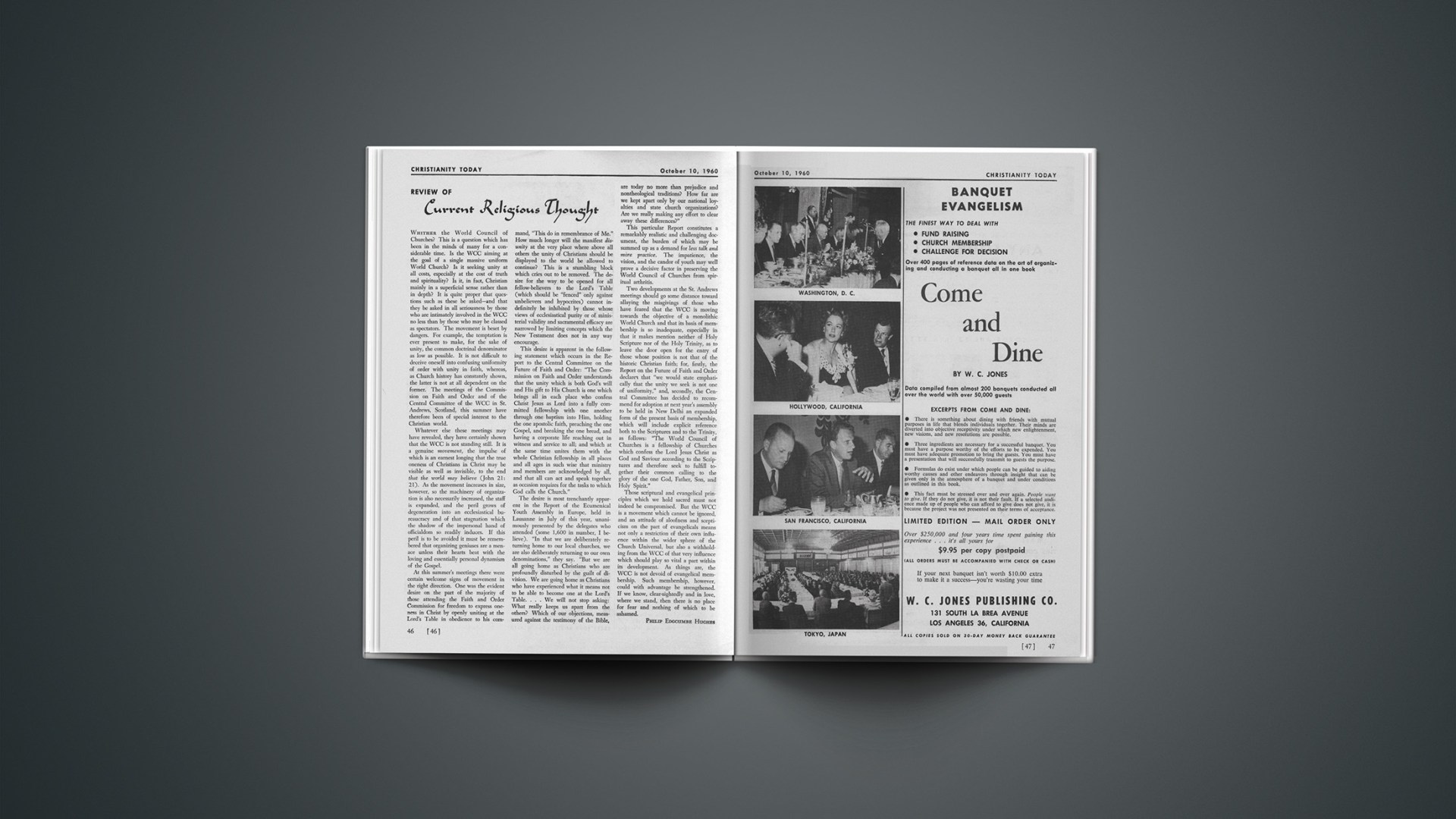
Whither the World Council of Churches? This is a question which has been in the minds of many for a considerable time. Is the WCC aiming at the goal of a single massive uniform World Church? Is it seeking unity at all costs, especially at the cost of truth and spirituality? Is it, in fact, Christian mainly in a superficial sense rather than in depth? It is quite proper that questions such as these be asked—and that they be asked in all seriousness by those who are intimately involved in the WCC no less than by those who may be classed as spectators. The movement is beset by dangers. For example, the temptation is ever present to make, for the sake of unity, the common doctrinal denominator as low as possible. It is not difficult to deceive oneself into confusing uniformity of order with unity in faith, whereas, as Church history has constantly shown, the latter is not at all dependent on the former. The meetings of the Commission on Faith and Order and of the Central Committee of the WCC in St. Andrews, Scotland, this summer have therefore been of special interest to the Christian world.

Whatever else these meetings may have revealed, they have certainly shown that the WCC is not standing still. It is a genuine movement, the impulse of which is an earnest longing that the true oneness of Christians in Christ may be visible as well as invisible, to the end that the world may believe (John 21:21). As the movement increases in size, however, so the machinery of organization is also necessarily increased, the staff is expanded, and the peril grows of degeneration into an ecclesiastical bureaucracy and of that stagnation which the shadow of the impersonal hand of officialdom so readily induces. If this peril is to be avoided it must be remembered that organizing geniuses are a menace unless their hearts beat with the loving and essentially personal dynamism of the Gospel.

At this summer’s meetings there were certain welcome signs of movement in the right direction. One was the evident desire on the part of the majority of those attending the Faith and Order Commission for freedom to express oneness in Christ by openly uniting at the Lord’s Table in obedience to his command, “This do in remembrance of Me.” How much longer will the manifest disunity at the very place where above all others the unity of Christians should be displayed to the world be allowed to continue? This is a stumbling block which cries out to be removed. The desire for the way to be opened for all fellow-believers to the Lord’s Table (which should be “fenced” only against unbelievers and hypocrites) cannot indefinitely be inhibited by those whose views of ecclesiastical purity or of ministerial validity and sacramental efficacy are narrowed by limiting concepts which the New Testament does not in any way encourage.

This desire is apparent in the following statement which occurs in the Report to the Central Committee on the Future of Faith and Order: “The Commission on Faith and Order understands that the unity which is both God’s will and His gift to His Church is one which brings all in each place who confess Christ Jesus as Lord into a fully committed fellowship with one another through one baptism into Him, holding the one apostolic faith, preaching the one Gospel, and breaking the one bread, and having a corporate life reaching out in witness and service to all; and which at the same time unites them with the whole Christian fellowship in all places and all ages in such wise that ministry and members are acknowledged by all, and that all can act and speak together as occasion requires for the tasks to which God calls the Church.”

The desire is most trenchantly apparent in the Report of the Ecumenical Youth Assembly in Europe, held in Lausanne in July of this year, unanimously presented by the delegates who attended (some 1,600 in number, I believe). “In that we are deliberately returning home to our local churches, we are also deliberately returning to our own denominations,” they say. “But we are all going home as Christians who are profoundly disturbed by the guilt of division. We are going home as Christians who have experienced what it means not to be able to become one at the Lord’s Table.… We will not stop asking: What really keeps us apart from the others? Which of our objections, measured against the testimony of the Bible, are today no more than prejudice and nontheological traditions? How far are we kept apart only by our national loyalties and state church organizations? Are we really making any effort to clear away these differences?”

This particular Report constitutes a remarkably realistic and challenging document, the burden of which may be summed up as a demand for less talk and more practice. The impatience, the vision, and the candor of youth may well prove a decisive factor in preserving the World Council of Churches from spiritual arthritis.

Two developments at the St. Andrews meetings should go some distance toward allaying the misgivings of those who have feared that the WCC is moving towards the objective of a monolithic World Church and that its basis of membership is so inadequate, especially in that it makes mention neither of Holy Scripture nor of the Holy Trinity, as to leave the door open for the entry of those whose position is not that of the historic Christian faith; for, firstly, the Report on the Future of Faith and Order declares that “we would state emphatically that the unity we seek is not one of uniformity,” and, secondly, the Central Committee has decided to recommend for adoption at next year’s assembly to be held in New Delhi an expanded form of the present basis of membership, which will include explicit reference both to the Scriptures and to the Trinity, as follows: “The World Council of Churches is a fellowship of Churches which confess the Lord Jesus Christ as God and Saviour according to the Scriptures and therefore seek to fulfill together their common calling to the glory of the one God, Father, Son, and Holy Spirit.”

Those scriptural and evangelical principles which we hold sacred must not indeed be compromised. But the WCC is a movement which cannot be ignored, and an attitude of aloofness and scepticism on the part of evangelicals means not only a restriction of their own influence within the wider sphere of the Church Universal, but also a withholding from the WCC of that very influence which should play so vital a part within its development. As things are, the WCC is not devoid of evangelical membership. Such membership, however, could with advantage be strengthened. If we know, clear-sightedly and in love, where we stand, then there is no place for fear and nothing of which to be ashamed.

Book Briefs: October 10, 1960

Evangelical Certainties In Our Day

The Word for This Century, edited by Merrill C. Tenney (Oxford, 1960, 184 pp., $4), is reviewed by Dr. C. Adrian Heaton, President, California Baptist Theological Seminary.

“Evangelical Certainties in an Area of Conflict” is the subtitle of this lively volume. What certainties?

First, sin is a “willful revolt against the sovereign Holy God” says Carl Henry. Darwinism had laughed at the sense of sin. Freudianism dealt with “guilt feelings” rather than “guilt.” Liberalism almost completely lost the sense of sin, but “man’s iniquity forced the reappraisal of both secular and religious optimism” (p. 10). Biblical revelation, which true evangelicals take with complete seriousness, requires a depth concept of sin as a necessary part of an adequate doctrine of redemption and incentive to evangelism.

Second, the Bible at one and the same time points to the Living Word and is the God-breathed, authoritative interpretation of Christ, says Kenneth S. Kantzer. His chapter is not a rehash of clichés about the Bible but a treatment showing insight on the contemporary debate about revelation and authority. This chapter should be read along with Bernard Ramm’s new volume The Witness of the Holy Spirit, which is a fuller treatment of the same fresh insight.

Chapters on “The Person of Christ” and “Redemption by Christ” by Stuart C. Hackett and the late T. Leonard Lewis state other universally accepted evangelical certainties. Sanctification is treated by Billy Graham under the heading of “Christ in the Believer.” The chapter is largely sermonic in four points. First, “Put ye on the Lord Jesus Christ and make not provision for the flesh, to fulfill the lusts thereof.” Second, the putting off of the old man and the putting on of the new. Third, self-denial, “if any man come after me, let him deny himself” (Luke 9:23). Fourth, “and be not conformed to this world; but be ye transformed by the renewing of your mind” (Rom. 12:2).

Glenn W. Barker writes of “The Church of God” as both visible and invisible, the redeemed and the redeeming community. The Church is the new Israel, but not the complete fulfillment of the promises to Israel. Also she is the Body of Christ and the Possessor of the Holy Spirit. Some important questions are raised but hardly answered. For example, what is the proper order of ministry within the Church, and how is the unity of the Church to be expressed?

V. Raymond Edman contributes a chapter on Christian Ethics. His writing is devotional in nature. Especially helpful is his section on “The ethics of the Lord Jesus.”

The final certainty is “The Hope of the World,” by John F. Walvoord. “Christian hope is simply and completely faith in Christ,” says the author (p. 157). It includes bodily resurrection, the second coming of Christ, and the new heaven and new earth. Walvoord has much to say about the millennium. He seems to force the concept of the millennium into the Old and New Testament Scriptures wherever possible. He says (p. 174) “the Scriptures present the doctrine of the millennium as major theme of revelation.” While this will be debated by many, Walvoord surely writes consistently with this view.

The book is a splendid contribution to contemporary thought. Although it has some of the marks of spottiness growing out of its multiple authorship, and is somewhat weak in social ethics and in its view of the Church, it should have a wide reading and help people to understand some of the dynamic thought now going on among the graduates and staff of Wheaton College. This anniversary volume was edited carefully by Dr. Merrill C. Tenney, Dean of the Graduate School of Wheaton College. He affirms, “God has spoken His final word to men through the historical Christ, and because Christ still lives His truth is applicable to our age” (p. xv).

Confronted with the inadequacy of the “newer views” of modern scholars it is heartening to see the certainties of the orthodox Christian faith presented with such clarity and scholarly cogency. The writers adhere to the meaning and spirit of God’s Word and speak with refreshing relevancy to the times in which we live.

C. ADRIAN HEATON

Love Silhouetted

The Four Loves, by C. S. Lewis (Harcourt, Brace, 1960, 192 pp., $3.75). Reviewed by Clyde S. Kilby.

If I confess that this book has not, for me at least, the high merits of some of Lewis’ earlier ones, I hope it will not be supposed that it is by any means a second-rate book. Lewis is most at home, and most brilliant, on controversial issues—on those topics which we suppose we have long since settled and which he, like G. K. Chesterton and a few others, is able to bring before us again silhouetted as we have never seen them before. Except for his chapter on friendship, Lewis’ main discussion at least is in the traditional vein, and the value I discover in the present book is fully as much in the incidental and illustrative remarks as in the theme itself.

For instance, we learn once again of Lewis’ deep love for good walking and good talking and his antagonism to modern education, the “adjusted” child, and the notion of “togetherness.” And again we find Lewis taking sides with youth rather than age. He says he has been far more impressed with the bad manners of parents to children than the reverse. He analyzes with great sharpness the perversions of love, yet the reader is surprised to learn that these perversions are not precisely the ones he might expect.

As with most of Lewis’ books, this one will bear several readings. It is filled with provocative ideas on each of the four types of love discussed: Affection, Friendship, Eros, and Charity.

CLYDE S. KILBY

Modern Presupposition

Mysticism and the Modern Mind, edited by Alfred P. Stiernotte (The Liberal Arts Press, 1959, 206 pp., $4.50), is reviewed by Robert D. Knudsen, Instructor in Philosophy, Westminster Theological Seminary.

This book is a loosely organized collection of essays which seek to point out the relevance of mysticism to contemporary intellectual movements. An occasional essay shows insight and is helpful; but for the most part the writing is second-rate and uninteresting.

It might be admitted that certain contemporary movements approach what can be loosely called “mysticism.” But what this book designates as mysticism is so broad as to become almost meaningless. Even though one might agree to call certain tendencies mystical, he is left in considerable doubt as to precisely what can be gained by pointing them out.

One thing the book clearly shows, however, is how closely mysticism is wedded in the minds of the various authors with liberal religion. There is a typical mystical depreciation of the word revelation. Dogma becomes the expression of a general, ineffable religious experience. One looks in vain for the biblical view of man’s sinfulness or for the biblical message of redemption in Christ Jesus.

If one desires to read an enthusiastic attempt of some mystics to relate their mysticism to the contemporary scene, he might read this book. If he desires to read a succinct and penetrating exposition of what mysticism is, he should turn elsewhere.

ROBERT D. KNUDSON

Christian Missions

Earth’s Remotest End, by J. C. Pollock (Macmillan, 1960, 336 pp., $5.95), is reviewed by Sherwood Eliot Wirt, Editor of Decision.

The former editor of The Churchman, Anglican evangelical journal, and his wife report the fascinating results of their 33,000-mile adventure to Christian mission stations from Nepal to Japan, by way of Ceylon, Indonesia, and way points.

An able journalist, Pollock succeeds in getting to the root of world evangelization in many lands, as the profile of Christian missions in transition is clearly exposed through his adroit questioning. Interviews with Nehru, U Nu, Akbar Haqq, and others make the issues clear. The foreword is by Billy Graham.

SHERWOOD ELIOT WIRT

Zen’S Voidness

The Practice of Zen, by Chang Chen-Chi (Harper, 1959, 199 pp., $4), is reviewed by Edward John Carnell, Professor of Ethics and Philosophy of Religion, Fuller Theological Seminary.

In commenting on this cursory but competent statement of Zen Buddhism, I am tempted to deal with its plethora of unproved assumptions about the nature of mind and ultimate reality. Instead, I shall content myself with observing that the Zen way of salvation is reserved for an intellectual aristocracy. No consolation is offered to the masses in the Orient who must labor 16 hours a day for enough to eat.

One of the signs of the Messiah in Christianity is that he would preach the Gospel to the poor. The poor have no status in a sinful society, and neither have they the leisure or the endowment necessary to accept the disciplines of Buddhism. Zen transcends the miseries of life by a contemplation of Voidness. It escapes the fellowship of Christ’s sufferings, but at the same time it surrenders the hope of the Resurrection. A Christian would observe that the cure, in this case, is worse than the disease.

EDWARD JOHN CARNELL

Faith At A University

Faith and Learning, by Alexander Miller (Associated Press, 1960, 218 pp., $3.50), is reviewed by Cornelius Jaarsma, Professor of Education, Calvin College.

Dr. Miller is engaged in a unique experiment as professor of religion in Special Programs in the Humanities at Stanford University, California. The experiment, now about 10 years and without much publicity, is aimed at demonstrating how the truths of the Christian faith can be integrated in the humanities program of a modern university without permitting theological doctrine to stifle free investigation in the general field of learning. Dr. Miller thinks we can work toward what he calls an integral university where the community of faith and the community of learning are in constant communication, being enlightened by one another, and without one imposing its findings on the other.

It is stimulating to hear him as he comes to grips with the modern university problem. He speaks of its growing secularism, its lack of a genuine sense of direction, and the fact that it is a victim of pressures from without. Having been liberated from theological and ecclesiastical controls, men of higher learning have sought liberal education in a curriculum without presuppositional thinking, without faith. Indoctrination of a most vicious sort has been the result.

The author holds out hope for the modern university if it will incorporate a genuine presentation and study of Christian (not merely religious) truth as an integral part of the curriculum. The presuppositions of Christian thinking must receive consideration together with other sources of study. The community of faith and the community of learning should communicate with one another in mutual appreciation. The Christian college has a contribution to make if higher learning is its great enterprise in a community of faith rather than personal piety and ecclesiastical loyalty. The latter are not to be excluded, but they are the focal point of the church in the development of the Christian faith.

In Dr. Miller’s book there is no consideration of religious education in general. He is opposed to a department of religion in a university or college. He believes God has made and is making himself known, not in “the inerrancy of any written record or of any oral word” but in “truth mediated in history and community, and appropriated in love.” Revealed truth must be communicated in the community of learning.

Alas, Dr. Miller is likewise far removed from an objective norm for truth in thinking and living. Only as the Bible has its rightful place as the light in which we see light will higher learning have chart and compass for its curriculum in bringing about fruitful communication of faith and learning. Only a Christian university can constitute a truly integral university.

CORNELIUS JAARSMA

Today’S Challenge

Toward Tomorrow by Martin H. Scharlemann (Concordia, 1960, 160 pages, $1.95), is reviewed by Faris D. Whitesell, Professor of Practical Theology, Northern Baptist Theological Seminary.

Director of graduate studies at Concordia Seminary in St. Louis, Dr. Scharlemann presents 11 papers and essays in this book. They deal with the general subjects of welfare, human relations, theological essays, and miscellaneous.

Believing that “the full life of the Church embraces three ‘w’s’: worship, witness, and welfare” (p. 17), the author produces plenty of Scripture to prove that the Church is responsible for human welfare. He reviews the history of welfare in the Lutheran Church and concludes that “our church in its organizational structure never assumed responsibility for a welfare institution” (p. 59), but much has been done by individual pastors, congregations, and synods. He insists that the time has come “to start insisting that welfare work is a part of the total life of each congregation and that it is just as important as education and worship” (p. 63).

All of the essays conform to conservative theological thinking and are stimulating and helpful. The chapter on the biblical view of sex is well done and proves the adequacy of the Christian view. The most stimulating chapter to the reviewer was the one on creative scholarship in our profession, an essay presented to a synodical professors’ conference. He claims that creative scholarship requires freedom of expression, leisure, appreciation and encouragement, and an adequate income. The personal qualifications for such scholarship are self-discipline, sacrifice, courage, and curiosity.

FARIS D. WHITESELL

Eschatology

Jesus and the Future Life, by William Strawson (Westminster Press, 1960, 250 pp., $3.95), is reviewed by Edgar W. Boss, Dean of the College of Northern Baptist Theological Seminary.

This study in biblical theology combines brevity, clarity, and thoroughness with knowledge of the problems involved and the literature of the field. However, in a study designed to meet “the needs and questions of ordinary men” (preface, xi), it takes for granted considerable knowledge of present day critical studies.

So far as accepting the results of modern criticism is concerned, the author stands in a moderating position. He takes the words of Jesus seriously and feels that the Gospels reliably reflect those words. However, he is not as restrained as could be wished by those who are suspicious of the results of criticism (see pp. 64 and 152).

The author knows the problems involved in an honest attempt to understand Jesus in his first century setting and to interpret that Jesus to the twentieth century. So often, however, an author making this attempt resolves the difficulties by giving way to a mood which does not take Jesus seriously when he speaks of things otherworldly. Because of a supernaturalistic world view, Dr. Strawson takes the concept of the future life quite in stride, and finds that “raising the dead may be no more remarkable than cleansing a leper” (p. 87). Consequently he takes such a concept as “heaven” quite sincerely, although he cannot subscribe to an “outmoded view of a localized heaven” (p. 36). He grants that the reality of the future life is not susceptible to proof, but he must reckon with the fact that “Jesus believed in a future life” (p. 233) and the witness of the “living Word of God” is not for any Christian a “second-rate” ground of certainty (p. 236).

It is at the point of his conclusions concerning the destiny of the lost that the author’s statements become most controversial. He repudiates Restorationism (which is becoming increasingly more popular), but does espouse Annihilationism (see p. 155).

This is a book which belongs in any library on synoptic theology. Both the ordinary man and the scholar can profit from the study. The ordinary man will find it reverent and sensible, and the scholar will find that it deals adequately with the issues.

EDGAR W. BOSS

The Spirit In Nature

The Holy Spirit and Modern Thought, by Lindsay Dewar (Harper, 1959, 214 pp., $4.50), is reviewed by Bernard Ramm, Professor of Systematic Theology, California Baptist Theological Seminary.

Dewar’s basic intention is to present the reader with new ideas of the working of the Holy Spirit in the natural realm, and to work out a principle or two whereby we can differentiate the supernatural from the natural workings of the Spirit. As preliminary to developing his theses (an attempt to correlate the psychology of both Rhine and Jung with the work of the Spirit), Dewar gives us a summary of the biblical and the historical materials.

The two characteristics of this book with which I find myself in substantial agreement are: (1) the necessity of making the biblical and historical coverage before expressing one’s self; and (2) the necessity of a penetrating investigation of the so-called “natural workings” of the Holy Spirit.

This could have been a great book had the bibliographical coverage been more thorough. No reference is made in the Old Testament surveys to the Old Testament theologies of such men as Vriezen, Jacob, Knight, Köhler, or Rowley. In the historical section there is a fateful omission of Letters Concerning the Holy Spirit, by Athanasius, which represents a great turning point in the Church’s understanding of the Holy Spirit. Dewar’s treatment of Luther and Cabin is very unsympathetic. He nowhere cites Prentor’s Spiritus Creator which is devoted entirely to Luther’s doctrine of the Holy Spirit. Dewar simply cannot stand Calvin, and the odium theologicum mars virtually every reference to Calvin. Dewar is not aware of the meticulously written dissertation of Krusche (Das Wirken des Heiligen Geist nach Calvin) which, to my opinion, virtually contradicts every point Dewar makes against Calvin. Nor does he profit from Warfield’s brilliant essay on “Calvin’s Doctrine of the Knowledge of God,” which spells out so much of Calvin’s doctrine of the Holy Spirit. In Dewar’s concern for the natural operations of the Holy Spirit, he could have enriched his exposition by reading Kuyper’s great masterpiece, The Work of the Holy Spirit. There is also an extensive reformed literature on common grace which also explores the area of the natural operations of the Holy Spirit.

Some of us are not happy with the virtual canonization of the Anglican doctrine of baptismal regeneration, let alone Dewar’s odd defense of it by recourse to clinical psychology. Rhine’s psychological investigations are accepted as true even though presently they are not in good standing with most psychologists. Contrary to Dewar, there are psychologists who have made a study of Rhine and find his methodology very questionable (e. g., Rogasin).

The most suggestive and also the most controversial part of the book is Dewar’s attempt to correlate the work of the Spirit with modern psychiatry. He makes the bold claim that the work of the psychiatrist is the clearest analogy we have to the working of the Holy Spirit. I demur at two points: (1) Is this not basically a truism of long theological standing that all healing is but the beneficial working of God’s “secondary causes”? Are we really saying anything more significant when we attribute psychiatric healing to the Holy Spirit, than when we attribute the healing following a surgical operation to Him? (2) Is this the kind of correlation we should seek in our doctrine of the Holy Spirit? I would feel easier if Dewar had built a more sturdy bridge from exegetical foundations to dogmatic expositions, and then on to psychological and psychiatric interpretations.

BERNARD RAMM

Surgeon And Christian

Dr. Kelly of Hopkins, by Audrey W. Davis (Johns Hopkins Press, 1959, 242 pp., $5), is reviewed by Orville S. Walters, Psychiatrist, University of Illinois.

A celebrated painting by Sargent hanging in the Welch Medical Library at Johns Hopkins University portrays the men most responsible for the excellence and fame of its School of Medicine. “The Four Physicians” were Osler, Welch, Halsted, and Howard A. Kelly. The youngest of the group, Kelly went to Hopkins when he was 31, soon gaining a surgical reputation as “the most rapid and brilliant operator in America.” Only when he was almost 80 did he discontinue operating. When he died in 1943 at the age of 85, he was the last of the Four Physicians.

Dr. Kelly was generally known as a fundamentalist. Reared in a deeply religious home, he made an early commitment to Christ. The evening of his graduation from medical school he wrote in his diary, “I dedicate myself—my time—my capabilities—my ambition—everything to Him. Blessed Lord, sanctify me to Thy uses. Give me no worldly success which may not lead me nearer to my Saviour.” He began the day with an hour of Bible study and prayer and closed it the same way. At odd times during the day he was accustomed to read his Greek New Testament. His biographer writes of him, “… Because his heart belonged to Jesus Christ, wherever he went and in whatever he did a sweet savor of Christ abounded.”

Born into a wealthy family, Dr. Kelly was installed upon graduation in a fine office and home in Philadelphia, but he was attracted to the poor millhands of Kensington and divided his time with an office there. His interest gradually focused upon gynecological surgery, and it was in this field that he eventually became one of the most eminent authorities. In 1889, after nomination by Osler, he left Philadelphia to join the pioneer group that later brought fame to Johns Hopkins Hospital.

Throughout his 60-year career in medicine, and most of all after gaining world-wide prominence in his field, Dr. Kelly maintained a simple Christian witness. On his lapel he wore a button bearing a question mark. When asked its significance, he would reply that the emblem referred to the most important question in life, “What think ye of Christ? Whose son is He?” This was often the occasion for further conversation concerning the Christian life. On one occasion he discussed eternal life with Bernard Shaw.

Dr. Kelly’s insatiable curiosity as a naturalist made him an authority on herpetology, which was a lifelong interest. In his major field, he published nearly 600 medical articles and books. He assembled an enormous library, parts of which he eventually donated to establish notable collections elsewhere in mycology and lichenology.

Dr. Kelly’s biographer was his secretarial assistant during his last 20 years, and to her he left the diaries and notebooks which he kept throughout his life. What the biography lacks in literary luster is balanced by documentary detail.

ORVILLE S. WALTERS

Protestant-Roman Unity: 25 Scholars’ Views

For the third consecutive year, the news section ofCHRISTIANITY TODAY’s anniversary issue features a panel of 25 of the world’s foremost religious scholars responding to a timely question:

Do you see any hopeful basis of Protestant-Roman Catholic church unity?

KARL BARTH, professor, University of Basel: “Certain indications seem to point to a possible, perhaps already operative, inner renewal in today’s Roman Catholic church. The holy Scriptures are being read and studied, are being expounded academically and also in preaching with greater delight and accuracy than before. In connection therewith is a deepened attention to Jesus Christ, only Lord and Saviour, as the center and object of all church life and teaching. And we must not fail to appreciate a more earnest understanding of God’s free grace and therefore of the sinner’s justification by faith alone among some forward-moving Roman Catholic theologians, and also many efforts toward a more kerygmatic form of the mass. If and how all this will some day lead to a change with reference to a new interpretation of the Roman Catholic concepts of the mediatorial role of the virgin Mary and of the saints; of the merit of tradition; of the authority of the church, and particularly of the pope; and above all of the sacraments we cannot contemplate at the moment. In our opinion even the best Roman Catholics in no case could and would be expected simply to put aside these peripheral considerations. But neither can we expect them to find those central truths (Scripture, Christ, grace) better preserved and better championed in our Protestant churches than in their own. We ourselves would need to be, think, teach, and live more evangelically, if our Protestantism is to have any attraction whatever for today’s Roman Catholic Christianity that perhaps is newly seeking the gospel. On the other hand, we cannot therefore suppress our estrangement in view of peripheral matters of the Roman Catholic system (Mary, the church, the pope, the sacraments) as they have come to us thus far, inasmuch as we cannot conceive how they (these peripheral matters) can be joined to the central teachings. Therefore church unity between Rome and us cannot yet be in prospect today, but there is possibly a new brotherly discussion concerning what can unite Rome and us, and concerning that which always must divide Rome and us. At the same time we must reckon with the strange possibility that some day it might be apparent that what must and could unite Rome and us is comprehended in certain Roman spheres just as well, if not better, than in large segments of our own Protestant constituency.”

G. C. BERKOUWER, professor, Free University of Amsterdam, Netherlands: “The future of the Roman church is determined by its past. The very structure of Rome, especially its claim to infallible teaching authority, would seem to exclude an open future. New considerations of unity are restricted by the constitution of Rome. Unity must involve the profoundest conversion for Rome. In view of this, possibility of church union seems nil from the human perspective. My own answer, nonetheless, is that of 2 Timothy 2:9: ‘The Word of God is not bound.’ We would be guilty of unbelief and a failure of faith if we allowed ourselves to limit the future to the past. The Word of God is not bound!”

ANDREW W. BLACKWOOD, professor emeritus, Princeton Theological Seminary: “With countless Catholic laymen and some clergymen we Protestants can cooperate in various movements not ecclesiastical. But since that church does not recognize Protestants as Christians, or permit her priests to worship with us, I see no hopeful basis for church unity between Rome and followers of the Reformation.”

F. F. BRUCE, professor, Manchester University: “While there are many welcome signs of increasing and fruitful interchange and cooperation between Protestants and Roman Catholics in a number of fields, not least in biblical and theological studies, I see at present no hopeful basis at all of church unity between them in any proper sense of these two words.”

EMIL BRUNNER, professor, University of Zürich: “If the question is put in these terms, then the answer is a flat no. The churches can never unite. But within the churches there are some who have seen that the Bible knows of no church but of the ekklesia, the people of God, the brotherhood of men united in Christ. This rediscovery of the ekklesia, totally different from anything which is called ‘church’ is a real basis for a hope of progressing unity between Protestants and Catholics. It was this rediscovery which was on the origin of Reformation and which at present is a fact in both camps. It was always the emphasis upon the church which separated. The totalitarianism inherent in ‘churchism’ is what separates. He, Jesus Christ alone, is our peace.”

EMILE CAILLIET, professor emeritus, Princeton Theological Seminary: “Rome can only offer integration by unconditional surrender. The reason our Reformed tradition is losing sight of this basic fact is an insidious one. Loss of first love for the Lord has resulted in a drift to ‘churchism’ encouraged by self-seeking organization men filled with ambition to rule and covetous of worldly honors. Let therefore a prophetic Christianity reassert itself and give the Woman on the Beast a wide berth.”

EDWARD JOHN CARNELL, professor, Fuller Theological Seminary: “The Roman claim to infallibility precludes the possibility of unity through gestures of mutual repentance. But this grim fact should not prejudice the value of sincere, exploratory conversation. A more perfect understanding of the issues will bring sweeter attitudes into what is and will remain a tragic division in the body of Christ.”

GORDON H. CLARK, professor, Butler University: “Chapter 25, section 6, of the Westminster Confession reads as follows: ‘There is no other head of the Church but the Lord Jesus Christ. Neither can the Pope of Rome in any sense be the head thereof; but is that anti-christ, that man of sin and son of perdition, that exalteth himself in the Church, against Christ, and all that is called God.’ For true Presbyterians this is the authoritative answer to questions of union with Rome.”

OSCAR CULLMAN, professor, the Sorbonne: “Based on that collection of primitive Christianity (Gal. 2:9–10), the reciprocal collection (Protestants for Catholics, Catholics and Protestants), I proposed as the foundation of unity, has actually been realized for three years in various European countries during the ecumenical week of prayer. [See CHRISTIANITY TODAY, April 13, 1959, page 30—ED.] It has become known also in America through my publication, A Message to Catholics and Protestants (Eerdmans). Next to theological discussion (especially mutual biblical studies) this collection, it seems to me, is the only hopeful basis of unity in Christ, since a genuine unity of the church is impossible among those Protestants and Catholics who remain true to their inmost convictions concerning the structure of the church. Oversimplified statements of my suggestion have resulted in misunderstanding, as if we were dealing merely with some humanitarian benevolence. In actuality, it is intended to be an ecumenical symbol of unity. The answers I have given in my booklet to all criticisms should be carefully examined. There is good prospect that the Roman Catholic Ecumenical Council will take some position concerning this basis for unity, inasmuch as it is beginning to bear fruit in many places.”

FRANK E. GAEBELEIN, headmaster, The Stony Brook School: “Despite a few apparently encouraging signs, such as attendance of Roman Catholic observers at Protestant councils, there seems to be no real expectation of Protestant-Roman Catholic church unity. The doctrinal intransigence of Romanism is a hard fact of history, current as well as past. Moreover, it is highly questionable whether any union could be consummated short of surrender of vital convictions. Such union would be far less desirable than the present state of separation.”

JOHN H. GERSTNER, professor, Pittsburgh Theological Seminary: “Since the Roman Catholic church considers herself the only true church and since the Protestant churches do not consider themselves false churches, the only hopeful basis I see for Protestant-Roman unity is for the Roman church to cease to be Roman or the Protestant church to cease to be Protestant.”

CARL F. H. HENRY, Editor, CHRISTIANITY TODAY: “I do not find in a Bible a basis for discussing ‘Protestant-Roman Catholic church unity,’ but simply the unity of regenerate believers in the spiritual body of which the crucified and risen Redeemer is authoritative head. On this scriptural basis we may rest confident in a unity against which hell’s gates will not prevail, and which will survive into the eternities.”

W. BOYD HUNT, professor, Southwestern Baptist Theological Seminary: “Though the lines of communication between ‘catholic’ minded Protestants and the less sectarian Romans are multiplying, any organic unity between main line Protestantism and papal Romanism is inconceivable in the foreseeable future. The most encouraging contemporary development in ecclesiology is the deepening realization that Christianity stands in judgment over every aspect of institutional Christendom, both Roman and Protestant.”

W. HARRY JELLEMA, professor, Calvin College: “Meaningful unity would on both sides require more than the current sporadic, even though genuine, evidences of profound Christian spirituality and historical understanding. But, equally, a greater measure of these than is generally discernible is needed if we are to remain responsibly divided.”

HAROLD B. KUHN, professor, Asbury Theological Seminary: “The differences between Protestantism and Roman Catholicism are not superficial but fundamental. Any achievement of Protestant-Roman Catholic unity becomes thus a question of the negotiation of basic differences through mutual adjustments and concessions. There are limits to the kind and degree of adjustments to which Protestants can and will agree. And it remains to be seen whether the Roman church is willing to correct her assumption that she alone possesses the Truth, so that a beginning can be made.”

J. THEODORE MUELLER, professor, Concordia Seminary: “I see no hopeful basis of Protestant-Roman church unity, since, on the one hand, the Roman church at the Council of Trent (1545–1563) has once for all rejected the two fundamentals of the Evangelical Church Reformation, namely, 1. that Scripture is the only source and rule of faith, and 2. that sinners are justified and saved solely by divine grace through faith in Christ without works. By declaring these two Scripture doctrines anathema, the Council has fixed an impassable gulf between Romanism and believing Protestantism.”

REINHOLD NIEBUHR, professor emeritus, Union Theological Seminary, New York: “I see many hopeful signs of more Catholic-Protestant dialogues than there have been and I think these dialogues could be creative. I see no sign whatever of a Catholic-Protestant church unity.”

BERNARD RAMM, professor, California Baptist Theological Seminary: “The decrees of the Council of Trent, the papal dogmas of the nineteenth century, and the Marian dogma of the twentieth show that the Roman Catholic church cannot discipline her theological life by the word of God, and therefore any proposed unity of the Roman church and the Protestant bodies is not difficult, but impossible.”

W. STANFORD REID, professor, McGill University: “No, I do not. The Roman Catholic church’s insistence that it is the sole repository of grace and the sole interpreter of Divine Revelation means that the only possible unity which can come between Protestants and Roman Catholics is the unity that Jonah had with the whale, namely that the Protestants should be swallowed. Moreover, there is no evidence at all that the Roman Catholic church is prepared to change its approach or modify its exclusivist claims. Until Romanism ceases to claim exclusive authority and is prepared to modify and even reject some of its doctrines, unity would seem to remain as far away as ever.”

WILLIAM CHILDS ROBINSON, professor, Columbia Theological Seminary: “There is hope in the very way you have phrased this question. You have not asked the question on the Roman Catholic or horizontal basis, which would be, ‘Is there any hope of organizational unification?’ To such a question one could only answer, ‘No, we have no expectation of recognizing the Pope as the head of the church, or of becoming a part of his system.’ You have asked the question on the Protestant or vertical basis, ‘Is there any hope of church unity?’ Yes, there is hope that the Lord Jesus Christ will bring his people of every name to recognize their unity in him. We find the one Church wherever the Gospel is preached in its biblical character and its promises sealed by the sacraments Christ instituted.”

HERMANN SASSE, professor, United Evangelical Lutheran Church seminary (Australia): “No! the question calls to mind the tragic situation of Christendom today. Roman Catholicism needs the witness of the Reformation to counteract the pagan elements it has assimilated. Modern Protestantism is no longer able to bear this witness since it has abandoned too many of the doctrines of the Reformation. The true Church knows that its unity is not a human hope, but a reality in this world which will become manifest when with the glory of Christ the hidden glory of his body, the Church, will be revealed.”

JAMES S. STEWART, professor, University of Edinburgh: “I do not see any hopeful basis of Protestant-Roman Catholic Church unity at the present time and under present conditions. The most hopeful basis on a long-range view will be the realization that the things Christians hold in common—the Incarnation, the Atonement, the Resurrection—are so stupendous, so divinely and shatteringly wonderful, that they far outweigh the things that disrupt the Body of Christ.”

MERRILL C. TENNEY, dean, Graduate School, Wheaton College: “Unity between the Protestant churches and the Roman Catholic church can be achieved only by accepting reconciliation on Rome’s terms. The price of doctrinal compromise and of hierarchical absorption is too high to pay. Organic unity would be the funeral of free Christianity. Rome’s unchanging attitude makes discussion futile. Until there is a thoroughgoing reformation within the Roman church that returns that body to the Scriptures as the final authority, and that strips it of the pagan accretions that have gathered during the centuries, we cannot hope for any unity.”

CORNELIUS VAN TIL, professor, Westminster Theological Seminary: “The dynamic categories of Romanism and the activist categories of such Protestant theologians as Karl Barth, Paul Tillich and others alike involve the rejection of the Reformation principle of the sole and direct revelation of God in Christ and the Scripture. Both parties appeal finally to self-sufficient human experience. Why should they not ‘bury the hatchet’?”

H. ORTON WILEY, president emeritus, Pasadena College: “I see no possibility of union between Protestantism and Catholicism. First, the essentially Protestant principle of justification by faith alone is not shared by Catholicism. Second, Roman Catholicism regards itself as the only true church, and apparently seeks to dominate the religious world. It will make no adjustments with Protestantism.”

Venture for Victory

The Venture for Victory basketball team, made up of Christian college all-stars, achieved 76 victories against 4 losses in its eighth annual tour of the Far East.

In addition to the 80 games played under all kinds of weather and court conditions this year, the team conducted 55 religious services, ministering to an aggregate audience of 200,500 in Formosa, Hong Kong, and the Philippines.

The team now has overall won-lost record of 586–11 for its eight years of overseas play.

Florida Bound

Billy Graham’s next major evangelistic effort is scheduled for Florida, beginning in January. Graham will tour key resort cities during January and February, winding up with a three-week series in Miami Beach’s Exhibition Hall.

Following his return from Germany Graham was slated for a “Spanish-American Crusade” in New York City’s Madison Square Garden. The three-night crusade, October 7–9, was geared to the metropolitan area’s Spanish-speaking population, estimated at 250,000, under sponsorship of the Protestant Council of the City of New York.

Tokyo Crusade

Use of radio and television may make the Tokyo World Vision crusade the most effective evangelistic campaign in Japanese history. The month-long series is scheduled for the 10,000-seat Meiji Auditorium May 6–June 5, 1961. World Vision President Bob Pierce will speak.

Selection and training of a 1,000-voice choir is already under way. At least 2,000 counsellors also will be trained for the crusade.

Tokyo, with 9,100,000 inhabitants, is the largest city in the world.

Second Chance

U. S. clergymen are getting a second chance to participate in the Social Security program.

Under a new amendment to the Social Security act, members of the clergy can initiate voluntary coverage anytime between now and April 15, 1962.

Back in 1954, when Congress first enacted legislation providing Social Security coverage to clergymen who wanted it, a cut-off date of April 15, 1957 was set for filing. Some confusion over the provisions developed, prompting Congress to create a new opportunity.

Complete details of the new program are found in “Social Security for the Clergyman,” available for five cents from the Government Printing Office, Washington, D. C.

Clergy Travel Aid

An inter-airline coordinating agency for clergy fares won recognition from the Civil Aeronautics Board last month.

The agency, known as the Airlines Clergy Bureau, is now issuing identification cards which will enable clergymen to travel (first class or tourist) at 50 per cent of the regular fee. Under this arrangement, the clergyman is listed as a standby passenger and travels on a space-available basis.

The only major carrier currently offering such a clergy discount is Northeast Airlines, which serves the eastern seaboard, and which sponsored creation of the Airlines Clergy Bureau. But negotiations are under way to cover six central states and all western states from Alaska to Arizona by the end of the year.

The Airlines Clergy Bureau has also negotiated with 39 independent hotels and motels across the nation and four hotel chains for “special consideration” of 25 per cent discount off regular room rate when the identification card is presented.

Army and Religion

The Army is launching what it terms “the most ambitious program” in its history for the training of lay religious leaders.

Six-day schools are being conducted at 31 Army posts across America this fall under the leadership of civilian religious educators. Dr. J. Gordon Chamberlin, professor of religious education at Pittsburgh Theological Seminary, is overall director of the project.

The current series is for Protestant personnel. Roman Catholic and Jewish programs are being developed.

Chapel in the Ice

Chapel services were held for the first time last month in an ice tunnel 70 feet below the surface of the Greenland ice cap. The worshippers were U. S. servicemen stationed at Camp Tuto, a research and development post more than 500 miles above the Arctic Circle.

The “chapel” had been hand-mined out of ice estimated to be 2,000 years old. Carved in the round, it is 8 feet in diameter and 20 feet long.

Conducting the initial services for Protestant men were Chaplain (Captain) Jack Cutbirth and Chaplain (First Lieutenant) Grover G. DeVault. Catholic services also were held.

During the summer, services can be held above ice, but with the coming of winter it is necessary to “go below.”

Call to Worship

The twelfth annual Religion in American Life campaign, aimed at promoting church and synagogue attendance, will again have the benefit of some $8,000,000 worth of space and time donated by the major communications media.

The drive will reach its peak next month with the appearance of newly-designed RIAL posters bearing the caption, “Worship together this week.” The posters will appear on more than 6,000 billboards. Another 85,000 will be seen on buses, street cars, subway and commuter trains.

Simultaneously with the nation-wide advertising program, community campaigns will be held in more than 500 cities and towns.

RIAL advertising, distributed through the Advertising Council, a public service agency, is created voluntarily by the J. Walter Thompson Company.

A sample packet of community or congregational campaign materials is available for 25 cents from RIAL, 184 Fifth Avenue, New York 10, New York.

Honoring Gabriel

Plans are under way for a $3,000,000 basilica in Nazareth, which promises to be the biggest Roman Catholic shrine in the Middle East.

Vatican authorities have already approved the blueprints, according to a Religious News Service report.

The new basilica will replace an eighteenth-century church, razed six years ago, that occupied the site where the Archangel Gabriel is said to have announced to Mary that she was to be the mother of Christ.

Banquet Evangelism

Churches and religious organizations conducting promotional banquets can find a wealth of advice in Come and Dine, a 460-page handbook based upon the successes and failures of nearly 200 banquets.

The book is being published this month by the W. C. Jones Publishing Company of Los Angeles, whose owner and operator authored the book on the basis of banquets he has conducted from coast to coast, most famous of which is the annual “Presidential Prayer Breakfast” in Washington.

A minutely-detailed analysis of the art of sponsoring a banquet, Come and Dine warns of pitfalls and points out essentials (“at 9:30 p.m., the human body tires to the point of diminishing returns”) (“wisecracking is hazardous”) (“rheostatic control of the lights is an important factor”).

Come and Dine is basically a reference work which offers rules, comments, and suggestions according to such criteria as the purpose of the banquet, locale, type and number of guests, and financing.

“Do not pursue the idea of an banquet unless conditions ensuring success can be established,” cautions Jones. “Being conversant with all phases of organizing a banquet is the prerequisite to success.”

He says that “almost any banquet can be guided to a successful conclusion, if rules and suggestions are followed.”

‘Unity in Christ’

The twenty-first North American Liturgical Week of the Roman Catholic church, held in Pittsburgh this past summer, featured an invitation to Protestant and Orthodox clergymen to share in an emphasis on “Unity in Christ.”

“This is a new climate,” said the Rev. Robert L. Kincheloe, executive director of the Council of Churches of Christ in the Pittsburgh Area.

Monsignor Andrew J. Pauley, rector of St. Paul’s Cathedral and chairman of the welcome committee, stated in the letter of invitation to non-Roman religious leaders: “We wish we were as sure of heaven as we are sure that you will receive this invitation in the same spirit in which it is offered—a spirit of charity, affection and good will.”

Monsignor Pauley reported that 200 clergymen responded to the invitation and were observers at the exhibits and general sessions of the liturgical conference which drew about 5,000 delegates from the United States, Canada and Cuba.

At a mass in Point State Park, Bishop John J. Wright of the Pittsburgh diocese, referring to Christ’s resurrection appearances recorded in the Gospel of Luke, declared that Christ was not fully disclosed to his disciples in dialogue or discussion but in the breaking of bread.

Quoting the late Episcopal leader, Bishop Manning of New York, who said, “Reunion will come not by compromise of faith and conviction, not by throwing aside creed and doctrine, but by a fuller appreciation of the truth revealed in Christ,” Bishop Wright affirmed, “The central reality in Christianity is and must always be Jesus Christ … but as in the days of the first disciples, so today Christ is most vividly and perfectly recognized in the breaking of bread, in the liturgy which perpetuates his presence among us in the manner that He ordained and ordered.”

Their annual liturgical conference is now the third largest rallying point of U. S. Roman Catholics. Its attendance is surpassed only by the numbers who attend the Catholic educational and charities meetings.

The conference was signalized by a special greeting from Pope John XXIII whose message caused Protestant observers to see a connection between the cordiality shown by the local diocese and papal policy.

Following the conference, this distinction was underscored:

“The one fear,” said Bishop Wright, “is that our intellectual judgments concerning the theologies and philosophies of groups carry over unjustly and irrelevantly into moral judgments of the persons who hold the ideas which we reject.” He added that he could understand how Roman Catholics and Protestants might regard each others’ convictions in some areas as absurd, but that this did not justify the regarding the persons holding these convictions as absurd.

C.N.W.

The Great Doctrines: The American Clergy and the Basic Truths

Christianity Today’s ministerial survey (made by Opinion Research Corporation at a cost of $20,000) indicated that 74 per cent of the Protestant clergy in the United States regard themselves as either fundamental or conservative in theology (with slightly more than half preferring to be called “conservative” rather than “fundamentalist”). Of the remainder, 14 per cent describe their theology as “liberal” and 12 per cent as “neo-orthodox.” This essentially conservative bent of the Protestant clergy is seldom reflected in theological surveys of our time, which center their interest in the changing tides of liberal and neo-orthodox theologians.

While 93 per cent of all ministers interviewed hold that the Bible is the authoritative rule of life and faith, and classify this as an essential doctrine, 33 per cent (26 per cent being liberal or neo-orthodox) dismiss as unessential the view that the Bible was verbally inspired in the original writings.

In respect to other doctrines, 18 per cent reject the virgin birth of Christ; 17 per cent, the vicarious, substitutionary atonement; and 11 per cent, Christ’s historical, literal resurrection (neo-orthodox ministers being less prone than liberal ministers to question the importance of this doctrine).

Some 89 per cent of the Protestant ministers interviewed think it essential to teach and preach the unique deity of Christ as the Son of God; the others do not.

CHRISTIANITY TODAY’s survey thus attests the fact that the dilemma of modern Protestantism in America stems largely from a lack of doctrinal stability and conviction due to a departure from the Bible.

Interest in Church Union

Despite the contrary impression given by the ecumenical dialogue and some theological literature and ecclesiastical journals, only 27 per cent consider it “very important” to work for organic church unity. Despite ecumenical sentiment indifferent to doctrinal priorities, an impressive segment of the ministry, polled privately, believes that whatever mergers take place should be based primarily on doctrinal accord. Only 18 per cent favor church union through organic mergers, whereas 24 per cent oppose any form of merger. Almost half (48 per cent) of all ministers interviewed believe that church unity should be premised on doctrinal agreement. A summary by theological camps shows that liberal and neo-orthodox ministers tend to support merger based on organic union, and that only 17 per cent of liberal clergymen advocate merger on doctrinal beliefs only. Denominational differences are noteworthy: 83 per cent of Lutheran ministers are determined to accept mergers only on doctrinal beliefs, whereas only 25 per cent of the Methodist clergy take this view.

Denominations and the Creeds

Doctrinal latitude or strictness on particular tenets dramatizes this point. While virtually all Presbyterian ministers insisted that affirmation of “God as Creator of man” is important as a basis of church union, the percentage dropped to 92 per cent among Baptist pastors and 93 per cent among Episcopalian rectors. The lowest percentage was registered geographically in the South.

With respect to the historical, literal resurrection of Christ, only 68 per cent of Methodist clergy, and only 70 per cent of Presbyterian ministers thought the doctrine important as a basis of church unity. The main areas of doubt lie in the liberal and neo-orthodox ranks; only two in five of the liberal clergy and two in three of the neo-orthodox clergy think belief in our Lord’s bodily resurrection important for church unity.

Episcopalian clergy scored low on some other doctrinal concerns: only 93 per cent thought the affirmation of Christ as Saviour and Lord important; only 90 per cent thought the affirmation of one sovereign God important. (One will not be surprised, in view of this, that Episcopalian ministers also showed up most poorly with respect to the Bible as the authoritative rule of faith and life.) Baptists and Lutherans supported the doctrine’s importance for church unity by 97 per cent; Methodists and Presbyterians by 95 per cent; Episcopalians by only 97 per cent.

Both neo-orthodox ministers and liberal ministers showed up better than the Episcopalians as a group, percentagewise, in their view of the importance of the Bible. When this question was addressed in terms of the verbal inspiration of the Bible in the original writings, 87 per cent of the fundamentalist clergy, and 70 per cent of fundamentalist and conservative clergy together, held this an important basis of church unity, whereas only 21 per cent of the neo-orthodox and 23 per cent of the liberal ministers agreed. Only 90 per cent of Episcopalian and Presbyterian ministers thought the unique deity of Christ as the Son of God important (only Methodists held a laxer view on this doctrine, with 88 per cent affirming its importance). One in four liberal ministers thought the unique deity of Christ important as a basis of church unity.

Probed about the virgin birth of Christ, only 48 per cent of Presbyterian and 52 per cent of Methodist ministers thought this important; Episcopalians scored higher (83 per cent) and Baptists (87 per cent) and Lutherans (88 per cent) highest. Only 37 per cent of liberal ministers and 44 per cent of neo-orthodox clergy thought the doctrine significant as a basis of church unity. The figures on the vicarious, substitutionary atonement of Christ were: Methodists, 55 per cent; Presbyterians, 59 per cent; Episcopalians, 66 per cent; Baptists, 83 per cent; Lutherans, 91 per cent. By theological positions, only 42 per cent of liberal and 49 per cent of neo-orthodox ministers considered the doctrine important for unity.

“Second Coming” of Christ

An interesting reaction, not necessarily related to the issue of church union, came from ministers on the doctrine of the literal return or “second coming” of Christ. It was held essential by 32 per cent of the Methodists; Baptists were highest with 83 per cent and Lutherans with 78 per cent; Episcopalians voted 48 per cent and Presbyterians 46 per cent. Only 25 per cent of liberal and 26 per cent of neo-orthodox clergy thought the doctrine significant.

Economic and Religious Liberty

In respect to economic freedom, a majority (three in four) of the United States clergy stand in the free enterprise tradition, a minority lean strongly toward socialism. Four barometer questions indicate that the ministers definitely socialistic in their leanings number approximately one in five.

The first question tested whether religious freedom is jeopardized by a state philosophy involving government ownership of industry (“Economic and religious freedom are linked. If the government owns and operates all industry, religious freedom will disappear”). Of all ministers interviewed, 55 per cent agreed, 22 per cent disagreed, and 23 per cent had no definite opinion. The fundamentalists (64 per cent) are most positive in seeing the connection between economic and religious freedom; the neo-orthodox (46 per cent) least positive. This result indicates the extent to which the American clergy have already accommodated themselves to the fragmented view of freedom (for which a precedent may be found in Franklin D. Roosevelt’s now famous “four freedoms”), rather than viewing human rights and responsibilities in a unitary manner within the revelation of the sovereign God.

The poll of economic sympathies of the Protestant clergy shows a movement during the last 10 years in a conservative direction, while denominational social action pronouncements have meanwhile looked to the left. Whereas a decade ago a ministerial survey indicated that 33 per cent of the Protestant pastors (as attested by their answers to barometer questions) subscribed to the processes by which a socialistic economy is effected, the more recent poll narrowed the figure to 25 per cent (in contrast to 40 per cent for the general population average). Of these, the pollsters designated two per cent of the ministers as Communist, 10 per cent as socialist, and 15 per cent as fellow-travelers in their economic outlook, these being predominantly liberal and neo-orthodox in theological stance. Taken as a whole, the Protestant clergy, as indicated by the same poll, are slowly moving away from their earlier larger commitment to the left toward a more conservative social view.

Ideas

Why a Christian University?

Christian colleges dot our land. Most of them are affiliated with and partly supported by particular denominations. Most of them are in financial trouble, and a large number of them could immediately take more students without straining their facilities. Many offer an educational experience acceptable by secular educational standards; a few—a very few—offer work of exceptional quality in one field or another.

Why, then, is there talk of establishing a “Christian university”? Why not put the money into the hard-pressed Christian colleges already in existence?

Among the several answers that might be made, this writing considers only the one which emerges from this statement: it is not proposed to set up just another Christian college (or university, in the larger view) but a university of the highest academic excellence. This need is not filled by existing institutions. With full credit to those very few Christian colleges which enjoy the full and well-deserved respect of the world of secular higher education, the fact remains that such academic distinction is definitely the exception. What is looked for, then, is a university dedicated not only to the Faith but also to the highest and most rigorous academic standards, a university demanding the respect of the secular world of scholarship in the arts and sciences, and in the professions. At the core, solid, dynamic Christian unity; in the branches, solid and creative scholarship.

One need not profess Christianity to see the desperate need in American higher education for unity of purpose, for an agreed-to set of values. To teach facts without teaching values is worse than useless, it is dangerous. The power of knowledge put to evil use plagues our planet, and may plague it to death; it troubles the very footstool of God’s throne (Job 1:6). Few convictions are so deadly as that one which equates knowledge with virtue as well as with power.

And yet secular colleges and universities make little pretence that they still teach the ends to which the power of knowledge should be directed. Science, the keystone of our education, not only confesses, it asserts, that it has nothing whatever to do with value judgment. Long since lost is the implied unity of purpose implied by such phrases as “community of scholars” and “men and women joined in the fearless pursuit of truth.” In the now-standard jest, we have not so much universities as multi-versities sharing the same plumbing system—often suffering from edifice complexes. The wholeness and oneness once provided, at least in some measure, by common acceptance of Christian theology, philosophy, and ethics has exploded into fragments. A typical college student, taking five courses from five different instructors will, in any given week of attendance, hear either openly avowed or subtly implied five different value systems. (Among them, however, there may well be a clear, scholarly Christian point of view, for the situation is not so entirely black as some believe.)

But, it may be asked, is it possible to create a truly distinguished Christian university? Distinguished, that is, in the view of the world? Is there not something incompatible between true Christian education on the one hand and high standing in the secular world of scholarship on the other? Can one seek the approval of God and that of the secular world of scholarship at the same time?

Any full answer would be long, complex, and controversial. But one important facet of the answer is clear: every educator will be able to list offhand, in his own field of specialization, the names of many men who are eminent scholars and who are at the same time dedicated Christians. Gather enough of them together and the Christian university has its faculty. Typically, however, the most eminent of these men are now mostly to be found on the faculties of secular institutions. The existing avowedly Christian colleges have not attracted all the top Christian scholars.

Why not? Again, the answer would be long and controversial, but we may at least suggest a part of it by speaking of that sometimes bewildering thing, the “scholarly mentality.” (Remember, now, we are speaking of Christian education, not Christian evangelism.) That mentality demands a very specific kind of environment. Among the lesser things it demands are scholarly facilities (such as libraries and laboratories), the companionship of other dedicated scholars, encouragement by the administration of independent research, challenging and intellectually competent students, graduate-level teaching. But above all else it demands intellectual freedom.

Now, granted that “freedom to pursue the truth and to teach it without let or hindrance” may become merely a pious phrase, and granted that it even may be made a cloak to cover subversive intent, it yet suggests something absolutely essential to academic excellence. It is too often lacking at denominational colleges. When, in its recruitment of teachers, the Christian college demands subscription to a detailed code of conduct as well as to a basic statement of Christian faith and commitment, many Christian scholars decide that they can do their work better in the freer atmosphere of a secular institution. This is, of course, a problem which sets ganglions quivering, and has done so for some centuries. In its larger implications it plagued the apostolic Church. When all the talk is done, it adds up to this: no Christian university can hope to gather to it distinguished Christian scholars if it forgets the force of Peter’s question to the legalists at Jerusalem: “Now therefore why tempt ye God, to put a yoke upon the neck of the disciples, which neither our fathers nor we were able to bear?” (Acts 15:10) Nor can it succeed if it forgets James’ ruling: “For it seemeth good to the Holy Ghost, and to us, to lay upon you no greater burden than these necessary things …” (Acts 15:28).

Are we then to argue that a Christian university should require no more of its faculty members than that they be excellent scholars and vaguely devoted to “good things”? Not unless we attribute the same nonsense to Paul when he stood up against Peter (before Peter was, rather laboriously and at some trouble to God, enlightened on legalism) and when he stood up against the legalists at Jerusalem. It is beyond dispute that there are “necessary things,” the unalterable bases of our faith revealed in God’s inerrant Word, but we must not confuse these things with details of conduct. Indeed, it probably would be difficult to do better than to require assent to the articles of the Apostles’ Creed (taken for what they clearly say, without mental reservation and without ‘interpreting” them away) as the chief basis of Christian unity.

None of this line of thought is intended to deny that an individual’s conduct is part of his testimony, nor to deny the legitimacy and importance of supporting denominational colleges which, in details of conduct as well as in creedal statements, require conformity with what is most sincerely believed by members of the denomination. Rather, it is intended to distinguish between the denominational colleges which we now have and the kind of institution which is being proposed. Not all Christian scholars receive the missionary calling which leads them to serve in the more cloistered religious college. All honor—very great honor—to those who are so called. They often sacrifice distinguished careers on the altar of missionary service. But honor, too, to those who achieve eminence in the world of scholarship in secular institutions without for a moment compromising the “things necessary” to our Christian faith. It is these who must be attracted to a Christian university which seeks the highest academic reputation.

But there are students as well as teachers in the classrooms of our colleges, and the students, in their own academic excellence, must challenge and stimulate the teachers. This means that admissions standards must be set high. There must be no thought of substituting a “high degree of Christian commitment” for solid academic attainment, as demonstrated by scores made on such tests as are put out by the College Entrance Examination Board. Presumably, indeed, there should be no requirement that incoming students sign a statement certifying their Christian faith. The usual evidence bearing on good moral qualities will be sufficient, for surely one of the greatest services to be performed by the proposed Christian university will be to introduce uncommitted students to the intellectual validity, ethical grandeur, practical applicability, and unifying comprehensiveness of Christian philosophy. They thus may be led to the ultimate value, the discovery of the saving power of the Lord Jesus Christ, who alone is the Way, the Truth, and the Life. But this last is evangelism. The proposed Christian university must first and foremost be an educational institution.

The world has long sought to exhibit Protestant Christianity as essentially anti-intellectual, and all too often there has seemed to be evidence to show it. The proposed Christian university will confront many problems, but the chief one will be to hold high and clear the two basic characteristics sought: deep Christian faith and unity, and academic excellence. Fortunately, they are not incompatible.

FOURTH ANNIVERSARY OBSERVATIONS ON OUR THRUST FOR THE GOSPEL

We shall endeavor to sidestep the temptation to self-congratulation on reaching our fourth anniversary as a magazine. The past months have seen gains far beyond our original hopes, as ministers and laymen have responded warmly to the ministry of CHRISTIANITY TODAY. Our well-wishers tell us that the publication has now become a strong spokesman of broad-guage, historic Christianity in our day.

We are deeply grateful to God for the privilege of glorifying his Son through these columns. The editors are heartened by cordial support voiced in letters from pastors and laymen over a wide band of the ecclesiastical spectrum. We are sensitive, too, to thoughtful criticisms that have come our way from numerous directions. We are aware that not all readers of CHRISTIANITY TODAY agree with our views, and to these too we would send greeting, with a sincere admonition to follow us only insofar as you see us following Christ.

Despite the handicap of his theological climate, the late Peter T. Forsyth seems to have spoken some words which may still be taken to heart: “We need the humiliation in which we forget about religion, the faith in which we forget about either faith or works, the sanctity that has no knowledge of its own holiness. We need an experience of Christ in which we think everything about the Christ and not about the experience. We need that preachers shall not keep demanding either a faith or love that we cannot rise to, but shall preach a Christ that produces and compels both. Knowledge may give you convictions, and thought ideas; conscience will give you principles, and the heart sentiments; but that soul-certainty, that saved certainty which is Eternal Life, can only arise from something very objective and positive, which turns the truths of the preacher to the word of authority, sets him in the Evangelic succession, and clothes him with the apostolic power” (Positive Preaching and the Modern Mind, 1907, pp. 181, 195).

To take these words seriously, we must place our entire effort at the foot of the Cross of Calvary. Our magazine, now the interdenominational publication with the largest circulation in the world to the Protestant ministry and lay leadership, really has no claim to an independent existence at all. We exist for one purpose only, and that purpose is to speak for him whose we are and whom we serve. We covet as our goal a magazine that will cause its readership to reflect upon Christ and not upon the magazine. There is no “becoming modesty” here; it is too late in the day for such affectation. We are determined either to let Christ speak to our age through these pages or to strip the ribbons from our typewriters.

Somewhere in the United States or Canada or Europe or Australia or South America or Asia or Africa, this fourth anniversary issue will soon find itself on the study desk of a harassed and beleaguered pastor. He will look at its cover out of one comer of his eye, and then his back hair will bristle ever so slightly. “These fellows think they have all the answers,” he will mutter to himself. “They use big words to tell us to preach the Bible, and the simple Gospel, and then claim that will solve everything. They ought to live just one day with my problems!”

As we begin our fifth year we are more conscious than ever that we do not ourselves have all the answers, and that there is abundant room for earnest, creative thought in Protestant theology today. The reader will often find in these pages different perspectives within a basically Christian point of view. Yet some things are fixed and final, and in our time Christians ought not to pride themselves on how little they believe. Thus, Forsyth learned for himself, and warned his contemporaries in words that seem strangely up-to-date, that the quintessence of Christian faith is not simply the “Word made flesh” but the “Son made sin.” “The incarnation,” he declared, “has no religious value but as the background of the atonement.” There is much more of the vast biblical heritage that our generation needs desperately to rediscover.

As we seek to enrich the ministry with the fruits of evangelical scholarship, we are increasingly aware of the strategic significance and usefulness of CHRISTIANITY TODAY. We have reason to believe that many Christian ministers are preaching a healthier, heartier, more convincing Gospel, with a new kinetic power, because their faith has been buttressed through the reading of these pages. We feel that many laymen are stronger and more useful to God because they have found here nurture in the faith once delivered to the saints. Hardly a day passes but our circulation department receives a gift subscription for a pastor or lay friend, or a request that sample copies be sent with an invitation to subscribe to a list of alert prospective readers. We treasure this bond of interest and concern, and are heartened by expressions that CHRISTIANITY TODAY has become the most regulative influence for evangelical Christianity in contemporary Protestantism.

The heavy emphasis in each issue upon the authority of Holy Scripture has not resulted from an editorial contract to eulogize or idolize a book. We worship the triune God and none other. But we hold the Word of God precious. We have discovered also that whenever the Church has relaxed her fidelity to Scripture, she has ended by corrupting her doctrine.

Depending on prayer, we shall endeavor to continue an editorial policy in which the Christian message is fearlessly set forth, and in which differences of viewpoint are discussed at what we hope is a high and noble level. We have stockpiled no ammunition and our guns are trained on no human target. We desire to win men to the evangelical apostolic faith and to do so in the spirit of Christian love; and we join hands with believers everywhere in this greatest task on earth.

FACING MODERN WORLD PROBLEMS WITH EFFECTIVE GLOBAL STRATEGY

Probing a world breakthrough for evangelism, 34 Protestant leaders assembled at the invitation of evangelist Billy Graham in Montreux, Switzerland, on the threshold of his European crusades, together faced perplexing problems of Christian global strategy. Reflecting evangelical dynamisms inside and outside the World Council of Churches, they prayed and conversed three days about God’s program for the nations and asked the Lord of Harvest to reorient their personal ministries for an effective battleplan for the world. Dr. Graham and Dr. Tom Allan of Glasgow, came fresh from a WCC consultation on evangelism in Bossey at which Graham spoke and Allan was chairman.

First the group turned to the Holy Scriptures to discover biblical incentives for evangelism. These things impressed them:

The apostles evangelized the known world in little more than a half century.

Christ still sends disciples into the world as the Father sent the Son.

The Church faces no experience in the world today without some precedent or parallel in the Acts of the Apostles.

The promise of the Holy Ghost’s daily infilling for earnest seekers is still valid.

The Bible says that sinners are eternally doomed apart from new life in Christ.

Abundant life now as well as eternal life hereafter are dependent upon acceptance of Jesus Christ as Saviour and Lord.

The hope of the Lord’s return assures the triumph of righteousness in history.

Among disturbing signs the Montreux confreres recognized:

Five per cent of the world population is still unreached, and to reach them will require translating energies of 5,000 more linguists.

Evangelicals are not effectively united for maximal efficiency in their thrust and tend to individualize the Gospel as independents rather than to recognize the significance of a Christian community witness to the secular community.

Wide reaches of unregeneracy within the Church, requiring revival within as well as evangelism without.

Growing need for stricter church discipline.

The need of sound evangelical schools, since the Church’s condition reflects the theological colleges and seminaries.

Failure to prepare the Christian community for the possibility of suffering and persecution as consonant with the purpose of God in history.

The problem of communicating the Gospel to intellectuals and the masses outside the orbit of church influence.

Among hopeful signs these Christian leaders saw:

More than 135 nations are open to the Gospel. Only Communist countries and four Moslem lands are now closed. Not a single new nation has closed its doors to missionaries.

The missionary task force is larger than ever, and the Church is witnessing the biggest harvest ever in increasing percentages of memberships. In some sections of Africa, the gain runs 12 per cent and is outstripping population growth.

Most missionaries evacuated from the Congo are ready to return as order is restored.

After the United States, Brazil may be the most promising field for evangelism.

Communism has knocked out Buddhism in Tibet, has upset long-entrenched pagan traditions in China.

Spontaneous lay activity, while still spotty, is emerging on mission fields.

The growing prospect of non-Communist revolt against Romanism in Latin America.

Emergence of an evangelical research and resource center for combatting cults.

Persecution has stimulated growth and fidelity to the Bible, as in Colombia.

The appearance of CHRISTIANITY TODAY and other literature lending theological vigor to the evangelical thrust.

Among positive convictions:

God wants His leaders to be holy and obedient men, not great men.

Evangelism as incidental and peripheral must yield to saturation evangelism, already ventured in Nicaraugua.

The Asian appeal of the Gospel is intensified by the fact that Jesus was an Asian and that Christianity has an Asian history.

The evangelistic message must not stop with “pie in the sky” but must clarify the Christian-versus-Communist message for this life and for this world.

Missionary paternalism impedes development of a virile evangelical leadership by nationals on some distant fields.

Mass evangelism is legitimate and imperative, and represents a dynamism more potent than Communist manipulation of the masses.

Evangelism must be reinforced by a return to biblical and systematic theology.

The need for more and better literature to press the Christian claim in the war of ideas.

The urgency of facing youth with the necessity of total Christian commitment.

Such challenging findings deserve the thoughtful consideration of Christians everywhere. They should be a fresh incentive to action. The fields are “white unto harvest.”

addApple PodcastsDown ArrowDown ArrowDown Arrowarrow_left_altLeft ArrowLeft ArrowRight ArrowRight ArrowRight Arrowarrow_up_altUp ArrowUp ArrowAvailable at Amazoncaret-downCloseCloseellipseEmailEmailExpandExpandExternalExternalFacebookfacebook-squarefolderGiftGiftGooglegoogleGoogle KeephamburgerInstagraminstagram-squareLinkLinklinkedin-squareListenListenListenChristianity TodayCT Creative Studio Logologo_orgMegaphoneMenuMenupausePinterestPlayPlayPocketPodcastprintremoveRSSRSSSaveSavesaveSearchSearchsearchSpotifyStitcherTelegramTable of ContentsTable of Contentstwitter-squareWhatsAppXYouTubeYouTube