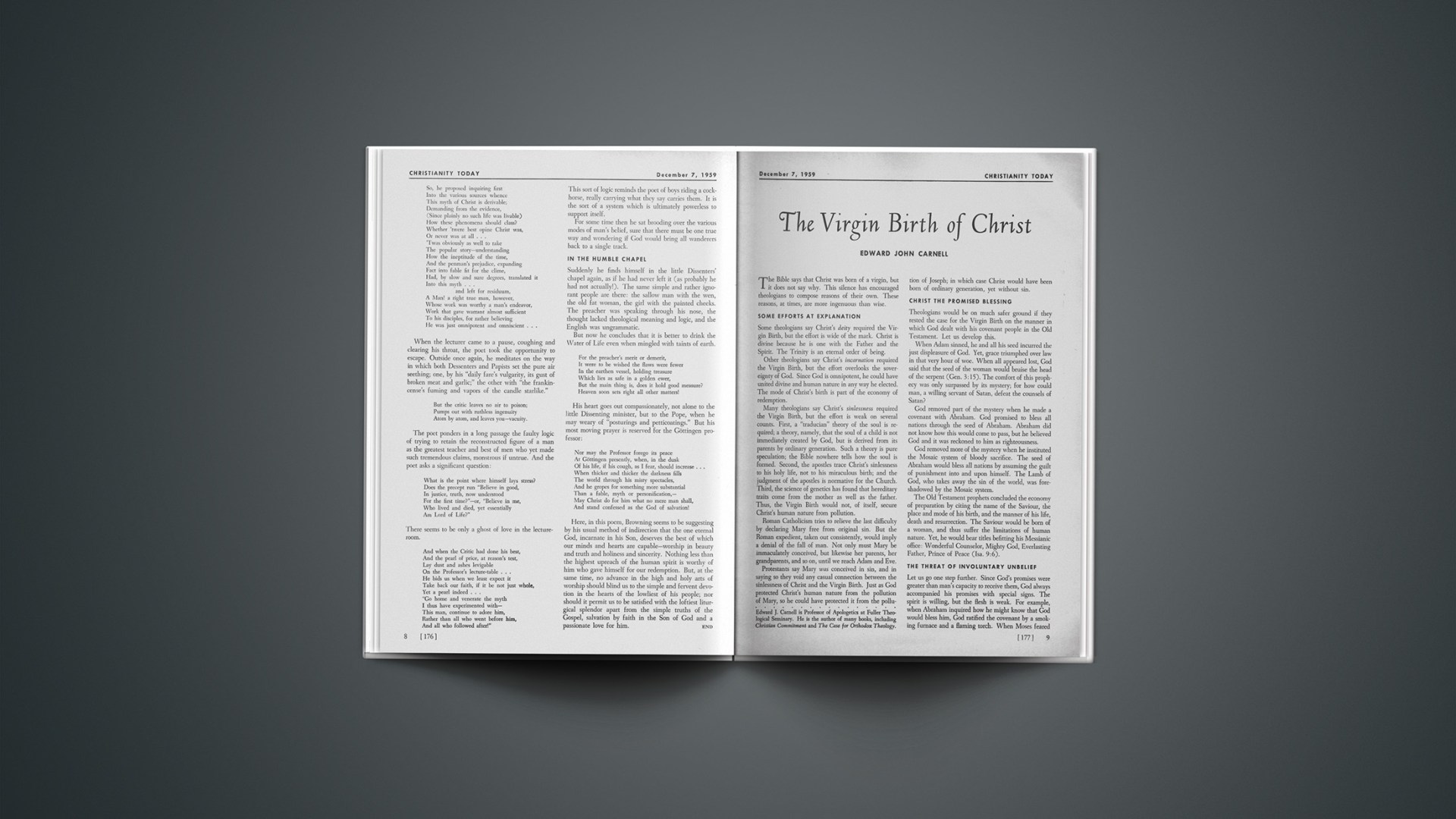
The Virgin Birth of Christ

The Bible says that Christ was born of a virgin, but it does not say why. This silence has encouraged theologians to compose reasons of their own. These reasons, at times, are more ingenuous than wise.

SOME EFFORTS AT EXPLANATION

Some theologians say Christ’s deity required the Virgin Birth, but the effort is wide of the mark. Christ is divine because he is one with the Father and the Spirit. The Trinity is an eternal order of being.

Other theologians say Christ’s incarnation required the Virgin Birth, but the effort overlooks the sovereignty of God. Since God is omnipotent, he could have united divine and human nature in any way he elected. The mode of Christ’s birth is part of the economy of redemption.

Many theologians say Christ’s sinlessness required the Virgin Birth, but the effort is weak on several counts. First, a “traducian” theory of the soul is required; a theory, namely, that the soul of a child is not immediately created by God, but is derived from its parents by ordinary generation. Such a theory is pure speculation; the Bible nowhere tells how the soul is formed. Second, the apostles trace Christ’s sinlessness to his holy life, not to his miraculous birth; and the judgment of the apostles is normative for the Church. Third, the science of genetics has found that hereditary traits come from the mother as well as the father. Thus, the Virgin Birth would not, of itself, secure Christ’s human nature from pollution.

Roman Catholicism tries to relieve the last difficulty by declaring Mary free from original sin. But the Roman expedient, taken out consistently, would imply a denial of the fall of man. Not only must Mary be immaculately conceived, but likewise her parents, her grandparents, and so on, until we reach Adam and Eve.

Protestants say Mary was conceived in sin, and in saying so they void any casual connection between the sinlessness of Christ and the Virgin Birth. Just as God protected Christ’s human nature from the pollution of Mary, so he could have protected it from the pollution of Joseph; in which case Christ would have been born of ordinary generation, yet without sin.

CHRIST THE PROMISED BLESSING

Theologians would be on much safer ground if they rested the case for the Virgin Birth on the manner in which God dealt with his covenant people in the Old Testament. Let us develop this.

When Adam sinned, he and all his seed incurred the just displeasure of God. Yet, grace triumphed over law in that very hour of woe. When all appeared lost, God said that the seed of the woman would bruise the head of the serpent (Gen. 3:15). The comfort of this prophecy was only surpassed by its mystery; for how could man, a willing servant of Satan, defeat the counsels of Satan?

God removed part of the mystery when he made a covenant with Abraham. God promised to bless all nations through the seed of Abraham. Abraham did not know how this would come to pass, but he believed God and it was reckoned to him as righteousness.

God removed more of the mystery when he instituted the Mosaic system of bloody sacrifice. The seed of Abraham would bless all nations by assuming the guilt of punishment into and upon himself. The Lamb of God, who takes away the sin of the world, was foreshadowed by the Mosaic system.

The Old Testament prophets concluded the economy of preparation by citing the name of the Saviour, the place and mode of his birth, and the manner of his life, death and resurrection. The Saviour would be born of a woman, and thus suffer the limitations of human nature. Yet, he would bear titles befitting his Messianic office: Wonderful Counselor, Mighty God, Everlasting Father, Prince of Peace (Isa. 9:6).

THE THREAT OF INVOLUNTARY UNBELIEF

Let us go one step further. Since God’s promises were greater than man’s capacity to receive them, God always accompanied his promises with special signs. The spirit is willing, but the flesh is weak. For example, when Abraham inquired how he might know that God would bless him, God ratified the covenant by a smoking furnace and a flaming torch. When Moses feared Pharaoh’s court, God gave him a rod of power. And when Gideon shrank before the Midianite hordes, God honored the fleece. These signs, in each case, were aimed at subduing the threat of involuntary unbelief.

When we see why God gave signs to his people, we can see why Christ was born of a virgin; for if the great heroes of the faith required signs when they looked forward to the Saviour’s coming, how much more were signs required by those into whose house the Saviour would be born? The signs of Christ’s appearance had to admit of no doubt. Yet, the signs had to be secret, lest the foes of righteousness begin their nefarious work before Christ’s hour had come.

SIGNS OF CHRIST’S APPEARANCE

When the angel told Mary that God had chosen her to be the mother of the Saviour, she found the tidings awesome. “And Mary said to the angel, ‘How can this be, since I have no husband?’ ” (Luke 1:34) The angel allayed Mary’s fear by naming two specific signs: first, her own child would be conceived of the Holy Spirit; second, Elizabeth would bear a child in her old age.

In due time Mary was able to confirm both of these signs. When she felt life stirring in her body, she knew that her child was a miracle sent from God. And a happy visit to the home of Elizabeth confirmed the second sign.

As time passed, however, a new cloud of difficulty gathered; for when Joseph found that Mary was with child, he “resolved to divorce her quietly” (Matt. 1:19). Joseph’s Hebrew piety, let alone his male ego, prompted this resolve. Not only had Mary brought shame on Israel by conceiving out of wedlock, but she had deliberately concealed her condition. This, at least, is how Joseph viewed the matter.

The cloud of difficulty did not lift until God dispatched an angel of light. “Joseph, son of David, do not fear to take Mary your wife, for that which is conceived in her is of the Holy Spirit; she will bear a son, and you shall call his name Jesus, for he will save his people from their sins” (Matt. 1:20–21). Convinced by this sign, Joseph took Mary to be his wife. Mary was now free to tell all that was on her heart. Mutual pardon was sought and forgiven. The holy couple then waited for God to give his gift to the world.

This pious vigil, however, did not end with the advent of Christ. The time of waiting, in fact, had hardly begun. Let us appreciate this as we ponder the Virgin Birth. Some 30 years elapsed between Christ’s birth and his manifestation to Israel. During these years Joseph and Mary had no other proof of Christ’s divinity than the signs surrounding his birth. Mary prophesied wonderful things about her Son, but she prophesied more than she understood. This is proved by the way she chided Jesus when he tarried in the temple at the age of 12. “Son, why have you treated us so” (Luke 2:48)? Jesus replied to this query with divine authority, “How is it that you sought me? Did you not know I must be in my Father’s house” (2:49)?

Now few Christians are disturbed by the silence of the early Church, for neither the book of Acts nor the Epistles make any explicit reference to the Virgin Birth of Christ. The difficulty, however, is easily resolved.

The mode of Christ’s birth forms no part of the “one act of righteousness” by which Christ reconciled God to the world. When Christ died on the cross, he offered up the fruit of a perfected human nature. He earned this fruit by loving God with all his heart and his neighbor as himself. Conscious, voluntary energy was required; an energy that Christ did not have as an infant, for his human faculties were undeveloped.

When the apostles preached the Gospel, therefore, they had no more reason to refer to the mode of Christ’s birth than they did to his legal parents or the street on which he lived. The Gospel draws on the public ministry of Christ, a ministry that began with the Baptism and ended with the Resurrection.

The Virgin Birth is precious to the household of faith because it plays a major role in connecting the promises of the Old Testament with their fulfillment in the New Testament. “All this took place to fulfill what the Lord had spoken by the prophet: ‘Behold, a virgin shall conceive and bear a son, and his name shall be called Emmanuel’ ” (Matt. 1:22–23 RSV). Scripture is inspired of God and has the force of law in the Church.

At this happy Christmas season, when we thank God for his inexpressible gift, let us renew our faith in the appointed means by which God made this gift to the world. God not only promised to bless all nations through the seed of Abraham, but he accompanied his promise with special signs. One of these signs was the Virgin Birth. If we disregard the Virgin Birth, we offend a confessional element that has united Christians from the first century until now.

Edward J. Carnell is Professor of Apologetics at Fuller Theological Seminary. He is the author of many books, including Christian Commitment and The Case for Orthodox Theology.

It Won’t Be Yours Again

Hustle this moment to yourself and hold it close, and warm it with your flesh. But do not spoil the new and uncut cloth of time around yourself, enhancing you. Turn it gently, fit it, give it shape. And do not overstrain the weave. You want it perfect, strong, unmended, whole. It won’t be yours again.

GLADYS VONDY ROBERTSON
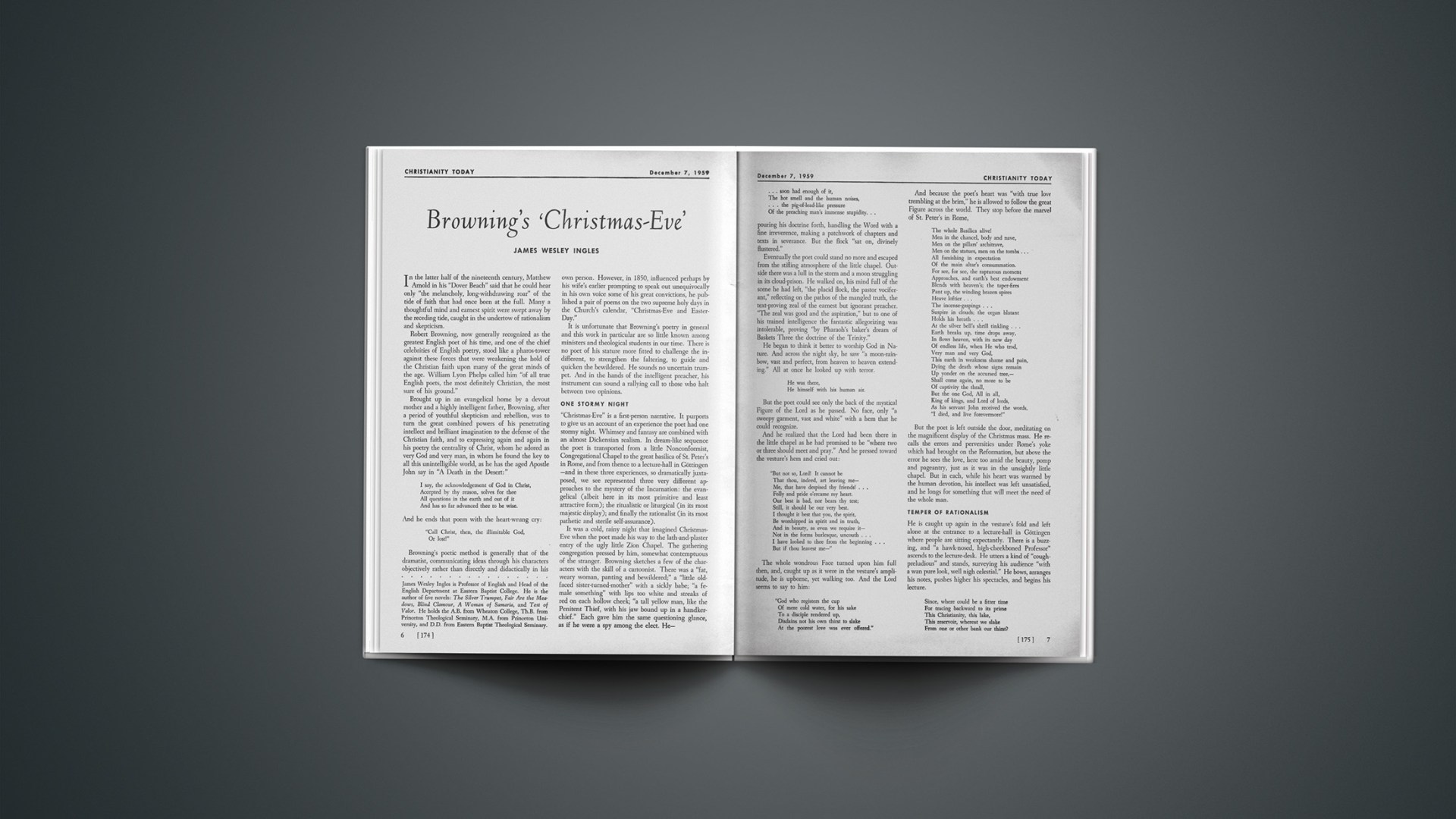
Cover Story

Brownings ‘Christmas-Eve’

In the latter half of the nineteenth century, Matthew Arnold in his “Dover Beach” said that he could hear only “the melancholy, long-withdrawing roar” of the tide of faith that had once been at the full. Many a thoughtful mind and earnest spirit were swept away by the receding tide, caught in the undertow of rationalism and skepticism.

Robert Browning, now generally recognized as the greatest English poet of his time, and one of the chief celebrities of English poetry, stood like a pharos-tower against these forces that were weakening the hold of the Christian faith upon many of the great minds of the age. William Lyon Phelps called him “of all true English poets, the most definitely Christian, the most sure of his ground.”

Brought up in an evangelical home by a devout mother and a highly intelligent father, Browning, after a period of youthful skepticism and rebellion, was to turn the great combined powers of his penetrating intellect and brilliant imagination to the defense of the Christian faith, and to expressing again and again in his poetry the centrality of Christ, whom he adored as very God and very man, in whom he found the key to all this unintelligible world, as he has the aged Apostle John say in “A Death in the Desert:”

I say, the acknowledgement of God in Christ,
Accepted by thy reason, solves for thee
All questions in the earth and out of it
And has so far advanced thee to be wise.

And he ends that poem with the heart-wrung cry:

“Call Christ, then, the illimitable God,
Or lost!”

Browning’s poetic method is generally that of the dramatist, communicating ideas through his characters objectively rather than directly and didactically in his own person. However, in 1850, influenced perhaps by his wife’s earlier prompting to speak out unequivocally in his own voice some of his great convictions, he published a pair of poems on the two supreme holy days in the Church’s calendar, “Christmas-Eve and Easter-Day.”

It is unfortunate that Browning’s poetry in general and this work in particular are so little known among ministers and theological students in our time. There is no poet of his stature more fitted to challenge the indifferent, to strengthen the faltering, to guide and quicken the bewildered. He sounds no uncertain trumpet. And in the hands of the intelligent preacher, his instrument can sound a rallying call to those who halt between two opinions.

ONE STORMY NIGHT

“Christmas-Eve” is a first-person narrative. It purports to give us an account of an experience the poet had one stormy night. Whimsey and fantasy are combined with an almost Dickensian realism. In dream-like sequence the poet is transported from a little Nonconformist, Congregational Chapel to the great basilica of St. Peter’s in Rome, and from thence to a lecture-hall in Göttingen—and in these three experiences, so dramatically juxtaposed, we see represented three very different approaches to the mystery of the Incarnation: the evangelical (albeit here in its most primitive and least attractive form); the ritualistic or liturgical (in its most majestic display); and finally the rationalist (in its most pathetic and sterile self-assurance).

It was a cold, rainy night that imagined Christmas-Eve when the poet made his way to the lath-and-plaster entry of the ugly little Zion Chapel. The gathering congregation pressed by him, somewhat contemptuous of the stranger. Browning sketches a few of the characters with the skill of a cartoonist. There was a “fat, weary woman, panting and bewildered;” a “little old-faced sister-turned-mother” with a sickly babe; “a female something” with lips too white and streaks of red on each hollow cheek; “a tall yellow man, like the Penitent Thief, with his jaw bound up in a handkerchief.” Each gave him the same questioning glance, as if he were a spy among the elect. He—

… soon had enough of it,
The hot smell and the human noises,
… the pig-of-lead-like pressure
Of the preaching man’s immense stupidity …

pouring his doctrine forth, handling the Word with a fine irreverence, making a patchwork of chapters and texts in severance. But the flock “sat on, divinely flustered.”

Eventually the poet could stand no more and escaped from the stifling atmosphere of the little chapel. Outside there was a lull in the storm and a moon struggling in its cloud-prison. He walked on, his mind full of the scene he had left, “the placid flock, the pastor vociferant,” reflecting on the pathos of the mangled truth, the text-proving zeal of the earnest but ignorant preacher. “The zeal was good and the aspiration,” but to one of his trained intelligence the fantastic allegorizing was intolerable, proving “by Pharaoh’s baker’s dream of Baskets Three the doctrine of the Trinity.”

He began to think it better to worship God in Nature. And across the night sky, he saw “a moon-rainbow, vast and perfect, from heaven to heaven extending.” All at once he looked up with terror.

He was there,
He himself with his human air.

But the poet could see only the back of the mystical Figure of the Lord as he passed. No face, only “a sweepy garment, vast and white” with a hem that he could recognize.

And he realized that the Lord had been there in the little chapel as he had promised to be “where two or three should meet and pray.” And he pressed toward the vesture’s hem and cried out:

“But not so, Lord! It cannot be
That thou, indeed, art leaving me—
Me, that have despised thy friends!…
Folly and pride o’ercame my heart.
Our best is bad, nor bears thy test;
Still, it should be our very best.
I thought it best that you, the spirit,
Be worshipped in spirit and in truth,
And in beauty, as even we require it—
Not in the forms burlesque, uncouth …
I have looked to thee from the beginning …
But if thou leavest me—”

The whole wondrous Face turned upon him full then, and, caught up as it were in the vesture’s amplitude, he is upborne, yet walking too. And the Lord seems to say to him:

“God who registers the cup
Of mere cold water, for his sake
To a disciple rendered up,
Disdains not his own thirst to slake
At the poorest love was ever offered.”

And because the poet’s heart was “with true love trembling at the brim,” he is allowed to follow the great Figure across the world. They stop before the marvel of St. Peter’s in Rome,

The whole Basilica alive!
Men in the chancel, body and nave,
Men on the pillars’ architrave,
Men on the statues, men on the tombs …
All famishing in expectation
Of the main altar’s consummation.
For see, for see, the rapturous moment
Approaches, and earth’s best endowment
Blends with heaven’s; the taper-fires
Pant up, the winding brazen spires
Heave loftier …
The incense-gaspings …
Suspire in clouds; the organ blatant
Holds his breath …
At the silver bell’s shrill tinkling …
Earth breaks up, time drops away,
In flows heaven, with its new day
Of endless life, when He who trod,
Very man and very God,
This earth in weakness shame and pain,
Dying the death whose signs remain
Up yonder on the accursed tree,—
Shall come again, no more to be
Of captivity the thrall,
But the one God, All in all,
King of kings, and Lord of lords,
As his servant John received the words,
“I died, and live forevermore!”

But the poet is left outside the door, meditating on the magnificent display of the Christmas mass. He recalls the errors and perversities under Rome’s yoke which had brought on the Reformation, but above the error he sees the love, here too amid the beauty, pomp and pageantry, just as it was in the unsightly little chapel. But in each, while his heart was warmed by the human devotion, his intellect was left unsatisfied, and he longs for something that will meet the need of the whole man.

TEMPER OF RATIONALISM

He is caught up again in the vesture’s fold and left alone at the entrance to a lecture-hall in Göttingen where people are sitting expectantly. There is a buzzing, and “a hawk-nosed, high-cheekboned Professor” ascends to the lecture-desk. He utters a kind of “cough-preludious” and stands, surveying his audience “with a wan pure look, well nigh celestial.” He bows, arranges his notes, pushes higher his spectacles, and begins his lecture.

Since, where could be a fitter time
For tracing backward to its prime
This Christianity, this lake,
This reservoir, whereat we slake
From one or other bank our thirst?
So, he proposed inquiring first
Into the various sources whence
This myth of Christ is derivable;
Demanding from the evidence,
(Since plainly no such life was livable)
How these phenomena should class?
Whether ’twere best opine Christ was,
Or never was at all …
’Twas obviously as well to take
The popular story—understanding
How the ineptitude of the time,
And the penman’s prejudice, expanding
Fact into fable fit for the clime,
Had, by slow and sure degrees, translated it
Into this myth …
and left for residuum,
A Man! a right true man, however,
Whose work was worthy a man’s endeavor,
Work that gave warrant almost sufficient
To his disciples, for rather believing
He was just omnipotent and omniscient …

When the lecturer came to a pause, coughing and clearing his throat, the poet took the opportunity to escape. Outside once again, he meditates on the way in which both Dessenters and Papists set the pure air seething; one, by his “daily fare’s vulgarity, its gust of broken meat and garlic;” the other with “the frankincense’s fuming and vapors of the candle starlike.”

But the critic leaves no air to poison;
Pumps out with ruthless ingenuity
Atom by atom, and leaves you—vacuity.

The poet ponders in a long passage the faulty logic of trying to retain the reconstructed figure of a man as the greatest teacher and best of men who yet made such tremendous claims, monstrous if untrue. And the poet asks a significant question:

What is the point where himself lays stress?
Does the precept run “Believe in good,
In justice, truth, now understood
For the first time?”—or, “Believe in me,
Who lived and died, yet essentially
Am Lord of Life?”

There seems to be only a ghost of love in the lecture-room.

And when the Critic had done his best,
And the pearl of price, at reason’s test,
Lay dust and ashes levigable
On the Professor’s lecture-table …
He bids us when we least expect it
Take back our faith, if it be not just whole,
Yet a pearl indeed …
“Go home and venerate the myth
I thus have experimented with—
This man, continue to adore him,
Rather than all who went before him,
And all who followed after!”

This sort of logic reminds the poet of boys riding a cockhorse, really carrying what they say carries them. It is the sort of a system which is ultimately powerless to support itself.

For some time then he sat brooding over the various modes of man’s belief, sure that there must be one true way and wondering if God would bring all wanderers back to a single track.

IN THE HUMBLE CHAPEL

Suddenly he finds himself in the little Dissenters’ chapel again, as if he had never left it (as probably he had not actually!). The same simple and rather ignorant people are there: the sallow man with the wen, the old fat woman, the girl with the painted cheeks. The preacher was speaking through his nose, the thought lacked theological meaning and logic, and the English was ungrammatic.

But now he concludes that it is better to drink the Water of Life even when mingled with taints of earth.

For the preacher’s merit or demerit,
It were to be wished the flaws were fewer
In the earthen vessel, holding treasure
Which lies as safe in a golden ewer,
But the main thing is, does it hold good measure?
Heaven soon sets right all other matters!

His heart goes out compassionately, not alone to the little Dissenting minister, but to the Pope, when he may weary of “posturings and petticoatings.” But his most moving prayer is reserved for the Göttingen professor:

Nor may the Professor forego its peace
At Göttingen presently, when, in the dusk
Of his life, if his cough, as I fear, should increase …
When thicker and thicker the darkness fills
The world through his misty spectacles,
And he gropes for something more substantial
Than a fable, myth or personification,—
May Christ do for him what no mere man shall,
And stand confessed as the God of salvation!

Here, in this poem, Browning seems to be suggesting by his usual method of indirection that the one eternal God, incarnate in his Son, deserves the best of which our minds and hearts are capable—worship in beauty and truth and holiness and sincerity. Nothing less than the highest upreach of the human spirit is worthy of him who gave himself for our redemption. But, at the same time, no advance in the high and holy arts of worship should blind us to the simple and fervent devotion in the hearts of the lowliest of his people; nor should it permit us to be satisfied with the loftiest liturgical splendor apart from the simple truths of the Gospel, salvation by faith in the Son of God and a passionate love for him.

James Wesley Ingles is Professor of English and Head of the English Department at Eastern Baptist College. He is the author of five novels: The Silver Trumpet, Fair Are the Meadows, Blind Clamour, A Woman of Samaria, and Test of Valor. He holds the A.B. from Wheaton College, Th.B. from Princeton Theological Seminary, M.A. from Princeton University, and D.D. from Eastern Baptist Theological Seminary.

Cover Story

Born of the Virgin Mary

A former student, strongly conservative in his theological views, was undergoing examination before a presbytery. He was asked, “Do you believe that the doctrine of the Virgin Birth is an essential doctrine?” He replied that he did not. Further questioning revealed his essential orthodoxy, but his incautious reply to that carelessly framed question very nearly led to a refusal to ordain him. The negative thesis of this paper is that such carelessness is all too typical of the handling of this doctrine both by those who accept it and those who question or reject it.

The student under examination should have requested further definition of the question. “Essential? For what?” Essential for salvation in the sense that one who believes all the doctrines of the creed and is personally committed to Jesus Christ as Lord and Saviour but has some doubts about the validity or importance of this one doctrine cannot hope for heaven? Surely no one would maintain that. The student was really saying that he did not accept the doctrine as essential in that sense, yet he failed to say so explicitly. The presbytery, on the other hand, misunderstood him but did not define it either. Obscure thinking about this doctrine seems to be so widespread that one might almost describe it as typical. But a sweeping generalization such as this requires at least some illustration.

SOME INSECURE DEFENSES

In the New Schaff-Herzog Encyclopedia, Beckwith begins his excellent presentation of this doctrine by pointing out that the Virgin Birth was the unchallenged conviction of the Church until the eighteenth century, and that the first to attack it then were such “free thinkers” as Voltaire and Thomas Paine. Historically his statement seems to be unimpeachable, but one asks whether it justifies any inferences as to the validity of the doctrine; and, if it does, how firmly may they be drawn? Surely the fact that so many Christian people, great and small, learned and ordinary, wise and simple, found this doctrine to fit into their understanding of the Christian faith would suggest that it ought not to be rejected lightly. On the other hand, one cannot forget that beliefs even more universally adhered to have at one time been abandoned.

Again, the fact that disbelief in this doctrine came late has been used by some as an argument in favor of the Virgin Birth and by others as an argument against it. One group seems convinced that antiquity proves validity, while the other would hold that the newer is the truer. The fact seems to be that chronological considerations are quite irrelevant to questions of validity. And the contention that this must be a valid doctrine because those who first attacked it were such “unsavory” people has no logical standing. To argue thus is to commit the well-known fallacy of argumentum ad hominem—surely even the devil may sometimes tell the truth. In any case, if it be granted that the estimate of those free thinkers was irresponsible and despicable, we have to remember that many a subsequent thinker, who cannot so readily be condemned, has agreed with their criticism of this doctrine.

Another way in which the Virgin Birth doctrine has been loosely attacked and defended has been in pointing to certain birth claims in nonbiblical sources. For instance, it is pointed out that in the past there was a widespread tendency to account for outstanding people like Alexander the Great in terms of supernatural paternity. The case of Jesus of Nazareth is said to be another example; and some have even suggested that such a claim was deliberately made on his behalf so that early Christianity might have miracles to match those of its rivals. Thus the implied argument is that no sensible person today would accept the supernatural paternity of Alexander, and no such person would believe this of our Lord. Whatever one might say for that conclusion, the argument itself is rather worthless.

In the first place, the cases of Alexander and of Jesus are not parallel. No one in a rigidly monotheistic setting ever suggested that an eternally-existing divine person became incarnate in Alexander the Great; yet that is exactly the claim made with regard to Jesus. In the second place, this argument can be simply turned around and still have the same force. One might contend that as Alexander was not born of supernatural paternity, neither was Jesus; and another could argue that since Jesus did have supernatural paternity, then Alexander did also.

For the present we are rejecting both arguments as arguments. We are convinced that in point of fact Jesus had supernatural paternity and Alexander did not; but one cannot argue from the one case to the other because the parallel is not valid. It may be that the tendency to claim supernatural paternity for great heroes, great benefactors of humanity, does carry slight implication in support of the actual supernatural paternity of Jesus. It is a Christian belief, supported by Scripture, that God has not left himself without a witness among any people. The suggestion is that in harmony with this universal witness thoughtful people have known that the real benefaction needed by fallen humanity could come only through one who enjoyed supernatural paternity, and that those who made such a claim for people like Alexander wrongly identified that benefactor. Had they been able to identify him with Jesus they would have been correct.

Would-be defenders of the doctrine of the Virgin Birth have also appealed to alleged examples of “natural” virgin birth in order to support their argument that Jesus could have been born of a virgin mother. They have claimed as a medically proven fact that virgin births do occasionally occur naturally. The writer has never seen evidence sufficient to convince him of this, but if it proves anything, it proves the very opposite of the conclusion it tries to support. Advocates would prove that Jesus may have been naturally born of a virgin, without any paternity whatever, yet what they really want to prove is his supernatural paternity! Why do they not see the folly of such reasoning? Perhaps they have their minds on something else. Their real concern is to maintain the full deity and competent saviourhood of Jesus, and for this they are sure that his supernatural paternity is essential. We agree. But then they take it for granted that there can be no supernatural paternity without virgin birth—an assumption which still remains to be examined. Furthermore, they blindly go on to argue for the Virgin Birth as a possibility without any paternity whatever. The truth is not served—it is rather betrayed—by such inconsequential reasoning.

A similar judgment must be passed on many who seek to prove the virgin birth of our Lord on the basis of his claim to sinlessness. Their interest also is in the full deity and adequate saviourhood of Jesus, for which sinlessness would seem to be essential. Again we agree, and we believe that each of these doctrines can be well established. The question is, does the sinlessness of Jesus, once granted, commit us to a belief in his virgin birth? Let us sharpen the question. We fully accept his deity, his all-competent saviourhood, his sinlessness, and his birth of a virgin. The question is, if you know of his sinlessness but had never heard of his virgin birth, could you logically deduce the latter doctrine from the former?

This has been attempted. Some have argued that virginity is a morally pure state, while natural motherhood apparently is not, and so a sinless saviour must have been born of a virgin mother. But is virginity morally superior to motherhood in lawful wedlock? We would deny it emphatically. Even if it were, however, a virgin would have to be sinless herself in order to give sinless birth.

It has sometimes been argued that the elimination of a human father, in the case of Jesus, broke the otherwise unbroken chain of original sin and so brought about his sinlessness; but who would seriously maintain that original sin descends only through the human father? If sin did not descend to Jesus, then the reason must have been either that there was no human father and his virgin mother was sinless (which is what the Roman Catholics maintain) or the supernatural agency of the Holy Spirit broke the chain. Could there have been such a supernatural agency, and could it have broken that chain, only if Jesus was born of a virgin? That is what would have to be proved by those who contend that the Virgin Birth is a logical inference from the sinlessness of Jesus. But no man knows enough to make such claims. We may believe that that is how it came about, but because we do not know what options were open to the power and wisdom of God we cannot maintain it was the only way it could have happened. The same is true of the argument that were he not virgin born, he was not God incarnate. We believe he was virgin born and that he was and is one theanthropic person; but no man knows enough to argue that he could not have been the latter if he were not also the former.

THE BASIS OF BELIEF

What then is the basis of our belief in the Virgin Birth? It rests mainly on our conviction that the Holy Spirit is the real author of the Scriptures, and that the Virgin Birth is adequately affirmed therein. Secondarily, it rests on the perception that while no man knows enough to contend that this doctrine is tied to the other doctrines of Christology and Soteriology by irrefragable logical connections, there is a beautiful harmony between the various doctrines. We cannot maintain that because Jesus is very God of very God, our sinless Saviour, he could have become incarnate only through a virgin birth. But we do believe that God himself has told us this was the way it happened, and on this basis we are bound to believe it. We can be sure that there was good reason on the part of God why he chose this manner rather than some other; and as we see it at this end, the divinely chosen way fits in beautifully with all the other basic doctrines of revelation.

Again, however, we are confronted by a view widely debated and with a surprising amount of loose thinking on both sides. Immediately involved in this discussion is the doctrine of revelation and the field of biblical criticism. What lies in back of the controversy is the problem of naturalism and supernaturalism. Many of the arguments used in questioning, rejecting, or rendering unimportant the doctrine of the Virgin Birth would appeal only to those who either do not recognize the Holy Spirit as the real and effective author of Scripture or who question the authenticity of the birth stories in Matthew and Luke. This latter problem seems to me to have been dealt with in masterly fashion by Dr. Machen in his book, The Virgin Birth of Christ. Nothing which has since been written seems to weaken his contention that these stories belong to the earliest tradition of the Church and formed part of the original Gospels.

Particularly since the discovery of the Dead Sea Scrolls, there has been a marked tendency to date all the Gospels early. The widespread contention that Matthew is unreliable seems to be increasingly subject to suspicion, and in any case it relates to Matthew’s treatment of the law, not to these birth stories. Luke’s competence, however, in recording facts is becoming more and more recognized. That he was a very able historian, whose record of the virgin birth of Jesus was early and carefully sifted from written and oral sources, is shown in that he has never yet been proved mistaken in his judgments of fact. He also was intimately acquainted with the teachings of Paul, and it seems inconceivable that he would have recorded the mode of Jesus’ birth without defending his doing so had he not known that it formed part of the belief of that apostle.

THE GENEALOGICAL PROBLEM

The great difference between the genealogies in Matthew and Luke has, of course, created difficulty. There is an explanation which seems at least plausible, and it is that Joseph was the legal, not the natural, father, and that Matthew, the “legalist,” gives us the legal genealogy while Luke, the historian and doctor, gives us the genealogy through the real mother. To reject that explanation, unless it can be shown to be utterly without chance when the alternative is so forbidding, seems to me to be possible only for those who have “an axe to grind.” The alternative is not one which ordinarily decent critics would lightly accept. Aside from the fact that it involves denying that these authors were moved to record this story by the agency of the Holy Spirit, it also contends that the authors of the first and third Gospels irresponsibly commended the person and work of Christ by claiming for him a birth which could only have raised very serious questions in the minds of Jesus’ followers and relatives (who were in a position to know if the stories were false) and to cause the unsympathetic to misrepresent his parentage (as we know that they actually did). It seems to me that modern writers who accept this alternative would feel very much aggrieved—and justly so—if, without any more evidence than is here available, their own competence were similarly reflected upon. Why then do some lightly accept such a reflection on the competence of the authors of the first and third Gospels? Even modern scholars have some obligation to be gentlemen.

THE UNITY OF SCRIPTURE

What must be said of the doubt thrown on the Matthew and Luke birth stories that the Virgin Birth is not clearly and directly referred to in the Epistles? Even if one ignores the position that the Holy Spirit is the real and effective author of the Scriptures, the argument for the doubt does not carry much weight unless it can be shown that, without such mention, the author could not have accomplished his purpose. For example, had there not been a serious abuse of the Lord’s Supper in the Church at Corinth, there would have been no occasion for reference to it in any of Paul’s Epistles. But to infer from such silence that Paul did not observe that Sacrament, and did not believe that it was instituted by our Lord himself, would be completely erroneous. Can it be shown in the Epistles that there was any occasion which could not have been dealt with, apart from reference to the Virgin Birth, if the writer had believed in it? I think not. It is understandable that such a doctrine would not have been discussed unless it was absolutely necessary.

The case for the Virgin Birth is of course stronger if one believes that the Holy Spirit was the real author of the Scriptures. He saw to it that this doctrine was related twice. How many times does He have to say something before some people will believe it? Furthermore, if the Holy Spirit thought this doctrine important enough to see that it was twice spoken of, what right have certain theologians to assert that they are downright uninterested in it?

The question finally boils down to this. Are we or are we not willing to accept the supernaturalistic claims of the Scriptures? If we are, then the doctrine of the virgin birth of Jesus will seem to us to be on solid ground. If we are not, then despite anything we may tell ourselves or others—albeit sincerely—we are sitting in judgment of the Scriptures and employing as our basis of judgment a philosophy more naturalistic than that of the Scriptures themselves.

Andrew K. Rule is Professor of Church History and Apologetics at Louisville Presbyterian Seminary. He holds the M.A. degree from University of New Zealand, the B.D. from Princeton Seminary, and Ph.D. from University of Edinburgh.

Review of Current Religious Thought: November 23, 1959

A good deal of discussion was aroused in Europe recently by the apparent change of mind in the Basel theologian, Fritz Buri. Professor Buri had written a book in which the tones of Reformation faith were distinctly audible. This was coupled with a wide-spread rumor that Buri had undergone a spiritual conversion under the influence of Karl Barth. What made the situation fascinating is the fact that this particular theologian was well known as a representative of an extreme liberal school of theology. His previous publications had established him in that position. He was a disciple of the thought world of Albert Schweitzer, particularly in regard to New Testament eschatology. He held that the New Testament was consistently eschatological and that its eschatological hopes had proven unfounded. This position has found defenders among such men as Martin Werner as well as Buri himself. Furthermore, Buri had been occupied in writing a dogmatics which was profoundly permeated with philosophical existentialism.

What interests us is the fact that Buri’s book has awakened a certain distrust among readers. Reading Buri’s book, one cannot escape the impression that a real and radical change has come over this Swiss theologian. But it is also apparent that among those discussing the book many feel it almost impossible that a genuinely liberal theologian could possibly become converted to orthodoxy. This suspicion is what concerns me here.

We encounter a conversion from Protestantism to Rome occasionally as well as from Rome to Protestantism. But a conversion from liberalism to evangelical orthodoxy sometimes seems too much for us to expect. We hardly count on such things taking place anymore. We speak rather glibly about the self-evidence of the Gospel; we talk about the sword of the Spirit. But we do not entertain the expectation that something is actually going to happen by the power of the Spirit. In this instance, many hardly dare trust Buri’s interest in the Reformation faith. They speak as though the lines are irretrievably drawn. I also have the impression that our theological discussions are often rendered fruitless simply by the prevalence among us of a similar attitude of hopelessness.

Should we not rather, in our theological discussions, count on the possibility of changes in men’s thinking through the power of the Word of God? Do we still believe in the usefulness of our theological labors? Do we still believe in Paul’s insistence that the Word of God is not bound (2 Tim. 2:9)? I cannot help recalling the time of the Reformation when there was a stringently worked out theological system (scholasticism); the position within it was heavily fortified with logic and authority. But the renewed study of Holy Scripture brought about a great change, one that recreated the whole situation in Europe. Is our polemic with liberal theology only a game we are playing? Is it carried on with expectation that something wonderful can happen, that profound changes can take place? Or do we work with the silent assumption that the theological fronts will remain unchanged until the coming of Jesus Christ?

I do not mean to imply that readers of such books as the new one of Buri should not subject them to keen analysis. I know that writings of theologians have sometimes worn the word clothing of orthodoxy while the content was still liberal. But if we meet every evidence of change of mind with suspicion, we ought to ask ourselves if we still believe in the power of the Word of God. If we always suspect that nothing is really changed, it may be that we have lost faith in the clarity of Scripture. Do we really believe in the power of the truth?

Our times are charged with spiritual struggle in theological matters as well as in others. Everything seems to have become part of a crisis; nothing seems to be certain. Orthodox theology surely is part of the critical picture. On the other hand, there is a strong interest manifest in the Word of God. We cannot discount the possibilities resident in this interest. Whenever God’s Word is being studied, the results are unpredictable. We must not rule out the possibility of surprises in the area of theology. I am personally convinced that we all need a rebirth of faith in the possibilities that lie within the power and self-evidential character of the Gospel. This does not mean we should be uncritical, quickly rushing to the conclusion that every change in manner of expression is a return to the Gospel. But we must not count out the working of the Holy Spirit. Where we lose this faith, our theological work is empty and useless. It serves only to express something of what we believe and think.

Consider, for example, the imperatives of our conflict with Rome. Often we carry on this conflict as though we were simply letting the other side know what we are thinking about rather than as though we were carrying on a discussion with profoundly significant issues at stake. This comes about because we really do not expect our polemic to issue in anything fruitful. We hardly dare believe that Rome can change.

Is it impossible to suppose that new avenues of thought can be opened by the Spirit? Is it not right to suppose that once men interest themselves in the Bible they are no longer left to themselves, that they may be in the powerful guidance of the Word which still is sharper than any two-edged sword? I think that we may believe that it is right to count on the power of the Word. This is why we should be critical of every change that seems to make itself manifest in men’s thinking, but also why we should never be distrustful.

In theology we are not dealing with something that arose in a dark corner somewhere, but with a Gospel full of grace and power. Those prophets who prophesy for bread are able to be absolutely sure of the future. But the true prophet is full of expectation, throws himself into the conflict, and then runs to the window to see what God shall bring about.

Book Briefs: November 23, 1959

Orthodox Judaism

This is My God, by Herman Wouk (Doubleday, 1959, 356 pp., $3.95), is reviewed by Edward John Carnell, Professor of Apologetics, Fuller Theological Seminary.

With the publication of this book, Herman Wouk may justly be called the C. S. Lewis of orthodox Judaism. He is a literary craftsman of the first water. Just feel his power as he describes the delights of Palestine: “Best of all I like the city of Haifa, white and busy on green slopes around a saucer of purple Mediterranean; then Jerusalem, the solemn magic of which I cannot write down, but its old hills in the dawn will draw me back year after year; and then the mysterious peaks of Galilee, with vistas down to the far blue sea of Kinneret which give you the illusion that Israel must be the world’s largest land instead of one of the smallest” (p. 268).

Many people picture orthodox Jews as an eccentric society, bearded, with their backs to progress and their faces to the Wailing Wall. Wouk pictures them as a religious aristocracy commissioned by God to bear the torch of piety and learning until the very end of time. The darkest hours of Jewish persecution are turned into the brightness of meridian sunlight. The law of Moses “prophesied that the glories would be temporary, that the people in their prosperity would lose their hold on the law and on their land, and would scatter into exile; and it ordained that the nation should go on observing the festivals wherever they dwelt, to all time. And so we do. Our people have lived for thousands of years in the faith that in God’s good time he will restore the nation to its soil, and that the festivals will take on, in the latter days, their ancient force and beauty” (p. 80). It is striking that Protestant dispensationalism would heartily agree with this interpretation of Israel’s future.

Wouk is really trying to persuade “assimilated Jews” that a dissolution of Jewish distinctives would be a catastrophe. “We are nothing at all, or we are a people apart, marked by history for a fate embracing the heights and the depths of the human experience” (p. 283). It is only by courtesy that Christians are allowed to overhear this solemn conversation.

Christians who listen carefully may be surprised by what they hear. Wouk not only defends the divine authority of the Mosaic law, but he supports his defense by a dexterous use of religious symbolism, logic, moral institution, and the latest discoveries of archaeology. His command of Jewish sources is impressive, but he never overwhelms the mind with a cascade of sheer information. He writes with an authentic sense of dedication.

If Christians think that orthodox Jews are on the verge of a great evangelical awakening, they are indulging in wishful thinking. With the founding of Israel as a state, orthodox Jews are all the more persuaded that God has destined them to remain a distinct people forever. “… I believe the survival of the Jewish people looks like the hand of Providence in history.… I believe it is our lot to live and to serve in our old identity, until the promised day when the Lord will be one and his name one in all the earth” (p. 20). This view of Providence is rather like that of Roman Catholicism.

After Christians manage to catch their breath, they may rightly inquire how orthodox Jews can rest their hope on a law that was designed as an instrument of death, not life. Wouk gives us the answer, though not by design.

Modern Jews take refuge in the same chambers of authority that sheltered the chief priests and Pharisees in the days of Jesus Christ. Judaism credits Moses with supreme authority, but in practice it vests this authority in the common law as set forth in the Talmud and later commentaries on the Torah. “Moses in his wisdom marked off only a few things in life that would endure. The rest he left to change. He did not freeze Jewish manners for all time in the cast of Egypt or of the desert” (p. 234). The elders of Israel may amend the law to meet the needs of the times and the abilities of the people. “The enabling clause for amendment is a passage in Deuteronomy [Wouk does not cite the passage] which instructs Israel to abide by the Torah as taught to them by their sages” (p. 202).

According to the New Testament, the purpose of the law is to reveal man’s wretched estate, that man may turn to God for grace and forgiveness. Wouk gives the impression that keeping the law is really not an unpleasant thing at all. If the Jews were to turn aside from the law, they would forfeit the happy calendar of ceremonies that gives depth to the religious year.

The Gospel is the good news that God put the curse of the law on his Son, Jesus Christ. Orthodox Jews void the Gospel by evacuating the law of its severity. The law is reduced to a manageable code of conduct. This code serves as a status symbol for a people who reject Christ’s Messianic claims, but who suffer no twinges of remorse for doing so.

This raises a very disconcerting point. The apostle Paul says that “salvation has come to the Gentiles, so as to make Israel jealous” (Rom. 11:11). Now, just how jealous are orthodox Jews? If Wouk represents their attitudes correctly, they are not jealous at all. In fact, their cup is full and running over. Thunders Wouk: “What is absurd in Judaism? The Torah is there. Its heroes are human. Its history is accurate. Its religious imagery is immortal. Its disciplines are understandable. Moses is as persuasive a lawgiver as any that ever lived. The Prophets are apostles of the social justice that the whole world seeks today. Is it absurd to look for God? It is just as absurd not to look for him, life today being what it is” (p. 337).

Another thing: orthodox Jews have a long memory. They recall the dreadful anti-Semitic movements which have grown on Christian soil. These movements persuade pious Jews that Christianity is a sect which has lost the true glory of God by separating from the traditions of the elders.

Nor is this the end of the matter. When a student of church history compares the sweet fellowship of the primitive church with later religious wars and institutional struggles for primacy, he does not need a great deal of discernment to understand why orthodox Jews are not jealous of the Christian church.

Gentiles are all too quick to charge Jews with clannish mannerisms, compromising business practices, and odd religious ceremonies. These charges root the Jews all the more deeply in their own traditions.

The issue remains the same today as it did in the time of the apostles. Did Moses look to the coming of Jesus Christ, or did he not? Christians say he did. “Do not think that I shall accuse you to the Father; it is Moses who accuses you, on whom you set your hope. If you believed Moses, you would believe me, for he wrote of me” (John 5:45–46).

Wouk adds some very nice touches to his book. He not only provides a working bibliography and glossary of terms, but he jots down interesting notes for friends who want to linger for coffee and fellowship.

The title of Wouk’s book is taken from Exodus 15:2. All royalties are being given to charity.

This book has humbled my own heart, for I must confess that Wouk has done a remarkable job in defending orthodox Judaism. I wish I knew Wouk personally. He must be a pleasant man to be around.

I guess this leaves only one thing to be said. When orthodox Jews manage to outlive and outthink orthodox Christians, we need not be surprised if Israel continues to set her hope on the traditions of the elders and not on Jesus Christ.

EDWARD JOHN CARNELL

Historical Background

The Mind of St. Paul, by William Barclay (Harper, 1958, 256 pp., $3.50), is reviewed by W. Boyd Hunt, Professor of Theology, Southwestern Baptist Seminary.

Barclay’s reputation as a gifted interpreter of the New Testament has already been clearly established by his earlier volumes, such as: A New Testament Wordbook, More New Testament Words, and Letters to the Seven Churches. His writing reflects his competence in the dual roles of scholar and preacher. On the one hand his work is marked by his ability to illumine profoundly the very heart of complex issues. He skillfully utilizes his keen knowledge of such background matters as gnosticism, Marcionism, neoplatonism, docetism, rabbinics, Greek philosophy, Roman custom, and Greek lexicography to clarify the meaning of the Pauline writings. This appreciation of historical context is really his forte, and so it is strange to read his claim: “I have simply gone direct to the Pauline letters.” On the contrary, and to the reader’s immeasurable gain, Barclay goes direct to the historical background of the topic under discussion.

One half of the chapter on “The Second Coming in the Thought of Paul,” for instance, is taken up by an invaluable treatment of Old Testament and Jewish eschatology. But Barclay’s discussion always moves along swiftly. He makes no painful attempts to impress his readers with his scholarship. Nor does he need to. It is evident that the price of his depth of insight and facility of expression is the high cost of his many years of disciplined investigation of materials.

On the other hand, Barclay strives for popular appeal. He indicates that “these chapters originally appeared as a series of weekly articles in the pages of The British Weekly.” As a result there is a certain unevenness and lack of total perspective. There are unnecessary repetitions. There is a tendency to approach each successive topic as though it were the central idea in the thought of Paul. The three chapters on God suffer no little by comparison with the scintillating chapter on faith. After suggesting that Paul uses six great metaphors to describe the work of Christ, only five are mentioned in the immediate context. And because a popular readership is in view, when sources are cited, which is seldom (although the book is replete with freshly worked citations of Scriptures), the reference is enclosed in parentheses, without the luxury of full footnoting. The book is also very brief, when one considers the size and number of the pages. The publisher’s blurb on the dust jacket claims that this is a “complete guide to the beliefs of Christ’s greatest witness,” but this is denied by Barclay who says that “these chapters do not in any way claim to be an exhaustive and complete Theology of Paul.” There are no indexes and no bibliography.

The result is a book which, though a valuable contribution to wider understanding of Pauline thought, is of limited usefulness. There are incisive analyses and careful definitions to excite the technician. But Barclay repeatedly plays his appeal to the heart as against an appeal to the mind. He seems overanxious “to put it simply.”

Some quotations will illustrate Barclay’s oversimplification and lack of precision. He solves the difficulty of interpreting biblical apocalyptic with the suggestion: “When we confess our ignorance, an ignorance which even Jesus shared, of dates and times; when we abandon all the Jewish imagery and pictures, which by this time have become only fantastic; when we strip the doctrine of the Second Coming down to its bare essentials, we are left with this tremendous truth—the Doctrine of the Second Coming is the final guarantee that life can never be a road that leads to nowhere, it is a road which leads to Christ” (pp. 229–30). Surely he sometimes confuses theology with philosophy (pp. 54 and 139). He writes off the Old Testament doctrine of God with the statement that “the fact is that until Jesus came into the world men had a wrong idea of God” (p. 74). Sometimes Jewish means Old Testament (pp. 208 ff.) and sometimes it means Rabbinic (p. 214). Nowhere is there evidence that Barclay has been significantly influenced by the recent rediscovery of the validity of Old Testament theology. Whatever his view of the Trinity may be, his stress is always on the unity of God: “Never at any time did Paul identify Jesus Christ and God. He never equated Jesus Christ and God” (p. 56). Again we read: “We believe that Jesus is so closely identified with God, if you like to put it so, that Jesus knows God so well, that we can only call Him the Son of God” (p. 142). He believes that it does not matter whether we interpret the Cross as the paying of penalty or as the demonstration of love (p. 89).

But it would be wrong to end a review of this volume on a negative note. The chapters on “The Work of Christ,” “In Christ,” and “The Mind of Paul Concerning the Church,” are surpassingly rich. Barclay sees clearly that justification is a right relationship to God (p. 79), that to justify means not to make a person something but to account a man as being something (p. 76). He carefully guards the interpretation of the phrase “in Christ” against mystical reductions. Nor will he allow the identification of the church with the risen Christ.

Despite its structural and theological weaknesses, no preacher planning a series of sermons on Paul can afford to neglect this volume.

W. BOYD HUNT

Political Convert

The Evolution of a Conservative, by William Henry Chamberlin (Henry Regnery Co., Chicago, 1959, 295 pp., $4.50), is reviewed by Irving E. Howard, Assistant Editor of Christian Economics.

“I had gone to Russia expecting to witness the evolution of a great act of revolutionary liberation. When I left Russia twelve years later, I was convinced that the absolutist Soviet state is a power of darkness and evil, with a few parallels in history,” writes William Henry Chamberlin in his autobiographical book, The Evolution of a Conservative. Chamberlin’s reaction against communism carried him from radicalism to conservatism. He identifies political conservatism with the thought of Edmund Burke, John Adams, John C. Calhoun, Alexis de Tocqueville, and The Federalist.

For some time evangelicals have contended that religious liberalism is intellectually bankrupt, but Chamberlin declares the same to be true of political liberalism. He points out that in England political liberalism has become confused and irrelevant. Once it dominated British politics, but now that field is ruled by the Conservatives and Laborites. In America, Chamberlin finds a worse situation. Here political liberalism has changed its coat. Instead of championing the free individual, as it did in the nineteenth century, modern American liberalism espouses government intervention and statism which inevitably destroys individual rights.

It is strange that this author and journalist of exceptional educational advantages had to live half a life and travel around the world and back again to discover the wisdom of “The American Idea” which he elaborates upon in a chapter by that title. Explaining his own belated appreciation of the political philosophy that came out of the American Revolution, he laments the omission of the insights of The Federalist and the founding fathers from our public school system.

Whether the average American knows it or not, and evidence seems to indicate that he does not know it, there is an intellectually respectable political philosophy behind the structure of our Constitution. It was fashioned by men (like John Adams) who believed in the depravity of human nature, and men (like James Madison) who also believed in man’s capacity for self-government. The tension between these two ideas produced a system of checks and balances designed to limit a government which could not be trusted with too much power, but yet must have the power to act. Consequently, it is not an exaggeration to say that the United States Constitution is the most marvelously constructed and delicately balanced political document in history. It has been belittled by a president of the United States, ignored by the Supreme Court, and forgotten by the common people, but it remains the bulwark of American liberty.

The increasing number of books like this which have appeared in recent months give grounds for hope that Americans will rediscover their birthright.

IRVING E. HOWARD

World Brotherhood

The Spirit is Willing, by David Soper (Westminster Press, 1958, 142 pp., $2.50), is reviewed by Edwin H. Palmer, Editor of The Encyclopedia of Christianity.

The author, who is chairman of the Department of Religion at Beloit College, sets forth his thoughts in a lively fashion. The book abounds in delightful epigrams, wit, and puns.

Ostensibly the book is about the “Holy Spirit,” and aims to give “a concrete definition of the elusive doctrine of the Holy Spirit.” In reality, however, any similarity to the classical Christian definition of the Holy Spirit is coincidental. The main theme of this book is not the Holy Spirit but the desirability of the formation of an ethical world community that transcends all languages, nationalisms, and religions. This world brotherhood, according to Dr. Soper, would be the result of the “forward thrust” of love or what he calls the “Holy Spirit.”

In his pursuit of world brotherhood, however, the author loses sight of the distinctiveness of Christianity. Thus he calls the whole of humanity “the body of God” (p. 117). The church, he writes, “is the world of our churches, our fragments of the future, whether Greek, Russian, Roman, Lutheran, Calvinist, or Anglican (whether Hindu, Buddhist, Moslem, or Jew)” (p. 127). Through all our fragments “God is now creating one church, one fellowship, one brotherhood including all religions, all races, all philosophies, all sciences, all governments—a universal fellowship of love, a classless society, the image of God” (p. 126). In this respect Soper has missed the “forward thrust” of the Bible. For the Bible teaches the uniqueness of Christianity when, for example, Jesus says: “No man cometh unto the Father but by me.”

The author, however, would call such a statement “dogmatic” and “the rigor mortis of the mind” (p. 107). Those under the forward thrust, he asserts, are intellectually humble and recognize that “no knowledge, now in hand, is absolute” (p. 107) and that our truth and “God’s truth are not, and cannot be, exactly identical” (p. 105). Orthodoxy should recognize that “its partial truth” is not “total, final, and infallible” (p. 101). Thus, on the author’s premise, it is impossible to assert that the Bible is verbally inerrant, for that would mean that we have final and infallible truth. It is intolerance, he holds, to say as Paul did: “Charge some that they teach no other doctrine.… If any man teach otherwise … he is proud, knowing nothing.” “Fortunately for us,” says Professor Soper, “James, Peter, and John taught differently” and even “Paul, like the rest of us, had his better moments” (p. 105).

Abstractly, it may seem commendable that the author advocates intellectual humility. Yet the most fundamental humility that a man can show is not the assertion that “no knowledge, now in hand, is absolute,” but rather the confession that biblical truths are identical with God’s truths. Refusal to accept the Bible as God’s infallible revelation is not humility but instead a proud exaltation of the mind over God.

When one denies the absoluteness and uniqueness of the Bible, consistency will eventually lead one to deny the absoluteness and uniqueness of Christianity too, just as is evidenced in this book.

EDWIN H. PALMER

Apologetic

By What Standard?, by Rousas J. Rushdoony (Presbyterian and Reformed, 1959, 209 pp., $3.95), is reviewed by William Young, Minister of Bloor East Presbyterian Church, Toronto.

The significance of the title is explained by the author in an appendix, also entitled, “By What Standard?”, in which he tells how the book of Job made clear to him that the whole of life must be measured in terms of the purpose of the sovereign God. The content of the book is described in a sub-title as “An Analysis of the Philosophy of Cornelius Van Til.” In Rushdoony’s judgment, Van Til’s thought represents “a consistent Christianity which significantly and effectively challenges not only the non-Christian philosophies of our time, but lays bare the failure of all ostensibly Christian thought which attempts to gain Christian fruit out of alien roots, which begins with any pre-supposition other than the self-contained and triune God of Scripture …” (pp. 6 f.).

Although the book contains one reference to Wittgenstein (p. 16), it does not contain one sentence of philosophical analysis in the style of the contemporary linguistic school. The idealistic type of metaphysical language that dominates the argument will have no appeal to the advanced philosophers of our generation. Rushdoony has not provided an analysis of Van Til’s philosophy in the sense of a restatement of what is truly important and challenging in it, but he has given rather a glowing exposition of Van Til’s remarkable attempt to develop an apologetic for the doctrine of sovereign grace which will not be in conflict with the faith it professes to defend. This is theology in a philosophical idiom rather than philosophy.

A fuller account of Van Til’s original work on the subject of common grace would be desirable. The same observation may be made in relation to the topic of the incomprehensibility of God, where the unclear notion of “content of knowledge” is introduced without explanation (p. 162).

In view of the obscure nature of the subject matter, Rushdoony is to be congratulated for having produced a highly readable book on a topic of vital interest for intelligent evangelicals.

WILLIAM YOUNG

Serving The Lord

Light in the Jungle, by Leo B. Halliwell (McKay, New York, 1959, 269 pp., $4.50), is reviewed by Horace L. Fenton, Jr., Associate Director, Latin America Mission.

One of the chapters of Adventurers for God, Clarence W. Hall’s recent book of missionary biographies, is devoted to the story of Leo and Jessie Halliwell, a Seventh-day Adventist couple who spent 30 years in the jungles of Brazil. In Light in the Jungle, that story receives book-length, first-person-singular treatment, as Halliwell himself recounts the trials and the triumphs of those years.

The author, an electrical engineer, and his wife, a nurse, have devoted their lives to a medical ministry, and have brought to the “green hell” of the Amazon a warm-hearted, self-sacrificing witness and love for needy people. Those of us who disagree with their theological position may nonetheless learn much from this well-told story of 30 years given to the healing of men’s bodies, and to the establishment of Seventh-day Adventist groups and churches in regions that apparently had long been neglected by other churches and mission boards.

Mr. Halliwell tells his story in a lively way and crams it full with incidents, sometimes pathetic in their revelation of human need, sometimes humorous in the picture they give of the reaction of the native people to missionaries. The author makes little of the hardships which his wife and he have endured; his stress is rather on the great privileges they have enjoyed in this ministry. When the Halliwells retired recently, they had the satisfaction of seeing their work recognized by the Brazilian government which honored them and also contributed generously toward an increased medical work in these areas. But it is evident that the greater satisfaction came to this missionary couple from the knowledge that their message had been received in many places, and that their work would be carried on by many others—both missionaries and nationals.

HORACE L. FENTON, JR.

Rich Diet

The Christian in Complete Armour, by William Gurnall (The Sovereign Grace Book Club, 1958, 603 pp., $6.95), is reviewed by John K. Mickelsen, Minister of Canoga Presbyterian Church, Seneca Falls, N.Y.

This reprint is an abridgment of the author’s 877-page treatment of Ephesians 6:10–17.

The exposition derives its wealth from the written Word. William Gurnall treats the topics suggested by each phrase of the passage in the light of the whole counsel of God. He draws richly on the teaching of Scripture to give content and depth to his comments.

The value of Gurnall’s exposition is enhanced by its practical emphasis, for he continually guides his reader into a deeper understanding and experience of God’s grace in the Christian’s warfare. Like the apostle, he both sets forth and applies his teachings. This book will reward the study required to master it.

The teachings concerning spiritual sins (pp. 142–162), perseverance (pp. 186–200), peace (pp. 343–396) and the Word of God (pp. 525–603) will serve as rich morsels to introduce the reader to the spiritual meat of this commentary.

The table of contents mars this otherwise invaluable reprint in two ways. It contains a somewhat arbitrary selection of the topics which Gurnall treats. This fails to acquaint the reader with the basic structure of Gurnall’s analysis of Scripture. (I believe topics deserve inclusion, but in an index.) And secondly, through some oversight, all the page numbers have been omitted from the table of contents.

JOHN K. MICKELSEN

Polish Protestantism

Protestants in Poland stand to gain from frequent clashes between the Roman Catholic hierarchy and the Communist regime. Wladyslaw Gomulka’s government indicates it is tired of such “hysteria” as was being brought on this month, for example, by reports of a Madonna-like vision over the steeple of St. Augustine’s Church in Warsaw. If there is to be religion in Poland (now some 95 per cent Roman Catholic), Red officials apparently prefer that it take on the form of quieter Protestantism.

Protestant pastors report more freedom to minister, according to the Rev. Earl S. Poysti, who made a 26-day, 3,000-mile preaching tour through Poland last spring.

Poysti, now working for the Gospel Furtherance Society in West Germany, was born in Siberia of Scandinavian parents, came to America in 1935 and subsequently took U. S. citizenship and a degree from New York University.

“Believers seem to take the spiritual life much more seriously than we do in the prosperous West,” says Poysti, who spoke in 25 churches across Poland before congregations of up to 200.

Unlike other Red satellite regimes, the Polish government allows churches to conduct Sunday Schools. “A goodly percentage of the Christians I found were young people,” Poysti observes.

He had gone to Poland under an invitation from the United Evangelical Church of Poland, which with about 100 churches represents the country’s largest Protestant body.

Poysti added that Polish Protestant pastors must be careful not to touch on political issues. “One never hears any criticism of the government in the pulpits,” he said. “Each church is registered with the government which keeps close watch over its activities and growth.”

Most Protestant congregations seem to worship in buildings which are other than church edifices. The government gave financial aid to reconstruct churches destroyed during World War II, but Poysti says he found none in eastern Poland—closest to the Russian border.

‘Light and Life’

Radio preacher Myron F. Boyd marked his 25th year of broadcasting by reporting on a three-week tour of Russia.

“I am a better American for having been in Russia,” said Boyd, speaker on the “Light and Life Hour,” international broadcast of the Free Methodist Church. He had already been on the air 10 years with a broadcast of his own when the “Light and Life Hour” was launched in October of 1944. The program is now being heard in three languages in more than 65 countries.

Boyd travelled through Moscow, Brest, Minsk, Smolensk, Kalinin, Novgorod, Leningrad, and Vyborg. He said his hosts reported that they were picking up his program, which when beamed to the Soviet Union features Russian speakers and musicians.

“I believe things are ripening for a revival in Russia,” Boyd said on his return last month to America. “The great mass of Russian people know nothing of spiritual things.”

Soviet Concern

“A remarkable reawakening in religion” among the Soviet people, reports a group of Russian scholars, is being accompanied by “ineffectual attempts on the part of the Communist Party Central Committee to suppress it.”

The Soviet scholars aired their concern last month while doing research on their homeland at the “Institute for the Study of the U. S. S. R.” in Munich, Germany. They cited an increasing number of Soviet press reports to the effect that religious beliefs are spreading.

Efforts to suppress religion in Russia have grown consistently more difficult, they say, especially after the publication of the Communist Party Central Committee’s decision of November 10, 1954, which halted punitive measures against religion.

Challenging Communism

Bishop Otto Dibelius incurred anew the wrath of the East German regime last month, then openly defied threats to ban him from the Soviet sector of Berlin.

Dibelius, whose office as chairman of the Council of the Evangelical Church in Germany makes him spiritual leader of both East and West Germans, has often challenged Red authorities.

In a recent booklet, he denied that either the East German Republic or any other totalitarian state constitutes a “supreme authority” to which Christians owe allegiance. Publication of the booklet occasioned wide controversy climaxed by a discussion over West Berlin radio in which Dibelius and Bishop Hans Lilje were participants. Both agreed that a Christian has the right to offer resistance if a state oversteps its limits by forcing citizens to subject even their thinking to a state ideology. They also affirmed that it is Christian duty, on the other hand, to obey and respect the state’s “outer order.” Lilje opposed, however, a Dibelius suggestion, in reference to the state, to change the phrase “supreme authority” in Luther’s translation of the Bible into “higher powers.”

East German authorities then reaffirmed earlier, unenforced, threats to bar Dibelius from the Soviet sector. The bishop nevertheless drove unhampered past border guards at Brandenburg Gate to make his scheduled once-a-month appearance at St. Mary’s Church, East Berlin. He found the 2,000-seat church filled to capacity.

His Reformation Sunday text? “Blessed are they which do hunger and thirst after righteousness, for they shall be filled.”

Biblical Philosophers Probe Process Theories

Does conservative Christianity face up to contemporary intellectual issues?

In the following report, Dr. Arthur F. Holmes of Wheaton College presents evidence of Biblical philosophers meeting new theories head-on:

That evangelical scholars are increasingly alert to the intellectual issues of the day is plainly attested by the professional conferences in which they periodically convene. The Sixth Annual Philosophy Conference of Wheaton College, meeting November 6–7, attracted evangelical thinkers from some 20 secular and Christian institutions.

The conference theme—“Recent Process Philosophies”—was posed in the light of the centennials of Alexander, Bergson, and Dewey, as well as of Darwin’s Origin of Species. Much of the time was devoted to discussion of metaphysical problems arising from the dominance of the new process theories over the Greek and Cartesian concept of unchanging substances.

From the outset, general appreciation was expressed for some positive values found in process philosophy. Professor John W. Sanderson of Westminster Theological Seminary noted that it provided a welcome counteraction to the exclusive concern of some philosophers with linguistic and logical analysis. Both he and others were happy also for the renewed emphasis on the unitary character of man, as against the caricature of the soul as a prisoner in a cave or a ghost in a machine. Said Dr. Carl Bangs of Olivet Nazarene College, Kankakee, Illinois, “It is his [Whitehead’s] account of the unity of man which has attracted the attention of some recent theologians who find in his anthropology a suggestive framework for expressing a non-idealist, Biblical point of view.”

Some philosophers ascribed much more weight than others to specific contributions of process metaphysics. Some regarded the notion of unchanging substances as largely passé. Dr. Jerome Ficek of Trinity Seminary, Chicago, asked whether the Trinitarian formulae might need to be re-expressed in the language of process metaphysics, rather than perpetuating the hypostasis and ousia of the Greeks. Others felt that regardless of the applicability of process categories to the created world, they could hardly be referred to the immutable and transcendent Creator. Still others regarded process metaphysics as necessarily and inevitably naturalistic. “Show me one of these writers with a transcendent God,” one conference participant demanded.

The concept of causality became the focus of attention when Dr. Nicholas Wolterstorff of Calvin College presented a paper treating Whitehead’s notion of causal efficacy as a possible answer to David Hume. He pointed out that if man does in fact have non-sensory perceptions of causes, then Hume can no longer object that causality is merely a generalization from the regular succession of impressions. It became apparent that while Hume viewed causality as an external relation between disconnected substances, process philosophy asserts rather the connectedness of all events, and therefore both the immanence and the transcendence of causal forces. In any case, it was agreed, some defensible notion of efficient causation seems essential in giving meaning to the Christian doctrines of creation and providence.

Traditional substance metaphysics, as interpreted by Locke and Berkeley, preceded the scepticism of David Hume. At the Wheaton conference, Sanderson argued that process metaphysics also produces scepticism—or, at the best, solipsism. A changing reality can yield changing man no fixed knowledge—so Plato and Aristotle had argued against the process philosophers of their day. Here the conferees differed. Some defended the possibility of making truth-judgments about changing objects. Others preferred to fight off Hume from within the epistemological dualism of substance metaphysics. Others avoided the empiricist’s dilemma by using Augustine’s rationes aeternae as the basis of certainty. But all agreed on the necessity of a clearly formulated and defensible epistemology.

Discussion at the conference moved from these issues to questions about the nature of metaphysics. Do process categories represent anything more than an attempt to describe things in terms of certain root-metaphors? Or do they represent also an attempt to explain and interpret what is described? Some felt that the descriptive powers of process categories render them useful tools for the Christian philosopher. Others felt that the interpretative element is so inseparably interwoven as to largely invalidate process categories.

Dr. Cornelius Van Til pressed this still further. From an assertion on which all Christian thinkers must agree, that the universe is intelligible to man only because of its God-given structure, he argued that the universe is intelligible to a man only if that individual explicitly confesses that its structure is God-given. Some objected that the structure of the universe is intelligible to man created in God’s image, and intelligible to such an extent as to provide empirical evidence for the existence of God.

The conference was permeated by a reverent recognition of the premises which give direction to Christian thought. As one participant remarked, it gave eloquent expression to Wheaton’s centennial theme, “Dedication in Education.”

Australian Ecumenism

More than 450 ecclesiastics, representing all major Protestant denominations in Australia, are expected at a conference in Melbourne called by the Australian Council for the World Council of Churches February 2–11, 1960.

While not directly a conference on church union, leaders anticipate that the program will include informal ecumenical discussions. Presbyterian, Methodist and Congregational churches already have initiated talks with a view to eventual unity, and the conference will doubtless stimulate such discussions preparatory to decisions in the churches.

The conference will begin with an outdoor rally. Dr. Alan C. Watson, moderator of the Presbyterian Church in Australia, will preside.

Religious News Service reported that the conference will be divided into five “commissions,” each assigned a specific study topic: “1. The authority for the Word of God. 2. The Australian Churches’ evangelistic responsibility, including recognition of partnership with the Churches of Asia. 3. Ethical problems of economic and technical assistance by governments. 4. The Church in an industrial community, with special attention to the appointment of industrial chaplains and the effect of automation and greater leisure. 5. The local congregation and whether it is meeting 20th century needs or has become too much of a secluded club.”

Among conference speakers: Bishop Leslie Newbigin of the Church of South India and chairman of the International Missionary Council last year; M. M. Thomas, a sociologist from the Mar Thoma Church in India; Miss Renuka Mukerji, principal of the Women’s Christian College, Madras; Masao Takenaka, professor of social ethics at Doshisha University, Kyoto, Japan, and Bishop Enrique C. Sobrepena of the United Church of Christ in the Philippines and chairman of the East Asia Christian Conference.

Cover Story

Global Survey: Thanksgiving in a Needy World

This year’s Thanksgiving season finds an estimated 20 million people hungry. Not since World War II has there been so much suffering in the world.

Storms, floods, droughts and earthquakes have taken a staggering toll. Political crises have added to the misery. In Hong Kong alone there are said to be some 1,000,000 refugees. An estimated 5,568,000 have fled Communist countries of eastern Europe since World War II.

In contrast, the U. S. horn of plenty was running over, despite more than 3,000,000 unemployed (strikers excluded). A record crop of 82 million turkeys is bringing farmers more than 320 million dollars during 1959.

As a representative national gesture of gratitude, and to perpetuate a tradition far older than the country itself, President Eisenhower issued the annual Thanksgiving proclamation. The first such proclamation to set aside the last Thursday of November was issued in 1863, one of the darkest years in U. S. history. Actual observance of a day of thanks dates back to an order handed down by Governor Bradford of Plymouth colony in 1621 and affirmed by George Washington in 1789.

“The time of harvest turns our thoughts once again to our national festival of Thanksgiving,” began the President’s proclamation for 1959, “and the bounties of nature remind us again of our dependence upon the generous hand of Providence.”

Here is the remainder of the proclamation:

“In this sesquicentennial year of Abraham Lincoln’s birth, it is fitting and proper that we should use his words contained in the historic proclamation of 1863, establishing this annual observance, to express anew our gratitude for America’s ‘fruitful fields,’ for our national ‘strength and vigor,’ and for all our ‘singular deliverances and blessings.’

“The present year has been one of progress and heightened promise for the way of life to which we, the people, and the Government of the United States of America, are dedicated. We rejoice in the productivity of farm and factory, but even more so in the prospect of improvement of relations among men and among nations. We earnestly hope that forbearance, understanding, and conciliation will hold increasing sway among us and among all peoples everywhere.

“In the enjoyment of our good life, let us not forget the birthright by which we reap the fruits of life and labor in this fair land. Let us stand fast by the principles of our republic enunciated in word and deed by the statesmen, teachers, and prophets to whom we owe our beginnings. Let us be thankful that we have been spared the consequences of human frailty and error in our exercise of power and freedom. As a token of our gratitude for God’s gracious gift of abundance, let us share generously with those less fortunate than we at home and abroad. Let us at this season of Thanksgiving perform deeds of thanksgiving; and, throughout the year, let us fulfill those obligations of citizenship and humanity which spring from grateful hearts.

“Now, therefore, I, Dwight D. Eisenhower, President of the United States of America, in consonance with the joint resolution of the Congress approved December 26, 1941 … designating the fourth Thursday of November in each year as Thanksgiving Day, do hereby proclaim Thursday, November 26, 1959, as a day of national thanksgiving. On that day let us gather in sanctuaries dedicated to worship and in homes devoted to family sharing and community service, to express our gratitude for the inestimable blessings of God; and let us earnestly pray that He continue to guide and sustain us in the great unfinished task of achieving peace among men and nations.”

Eisenhower normally sets the example for the nation by attending a church service Thanksgiving morning.

Across the land, many churches scheduled Thanksgiving services and ministers sought to rouse a greater sense of appreciation for the U. S. abundance. Christians will be asked to search their attitudes: Are these attitudes mere pious sentiment? To what extent do they epitomize the high ideals expressed in the President’s proclamation?

The phrase, “We have a lot to be thankful for,” has deteriorated into a cliché in America, but clergy the country over will resort to its key premise in contrasting their parishoners’ prosperity with sobering deprivations in other lands.

CHRISTIANITY TODAYpinpointed areas of need in a global survey, which revealed that these were among the hardest hit in recent months (casualties represent authoritative estimates):

MEXICO: As many as 2,000 were feared dead in floods and storms which swept Pacific coast states last month. Ten communities were wiped out. In one village, survivors were attacked by swarms of scorpions and tarantulas whose nests had been unearthed by a landslide.

JAPAN: Typhoon Vera left 1,500,000 homeless. Some 100,000 homes were destroyed, 5,000 persons killed, and another 15,000 injured. There was an alarming spread of disease.

KOREA: Typhoon Sarah drove 625,000 from their homes.

INDIA: Floods caused some 5,000,000 to flee their homes.

FORMOSA: Three days of rain and the resultant flooding, effects of Typhoon Ellen, left 240,000 homeless. The government instituted food rationing to meet the emergency.

PAKISTAN: Approximately 5,000 square miles were inundated as floods, an annual occurrence in Pakistan, came early this year.

CEYLON: With the assassination of Premier S. W. R. D. Bandaranaike, the country’s Buddhists were asking crucial questions about their religious leaders. Widespread public revulsion is reported as corruption in the Buddhist clergy becomes more apparent. The premier was shot by a bona fide Buddhist clergyman even as he was in the very act of bowing to the saffron-robed visitor.

MADAGASCAR: A cyclone, perhaps the worst natural disaster ever to hit the country, left 3,000 dead.

NORTH AFRICA: Civil strife has prompted an estimated 120,000 Algerians to flee to Tunisia, another 200,000 to Morocco, and more than 1,000,000 have been displaced from their homes in Algeria.

GREECE: A series of earthquakes left 90 villages destroyed.

JORDAN: The country’s worst drought, which ended last year, was followed by violent snowstorms. About one-half of all grazing animals perished.

SCANDINAVIA: A summer drought left severe water shortages in a number of communities. Crops were affected.

POLAND: Droughts brought on a shortage of feed grains and a meat shortage was feared.

HAITI: A famine precipitated by prolonged droughts, particularly in the northwest part of the island, threatens to take the lives of thousands.

CUBA: Fighting in Oriente province left 52,000 in need of food, clothing, and shelter. At least 200 were executed after trials by the Castro government.

URUGUAY: Floods last spring drove 50,000 from their homes.

BRAZIL: Widespread flooding deprived some 60,000 of their homes. Destruction of property resulted in a wave of unemployment.

COLOMBIA: This country, scene of much Protestant persecution, is also plagued by internal strife and banditry. Within the last 10 years, 100,000 are said to have been killed in bandit raids.

To alleviate suffering caused by the recent “constellation of disasters” (so characterized by Executive Director R. Norris Wilson of Church World Service), Protestant relief organizations are stepping up campaigns for funds, food and clothing.

In launching a Thanksgiving season drive in behalf of the “Share Our Surplus” program, Wilson said $865,210 was needed immediately to offset depleted stocks of relief materials.

An equally urgent appeal came from Wendell L. Rockey, executive director of the National Association of Evangelicals’ World Relief Commission.1Church World Service, a National Council of Churches agency, uses local churches as pickup points. The NAE World Relief Commission has headquarters at 12–19 Jackson Ave., Long Island City, New York. Relief materials can also be sent in care of the World Relief Commission to Brethren Service Centers at Nappanee, lndiana, or 919 Emerald Ave., Modesto, California. Rockey cited the need for large amounts of “clean, wearable clothing.”

People: Words And Events

Deaths:Dr. Walter Freytag, 60, vice chairman of the International Missionary Council, in Hamburg, Germany … the Rev. Noel O. Lyons, home director of Greater Europe Mission.

Appointments: As president of Taylor University, Dr. B. Joseph Martin … as pastor of Trinity Baptist Church in San Antonio, Texas, the Rev. Buckner Fanning, widely-known evangelist … as preacher to the Avenue Road Church of the Christian and Missionary Alliance in Toronto, Dr. A. W. Tozer (a somewhat unique appointment which does not entail pastoral responsibilities) … as editor of Youth for Christ Magazine, Warren Wiersbe … as director of immigration services of Church World Service, James MacCracken.

Elections: As Primate of Australia, Anglican Archbishop Hugh Rowlands Gough … as president of the American Board of Commissioners for Foreign Missions (Congregational Christian), Mrs. Douglas Horton.

Nomination: As moderator-designate of the General Assembly of the Church of Scotland, Dr. John H. S. Burleigh.

Award: To Dr. Theodore F. Adams, president of the Baptist World Alliance, the 1960 Upper Room citation.

The Roman ‘Summit’

The first “summit conference” of the Roman Catholic hierarchy in the Western Hemisphere took place on the campus of Georgetown University in Washington, D. C., this month.

Twenty-two bishops, representing 220 million Catholics in North and Latin America, assembled for three days of closed door talks.

Comparatively little was released on the nature of the discussion, but many regarded the occasion as a very important strategy conference.

The Bureau of Information of the National Catholic Welfare Conference issued a statement which said that Latin American problems occupied much of the bishops’ time. The Roman Catholic church is known to have been sustaining serious losses in South America.

Protestant Panorama

• Billy Graham’s month-long crusade in Indianapolis drew an aggregate attendance of 350,000, with 9,320 individuals making decisions for Christ.

• U. S. temperance forces lost a key proponent in the death November 8 of Senator William Langer of North Dakota. Langer several times sponsored Congressional legislation aimed at banning liquor advertising.

• The Lutheran Church—Missouri Synod says it is ready to meet with the National Lutheran Council to explore relationships between the two groups which represent about 90 per cent of the Lutherans in North America.

• The pilot of the Piedmont Airlines DC-3 which crashed near Charlottesville, Virginia, October 30, was a member of the Cherrydale Baptist Church in Arlington, Virginia. George Lavrinc, 32, among the 26 victims, had also edited a monthly paper for Northern Virginia Youth for Christ.

• At an annual meeting in Chicago last month, the Accrediting Association of Bible Colleges gave full accreditation to Western Baptist Bible College, El Cerrito, California; Bethany Bible College, Santa Cruz, California; London (Ontario) Bible Institute; Berkshire Christian College, Lenox, Massachusetts; Lee College, Cleveland, Tennessee; and Midwest Bible College, St. Louis.

• All 85 performances of the world-famous Oberammergau Passion Play in 1960 are sold out.

• The Methodist Publishing House reports net sales, rentals, and advertising for the past fiscal year of $25,616,249. Net income: $1,174,059.

• The Conservative Baptist Foreign Mission Society plans to send missionaries to western Borneo.

• WNEW-TV sponsored the first New York City television showing of the “Martin Luther” film on Sunday evening, November 1.

• The General Council of the American Baptist Convention voted last month to receive into membership churches from the South. The move was obviously a counter-measure taken to offset northern inroads of the aggressive Southern Baptist Convention.

• Four Presbyterian missionaries and one representing the Reformed Church in America are back at their posts in Iraq after an absence of several months following political disturbances in the country.

• A petition signed by more than 14,000 Protestants “and other Colombians” was presented to the House of Representatives at Bogotá last month. The petition called upon the government to make effective the religious liberty guaranteed in the country’s constitution.

• Providence-Barrington Bible College is changing its name to Barrington College. The school’s 110-acre campus is located in a suburb of Providence, Rhode Island.

• “Facing the Unfinished Task” will be the theme of the Congress on World Missions to be held in Chicago December 4–11, 1960. The Congress will be sponsored by the Interdenominational Foreign Mission Association. The group, which includes 42 societies with 8,000 missionaries, held its annual convention in Racine, Wisconsin, last month.

• An exhibit of the Arkansas Child Evangelism Fellowship at last month’s state Livestock Exposition in Little Rock was tabbed “the best on the show grounds” by teen-agers.

• Church property valued at $18,166,000 was destroyed by fire during the past year, according to the National Fire Protection Association. Though the total of 4,200 fires in U. S. churches showed an increase of 1,100 over the previous year, total monetary loss dropped by about $2,500,000.

• The Fellowship of Evangelical Baptist Churches in Canada voted at a convention last month to cooperate with Western Regular Baptists in “a programme of united action in areas of (a) home missions, (b) publications, and (c) evangelism.”

Vatican Postponement

The Vatican announced last month that the ecumenical council summoned by Pope John XXIII will not be held until the end of 1962 or the beginning of 1963.

Originally, the council had been expect had to meet late next year or early in 1961.

A Vatican source said it will take a minimum of three years to process suggestions for topics of discussion which are coming in from cardinals, archbishops, bishops and religious superiors around the world.

President and Pope

President Eisenhower’s scheduled meeting with Pope John XXIII on Sunday, December 6, will make him the second U. S. chief executive to be received in audience by a Roman Catholic pontiff. The only other was Woodrow Wilson, who visited Pope Benedict XV on January 4, 1919, prior to the Paris Peace Conference. Like President Eisenhower, Wilson was a Presbyterian.

President Theodore Roosevelt, after he had retired from the White House, scheduled a meeting with Pope Pius X while on a trip abroad in 1910. Roosevelt never did see the pope, however, because of an incident involving Vice President Charles W. Fairbanks. Fairbanks, a Methodist, was visiting Rome shortly before Roosevelt was due and arranged a meeting of his own with the pope. But Fairbanks wanted to visit Methodist headquarters in Rome, too. Pius declared the visit would have to be exclusive. Fairbanks refused to accept the condition and Roosevelt followed suit.

Crucial Omission

Recent controversy among Unitarians over whether to consider themselves Christian came to a head in Syracuse, New York, where delegates of the 110,000-member American Unitarian Association met October 31-November 2 with representatives of the 75,000-member Universalist Church of America to vote on a constitution uniting the two bodies as the “Unitarian Universalist Association.” The merger carried overwhelmingly, but the constitution gave scant comfort to those who considered themselves somewhat Christian-oriented.

The document which was presented to some 1,000 delegates by the 12-member joint merger commission stated this aim: “To cherish and spread the universal truths taught by the great prophets and teachers of humanity in every age and tradition immemorially summarized in their essence as love to God and love to man.” Previous documents of the two church bodies have singled out Jesus as a major prophet and teacher.

An amendment inserting mention of Jesus and the Judeo-Christian tradition in the above statement was defeated. Its sponsor, Dr. Walter D. Kring of All Souls Unitarian Church, New York, said he found himself in a meeting “where Jesus is anathematized.” It was suggested that the issue was important enough to make some Unitarians and Universalists desert to the Congregational Christian churches. The merger must still be ratified by the autonomous local churches and assemblies of both denominations by next May, with final union scheduled for May, 1961.

Amid secession rumblings came a dramatic last-minute reversal. First the Universalists and then the Unitarians in separate sessions voted to substitute the words “the Judeo-Christian heritage” for “their essence.” Universalist spokesmen said the change was made for unity and to avoid offense. But one Unitarian delegate resented “being steamrollered by the Universalists,” and a woman charged she was “browbeaten” and had her “arm twisted” in an effort to change her vote.

Some evangelicals see evidence of the “offense of the cross” in the continued refusal to name the name of Jesus. Yet delegates expressed dissatisfaction with the “exclusiveness” involved in singling out any one teacher for special mention. “Let’s hope to include everybody,” said one. But orthodox Protestants point to the excruciating confines of an exclusiveness which expels the Christian God. They see in the current debate an illustration of the toboggan slide of Unitarianism from its early convictions as exemplified in such as William Ellery Channing, who believed in the preexistence (not Godhead), miracles, and physical resurrection of Jesus.

Following merger approval, denominational heads issued this statement: “We do not disavow our Judeo-Christian heritage but affirm the universality of real religion and recall the words of Jesus: ‘Not he that saith unto me, Lord, Lord, but he that doeth the will of my Father shall enter into the kingdom of heaven.’ ” But on the content of the Father’s will, Unitarians and Universalists confess crucial differences with Jesus Christ.

F.F.

Missionary Heroine

As the end of her four-month U. S. tour drew near, missionary heroine Gladys Aylward was appealing for concentrated Christian witness in the Far East during the next two years.

Miss Aylward, whose articulate and dynamic British delivery challenged church audiences from coast to coast, fears that current missionary opportunity among Orientals may not last.

She vigorously opposes recognition of the Chinese Communist regime by the United States and the United Nations.

Her challenge to American Christians was that they develop a vital, personal concern for the witness abroad. Collecting money for a select few and bidding them, “Off you go,” falls short of true evangelical responsibility, she said.

Miss Aylward plans to return next month to Formosa, where she operates orphanages and preaches regularly. (Formosa currently has some 180,000 Protestants and 145,000 Roman Catholics. Buddhists number about 1,000,000.)

Born near London nearly 60 years ago, she was converted while in her twenties. “I was not only saved, but the Lord shook me,” she recalls.

With no training in language or missionary techniques, she set out across Asia and finally settled in a mountain town in Northwest China. There she founded an inn which later doubled as a missions station. Her great work was in a ministry to children.

Miss Aylward says she does not know what became of the inn when Communists moved in. She estimated that half her converts have been executed.

Her trip to the United States and her speaking tour of churches was sponsored by World Vision. Her exploits are described in The Small Woman, written by Alan Burgess, and in the film, “The Inn of the Sixth Happiness.”

Ideas

Isaac and Rebekah

Recent scholarship boasts that more new light is being thrown upon the meaning of the Scriptures today than in many a century, much of this advance being attributed to greater knowledge of the language of the Bible. The knowledge of language here referred to is not that of the details of Hebrew grammar nor of the fixing of the vocabulary through comparison with Ugaritic poems and other ancient documents. Such digging into the minutiae of the past is flouted as mere academic scholarship. No doubt it has some use or other, but it has little to do—so it is said—with the spiritualities of a living palpitating religion.

Our new knowledge about language—equally scholarly of course with grammatical studies—frees us from dependence on such laborious methods! No longer is our faith bound by Semitic verb forms and syntax. On the contrary, it is now accepted by all intelligent churchmen—any who do not, are unintelligent—that language is symbolic. All language is symbolic, but religious knowledge is peculiarly so. Very peculiarly.

When we understand that language is symbolic and not literal, the “advantages” accruing to biblical studies soon become apparent. Merely compare the superiority of present biblical knowledge with the procedures of 50 years ago. The best the Wellhausen critics could do was to complain that the narratives of Genesis were historically false because they pictured Abraham, Isaac, and Jacob as individuals, when as a matter of fact (as the critics theorized) they are names of tribes and dynasties that continued over many centuries. Today the “new look” in critical circles scorns this Wellhausian type of criticism as stupidly literal: because it was commonly thought that religion was based on historical truth, one was always under obligation to revise one’s religion to fit the ever changing theories of history. These critics were mere historians; they were not men of religion. They had no eye for the “deeper spiritual truth” that historical falsehoods symbolize! Now that we know that religious language is symbolical and not literal, it is no longer necessary—so we are being told—to adjust our faith to historical scholarship. The Bible can be untrue throughout and all our sermons can be false, so long as our falsehoods symbolize the personal passionate truth of religion!

The art of using language symbolically removes the need (among addicts of the newest critical fads) for studying Hebrew and Greek grammar and laboring over classical exegesis. Such study becomes merely a schoolboy’s exercise. When a man of faith experiences a direct confrontation with God, he achieves a superior insight into the meaning of these ancient religious records. The Bible is a record of a revelation. Some unknown religious genius saw God and wrote his impressions in the book we call Genesis. When we have the same direct experience, we know what he meant by his fanciful stories.

Thus under the impact of such a vital experience, we can give a trustworthy interpretation of—Isaac and Rebekah, for example. These fictitious characters are not historical individuals; they are symbols of enduring human values.

Obviously the story pictures the problem of marriage as it confronts young men and women in every age. The part about Abraham’s sending his servant to choose and bring a wife for his son symbolizes the inability of teen agers to choose suitable mates for themselves. They should have their parents order a servant to make the choice for them. Capitalistic Calvinists argue that parents who are not wealthy enough to employ servants should not have children; but working-class Arminians are clearly right in saying that the union could perform this function equally well.

Then the part about Rebekah’s drawing water for the servant’s camels and riding off with him the next day is a beautiful symbol teaching all girls that they do well to accept hitch hikes from strange men, particularly if the men offer them jewelry.

Parenthetically, the writer wishes to confess to our reader that he palpitates and emotes more vitally than most religious geniuses, and therefore his faith leaps farther. This explains his superior vision and the tone of authority in his typewriter. Yet to avoid even the suspicion that these principles of interpretation are in the least strained, substantiation is forthcoming from parallel studies of secular literature. Religious language may be peculiarly so, but nonetheless all language is symbolic. Therefore consider the well-known myth about Julius Caesar.

One entirely misses the point if one believes Caesar to have been an historical person circumscribed by Roman time and space. Caesar is a symbol of beneficent and autocratic socialism wherever found. Brutus represents the selfishness of individualism. This explains why, according to one of the latest and best manuscripts, it is the lascivious Anthony who said, “This was the noblest Roman of them all.”

Not everyone is gifted with sufficient spiritual insight to see the significance of religious literature. Too many dwell in the ivory tower, no, the mud hut of grammatical and historical literacy. Insight is the opposite of literacy and is achieved only by a leap of faith into the freedom of symbolism.

Fortunate are we to live in this age when many are choosing freedom. Biblical interpretation can at last take up where Philo of Alexandria long ago left off in his Allegorical Interpretation of Genesis.

Since all religious language is symbolic, and peculiarly so, and since this article is very religious, it follows that the foregoing article should not be taken literally, but symbolically. It requires profound insight to see what it is symbolic of.

—ED.

THE TURNING TIDE IN BIBLICAL STUDIES

Originally issued under the title The Revival, to supply news of the awakening which affected the religious life of the British Isles so powerfully in 1859, The Christian recently celebrated its centennial. It has adhered to the evangelical cause for a century.

The commemoration issue carries a significant article on “A Century of Christian Scholarship,” by Professor F. F. Bruce. Recently appointed Rylands Professor of Biblical Criticism at Manchester University, Dr. Bruce’s present post was occupied in the thirties by Professor A. S. Peake, editor of a one-volume commentary which represented a fairly advanced position on both Old and New Testament criticism.

Dr. Bruce writes: “There is indeed a sense in which Biblical scholarship in this country has never ceased to be generally conservative; the general consensus of American and Continental scholars even today would be that British Biblical scholarship has always been marked by this characteristic.” He contrasts the effects in Britain of the Old Testament views of Wellhausen and the New Testament views of the Tübingen school. While the latter were satisfactorily refuted by scholars of the highest caliber in Britain, notably Lightfoot, the former were accepted and popularized by leading scholars, notably S. R. Driver in England and W. Robertson Smith in Scotland.

“While individuals in Great Britain continued to write and speak in defence of the older views,” Professor Bruce notes, “it is to America that we have to look in those years for an effective conservative school. Such a school we find pre-eminently in the faculty of Princeton Theological Seminary, where at that time the traditions of the Alexanders and the Hodges were maintained in their purity.” Professor Bruce points out that the Princeton tradition is now worthily maintained by Westminster Theological Seminary, Philadelphia, and also gives honorable mention to conservative seminaries in the United States.

While conservative theological colleges have not been lacking in Britain, other schools not distinctively conservative have been served by scholars who made notable contributions to the conservative cause. Describing the Inter-Varsity Fellowship as the “most significant development in the conservative evangelical scholarship in the British Isles in the present century,” Dr. Bruce refers to the growing output of theological publications and books by the Tyndale Fellowship and the parallel movements in other English-speaking lands as well as the European continent.

“What has been described here is not a recrudescence of Fundamentalism, such as certain people fear,” his survey concludes, “but a resurgence of Evangelical scholarship. If those who are involved in this resurgence hold conservative views, it is not because they are prejudiced in favour of traditionalism, but because they believe these are the views which are in accord with the relevant evidence.”

On this subject of British biblical scholarship, an interesting comment appeared the following week in the British Weekly in an article by Richard Fish wick: “It is good that conservative scholars are today producing Biblical commentaries of first-class calibre. The days in which the ‘fundamentalist’ could be contemptuously dismissed are gone.”

THE GOSPEL, THE POWER THAT CHANGED KOREA

Dr. Horace Allen “opened the Hermit Kingdom to the Gospel with his surgeon’s scalpel” in 1884. The Republic of Korea gave him high and fitting honor last month when its Office of Public Information publicized a 75th Anniversary National Celebration of Protestant missionary endeavor.

The names of Allen, Underwood, Appenzeller, Moffett and Baird who pioneered in the cause of Christian missions have become an inseparable part of the history of modern Korea. They began their work under great hardships but the response of the Korean people exceeded that of any oriental land. Korea’s great Protestant churches are today known throughout the world.

More Protestant seminary students are enrolled in Korea today than in any other country in Asia, Africa or Latin America. No visitor to Korea can fail to be impressed by the multitude of church steeples dominating the skyline of cities or countryside. Christian influences have penetrated every phase of Korean life.

From Dr. Allen’s little “Royal Hospital” in Seoul have grown all the ministries of mercy including the great Amputee Vocational Training Center in Taejon which is bringing hope and opportunity to the cripples of the Korean War. Christians stand in the forefront of the nation’s battle against disease and death.

In education, such Christian schools as Yonsei, Ewha and Soongsil pioneered in bringing modern educational standards and methods to revitalize Korea’s ancient heritage of learning. The Christian Church first opened the gates of academic learning to Korean women.

Korea’s existence in the family of nations owes much to the Christian faith. Although Protestant missionaries sought to avoid political entanglements, they could not hide their sympathies for the cause of Korean independence. As a result the names of 16 Protestant Christians were among the 33 signers of the Korean Declaration of Independence in 1919.

During the national observance, Mr. In Kyu Choi, ROK Minister of Home Affairs, paid high tribute to Protestant missions:

The debt we owe to our missionary friends is beyond all calculation. Only a part of it can be measured in church buildings, schools, hospitals and relief centers. More important than these concrete contributions to the progress and development of our country, are the intangible resources of heart and mind and spirit which have come to us through the sacrificial work of the Christian missionaries and which arm us with fresh courage and strength in the forces of atheistic materialism that threaten us from the North. In the battle for men’s minds, faith is more important than bullets.

Further tributes were-paid by Dr. Sung C. Chun, Director of the Office of Public Information, and Dr. Chai Yu Chai, Minister of Education, as they addressed 500 representatives of the Protestant community including 40 different mission boards and agencies. This high day in Seoul was tremendous testimony to the massive strength and witness of evangelical Christianity in Korea today despite the tensions and schisms which appear to be troubling the Church in that land.

In a day when some critics are morbidly proclaiming the demise of foreign missions it is refreshing to have this further confirmation of the power of the Gospel in changing men’s lives and elevating the standards of human society.

SUBSCRIBERS TO RECEIVE NEW BOOK AS ADDED BONUS

For a limited time readers of CHRISTIANITY TODAY are receiving a remarkable offer, a free copy of the international symposium on Revelation and the Bible (issued earlier this year at a publisher’s price of $6). This 413-page volume, shaped by 24 prominent scholars—their efforts coordinated by Editor Carl F. H. Henry—is widely acknowledged to be one of the most significant works of our time on the theme of revelation and inspiration. The volume presents the high view of the Bible, takes firm hold of contemporary criticism, and lays bare the weaknesses of mediating theories.

The decision of CHRISTIANITY TODAY’S Board of Directors to make this book available in the U.S. and Canada, to old and new subscribers, even as a bonus with Christmas gift subscriptions, is a further step of sacrificial evangelical devotion by dedicated men who have so signally helped to advance the resurgence of evangelical Christianity in our day. Readers of CHRISTIANITY TODAY who wish to share their blessings with friends will find no more opportune time than this to widen the ministry of the magazine and to extend its evangelical witness.

THE FALL OF AN IDOL; SOME DECEPTIONS THAT REMAIN

The fall of the intellectual idol Charles Van Doren—tripped by his own falsehoods and locked in the isolation booth of his conscience—serves also to condemn modern entertainment ethics and to indict business morality. The gifted scholar has found grace to acknowledge the error of his ways, perhaps even to do works of repentance, but the social circumstances that contributed to his scandal remain to be unmasked.

Confessing that his $129,000 winnings on NBC’s defunct quiz program “Twenty-one” resulted from coaching more than genius, and that to protect his unearned popularity he lied (to his NBC employers, to the Today network audience [“I myself was never given any answers or told any questions beforehand.…”], to the New York District Attorney’s office, to his own lawyer, to the Grand Jury, to his friends and family, and to counsel for a special legislative subcommittee [“At no time was … supplied any questions or answers.…”]), Van Doren lost both his $5,500 assistant professorship at Columbia University and his $50,000 television job. The story of Van Doren’s deception (“I have an odd memory … I find it difficult to forget things,” he remarked in explanation of his television successes; in This Week magazine he attributed his powerful memory to discipline in the home) is a stunning commentary on the evils of the love of money. “Guaranteed” $1,000 for his first appearance, he consented after “intense moral struggle.” Then his “guarantee” was raised to $8,000. Soon publicity and popularity “went to my head,” he told the House Special Subcommittee on Legislative Oversight. “I was winning more money than I had ever had or ever dreamed of having. I was able to convince myself that I could make up for it after it was over.” In 14 appearances he accumulated $129,000, retaining from $50,000 to $55,000 after taxes.

Van Doren’s soul-anguished recantation, and his confession that 80 per cent of his answers were relayed in advance, and that he was drilled even in gestures and mannerisms, blemished one of the distinguished names in American letters. But it marked a bold first step also toward unveiling an evil that infects the entertainment industry (not simply one network, in view of disclosures of rigging also on CBS’s “$64,000 Challenge” and “The $64,000 Question”) and business interests that made possible his downfall, implicating others, among them (regrettably enough), even some clergymen.

Van Doren has “learned a lot about … the responsibilities any man has to his fellow men … about good and evil.… I would give almost anything I have to reverse the course of my life in the last three years.… The truth is always the best way, indeed, it is the only way, to promote and protect faith. And the truth is the only thing with which a man can live.” But what have the networks and commercial sponsors learned? What of charges by a television producer that Revlon named the contestants who were to win or lose? Sales soared while the public was deceived about the integrity of quiz shows. Meanwhile some sponsors were engaged in a further deception, employing misleading commercials to promote potentially harmful cosmetics, selling seven cents worth of skim milk and lemon flavoring for $3.00 a bottle as a reducing aid, and plugging an alcoholladen (12 per cent) formula as a remedy for tiredness. Do not these sponsors, too, need to learn that truth is not only virtuous but expedient? The Federal Trade Commission plans to curtail television advertising that “exaggerates, irritates and nauseates”—a control that industry invites through lack of self-discipline.

Furthermore, did not sponsors hopeful of exploiting quiz shows (even if unrigged) for profitable ends, imply their cheap cynicism over the free enterprise system (with its reward of industry) by exalting the reward of guesswork (let alone of public fakery) alongside knowledge? Where does glorification of “the fast buck” lead a responsible economy?

And what of television morality—of an industry that made these evils possible, gloating in audience ratings they produced? Van Doren testified he could not go on the program honestly; that he was told “the show was merely entertainment and that giving help to quiz contestants was a common practice and merely a part of show business”; that he “would be doing a great service to the intellectual life, to teachers, and to education in general, by increasing respect for the work of the mind” through his performances. Here is a basic perversion, the deliberate surrender of the life of leisure to the lie, and even the daring proposal to establish the prestige of education upon a deception. Ought not the public to demand fundamental reform of this mass medium, at a time when truth and falsehood in propaganda assume international import in the cultural crisis?

The exploitation of human gullibility is no happy development in a republic which relies heavily upon an informed public opinion. Not simply a man, but a medium, which helped make Van Doren its victim, stands in need of repentance and renewal. Is this requirement adequately met simply by cancelling quiz programs? Will communications networks invite government policing by failure to discipline themselves?

Perhaps only public indignation can force a revision of television morality. But are the viewers really indignant? Are they inclined to bypass a shady program, or to snub a shady product? Or do they too welcome comfortable delusion above the hard truth? Has the true and the good grown too demanding for us—something our age expects only when it becomes “public necessity”? Have humanistic pressures deteriorated our reverence for human life to dramatic farce, devoid of dignity and duty, and openly disdainful of high and holy things?

KARL MARX: A STUDY IN TRAGEDY

A pamphlet charting Karl Marx’s life and work has been prepared by the Legislative Reference Service of the Library of Congress at the request of the House Committee on Un-American Activities. A portrait emerges, an unpleasant one, from these and other facts of Marx’s life: the religious indifference prevailing in his childhood home, his Jewish family switching to Christianity for economic and social reasons; his father charging him with egoism and lovelessness; his paradoxical traces of anti-Semitism; the later grinding poverty to which his wife and children were subjected; his able intellect untempered by humility; his arrogant insolence; his fanatic self-assurance and intolerance; his self-imposed social isolation; his perennial subversive activities; the influence upon his thought of Hegel’s idealism and Feuerbach’s radicalism; his economic determinism; his fanatic faith that out of his doctrines of class hatred would come a regime of universal love and social perfection; his deep and abiding contempt, ironically enough, for Russia, today’s heartland of his system with “the most total dictatorship the worlds has ever known, oppressive in the extreme and dangerous for the peace and welfare of mankind.”

The tremendous impact for evil of the old revolutionary’s life and thought is well known and calls to mind a warning in our Lord’s Sermon on the Mount:

Beware of false prophets, which come to you in sheep’s clothing, but inwardly they are ravening wolves. Ye shall know them by their fruits. Do men gather grapes of thorns, or figs of thistles? Even so every good tree bringeth forth good fruit; but a corrupt tree bringeth forth evil fruit. A good tree cannot bring forth evil fruit, neither can a corrupt tree bring forth good fruit. Every tree that bringeth not forth good fruit is hewn down, and cast into the fire. Wherefore by their fruits ye shall know them.

For Men to See

FOR MAN TO SEE

Determination of drift is made, not by comparisons between those who are drifting, or the boat in which one is riding, but with some fixed object on the shore.

The apostle Paul warns against the mistake of false comparisons: “but they measuring themselves by themselves, and comparing themselves among themselves, are not wise” (2 Cor. 10:12).

For the Christian there is a fixed object to which we can look and by which we can determine our own position, and that object is Christ.

In national life also comparisons need to be made. Have we as a people drifted from that course which under the hand of God’s blessing has made our nation great? There is every reason to think that we have drifted far.

Within the framework of our Constitution and those instruments of freedom and protection which together bring blessing to the greatest proportion of the citizens of any nation in history, there are found certain principles which had their origin in the Christian faith. It is to these principles that we speak.

The men who drew up the Constitution never envisioned its use as a protective device for those who would be its avowed enemies. Nor was it ever contemplated that the document should become a cloak under which the destruction of our government might be planned.

That the freedoms guaranteed to our citizens by the Constitution have become license for traitors is a matter of record.

But one particular menace demands our attention now. There is an alarming tendency on the part of some to surrender the sovereignty of our government to international agencies and in so doing to erode away not only the rights of American citizens but also to lose for our own land the prestige and power that can best be wielded by people who operate according to tried and true principles.

Arnold Toynbee, sensing the trend toward world government, with its recession from basic Christian ideals, says in his book, An Historian’s Approach to Religion: “We can, however, foresee that, when world government does come, the need for it will have become so desperate that Mankind will not only be ready to accept it even at the most exorbitantly high price in terms of loss of liberty, but will deify it and its human embodiments, as an excruciated Graeco-Roman World once deified Rome and Augustus. The virtual worship that has already been paid to Napoleon, Mussolini, Stalin, Hitler and Mao indicates the degree of idolization that would be the reward of an American or Russian Caesar who did succeed in giving the World a stable peace at any price; and in this baleful light it looks as if the ecumenical welfare state may be the next idol that will be erected in a still discarded Christianity’s place” (p. 219).

These are the words of a sober observer, one of the world’s great historians.

Toynbee sees the drift of our times. He sees the desire for peace at any price. He recognizes that the welfare state is man’s attempt to produce a utopia by governmental power rather than by human character.

Furthermore Toynbee foresees the very thing predicted in Holy Scripture—the emergence on the world scene of a superman who will offer “world peace”—the peace of death.

With these trends for all to see what should be the Christian’s attitude? How can he stand forth against the things that are contributing to the downfall of the nation?

Strange as it may seem, there is a powerful element in the Church which has fostered and continues to support every step toward a welfare state. Envisioning for the Church the status of ultimate world domination (rather than that of a witness in the midst of unbelief), this segment of the Church caters to the concept of big government and the controls of big government.

At the heart of the matter is the philosophy of spending and yet more spending. The present devaluation of our own currency to a 47¢ dollar, the unending spiral of inflation, the astronomical national debt, and the continuing unbalanced budget of the nation are all part of a trend which, without any other factors, can destroy America.

Scattered throughout both the Senate and House of Representatives are men who repeatedly advocate the expenditure of funds which the government does not have and who with eyes wide open are willing to see the nation go further and further in debt. That they thereby buy the votes of selfish and misguided constituents is a poor excuse for hastening the day of national economic collapse.

Christians should oppose every candidate for office who shows himself either ignorant of the laws of economics or callous to the welfare of the nation. They can speak out and do so with great power and effect.

There was once a time when the basic principles of Christianity were clearly reflected in public life. That day is rapidly fading. Few indeed are the men who will take a stand for the right regardless of political, social, or economic consequences. In the last 25 years expediency has become increasingly the watch-word; righteousness has become relative.

Wherever possible, Christians ought to be offering themselves for public office, not on a basis of partisan politics but out of a motive for the good of the whole. In many cases this will mean personal sacrifice and a difficult life for those that are elected.

But unless something is done at this level the present trends cannot be stopped.

A new generation has emerged, a generation which values security more than freedom, ease more than hard work, pleasure more than application, entertainment more than enterprise. Worst of all we live in a time when millions think the government owes them a living—one of the most damning philosophies men ever had.

Without question, the government owes to all fairness and equality of opportunity. But that the government should be both umpire and play along with one of the teams is a different thing.

The cry that times have changed and our industrialized society needs big government to control big business is an unconvincing argument. That which is wrong for the individual or groups of individuals is also wrong for the government. The same laws of economics which hold for the man on Main Street are valid for the government in Washington. The greatest good of society is to be found where good principles are practiced by and for all concerned.

The ecumenical welfare state which Toynbee foresees is but part of a world government where God is gradually replaced by man, and the whole structure is foredoomed to destruction.

L. NELSON BELL

addApple PodcastsDown ArrowDown ArrowDown Arrowarrow_left_altLeft ArrowLeft ArrowRight ArrowRight ArrowRight Arrowarrow_up_altUp ArrowUp ArrowAvailable at Amazoncaret-downCloseCloseellipseEmailEmailExpandExpandExternalExternalFacebookfacebook-squarefolderGiftGiftGooglegoogleGoogle KeephamburgerInstagraminstagram-squareLinkLinklinkedin-squareListenListenListenChristianity TodayCT Creative Studio Logologo_orgMegaphoneMenuMenupausePinterestPlayPlayPocketPodcastprintremoveRSSRSSSaveSavesaveSearchSearchsearchSpotifyStitcherTelegramTable of ContentsTable of Contentstwitter-squareWhatsAppXYouTubeYouTube