Cover Story

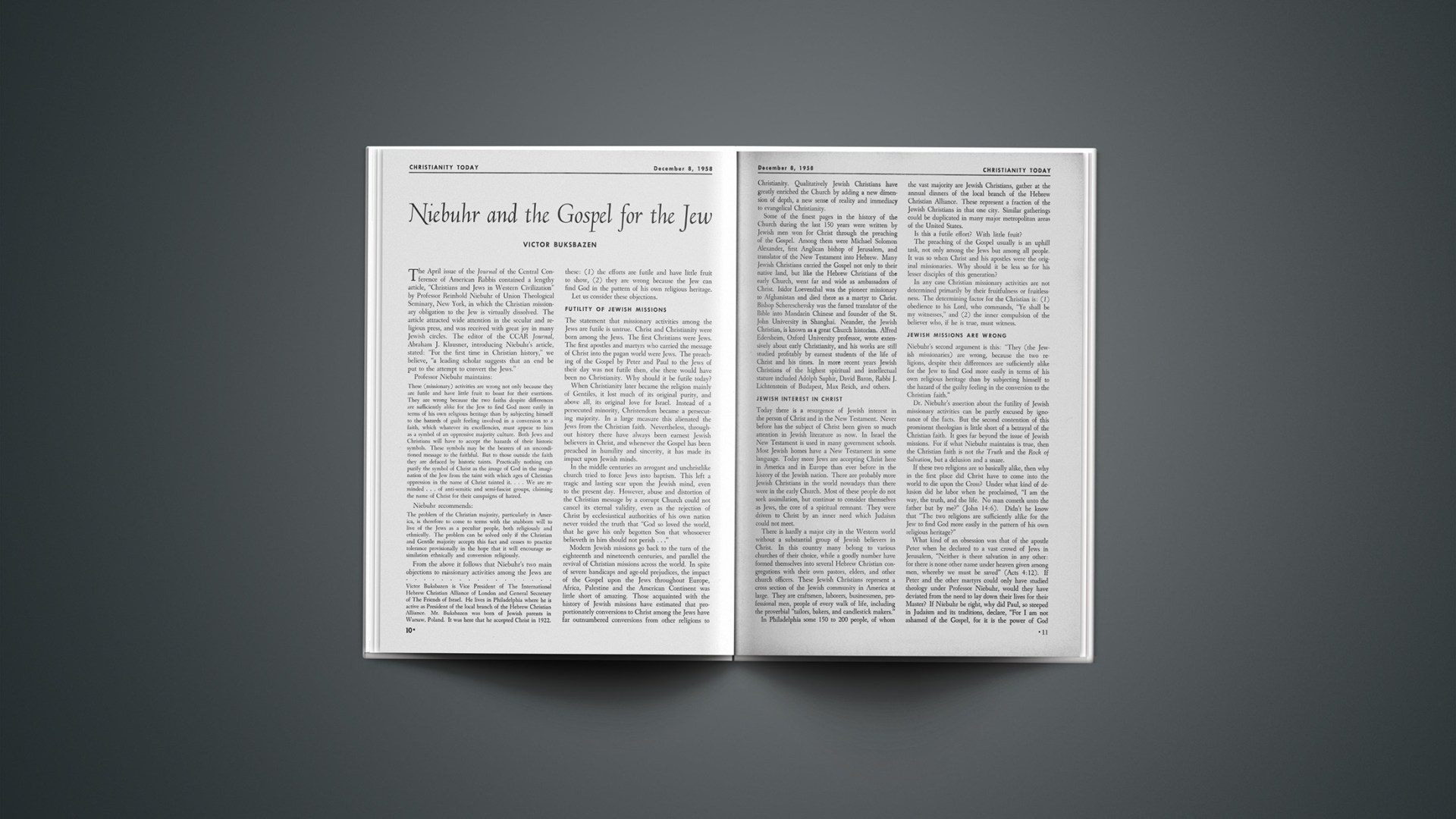
Niebuhr and the Gospel for the Jew

The April issue of the Journal of the Central Conference of American Rabbis contained a lengthy article, “Christians and Jews in Western Civilization” by Professor Reinhold Niebuhr of Union Theological Seminary, New York, in which the Christian missionary obligation to the Jew is virtually dissolved. The article attracted wide attention in the secular and religious press, and was received with great joy in many Jewish circles. The editor of the CCAR Journal, Abraham J. Klausner, introducing Niebuhr’s article, stated: “For the first time in Christian history,” we believe, “a leading scholar suggests that an end be put to the attempt to convert the Jews.”

Professor Niebuhr maintains:

These (missionary) activities are wrong not only because they are futile and have little fruit to boast for their exertions. They are wrong because the two faiths despite differences are sufficiently alike for the Jew to find God more easily in terms of his own religious heritage than by subjecting himself to the hazards of guilt feeling involved in a conversion to a faith, which whatever its excellencies, must appear to him as a symbol of an oppressive majority culture. Both Jews and Christians will have to accept the hazards of their historic symbols. These symbols may be the bearers of an unconditioned message to the faithful. But to those outside the faith they are defaced by historic taints. Practically nothing can purify the symbol of Christ as the image of God in the imagination of the Jew from the taint with which ages of Christian oppression in the name of Christ tainted it.… We are reminded … of anti-semitic and semi-fascist groups, claiming the name of Christ for their campaigns of hatred.

Niebuhr recommends:

The problem of the Christian majority, particularly in America, is therefore to come to terms with the stubborn will to live of the Jews as a peculiar people, both religiously and ethnically. The problem can be solved only if the Christian and Gentile majority accepts this fact and ceases to practice tolerance provisionally in the hope that it will encourage assimilation ethnically and conversion religiously.

From the above it follows that Niebuhr’s two main objections to missionary activities among the Jews are these: (l) the efforts are futile and have little fruit to show, (2) they are wrong because the Jew can find God in the pattern of his own religious heritage.

Let us consider these objections.

Futility Of Jewish Missions

The statement that missionary activities among the Jews are futile is untrue. Christ and Christianity were born among the Jews. The first Christians were Jews. The first apostles and martyrs who carried the message of Christ into the pagan world were Jews. The preaching of the Gospel by Peter and Paul to the Jews of their day was not futile then, else there would have been no Christianity. Why should it be futile today?

When Christianity later became the religion mainly of Gentiles, it lost much of its original purity, and above all, its original love for Israel. Instead of a persecuted minority, Christendom became a persecuting majority. In a large measure this alienated the Jews from the Christian faith. Nevertheless, throughout history there have always been earnest Jewish believers in Christ, and whenever the Gospel has been preached in humility and sincerity, it has made its impact upon Jewish minds.

In the middle centuries an arrogant and unchristlike church tried to force Jews into baptism. This left a tragic and lasting scar upon the Jewish mind, even to the present day. However, abuse and distortion of the Christian message by a corrupt Church could not cancel its eternal validity, even as the rejection of Christ by ecclesiastical authorities of his own nation never voided the truth that “God so loved the world, that he gave his only begotten Son that whosoever believeth in him should not perish …”

Modern Jewish missions go back to the turn of the eighteenth and nineteenth centuries, and parallel the revival of Christian missions across the world. In spite of severe handicaps and age-old prejudices, the impact of the Gospel upon the Jews throughout Europe, Africa, Palestine and the American Continent was little short of amazing. Those acquainted with the history of Jewish missions have estimated that proportionately conversions to Christ among the Jews have far outnumbered conversions from other religions to Christianity. Qualitatively Jewish Christians have greatly enriched the Church by adding a new dimension of depth, a new sense of reality and immediacy to evangelical Christianity.

Some of the finest pages in the history of the Church during the last 150 years were written by Jewish men won for Christ through the preaching of the Gospel. Among them were Michael Solomon Alexander, first Anglican bishop of Jerusalem, and translator of the New Testament into Hebrew. Many Jewish Christians carried the Gospel not only to their native land, but like the Hebrew Christians of the early Church, went far and wide as ambassadors of Christ. Isidor Loeventhal was the pioneer missionary to Afghanistan and died there as a martyr to Christ. Bishop Schereschevsky was the famed translator of the Bible into Mandarin Chinese and founder of the St. John University in Shanghai. Neander, the Jewish Christian, is known as a great Church historian. Alfred Edersheim, Oxford University professor, wrote extensively about early Christianity, and his works are still studied profitably by earnest students of the life of Christ and his times. In more recent years Jewish Christians of the highest spiritual and intellectual stature included Adolph Saphir, David Baron, Rabbi J. Lichtenstein of Budapest, Max Reich, and others.

Jewish Interest In Christ

Today there is a resurgence of Jewish interest in the person of Christ and in the New Testament. Never before has the subject of Christ been given so much attention in Jewish literature as now. In Israel the New Testament is used in many government schools. Most Jewish homes have a New Testament in some language. Today more Jews are accepting Christ here in America and in Europe than ever before in the history of the Jewish nation. There are probably more Jewish Christians in the world nowadays than there were in the early Church. Most of these people do not seek assimilation, but continue to consider themselves as Jews, the core of a spiritual remnant. They were driven to Christ by an inner need which Judaism could not meet.

There is hardly a major city in the Western world without a substantial group of Jewish believers in Christ. In this country many belong to various churches of their choice, while a goodly number have formed themselves into several Hebrew Christian congregations with their own pastors, elders, and other church officers. These Jewish Christians represent a cross section of the Jewish community in America at large. They are craftsmen, laborers, businessmen, professional men, people of every walk of life, including the proverbial “tailors, bakers, and candlestick makers.”

In Philadelphia some 150 to 200 people, of whom the vast majority are Jewish Christians, gather at the annual dinners of the local branch of the Hebrew Christian Alliance. These represent a fraction of the Jewish Christians in that one city. Similar gatherings could be duplicated in many major metropolitan areas of the United States.

Is this a futile effort? With little fruit?

The preaching of the Gospel usually is an uphill task, not only among the Jews but among all people. It was so when Christ and his apostles were the original missionaries. Why should it be less so for his lesser disciples of this generation?

In any case Christian missionary activities are not determined primarily by their fruitfulness or fruitlessness. The determining factor for the Christian is: (1) obedience to his Lord, who commands, “Ye shall be my witnesses,” and (2) the inner compulsion of the believer who, if he is true, must witness.

Jewish Missions Are Wrong

Niebuhr’s second argument is this: “They (the Jewish missionaries) are wrong, because the two religions, despite their differences are sufficiently alike for the Jew to find God more easily in terms of his own religious heritage than by subjecting himself to the hazard of the guilty feeling in the conversion to the Christian faith.”

Dr. Niebuhr’s assertion about the futility of Jewish missionary activities can be partly excused by ignorance of the facts. But the second contention of this prominent theologian is little short of a betrayal of the Christian faith. It goes far beyond the issue of Jewish missions. For if what Niebuhr maintains is true, then the Christian faith is not the Truth and the Rock of Salvation, but a delusion and a snare.

If these two religions are so basically alike, then why in the first place did Christ have to come into the world to die upon the Cross? Under what kind of delusion did he labor when he proclaimed, “I am the way, the truth, and the life. No man cometh unto the father but by me?” (John 14:6). Didn’t he know that “The two religions are sufficiently alike for the Jew to find God more easily in the pattern of his own religious heritage?”

What kind of an obsession was that of the apostle Peter when he declared to a vast crowd of Jews in Jerusalem, “Neither is there salvation in any other: for there is none other name under heaven given among men, whereby we must be saved” (Acts 4:12). If Peter and the other martyrs could only have studied theology under Professor Niebuhr, would they have deviated from the need to lay down their lives for their Master? If Niebuhr be right, why did Paul, so steeped in Judaism and its traditions, declare, “For I am not ashamed of the Gospel, for it is the power of God unto salvation to everyone that believeth, to the Jew first and also to the Greek” (Rom. 1:16).

And what of Professor Niebuhr’s statement that the Jew who accepts Christ does so outside his “own religious heritage and subjects himself to the hazard of a guilty feeling?”

Christ and the New Testament are the Jew’s own religious heritage, at least as authentic as the Rabbinical heritage, and certainly far more nourishing. And, as for the hazard of a guilty feeling, the contrary is true. The Hebrew Prayer Book for The Day of Atonement reflects the tremendous burden of guilt under which the Jewish people labor. The more conscientious and sensitive the soul of the Jew, the greater the sense of guilt. It is when a Jew finds Christ that he is able to rid himself of the guilty feeling through Christ his sin-bearer.

There is no alternative: If Niebuhr is right, then Christ and his apostles were wrong. But the men of every nation (including Jews) who have found in Christ forgiveness of sin, new life and the peace of God which passeth all understanding, would declare: “No, Christ has not deceived us. He is God’s power unto salvation.”

Those of us who were raised in Judaism, know from our own most intimate experience, that it is incapable of satisfying the deepest spiritual yearning of the human soul. Like millions of other Jews, there was a time when we had lost touch with God but found our way back to the living God and to a satisfying fellowship with him through Christ.

Multitudes of Jews today, who are not Christians, attest that Judaism has left them spiritually sterile and unsatisfied. Professor Niebuhr need only follow the Jewish press and read what leading Jews themselves say about the spiritual condition of Jews today.

In saying that missionary activities among the Jews are futile and wrong, Niebuhr goes far beyond this immediate issue. His is essentially a denial of Christ. For if Niebuhr be right, that Christ is powerless to win the Jewish heart and mind, why should he be able to win others for himself? If the deepest longings of the Jew can be satisfied through “the Jewish heritage of religion,” could not others also find fulfilment in their own religious heritage?

Where then is the uniqueness, the universality, and finality of Christ and of his Gospel?

Plea For Tolerance

Niebuhr’s plea for tolerance vis-a-vis the Jews is as confusing as it is misleading. Every sincere Christian and every man brought up on the ideals of Western democracy is in favor of tolerance. We would oppose any discrimination that would infringe upon the civil, religious, or cultural rights of the Jews, or of any other man. But does tolerance mean that a Christian should be spiritually deaf and mute and cease giving expression and sharing with Jews or anybody else his deepest convictions and his faith?

Missionary activity is at the very heart of Christianity. Without is there is no Christianity. “Go ye into all the world, and preach the gospel to every creature” were the last words of our risen Saviour.

Does tolerance mean that we disobey Him and disregard the innermost promptings so ingrained in the soul of every Christian believer? The kind of tolerance which Dr. Niebuhr advocates is not really tolerance but moribund indifference, born posthumously of a faith which died.

As a matter of fact, everybody, whether he knows it or not, is a missionary of some cause. We share and propagate our political, social, educational and economic beliefs. We even spend millions of dollars propagating certain brands of cigarettes or motor cars, beer or toothpaste.

When two people meet and each of them advocates his particular viewpoint, they are both missionaries. Should the Christian be deprived of his privilege to advocate his Lord and His Gospel, or to share that which means to him more than anything else in the world? Would that be tolerance?

The Christian has a right and a duty to express his faith and to seek to win everybody else for his Lord. Everybody else has a right to listen or not to listen to him, to believe or to disbelieve. And as long as Christ will continue to call men to follow him and to become fishers of men, there will always be missionaries. When Christians stop being missionaries they will stop being Christians.

END

Two Ways

Religion may be fashioned by a man

from out the hope and heartache of his need,

may draw its form, its spirit, and its creed

from desperation; but it never can

find God that way. For God is past the scan

of human mind, and though a man may seed

his soul with speculation, yet the weed

resulting leaves him worse than he began.

Religion cannot rise from earth to God.

It must come down from God to man. The Word

in which we find our life is He who trod

the land we know, who spoke what we have heard.

When Christ was born, our God came from above.

By showing us Himself, God showed his love.

TERENCE Y. MULLINS

Victor Buksbazen is Vice President of The International Hebrew Christian Alliance of London and General Secretary of The Friends of Israel. He lives in Philadelphia where he is active as President of the local branch of the Hebrew Christian Alliance. Mr. Buksbazen was born of Jewish parents in Warsaw, Poland. It was here that he accepted Christ in 1922.

Cover Story

Christian Approach to the Jew

It was not all unexpected that Reinhold Niebuhr’s essay on “The Relations of Christians and Jews in Western Civilization” (Pious and Secular America, Charles Scribner’s Sons, New York, 1958) should have been published first in a Rabbinic magazine (CCAR journal, the organ of the Central Conference of American Rabbis, Reform, April, 1958) and applauded so vigorously by Jewish leaders. For even if they did not follow or agree entirely with his line of reasoning, it was enough that one of America’s distinguished Christian theologians had finally told his brethren in effect: stop trying to evangelize the Jew. Acknowledging “the stubborn will of the Jews as a peculiar people, both religiously and ethnically,” Dr. Niebuhr suggests that the Christian and Gentile majority “accept this fact and cease to practice tolerance provisionally in the hope that it will encourage assimilation ethnically and conversion religiously.”

“Such religious tolerance always produces violent reactions when ultimately disappointed …” says Dr. Niebuhr and so he advises his Christian readers, “the Christian majority can achieve a more genuine tolerance only if it assumes the continued refusal of the Jew to be assimilated.… That recognition involves an appreciation of the resources of Jewish life, morally and religiously, which make Judaism something other than an inferior form of religion such as must ultimately recognize the superiority of the Christian faith; and end its long resistance by capitulation and conversion.”

So Dr. Niebuhr cautions the Christian evangelist: the Jew is not at all easy to convert and not many of them will; and if the major factor in your relationship to him is in terms of your evangelical aspirations you are sure to provoke his “stiff-necked” resistance or at least add a dimension of tension to the Jewish-Christian dialogue. Furthermore, why should Christians try so hard to convert the Jew when after all there is not much difference between the two covenant faiths; and frequently as not Judaism adds a legitimate insight. So Dr. Niebuhr demonstrates time and again as he reviews the alleged differences between Judaism and Christianity that “there are differences in emphasis in both the diagnoses of the human situation and the religious assurances corresponding to the diagnoses, but there is no simple contrast.… It is almost inevitable that … Christians should claim uniqueness for our faith as a religion of redemption. But we must not claim moral superiority because of this uniqueness.”

“In short,” concludes Dr. Niebuhr, “if we measure the two faiths by their moral fruits, the Jewish faith does not fall short particularly in collective moral achievement.…”

Oversimplifying A Dilemma

I must admit that I was among those who at first cheered Niebuhr’s prescription for the malaise in Jewish-Christian relations; although I suspected that if I were a Christian I should refuse to accept it. Then later I realized that I was applauding him not out of an unreasonable impatience with the methods of Christian evangelism but that quite frankly I did not completely agree with Niebuhr’s analyses of the Jewish-Christian dilemma, nor with his denial of the legitimate evangelistic mission, and above all I rejected his blurring the significance of the differences between Judaism and Christianity. (Naturally, of course, I believe the hard, earth-rooted revelations of Judaism to be profoundly more relevant to the kind of world in which we live—God’s world—than the other-worldly promises taught in the name of Christianity.)

The memories of enforced conversions, the tales of the inquisition, the inevitable bristling when confronted by a missionary who prays for your eternal soul but bothers little with your earthly body and your here-and-now woes, who loves you only as he can win you—these were the associations evoked for me upon my first reading of Niebuhr’s article. No wonder we Jews want Christian missionaries to leave us alone. They have bungled the job so badly! Conversion was too frequently used in history as the easy method of “getting rid” of Jews. At least half the Jews in the United States fled from Eastern Europe where the announced program for solving the Jewish problem was “to convert one third, to drive one third away, and to massacre the final third.”

Even when such an obviously hostile intention was not involved in the evangelistic encounter, the smug devaluating of Judaism by missionaries who claimed we were “without hope” or charged us with “legalistic sterility” or “Pharasaic hypocrisy” was enough to drive us to fury. No wonder Niebuhr’s sophisticated word of appreciation for a Judaism still vital and relevant is enough to provide an otherwise sober rabbi with a “heady” uplift. Nor can we forget that even in today’s America it is in the “Bible Belt” area, where missionaries are so actively engaged, that there is still to be found the largest number of members and supporters of the organized hate groups that foment anti-Semitic propaganda in addition to a whole repertoire of other hates and prejudices.

There are other stumbling blocks, too, that make the work of a Christian missionary difficult even if the Jewish subject has questioned his faith and is attracted to Christianity. In today’s world the right of the Jew to live fully and freely as a Jew has become one of the criteria by which we measure the well-being of our democratic society. For the Jewish-born to abandon the Jewish people now in the moment of their struggle (and when was this not the case?) is to be traitorous. The redemption of society—if not by Christian theology, at least by historic fact—has seemed to be bound up with the destiny of the Jew; and Jews (identified as Jews—whether they liked it or not) have played such a conspicuous role in the shaping of Western civilization (Freud, Marx, Einstein, Baruch, Weitzman, Waxman, Salk) that even the Jew who wears his yoke as though in chains finds himself called to remain at his post by an obligation that transcends his reason and overwhelms his will.

Last but not least there is the sad fact that many Jews who have gone over to Christianity failed to find there a cessation from prejudice and finger-pointing. They carried the burden of their Jewish heritage even into the “enemy camp.”

Evangelism And Method

But it seemed to me finally upon the second and third reading of Niebuhr’s essay that these were no reasons for the Christian to cease from his missionizing. It is good reason, however, for him to rethink his whole approach to evangelizing the Jew, and thereby to revise drastically his methods. It will probably serve the Christian better to live his Christianity to the fullest and so witness to the Jew not through the transmission of literature or the distribution of New Testaments but by making the Testament a living reality in his life pattern. In my judgment the tension in Jewish-Christian relations derives not from the Christian’s desire to assimilate the Jew and the Jew’s refusal to be assimilated; it goes deeper and beyond. Niebuhr correctly understands the inevitable consequence of a faulty and sinful technique, but he does not speak to the motivating concern that remains in my view both valid and necessary.

Indeed there is a tension between Jew and Christian, but it has resulted not because we would share with each other, yea, convince each other, of our ultimates and our absolutes. The tension results when the Christian is not genuinely Christian in his relation to the Jew, when he is governed by his pride and acts not in accordance with the will of God but in response to the needs of his human sinfulness. Certainly Jesus did not ask his followers to use manipulative and coercive methods to achieve the “fullness of his time” among his own people. Certainly the Christian who ignores the fact of anti-Jewish discrimination as he proposes to the Jew that he escape from this burden through conversion is preaching a fragmented Christianity devoid of its relevance to this world; so he deserves to fail. Certainly the Christian who anticipates that he can sell the virtues of his faith by condemning another’s is only half-taught; he has failed to recognize that in Christian teaching there are to be found other lessons concerning the more effective communication of the gospel, particularly lessons that speak of charity and love and sacrifice.

I suggest, therefore, that the harm that has been perpetrated in the historic relationship between Jew and Christian derives from the sinfulness of man and not from the essential doctrines of the Church—particularly that mission to go and preach to the world. Nevertheless those sins already committed in the name of the Christ now stand as judgments before the sensitive Christian who will have to acknowledge his failure penitently and in humility.

Sharp And Tragic Differences

There will always be tension between Jew and Christian for we both (certainly we ought to) believe that our particular revelations represent the Truth. And the differences in our understanding of the Truth are not, as Niebuhr suggests, merely matters of emphasis—they are sharp and firm and tragic and perhaps irreconcilable.

The Jews were persecuted mercilessly by Christian popes and priests particularly when we were successful at communicating the Word, and so we ceased; and we have entered into the dialogue ever since only reluctantly. But now that we have had a new kind of experience in America where the Christian (Protestant) ethos has merged so effectively with a secularistic democratic experiment calling for the separation of Church and State and the guarantee of religious liberty, the Jews are stirring. The Reform movement at least hears continually serious calls for a more ambitious program to present Judaism to the unaffiliated (Jews and non-Jews). It is not that we believe salvation is denied to the non-Jew. God forbid that we shall take upon ourselves his prerogatives and define or delimit according to fleshly appearance those who shall abide with the Lord in the time-to-come! So we anticipate that salvation will come to all of those who thirst for the living God of our fathers Abraham, Isaac and Jacob even though they are not Semite by flesh but only in spirit. But we believe that His Word entrusted to us is true; and it is true not for us alone. It is our mission to bear witness to that Word to all men to the ends of the earth.

Perhaps in his wisdom God has ordained that several peoples each shall carry an aspect of his whole truth and that the challenge to man is to learn how to make a unity out of the disparate revelations. But I cannot know this. I know only that God revealed himself to my fathers and reveals himself still to his chosen people. In Jewish sufferings do I see the stripes of his love, in the birth-pains of Israel evidence of his hand at work in history. It is we who suffer the modern-day Crucifixion and not the Christian. It is we who have borne the sin of men and point to the redemption. I can do no other but live by His law and teach men of His way. And I believe that in the time to come the law shall be proclaimed from Jerusalem and the word of God from Zion; and the Jewish people shall be the ministering priests unto the Kingdoms of men. If I hold this view for myself I cannot deny it to another. So ultimately I reject Niebuhr’s denial of the evangelistic dimension in the absolute faith.

The Jewish Rejection Of Jesus

Of course, I have already suggested that the differences between Judaism and Christianity are more basic than Niebuhr has allowed. It is hardly possible now in the space allotted to define these differences at length. Let me, however, touch lightly upon that difference that is central and most troublesome.

For the Jew the world is not yet redeemed. The Messiah has not yet come. Law, therefore, is still utterly relevant and the individual cannot by faith attain a salvation that will permit him to escape the judgment rendered upon society. Furthermore man must evermore urgently dedicate his hands at shaping and reshaping the stuff of this life for the redemption is a gift that must be earned and deserved.

How the Christian will bristle at every word in the preceding paragraph! For the Christian the world is redeemed. The Christ has come. Law, therefore, is for the sinner and makes for sin. Salvation is achieved not by man’s works but in his faith—in his faith in a redemption here and present.

How sharply and strongly we differ at this point. Indeed there is a contrast here. It is more than a matter of emphasis. No polite language can hide the fact that Jews are convinced that Christianity, unfortunately, has enabled too many individuals to think that they can be saved even though their world is crumbling all about them, that Christianity has misled some men into believing that faith without works counts more than the agonizing appraisal and reappraisal by faithful men of the schemes, programs and formulas by which justice can be achieved in the concrete.

So the debate begins … and will continue.

But Jews and Christians need to recognize that though our differences are painful there was once a time of oneness. Of one vine are these branches. And we thrive in a world of poor soil and strangling weeds. How much labor we must do together in God’s vineyard. Let there be no fences between us, therefore, and let us love deeply so that in our brother’s eyes we shall see not our own reflection but his light.

END

Rabbi Arthur Gilbert was ordained at the New York School of the Hebrew Union College—Jewish Institute of Religion (Reform). He has held pulpits in New Jersey and has served on the staff of the Jewish Graduate Society of Columbia University. Presently he is serving as Director of Inter-religious Cooperation for the Anti-Defamation League of B’nai B’rith.

Cover Story

The Man in the Tar Paper Shack

After the temptation in the wilderness, according to Luke, Jesus went to Nazareth. “He came to Nazareth where he had been brought up, and, as his custom was, he went into the synagogue on the sabbath day.” In modern parlance, Jesus made it his habit to go to church.

This sentence would seem to be something of a rebuke to that company of church members who, come the Lord’s Day, take lightly their appointment with God. A question haunts the edge of the mind: “Why did he go?” Were there not hypocrites in that synagogue? Consider the obvious faults of that Nazareth congregation. If those two clergymen who passed by the poor, desperate, done-in man on the Jericho road were a fair sample of the religious leadership of the day, I wonder that Jesus ever went near the place. But Luke, who checked all things for accuracy, says: “He went as his custom was into the synagogue on the sabbath day.”

Why did he go? He knew what some of us must still learn—that although God can be found under the quiet pageant of the night sky, or beside the tumbling descent of a mountain stream, or even on the fourteenth green of some country club, the one place the human soul most surely encounters God is in the prayerful gathering of his people. “Where two or three are gathered together in my name, there am I in the midst of them,” he would say to the oncoming generations with the gentle expectation that they would not “forsake the assembling of themselves together.”

Thus Jesus stepped across the threshold of his home town’s place of worship despite its erring people, its faulty preachers, and a sprinkling of hypocrites, because he had earnest business with his Father. It is a rebuke to those who, absenting themselves from this appointed hour in our modern times, improvise flippant excuses.

On this particular Sabbath, the ruling elder extended an invitation to Jesus to read the Scripture and comment. The portion chosen opens what we know today as Isaiah 61:

The Spirit of the Lord God is upon me,

because the Lord has anointed me

to bring good tidings to the poor;

he has sent me to bind up the brokenhearted,

to proclaim the year of the Lord’s favor.

His Galilean accent lifted those words off the sacred scroll and set them ringing over the quiet room. He finished the reading with this startling comment: “This day is this scripture fulfilled in your ears.”

A ripple of whispered excitement moved through the congregation over this word—the holy word of their prophet coming to fruition before their eyes. They were on hand, they were in the front seats, and God was fulfilling his ancient promises!

Let us take a look at one of these promises, about to have its joyous realization: Good news was to be the portion of the poor. Here is something hard to take in from a safe distance. To be desperately, hauntingly poor is something not many of us have endured. I confess I tried to drink in what these words might mean to an empty-handed impoverished person and found I could not until I became such a person.

Mentally I removed my Kuppenheimer and replaced its soft warmth with an assortment of soiled, ill-fitting, ragged pants, coat and shirt. The Florsheims were gone from my feet, and in their place were laceless, worn tennis shoes lined with old pieces of newspaper to turn back the thrust of a cold pavement. There was no longer an office door bearing my name, no longer a bi-monthly check, no insurance or hospitalization. I closed the door on my comfortable brick home in a fine Washington residential district and took up quarters in a tar paper shack in shanty town. In fancy I became poor. No food! No money! No job! No resources! Barren, cold, lonely!

As the man in the tar paper shack, I asked myself, “What would be good news to me?” Would it be a knock on that paper-thin door and a messenger bringing a letter to inform me that I had come into a small fortune? Anyone who does not believe such a letter would not be the kind of news to set a soul to shouting and dancing just has no imagination. To make a sudden leap from rags to riches is in the same category of good news as that a condemned man receives when he is reprieved five minutes before the time of his execution.

However thrilling it might be to be catapulted out of hapless poverty to a condition of affluence, Jesus never ran a strike-it-rich program. Good news to the poor means something more than a gigantic give-away to all those miserable in tar paper shacks.

One difficulty in all this is that we are not accustomed to relating theology and economics. God hath joined these two, and twentieth-century man puts them asunder—and a sorry sundering of holy things it has been. The Jews of Jesus’ day related theology and economics, but misunderstood the union and ended up with a strange perversion of the relationship.

Wealth and well-being to the first-century Jew was a sign of God’s favor. Poverty, bad circumstances, the fall of Siloam’s tower on a group of workmen, were supposedly irrefutable proof of man’s iniquity. Huddled on the ground yonder, draped in his pitiful rags, is a man born blind. His sightless plight raises but one poignant question for the disciples: “Lord, who sinned, this man or his parents, that he was born blind?” Let boils strike Job’s flesh and death whittle a path through his family and even Job’s friends counsel: “Confess your sin, Job, for you know they that plow iniquity and sow wickedness reap the same.” The man in the graystone mansion—the peerless saint! The man in the tar paper shack—the miserable sinner!

Now it is bad enough to be poor, but to have this extra burden of the community’s considering you God’s outcast makes poverty twice intolerable. But suppose there comes to your tar paper shack someone to take away this stigma of your exigency, to give you a new status before men. In some ways, this is more wonderful than taking away your poverty.

Here is why this is so: Self-respect and dignity are worth much more than fine gold. This was the good news to the poor man in the tar paper dwelling. Someone had come on the scene to give him standing and make it indelibly clear that he is not God’s outcast but God’s greatly beloved.

Wealth and abundance are not the yardsticks of man’s acceptance by his Creator. Nor are poverty, haplessness, or suffering the criteria of man’s rejection. Operation sin holds forth above the tracks no less than below the tracks. The efficacy of the Cross to make reparation for guilt and sin reaches down the streets of both the healthy bank president and the not-so-healthy, illiterate poor man. Both the man in the graystone and the man in the tar paper shack can and must take hold of this redeeming act by the same handle of faith. The Cross makes both men neighbors.

When men began to comprehend this message of God’s love and to see the act of Calvary in terms of grace, it began to dawn upon them that every person must have divine worth, whether he lived in an exclusive neighborhood or in some frightful shanty town. With this new look at the world’s poor and suffering, there dawned a new day for the world’s miserables. But as long as these poor people were envisioned as victims of their own unworthiness, punished by God, who would dare lift a hand toward them lest they would seem to be put in the position of fighting God?

Today, to remember Jesus is also to remember that man in the tar paper shack in Brooklyn, the man in the mud hut in Tanganyika, the homeless refugee along the Gaza strip, or the watery-eyed derelict of the bowery, cannot be left out of our thinking and Christian concern.

Yes, good news to the poor! They have worth!

Let us not forget that poverty is not always economic. The family in the suburban ranch house with wall-to-wall carpeting, Van Gogh’s in the living room, a station wagon and a sports car in the garage, can also be poor. Contrariwise, the family in shanty-town with old copies of the Washington Post for wall paper, no trace of anything on the floor and no garage, can be rich.

To be without friends is poverty. To be without health is poverty. To be without God is the most terrible insufficiency of all. And great is this company!

This is our mission. For this we are anointed! For this purpose the Spirit of the Lord is upon us—to proclaim good news to the poor!

If you are lonely, “what a friend you have in Jesus.”

If your soul is prisoner to some brutal sin, “there is mercy with the Lord.”

If you are weary, bruised and mangled by the Fall, Jesus, our great high priest, has made atonement.

Whatever your poverty, the same Christ of that Nazareth synagogue waits even now at your elbow to bestow his salvation, his peace, his companionship, and the riches of his love.

It is for you dwelling in the mansion. It is for you in the tar paper shack.

END

Lee Shane is Pastor of the National Baptist Memorial Church, Washington, D. C. In 1957 when he was pastor of the Calvary Baptist Church, Charleston, West Virginia, he won the American Baptist Award for the best locally produced television program. He is now Chairman of the national Radio and TV Committee for the American Baptist Convention.

Cover Story

The Word Was Made Flesh

And the Word was made flesh, and dwelt among us, (and we beheld his glory, the glory as of the only begotten of the Father,) full of grace and truth (John 1:14).

On Christmas Day and in Christ’s Church, we want to touch the heart of the truth and have it touch us. Therefore we go to the Word of God in the Scriptures, and especially to that most inspired word found in the Prologue to St. John’s Gospel. And there we find the affirmation which will forever define to the world the meaning of Christmas: “And the Word was made flesh, and dwelt among us (and we beheld his glory, the glory as of the only begotten of the Father) full of grace and truth.”

I want to lead your minds into some of the deep places of that majestic truth. We must know what St. John meant by the ‘Logos’ or ‘Word’ of God. The word ‘logos’ has two meanings in Greek. It means reason or intelligence as found in the mind, and it also means this same reason bodied forth in spoken language. Jesus is called the ‘Word’ of God because he is one with the inner mind and thought of God, and because he bodies forth that inner mind and thought in creative action. Being one with God, he planned creation as God; and this Prologue says, “All things were made (i.e. through) him, and without him was not anything made that was made.” But then, in the fulness of time, he took on himself a part of the nature he had created, namely human nature; and came into our midst wearing a body like our own. This word ‘logos’ was a bridgeword. It was understood both by Jews and Greeks, and in the same sense. Jews, religious Greeks, and impious pagans with some education, would understand this noun in much the same way. It was already a familiar conception to them.

A Flash Of Insight

It was a flash of insight or genius which caused St. John to see in the already existing beliefs of these groups, to whom he wanted to commend the truth of Christ, a kind of forerunner of him, a belief on which could be built this new and startling truth. There were two differences in his conception of the Logos: (1) the Logos, with him, was not a principle, as with these others, it was personal; and (2) the thought that the Logos should become flesh was unfamiliar with them, and to the Jews at least would not be acceptable. He said to them in effect, “The reason which you find about you in creation has been bodied forth in one human life—Jesus of Nazareth.” Thus, building on what was already there, he added this superb faith which was new to them.

This Word “was made flesh.” When you think of the materiality into which all religion tends to degenerate, you do not wonder that the Jews and the Spiritual pagans tried to get away from all materiality and make religion a purely ‘spiritual thing.’ But they were on the wrong track. For creation itself is both a spiritual and a material thing. God is the Source and Creator of it, but God spun it out of nothing because it was his will that a material nature should increasingly show forth his glory. Therefore the final word had not been said when religion had been rescued from materiality: the final word had not been said till religion got right back into the middle of materiality, and rescued it also. Men would divide God from his creation, as long as they thought that the more purely spiritual religion was, the better it was. It is true, “God is spirit, and they that worship him must worship him in spirit and in truth.” But we live in earthen temples while we are in this world; and they are meant to serve and glorify God, too. True religion is intense in its spiritual conviction, but it is concerned with the redemption of the body and of all nature. It is for us, not so much to despise material things, as to seek to make them glorify God by right use. No material thing is evil in itself, but by its wrong use. Atomic energy can turn the world into a grave-yard, but it can also help turn it into a garden, if the men who control it use it for the right ends.

“… and dwelt among us.” It really means “dwelt in a tabernacle among us,” and this would make Jews think of the Shekinah of old, which meant as much of the presence of God as was compatible with contact with the ancient tabernacle and with man—remember their conception of God was definitely transcendent and separate from sinful man. Now the Shekinah was Jesus’ own body, born of Mary, a body physically like our own, knowing weariness and thirst and impulse and temptation and hurt. Here, really, was the test. God might have momentarily created a life that was also the Logos, and then quickly withdrawn it. The Resurrection body did not remain long in this world, and the Incarnation might have been brief. But you and I know that we feel differently about Him because he ‘tarried’ here, as one translation puts it. He came, but he also lingered. Only so would he fully know what life on this earth was like—the long stretches, the empty places, the continued trials, the unresolved problems. Those are what he assumed, exactly as we must assume them, when he “dwelt among us.”

Man Looks At Jesus

“… and we beheld his glory.” Now the subject shifts to us. We have been watching the divine action of God, the outward thrust of his love man-ward: the action has been his. Now this action sets up a reaction. Man begins to look at Jesus. At first he saw nothing very unusual, a Man much better than other men; outwardly like them. And then there began to unfold a purer truth, a mightier deed, the aura of something mysterious and beyond ordinary life altogether. The ‘glory’ of the best life that could be lived was a degree of glory; but this was not all. When God began pouring through Him such healing of sick bodies as they had never seen, and such truth as they had never heard, and then when the great dark mystery of the Cross was followed by the great bright mystery of the Resurrection, and then this body born at Christmas was drawn away entirely at the Ascension, they knew they were in the presence of such ‘glory’ as could be only the glory of God himself.

And so St. John says, “glory as of the only begotten of the Father.” And this means that His was no reflected glory. In a prophet or saint, in any good and Christian spirit today, you will see something of the glory of God. The difference between that and Christ is like the difference between the moon and the sun: one has the glory of reflected light, and the other is the light itself. Jesus was the “only-begotten” of the Father. That is St. John’s phrase: it is the God-ward side of his divinity—he does not reflect God, He is God’s Son, his very Self. Jesus was not created once and then sent off into an independent existence, as we are: but he continually emanates from the Father in a co-existence with him that means identity.

“… full of grace and truth.” Grace is the mark of divine favour and power. Truth is more than honesty or even the power to see and manifest the truth in life and in word: it really means, as used by St. John, something more like holiness. Here seems to be the attestation in life of His true and divine nature. The mystery about Christ, which cannot be resolved at all except on the basis that he is of “one substance with the Father,” has a simple base for credential. He expanded human life as far as it could be expanded while still remaining human, on the side of his human nature; he lived out the essential elements of divinity, on the side of his divine nature. Anybody could recognize the “grace and truth.” ‘Grace’ is God active, the Holy Spirit seeking out human lives to guide and strengthen them. Already in the very word itself is implicit all that God did for those early Christians, and all that he has done for the world, and all that he has done for us.

For it would be of little help to us if we only knew that once, on the plane of history, God had appeared. We should have questioned it, and even if we had come to believe it, it would just be another ancient wonder, like the Hanging Gardens of Babylon. The wonder was a miracle, but it is a continuing miracle. For Jesus is more alive in the world today than he ever was. He is alive in the movement which he began, and in the hearts of the millions of people who look to him in faith. As Jesus was and is “begotten” of God, continually sent out from him in an organic and unbroken relation, so the Church was and is “begotten” of Christ, continually sent out from him in an organic and unbroken relation. God’s life poured out in Christ, Christ’s life poured out in the Church—that is exactly what we have all experienced who call ourselves Christians. It is all important and essential to us because of what it means to us to discover these things in Christ, in the Word made flesh.

Marvelous Meaning

And so, what does it all mean to us now—the ancient story we read in St. Luke, and the ancient interpretation we read in St. John? Three great and simple things it means:

It means that the universe is personal. It is personal because God is in it. The vast spaces and the infinite stars and planets seem sometimes so impersonal and indifferent. They are not the heart of the universe. God is the heart of the universe, and God is our Father. What does it mean to be personal? It means to be capable of relationships. So far as we know, next after beings of the supernatural order, like angels, men are the highest things God ever created. Men are personal because they can have fellowship with one another, and with God. Christ made the whole summary of the moral law a matter of relationships: of love towards God and towards our neighbor. Life means much or little to you and me according to the intensity or questioning with which we believe in and appreciate its personalness.

It means that God broke the tension of estrangement between him and man. We are always trying to do that without a Mediator—just to jump the infinite space, and the still more infinite moral distance, between us and God. Insofar as we manage to do it, we become inflated with pride; and insofar as we fail to do it, we become bitter with despair, and call it all too mysterious for us. God sent Jesus into the world to dispel most of the mystery with revelation, and to cancel the pride by the manifestation of his infinite mercy, and so to make the despair utterly unnecessary. The way between heaven and earth is open now. No wonder angels appeared at his birth, and no wonder men sing and fairly caper for joy that they are now the conscious sons of God.

And it means that now we know what life here on this earth ought to be. We were in the dark before, knowing somehow that there was a God, and that he demanded rightness of life from us. Now no longer need we fumble and miss the way—he is the way. Now no longer do we need to grope for the truth—he is the truth. Now no longer do we need to wonder what constitutes life as life ought to be in this world—he is the life. Because of the completeness of his revelation, because there, in that one life, is all that we need to know about the fundamental nature of our human existence, it is all very simple. Accept this faith which has been the faith of the believers from the first, and the great issue of life is settled. There is much to work out. Our world is still in strife and confusion. We might blow ourselves and our civilization and our planet to pieces. We would not if we took his way. But in the vaulted arches of the universe, in the uttermost confines of space, in the infinite reaches of time backward and forward, this is eternally true. Jesus has come. And God is like Jesus. And life must be made like Jesus. As Bryan Green said one night at the cathedral, “Hallelujah! for the Lord God omnipotent reigneth—and the Child of Bethlehem is that God!”

END

Samuel M. Shoemaker’s gifts range from pen to pulpit. His contribution above is a sermon which he has delivered at Pittsburgh’s Calvary Episcopal Church where he serves as Rector.

Review of Current Religious Thought: November 24, 1958

On July 1, 1858, papers were read to the Linnean Society of London by A. R. Wallace and Charles Darwin on the subject of natural selection. These lectures were followed by the publication on November 24, 1859, of the first edition of Darwin’s monumental work, The Origin of Species.

This forthcoming centenary is the subject of a paper by Dr. A. J. Friend, senior lecturer in chemistry of the University of Tasmania, in The Reformed Theological Review (June, 1958).

Dr. Friend is a graduate of Sydney, Australia, and Cambridge, England, and he was organizing secretary of the Inter-Varsity Fellowship of Australia prior to his present appointment. He is an able scientist and a competent theologian.

He points out that Darwin’s doctrine that “species undergo modification, and that the existing forms of life are the descendants by true generation of pre-existing forms” was not original. What Darwin did was to describe a plausible mechanism, that of natural selection, supported by much evidence, to show how the changes might have taken place. Writers, such as Lamarck, had adopted the hypothesis that acquired characteristics were transmitted.

At first, opposition came largely from scientists, notably Richard Owen and Adam Sedgewick. The attitude of clerics was not unsympathetic and T. H. Huxley was forced to confess himself “pleasantly disappointed; there has been far less virulence and much more just appreciation of the weight of scientific evidence than I expected.”

The situation, however, soon altered. Many scientists and philosophers (e.g., Huxley and Herbert Spencer) carried Darwinism further, and erected a complete world view which had no need of a Creator. (It is no coincidence that in the U.S.S.R. Darwinism and Marxism are taught together as one of the foundations of its philosophy.) On the other hand, many Christians adopted an attitude of uncompromising hostility to any view which departed from the doctrine of the fixity of species. (And yet this view was only developed in the eighteenth century by Linnaeus.)

It is not clear just what Darwin’s own understanding of the Christian faith was. Dr. Friend makes Darwin’s position clear:

“He has been represented as a sincere Christian, and also as a man to whom Christianity meant little in his later life.

It is known from his own words that much of his earlier religious belief deserted him towards the end of his life; but it is another question whether he was deliberately seeking to undermine the teachings of the Scriptures as they were accepted. He certainly added many passages to later editions of ‘The Origin of Species’ which gave the impression that he was a believer in what has come to be called ‘theistic evolution.’ … He was never as anti-clerical as Huxley, who was very conscious of the low regard in which scientists were held by the community as a whole compared with the clergy, and could never resist an opportunity for a jibe at what he considered the absurd teaching of the Old Testament.”

This whole question was the theme of an important conference recently arranged by the graduate fellowship of the I.V.F., at which a paper was read by F. I. Andersen (before his departure for America). In this paper he points out the dangers of a “negative apologetic.” For example, he cites those who would discredit and “debunk” all scientific investigation by saying “after all, they are only theories,” “they are not proved,” etc. Andersen comments: “An apologetic of this kind is well-suited to counteract the less cautious spokesman of science who makes inflated claims about the sure conclusions which contradict Christianity, but more often this criticism is aimed at discrediting science as a whole, and making what are solid achievements appear very uncertain.”

Over against this “negative apologetic,” Andersen points out the value of a more positive approach:

“Much good would be done if Christians were to shake off a feeling of inferiority and hostility towards science, and seek to use it positively in the interests of evangelism.… Instead of looking upon science as hostile territory to be attacked, it should be regarded as one of God’s realms, to be rightfully claimed for His lordship. Instead of regarding the scientist as an enemy, we should look on him as a servant of God, obeying (usually unwittingly) the primaeval command to subdue the earth.” Nevertheless, there are dangers arising from the “tentative and transitory nature of most scientific theory.” Andersen concludes by making certain observations: “We may note this basic difference between the attitude of the Bible and the attitude of positive science to the universe. Biblical descriptions of nature are phenomenonological, whereas those of science are ordered in the light of some hypothesis. Hence biblical descriptions are permanently true, and universally and directly understandable. For example, the statement that the sun rises in the east is true, and will always be true for all men, in spite of the overthrow of Ptolemaic astronomy.

“On a more metaphysical level we find another important distinction. Biblical descriptions of nature explain most things immediately by the ultimate cause—the will of God. He makes the wind blow, the grass grow, etc. Positive science, on the other hand, is wholly occupied with secondary causes, or to speak more precisely, with those antecedent circumstances which habitually precede (and are presumed to cause) phenomena. Hence the two points of view are largely mutually exclusive. No statement about secondary causes can be turned into a denial of the operation of the will of God as an ultimate cause. The Bible is not concerned with the processes God uses to govern nature, whereas science is wholly concerned with such processes. Hence its discoveries make no difference to the truths of the Bible unless scientists overstretch the bounds of their subject and move into metaphysical questions, as in the argument that since science postulates universal regularity in nature, therefore irregularities (miracles) never occur, or in the inference that since science studies proximate causes, an ultimate superphenomenal cause has no reality.

“Finally, on a positive note, the point must be most emphatically made that only a vigorous biblical faith can afford a stable basis for sound science and that therefore Christianity and Science should be the closest of friends.”

He says, in conclusion, that the Bible gives a specific charter for Science. “Man was created to be a scientist! Man was placed in charge of this work (Ps. 8), as lord of all creatures (Gen. 1). He was instructed to subdue the earth, and at the very first exercised that power of identifying, distinguishing, classifying and naming objects, that is the basis of all science.”

Book Briefs: November 24, 1958

Power Ethics

The Organization Man, by William H. Whyte (Doubleday, 1956, 456 pp., $1.45), is reviewed by R. Richard Searle, assistant minister of First Presbyterian Church, River Forest, Illinois.

The panorama of the ages is designed to show that man, individually and collectively, is inadequate to his predicament as a sinner. Supernatural aid is prerequisite to the effecting of any salvation of the soul or of society. It is the purpose of God to make himself experimentally indispensable to righteousness. He says, “Come unto me all ye that labor …” But man will not heed. He hears other voices beguiling him into a pseudo-security. They are all more dangerous to his soul when they pose as economic or social systems benevolent to his welfare. In fact they are really horizontal religions. Modern man is currently caught in the throes of one of these redemptive systems. His predicament is quite thoroughly analyzed in the 1957 non-fiction best seller by William H. Whyte, Jr., entitled The Organization Man.

The organization man is identified as the man in the middle. He is married to his job and the ideology thereof. But like most systems its adherents appreciate its pragmatic value more than its theoretical intricacies. The junior executive, the corporation “dog-face,” the collectivized man lives in the context of an otherwise free environment. The business trainee, the seminary student, the Ph.D. on the science lab team, the clinical physician are each representative of his clan. He may talk in terms of the rat race, the treadmill commuter, laughing at the description because he’s afraid not to. For the organization man is theoretically unable to control his economic destiny, and is therefore forced to believe in the ultimate harmony between the organization and where it is going and his own destiny as irresistibly swept along by it. At least this is what he is led to think through company “retreats” and seminars.

Whyte’s thesis is a critique of the attitudes which have generated a deification of this modern system as utopian though it sacrifices the rights of the individual. To believe that society is the soul of the individual and not in basic conflict with him is utter delusion according to the author. He affirms that it can’t bring the “peace of mind” that it seems to offer, although he conceded that it may be a necessary step to that which ultimately will do so.

Organization man, then, is the victim of his material environment. But he is also the spiritual victim of a naturalistic fatalism which is a philosophy of life for the here and now. How did this come about?

To understand the historical perspective Mr. Whyte outlines certain basic economic principles which are identified as the Protestant Ethic. Included are free, individual enterprise in which survive only those best fitted by the rigors of competition; hard work, by which one inevitably achieves that economic and social stature which he so richly deserves; and thrift, through which the individual by sheer power of the fact that “money talks” is able to control his circumstances.

This Protestant Ethic “produced” that which the author identifies as the Social Ethic, the present system in which organization man lives and moves and has his being. Mr. Whythe is not clear, however, in pointing up that it was not the logical evolvement of the Protestant Ethic but the illogical denials of its basic tenets that produced the Social Ethic. When the “breaks” were handed out to the favorite rather than to the worthy, the fawner rather than the fittest, when it mattered more whom one knew than what one knew, a major shift in the economic climate was inevitable.

Organization man had to live with himself and with his family. He had to explain in a plausible manner the reason why he did not make the next rung on the ladder. The shift then, is marked by an escapism—a shifting of the responsibility from the individual and his free will to the society as the imposing source of his destiny. When hard work no longer brought its recognition and rewards, man would continue the Edenic pattern of passing the blame to another.

The curious phenomenon of the day is that our economic leaders talk about the new regime in terms of the old. Whyte states, “Few talents are so sought after as the knack of describing departures from the Protestant Ethic as reaffirmations of it” (p. 19).

To point out the basic parallel in the religious realm, we see that the old-fashioned Gospel is indicted as the sire of a new, social gospel, not for adhering to its principles but for neglecting them. Now that the strictly liberal approach must be redefined in conservative terms, churches, too, strive for that pastor who has the knack of describing departures from the faith as reaffirmation of it. The shift from emphasis on man’s free will to the sovereignty of Another is also in keeping with the whole cultural trend.

The tenor of our times is characterized by group pressure, frustrated creativity, and the anonymity of accomplishment. Mr. Whyte raises the question: Are these virtues or vices? Can the individual live with himself under these circumstances? If so, he must have certain basic underlying assumptions as a framework or a rationale that will justify the individual’s self-surrender. The author points out three axioms of the new “faith,” the inevitable hand-maiden of organization man’s social ethic.

The first is scientism. It is assumed that an exact science of man can be achieved. The behavior pattern of men can be calculated by formula. Hence, personality tests are used to determine who shall go up the ladder of success. (Whyte tells how to cheat on these tests in a later chapter. Actually, he analyzes what is wanted from these tests—the ascertaining of an adaptability index.) Who will fit into the picture of success? By a process of social engineering modern man will be ushered into a redeemed utopia. But what about the moral norms of such a society? These, say the experts, are to be scientifically determined by the concept of “equilibrium”—we’re all in the same boat so don’t rock it. But who determines what this state of equilibrium is? A group leader, a peace planner, an integration therapist, a social diagnostician? Whyte states, he is to be “a person empowered to dominate society, but so disciplined by a scientific code of ethics from using his knowledge in any but good ways” (p. 33).

Hence, the real impact of scientism is on our values. The point at bay is that we in the U.S.A. are not in danger of being dominated by values imposed upon us by the state, but we are in danger of being dominated by values to which we have wittingly or unwittingly unreservedly surrendered ourselves. The scientists really are afraid it can work.

Belongingness is the term applied to the state of emotional security to be derived from total integration within the group into which so-called skilled leaders will guide us. Since man has an incurable urge to belong, and since he wants this group solidarity even though he doesn’t realize it, the organization man must be willing to make sacrifices by adjustment to his environment so that there will come to him the ability to enjoy it. The goal, then is an adaptive society in which there are no maladjusted people, a group purged of conflict.

The third element of this economic ideology is togetherness. Whyte on page 52 says, “He is erecting what is almost a secular religion.” Togetherness is that which can give coherence to the system. It is a theory widely believed but only tentatively proved that the group is superior to the individual, the totality of society greater than the sum of all its parts.

RICHARD SEARLE

Record Of Salvation Army

The House of My Pilgrimage, by Albert Orsborn (Salvation Army, London, 1958, 294 pp., 15s.) is reviewed by Frank Houghton, Bishop at St. Marks, Warwicks.

This is the autobiography of the sixth General of the Salvation Army. The title, taken from Psalm 119:54, “Thy statues have been my songs in the house of my pilgrimage,” is particularly appropriate because General Orsborn has been a prolific writer of “songs” which are sung by the Salvation Army throughout the world, and at least one chorus which is current among evangelical Christians of all denominations—“Let the Beauty of Jesus be Seen in Me.”

Perhaps it would be more accurate to describe the book as the General himself describes it—“some of my memories of Salvation Army service and leadership in the first half of this century”—rather than as an autobiography. For while we are given fascinating details of his early life, they are not so much personal as typical of the upbringing of thousands of children who were born and reared in the Army. His parents were Salvation Army officers. “Ten times,” he says, “I had to change schools,” because his father was posted elsewhere—and all this between the ages of four and thirteen. After that he began to earn the equivalent of one dollar a week. It was in a Sunday night meeting “following a resounding open-air attack and a lively singing and shouting march to the citadel” that he was saved. It was a vital experience which “has stood the test of over half a century of strenuous living.”

The second important experience—God’s call to join the Salvation Army—came to him in a crowded suburban train. He had a vision of “struggling, suffering humanity, parting and dividing into two turgid streams, one trying to get into the light and the other going hopelessly into the darkness.” From that moment it has been his one increasing purpose to help men “get into the light,” and his story becomes more and more an impersonal record of men of note in the Salvation Army, beginning with General Booth and his son Bramwell (who is clearly his hero), and then of notable people whom he met after his appointment as General in 1946. There are stories, and in some cases pictures, of his interviews with Pandit Nehru, President Truman, King Haakon of Norway, Queen Juliana of Holland, King George VI of England, and others.

But General Orsborn is at pains to explain that these contacts came solely through his position in the Salvation Anny, apart from which he himself “would be relatively unimportant.” For all who wish to arrive at a correct appraisal of the world-wide work of the Army today, which is striving (as it always has) to justify its title while engaging also in social work on a vast scale, this book provides valuable material. The “authentic purpose and passion” for the souls of men which was so marked a characteristic of William Booth has been transmitted to each of the succeeding Generals of this great organization.

FRANK HOUGHTON

God’S Revelation

The Study of Old Testament Theology Today, by Edward J. Young (Clarke, 1958, 112 pp. 10s. 6d.), is reviewed by David W. Kerr, Professor of Old Testament, Gordon Divinity School.

The opening chapter of this little book might well be read by those who study Jacob’s Theology. Young indicates that the Old Testament presents itself as a revelation of God to men, rather than a record of what men thought about God. To some this may be a distinction without a difference, a matter of semantics. The author validates his point, however, in his discussion of the nature of Old Testament theology. As a study, it must do justice to the historical and progressive character of revelation. It may not evaporate the revelation into the atmosphere of today’s secular culture.

As for the content of Old Testament theology, the relationship of Israel to her God was convenantal from the beginning, and the covenant is regulative of God’s dealings with his people. It is impossible to do justice to the Old Testament without recognizing this fact.

Because the four chapters of the book are four lectures given at the London Bible College, they are of necessity not as detailed as certain literary studies might be. Some may feel that an attempt has been made to annihilate the Goliath of form critical theology with a somewhat doctrinaire pebble. The reviewer, however, feels that the truth is on Young’s side and that be has emphasized the points where many modern discussions of Old Testament theology are weakest.

DAVID W. KERR

The Apostolic Idea

Preaching to Meet the People’s Needs, by Charles N. Pickell (Exposition Press, New York, 1958, Bibliographies, 82 ff., $3.00) is reviewed by Andrew W. Blackwood, author of Leading in Public Prayer.

The sub-title, “The Meaning of the Arts as a Guide for Preaching Today,” accurately describes the contents and the purpose of this little book. It opens up a field that has been strangely neglected. Preaching bulks large in the Book of Acts, but there is in print no adequate discussion of the preaching by Peter or Paul, as an example of what to preach today, as well as how and why.

The author has read the appropriate literature by C. H. Dodd and others. The book reaches sound conclusions about the preachers and the preaching of apostolic times as ideals for today. In his Boston ministry, according to my friends there, this young man’s pulpit work follows these ideals. His book will serve any student or class as a suitable guide for a fresh and rewarding way of dealing with the Acts. The subject deserves fuller development and discussion of the good ideas in this book.

ANDREW W. BLACKWOOD

An Eternal Excellency

Shadow of the Almighty, by Elisabeth Elliot (Harper, 1958, 249 pp., $3.75), is reviewed by Marian J. Caine, Editorial Assistant of CHRISTIANITY TODAY.

Shadow of the Almighty is a good deal more penetrating than a popular devotional book; it is even more uncommon than a first rank piece of literature. I would suggest that in God’s providence it might be His conspicuous answer to a prayer which one young missionary martyr prayed about nine years before his death. His words were, “Lord, make my way prosperous not that I achieve high station, but that my life may be an exhibit to the value of knowing God.”

For this reviewer, this life of Jim Elliot is eminently that exhibit. Elisabeth lets her husband speak for himself here in letters and diaries which she has edited into a story—a depiction, that is, of a man in his relation to the Almighty. It is a poignant presentation, different from Through Gates of Splendor because of its more personal and less dramatic nature. But what it is not in drama, it is even more in profundity. Isaiah speaks of a trusting child of God as “a spring of water whose waters fail not.” There seems to be a clear likeness of this image to Jim Elliot, and one remembers the words of the Almighty that he makes of such saints “an eternal excellency, a joy of many generations.”

He was tall, well-built, and amazingly energetic with a personality that fairly pulsated with animation. To him Christianity was no conservative way of living. It meant a life sold out to Christ—a venture every bit as radical, fragrant, and exciting for the twentieth century as it was for the first. “The world cannot hate us,” he said once, “we are too much like its own. Oh that God would make us dangerous.”

At Wheaton College he earned top honors with a Greek major, and along with that he proved himself a champion wrestler, as well as one who could captivate audiences with his speaking. He wrote unusually well, even poetically as one sees in these journals. But the book, as an exhibit, reveals simply and forcefully a young man who was intensely honest with himself before his Bible in the presence of the Almighty. Indeed, a powerful transparency of soul in the face of God is what marks the genius of this whole biography. Jim valued nothing whatever aside from getting to know’ God and walking in obedience to Elis will. “Not a long life,” he would pray, “but a full one, like you, Lord Jesus.” And a full life embraced a many-sided personality “lived to the hilt” for the eternal glory of God.

It was his desire to reach the Auca savages of Ecuador with the Gospel when he first learned of them in college. And many of his personal records at that time, and shortly before he reached the mission field, were frankly prophetic of his early death. For instance, he wrote, “Father, if Thou wilt let me go to South America to labor with Thee and to die, I pray that Thou wilt let me go soon.” At another time he said, “Father, take my life, yea, my blood if Thou wilt … I would not save it, for it is not mine to save. Have it Lord, have it all. Pour out

my life as an oblation for the world. Blood is only of value as it flows before Thine altar.”

Often he would remind himself that one “is no fool who gives what he cannot keep to gain what he cannot lose.” And about five years before his death he said, “I have had all that a young man can have, at least all this young man can have. I am ready to meet Jesus.”

As Elisabeth observes in the preface: “Some who pick up this book may make no claim to know God. Others may make the claim but be victims of self-delusion [profession without obedience] … Yet others may know Him, obey Him, but wonder sometimes at the value of this knowledge and this obedience.” In the reviewer’s mind, there is a compelling testament here to the heart situation of any reader in these three categories. And it should prove an awakening to cynics that genuine Christianity, as gloriously Real and surpassing the temporary lusts and pride of life, is actually lived in the world today. In the life of Jim Elliot, one is brought face to face with “the salt of the earth.”

MARIAN J. CAINE

Valuable Contribution

Egypt in Biblical Prophecy, by Wilbur M. Smith (W. A. Wilde Company, Boston, 1957, 256 pp., $3.50) is reviewed by Horace L. Fenton, Jr., associate general director of the Latin America Mission.

With the thoroughness so characteristic of his writings, Dr. Smith here sets forth the prophetic teaching of the Word concerning Egypt. He tells how he turned to this study at the time (1956) when that land was so constantly in the headlines, and he admits that six months before making his investigation, he would have failed to pass an examination on this prophetic subject, “even if the questions were not of a technical nature” (p. 5).

The result of Dr. Smith’s research represents a valuable contribution to biblical literature, and doubly so because this theme has so largely been neglected by other scholars. He finds in the Book three great collections of prophecies concerning the nations, and as he gives himself to a careful study of these portions, he discovers much of interest and value. The author does not dodge the difficult passages, and does not hesitate to point out that in areas of prophecy which he examines, earnest students of the Word have not been able to come to agreement. Neither does he withhold the expression of his own opinion concerning these passages, albeit given with a refreshing lack of dogmatism.

While God’s dealings with Egypt in history (both biblical and secular) are of interest, readers will undoubtedly enjoy especially the chapters which deal with prophecies yet to be fulfilled. The idea that God will cause a second exodus of Jews from Egypt at the end of the age may well stimulate further study, and the prophecies of Egypt’s ultimate blessedness will also challenge the thinking of many readers.

Dr. Smith’s work has been well done, and it is documented with the care and exhaustiveness which we have come to expect of him.

HORACE L. FENTON, JR.

Theism And Science

The Evidence of God in an Expanding Universe, by John Clover Monsma (G. P. Putnam’s Sons, 1958, $3.75), is reviewed by Stuart C. Hackett, Professor of Philosophy, Louisiana College.

The overwhelming impact of this compilation of testimony from 40 American scientists is that belief in theism (in many cases specifically Christian biblical theism) is in no way incompatible with a whole-hearted commitment to the genuine implications of mathematical and empirical science, but that, if anything, scientific considerations definitely tend to support such a theistic faith. This sort of insight is by no means new: but it is always relevant in an age dominated by excessive preoccupation with scientific progress.

In asserting the reality of God within the context of scientific data, our authors embody certain recurring emphases in their attempt to draw a line of continuity from such data to theistic belief. The most frequent appeal is to the teleological argument for the existence of God: an argument which urges that the order and design of the known universe are so intricately complex and so well-adapted to the fulfilment of significant functions or ends that a chance explanation of the universe is virtually unthinkable and that therefore the ultimate ground of such an ordered world must be a Supreme Intelligence. Again, this argument is an ancient one: but the present work is of particular value because it supplies a wide exemplification of the types of intelligent adaptation throughout the whole natural order in areas ranging all the way from chemistry and physics to astronomy.

The next most frequent appeal is to the cosmological or causal argument which insists that the mere existence of a finite space-time universe, because it is characterized by change and process and therefore must have had a beginning, requires an infinite and transcendent First Cause for its adequate explanation. In this causal appeal, the numerous writers emphasize especially the principle of entropy (and in particular, the second law of thermodynamics) according to which the amount of available energy in the universe is constantly diminishing so that the universe could not have had an eternal past, since in such an infinite time all available energy would long since have been expended. Less frequent appeals are made to personal spiritual experience (encounter with God), special revelation in the Bible, and even the universality of belief in an ultimate Being.

While such an array supports the basic intention of the book as explained by the editor (p. 12)—namely, the documentation of the fact that science and theistic religion are compatible; there seem to be certain inadequacies that in part detract from the positive impact of the discussion. The most serious defect is the absence of any adequate discussion of the whole relation between science and philosophy (or theology) from an epistemological standpoint. On the one hand, for example, there are recognitions of the limitations of science in dealing with ultimate questions such as the existence of God (p. 31, 63, 71, 87, 207–208); on the other hand, the editor himself, as a spokesman for a different emphasis, asserts that “science can establish, by the observed facts of Nature and intellectual argumentation, that a super-human Power exists” (p. 12). Tensions of this sort extend through the whole book; and the question of the epistemological basis of the entire discussion should therefore receive extended treatment in such a work.

Several other criticisms deserve brief mention: first, a number of the appeals to detailed scientific data would be nearly unintelligible to a scientific amateur (see p. 39, 101, for examples)—a definite weakness in a work intended for the general public. Again, the inferences from scientific observations to an ultimate Intelligence or First Cause are frequently not explained with any degree of clarity or detail (see p. 53, 88, 104–105)—only persons already thoroughly familiar with the theistic arguments would be in a position to follow the inferences. Finally, there frequently appears in the articles the implicit assumption that a scientific explanation of certain effects, in terms of proximate or secondary causes, would render appeal to an ultimate Cause unnecessary (e.g., p. 89—though this idea is also opposed, but far less frequently: p. 123, 124). This assumption, so frequent in naturalistic literature (and therefore questionable in the present context), seems to me to be utterly false—the understanding of intermediate causes (even if exhaustive and complete—which is never the case in empirical science) in no way eliminates the necessity for an ultimate cause. If, for example, the theory of creative biological evolution were a completely adequate explanation of the origin of the various forms of life (a point which we need here neither grant nor deny), that would not eliminate the necessity for appealing to an ultimate Intelligence: evolutionary process itself would involve a complexity of means in the achievement of ends and would still be ultimately explicable only by appeal to Intelligence. It is not the unknown and scientifically inexplicable that provides evidence for theism: instead, it is precisely the known and understood evidence that requires such a conclusion.

These criticisms, nevertheless, should not deprive us of the main thrust of the book with its implication of the validity of natural theology (an implication which I fully accept): however understood and interpreted, the conviction that theism and science can mutually and intelligently grant each other their full weight, is a welcome emphasis in an age which has still not recovered from “the warfare between science and Christendom.” In an age dominated by an emphasis on scientific progress, the testimony to Christian theism fills a definite need.

STUART C. HACKETT

Unfulfilled Prophecy

The Alpha and the Omega, by Paul Erb (Herald Press, 1955, 153 pp., $2.50) is reviewed by Robert Strong, Minister of the First Presbyterian Church, Augusta, Georgia.

The 1955 Grebel lectures, delivered to Mennonite gatherings, are embodied in this book. Dr. Erb is a bible believer and, therefore, insists that the Lord Jesus Christ will return to earth in person and power. He is mildly premillennial but lays his main emphasis upon the eternal order that Christ our King will usher in at last. There is value here for the layman who seeks an easy introduction to the study of unfulfilled prophecy.

ROBERT STRONG

First Pictures of Missionaries and Auca Indians

NEWS

CHRISTIANITY TODAY

South Amercia

Wild animals, germs, and tribal war threats are only a few of the problems faced by two women missionaries who have chosen to live with the Auca Indians. Yet, after more than a month in the jungles of eastern Ecuador, Mrs. Elisabeth Elliot and Miss Rachel Saint have learned much to facilitate Christian witness. They have also discovered more about the Aucas’ massacre of five young missionaries nearly three years ago.

Living in a clearing on the banks of the Tiwaenu River with Mrs. Elliot and Miss Saint are Valerie, Mrs. Elliot’s four-year-old daughter, and Dayuma, an Auca woman who fled the tribe 12 years ago and subsequently professed salvation in Christ.

Will you pray for Dayuma,” asks Miss Saint, “as she gathers the whole group together every Sunday under one of the thatched roofs, instructs them not to laugh, and then teaches them little by little about God, the Creator, and his Son, Jesus?”

Mrs. Elliot has with her a camera, tape recorder, and tranceiver. Supplies are dropped from planes, which also lower buckets by rope for pickups.

Below are excerpts from a letter written by Mrs. Elliot to Mrs. Marjorie Saint and Mrs. Marilou McCully. All three are wives of the Auca martyrs. Miss Saint is a sister-in-law of Mrs. Saint.

Dearest Marj and Marilou:

It’s a rainy day and there’s no one here except Dayuma, Rachel, Val, and one couple (Kimu and Dawa).

… I have now met four of the seven men who killed our husbands. It is a very strange thing thus to find oneself between two very remote sides of a story. To us, it meant everything in life and continues to mean that. To these simple, laughing, carefree forest people, lulling five men was little more than routine and they had probably forgotten about it.

The story as I have managed to get it thus far is that the men were all on the beach. The Aucas leaped suddenly out of the forest from behind the tree house and killed them immediately. I suppose they jumped back in to the water (the fellows) hoping to evade the sudden shower of spears.

[Presently] there are certainly real problems which I had hoped to avoid in the initial stages of introducing what it means to be a follower of Christ. But for this too, I can trust and believe that the prayers of thousands are yet to be answered in the way God wants it.

I wish you could hear the singing at night! When the Quechua men were still here, we all sat on the logs under the stars and took turns—first Aucas, then Quechuas singing! The Auca men sit with solemn gaze, hands clasped in front of chest, and chant in three parts—a single minor chord, unvaried through literally hundreds of repetitions of a seven-beat phrase. The words may change every 40 times or so, but not the rhythm or the music. It is fantastically hypnotic.…

October 11

Yesterday the plane came over bringing the meat, fish, cheese, candy, toasted was, canned meats, etc. that I guess you two sent. Thanks so very much for all your thoughtfulness and for your letters and prayers and understanding. You see things rightly when you realize that the problems are not all solved with an apparently successful entrance into the tribe. The problems are new ones now, and the testings of a different nature, but the tempter has the same object as has the Deliverer. That is, the former’s is to make disciples for himself, as the latter’s is to make us like Himself. New situations are only new arenas for faith to be proved. Pray that my faith rest firmly in the Pioneer and Perfecter.

I wish you could see this gang eat.… The sound effects (smacking, sucking, tearing, munching) are fantastic. It’s all over in about three minutes. The men rise from their haunches, the women lick up whatever remains, and they scatter into the twilight. No one has said a word—“help yourself” or “thank you” or anything. Then the fires are fanned, showing up the ragged silhouettes of leaf huts, hammocks are strung and quiet settles in. The toads and frogs, crickets, and cicadas start in with the occasional horn-like call of a munditi (the black bird like they gave Ed and Marilou) or owl, and once according to Dayuma, the panting of a nearby puma.

October 18

Breakfast this morning besides certain civilized blessings sent by you two (1 presume) was the forearm and a clenched fist (with drawn white skin and black nails) of a monkey. Not bad, except for the very penetrating flavor of burnt hair. Last night Gikita and two sons brought in five monkeys and two birds—caught with blowguns and poison darts. We all sat around while Mankamu thrust the hopeless animals one after another into the fire, till the thick fur burned itself into sizzling, popping balls, the limbs curled up in paroxysms (it seemed) of pain and the dead, human faces gaped in agony. Then into the pot they went along with yuca and plantains and we all sucked and tore away. (It is quite impossible to bite monkey flesh—you simply clamp your incisors on it and tear.) It is a comfort to know that the meat is easily digested even if not chewed!

Yesterday afternoon, Watu gave me two of my favorite fish—a descendant, I understand, of an armored prehistoric species. For the first time I discovered why Indians regard the head as choice. I found it delectable—especially the brain and eyes. The latter I had somehow mistakenly assumed were very bitter.

There is a horde of kids around which keeps Val happy. She is, of course, in her element in an Indian environment—would rather drink their stringy, lumpy banana drink than milk; seems to sleep every bit as soundly on bamboo as on a mattress. She plays in the river whenever anyone goes down to fish, bathe, or wash pots. She hacks away at trees with a machete, fans fires, strings beads, twists fibers, and generally makes an Auca of herself except for the language.

There are now 10 houses—all of them tiny (about 6’ x 8’) leaf shacks except for those which Gikita and Kimu are in process of building. Rachel sleeps under the roof Gikita put up. Val and I have our own “private” house. So far there hasn’t been a real rain. We shall see how this roof takes it. There are of course no walls or floors—plenty of fresh air. Weather is ideal, not hot as I had expected and no mosquitoes. Plenty of gnats between 6 a.m. and 6 p.m.

October 25

Day before yesterday, Dabu arrived. He is the only one of the present group of men (except Munga, who is from down-river) who had no part in killing the five. He, you remember, cried when he heard about it.…

Exploit Reaction

Comments below indicate how the Auca exploit looks to Christian leaders.

Dr. Philip E. Howard Jr., president and editor of The Sunday School Times and father of Mrs. Elisabeth Elliot:

“I believe the recent developments have come about through the sovereignty of God and because of His love for the Auca Indians, and because of a great volume of prayer which has gone up on their behalf from believers all over the world.

“I think, too, that God is honoring the faith and perseverance of Rachel Saint, Dayuma, Betty Elliot, Dr. and Mrs. Wilfred Tid-marsh, the pilots of the Missionary Aviation Fellowship, and other missionaries in Ecuador who are behind the scenes, so to speak.

“Mrs. Howard and I are profoundly thankful that God has made it possible for Rachel, Dayuma, Betty, and her little girl, Valerie, to carry the Gospel into the Auca Territory.”

Dr. V. Raymond Edman, president of Wheaton College who baptized Dayuma, first Auca convert to Christianity.

“The Aucas of the Ecuadorian jungles are among the most savage and brutal people in the world. The martyrdom of five young missionaries seeking to reach them is the most stirring missionary account of this century. The courageous return of Dayuma, the Christian Auca, to her people, which made possible the going of Rachel Saint, Betty Howard Elliot and her little Valerie to the Aucas is the greatest adventure in this missionary epic.”

On Thursday night, we were all sitting or swinging in hammocks by the fire in Gikita and Mankamu’s house when the dogs began to bark. Of course, this could mean only two things: a tiger, or the downriver killers. So, supposing it to be the latter, Mankamu (who I now observe to be the matriarch of the tribe) went out and perched up on a log and sermonized for about half an hour. She told them we are all living well now, we don’t kill, we’ll be glad to receive them if they will come out without spears, etc. I guess they didn’t like the terms—at least, no one appeared!…

October 26

Another mail and food drop yesterday. Word that they’ll make a bucket drop on Tuesday or Wednesday, so I’ll wind up these pages soon and get them ready to send out.

I don’t think I told you that the first day we arrived, Val just sat down on the log which Kimu was squatting on and stared and stared. Then she said “Mama, who is that? Is that my daddy? He looks like a daddy.” Somehow, in her child mind, she had associated Aucas and daddy—though I’d never told her till a few days ago that the Aucas had killed her daddy. I waited till she had met five of the men and then I told her that those men had killed daddy. She said, “Oh.” She prays for them and for the others she knows by name.

Please pray especially now for the down-river group. I feel about them now as I once did about this group—“impossible to reach.” But “it is God who will tread down our enemies” and bring them into subjection to himself. These people, including Dayuma fear them exceedingly and expect a retaliation any day. (It is their turn now to kill someone up here). But there are several down-river people here in this group now—perhaps God will use them to bridge the gap.

Very much love, Betty

October 28—P.S. On Sunday night the last of the men, Nimunga, arrived with his wife and baby. Now they have all been here (all 7 of them) at one time or another.

Last night Dayuma was telling me more of the thrillers that are routine small-talk in this outfit. It seems that when Nimunga went to finish off George, he didn’t do a very thorough job. George, knowing he wouldn’t pull through, went to his own grave under his own locomotion, got in, demanded that his kids be strangled and thrown in with him (only one child was) and then asked to go ahead and cover him up. His two wives (Delilah and Ipa) stood and watched while they fixed the split palm boards over the body (this makes quite an ample space, so the victim probably breathes and writhes for a good long time) and then they watched them tamp the earth “tight so he won’t come out” and listened to the faint groans from underground. These are the men and women with whom we live and eat.

[Background information on this latest Auca missionary endeavor appears in CHRISTIANITY TODAY for October 27 and November 10.]

Church And State

The Tempter’S Snares

Now you can expect to be tempted by shapely models daintily fingering cocktail glasses. The Distilled Spirits Institute says women may appear in hard liquor ads if they do so in a dignified manner.

Only a few weeks ago, a noted temperance leader won time for a weekly network radio broadcast. “This is a break for temperance,” said Dr. Sam Morris. He attributed the “breakthrough” to recent hearings in Washington on a bill to outlaw liquor advertising.

Then the “breaks” started to go the other way. In quick succession two radio stations defied an industry code which has always forbid the selling of whiskey via the air waves. In line with the trend, the Distilled Spirits Institute decided it would be acceptable to serve up hard liquor ads with cheesecake.

The developments probably will encourage temperance leaders and some churchmen to plead even more strongly before the next Congress for a law against liquor advertising.

Congress may also hear new demands for stricter laws governing obscenity. But the Post Office Department, in the meantime, initiated legal action against Playboy on grounds that the magazine’s November number is obscene. The Churchmen’s Commission for Decent Publications has protested Playboy’s accounts many times. The Commission denounced the magazine for a “scurrilous attack” on Dr. Albert Schweitzer in its November issue, adding that the attack “is couched in the most vulgar profanity imaginable in as sordid a piece of fiction as has ever appeared in print in any publication.”

Pornography and alcohol are not the only areas which find government standing between Christian principles and decaying public morality. These were among other developments this fall which at least hint of church-state tensions:

—Oregon has no juvenile code. As a result legal problems of juvenile delinquency are not handled uniformly. The State legislature and the National Probation and Parole Association are appraising conditions and expect to come up with proposals for dealing with an ominous situation.

—Protestants and Other Americans United charged that U. S. cardinals voting in a papal election violate American law. Not a “political election,” replied the State Department.

—Anxieties were expressed over official U. S. delegations on hand in Rome for the funeral of Pope Pius XII and the coronation of Pope John XXIII. Presidential Press Secretary James C. Hagerty said the coronation delegation was according the pope recognition “as head of the Roman Catholic church” and not as chief of state of Vatican City.

—The U. S. Court of Appeals ruled that award of a commercial channel to Loyola University in New Orleans does not fall within the federal ban on alien control of television stations. The argument against the award had cited the fact that Loyola is a school of the Jesuit order, which has headquarters in Rome.

—The National Association of Evangelicals asked the Navy to correct a series of posters omitting what most Protestants have traditionally considered the second commandment, which prohibits the making and worshipping of graven images.

—Justice and Post Office Department officials discussed legal means of combating the flow of “hate sheets” in the mails, but indicated that constitutional restrictions made this action difficult. (The American Council of Christian Churches objected to any move against the mailing of hate literature with the statement that it would be a “distinct step toward suppression of Americans’ traditional rights to freedom of speech and expression.”)

—The Ohio attorney general ruled that Roman Catholic nuns may teach in the state’s public schools while wearing religious garb.

—Principals of five public schools in Syosset, New York, were warned by their district superintendent against the “expression of faith or worship” in Christmas observances.

—The Canadian Protestant League condemned a government order which required flags to be flown at half-mast on public-owned buildings after the death of Pope Pius XII.

—In the remote village of Killaloe, County Clare, in Ireland, three Protestant evangelists were attacked while trying to hold a street meeting. Three men who pleaded guilty to the attack were given the benefit of the Probation of Offenders Act (technically a conviction, but no penalty) by the local court. Said Justice Gordon Hurley: “Religion is above courts, the main business of which is to preserve peace. When men come into an Irish village and provoke the people by foisting their views on them they are abusing whatever rights they have under the Constitution which guarantees freedom of religious worship.”

Bringing The Bacon

The 1958 national elections may well go down in history as important milestones in the rise of Roman Catholic power in America.

California and Pennsylvania, second and third largest states in the Union, elected their first Catholic governors. Maine and Minnesota elected their first Catholic senators.

Catholic Democratic candidates, moreover, ran ahead on their tickets in a big majority of cases.

“You can even argue,” said columnist Joseph Alsop, “that the pattern foreshadows what can be called a strong ‘Demo-Christian’ trend. Of course the word, in its European context, has a meaning that it could never have here. But in many states, after this election, the Democrats will certainly tend to prefer Catholic candidates, simply because Catholic candidates are plainly more likely to bring home the bacon.”

The editorially-influential Washington Post and Times Herald saw it this way: “Viewed in retrospect, the most heartening aspect of last week’s election may be the unmistakable way that the voters laid to rest some old nostrums about Catholicism in American politics.”

In speaking of Catholic Eugene McCarthy’s victory in the race for the U. S. Senate in Minnesota, columnist Drew Pearson said, “Religion was raised by some voters privately, but when the votes were counted, the majority had put religion on the sidelines.”

Thus did the nation’s press largely dismiss the view that perhaps a man’s faith has something to do with his ability to hold office after all, that perhaps his religious convictions do influence to some extent at least his loyalties and character as a lawmaker.

Among other election results:

—The city of New York and the state of Colorado voted to legalize bingo games sponsored by religious and fraternal organizations. In New York, the margin was two to one. In Colorado, out of some 156,000 votes cast, the measure won by about 20,000.

—California voters by a two-to-one margin defeated “Proposition No. 16,” which would have denied property tax exemption to nonprofit, nonpublic schools below college level, except those for the handicapped.

—Two men who have admitted to holding Quaker-type, pacifist views that make them conscientiously opposed to participation in war were elected to Congress. They are Representative William H. Meyer, a Quaker who will become the first Democrat to represent Vermont in Congress since 1852, and Representative Bryon Johnson of Colorado, a Congregationalist who won a seat that has been Republican for 20 years.

THE CATEGORICAL IMPERATIVE

So philosophy calls it, but the Word of God uses simpler and clearer language. “It was necessary,” Paul told the Jews at Antioch, “that the Word of God should first have been spoken to you.” That is, as if he were to say, “I can’t help myself; it is a categorical imperative!”

The imperative lies inherently in the very nature of the case. The natural procedure is to start any Gospel program with the Jew. Sentiment calls for it; gratitude requires it; and, above all, God commands it! So powerfully was this conviction born in upon the conscience of Paul, and so important did he consider Jewish conversion, that he cried out, “I could wish that myself were accursed from Chirst for my brethren … who are Israelites!”

Dear child of God! Will you not ask Him to let you see Israel as He sees her? And when you do, a new joy ana a new blessing will come to you. Try it. We feel that some day you will thank us that you did.

Our work merits your every confidence. It is a program of word-wide testimony to the Jews. Your fellowship is always welcomed and appreciated. THE CHOSEN PEOPLE magazine is sent to all contributors.

Protestant Panorama

• A resolution deploring “centralized authority and the depersonalizing of the individual” was adopted by the National Association of Congregational Christian Churches at its fourth annual meeting in Detroit. The association, which estimates its constituency at 70,000, aims to provide “a continuing fellowship for those churches which intend to remain Congregational.” Its churches have bolted the union of the Congregational Christian General Council with the Evangelical and Reformed Church.

• Evangelist Tom Rees is touring the United Kingdom. He expects by spring he will have visited every county. The inaugural rally was held in Central Hall, Westminster … The Egypt General Mission, celebrating its sixtieth anniversary, is advancing into the Red Sea province of Eritrea.

• Religious News Service quotes a U. S. Department of Agriculture report predicting for 1958 a record consumption of 425 billion cigarettes (16 billion over last year, a rate of 3,528 cigarettes per capita for the U. S. population 15 years of age or over).

• To the great surprise of authorities, the Soviet ambassador to Great Britain, M. Malik, attended a special mass in London’s Westminster Cathedral … The fall meeting of the British Council of Churches resulted in adoption of a resolution urging the English government to support any NATO measures for an amicable solution of the Cyprus problem.

• The Board of National Missions of the United Presbyterian Church in the U. S. A. secured a $5,000,000 loan from the New York Life Insurance Company this month to aid synods, presbyteries, and congregations lacking adequate facilities.

• Korean Methodists extended a warm welcome to the Rev. Kim Chong Peel as their new bishop after watching with mounting excitement a closely contested election which extended through 32 ballotings and three days before the necessary majority vote was achieved … Korean President Syngman Rhee awarded a special medal to Bishop Richard C. Raines of the American Methodist Church and Dr. Edward Adams, newly-elected president of Keimyong Christian College, missionary of the United Presbyterian Church. The award cited “cultural” achievement.

• A controversy among Soviet Zone pastors and laymen over biblical and scientific explanations of man’s origin was climaxed in Berlin last month when the management of the Evangelical Church of Berlin and Brandenburg issued a statement saying that no “certain standpoint” on the issue was binding.

• Reformation Day services drew many thousands of Protestants. Some 12,000 gathered at Madison Square Garden for a “Protestant Reformation Festival” sponsored by the Protestant Council of the City of New York. In Louisville, Kentucky, an estimated 17,000 turned out. Even in Allentown, Pa., a council of churches mass meeting attracted 3100.

• The Free Methodist Church of North America last month approved a merger with the Holiness Movement Church in Canada, which has already endorsed the union.

• Three thousand delegates to the third National Methodist Conference on Family Life went on record in favor of regional profession counseling programs on marital problems, total abstinence from all intoxicants and narcotics, and support of world law and strengthening the United Nations.

• The Church Assembly, legislative organ of the Evangelical Lutheran Church of Finland, postponed action on the question of women in the ministry until 1963 … A debate on ecumenism proved the most spirited item on the agenda of the second Conference of Presbyterian Churches in Latin America. Present were 65 official and fraternal delegates representing approximately 350,000 Presbyterians from eight Latin American countries. Also represented were three mission boards and five organized missions. A number of top Presbyterian church officials from the United States were on hand as well.

Theological Education

Protestant seminary enrollments may have hit a new high this fall, a survey made by CHRISTIANITY TODAY indicates.

Member institutions of two religious school accrediting agencies were asked for student enrollment totals of the fall term, 1958, as compared with those of the last academic year. The tabulation below represents member schools which responded to this publication’s request for data (United States and Canada).

When totalled, the seminary figures for this fall come slightly short of the aggregate for last year. However, some schools have compared this fall’s enrollment with a cumulative total for 1957–58 which takes in two or more semesters. When these figures are accurately adjusted and remaining schools report, the total may exceed the record of 20,910 set in 1956–57 by member schools of the American Association of Theological Schools.

The American Association of Theological Schools is composed of 127 “theological seminaries engaged in educating and training for the Christian ministry.” The Accrediting Association of Bible Colleges recognizes schools on an undergraduate level (its membership criteria, however, exclude many Christian liberal arts colleges).

Order of listing: Name of school; denominational affiliation (if any); enrollment last year; enrollment this year.

Abbreviations: B., Bible or Biblical; C., College; D., Divinity; I., Institute; R., Religion; S., School; Sem., Seminary; T., Theology or Theological; U., University.

American Association Of Theological Schools

Anderson C. S. of T.; Church of God; 83; 82

Andover Newton T.S.; A. Bao.-Cong. Ch.; 204; 238

Asbury T. Sem.; 205; 205

Augustana T. Sem.; Augustana Luth.; 218; 204

Austin Presb. T. Sem.; Presb. U.S.; 116–147

Bangor T. Sem.; 104; 96

Berkeley Baptist D. S.; Am. Bap.; 276; 199

Berkeley D. S.; Prot. Epis.; 114; 99

Bethel T. Sem; Bap. Genl. Conf.; 111; 108

Bexley Hall; Prot. Epis.; 45; 46

Biblical Seminary in N. Y.; 144; 141

Bloomfield T. Sem.; U. Presb. U.S.A.; 23; 23

Calvin T. Sem.; Christian Reformed; 125; 104

Candler S. of T.; Methodist; 399; 419

Central Bap. T. Sem.; Am. Bap.; 159; 117

Central Luth. T. Sem.; ULCA; 42; 48

Chicago Luth. T. Sem.; ULCA; 165; 167

Chicago T. Sem.; Cong.; 131; 128

Chicago, U. of D. S.; 212; 197

Christian T. Sem.; Disciples of Ch.; 442; 462

Colgate Rochester D. S.; Bap.; 130; 134

College of the B.; Dis. of Ch.; 196; 151

Columbia T. Sem.; Pres. U. S.; 247; 258

Concordia T. Sem.; Mo. Luth.; 375; 427

Crane T. S., Tufts U.; 23; 21

Crozer T. Sem.; Baptist; 65; 63

Cumberland Presb. T. Sem.; Presb.; 53; 49

Disciples D. House; Disciples of Ch.; 19; 24

Drew U. S. of T.; Methodist; 300; 319

Dubuque, U. of, T. Sem.; Presb.; 118; 139

Duke U., D.S.; 275; 270

Eastern Bap, T. Sem.; Am. Bap.; 180; 202

Eden T. Sem.; Evang. & Reformed; 158; 155

Episcopal T. S.; Prot. Epis.; 102; 109

Episcopal T. Sem. of Southwest; Epis.; 90; 84

Erskine T. Sem.; Ass. Reformed Presby.; 24; 32

Evang. & Reformed Ch., T. Sem.; 87; 96

Evangelical Luth. T. Sem.; Am. Luth.; 232; 245

Fuller T. Sem.; 236; 237

Garrett B. I.; Meth.; 716; 728

General T. Sem.; Episcopal; 215; 210

Golden Gate Bap. T. Sem.; Bap.; 333; 314

Goshen C. B. Sem.; Mennonite; 35; 40

Harvard D. S.; 230; 242

Howard U., S. of R.; 50; 56

Iliff S. of T.; Methodist; 125; 147

Knox C.; Presb. Church in Canada; 49; 49

Louisville Presb. T. Sem.; Presb.; 173; 149

I.uther T. Sem.; Ev. Luth.; 513; 569

Luth. T. Sem., Gettysburg; Luth.; 144; 156

Luth. T. Sem., Phila.; ULCA; 156; 156

McCormick T. Sem.; Presb.; 290; 308

McMaster D. C.; Bap.; 34; 32

Meadville T. S.; Unit.-Univ.; 19; 24

Mission House T. Sem.; Evang. & Reformed; 30; 28

Moravian T. Sem.; Moravian; 29; 34

Nazarene T. Sem.; Ch. of Nazarene; 189; 170

New Brunswick T. Sem.; Ref. Ch. in Am.; 60; 57

New Orleans Bap. T. Sem.; S. Bap.; 797; 798

North Park T. Sem.; Evang. Cov. Ch. of Am.; 89; 86

Northwestern Lutheran T. Sem.; ULCA; 69; 72

Oberlin C., Graduate S. of T.; 160–167

Pacific S. of R.; 150; 137

Payne T. Sem.; African Meth. Epis.; 20; 15

Perkins S. of T.; Methodist; 407; 417

Pittsburgh-Xenia T. Sem.; Presb.; 247; 227

Presbyterian C.; Presb.; 27, 25

Princeton T. Sem.; Piesb.; 500; 485

Protestant Epis. Ch., D. S. in Phila.; 72; 63

Protestant Epis. T. Sem.; Epis.; 181; 187

Queen’s T. C.; United Ch. of Can.; 41; 37

St. Lawrence U., T. S. of; Univ.; 11; 15

St. Stephen’s C.; United Ch. of Can.; 27; 30

San Francisco T. Sem.; Presb.; 272; 245

Seabury Western T. Sem.; Epis.; 56; 68

South, S. of T. of U. of the; Epis.; 80; 79

Southeastern Bap. T. Sem.; Bap.; 652; 713

Southern Bap. T. Sem.; Bap.; 1548; 1308

Southwestern Bap. T. Sem.; Bap.; 2005; 1928

Trinity T. Sem.; Lutheran; 16; 20

Union T. Sem., New York; 660; 668

Union T. Sem. in Va.; Presb.; 288; 282

United T. Sem.; E. U. B.; 198; 191

Vanderbilt U. D. S.; 195; 190

Virginia Union U. Grad. S. of R.; Bap.; 40–35

Wartburg T. Sem.; Am. Luth.; 214; 210

Western T. Sem.; Reformed Ch. in Am. 95; 81

Western T. Sem.; Presb.; 118; 133

Wycliffe C.; Anglican; 30; 40

Yale U. D. S.; 375; 411

Accrediting Association Of Bible Colleges

Bethany B. C.; Essys. of God; 217; 238

Biola College; 499; 592

Chicago Evangelistic I.; 69; 85

Columbia B. C.; 383; 362

Detroit B. I.; 143; 131

Eastern B. I.; Assemblies of God; 201; 189

Eastern Pilgrim C.; Pilgrim Holiness Ch.; 297; 213

Fort Wayne B. C.; Mis. Ch. Assn.; 340; 329

Free Will Bap. B.C.; Free Will Bap.; 197; 196

Friends B. C.; Friends; 73; 77

Grace B. I.; Mennonite; 245; 296

Kansas City B.C.; 98; 127

London B. I. & T. Sem.; 120; 92

Manhattan B. C.; Christian Ch.; 83; 65

Mennonite Brethren B. C.; 115; 137

Minnesota B. C.; Christian Ch.; 184; 206

Moody B. I.; 988; 1004

North Central B. C.; Assys. of God; 331; 350

Northeastern B.I; 127; 112

Northwest B.C.; Assys. of God; 190; 229

Nyack Missionary C.; C&MA; 530; 518

Multnomah S. of the B.; 344; 366

Philadelphia C. of the B.; 286; 354

Piedmont B. C.; Baptist; 158; 175

Providence-Barrington B. C.; 455; 437

Reformed B.I.; Chr. Ref. & Ref. Ch. of Am.; 96; 101

Simpson B. C.; C&MA; 181; 208

South-Eastern B. C.; Assy. of God; 256; 258

Southwestern B. I.; Assys. of God; 498; 508

So. Calif. B. C.; Assembly of God; 169; 204

Washington B. C.; 89; 98

Telivised Bible Study

More than 1400 persons in metropolitan Washington are enrolled in the first college course in Bible study ever offered via television. Of these, 100 will write term papers and take final examinations for credit from American University.

The National Capital Area Council of Churches is cooperating with station WMAL-TV and American University in offering the course.

The weekly television class is being taught on Saturdays by Dr. Edward W. Bauman, chaplain at American.

Continental Europe

The Trumpet Sound

“As one close observer commented, the Protestant exhibit was lovely, but it didn’t really challenge anybody. If a trumpet gives forth an uncertain sound, who will prepare himself for battle—or to meet his God.”

So writes John C. Winston, former Roman Catholic who now helps direct the Belgian Gospel Mission. Winston was referring to the Protestant Pavilion at the Brussels World Fair. Here he tells of evangelical witness at the fair:

“Since the chorus of humanistic and materialistic voices at the fair would drown out any but the clearest sounds, many evangelical Christians in Belgium felt the necessity of proclaiming as forcefully as possible the essentials of the gospel of Jesus Christ. Their opportunity came in helping the Belgian Bible Society set up a huge open Bible pavilion on a nearby hill. Far into the night Scripture verses in German, English, French, Russian, Flemish, and Spanish were spelled out by luminous letters moving across its pages. Backed mainly by the Belgian Gospel Mission, the Open Brethren, the Darby Brethren, and the Mennonite Mission, the Scripture Gift Mission of London, the Belgian Bible Society was able to finance and fully staff this pavilion.

“Small, yet dignified, it sheltered many thoughtful visitors as they came to realize the importance of the Bible in the life of people around the world, from being the book first printed to the most widely read book today. Along the whole back wall of the stand, a half dozen huge photos forcefully depicted the essential message of the Scriptures, the bliss of life in Eden, the heartbreak of sin and its bondage, glorious deliverance at the cross (here a large wooden cross and a broken chain stood out from the photo), and finally a fork in the road reminding each spectator quietly but unmistakably that there is a choice to be made. Clear answers were given to visitors’ questions by a carefully selected staff of guides at the pavilion.

“Besides Scriptures distributed at the American Pavilion and to Russians throughout the fair grounds, the Belgian Bible Society sold 7280 Bibles, New Testaments, and Gospels in 170 languages at the luminous Bible, and at its little booth under the exhibition hall of the Protestant Churches Pavilion.

“From these two centers and the stand of Protestant Missions in the Congo Palace, some 567,300 Scripture portions and tracts were given out. This means that of the 40 million people who passed through the gates, one out of eighty received a piece of free literature.

“Some people we know of who live just a few miles from the Atomium are reading the Bible they bought at the fair and are finding the One who gave Himself that men everywhere—in 1958—might be saved.”

Pope John Xxiii

“The election of Cardinal Roncalli to the supreme office of the Roman church stirs new hopes in those who look for a renewal inside the Catholic body,” writes CHRISTIANITY TODAY correspondent Renato Tulli in a news report from Italy.

“It appears that John XXIII is a man of large and modern views, free from any tie with those traditionalist courses which in some instances have imposed limits to papal initiatives. We know also that the new pope is deeply acquainted with the spiritual and material needs of the people and that he has above all fostered in the clergy depending on him the care for souls and charity as the main duties and paramount tasks of a minister of God.

“Seemingly, Roncalli is the type of pontiff that most people wished for in Italy—a religious more than a political pope. It is good to take account, by the way, that it is believed he was a candidate of the French Episcopate, which is progressive and supported the ‘priest workers’ opposed by Pius XII. It is interesting to note also that Roncalli refused a post in the Roman See in order to devote himself to religious and social work in the Venice Patriarchate.

“On the other hand, in his motto ‘Oboedientia et Pax’ (Obedience and Peace) some quarters see revealed, the firm purpose of John XXIII not to detach himself from some definite theological traditions. In fact, in his first message broadcast to the Catholic world the day

after his election, he invited all ‘separated’ Christians to turn back to the Roman church—which he defined the ‘House of the Common Father’—so that there may be only ‘one flock and one shepherd.’

“However, two circumstances give to Protestants here cause for expecting favorable developments. Firstly, the fact that the new pope has chosen the name of John, which was the name of the Apostle of love. The selection of this name—which was the first act of his pontificate—indicates a some such intention to break with the tradition of Pius and Leos and certainly was not casual. Moreover, the last Pope named John XXII, having reigned from 1316 to 1334, that is before the Counter-Reformation when the Western Christian Church still formed one body, may point toward an ecumenical objective. Secondly, it is thought in many circles that the new pope will proceed to structural changes inside the Roman See, with the aim of restoring a democratic system in Church administration, which was upset by the centralizing methods of the late Pius XII.

“Of course, one thing is a program and another thing is the realization of it. All depends on the grace of God and on following the leading of the Spirit.

Eutychus and His Kin: November 24, 1958

PREACHER’S MATHEMATICS

From our Preacher’s Vademecum

And Almanac for Clerics,

We bring this jingled guide to

Rhetorical numerics.

For every pulpit speaker

Must know the spell of number;

If arguments are weak, or

The nodding hearers slumber,

No study of linguistics,

Patristics, or the mystics,

Has half of one per cent of

The power of statistics.

Through mastery of digits,

Geometry, and Trig., yours

Must be the added duty

Of proving it with figures.

Percentages are potent,

And who can bring objection

To sociometric survey

With I.B.M. projection?

In analyzing factors,

No room for question lingers;

If you would make your points, sir,

Just count them on your fingers.

The graphs in paragraphs of

Your exponential preaching

Will plot a soaring orbit

Of influence far-reaching.

Yet numbers without nuance

Do little to incline us;

Your phrasing must assign them

A value, plus or minus.

A cold and empty zero

Is void if so you take it;

If vacuous, inane,

And uninformed you make it.

But verbal mathematics

Emotionally spoken

Creates a zero plus, all

Unprejudiced and open!

One minus—monolithic,

Undifferentiated,

Alone and solipsistic,

When differently stated

May lose the insularity

Of single isolation.

Becoming solidarity

In union with our nation.

“The schizophrenic splittings

Of deviating schism”

Are proper verbal fittings

For wicked dualism,

While twoness that we relish

Is favorably rated—

To praise togethernesses

Our verbs are conjugated.

If one is undecided

Which dual scheme to mention,

A polar dialectic

Will furnish both in tension

Rhetorical numerics

Adds benefits uncounted

But just be sure your numbers

Are colorfully mounted!

—EUTYCHUS

THE MILLENNIUM

I have … read Professor Ladd’s article on the millennium (Sept. 1 issue) and was impressed by the excellent attempt to prove the millennium in other places beside Revelation 20.… But if it were not for Revelation 20 raising the necessity for the birth of such an interpretation, it would never have been devised or “read into” the rest of the New Testament.

Blaney Memorial Baptist Church

Dorchester, Mass.

In … “Dispensational Premillennialism” (Sept. 15 issue) … Walvoord makes the statement, “Though dispensationalists have tended to contrast Israel and the Church, it is false that they alone make this distinction, as is frequently alleged. Postmillenarians like Charles Hodge and amillenarians like William Hendriksen, though not dispensationalists, also believe that Israel has special promises that belong only to those who are in the racial seed of Jacob, and do not equate Israel and the Church.”

In Theodore Graebner’s book, War in the Light of Prophecy (pp. 34–35), we find a long quotation from Charles Hodge, which in our opinion proves just the opposite of what Walvoord contends.… “The idea that the Jews are to be restored to their own land and there constitute a distinct nation in the Christian Church is inconsistent not only with the distinct assertion of the Scriptures, but also with its plainest and most important doctrines. It is asserted (in the New Testament) over and over again that the middle wall of partition between Jew and Gentile has been broken down; that God has made of the two one; that Gentile believers are fellow-citizens of the saints and members of the household of God; that they are built up together with the Jews into one temple: all this is plain from the entire teaching of the New Testament on this matter.” Where is the distinction, according to this? In our study of dispensationalism, we have come to the conclusion that this system of biblical interpretation is a jumble of contradictions, inconsistencies, misconceptions, and misinterpretations.

Poulsbo, Wash.

The writer of this article speaks of “the charge … that dispensational teaching tends to minimize the cross or declare it unnecessary,” which charge he states is “entirely unjustified” … Recently at camp meetings I have heard some ministers taking the position that if Israel had accepted Christ as their Messiah … the world could have been saved without the death of Christ.

Covina, Calif.

The five tests proposed by God to measure man’s faith before he gave the gospel, really amount to five different approaches to salvation, and as such they are confusing. And the more they are diminished (being subordinated to faith) the less significant the dispensational principles become.

[As to] the … contribution by I. M. Rainey (Eutychus)—the average working pastor puts from 65 to 90 hours a week into his work and his vacation is a matter of economic wisdom. It is an opportunity for him to catch up on his necessary reading, and to revitalize his nervous force.… The … reference to bingo is certainly very regrettable as referring to Protestant ministers. I have never heard of a Protestant church where bingo is made use of.

Browns Mills, N. J.

As a missionary from India I am in complete disagreement with Dr. Boettner that “pagan religions have had their day and are disintegrating” (Sept. 29 issue). As one of the major pagan religions, Hinduism is an integral part of those things which foster India’s strong nationalist spirit, and as such is gaining recognition hitherto unknown. From the visit of St. Thomas in the first century to this twentieth century we find the vast population of India proper still only one per cent Christian, and hardly the “marvelous progress” of which Dr. Boettner speaks. Nor is India’s case an exception. Witness North Africa which was once a stronghold for Christianity now almost 100 per cent Moslem, and the recent revival of Shintoism in Japan. If the pagan religions temporarily disintegrate, it will be through the combined efforts of scientific humanism, materialism, and the subversive tactics of communism, not the “open competition of Christianity.” No, I am not a defeatist, just a premillenialist.

The Boys’ Christian Home Mission

Dhond, India

I was struck with the shallowness of the paragraph, “Literal and Spiritual.” The implication of this section seems to be that if the Jews had not followed a literal interpretation of Messianic prophecy, there wouldn’t have been the “fearful consequences” of Christ’s crucifixion. If this be true then Dr. Boettner and the rest of us can be very thankful that the Jews were not able to frustrate the eternal purposes of God in redemption by being spiritual in their interpretation of Messianic prophecy. Or was the fault of the Jew rather … that they were not literal consistently enough? Were they literal in that prophecy for which they desired literal fulfillment—spiritual where they did not desire the literal? They looked for literal fulfillment of prophecies concerning the Kingdom but they could not, would not, see a literal death for the King.

First Baptist Church

Port Washington, N. Y.

If our Lord is not to return until after the millennium, there seems no point in Scripture’s exhortations “to watch” nor any fear of his return “as a thief in the night.” We could hardly pray, “Even so, come, Lord Jesus,” since we look first for the millennium.

La Tour-de-Peilz, Switzerland

This perfect nonsense of “amillenialism” is so ridiculous that I cannot understand how you could print it in your otherwise good magazine (Oct. 13 issue). To teach that this church age is the age of Christ’s reign on earth for a thousand years is so ridiculous that even an unbeliever knows better.

Millville, N. J.

PACIFIST QUESTION

Does Mr. Pollard really think that ethics endanger the Christian story? (Oct. 13 issue).… Why need one choose between Christian ethics and Christian doctrine? They go together very well. Does Mr. Pollard know that there is a biblical as well as a humanistic pacifism?

Mennonite General Conference Secy.

Scottdale, Pa.

To … the non-resistant Christian …, proclaiming the gospel of peace to all men and preparing or engaging in war are separate functions which have nothing in common.

Editor

Missionary Bulletin (Mennonite)

Altha, Fla.

Watered-down Christianity.

New Bloomfield, Mo.

It is true that Christianity is not ethical idealism, but it is certainly a reversal of truth to claim, therefore, that a Christian is not required to work for the realization of Christian ideals.

Dept. of Rel.

The St. Lawrence Univ.

Canton, New York.

It seems to me that some people have a misconception of the basic purpose of the church. Certainly, social, political and economic reforms are necessary, but are they the concern of the organization we call the church? Are they not rather the concern of the church through its individual members living the Christ-centered life in their chosen fields. Christ himself seems to have resisted the efforts of the disciples and others to put him in a position where he was actively and directly campaigning for reforms in man’s interrelational activities. Christ was interested in reforming men.

It is true that the church as a pressure group has power and can agitate effectively for reform, and there is no question that the business of the church is to convert souls. I firmly believe, however, that the soul-saving business is the only legitimate business of the church and when it gets involved in other do-good schemes, the church suffers. As a consequence it loses the esteem of clear-thinking persons and it aggravates the already serious ministerial shortage. The soul-saving job also is slighted and suffers accordingly. The church can best bring about reforms by tending to its own business, the divinely-appointed task of soul-winning. When the souls of men are converted and are thereby properly oriented in their relationships to God and man, the desired reforms will come about automatically. I think we may properly apply Matthew 6:31–34 (“Seek ye first the kingdom of God.…”) to this matter.

Evangelical United Brethren

Bloomsburg, Pa.

Thank you.… This timely Christian study gives valuable insights and guidelines for the understanding of the momentous issues of our time sub specie aeternitatis. Dr. Pollard performs a difficult ask in delineating the place and motives of present day secular moralists. The relationship of these men and organizations to the faith and life of the church has often been a perplexing problem. [Pollard] shows clearly that present-day social secularism is really a manifestation of the fleshly turn “from faith to works,” as Martin Luther would put it.

First St. Paul’s Evangelical Lutheran

Chicago, Ill

“The Christian and Atomic Crisis” is outstanding. I am deeply convinced the so-called Christian pacifism in alliance with the humanitarian pacifism will allure eventually the Communists to aggress and so lead to World War III.

I sent Dr. Pollard’s article today to the German ambassador in Washington.…

New York City

CHRISTIANITY AND LAW

I read with interest your article on the conference of “Christianity and Law” (Sept. 29 issue). I want to express … my … appreciation for the complete and thorough nature of the report. Your article was by all odds the best of any that I have seen on the conference.

Chicago, Ill.

SCIENCE AND THE MOON

The scholarly reaction to the “Moon Shot” (Oct. 13 issue) reminds me of the reaction of the scholars Tacitus, Pliny and others to the Christian movement. There is a deep gap between the thinking of scholars and existential Christianity. Have we two religions in Protestantism—the religion of scholars and the religion of the churchgoers?… In almost every encounter with science, religion has retreated according to history.… Name one thing that religion has done as miraculous as radio or any other applied scientific wonder in the last 100 years.

Calvary Baptist

Chester, Pa.

One must understand [the] great spiritual truth of man’s and Satan’s mad compulsion to emulate God before he can truly grasp the significance of the devilish impasse to which science, both theoretical and technological, has brought man’s world.

Miami, Fla.

I really cannot recall ever having seen before such a collection of truisms accorded the dignity of publication.

Metropolitan United Church

Toronto, Ont.

You can’t imagine how delighted I was with the article.…

Kewanna, Ind.

RELIGION AND HYPOCRISY

I was … astounded by … your editorial … “Compulsory Chapel Attendance at our Military Academies” (Oct. 13 issue).… To have any attend … compulsorily is but to make them hypocrites … if they are not freely so minded.…

Monterey Park, Calif.

Religious tyranny.… I would be very tempted to start another Civil War if anyone presumed to tell me that I had to attend my own church. Military cadets are still citizens of this country—or are they? The denial of religious freedom is the denial of a basic right.… Military service is a privilege reserved for citizens without reference to their religious beliefs.

Trinity Lutheran Church

Okmulgee, Okla.

THE GRAHAM TEAM

There was a time when I took a rather dim view of the Billy Graham evangelistic effort, but it was my privilege to join the Graham team for the closing weeks of the San Francisco Crusade, and to remain through the crusade in Sacramento, … as a result of which this attitude has been completely changed.

The team is made up of men and women whose devotion to Jesus Christ and his Word no one has a right to question.…

A close observer will be forced to acknowledge that the spirit of humility and the spirit of oneness that are so outstanding could only be produced by the Spirit of God.…

That mistakes are made is both obvious and inevitable. The remarkable thing is that so few are made, and perhaps even more remarkable is this—the team is as open with its mistakes as with its successes.…

Critics of Billy Graham have drastically overstepped themselves in charging him with failure to preach the cardinal doctrines of the Christian faith. Though he does not lay claim to the title of “theologian,” even the most exacting theological mind would have to credit him with preaching the great truths that have been regarded as basic and proclaimed with zeal by ardent “fundamentalists.” The deity of Christ, the virgin birth, the blood atonement, the resurrection, the second coming of Christ, judgment, hell, heaven, the authority of the Bible, are all clearly presented with the point of emphasis always being salvation by grace through faith.…

That there could be and probably are in each crusade some committee members who do not agree with Billy Graham in regard to important or even essential doctrines no one attempts to deny. Such would be true in any enterprise involving so many people from so many branches of the Christian church. However, the charge that known modernists are given places of responsibility and are allowed to exercise control over team and crusade operations is absolutely false.…

It should be a matter of grave concern to every Christian that there should continue to be so much caustic and unjustifiable criticism of Billy Graham and his ministry. Such is not furthering the cause of Christ. In discussing this with Billy Graham it became quite apparent that he does not mind, but rather welcomes the attacks made by extreme liberal and modernist elements, but that he is grieved by the assaults of those with whose views and ministries he would be in basic accord. However, in no instance, though the criticisms and critics were freely discussed, did Billy Graham utter an unkind word concerning any one of them.

Having had the privilege of “joining” the team for a brief period has made me a team supporter forever.

Fort Lauderdale, Fla.

Bible Text of the Month: Luke 2:10, 11

And the angel said unto them, Fear not: for, behold, I bring you good tidings of great joy, which shall be to all people. For unto you is born this day in the city of David a Saviour, which is Christ the Lord (Luke 2:10, 11).

The message of the angel, though concise, was comprehensive and full. It contained, (1) the fact, “Unto you is born this day,” (2) the place, “In the city of David,” that is, in Bethlehem, so called, because David likewise had been born there, (3) the office of the Messiah, “A Saviour,” (4) His name, honour, and character, “Christ the Lord.”

Fear Not

The fright that came upon the shepherds as poor mortal men thus coming in contact with the Lord’s glory and his angels in the dead of night is to cease, for it is blessing, yea, the absolute supreme blessing for mortal men that is thus revealed to these shepherds. The Gospel for sinners always must begin with “fear not,” for it removes sin and fear. With “for” the angel justifies the command, and with “behold” exclaims at the greatness of this justification. But he first states the effect, and then the cause, first the joy, then the birth that produces the joy.

R. C. H. LENSKI

While it is natural that man should be afraid when the invisible, the unknown, suddenly becomes visible to him, the angel, now that Christ has been born, comes with the words “Fear not!” He does not, however, leave it at that, but gives the reason why they need have no fear. He brings to them the glorious tidings that in Bethlehem, the city of David, on that day, the promised Messiah has at length been born. The hope of the centuries has been fulfilled. For this reason the tidings are joyful to them and to all the people.

NORVAL GELDENHUYS

Joyful Tidings

What are these joyful tidings? What was the content of this report? Why, “This day is born a Saviour, Christ the Lord.” It is only this, “A Saviour is born; a way of escape is provided,” and farther they do not proceed. Yet this they say is a matter of great joy; as it was indeed. It is so to every burdened, convinced sinner, a matter of unspeakable joy and rejoicing. Oh, blessed words! “A Saviour is born!” This gives life to a sinner, and opens “a door of hope in the valley of Achor,” the first rescue of a sin-distressed soul.

JOHN OWEN

It is still proclaimed in our ears that to us is born a Saviour, Christ the Lord. These should be glad tidings to all, for in them all our hopes centre, and from them all our comforts flow. What an auspicious mom was that which brought so great a blessing to mankind! What a joyful day is that which first conveys the sound of the gospel to our ears! But most happy for us is that hour in which we are enabled to believe in Christ for the salvation of our souls. If real Christians deem it proper to commemorate the birth of Christ at a season set apart for that purpose, they will not do it with revellings and feastings, but with abundant thanksgivings to God, and liberality to their poorer brethren.

COMMENTARY OF HENRY AND SCOTT

Lord And Saviour

Christ Jesus, the only Son of God, is our Lord in three ways: first, by creation, in that he made us of nothing when we were not; second, he is our Lord by the right of redemption; third, he is the head of the Church (as the husband is the head of the wife) to rule and govern the same by his word and spirit.

M. W. PERKINS

Our Saviour is called in the Old Testament the Messiah, and in the New Testament the Christ; and both words import that he was the Anointed One. This designation is given to him, in allusion to the rite by which persons were consecrated to their offices under the former dispensation, namely, by being anointed with oil. This rite was observed in the case of the three offices which were most celebrated, those of prophet, priest, and king.

JOHN DICK

Hear that message of the angel in the world as it was, a world lacking joy, that had heard no good tidings for a generation, that was afraid in its heart of the tyranny of oppression. Then … there is born to you this day in the city of David a Saviour, who is Christ the Lord. Saviour—confronting all the sin of the world with regal authority, based upon redeeming power. Christ—confronting all the chaos of the world, the Messiah, who will be able to realize the true hegemony, the Kingdom of God. Lord—the One who confronts all eternity and all ages, and He is born.

G. CAMPBELL MORGAN

Like Matthew 1:21, this passage clearly indicates that to the circle in which Jesus moved his coming as the Messiah was connected with the great series of prophecies which promised the advent of Jehovah for the redemption of his people, as truly as with those which predicted the coming of the Davidic King. The terms, “a Saviour, which is Christ the Lord,” are, indeed, an express combination of the two lines of prophecy, and import that the Child who was born in the city of David was both the promised Redeemer of Israel and the Anointed King that was to come.… This Child is at once a Saviour, the promised Messiah, and Sovereign Lord of men and angels—for it is an angel who speaks these words.… There is here a declaration that in this Child born in the city of David, the functions of Redemption, Messiahship and Supreme Lordship are united.

B. B. WARFIELD

To All People

Though the angel addresses the shepherds alone, yet he plainly states, that the message of salvation which he brings is of wider extent, so that not only they, in their private capacity, may hear it, but that others may also hear. For God had promised Christ, not to one person or to another, but to the whole seed of Abraham. If the Jews were deprived, for the most part, of the joy that was offered to them, it arose from their unbelief; just as, at the present day, God invites all indiscriminately to salvation through the Gospel, but the ingratitude of the world is the reason why this grace, which is equally offered to all, is enjoyed by few. Although this joy is confined to a few persons, yet, in respect to God, it is said to be common. When the angel says that this joy shall be to all people, he speaks of the chosen people only; but now that “the middle wall of partition” (Eph. 2:14) has been thrown down, the same message has reference to the whole human race. For Christ proclaims peace, not only “to them that are nigh,” but to them that are “far off” (Eph. 2:17), to “strangers” (Eph. 2:12) equally with citizens.

JOHN CALVIN

Ideas

Giving the Bible Its Sway

Giving The Bible Its Sway

If actions speak louder than words, we all realize that it is much easier to speak than to act; to voice a loud protestation than to put it into practical effect. This is particularly true in relation to the supremacy of the Bible as our authoritative norm of faith and conduct. Almost all churches agree nominally in according this role to the Bible. But our human make-up instinctively resists the implied authority of Holy Scripture, and therefore seeks, if not to deny or flout it outright, at least to render it innocuous so far as practical thinking and living are concerned. While the Bible is the supreme rule, it is not allowed to exercise this rule freely but is tamed or harnessed in such a way that behind or above or around the rule of the Bible there stands another and ultimately decisive rule.

This emerges very clearly in liberal Protestantism. Liberalism, too, is willing to take the Bible as its starting point. In its own way and according to its own understanding it can join in the acceptance of the Bible’s supremacy. But the vulnerable point is that, whereas freedom is claimed for inquiry and interpretation and experience and rational thought, the Bible itself is not allowed to be free. It is subjected to various norms of understanding which are forced upon it from outside, so that in the long run the only useful purpose which can be found for it is to provide illustrations for the individual ideas, experiences or even preferences of individual thinkers, speakers or disciples.

This emerges no less clearly in Roman Catholicism. No church has a clearer or more consistent record of assertion of the authority of Scripture than the Roman Catholic. Yet no church has more blatantly or successfully thwarted the Bible in the free exercise of its authority. It is allowed to be the Bible at all only by the gracious sanction of the church. It has no genuine initiative in doctrine, but may only substantiate what the church defines. It is hampered by the competing authority of tradition. It is subjected to a normative interpretation which is as hidebound as it is complicated. Indeed, it is even frozen to all intents and purposes in a particular version. In relation to the accepted dogmas or canonical practices of the church it can exercise no critical or reformative office. In other words, the assertion of its authority is little more than an imposing form of words to which there corresponds little or no reality of practice. To be sure, an ultimate biblical basis may be found for much that is now thought or said or done in this church; but the fact remains that the Bible is prevented from discharging its function with the living freedom which alone safeguards its authority and which demands a corresponding freedom for the Bible which alone can give true authority to the church.

The question remains, however, whether the Evangelical churches are really in much better case. Their assertion is the loudest of all. They stand foursquare by the Bible. They will not allow any infringement of its authority. They insist upon its infallibility and inspiration. They are ready to crush or excommunicate or calumniate at a touch those who seem to question or deny in any sense the supremacy of the Bible. Nor is this faithful witness to be scorned. But the question poses itself insistently whether it is really backed by the practice of the Evangelical churches. Do they in fact subject their thinking and action wholly and honestly to the Bible itself? Is the Bible able to exercise its free and living rule even amongst those who contend most earnestly and sincerely for the supremacy of its rule? And if not, is there any real force or power in the legitimate protestation which is their primary contribution to the modern theological debate?

To a large extent, we all inevitably approach the Bible with assumptions which are drawn from very non-biblical sources. To that extent it is difficult even to pose, let alone to answer, the vital question whether we ourselves are genuinely biblical in many of the most important areas of our thought and speech and action. We rightly assert the supremacy of Holy Scripture, but do we bow to that supremacy?

Do we bow to it in biblical exposition? Unless we do so at this point, we cannot do so anywhere. For then we cannot properly understand the Bible, and therefore we can only import meanings into the text instead of deriving them. By all means let exegesis and consequent exposition be a simple unfolding of the text itself. By all means let it be free from the tyranny of past interpretation. But let it be a genuine unfolding of the text with all that this implies in the field of lexical study. Let it be free from the tyranny of the conceptions which we ourselves so easily bring to the task under the influence of our own fancy or background or extraneous or ecclesiastical factors. When it comes to the point, is it not the real work of the Evangelical churches to prosecute the vigorous understanding of the Bible in terms of itself which will simply mean the complete and unobstructed exercise of its supremacy in face of every attempted restraint?

Do we bow to its supremacy in relation to current thinking? Evangelicals no less than others fall hastily into the trap of supposing that the Bible is there to answer the philosophical or scientific or more general questions of their own posing rather than accepting the fact that the Bible itself poses the right questions together with the right answers. Unnecessary controversies have been created, unnecessary hostilities incurred, unnecessary injury done to the supremacy of the Bible itself, just because so few have stopped to ask whether even the questions at issue are biblical anyway. But if we accept non-biblical questions, are we really being consistently biblical, and can we expect genuinely biblical answers, no matter how true we are to the actual substance of the Bible? If the Bible is our supreme rule, the important thing is that true biblical exegesis should issue in true biblical theology, in which the Bible itself can discharge its office with living freedom.

Do we bow to its supremacy in relation to the creedal formulations which are either our cherished inheritance from those who heard the voice of Scripture in the past or the sum of our own understanding of Scripture in the present? To be sure it is no light thing to challenge a creedal formulation even in the name of the Bible, for the formulations themselves are only an attempt to express what the Bible teaches. But the necessary restraint of formulations can so easily become a constriction. They may make it impossible to read the actual text of the Bible in freedom from external pressure, and therefore in true openness to the Word and Spirit. They may achieve the importance of being themselves the supreme rule which only theoretically but not in practice can be brought under the reformative scrutiny of Scripture. Brethren who even dare suggest that the creed or confession might be scripturally inadequate, or badly phrased, or even wrong, are immediately silenced or excluded. Brethren who claim that on this point or that their own different creed is more genuinely biblical are suspected or excommunicated instead of invited to frank and humble and prayerful discussion under the one rule which alone is supreme in the Church. The Bible, in fact, is chained to the formulation, so that suspicion of the formulation is tantamount to rebellion against the Bible itself, even if genuinely (though perhaps mistakenly) advanced in the name and on the authority of the Bible. The Bible cannot be the supreme rule in such a way that confessions and confessors alike are open and reformable under its free and authoritative voice.

Do we bow to its supremacy in relation to the mission of the church, that is, our whole theology of the work of the church and its ministry in the world? To put it more pointedly, is our theology of preaching that of Paul in 1 Corinthians 1 ff.? Is our theology of church government that of Christ in Luke 22:24? Is our theology of youth work based upon something that we find in the Acts or Epistles or anywhere in the New or Old Testaments? Do we even see that we need a biblical theology of these things, or do not even the Evangelical churches find it much easier to evolve or accept a “philosophy” in which there is perhaps more of conformity to this world than transformation by the renewing of our minds? But if this is the case, where is the supremacy of the Bible which we rightly protest in the face of those who more blatantly evade or deny it? If the Bible is truly the rule of faith and conduct, it must rule in these areas too, bringing to bear its deep and searching scrutiny, posing its own questions and suggesting its own most sure and certain (that is, inerrant and infallible) answers.

The Bible is supreme. No attempted evasion or denial can alter the fact. In its supremacy, the Bible cannot finally be chained or harnessed. As in Reformation Europe, it has the power to break through the cords which bind and constrict it. Already, perhaps, in liberal Protestantism and even Roman Catholicism there are signs of liberation as the Bible is still read and studied and its message pondered. We do not really accept the supremacy of Scripture if we think that it can be otherwise, and if therefore, we do not welcome the fact that, for example, in modern lexical studies and the movement toward biblical theology, there are signs that the Bible is again asserting its freedom. There may not yet be in certain circles a wholehearted acceptance of biblical authority, but, to the extent that there is openness and eagerness to know what the Bible itself really says and implies, these tendencies are surely to be promoted and reinforced.

Above all, however, it is the task and privilege and responsibility of the Evangelical churches to be foremost in giving an example of what they have always rightly maintained. They can be first in the fields of exposition, for the text is essential if the free authority of Scripture is to be exercised. They can be first in the field of biblical theology, for no theology, however learned or orthodox, can be real theology unless it consists primarily in objective exposition of the teaching of Scripture in its own terms and categories. They can be first in creative theological discussion, for no matter how valuable existing formulations, none can claim exemption from the free and authoritative scrutiny of the supreme rule. They can be first in rethinking the theology of Christian ministry and practice, for the point of practical impact upon the world is that at which the temptation is perhaps most urgent to allow worldly needs, pressures, circumstances and methods to replace the free lordship of Holy Scripture.

This is the challenging and postive task of the age for Evangelicalism with its firm and continuing insistence upon the normativeness of the Bible as our rule of faith and conduct. It is not enough to assert this against the world and others. What is now required is to show it in practice for the world and others. It is not important that we should increase the vociferousness or violence of our assertion. What is required is that Evangelicals first should show what it means in the positive subjection of their own exposition, thinking, confession and practice to the free authority of the Bible. Then others will see that they really mean what they assert. They will also see what the assertion means. Indeed, it may well be that, unable to evade or escape the enduring supremacy of the Bible, they will be caught up in the movement of reformation and reconstruction in which the Bible is again the free and living voice which rules supreme in the faith and practice of the Church.

END

Election Trends: Observations And Lessons

Whatever truth there may be in President Eisenhower’s post-election appraisal (and it was a generalization) that the American public “obviously voted for … the spenders,” no sound judgment will view the national election results as a mandate for bigger government, wider controls, larger expenditures, more inflation.

As many interpretations are likely to be put upon the election outcome as there are special interests.

Labor bosses will tend to view the fate of right-to-work laws as a blanket approval of unionism, as a mandate to Congress to enact labor’s legislative program, including “full employment.” Politicians indebted to the labor vote (the Committee on Political Education [COPE], political arm of AFL-CIO, promptly interpreted election results as a .685 efficiency in its endorsements) will be tempted to ease demand for union reforms and curtailment of graft. As long as bosses achieve their special ends through established parties, the prospect of a Labor Party in American politics remains submerged. Labor’s legislative goals include widening the right-to-work setback and multiplying required welfare benefits that corrode the free enterprise system. What will be swiftly forgotten is that 2 million Galifornians approved Senator Knowland’s gubernatorial race on a right-to-work platform; that a special right-to-work proposition on the ballot was supported by 1½ million voters there. In fact, although right-to-work legislation carried in only one of the six states in which an amendment was sought, more than 3 million voters upheld it in these states in the face of highly powered union opposition, and the Kansas victory widened the number of right-to-work states to 19.

Nor is it possible to view the election as a strategic breakthrough for some religious faction in American life, Roman Catholicism especially. Senator John Kennedy’s re-election in Massachusetts was expected and, despite his popularity, it remains unlikely that he will be his party’s presidential nominee. Edmund G. “Pat” Brown’s election in California was in no sense a test of Roman Catholic strength; it resulted from the split in Republican ranks and organized labor’s campaign against Senator Knowland. Despite a vast Catholic minority in California, voters opposed taxing private schools below college level (from which parochial schools stand to gain most) by a two-to-one margin, with the encouragement of leading Protestant religious journals.

An eight-term campaigner, Congressman Brooks Hays, Democratic representative from Arkansas and president of the Southern Baptist Convention, narrowly lost re-election when a political neophyte, Dr. Dale Alford, outspoken segregationist, unofficially approved by Governor Faubus, conducted an eight-day write-in campaign. It was Hays who arranged the Eisenhower-Faubus meeting at Newport, Rhode Island, in 1957. His position as a “moderate segregationist” was made increasingly difficult in Arkansas through secular and ecclesiastical integrationist pronouncements neglectful of States’ rights. This will probably not be the last time in American life, unless there is some major regrouping of political forces, that an evangelical moderate is likely to suffer wounds in the crossfire of extremists to the right and to the left.

President Eisenhower rightly senses that the great issue before the American people today is the survival of the tradition of liberty. The “whole theory of liberty and freedom and of free enterprise” may be imperiled, he warns, unless present “money spending” trends are halted. As dangerous spurs to inflation he singles out the continuing wage-price spiral and unnecessary Federal spending involving huge budget deficits. But Mr. Eisenhower’s own party has neglected its opportunities to revise this tendency in recent years which have witnessed a further dilution of the dollar and approval of the largest peace-time budget in history. Under pressure from its liberal wing, the Republican party drifted from its own principles, and even tended to disguise its Republicanism so that the image of the party in the public mind was confused and uncertain. Coupled with the far-reaching strength of Democratic forces, this added up to nothing less than a Republican debacle. Even Republican successes (Nelson Rockefeller as governor in New York; Senator Barry Goldwater in Arizona) reflected a difference almost as wide as the “house divided” in which terms President Eisenhower has depicted his Democratic opponents.

The November vote seems not so much a permanent Democratic commitment as an alternative to anxiety. Where it leads next is important for the nation, and that direction is not at all sure.

END

addApple PodcastsDown ArrowDown ArrowDown Arrowarrow_left_altLeft ArrowLeft ArrowRight ArrowRight ArrowRight Arrowarrow_up_altUp ArrowUp ArrowAvailable at Amazoncaret-downCloseCloseellipseEmailEmailExpandExpandExternalExternalFacebookfacebook-squarefolderGiftGiftGooglegoogleGoogle KeephamburgerInstagraminstagram-squareLinkLinklinkedin-squareListenListenListenChristianity TodayCT Creative Studio Logologo_orgMegaphoneMenuMenupausePinterestPlayPlayPocketPodcastprintremoveRSSRSSSaveSavesaveSearchSearchsearchSpotifyStitcherTelegramTable of ContentsTable of Contentstwitter-squareWhatsAppXYouTubeYouTube