Theology

Spotlight on St. Augustine

Out of a massacre with religious overtones was established the first permanent European settlement in what is now continental United States. Today another violent conflict with religious overtones threatens to destroy the nation’s oldest city.

St. Augustine was established by Pedro Menendez de Aviles as a Spanish fort and Catholic village in 1565 to protect Florida from the French as a nation and the Huguenot religion, both represented in the Fort Caroline colony he had just wiped out.

Not quite 400 years later the Southern Christian Leadership Conference was engaged in civil rights demonstrations—some aimed at churches—that fomented violence anew in the “Ancient City,” until recently a quiet little tourist city of Spanish Catholic traditions with a population steadily becoming predominantly Protestant. About a third of the area’s 30,000 residents are Negroes, affiliated, for the most part, with Baptist or African Methodist Episcopal churches.

Business already is off 30 per cent in this, usually the peak, tourist season, and church budgets drawn up this fall will reflect the deep cut in incomes of members.

Ironically, there has been more actual integration in the “Ancient City” than in most other American population centers. While there are two definite Negro sections in St. Augustine, there are eleven major segments where Negroes and whites over the years have lived as neighbors and friends in quite thoroughly mixed circumstances. The Negroes and the whites have their own churches, but it has been customary to see a few Negroes attending (without segregated seating) a service in a white church or a few whites at a Negro church.

Dr. J. E. McKinley, pastor of the large, downtown First Methodist Church and secretary of the local Ministerial Alliance, feels that things were going well until last Holy Week when a group of well-known Northerners came to town and gave national publicity to civil rights demonstrations.

“We have a long way to go, but we were on our way,” he said. Changing a centuries-old way of life can’t be done overnight, he feels, and he is “convinced that continued, aggressive demonstrations will make it extremely difficult to adjust when the civil rights bill passes.”

Agreeing that relations had been cordial is the Rev. Charles D. Dixon, pastor of the St. Paul A.M.E. Church, which has the largest Negro congregation in St. Augustine. But he did not see accomplishments as such a rosy picture. Whites, he feels, have been too slow to hear or act on Negro grievances.

However, like most of the city’s Negro ministers, the Rev. Mr. Dixon is not really in favor of the demonstrations that have put St. Augustine in the nation’s spotlight. “We want freedom, but we think there is a better way to obtain it,” he explained. “I believe that if we have a law, we ought to abide by it. I felt that with the civil rights bill working, it would be the answer to our demands.”

The Negro ministers are in sympathy with the objectives of the demonstrations because they believe that the Bible teaches all men are equal and are of the same blood, and that Negroes ought to feel free to go to any church or anywhere else, whether or not they ever do go. But the ministers question the leadership of the demonstrations, since the local head of the SCLC, Dr. Robert Hayling, a dentist, is a declared atheist who was forced out of the NAACP, has not cooperated with the local churches, and has issued inaccurate and distorted information about the city. Yet there is great respect for the national leadership of Dr. Martin Luther King. The ministers have opened their churches for rallies and conducted prayer services for the demonstrators in an effort to maintain their traditional influence over Negro rights work.

In their own leadership efforts, the Negro ministers had been meeting with the white ministers and had approached the city commission with a plan for setting up a biracial committee for the community. The outbreak of Easter demonstrations ended those negotiations. Demonstrations continued until June 30, when a truce was declared pending the outcome of new talks.

Like most men of the cloth, Msgr. John P. Burns, pastor of the historic Cathedral of St. Augustine, has urged church members to refrain from taking part in the demonstrations or other unrest. And he reminded worshipers from the pulpit that “it is a precept of our Catholic faith that we love all men as our brothers in Christ, and that we treat them with fraternal charity.” He asked them to do all they could “to promote good will and to labor for peace in our community.”

Msgr. Burns noted that he would be happy to work with anyone trying to solve the problem. Other local clergymen have expressed similar desires, and one of the reasons they have resented the work of Dr. King and his group is that he and his representatives had made no effort to contact them in order to try to work out the situation together.

Some Negro church members share fears that racial accomplishments have been destroyed, although they feel the original, local demonstrations may have been necessary to awaken the white leaders to the fact that the city’s Negroes, while appreciative of the good relations between the races in the community, were not completely satisfied with the pace at which they were being granted equal rights.

Some white laymen are confused. One such is James E. Brock, manager of the motel of television notoriety in the racial strife. Many viewers who saw him lose his temper when integrationists jumped into the pool of his motel were unaware of the background. They did not know that Brock, a deacon in the city’s largest (and most segregated) Protestant church, Ancient City Baptist, had urged members of the Florida Hotel and Restaurant Association (which he heads) to desegregate their establishments. When the organization refused, he stated his motel would be the first to comply when the public-accommodations sections of the civil rights bill became law. Viewers also did not know that a near-midnight demonstration at the motel had sent Brock’s 75-year-old mother-in-law, who lives there, to the hospital with a heart attack, or that there had been 169 incidents (by actual count) at his motel before he finally lost his temper.

Such provocative activities of the integrationists are not Christian, in the view of the Rev. W. W. Fountain, pastor of the large, suburban Calvary Baptist Church. “If God doesn’t force himself on you or me, is it Christian to force yourself on others?” he asks.

“If things were normal here and local Negroes came to our church to worship, they would be seated,” he said, “but we won’t seat troublemakers.” He added that he would have joint programs and pulpit exchanges with the Negroes in St. Augustine if the situation were normal. “Present circumstances hinder our normal relations,” he said as he expressed resentment against invading Northern clergymen who, he feels, have done less to solve racial difficulties in their own cities than local ministers have in St. Augustine.

Most of the white churches are split over the situation, and the oldest Protestant church in the city, Trinity Episcopal, is no exception. But the Rev. Charles M. Seymour feels most of the congregation is with him in carrying out his personal conviction and the order of his bishop, the Rt. Rev. Hamilton West, that Negroes be welcomed into the church—as they always have been at Trinity, except on a couple of recent occasions when one or two men at the door turned away Negro visitors without the knowledge or consent of the rector.

Fr. Seymour, a fifteen-year veteran of the pulpit in St. Augustine, feels what was essentially a good racial relationship has been destroyed by “the basic selfishness in man.” Although unnamed, the man in question was obviously Dr. King, who, it was intimated, refused a compromise suggested by the grand jury because it was not exactly what he had asked for.

Nearly everyone—white and Negro—agrees that the situation would be helped considerably if outsiders would get out and leave the natives to work out their own problems. That feeling applies not only to the integrationists but perhaps even more so to the white “red necks” who have congregated in the Ancient City to stage anti-demonstration demonstrations. It is these 200 or so toughs (men and women) who have carried out most of the violence. These belligerent roughnecks apparently have never been touched by any church, in the opinion of Fr. Seymour, back home in rural Florida, Jacksonville, south Georgia, and Alabama, from which they have come at the request of the Ku Klux Klan.

Churchmen of all persuasions and all colors in St. Augustine agree that the problems they now face in the racial strife are difficult. They hope they can again get the situation within the influence of the Church. Most feel that opportunity has been set back at least a generation by what they consider unwarranted and unwanted interference from outsiders. If the answer is Christ, as they all feel it is, then he must be sought by all concerned on both sides.

Reaffirming Loyalty

The incident in which a young parish priest accused his cardinal-archbishop of failure to speak out on racial issues “has been resolved,” according to an announcement made by the Roman Catholic diocese of Los Angeles.

Father William H. DuBay, 29, an assistant at St. Albert the Great Church in Compton, California, was said to have met with James Francis Cardinal McIntyre and reaffirmed his loyalty and obedience.

The announcement by Msgr. Benjamin G. Hawkes, archdiocesan chancellor, said that Father DuBay had gone “on retreat and on vacation. The matter has been concluded. The situation has been resolved.”

In a letter to Pope Paul VI, Father DuBay had claimed Cardinal McIntyre did not regard racial discrimination as a “moral” issue and asked his removal as archbishop (see CHRISTIANITY TODAY, July 3, 1964, p. 39).

Architectural Kudos

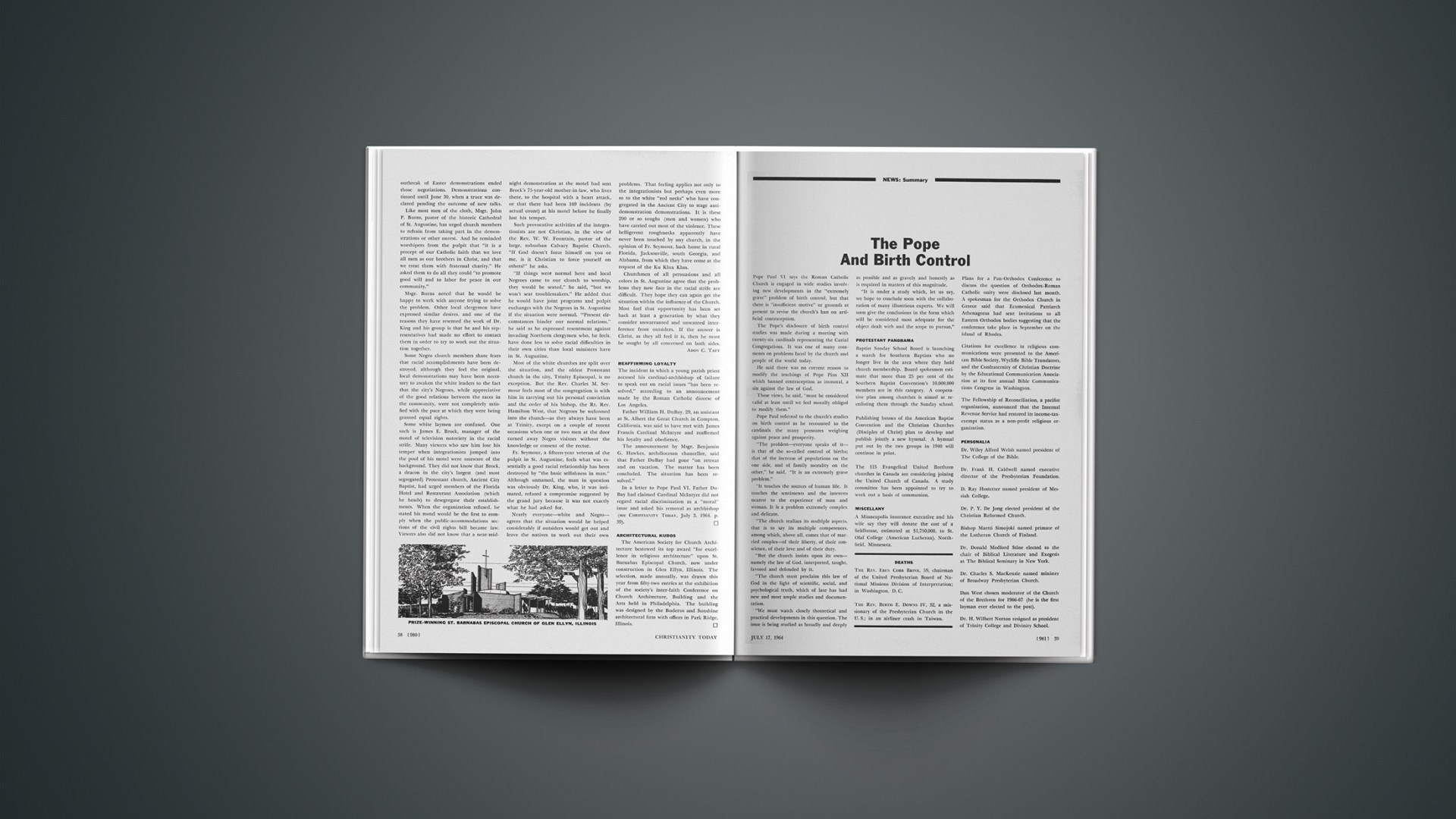
The American Society for Church Architecture bestowed its top award “for excellence in religious architecture” upon St. Barnabas Episcopal Church, now under construction in Glen Ellyn, Illinois. The selection, made annually, was drawn this year from fifty-two entries at the exhibition of the society’s inter-faith Conference on Church Architecture, Building and the Arts held in Philadelphia. The building was designed by the Buderus and Sunshine architectural firm with offices in Park Ridge, Illinois.
Theology

Current Religious Thought: July 17, 1964

It is ironic that each major inventive breakthrough achieved by man is a source of ambivalence and frequently of anxiety to the human race in general, and to the Christian Church in particular. Very frequently the appearance of revolutionary products of human ingenuity finds the race unprepared to use them creatively. While we must recognize that God, in his sovereign pleasure, does permit man to make discoveries that almost overnight alter his way of living, yet in a certain sense man’s inventive genius all too frequently seems to outrun his moral resources.

It is partially true, of course, that necessity is the mother of invention, so that inventions answer to some growing problem that impinges upon the race. The menacing problem of population growth has therefore led to persistent research into the reduction of the human birthrate. Today it seems that medical science is approaching the point at which the control of human reproduction can be effected by means that “cut with the grain” of the human organism. The development and perfection of the oral contraceptive (popularly known as “the Pill”) is upon us. Whether we relish the fact or not, this discovery presents the Christian Church with a challenge at least as great as any that man’s inventive genius has placed upon her for centuries.

While mankind has in general been slow to recognize the problem of population growth, the world has not been caught totally unawares. While it took millennia for the population of the earth to reach the billion mark (by 1830), in 130 years since that time the inhabitants of the earth have trebled in number. Man’s reproductive energy is rapidly outrunning his ability to produce and distribute the food essential for human subsistence.

The crisis in population is due in part to the removal of population controls, particularly during the past century. Inventive genius has vastly decreased infant and maternal mortality, even in lands where medical service has developed slowly. Communicable diseases are rapidly being brought under control. Techniques of occupational safety and legal controls upon work hazards have united in the effort to prolong life.

Traditionally the Christian Church has been perplexed by the question of population growth. Her thrust into the non-Christian world in medical missions has been, to a large measure, responsible for the removal of many “death controls” and thus for a significant increase of population growth. At the same time, the question of artificial family limitation has given her concern, due in part to the fact that the availability of regulative techniques has wide implications for her entire philosophy of marriage.

The Church was faced with similar perplexities by inventions of a sweeping nature in the past. Vaccination against smallpox (which promised to control the Plague, regarded by some as a divine scourge upon especially wicked societies) was resisted as impious. The use of anesthesia, especially in confinement cases, was resisted upon the supposed grounds that it violated Genesis 3:16. More recently, well-meaning clergymen denounced horseless carriages and inveighed against television. The instructive thing is that usually such persons (among them many evangelicals), after a period of denunciation, came quietly to accept the new developments.

In general Protestants have reacted confusedly toward the appearance of means by which the begetting of children can be brought within a rational scheme of things. On one hand, some have adopted a defensive and radically negative stance. Others have given uncritical endorsement to such techniques, in some cases hailing them as a cure-all for human ills. The association of this acceptance with the social gospel has caused some evangelicals to react defensively and emotionally and to adopt postures that have later become an embarrassment to them.

Meanwhile human inventive genius seeks relentlessly for a way to control human conception that is esthetically acceptable and ethically unobjectionable. It seems that an increasing number of sensitive Christians, including many of frankly evangelical belief, feel that the oral contraceptive, when perfected so as to eliminate discomforting side effects, will answer these two requirements.

It is not now clear, however, that evangelical circles are really coming to grips with the question. One could wish that someone with this orientation might write an article as forthright as that by Peter A. Bertocci in the Christian Century (Feb. 26, 1964) entitled “Experimental Sex and the Pill.” Certainly an evangelical treatment of the subject would be far less permissive than that by Dr. Bertocci. At the same time, we would welcome a frank statement, from our perspective, of the biblical understanding of marriage which gives to the words, “the two shall be one flesh,” at least equal significance with the words, “be fruitful, and multiply, and replenish the earth.”

The oral contraceptive has appeared at a time when the human race is ill-prepared to use it constructively, a time marked by lack of personal moral restraint and an artificial emphasis upon sex as an end in itself. The brute fact is that the use of “the Pill” will inevitably include a great deal of abuse by undisciplined members of our society, single and married.

Granting this, what should be the attitude of the evangelical in the matter? At least three courses are open to him. He may adopt an ascetic and aseptic aloofness. He may maintain a negative and defensive posture, fortified by resort to such pathetic irrelevancies as the case of Onan. Or he may take a position of Christian realism, recognizing that nothing can be “uninvented” and that such a major breakthrough as this demands a better quality of living, a better type of men and women. Thus he may seek by every means at his disposal to bring those within his influence to live ethically, rather than merely by the mores and usages of his society.

The Pope and Birth Control

Pope Paul VI says the Roman Catholic Church is engaged in wide studies involving new developments in the “extremely grave” problem of birth control, but that there is “insufficient motive” or grounds at present to revise the church’s ban on artificial contraception.

The Pope’s disclosure of birth control studies was made during a meeting with twenty-six cardinals representing the Curial Congregations. It was one of many comments on problems faced by the church and people of the world today.

He said there was no current reason to modify the teachings of Pope Pius XII which banned contraception as immoral, a sin against the law of God.

These views, he said, “must be considered valid at least until we feel morally obliged to modify them.”

Pope Paul referred to the church’s studies on birth control as he recounted to the cardinals the many pressures weighing against peace and prosperity.

“The problem—everyone speaks of it—is that of the so-called control of births; that of the increase of populations on the one side, and of family morality on the other,” he said. “It is an extremely grave problem.”

“It touches the sources of human life. It touches the sentiments and the interests nearest to the experience of man and woman. It is a problem extremely complex and delicate.

“The church realizes its multiple aspects, that is to say its multiple competences, among which, above all, comes that of married couples—of their liberty, of their conscience, of their love and of their duty.

“But the church insists upon its own—namely the law of God, interpreted, taught, favored and defended by it.

“The church must proclaim this law of God in the light of scientific, social, and psychological truth, which of late has had new and most ample studies and documentation.

“We must watch closely theoretical and practical developments in this question. The issue is being studied as broadly and deeply as possible and as gravely and honestly as is required in matters of this magnitude.

“It is under a study which, let us say, we hope to conclude soon with the collaboration of many illustrious experts. We will soon give the conclusions in the form which will be considered most adequate for the object dealt with and the scope to pursue.”

Protestant Panorama

Baptist Sunday School Board is launching a search for Southern Baptists who no longer live in the area where they hold church membership. Board spokesmen estimate that more than 25 per cent of the Southern Baptist Convention’s 10,000,000 members are in this category. A cooperative plan among churches is aimed at reenlisting them through the Sunday school.

Publishing houses of the American Baptist Convention and the Christian Churches (Disciples of Christ) plan to develop and publish jointly a new hymnal. A hymnal put out by the two groups in 1940 will continue in print.

The 115 Evangelical United Brethren churches in Canada are considering joining the United Church of Canada. A study committee has been appointed to try to work out a basis of communion.

Miscellany

A Minneapolis insurance executive and his wife say they will donate the cost of a fieldhouse, estimated at $1,750,000, to St. Olaf College (American Lutheran), Northfield, Minnesota.

Deaths

THE REV. EBEN COBB BRINK, 59, chairman of the United Presbyterian Board of National Missions Division of Interpretation; in Washington, D. C.

THE REV. BERTIS E. DOWNS IV, 32, a missionary of the Presbyterian Church in the U. S.; in an airliner crash in Taiwan.

Plans for a Pan-Orthodox Conference to discuss the question of Orthodox-Roman Catholic unity were disclosed last month. A spokesman for the Orthodox Church in Greece said that Ecumenical Patriarch Athenagoras had sent invitations to all Eastern Orthodox bodies suggesting that the conference take place in September on the island of Rhodes.

Citations for excellence in religious communications were presented to the American Bible Society, Wycliffe Bible Translators, and the Confraternity of Christian Doctrine by the Educational Communication Association at its first annual Bible Communications Congress in Washington.

The Fellowship of Reconciliation, a pacifist organization, announced that the Internal Revenue Service had restored its income-tax-exempt status as a non-profit religious organization.

Personalia

Dr. Wiley Alfred Welsh named president of The College of the Bible.

Dr. Frank H. Caldwell named executive director of the Presbyterian Foundation.

D. Ray Hostetter named president of Messiah College.

Dr. P. Y. De Jong elected president of the Christian Reformed Church.

Bishop Martti Simojoki named primate of the Lutheran Church of Finland.

Dr. Donald Medford Stine elected to the chair of Biblical Literature and Exegesis at The Biblical Seminary in New York.

Dr. Charles S. MacKenzie named minister of Broadway Presbyterian Church.

Dan West chosen moderator of the Church of the Brethren for 1966–67 (he is the first layman ever elected to the post).

Dr. H. Wilbert Norton resigned as president of Trinity College and Divinity School.

About This Issue: July 17, 1964

One of the nation’s leading Shakespeareans, Roland Mushat Frye, discusses the religious implications of Shakespeare’s plays in an essay written especially for us in this quadricentennial of the great poet’s birth.

Imitation as the basis of art is related to Christian perspective in John C. Cooper’s article (page 11). Bastian Kruithof discusses the problem of secularism (page 13).

Some straight talk on evangelistic methods comes from Carlton L. Myers.

A new interdenominational lay movement to promote and coordinate short-term Christian service abroad is proposed by the Rev. Robert N. Meyers, a Presbyterian minister in Vienna, Virginia (page 8).

Reports from Church Assemblies

Portland, Oregon—“We are gathered here today between a memory and a hope,” said General Superintendent Gordon B. Williamson at the opening of the sixteenth quadrennial General Assembly of the Church of the Nazarene at Memorial Auditorium in Portland. And he invited the 17,000 members of the church who were present to partake of the Lord’s Supper in renewed commitment to both the past and the future.

The memory to which Williamson referred was that of Calvary; the hope, the Second Coming of Christ. But between these two temporal mileposts in the Christian’s sense of eternity lay the memory of the brief span of Nazarene history—nearly all of it in the twentieth century—and the high hopes in which this assembly laid plans for the denomination’s future. The most obvious conclusion to be drawn from the events of the assembly is that the Nazarenes remain more firmly than ever committed to the Wesleyan and Arminian view of the Christian Gospel, and especially to the doctrine of entire sanctification, or Christian perfection.

The most important new legislation adopted by the assembly reflected an explicit commitment to carry the Wesleyan heritage into the future. Such was the decision to establish two new liberal arts colleges. This was made in the face of considerable resistance from the five existing institutions, which have very recently won their long struggle for accreditation. And it required troublesome readjustments of sources of financial support and of students.

In a pre-assembly interview, Dr. Paul Updike, chairman of a commission that had studied the problem of denominational higher education for the past four years, explained that the action was dictated by the Wesleyan tradition. The commission had rejected a plan to establish a denominational Bible college, he said, because such institutions harmonized more with the Calvinist than with the Wesleyan tradition in biblical study. Updike declared that Wesley held reason and revelation closely together; the Bible was one book, which must speak through Christians to the world. Calvin’s modern followers, by contrast, studied carefully the separate parts of the Bible, seeking what it might say to the Christian himself. Though the latter kind of study was valuable and necessary, Updike continued, the Wesleyan view had given birth to liberal arts colleges, in which Bible study was important, not for itself alone, but for its central position in all man’s intellectual pursuits. Such colleges, he concluded, not only were true to the denomination’s past but were the key to its future.

After an extensive floor debate, the General Assembly adopted the plan for the colleges but proceeded to authorize the establishment of a Bible college as well. General Superintendent Williamson and a half-dozen district leaders took the floor to argue that such a school was necessary to preserve a spiritual balance in the Nazarene ministry. It would, they said, prevent the intellectualism of the liberal arts college and of the denominational seminary from choking out the fervor of Wesleyan perfectionism.

Other pronouncements and decisions revealed the same preoccupation with a future that would be true to the past. The quadrennial address of the Board of General Superintendents—the six men who direct the work of the church between assemblies—criticized sharply, for example, the “popular ecumenical movement, with its apparent ideal of ‘togetherness at any price.’ ” The statement reflected the experience of the denomination since the 1920s, when its leaders found themselves isolated from liberal Protestantism on one hand and from a Calvinistically oriented fundamentalism on the other. Nevertheless, the same message, and the subsequent action by the assembly itself, committed the Nazarenes to exploring the possibilities of “union with any or all holiness groups.” When a proposal to change the name of the “Committee on the State of the Church” to “Social Action Committee” came up, the assembly adopted instead the name “Christian Action Committee,” so as to allow no impression of compromise with a gospel that is merely social.

The strengthening of the denominational stand upon civil rights likewise reflected more a religious determination to carry out Wesleyan commitments than any willingness to participate in politics. The delegates voted to define the Nazarene view as supporting equal rights to vote, to secure an education, to be employed, and to enjoy all publicly supported facilities, without discrimination because of race. This was done on the grounds that such equality of opportunity was in harmony with the spirit of the Gospel of perfect love.

The sense of healthy growth and of enthusiasm was striking, despite the somewhat slower rate of increase in membership over the past four years—a total of slightly over 10 per cent.

The government of the Church of the Nazarene operates very efficiently, and, remarkably, this is more on the basis of influence than of authority. From the general superintendents down to lay members of each local church board, every officer and pastor must frequently stand for re-election by ballot vote. Few did as well in this assembly as did Paul Skiles, the youth executive who received 479 of the 480 ballots cast. But all were easily re-elected, and a new general superintendent, foreign missions executive George M. Coulter, was named on the second ballot to replace D. I. Vanderpool, who is retiring.

The remarkable influence of the general superintendents over the executives who administer the church programs from the denomination’s International Headquarters in Kansas City is a triumph in the mastery of the problems of denominational bureaucracy. The debate and the several decisions on colleges and the Bible college indicate a considerable extension of the general superintendents’ influence over the educational institutions as well.

This reporter left Portland with a haunting memory of the combined college choirs singing “Let Thy Mantle Fall on Me,” a gospel hymn that echoes Elisha’s prayer for the power of the older prophet. The Nazarenes’ vision of the future seemed, in retrospect, especially close to their loyalty to their past. They gathered on the banks of the Columbia some 20,000 strong, despite the fact that this was their first venture out of the more central Midwestern heartland. Their satisfaction with their own way, and their consequent isolation from many other Christian movements swirling about them, may have brought discontent to others who work for the unity of all evangelicals, but the satisfaction rested on solid accomplishment. Now nearing 350,000 members, with 4,852 churches in America and the British Commonwealth and a dozen other nations, the Nazarenes have become not just a denomination but a people. The General Assembly was in part a reunion of old friends, families, and school associates. It was also in part an anticipation of another reunion toward which all Christians look, with the family of God in heaven. The Nazarenes, like many other church families in America, are becoming affluent and efficient, but they are an other-worldly people still, nurtured by a hope that is anchored to the memory of the Cross and that transcends time.

Winona Lake, Indiana—The annual meetings of the General Association of Regular Baptist Churches resemble Bible conferences rather than business-filled conventions. At the 1964 GARBC conference, brief sessions were provided for resolutions, elections, and reports; but the emphasis was on expository, frequently militant, and always fundamental gospel preaching.

“I am not ashamed to be called a fundamentalist,” said one speaker last month. “You don’t need to worry about neo this or neo that—it’s this,” said another, holding up his Bible. To the Regular Baptists, “evangelicalism” and “neo-evangelicalism” connote a soft line on such issues as the doctrine of Scripture and separation, and they have been vocal in their criticism of what they see as a departure from the full counsel of Scripture. To them this means not only separation from unbelief and apostasy but also separation from unseparated believers.

Dr. Paul R. Jackson, the national representative of the GARBC, has written, “If we make Biblical separation an end in itself, or major upon it to the neglect or exclusion of other great Biblical doctrines, we have failed those to whom we minister, as the surgeon would fail who sterilizes but never operates. But on the other hand, let us never forget that we also fail if we do not preach and practice this doctrine of separation, as the surgeon will fail, no matter how skillfully he operates, if he neglects proper sanitation in the operating room.”

If to the outsider it appears that the Regular Baptists do not always achieve the balance for which they strive, perhaps it is because the movement tends to defend most vigorously what is most under attack.

The movement began in 1932 when a group of Baptists left what is now the American Baptist Convention because of what they believed were modernistic trends in theology and authoritarian trends in polity.

The association now has some 1,150 churches in forty states and has added, on an average, one new church a week for several years. The total membership is estimated at 160,000. Missionaries under the GARBC’s approved mission boards number about 1,200, and 23 per cent (about $4½ million) of total church giving went to missions last year. GARBC Sunday school literature (which includes about 300,000 separate items) is used by 700 churches outside the association.

The week of meetings, conducted under the quiet, effective leadership of Dr. Joseph Stowell, was to a great extent a vigorous asseveration of the “mountain top stand” in 1932, to which Dr. Robert Ketcham, the GARBC’s plain-spoken elder statesman, referred in his concluding address.1Dr. Ketcham was presented with a plaque by Dr. George Ford of the Winona Bible Conference for his many years of gospel service and ministry.

The messengers reaffirmed in an official resolution their stand on the infallibility of the Bible, assailed the decision of the American Baptist Convention to send an observer to the Prague Christian Peace Conference, and called for clarification of the Supreme Court rulings on Bible reading and prayer in the public schools, though they did not expressly support an amendment to the Constitution as did Dr. Carl McIntire, with whose American Council of Christian Churches the GARBC as an association is affiliated.

The Regular Baptists also subjected themselves to severe scrutiny, and perhaps the most deeply felt resolve was an unwritten one that concerned their own work and direction. It came half-way through the week, after Dr. Quentin Kenoyer, a medical missionary to Assam, India, lined out some sobering statistics: ninety-nine missionary appointees unable to go to the field because of lack of full support, a decreased percentage of volunteers, decreased per-capita giving, while “the buildings are getting larger.” (A spokesman said the slight decrease in per-capita giving last year was in contrast to the general upward trend of recent years.) Many rose after his message to rededicate themselves to “getting out the Gospel.”

The week also included a highly successful youth talent program (several GARBC young people participated in an international competition in Interlaken, Switzerland). The peak attendance at the conference was estimated at 7,000, a record for the association. Dr. Wilbert Welch, the new chairman of the Council of Fourteen—the association’s executive body—said, “This has been to my mind one of the greatest conferences I have ever attended.”

Winona Lake, Indiana—Framework was established for an international organization of Free Methodist churches during the two-week, quadrennial General Conference of the 56,000-member Free Methodist Church of North America. Delegates approved creation of a permanent, non-legislative Free Methodist World Fellowship. They adopted a statement of “Principles of Free Methodism” to which Free Methodist bodies overseas must adhere before becoming autonomous and also a plan to establish a Constitutional Council, a court-like agency that will be international in scope and will be called on to interpret church law.

Denominational leaders from thirteen nations took part in the action, which also saw the General Conference limit its own authority and raise to its level General Conferences in Japan and Egypt.

Two new bishops were elected: Dr. Myron F. Boyd, voice of the international radio broadcast, “The Light and Life Hour,” and the Rev. Paul N. Ellis. The Rev. Donald Bastian of Greenville, Illinois, had also been elected bishop but refused the office, saying, “I cannot get the consent of my conscience to leave the pastorate at the age of thirty-eight.”

The Free Methodist Youth Department gave full endorsement to short-term service abroad for young people in connection with the church’s missionary program.

Grand Rapids, Michigan—It began and it ended with thunder, lightning, and driving rains. During the ten days between, the Synod of the Christian Reformed Church deliberated the permissibility of nuclear war. It rejected a proposal that a general thermo-nuclear war, which would virtually destroy the human race and the “technical, cultural, and spiritual treasures of mankind,” is not a just war and is therefore impermissible. The proposal did not suggest unilateral disarmament, nor did it rule out the limited use of nuclear weapons. It rather asserted that an all-out nuclear war does not fall within the classical Christian category of a just war, for such a nuclear war “does not rest on the purpose and on the prospect of securing an historically meaningful socio-political order.” Although the 128 delegates refused to adopt the proposal as a guideline for the thinking of the church’s membership, they did recommend the plan to the membership for study.

A recommendation was made by a standing committee that an overture from Classis Central California requesting official action for closer fellowship with the Reformed Church in America be rejected; the recommendation was unanimously tabled. Instead the delegates of the 108-year-old denomination referred the request to the Committee on Inter-Church Correspondence. The Christian Reformed Church withdrew from the RCA in 1857. The two churches have a common credo and heritage.

A statement on race that had been adopted by the Reformed Ecumenical Synod, of which the Dutch Reformed Church in South Africa is a member, was adopted last month by the CRC delegates. The statement asserts, “God’s Word does not teach either racial integration or separate racial development as a universally regulative principle expressing God’s will for our Christian conduct in race relations.”

Pan-Presbyterianism

When do “talks” between churches become “conversations,” and when do “conversations” become “negotiations” for union?

Presbyterians throughout the nation are beginning to wonder. Almost all of them are involved, in one way or another, in “talks,” “conversations,” or “negotiations.”

Whether the result of all the discussion will be a new denomination devoted to the Reformed faith and Presbyterian order is the question on the mind of evangelicals. In the background of all discussion on the matter is the fact that the United Presbyterian Church in the U. S. A. is a leading participant in the “Blake-Pike” Consultation on Church Union, which includes such communions as the Methodists, Episcopalians, and Disciples.

The Presbyterian U. S. (Southern) General Assembly in 1963 decided that “ultimately the Presbyterian and Reformed Communions in the United States should present a united life and witness according to the Reformed faith and Presbyterian order.” The action was reaffirmed by the denomination’s 1964 General Assembly in April.

In May the United Presbyterian General Assembly approved a letter to its Southern cousins, inviting them to conversations to explore “the conditions conducive to union and that make union imperative now.”

In addition, the UPUSA assembly authorized appointment of a twelve-man committee to join negotiations already going on between Southern Presbyterians and the Reformed Church in America. The April Southern assembly had suggested that its talks with the RCA might be broadened to include the UPUSA, but only with RCA concurrence.

The RCA met in June and ruled out the possibility that the negotiations would be broadened. A 1962 decision “to hold other union possibilities in abeyance” was reaffirmed. That left the UPUSA, largest of American Presbyterian denominations, out of the Presbyterian-Reformed negotiations.

Meanwhile, UPUSA officials were dispatching to the other Presbyterian bodies copies of the invitation they sent to Southern Presbyterians to hold exploratory conversations.

First to respond was the 27,000-member union-shy Associate Reformed Presbyterian Church. Its General Synod, meeting at the same time the corresponding body of the RCA was in session, accepted the UPUSA invitation.

The UPUSA letter was not presented to the RCA synod.

The letter was before the Cumberland Presbyterian Assembly, but no formal answer was voted. Instead, the Cumberland judicatory enlarged the scope of its interchurch relations committee’s work and authorized it to handle such correspondence.

ARTHUR H. MATTHEWS

A study committee was appointed to investigate the missionary message of the church’s professor of missions at Calvin Seminary and to determine whether his views are in harmony with biblical teaching and the church’s confessions regarding limited atonement. The professor, Harold Dekker, has pleaded the permissibility of preaching to any man “God loves you,” and “Christ died for you.”

Next year the Synod will meet in Sioux Center, Iowa, home of church-free Dordt College. This will be the first time in decades it has convened outside Grand Rapids, Michigan.

Long Beach, California—Conservative Baptists, long haunted by a hard-core ultra-right element, met June 18–23 for their twenty-first annual fellowship in sessions that were relatively mild, although moderates scored significant advances on several fronts.

One highlight of the sessions was the resolution of a vexing problem involving leadership of the Conservative Baptist Foreign Mission Society. Dr. Vincent Brushwyler, general director of the society since its beginning, had been under gross pressures during the past several years. He submitted his resignation last January, and after some tactical maneuvers the resignation was accepted by the society’s board. The matter threatened to erupt in the sessions at Long Beach. Indeed, there was considerable discussion of it in several open forums. The delegates regretted Dr. Brushwyler’s resignation but also expressed confidence in the board. A largely attended banquet on Friday evening honored Dr. Brushwyler for his long and effective years of service, during which some 500 missionaries were sent out by the board. He was given prolonged applause.

The hard-core element of the fellowship received its most substantial defeat in the transactions of the Conservative Baptist Home Mission Society. At the Central Regional meeting of the society’s board last fall, the dissident group sought to control matters by refusing to permit the vice-president, Dr. Russell Pavy, to preside over the meeting in the absence of the president. Since the constitution requires that the vice-president preside in the president’s absence, the board declared the meeting illegal and vacated the offices that had been filled. The matter came up for discussion and decision at Long Beach. Dr. Pavy took the floor to answer charges against him, and at the conclusion of his defense the delegates gave him a tremendous ovation. The victory for the moderates was further strengthened by the election of Pavy as president of the Home Mission Society.

Another victory for moderation was the election of Donald Bjork as treasurer of the Conservative Baptist Association of America. He was nominated from the floor after the hard-core element had presented the name of Floyd Northrop to the delegates. Bjork’s sound defeat of Northrop made it evident that the moderates were in control.

A banquet given by the Conservative Baptist Seminary of Denver was attended by 600 messengers. In a masterful address President Vernon Grounds inveighed against divisive members of the fellowship who use typewriter and mimeograph to assassinate character and poison the minds of the constituency. He came out strongly for the authority and inerrancy of the Holy Scriptures, while at the same time he distinguished between human interpretation and biblical authority. He forecast that certain elements of the fellowship would lead it into divisive sectarianism if they were permitted to destroy soul competency, the priesthood of believers, and the right to private interpretation of the Scriptures. Calling for the end of disunity and disruption, President Grounds stated that Baptists have a Man—Christ Jesus; a cause—the Gospel of Christ; and a strategic opportunity in one of history’s darkest hours.

The various agencies of the fellowship reported increased incomes and a forward movement generally. The delegates elected Dr. Herbert Anderson, minister of the Hinson Memorial Baptist Church of Portland, Oregon, as president of the association. Dr. Lloyd T. Anderson, minister of the Bethany Baptist Church of Covina, California, was elected president of the Foreign Mission Society.

Resolutions passed by the messengers included statements against the ecumenical movement, against immodesty in dress as evidenced by the new-style bathing suits, against Communism, and against the teaching of evolution in public schools. The messengers reaffirmed their belief in individual rights, deplored anti-Semitism, and called for freedom of worship and the use of the Bible in public life and institutions.

Toronto—A new Book of Common Order was approved by delegates to the ninetieth General Assembly of the Presbyterian Church in Canada.

The book, characterized by opponents as incorporating “Catholicizing tendencies,” represents eleven years of committee work. It is the first major revision of the book since 1938 and is intended for voluntary use in the Presbyterian churches of Canada.

The final vote on the revised book was by show of hands. There were only five dissents, but many of the 250 delegates abstained.

Critics say that the new book introduces the rite of christening, that its baptismal service prayers teach baptismal regeneration, and that the preamble to the ordination service is not in accord with the Westminster Confession.

Assembly delegates, meeting at Knox College, authorized discussions with the United Church of Canada on cooperation and the biblical meaning of unity. They also approved discussions between a subcommittee from the Committee on Articles of Faith and a United Church of Canada group.

The delegates set aside, however, a move to have a subcommittee on church music consult with a similar group from the United Church to produce a hymn book.

The assembly urged the federal government to revise the Canadian Criminal Code to allow married couples to buy birth control devices legally.

A proposal that Canadian law be liberalized by recognizing willful desertion as legal grounds for divorce was endorsed.

The denomination’s eight synods were asked to make studies with a view to “rooting out racial and ethnic discrimination in the church and by Presbyterians in all their work and relationships.”

Hamilton, Ontario—Delegates to the seventy-fifth anniversary assembly of the Baptist Convention of Ontario and Quebec voted to accept a new Sunday school curriculum prepared jointly with the United Church of Canada despite protests that the material embraces critical views of the Scripture. According to Religious News Service, the Rev. Leland Gregory, general secretary of the convention, told the assembly that if Baptists withdrew from the joint project, they would be morally bound to pay $50,000. Denominational administrators were instructed to assist any congregation that sought to secure other material from U. S. Baptist sources.

The delegates represented some 50,000 Baptists in 450 congregations. They form the middle geographical third of the Baptist Federation of Canada.

Minneapolis—A referendum among congregations of the Evangelical Covenant Church of America to determine whether they want their denomination to affiliate with interchurch organizations was authorized by a vote of delegates at the denomination’s annual meeting.

The Evangelical Covenant Church, which embraces some 80,000 members, does not now belong to any group such as the National Council of Churches or the National Association of Evangelicals.

Delegates voted to deplore “irresponsible and violent methods of expressing racial sympathies,” but they affirmed “the rightness of orderly and non-violent means of combating injustice toward racial minorities.” They recorded their “profound appreciation” over Senate passage of the civil rights bill.

Ocean Grove, New Jersey—Trinity College, operated by the Evangelical Free Church of America, will be moved from the northwest side of Chicago to suburban Bannockburn, Illinois, according to legislation enacted at the church’s eightieth annual general conference. The Evangelical Divinity School, also operated by the church, is already located on the 79-acre Bannockburn plot.

A 3 per cent membership growth was reported for the past year, and per-capita giving rose to $233.43, up $50 from five years ago. The denomination now has some 41,700 members.

One of the denomination’s ministers, the Rev. Theodore DeBoer, of Lake Alfred, Florida, was killed in a traffic accident en route to the conference.

Chicago—At its annual session, held for the first time, as a resolution phrased it, “in the far North,” the American Baptist Association adopted an omnibus resolution noting that “this nation’s society has reached a new high in low living, due in large measure to a type of advertising in many fields that encourages man to ignore restraints and let his carnal nature have its way.” The resolution asserted that “in spite of the constant diet fads, improper diet and over indulgence in foods is responsible for great health loss to our nation.” It also pointed to a raising rate of alcoholism, to the effect of cigarettes on the death toll, and to slaughter on the highways.

The ABA is a group of more than 3,000 churches with an aggregate membership of 653,000. Most are located in the South.

Cape May, New Jersey—A representative of the Southern Christian Leadership Conference appealed to the Friends General Conference for continued support in behalf of civil rights. The Rev. Wyatt Tee Walker told the 3,000 Quaker delegates that the demonstrations will increase and that the emphasis of future demonstrations will be on enforcement and implementation of the civil rights bill.

Fergus Falls, Minnesota—The Church of the Lutheran Brethren in America, at its sixty-fourth annual convention, ratified a change in its constitution that bars certain lodge members from communicant membership. The amendment has been approved by all seventy of the church’s congregations.

Lincoln, Nebraska—Delegates to the 178th annual conference of the Church of the Brethren advised church members to support as a presidential candidate a man who avoids “threats, arrogance, and the flaunting of our military might,” who upholds the United Nations, and who advocates “effective enforcement” of the civil rights bill.

The delegates modified the church’s position against the remarriage of divorced persons. The new policy allows ministers to officiate in such weddings when, in the pastor’s estimation, the marriage partners meet certain conditions.

In other actions the delegates: endorsed family planning as a means of counteracting the population explosion; called on church members to create a “climate of understanding, good will, and concern for the right” in race relations; and termed “ill-advised” efforts to amend the Constitution to permit school devotional exercises.

Preparation, Penetration, and Preservation

A year-long evangelistic series in the Atlantic provinces of Canada was climaxed last month with open-air services and a ministers’ conference in the historic seaport of Halifax. The series, spearheaded by 32-year-old Leighton Ford, an associate of Billy Graham, embraced Nova Scotia, New Brunswick, Prince Edward Island, and Newfoundland. Attendance figures for the twelve-month effort totaled an estimated 500,000, and about 7,000 decisions for Christ were counted.

The closing events in Halifax included an evangelistic service in a natural amphitheater where Graham addressed a crowd of 30,000 seated on the grass. A week-long ministers’ conference on evangelism, the first such ever conducted by the Graham team, drew 300 registrants.

Graham also addressed rallies in Saint John, New Brunswick, and Charlottetown, Prince Edward Island. But the rest of the meetings were conducted by associate evangelists Ford, Joe Blinco, Larry Love, and Lane Adams.

Looking at one crowd of inquirers prompted a pointed observation from Dr. Ralph Chalmers, professor of systematic theology at the United Church of Canada’s Pine Hill Divinity School.

“This is Pentecost,” he said. “There are our ministers and missionaries for the future.”

It is a point of record that the Atlantic provinces have produced more ministers and missionaries than any other area of Canada. The populace retains an important measure of religious ties, which helped the evangelistic effort. But it is also conservative and cautious, which produced some impediments.

The Ontario-born Ford and his colleagues conducted a total of fifteen crusades in the four provinces. They covered all the major and several of the minor population areas.

Ford says that a thorough attempt was made to evangelize in depth. The theme was “Preparation, Penetration, and Preservation.” There were the usual pre-crusade counselor training sessions, prayer meetings, rallies, radio and television programs, and follow-up procedures. But this time there were also such things as regular morning Bible classes in a dozen cities, “conversational evangelism,” and “penetration teams.”

Some of the morning Bible classes attracted 1,000 persons each. In Halifax, a penetration team of thirty laymen moved into factories, offices, civic clubs, and homes to speak and answer questions. Team members took on informal luncheon assignments, mixing with businessmen and students to talk on spiritual themes.

Occasionally the crusades got support from unexpected sources. In Charlottetown the Roman Catholic bishop postponed a convocation in deference to the crusade and wished the Protestants well.

Ford feels that the effort vindicates the introduction of new dimensions to mass evangelism. A similar approach is scheduled for the West Coast provinces of Canada next year.

Honors At The Fair

Evangelist Billy Graham, addressing nearly 4,000 persons at the Court of the Universe at the New York World’s Fair, declared that only a “great religious revival” can save America from anarchy and revolution.

In an outdoor address on June 26, “Billy Graham Day” at the fair, the famed clergyman stressed that this nation and the world today “can see the possibility of having all our dreams fulfilled. But we also see the possibility that the human race might be destroyed. However, in the hand of God, the whole course of history moves like a guided missile to the fulfillment of his purpose. Not military might, but God will ultimately triumph.”

Before his address, Graham received the George Washington Carver Memorial Institute’s 1963 Gold Award for his “outstanding contribution to the betterment of race relations and human welfare.”

The award was presented by Republican Senator Jacob Javits of New York on behalf of the non-profit educational institution, which this year is marking the 100th anniversary of the eminent Negro agronomist and scientist.

At a press conference earlier, the evangelist hailed the courage and idealism of civil rights workers in Mississippi but questioned the wisdom of the college-student “summer project.”

Graham also received the fair’s Silver Medallion from Robert Moses, president of the Fair Corporation, and was presented with a $100,000 check to support his ministry at the exposition.

The check, which was 60 inches long and 22 inches wide, was made of polished Tennessee black walnut and was carved in the shape of the state of Tennessee. It was presented by the Billy Graham Special Train Committee of Tennessee, Inc., an organization which provides transportation to and from the evangelist’s crusades.

Made from wood taken from the farm of the famed Sergeant Alvin York, the check contained a plug of wood from a schoolhouse where Sam Houston taught. It was inserted to represent the state capital at Nashville.

After being processed, the canceled check was to be made into a coffee table for the Graham family home at Montreat, North Carolina.

Earlier last month, Graham spoke to some 30,000 persons crowded into the Arlington Park Race Track near Chicago. It was the closing rally of the Suburban Chicago Crusade, a follow-up to Graham’s Greater Chicago Crusade of 1962. The rally was preceded by a week of nightly evangelistic services.

This week Graham was scheduled to be conducting a crusade in Columbus, Ohio. The ten-day series has the support of some 800 churches.

Graham’s schedule for the remainder of 1964 includes two additional major city crusades: September 4–13 in Omaha and September 18–27 in Boston.

Books

Book Briefs: July 17, 1964

The Value Of The Old

The Old Testament and Christian Faith, edited by Bernhard W. Anderson (Harper & Row, 1963, 271 pp., $5), is reviewed by Lester J. Kuyper, professor of Old Testament, Western Theological Seminary, Holland, Michigan.

The essays in this book contribute interesting and discerning light on the much discussed subject of the relation of the Old Testament to the New Testament, or the place the Old Testament has in Christian thought. It is apparent that the Old Testament cannot be taken over bodily into our way of thought and life. In fact, some wonder whether it can contribute anything to Christians who consider the Christ-event—incarnation, death, and resurrection—as the only and final event with which we have to do.

The scheme of this book centers around Rudolph Bultmann’s teachings concerning the significance of the Old Testament. The writers of the various chapters offer their criticisms and reactions to the famous Marburg professor’s essay, “The Significance of the Old Testament for the Christian Faith,” presented as the first chapter of the book.

Bultmann’s essay surmises that since man’s relation to God is bound to the person of Jesus, the Old Testament must recede into a very secondary place. Luther observed that the Old Testament as law placed divine demands on man that made man aware of his need of the Gospel. However, this contrast of law versus grace overlooks the grace in the Old Testament and the place of law in the Gospel. Bultmann has rightly understood the element of grace in law in the Old Testament, and therefore Luther’s distinction is less than satisfactory.

Since the Christ-event is God’s final redemptive act in history, the redemptive acts in the Old Testament are no longer revelation for the Christian as they were and still are for the Jews, according to Bultmann (p. 31). The Old Testament has value only in the sense in which it brings better understanding about the New Testament. To this reviewer, Bultmann’s position is too radical a rejection of revelation in the Old Testament. To be sure, not all of it can be considered authoritative and relevant for Christians. However, even in its message to Israel, the Old Testament carries in itself the essence of validity for Christian faith and life. In fact, the record of God’s people through the long span of history reflects more clearly the relation of grace and judgment than the record of the comparatively brief history of the New Testament Church.

Cullmann’s chapter on the “Connection of Primal Events and End Events” stresses the non-historical or mythological features of these events in the New Testament. The in-between redemptive event of Christ’s life, death, and resurrection is historical and projects special meaning to the beginning and end events. Jesus of Nazareth is truly historical in a way in which Adam is not a historical person. However, the intent of the New Testament is to place the non-historical beginning into vital relationship with the historical Christ. Cullmann senses the overall significance of beginning and end by placing it under the redemptive Christ-event.

Alan Richardson answers the question, “Is the Old Testament the Propaedeutic to Christian Faith?” by stating that it is that and more. And the “more” is important, since the Old Testament is the kerygmatic record of God’s redemption in history which is completed in the New Testament (pp. 47, 48). This reviewer agrees that a firm adherence to the Heilgeschichte concept of the Old Testament properly relates the Old Testament to the New Testament salvation event in Christ. Yet one may ask whether this is not propaedeutic in another form.

Carl Michalson finds that Bultmann’s use of the Vorverständnis given in the Old Testament as the proper preparation for understanding and accepting the New Testament successfully combats ancient Marcionism or the present-day “creeping” Marcionism. This chapter (3) has much material on the proper pre-understanding the believer must have to believe rightly. When the exegete makes his own Vorverständnis the “assured state of affairs,” he has perverted hermeneutics and is unable to sense the kerygma of the New Testament.

Wilhelm Vischer’s chapter, “Everywhere the Scripture Is About Christ Alone,” attempts to establish the value of the Old Testament for Christians in his opposition to Bultmann’s dismissal of the Old Testament for the new community in Christ. What value does Vischer see in the Old Testament? God’s people in history, in their election by God, rebellion against him, and consequent need of redemption, establish the pattern by which the New Testament community encounters Jesus Christ. The history of Israel was recorded for the purpose of bringing present-day man to Christ. We learn from the Old Testament that God encounters Israel in history, which is the model for God’s encounter of Israel and all people in the historical Christ-event. This reviewer is not convinced that Vischer has successfully dismissed Bultmann’s rejection of the Old Testament’s having positive value for the Christian (pp. 98–101).

Other scholars in their essays express their views on the Old Testament-New Testament relation by subjecting Bultmann’s position to critical study. Most scholars accept the “negative” values of the Old Testament; however, many search the Old Testament for the “positive” contributions it makes for Christian faith and life. I find myself among the latter.

LESTER J. KUYPER

The Full Day

The Day of His Coming: The Man in the Gospels, by Gerhard Gloege (Fortress, 1963, 302 pp., $4.25), is reviewed by Ronald A. Ward, rector, Kirby Cane and Ellingham, Bungay, Suffolk, England.

This book is a study of the “single day” of the New Testament in which the thousand years of the Old Testament are realized. Appropriately enough, a large introductory section is devoted to the intertestamental period, the special danger zone of Hellenism and the Roman Empire. Then comes the earnest search for the historical Jesus. Use is made of the critical methods of historical research and the results of modern scholarship. The assumption of form criticism that the pericopai originally circulated as independent units is accepted, in spite of the acute observation of others that only an anecdotal form has been proved by the form critics, not necessarily an existence in separation.

The author believes that the record of Jesus is so colored by the believing Church that we cannot make a clean break between his own words and those of the early Church, which misunderstood a great deal or formulated his words afresh. Our Lord’s words were shaped and filled by the community. This does not give sufficient weight to the possibility that the influence of the community may have rescued differences and “contradictions” for the record instead of manufacturing them. For our Lord, like many a preacher, must often have repeated himself with a difference. He was prevented from conducting dialogues in Socratic fashion by the authority of the law and the prophets; the truth did not tolerate any human support. Strangely enough, however, the New Testament writers are engaged in a dialogue: with their contemporaries, with one another, and with us.

I am wondering if Dr. Gloege has put his finger, perhaps unwittingly, on the great defect of modern scholarship, massive though that scholarship is. In contrast to the New Testament itself, we are interested in every possible detail of our Lord’s life: his birth, his youth, his education—in short, how he became what he was. We may, and do, understand this sympathetically; but it may be dangerously misunderstood. Exegesis itself might be helped if scholars, as scholars, determined to know nothing save Jesus Christ and him crucified. This does not mean restricting themselves to the Passion story; it does mean letting the Cross color every text.

In spite of what we have said, and in spite of the author’s apparent belief that the Bible has been taken over uncritically from a pious generation without any personal confrontation or conversation, and in spite of his attack on the “biblicists” (see Matt. 23), this is a stimulating book, full of arresting things. Sin is rebellion against God and retreat from God. Men speak and write about life but refuse to live. The man who loves lives on forgiveness. Our Lord’s words bring salvation, not solution. Jesus releases man from the curse of planning. The Gospels give no indication of a process of development (in Jesus). Bureaucracy is the secular form of theocracy.

Best of all is the interpretation of the Cross. As a man, Jesus is afraid of death and its physical pain; but “far more terrible for him is the fact that death comes to him to execute the judgment of God.… In the Garden of Gethsemane Jesus was aware of the power of God’s wrath. He trembled before it.… The Cross means that God himself rejected Jesus—not for his sake but for our sake.”

The volume includes a short bibliography, an index, and an interesting epilogue on “The Rescue of Sisyphus” (Camus).

RONALD A. WARD

Militant For Peace

The Militant Ministry, by Hans-Ruedi Weber (Fortress, 1963, 108 pp., $2), is reviewed by H. C. Brown, Jr., professor of preaching, Southwestern Baptist Theological Seminary, Fort Worth, Texas.

“Almost everywhere the church is becoming a minority in a world which does not stand in awe before the miracles of God but is fascinated by the miracle of Technology.” With this statement Hans-Ruedi Weber, a minister of the Swiss Reformed Church and associate director of the Ecumenical Institute at Chateau de Bossey, sets the stage to challenge the Church to a “militant ministry” in a hostile, skeptical, and unbelieving world. If the Church is to have a “militant ministry,” says Weber, it must become involved in and with the world according to that pattern found in the New Testament and in the first four Christian centuries (centuries which, according to Weber, are more relevant for the Church than is the Reformation period).

This volume defines “ministry” as “the calling and task of Christ and all members of God’s people (it is therefore often synonymous with the ministry of the laity), while the term ‘ministers’ is used in a more restricted way, designating those church members who have received a calling for a special office within and for God’s people, such as pastors, missionaries, and bishops.” Throughout this volume there is a wholesome challenge to all Christians to involve themselves in God’s work.

Five aspects of the Church’s struggle depict the “militant church”: (1) baptism as the initiation into the ranks of the militant Church, (2) the mission of peace, which shows the apostolic character and purpose of the Church, (3) the equipment of grace (given for service to each true convert and to the whole Church), which is charismatic in character, (4) the sacrificial way of life, which imparts a distinct quality of life to those involved in the battle of faith, and (5) the true Christian joy, which depicts the Resurrection victory and foreshadows the Kingdom.

In some ways this volume will impress the technical student of the New Testament, of church history, and of theology more than the pastor. But the pastor will discover fresh insights into the total involvement of all Christians as well as numerous biblical and historical illustrations that throw new light on old thoughts.

Weber adds a word of caution about his book: he is examining the New Testament and early historical use of military imagery and is fully aware that this is only one minor section of the total data. “Writing from such a limited standpoint one cannot claim to express the whole truth.” His desire is that “laymen and ministers … discern what their particular task is today in the battle of faith of the militant church.” To a considerable degree, he succeeds.

H. C. BROWN, JR.

Berlin Novel

Behind the Wall, by Robert E. A. Lee (Eerdmans, 1964, 169 pp., $3.50), is reviewed by Harold B. Kuhn, professor of philosophy of religion, Asbury Theological Seminary, Wilmore, Kentucky.

Two worlds, two ways of life, touch each other at the Wall in Berlin. Robert E. A. Lee, executive secretary of the Lutheran Film Association, has in this work chosen two persons to dramatize the opposing ways of life: Werner Hirm, a West German Lutheran who has come to take his freedoms for granted, and Lise Lehman, an East Berliner devoted to the Communist party in the so-called German Democratic Republic.

This novel presents a series of meetings of Werner and Lise in East Berlin and Leipzig. The plot is simple: the two people are attracted to each other, but there is no place in Communist ideology for sentiment. Their contacts in Leipzig dramatize the conditions of secrecy that must surround party affairs. The fanatical devotion to the party of Lise’s mother complicates the problem. In Leipzig Werner meets the pastor who baptized and confirmed him, and he is brought face to face, perhaps for the first time, with the realities of the Christian faith that as a nominal Lutheran he has taken for granted.

In the course of the conversation, the author reveals to us the incredible hardships against which pastors must work in the East German puppet state. Werner comes from the conference challenged by Pastor Moser to “fight the good fight of faith.”

As Werner returns to East Berlin, Lise is assigned the sordid task of “softening up” a certain Comrade Blatnik from Yugoslavia. From this moment on she is torn between an innate sense of decency and the demands of the party. In East Berlin, Werner makes plans for Lise’s escape by one of the tunnels under the Wall. When at last all plans are complete, a note from Lise reaches Werner; in it she says that she has met a Frau Spier, through whom the Light of Christ has come to shine upon her heart, and that she must stay in the East to face an uncertain future for deserting her assignment for the party.

The book must be read to be appreciated. It lifts the curtains a little upon the Red world, with its intrigue, its diabolical cunning, and its war of attrition against the Church of our Lord.

HAROLD B. KUHN

He Is Not Without Love

The Unpopular Missionary, by Ralph E. Dodge (Revell, 1964, 167 pp., $3.50), is reviewed by H. Cornell Goerner, secretary for Africa, Foreign Mission Board of the Southern Baptist Convention, Richmond, Virginia.

This book is not quite so radical as the title suggests. Written by a Methodist bishop who had fourteen years of missionary service before he was placed in charge of all Methodist work in Angola, Rhodesia, and South East Africa, it is thoroughly constructive and keenly critical.

Bishop Dodge adds his voice to a swelling chorus of protests against any lingering remnants of colonialism, racial prejudice, and the presumption of cultural superiority. With clear-eyed realism, he confesses for the Church that its missionary representatives have sometimes reflected imperfect attitudes of their own cultural background and have not always been the champions of change. His self-criticism on behalf of the missionary enterprise is the more sharp because lie speaks from the point of view of the churches in Southern Rhodesia, Angola, and Mozambique. These are the remaining strongholds of white supremacy, where missionaries find themselves caught between their desire to serve the African masses, with whom their sympathies largely lie, and the necessity of being loyal to, or at least law-abiding in, countries in which a European minority is still firmly in control of government. The only alternative open to missionaries in these territories is identification with African nationalist groups that would promptly eject them from the country in which they are serving.

It needs to be clearly recognized that the conditions in the southern part of the African continent that Bishop Dodge describes are by no means typical of the entire African continent. In the newly independent African nations of West Africa and East Africa, the situation is quite different. There is no excuse for continued racial prejudice and for attitudes of superiority on the part of the missionaries; but there is even less evidence that these attitudes are present. It would be erroneous to regard Bishop Dodge’s book as an accurate description of the attitudes and activities of Protestant missionaries in most of Africa. It would also be erroneous to suppose that missionaries are “unpopular” with the African people they are serving. Quite the opposite is true in many parts of Africa. The services that missionaries are offering in education, in medicine and public health, and in those activities directly related to the growth of the churches, are received with appreciation and gratitude by millions of African people. There is a clamor for more missionaries, and there is competition for the services of those who are available.

Books that cause us to confront the realities of our changing world and that prompt us to confess the shortcomings of methods used in the past can be wholesome for the rethinking and the reorganization of the missionary enterprise. It would be unfortunate, however, if these generalizations made with reference to one section of the African continent should be uncritically applied to the continent as a whole. Perhaps someone will now dare to write about “the popular missionary,” who is quite real in many parts of Africa today.

H. CORNELL GOERNER

Broad And Narrow

Psychology’s Impact on the Christian Faith, by C. Edward Barker (Allen & Unwin [London], 1964, 220 pp., 28s.), is reviewed by M. G. Barker, lecturer in psychiatry, University of St. Andrews, St. Andrews, Scotland.

The title of this book is misleading, for by psychology the author means psychoanalytic theory. The psychology of Jung and Adler and the more recent contributions of workers such as Piaget are not even mentioned in the book. This is an attempt to synthesize psychoanalytic theory and what the author considers to be true Christian faith without the accretions of Paul and the theologians. He may seem well qualified for this in that he was a Methodist minister for the first half of his working life and then, after undergoing a training analysis, became a lay psychotherapist.

The argument of the book is that the difficulties of many nervous sufferers “can be traced back, not to the teaching of Jesus himself, but to the misrepresentation of the mission of Jesus found first in the theological letters of St. Paul.” Original sin is discounted as a distortion of troubled minds, and “atonement by the blood of Christ is a theory initiated by the Apostle Paul”; while the “church is bogged down by such themes as reconciliation, forgiveness, atonement and sacrifice.”

The author divides his material into two sections. In the first he expounds his view that obsession, masochism, and distorted views of sex have clouded the true Gospel of Christ. Since Paul is subject to each of these traits, his exposition of Christian doctrine is thereby contaminated. Part II is a dull and labored reinterpretation of the biblical doctrines of man, the Kingdom, the Cross, and the Resurrection, as well as of suffering, marriage, and divorce.

This work is at times an ingenious one, but its theology will be too broad for most readers of this journal and its psychology too narrow for most psychologists and psychiatrists.

M. G. BARKER

Expositor Incomparable

A Commentary on The Holy Bible: Volume III: Matthew-Revelation, by Matthew Poole (Banner of Truth Trust, 1963, 1,008 pp., 42s.), is reviewed by A. Skevington Wood, evangelist-at-large, York, England.

We have already welcomed the reprint of the two Old Testament volumes of Matthew Poole’s Bible commentary in these pages. The appearance of Volume III, which covers the entire New Testament, completes a finely produced and exegetically valuable set. The publishers are to be congratulated.

Poole is one of the classic expositors of the seventeenth century. Indeed, Richard Cecil, the noted Anglican evangelical preacher of the succeeding century, claimed that he was incomparable. In an age like ours, when all too often faithful elucidation of the text is subordinated to critical considerations, to turn to the single-minded Poole is both salutary and stimulating. His one aim is to demonstrate what the Protestant Reformers called the perspicuity of Scripture. For this reason, he spends most time on those passages that have been regarded as hard to understand.

For example, in Philippians 2:7 he anticipates and resolves kenotic dilemmas by insisting that our Lord did not abandon the form of God when he took the form of a servant but merely veiled his majesty and power. In Romans 7:14 he recognizes the significant change of tense that supplies the clue to Paul’s self-analysis. In John 3:5 he refuses to bind regeneration to baptism in a mechanical way, while allowing that “the new birth is signified, represented, and sealed” by the ordinance. He lists the interpretations of Matthew 16:18 that identify the rock with Christ, with Peter as the typical apostle, or with Peter’s confession of faith. “In which sense soever it be taken,” he concludes, “it makes nothing for the papists’ superiority or jurisdiction of St. Peter, or his successors.”

Poole quotes William Perkins, the Puritan, as advising readers to begin with John and Romans because they are the keys of the New Testament. His own treatment of these two books is outstanding.

A. SKEVINGTON WOOD

Delightful And Disturbing

The Miracles of Christ, by David A. Redding (Revell, 1964, 186 pp., $3.50), is reviewed by James P. Martin, associate professor of New Testament, Union Theological Seminary in Virginia, Richmond.

Here is an eloquent, delightful, and disturbing volume on the miracles of Christ by the pastor of the First Presbyterian Church in East Cleveland, Ohio. David A. Redding reveals his mastery of English style, his faith, and his sincere concern to communicate the wonder and offense of the miracles and, through them, the wonder and offense of Christ. His only prerequisite for this study is belief in the miracle of Christ himself. This book offers such a fascinating mixture of good and weak exposition, marvelous illustration, apologetic barbs, miscellaneous scientific support for miracles, and exhortations and challenges to faith that a complete review would demand pages of comments. We restrict our remarks to major considerations.

The style reflects more the sermon than the classroom disquisition. The delicate phraseology, the striking figures, and the illustrations that illustrate will greatly stimulate and freshen the art of preaching on the miracles. The apologetic key is frequently sounded, albeit in different notes. Rhetorical questions catch modern man off guard, prick lazy indifference and stab conceit, and skillfully direct us to think afresh of Christ. At times Redding harps on the limitations of modern knowledge; at other times he pounds directly on factualness—it happened and that’s that! This apologetic style will certainly help many, and, of course, will not help others who need a more detailed, argued, and reasoned-out approach to profound questions in a scientific age.

The convenient four-division arrangement of the miracles: Mastery of Nature, Healing of the Body, Healing of the Mind, and Raising of the Dead, examines similar materials together and allows the author to provide general information for each group. Nevertheless, scattered observations on the setting of a miracle within a given Gospel point up the fact that this topical approach cannot measure up to the demands of biblical interpretation in terms of the books in which the miracles are set. The context of the given Gospel can be of decisive importance for interpreting a miracle. The miracle at Cana (John 2), the paralytic at Bethesda (John 5), and the raising of Lazarus (John 11), cannot be understood except in terms of the total historical-theological structure of the Fourth Gospel. The horizontal line of the ministry of Jesus according to John cannot be broken without damaging individual pericopes. For example, the saying at Cana, “My hour is not yet come,” is crucial to the meaning of that miracle (sign), and the Lazarus narrative is designed by John to speak about the death of believers in view of the delayed parousia as well as to tell of an immediate cause of the final plot against Jesus.

The admirable emphasis throughout the book on the mystery of how Jesus performed these miracles and on the fact that he did (so there!) tends to obscure another equally important question—why and to what purpose? The answer to this question (on the dust jacket), that Jesus did not do these wonders as “isolated bits of magic but in a compassionate response to faith and human suffering,” is only a partial answer and does not reflect the Gospel’s proclamation of Jesus as the eschatological Redeemer. A few hints thrown in the direction of the Resurrection do not suffice to account for the gaps left in the picture of the purposeful work of Jesus. The lack of a clear note on purpose also sets in relief another problem with which the author is genuinely concerned and yet which he does not quite meet head on; that is, the problem of the relevance of miracles today in the Church’s mission as well as in her theology. A brief, questioning reference to a possible healing ministry in the Church (p. 122) does not suffice, and we are left with an odor of historicism (pastness) hanging over the miracles of Jesus. Not even the use of miracles to point up the personal miracle of Jesus himself is sufficient to answer this problem, for it annoyingly leads to a further query: Is the resurrected Christ incapable or unwilling to do for “suffering humanity” what he was so able and willing to do in the days of his flesh? The author is certainly not alone in his dilemma, and we can be thankful for the sharp manner in which he illustrates it for us. Time and again the realistic and colorful description of first-century sickness, disease, and wretchedness and their remarkable real cure by the action of Jesus, is suddenly transposed into a spiritualized application to our “unbelief” and scientific fixations. But what does the Christian say about Jesus Christ to the real and agonizing suffering of twentieth-century disease? Such a clever remark as, “Good health is not the absence of symptoms, but the beating of a thankful heart” (p. 80), does not describe the healing of the leper, nor does it suffice for the modern cancer-eaten sufferer.

Redding’s own strong belief apparently reaches its limits in the case of the demoniac Legion, who, it seems, is most probably a psychopath (à la Weatherhead’s description, p. 146), although the word “demoniac” is preserved in the description. But is psychosis a prerequisite for recognizing the transcendent (not in Bishop Robinson’s sense!) origin, holiness, and purpose of Jesus? The same feature is central in the account of the demoniac in Capernaum. The author should not dilute his rugged realism at such a critical juncture but should, in accordance with the demand he repeatedly makes upon his hearers, drink the bitter medicine of biblical realism straight. For the miracles raise not only the question of sickness but also the problem of evil in its totality. What kind of a universe is this in which man dwells, and what kind of a Saviour is Jesus Christ?

A strange omission in this book, and one that reveals a basic hermeneutical weakness related to the question of the why of the miracles, is the absence of an effective historical dimension. The Gospels set forth Jesus’ miracles, not as wonders better than Egyptian magic or good enough for twentieth-century scientists, but as the fulfillment (proleptic, or inaugurated) of the Old Testament pattern of eschatological expectation (e.g., the question of John, and the answer of Jesus in Luke 7 given in Isaianic language). Old Testament references, figures, and allusions are generally missing in this treatment of miracles. But we ignore this historical dimension at our peril, for no amount of dazzling rhetorical pyrotechnics is able of itself to keep the Church seriously concerned about the inner meaning of the miracles, namely, the cosmic and realistic salvation intended by God and to be proclaimed, offered, and realized in our misery and our time. The miracles of Jesus point to the new creation and the Last Day and are thereby imbedded in the time process.

The author may protest that this review has raised questions beyond the intention of his book, but we should be thankful that he has written so well that he compels us to think about matters basic to the Church’s message and mission. If his purpose in writing was to aid the quality of sermons on miracles, then he may rest assured of success, for his work will greatly assist a genuine wrestling with the texts and will not merely shore up preconceived agreement or disagreement with the miracles of Christ. The real test of this book is whether it will make plushy sermons on miracles an integral part of our plushy church life, or whether it will move the Church to the mission of Jesus Christ to humanity outside.

JAMES P. MARTIN

Book Briefs

And Our Defense Is Sure: Sermons and Addresses from the Pentagon Protestant Pulpit, edited by Harmon D. Moore, Ernest A. Ham, and Clarence E. Hobgood (Abingdon, 1964, 191 pp., $2.50). Selections from what is heard at the Pentagon’s weekday noon-hour program for personnel assigned to duty in the nation’s capital.

Hod-Carrier: Notes of a Laborer on an Unfinished Cathedral, by Gerald W. Johnson (William Morrow, 1964, 211 pp., $3.95). Salty reflections on American life, morals, and government.

For Preachers and Other Sinners, by Gerald Kennedy (Harper & Row, 1964, 110 pp., $3). Three-minute essays that cover the waterfront of common everyday subjects. Written with zest, they will be read with pleasure.

History of Christian Education, by C. B. Eavey (Moody, 1964, 430 pp., $5.50). A wide-ranging study with special emphasis on the part played in education by the Christian Church.

The Psalm of Christ: Forty Poems on the Twenty-second Psalm, by Chad Walsh (Westminster, 1963, 80 pp., $2.95).

Youth Looks at Love, by Letha Scanzoni (Revell, 1964, 128 pp., S2.95). The title is hardly appropriate; a loyal-to-the-Bible treatment that scarcely gets out of the Bible to the world of youth for which it was written. Endless textual references won’t encourage teen-age reading.

The Greek New Testament: Being the Text Translated in the New English Bible 1961, edited by R. V. G. Tasker (Oxford and Cambridge, 1964, 460 pp., $4.50).

Family Altar: Devotions for Everyday of the Year, by F. W. Herzberger, revised by Harry Huxhold (Concordia, 1964, 382 pp., $4.95). Brief daily devotions based on Scripture texts. 1964 edition.

Youth Seeks a Master, by Louis H. Evans (Revell, 1964, 126 pp., $2.75). A long-time friend of young people speaks understandingly and sincerely about the meaning of Christ for them.

Group Counseling, by Joseph W. Knowles (Prentice-Hall, 1964, 144 pp., $2.95). A detailed discussion of the therapeutic value of group counseling within a Christian context.

The Holy Bible, Catholic Edition, and The Holy Bible, Protestant Edition (Publishers Company, Inc., 1963, 1962, $49.50 each). A large “family Bible,” with an extensive section for recording family records, with a section of stories and a section on the Bible’s “spiritual gems,” with concordance, pictures, and large print, sometimes poorly inked. Protestant edition has the King James Version, and the Roman Catholic the Douay Version. Both are bound in white.

Minister’s Service Manual, by Samuel Ward Hutton (Baker, 1964, 224 pp., $2.95). A convenient, pocket-size book of forms and services for all occasions. Of particular value to ministers in denominations that have none of their own.

Jesus Christ, Light of the World, by Waldemar Roberts (Nelson, 1964, 96 pp., $1.95). Pictures and stories of the religious exhibits of the various Protestant and Orthodox churches at the current New York World’s Fair.

Prayers That Are Different: For Church and Home and All Times of the Year, by Frederick White Lewis (Eerdmans, 1964, 166 pp., $2.95).

Reshaping the Christian Life, by Robert A. Raines (Harper & Row, 1964, 174 pp., $3). How the Church must reshape its life to fulfill its mission in the world.

Seven Themes from the Gospel of John: A Devotional Guide, by Robert Roy Wright (Abingdon, 1964, 124 pp., $2.25). A week of daily meditations, one on each of seven of Jesus’ “I am” themes. They are exceptionally good.

The Fourth American Faith, by Duncan Howlett (Harper & Row, 1964, 239 pp., $4.50). The author turns unbelief into a fourth faith (alongside Protestantism, Roman Catholicism, and Judaism) and contends it could be held within existing churches.

The Virgin Birth, by Thomas Boslooper (Westminster, 1962, 272 pp., $6). A helpful history of the doctrine of the Virgin Birth by an author who believes the Virgin Birth is original with Christianity yet mythic in character and required by those who think mythically.

God’s Discipline: Romans 12:1–14:12, by Donald Grey Barnhouse (Eerdmans, 1964, 230 pp., $4.50). Another volume in a series that is one of the most exhaustive commentaries on Romans in modern times.

Ideas

Christian Responsibility And The Law

Christian Responsibility And The Law

After the longest debate in the history of the Senate, the civil rights bill has become law. It is no longer a political question. Unlike a Supreme Court decision in which the justices interpret the Constitution, the new civil rights law becomes an act of Congress, arrived at by the basic legislative process through which our American democracy functions.

Since the passage of the bill in the Senate, many thousands of words have been written in anticipation of its effect. Certainly the new law does not provide the whole solution of the racial problem. Complacency on the part of those who supported the legislation would be short-sighted. By the same token, bitterness on the part of those who opposed it would be dangerous.

The period ahead may well be domestically the most crucial in our history since the Civil War. Complex problems of compliance and enforcement will not quickly be solved. Long-established traditions will not easily be changed. In their response to the new law, our people face a searching test of civic maturity and responsibility. If some of the provisions of the civil rights act prove incapable of enforcement, superfluous, or unconstitutional, these flaws are bound to be revealed and, it is to be hoped, corrected by democratic processes. In the meantime great restraint in demonstrations and avoidance of inflammatory actions are essential.

But what, it may be asked, can Christians do in the present situation? The answer to that question must be given with humility. Surely now is the time to speak words of healing, repentance, love, and forgiveness according to the Word of God. Pride on the part of advocates of the civil rights legislation must be repented of no less than rancor on the part of its opponents. All are equally sinners in the sight of a Holy God; all need his forgiveness. As a great newspaper said editorially, “The real responsibility lies in the heart of each one of us.” If this is true, as indeed it is, the call for renewed and faithful proclamation of the Gospel of our Lord Jesus Christ was never greater. Perhaps never will this generation have a more critical need of that Gospel which alone can change the heart of man. Yet to expect all the problems facing the nation to be solved only by preaching and personal witnessing would be to fall into naïve over-simplification. Realism compels the acknowledgment that Christians have been ranged on both sides of the civil rights debate.

For Christians, the principle of obedience to law is mandatory. Herein lies an inescapable part of their function as salt in a secular society and light in a darkened world. In the classic New Testament passage about the relation of the believer to government, the Apostle Paul said, “Every Christian ought to obey the civil authorities, for all legitimate authority is derived from God’s authority, and the existing authority is appointed under God. To oppose authority then is to oppose God …” (Rom. 13:1, 2, Phillips). While obedience to the law for the sake of Christian conscience will not in itself settle everything, it is an example that no Christian should fail to set.

It is significant that immediately after the great exposition of the relation of the Christian to government, Paul turns to the law of love. After quoting from the Decalogue, he says, “All other commandments are summed up in this one saying: ‘Thou shalt love thy neighbor as thyself.’ Love hurts nobody: therefore love is the answer to the Law’s commands” (Rom. 13:9b, 10, Phillips). To love in this deep Christian sense is not easy. Years of controversy and strife are not lightly forgotten. Yet the word is sure: “Love never fails.” The constraining love of Christ is greater than misunderstanding and contention.

But at this point a commonsense observation should be made. Love for one’s neighbor does not necessarily mean personal attraction toward one’s neighbor. Love includes seeking for one’s neighbor what is good, and just, and best, even as it includes seeking these things for oneself. Personal preferences belong to another order.

It is not natural for man to love his neighbor as he should. No civil rights act can compel such love. But to Christians there is given by God’s grace a power that transcends the natural. As the great Apostle said of a higher law, “What the law could never do, because our lower nature robbed it of all potency, God has done: by sending his own Son in a form like that of our own sinful nature, and as a sacrifice for sin, he has passed judgment against sin within that very nature, so that the commandment of the law may find fulfilment in us, whose conduct, no longer under the control of our lower nature, is directed by the Spirit” (Rom. 8:3, 4. NEB).

In a new and critical situation when the stability of our democracy is being tested, let Christians be what they really are—new men and women in Christ. Let them obey the God-ordained authority of their government, while manifesting love for their neighbors. And let them also proclaim the Gospel. Short of this there can be no real fulfillment of Christian responsibility.

Religious Liberty And The Armed Forces Sunday Schools

For some years a situation has existed in the Protestant Sunday schools in the Armed Forces that gives cause for concern regarding violation of the First Amendment of the Constitution. Affected is the religious freedom of hundreds of Protestant chaplains and about 150,000 pupils in military Sunday schools. At issue is the official promotion of the “Unified Protestant Sunday School Curriculum for Armed Forces” (UPSSC) and, in the case of the Air Force, the mandatory use of this curriculum in all Sunday schools on Air Force bases. Also in question is the use of Unified Course materials. While these materials are not technically required in the Armed Forces, they are so firmly backed by senior officers of the respective chaplaincies as to tip the scales heavily in favor of their use by chaplains. In the Air Force, only by special permission may substitute materials be used.

We recognize with gratitude the indispensable contributions of chaplains, their supporting denominations, and lay Christians to the men and women and families in the Armed Forces. Basic to the spiritual welfare and morale of service personnel is their relation to chaplains and to Christian commanders. We are also aware of the peculiarly difficult administrative problems of the service Sunday schools.

Nevertheless the Supreme Court said in deciding in Engel v. Vitale (the Regents’ prayer case) and Abington School District v. Schempp (the Bible reading and Lord’s Prayer case) that for government to prescribe religious and devotional materials is unconstitutional. But in the Armed Forces this very thing is being done extensively and against continued protest.

Since 1962 the National Association of Evangelicals has, in a series of communications, called the situation to the attention of the Armed Forces Chaplains Board and the Department of Defense. Members of Congress have also protested. Nevertheless, a directive to command chaplains in the Air Force, dated December 16, 1963, declared: “This curriculum [UPSSC] is not only suggested; it is the Air Force Program, and Command Chaplains are expected to give it their leadership and support.” Of the materials, the directive said, “The Unified Course materials are selected annually by qualified civilian and military personnel. Because these materials represent the best available and come from many denominational sources, they are recommended for use in the Air Force Unified Religious Education Program.” Then, after instructions about procurement of supplementary materials, there is this statement: “The authority to supplement does not authorize elimination of the recommended materials. [Does not this imply prescription of materials?] If, however, the chaplains of a major faith group, on any given installation, find that the recommended course materials are inadequate to meet the needs of the religious education program … a letter may be submitted through channels to this office stating their reasons for regarding the materials to be inadequate and giving a description and the source of recommended substitute materials. If it is determined that a valid requirement for change exists and if the recommended course materials cover the subjects as outlined in the curriculum, favorable consideration will be given to the recommendation.”

Surely it is clear that this is a case in which a religious curriculum is prescribed and religious materials promoted by high military authority and in which the substitution of alternate materials is hedged about by official military procedure. Particularly disturbing is the refusal of the Armed Forces Chaplains Board and the Department of Defense to alter the situation. In October, 1963, the Honorable Norman S. Paul, assistant secretary of defense, said in a letter to Representative L. Mendel Rivers of South Carolina, “With the pending change in Air Force regulations, there is no regulation which requires a military installation to use the Unified Sunday School Curriculum materials.” But with regard to the curriculum itself, the directive of December 16 of the same year, declaring the UPSSC to be “the Air Force Program” (italics ours), still stands. And as for the UPSSC materials, how can their official promotion by the directive be constitutionally justified?

At the Air Force Chaplains Conference in Washington in September, 1961, endorsing agents and denominational representatives of all the major denominations unanimously requested that mandatory provisions for the use of the Unified Curriculum be removed. At that time the Chief of Air Force Chaplains promised that the mandatory provisions would be removed. Almost three years have passed. The situation has not been rectified, despite protest from the National Association of Evangelicals, members of Congress, members of the Officers’ Christian Union, and others.

The problems of Sunday schools conducted under the military chaplaincies are not simple. Frequent shift of personnel from one post to another makes some uniform plan of study or curriculum highly desirable. Children should not have to study a lesson on Moses again when they move to a different Sunday school. But desirability cannot justify violation of religious freedom. As Mr. Justice Clark said in the majority opinion in Abington v. Schempp, “It is no defense to urge that the religious practices here may be relatively minor encroachments on the First Amendment. The breach of neutrality that is today a trickling stream may all too soon became a raging torrent.…”

Obviously, some correlation of religious instruction in Armed Forces Sunday schools is needed. An orderly Bible-study program, such as the International Sunday School Lessons, might be offered, but with unhampered liberty of substitution. The initiative should come from the religious groups and not through any official Armed Forces action.

As for course materials, religious groups might be invited to provide such materials with an understanding that they measure up to mutually agreed upon criteria. The use of specific materials should be wholly voluntary, and the supplementing or substituting of materials should not require official permission. The Armed Forces Chaplains Board should do nothing more than make available information about materials.

Granting the best of motives administratively and religiously on the part of the Armed Forces Chaplains Board in their endeavor to solve a real problem, the fact remains that the mandatory prescription of the UPSSC and official backing of its materials by the Air Force together with the official promotion of this curriculum and its materials by the other services violates the First Amendment. Rectification of this situation, which we respectfully call to the attention of the Department of Defense, is overdue.

Let’s Have The Unfiltered Truth

Anyone who has studied the evidence implicating cigarettes as a cause of lung cancer and of other serious diseases will find it difficult to muster sympathy for the cigarette industry in its present expression of outrage at the action of the Federal Trade Commission in deciding to require manufacturers to place warnings on their products and in their advertising. The specific ruling of the FTC is that beginning next year all cigarette packages must plainly call attention to the dangers of smoking and that by July, 1965, similar statements must be part of all cigarette advertising.

That the industry is responding with threats of legal contests estimated to delay enforcement of the new regulation for perhaps six years is not unexpected in the light of its long record of persistent opposition to medical and statistical evidence regarding the deleterious nature of its product.

In spite of the apathy of many members of Congress about a problem so intimately related to the public welfare and also despite the formidable economic problems involved, several things are plain. The Federal Trade Commission is obligated by law to see that the public knows when a product is dangerous. The cigarette industry has played fast and loose with truth in its advertising. The unfiltered truth must now be told, even though most cigarette smokers will probably ignore the warnings.

We acknowledge the legal right of the tobacco industry to appeal to the courts, although we question its moral right to postpone compliance with FTC regulations. We cannot help feeling, however, that it would enhance its public image and render better service to the country by using its resources to find new uses for tobacco and to equip those currently employed in the industry for different jobs.

Getting Ready For November 3

Democratic societies and their free governments are built on the proposition that the individual is significant. This evaluation of the individual is reflected in the respect democratic societies have for the rights of a minority, particularly in their recognition that a minority may be constituted by only one person. Even more, the supreme worth of the individual is a basic biblical concept, plainly stated by Christ himself.

It is strange and paradoxical, therefore, when members of a democratic society fail to vote because they feel that one man’s vote does not really count. This feeling keeps many people from the polls every election day. Yet the value of one man’s vote is that same value of the individual upon which democracy rests. Where the significance of one vote is denied, the significance of the individual on which democracy rests is undercut.

Those who are not moved by this bit of moral philosophizing may perhaps be moved by some facts and numbers. In recent years we have seen some very close elections. In 1960 John F. Kennedy attained the White House by a mere 100,000 votes. But in the same election 30,000,000 Americans failed to vote. If all those in this 30,000,000 who failed to vote because “one vote doesn’t count anyway” had actually voted, they could have put Richard M. Nixon in the Presidency, or given John F. Kennedy a landslide victory.

If one man’s vote does not count because one man does not count, then the foundation on which our democracy rests has been removed.

Merely to vote, however, is not enough. One must vote intelligently. To become informed about the men and the issues is the duty of every voting American, and surely not least the duty of every voting Christian. We should begin now by following the political conventions this summer. As we move toward another national election, Americans should become informed about the issues at stake. Every such election has history-making potential. When Tuesday, November 3, comes, choices will be on things more important than pleasing personalities and platform appearances.

Preparation for intelligent voting ought to begin now. This is the time for the voter to do his homework. If the American people are to make the grade in our revolutionary world, they cannot afford to act like college sophomores, putting off the homework with the intent to cram the night before. That never was a good way to stay in school, and it will never be a good way to stay in the business of democracy.

The national chairman of one of our political parties (no, not the one you are thinking of—the other one) has said that if “we get ten more votes in every precinct, there is no question about who will win in November.” For good or ill, each vote counts.

Troubled Waters

The disappearance of the three young men in Mississippi has served to highlight for the nation forces already in motion that are highly dangerous. Cooler heads on both sides are seeking to calculate the dynamics at work with the hope of mitigating them.

Men of good will everywhere feel deep concern for the three young men and compassion for their loved ones. Moreover, we are uneasy about what may yet happen. And we appreciate the idealistic and courageous motivation of students of the Mississippi Summer Project in the effort to develop crash education programs, welfare projects, and training toward increasing Negro voting registration.

Though Mississippi has made real efforts to improve itself in such fields as industrialization, agricultural reform, and education, it remains the state most closely related in the public mind to diehard segregation. Overt coercion and disrespect for law are evident daily.

This, then, is something of the scene confronting students being organized by the Council of Federated Organizations (COFO—Mississippi branches of various civil rights groups) and trained by the National Council of Churches’ Commission on Religion and Race in what many consider an ill-timed and unwise, though legal, program for whose complexities neither the commission nor its idealistic participants are fully prepared. Observers praise the youthful dedication of the students, which has apparently been stiffened by the disappearance of the three missing men even though death has become a greater possibility. According to Joseph Alsop, “an undeclared guerilla war has in fact begun” in Mississippi, for which there is no easy answer. The possible extension of this situation should be pondered, as Mr. Alsop points out, by some leaders who seem almost desirous of bringing about military occupation reminiscent of Reconstruction days.

But Mississippi is only part of the problem. A United States district judge in Florida has indicated that Ku Klux Klansmen are behind the segregationist counter-demonstrations in St. Augustine. J. Edgar Hoover has said that the infiltration, exploitation, and control of the Negro population in the United States has long been a Communist party goal and is one of its goals today. The NAACP’s Roy Wilkins has denounced New York Negro teen-agers as “punks” and “morons,” in reference to recent subway outrages. That armed vigilantes have sprung up in the nation’s greatest city and that parks and streets not only in New York but in other great cities are no longer safe shows the extent to which violence has invaded our society.

American citizens engaged in legal pursuits have the right of freedom of movement within the nation. But the situation is explosive. The need for caution on all sides must be reiterated. It seems tragic that major crises may be precipitated before the nation’s strongest civil rights measure has a chance of lawful application.

More federal action in Mississippi may regrettably prove necessary. But a Samaritan somehow haunts the scene. What might have been, had the white Christian tried to love his Negro neighbor just as much as he loved himself. And not only the Mississippi Christian but all of us. And what might yet be, if Christians in that troubled state would themselves be doing the things visitors from elsewhere have come to do.

Talking Machines Are Back

Some of us recall our shock on first hearing the human voice on a gramophone. Well, we are in for bigger shocks. According to John Wilkinson, staff member of the Center for the Study of Democratic Institutions, data-processing machines when linked together are able to converse together and come up with decisions. When computers are “joined together in such a way that the decisions—or outputs—of the one become the inputs of the other, a new unitary machine is created with properties … involving feedback and unpredictable secondary effects.” Wilkinson fears these decisions. Misread, says Wilkinson, they could plunge the world into nuclear, political, or economic upheavals. The computer, which threatens to downgrade man to the position of a “baby sitter” for a computing device, is also said to have something like a free will. How else could it converse? The mystery here is real and shocking. Yet we may be sure that the Word who became flesh is Lord, even over the word that comes from the new talking machine. As to the computer’s free will—this will give Calvinists plenty to talk about!

Theology

Reversing the Order

The “cart before the horse” is a time-tested proverb that is used frequently. There is increasing evidence that the Church is more and more engaged in activities that result from a confusion of mission and method.

A cart and horse are hitched together in order that the horse may pull the cart and its contents to a desired destination. Reverse the arrangement—put the cart in front of the horse—and the intended purpose cannot be achieved. Confusion results for all concerned.

To keep the mission and work of the Church in proper sequence it is important to ask some relevant questions.

Is the message and work of the Church that of redemption or of reformation?

It is popular today to speak of Christ as a reformer and a revolutionary, but this does not give a true picture of either his message or his activities. Christ came into the world to redeem individuals, to set them free from the power and consequences of sin. The words “redeem,” “redeemed,” “Redeemer,” and “redemption” are found many times in the Bible, while the truth expressed in these words appears many more times. “Reformation” and “reformed” appear but twice and in both instances are limited in their meaning.

And yet, from many of the activities and pronouncements of the Church one would gather that there are those who regard her primary purpose to be reformation, not redemption.

There is an ancient Chinese proverb, “One cannot carve rotten wood.” We find continued efforts to carve the rotten wood of unredeemed men into pillars of righteousness by the process of reformation, without the transformation that comes only through the Redeemer.

Study of the Scriptures reveals that the only sequence recognized is first a man’s redemption and then his living for his Lord in his daily associations.

A second question must be asked: Does the Church exist primarily to prepare men for this world or for the next?

Oh yes, we hear the chorus of those who inveigh against “other-worldliness,” “pie in the sky,” and so on. But we ought not to be frightened by such ridicule. This question goes to the very heart of our problem.

All through the Bible the glories of heaven are portrayed. The heroes of faith mentioned in the eleventh chapter of Hebrews were men and women who looked beyond the immediate and saw down the corridor of time the Eternal City. They endured in faith because of that hope.

No man is fit to live in this world until he is prepared to live in the next. There is no lasting profit in trying to make men who are not Christians live like Christians. There is no justification for the Church’s laboring to “make the world a better place in which to live” unless she works with even greater zeal to convert men who will be “salt” and “light” in the social order.

It is because the Church has so largely set her eyes on the things that can be seen rather than on the things that cannot be seen that she has impaired her influence in things of the Spirit in a world which so desperately needs the heavenly vision.

Again, Is the Church in the world to influence for righteousness or to coerce men into a right way of life?

A tragedy of our time is the attempts of the Church to use secular governments in order to legislate righteousness. Having failed to change men because of her neglect of preaching the Gospel, the Church now turns to secular governments to cover up this failure. Dr. Ilion T. Jones’s article entitled, “Enforced Christianity?” (CHRISTIANITY TODAY, April 10, 1964), is a clear statement of this problem.

The influence of the Gospel on the hearts of men is of incalculable value. Neglect the Gospel, or pervert its meaning, and there is no true righteousness in man; neither he nor society can rise above its natural capabilities.

Then there is this question: To which does the Church minister primarily, the body or the soul?

The needs of the body are obvious. The responsibility of the Christian to help meet the needs of others is axiomatic. The sick, the hungry, the destitute, the oppressed must be the objects of our compassion, love, and action. But again, if we lose sight of the fact that these unfortunate people also possess souls, our ministry to their bodies is but a passing gesture. Care for the sick, feed the hungry, relieve the destitute, and free the oppressed—their major need has yet to be met.

We are now confronted in many areas by a substitution of humanitarianism for Christianity. Compassion for human need is a beautiful and wonderful thing, but compassion for lost souls is even more compelling and must be the major objective of the corporate Church.

Again, Is it the mission of the Church to proclaim truth or to “search for” it?

Where are those days of deep conviction, when men preached with certainty and with the authority of “Thus saith the Lord”? Ours has rightly been called the “generation of the uncommitted.” Paul wrote to Timothy some prophetic words about people who would be “holding the form of religion but denying the power of it … who will listen to anybody and can never arrive at a knowledge of the truth” (2 Tim. 3:5, 7, RSV). These words are being fulfilled today.

The world is hungry for a word of authority, a word based on the divine revelation, not on the vain speculations of men.

Yet again, Shall the Church exercise love or force?

An increasing number of churches are becoming involved in lawsuits, or in the promotion of legislation to enforce what is thought to be the “Christian” approach to current issues.

Admittedly, we are surrounded by many problems. But should the Church use secular power and methods to effect change, or should she exercise her influence to change the hearts of men through the unchanging Gospel? We believe the latter is her true mission and that any other defeats the ultimate reason for her existence.

There is certainly a need for changes in the social order. Nevertheless, the Church’s task is spiritual: she is to change the hearts of men through the indwelling Christ and not through secular legislation.

Finally, Is the mission of the Church to preach repentance or to work for worthy resolutions in the hearts of men?

Man’s basic problem stems from sin in the heart. For this God requires repentance and not merely pious resolve. Repentance is an integral part of the proclamation of truth. Because it is so largely neglected today the churches are filled with unrepentant sinners.

The Church’s primary task has to do with redemption, the world to come, the making of new men in Christ, the ultimate destiny of the soul, the proclamation of truth, the exercise of love and compassion, and insistence on man’s need of repentance toward God and faith in the Lord Jesus Christ. As long as she continues to put the cart before the horse, to look for fruit apart from the vine, she will continue to fail in her God-given task and add confusion to an already confused world.

Eutychus and His Kin: July 17, 1964

THE BRIGHT-EYED PIG

A very good friend of mine out around Detroit argued practically the whole length of an auto trip one time that billboards really enhance the highways. He would keep saying, “Look how interesting they are.” This went against everything I had ever supported on such subjects as conservation, aesthetics, and the American Frontier.

The trouble is that once my friend had insinuated this idea into my mind, I had a harder and harder time getting over it. With great resentment I had noted how the billboards blocked off the scenery. Meanwhile I was reading the billboards, so when I said to myself, “I just won’t read the billboards,” this was like saying to myself, “Well, forget it—just don’t worry,” and the like.

Most of the towns across the country are beginning to look much alike with gas stations, neon lights, national chain stores, and standard brands. But you discover by reading billboards that you can locate yourself in almost any part of the country by what is being advertised. Just recently I was passing through an area where they were advertising pellets, hybrid corn, and pig starter. I was in Iowa. I don’t think the billboards around Brooklyn are advertising hybrid corn. They have their own kind.

And do you know something? In a lovely picture of a whole row of little pigs chomping away in a trough, this one little pig had his head up out of the trough looking me, the car driver, right in the eye. I couldn’t help laughing at the expression on his face. He looked as if I had startled him—but as a matter of fact he had startled me. We were, in some sense, seeing things eye to eye; and for about 500 miles (just to show you what kind of a mind I have) I kept thinking about that blasted pig.

What makes one pig raise his head up out of the trough? If we knew that, we would know a lot of things about evolution, education, and religion. Says the Psalmist, “In the morning I will look up.” Have you looked up from the trough lately?

He was a bright-eyed little fellow, too.

EUTYCHUS II

THE PROGRESSIVE STATUS QUO

I am writing to commend you on the editorial in the June 19 issue entitled: “What About the Becker Amendment?” It seems to me that this is the most fair, objective write-up that I have read on this subject. You have looked at both sides of the issue without prejudice or emotion, and on this basis you have taken a clear position, which incidentally I believe is the right one. Furthermore you have made positive helpful suggestions as to what should and can be done now in reversing the trend toward secularism. Certainly the teaching of the Bible as history and literature is of greater value to all concerned than would be the devotional exercises.

I have not been a particular enthusiast for your magazine, feeling that too often you reflect the status quo elements of our society and of our faith. However, in this case I must agree that the status quo is the most progressive thing possible.…

JOHN A. ESAU

Faith Mennonite Church

Minneapolis, Minn.

I was pleased to read your excellent editorial.… Many of us have been concerned with the problem of maintaining religious freedom without encouraging hostility to religion.

DAVID E. WITHERIDGE

Executive Secretary

Greater Minneapolis Council of Churches

Minneapolis, Minn.

Please accept my sincere congratulations on your direct and perceptive editorial.… Such a profound statement deserves wide publicity and is generally needed in our nation.…

GILES E. STAGNER

First Methodist

Peabody, Kan.

I think you lose sight of this basic fact: Ours is a constitutionally governed republic—each state has all powers not specifically surrendered to the federal government. The states have never surrendered the right to control either education or “religion.” And Congress has never given any such appellate jurisdiction to the Supreme Court, even if they had the power to do so. Constitutionally, each state community can decide for itself what it is to do. Parents, who make up a community and are responsible for the education of their children, have the right (“the free exercise thereof”) to insist that devotions be a part of their educational program with attendance voluntary.

This is a basic attack upon the foundation of our moral and spiritual heritage. We dare not retreat. The Supreme Court has already weakened the classic expression, “Congress shall make no law respecting an establishment of religion, or prohibiting the free exercise thereof,” in our First Amendment, but its shameful decision is based on opinion and not law. The Becker amendment is needed to re-establish the First Amendment in its historical position.…

For a Christian in a Christian nation to say that God’s Word should be prohibited from any place, at any time, is astounding, and no matter what the prayer might be, it is the acknowledgment of a Higher Authority and this is definitely needed in our country. Fail to acknowledge that Authority and his Word in public places, in every part of life, and the nation is doomed to disaster. May God have mercy upon us.…

Personally, I would prefer that Congress simply pass an act on the basis of Article III, Section II, of the Constitution, specifically stating that it has never granted to the Supreme Court appellate jurisdiction to hear appeals on educational or religious matters and that, therefore, the Supreme Court does not have and shall not have such authority. This would make present and past decisions null and void and would require only a majority vote by Congress. But when Congress fails to do so and the Supreme Court ignores the fact that it has never been given such jurisdiction, then the people have to act by amendment. And the Becker amendment meets the need.

All evangelicals should support the proposition that the citizens of the United States should be given an opportunity to decide on this amendment through their regularly chosen representatives in state legislatures.…

FREDERICK CURTIS FOWLER

The First Presbyterian Church

Duluth, Minn.

It is a fact … that had the Bill of Rights stood undisturbed as originally adopted, none of the cases which created the present confused state of affairs would have reached the Supreme Court. Each case would have been resolved at the state level, which was the specific intent of the First Amendment. Mr. Justice Stewart noted in his dissent (Abington v. Schempp) that “as a matter of history, the First Amendment was adopted solely as a limitation upon the newly created National Government.”

It was only by a process of stepladder decisions, one upon another, that the Supreme Court gained appellate jurisdiction. Since the court’s first decision (Marbury v. Madison, 1803) that established the doctrine of judicial review its exclusive right to interpret the Constitution has not been successfully challenged even though it has been questioned many times. The next step came in 1940 (Cantwell v. Connecticut), when the court used the Fourteenth Amendment to make the First applicable to the states.

Only on the basis of these two decisions could the court claim appellate jurisdiction and make the First Amendment applicable to the prayer and Bible-reading cases. No objective consideration of the legislative history of either the First or Fourteenth Amendment could possibly bring you to the conclusion that this was their intended use.

So for the first 150 years, the First Amendment served its original purpose and all was well. In 1940 its use was changed not by due process but by judicial fiat. Since 1940 the court has made one decision after another in areas far beyond its clearly defined jurisdiction in the Constitution. There is little doubt about the direction it is headed, but there is grave concern about where it will lead us if the brakes are not applied or the trend reversed. The result has been confusion and unrest throughout the whole educational system which in turn has triggered a sociological upheaval.

All of this seems to point up the wisdom that is reflected in our Constitution. The framers made ample provisions for changes through amendments or legislative process rather than by judicial usurpation. It seems to us that an expression from the people in the form of an amendment is past due. The last thing that should happen is to wait and see what the Supreme Court will do next.

FLOYD ROBERTSON

Office of Public Affairs

National Association of Evangelicals

Washington, D. C.

Here’s my comment—Amen!

It is a thoughtful and courageous presentation and offers a constructive approach towards a solution.

THERON R. COOPER

Sand Lake Baptist Church

Averill Park, N. Y.

SENSITIVE TO RELIGIOUS VALUES

In your June 19 [issue] you incorrectly describe the late Prime Minister Nehru as an “atheist” (News). [In] the same edition (Editorials) you describe him more correctly as an agnostic who was warmly and intelligently sensitive to religious values.

CHARLES R. ATWATER

Sterling College

Sterling. Kan.

HOWARD TILLMAN KUIST

I was deeply saddened over the death of Dr. Howard Tillman Kuist of Princeton Seminary which you reported in your June 5 issue (News), and feel constrained to write a note of tribute.

It was my privilege to study under Dr. Kuist for four years. During that time I was deeply influenced by his unswerving devotion to his Lord, his refreshing enthusiasm in presenting the great biblical truths which came to light under his inductive analysis, and his profound insights into the passages of Scripture under study. Three things stood out in his classes which made him a truly great Bible teacher. First, his reverent treatment of the Scriptures was profoundly Christ-centered. I remember vividly one class period which included lecture, discussion, and investigation on the fourth chapter of the Gospel of John in which the presence of Christ himself was so distinctly felt that the students left the room at the close of the period in hushed reverence. Outside I commented to a classmate, “Christ spoke to us from his Word today. He was present in that classroom.”

Secondly, Dr. Kuist always insisted that the findings based on the inductive study of Scripture must not be merely academic but vitally applied to faith and life. I still marvel at his ability to take some of the driest passages of Scripture and make them meaningful for daily life and doctrine. Thirdly, he insisted that there was no substitute for an actual, first-hand, open-minded study of the Scriptures. He instilled in his students the desire to study the Bible for themselves. When questions concerning interpretation arose he never gave facile answers and after presenting a survey of the history of interpretation would lead the students back to the Scriptures. The guiding thought was always, “What do the Scriptures actually say?”

Princeton Seminary is poorer for having lost a great Bible teacher, but many ministers and missionaries are richer for having learned from him the basic skills in fruitful Bible study and interpretation. May God raise up one to follow in his steps.

JOHN HUEGEL

Pabellon, Ags., Mexico

WORTHY OF DESCRIPTION

I appreciate your complimentary comments in the June 5 issue (Editorials). I am glad you liked my article in the Saturday Evening Post, and it was very kind of you to describe it so fully. Thank you.

KARL MENNINGER

The Menninger Foundation

Topeka, Kan.

THE TIE ABIDES

The brief news item, “The Tie with Missouri,” … in your June 5 issue is not quite accurate. The proposal to form an independent body to be known as The Lutheran Church—Canada failed, althuogh 78 per cent of the voting congregations cast ballots approving the move. The resolution needed a two-thirds majority of congregations in each of the three geographic districts, not just a two-thirds of all congregations operating in Canada. Thus, although 90 per cent of the congregations in the Alberta-British Columbia District and 80 per cent of the congregations in Manitoba-Saskatchewan District voted for the establishment of an independent body, the movement was defeated because only 50 per cent of the congregations in the Ontario District voted for autonomy.

At its recent two-day convention held in Toronto, June 2 and 3, a federation of congregations belonging to the Lutheran Church—Canada asked officials of The Lutheran Church—Missouri Synod to study the advisability of a separate seminary in Canada, to establish an administrative counselor for the synod in Canada, to create a publication for the three districts in Canada, and to consider a full-time staff for the federation.

NORMAN TEMME

Dept. of Public Relations

The Lutheran Church—Missouri Synod

New York, N. Y.

A QUESTION OF COLONIALISM

I have only recently read the editorial, “Ecumenism’s Neo-Colonial Compromises,” which appeared in the January 17 issue. The main point of the editorial seems to be the charge that the World Council of Churches “takes on the character of an ecclesiastical version of the colonial era through its neo-colonial methods of purchasing ecumenical cooperation.”

Although I know nothing of the validity of such an accusation in other areas, I do know that the Near East School of Theology in Beirut, Lebanon, cannot be used as a case in point to support this thesis. I have been following and in some measure guiding the direction of this seminary for over seventeen years and am therefore in a position to assert that every statement you have made regarding the Near East School of Theology is either false or, at best, a misleading half-truth.…

In summary, your three sentences about the Near East School of Theology in Beirut are wrong on the following points, some trivial but others of serious import: (1) The Theological Education Fund did not offer $99,000 to assist in relocation. (2) The Theological Education Fund did not specify the site of the proposed relocation. (3) The Theological Education Fund did not stipulate the source of the matching grants. (4) The Theological Commission (if such there be) of the United Presbyterian Church, U. S. A., has nothing to do with the management of the Near East School of Theology. (5) Neither the Theological Education Fund nor the supporting bodies have required that the school’s present president he replaced. (6) Neither the Theological Education Fund nor the supporting bodies have made any condition as to the nationality of any member of the staff of the Near East School of Theology. (7) The supporting bodies have not yet pledged the necessary matching grants.

GEORGE F. MILLER

Chairman, Board of Managers

Near East School of Theology

Beirut, Lebanon

• In matters of detail CHRISTIANITY TODAY’S report was in error. But on the substantive issue (Number 5 above), while Chairman Miller’s statement is literally correct, it is inaccurate as a description of the pressures that took place behind the scenes and to which the Board of Managers refused to yield. Those pressures sought the replacement of the present president, a national, by a non-national.—ED.

JOHN CALVIN

Just a brief note to express my appreciation for the fine “Calvin issue” (May 22). I appreciated particularly the fine editorial and would like to have my gratitude extended to whoever wrote it.

ROGER NICOLE

Gordon Divinity School

Wenham, Mass.

addApple PodcastsDown ArrowDown ArrowDown Arrowarrow_left_altLeft ArrowLeft ArrowRight ArrowRight ArrowRight Arrowarrow_up_altUp ArrowUp ArrowAvailable at Amazoncaret-downCloseCloseellipseEmailEmailExpandExpandExternalExternalFacebookfacebook-squarefolderGiftGiftGooglegoogleGoogle KeephamburgerInstagraminstagram-squareLinkLinklinkedin-squareListenListenListenChristianity TodayCT Creative Studio Logologo_orgMegaphoneMenuMenupausePinterestPlayPlayPocketPodcastprintremoveRSSRSSSaveSavesaveSearchSearchsearchSpotifyStitcherTelegramTable of ContentsTable of Contentstwitter-squareWhatsAppXYouTubeYouTube