Woodrow Wilson: Christian in Government

Woodrow Wilson stands pre-eminent among all the inheritors of the Calvinist tradition who have made significant contributions to American political history. Indeed, he was the prime embodiment, the apogee, of the Calvinist tradition among statesmen of the modern epoch. Every biographer of Wilson has said that it is impossible to know and understand the man apart from his religious faith. His every action and policy was ultimately informed and molded by the Christian insight that it was given him to have.

One word of explanation is necessary at the outset of this essay. Woodrow Wilson was first a Christian and secondarily a Presbyterian; that is, his faith was that faith which God gives to the one holy catholic Church. He was, moreover, a very ecumenically minded Christian. As an undergraduate at Princeton University, and later as professor and president, he took active part in the interdenominational Philadelphian Society, the YMCA, and the World Student Christian Movement. As Governor of New Jersey and President of the United States, when his influence and interests had wider scope, he played as active a role as possible in the work of such groups as the Sunday School Union and the Federal Council of Churches of Christ in America. In death he sleeps in a crypt in an Episcopal cathedral. Insofar as the voluminous evidence of his life can show, he had no sectarian pride or consciousness; nor, for that matter, did he ever show any trace of antipathy toward other Protestants, Roman Catholics, or Jews. This was true, one would like to believe, because Wilson was a faithful Presbyterian. But saying this does not get the present writer off a very sharp methodological hook—the difficulty, almost impossibility, of discriminating between those influences in Wilson’s life and thought that are God’s gift to his one Church and those that might be considered an inheritance of the Calvinist tradition.

Woodrow Wilson was born in the Presbyterian manse in Staunton, Virginia, on December 28, 1856, and grew up in manses in Augusta, Georgia; Columbia, South Carolina; and Wilmington, North Carolina. Thus he had, as he once put it, “the unspeakable joy of having been born and bred in a minister’s family.” It was a secure, tightly knit family dominated by a strong-willed father who valued education along with faith. Young Woodrow grew up on family worship, Bible reading, study of the Shorter Catechism, and stories of Scottish Covenanters. As he later said in a speech in London on his sixty-second birthday, “The stern Covenanter tradition that is behind me sends many an echo down the years.” Admitted to the membership of the First Presbyterian Church of Columbia on July 5, 1873, he also grew up in the bosom of the church, imbibing unconsciously its traditions and faith. He shared in its work as his father’s right-hand man in pastoral calling, in carrying out the business of the North Carolina Presbyterian, which his father edited for a time, and in preparing the minutes of the General Assembly.

Such an inheritance laid strong foundations for faith in mature life. “My life,” he told a friend when he was President of the United States, “would not be worth living if it were not for the driving power of religion, for faith, pure and simple. I have seen all my life the arguments against it without ever having been moved by them.… There are people who believe only so far as they understand—that seems to me presumptuous and sets their understanding as the standard of the universe.… I am sorry for such people.” It was true, and Wilson apparently was never buffeted by strong winds, much less storms, of doubt. His faith found expression, among other ways, in family worship, daily prayer and Bible reading, and, above all, active church membership. He and his family were members, successively, of the Byrn Mawr Presbyterian Church, the Congregational Church of Middletown, Connecticut, the Second Presbyterian Church of Princeton, and the First Presbyterian Church of the same town. He was ordained a ruling elder in 1897 and served on the sessions of both Princeton churches.

Wilson and his wife moved their membership to the Central Presbyterian Church when they went to Washington in 1913, thus resuming intimate relationship with the denomination in which they both had been reared. It was a small congregation, and Wilson loved its simple service—it took him back, he said, to “the days when I was a boy in the South”—and the courtesy of the members in permitting him to worship quietly. “I have been to church,” he wrote one Sunday in 1913, “in a dear old-fashioned church such as I used to go to when I was a boy, amidst a congregation of simple and genuine people to whom it is a matter of utter indifference whether there is a [social] season or not.” He attended as regularly as possible until 1919, when illness confined him to his home, and he showed his concern in ways large and small.

An Eloquent Christian Speaks

Wilson was one of the most thoughtful and articulate Christians of his day. He spoke with increasing perception and power on subjects ranging from problems of the ministry and Christian education to problems of the rural church in a changing society. He was also a pulpit preacher of moving eloquence and great evangelical fervor. He preached only in the Princeton Chapel, and all but one of his sermons have remained unpublished and consequently unknown. They were among the greatest speeches he ever delivered.

It is fairly common knowledge that Woodrow Wilson was an honorable man. His integrity was as considerable as his personal ethics were lofty. Before he entered politics he had already given abundant evidence of integrity as president of Princeton in risking serious decline in enrollment by greatly elevating academic standards and in refusing to change policies in order to curry favor with alumni or potential donors. He was the same kind of man in politics. He was incapable, not only of outright corruption, but also of more subtle and dangerous forms of corruption, like acceptance of political support when he knew that strings were attached. There is no need to labor the obvious. Let it suffice to say that Wilson set an example of morality in politics excelled by few other American statesmen.

It is more important to talk about the wellspring of Wilson’s morality—his belief, undoubtedly sharpened and defined by the Calvinist emphasis, that God governs the universe through moral law, and that men and nations are moral agents accountable to God and transgress that law at the peril of divine judgment. This theme runs through virtually all his political speeches. But to stop at this point would be to repeat the common mistake of saying, at least implying, that Wilson was simply a moralist who lived rigidly by rules, with all the inevitable consequences of this way of life. Wilson had, in fact, a very sophisticated understanding of Christian ethics. He believed firmly, deeply, in moral law and judgment, but he understood them also in the light of God’s love and reconciling work in Jesus Christ. Moreover, he believed that morality and character were by-products of obedience, like Christ’s own obedience, and that Christ alone gives persons power to live righteously by enabling them truly to love one another. He said these things often, but never more movingly than in his baccalaureate sermon at Princeton in 1905:

And so the type and symbol is magnified,—Christ, the embodiment of great motive, of divine sympathy, of that perfect justice which seeks into the hearts of men, and that sweet grace of love which takes the sting out of every judgment.… He is the embodiment of those things which, not seen, are eternal,—the eternal force and grace and majesty, not of character, but of that which lies back of character, obedience to the informing will of the Father of our spirits.… [In Christ] we are made known to ourselves,—in him because he is God, and God is the end of our philosophy; the revelation of the thought which, if we will but obey it, shall make us free, lifting us to the planes where duty shall seem happiness, obedience liberty, life the fulfillment of the law.

Wilson, like all other mortals, suffered the plagues of sin and death. He had a powerful ego and drive toward dominance. He had a tendency to identify his own solutions with the moral law. He often sounded like a moralizer. But to form an accurate judgment one must look at Wilson’s entire career in politics, not merely at particular episodes. The record shows a man committed very deeply to fundamental Christian affirmations about moral law but also enormously flexible about details and methods, so long as they did not violate what he thought was right.

The Awesome Presence

Wilson was most obviously a Calvinist in his emphasis upon the majesty and sovereignty of God. He literally stood in awe of the Almighty One. He was not a prig, and he occasionally used words of which some Presbyterians would not approve. But using the Name lightly was to him blasphemy against divine majesty. His daughter, Mrs. Eleanor Wilson McAdoo, has told the present writer about his fearsome reaction when she once repeated a ditty that took liberties with God’s name. This is said merely as illustration of Wilson’s consciousness, manifested in numerous other ways, that he stood constantly in the presence of a jealous God.

This same God was, in Wilson’s view, not only the Lord of individuals but also the Lord of history, ruler of men and nations, who turned all things to his own purpose. “The idea of an all merciful God,” Wilson’s brother-in-law once said, “was, I believe, to him, a piece of soft sentimentality.” This did perhaps characterize Wilson’s earlier understanding of God’s sovereignty as it had been influenced by his father’s stern Calvinism. But it was not Wilson’s mature understanding of the sovereign Lord of history. At least by the early 1900s he had come to a new understanding—that men truly know God only through Jesus Christ. God’s saving work in history is most clearly revealed in his work of reconciliation through Christ, who is also the Lord of the ages. God’s providence did not end with the once-for-all revelation. In his triune nature he has constantly been at work in the affairs of men, shaping, directing, and controlling history in order to achieve his purpose of advancing justice, righteousness, and human welfare. Men might, often do, try to thwart God’s saving work. It does not matter. They are contemptible, futile, and impotent. It is man’s duty to apprehend God’s purposes and then to cooperate cheerfully.

‘Reform Cannot Be Stayed’

About the irresistibility of God’s providential work Wilson had the following to say in his address on the Bible in 1911:

The man whose faith is rooted in the Bible knows that reform cannot be stayed, that the finger of God that moves upon the face of the nations is against every man that plots the nation’s downfall or the people’s deceit; that these men are simply groping and staggering in their ignorance to a fearful day of judgment; and that whether one generation witnesses it or not the glad day of revelation and of freedom will come in which men will sing by the host of the coming of the Lord in his glory, and all of those will be forgotten—those little, scheming, contemptible creatures that forget the image of God and tried to frame men according to the image of the evil one.

There was power in faith such as this. For Wilson it meant, when plans were succeeding, the strength and joy that come from the conviction that one is doing God’s work in political affairs. It also brought courage and hope in the time of his great adversity, when the Senate wrecked his work at Versailles and, as he thought, the best hope for peace in the world. “I feel like going to bed and staying there,” he told his physician, Dr. Cary T. Grayson, after he had received word that the Senate had rejected the treaty for a second time. But later in the night he had Dr. Grayson read Second Corinthians 4:8, 9, and then he said, “If I were not a Christian, I think I should go mad, but my faith in God holds me to the belief that he is some way working out his own plans through human perversities and mistakes.” Later in the last public speech that he ever made he reiterated his unshaken faith: “I am not one of those who have the least anxiety about the triumph of the principles I have stood for. I have seen fools resist Providence before, and I have seen their destruction, as will come upon these again, utter destruction and contempt. That we shall prevail is as sure as that God reigns.”

To be sure, faith like this carried obvious dangers, the principal one being the temptation to believe that what the self wants to do is what God commands, and that one’s opponents are not only mistaken but of evil heart and mind. But all Christian statesmen have to run such dangers. And if Wilson succumbed at times, he never forgot for long that he was a servant of Jesus Christ and that the final judgment belongs to God. As he once said in an address before the Pittsburgh YMCA about men with whom he disagreed, “While we are going to judge with the absolute standard of righteousness, we are going to judge with Christian feeling, being men of a like sort ourselves, suffering the same temptations, having the same weaknesses, knowing the same passions; and while we do not condemn, we are going to seek to say and to live the truth.” Wilson even came to accept defeat of American membership in the League of Nations as God’s decision, saying humorously, “Perhaps God knew better than I did after all.”

It is a great temptation to an admirer of the Presbyterian form of government to say that Woodrow Wilson was profoundly influenced by the constitutional structure of the Presbyterian Church. He believed very ardently in representative government. He was forever writing constitutions for college debating societies, and he crowned this activity by writing one for the government of the world. He knew the Presbyterian system as well as any statesman this country has ever produced. But there is not a shred of evidence to suggest that his study and practice of the Presbyterian system influenced his thinking about a secular political order, while there is a great deal of evidence that English and American political theorists and practitioners influenced him strongly in this field.

The Role Of Government

The most remarkable thing about Wilson as a political leader was the change that occurred in his thinking about the functions of government. His views on government paralleled his thinking about the Christian’s duty toward his fellowman. This was more than mere coincidence. Wilson’s views about the role of government stemmed directly from his growing understanding of Christian social and political duty.

Wilson grew up during the high tide of individualism in the Western world. His political heroes were the English devotees of laissez faire—Cobden, Bright, and Gladstone, and the earlier but equally conservative Burke. He studied with some admiration British and American classical economists, including Adam Smith, Malthus, Ricardo, and Amasa Walker. We can say that Wilson, like most Eastern academic people during his day, did not seriously question prevailing assumptions. He admired rich men and captains of industry and their political allies like Grover Cleveland and William McKinley. He had ill-disguised contempt for the Populists, William Jennings Bryan, and other tribunes of the discontented. He seems to have been oblivious of the great movement to reawaken Christian social conscience that began in an organized way in the 1870s and was beginning to leaven American religious thought and life by the 1890s. This was true even as late as the first decade of the twentieth century, when Wilson was president of Princeton University. He gained what little political fame he then enjoyed as a critic of Bryan and Theodore Roosevelt and an advocate of very cautious solution of economic and political problems.

Wilson’s political thought first began to show signs of changing about 1907. By 1910, even before he entered politics, he was a moderate progressive who affirmed that reform of many aspects of American life was overdue. The first sign of this metamorphosis was a significant shift in his thinking about the role that Christians and the Church should play in the world at large. He delivered three major addresses on this subject between 1906 and 1909—“The Minister and the Community,” in 1906, and “The Present Task of the Ministry” and “The Ministry and the Individual,” both in 1909. They revealed that Wilson had not yet altogether shed his earlier pietism and intense individualism. The Church’s duty, he said, was to save individual souls. Christ was not a social reformer. “Christianity, come what may, must be fundamentally and forever individualistic.” The minister should “preach Christianity to men, not to society. He must preach salvation to the individual.” Yet a momentous intellectual ferment was also evidenced in the last two lectures. We find Wilson also saying—not in 1906, but in 1909—that “if men cannot lift their fellow-men in the process of saving themselves, I do not see that it is very important that they should save themselves.… Christianity came into the world to save the world as well as to save individual men, and individual men can afford in conscience to be saved only as part of the process by which the world itself is regenerated.”

Wilson crossed his political Rubicon dramatically in 1916 by espousing and winning adoption of a series of measures, including the first federal child labor law, that for the first time put the government squarely into the business of social reform and amelioration. Moreover, he went on during the campaign of 1916 to describe his vision of the new good society in which government would be ceaselessly at work to restrain exploiters, uplift the downtrodden, protect children, and defend the helpless and weak. It was nothing less than a vision of the modern welfare state. Again, the significant fact about his vision was its origin, at least in part, in Wilson’s Christian social conscience. Over and over he said that Americans had no choice but to carry their compassion into all the byways of life.

These convictions grew as the years passed. The last words that Wilson published—an article, “The Road away from Revolution,” which appeared in the Atlantic Monthly in 1923—were a warning to Americans then reveling in materialism that their society could not survive the onslaught of the disinherited unless it became “permeated with the spirit of Christ and … [was] made free and happy by the practices which spring out of that spirit.” This meant, he made clear, a social and economic order based on “sympathy and helpfulness and a willingness to forego self-interest in order to promote the welfare, happiness, and contentment of others and of the community as a whole. This is what our age is blindly feeling after in its reaction against what it deems the too great selfishness of the capitalistic system.”

America’s World Mission

Woodrow Wilson’s whole thinking about foreign policy for the United States was shaped by his concept of ministry and his belief in divine Providence. Ministry, as he said many times, is Christ’s ministry of unselfish service to individuals, societies, and nations. He believed that God had created the United States out of divers people for a specific, almost eschatological, role in history—as one scholar has written, “to realize an ideal of liberty, provide a model of democracy, vindicate moral principles, give examples of action and ideals of government and righteousness to an interdependent world, uphold the rights of man, work for humanity and the happiness of men everywhere, lead the thinking of the world, promote peace,—in sum, to serve mankind and progress.” Foreign policy should not be used for material aggrandizement, nor even defined in terms of material interest. America’s mission in the world was not to attain wealth and power but to fulfill God’s plan by unselfish service to mankind.

It is no coincidence that this sounded like the language of the American missionary movement of that day. Wilson believed intensely in an evangelical, missionary church. At Princeton he participated in the World Student Christian movement of the YMCA and knew and greatly admired its leader, John R. Mott. It was, he said to the Pittsburgh YMCA, “an association meant to put its shoulders under the world and lift it, … that other men may know that there are those who care for them, who would go into places of difficulty and danger to rescue them, who regard themselves as their brother’s keeper.” Speaking to the Presbytery of Potomac in 1915 about Christian missions in China, Wilson said:

Why, this is the most amazing and inspiring vision that could be offered to you, this vision of that great sleeping nation suddenly cried awake by the voice of Christ. Could there be anything more tremendous than that?… China is at present inchoate; as a nation it is a congeries of parts, in each of which there is energy but as yet unbound in any essential and active unity. Just as soon as its unity comes, its power will come in the world. Should we not see that the parts are fructified by the teachings of Christ?

Wilson came to the presidency, as has often been observed, with no training and little interest in foreign affairs and diplomacy. As President he of course had to deal with international problems, and to deal with them immediately in Mexico, the Caribbean area, and the Far East. He simply adopted all his assumptions about the nature of the Church’s worldwide ministry as the basic assumptions of his foreign policy. And during the first two years of his presidency, he and his secretary of state, William J. Bryan, another Presbyterian elder who shared Wilson’s motivation, put into force what has elsewhere been called “missionary diplomacy” aimed at helping underdeveloped countries work toward domestic peace and democracy.

Wilson struggled to avoid involvement in the First World War in part because he ardently desired to use American power for a noble mission—mediation of the conflict. He accepted belligerency in 1917 in large part because he then believed that American participation was at that time the surest if not the only way to peace. He created the League of Nations in part because he thought that it would be the instrumentality of America’s redemptive work in the world. And he spent his health and strength to convince Americans that God had laid the burdens of leadership for peace on them.

Another salient aspect of Wilson’s fundamental thinking about international relations was also an obvious product of his life and faith as a Christian. It was his abhorrence of war as an instrument of national policy. I do not believe that Wilson subscribed to the classical Christian doctrine of the just war, although we have scanty evidence of his views on this matter. He certainly thought that aggressive war was organized murder, and he burned with shame at the thought that his own country had engaged in aggressive war against Mexico in 1846–48. Wilson was not, however, a Christian pacifist. He thought that there were times and places when Christians had to accept war as the less evil option. But when he was forced to lead his country into battle in 1917, he tried to turn evil into good by giving moral purpose to American participation.

Woodrow Wilson’s Christian faith was the source and motivation of all his thinking about ethics, political and social action, and America’s role in the world at large. He was primarily not a moralist but a Christian realist who lived from day to day by the light that he believed God had given him. It would now surely be rhetorical to ask whether being a Christian, one profoundly influenced by the Calvinist tradition, made any difference in this great man’s life. The peculiar character of his contributions to American political traditions gives eloquent answer to this question.

How To Be Born Anew

Nicodemus recognized Christ’s power when he said, “We know that thou art a teacher come from God: for no man can do these miracles that thou doest, except God be with him.” He didn’t really get to his point before Christ cut in with something that took the direction of the conversation. “Except a man be born again, he cannot see the kingdom of God.” That was not administration, or code, or institutionalism: that was experience. And that was where Nicodemus was weak. It was where all his lineal descendants—the cultivated, well-intentioned, inarticulate, diffident, institution-minded laymen and clergymen—are weak today.…

They are always uneasy when anybody comes to the question of experience. They don’t quite think it is nice to talk about it. People like themselves have their religious code. Isn’t that enough? And Christ simply says, not to the prodigals and sinners who already know that they need to be changed, but to the religious, the respectable, the church people, clergymen and pious laymen, “Except a man be born again, he cannot see the kingdom of God.” It is difficult for a person like this to see where he needs anything more. He believes in the Commandments, he says his prayers, he is a good, religious citizen—what more can Jesus Christ want of him? For, mind you, Nicodemus was already just about everything that the present-day Christian Church requires of a layman. But still Christ says there is more to come. “Ye must be born again.” All the poor bewildered man can say to him is, “How …?” Nicodemus knew the “what” of religion, but he didn’t know its “how.”

If the Christian Church is to be effective again in the affairs of men, it must begin by once more illuminating this great truth of rebirth. We must see it, not in the light of somebody’s extravagant religious enthusiasm, but in the light of a world trying to live without God at all, reduced to its own power and wisdom. We tend to relegate such a truth to a few emotional people, in special needs, and rather susceptible; but Nicodemus was not from a slum. He was educated, he was privileged—and Christ told him he needed a new birth.

A man is born again when the control of his life, its center and its direction, pass from himself to God. We can go to church for years without having that happen. You can easily be vaccinated with just enough dead germs of Christianity to make you immune to the real thing, so immune that you won’t even know it when you see it. But then life and facts turn on us and make us face the truth. We look out on a world like ours; we helped make it, but we have no power to help remake it. We bleat plaintively or criticize censoriously; but in our hearts we know that something is desperately wrong, and we are part of the wrong. We may then be given grace to develop a conviction of sin.…

And the thing to do with sin is to do what Nicodemus did: go and search out someone with whom we can talk privately and frankly. Tell them of these things and, with them, to God. You say that you can do this alone with God; and I ask you, Have you succeeded in doing so? I said I was going to do that for years, but it never happened until I let a human witness come in on my decision. That is the “how” of getting rid of sin if you are in earnest about doing it at all: face it, share it, surrender it, hate it, forsake it, confess it, and restore for it.—SAMUEL M. SHOEMAKER. (From 88 Evangelistic Sermons, edited by Charles L. Wallis, Harper and Row, 1964. Used by permission.)

Arthur S. Link is professor of history at Princeton University. He holds the Ph.D. from the University of North Carolina and the M.A. from Oxford University. Dr. Link is the editor of The Woodrow Wilson Papers and the author of five books on President Wilson. This essay condenses a lecture he gave in Washington as part of the Woodrow Wilson Lecture Series sponsored by the Council of the National Presbyterian Church and Center. The address will appear in its entirety in “Calvinism and the Political Order,” edited by George L. Hunt.
The American Revolution: Revolutionary or Liberative?

The American Revolution is unique in the annals of modern man. It bears little resemblance to the late eighteenth-century revolution in France and has few, if any, parallels with the Russian Revolution of 1917. Its distinctive character is to be found in its religious antecedents. The demand of English colonials for redress of grievances, and ultimately independence, arose out of religiously grounded political convictions. Both the French and the Russian revolutions sought to deny religious antecedents and to base their claim for a new order upon rational or scientific assumptions.

Early interpreters recognized a number of influences in the American scene that gave rise to the Revolution. Underlying the contemporary grievances was a religious and philosophic state of mind. David Ramsay, one of the earliest American interpreters of the revolutionary changes of his generation, sought for an understanding of this colonial mind in his History of the American Revolution (Philadelphia, 1793). He was readily cognizant of the weaknesses in the British system of imperial administration and recognized also the selfish desire for property by men on both sides of the Atlantic. He made the observation that all the inhabitants were of one rank. But he did not neglect to observe that most of the colonists were Protestants, and that Protestantism was founded “on a strong claim to natural liberty, and the right of private judgment.” He reflected also that colonial Protestantism was strongly flavored with Puritanism, whose theology maintained a virile tradition of opposition to tyranny and talked much of the separation of church and state.

John Adams hinted at this perspective when, in looking back on the events of the last half of the eighteenth century, he observed that the Revolution was in the “minds and hearts” of the people. This observation gives point to the current emphasis in American scholarship upon the religious and intellectual heritage of the English colonials. It leads one back, as Ramsay observed, to the foundations of English Protestantism and to the classical underpinnings of such writers as Cato and Locke. From these sources, some biblical, some pagan, Englishmen and colonials had constructed a vision of society where law prevailed, where men possessed God-given rights that were natural to all, where political authority rested upon the agreement and consent of the people, where the final authority in all things political would be the people or their chosen representatives, and where resistance to all forms of tyranny through responsible representatives was sanctioned by the laws of God and the laws of nature.

What secular historians are now discovering is that American political liberalism of the eighteenth century had a rich subsoil of political Calvinism. This made it impossible for an English colonial—Anglican, Nonconformist, Deist, or Dissenter—to claim an absolute authority within the community. It must be external, always, whether grounded in the biblically revealed God or in the rationally conceived law of nature.

There is a vast difference between this vision of a new order and the visions that motivated the French and the Russian revolutions. For the men of the French Revolution, it was the desire to create a new world based on the model of a secularized Genevan republic so well portrayed in Rousseau’s Social Contract. Their absolute, their ultimate authority, was the ersatz God, the general will, revealed in the consensus of the citizenry. For the Bolsheviks in 1917, the historical image of cataclysmic change, vigorously predicted in the Communist Manifesto, had to be endured, along with the rigorous discipline of the dictatorship of the proletariat, before the new order of peace, harmony, and equality could be achieved. Their absolute was the dialectical materialism of universal history revealed in the class struggle. In neither case had the people concerned been involved in the development of the concept of a revolutionary state. For Frenchmen and for Russians the model was still a dream. To English colonials their model was a reality.

It is at this very point that the history of the American Revolution and other revolutions comes to the parting of the ways. The American resistance movement was in defense of a model of society already tried and found fruitful in the blessings of liberty. It was, as Edmund Burke put it, “a Revolution not made, but prevented,” for to the American colonial the growing power of the British imperial system threatened to destroy a way of life grounded in his religious convictions and substantiated by over a century of experience. For the Frenchman or the Russian, his revolution was a desperate reaching out for a model that was untried, a model that had few roots in and drew little sustenance from his cultural system.

It is this very feature of the American Revolution that enabled it to make a constructive contribution to mankind. The transition from monarchic government to republican institutions has frequently been attended by violence and continued instability. One would be foolish to disclaim the presence of any such phenomena on the American scene during the years 1774–89. But the fact remains that the psychology of the American political revolution is the biblical psychology of emancipation. It is the release to full responsibility of political institutions already grounded in the culture and practices of the people. Revolution is an act of liberation from the tyrannical hand of institutions already decadent because they have forsaken the time-honored foundations of political authority and are acting outside the law. This is in direct contrast to the cycle of movement in both the French and the Russian revolutions which liberated the people from one form of tyranny only to return them to a new form of tyranny through the tortuous pathway of organized terror.

Biblically Oriented Freedom

The American Revolution is predicated also upon a biblically oriented conception of freedom. Modern revolutionary movements offer an ambivalent model of freedom. They invite their devotees to throw off all traditional restraints in order to enjoy the freedom of life devoid of these restraints. But in so doing man becomes a slave, as Plato observed, and is psychologically prepared to endure a new tyranny in an effort to discover security and meaning for life. Both the French and the Russian revolutions encouraged anarchy in order that men might be “liberated” to the acceptance of the new tyranny that was necessary to restore order and to preserve life.

The American Revolution, being grounded upon a moral conception of freedom that found its clearest representation in the model of a man responding to the laws of God and the laws of men, had little occasion for the encouragement of anarchy and the inauguration of tyranny. The entire revolutionary movement is unique in its insistence upon the early establishment of legal institutions in the states, and the later inauguration of a federal government, which would guarantee the traditional liberties of responsible men. And because republican institutions both in theory and in practice provided the greatest guarantee of the perpetuation of this conception of freedom under the law, the new government pioneered in the use of the republican form both for the individual states and for the union of the states.

Ramsay’s observation that the colonials drew their ideas from the Christian religion and from pagan philosophy is representative of the multicultural system that prevailed in Colonial America. The Calvinistic insistence upon separation of state and church made way for continued freedom of expression, religious and philosophic. The American Revolution was far from a doctrinaire movement. Even though the men of that day were religiously minded, they enjoyed the freedom of drawing inspiration for their political system from Christian, classical, and even scientific sources. This is in direct contrast to both the French and the Russian revolutions, in which men were compelled to submit to a unicultural system based either on reason or on science, so-called.

Calm re-evaluation of the grievances enumerated in the Declaration of Independence may leave some historians in doubt as to the validity of the colonials’ cry of tyranny. But this same re-evaluation cannot erase the fear that the colonials experienced as they anticipated the destruction of the society so clearly portrayed in the Lockian language of the opening paragraphs of that instrument. Carl Bridenbaugh in his Mitre and Sceptre (Oxford, 1962) demonstrates that many colonial pastors saw in the continuous effort of the Anglican churchmen to establish the bishopric in America the destruction of that dream. The bishopric, to them, meant the establishment; the establishment, the union of church and state; the union of church and state, the suppression of a free expression in both religion and politics. The consecration of a bishop would mean the first step in the fulfillment of the entire imperial design. So it had been looked upon in New England in 1689; so it was looked upon in the Colonies in 1763.

Some pastors, such as Ezra Stiles of Connecticut, found themselves deeply moved by impending events but were loath to identify themselves with the leaders of political resistance to British rule. The events of 1774, however, as Edmund S. Morgan’s biography of Stiles, The Gentle Puritan (Yale, 1962), shows, forced this Congregational minister and others to join hands with the leaders of resistance and to become identified with the patriot cause.

The increasing pressure of British authority in the Colonies after 1774 drove both political and ecclesiastical leadership back to the Bible for inspiration and guidance. Here they found identification with ancient Israel as in times of duress the people had joined together before God to seek corporate forgiveness and the restoration of divine leadership. The call of the Second Continental Congress for “a day of publick humiliation, fasting, and prayer” on July 20, 1775, revived the biblical image of a “covenant” people. This symbolic act of worship, and the call to repentance that preceded it, gave a sense of identity and moral purpose to the growing resistance movement in the Colonies and a basis for national consensus. Without this invocation of divine assistance in all of the Colonies, says Perry Miller in his perceptive essay, “From the Covenant to the Revival,” in The Shaping of American Religion (Princeton, 1961), it is impossible to understand the morale of the English colonial revolutionary.

Two Further Questions

Two questions remain: why is the American Revolution frequently presented as a social revolution, and why did the American Revolution stimulate other peoples to abolish monarchy for republicanism?

There are evidences of social revolution during the American Revolution. The action of the various state governments in seizing the landed estates abandoned by fleeing Loyalists for sale and distribution initiated steps that led to the destruction of the last vestiges of landed feudalism. The abolition of primogeniture and entail in the settlement of estates and the disestablishment of the Anglican church in a number of states opened the door for greater equality of privilege and greater freedom of thought among the people.

Contemporary historical research reveals, however, that many of the landed estates were not broken up for distribution. Court action by legal descendants of the Loyalists often brought about restoration of title to seized lands under the terms of the Treaty of Paris of 1783. Changes in inheritance laws and in the laws providing public support to the church quite often merely sanctioned practices already initiated but not legally confirmed. The conviction is growing that the social revolution of this period was largely a confirmation of changes already inaugurated. Even the organization of national churches by Protestant groups simply confirmed the existence of religious bodies whose doctrine and polity reflected a century or more of independent development. The American Revolution is not a clear demonstration of the Marxian theory of class struggle. Neither is it a case study in peasant revolt. Rather, it is a pattern of social change derived largely from the principles of English Whiggery that sought to establish the principle of respect for the rights and property of the middle-class land-owner and entrepreneur.

The social revolution inherent in the principle of equality emblazoned in the Declaration of Independence is not discernible until at least a half-century later. It was the anti-slavery movement of the 1830s that focused attention upon this aspect of the American Revolution. The Abolitionists and other social reformers sought to make this principle a basic tenet of the American Constitution. It took the Civil War to secure its formal recognition in the Fourteenth Amendment, and Americans are wrestling still with its application.

The second question is to be answered in the light of the afterglow of the American Revolution. To the external observer, the great achievement of the Revolution was the establishment of republican institutions. This became identified with federalism, a system of power distribution that had been discussed and practiced in the British empire for almost a century. Political changes, which to some degree were revolutionary, were actually designed to preserve long-established privileges in politics, economics, and religion. The Constitution drafted in 1787 merely sanctioned a system of government already in operation. But this system, so well known to the Americans, was new to peoples in Europe and in Central and South America. To them the American Revolution became the symbol of political and economic liberty because it demonstrated that centralized monarchy and a unitary cultural and religious system were no longer essential to stable political institutions.

The religious foundations of the political and social system developed in the English Atlantic seaboard colonies gave a conservative cast to the entire revolutionary movement, when viewed from the perspective of the French and Russian revolutions. The solid achievements of the American Revolution in the field of politics and societal reorganization, all based on previous discussion and experience, ultimately became radical in character as they were projected abroad. The fact is that these same principles are still at work in the countries now coming to independent life in South and Southeast Asia, Africa, and the Middle East. The American Revolution has become the enduring revolution in spite of Communism’s claim to pre-emption in this field.

HEARTH SONG

When Francis made his canticle

In praise of all things beautiful,

Against the darkness of earth’s night

He saw shine the eternal light

Whose brightness burns in that saint’s song.…

O living flame as fair as strong

Dance on our hearths now, mock the gloom!

Frolic with shadows in this room:

So laying worldly terrors by

We talk with God, familiarly

As did His holy, humble friar,

And sing praise, too, of Brother Fire.

M. WHITCOMB HESS

S. Richey Kamm is chairman of the Division of History and Social Science at Wheaton College in Illinois. He holds the A.B. from Greenville College, A.M. from the University of Michigan, Ph.D. from the University of Pennsylvania, and LL.D. from Seattle Pacific College.

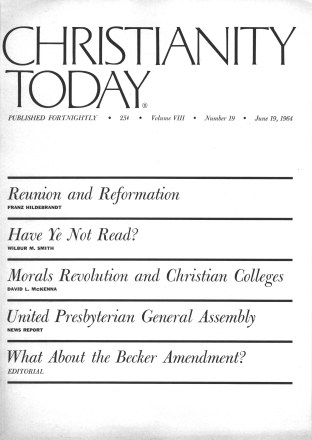
About This Issue: June 19, 1964

What is the nature of the issues that divide Christendom? The Methodist theologian Franz Hildebrandt assesses the current ecumenical trend from a perspective of doctrine and order (see the opposite page).

Wilbur M. Smith stresses the priority of the Bible in the minister’s intellectual life (page 7), and Charles N. Pickell examines the practical emphasis of James’s epistle (page 13).

The House debate over public school devotional exercises prompted one congressman to call it “the biggest thing since the Scopes trial.” For an appraisal of the much-discussed Becker amendment see our lead editorial (page 20).

Our news section features an eyewitness account of the United Presbyterian General Assembly (page 30).

Theology

Current Religious Thought: June 19, 1964

Freedom of religion and civil liberty, it is said, are like Hippocrates’s twins—they weep or laugh, live or die together. For Malta’s 330,000 inhabitants, this is the day of the false choice. The 122-square-mile Crown Colony (which includes the adjacent islands of Gozo and Comino) has two rulers: Britain, which has held it for 150 years, and the Roman Catholic Church, which has dominated it for centuries longer. Britain is eager to grant independence; the hierarchy is fighting bitterly to retain its traditional hold.

The fight became a holy war when Michael Gonzi, seventy-three-year-old archbishop of Malta, flung himself into the 1962 elections, deciding for the faithful that this was no simple choice from among four pro-church groups and the Labour party. “Death to Socialism!” clamored the placards; “Victory to the Roman Catholic Church!” It was pronounced a mortal sin for anyone to read, write for, print, distribute, or advertise in any pro-Labour newspaper. The Labour executives were put under an interdict and cannot receive the sacraments or be buried in consecrated ground.

The ironic truth is, however, that the Labour party is not anti-church. The British Roman Catholic Tablet admits that Labour supporters are not, as has been alleged, “infected by a pernicious materialism,” that many of them had faithfully continued their family religious observances, and that no one had proved that Dom Mintoff, the Labour leader, was teaching errors of faith. (His party seeks to improve appalling social conditions and to establish a proper division of power between church and state.) The Tablet concludes that the church’s present tactics can bring only “the same history of disintegration as Italian Catholicism” has experienced since Pius IX’s time.

The 1962 poll to elect members for the fifty-seat legislature gave Borg Olivier’s

Nationalist party twenty-five seats (42 per cent of the vote) and the Labour party sixteen seats (34 per cent), with the remaining nine seats (24 per cent) divided among three smaller parties. The church had technically won its fight, but it was ominous that in the face of harsh sanctions so many in a population one-third of which is illiterate or semi-literate should have jeopardized their eternal welfare for the sake of fundamental human rights. This brought reprisals: priests were told verbally to question penitents in the confessional about their votes and to exclude from the sacraments those who had voted Labour.

Two years have passed. In preparation for independence (originally scheduled for May 31 this year), the Nationalists drafted a constitution which, inter alia, favors the continuance of the present Roman Catholic establishment. A referendum was held last month on the somewhat vague question: “Do you want the Government’s constitution or not?” Of the votes cast, 54 per cent said Yes, 46 per cent No. However, a policy of abstention and spoilt votes by the three smaller parties (who realized that through priestly influence the issue had been strangely changed into a democracy versus church battle) whittled down the Nationalist backing to a mere 41 per cent. The church’s reign is passing, though it continues to stress salvation and damnation as political alternatives in the hope that Mintoff’s “human freedoms” will lose luster in the perspective of eternity. No one who has visited Malta (I spent several months there) can avoid the shameful significance of cramped and squalid rural communities struggling for existence under the shadow of enormous churches.

What the Labour party resists is the church’s encroachment on the privileges and liberties of the individual. It wants a constitution that would allow people to vote according to conscience, allow a person or party attacked on religious grounds to defend themselves, and give freedom in law for all religious denominations, so that parents could opt out of Catholic religious teaching for their children without the children’s future career being penalized thereby, and so that non-Catholics or outlawed Catholics could be legally married by a magistrate or minister of some other church—a facility not at present freely available to Maltese.

The Labour party merely wants Mother Church to be as reasonable as she is in Britain, the United States, or Italy, but the hierarchy considers that in such lands the church has surrendered to liberalism. “If Peter has lost his purse without starving afterwards,” says a prominent Maltese cleric, “that is no reason why Paul should lose his.” The false choice was again apparent, and the issue further muddled, when Archbishop Gonzi insisted that any new constitution must uphold the church’s claims. “Your bishop,” he said, “will follow the example of many other bishops who sacrificed themselves behind the Iron Curtain.” The archbishop has to work by innuendo at times, for Mintoff has threatened to sue anyone who calls him a Communist.

Despite all this, he would be sorely misled who regards Dom Mintoff merely as an enlightened champion against ecclesiastical tyranny: personal power is far from distasteful to him, and he has declared that he would accept help from the Soviet Union or its satellites if Western aid were to prove inadequate. Both Gonzi and Mintoff are right: Mintoff when he says elections should be free, Gonzi when he retorts that to limit the church’s power will eventually take away its authority altogether.

Saint Paul was shipwrecked on this island and received “no little kindness” at the hands of the “barbarous people.” Nineteen centuries have gone by. Where the Apostle healed the governor’s father, a cathedral now stands—a fact that some might find oddly symbolic. The islanders today are just as kindly, but those now charged with delivering to them the apostolic message have allowed themselves to become diverted, to the neglect of the Divine Commission and of that apostolic humility which seeks exaltation only for Jesus Christ.

A Little War on Poverty

Churches are expected to play leading roles in a pilot project aimed at improving the lot of the poor through credit-union operations, according to Religious News Service.

The project will be initiated soon in the low-income areas of New York, Chicago, and Washington, under auspices of the National Credit Union Association.

Seminars are planned in these three cities, RNS said, in an effort to encourage poor people to begin savings plans. The NCUA, meanwhile, is expected to help local church units organize credit unions.

A priest in Washington, D. C., Father Geno Baroni, is credited with prompting the project. He urged the action in an address to an NCUA convention, and the plan was adopted by that group as “a little war on poverty.”

Of 23,000 credit unions in the nation, approximately 3,000 of them are maintained by church groups. Father Baroni said that between 60 and 70 per cent of these are sponsored by Roman Catholic organizations.

Membership in credit unions across the nation totals 15 million persons. In most cases the unions are organized as a result of employment relationships.

The priest is also working with church leaders, legislators, and credit-union experts in an effort to have some of the program incorporated into the Johnson administration’s anti-poverty legislation. Specifically, as now envisioned, projects such as planned in the three cities would be expanded under the anti-poverty bill as applicable to all poverty pockets in urban areas.

Father Baroni says the credit-union plan among the poorest groups in cities is unique. He asserts that it will be a “mutual self-help” program for the poor and will equip participants with “an economic literacy” inculcated through church and social programs.

“Establishment of a workable credit union among the poor,” he declares, “is an important instrument for translating the social implications of the teachings of the church into everyday reality.”

He describes the projects as getting down to a “bread and butter” issue that will make visible some of the “practicality of the brotherhood of man.”

Protestant Panorama

American Methodism’s only Japanese conference took final action last month to disband and integrate its thirty-one churches into existing regional jurisdictions. The Japanese Methodist churches are scattered across California, Oregon, Washington, and Colorado.

A Lutheran-sponsored experiment in adult education known as the “Minnesota Project” is aimed at exploring how the church can be a more effective instrument in specific areas of daily life. It will extend over two years.

The Swedish Free Church Assembly rejected by an overwhelming majority a proposal that it seek financial support from the Swedish government.

Miscellany

Rabbi Joachim Prinz, president of the American Jewish Congress, and eleven other leaders of the organization were arrested for demonstrating outside Jordan’s Pavilion at the World’s Fair in protest against a mural which they say is anti-Semitic.

The U. S. government was urged to work for another Geneva conference “to consider de-militarization and neutralization, under international guarantees,” of the entire Indo-Chinese peninsula in a resolution adopted by delegates to the annual meeting of the Unitarian Universalist Association in San Francisco last month.

North Park College, operated by the Evangelical Covenant Church of America, announced plans for a $1.65 million construction program on its Chicago campus. A residence hall for 210 women and a campus activities center will be built.

The Supreme Council of the Church of God will recommend that denominational headquarters be moved from Cleveland, Tennessee. Atlanta, Memphis, and Chattanooga were cited as alternatives.

The Rev. Canon Albert J. DuBois, executive director of the American Church Union, charges that President Johnson is violating church law by participating in Episcopal communion services. The high church group official says he has no doubt about the President’s “good faith and sincerity” but that church law restricts communion to fully qualified members and Johnson is not a member.

Conwell School of Theology, located on the campus of Temple University in Philadelphia, produced its first crop of graduates this month. Nine students received bachelor of divinity degrees.

Leaders of nineteen churches and religious communities—Christian, Jewish, and Muslim—joined in a statement condemning South Africa’s ninety-day detention law and urging that it be repealed. The legislation was denounced as “a tragic breach of the principle that there should be no imprisonment without trial.”

Personalia

Dr. Mark L. Koehler named president of Presbyterian-related Whitworth College in Spokane, Washington.

Dr. John W. Bachman named president of Wartburg College (American Lutheran).

Dr. Ronald S. Wallace appointed professor of biblical theology at Columbia Theological Seminary.

The Rev. William R. Crawford, a Methodist pastor, became the first Negro to receive the Democratic nomination for a seat in the North Carolina Legislature since Reconstruction days.

Dr. Martin H. Andrews elected president of the Christian Medical Society.

They Say

“It is more important that people worship than to be concerned about what they are wearing.”—The Rev. Frank Potter, rector of St. Mary’s Episcopal Church, Rockport, Massachusetts, in announcing that shorts and other casual attire will be permitted at summer services.

A Blessing on Baccalaureates

The U. S. Supreme Court issued a significant new ruling this month on the role of religion in public schools. In effect, the court’s action gave a new lease on life to baccalaureate services. But more than that it seemed to serve notice that the court is not intent upon wholesale removal of religion from public life.

The constitutionality of public school sponsorship of baccalaureate services has been seriously questioned since the court’s 1963 ruling against prayer and Bible reading in the classroom. The new ruling, however, shows that school boards that canceled baccalaureate services acted hastily and without warrant.

Veteran observers in Washington interpret the court’s latest order as indicating that it does not intend to pursue enforcement of a stricter line of separation of church and state.

“Constitutional lawyers will get the message loud and clear,” one source predicted. They will readily see, he added, that the court is not about to consider an end to the chaplaincy or even to the removal of the phrase “under God” from the Pledge of Allegiance.

The new ruling came in response to an appeal of a Florida Supreme Court decision that upheld Bible reading and prayer in public schools as well as baccalaureate services, a religious census of pupils, and a religious test for teachers. The U. S. Supreme Court reversed the state court’s ruling on Bible reading and prayer, as expected, but dismissed the appeal on the other matters “for want of properly presented federal questions.”

It was felt especially significant that comments on the order were written by Justice William O. Douglas, in view of the fact that Douglas is known to hold the most extreme view of church-state separation of any member of the court.

His comments, specifically endorsed by Justice Hugo L. Black, asserted that baccalaureate services and the religious census “do not present substantial federal questions, and so I concur in the dismissal of the appeal as to them.”

Douglas said he did feel the religious test for teachers ought to be argued as a substantial question. The “test” consists of the fact that in Florida applicants for teaching positions are required to answer the question, “Do you believe in God?” Religious attitudes are also considered in making promotions.

Justice Potter Stewart, the lone dissenter in the earlier Bible-reading and prayer decisions, “would note probable jurisdiction” of the Florida appeal as a whole “and set it down for argument on the merits.”

Though many observers see this month’s order as a clarification of the court’s intent, others feel that not all anxieties have necessarily been put to rest. These others believe that a test case posed by litigants who persuasively pose a “hardship” brought on by religious exercises might win a hearing from the court.

The Florida case, decided June 1, was taken to the nation’s highest court by four Dade County (Miami), Florida, parents—two Jewish, a Unitarian, and an agnostic.

Their failure to win a reversal from the U. S. Supreme Court on religious exercises in public schools—excepting classroom devotions—may spell a move to reinstate baccalaureate services in localities where the practice has been dropped. It means an opportunity for clergymen and church laymen to prod their school boards to introduce the religious element at appropriate points in the curriculum. There is a widespread feeling that many school officials have misused previous court decisions as an excuse to eliminate religious facets against which they were prejudiced anyway.

Compromise In Congress?

The House Judiciary Committee wound up hearings this month on proposals to override the Supreme Court’s ban on prayer and Bible reading in public schools. More than 150 persons testified before the committee during the hearings, which extended from April 22 until June 3. Informed opinion in Washington was that something less than a Constitutional change such as proposed by Republican Representative Frank J. Becker of New York was in the offing. Sentiment seemed to be growing instead for a congregational declaration on the role of religion in public schools, a declaration that would merely reflect the viewpoint of the lawmakers and encourage religious practices other than daily prayers and devotional Scripture readings in the public schools. A declaration of this nature indicating “the sense of Congress” would not have the force of law.

Pentecostal Landmark

Some 10,000 persons traveled to Springfield, Missouri, to attend the fiftieth anniversary convention of the Assemblies of God, largest Pentecostal denomination in the world. The four-day April meeting featured missionary speakers from around the world and some 170 workshop sessions. No business was conducted and no legislation enacted.

North American Baptist Fellowship

The name of the organization shall be the North American Baptist Fellowship. The purpose of the organization shall be: (a) to continue the gains and values growing out of the Baptist Jubilee Advance program (1959–1964); (b) to make possible opportunities for fellowship and the sharing of mutual concerns; (c) to cooperate with all departments of the Baptist World Alliance. It shall have no authority over any Baptist Church nor undertake any work for which the member bodies are responsible.

Under this definition the majority of Baptists in the United States may soon be brought under a permanent framework of organizational cooperation for the first time in well over a century.

Present plans call for the new structure, the North American Baptist Fellowship, to be composed of the seven Baptist denominations of North America that hold membership in the Baptist World Alliance.1Southern Baptist Convention, National Baptist Convention of the U. S. A., Inc., National Baptist Convention of America, American Baptist Convention, North American Baptist General Conference, Baptist Federation of Canada, and the National Baptist Convention of Mexico. If all seven groups join it would mean a constituency of some 22,000,000 church members.

First to indicate official willingness to join was the American Baptist Convention. In voting endorsement of the new fellowship at their annual sessions in Atlantic City last month, ABC delegates asked for an expansion of its purpose. The convention requests that (b) in the stated purpose be amended to read: to make possible opportunities for fellowship and instruction and the sharing of mutual concerns at the local level as well as at continental meetings.

The whole idea did not fare so well on the floor of the Southern Baptist Convention. SBC messengers voted against the new fellowship, then decided to refer the question to a committee for reconsideration next year.

The other Baptist denominations involved will vote on the measure in coming months. The fellowship will come into being as soon as five bodies grant official approval.

Some Southern Baptists expressed fears that the proposed fellowship would be the first step toward an ecumenical organization. Proponents flatly denied any such intent.

Opposition also developed on grounds that distinctives would be blurred on the local level. Ecumenists, on the other hand, see a projection of denominationalism onto the continental level.

A few Southerners voiced anxieties about “fellowship” with Negro churches. One group suggested the name of “North American Baptist Communications Group.”

The specific tasks of the proposed fellowship are still somewhat nebulous. Dr. Theodore F. Adams, noted Southern Baptist churchman and a leading proponent of the fellowship, says that what it does “would be up to the leaders.” Adams said it could not be called a counterpart of the European Baptist Federation because that group “was tailored to fit their needs.” The EBF coordinates missionary efforts.

One obvious if minor task would be to operate such joint endeavors as the World’s Fair display initiated by the Baptist Jubilee Advance program.

During the ceremonies that climaxed the six-year Baptist Jubilee Advance effort in Atlantic City last month, credit for initiating the idea of the North American Baptist Fellowship was given Dr. C. Oscar Johnson, former president of the Baptist World Alliance. Johnson first suggested a North American BWA arm in 1948. Baptists in the United States have not had a comprehensive cooperative program since the Southern Baptist split in 1845.

Race And Polity

A major storm was brewing among Southern Presbyterian churches this month in the wake of their General Assembly’s action aimed at desegregation.

The Synod of South Carolina, embracing 331 churches with more than 66,000 members, adopted an overture stating that the April assembly “did not have the authority to instruct” presbyteries to receive Negro churches within their boundaries. It asks the assembly to “reconsider its action … in the light of Presbyterian polity and procedure.” In a separate action the synod urged its eight presbyteries to take the Negro churches within their bounds “as soon as possible.”

The overture questioning the assembly’s authority was initiated by the Harmony Presbytery, which earlier voted refusal to comply with the assembly’s order. A presbytery in Alabama also has voted rejection of the request to integrate.

A First In Canada

To the accompaniment of a red-coated Royal Canadian Mounted Police band and choir, 500 leading Canadians assembled in an Ottawa hotel one morning this month for the country’s first national interreligious prayer breakfast.

The Speaker of the House of Commons, Allan MacNaughton, described the gathering as unique and expressed hope that it would become an “annual event in Canada’s Christian calendar.” Officials in the Canadian capital city said there is every likelihood it will.

Religious News Service, reporting on the breakfast, quoted MacNaughton as saying it represented “the best example of the ecumenical force at work in the world today.”

Prime Minister Lester B. Pearson and opposition leader John G. Diefenbaker read the Scriptures. Edmond Michelet, a member of the Constitutional Council of France, and Boyd Leedom, a member of the National Labor Relations Board in the United States, made brief addresses.

One of the Scripture passages included the verse from Psalm 72 reading: “He shall have dominion also from sea to sea.” It was that passage to which the fathers of the Canadian confederation looked a century ago when their country was being named the “Dominion of Canada.”

Leedom said Canada and the United States had been granted an unparalleled opportunity for development of people and resources and must live up to their great heritage. The civilizing force has always been God’s men, he said.

Michelet said all the prophets did not belong to Bible times. He said he considered the work of the International Council for Christian Leadership, with which the prayer breakfast officials are affiliated, to be that of a prophet.

The gathering was a major extension of the Parliamentary breakfast group of members of Parliament. This meets once a month.

Following the breakfast, a seminar on Christian leadership was held under the auspices of ICCL.

Uniform Rainfall

Metsad Gozal, the site of an Edomite fortress destroyed by David around 1000 B.C., yielded some of its secrets to members of a spring expedition jointly sponsored by the Israel Department of Antiquities and the Protestant-oriented Israel-American Institute for Biblical Studies.

The excavations, directed by Dr. Y. Aharoni of the Hebrew University, further revealed that rainfall in the Dead Sea area has changed little since the days of the judges, but that in earlier times it was much heavier. The fort is located at the north end of Jebel es-Sodom, about three miles north of modern Sodom.

Salt sedimentation was found on two levels, indicating that the fort had been covered by rising Dead Sea water on two different occasions: first around 1000 B.C., and again in about the sixth century A.D.

A discovery of particular importance came to light as the excavators uncovered a wall built with a row of timbers between each two rows of the huge stones that made up the lower wall of the fort. This exact type of construction is described by Ezra (5:8; 6:4) as the method of building the walls of the Second Temple in 520 B.C.

150 Route De Ferney

The World Council of Churches is setting up shop in its new headquarters building in Geneva. Staff members moved into their new offices several weeks ago. Construction work continues on a library, assembly hall, and exhibit area. A dedication date has not yet been set.

The new WCC address is 150 route de Ferney. The building, which also houses offices of the Lutheran World Federation and the World Presbyterian Alliance, is located on the north side of Lake Geneva.

Since its inception in 1948 the WCC had occupied a cluster of quaint but rickety buildings on a hill south of the lake.

Songs In Mourning

In life Prime Minister Nehru of India declared himself an atheist. In death, however, persons of many religions paid him tribute. Prior to the start of the funeral procession Hindus, Muslims, Buddhists, and Sikhs chanted prayers, sang hymns, or read scriptures. Some Christians sang “Lead, Kindly Light” and “Abide with Me.” Evangelicals in India will remember Nehru, who died May 27, as the one chiefly responsible in declaring India a secular state with freedom to preach the Gospel (see also the editorial on page 22).

Presbyterians Press Social Claims

The 176th General Assembly of the United Presbyterian Church in the U. S. A. met last month in a spirit sometimes reminiscent of 1776. Below the Mason-Dixon line for the first time in decades, the United Presbyterians announced from Oklahoma City continuing concern with and involvement in the problems of the nation and the world.

For the first time in its history the General Assembly elected a Negro moderator, Dr. Edler G. Hawkins; he was chosen by a 465–368 vote over the Rev. A. Ray Cartlidge. Hawkins, a native New Yorker, has been pastor for twenty-six years of St. Augustine Church in the Bronx, a church which he organized with nine members after graduating from New York’s Union Theological Seminary. The church now has more than 1,000 members. In a nominating speech Attorney J. Vernon Lloyd of Danville, California, said that Hawkins’s election would be “more eloquent than any sermon,” and Dr. Eugene Carson Blake, the denomination’s stated clerk, interpreted Hawkins’s election as indicative of the direction the church wants to go and the measure to which “we have become color blind.”

This diagnosis proved correct. The 841 commissioners of the 3.3-million-member denomination adopted amendments to its form of government that make it a violation of church law for a local congregation to exclude anyone from its membership because of race. Steps were also taken to wipe out racially segregated presbyteries, one all-Indian and some all-Negro, by 1967. The assembly also set a precedent in deciding that its boards and agencies, as well as standing program committees of synods, presbyteries, and sessions, may, after obtaining approval in each instance, become members of non-ecclesiastical agencies to learn from them and work cooperatively with them. This will permit these units of the denomination to participate in and even join various racial organizations and their demonstrations.

The commissioners also issued a call to “all church bodies, pastors, and members of the United Presbyterian Church to re-double their efforts to support and be involved in those groups—church, private, and governmental—that are working to bring about racial freedom and justice.”

The pronouncement of the 172nd General Assembly on civil disobedience—which does not in every instance forbid civil disobedience—was reaffirmed after the assembly was told that in some cases the best way to test the legality of a law was to break it and thereby bring it to the courts for adjudication.

Moderator Hawkins told reporters that he had participated in civil rights demonstrations and would do so again if the necessity arose.

On the last day of the assembly an overture from the Presbytery of West Tennessee reached the floor requesting that the church “refrain from inviting the Rev. Martin Luther King, Jr., and any and all others who share his persuasion to disregard and violate constitutional laws, to speak at its sessions”; the presbytery further requested that the church “remind the Rev. Eugene Carson Blake … to cease and desist from all violations of duly enacted laws of this land.…” The assembly decided to take “no action” on the overture and instead commended “the Rev. Eugene Carson Blake for his courageous action and witness in the area of race relations; … we affirm his right and his duty as Stated Clerk to speak and act in consonance with the pronouncements and actions of the General Assembly.…” A prolonged, dramatic silence greeted the call for the negative vote, indicating the intended rebuke had been turned into a unanimous commendation of Blake for his action in a segregated Maryland park which led to his arrest.

The assembly expressed itself on other social matters: it said that “acute poverty” should be recognized “as a gravely moral issue” in an affluent society where more than five million families live on less than $38 a week, and urged its Board of National Missions “to provide leadership in initiating specific denominational strategies of action against poverty.” The testing of nuclear weapons in the atmosphere was condemned; hope was expressed for negotiations that will ban underground testings; and a summons was issued to all the governments of the world that are not yet signatories of the nuclear test ban. A call was also issued to the United States government “to stimulate world trade for the benefit of the less-developed areas.” Another call was issued to President Johnson to convene a White House conference on community development and housing in order to “focus national attention on the overlooked and unmet needs of urban areas.”

Despite floor protests that it violated the principle of separation of church and state and was utterly unrealistic in our present world, the assembly adopted a proposal that “urges the President and Congress to make preparations for the conversion of our military economy to a peacetime economy and for the retraining that may be necessary.”

The church reaffirmed its position on prayer and Bible reading in the public schools as unconstitutional. Amid spirited opposition the assembly reaffirmed its support in principle of “federal tax aid to public elementary and secondary school systems”; amid even more spirited opposition it declared support for a “program of federal aid to public school systems that would encourage shared-time arrangements to permit students enrolled in private or parochial schools to obtain a portion of their education in the public schools.”

In the area of public housing, the assembly urged the various judicatories of the church “to analyze federally assisted low and middle income housing programs in local communities, and to press for adequate administration and creative use of existing programs to achieve housing on an integrated basis.”

A seven-point proposal on smoking presented by the Commission on Church and Society was adopted; the proposal expresses concern about the health hazard of “widespread use of cigarettes” and misleading advertising, and calls for establishment and support of “withdrawal clinics.” Added to the commission’s report was an amendment that provides a program to educate youth on the hazards of smoking. A floor amendment calling on the assembly to summon the church’s membership to “voluntary abstinence” was defeated.

United Presbyterians contributed almost $298 million to their church in 1963, an increase of $9 million over the 1962 figure. Wide concern was expressed over the spiritual condition of the church, which in 1963 experienced a drop in infant baptisms, in adult baptisms, in church school pupils and teachers, and in students for the ministry. The Standing Committee on Theological Education announced that “84 per cent of our churches do not presently have any candidates for church vocations.”

The Rev. Robert H. Stephens of Summit, New Jersey, retiring chairman of the Commission on Evangelism, declared that the “slipping statistics” might have something to do with the fact that the church, having done all kinds of good things for people, has perhaps “done everything for them except offering them Christ.” He called for an evangelism that pleads for decisions, conversion, and nurture in the Church. Against the claim that “everything we do is evangelism,” he countered, “It ain’t necessarily so.”

United Presbyterians have been conducting a study of the nature of the ministry, including the matter of ordination, for the past six years. A special committee assigned to this study reported that its proposals were “not as radical as the times and the Gospel demand.” Its report also declared that “anyone who has followed” its “interim reports must realize that it intends to recommend to the General Assembly and to the presbyteries a change in the confessional standards of the Church which will modify the legal authority of the West-minister Confession and Catechisms. But at present our Form of Government is basically dependent on those confessional standards and could not be thoroughly revised without revising the Confession as well.”

The report declared, “It is now quite obvious that a congregation-centered parish as an institutional pattern cannot fully meet the needs of an urban society.” To meet the need of a more diversified ministry, the committee suggested only two ordinations: one for the “ministers of the church catholic” and one for “ruling elders.” The ordination of deacons would be eliminated, and ministers who served in “administrative” functions would be called “deacons.” This would make, for example, the church’s stated clerk, Eugene Carson Blake, a deacon.

The whole matter was referred for further study, but it serves to point up the massive theological fermentation going on, not only in the United Presbyterian Church but in many other American churches as well, concerning the nature of the ministry and the Church.

For the first time in its history, the assembly received a Roman Catholic prelate, Bishop Victor Reed of the Oklahoma City-Tulsa Diocese, who greeted the commissioners as “brothers in Christ” and commended the church for its contributions to Christian unity.

In a press conference in which Moderator Hawkins told reporters that the civil rights bill was a “good package of minimums,” he also expressed his desire, as moderator, to see the Roman Pope. He thought it would promote a “climate of spirit, contact, and knowledge of each other” and would be a “tremendous experience.”

The assembly authorized its Committee of Nine to participate in drawing up a plan of union with the Consultation on Church Union. This consultation grew out of the so-called Blake-Pike proposal of 1960 for a united Protestant church, “truly catholic, truly reformed and truly evangelical”: it now includes six denominations, which comprise one-third of American Protestants. In making the authorization, the assembly retained the right to reject the plan “if the bases of the consultation’s proposed plan were later judged unsatisfactory.”

The assembly noted that the Presbyterian Church in the U. S. (Southern) has put to the Reformed Church of America, with whom it is discussing union, the question of “advisability” of expanding this discussion to include the United Presbyterians and other Reformed churches. In view of this development, the assembly decided to select a committee of twelve, if the Reformed Church of America is willing to include the United Presbyterians in its current discussions with the Southern Presbyterians.

In a letter to Southern Presbyterians the 176th General Assembly declared that it has “directed its Commission on Ecumenical Mission and Relations to cooperate with your Commission on Inter-Church Relations and to give fullest attention to these conversations throughout this year and to report back to our 177th General Assembly the conditions conducive to union and that make union imperative now.”

Methodist Merger

The African Methodist Episcopal Church, in a resolution adopted at its quadrennial General Conference in Cincinnati last month, called for speedy completion of plans for merger with two other Methodist Negro bodies. They are the African Methodist Episcopal Zion Church and the Christian Methodist Episcopal Church. The AME Church, with some 1,500,000 members, is the largest of the three. The Zion Church has 770,000 communicants and the CME, about 450,000. Present union plans have a target date of 1968.

Meanwhile in Indianapolis, where the Zion Church was holding its quadrennial session, an invitation to merge with the Evangelical United Brethren Church and The Methodist Church was extended by Bishop Reuben H. Mueller, EUB president. The EUB Church has 758,000 members, and The Methodist Church has 10.2 million.

Toward ‘A Brighter Sunday’

A disgusted commissioner at last month’s Church of Scotland General Assembly was heard to lament: “Fancy spending two hours discussing a piffling subject like the Sabbath when there are far more important things on the agenda.” To which could have been made the crushing retort of the small boy told that millions of people in China would be glad to have those prunes: “Name one!”

With perhaps one exception, no other item during the assembly’s nine-day deliberations raised as much interest as the Christian use of Sunday, included in the report of the Church and Nation Committee. The convener, the Rev. John R. Gray, is always good value, and as usual he went straight to the heart of the matter. His committee had again been widely misunderstood. The report (published in advance) did not advocate a continental Sunday, nor did it seek to revise the Westminster Confession. Mr. Gray then made an extraordinary attack on Britain’s most popular daily, which is owned by an aged peer of Canadian origin. “I would not wish to spoil anyone’s eighty-fifth birthday,” he cried, “but that man’s newspaper has grossly and persistently misrepresented the report.” (Next morning that man’s newspaper unrepentantly said that if it owed Mr. Gray an apology it was “for being too slow in catching up with his shifting attitudes.”)

The convener said his committee could find no warrant in Scripture for the prohibition on any day of the week of quiet and healthful recreation involving no labor for other people, nor for the transfer of regulations applicable to the Jewish Sabbath to the Christian Lord’s Day.

Evangelicalism is not always happy in its spokesmen on such occasions, but in this case what was said from that viewpoint was said cogently, winsomely, and with biblical authority behind it. The significant feature was that the speakers were not (as might have been expected) from the more conservative Highlands, but were Lowlanders, and of the younger generation. They pointed out that what Mr. Gray’s report dealt with was a strict legalistic Sabbath which simply does not exist in Scotland. Whatever church and nation were suffering from, said the Rev. George M. Philip of Glasgow, it was not a rigid Sabbatarianism that was strangling true religious life. The committee, he alleged, “paints a picture of the population slaving day after day and being denied a breath of air and a moment of ease at the weekends.” Thus, in the name of pleasure, Sunday with all its moral and spiritual significance was disappearing from the lives even of church members. The Rev. Eric Alexander of New-milns charged the committee with trying to become in the report as little different from the world as possible, and added: “That policy has consistently failed since Lot tried it in Sodom.”

The report nevertheless won the vote. Despite Mr. Gray’s disclaimers to the contrary, subsequent newspaper headlines showed unmistakably what editors had understood, and what readers will understand, from the assembly’s approval: that the Kirk had given its blessing to “Sabbath golfers” and to “a brighter Sunday”—whatever that means.

Another row blew up over an innocent-looking deliverance wherein the Inter-Church Relations Committee invited the assembly to “welcome” the continuance of informal meetings with Roman Catholics in Scotland. Dr. Harry Whitley (who proudly quoted an ex-moderator’s description of him as “the greatest non-theological factor in Church disunity”) wanted the meetings merely “noted,” because they had profoundly disturbed many ordinary people. He was rash enough to quote John Knox, a predecessor of his at St. Giles’. That was enough to bring the heavy artillery of a line of former moderators to bear against him, in the name of “charity.”

One of them, Dr. A. C. Craig, famous for his 1901 Vatican visit, said that critics of the meetings who thought Presbyterians were selling the pass “simply do not know what is going on.” It was an unhappily worded statement, for much of the criticism derives from the fact that the meetings concerned are held in secret. Then, incredibly, Dr. George MacLeod, as staunch an ecumenist as ever set foot on Iona, rose to support Dr. Whitley, who, he revealed, had even asked the Roman Catholic Archbishop of Edinburgh to preach in his pulpit. The debate moved along intriguingly till the professional Protestants took a hand and predictably ruined their case by gross overstatement, making the assembly “welcome” the meetings after all.

Another tense debate evolved when a young minister, the Rev. J. L. Scott, moved “that the assembly instruct the Panel on Doctrine to investigate the issues involved in Church members who are under vows to Christ, being members also of societies involving secret ceremonies and secret binding oaths.” He frankly admitted that he was thinking especially of the Masonic Lodge, but disclaimed any animus against it—and no one who heard his engagingly candid speech could sense any prejudice.

Disclosing that some of the most loyal members of his own congregation were Masons, he pointed out that the Church of Scotland had never given guidance to men who had no way of knowing what the vows were before they came to take them. Pressure was often put upon young ministers to join, with the suggestion that here was a way to get alongside men. “Ought we who have been set free by Jesus Christ,” he asked, “to risk our liberty by entering on such vows?” Masons might argue that their vows included nothing incompatible with civil, moral, or religious rights—but that was the assurance of Masonry. The Christian looked to his church for guidance, because “for a Christian there is nothing that cannot be brought to Christ’s standard of judgment.”

After some discussion in which several elder statesmen of the Kirk confessed and defended their Masonic links and asked the house to reject Mr. Scott’s proposed investigation, the vote substantially favored him. A piquant factor is that the Panel on Doctrine charged to carry out the enquiry is about equally divided, for its convener and half of its members are Masons. The panel will report at next year’s assembly.

The assembly had earlier: elected Dr. Duncan Fraser of Invergordon as moderator in succession to Professor James S. Stewart: set up a special committee to consider the possibility of directing ministers because of the Kirk’s 140 vacant charges; declined to set up another special committee despite Dr. George MacLeod’s customary eloquent plea to review the issues raised by modern war; heard that the new notorious incident of the nude at last year’s Edinburgh Festival was merely “a silly piece of pretentious vulgarity”; and heard from its Foreign Missions convener that for the second year in succession no minister was in training at the Kirk’s missionary college.

Meanwhile, across the street in the Free Church Assembly the new moderator, the Rev. Angus Finlayson of North Tolsta, attacked the national Kirk’s attitude to Sunday, saying she had shirked her duty, “capitulating to the clamour of the age and to the claims of the modern mind.”

Regarding the ecumenical movement Mr. Finlayson said: “The Pope has assumed the role of a director of traffic. Not long ago we commemorated the Reformation and its leaders … who in their day directed religious traffic … back to God and his Word. Now Rome is rerouting the creedless churches of Christendom back to what she regards as the one true church, and foremost in the van are those who but a short time ago vied with us in celebrating the liberty won for them by the Reformation.” The Free Kirk Assembly was further enlivened when the chair in which sat the assistant clerk collapsed and he was deposited on the floor. He was unhurt.

J. D. DOUGLAS

Books

Book Briefs: June 19, 1964

When To Pad The Expense Account

Ethics in Business, by Thomas M. Garrett, S. J. (Sheed & Ward, 1963, 190 pp., S3.95), is reviewed by Clarence Bauman, assistant professor of theology and ethics, Mennonite Biblical Seminary, Elkhart, Indiana.

This book is written on the assumption that in principle everyone favors business ethics. Its purpose is to inform those who know most about ethics of the realities of business, and to assist those in the business world in developing moral principles that are rationally valid and realistic.

The author introduces the dilemma of business ethics by a descriptive analysis of the conformist whose failure to assume personal responsibility is ascribed to the popularized Freudianism and behaviorism characterizing our age of the “buck-passer.” Moral failure is blamed on either the environment, irresistible impulses, or complex unconscious drives, while social adjustment and conformism are proclaimed as the new gospel of the American way of life. Consequently, for the company man ethics and morals are reduced to an uncritical acceptance of the social standards and mores of his firm, which soothes the conscience of its employees with the comforts and security of the corporation setup. In so doing the corporation cultivates a pseudo-scientific contempt for free will and moral obligations by a scrupulous avoidance of any form of suffering, sacrifice, or self-discipline. To compensate for this personal demoralization, corporations provide medical plans, model homes, and even neckties bearing the corporate insignia, to provide a pseudo self-respect for one’s identification and a feeling of social community.

The flight from personal responsibility is accelerated by the mechanization, rationalization, and automation of management decision and by the absence of public consensus on moral issues. To avoid undue conflict with either reformers, liberals, or conservatives, business enterprise assumes as little social responsibility as possible, and for the rest does what is profitable. To temper this indictment of corporation enterprise, the author finds comfort in the fact that the Harvard Business Review at least pays lip service to higher ideals, even if only as a result of enlightened self-interest.

The author devotes a chapter to man, business, and society, and their centrality in determining notions of responsibility. He concludes with the observation that a corporation best serves the public welfare when it serves its own long-range interests.

Perhaps the most theologically rewarding chapter is the one on the meaning of work. We are told that work is not a penal activity nor a means of human perfection, though in itself it is not an obstacle to holiness. Apart from being a means of earning a living, work is seen as collaboration of man with the Creator to restore the world to harmony. On this assumption the author grapples with the problem of how to transpose the discontent, drudgery, frustration, and meaninglessness of much of labor—such as advertising cosmetics, selling toy balloons, or peddling whisky—into the ideal; how to convince man of the cosmic significance of his work when he realizes the futility of the values for which he labors.

The reader is overwhelmed with the enormity and difficulty of inspiring some degree of moral discernment relevant to business practices when price-fixing, bribery, and cheating are so common that an honest man of the old-fashioned sort seems a rarity in a moral atmosphere “in which honesty itself has largely become a question of convenience, expediency or social conformity, rather than a matter of principle” (p. 64). Not infrequently the author endorses broad mental reservation in preference to outright falsehood, as in the case of the junior executive who plays cards rather well but is instructed by his superior to lose so as to gain a client’s good will. Father Garrett advises that when the expense is for the benefit of the company one’s conscience need not be disturbed over “padding” the business expense account.

The book opens up numerous other areas of moral ambiguity, such as (a) the problem of psychic privacy in a nontherapeutic situation in which the corporation for motives of profit violates the personal dignity of the employee by psychological tests that force him to reveal the inner secrets of his personality as the price for being hired; (b) the widespread use of the computer, operated on the assumption that the ultimate goals of men can be expressed mathematically; (c) the awesome success of economic brainwashing by persuasive advertising techniques; and (d) the problem of waste and planned built-in obsolescence essential to an economy whose growth depends on increase in consumption.

In all this the author points to the need for a professional code of business ethics so as to encourage internal checks and balances in preference to government control. He himself has provided in the appendix two such tests to rate one’s integrity quotient.

In conclusion, Father Garrett directs attention to the religious dimension on the grounds that “enlightened self-interest and purely rational considerations are often not enough to move men to virtue.… In short the certitudes of faith are needed to complete the work of ethics” (p. 174). Charity is advocated as “the antidote for a spirit of calculating obedience,” as “the force that breathes life and holiness into the decisions of mere men” (p. 175).

This book is an elaboration of the theme “that ideals must be aided by prudence lest good will destroy itself” (p. 22). But there is no mention of the more radical question whether being in Christ actually means accepting our involvement in the sinfulness of the economic order as our destiny; whether the real task of Christian ethics is merely to console ourselves with the inevitability of compromise as a prerequisite to human existence and civilization. There is nowhere a hint as to the spiritual significance of the poverty of Christ for those whom he instructs not to fear the threats (including economic threats) of this world, nor to be tempted by its wealth. The voluntary poverty of Jesus and Paul might inspire Christians to subordinate the material aspects of life to the spiritual. But when the Church is caught up in a society in which acquisition of wealth is the chief criterion of success, this is not likely to happen. And treatises on business “ethics” that assume the dissociation of economic interests from kingdom presuppositions are part of this moral ambiguity.

CLARENCE BAUMAN

True Story

Angel at Her Shoulder, by Kenneth L. Wilson (Harper & Row, 1964, 256 pp., $3.95), is reviewed by E. H. Hamilton, missionary, Presbyterian Church in the U. S., Taipei, Taiwan, Free China.

Although this story reads like fiction, it is certainly true. The reviewer has for nearly twelve years worked in Formosa alongside that little “ball of fire” Lillian Dickson and her equally remarkable husband Jim Dickson. And although the reviewer has made frequent trips into the high mountains and to the leprosarium and other places with the Dicksons, this book reveals many things about this intrepid couple that even he did not know.

It is almost unbelievable what God has done through these two dedicated lives to “preach good news to the poor, to proclaim release to the captives.” Of Lillian and Jim Dickson, as of King Solomon’s court, it might be said, “The half has not been told!” But Kenneth Wilson has told a fascinating story. This book will certainly become a best-seller in the religious field.

E. H. HAMILTON

Shocking Nonconformist

Laughter in Heaven, by Henry C. Whitley (Revell, 1964, 189 pp., $3.50), is reviewed by J. D. Douglas, British editorial director, CHRISTIANITY TODAY.

It was generally considered an extraordinary choice when ten years ago Harry Whitley went to St. Giles’, Edinburgh. Brought up in the Catholic Apostolic Church (he wrote a biography of Edward Irving), he engaged in pioneer youth work in the Edinburgh slums, then entered the ministry after coming under the spell of George MacLeod.

Whitley’s first parish was in industrial Port Glasgow, and much of his book is concerned with the fifteen years he spent there. The location is Scotland, but the account of a minister’s dealings with his people is for all places and times. He writes with humor and pathos, discernment and compassion. He quotes an old gate-man’s comment that is not irrelevant to the present decline of the Clyde shipyards: “Once iron men came in here to build wooden ships, today wooden men come to build iron ships. Once men came here to build ships, now they come to collect pay pokes [i.e., envelopes].”

After a short ministry in Partick, where he scandalized the fashionable by dirtying his hands painting dreary tenements and consorting with the poor, he was selected for John Knox’s pulpit in Scotland’s mother church. It has not tamed him. “It is now my solemn conviction,” he announced on one memorable occasion, “that there can be no renewal of Christ’s Church in Scotland until the powers of the Woman’s Guild are considerably curtailed, and their purpose and existence severely scrutinized and criticized.” The resultant furor could be paralleled only if some Republican pundit attacked the raison d’être of the DAR.

The continuing pressure on him to conform must be tremendous—he said himself that at St. Giles’ there were temptations to sell his soul that honors might come—but he is still the fearless crusader. There is something of the showman about him, and he displays no small conceit of Harry Whitley on occasion; but readers of this entertaining biography will love the man. His criticism of the current talks with Roman Catholics in Scotland carry the greater weight because in his first parish he had the local priest as a close friend. Dr. Whitley is, moreover, that rare bird: a critic in high places who realizes that a verification of one’s references is a necessary condition of the luxury of outspokenness.

J. D. DOUGLAS

To Write A Better Bible

Reason in Religion, by Nels F. S. Ferré (Nelson, 1963, 336 pp., $7.75), is reviewed by David H. Freeman, chairman, Department of Philosophy, University of Rhode Island, Providence.

In this book, Ferré seeks to determine the relation between reason, primarily conceived of as man’s ability to order and direct experience, and religion, understood as the conviction that there are harmful or beneficial powers beyond ordinary experience.

The four main sections of the book deal with reason as related to God, to man, to history and nature, and to the world religions. Reason enables faith, as the distinctive function of religion, to avoid error and inconsistency. It teaches us that God stands out from all finite things as the ground, power, and purpose of the cosmic process of development. The nature of what is beyond ordinary experience is, however, best seen in human life and history, the highest manifestation of which is found in the life, teaching, death, and resurrection of Jesus, called the Christ. For although we cannot know how well Jesus knew God, and although the historic details of the Resurrection are confused and tangled, nevertheless, through Jesus, God came to be understood as unconditional, universal, eternal love.

God is the companion of persons and community. As an objectified realm, creation is in God; and yet it is also qualitatively external to God. It is grossly unfair to man and unworthy of God to believe that death settles man’s fate once and for all. It may be that every life that God has created will be perfected before any life can reach its destiny in God. In any case, however, the notion of an eternal hell is to be rejected; the nirvana of Buddhism is in fact closer to Christ than is the doctrine of eternal punishment.

To make room for its universal message of love Christianity must undergo a radical reformation of the faith. It may be possible to maintain a continuity of institution. However:

Certainly we should send to the slaughterhouse mythological Christianity, and dare to put the knife unshrinkingly even to our own ideological son of traditional Christianity. We must heed the Jewish and Muslim protest in the name of genuine monotheism and declare once for all that we do not worship Jesus of Nazareth [p. 313].

Dr. Ferré regards the New Testament as a “mixture of high and holy faith and truth, on the one hand, and uncritical mythology, on the other …” (p. 310).

The critical question remains, namely, how does Dr. Ferré know how to separate the mythological from what is true and holy? The spirit of Dr. Ferré may pant “to write better Scriptures for a new age” (p. 314), but the rejection of the work of the Holy Spirit results in a speculative cafeteria-style religion in which anyone is free to select whatever is regarded as of ultimate concern.

The God that Dr. Ferré would have us worship is not the God revealed in the New Testament but the product of his own imagination.

DAVID H. FREEMAN

Three Myths?

The Teaching of Contempt: Christian Roots of Anti-Semitism, by Jules Isaac (Holt, Rinehart and Winston, 1964, 154 pp., $4), is reviewed by James Daane, editorial associate, CHRISTIANITY TODAY.

The strength of this book derives from the virtues of the author and the sins of the saints. The late Jules Isaac was an accomplished French historian, and his treatment of anti-Semitism carries the weight of his profession. But what makes the book even more uncomfortably forceful is the mass of Christian anti-Semitism that it adduces, and the telling way in which Isaac uses the admission of many Christians that the New Testament records are replete with contradictions and distortions. He further disturbs the Christian conscience by the reminder: “A true Christian cannot be an anti-Semite; he simply has no right to be one.”

Isaac sees three main roots of Christian anti-Semitism of which after careful historical research nothing remains, he says, except the perversity of the habit. Isaac admits that any decent theology must, in interpreting history, go beyond history. But he insists that the Christian theology which sustains the myths of anti-Semitism does not go beyond but rather violates the facts of history.

The first historical myth that fosters anti-Semitism is the Christian theological insistence that the Diaspora following the destruction of Jerusalem in A.D. 70 is a punishment of God upon the Jews for crucifying Christ. Isaac dismisses this by pointing out that the Diaspora had been going on for centuries before Christ and that as a matter of fact a considerable number of Jews remained in Palestine long after A.D. 70.

The second myth is the Christian theological contention that the religious life of the Jews during the time of Christ was in a degenerate state. Isaac insists that it was, on the contrary, marked by a high virility. He cites religious writings from the time and sees in the recently discovered information about the Essenes additional proof of spiritual virility.

The third myth is the theological contention of Christians that in crucifying Christ the Jews became guilty of deicide (killing God) and that they are therefore a people under a divine curse. The facts, says Isaac, are quite the opposite. Jesus never claimed to be God. He was crucified with the cooperation of a few renegade Jews, but chiefly by the decision of Romans who feared his messianic claims and who, unlike the Jews (who were eager for them), regarded them as a political crime. Further, it is “ridiculous and unintelligible” to charge Jews with deicide, he argues, for the unshakable foundation for belief in one God came from the bosom of the Jewish people. Nor could the illegalities of Jesus’ trial as recorded in the New Testament be true, for they are, says Isaac, simply contrary to Jewish procedure. Since illegalities are illegal, they cannot occur. This is as convincing as the assertion that six million Jews were not exterminated in Nazi Germany because that would be immoral.

Isaac’s argument that the Romans were the chief promoters of the Crucifixion is also unconvincing, since he admits that Jesus hid his messianic claims. Moreover, it leaves the Crucifixion of Christ without motivation. The argument that the Romans bear chief responsibility for the Crucifixion of Christ is unconvincing as long as no adequate motivation can be found in the Romans for desiring the Crucifixion.

The author wields what many people will regard as a heavy argument when he urges that the sin of a few renegade Jews cannot be laid upon the Jewish people as a whole.

Isaac docs not succeed in eliminating all the historical factors on which he thinks anti-Semitism to rest. Hence in the end the matter turns on theological interpretation, specifically on how one thinks of Christ. If he is the Son of God, then the sin of killing the Son of God stands. If he is the Son of God, then the Jewish religion only revealed the degeneracy of its virility in crucifying Christ. If he is the Son of God, the One who can act for others and through whom God deals with all men, then the ground falls away from the insistence that the sin of a few Jews could not bring punishment upon a whole people and that the Diaspora could not be a divine punishment on the whole nation.

Little remains of the force of Isaac’s argument except that derived from the anti-Semitic sins of the saints—which is plenty. Indeed, Isaac is often right. It did take the extermination of 6,000,000 Jews, 1,800,000 of whom were children, to awaken the Christian conscience about anti-Semitism. And he often turns profound Christian beliefs against the Christian, as when he urges that Christians are not concerned with the sins of others (Jewish guilt for the Cross), and when he reminds us that Jesus prayed forgiveness for his slayers and that Jesus, according to Christians, died not only for Gentiles but for all men.

This book, written by Isaac when he was eighty-five and his first translated into English, should help quicken the Christian conscience about the evil of anti-Semitism. It will show Christians that after almost 2,000 years they have not yet made clear that Jews are under judgment, not for the Crucifixion, but for rejecting the crucified and living Christ who comes to them in the preaching of the Gospel. Readers of this book will find it hard not to listen sympathetically to this man, a man whose wife said to him as she and most of his family went to death at the hands of the German Nazis, “Save yourself for your work; the world is waiting for it.”

JAMES DAANE

Caught In The Middle

The United States and the Middle East, edited by Georgiana G. Stevens (Prentice-Hall, 1964, 184 pp., $3.95; also paper, $1.95), is reviewed by Francis Rue Steele, home secretary, North Africa Mission, Upper Darby, Pennsylvania.

“No policy is poor policy” might well serve as a candid description of the United States’ early approach to the problems of the post-war Middle East. That the situation needs correction and is undergoing change is the thesis of this book published by the American Assembly, Columbia University. The purpose of the assembly, as stated in the introduction of the book (p. 8), is to provide materials for discussion in order to “help an informed public make up its mind about American policy.” Seven volumes have already been issued, six in revised editions, on other aspects of American policy.

The present book opens with an introductory chapter by the editor. This is followed by six chapters entitled, “Middle East Background,” “Social Modernization: The New Man,” “Economic Modernization,” “Regional and International Politics in the Middle East,” “The Arab-Israeli Conflict Today,” and “United States Policy and the Middle East,” by such experience observers as William Sands, William R. Polk, A. J. Meyer, J. C. Hurewitz, Harry B. Ellis, and Richard H. Nolte respectively. This slender volume is a mine of pertinent facts clearly and simply presented. Benefiting from their vantage point in time, the writers set events over the past score of years in the Middle East in perspective alongside similar developments elsewhere around the world. Here too we find the breakdown of European control leading to the founding of many smaller political units often ill-prepared to manage their own affairs apart from outside advice and assistance. Inevitably these new countries are drawn into the conflict for control of man and markets engaging the West and East in what is known as the cold war.

In the Middle East three main factors—American inexperience, the anomaly of Israel, and the tension of Arab versus Muslim loyalty—have made resolving American interests with local aspirations exceedingly difficult. For some years American policy seemed characterized by inexpert attempts to “line up” followers from among the newly emerged countries by threats and bribes. Ignorance and inexperience were perhaps largely responsible for such actions as the United States moved into the power vacuum created by the withdrawal of British and French influence. As often as not, well-intentioned plans produced enemies rather than friends. Certainly a vacillating policy could produce only confusion, even among friends. It would appear, then, that further illumination from an outside source might indeed be helpful. (Mr. Polk alone of the contributors is in government service, and he only since 1961.)

The conclusion that is reached by the writers is that, first of all, a plain, positive policy must be developed which is farsighted and feasible. Then it must be applied with firmness and understanding by men of stature and skill. It is encouraging to discover that these writers find significant improvement in the conduct of American foreign policy.

For reasons of political, economic, and even missionary concern on the part of America’s evangelical Christians, this book should be studied carefully as an aid in interpreting present and future developments in one of the world’s most crucial spots—the Middle East.

FRANCIS RUE STEELE

The Latter-Day Saints Today

The Latter-day Saints in the Modern Day World: An Account of Contemporary Mormonism, by William J. Whalen (John Day, 1964, 319 pp., $5.95), is reviewed by J. K. Van Baalen, author of The Chaos of Cults.

Behold the latest—and by that token in many respects the best—book on the Latter-day Saints. It is free from passion, ridicule, calumny. The early history of the “Saints” was such that many of the older books, both pro and con, contained much of all this. Like Christian Scientists and Jehovah’s Witnesses, the Saints of today prefer to ignore most of their early history, which certainly gave occasion to firm opposition though not always to the manner in which the opposition was manifested. Quite objectively the author relates the main facts of the Saints’ history. The bulk of the book, however, describes the Saints as they are and operate today. (Incidentally, the name Mormon is now accepted by the Utah Saints but is rejected by the other followers of Joseph Smith, who are dealt with in a brief chapter. As to the original “scholarship” of the movement, Smith interpreted the word “Mormon” as meaning “more good” and claimed that it was a combination of English and Egyptian.)

The Mormons have a president whose “power rivals that of the Pope” (the reviewer thinks excels would be the better word, since the president is free to announce an infallible “revelation” at any time and all by himself—a power that neither the Pope nor the president of the Witnesses possesses). They have twelve apostles, a council of seventy, a patriarch, presiding bishops, “stake” presidents, ward bishops (i.e., non-salaried pastors), and a two-fold priesthood. They are, in short “probably the most elaborately organized and disciplined religious structure of modern times.”

In this fantastic and huge organization Dr. Whalen sees both the strength and the weakness of the Mormons—their strength because it affords an unequaled hold upon the membership and because every Mormon’s ego is flattered with an ecclesiastical office and resounding title: a boy (only!) becomes a deacon at the age of twelve, an elder (lowest rank in the lower or Aaronic priesthood) at eighteen or nineteen. There are an unlimited number of priests, and the ideal of every loyal Mormon is to become a high priest—and to become a “god” in the hereafter.

The earlier Adam-God doctrine is no longer held; but that our God was a man upon some other planet before coming to this earth is now held and taught. The heresy of a Trinity consisting of a flesh-and-bones God the Father, a similar God the Son, and a Holy Spirit who is “a personage of spirit” is still taught today, as the thousands who hear the free lectures on Temple Square know.

A strong point of the Mormon organization is that it is virtually impossible to get anywhere in Mormonism without a recommendation from the local bishop, and that once this has been obtained, the president himself makes the appointment to the office.

The leading Mormons are immensely rich (there are 300 millionaires) and have controlling interests in the stock of huge business corporations owned by the church. The income of the church is well over a million dollars per day.

Other strong points of the Saints are their solidarity, their truly unequaled sacrifices for the church, their high standards of morality and ideal concept of family life (in spite of the fact that polygamy, now not mentioned, remains an essential point of doctrine), and their welfare program. And they are growing in political influence.

Dr. Whalen’s book gives the first (so far as this reviewer knows) authentic description of the secret rites in the twelve temples: 47,745 “ordinary” baptisms plus 2,566,476 ordinances for the dead in 1962! It also describes the six lessons whereby converts are made.

Weaknesses of Mormonism are said to lie in their antagonistic attitude toward Negroes; in their flimsy training of missionaries; in their insistence that they are “the only Church” (in a more and more ecumenically minded age); and in the incongruity between their tremendous drive toward college and university education and their simultaneous insistence upon the impossible myths that underlie the system.

Here, then, is an important and excellent volume. The author of The Chaos of Cults humbly and gratefully admits that he has learned much from Whalen’s book.

One or two minor flaws in this superb book are that the author is so objective that he remains totally silent on the unethical methods whereby the Mormon hierarchy acquires farms and the like in states where they are numerically strong, and that he is also silent about First Corinthians 15:24, upon which the farce of “baptism for the dead” is based and of which Professor Jean Cadier has proposed a simple and (to the reviewer) satisfactory exegesis.

But what are these amid so much that is good? Every church library should have at least one copy of this book and keep it circulating among its membership.

J. K. VAN BAALEN

Hazardous Occupation

The Pastor’s Wife and the Church, by Dorothy Harrison Pentecost (Moody, 1964, 316 pp., $3.95), is reviewed by Thea B. Van Halsema, author of Glorious Heretic and This Was John Calvin.

The girl who marries a minister finds her “full-time job in the work of the church … the most hazardous and dangerous occupation a woman can have.… Only the best adjusted … and thick-skinned will ever come through the experience emotionally and mentally unscarred.” But “I feel sorry for anyone who is not a pastor’s wife.”

Running the gamut of these feelings, Mrs. Pentecost shares her own twenty-five-year experience and covers in practical fashion everything from one’s calling and training to children, counseling, clothes, and calories. The book is intended also for congregations, but its greater value would seem to be for young women facing life in a parsonage or still in the first years of this experience. Seasoned pastors’ wives may find it interesting to compare their experiences and convictions with those of Mrs. Pentecost, as well as to re-evaluate their goals and the use of their time.

No two congregations are alike, nor are any two ladies of the manse. It remains for each pastor’s wife, novice or experienced, to chart her own course prayerfully so that her service to her family and her church will be as effective and enduring as she can make it.

The basic things, fortunately, do not vary. “The greatest reward that a minister’s wife can have is to know that she is needed, trusted, and looked up to as a godly woman who knows the Word and has power with the Lord in prayer.”

THEA B. VAN HALSEMA

Paperbacks

Council Speeches of Vatican II, edited by Hans Küng, Yves Congar, O. P., and Daniel O’Hanlon. S. J. (Paulist Press, 1964, 288 pp., $1.25). The only primary documentation now available from the Second Vatican Council; contains key speeches of considerable interest.

The New Group Therapy, by O. Hobart Mowrer; The Roots of Consciousness, by David C. McClelland (Van Nostrand, 1964, 262 pp., 219 pp., $1.95 each). Though the titles might suggest something else, these are extremely interesting books.

The Significance of the Synoptic Miracles, by James Kallas (Seabury, 1961, 118 pp. $3). The author strives for a theology of miracles and protests modern attempts to “demyth” them. He believes the New Testament must be understood on its own terms, and he writes in the no-nonsense fashion of a man who has miles to go before he sleeps.

Nuclear Disaster, by Tom Stonier (World, 1964, 226 pp., $2.45). A scientist writes on the “unthinkable”: what would happen if a twenty-mega ton bomb fell on a great American city. His sobering answer to this terrifying question describes the attack, the aftermath, and the legacy of nuclear attack.

Reformation Europe 1517–1559, by G. R. Elton (World, 1963, 349 pp., $2.95). A quite readable account of the religious and theological history of the Reformation by an author the book identifies but little.

Christ’s Preaching—and Ours, by Michel Philibert (John Knox, 1964, 55 pp., $1). A study of the difference and similarity between preaching and teaching in the “preaching” of Jesus. Translated from the French.

Handbook for Church Weddings, by Edward Thomas Dell, Jr. (Morehouse-Barlow, 1964, 64 pp., $1.50). Much practical advice by an author who regards weddings as a kind of worship service.

Marx and Engels on Religion, introduction by Reinhold Niebuhr (Schocken Books, 1964, 382 pp., $1.95). First printed in 1957.

The Holy Bible (World, 1964, 1021 pp., $1.95). The King James Version in a quality paperback.

The New Morality, by Arnold Lunn and Garth Lean (Blanford Press [London], 1964, 154 pp., 5s.). A discussion in strength and depth of the nature and consequences of the current revolt against Christian morality. The authors contend that once the revolt is at full swing in a nation, the nation can last no longer than a generation.

Book Briefs

Temples, Tombs, and Hieroglyphs: The Story of Egyptology, by Barbara Mertz (Coward-McCann, 1964, 349 pp., $6.95). A chatty, popular story of Egypt chiefly in terms of archaeological research.

Focus on Prophecy, edited by Charles L. Feinberg (Revell, 1964, 256 pp., $3.95). A discussion of biblical prophecy as it relates to the Jews, to the Gentiles, and to the Church.

Luther’s Works, Vol. 27: Lectures on Galatians 1535, Chapters 5–6, 1519, Chapters 1–6, edited by Jaroslav Pelikan (Concordia, 1964, 441 pp., $6). In addition to chapters live and six of the lectures Luther delivered on Galatians in 1531, this volume contains all six chapters of the discourses he based on the same book of the New Testament almost fifteen years earlier.

Concise Dictionary of American Biography, Joseph G. E. Hopkins, managing editor (Scribner’s, 1964, 1,273 pp., $22.50). Each of the 14,870 articles of the original many-volumed Dictionary of American Biography is presented in concise form in this single volume. A very valuable and useful reference work, limited by the consideration that it includes no one who died since 1941.

The Art of Staying Happily Married, by Robert W. Burns (Prentice-Hall, 1963, 223 pp., $3.95). By the famous “Preacher of Peachtree Street” who has counseled thousands of couples on the art of marriage.

Evangelism in the Acts, by C. E. Autrey (Zondervan, 1964, 87 pp., $2.50).

The Child in the Glass Ball, by Karin Stensland Junker, translated by Gustaf Lannestock (Abingdon, 1964, 256 pp., $4). A courageous mother’s story of hope for retarded children.

Intermarriage: Interfaith, Interracial, Interethnic, by Albert I. Gordon (Beacon Press, 1964, 420 pp., $10). A very extensive survey of the problems of, possibilities of, and attitudes toward intermarriage in the United States.

Bernard of Clairvaux, by Henri Daniel-Rops, translated by Elizabeth Abbott (Hawthorn, 1964, 232 pp., $4.95). An interesting account of an interesting man.

Living with Myself, by William E. Hulme (Prentice-Hall, 1964, 160 pp., $2.95). Informative reading on how to get along with yourself.

The Elect Nation: The Meaning and Relevance of Foxe’s Book of Martyrs, by William Haller (Harper & Row, 1963, 259 pp., $5). The purpose of this book is to show how Foxe’s Book of Martyrs led the English to regard themselves as the Elect Nation on whom all history converged, and how it became the pivot for molding the future history of England and America. Scholarly and interesting.

Mary Mother of All Christians, by Max Thurian (Herder and Herder, 1964, 204 pp., $4.75). A Reformed Protestant monk discusses the biblical texts delated to the life of Mary and thus provides a book in which Protestants will learn what they have in common, and what they do not have in common, with Roman Catholic Mariology.

Reprints

Jesus the Master Teacher, by Herman Harrell Horne (Kregel, 1964, 212 pp., $3.50). The author, best known for his opposition to John Dewey’s progressive education, discusses not the content but the form of the teaching of Jesus. Foreword by Milford F. Henkel. Date of first printing not given.

In Christ: The Believer’s Union with His Lord and The Ministry of the Spirit, by A. J. Gordon (Baker, 1964, 209 pp., 225pp., $2.95 each). Evangelically sound, stylistically very good; by the man who gave his name to Gordon College and Gordon Divinity School. The first was published first in 1872, the second in 1894.

Man’s Most Dangerous Myth: The Fallacy of Race, by Ashley Montagu (World, 1964, 503 pp., $7.50). A scientific analysis and evaluation of race. First published in 1942.

The Spirit of Protestantism, by Robert McAfee Brown (Oxford, 1961, 264 pp., $5). The kind of writing that invites reading, elicits both approval and disapproval, and thus stabs the Protestant into self-discovery.

Ideas

What about the Becker Amendment?

No question before the country today, with the possible exception of the civil rights issue, goes deeper constitutionally and religiously than the proposed Becker amendment. If volume of mail is an indication, this so-called prayer amendment is for many citizens of greater importance than the civil rights bill. And while, as in the latter case, heightened feelings make it an explosive issue, substantial constitutional and moral problems are likewise involved. The need is to see the central issues behind the pejorative slogans of some proponents and some opponents of the amendment.

Simplistic solutions, based upon emotional responses to partial knowledge, can hardly provide adequate answers to questions on which thoughtful, patriotic, and godly Americans differ. Nor should weighty constitutional and legal problems inhibit discussion. The Supreme Court is an august body, entitled to respect. But it is not infallible, and criticism of its actions is an American privilege. Therefore, it is incumbent upon informed Christian citizenship to take time to ask and answer the question, “What about the Becker amendment?”

The proposal of such an amendment stems from two recent Supreme Court decisions—the first, ruling against the action of the New York State Board of Regents in composing and promoting a non-denominational prayer for use in the public schools of the state; the second, ruling against the devotional reading of the Bible and the repetition of the Lord’s Prayer in public schools in Pennsylvania and Maryland. The former opinion (delivered June 25, 1962) stirred greater immediate reaction than the latter (delivered June 17, 1963), although the court’s reasoning against a state-composed-and-promoted prayer seems subsequently to have been better understood than the more subtle argument against the prescribed practice of reading a short portion of the Bible without comment and repeating the Lord’s Prayer. The dissatisfaction of many with other decisions of the court and the concern of large numbers of religious people about the trend toward secularism in public education have probably contributed to the unpopularity of the prayer and Bible-reading rulings. Many thousands believe that the Supreme Court placed a taboo upon the Bible in public schools and banished God from them. Out of the chorus of opposition to the action of the court has come the call to correct it by amending the first article of the Bill of Rights. Of the large number of amendments proposed—more than 150—attention during the hearings before the House Judiciary Committee this spring has been focused upon the one submitted by Representative Frank J. Becker of New York, H.J. Res. 693.

Many people, representing various shades of theological convictions and including numbers of evangelicals, are supporting the amendment. On the other hand, leaders (evangelicals also included) of virtually all major Protestant denominations are opposing it. And, as the hearings have been extended because of the many asking to testify, important principles are becoming clear.

The opinions in Engel v. Vitale (the Regents’ prayer case) and Abington School District v. Schempp (the Bible reading and Lord’s Prayer case, which includes Murray v. Curlett) comprise a book of 151 closely reasoned pages. Questions of constitutional law, political science, history, philosophy, education, and religion are involved. But this is not to say that the debate is beyond the comprehension of the layman in these fields. It is an American principle that the ordinary citizen is capable of coming to valid conclusions upon important and difficult issues and of expressing these conclusions through the ballot and free speech. That clergymen, lawyers, educators, and others are testifying and being widely reported means that an important process of education is going on.

What, then, are some main considerations relating to the Becker amendment? And in the light of them what conclusions accord best with evangelical conviction?

To begin with, it is necessary to know what the Supreme Court in Engel and in Schempp did and what it did not do. It did rule unconstitutional a state-composed-and-promoted prayer and state-prescribed devotional exercises consisting of Bible reading and the Lord’s Prayer, even though pupil participation was officially voluntary. It so ruled on the ground that no state agency has any business setting official forms of worship. And it also concluded that, because of the readiness of children to conform and because of the weight of official sanction of such worship, the option of voluntary participation was invalid.

But the court did not banish God from the schools nor sanction atheism. It did not remove all prayer and Bible reading from the public schools. It went out of its way to declare that “religion has been closely identified with our history and government,” and it reaffirmed the court’s recognition (when in Zorach v. Clauson it supported released-time religious education in New York City schools) that “[we] are a religious people whose institutions presuppose a Supreme Being” (cf. Mr. Justice Clark’s Majority Opinion in Schempp). Moreover, it asserted “that one’s education is not complete without a study of comparative religion or the history of religion.… It certainly may be said that the Bible is worthy of study for its literary and historic equalities. Nothing we have said here indicates that such study of the Bible or of religion, when presented objectively as part of a secular program of education, may not be effected consistent with the First Amendment” (Majority Opinion in Schempp). The court based its action upon a strict concept of neutrality. “The place of religion in our society is an exalted one, achieved through a long tradition of reliance on the home, the church and the inviolable citadel of the individual heart and mind.… In the relationship between man and religion, the State is firmly committed to a principle of neutrality” (Majority Opinion in Schempp). Those who agree with the court approve its strong interpretation of the establishment clause of the First Amendment and believe it has done both religion and the state a service in keeping the two apart.

Yet there are many who, for various reasons, do not agree with the court. For them its actions are incompatible with our national religious heritage and tradition, unrealistic in failing to see the impossibility of neutrality in education, and constitutionally questionable in the application of the First to the Fourteenth Amendment; they see the decisions as a long step on the road to secularism and as an absolutist interpretation of the First Amendment. Such objections are not inconsiderable. It may be that in its zeal to preserve a strict separation of church and state the court has fallen into a kind of absolutism and that its application of the First to the Fourteenth Amendment will not bear close historical scrutiny. And it may also be that its emphasis upon religious neutrality has loaded the scales for secularism and that the removal of the recognition of God through formal devotional exercises is a deprivation. Perhaps the court ought not, as some say, to have ruled on the cases. But it did rule, and the practices it removed from the schools were religious practices.

Consider now the remedy proposed in the Becker amendment. Its advocates see in it a means for correcting the court, and the right of the people to amend the Constitution is indeed beyond question. Section I is not so much an authorization of prescribed devotional Bible reading and prayer as a removal of limitations upon them. Thus it would open the door in our religiously pluralistic society to a variety of state-prescribed devotional exercises. Section II anticipates possible future decisions against the practices it specifies. Section III states that the practices from which the amendment removes limitations are not an establishment of religion.

What are some objections to this proposed remedy? First of all, the fact that in our national history no amendment to the Bill of Rights has ever been adopted bespeaks the need for greatest caution. The article to be amended with its precise definition of church-state separation stands as a unique American contribution to government, basic to our most precious liberties and worthy of being preserved intact.

Again, by removing present limitations upon state-prescribed religious exercises, Section I of the amendment is dangerous. Under it there is nothing to prevent such practices as the devotional reading of the Bible and the Book of Mormon (in Utah and Idaho, for example) or the recitation of the “Hail Mary.” Moreover, Section I offers only a piecemeal rather than a basic remedy, and its voluntarism is not a true option in view of the pressure of conformity and of official sponsorship of prescribed devotions. As for Section II, it may well be unnecessary because of the court’s idea of permissive accommodation of certain aspects of religion to education, as in Zorach, and because of Mr. Justice Brennan’s recognition of this in concurring in Schempp that “there may be myriad forms of involvements of government with religion which … should not in my judgment be deemed to violate the Establishment Clause.” Among these involvements he mentioned military chaplaincies and prayers in legislative bodies.

Congress shall make no law respecting an establishment of religion, or prohibiting the free exercise thereof.…

From the First Amendment to the Constitution

‘The Becker Amendment’

Section 1. Nothing in this Constitution shall be deemed to prohibit the offering, reading from, or listening to prayers or biblical scriptures, if participation therein is on a voluntary basis, in any governmental or public school, institution, or place.

Sec. 2. Nothing in this Constitution shall be deemed to prohibit making reference to belief in, reliance upon, or invoking the aid of God or a Supreme Being in any governmental or public document, proceeding, activity, ceremony, school, institution, or place, or upon any coinage, currency, or obligation of the United States.

Sec. 3. Nothing in this article shall constitute an establishment of religion.

Sec. 4. This article shall be inoperative unless it shall have been ratified as an amendment to the Constitution by the legislatures of three-fourths of the several states within seven years from the date of its submission to the States by Congress.

What, finally, about evangelical response to questions posed by the Becker amendment? It is our opinion that, in view of the peril of weakening the classic expression in the First Amendment of our religious liberty, in the light of what the Supreme Court did in Engel and Schempp to maintain (overstrict though it may have been) full separation of church and state, and in consideration of the weaknesses of the proposed amendment, it does not merit support. While we recognize that other evangelicals feel differently, nothing in the present debate has changed our position respecting the unconstitutionality of state-prescribed devotions in public schools (see editorials in the July 20, 1962, and the August 30, 1963, issues of CHRISTIANITY TODAY).

Yet there are aspects of public education today that cause evangelicals deep concern. Chief among them is the steady undertow of secular naturalism that is manifest in much educational philosophy and practice and that may well violate the neutrality concept upon which the ruling in Schempp was in good part based. Indeed, the question has yet to be settled whether secular naturalism in public education infringes upon the free-exercise clause which balances the establishment clause of the First Amendment. We believe that Christians who stand for strict church-state separation in public schools should protest secular naturalism as a trespass upon their right to bring up their children in the nurture and admonition of the Lord. As the Committee on Religion and Education of the American Council on Education stated in 1947: “To vast numbers of Americans the denial of the supernatural in the classroom is a negation of their faith and to make such denial is to bring religion into the schools with a vengeance.… Religious people have every right to resent and resist an attack on their faith in the name of academic scholarship.”

We also believe that an effective mitigation of the trend to secularism may be the development of public school courses in the literary and historical study of the Bible, as suggested by the Supreme Court. To those who consider such teaching useless, evangelicals reply that the Word of God is not bound and that no school board or teacher can nullify God’s promise that his Word will not return unto him void. Let evangelicals, therefore, lead in urging public schools in their communities to teach the Bible as literature and history.

Another means of withstanding the trend to secularism may be shared time, which offers a collaboration between religious schools and public schools that, according to competent legal authority, may be constitutional and that in some communities is already being practiced.

The challenge is for us to lengthen the cords and strengthen the stakes of Christian education. Education is a total process. The public school, though essential, is not the whole of it. Equally and even more essential are the home and the church. Furthermore, it is a constitutional right for parents able to do so to choose independent Christian schools for their children. What is needed is a renewal of educational commitment in home, church, and Christian elementary and secondary schools. The Supreme Court decisions and the debate on the Becker amendment are a summons to responsible evangelical interest in and support of public schools, which remain a bulwark of democracy, and a spur for evangelicals to back wholeheartedly and sacrificially the agencies of Christian education open to them.

Jawaharlal Nehru

In Jawaharlal Nehru a giant figure passes from the scene, and a particularly agonized sector of this planet knows a profound loneliness.

In retrospect the man and his career seem to form a concatenation of contradictions. Educated at Harrow and Cambridge, the handsome, cultivated, and sensitive Indian once said: “I have become a queer mixture of East and West, out of place everywhere, at home nowhere.”

Molder of modern India and her prime minister for the seventeen years since independence, he tirelessly fought British dominion and spent years in British jails, but he scolded the Indians for not being more like the British.

He loved peace and was dedicated to the non-violence doctrine of his beloved leader Mahatma Gandhi; yet he used troops in Goa, Kashmir, Hyderabad, and Junagadh.

His friendliness toward the giant Communist powers that menaced his borders was coupled with hostility toward Indian Communists, hundreds of whom he jailed.

While maintaining his doctrine of nonalignment with Communist and Western power blocs, he asked for American and British help in India’s struggle to resist Chinese invasion.

He was an aristocrat who became a socialist, but he moved from a doctrinaire Marxism to become a pragmatic planner who accorded a significant role to private enterprise.

In religious and superstitious India, he was a devotee of reason. He studied many religions—Christianity, Hinduism, Islam, Buddhism—and pronounced himself an agnostic. At one time he sought to point India from extreme religiosity to science. But in 1961 he spoke often of the need for “spiritual solutions” to India’s problems. “Yes, I have changed,” he told an interviewer. “The emphasis on ethical and spiritual solutions is not unconscious; it is deliberate.… I believe the human mind is hungry for something deeper in terms of moral and spiritual development without which all the material advance may not be worthwhile.… The old Hindu idea that there is a divine essence in the world, and that every individual possesses something of it and can develop it, appeals to me.”

In 1954 Nehru suggested a restriction on the number of foreign Christian missionaries that has reduced missionary personnel in India by about 20 per cent, but he often reminded Indians of the need for religious freedom. “Christians are as much Indians as anyone else,” he said. “They must have full opportunity,” he added in the course of condemning a movement that demanded Hindu domination. His advocacy of a curb on Christian missionaries, particularly in border areas, was politically motivated, he said, noting that foreigners were looked upon with suspicion in certain areas.

But if Nehru’s actions frequently did not fit into logical compartments, neither did the staggering immensity of India’s problems, which he made his own. He sought to leap the centuries without benefit of a totalitarian state, shunning the role of dictator that some tried to thrust upon him. He sought unity for a country terribly divided by sects, castes, languages, tribes, and clans. It seemed at times that only the mystique of his own person prevented the shattering of a brave show of unity.

Upon his successor, Lai Bahadur Shastri, falls an awesome burden as a subcontinent, and even Asia itself, hang in the balances. Lacking Nehru’s towering personal stature, he now must face the problems of poverty and disunity within and the problems of China and Pakistan without. Their resolution is in grave doubt. But he may swing his country closer to the West. And the West could breathe a sigh of relief that it would not be dealing with former defense minister Krishna Menon, left-leaning neutralist who was toppled from power by the Chinese invasion—a curious benefit from a dastardly act.

Pandit Nehru once proposed his own epitaph: “If any people choose to think of me, then, I should like them to say: ‘This was a man who with all his mind and heart loved India and the Indian people. And they in turn were indulgent to him and gave him of their love most abundantly and generously.’ ”

The Last Battle In Asia?

It is hard to see how the United States can avoid more direct intervention in the prolonged, bloody struggle for South Viet Nam.

“The battle in Viet Nam is the last one in Asia,” says the foreign minister of South Viet Nam, Phan Huy Quat. “If the misfortune happened to the free world of losing it, then even the ultimate sanctuaries, such as India and Japan, would be of little strategic value.”

Unfortunately, the current strategy for ridding South Viet Nam of Communist guerrilla forces seems inadequate. The new government in that country apparently realizes that victory entails a combination of military, political, economic, and social programs. But real progress continues to elude us.

Thus there emerges, on the one hand, agitation for more aggressive tactics to root out the guerrillas. On the other hand, an alternative—to accede to the demands for so-called neutralization—is what Secretary of State Dean Rusk rightly regards as “a formula for surrender.”

A particularly distressing aspect of the situation is the apathy of our allies toward possible loss of Viet Nam. The United States is again left holding the bag. Even the Vietnamese themselves apparently manifest some measure of indifference. One wonders to what extent the American image abroad has contributed to this apathy and unconcern.

Transcending The Meaningless

Twentieth-century man is not the same as the man of the sixteenth or the fourth century. If sixteenth-century man was driven by the anxiety of sin and guilt, twentieth-century man is haunted by a sense of meaninglessness that drains all purpose and joy from his life. Sin, like most other things, has a history, and in the process sinful men have changed.

The distinguishing mark of twentieth-century man is his sour and bitter view of human life. Many intellectuals, among them novelists, playwrights, social critics, and philosophers, regard life as a disease and human existence as a curse. They accept Jesus’ assessment of Judas’s life as their own, convinced that it would really have been better had they never been born. And masses of unreflective people instinctively regard the struggle of their lives as an aimless journey from an erratic sexual act to a final nothing.

Modern men are paying the price for refusing to take sin seriously. The bitter price is to read evil, irrationality, and death into the fabric of human life.

No view of life takes sin more seriously than the Christian view. Yet Christianity regards evil as an additive, something with which man has contaminated life but something God can and does remove through Jesus Christ. Thus the Christian can admit the full dimensions of evil and yet greet life with an affirmative attitude. For him to be alive is a blessing, a divine gift to be enjoyed. Life is a good thing. At the heart of reality is a transcendent divine goodness that created the world good and is greater than all its acquired sin and evil. The Christian with the Psalmist, therefore, sees the growing grass as a sign and guarantee that the mercy of God endureth forever. At the altar of redemption he sees room in the divine grace for the sparrow, for at the altar of God the sparrow finds a place to build her nest and raise her young. Even the existence of the sparrow is good—how much more human existence!

In a recent issue of the Manchester Guardian Weekly, Anthony Burgess assesses Franz Kafka. Kafka in his novels is said to present us with the public symbols he wrought out of the lonely agony of his inner life to purge the nightmare of his soul. Yet these projections of his private agony are not a “pilot for our pain” leading us into the harbor of redemption. Kafka, as Burgess admits, never found the harbor of Christianity but died alone in his sea of private darkness. It is not true—as Kafka’s own life demonstrates—that the nature of our sin and evil must first be learned from such artists as he, and that only then will the answers of revealed religion be understood. Our sin and loneliness can be understood only within the Christian faith. Outside it, they appear as darkness, not light, and only confuse and mystify. They do not lead to redemption. Until evil is seen in the light of God’s creation and redemption of the world, our abortive agonies and struggles are viewed as the very fabric of man’s life and world, a view that excludes redemption and ends in bitter cynicism.

Only within a Christian understanding of evil can life be accepted as good.

Theology

God’s Only Way Is Also Man’s

One of the inescapable facts of the Gospel is that God had no other way to redeem men than to send his Son into the world for that specific task.

From this proceeds the second inescapable fact, that man has no other way of salvation than through faith in the work of God’s Son.

Basic to these two is the fact and nature of sin and its effect on mankind. That sin is an offense against a holy God and that it separates man from his Creator is self-evident. But the magnitude of the offense can be judged only in the light of the magnitude of the cost of redemption, and of God’s love that made it possible.

Many observations can be made about the Cross. Viewed from God’s standpoint, it is the focus of his cleansing love. But man must see it as an instrument of torture and death, and if he is to see himself as he is he must see on that Cross the perfect, pure, and holy Son of God.

There is no meaning in the Gospel until we realize the necessity of judgment. To minimize the enormity and universality of sin is to miss completely the witness of Scripture and the nature of the unredeemed heart. Not for nothing did Paul argue about justice and self-control and future judgment as he witnessed to Felix.

Let us make this plain: We are talking about God’s only way to save the sinner and about the sinner’s need to recognize that he has no alternative but to accept God’s way.

Our Lord categorically said: “No man cometh unto the Father, but by me.” The Apostle Peter affirmed the same truth—“Neither is there salvation in any other: for there is none other name under heaven given among men, whereby we must be saved” (Acts 4:12).

Man’s obligation is not to look for another means of salvation but to receive God’s means—his only means.

It seems unfitting to speak of God as facing a dilemma, but it can be reverently assumed that God was confronted with just that—either to let man be irrevocably alienated from him or to offer his Son as the means of cleansing, forgiveness, propitiation, and redemption.

And it is certainly fitting to say that man’s dilemma is his own inability to save himself and the necessity of receiving God’s love, mercy, and forgiveness in the person of his Son.

Damnation is no longer a popular word, except on the lips of the profane. But Scripture is too clear about the ultimate end of the unrepentant to ignore what it has to say. If the wages of sin is death, if the state and end of the sinner is separation from God, if the choice is heaven or hell, then surely we need to find out what God says about these things and what he has done on man’s behalf.

We are confronted with a dual situation. God had no alternative but to send his Son. Man has no alternative but to accept this gift. Much of man’s indifference stems from his failure to realize what God has done and why he did it. Not only so, but man is faced with the necessity of accepting in faith that which he is unable to explain.

The appeal to faith is not a subterfuge; it is the sole means by which God’s dilemma and man’s only hope can be brought into focus. Some deplore any position that leaves no alternatives, but life is full of such situations.

If the Scriptures are to be taken as authoritative in matters of faith and practice, then even a casual search will show that God’s love and redemptive plan are offered to man as his only way out.

If there were an iota of capriciousness in the divine offer of salvation, if there existed even the suggestion that the way is not plain or that it is only partial, either in provision or effect, there might be room for human argument.

But the offer of forgiveness is universal, and its effect is universal to all who will accept. That man should carp about the necessity of accepting God’s gift before it can become his is one of those perversions of human nature that can be resolved only by the Spirit of God.

The finality of Christ as God’s way to redeem man can be denied only by denying the revelation of his love and mercy.

Christ has no legitimate competitors, nor are there other sources for man’s relief. Christ precedes and transcends all others. At no time in human history has he not been “standing in the shadows” as the One who is, who was, and who is to come. He is and always has been the determining factor, and in his own time he will ring down the curtain of human history and merge time with eternity, of which he has always been a part.

On the one hand, had God had some other way whereby to overcome the power of sin, it is reasonable to think he would have exercised it. At the same time, the fact that the Bible reveals no alternative for man but to accept redemption on God’s terms and in his way should put an end to quibbling and lead men to receive joyfully that which is spoken of as “such a great salvation.”

Man’s view is so infinitesimal within the panorama of eternity that he should realize the futility and perverseness of questioning God’s plan. That God has abundantly revealed this to men makes any questioning all the more irreverent and foolish.

The writer once heard a scholar declare: “I refuse to try to ‘get by’ on the basis of what you claim Christ did for me.” That refusal was his privilege, as it is the privilege of men of all times, but this in no way invalidates what Christ did on Calvary or the fact that the salvation effected there is God’s only way for man.

Again we are thrown back on the height and depth and breadth of man’s need and the transcendent fact that Christ meets that need to the fullest.

A correspondent recently questioned our right to speak of God as having “concern” for sinful man, saying that because he is sovereign such a word is out of place. But is “love” out of place in speaking of him? Can we not speak of his mercy? Of course we can, and when we say God was and is “concerned” about man we are reflecting the overwhelming thought that this “concern” went the limit to provide a way out for man.

Confronted, then, with God’s only way, how can we do less than accept that way as our only hope? This is the very antithesis of legalism. It is accepting as fact that for our need there is a solution—one solution—and that God’s “whosoever” includes us and every other sinner.

We readily admit that there are deep mysteries in the sovereign grace of God. It could not be otherwise. Paul caught the temper of the unregenerate in these words: “Nay but, O man, who art thou that repliest against God? Shall the thing formed say to him that formed it, Why hast thou made me thus?” (Rom. 9:20).

We are confronted with two amazing truths: God provided the only way of redemption, his Son and his Cross; and man too has an only way, God’s Son and his Cross. Thus we find that God’s only way is also man’s—and it leads to an eternity with him.

addApple PodcastsDown ArrowDown ArrowDown Arrowarrow_left_altLeft ArrowLeft ArrowRight ArrowRight ArrowRight Arrowarrow_up_altUp ArrowUp ArrowAvailable at Amazoncaret-downCloseCloseellipseEmailEmailExpandExpandExternalExternalFacebookfacebook-squarefolderGiftGiftGooglegoogleGoogle KeephamburgerInstagraminstagram-squareLinkLinklinkedin-squareListenListenListenChristianity TodayCT Creative Studio Logologo_orgMegaphoneMenuMenupausePinterestPlayPlayPocketPodcastprintremoveRSSRSSSaveSavesaveSearchSearchsearchSpotifyStitcherTelegramTable of ContentsTable of Contentstwitter-squareWhatsAppXYouTubeYouTube