Eutychus and His Kin: January 4, 1963

Resolutions

If I may claim your courtesy,

I ask that you would print for me

In January, Sixty-Three

For all my Eutykin to see

These New Year’s resolutions.

(The uses of publicity

May underwrite a guarantee

Correcting the fragility

Of resolutions framed by me.

Resolves should gain longevity

When printed for posterity.)

I should resolve to give up Cokes

And buying books and telling jokes;

I should resolve to answer mail

The day I get it, without fail;

To count my calories and weigh

The consequences every day;

To take a break without a snack

And learn to drink my Sanka black.

Domestic duty calls for action:

Some traces of dissatisfaction

Appear in notes in which the author

Describes her plans for kitchen tile, or

(What strengthens my resolve the most) her

Concern that I should fix the toaster.

The faucets leak, the stove is stuck,

The kitchen drain is clogged with muck;

It is apparent that, in fact,

The only way to keep intact

Monogamous alliance is

Repairing home appliances.

Resolving, it is plain to see,

Will be my job for Sixty-Three,

For other areas arise:

Before I lay in my supplies

To mend my fences near and far,

I must put Esso in my car—

And then resolve to moderate

That itching to accelerate;

To view with Christian charity

The driver just in front of me,

And tolerate the lead she gains

By Dodging action in two lanes.

On second thought, or third, I see

No profit from your courtesy.

The list is long and will not finish

For numbering will not diminish

The unending mending required.

Resolution is no solution

For a Happy New Year!

Racket And Ricochet

I have read with interest the feature article … by the Rev. Glendon E. Harris (Nov. 23 issue) entitled: “The Quietest Racket in America”.…

Everyone knows that transient men and families apply to the churches for help and crooks of all kinds thrive on this kind of “charity,” but the fact is that so many young ministers forget when they enter a community that they are not only the pastor of a church but a member of the community itself and should learn what its total resources are to meet human need. Certainly the minister knows where the doctors and lawyers are and can seek their aid when necessary. Why, then, is he not aware of the service available from the regularly constituted social agencies? Unless it be a very small community, there will be a Community Chest or its equivalent, and the agencies coordinated in it are skilled and able to handle human physical and social problems.

The Family Service, the Salvation Army, and many others are ready and willing to interview the applicant for aid and sift out the true from the false, thus saving the minister not only time but money.…

Dallas, Tex.

Located at the junction of U. S. Highways 66 and 166, our little town (population 4400) has more than its share of professional transients.…

Several experiences convinced us that an infinitesimal percentage were truly in need. However, we too … had “rather be swindled a dozen times than turn away one deserving case”.…

However, a joint project was inaugurated with the Salvation Army and the local Police Department (who welcomed the solution).

It works like this: Each minister in town has instructions to sent all transients to the City Hall (Police Station). There, the Officer on duty has the authority to provide a meal, groceries, gasoline, or lodging (no cash!). He does this by making arrangements on the phone, charging the amount to either the Ministerial Alliance or The Salvation Army. (We furnish about two-thirds of the budget.) A limit is set on the amount the officer can charge without getting permission from the President or Vice-President of the Alliance.

The officer fills out a card on the applicant while he is at the station. This discourages the “pro” from returning.

The plan has several advantages: (1) The ministers are freed from personal “touches.” (2) The transient can only “work” one minister since we all send him to the same place. (3) It screens out people in trouble with the law. (4) It provides a “clearing house” which is open day and night. (5) It gives the minister an opportunity to deal with the individual, but the final decision on material help rests in the judgment of a police officer, a person who isn’t easily “taken.” (6) The churches do the bulk of the financing.

In order to replenish the transient fund, all cooperating churches observe “Ministerial Alliance Day” once a year. A special offering is received in each church on that Sunday.…

First Baptist Church

Baxter Springs, Kansas.

True, there is a racket of this type, and I have been taken in several times. To magnify this thought seems to say that we should shut out mercy to those in need.

Very often social agencies have residence requirements before persons passing through can be helped. Others who could help are suspicious. What is a person in need to do when even church people and church denominations warn against helping?

Even if those in need are to be considered enemies, St. Paul tells us, “If your enemies are hungry, feed them.”

First United Presbyterian Church

Paulding, Ohio

We first tried a committee of laymen to cope with the problem. This worked fine for local needs, but was unsatisfactory for those traveling. We still have the committee for purposes of helping local people.

The best solution I have known of is cooperation with the local police. Out ministerial alliance and the police cooperate in this matter here. The police hold and administer a fund furnished by local churches and civic clubs to help those traveling who have a legitimate need.…

Pittsburg Baptist

Pittsburg, Calif.

The Wisdom Of Joseph

I was shocked when I read in the article, “Israel’s Favorite Game” (Nov. 23 issue), that “Aseneth was the daughter of Potiphar, wife of Joseph.…

According to every copy of the Bible that I have, and after consulting my commentaries, I find every one states that Joseph’s wife was the daughter of Potiphera (Gen. 41:45). Joseph had his troubles with Potiphar’s wife (Gen. 39:1 ff.). He surely did not marry her daughter.

First English Lutheran Church

Pittsburgh, Pa.

• Reader Wentz is correct. In the same sentence the spelling of the name of Joseph’s wife should have been “Asenath.”—ED.

To find such keen interest on the part of the general public in any part of the world in a Bible contest is really a sensation! I have read about these … contests in the secular papers but nowhere did I detect the fact that this contest aroused popular interest comparable to interest in the World Series.…

Rochester, N. Y.

Distinctions

The Review of Current Religious Thought for November 9 by Addison H. Leitch … on “distinctions” … expresses my sentiments exactly. However, I predict a cold reception for this article on the part of many. Some time ago I preached on the subject “Protestant Biblical Distinctives and the Second Vatican Council.” Awaiting me at the door was a lady who said, “May God forgive you for all those horrid things you said. That was the most narrow, bigoted, pharisaical thing I have ever heard.… Both (Rome and the Protestants) of us will have to give up a little (for effective ecumenism), but we should be willing to do it!”

As for Dr. Leitch, should my prediction come true, I know he will take heart. As for me, I do not care to give up Sola Scriptura and Sola Fide for the Papacy and the Mary cult.…

Sugar Hill, N.H.

Baiting the Pope can be almost as “great fun” as burning heretics.

Does it occur to Dr. Leitch that one who “thinks on the Man of Galilee” might consider it unworthy to comment on the separation of Christians in a flippant tone? Dr. Leitch talks about being aroused to “cynicism and a certain sadness.” His comments, however, reveal more cynicism than sadness, and an attitude for which—to the extent that we all share it—we should pray for forgiveness.

Chairman

Humanities Division

Wabash College

Crawfordsville, Ind.

I am in agreement with Dr. Leitch that truth must be broadcast and error exposed; however, I think it can be done in a conciliatory, informative, comparative and gracious way. I had a Catholic friend read this article who is very concerned about prayer, God’s will, etc., and he felt very hurt by the non-serious fun-poking as he considered it to be.

I am at present studying in a Roman Catholic university and would like to present various articles to various faculty members from time to time, with a view to their ultimate enlightenment and conversion.…

Chicago, Ill.

Only On Sunday

Recently I noticed a moving picture title, “Never On Sunday.” I knew nothing about this picture except its title. During October (Oct. 26 issue) an article by this name appeared in CHRISTIANITY TODAY … to stress the importance of the Lord’s Day. Now I believe in the Lord’s Day and keeping it; but as I read this article, I thought of how often Christians do things only on Sunday, that God would have them do every day.…

Our life has been so secularized that the only time the majority of Christians seem to have time for religious education is … Sunday.…

It is rather unusual today to hear Psalms or hymns on week days. Much of our worship is only on Sunday.… Wouldn’t the average deacon’s or elder’s wife be startled if she heard her husband singing “Holy, Holy, Holy, Lord God Almighty, early in the morning our songs shall rise to Thee,” as he shaved or prepared to leave for work in the morning.…

At church, on Sunday, prayer is offered for ruler, nations, missionaries and many other needs. Sometimes a small percentage of the Sunday group gathers to pray in the middle of the week, but for the most part … only on Sunday.…

To get right down to brass tacks, perhaps our title should be “Only In Church.” The language of the church, the hymns of praise, the open Bible and prayers are beginning to seem out of place except in the church, and even there only on Sunday.…

The Calvary Bible Baptist Church

Monroeville, Pa.

Marx And Marxism

Many students of Communism would take exception to Lester DeKoster’s “The New Face of Marxism” (Oct. 26 issue). Two of [his] ideas need careful scrutiny.

The first is the notion that Soviet-Sino style Communism has lost its appeal to “uncommitted” peoples. This theory is misleading.… Communism has never appealed to a majority in any nation. Rather, Communism has been imposed from the top down.…

Mr. DeKoster’s picture of Marx also needs correcting. Among phrases quoted and coined in discussing Marx are … “basically humanist” and “passion for righteousness.” It is true that Mr. DeKoster has dealt with the false Marxist claims to humanism, but it is unfortunate that he has left uncorrected the above … concept of the man Marx. Leopold Schwarzschild’s Karl Marx: The Red Prussian … draws heavily on Marx’s correspondence with Engels in supporting his description of the bigoted and bitter hater of mankind that was the person Karl Marx.…

Manchester by the Sea, Mass.

Church leaders should: (1) quit grouping together all the anti-Communists from the opportunists and die-hard segregationists to the real patriots; and (2) enter into an all-out effort to show that the love of God is a better reforming agency than the doctrines of class hatred and liquidation of Marx and Lenin.

First Presbyterian

Elsinore, Calif.

Disciples Convention

Thank you very much for the excellent article (“Disciples Battle Integration Problems,” News, Oct. 26 issue) interpreting the whole convention.… It certainly was a fair report of exactly what happened at the meeting.

I read your magazine with great interest … and have enjoyed many of the articles in the recent months of crisis.

President

International Convention of Christian Churches (Disciples of Christ)

Indianapolis, Ind.
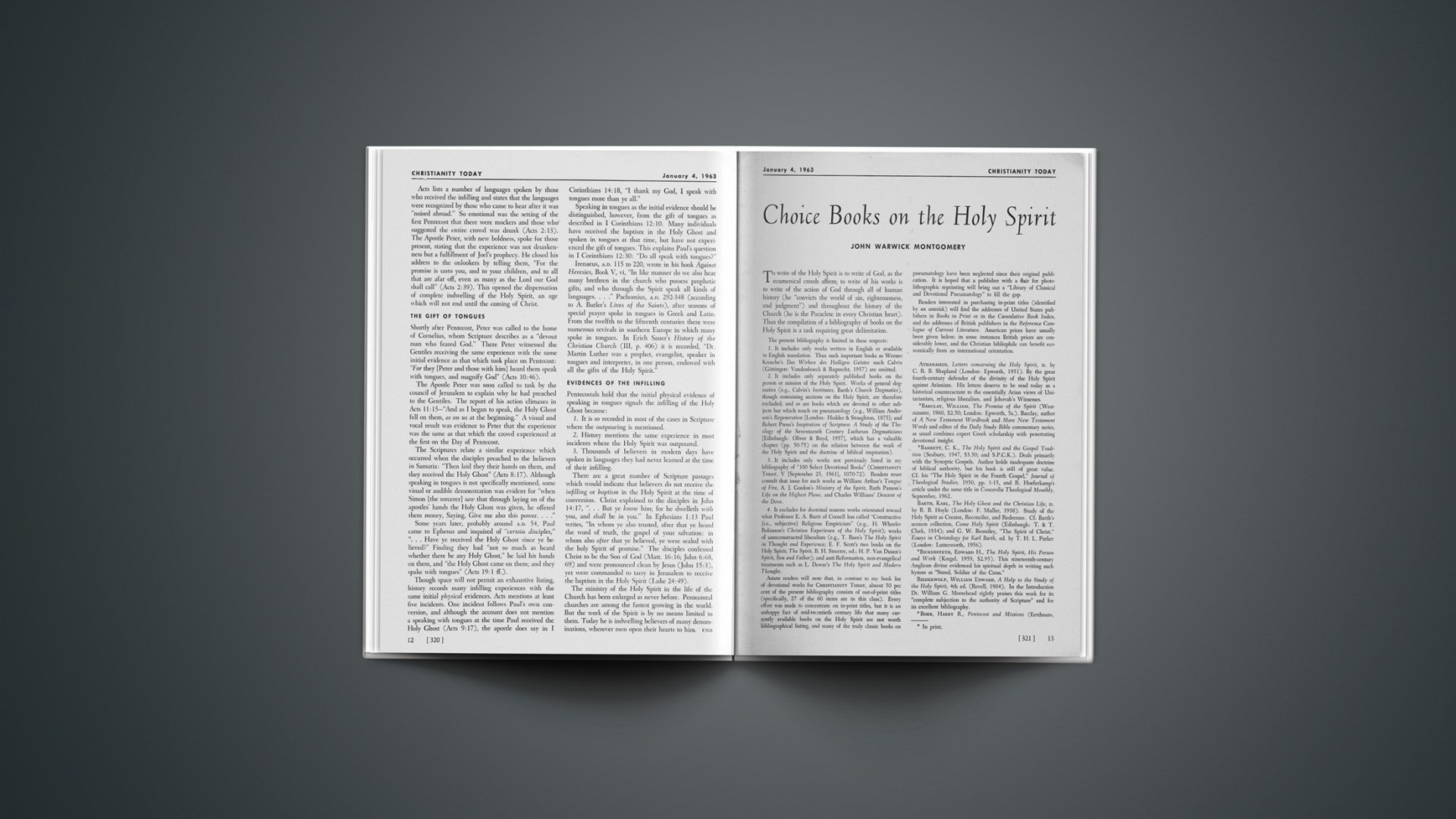
Choice Books on the Holy Spirit

To write of the Holy Spirit is to write of God, as the ecumenical creeds affirm; to write of his works is to write of the action of God through all of human history (he “convicts the world of sin, righteousness, and judgment”) and throughout the history of the Church (he is the Paraclete in every Christian heart). Thus the compilation of a bibliography of books on the Holy Spirit is a task requiring great delimitation.

The present bibliography is limited in these respects:

1. It includes only works written in English or available in English translation. Thus such important books as Werner Krusche’s Das Wirken des Heiligen Geistes nach Calvin (Göttingen: Vandenhoeck & Ruprecht, 1957) are omitted.

2. It includes only separately published books on the person or mission of the Holy Spirit. Works of general dogmatics (e.g., Calvin’s Institutes, Barth’s Church Dogmatics), though containing sections on the Holy Spirit, are therefore excluded; and so are books which are devoted to other subjects but which touch on pneumatology (e.g., William Anderson’s Regeneration [London: Hodder & Stoughton, 1875]; and Robert Preus’s Inspiration of Scripture: A Study of the Theology of the Seventeenth Century Lutheran Dogmaticians [Edinburgh: Oliver & Boyd, 1957], which has a valuable chapter (pp. 50–75) on the relation between the work of the Holy Spirit and the doctrine of biblical inspiration).

3. It includes only works not previously listed in my bibliography of “100 Select Devotional Books” (CHRISTIANITY TODAY, V [September 25, 1961], 1070–72). Readers must consult that issue for such works as William Arthur’s Tongue of Fire, A. J. Gordon’s Ministry of the Spirit, Ruth Paxson’s Life on the Highest Plane, and Charles Williams’ Descent of the Dove.

4. It excludes for doctrinal reasons works orientated toward what Professor E. A. Burtt of Cornell has called “Constructive [i.e., subjective] Religious Empiricism” (e.g., H. Wheeler Robinson’s Christian Experience of the Holy Spirit); works of unreconstructed liberalism (e.g., T. Rees’s The Holy Spirit in Thought and Experience; E. F. Scott’s two books on the Holy Spirit; The Spirit, B. H. Streeter, ed.; H. P. Van Dusen’s Spirit, Son and Father); and anti-Reformation, non-evangelical treatments such as L. Dewar’s The Holy Spirit and Modern Thought.

Astute readers will note that, in contrast to my book list of devotional works for CHRISTIANITY TODAY, almost 50 per cent of the present bibliography consists of out-of-print titles (specifically, 27 of the 60 items are in this class). Every effort was made to concentrate on in-print titles, but it is an unhappy fact of mid-twentieth century life that many currently available books on the Holy Spirit are not worth bibliographical listing, and many of the truly classic books on pneumatology have been neglected since their original publication. It is hoped that a publisher with a flair for photolithographic reprinting will bring out a “Library of Classical and Devotional Pneumatology” to fill the gap.

Readers interested in purchasing in-print titles (identified by an asterisk) will find the addresses of United States publishers in Books in Print or in the Cumulative Book Index, and the addresses of British publishers in the Reference Catalogue of Current Literature. American prices have usually been given below; in some instances British prices are considerably lower, and the Christian bibliophile can benefit economically from an international orientation.

ATHANASIUS, Letters concerning the Holy Spirit, tr. by C. R. B. Shapland (London: Epworth, 1951). By the great fourth-century defender of the divinity of the Holy Spirit against Arianism. His letters deserve to be read today as a historical counteractant to the essentially Arian views of Unitarianism, religious liberalism, and Jehovah’s Witnesses.

1In Print.BARCLAY, WILLIAM, The Promise of the Spirit (Westminster, 1960, $2.50; London: Epworth, 5s.). Barclay, author of A New Testament Wordbook and More New Testament Words and editor of the Daily Study Bible commentary series, as usual combines expert Greek scholarship with penetrating devotional insight.

2In Print.BARRETT, C. K., The Holy Spirit and the Gospel Tradition (Seabury, 1947, $3.50; and S.P.C.K.). Deals primarily with the Synoptic Gospels. Author holds inadequate doctrine of biblical authority, but his book is still of great value. Cf. his “The Holy Spirit in the Fourth Gospel,” Journal of Theological Studies, 1950, pp. 1–15, and R. Hoeferkamp’s article under the same title in Concordia Theological Monthly, September, 1962.

BARTH, KARL, The Holy Ghost and the Christian Life, tr. by R. B. Hoyle (London: F. Muller, 1938). Study of the Holy Spirit as Creator, Reconciler, and Redeemer. Cf. Barth’s sermon collection, Come Holy Spirit (Edinburgh: T. & T. Clark, 1934); and G. W. Bromiley, “The Spirit of Christ,” Essays in Christology for Karl Barth, ed. by T. H. L. Parker (London: Lutterworth, 1956).

3In Print.BICKERSTETH, EDWARD H., The Holy Spirit, His Person and Work (Kregel, 1959, $2.95). This nineteenth-century Anglican divine evidenced his spiritual depth in writing such hymns as “Stand, Soldier of the Cross.”

BIEDERWOLF, WILLIAM EDWARD, A Help to the Study of the Holy Spirit, 4th ed. (Revell, 1904). In the Introduction Dr. William G. Moorehead rightly praises this work for its “complete subjection to the authority of Scripture” and for its excellent bibliography.

4In Print.BOER, HARRY R., Pentecost and Missions (Eerdmans, 1961, $5). A doctoral study “concerned with the significance of Pentecost for missions.” Author is a theologian-missionary of the Christian Reformed Church to Nigeria.

BURTON, EDWARD, Testimonies of the Ante-Nicene Fathers to the Doctrine of the Trinity and of the Divinity of the Holy Ghost (Oxford, 1831). Still the standard work.

CANDLISH, J. S., The Work of the Holy Spirit (Edinburgh: T. & T. Clark, n.d.). A brief, lucid work, published originally in the series “Handbooks for Bible Classes and Private Students,” ed. by Marcus Dods and Alexander Whyte. Candlish was professor of systematic theology, Free Church College, Glasgow.

5In Print.CHAFER, LEWIS SPERRY, He That Is Spiritual (Findlay, Ohio: Dunham, 1918, $2.75). By the former president and professor of systematic theology at Dallas Seminary. Practical yet profound analysis of Holy Spirit-created spirituality.

6In Print.COME, ARNOLD B., Human Spirit and Holy Spirit (Westminster, 1959, $4). Strongly Kierkegaardian in outlook. Its anthropocentric starting-point and its lack of a clear revelational criterion of authority are great weaknesses, but it offers stimulating insights via depth psychology and process philosophy.

CUMMING, JAMES ELDER, “Through the Eternal Spirit”: A Bible Study on the Holy Ghost (Stirling, England: Drummond, 1891). Correctly regarded by Wilbur Smith as a “standard work”; scholarly, comprehensive, beautifully organized, thoroughly scriptural and devotional.

7In Print.DAVIES, J. G., The Spirit, the Church and the Sacraments (London: Faith, 15s.). An exceedingly attractive presentation from the standpoint of contemporary evangelical Anglicanism; shows acquaintance with the best literature, ancient and modern, English and non-English, on the subject.

8In Print.DILLISTONE, F. W., The Holy Spirit in the Life of Today (Westminster, 1947, $2). Short, well-written book “for the average man.” Author is chancellor of Liverpool Cathedral, England; previously he served as professor of systematic theology at Wycliffe College, Toronto, and at the Episcopal Theological School, Cambridge, Massachusetts.

DIXON, A. C., ed., The Holy Spirit in Life and Service (Revell, 1895). Consists of 19 addresses delivered before the Conference on the Ministry of the Holy Spirit held in New York in 1894; authors include, inter alia, W. J. Erdman, A. J. Gordon, and A. T. Pierson. The papers relate the work of the Holy Spirit to a wide range of church activities.

9In Print.DOWNER, ARTHUR CLEVELAND, The Mission and Ministration of the Holy Spirit (Edinburgh: T. & T. Clark, 1909, 13s.). “A book that deserves the widest circle of readers”—Wilbur Smith. Comprehensive, well organized. Comparable to Kuyper, though shorter, and orientated more to biblical than to dogmatic theology. Author was Anglican.

FABER, GEORGE STANLEY, A Practical Treatise on the Ordinary Operations of the Holy Spirit, last edition, with a biographical notice (New York: Protestant Episcopal Society for the Promotion of Evangelical Knowledge, 1857). By the nineteenth-century bishop, apologist, and student of biblical prophecy.

10In Print.HAMILTON, NEILL Q., The Holy Spirit and Eschatology in Paul (Naperville, Ill.: Allenson, 1957, paper $2.25; London: Oliver & Boyd, 8s. 6d.). In the series Scottish Journal of Theology Occasional Papers (No. 6). Contains useful bibliography.

HARE, JULIUS CHARLES, The Mission of the Comforter, ed. by E. H. Plumptre (London: Macmillan, 1886). Sermons preached at Cambridge University in 1840. Archdeacon Hare added numerous valuable scholarly notes.

11In Print.HENDRY, GEORGE S., The Holy Spirit in Christian Theology (Westminster, 1956, $2.50). Regarded by T. N. Tice of Princeton as “at this point the one indispensable treatise on the subject by an English-speaking theologian.” Excellent on the problem of the Holy Spirit in current theological thought, but marred by a neoorthodox view of Scripture.

12In Print.HENRY, ANTONIN M., The Holy Spirit, tr. by Lundberg and Bell (Hawthorn, 1960, $3.50). In the “Twentieth Century Encyclopedia of Catholicism” series. An exceedingly valuable work demonstrating once again that Protestants cannot afford to ignore contemporary Roman Catholic theological writing.

13In Print.KÖBERLE, ADOLF, The Quest for Holiness; a Biblical, Historical and Systematic Investigation, tr. by J. C. Mattes (Augsburg, 1930, paper $1.25). Contemporary Lutheranism’s greatest contribution to the study of sanctification; the book combines scholarly thoroughness with devotional depth.

14In Print.KUYPER, ABRAHAM, The Work of the Holy Spirit, tr. by Henri De Vries, Introduction by B. B. Warfield (Eerdmans, 1900, $5). An unsurpassed classic. Undoubtedly the most comprehensive work in print on the subject. In the tradition of Reformation-Calvinist systematic theology.

MACGREGOR, G. H. C., ed., “The Things of the Spirit”: The Teaching of the Word of God about the Spirit of God (London: Marshall, 1898). A valuable classification of the biblical passages on the Holy Spirit by a close friend of G. Campbell Morgan. Cf. Wilbur Smith’s classification in his A Treasury of Books for Bible Study15In Print. (Wilde, $3.95).

MCINTYRE, DAVID M., The Spirit in the Word (London: Morgan & Scott, 1908). An excellent treatment of the work of the Holy Spirit in the inspiration of the Bible. Cf. L. Gaussen’s Theopneustia.

16In Print.MORGAN, G. CAMPBELL, The Spirit of God (Revell, 1900, $2.75). One of the finest books written by this great preacher and Bible expositor.

MOULE, H. C. G., Veni Creator: Thoughts on the Person and Work of the Holy Spirit of Promise (London: Hodder & Stoughton, 1890). A superlative book by the prolific doctrinal and devotional writer well known for his contributions to the Cambridge Bible for School and Colleges, for his Christian poetry, and for his biography of Charles Simeon.

17In Print.MURRAY, ANDREW, The Spirit of Christ (Zondervan, $3.50). Meditations of extraordinary depth by the nineteenth-century Dutch Reformed pastor.

18In Print.NUTTALL, GEOFFREY F., The Holy Spirit in Puritan Faith and Experience, 2nd ed. (Oxford: B. Blackwell, 1947, 18s.). A valuable historical study, particularly with regard to Quakerism, though marred by its author’s enthusiastic proclivities. The book originated as an Oxford University D.D. thesis.

19In Print.OCKENGA, HAROLD JOHN, The Spirit of the Living God (Revell, 1947, $2). High-quality sermons by the pastor of Park Street Church, Boston, and president of Fuller Theological Seminary. Cf. his Power through Pentecost* (Eerdmans, 1959, $2).

20In Print.OWEN, JOHN, The Holy Spirit, His Gifts and Powers (Kregel, 1954, $3.95). Regarded by Kuyper in 1888 as “still unsurpassed”; the same must be said today. Owen, a Presbyterian Nonconformist of the seventeenth century, was one of the most learned and prolific theological writers of all time.

21In Print.PACHE, RENÉ, The Person and Work of the Holy Spirit, tr. by J. D. Emerson (Moody, 1954, $3.50). A carefully outlined, lucid exposition of biblical teaching on the Holy Spirit by the president of Emmaus Institute, Lausanne, Switzerland. Particularly helpful for sermon construction and in Bible study preparation.

PARKER, JOSEPH, The Paraclete: An Essay on the Personality and Ministry of the Holy Ghost, with Some Reference to Current Discussions (Scribner, 1886). The first edition of this fine work appeared anonymously.

PHELPS, AUSTIN, The Work of the Holy Spirit; or, The New Birth (Boston: D. Lothrop, 1882). By the brilliant Congregationalist homiletician who served as professor of sacred rhetoric (1848–79) and president (1869–79) of Andover Seminary.

PIERSON, ARTHUR T., The Acts of the Holy Spirit, Being an Examination of the Active Mission and Ministry of the Spirit of God, the Divine Paraclete, As Set Forth in the Acts of the Apostles (Revell, 1895). By the nineteenth-century authority on missions and voluminous Christian writer who edited the Missionary Review of the World.

22In Print.PRENTER, REGIN, Spiritus Creator, tr. by J. M. Jensen (Muhlenberg, 1953, paper $1.50). The first comprehensive study in the twentieth century of Luther’s concept of the Holy Spirit.

23In Print.RAMM, BERNARD, The Witness of the Spirit; an Essay on the Contemporary Relevance of the Internal Witness of the Holy Spirit (Eerdmans, 1959, $3). A trenchant systematic-historical analysis, with a final chapter criticizing Romanism, liberalism, and fundamentalism; by the neo-evangelical apologist and professor of systematic theology at California Baptist Seminary.

REDFORD, R. A., Vox Dei: The Doctrine of the Spirit As It Is Set Forth in the Scriptures of the Old and New Testaments (London: J. Nisbet, 1889). By the nineteenth-century biblical apologist and contributor to The Pulpit Commentary.

24In Print.SANDERS, J. OSWALD, The Holy Spirit of Promise; the Mission and Ministry of the Comforter (Fort Washington, Pa.: Christian Literature Crusade, 1959, $2.50). For the general reader; a short but penetrating overview of the central problems of pneumatology by the director of the China Inland Mission.

25In Print.SHOEMAKER, SAMUEL M., With the Holy Spirit and with Fire (Harper, 1960, $2.50). Typically warm and practical book from the prolific pen of this much-loved Episcopalian rector.

26In Print.SIMPSON, A. B., The Holy Spirit, or, Power from On High, 2 vols. (Harrisburg, Pa.: Christian Publications, 1924, $5.80). Subtitle: “An unfolding of the doctrine of the Holy Spirit in the Old and New Testaments.” Originally presented as sermons in the Gospel Tabernacle, New York City, by the founder of the Christian and Missionary Alliance.

27In Print.SMEATON, GEORGE, The Doctrine of the Holy Spirit (Christian Literature Crusade, $3.50). A classic, worthy to be placed with Downer, Kuyper, and W. H. Griffith Thomas. Includes a historical survey of the doctrine of the Holy Spirit from New Testament times through the nineteenth century.

SNAITH, NORMAN H., et al., The Doctrine of the Holy Spirit (London: Epworth, 1937). Contents: “The Spirit of God in Jewish Thought,” by Snaith; “The Spirit in the New Testament,” by Vincent Taylor; “The Holy Spirit in the Church,” by Howard Watkin-Jones; and “The Holy Spirit and the Trinity,” by Harold Roberts. Exceedingly valuable, though not always manifesting a high view of biblical inspiration.

28In Print.STARKEY, LYCURGUS M., JR., The Work of the Holy Spirit: A Study in Wesleyan Theology (Abingdon, 1962, $3). A historical study of Wesley’s concept of the Holy Spirit.

SWETE, HENRY BARCLAY, The Holy Spirit in the New Testament (London: Macmillan, 1909). To be used in conjunction with Swete’s other three standard works on the early history of doctrine: The Holy Spirit in the Ancient Church (London: Macmillan, 1912), covering the patristic age; On the Early History of the Doctrine of the Holy Spirit with Especial Reference to the Controversies of the Fourth Century (Cambridge: Deighton, Bell, 1873); and On the History of the Doctrine of the Procession of the Holy Spirit, from the Apostolic Age to the Death of Charlemagne (Cambridge: Deighton, Bell, 1876).

29In Print.THOMAS, W. H. GRIFFITH, The Holy Spirit of God, 3rd ed. (Eerdmans, 1955, $3). A masterly work by the conservative Anglican theologian who served as professor of Old Testament literature and exegesis in Wycliffe College, Toronto. The book, which first appeared in 1913, studies the doctrine biblically, historically, systematically, and practically; its comprehensiveness ranks it with Downer, Kuyper, and Smeaton.

TOPHEL, GUSTAVE, The Work of the Holy Spirit in Man, tr. by T. J. Després (Edinburgh: T & T. Clark, 1882). Five discourses of great devotional power.

30In Print.TORREY, R. A., The Holy Spirit: Who He Is and What He Does (Revell, 1927, $3). In the perceptive and lucid style characteristic of this great pastor, evangelist, and onetime (1889–1908) superintendent of the Moody Bible Institute.

31In Print.UNGER, MERRILL F., The Baptizing Work of the Holy Spirit (Wheaton, Ill.: Scripture Press, 1953, $2.75). Provocative study of a difficult aspect of pneumatology by the eminent Old Testament scholar and professor at Dallas Seminary.

WALKER, JAMES BARR, The Doctrine of the Holy Spirit, or Philosophy of the Divine Operation in the Redemption of Man, 6th ed. (Cincinnati: Jennings and Pye, 1901). A continuation of the author’s Philosophy of the Plan of Salvation, which deservedly attained great popularity in the nineteenth century.

32In Print.WALVOORD, JOHN F., The Holy Spirit, 3rd ed. (Findlay, Ohio: Dunham, 1958, $3.95). By the president and professor of systematic theology at Dallas Seminary. Contains a valuable appendix on “The Holy Spirit in Contemporary Theology.”

WATKIN-JONES, HOWARD, The Holy Spirit in the Medieval Church (London: Epworth, 1922). A continuation of the work of Swete. It deals with the history of the doctrine from the post-patristic age to the Counter-Reformation, and is itself continued by Watkin-Jones’ Holy Spirit from Arminius to Wesley (London: Epworth, 1929), which covers the seventeenth and eighteenth centuries.

WEIDNER, REVERE FRANKLIN, Pneumatology, or, The Doctrine of the Work of the Holy Spirit (Wartburg, 1915). Systematic treatment from the standpoint of conservative Lutheranism. Author was professor of dogmatics and president of Chicago Lutheran Seminary (1891–1915).

33In Print.WINSLOW, OCTAVIUS, An Experimental and Practical View of the Work of the Holy Spirit (London: Banner of Truth Trust, 3s.). First published in 1843. Powerfully evangelical and deeply devotional, as were all of this prolific writer’s works, some 100 of which are listed by the British Museum’s Department of Printed Books.

WINSTANLEY, EDWARD WILLIAM, Spirit in the New Testament (Cambridge: University, 1908). Subtitle: “An enquiry into the use of the word pneuma in all passages, and a survey of the evidence concerning the Holy Spirit.”

34In Print.WISLӦFF, FREDRIK, I Believe in the Holy Spirit, tr. by Ingvald Daehlin (Augsburg, 1949, $3). By a European Lutheran pastor who represents a contemporary blend of classical orthodoxy with the evangelical pietism characteristic of the Norwegian Inner Mission movement. His book cannot be too highly recommended for its faithfulness to Scripture and its genuine experiential impact.

END

Plea for the Pentecostalists

Worldwide revivals around the turn of the twentieth century resulted in the establishment of more than a dozen “denominations” commonly called Pentecostal. While some divergence of doctrine exists, one basic position unites Pentecostals—their common belief that “the baptism in the Holy Spirit” is a distinct experience which all believers may and should have following conversion.

During their formulative years, Pentecostals came from various backgrounds. Revivals of the late 1800s and early 1900s touched individuals in the old-line denominations, as well as many who had no previous affiliation. Early congregations often faced opposition from the community and the established churches. Far from stamping out the groups, hard-hitting opposition fanned the small flame that had a doubtful future.

As the various Pentecostal denominations grew, each established its own program of world evangelism since lack of communication had separated most of the groups during their infancy. However, 15 years ago, recognizing more similarities than differences, ten of the denominations formed the Pentecostal Fellowship of North America. Though each has retained its own organization, their common position on the Holy Spirit serves as a rallying point for united fellowship.

This backdrop provides but a brief history of the work and advancement of Pentecostals. Time has brought changes, but no modification in the emphasis, teaching, and experience of the baptism of the Spirit.

The Promise Of The Spirit

Just before the dark days preceding the birth of Christ, Joel prophesied of the coming of the Holy Spirit into the world. “And it shall come to pass afterward, that I will pour out my spirit upon all flesh; and your sons and your daughters shall prophesy, your old men shall dream dreams, your young men shall see visions: And also upon the servants and upon the handmaids in those days will I pour out my spirit” (Joel 2:28, 29).

This prophecy was repeated by Peter as he spoke to those who received the experience on the Day of Pentecost (Acts 2:17, 18). Pentecostals have asked, “If this is not what is being experienced today, where is the fulfillment of this prophecy in the ‘last days’?”

John the Baptist heralded the coming of the Holy Spirit when he foretold the ministry of Christ. In Matthew 3:11 he said: “I indeed baptize you with water unto repentance: but he that cometh after me is mightier than I, whose shoes I am not worthy to bear: he shall baptize you with the Holy Ghost, and with fire.”

Most Bible scholars accept the position that the word “baptize” used by John was the Greek baptidzo, meaning to immerse. This meaning is consistent in classic Greek. The word is used to describe the sinking of a ship, and, metaphorically, being drowned in drink. Hence, Pentecostals accept the position that to be baptized in the Holy Spirit is to be immersed.

During his ministry Christ repeatedly promised the Holy Spirit to the disciples. The sending of the Third Person of the Trinity is also mentioned by Christ in John 14:26 and 16:7 and in Luke 24:49. Finally, when gathered with the disciples and with friends on the Mount of Ascension, Christ “commanded them that they should not depart from Jerusalem, but wait for the promise of the Father, which, saith he, ye have heard of me. For John truly baptized with water; but ye shall be baptized with the Holy Ghost not many days hence” (Acts 1:4, 5).

The promise of the baptism in the Holy Spirit was initially fulfilled on the Day of Pentecost, ten days after the ascension of Christ. Hence the expression Pentecostal experience. This term is a modern-day one, unmentioned in the Bible. So encompassing was the experience that it was described as “a sound from heaven as of a rushing mighty wind” (Acts 2:2). The use of the word rushing portrays the rapidity with which the Spirit’s influence spread. The account of the first outpouring indicates also that all spoke with tongues as the Spirit gave them utterance (Acts 2:4). This Pentecostals accept as the initial physical evidence of the infilling or baptism in the Holy Spirit.

Acts lists a number of languages spoken by those who received the infilling and states that the languages were recognized by those who came to hear after it was “noised abroad.” So emotional was the setting of the first Pentecost that there were mockers and those who suggested the entire crowd was drunk (Acts 2:13). The Apostle Peter, with new boldness, spoke for those present, stating that the experience was not drunkenness but a fulfillment of Joel’s prophecy. He closed his address to the onlookers by telling them, “For the promise is unto you, and to your children, and to all that are afar off, even as many as the Lord our God shall call” (Acts 2:39). This opened the dispensation of complete indwelling of the Holy Spirit, an age which will not until the coming of Christ.

The Gift Of Tongues

Shortly after Pentecost, Peter was called to the home of Cornelius, whom Scripture describes as a “devout man who feared God.” There Peter witnessed the Gentiles receiving the same experience with the same initial evidence as that which took place on Pentecost: “For they [Peter and those with him] heard them speak with tongues, and magnify God” (Acts 10:46).

The Apostle Peter was soon called to task by the council of Jerusalem to explain why he had preached to the Gentiles. The report of his action climaxes in Acts 11:15—“And as I began to speak, the Holy Ghost fell on them, as on us at the beginning.” A visual and vocal result was evidence to Peter that the experience was the same as that which the crowd experienced at the first on the Day of Pentecost.

The Scriptures relate a similar experience which occurred when the disciples preached to the believers in Samaria: “Then laid they their hands on them, and they received the Holy Ghost” (Acts 8:17). Although speaking in tongues is not specifically mentioned, some visual or audible demonstration was evident for “when Simon [the sorcerer] saw that through laying on of the apostles’ hands the Holy Ghost was given, he offered them money, Saying, Give me also this power.…”

Some years later, probably around A.D. 54, Paul came to Ephesus and inquired of “certain disciples,” … “Have ye received the Holy Ghost since ye believed?” Finding they had “not so much as heard whether there be any Holy Ghost,” he laid his hands on them, and “the Holy Ghost came on them; and they spake with tongues” (Acts 19:1 ff.).

Though space will not permit an exhaustive listing, history records many infilling experiences with the same initial physical evidences. Acts mentions at least five incidents. One incident follows Paul’s own conversion, and although the account does not mention a speaking with tongues at the time Paul received the Holy Ghost (Acts 9:17), the apostle does say in 1 Corinthians 14:18, “I thank my God, I speak with tongues more than ye all.”

Speaking in tongues as the initial evidence should be distinguished, however, from the gift of tongues as described in 1 Corinthians 12:10. Many individuals have received the baptism in the Holy Ghost and spoken in tongues at that time, but have not experienced the gift of tongues. This explains Paul’s question in 1 Corinthians 12:30: “Do all speak with tongues?”

Irenaeus, A.D. 115 to 220, wrote in his book Against Heresies, Book V, vi, “In like manner do we also hear many brethren in the church who possess prophetic gifts, and who through the Spirit speak all kinds of languages.…” Pachomius, A.D. 292–348 (according to A. Butler’s Lives of the Saints), after seasons of special prayer spoke in tongues in Greek and Latin. From the twelfth to the fifteenth centuries there were numerous revivals in southern Europe in which many spoke in tongues. In Erich Sauer’s History of the Christian Church (III, p. 406) it is recorded, “Dr. Martin Luther was a prophet, evangelist, speaker in tongues and interpreter, in one person, endowed with all the gifts of the Holy Spirit.”

Evidences Of The Infilling

Pentecostals hold that the initial physical evidence of speaking in tongues signals the infilling of the Holy Ghost because:

1. It is so recorded in most of the cases in Scripture where the outpouring is mentioned.

2. History mentions the same experience in most incidents where the Holy Spirit was outpoured.

3. Thousands of believers in modern days have spoken in languages they had never learned at the time of their infilling.

There are a great number of Scripture passages which would indicate that believers do not receive the infilling or baptism in the Holy Spirit at the time of conversion. Christ explained to the disciples in John 14:17, “… But ye know him; for he dwelleth with you, and shall be in you.” In Ephesians 1:13 Paul writes, “In whom ye also trusted, after that ye heard the word of truth, the gospel of your salvation: in whom also after that ye believed, ye were sealed with the holy Spirit of promise.” The disciples confessed Christ to be the Son of God (Matt. 16:16; John 6:68, 69) and were pronounced clean by Jesus (John 15:3), yet were commanded to tarry in Jerusalem to receive the baptism in the Holy Spirit (Luke 24:49).

The ministry of the Holy Spirit in the life of the Church has been enlarged as never before. Pentecostal churches are among the fastest growing in the world. But the work of the Spirit is by no means limited to them. Today he is indwelling believers of many denominations, wherever men open their hearts to him.

END

The Witness of the Sprit

Contemporary Christianity spends itself far more in posing questions and pondering problems than in maintaining and promulgating the faith. The habit of the early Church was otherwise. It leaned hard on the reality and power of the Holy Spirit for vitality, assurance, and direction. Perhaps the modern Church needs a fresh look at Pentecost to see the folly of relying mainly on human organization and skills. Not to seek the Holy Spirit, not to thrust open our souls to his illuminating, purifying, and empowering light is to invite gloom and tragedy into the work of the Kingdom. To substitute the clatter of ecclesiastical machinery for the quiet penetration of the Spirit’s teaching and transforming power spells uncertainty and failure; not because of him but of ourselves we become straitened and weak.

The teaching of Paul and of our Lord himself indicates that the most vital doctrine of our Christian faith is that of the Holy Spirit. Yet far more is said and read about the Fatherhood of God and Christ’s sacraficial life and death than about the Person and power of the Holy Spirit. This is not wholly bad, of course, for to glorify the Son is to glorify the Father; yet even this requires the Holy Spirit’s glorification of the Son. With so much emphasis on the Holy Spirit in both the Old and New Testaments it seems strange that Christians should have neglected this doctrine so long.

Eighteenth-century deism proclaimed an absolute Deity. Its God was mighty enough to fashion the universe and to announce laws for its regulation, but it had no Father whose measureless love provided a Redeemer-Son for sinning humanity. For men of that deistic age God was simply Sovereign Ruler, Mighty Architect, All-wise Judge. Such faith furnished a creed for the intellect, a law for conduct, and purpose for the world. But it offered man no help in realizing God’s abounding love manifested in the saving grace of Christ.

Perhaps the tremendous concentration these days on man’s own energy and activity has deceived us into forgetting that the triune God is the source and sustainer of life.

The Spirit’S Work

It is the Divine Spirit who makes known our adoption into the family of God and imparts the needed strength for daily service. He fills us with the knowledge of God’s will in spiritual wisdom and understanding. The Holy Spirit reveals our partnership in the divine nature; he evidences the fact that we are in God and God in us. He reveals Christ, by whom the tangle of our sinful nature is quieted. The Spirit invigorates our wills, delivers us from the law of sin and death; assuring us of our eternal sonship, he enables us to live in daily, unbroken fellowship in the household of faith.

Through Joel God declared this prophetic promise: “And it shall come to pass afterward, that I will pour out my spirit upon all flesh …” (2:28). Peter’s sermon at Pentecost reverts to Joel’s prophecy; in fact, the redemptive experiences of that day were in no sense alien to Jewish thought. On that day, according to each person’s power to receive and the work entrusted to him, leaders and followers, men and women, young and old, shared in the outpouring of the Divine Spirit. Their spiritual training had deeply impressed the people of Israel with the close relation of God to his people, and thus prepared them to receive and to appreciate the baptism given at Pentecost.

This revelation in the Old Testament is essential for understanding the New Testament message. From the first chapter of Genesis through the prophetic books, the Spirit of God appears in many places and in many lives. In nature he broods over chaos and brings faith, order, light, fertility, and fragrance. The origin of life itself is the divine breath of God which he breathes into man. Across the Old Testament pages we see Judges introducing order; Elijah dares to act, Daniel dreams, Ezekiel writes, and Isaiah preaches—all work under the Holy Spirit’s direction.

But notice this mystery! While the Divine Spirit illuminated and empowered writers, warriors, and statesmen, his intimate presence and energizing power he does not seem to have entrusted to all of God’s people for day-by-day possession and practice. The Spirit directed certain leaders and manifested his power on certain extraordinary occasions, but clarified vision, victory over self and sin, and a close walk with God were not the conscious experience of all believers. Joel’s promise, therefore, becomes all the more significant, for he declared a day would come when God’s Spirit should consciously engulf all believers. This promise, which hovers over the closing pages of the Old Testament, burns like a star before the eyes of God’s people. The faithful seem to stand on tiptoe, waiting not alone for a Redeemer but for the fulfillment of Joel’s prophecy. Pentecost became the fulfillment of this promise; what happened on that day justified all expectations.

The Spirit’S Witness

Of all the doctrines of Christian theology which may be verified by experience, none requires more careful and discriminating study than what we call the witness of the Spirit or assurance of faith. If we believe in what we call “experimental religion,” we must believe that the living Christ is made present in our lives through the indwelling of the Holy Spirit.

Christianity is a religion of redemption! It affirms that all men are sinners; that Christ died for all men; that all men can be saved by repentance and faith in the Lord Jesus Christ. It declares, further, that by the witness of God’s Spirit all men can know they have been saved. Christianity presents the plight of man and proffers the power of Christ. Through disobedience man lost his place in God’s favor and family and therefore needs a new relationship to God, a renewed personality, a complete renewal of his nature. To secure a right relationship with God he must be reborn; this experience is apprehended by faith in Christ Jesus and ministered to the believing soul by the Holy Spirit. Paul spoke of being “strengthened with might by his Spirit in the inner man.” Thus the miracle of divine love frees the sinner from the law of sin and death.

Paul often used the word “flesh” to describe the perishable sinful condition of the natural man. He insisted that apart from God’s grace and left to himself man is not only frail and mortal but wayward, selfish, and evil; not only has he broken God’s law, but he has also placed his trust in himself. He is a sinner who must be changed and converted. He must believe on the only begotten Son of God. Only the Holy Spirit can reveal his need for pardon and give him an awareness of its abundant provision in the Saviour.

The Holy Spirit takes the initiative in this miracle of awakening and renewal. We can be sure that God has left no man without the leadings and strivings of the Holy Spirit, though man so often disregards and stubbornly resists them. Man cannot apprehend nor remedy by his own effort the sense of guilt in his heart. Any one who denies the need for a life hid with Christ in God will never rise above the level of the natural man. But anyone born of the Spirit experiences a veritable miracle. To be in Christ is to be a new creation—ruled, directed, and controlled by the indwelling Spirit of God.

Wesley emphasized both what he called the “direct” and what he called the “indirect” witness. The former, which he identifies with the work of the Holy Spirit, he defines as an inward impression on the souls of believers whereby the Spirit of God directly testifies to their spirit that they are the children of God. He calls the “indirect witness” the testimony of a good conscience toward God which, strictly speaking, is a conclusion drawn partly from the Word of God and partly from personal experience. The Bible affirms that everyone who has the fruits of the Spirit is a child of God. These two witnesses, the “direct” and the “indirect,” are never disjoined in normal and ideal experience but always united. Experimental religion is evidenced by a conscious knowledge of sins forgiven; it is this same Spirit that convinces us of guilt and assures us of pardon. When this witness is absent, a professing Christian is constantly on the defensive and continually attempts to prove he is a child of God. The Bible promises that “the Spirit itself beareth witness with our spirit, that we are the children of God.”

We must not limit the witness of the Spirit to the assurance of salvation. His indwelling presence kindles aspirations to lay hold on things divine, and to grow as loyal and resolute servants of righteousness. Christ promised that the Spirit would lead us into truth, that by his illumination we should be able to discriminate between the raucous voice of the world and the still small voice of God. The Holy Spirit exalts the Christ and makes known what he offers us and the world; he stirs our emotions and minds to new quests. Habitual yielding to the guidance of the Spirit increases our confidence, joy, and fruitfulness, for his indwelling brings spiritual enrichment, greater victory over self and sin, and deeper intimacy with him whom having not seen, we yet love. Elevating and broadening our interests and sympathies, he makes us increasingly alive to all the great realities. Observing life as the Spirit reveals it, we discover how impertinent it would be to limit the blessings of the Gospel to any one race, class, or nation. “Now we have received, not the spirit of the world, but the spirit which is of God; that we might know the things that are freely given to us of God. Which things also we speak, not in the words which man’s wisdom teacheth, but which the Holy Ghost teacheth …” (1 Cor. 2:12, 13). To be filled with the Spirit is to accept and walk in the truth of God; to be guided by the will of God; to surrender the whole man in loving loyalty to the service of Christ.

The Spirit’S Fullness

In the Epistle to the Ephesians, which contains much of his ripest teaching, Paul prays that the Church be clothed with might by the Spirit in the inward man. He exhorts all believers to “be filled with the Spirit” (5:18). This does not mean to “become full” like an empty vessel that is replenished. It means, rather, that the believer finds his fullness, the true realization and fulfillment of his highest being, by and through the presence of the Holy Spirit. If the Church is to rise to its fullest stature in God, if it is to enjoy the abundant life, if it is to meet all foes in the spirit of triumph, it must rely not upon its numbers or its human skills, but upon the power of the Holy Spirit. To accomplish the mission of the Church by trusting only earthly means spells failure, even in the midst of what the world calls success.

We need to be quickened. We need to resort once again to the sources of power. The Church is hindered and the Kingdom thwarted not so much by the non-Christian influences in the world, but rather by the tepid, stoic religiosity of Jesus’ professed followers. Christ desires not our polite deference but the total strength of our lives. The enormous forces unleashed in the world today only God can govern and direct. They challenge our courage. While the world wistfully awaits the Christ, can we so present a Church which incarnates Christianity effectively, redemptively, and relevantly to all of life, that men must say in truth: “Here is hope, here is salvation”? To share in such a ministry of redemption is a veritable baptism into immortality, the beginning of a more radiant, vigorous, and joyous life than was ever dreamed possible in these shadows of our present existence.

The symbol of the Gospel is neither an isolated cross, nor a distant crown of proud, despotic aloofness. Rather both together symbolize the Gospel: the cross lying within the crown, the crown haloing and encircling the cross.

END

The Spirit: Tongues and Message

Once every year the Christian minister is confronted with the task of preaching a sermon on Pentecost. Barring happy exceptions, most ministers see themselves not so much confronted with a wonderful challenge as condemned to an inevitable annual chore. Given the reigning conception of Pentecost in the Christian church, the reason is not hard to find. One has to say something about those tongues of fire, that rushing mighty wind, and particularly all those languages spoken at the same time. These mysterious occurrences, so far removed from our own experience and observation, are indeed difficult to do anything with either theologically or homiletically if they are regarded as in themselves significant phenomena.

Pentecost is much like the Cross. One can regard the Crucifixion as an event of a few hours’ duration, in which case one soon comes to the end of the discursive rope. It can also be regarded as the epitome of the Christian message, the height and breadth and depth of which angels desire to know. That is what Paul had in mind when he wrote, “For I decided to know nothing among you except Jesus Christ and him crucified.” It is in this manner that Pentecost should be viewed. It is not an “event” that was over when Peter began to preach, but rather the beginning of a great divine work that continues in our day and will continue to the of time. The beginning has no meaning without the continuation, and the continuation could not be without the beginning.

Pentecost was the beginning in redemptive history of that specific function or activity of the Holy Spirit of which he had already given so powerful a manifestation in the realm of the natural, namely the giving of life. The Spirit gives life. He is the life-giving Spirit of all creation, and his is the life of the new creation. Having brooded upon the face of the waters to bring forth, he gave life to grass and flowers and trees, to animals and to men. Every birth is a manifestation of this mysterious gift of the Spirit to the creature.

His, too, is the life that makes possible the rebirth of man. “Verily, I say to you, unless one is born of water and the Spirit he cannot enter into the kingdom of God.” In the New Testament the Holy Spirit is most intimately linked with both the initiation and the continuation in its many and varied forms of the new life of the believer in Christ. To transmit and to develop this life is the specific function of the Holy Spirit in the divine redemptive economy. The Cross made the giving of this life possible; Pentecost began the effectuation of it in the history of the Church.

The question we want to consider more particularly in this article is: How is the most prominent phenomenon associated with Pentecost, namely the speaking with tongues, related to this work of the Spirit? In taking up this question we do not forsake the grand theme of the life-transmitting work of the Spirit; rather, we enter upon the very heart of the theme.

The Spirit Speaks

When one reads the Pentecost account in Acts 2:1–13 carefully, he is struck by the imbalance between the space devoted to the tongues of fire and the mighty rushing wind, on the one hand, and that given to the speaking with tongues, on the other. Clearly the writer intended the central significance of Pentecost to be found in the speaking with tongues, not in the rushing wind or the tongues of fire. The latter are mentioned in verses two and three respectively, but are not again alluded to. The speaking with tongues, by contrast, is introduced in the fourth verse and then dominates the account to its very end, even carrying over into Peter’s sermon. We must not fail, therefore, to give very serious consideration to the speaking with tongues if we are to understand the coming of the Spirit.

It is passing strange indeed that through all the centuries of the Church’s reflection on the Pentecost event, so much attention has been devoted to the manner of the speaking with tongues and so little (almost nothing) to the fact of the speaking with tongues. It should be a matter of sanctified indifference to us whether the speaking with tongues constituted a miracle of speaking or a miracle of hearing, whether the tongues that were spoken were a new language, the language of Paradise, the language of heaven, or a form of ecstatic utterance. Why should we be concerned about such curious questions when the New Testament itself manifests not the slightest interest in them? What stands in the foreground of the account is the fact of the speaking. The Holy Spirit who came to indwell the Church at Pentecost came as a witnessing, a proclaiming, a speaking Spirit. He himself was not heard or seen. His effects were heard and seen, among which the speaking of the mighty works of God overshadowed all others.

We should further note that this speaking framework in which the Spirit came to us is not only inseparable but also indistinguishable from his coming. Think this speaking away and there is no Pentecost left. The prophetic form in which the Holy Spirit came to dwell in the Church was not accidental but was essential to his coming. It was essential because it is the nature, the character, the very being of the Spirit to witness, to speak, to proclaim. His coming in the Old Testament is foretold as a prophetic coming. When Jesus gave the Great Commission to his disciples, he told them to wait in Jerusalem for the coming of the Spirit. When the Spirit had come upon them, then they would be his witnesses in Jerusalem, Judea, Samaria, and to the ends of the earth. The whole book of Acts is the elaboration of this theme. At every significant turn in the book the Holy Spirit is the central Actor, and the grand climax is St. Paul’s arrival in Rome, the capital of the kingdoms of the world, to make known there the mystery of Christ. In Jesus’ discourses in John 14; 15, and 16 the Holy Spirit is presented as the one who will guide, teach, judge, reveal, witness, and show, with respect to the things that Christ will give to the Church. Pentecost, concentrating all this in a dramatic symbolic action, wants to make plain that the witness of the Church is wholly identified with, grounded in, and flowing out of the coming of the Spirit. Not later, not soon, not immediately after, but in the coming, through the coming of the Spirit, the Church became a witnessing Church.

The Spirit Gives Life

The witnessing nature of the Spirit, and therefore of the Church in which he dwells, is seen to be grounded even deeper when beyond the explicit data of Scripture, and as the fundamental reason for them, we have regard to the Spirit’s specific function of transmitting life. This activity of the Spirit is most intimately related to the preaching of the Gospel. There is only one way in which the life of the Spirit can come into being in the life of a man. That way is the believing acceptance of the proclaimed word of the Gospel. Where the preaching of the Gospel (or its equivalent: hearing or learning through some human agency) has not taken place, there the Christian life, that is, the life of the Spirit, cannot exist. Fundamental to the life of the Church is the spoken witness to the Gospel of Christ. The witness of the Church is the means by which the Spirit of God transmits his life to the children of men. There is no other way. “… How are men to call upon him in whom they have not believed? And how are they to believe in him of whom they have never heard? And how are they to hear without a preacher?” The ministry of the Word is the mystic agent of that spiritual reproductive process which brings into being the life of the new man in Christ. Therefore the Church is first of all, most of all, and above all, a witnessing body. Out of the prophetic activity to which her inner nature prompts her flow all her other activities of worship, fellowship, confession, teaching, mercy, discipline, reflection. The Word begets; all else follows from the birth.

Now this is the fact that the speaking with tongues at Pentecost dramatizes. For the purpose of this grand occasion the power with which the Spirit comes (the wind) and the purifying effect of his presence (the tongues of fire) recede into the background to make possible the full projection of the manner in which the life of the Spirit is transmitted. The Gospel is to be preached in all languages. It is to be preached to all nations. Christ for the world through the witness of the Church! This is the message of the “other tongues.” This is the meaning of Pentecost.

The principle given at Pentecost rapidly took on permanent and radical historical form in the change that came over the institutional manifestation of the People of God in the world. The Jewish congregation became the supra-national Church. Temple and synagogue yielded to the worship service of the New Testament church. The priest was replaced by the preacher, the altar by the pulpit, the strictures of the law by the freedom of the Gospel, circumcision by baptism, Passover by the Lord’s Supper; the Gentile became the equal of the Jew. In short, at Pentecost, by reason of the universally witnessing character of the Holy Spirit, the People of God was reconstituted from a national sacerdotal manifestation to a universal prophetic one to fit it for the new role into which the coming of the Spirit had thrust the Church.

One is tempted to say that Pentecost has a missionary message. But this is too superficial a statement. It might strengthen the reigning conception that the Church amid her multifarious activities “also does mission work” and that Pentecost has to do with this facet of her existence. Rather, Pentecost calls the Church to reexamine her entire spiritual heritage, her deepest and truest nature, and then to rechannel her energies in the direction to which the renewed discovery of her basically prophetic character points her.

END

The Christ-Centered Spirit

Many Christians have quite clear ideas about God the Father and God the Son, but only rather vague, indistinct ideas about God the Holy Spirit. This stems, in part, from the fact that as human beings Christians have knowledge of fathers and sons in everyday experience, but not of personal bodiless spirits.

Though reluctant to admit it (it’s so unspiritual!), even ministers often share this indefiniteness about the Holy Spirit and almost dread occasions that call for special sermons on this subject. It is much easier to preach about Christ and to take silent refuge in the fact that even theologians have found it far easier to formulate a doctrine of Christ than of the Holy Spirit. Yet this uneasiness is not so much a matter of deficient spirituality as it is a misunderstanding about the possibilities of knowing the Holy Spirit.

Two other Christian truths are still without clear and adequate formulation. Both, interestingly enough, are intimately related to considerations of the Spirit. They are: eschatology (the doctrine of the last things) and ecclesiology (the doctrine of the Church). The dependence of both upon the Spirit is clear from the biblical teaching that the Church was constituted, and the last things were introduced, by the outpouring of the Spirit upon the day of Pentecost (Acts 2:1–17).

With the rise of the ecumenical movement and with the impact of Albert Schweitzer’s insistence in The Quest of the Historical Jesus that Jesus was an eschatological figure, a vast amount of research has been turned on the New Testament teaching about eschatology and the Church. And as a by-product came a deeper understanding and richer appreciation of the Spirit.

Our Knowledge Of The Spirit

This concomitant emergence of greater knowledge of the Spirit illustrates a cardinal truth which must be recognized if we are to gain greater clarity concerning the Spirit and lose the uneasy sense of guilt concerning our deficient knowledge. By the term “by-product,” I mean to suggest that we know the Spirit of God only indirectly; he himself ever eludes us—for we hear the sound, but know not whither he comes or whither he goes. It is not given us to know the Spirit in isolation, to know the Spirit simply as the Spirit. We can know him only indirectly, in and from our knowledge of Christ. To know Christ is to know his Spirit; to know the Spirit is to know Christ. The one does not occur without the other. Our quest to know the Spirit cannot circumvent the fact that God has given his Spirit to Christ, nor the fact that the Spirit so accepts this being-given-to-Christ that he makes Christ known but not himself.

Before pursuing this matter further, we must linger for a moment with another factor that explains the peculiar status of our knowledge of the Spirit. It is commonly recognized that the illuminating and directing action of the Spirit upon our hearts and minds is that which makes any and all Christian knowledge possible. It is not so commonly recognized, however, that this creates a special obstacle for every attempt to obtain direct knowledge of the Spirit. Since the action of the Spirit upon our spirits is the precondition of all Christian knowledge, it is also the precondition of our knowledge of the Spirit. Every attempt therefore to gain direct knowledge of the Spirit objectifies him who is the indispensable element in our subjective processes of coming to know him. The effort presupposes itself; it involves a detachment from the very condition within which all Christian knowledge, including that of the Spirit, is alone possible. Direct knowledge of the Spirit is an attempt to know the means of Christian knowledge without using the means, that is, to know the Spirit without the help of the Spirit.

Such an attempt to gain direct knowledge of the Holy Spirit is quite similar, both in intent and final result, to the epistemological experiment conducted by modern philosophy since the days of Descartes. From that time on a “critical philosophy,” by separating the object from the knower, sought to know the conditions of knowledge without using them; it ended finally in skepticism concerning the possibility of any valid knowledge at all. Once the Christian separates himself from the true object of his knowledge—namely, from Christ—by isolating the Spirit and by attempting to know that Spirit which is the very condition of all Christian knowledge, directly and apart from Christ, he too will in a Christian skepticism, or at best in an irrational form of Christian mysticism. Whether in philosophy or theology, every attempt to know directly the conditions of knowledge by abandoning those conditions is doomed to failure.

We return now to our theme that all knowledge of the Spirit is first of all a knowledge of Christ. It must be urged that this “first” is not something that can be left behind, as though once having gained a knowledge of the Spirit through Christ, we can then enjoy and retain this knowledge apart from Christ. The Spirit is eternally Christ’s and is never ours except as his Spirit and as his gift (Acts 2:33).

We read that God made Jesus to be the Christ (Acts 2:36), and did so by the gift of the Spirit. As the one who has received from God the gift of the Spirit, Jesus is the Christ (Hebrew, Messiah), i.e., the “anointed one.” It is the possession of the Spirit which constitutes Jesus as the Christ. Without the Spirit, Jesus would not be the Christ; Jesus Christ is who he is because of this peculiar possession of the Spirit. If others also shared in this unique anointing and peculiar possession of the Spirit, Jesus would not be the only Christ. It is his peculiar anointing and possession of the Spirit that makes him the only Christ, and makes all other Christs and Messiahs false.

Just as unique anointing constitutes him the only Christ, so it constitutes him also the only Elect of God. He is the Elect of God beside whom there is none else. On this fact rests the divine summons to the elect nation of Israel: “Behold my servant, whom I uphold; mine elect, in whom my soul delighteth” (Isa. 42:1a). This unique anointing accounts also for the special designation of Psalm 2, “Thou art my Son”—a distinction applicable to none other; accordingly he alone is designated as the one who shall receive the nations for his inheritance, the one whom we must kiss lest we perish in the way. This unique anointing also is the basis for that public and dramatic announcement at the beginning of Jesus’ ministry: “The Spirit of the Lord is upon me, because he has anointed me …” (Luke 4:18). If the significance of this escapes us, it did not escape Jesus’ enemies, for they thereupon sought to kill him. The peculiar reception and possession of the Spirit constitutes Jesus the one and only Christ, the one and only Elect of God, beside whom all others are pretenders.

The Reticence Of The Spirit

That this Spirit, so uniquely given to Christ, does not make himself the object of our knowledge is clearly asserted by Jesus: “Howbeit when he, the Spirit of truth, is come, he will guide you into all truth: for he shall not speak of himself; but whatsoever he shall hear, that shall he speak.…” Further, “He shall glorify me: for he shall receive of mine, and shall show it into you” (John 16:13, 14). Here our Lord plainly says that the Spirit will talk not about himself, but about Christ; that he will not glorify himself; that he will “seek not his own” but the things of Christ; that he will be an echo of Christ and by so doing will guide us “into all truth.” This silence about himself has been called “the reticence of the Spirit.” We know the Spirit not as one who makes himself known to us, but as one whose function is to give the knowledge of Christ. Only as one who makes Christ known, do we know him.

The Leading Of The Spirit

Of what “spirit” God is or what the Spirit of God is like, we discover not by looking directly to him, but by looking to Jesus of Nazareth whom God by the bestowal of his Spirit hath made to be both Lord and Christ. It was this bestowed Spirit that drove Christ into the wilderness to triumph over Satan and all the demonic powers that haunt our spirits and lure us to destruction. Prompted by the Spirit, Jesus gave sight to the blind, healing to the sick and brokenhearted, food to the hungry, liberty to the captives; by the Spirit he had compassion for the mutitudes, good news for the poor. Induced by the Spirit, Jesus took our iniquities and diseases upon himself and made them his own. When in Gethsemane the flesh was so weak that “mere” contemplation of the Cross brought it nigh unto death and prompted the cry “Now is my soul troubled, even unto death,” it was the Spirit that was strong. The Spirit led him to the Cross, and there through this eternal Spirit, he offered himself unto God (Hebrews 9:14). It is the Spirit, too, that creates for him his Body, the Church, that community of God in which men, prompted by the same Spirit, accept Christ as Lord and each other in love and forgiveness. By the Spirit the Church becomes that authentic Body of Christ which does not talk about itself, but echoes Christ, bearing witness to him and to his glory. It is by the Spirit that Paul is prompted to assert, “We preach not ourselves but Jesus Christ.” In Christ is revealed the nature of God’s Spirit, the Spirit of the Almighty, whose tender and thoughtful solicitude commanded that a young girl be given something to eat (Mark 5:43).

The biblical imperative is not that we know the Spirit, but that we know Christ and be filled and led by his Spirit. By New Testament definition the spiritual man is he who knows the “reticent” Spirit indirectly as the unique possession of Jesus. The spiritual man therefore acknowledges that Jesus is the Christ, and is humbly and happily willing to share in Christ’s calling and election, in his name and Gospel, in his death and resurrection, and in his final glory. Until that glorious day he seeks not his own but the things of Jesus Christ. In a word: The spiritual man knows Jesus as the Christ, who led by the Spirit died for him.

END

When the Spirit Forsakes Theology

The departure of the Spirit from theology can occur in two ways.

The first possibility is that theology, whether it is primitive or exceedingly cultivated, whether old-fashioned or, perhaps, most fashionable, will no doubt be practiced more or less zealously, cleverly, and probably also piously. In any case it will certainly be occasionally reminded of the problem of the Holy Spirit. Yet this theology does not muster the courage and confidence to submit itself fearlessly and unreservedly to the illumination, admonition, and consolation of the Spirit. It refuses to permit itself to be led by him into all truth. By such refusal, theology fails to give, in its inquiry, thought, and teaching, the honor due the Spirit of the Father and the Son that was certainly poured out over all flesh for its sake. One moment theology stands in out-and-out fear of the Spirit; in another it plays dumb, perhaps pretending to be better informed or else becoming obstinate in open opposition to him. As soon as the Spirit begins to stir within it, it suspects the danger of fanaticism; or it may rotate in circles of historicism, rationalism, moralism, romanticism, dogmaticism, or intellectualism, while “round about lies green and pleasant pasture” (from Goethe’s Faust, Part One).

When theology poses and answers the question about truth in the above style and manner, it certainly cannot be serviceable to the community which, like itself, is totally dependent on the Holy Spirit. Its effect will be just the opposite! If theology is in the same situation as those disciples of John in Ephesus, who reportedly did not even know that there was a Holy Spirit, then theology must inevitably open the door to every possible, different, and strange spirit that aims at nothing other than to disturb and destroy the community, the church, and itself. Unpleasant consequences cannot and will not be lacking! Human criticism, mockery, and accusation, to be sure, cannot help theology when it is in this predicament. Only the Spirit himself can rescue theology! He, the Holy One, the Lord, the Giver of Life, waits and waits to be received anew by theology as by the community. He waits to receive from theology his due of adoration and glorification. He expects from theology that it submit itself to the repentance, renewal, and reformation he effects. He waits to vivify and illuminate its affirmations which, however right they may be, are dead without the Spirit.

The second possibility is that theology may know only too well about the rival power of the Spirit, which is indispensable to Christianity, to every Christian, and to it as well. Just because of this familiarity, theology may once again fail to acknowledge the vitality and sovereignty of this power which defies all domestication. In such a situation theology forgets that the wind of the Spirit blows where it wills. The presence and action of the Spirit are the grace of God who is always free, always superior, always giving himself undeservedly and without reservation. But theology now supposes it can deal with the Spirit as though it had hired him or even attained possession of him. It imagines that he is a power of nature that can be discovered, harnessed, and put to use like water, fire, electricity, or atomic energy. As a foolish church presupposes his presence and action in its own existence, in its offices and sacraments, ordinations, consecrations and absolutions, so a foolish theology presupposes the Spirit as the premise of its own declarations. The Spirit is thought to be one whom it knows and over whom it disposes. But a presupposed spirit is certainly not the Holy Spirit, and a theology that presumes to have it under control can only be unspiritual theology.

The Holy Spirit is the vital power that bestows free mercy on theology and on theologians just as on the community and on every single Christian. Both of these remain utterly in need of him. Only the Holy Spirit himself can help a theology that is or has become unspiritual. Only the Spirit can assist theology to become enduringly conscious and aware of the misery of its arbitrary devices of controlling him. Only where the Spirit is sighed, cried, and prayed for does he become present and newly active.

Veni creator Spiritus! “Come, O come, thou Spirit of life!” (title of a hymn by Heinrich Held, 1658). Even the best theology cannot be anything more or better than this petition made in the form of resolute work. Theology can ultimately only take the position of one of those children who have neither bread nor fish, but doubtless a father who has both and will give them these when they ask him. In its total poverty evangelical theology is rich, sustained, and upheld by its total lack of presuppositions. It is rich, sustained, and upheld, since it lays hold on God’s promise, clinging without skepticism, yet also without any presumption, to the promise according to which—not theology, but—“the Spirit searches all things, even the deep things of God.”

Review of Current Religious Thought: December 21, 1962

The first national institute on Religious Freedom and Public Affairs, held November 18–21 in Washington, D.C., brought together a hundred representatives of the elements composing the American religious scene. Sponsored by The National Conference of Christians and Jews, the institute was designed to encourage the freest discussion of the relation of the diversities of American religious pluralism to public order.

Four major groups were represented at the institute: Protestants, Roman Catholics, Jews, and exponents of secularism (these regarding themselves as exponents of “the Open Society”). Each of these appealed to its own understanding of the American Tradition.

Religious pluralism was accepted as a working basis for American religious expression, and “voluntaryism” (the principle that both church membership and church support rest upon the uncoerced choice of the individual) was agreed to be a primary quality of religious adherence in America. With this broad basis of agreement as a launching pad, the institute moved into the workshop stage.

Most participants were delighted that the honeymoon period of the conference was short and that highly charged issues were brought out into the open. Ground rules preclude quotation in the absence of the explicit permission of those speaking. It may be instructive, however, to note some of the “lines of fracture” which the sessions traced.

With respect to the bearing of religion upon American voting behavior, detailed studies indicate that religious loyalties exert a profound influence upon voting. This factor was consciously tested in the national elections of 1960. It seems that for several decades presidential elections will reckon heavily with the factor of the religious affiliation of the candidates. Participants in the discussions, of whatever religious faith, did not regard this as an unmixed blessing.

With reference to public policy concerning the issues of aid for Roman Catholic parochial schools, public programs for family limitation, and legislative strictures upon gambling and upon Sunday commerce, only the broadest type of consensus emerged. Roman Catholics saw neither public injustice in a policy of tax-support for their schools, nor any justification for opposition to such support. With respect to public support of programs for family planning, particularly among the indigent who may wish such assistance, Jewish and Protestant representatives felt that the interests of public prudence and proper social concern conjoin with responsible religious policy here, so that no application of the advances in medical science may be considered illicit in itself. Roman Catholic delegates opposed, upon the bases of Catholic dogma and Natural Law, any form of artificial family limitation, and any program by which institutions or agencies supported by public funds furnish such information, whether desired by the recipient or not.

The discussions of gambling and of Sunday closing were less animated. Both questions were explored ably, and the hidden factors in the public concern for them were exposed. They were discussed by men in public life who were directly subject to the conflicting pressures of public opinion at both of these points. The participants seemed willing to deal with these issues on a two-fold basis: partly upon pragmatic grounds, and partly in accordance with the legal requirements of the First Amendment.

The question of the relation of religious groups to political pressure came in for careful treatment. It was recognized on all hands that non-involvement is impossible here. The discussion revolved around the question of what form of involvement is legitimate and prudent. It emerged from the discussion that when religious group-pressures lead to a stylizing of slates of candidates (so as to include typically a Protestant, a Roman Catholic, and a Jew), then the quality of candidates stands to be lowered.

The question of the meaning and the broad implications of religious liberty occupied the last half of the institute. Presentations were made, as noted previously, by four groups: Protestants, Roman Catholics, Jews, and secularists. The spokesmen for these “faiths” sought to present their cases in terms of contemporary theory and contemporary legislation, rather than in terms of some norm in the historical past. There was basic agreement at the point of what religious liberty means in terms of cultic practice. Problems and divergences appeared chiefly over situations in which religious faith leads men to a given course of action.

Involved here is a vast range of questions: religious instruction in the organs of general education, the observance of religious holidays, the use of religious formulae in public life, the maintenance of military chaplains, and so on. Opinions seemed to polarize around two centers: Roman Catholics and (perhaps to a less marked degree) Protestants were concerned to maintain a liberty for some type of public expression of religious faith, while Jews and secularists preferred a minimum of public expression and a broader range of personal discretion in such matters.

It is to be expected that the relationship of American law to our public policy would be subjected to careful analysis in such a discussion as this. The institute was favored by the presence of several men skilled in legal matters, so that the over-simplification to which exponents of religion are tempted was overcome. It was shown that some religious practices (e.g., polygamy in Utah) are regulated regardless of the First Amendment; that the legislative power is limited by the courts, even in cases in which the exercise of such power might avoid many nuisance-situations in religious practice; and that in some cases, religious freedom is spelled out by direct legislative action.

The net result of this discussion was that many issues formerly left dangling were brought into orderly perspective. This highlights the major contribution of this First National Institute on Religious Freedom and Public Affairs.

A final trend may be noted as emerging from the discussions. Clergymen, who made up a considerable share of the participants in the institute, were at times embarrassingly aware that in numerous situations, laymen and secularists have been more forthright in their advocacy of religious freedom and equality than have been those who might be expected to lead their people in such matters. The institute emphasized that it is not merely a question of clergy or laity, nor, within the context of the clergy, whether action should be priestly or prophetic. It was rather a question of the manner of the clergy’s implementing their responsibility by constructive and far-seeing participation in public affairs.

Mission to the Mentally Ill

Jesus christ was concerned about persons with a variety of special needs, including the mentally ill (Matt. 4:23, 24). So was Paul. Commenting on 1 Thessalonians 5:14 (RSV), The Interpreter’s Bible suggests that which is basic to the Church’s ministry to the mentally ill: “To help was to attach oneself to, and to sustain, by giving one’s strength to support another.… Encouragement must be given to those who have lost their courage.” The lack of courage in the form of self-confidence is a common symptom of the mentally ill and the emotionally disturbed. A prominent European psychiatrist, Dr. André Liengme, claims that lack of self-confidence afflicts the mentally ill more than anything else.

According to Dr. Gerald I. Gingrich, Associate Secretary of the Division of Institutional Ministries of the American Baptist Home Mission Society, “more than thirty million Americans spend time in some institution each year.… No single group of people receives such inadequate ministry from the Church. True, some service is rendered by parish clergymen. The great responsibility, however, is with the institutional chaplains. But there are only 1200 full-time chaplaincy appointees to serve 24 million Protestants. This means one chaplain for every twenty thousand! Quite a parish for any minister! The standards of the American Psychiatric Association and the Association of Mental Hospital Chaplains call for a chaplain for every five hundred patients. The need for more qualified men and women is thus apparent and urgent, if these standards are to be met. However, specialized training—clinical training, beyond that required for the parish ministry—is necessary’ ” (“The Challenge of the Institutional Chaplaincy,” Concern, Jan.-Feb., 1962, pp. 4–5). Mrs. Fern Babcock Grant in Ministries of Mercy notes that “the contribution that churches make to the treatment of the mentally ill is in sharp contrast to that which they make to persons who are physically sick” (New York: Friendship Press, 1962, p. 91).

A number of recent events may be considered as aids to a more effective mission by the Church to the mentally ill. In 1961 the American Medical Association established a new Department of Medicine and Religion. Its head, Dr. Paul B. McCleave, a clergyman, says that its chief concern is “to provide better health care for ‘the whole man.’ ” The department will encourage closer relations between pastors and physician members of their churches to discuss health and spiritual programs and the preparation of articles and editorials for the medical and religious press. Establishment of the section on Psychiatry and Religion by the American Psychiatric Association and organization of the Academy of Religion and Mental Health have also facilitated access by the Church to the mentally ill. In addition, the Society for the Scientific Study of Religion and the Religious Research Association promote research in the area of religion.

Leaders in psychiatry, psychology, and theology seem to agree that healthy religion is ultimately an aid, not a hindrance, in the treatment of the mentally ill. There is new awareness, moreover, of the healing quality of interpersonal relationships rooted in love.

Specifically, the Church must help the mentally ill cope with their aloneness. The Christian community must eliminate antiquated notions of mental illness with attendant consequences of stigma, isolation, rejection, and fear.

Essential to an effective Christian ministry of witness to the mentally ill is the integration of sound psychological and psychiatric findings with our native rootedness in the Word of God. We would do well, however, to heed the caution spoken by Dr. Reuel L. Howe: “Christian theological thinking needs to beware of abdicating to the disciplines and authority of psychology. There is much that we can learn from the psychological sciences, and we need their contribution to our thought and practice. But we must remember that they have only begun to scratch the surface of the truth about man that is there to be uncovered, and that they subject what they have discovered to many confused and contradictory interpretations” (“The Psychological Sciences,” New Frontiers of Christianity, Ralph C. Raughley, Jr., Editor, New York: Association Press, 1962, p. 44).

The Church has various open avenues to a more effective ministry to the mentally ill. More clergymen need to enter the ministry of institutional chaplaincy. This requires a positive recruitment policy in which the institutional chaplain’s image within the church fellowship is not inferior to that of the parish minister. The Church ought to provide scholarships for clinical pastoral training of theological students and clergymen seeking to qualify as institutional chaplains. The Church should educate its constituency with accurate information on mental health and mental illness. The Church could break down barriers of ignorance, suspicion, fear, and isolation which prevent the mentally ill from receiving the healing ministry of the Church.

By careful research the Church discovers the inner dynamics of personal religion which promote mental health. By vocational guidance the Church can encourage youth to consider vocations needful of a Christian witness. The work of psychiatrist, psychologist, psychiatric social worker, and psychiatric nurse, as well as chaplain, all deals with troubled persons, and thus may be considered church-related. The Christian influence of therapists who deal with the inner core of human personality is paramount.

The Church should establish church-related hospitals which treat persons suffering from mental diseases and emotional disorders. In view of increasing recognition of the significance of healthy religion as a therapeutic agent, the Church should establish half-way houses and other counseling units for the convalescent in order to promote rehabilitation. Those churches which operate general hospitals can assist the mentally ill by establishing psychiatric wards for the treatment of the acutely emotionally disturbed. Churches which sponsor rest homes and nursing homes for the aged ought to improve their facilities so that they can more adequately care for the senile and arteriosclerotic among their aged.—Chaplain WILLIAM L. HIEMSTRA, Pine Rest Christian Hospital, Grand Rapids, Michigan.

TOGETHERNESS THAT LASTS—Families that fish together, stay together.—Congressman MIKE KIRWAN (Dem.-Ohio), in remarks in support of a bill authorizing a $10 million aquarium for the District of Columbia.

Book Briefs: December 21, 1962

The Church: A New Basis Of Certainty?

The Church and the Reality of Christ, by John Knox (Harper & Row, 1962, 158 pp., $3.50), is reviewed by L. B. Smedes, Associate Professor of Bible, Calvin College, Grand Rapids, Michigan.

When you accept the conclusions of radical historical criticism, do you lose hold of the reality of Jesus Christ? Dr. John Knox thinks not, and tells us why in his latest book. One can know the objective reality of Christ, he argues, if he is willing to recognize the priority of the Church. His basic thesis is that the mighty act of God for man’s redemption, the salvation Event, is the bringing into being of the Church. This is the basis on which he attempts a reconstruction of the divine reality of Jesus Christ within the apparent vacuum left by a demythologized Gospel. It is a challenging, sometimes brilliant, but frustrated effort at a post-Bultmann revision.

The reality of Jesus is found, first of all, not in some isolated historical facts which are at best meagre, but in the memory that the Church has of Jesus. The reality of Jesus must be defined in terms of what is real for the Church, not in terms of what is real for the historian. What is real for the Church is its memory. Whether this memory coincides with historically verifiable facts is beside the point. The memory of a person, certainly of this Person, is far richer and more meaningful than mere facts about his birth, life, and death could possibly be. Not only is the memory all we have, it is all we need to have. Provided we are part of the agapic fellowship which shares this memory, we have in it the Jesus of the past.

But the memory of Jesus past arises and becomes powerful only as we share in the reality of Christ present. That is to say, we share the memory of Jesus only as we live in the reality of the Church. Dr. Knox’s thesis that the Church is prior to the memory and the affirmation of Jesus Christ works itself out to the thesis that the Church is Christ in the most literal sense possible. The incarnation, for example, is not something that happened to Jesus prior to the Church. It is the Church, for the Church is “the historical locus, the ‘embodiment’ of God’s saving action in the temporal order.” The Church remembers Jesus as a good man living among ordinary men; the Church knows the “Word become flesh” in its own existence. The atonement is not to be pinpointed on the calendar at one particular moment of the past. The atonement is the divine work of reconciliation that takes place in and through the Church. The Church remembers a man dying on a Roman cross; the Church becomes the atoning Event when it begins to exist as the community of reconciliation. The resurrection—the one event, according to Dr. Knox, without which the Church is inconceivable—is not to be identified with a corpse coming to life. The resurrection is the Church’s experience of the Spirit of God as the presence of Jesus in its midst. The Church remembers the indestructible personality of Jesus. The Church becomes the risen, living body of the Christ through its possession of the Spirit whom it identifies as the mysterious presence of Christ. In this way, then, the believer shares in the reality of Christ when he shares the spiritual reality of the Church.

The great miracle, then, is the creation of the Church. All that one has perhaps thought was necessarily real about Christ in His own unique right is sucked into the greater reality of the Church. Anything miraculous about Jesus is superfluous and irrelevant in the light of the far greater miracle of the rise of the Church as the saving Event in history. If anyone should suggest to the author that he tends to subjectivize the reality of Christ, the author would insist that his intent has been lamentably misunderstood. We need not question his intent to present an objectively real Christ. But what about his success?

Dr. Knox’s effort is fatally hurt by a nagging ambiguity. He consciously refuses to consider seriously the difference between the memory and affirmation of a past event and the occurrence of that past event. When he says that the Church remembers and affirms Jesus Christ only because the present reality of the Church exists, he is saying something to which we need not object. But the question is what did the Church affirm? Did not the Church affirm in all seriousness that an event took place prior to anyone’s believing it, prior to anyone’s experiencing it, and prior to anyone’s affirming it? Peter would not have proclaimed what he did, probably, had not the Spirit come into the midst of the company, but what he proclaimed had to do with something that really did happen on a particular Sunday to one particular Person, apart from and prior to Pentecost and the experience of the Spirit. Dr. Knox reminds us of something true when he says that the reality of Christ must not be isolated in one particular moment of history. But he is surely wrong when he asks us to understand that the Church itself, at its own creation, did not look backward to one particular event, as a sine qua non.

The important question that Knox lays on the table is so big that it needs an incalculably greater argumentation than is possible in a brief review. Indeed, it is probably the question that the next generation will still be busy with. But the entire enterprise must be gotten at, not in Dr. Knox’s way, on the basis of what is real about Christ after the critics have had their say, but by examining what the early Church itself, with its apostles, meant by proclaiming the Event of redemption in Christ. The author presents his argument in this book, as in his others, in a most able and disarmingly gracious manner. He also serves us with a reminder that we must include the wonder of the Church’s rise into existence in our consideration of the reality of Jesus Christ. But in the end, one must ask whether Dr. Knox’s major premise that the reality of the Church defines the reality of Christ is the premise made by the early Church itself when it proclaimed that Jesus Christ—not the Church—is the Word made flesh, that it is he who, risen on the third day, is Lord over the Church in his own concrete reality.

L. B. SMEDES

Justice And The Neighbor

The South and Christian Ethics, by James Sellers (Association, 1962, 190 pp., $3.75), is reviewed by T. B. Maston, Professor of Christian Ethics, Southwestern Baptist Theological Seminary, Fort Worth, Texas.

The author of this book is the Southern-born, -reared, and -trained Associate Professor of Christian Ethics and Theology at Vanderbilt University Divinity School. His book is not a study of Christian ethics in general but of race as the major ethical issue of the South. There are other ethical problems in the South, but the author suggests that more of an impact will be made if he concentrates on just one. One thing can be learned from the social gospel; it concentrated on one issue (the evils of an industrial society).

Professor Sellers suggests also that the social gospel was effective because of its close relation to the theological movement that spoke the language of its day and to the cultural situation of a particular area at a particular time. Similarly, if an ethic for the South is to speak effectively to the South, it must be related to the theological climate of the day and to the culture of its area with its distinctive problem. The author’s theological perspective is neoorthodox. He fails to recognize that traditional orthodoxy, still very prevalent in the South, speaks some language in common with neoorthodoxy, and is in general more acceptable than neoorthodoxy to the people of the South.

The main purpose of the book is to say something helpful about how men “of the next generation” may become better neighbors, how men on both sides—white and Negro—can learn “to treat each other as human beings” (p. 9). Professor Sellers suggests that so far the white people of the South have simply co-existed with the Negro; they have not lived with him, for that would mean recognizing his humanity. He believes that men cannot be real neighbors across the high fence of segregation, but the elimination of the fence will not automatically mean the achievement of meaningful neighborliness. The former is the work of justice, “but justice alone is never enough.” It is at most “a forerunner of neighborliness … a setting of outer conditions for the inner growth of charity” or love (p. 166). The Church’s chief concern is “more than objective justice; it is for fellowship” (p. 175). This should be the chief concern of the Church, not only after desegregation but also during the struggle to achieve it.

T. B. MASTON

Communism And Conduct

Communism: Its Faith and Fallacies, by James D. Bales (Baker, 1962, 214 pp., $3.95), is reviewed by Lester DeKoster, Librarian, Calvin College, Grand Rapids, Michigan.

Mr. Bales, who is professor of Bible at Harding College, has written a generally sober and well-informed book which can be read with profit.

The author is at his best in dealing with the phenomenology of Communism, its dominant characteristics and results, and its impact on modern life. He points up the practical implications for the life of Everyman which are implied in the doctrines of the Marxists and embodied in the practice of Communist Russia and Communist China.

Probably his discussion of Marxist atheism—a subject upon which Professor Bales has written before—is the strongest theoretical section of the book. However, though atheism is, as the author says, fundamental to Marxism and constitutive of its whole orientation to man and to history, the disproportionate space allotted to its discussion in this volume produces some imbalance in the structure of the whole. This fact illustrates the want of an organic development in Mr. Bales’s treatment which leaves him generally confined to a treatment of successive phenomena of Communism.

Reading for Perspective

CHRISTIANITY TODAY’S REVIEW EDITORS CALL ATTENTION TO THESE NEW TITLES:

The Reformation: A Rediscovery of Grace, by William Childs Robinson (Eerdmans, $5). With an eye on ecumenical dreams of union with non-Reformed churches, the author uncovers the centralities of Reformation theology.

The New Delhi Report, edited by W. A. Visser ’t Hooft (Association, $6.50). Basic documents, discussions, decisions of the World Council of Churches’ meeting at New Delhi, with day-by-day account by S. McCrea Cavert.

The Wycliffe Bible Commentary, edited by Charles F. Pfeiffer and Everett F. Harrison (Moody, $11.95). Entirely new, one-volume, phrase-by-phrase exposition of the entire Bible by 49 American conservatives.

The reader will appreciate the scores of references to Communist and other literature, including useful quotations from Chinese Communist writers. It must be added, though, that in a semi-popular exposition like this one, the large number of footnotes may dismay the readers for whom the volume is chiefly intended; and the notes frequently tend to confuse an otherwise easily readable and usefully subdivided typography. Moreover, the reader will do well to discriminate, so far as he can, the gradations of authority represented by the extensive and varied sources employed.

In these days of flamboyant and irresponsible anti-Communism, it is refreshing to find so serious and thoughtful an attempt as Mr. Bales has made to deal constructively with the clash between Marxism and Christianity. That the author gives here more of his attention to Communism as conduct rather than as ideology is but an indication that he might want to shift that emphasis in a companion study. Until then, however, the reader who wishes even to begin to investigate the leads opened here by Mr. Bales’s wide reading will be usefully employed.

LESTER DEKOSTER

Windows On Churchmanship

Worship and Theology in England: From Newman to Martineau, 1850–1900, by Horton Davies (Princeton University Press, 1962, 404 pp., $7.50), is reviewed by Philip E. Hughes, Editor, The Churchman, London, England.

Like its predecessor, which covered the period 1680–1850, this superbly produced volume is full of fascination and instruction, providing an engagingly portrayed perspective of churchmanship in its great variety of forms—Evangelical, Anglo-Catholic, Roman Catholic, Non-conformist, Unitarian—as manifested in England during the Victorian era. The trends of ecclesiastical architecture, particularly the theologically significant abandonment of the Grecian for the neo-Gothic style, are described and illustrated. The age was one of outstanding personalities—such men as Newman, Dale, Spurgeon, and Robertson, whose preaching is carefully analyzed and assessed with respect to style as well as content, and, not least, Edward Irving, the wayward one-time assistant to Thomas Chalmers and one of the founders of the Catholic Apostolic Church (the adherents of which were also known as “Irvingites”).

Of course a book of this nature is necessarily selective, which means that it would not be difficult for different persons to complain of gaps and deficiencies according to their particular predilections. There are certain places, however, where the author’s qualities of discernment seem to fail him. He shows, for instance, an inadequate understanding of the truly Reformed nature of the worship of the Book of Common Prayer; and Congregationalist though he is, he evinces a surprisingly uncritical admiration for the worship of Roman Catholicism. There is also a tendency to repetitiousness: for example, the epigrammatic but not original inversion “the holiness of beauty” crops up three times; a story told on page 229 is rehashed on page 289; the Gorham case is explained twice, on pages 116 and 202; and a saying of Forsyth’s given on page 83 is repeated on pages 203 f. Repetitions are not crimes, only irritations, but they should have been noticed and removed at least at the proofreading stage. It should be pointed out, incidentally, that the mixing of water with the wine at Communion is not “intinction” (p. 125).

This, however, is a book to please and inform all who respond to a cultured mind and have a feeling for the pattern of history.

PHILIP E. HUGHES

Rediscovery Of Love

On the Love of God, by John McIntyre (Harper, 1962, 255 pp., $4), is reviewed by James Daane, Editorial Associate, CHRISTIANITY TODAY.

The word “love” has been debased in modern usage. For the serial-story writer, love is a sickly saccharin; for the realistic novel writer who has forgotten “that the function of the Id is to remain hid,” love means behavior unseemly even in a bedroom. For some psychologists it is merely a glandular-induced physical disturbance, while for some theologians love is merely one of many characteristics attributable to God.

In view of the popular debasement of the word, how shall the Church effectively communicate that love of God revealed in the life, death, and resurrection of Jesus Christ which, says McIntyre, is the sum and substance of the Gospel? How shall the preacher of Christ convey the truth that “in love we were created; by love we were redeemed; through love will we be ultimately sanctified”?

The answer, asserts McIntyre, is to free the term of its modern encrustations and spell out the meaning of divine love anew. He himself does so in terms of God’s concern, commitment, communication, community, involvement, and identification. Wearing his learning lightly and moving with ease in critical appraisal of various theological positions, McIntyre defines God’s love by each of these terms, shows how each term leads on to the next and how the whole series has its fulfillment and actualization in God’s redemptive love in Jesus Christ.

He then begins at the end of the series and, moving toward the beginning, spells out the nature of the Christian’s response and responsibility to God’s love in Christ. Here too he shows, in reverse order, that each term involves the succeeding one and that all of them taken together spell out the meaning of man’s love for the God who first loved him.

Let none think this nothing but a contrived, pat little scheme. The author’s treatment has the body of theological substance, the warmth of a personal confession of faith; it is studded with relevant applications to modern personal and social problems, and freighted with ideas that beg to become sermons. The book issues from a consciously possessed theological position and perspective. It will help the minister and the student who have only fragments of unrelated theological commitments to achieve a consciously held theological standpoint of their own, and thus enable them to preach out of a definitive theological commitment.

No reader will agree with everything McIntyre asserts, but none will go away empty handed. My only real criticism of his treatment as a whole is that he is all but silent on the consequences that follow upon a man’s rejection of God’s love. This is a deficiency in a treatment of the love of God by an author acutely aware that divine love can so easily be reduced to a divine sentimentality that knows nothing of the “wrath of the Lamb.”

This is one of the finest up-to-date treatments of the love of God.

JAMES DAANE

One Last Word

Christian Devotion, by John Baille (Scribner’s, 1962, 119 pp., $2.50), is reviewed by David A. Redding, Minister, Glendale Presbyterian Church, Cincinnati, Ohio.

One might expect Christian Devotion to be the bottom of Baille’s barrel, scraped together by the publisher to squeeze the last penny from the fans of the famous author of A Diary of Private Prayer. Surprisingly, this little volume of sermons shows Baille at his best. Bonus: the book is introduced by a charming and intimate little biography.

I heard John Baille speak shortly after I left seminary, and I was completely disarmed. That inspiration sent me immediately to the bookstore to get everything else he had written. Our Knowledge of God, The Belief in Progress, What is Christian Civilization, And The Life Everlasting still stand on my shelf as a landmark in my Christian upbringing. I know that for many the name Baille means Donald, John’s brother. I do not wish to deny Donald the distinction he has won, but while reading Christian Devotion I was struck once again with John Baille’s extraordinary insight into the modern temper, and the pains he took, and the great mind he had to make the Gospel so gentle and yet so gripping. His cousin sheds some light on this by saying, “He was an adoring father, but even against small Ian his study door was locked from nine to one each day.” But Baille was broad as he was deep, ecumenicist as well as Scots student. As Hugh Montefiore wrote about Donald, he “was not just a Presbyterian Divine: Like all the Saints he belongs to the whole Church of God.”

DAVID A. REDDING

The Generating Situation

The Birth of the New Testament, by C. F. D. Moule (Harper and Row, 1962, 252 pp., $5.00), is reviewed by Robert C. Stone, Professor of Classical Languages, North Park College, Chicago, Illinois.

The publishers have designed this volume “as a general introduction to Harper’s New Testament Commentaries,” and it admirably fulfills this function. Departing from the usual format of the “introduction,” the writer seeks to explain the content of the New Testament in relation to the needs of the early Church, both internally and externally. The result is a very readable account which will appeal to scholar and layman alike.

Moule adopts the general standpoint of “form criticism” in that “it is to the circumstances and needs of the worshipping, working, suffering community that one must look if one is to explain the genesis of Christian literature.” He is careful to point out, however, that he discards or qualifies many of the assumptions that usually go with it. He makes it very clear that the guidance of God was operative in the production of the material itself and in the process by which it was collected into Christian scriptures. He insists on the “primacy of the divine initiative.” Throughout the book there appears a reverent regard for the Word of God.

Readers at one extreme of the theological spectrum will no doubt feel that Moule has conceded too much to the divine initiative. Readers at the other extreme will insist that he makes the New Testament too much a human product. In reality the broad thesis of the book can certainly be fitted into the framework of a conviction that the New Testament is an inspired book, the very Word of God, and at the same time serve as a corrective to the view held at least tacitly by some, that in some mysterious way the documents of the New Testament appeared ex nihilo and almost in vacuo. It gives the impression that here were real people with real problems which they confronted with humble dependence on God’s Spirit. The fact that there are concessions throughout the volume to the liberal point of view does not destroy the value of the book in this respect.

Of special interest are chapters IX and X, dealing respectively with “Variety and Uniformity in the Church” and “Collecting and Sifting the Documents.” The former impresses the reader with the extraordinary unity of the Church in spite of the real differences of doctrinal emphasis and practice encountered in the various communities. The latter is a succinct account of the problem of the Canon which the serious student of the New Testament will appreciate.

For those who wish to probe more deeply into some of the more technical problems involved in the subject, there are four excellent excursuses at the end of the book.

ROBERT C. STONE

For Greater Discussion

Ethics and Business, by William A. Spurrier (Scribner’s, 1962, 179 pp., $3.50), is reviewed by Sherwood E. Wirt, Co-editor, Decision.

As the author of Power for Action Spurrier made a contribution to Christian ethics from the neoorthodox perspective. In this latest book he invades a field most ministers avoid like the plague: the business world. It is a work designed for easy reading by laymen, and is structured as a series of letters to merchants and businessmen on such problems as price decisions, public relations, labor-management, advertising, and production goals.

The book—certain to stimulate animated discussion—raises two serious questions to this reviewer.

First, I am disturbed by a feeling of insecurity that pervades the work. The author determines to be realistic, but in doing so gives away much of the ground he stands on. When he speaks about the Church, he prefaces it by saying, “Let me begin by acknowledging all the weaknesses of the Church.… For every weakness the outsider can mention, we who are on the inside can name ten more.” Not a very businesslike approach! What about the Church’s strength? One yearns here for a sharp, clear denunciation of the evils of commerce in the tradition of Amos, and in the name of the Lord. Again, we are told that a Christian is not permitted the luxury of an easy conscience. In that case the New Testament would never have been written. Jesus Christ either frees a man from sin and guilt or he does not. I say he does, and that he even saves us from our ambiguities.

My second concern is harder to express, since I also am a clergyman. I have a feeling that the Christian printers, paper salesmen, and other businessmen whom I meet daily would find some of these pages naïve in spite of the well-rounded discussions of moral and ethical problems in the mercantile world. They do not agonize hourly over the question, “Am I doing the right thing?” They are men whose integrity is based on personal behavior, whether in business or out of it. To them a dirty deal is a dirty deal—and they shun it accordingly. But “Am I giving my customer what he wants? Am I doing the best job I can for him?”—these are relevant questions of business ethics they ask themselves every day.

For them the business world is not a playground or a Sunday school; it is a rough and brutal field in which anything can happen. The way to bring moral principles to bear on it, they would say, is to get people of common interests to draw up their own self-enforced codes and rules. Ministerial advice is gratuitous, church pronouncements by and large superfluous; but Christian laymen, indoctrinated in the Bible, can and should establish ethical principles to cover the whole business field, and make them work.

If this book stimulates discussion to that end it will have served a useful purpose.

SHERWOOD E. WIRT

Barth In The Balances

Christianity and Barthianism, by Cornelius Van Til (Presbyterian and Reformed, 1962, 450 pp., $6.95), is reviewed by Carl F. H. Henry, Editor, CHRISTIANITY TODAY.

Dr. Van Til remains as implacable a foe as ever of the theology of Karl Barth. The judgment Van Til pronounced against the theology of crisis in his earlier The New Modernism is in fact reinforced and deepened in this latest work. For, says Van Til in Christianity and Barthianism, the Barthian theology is simply “a higher humanism,” or “a man-made religion … using the language of Reformation theology” (p. 446). Barth’s modifications of his position are considered quite inconsequential.

Now if one wishes—as Dr. Van Til apparently does—to take liberties with the definition of humanism (so as to include some advocates of supernaturalism, special revelation and redemption, and a unique divine incarnation in Christ), that is perhaps his prerogative. But those who have switched theological sympathies to Barthianism (whatever its serious defects) seem to us rather to be in revolt against humanism and liberalism (in the generally understood sense of those terms)—although they are not on the basis of such revolt entitled to capture and appropriate the term “evangelical theology.”

Doubtless intentionally, the title of Van Til’s book recalls the earlier work by J. Gresham Machen, Christianity and Liberalism—which seems to us superior for its orderly and logical demolition of the liberal viewpoint. Van Til’s work, on the other hand, is difficult reading, in part because the sustained commentary approach sometimes obscures for the moment just who is speaking. The appraisal tends still to read Barth in terms of the consistent outcome of his presuppositions even where Barth vulnerably prefers inconsistency.

Yet the fact remains that Van Til strikes hard against vulnerable and non-evangelical elements in Barth’s dogmatics—his refusal to identify any history, and the Scriptures, and Jesus Christ, directly with revelation; his dismissal of divine wrath as a mode of grace; his espousal of a doctrine of grace that implies universalism (his notion that Jesus Christ is the only elect man and that all men are elect in him); his ambiguous connection of Christ’s revelation and history.

Van Til concedes that “no more basic criticism of Barth’s theology can be made” than G. C. Berkouwer’s, that it permits “no transition from wrath to grace in history” (p. 113). One of the most useful sections of Van Til’s study is the survey of criticisms of Barth’s views made by a number of Reformed theologians—G. C. Berkouwer, Klaas Runia, Klaas Schilder, A. D. R. Polman, among them—and by several Christian philosophers. A good subject index would enhance the value of the work.

Van Til’s basic complaint is that Barth’s theology is “dialectical rather than biblical in character” and hence is “essentially a speculative theology” (p. 203). Its informing principles are therefore apostate, and it is more deeply speculative than Romanism (p. 239).

The work skips lightly (pp. 341–43) over what in this reviewer’s opinion must remain a basic issue in assessing Barth: whether Barth’s claim that faith seeks understanding—that is, genuine knowledge of the Religious Object—is worked out by Barth so as to assure knowledge that is universally valid apart from subjective decision. Van Til is sure Barth does not succeed, but Barth’s argument (particularly its professed larger scope for reason) needs to be dismantled (and it can be).

Hence one must at least share Van Til’s conviction that Barth’s announced intention of “achieving an evangelical theology which can stand worthily against Roman Catholicism which I hold to be the great heresy” (in Theologische Blätter, 1932) remains unfulfilled. One may be forgiven, however, for refusing to say with Van Til that “in the last analysis, one must take his idea of revelation in Christ from Scripture as the direct expression of that revelation or one has to project his Christ from his own self-sufficient self-consciousness” (p. 135). It is just possible—and, in fact, is often the case in theological development—that powerful thinkers blend the two motifs. Even if men thereby sacrifice an objective, authoritative theology, the surviving biblical elements in their thought should be recognized for what they are, and should be welcomed and reinforced in the light of scriptural truth.

CARL F. H. HENRY

Paul In Context

St. Paul and His Letters, by Frank W. Beare (Abingdon, 1962, 142 pages, $2.75), is reviewed by E. Earle Ellis, Visiting Professor of New Testament, New Brunswick Theological Seminary, New Brunswick, New Jersey.

This publication is an elaboration of radio talks given in Canada in the spring of 1961. It summarizes each of the letters, giving a sympathetic portrayal of the apostle’s battles, burdens, and joys, with appropriate quotations of the most significant passages. Readable throughout, it is not infrequently enlivened by a sparkling comment: “An exaggerated asceticism may impress people as a superior piety, but it is really an inverted worldliness” (p. 107).

The critical tone of the book is reminiscent of the old Chicago school. Ephesians and the Pastorals are omitted as non-Pauline, and the former is (cautiously) suggested to be a later introduction to the Pauline collection. On the other hand, Acts is used as a frame for Paul’s life, and the traditional Roman dateline for the prison letters is accepted. The author takes a developmental view of Paul’s eschatology in which the resurrection of the body at length loses its relevance (P. 84).

The book is strongest in making Paul’s letters live within their historical setting. It is here that the general reader, for whom the book is intended, will find the comment most helpful. Negatively, one could wish that Professor Beare had made his readers more aware of critical conclusions differing from his own. (The Pastorals and especially Ephesians have better Pauline title than his cursory dismissal of them would suggest. Nor is an emerging Platonism the most likely understanding of Paul’s eschatology.) But this is a liability under which all popular presentations must labor, and Professor Beare has labored better than most.

E. EARLE ELLIS

Critical And Devotional

Song of the Vineyard, by B. Davie Napier (Harper, 1962, 387 pp., $5.50), is reviewed by David A. Hubbard, Chairman, Division of Biblical Studies and Philosophy, Westmont College, Santa Barbara, California.

In this “Theological Introduction to the Old Testament” Professor Napier (Yale Divinity School) surveys the writings under four headings: (1) Creation: Order Out of Chaos (the Pentateuch and Jonah); (2) Rebellion: Chaos Out of Order (Judges—II Kings); (3) Positive Judgment (the pre-Exilic prophets); (4) Existence: The Meaning of Yahwism (post-Exilic prophets and wisdom writings).

In a vigorous and graphic literary style that at times borders on the racy, the author expounds the theological ideas of the biblical writers against their historical backgrounds. He packs a great deal of helpful insight into his pages because he assumes his reader has read the relevant passages. His handling of the Old Testament is both critical (e.g. Esther is Maccabean) and devotional. If at times he does not put sufficient emphasis on the historicity of the biblical accounts, at least he reminds us that they are seen through the eyes of faith—they are a record not only of what happened but of devout men’s interpretation of these happenings. Though conservatives will take exception to many statements, few books will give a more gripping presentation of the teachings of the Old Testament and the trail they blaze for the New.

DAVID A. HUBBARD

Book Briefs

Printer’s Devil from Wittenberg, by T. J. Kleinhans (Augsburg, 1962, 207 pp., $3.95). A novel for teen-agers; the story of a young man caught up in the religious struggle of Luther’s Wittenberg.

To Know Christ Jesus, by F. J. Sheed (Sheed & Ward, 1962, 377 pp., $5). A running presentation of the life of Christ by a Roman Catholic “for the great mass of people … who … barely know him.”

Papyrus Bodmer XVIII (Deuteronomy I–X, 7), edited by Rodolphe Kasser (Bibliotheca Bodmeriana, Cologny-Geneva, Switzerland, 1962, 228 pp. and 49 plates, 65 Swiss francs). Part of the most important manuscript discovery of the century.

The Epistles of John, by Lehman Strauss (Loizeaux Brothers, 1962, 188 pp., $3). Competent devotional studies. He who can read can understand.

The Sacrament of Penance, by Paul Anciaux (Sheed & Ward, 1962, 190 pp., $3.50). For those who desire to understand the Roman Catholic sacrament of penance. First published in French.

The Shape of the Past, by John Warwick Montgomery (Edwards Brothers, Ann Arbor, Mich., 1962, 382 pp., $5). An introduction to philosophical historiography in which the author seeks to present a view of history from the Christian perspective. First of a projected five-volume series.

These, Too, Were Unshackled!, by Faith Coxe Bailey (Zondervan, 1962, 127 pp., $1.95). Fifteen dramatic stories of men and women freed by the power of the Gospel in the Pacific Garden Mission. Adapted from the radio scripts of “Unshackled.”

The Lady General, by Charles Ludwig (Baker, 1962, 93 pp., $1.50). A story of Evangeline Booth of Salvation Army fame; written for children.

I Believe in the American Way, by James H. Jauncey (Zondervan, 1962, 128 pp., $1.95). An American minister, Australian born, declares his happy faith in the land of Old Glory.

Flesh and Spirit, by William Barclay (Abingdon, 1962, 127 pp., $2). An examination of the fruits of the spirit and those of the flesh in terms of the Greek word for each. Detailed, substantial study of Galatians 5:19–23.

A History of Christianity, Volume I, edited by Ray C. Petry (Prentice-Hall, 1962, 561 pp., $8.50). Readings in the history of the early and medieval Church; first in a two-volume endeavor.

Luther: Early Theological Works, Volume XVI of The Library of Christian Classics, edited by James Atkinson (Westminster, 1962, 400 pp., $6.50). In addition to Luther’s commentary on Hebrews, the book includes also his “The Disputation Against Scholastic Theology,” “The Heidelberg Disputation,” and “The Reply to Latomus.”

Fundamentals of Voluntary Health Care, edited by George B. de Huszar (Caxton Printers, Caldwell, Idaho, 1962, 457 pp., $6). Physicians and others present a symposium critical of compulsory health care and positive about the methods and contributions of voluntary health care.

Essential Christianity, by Walter R. Martin (Zondervan, 1962, 114 pp., $1.95). A handbook of basic Christian doctrines; brief, readable treatments.

Prayer, by Olive Wyon (Muhlenberg, 1962, 68 pp., $1). Brief, refreshing, highly readable essays on the practice and value of prayer.

Philippians (New Testament Commentary), by William Hendriksen (Baker, 1962, 218 pp., $5.95). A good evangelical commentary which just misses excellence through occasional muffling of exegesis by theological commitments.

Who Was Who in Church History, by Elgin S. Moyer (Moody, 1962, 452 pp., $5.95). Approximately 1,750 entries about people who played a role in the history of the Church. Especially good for those wanting bits of biographical information.

The Gifts of Christmas, by Rachel Hartman (Channel, 1962, 125 pp., $2). Lyrical and joyful ways and means of celebrating Christmas this year.

Paperbacks

Sermons of the Great Ejection, Introduction by Iain Murray (Banner of Truth Trust, 1962, 220 pp., 3s. 6d.). Two thousand ministers of the Church of England were driven from their livings in 1662 for conscience’s sake. A good introduction to Puritan character and thought.

Reinhold Niebuhr, essays in tribute by Paul Tillich, John C. Bennett, and Hans J. Morgenthau (Seabury, 1962, 126 pp., $2). Brief papers, questions, and discussions on the thought of R. Niebuhr by friends gathered in his honor. A candid close-up of the men and the issues.

1001 Sentences Sermons, by Croft M. Pentz (Zondervan, 1962, 61 pp., $1). Modern proverbs for fillers. Scarcely “sermons”; some will fill space but little else. Sample: “Easy street is a blind alley.”

Seeds in the Wind, by Frank S. Cook (World Radio Missionary Fellowship, Box 691, Miami, Fla., 1961, 187 pp., $1). The story of the radio Voice of the Andes and its 30 years of mission effort.

The Mastery of Sex, by Leslie D. Weatherhead (Abingdon, 1962, 192 pp., $1). A sane, candid, comprehensive discussion of the direction and control of sexuality. First printed in 1959.

The Problem of Pain, by C. S. Lewis (Macmillan, 1962, 160 pp., $.95). An examination of human pain by the well-known writer of popular theology. First printed in 1940.

The Suburban Captivity of the Churches, by Gibson Winter (Macmillan, 1962, 255 pp., $1.45). An analysis of Protestantism’s severance from and responsibility to the expanding, sprawling metropolis.

Letters and Papers from Prison, by Dietrich Bonhoeffer (Macmillan, 1962, 254 pp., $1.45). Smuggled from prison, these last works throw a candid light on the person and thought of a disturbing theological mind. First printed in 1953.

A Layman’s Guide to Protestant Theology, by William Hordern (Macmillan, 1962, 222 pp., $1.45). A lucid introduction to the developments which led to modern-day theology. First printed in 1955.

The Ethics of Paul, by Morton Scott Enslin (Abingdon, 1962, 335 pp., $2.25). An analysis of Paul’s ethics which seeks to answer the question of his debt to Judaism, Stoicism, and Oriental mysteries. First printed over 30 years ago.

Christmas: An American Annual of Christmas Literature and Art, Volume 32, edited by Randolph E. Haugan (Augsburg, 1962, 68 pp., $3.50). An artistic production with stories, poetry, music, and art from home and abroad. A nice Christmas gift.

How To Organize Your Church Library, by Alice Straughan (Revell, 1962, 64 pp., $1). Just what the title claims.

addApple PodcastsDown ArrowDown ArrowDown Arrowarrow_left_altLeft ArrowLeft ArrowRight ArrowRight ArrowRight Arrowarrow_up_altUp ArrowUp ArrowAvailable at Amazoncaret-downCloseCloseellipseEmailEmailExpandExpandExternalExternalFacebookfacebook-squarefolderGiftGiftGooglegoogleGoogle KeephamburgerInstagraminstagram-squareLinkLinklinkedin-squareListenListenListenChristianity TodayCT Creative Studio Logologo_orgMegaphoneMenuMenupausePinterestPlayPlayPocketPodcastprintremoveRSSRSSSaveSavesaveSearchSearchsearchSpotifyStitcherTelegramTable of ContentsTable of Contentstwitter-squareWhatsAppXYouTubeYouTube