The Grace of God

Rare indeed is the Christian who does not consciously, or unconsciously, harbor the feeling that in some measure he is earning his own salvation and therefore deserves to be saved.

Innate human pride is such that we love to think of ourselves as good, so that every act of worship, kindness, or favor to others is apt to give us an inner satisfaction and a sense of self-righteousness which, we should know, God utterly detests.

One of the signs of true spiritual maturity is a growing realization of the grace of God. More than four centuries ago, on seeing criminals being led out to execution, John Bradford exclaimed: “But for the grace of God there goes John Bradford.” Today, when we see the wages of sin on every hand we should remember that but for God’s grace we too would face death and judgment.

Salvation through grace is the very heart of the Gospel message. The fact that eternal life cannot be merited should cause us to ponder the mystery of our own redemption—an act of God’s sovereign mercy whereby the redemptive act of his Son becomes operative in our lives through faith, and faith alone.

The Apostle Paul, speaking of the sovereignty of God’s acts of mercy and election, says: “O the depth of the riches and wisdom and knowledge of God! How unsearchable are his judgments and how inscrutable his ways!” (Rom. 11:33).

Nothing is more calculated to bring us to our knees in worship and thanksgiving than a realization that all which we have is undeserved. Speaking of Abraham’s faith Paul also says: “That is why it depends on faith, in order that the promise may rest on grace and be guaranteed to all his descendants—not only to the adherents of the law but also to those who share the faith of Abraham, for he is the father of us all” (Rom. 4:16, RSV).

But grace is not to be trifled with. To presume on the love and grace of God is to trifle with that which may turn and rend us. The Apostle Paul poses this question, and Phillips in his translation of Paul’s words says: “Now what is our response to be? Shall we sin to our heart’s content and see how far we can exploit the grace of God? What a ghastly thought!” (Rom. 6:1, 2a). And yet we have known people who, taking the premise that we are “not under the law but under grace,” have seemed to feel they were therefore free to sin. “Ghastly”? Yes, and utterly perverse.

Grace has been spoken of as the free and eternal love and favor of God, which is the spring and source of all the benefits which we receive from him. As a young man we remember hearing an old minister praying, “All that we have except sin comes as a blessing from Thee.” How well this fits in with the gracious affirmation of Romans 8:28, “And we know that all things work together for good to them that love God, to them who are the called according to his purpose.”

Accustomed as we are to the idea of merit and payments, therefore, it always comes as an overwhelming shock when we first realize that forgiveness of sin and eternal life are gifts of God’s grace and never earned or merited. Those who have tasted deeply of this truth can never be the same. “Just as I am, without one plea, but that thy blood was shed for me,” takes on an eternal significance, and pride is humbled in the face of God’s redeeming love. Nowhere more than here do we see the sovereignty of God. Why has he been so kind to me? Why has he made it possible for me to stand in his holy presence without a sense of guilt? The answer is, of course, in the atoning work of his Son, through whom his grace becomes operative and magnified.

This combination of love—the gift of his Son and grace which is that love in action—reflects for all to see that the divine calling demands humble acceptance on our part. That pride so often suggests another way shows the blindness and perverseness of the unregenerate heart.

But grace is more than saving in its nature; it is also sustaining.

All of us live confronted with a multiplicity of problems and difficulties, physical, material, and emotional. How often do we experience, or see others experiencing, the deep and trying vicissitudes of life. The Apostle Paul plumbed the depths of such experiences only to have God tell him, “My grace is sufficient for you, for my power is made perfect in weakness” (2 Cor. 12:9b, RSV). Here we have demonstrated once for all that God’s grace not only saves us but continues as the controlling and sustaining force in our lives as Christians.

Grace also has its fruits. From it proceed those evidences of the indwelling Christ which commend to others the faith we profess. Nowhere more than in the interpersonal relationships should grace be shown. People irritate us—God’s grace in our hearts will enable us to react in love and not in anger. Problems arise for which we have no immediate solution—the grace of God enables us to look beyond to the One who has the solution. Sorrows come—the grace of God enables us to look through our tears to the One who will some day wipe away every tear. The daily routine gets us down and we groan under its monotony and its burden—but God’s grace enables us to rise above this and to sense his presence and love.

Grace is spoken of as a fair ornament in Proverbs 4:9—“She [wisdom] shall give to thine head an ornament of grace: a crown of glory shall she deliver to thee.” How often we have seen this demonstrated in the lives of others, and how pleasant to see! “Graciousness” is one of the loveliest words in all of the English language, and one of the nicest attributes by which one may be described. Where affected it is hypocrisy, but where genuine it is a reflection of God’s glory in a work of his new creation.

The grace of God is shown in the perfection of his creation, marred only by the sinfulness of man. “Where every prospect pleases, and only man is vile,” is far more than the poetic expression of a hymn. All around us we see evidences of the loving provision of God’s grace. Little wonder that the Bible concludes its revelation to man with the crowning act of all the ages: “The grace of our Lord Jesus Christ be with you all. Amen” (Rev. 22:21, AV).

Living in the dispensation of grace, surrounded by its evidence on every hand, offered its perfection in the person and work of the Son of God, we, individual Christians and the Church in her corporate witness, should at all times proclaim that the grace of God is God’s offer of forgiveness and freedom from the penalty of sin to all who will accept it. The Gospel is as complicated and as simple as Paul’s words to Titus: “For the grace of God that bringeth salvation hath appeared to all men” (2:11).
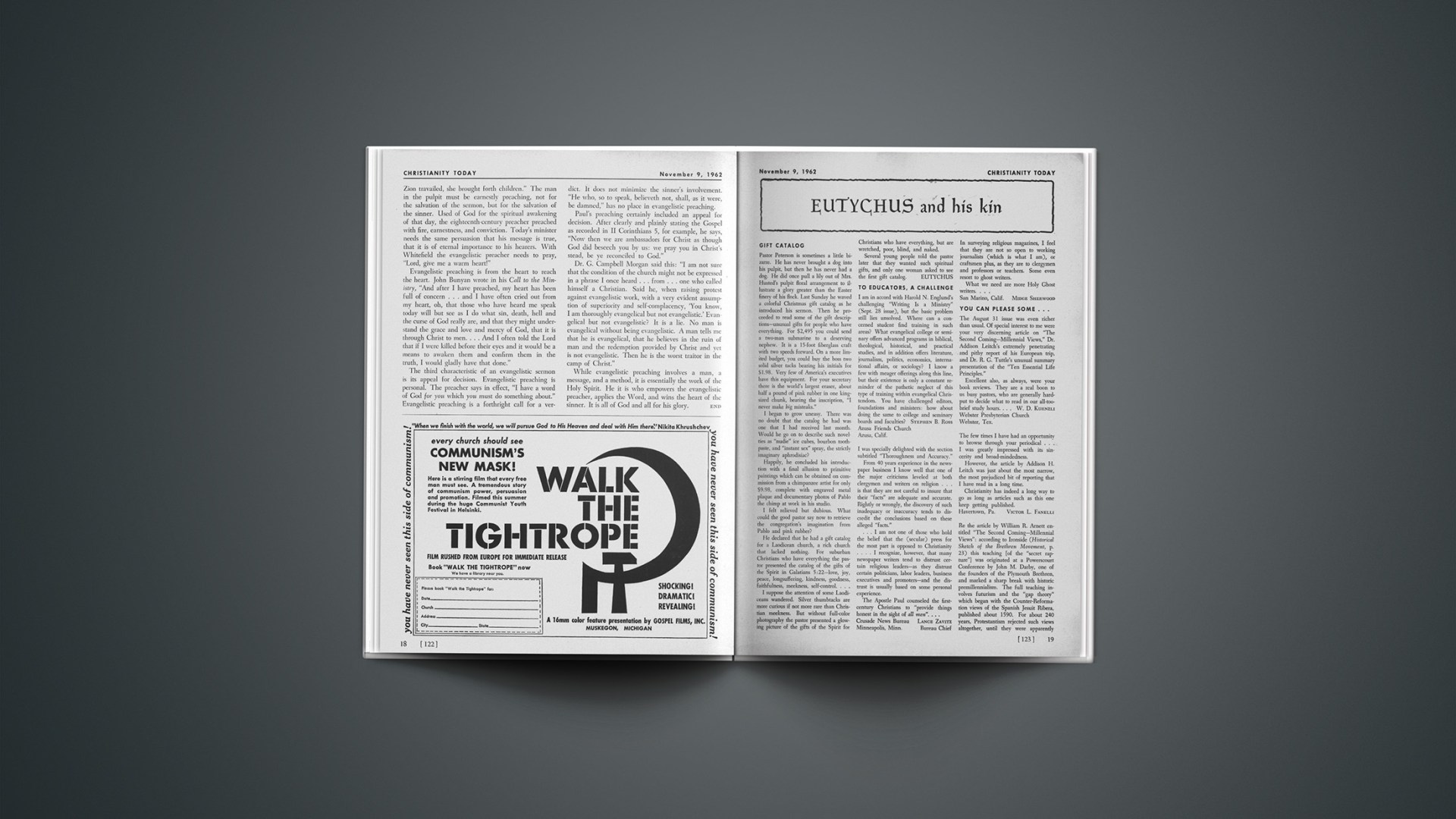
Eutychus and His Kin: November 9, 1962

Gift Catalog

Pastor Peterson is sometimes a little bizarre. He has never brought a dog into his pulpit, but then he has never had a dog. He did once pull a lily out of Mrs. Husted’s pulpit floral arrangement to illustrate a glory greater than the Easter finery of his flock. Last Sunday he waved a colorful Christmas gift catalog as he introduced his sermon. Then he proceeded to read some of the gift descriptions—unusual gifts for people who have everything. For $2,495 you could send a two-man submarine to a deserving nephew. It is a 15-foot fiberglass craft with two speeds forward. On a more limited budget, you could buy the boss two solid silver tacks bearing his initials for $1.98. Very few of America’s executives have this equipment. For your secretary there is the world’s largest eraser, about half a pound of pink rubber in one king-sized chunk, bearing the inscription, “I never make big misteaks.”

I began to grow uneasy. There was no doubt that the catalog he had was one that I had received last month. Would he go on to describe such novelties as “nudie” ice cubes, bourbon toothpaste, and “instant sex” spray, the strictly imaginary aphrodisiac?

Happily, he concluded his introduction with a final allusion to primitive paintings which can be obtained on commission from a chimpanzee artist for only $9.98, complete with engraved metal plaque and documentary photos of Pablo the chimp at work in his studio.

I felt relieved but dubious. What could the good pastor say now to retrieve the congregation’s imagination from Pablo and pink rubber?

He declared that he had a gift catalog for a Laodicean church, a rich church that lacked nothing. For suburban Christians who have everything the pastor presented the catalog of the gifts of the Spirit in Galatians 5:22—love, joy, peace, longsuffering, kindness, goodness, faithfulness, meekness, self-control.…

I suppose the attention of some Laodiceans wandered. Silver thumbtacks are more curious if not more rare than Christian meekness. But without full-color photography the pastor presented a glowing picture of the gifts of the Spirit for Christians who have everything, but are wretched, poor, blind, and naked.

Several young people told the pastor later that they wanted such spiritual gifts, and only one woman asked to see the first gift catalog.

To Educators, A Challenge

I am in accord with Harold N. Englund’s challenging “Writing Is a Ministry” (Sept. 28 issue), but the basic problem still lies unsolved. Where can a concerned student find training in such areas? What evangelical college or seminary offers advanced programs in biblical, theological, historical, and practical studies, and in addition offers literature, journalism, politics, economics, international affairs, or sociology? I know a few with meager offerings along this line, but their existence is only a constant reminder of the pathetic neglect of this type of training within evangelical Christendom. You have challenged editors, foundations and ministers: how about doing the same to college and seminary boards and faculties?

Azusa Friends Church

Azusa, Calif.

I was specially delighted with the section subtitled “Thoroughness and Accuracy.”

From 40 years experience in the newspaper business I know well that one of the major criticisms leveled at both clergymen and writers on religion … is that they are not careful to insure that their “facts” are adequate and accurate. Rightly or wrongly, the discovery of such inadequacy or inaccuracy tends to discredit the conclusions based on these alleged “facts.”

… I am not one of those who hold the belief that the (secular) press for the most part is opposed to Christianity.… I recognize, however, that many newspaper writers tend to distrust certain religious leaders—as they distrust certain politicians, labor leaders, business executives and promoters—and the distrust is usually based on some personal experience.

The Apostle Paul counseled the first-century Christians to “provide things honest in the sight of all men”.…

Crusade News Bureau

Minneapolis, Minn.

Bureau Chief

In surveying religious magazines, I feel that they are not so open to working journalists (which is what I am), or craftsmen plus, as they are to clergymen and professors or teachers. Some even resort to ghost writers.

What we need are more Holy Ghost writers.…

San Marino, Calif.

You Can Please Some …

The August 31 issue was even richer than usual. Of special interest to me were your very discerning article on “The Second Coming—Millennial Views,” Dr. Addison Leitch’s extremely penetrating and pithy report of his European trip, and Dr. R. G. Tuttle’s unusual summary presentation of the “Ten Essential Life Principles.”

Excellent also, as always, were your book reviews. They are a real boon to us busy pastors, who are generally hard-put to decide what to read in our all-too-brief study hours.…

Webster Presbyterian Church

Webster, Tex.

The few times I have had an opportunity to browse through your periodical … I was greatly impressed with its sincerity and broad-mindedness.

However, the article by Addison H. Leitch was just about the most narrow, the most prejudiced bit of reporting that I have read in a long time.

Christianity has indeed a long way to go as long as articles such as this one keep getting published.

Havertown, Pa.

Re the article by William R. Arnett entitled “The Second Coming—Millennial Views”: according to Ironside (Historical Sketch of the Brethren Movement, p. 23) this teaching [of the “secret rapture”] was originated at a Powerscourt Conference by John M. Darby, one of the founders of the Plymouth Brethren, and marked a sharp break with historic premillennialism. The full teaching involves futurism and the “gap theory” which began with the Counter-Reformation views of the Spanish Jesuit Ribera, published about 1590. For about 240 years, Protestantism rejected such views altogether, until they were apparently picked up and actively promoted by Darby. They have had a place in the evangelical wing of Protestantism only since about 1832. Now we have the amazing paradox of evangelicals actively promoting what was originally a Counter-Reformation interpretation by a Roman Catholic Jesuit.

Carmel Valley, Calif.

Thank you for the superb article on the Second Coming. Arnett is to be commended for his concise review of the doctrine, with the millennial views which relate to it. The article is biblically and creedally interested, clearly and sanely presented, evangelistic, and fair to the various evangelical theories—it being enough that he simply listed the denial views.…

The one minor matter which I somewhat question … is that in the New Testament “it is mentioned” [the Second Coming] approximately “eight times as much as Christ’s first coming.” Some 318 verses, it is stated, are on the Second Coming. One-eighth of this would make about forty verses on the first coming.

But, in spite of this, I consider it to be by far the finest brief treatment I have read on Christ’s return.

Associate Professor of Theology

Nazarene Theological Seminary

Kansas City, Mo.

The Keswick Movement

Too bad Britain’s J. D. Douglas’ prejudice toward the God-raised-up Keswick movement and message (News, Aug. 31 issue) should be allowed by CHRISTIANITY TODAY to so distort the truth. I trust my fellow subscribers … know that this 87-year-old work is heartily endorsed by Dr. Wilbur M. Smith, Dr. Alan Red-path, Dr. Stephen Barabas, and the late Dr. Barnhouse, together with thousands across the years who have been released from the bondage of self and sin into the liberty and victory of the Spirit-filled life. Keswick in England, Canada, and the United States has had a profound influence for righteousness in the Christian Church. Please refer your readers to these volumes on it: Keswick’s Authentic Voice (Zondervan); So Great Salvation and The Message of Keswick (Marshall, Morgan and Scott).

North Presbyterian

Pittsburgh, Pa.

You can always tell how entirely sanctified some people are by marking their reaction to any criticism of Keswick.

Manchester, England

I would like to say that it is hardly a correct description of England’s grand Keswick Convention.…

My first impression of the meetings in the great tent was the conscious presence of God.… I once heard the saintly Bishop Moule preach in St. John’s Episcopal Church one Sunday morning and the congregation was spellbound, not with oratory, but they were listening to a message from God. To use the common phrase, you could have heard a pin drop. Keswick was then and still is, in my opinion, composed of the very finest and sanest Christian people from every part of the British Isles.

Watertown, N. Y.

• Careful reading of the Keswick report will disclose only two criticisms of the movement: (1) the myth of a unique “Keswick message” as such, a point made in a quotation from remarks of a chaplain; (2) the predilection for intensively devotional hymns to the exclusion of other hymns.—ED.

Sda And Wcc

I note what the writer has to say about the Seventh-day Adventists remaining outside of the World Council of Churches (News, Aug. 31 issue), and it is very true, but there are many other denominations which do not unite with the WCC. However, we do have membership on one of their special committees.…

There is one way in which we do try to cooperate with other church groups that is not understood by many. I refer to the fact that our ministers are encouraged to and do join local ministerial association groups and work with them. This is encouraged by an occasional suggestion from the editor of our magazine Ministry, and I believe this is as it should be. Although I am now retired, for many years during my active ministry I not only tried to work with and cooperate with local ministerial associations, but had the honor of serving as chairman in some instances, and as secretary in other localities.…

Arlington, Calif.

Macedonian Call

The last sentence in the second paragraph of the first column (p. 16) in the article … entitled “The Missionary Situation in Europe” (July 20 issue), needs correcting. This sentence reads: “But in response the churches of North America sent only about 50 missionaries to Europe before World War II.” … The records of the Eastern European Mission show that we supported a total of 56 American missionaries in Europe between 1927, when this mission was founded, and 1939, when World War II began.… The total number of American missionaries ministering in Europe in prewar days likely was about 125.

President

Eastern European Mission

Pasadena, Calif.

The Pastor’S Sunday

Thank you for your timely editorial in the July 6 issue, “Sunday Union Meetings Pose Dilemma For Protestant Workers.” I cannot help but wonder if some of our Protestant denominations do what is just right in this regard when they set up meetings on Sunday afternoons and evenings making it impossible for pastors … to get back into their pulpits for the evening services.

Editor

The Sunday Guardian

Newark, N. J.

Prince Of Preachers

Dr. Andrew W. Blackwood in his article “Expository Preaching: Preparing for a Year of Pulpit Joy” (June 8 issue) states, inter alia, “Spurgeon’s Autobiography (four large volumes) shows that he toiled over his sermons, and that he spent a full day or more every week perfecting the form of the message that went into print.”

It should be pointed out, of course, that the time spent on preparing the message for the press followed the preaching of the sermon.… (After delivery the selected sermons were set up in type from the shorthand reporter’s notes and only then submitted to him … for necessary amendment.) Spurgeon urged his students to write out their sermons from time to time in order to cultivate orderly habits, and made it quite clear that he derived from the correcting of his sermons for the press the same benefit that writing out sermons prior to delivery would accrue to them.

He “toiled over his sermons” to the extent that he had frequent difficulty in selecting his text or topic. Once that had been given to him the rest was easy.

On page 207 of the first volume of the Autobiography he says, “I am always sure to have the most happy day when I get a good text in the morning from my Master. When I have had to preach two or three sermons in a day, I have asked Him for the morning subject, and preached from it; and I have asked Him for the afternoon’s topic or the evening’s portion, and preached from it, after meditation on it for my own soul’s comfort,—not in the professional style of a regular sermon-maker, but feasting upon it myself. Such simple food has done the people far more good than if I had been a week in manufacturing a sermon, for it has come warm from the heart just after it had been received into my soul; and therefore it has been well spoken, because well known, well tasted, and well felt.”

On page 42 of the third volume of the same work will be found the following: “I … very seldom know, twenty-four hours beforehand, the subject of any sermon I am going to preach. I have never been able to acquire the habit of elaborate preparation. I usually begin my sermonizing for the Sabbath-day on Saturday evening. I cannot think long upon any one subject; and I always feel that, if I do not see through it quickly, I shall not be likely to see through it at all, so I give it up and try another.”

I think Spurgeon conveyed to his students in his famous Lectures a very graphic idea of his secret as a sermon-maker. “If a man would speak without any immediate study, he must usually study much.” His mind was so saturated with Scripture and with illuminating thoughts thereon, that his sermons came relatively easily.

The modern preacher cannot do better than study Spurgeon’s methods. He should bear in mind, however, that Spurgeon had an abnormally sensitive mind and retentive memory; that he could skim his eyes over a page of a book and then repeat the content almost word-for-word without a mistake; that he died at a comparatively early ago from a mysterious complaint, which, as he himself says, was called “ ‘gout’ for want of a better word,” and that this disease affected his head.

There will never be another Spurgeon, but, happily, Spurgeon’s God is still the inspiration of the true servant of the Lord today, able and willing to speak through frail mortals the Word of Life.

Kenilworth, Cape Province, S. Africa

In Massachusetts

In “A Layman and His Faith” (June 22 issue) the statement is made: “At no time have the major evangelical denominations recognized these churches (Universalist-Unitarian) as a part of the Protestant tradition, nor has either of them been admitted to membership in cooperative church groups.”

I think that in Massachusetts you will find that Dr. Dana McLean Greeley was president of the Massachusetts Council of Churches. Also you will find that the Universalist-Unitarian churches are admitted to full membership in their State Council of Churches—as they are in several local councils.…

First Congregational Church

Adams, Mass.

A Different Incarnation

The Rev. T. Paul Verghese, news associate secretary of the WCC, in his references to what he considers to be the tyrannical disruptive force of being called a Com-symp, borders, in my opinion, upon blasphemy when he calls Christ “the master fellow-traveller.” If Communism were only another economic or political system his statement might go unchallenged, but since it is the incarnation of atheistic materialism at its worst, Mr. Verghese reflects no credit on God’s Son, himself, or the WCC.

Cobden, Ont.

A Case Of Identity

Re “The Pastor and the Psychopath” by Stuart Bergsma (June 8 issue): It appears to me that Mr. Bergsma has … brought under the aegis of evangelical Christianity one of the most pernicious doctrines of so-called liberalism, i.e., that we must look upon the abominable, the fornicators, the drunkards, etc., more as sick persons than as sinners.…

Staten Island, N. Y.

Call For Poetic Seer

Upon reading of the death of America’s rebel-troubadour of conventional punctuation, e. e. cummings, I began to survey, at random, the poetic scene in 20th-century America. With the passing of Cummings, America lost again another potential seer into the unseen world of spiritual realities. No one would dispute his poetic talent, but few Americans, especially among the bourgeois, will reread his verses for a better glimpse into the spiritual world. Cummings, a New England recluse, had small concern for the Scriptures, and he shut the door of his Joy Farm paradise to all but a select few. The son of a minister, Cummings drew from the external world around him for his source of inspiration. His own fertile imagination was his well of memory. He will be remembered as a prophet of stylistic rebellion and a champion [against] social abuses, but not as a seer who set before the American people the mind of God.

In the world of literary scholarship, it is disturbing to me to find so few who seek poetic inspiration in the Scriptures. The famous Miltonic call for the aid of the Holy Spirit—instead of invoking the pagan muses—is all too lacking among the men of letters. Has the source of all truth in inspiration gone dry, or have poets forgotten how to obtain divine guidance? Poets, representing the American intelligentsia, have, for the most part, continued to look inward and not upward for poetic inspiration and subject matter. The early Romantics of the 19th century looked outward to nature, and became obsessed with the beauty of creation. But 20th-century American poets (Robert Frost is the last of the Romantics)—especially the “literary” ones—have dwelt upon their own personal conflict, and from this media of highly individualized and introspective research have produced verse which has for its subject matter the turmoil of man’s struggling spirit (often with touches of perversion) apart from God’s grace. The tools of poetry (rhyme and meter) have been dissolved into a rugged, often unintelligible, prosaic verse which dies the moment after it is voiced. Is this to be American verse in the 20th century?

A poet is first of all a seer or prophet, and he has the noble task of picturing in meaningful language the acute needs of his people. A poet stands between God and man as a sensitive interpreter of the inner reality of things both sacred and profane. Cummings pictured for us clearly the profane, i. e., the social issues in America, and can be praised for his perception into the dry boredom of conventions without purpose. He pointed with acid satire to the false gods of materialism and status-seeking before which America bows, but he offered no predictions of hope, nor did he suggest an upward look for salvation. What of America’s spiritual needs?

We need in America today a poet with the literary talent of C. S. Lewis who can reveal and penetrate spiritual truth. We need a poet who can touch the American heart, and make it bleed with the blood of repentance. A poet who can heal the sin-sick with the cleansing flow from Calvary.

I ask for a poetic seer who will become a rebel for the sake of the Gospel, and who will find his inspiration in the Scriptures under the Holy Spirit’s direction. Who will pray with the Psalmist: “Let the words of my mouth, and the meditations of my heart be acceptable in thy sight, O Lord, my strength, and my redeemer.”

Georgetown, Mass.

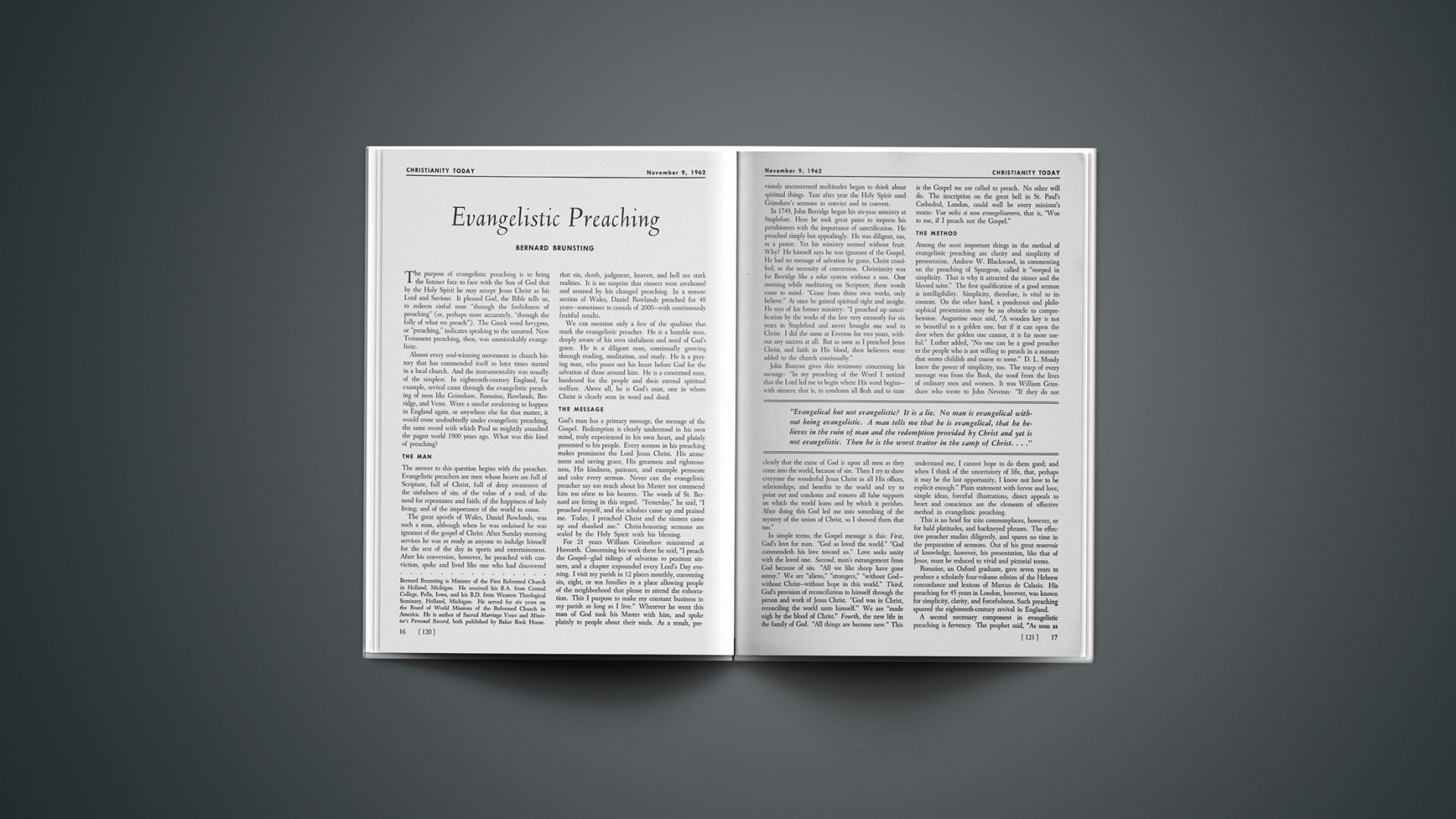
Evangelistic Preaching

The purpose of evangelistic preaching is to bring the listener face to face with the Son of God that by the Holy Spirit he may accept Jesus Christ as his Lord and Saviour. It pleased God, the Bible tells us, to redeem sinful man “through the foolishness of preaching” (or, perhaps more accurately, “through the folly of what we preach”). The Greek word kerygma, or “preaching,” indicates speaking to the unsaved. New Testament preaching, then, was unmistakably evangelistic.

Almost every soul-winning movement in church history that has commended itself to later times started in a local church. And the instrumentality was usually of the simplest. In eighteenth-century England, for example, revival came through the evangelistic preaching of men like Grimshaw, Romaine, Rowlands, Berridge, and Venn. Were a similar awakening to happen in England again, or anywhere else for that matter, it would come undoubtedly under evangelistic preaching, the same sword with which Paul so mightily assaulted the pagan world 1900 years ago. What was this kind of preaching?

The Man

The answer to this question begins with the preacher. Evangelistic preachers are men whose hearts are full of Scripture, full of Christ, full of deep awareness of the sinfulness of sin; of the value of a soul; of the need for repentance and faith; of the happiness of holy living; and of the importance of the world to come.

The great apostle of Wales, Daniel Rowlands, was such a man, although when he was ordained he was ignorant of the gospel of Christ. After Sunday morning services he was as ready as anyone to indulge himself for the rest of the day in sports and entertainment. After his conversion, however, he preached with conviction, spoke and lived like one who had discovered that sin, death, judgment, heaven, and hell are stark realities. It is no surprise that sinners were awakened and aroused by his changed preaching. In a remote section of Wales, Daniel Rowlands preached for 48 years—sometimes to crowds of 2000—with continuously fruitful results.

We can mention only a few of the qualities that mark the evangelistic preacher. He is a humble man, deeply aware of his own sinfulness and need of God’s grace. He is a diligent man, continually growing through reading, meditation, and study. He is a praying man, who pours out his heart before God for the salvation of those around him. He is a concerned man, burdened for the people and their eternal spiritual welfare. Above all, he is God’s man, one in whom Christ is clearly seen in word and deed.

The Message

God’s man has a primary message, the message of the Gospel. Redemption is clearly understood in his own mind, truly experienced in his own heart, and plainly presented to his people. Every sermon in his preaching makes prominent the Lord Jesus Christ. His atonement and saving grace, His greatness and righteousness, His kindness, patience, and example permeate and color every sermon. Never can the evangelistic preacher say too much about his Master nor commend him too often to his hearers. The words of St. Bernard are fitting in this regard. “Yesterday,” he said, “I preached myself, and the scholars came up and praised me. Today, I preached Christ and the sinners came up and thanked me.” Christ-honoring sermons are sealed by the Holy Spirit with his blessing.

For 21 years William Grimshaw ministered at Haworth. Concerning his work there he said, “I preach the Gospel—glad tidings of salvation to penitent sinners, and a chapter expounded every Lord’s Day evening. I visit my parish in 12 places monthly, convening six, eight, or ten families in a place allowing people of the neighborhood that please to attend the exhortation. This I purpose to make my constant business in my parish so long as I live.” Wherever he went this man of God took his Master with him, and spoke plainly to people about their souls. As a result, previously unconcerned multitudes began to think about spiritual things. Year after year the Holy Spirit used Grimshaw’s sermons to convict and to convert.

In 1749, John Berridge began his six-year ministry at Staplefort. Here he took great pains to impress his parishioners with the importance of sanctification. He preached simply but appealingly. He was diligent, too, as a pastor. Yet his ministry seemed without fruit. Why? He himself says he was ignorant of the Gospel. He had no message of salvation by grace, Christ crucified, or the necessity of conversion. Christianity was for Berridge like a solar system without a sun. One morning while meditating on Scripture, these words came to mind: “Cease from thine own works, only believe.” At once he gained spiritual sight and insight. He says of his former ministry: “I preached up sanctification by the works of the law very earnestly for six years in Stapleford and never brought one soul to Christ. I did the same at Everton for two years, without any success at all. But as soon as I preached Jesus Christ, and faith in His blood, then believers were added to the church continually.”

“Evangelical but not evangelistic? It is a lie. No man is evangelical without being evangelistic. A man tells me that he is evangelical, that he believes in the ruin of man and the redemption provided by Christ and yet is not evangelistic. Then he is the worst traitor in the camp of Christ.…”

John Bunyan gives this testimony concerning his message: “In my preaching of the Word I noticed that the Lord led me to begin where His word begins—with sinners; that is, to condemn all flesh and to state is clearly that the curse of God is upon all men as they come into the world, because of sin. Then I try to show everyone the wonderful Jesus Christ in all His offices, relationships, and benefits to the world and try to point out and condemn and remove all false supports on which the world leans and by which it perishes. After doing this God led me into something of the mystery of the union of Christ, so I showed them that too.”

In simple terms, the Gospel message is this: First, God’s love for man. “God so loved the world.” “God commendeth his love toward us.” Love seeks unity with the loved one. Second, man’s estrangement from God because of sin. “All we like sheep have gone astray.” We are “aliens,” “strangers,” “without God—without Christ—without hope in this world.” Third, God’s provision of reconciliation to himself through the person and work of Jesus Christ. “God was in Christ, reconciling the world unto himself.” We are “made nigh by the blood of Christ.” Fourth, the new life in the family of God. “All things are become new.” This the Gospel we are called to preach. No other will do. The inscription on the great bell in St. Paul’s Cathedral, London, could well be every minister’s motto: Vae mihi si non evangelisavero, that is, “Woe to me, if I preach not the Gospel.”

The Method

Among the most important things in the method of evangelistic preaching are clarity and simplicity of presentation. Andrew W. Blackwood, in commenting on the preaching of Spurgeon, called it “steeped in simplicity. That is why it attracted the sinner and the blessed saint.” The first qualification of a good sermon is intelligibility. Simplicity, therefore, is vital to its content. On the other hand, a ponderous and philosophical presentation may be an obstacle to comprehension. Augustine once said, “A wooden key is not so beautiful as a golden one, but if it can open the door when the golden one cannot, it is far more useful.” Luther added, “No one can be a good preacher to the people who is not willing to preach in a manner that seems childish and coarse to some.” D. L. Moody knew the power of simplicity, too. The warp of every message was from the Book, the woof from the lives of ordinary men and women. It was William Grimshaw who wrote to John Newton: “If they do not understand me, I cannot hope to do them good; and when I think of the uncertainty of life, that, perhaps it may be the last opportunity, I know not how to be explicit enough.” Plain statement with fervor and love, simple ideas, forceful illustrations, direct appeals to heart and conscience are the elements of effective method in evangelistic preaching.

This is no brief for trite commonplaces, however, or for bald platitudes, and hackneyed phrases. The effective preacher studies diligently, and spares no time in the preparation of sermons. Out of his great reservoir of knowledge, however, his presentation, like that of Jesus, must be reduced to vivid and pictorial terms.

Romaine, an Oxford graduate, gave seven years to produce a scholarly four-volume edition of the Hebrew concordance and lexicon of Marcus de Calasio. His preaching for 45 years in London, however, was known for simplicity, clarity, and forcefulness. Such preaching spurred the eighteenth-century revival in England.

A second necessary component in evangelistic preaching is fervency. The prophet said, “As soon as Zion travailed, she brought forth children.” The man in the pulpit must be earnestly preaching, not for the salvation of the sermon, but for the salvation of the sinner. Used of God for the spiritual awakening of that day, the eighteenth-century preacher preached with fire, earnestness, and conviction. Today’s minister needs the same persuasion that his message is true, that it is of eternal importance to his hearers. With Whitefield the evangelistic preacher needs to pray, “Lord, give me a warm heart!”

Evangelistic preaching is from the heart to reach the heart. John Bunyan wrote in his Call to the Ministry, “And after I have preached, my heart has been full of concern … and I have often cried out from my heart, oh, that those who have heard me speak today will but see as I do what sin, death, hell and the curse of God really are, and that they might understand the grace and love and mercy of God, that it is through Christ to men.… And I often told the Lord that if I were killed before their eyes and it would be a means to awaken them and confirm them in the truth, I would gladly have that done.”

The third characteristic of an evangelistic sermon is its appeal for decision. Evangelistic preaching is personal. The preacher says in effect, “I have a word of God for you which you must do something about.” Evangelistic preaching is a forthright call for a verdict. It does not minimize the sinner’s involvement. “He who, so to speak, believeth not, shall, as it were, be damned,” has no place in evangelistic preaching.

Paul’s preaching certainly included an appeal for decision. After clearly and plainly stating the Gospel as recorded in 2 Corinthians 5, for example, he says, “Now then we are ambassadors for Christ as though God did beseech you by us: we pray you in Christ’s stead, be ye reconciled to God.”

Dr. G. Campbell Morgan said this: “I am not sure that the condition of the church might not be expressed in a phrase I once heard … from … one who called himself a Christian. Said he, when raising protest against evangelistic work, with a very evident assumption of superiority and self-complacency, ‘You know, I am thoroughly evangelical but not evangelistic.’ Evangelical but not evangelistic? It is a lie. No man is evangelical without being evangelistic. A man tells me that he is evangelical, that he believes in the ruin of man and the redemption provided by Christ and yet is not evangelistic. Then he is the worst traitor in the camp of Christ.”

While evangelistic preaching involves a man, a message, and a method, it is essentially the work of the Holy Spirit. He it is who empowers the evangelistic preacher, applies the Word, and wins the heart of the sinner. It is all of God and all for his glory.

END

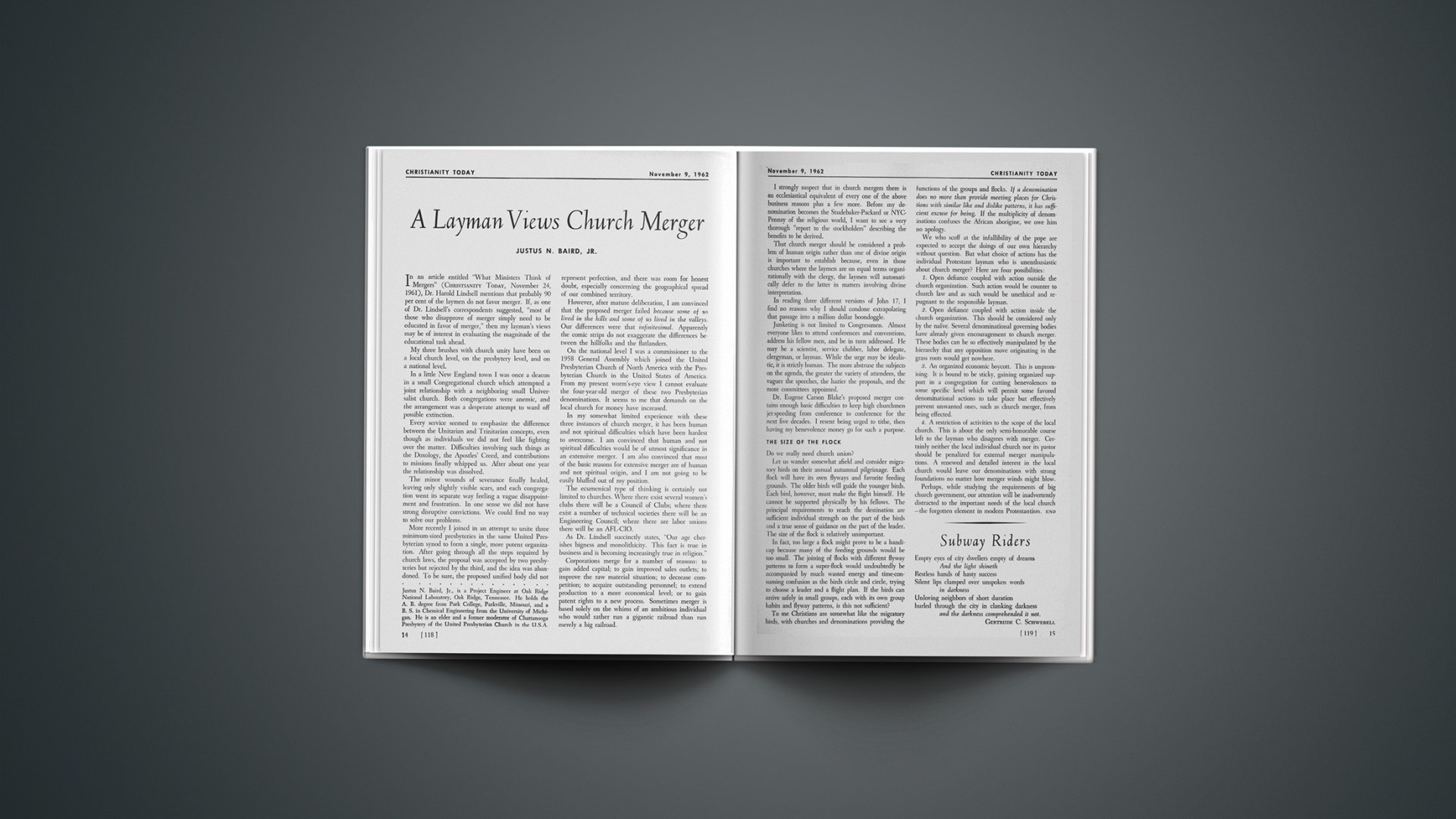
A Layman Views Church Merger

In an article entitled “What Ministers Think of Mergers” (CHRISTIANITY TODAY, November 24, 1961), Dr. Harold Lindsell mentions that probably 90 per cent of the laymen do not favor merger. If, as one of Dr. Lindsell’s correspondents suggested, “most of those who disapprove of merger simply need to be educated in favor of merger,” then my layman’s views may be of interest in evaluating the magnitude of the educational task ahead.

My three brushes with church unity have been on a local church level, on the presbytery level, and on a national level.

In a little New England town I was once a deacon in a small Congregational church which attempted a joint relationship with a neighboring small Universalist church. Both congregations were anemic, and the arrangement was a desperate attempt to ward off possible extinction.

Every service seemed to emphasize the difference between the Unitarian and Trinitarian concepts, even though as individuals we did not feel like fighting over the matter. Difficulties involving such things as the Doxology, the Apostles’ Creed, and contributions to missions finally whipped us. After about one year the relationship was dissolved.

The minor wounds of severance finally healed, leaving only slightly visible scars, and each congregation went its separate way feeling a vague disappointment and frustration. In one sense we did not have strong disruptive convictions. We could find no way to solve our problems.

More recently I joined in an attempt to unite three minimum-sized presbyteries in the same United Presbyterian synod to form a single, more potent organization. After going through all the steps required by church laws, the proposal was accepted by two presbyteries but rejected by the third, and the idea was abandoned. To be sure, the proposed unified body did not represent perfection, and there was room for honest doubt, especially concerning the geographical spread of our combined territory.

However, after mature deliberation, I am convinced that the proposed merger failed because some of us lived in the hills and some of us lived in the valleys. Our differences were that infinitesimal. Apparently the comic strips do not exaggerate the differences between the hillfolks and the flatlanders.

On the national level I was a commissioner to the 1958 General Assembly which joined the United Presbyterian Church of North America with the Presbyterian Church in the United States of America. From my present worm’s-eye view I cannot evaluate the four-year-old merger of these two Presbyterian denominations. It seems to me that demands on the local church for money have increased.

In my somewhat limited experience with these three instances of church merger, it has been human and not spiritual difficulties which have been hardest to overcome. I am convinced that human and not spiritual difficulties would be of utmost significance in an extensive merger. I am also convinced that most of the basic reasons for extensive merger are of human and not spiritual origin, and I am not going to be easily bluffed out of my position.

The ecumenical type of thinking is certainly not limited to churches. Where there exist several women’s clubs there will be a Council of Clubs; where there exist a number of technical societies there will be an Engineering Council; where there are labor unions there will be an AFL-CIO.

As Dr. Lindsell succinctly states, “Our age cherishes bigness and monolithicity. This fact is true in business and is becoming increasingly true in religion.”

Corporations merge for a number of reasons: to gain added capital; to gain improved sales outlets; to improve the raw material situation; to decrease competition; to acquire outstanding personnel; to extend production to a more economical level; or to gain patent rights to a new process. Sometimes merger is based solely on the whims of an ambitious individual who would rather run a gigantic railroad than run merely a big railroad.

I strongly suspect that in church mergers there is an ecclesiastical equivalent of every one of the above business reasons plus a few more. Before my denomination becomes the Studebaker-Packard or NYC-Pennsy of the religious world, I want to see a very thorough “report to the stockholders” describing the benefits to be derived.

That church merger should be considered a problem of human origin rather than one of divine origin is important to establish because, even in those churches where the laymen are on equal terms organizationally with the clergy, the laymen will automatically defer to the latter in matters involving divine interpretation.

In reading three different versions of John 17, I find no reasons why I should condone extrapolating that passage into a million dollar boondoggle.

Junketing is not limited to Congressmen. Almost everyone likes to attend conferences and conventions, address his fellow men, and be in turn addressed. He may be a scientist, service clubber, labor delegate, clergyman, or layman. While the urge may be idealistic, it is strictly human. The more abstruse the subjects on the agenda, the greater the variety of attendees, the vaguer the speeches, the hazier the proposals, and the more committees appointed.

Dr. Eugene Carson Blake’s proposed merger contains enough basic difficulties to keep high churchmen jet-speeding from conference to conference for the next five decades. I resent being urged to tithe, then having my benevolence money go for such a purpose.

The Size Of The Flock

Do we really need church union?

Let us wander somewhat afield and consider migratory birds on their annual autumnal pilgrimage. Each flock will have its own flyways and favorite feeding grounds. The older birds will guide the younger birds. Each bird, however, must make the flight himself. He cannot be supported physically by his fellows. The principal requirements to reach the destination are sufficient individual strength on the part of the birds and a true sense of guidance on the part of the leader. The size of the flock is relatively unimportant.

In fact, too large a flock might prove to be a handicap because many of the feeding grounds would be too small. The joining of flocks with different flyway patterns to form a super-flock would undoubtedly be accompanied by much wasted energy and time-consuming confusion as the birds circle and circle, trying to choose a leader and a flight plan. If the birds can arrive safely in small groups, each with its own group habits and flyway patterns, is this not sufficient?

To me Christians are somewhat like the migratory birds, with churches and denominations providing the functions of the groups and flocks. If a denomination does no more than provide meeting places for Christians with similar like and dislike patterns, it has sufficient excuse for being. If the multiplicity of denominations confuses the African aborigine, we owe him no apology.

We who scoff at the infallibility of the pope are expected to accept the doings of our own hierarchy without question. But what choice of actions has the individual Protestant layman who is unenthusiastic about church merger? Here are four possibilities:

1. Open defiance coupled with action outside the church organization. Such action would be counter to church law and as such would be unethical and repugnant to the responsible layman.

2. Open defiance coupled with action inside the church organization. This should be considered only by the naïve. Several denominational governing bodies have already given encouragement to church merger. These bodies can be so effectively manipulated by the hierarchy that any opposition move originating in the grass roots would get nowhere.

3. An organized economic boycott. This is unpromising. It is bound to be sticky, gaining organized support in a congregation for cutting benevolences to some specific level which will permit some favored denominational actions to take place but effectively prevent unwanted ones, such as church merger, from being effected.

4. A restriction of activities to the scope of the local church. This is about the only semi-honorable course left to the layman who disagrees with merger. Certainly neither the local individual church nor its pastor should be penalized for external merger manipulations. A renewed and detailed interest in the local church would leave our denominations with strong foundations no matter how merger winds might blow.

Perhaps, while studying the requirements of big church government, our attention will be inadvertently distracted to the important needs of the local church—the forgotten element in modern Protestantism.

Subway Riders

Empty eyes of city dwellers empty of dreams

And the light shineth

Restless hands of hasty success

Silent lips clamped over unspoken words

in darkness

Unloving neighbors of short duration

hurled through the city in clanking darkness

and the darkness comprehended it not.

GERTRUDE C. SCHWEBELL

What’s Ahead?

The decision of the United States Supreme Court disallowing the New York Regents’ prayer aroused furor in many parts of the country. Another possibly equally perturbing decision is still pending—that concerning the constitutionality of Bible reading in Pennsylvania, Maryland, and Florida public schools. To understand these situations one must understand the changes that have been penetrating the religious life of our nation.

No one questions that our nation, by and large, was founded and established by men of deep religious faith and conviction. Mostly of British background and also of German, French, Dutch, and Swedish heritage, the early settlers were, in the main, of Protestant persuasion. Congregational-Presbyterianism prevailed in New England, and Anglicanism predominated in the South. While some of the middle colonies professed and practiced religious toleration, or even religious freedom, they were the exception.

Our founding fathers considered the relationship of man to his maker a fundamental part of their philosophy of life and believed that human rights were derived from this relationship. They recognized also the fact of their Christian heritage. But they knew history well enough to recognize the dangers of an established religion and saw the necessity of encouraging the free practice of religion in a free society. Accordingly, they wrote this safeguard into the First Amendment to the Constitution: “Congress shall make no law respecting an establishment of religion, or prohibiting the exercise thereof.” By these words they rejected the idea of an established religion and guaranteed personal religious freedom.

They had no intention, however, of thereby encouraging a spirit of anti-religion. As Norman Cousins indicates, “It is significant that most of the founding fathers grew up in a strong religious atmosphere; many had Calvinist family backgrounds. In reacting against it, they did not react against basic religious ideas, or what they considered to be the spiritual nature of man. Most certainly they did not turn against God, or lose their respect for religious belief. Indeed it was their very concern for the conditions under which free religious belief was possible that caused them to invest so much of their thought and energy into the cause of human rights” (In God We Trust, p. 9).

While most of the men who authored our documents of freedom affiliated themselves with Protestant denominations as professing Christians and were influenced by eighteenth-century enlightenment, they nevertheless believed in religious freedom. They were well aware of the discrimination and persecution that followed whenever the colonies superimposed an established religion upon their people. Such evil they were determined to prevent. So they underwrote religious freedom, not to do away with the practice of religion but rather to insure it for everyone. They knew that religion as a whole would be destroyed if each group, in affirming the truth of its own faith, practiced intolerance and bigotry.

Despite this provision by the founding fathers for practicing differences of religious conviction, the nation shared a common bond of unity. As the various colonies ceased to exist legally as independent religiously established units and became a nation, the people of America recognized the fact of a common heritage. This common heritage was not only Christian and Protestant, but Protestant Christianity of Calvinistic orientation. For many years this special kind of faith characterized the American people as a whole. This faith was unique in its ability both to influence the new nation and to adapt itself to a changing environment without sacrificing any of its peculiar genius.

In the early days of American history the chief center of community life and culture was the Church, specifically the Protestant Church. It was the one institution that united people into a cohesive unit. While there were many denominations and sects, they shared a common belief in God, in Jesus Christ, and in the Bible as divinely authoritative. Protestantism also incorporated a healthy individualism that stimulated the nation’s growth. American Protestantism had no ecclesiastical dependence upon churches in Europe. Men were free to preach the Gospel, and even to establish new churches on the growing frontiers of American life. As the newer states matured from their pioneer status, their churches, which were Protestant, effectively influenced the shaping of community life.

The revival services that characterized American Protestantism aided the growth and impact of the Church. Whole communities were changed as thousands of people came under the influence of the Gospel message. In both the East and the West the number of those who professed Protestant Christianity continued to rise. There was virtually no competition. Roman Catholicism was but a small, almost negligible factor in the life and culture of those times. Its adherents were few; in 1787 there may have been 35,000 (Kenneth Scott Latourette, The Great Century, Vol. IV, p. 230) in a total population of about 3,900,000 (in the census of 1790 the total population was 3,929,214), or less than one per cent. Thus while the founding fathers espoused and provided for a pluralistic society, American culture for decades was predominantly Reformed-Protestant in perspective.

During this period in our national life no one seriously challenged the fact that religion (and by religion we mean Protestantism) was an integral part of the American scene. Public education, for example, knew nothing about excluding the major premises of the Christian faith from its pedagogy. Religion, in fact, was the mother of education in America. During the colonial period, the primary schools were conducted in close alliance with the churches. And until the turn of the present century, secondary education, especially in the newer areas of settlement, was provided largely in academies operated under religious auspices and taught by ministers. Most of our colleges and universities, including such revered institutions as Harvard, Yale, Columbia, Chicago, Kentucky, and Vanderbilt, were established by churchmen. The ministry of teaching has been a major contribution of Christianity to American culture (Ronald B. Osborn, The Spirit of American Christianity, pp. 33 f.). Schools were free to teach the Beatitudes or other Scripture passages in entirety. Classes could begin with prayers invoked in the name of Christ. The Bible could be taught and read, and hymns could be sung. Christian holy days, such as Christmas and Easter, could be observed accordingly. The culture of America was predominantly, even profoundly, Christian in the Protestant tradition. No one seriously challenged either this devotion to religious heritage, or the doctrine of religious freedom laid down by our founding fathers.

This situation, however, underwent gradual change. Before 1820 (200 years after our Pilgrim fathers) there were no more than 20,000 immigrants a year, and these were mostly Protestants. Between 1820 and 1860, however, about 5,000,000 immigrants entered the United States, and since then over 35,000,000 have come to our shores. Among these later immigrants were many Roman Catholics and Jews who brought with them—and this is no condemnation, but merely a statement of fact—ideas and cultures that differed extensively from those of the early settlers and founders of our nation.

In the 1820s and especially after the potato famine of 1846 in Ireland, the Irish came to America in great numbers. For the first time in American history our population had a sizable representation of Roman Catholics. Toward the end of the century most immigrants came from southern and eastern Europe and introduced new ethnic groups into our society. While most of these people were Roman Catholic, they incorporated also two sizable new elements, namely, the Eastern Orthodox and the Jewish. America was becoming less Protestant and less Puritan in spirit. We were becoming a more complex and pluralistic society.

Being new, and at first often of lower economic and social status, these new minority groups found it profitable and advantageous to adhere to our predominantly Protestant culture. This was the only way they could progress. There was still no danger to our Protestant heritage, however, and even as late as 1927 foreign observers like André Siegfried could speak of Protestantism as the United States’ only national religion. Someone else observed, however, that “they [the immigrants] still saw the more ancient stamp on our culture rather than the immediate dynamics of the situation.”

The Yearbook of American Churches for 1962 reported that the United States now has 63,688,835 Protestants, 42,104,900 Roman Catholics, 5,367,000 Jews, and 2,698,663 Eastern Orthodox. The Roman church, that for over a century was a relatively insignificant minority, is today a sizable group in our country. The Roman church has increased markedly in number, wealth, and prestige. Its members, by and large, are loyal to their church in active membership and support, while many Protestants, on the other hand, are Protestant merely in name.

Furthermore, America’s new culture is becoming urban centered, and the large cities which dominate this new culture are becoming, or have become, largely Roman Catholic. Cities like Boston, New York, Philadelphia, Baltimore, Cleveland, and Chicago, are all concentrations of Roman Catholic population, and increasingly control the political life of our nation. For the first time in our nation’s history we have a Roman Catholic president, whose election, moreover, was largely carried by the city vote. The majority leaders of both the House and the Senate are Roman Catholic, a situation that 50, or even 30 years ago would have been quite improbable in American life. Whether this change is good or bad is not the issue. The point is that something new has appeared on the American scene, and Protestants must increasingly learn to live with this fact. The Roman church is now a powerful political force in the life of the nation. Its effort to get Federal aid for parochial schools has made many Protestant leaders fearful of this increased power. The doctrine of the separation of church and state has accordingly become a live issue that 50 or 100 years ago, when Protestantism had no competitors on the American scene, was nonexistent, or relatively unimportant.

Likewise Jewish culture has assumed an increasingly important part in American life. For one thing, Hitler’s persecution stirred the Jewish people everywhere to a renewed religious-cultural consciousness that, among other things, brought into being the new state of Israel. The establishment of this national Jewish state has had the active support of thousands of Jews in America. In this resurgence of religious-cultural consciousness, the Jewish people are investing vast sums to educate their youth in the Jewish religion, a revival of Judaism that is being felt in America, too. At inter-faith gatherings here, our Protestant Christian heritage must frequently be adjusted to avoid offending the Jewish faith. Bible readings, for example, must be selected from the Old Testament, and prayer must not be offered in Jesus’ name. And we are pressured to have an open Sabbath in deference to the Jews, who observe Saturday rather than Sunday.

These facts reveal the pluralistic state of our society, for which our founding fathers provided, but with which we have not had to cope seriously until the present time. This development, of course, comes at the expense of Protestantism, which through the years had enjoyed a preferred religious position in America. Whether this status was good or bad is another question. The fact is that Protestantism seemed unaware of what was happening. No longer is old-line American Protestantism in a position to guide the spiritual life of the nation as before. We have reached the place in our national life where many of our theories must be adapted to the practical outworkings of life. To do this is a new experience for us both as Protestants and as Americans and is part of the tension now operative in our approach to the problem of separation of church and state.

Secularism is another element in American life that cannot be overlooked. Many persons either do not believe in God at all, or have so diluted any concept of him as to make him virtually nonexistent. Many young people are being reared in a new kind of faith that makes God quite irrelevant to life. Because of this changing status of religious life in America there has come increased pressure to define what we mean by the separation of church and state, and by religious freedom. For the first time since its founding as a nation, America is being brought face to face seriously with the demands of a pluralistic society.

In a 1952 decision of the Supreme Court, Justice William O. Douglas said, “We are a religious people and our institutions presuppose a Supreme Being.” These words contrast tellingly with the words of Justice Sutherland in an earlier decision of 1931 which refers to us as “a Christian people.” In the 21-year interval between 1931 and 1952 we moved from designation as “Christian” to simply “religious” people. It is doubtful whether we can ever again recapture the former identity. It is conceivable that in the not too distant future we shall even drop the term “religious” in reference to ourselves. If religious faith is to prevail in our pluralistic society, it must center increasingly around the life of our churches. Perhaps this is as it should be. Louis Cassels, United Press religion correspondent, concluded a recent column titled “A Look Past the Prayer Decision” by saying:

The Supreme Court ruling means that Protestant parents must now face up to reality. And the reality is that the average Protestant child is not receiving much religious education. Even if he attends Sunday School faithfully he gets only about 25 hours of solid instruction a year.

Some Protestants have reacted to the ruling by denouncing the Supreme Court and talking about a constitutional amendment to permit the public school religious exercises which parents have found so comforting.

Others, however, are already looking beyond this kind of emotional response to see what constructive steps the Protestant churches can take to provide children with the kind of religious-oriented educational experience which is now quite obviously ruled out of the public schools.

One thing is obvious. Recognizing what has taken place in the American scene, we must go on to meet further challenges that will confront us as we try to define what our founding fathers meant by the separation of church and state.

Preacher in the Red

NO RETURN ADDRESS NECESSARY

I was a minister of one of England’s great old Methodist churches, a splendid edifice dating back to Wesley’s time. Extensive renovation and restoration had been done and I invited an earlier famous and beloved pastor to share in the dedication services.

Seated by his side on the platform I said to him enthusiastically: “Beautiful isn’t it? You see how we have done out the front of the gallery in simple white and gold, replacing that hideous multi-colored blotch of a frieze—that gaudy, tasteless, inartistic abomination unto the Lord. Do you remember it?”

“Yes I do,” he replied. “I put it there twenty years ago.”—THE REV. T. L. BARLOW WESTERDALE, “Camelot,” 12, Cheriton Road, Winchester, England.

Full Tables or Full Lives?

Many years ago, as the wise men of Jerusalem observed the flow of life in and out of their city gates, as they listened to the daily petty disputes of the common people, and as they considered their own experience as part of the panorama of life, they coined a wise proverb, which is found in Proverbs 15:17: “Better is a dinner of herbs where love is, than a stalled ox and hatred therewith.” They recognized that a humble meal with love was far better than a fatted calf with hatred.

As we anticipate the bounteous dinners which will grace our tables on Thanksgiving Day, we shall do well to heed the message of this proverb. As we enjoy the fruits of our labors, we will be wise to remember that more exists to life than an abundance of food and clothing and to guard lest we become self-satisfied.

The undeniable truth of this proverb is illustrated in two episodes of history.

The first such incident occurred in ancient Egypt during the reign of the Pharaohs. In order to construct a memorial to their national greatness, the Egyptians had enslaved a colony of Hebrews, forcing them to toil many hours daily. Despite the persecution, the colony continued to multiply and threatened the numerical supremacy of its masters. These ordered the death of all male children at birth.

One family tried to protect its infant son. By chance the baby was discovered by the princess, who raised him as her own son in the palace of the Pharaoh. Thus the boy grew up a prince and shared in all the splendid advantages of the Egyptian court—its education, its regal dress, its bountiful delicacies. Gradually, however, the prince’s heart was stirred by a deep sense of injustice at the slavery of his people, their overwork and their poor diet. Eventually, God used Moses to become the deliverer of his people and to lead them out of Egypt into Canaan. Summarizing his life, the epistle to the Hebrews notes,

By faith, Moses, when he was come to years, refused to be called the son of Pharaoh’s daughter; choosing rather to suffer affliction with the people of God, than to enjoy the pleasures of sin for a season; esteeming the reproaches of Christ greater riches than the treasures in Egypt.

May this be the clue to solving some of the social issues of our day? Are we, like Moses, unafraid to make the personal sacrifice of giving ourselves to a needy humanity? Christians must earnestly seek to know, to understand, and to love the downtrodden people of the world. We must give a practical demonstration that “better is a dinner of herbs where love is, than a stalled ox and hatred therewith.”

A palace is the setting for another episode. In the days of the Babylonian empire, the finest young men of Judah were selected for government service. Part of their training included dining at the king’s table, enjoying the king’s meat and the wine which he drank. For many youths this was a great honor, but four young Hebrews knew that the fulfillment of this requirement meant religious defilement. The Bible says, “Daniel purposed in his heart that he would not defile himself with the portion of the king’s meat, nor with the wine which he drank.” He and his friends cherished their purity and personal integrity; they would not sacrifice it by eating at the king’s table. They believed that a dinner of pulse and water with moral purity was better than meat and wine with moral compromise.

In the Sermon on the Mount, Jesus asked one of the most profoundly simple questions of his ministry—simple because its answer is obvious, profound because its practical implications are so far-reaching. Addressing the disciples, Jesus asked, “Is not life more than meat, and the body more than raiment?”

What more obvious question could Jesus have asked? Anyone can compile a list of things which he values as highly as meat and raiment—such things as health, friendship, integrity, and a vital faith. But scores of people live as if food and clothing were all there is.

As we give thanks this year, let us earnestly consider what our bounteous dinners have cost us. To enjoy them, did we tolerate social injustice and exploitation? Did we have to sacrifice our moral purity on the altar of expedience? Does our conscience smart because of failure to stand for what is true? If we have full tables and full lives, then we can be thankful indeed.

END

Liberal Social Ethics: Confronting the Four Horsemen

Outlined against a blue-gray October sky, the Four Horsemen rode again. In dramatic lore they are known as Famine, Pestilence, Destruction and Death. They are only aliases. Their real names are Stuhldreher, Miller, Crowley and Layden. They formed the crest of the South Bend cycle.” So wrote Grantland Rice in 1924 as the Army football team fell before the magnificently balanced backfield of Notre Dame. But though it was the age of athletic giants and the peaceful decade of the 1920s, even the most optimistic of liberal Protestant preachers doubtless found this memorable identification of the Four Horsemen of the Apocalypse somewhat confining, albeit Albrecht Dürer’s terrifying portrayal may have seemed rather pessimistic for the day. For the liberal social gospel was then confronting the Four Horsemen—in their twentieth-century manifestations—on several fronts, and its chief mouthpiece was The Christian Century (see Donald B. Meyer, The Protestant Search for Political Realism, 1919–1941 [University of California Press, 1960], pp. 44, 53 f.; Robert Moats Miller, American Protestantism and Social Issues, 1919–1939 [The University of North Carolina Press, 1958], p. 39; and The Christian Century, Oct. 5, 1938, p. 1187). They were moving together toward the victorious crest of 1928 when the social gospel appeared to be carrying all before its onward surge. It fought not with ancient weapons of biblical Christianity but with shining new ones forged in the twentieth-century crucible of liberal optimism, which proclaimed for all who would hear that man was inherently good, that his evolution could be assisted through environmental improvement. So pass good laws—and legislate the Kingdom into history!

Weapons Of The Social Gospel

Against the white horse of conquest and the red horse of war, the supreme Christian Century weapon was the outlawry of war, which was confidently legislated by the 1928 Pact of Paris, also called the Kellogg-Briand Pact (see earlier essays in this CHRISTIANITY TODAY series: Jan. 5, 19, Feb. 2 issues). For who then could see the long shadows of white and red horses moving toward Manchuria, object of Japanese aggression in 1931? (And onward to Ethiopia, Spain, China, Finland, Poland, Pearl Harbor, Hiroshima, Korea, Algeria, Laos, Vietnam, Cuba …?)

If optimistic passage of a law was deemed appropriate to halt conquest and war, optimistic defense of the National Prohibition Act was the chosen weapon against the black horse of famine, which seemed to be running on a muddy track in the America of the 1920s. Its chief threat was singled out as the poverty and waste resulting from drunkenness, so prohibition was given priority over welfare state legislation. Rising to its defense, the social gospel rallied forces to contribute to a smashing 1928 election victory over the law’s opponents represented in the challenge of Al Smith. Unforeseen was the 1932 election reversal which brought repeal in 1933. Also unanticipated was the 1929 stock market crash which was to plunge the nation into a critical depression.

And what of the ultimate enemies reflected in the pale horse of death followed by Hades? Fighting was not as strenuous and unremitting on this front. Theological answers to ultimate questions, evangelistic and missionary quest for lost souls—these became a secondary theater of the conflict. Social gospel and Christian Century energies were primarily absorbed by political matters, true to American activist traditions. Al Smith’s religion did raise certain theological questions related to the issue of political freedom. And the 1928 Jerusalem Conference on missions was hailed by the Century for what it saw as a great thrust forward for modernism from positions held at the Edinburgh Conference of 1910. But the tall shadow of Karl Barth, who would wreak such havoc upon the liberal gospel, had not yet fallen across the English-speaking world. This would take place with telling effect in the 1930s. Der Römerbrief, published in 1918, would not be translated into English until 1933 (religious publishing houses being dominated by modernist advisors).

And the challenge to the liberal social gospel by American neoorthodoxy embodied preeminently in Reinhold Niebuhr was yet to come. The pessimism of Niebuhr’s first book, published in 1927—Does Civilization Need Religion?—still lay safely within social gospel presuppositions. But he came to emphasize the extent to which the social gospel identified Christianity with the religion of social progress, and as early as 1932 he wrote sharply of its limitations. He criticized its prophet, Walter Rauschenbusch, as partaking of the liberal illusions concerning the possibility of constructing a new society through education and moral persuasion apart from class struggle. The Great Depression had struck, giving Niebuhr a receptive audience for his castigations of the social gospel for its identification of Christianity with mild socialism and less mild pacifism encased in an overall utopianism. In the thirties The Christian Century, among others, would hear much on man’s sinfulness and God’s transcendence, as Niebuhr moved to the right in theology and to the left in politics. Early in that period, he was pessimistically entertaining the possibility that American middle-class culture, at its zenith in 1929, would have fallen into full decay by 1950. He became in effect a fifth horseman to harry the social gospel which found in him its supreme critic. (For those readers whose sense of imagery is persistent: the color of Niebuhr’s horse is not known; his dialectic mounts a mottled steed.)

Donald Meyer’s portrayal of social gospel pastors is significant:

“For most of them, deliberate, systematic attention to politics and questions of social organization was their primary professional occupation, precisely as men of religion. They thought of their interest, in fact, as the heart of their religious evangel, as a ‘gospel,’ the social gospel.” “The social gospel could be regarded as, in a sense, reform with a Protestant gloss, the gloss interesting but inessential.”

“… For The Christian Century, the social gospel was in itself close to being the heart of the total evangel.… Discussions of theology appeared now and then, but the Century’s speciality was not critical and systematic. Rather it was unremitting attention to Protestantism’s place in the national culture, and in fact to Protestantism as culture and as the national culture.” “Ably, often enough brilliantly, edited, the Century was a voice incomparably more broadcast, though not necessarily more penetrating, than any other social-gospel organ. Aside from the liberal seminaries, there was probably no agency more responsible for keeping the passion vital in the ranks of the ministry” (op. cit., pp. 1 f., 53 f.).

If the glory year of 1928 appeared to be bringing in the Kingdom by means of the social gospel’s pacific arms, the tragic four years immediately following witnessed a decline and fall of stunning swiftness. Deafening was the discord between liberal optimism and those apocalyptic days. The Century optimism which had in 1911 seen the “near approach” of “inevitable” “universal peace” (Apr. 6, p. 2) had survived the World War. (With more Augustinian fervor than Augustinian insight, Chicago had been described as “a great city of God” [Mar. 24, 1910, p. 11].) The 1928 Kellogg-Briand Pact triumph in August led onward to November’s Hoover landslide at the polls, an election the Century considered, over Niebuhr’s objections (Sept. 13, pp. 1107 f.), a “referendum on prohibition” (Sept. 6, p. 1068; Nov. 15, p. 1388).

To be sure, this was not the only issue of the campaign. Two others were also considered paramount—world peace and Roman Catholicism—and on all three Hoover was to be preferred, though this preference had not come easily for the Century. Hoover had made “strong utterances” on the Kellogg Pact while Smith evidenced “no intelligent understanding” of the outlawry of war. The Roman Catholic issue was regarded as a legitimate one, while the issue of liberal welfare legislation was not paramount—“Both parties are conservative …” (Nov. 1, pp. 1315–1318). But Smith had “chosen” prohibition as the decisive “battle ground,” and the Century chose “for Sahara” over Smith (Sept. 13, pp. 1098 f.).

“The Christian Century believes that the adoption of the eighteenth amendment was the most signal and significant project of self-discipline which a democracy ever undertook. We believe that it was not only a ‘noble experiment,’ as Mr. Hoover describes it, but that it was socially and economically exigent” (Nov. 1, p. 1317).

Prohibition, Part Of The Creed

Prohibition, the journal maintained, was also a religious issue even as Roman Catholicism. The conviction that the traffic in liquor for beverage purposes was “inherently and unqualifiedly evil” had been formed as “a part of the living creed of the churches.” The social gospel priority of politics over theology stood revealed without apology:

“It is a profound and intense moral conviction, a more vital article in the real creed of effective American Protestantism than the belief in the virgin birth of Christ. It was the Church’s legitimate activity in politics that brought the prohibition principle up to the level where industry and commerce united with religion to enact it into law.… Prohibition has come to be a part of the orthodoxy of churches” (Oct. 18, p. 1252).

The election was expected to be very close (Sept. 13, p. 1098), but the liberal optimism held: “We cannot turn back. We expect to witness the annihilation of the liquor traffic in America.” And this, despite “the wet press” with its “present seditious policy of stimulating the law’s violation” (Nov. 1, p. 1318). However, win or lose, no realistic political observer “can now dimly foresee the coming of the day when it will be possible to undo the 18th amendment” (Oct. 11, p. 1220). Hoover’s victory was seen as a great victory for prohibition, the “clearest” issue of the campaign. A Protestant crusade had been won (Nov. 15, pp. 1387 f.).

Century idolizing of prohibition was no new thing. After the 1916 election of Wilson over Hughes, the journal had declared that dry victories in that election had been more significant than the choice of a President (Nov. 16, p. 6). The next year the future of civilization was said to be dependent on the prohibition issue (Dec. 13, p. 8), and in 1919 Wilson was attacked for “unsoundness of conviction” on the matter, a “mortal offense” (May 29, p. 6). After the eighteenth amendment was adopted, assurance was given that it would never be “unwritten” (Nov. 19, 1925, p. 1434).

Thus in 1933 an editorial titled “This Is Armageddon!” comes as no surprise upon the occasion of Congressional submission of the repeal amendment to the states (Mar. 1, pp. 279–281). Response to repeal was: “We shall have to begin anew.” Prohibition through constitutional amendment was said to have been a mistake. Congressional regulation or prohibition was now preferred (Aug. 2, 1933, pp. 974 f.).

But the issue receded from the Century’s pages. In 1958 it noted, “Obviously prohibition, national or even statewide, is not a live issue now.” Prohibition proponents prior to repeal had, in concentrating on enforcement, “neglected their mission of public education.” “Prohibition failed. Now repeal has failed. The churches have failed; but we are not permitted to quit caring or to stop trying” (Dec. 10, p. 1420). But Century silence on the issue was the rule rather than the exception. Thirty years after repeal, the Virgin Birth remained considerably more a live issue for most American Protestantism than prohibition, the Century’s social gospel “creed” of the twenties notwithstanding.

Al Smith’S Religion

As has been noted, the Century saw prohibition as such an overriding issue as to make the 1928 election a referendum on prohibition. It was thus described in September and also in November both before and after the election. But earlier, in July, the journal had stated its conviction that Smith’s “membership in the Catholic church will be by far the most powerful single factor operating to influence the casting of votes” (July 12, p. 875). Later, Smith himself was seen narrowing the campaign down to the issue of prohibition.

“To say that this fight is really a fight against Mr. Smith’s Catholicism is to distort the facts. Had the democrats nominated Senator Walsh of Montana, there would have been no revolt in the south. Neither would large groups of protestants in other parts of the country have come to regard this campaign as a moral crisis. Yet Senator Walsh is a Catholic” (Aug. 30, p. 1040; see Sept 6., p. 1068).

(Said Reinhold Niebuhr: “It is idle … to make sweeping generalizations about the phenomenon of protestant opposition to Gov. Smith” [Sept. 13, p. 1107].)

The Century took strong exception to what it called “the browbeating tactics of Governor Smith and the Catholic-cowed press … which has accepted Smith’s Oklahoma City speech as an annihilation of the religious issue.… Those who make an issue of his Catholicism are bigots, says Mr. Smith.” The northern press, especially in big cities, was described as “tied hand and foot with Roman Catholic patronage.” In defending the propriety of discussing the religious issue, the Century declared:

“If a voter … holds that the system as projected by our Protestant-minded, Anglo-Saxon fathers is a better system than that with which a medieval church, dominated by a Latin mentality and controlled by a foreign oligarchy would displace it, why should he be stigmatized as a bigot because he refuses to jeopardize the social order in which he does believe by encouraging with his ballot the forces which desire to bring about the kind of a social order in which he does not believe? The whole appeal rests upon a perversion of democracy.”

“Does [the Catholic church] … exercise pressure upon its members to secure their support of [its] … policies?… Every organization exercises some degree of pressure upon its members, and that pressure is potent in proportion to the centralization of its authority, the compactness of its organization, and the sanctity which its members ascribe to it” (Oct. 11, p. 1219).

Just before the election, the Century seemed to be erecting a shield against any unearned charges of religious bigotry when it proclaimed the issue to be political and not religious because “Roman Catholicism is both a form of worship and a form of government.”

“Catholicism as a form of government comes into clash with American institutions in several definite areas of conflict such as marriage, education, and property, in addition to its clash with the fundamental principle of the relation of church and state.

“The Catholic question is not in reality a religious question at all. It is a political question—as much … as socialism is a political question.… The Christian Century has nowhere taken the position that the Catholic issue should alone be decisive of a citizen’s vote. No issue is absolute. It is qualified by other issues” (Nov. 1, p. 1317).

After the election the Century found no evidence that those who had voted solely on the Catholic issue were “sufficiently numerous to determine the electoral vote of any state” (Nov. 15, p. 1388).

The Century had also opposed Smith during his losing bid for the Democratic nomination in 1924.

“… Not every person who is constitutionally qualified is fit for office.” “Dean Inge puts it rather sharply when … he says: ‘No Catholic is more than conditionally a patriot.’ We would not like to phrase it so cuttingly.” “… Catholicism is fundamentally and constitutionally intolerant. Protestant tolerance and true American tolerance require that even the intolerant should be tolerated, but not necessarily that the intolerant should be placed at the head of the government (July 10, pp. 878 f.).

Just after Charles Clayton Morrison “refounded” the Century in 1908, the journal noted that William Howard Taft’s election to the presidency had come without any serious opposition being raised by the fact that he was a Unitarian. But had he been a Catholic, opposition would have been “justified” because of the papal theory of subordination of state to church. In any case, Catholic candidates “equally qualified in character and independent intelligence” with Protestant candidates would be “pretty hard to find!” (Nov. 21, p. 4).

In 1932 the Century believed that New York Governor Franklin Roosevelt’s bid for the Democratic nomination involved “the religious issue almost if not altogether as “inescapably” as Smith’s candidacy, due to Roosevelt’s “weak subservience” to the power of the Catholic Church: “… The question of his Americanism is bound to be raised by those citizens who are intelligently determined to keep our democracy free from church control of its laws and institutions” (Apr. 20, pp. 502 f.).

Temporal Power Of The Vatican

Through the years the Century kept up a running critique of Roman Catholicism not on theological grounds but on the issues of church-state relations and political freedom and morality. “… There is no first-rate nation in the world in which Catholicism is the established religion” (Oct. 25, 1917, p. 5). Much of the criticism was directed at the Vatican, which represented the ecclesiastical temporal power so strongly opposed by the Century. Near the end of World War I, the journal spoke of the pope’s “outward neutrality,” but observed that “his peace overtures have come at times which favored German plans” (Aug. 22, 1918, p. 4). During World War II an editorial entitled “Behind the Pope’s Peace Plea” reflected a similar mood:

“Pope Pius XII has at last decided that the United Nations are destined to win the Second World War.… He delivered a stinging rebuke to Hitler and his followers, although he still cautiously refrained from using names.”

“… The papacy has its own ends to serve. That these ends are primarily and solely concerned with peace only those can believe who never heard of General Franco or the Spanish war, who are ignorant of the concordats with Mussolini, Dolfuss and Hitler and who know nothing of clericalism in European history” (Sept. 15, 1943, pp. 1031, 1033).

Here in effect the social gospel was confronting the white horse of conquest, a new Roman imperialism now in religio-political form. At war’s end, Rome was seen probing “every fissure in the political and social structure in the interest of clerical power” (Aug. 22, 1945, p. 953). The Catholic Church “is definitely an obstacle to the democratization of Italy.” “The Vatican has never been the friend of democracy anywhere” (Mar. 28, 1945, p. 390). On the other hand, fascism “has historically proved itself to be compatible with Catholicism” (Dec. 22, 1943, p. 1497). Century readers were kept abreast of Catholic persecution of Protestants in places like Spain and Colombia. The coronation of Pope John XXIII in 1958 prompted the Century to repeat its 1939 description of the coronation rubric—which included the words “Ruler of the world”—as “blasphemous arrogance” (Nov. 26, pp. 1357 f.).

Franklin Roosevelt’s appointment of Myron C. Taylor to the Vatican (“an illegal ambassador”) was vigorously denounced as an “executive usurpation” which struck at the root of the American system of separation of church and state (Mar. 13, 1940, p. 344; Jan. 10, pp. 38–40; Feb. 14, p. 209). Harry Truman’s attempts to send Taylor and Mark Clark to the Vatican likewise provoked strong opposition: “illicit intrigue between our state department and the Vatican”; “President Surrenders To the Pope”; “unconstitutional”; “political Romanism is a tremendous and dangerous power”; “the campaign [in America] to promote the political interests of the Roman Catholic Church never ceases” (Apr. 3, 1946, p. 422; Oct. 31, 1951, p. 1243; Dec. 19, 1951, p. 1455; Jan. 30, 1952, p. 119). The Vatican, it was indicated, was not honest enough to admit its identity as both political state and religious society (Jan. 23, 1952, p. 95).

Church-state separation is at issue in Century opposition to Roman Catholic desires for public tax funds for parochial schools. In this connection Protestants were called on in 1947 to “lift high the banner to which all lovers of religious liberty can now repair” (Feb. 26, p. 264). In 1961, confronted by Cardinal Spellman’s demand for public funds for parochial schools, the Century declared for Protestant non-payment of taxes for this purpose even if laws were passed requiring such taxes (Feb. 1, p. 132). The journal also pronounced low-interest government loans for parochial schools unconstitutional (Mar. 22, p. 381). The “shortsighted, indulged self-interest of the Roman Catholic hierarchy” was charged with killing Federal aid to public schools (Aug. 2, p. 924). The Roman church’s flexing of muscles “should remove all doubt that it is a political as well as a religious institution” (Apr. 5, p. 412).

At the time of the founding of Protestants and Other Americans United for Separation of Church and State in 1948, the Century defended its aims in opposition to the “vulgar epithets” of Roman Catholics (Feb. 18, p. 199).

Century grievances against the Roman church in America have been numerous and durable. It saw in 1924 a “menace” to American society in Catholic property holdings: “A dull and brutish power furnishes none of the makings of an intelligent and forward-looking society.” The Roman church “has never proved to be [a constructive social force] anywhere else, or at any other period of history, and it will not become such in our society, now or at any time in the future” (Oct. 9, p. 1927). In an editorial, “Who Killed Prohibition),” the Roman church’s opposition was listed as one of nine factors (Nov. 15, 1933, pp. 1430–1432). In calling for the outlawry of organized gambling, the Century noted that the Roman church “not only condones organized gambling, but actually conducts it to swell its own revenues”—an “indefensible position” (Mar. 21, 1951, p. 358). Inasmuch as the Century has said that “unplanned, uncontrolled population expansion may in the long run prove more of a threat to the American way of life than nuclear war” (Jan. 17, 1962, p. 78), its attitude toward Roman teaching on this subject is highly predictable. The church “errs in its teachings” (Aug. 17, 1960, p. 942), though hope is seen in that “all Roman Catholics today are not devotees of that fertility cult in the church that does most of the talking” (Oct. 1, 1958, p. 1100, italics theirs).

Senator John F. Kennedy’s presidential ambitions raised anew the religio-political questions of 1928. One acquainted with Century attitudes through the years might expect opposition to Kennedy’s candidacy. But it was not to be. However, the journal did raise the issue, asserting early in 1959: “Politically, ours is and must remain a secular state.” This was interpreted to mean not state adoption of a “secularistic creed,” but rather state neutrality respecting the rival claims of churches.

“The separation of church and state does not demand the separation of religion and politics, but it does require that church and state, the institutions of religion and politics, shall limit themselves or be limited to their own realms of freedom. This is pluralism.”

The fact that the Roman church hierarchy periodically challenges the pluralistic nature of the American political order “constitutes a serious liability to Catholic candidates for high office” (Mar. 4, pp. 252 f.). The Century did not like the Kennedy “capture” of the Democratic party at the Los Angeles convention (July 27, 1960, pp. 867 f.); it complained that both party conventions had “shunted aside” the best men, Adlai Stevenson and Nelson Rockefeller, for competent political manipulators (Aug. 10, p. 915).

1928 And 1960

As in 1928, the journal believed Catholicism to be a legitimate campaign issue, but held that one’s vote should not be decided on this issue alone (Oct. 26, p. 1236; June 22, p. 740). But while in 1928 it was one of three “paramount and decisive” issues, in 1960 it was not listed among “the major issues”—“international relations, foreign aid, civil rights, schools, defense, slums, depressed areas, agriculture, a worthy national purpose” (Sept. 28, p. 1109). The Century favored election of liberal congressmen to make possible “the enactment of humanitarian legislation” (Oct. 26, p. 1237). And Kennedy was known to be more liberal than his Republican opponent Richard M. Nixon.

On the religious issue, the journal seemed reassured by Kennedy’s pronouncements on church-state separation in a way that it had not been by Smith’s in 1928 (ibid., p. 1235; Sept. 28, p. 1109). There were more Roman Catholics now and ecumenical winds were blowing. In October, Century editor Harold E. Fey told the United Church Women of Greater Chicago that he had not yet decided between the two presidential candidates. And Charles Clayton Morrison, founder and for 40 years editor of the Century, turned to CHRISTIANITY TODAY for publication of an open letter to Kennedy which indicated that he, Morrison, was distinctly unsatisfied with the extent of the candidate’s statements on church and state.

Social Reconstruction Could Wait

Prohibition, Roman Catholicism, and world peace—these “immediate” issues in the 1928 election, affirmed the Century, pressed “so hard upon the liberal Christian intelligence” as to make them paramount and decisive. Thus they overrode the “important” long-time issue of fundamental economic and social reconstruction, though the journal was “impatient … to see it joined in our American political arena by the appearance of a genuine party of innovation.” Hoover’s “apologetic for private initiative and the competitive system” was “as fallacious as it is able” (Nov. 1, pp. 1315 f.). He was seen ranging himself “with the extreme conservatives” “on the tariff and on the economic order in general” (Aug. 23, p. 1016).

Reinhold Niebuhr spoke of a lack of “the measure of appreciation for Gov. Smith’s liberalism which one might expect from a liberal journal like The Christian Century.” He held up the need for “rebuking the whole reign of big business as exemplified in the republican [sic] rule of the past eight years.” Were the choice between only Smith and Hoover, he’d vote for Smith. As it was, “my vote will go to Norman Thomas” (Sept. 13, pp. 1107 f.). Responded the Century:

“If the use of the injunction in labor disputes, the development of superpower corporations, imperialism in the Caribbean, and similar questions were the only issues involved in this campaign The Christian Century might find itself in either the Smith or the Thomas camp. But anyone with any sense of political reality knows that these are not even major issues.” “If Governor Smith wins the presidency, he will win it, not as a progressive, but as a wet” (ibid. pp. 1098 f.).

Events on Wall Street a year hence would eventually transform economic and social reconstruction, rightly or wrongly, into a major issue for the Century. The black horse of famine would outride its identification with drunkenness to be darkly descried in the gloom of depression as the capitalistic system itself.

Review of Current Religious Thought: October 26, 1962

THE EXCITEMENT CREATED by the posthumously published work of Father Teilhard de Chardin continues unabated. As most readers know, the intense interest in this remarkable Catholic thinker began with the appearance of his book, The Phenomenon of Man. It was here that his views on the evolution of man were so brilliantly argued. In connection with his evolutionary thesis, Teilhard also revealed his vision of the future. All things, he insisted, work towards God as their great Omega. The end of creation and its evolution is God, who shall be all in all (1 Cor. 15:28).

In this last regard, many have wondered whether Teilhard did not underestimate the degenerative power of evil. But passionate disciples of his thought answered that Teilhard’s optimism was based not on nature, but on faith, a faith that refused to take the world’s rebuff against God as the final word. At least this is how Henri de Lubac interprets Teilhard (cf. de Lubac, The Religious Thought of Teilhard de Chardin, 1962).

Teilhard was never brought to an open break with the Roman Catholic faith, and he remained a faithful son within the Roman family until he died. He was born in 1881, taught for a long time at the Catholic Institute of Paris, and took part in several research expeditions in China and other parts of the world. His views on evolution were being talked about back in 1925, but fame waited until after he had died.

Teilhard fought hard against all forms of existentialism that threatened to take the meaning out of life. His views of the primitive past as well as his hope of the fulfilled future carried sharp polemics against existentialism’s message of despair and emptiness. A month before he died, he wrote, “I am more optimistic than ever,” and went on to speak of the presence of God in all the world, a presence whose purpose and power removes all bitterness and fills life with triumphant joy even in darkness.

But how does Teilhard now rate within the Roman Catholic Church? The Roman church has had a position against atheistic evolution for a long time. But times are changing, and Rome has been faced with strong insistence that the Catholic faith does not reject all forms of evolutionary theory. In the encyclical Humani Generis of 1950, Pope Pius XII gave the Catholic scientist freedom for research in the evolution of man as long as it was limited to man’s body. The Catholic had to believe in the immediate creation of the human soul. But within this dualism, all kinds of problems have arisen, and so-called Christian evolutionism has increasingly been in the center of dispute.

The discussion has just recently been given a new twist by the sharp criticism of Teilhard’s views issued from the Holy Office in Rome. This criticism charges Teilhard with “ambiguous expressions” and “serious errors” and gives earnest counsel to keep Teilhard’s books from immature eyes. One guesses that the Holy Office’s rebuke is not unrelated to the publication of Henri de Lubac’s very appreciative evaluation of Teilhard. For de Lubac is one of the prominent leaders in the Theologie Nouvelle, a movement which has been a constant thorn in the side of the Roman Catholic traditionalists and a knotty problem for the Pope. So Teilhard may become a large factor in the tensions that already exist between the more progressive and the more conservative wings of the church. The tension arises from differing ideas as to the posture the church should take vis-à-vis modern culture and modern science.

Clearly the case of Teilhard is symptomatic, however, of the situation in Protestant as well as Roman Catholic circles. The evolution question is high on the agenda of the on-going discussion concerning faith and science. And in today’s situation, the question of evolution has to do, not simply with unbelieving science in opposition to the Christian faith, but with a new and earnest look at the place of man within God’s creation. In this situation there is utmost need for clarity. No one may be permitted the luxury of quick negatives to serious questions. Those who say No must first pay the price of a deep and earnest consideration of the many new questions which devout Christian thinkers have conscientiously raised. Those who refuse to pay this price may manage to keep the problems from the inquiring minds of the younger generation, but they will do so with the disastrous result of alienating many from the leadership of the Church.

The problems are not the same nor are they raised in the same way as they were in Darwin’s time. Today, in Christian, evangelical circles the new study is being carried on, not in opposition to, but in the light of, the Bible. In this regard, it ought not to surprise anyone that new consideration is also being given to the problem of hermeneutics, and that specifically in reference to the creation story of Genesis 1. The new situation, in both Catholic and Protestant circles, calls for responsible reaction. On one side, we must take care that we do not fall blindly under the yoke of science as the unyielding master of our thinking. On the other hand, we must take care not to underestimate the results of scientific research, remembering the sad episodes of the past when the Church rejected the results of scientific studies with Bible texts in a way that only hurt the Church. I have the feeling that we have entered a new and important phase of the long process of science-faith interaction. This is apparent, I think, in the Roman Catholic Church’s response to Teilhard du Chardin as well as in the Humani Generis encyclical. Protestantism has no Holy Office to solve its problems—or to make them worse. But the same problems confront us. And it is of immense importance for us to see that the coming generation of leaders are honestly and respectably educated in the problems of faith and science. They will have to find the way of Christian faith in the world of today and tomorrow. Honesty and courage must be ours as we try to help them. And, if anywhere, then here, prayers must be offered in earnest for men of science. Veni Creator Spiritus!

Book Briefs: October 26, 1962

Man Is No Dualism

Man: The Image of God, by G. C. Berkouwer, translated by Dirk W. Jellema (Eerdmans, 1962, 376 pp., $6), is reviewed by Andrew K. Rule, Professor of Apologetics and Ethics, Emeritus, The Louisville Presbyterian Seminary, Louisville, Kentucky.

I have learned to await with impatience the appearance in English of the successive volumes of Berkouwer’s series of theological monographs. This one is the eighth in a projected nineteen volumes. I have read them all so far, and expect to read them all and to study them repeatedly. One is amazed at the wealth of scholarship which they severally display. In this volume, for example, more than 430 authors are dealt with, many of them recent or contemporary continental scholars, though past history and English-speaking writers are not neglected. They are used in a perfectly natural way to clarify by example or contrast Berkouwer’s own thought. He deals with them fairly, sees what seems to him to be of value in each, but keeps consistently to his own insights. And these insights are those of the Reformed faith, based on a loving, believing, scholarly study of the Scriptures. In this volume alone, passages from 26 Old Testament books and from 24 New Testament books are dealt with, and each is interpreted in the light of Scripture as a whole.

Berkouwer is concerned to emphasize two features of the biblical view of man which are frequently neglected. First, man is always regarded as a concrete reality in his relation to God, that relation being not added to, but constitutive of, his humanness. To present man in himself, in his essence, whether the relation to God is then added or not, is to deal with an abstraction. Second, the image of God is to be found in the whole man—not in a soul, the body being denigrated or excluded; not in conscience, regarded as the “voice of God”; nor in the rational mind. For this reason the title is not, as one usually sees it, “God’s Image in Man,” but “Man: The Image of God.” A duality between body and spirit is to be recognized, but not a dualism of two substances. The excellent discussion here might perhaps be improved by some consideration of the various senses in which the term “substance” has been employed, to lead to a clearer definition of the sense in which the author uses the term.

This emphasis on concreteness and wholeness is consistently maintained as the author considers such relevant matters as the immortality of the soul, creationism, traducianism, and freedom. In each case various views are approved or rejected, as scriptural or unscriptural, according as they do or do not do justice to the whole man in his concrete relationship to God, to his fellows, and to creation as a whole. For this reason freedom must mean, not a power of contrary choice inherent in the will of natural man, but that freedom which man lost but receives again in redemption, to choose the will of God. The antithesis of creationism and traducianism is a false one, because each view rests on a dualism between body and soul. The immortality of the soul as an inherent, natural characteristic of man is to be rejected in favor of eternal life for the whole man in Christ Jesus.

In this, and in the other volumes of this series, one finds both a sound presentation of scriptural teaching and a very valuable survey of contemporary continental thought.

ANDREW K. RULE

Watch For Blurs

The Reformation: A Rediscovery of Grace, by William Childs Robinson (Eerdmans, 1962, 208 pp., $5), is reviewed by W. Stanford Reid, Professor of History, McGill University, Montreal, Canada.

Believing that the teachings of the Protestant Reformation of the sixteenth century still have contemporary relevance, Professor Robinson of Columbia Theological Seminary presents this book. His principal reason for doing so is that in the present “ecumenical era” the desire of some churchmen to bring about a great Protestant and Roman Catholic amalgamation cannot but lead to the blurring of theological lines. Therefore, in strong contrast to much present doctrinal indefiniteness, he has tried to state in clear-cut terms those things which the Reformers held most dear.

Professor Robinson endeavors, without apology, to explain what the Reformers taught. He does not attempt an all-inclusive systematic presentation, although individual chapters do follow a systematic plan. Because of their original character as lectures, some of the chapters overlap. In his first chapter he deals with “The Slogans of Grace,” such as sola gratia and solo Christo. He then turns to an evaluation of the significance of the Reformation as “The Rediscovery of God.” Chapter three is devoted to “The Gospel of the Reformation,” where he discusses the threefold mediatorial office of Christ. This leads next to a discussion of justification by faith, which is followed by a chapter on Calvin as a theologian. Chapter six is concerned with “The Preached Word”; the final chapter discusses “The Evangelical Church.” Thus he endeavors in a popular vein to touch upon the highlights of the Reformation.

In order to make clear the relevancy of Reformation teaching, the author quotes copiously from many modern theologians, thus demonstrating that the theological problems dealt with by the Reformers are anything but outmoded. In this way Professor Robinson has provided a valuable service to Christian people.

This reviewer, however, is somewhat disappointed that the author fails at times to state his position more incisively. In the light of Barth’s and Bultmann’s views of revelation, his discussion of Christ’s work as prophet leaves much to be desired. Had he followed a more systematic approach he might at times have made his position clearer. One may also take exception to some of his interpretations of the Reformers. The reviewer must call in question, for instance, his view that “Calvin interprets Scripture by no one organizing principle,” for this reviewer believes that the sovereignty of God’s grace in Christ Jesus dominates Calvin’s whole point of view.

The reviewer also feels that at times the unwary reader may be misled by quotations from, or references to, modern theologians who, in Professor Robinson’s hands, come to agree with Calvin’s views. At times one may receive the impression that Barth and Calvin agree on the doctrine of election, on the illumination of the Spirit, and on the relation of justification and sanctification, points which are, to say the least, debatable. Similarly, Bultmann’s view that God “makes Himself known to us in the preaching of His Word,” while sounding like many of the Reformers’ statements, surely holds a very different meaning—something which Professor Robinson might have pointed out. One may feel also that Robinson might have used to better advantage some of the nineteenth-and twentieth-century classical upholders of Reformation views, such as Hodge, Warfield, Kuiper, Bavinck, and Machen.

Despite these criticisms, the reviewer feels that it is good that Professor Robinson endeavored to set forth the testimony of the Reformation. While the book must be read with discrimination, it should indeed make us see once again that the Reformers are clearly our contemporaries dealing with our problems.

W. STANFORD REID

No Dodger

Sin, by Marc Oraison and others (Macmillan, 1962, 177 pp., $4.50), is reviewed by Georges A. Barrois, Professor of the History and Theology of the Medieval Church, Princeton Theological Seminary, Princeton, New Jersey.

This symposium on the Roman Catholic doctrine of sin was first published in French in 1959. It was written for the general public. We are happy to say that it is not one of those pieces of cheap vulgarization which do more harm than good by dodging real issues and by offering illusory solutions to insoluble problems. Protestant readers (I suppose these will be chiefly seminarians and clergymen) will have to give up the rash judgments so frequently heard: (1) that Roman Catholic theology does not take sin seriously; (2) that Roman theologians are hopelessly entangled in an obsolete scholasticism; and (3) that their teaching on sin is irremediably tied up with the ethics of a low-grade casuistry.

Marc Oraison, a French priest and psychiatrist, analyzes the fact of sin in the complex psychological setup of modern man, and Henri Niel, a Jesuit, scrutinizes the limits of moral responsibility, both individual and collective, in the light of modern research in depth psychology. It is obvious that all this is of prime importance for a working program of education, with emphasis on the positive, constructive aspects, within the framework of Christian belief.

The remaining essays are concerned with general theological perspective. François Coudreau, a Sulpician, studies the impact of sinfulness, a distortion and would-be negation, on God’s creation, and how creation involves the three divine persons. He is formal in stating that there can be no correct understanding of man’s salvation short of a trinitarian catechesis. Consequently, the modalities of salvation thus understood are examined by J. de Baciocchi, a Marist, who, like Coudreau, stresses the saving value of the glorification of Christ; this is a theme often overlooked in Western theologies, which unconsciously terminate the saving works of Jesus at the moment he died on the Cross.

The last essay, by the German philosopher Gustav Siewerth, ambitiously deals with the problem of original sin. It is a fluent and lucid presentation, and only informed theologians will realize the underground foundations on which the author has built. He is probably right in believing that unilateral views on original sin lead nowhere, or lead to false conclusions. His attempts at solving the problem in its fullness, however, labor under a twofold ambiguity. Original sin, as defined by Siewerth, consists in the fact that man, who cannot be fully human except in connection with God, lives from the day of his birth as if this connection did not exist. Quite so, but why call this necessary connection between man and his Creator a “grace”? If so, creation also is “grace,” but is this not stretching too far the meaning of the words? Furthermore, who is that man of whom Siewerth speaks? Is he “this man Adam”? Or is he every one of us, Jedermann? Every discussion of the nature of original sin seems futile, as long as this ambiguity is not removed. Medieval Augustinism could somehow overlook this difficulty, because its speculation moved on a supra-historical level, where the ultimate reality was that of the “Universal.” But modern theology does not work any more on the presuppositions of medieval realism. Today the Magisterium does not countenance the theory that Adam is Jedermann, and the decrees of the Pontifical Biblical Commission on the “historicity” of the first three chapters of Genesis were upheld by the encyclical Humani Generis in 1950. Now there seems to be a contradiction between the mythical interpretation of Adam as Jedermann and the “historical” recording of the creation and fall of the father of the race—or are we overstating the case? At any rate, we are not certain that Siewerth reconciles successfully the mythical and the historical; moreover we feel that no amount of dialectical balancing would suffice, either, in order to solve a problem which we had better leave open.

GEORGES A. BARROIS

Winds Of Thaw

The Council, Reform and Reunion, by Hans Küng (Sheed & Ward, 1962, 208 pp., $3.95); Progress and Perspectives, by Gregory Baum, O.S.A. (Sheed & Ward, 1962, 245 pp., $3.95); and The Vatican Council and All Christians, by Claud D. Nelson (Association, 1962, 126 pp., $3), are reviewed by James Daane, Editorial Associate, CHRISTIANITY TODAY.

Soft thawing winds are blowing through Protestant-Roman Catholic relations. Whence do they come? From both ecumenical Protestant and Roman Catholic sources. So far as the literature is concerned, the sources seem predominantly Roman Catholic. I know of no Protestant books of comparable irenic spirit and depth of concern as those of Küng and Baum. Whether do they blow? Though they are effecting a thaw in the long war of cool silence so that Protestants and Roman Catholics are speaking to each other again—the least Christians ought to do under any circumstances—the summer of unity in the bond of peace is regarded by neither side as imminent.

While the stream of Protestant books decrying Roman Catholicism continues unabated, Roman Catholics such as Küng (a Swiss) and Baum (a Jew) are “suddenly” acknowledging Protestant believers in Jesus Christ as saved but separated brethren who as one with them in Christ ought be one with them in the visible Church. Both breathe the sweet air of charity; both candidly admit Roman Catholic weaknesses, sins, and errors, and as frankly point to those in Protestantism. Both also admit that both Protestantism and Catholicism must be purged, reformed, and renewed if a far-off reunion is ever to be achieved; yet both place the primary emphasis on the renewal that must occur by the Spirit of God within the Roman church itself, and regard it as the indispensable prerequisite of reunion.

Most Protestants, even some of the clergy, know little about Roman Catholicism. Few have an adequate knowledge of that reformation of the Catholic Church which followed the Protestant Reformation. Protestants will find both Küng’s and Baum’s books highly informative, heartwarming, and such as leave a dull aching for a reunion that is as necessary as it is seemingly improbable—at least for a long, long time.

Henry P. Van Dusen has said that he is so happily pleased with Küng’s book that he would very much like to know Pope John XXIII’s reaction to it. Many another Protestant reader of books such as Küng’s and Baum’s will find himself asking the same question, for there is an undeniable change of spirit in many prominent Roman Catholics toward Protestantism. Even Martin Luther is receiving a much more objective and closer-to-the-truth appraisal than in the past.

Yet while Protestants ought to be thankful and of new hope, they ought not to become sentimental—a danger especially great among Protestants of small and vague doctrinal, positional commitment. Men such as Küng and Baum are hardheaded and realistic, and without intent to surrender what they hold to be truth. And the surprise which Protestant readers may share with Van Dusen at the explicit and outspoken assertion of such men as Küng and Baum that there is no hope for reunion except there be a renewal of the Roman church, ought to be a tempered surprise.

Protestants should recognize that the Roman Catholic insistence that reunion waits upon a renewal of the Roman church and a purifying movement of the Holy Spirit within it, rather than upon such occurrences within Protestantism, is not an unspoken admission that Catholicism rather than Protestantism needs a major overhaul. Speaking from within their theological conviction that the Roman church is the only Church, they can hardly allow that the spiritual renewal and reformation prerequisite to possible reunion could arise outside of their church. To assert that the power and spiritual resources needed to effect the necessary revitalization and reforming of the Church must occur within Protestantism would be a concession that the Church is located in Protestantism rather than in Catholicism. Van Dusen’s surprise, which we may share with him, should attach rather to the fact that Roman Catholics are speaking about the required renewal, than to their saying that it must occur within the Roman church.

The Vatican Council and All Christians is a helpful aid to all who desire to know something of the terminology and the internal organizational machinery of the Roman church in order to follow intelligently the events of the Second Vatican Council as the Roman Catholic Church seeks to renew its spiritual life and remarshal its energies.

JAMES DAANE

Creeds And Unity

Creeds and Confessions, by Erik Routley (Duckworth, 1962, 159 pp., 15s.), is reviewed by G. E. Duffield, Member of the National Assembly of The Church of England.

Seven of this book’s ten chapters expound briefly but competently the classical 16th and 17th century Confessions of Faith. The author regards Confessions unsympathetically; in one place he even suggests hymns are a better basis for belief today (p. 145). Confessions are in constant danger of petrifying and restricting growth, he says, but we have to ask whether the growth is really growth or deviation. On page 133 he instances the appearance of a monastery in the Reformed Church at Taizé and the use of the Romish service of benediction in some Anglican churches. Both are deviations, without biblical warrant. Confessions can petrify, of course, but no one would object to changing them if it were clearly shown they are unscriptural.

Dr. Routley pinpoints episcopacy as the center of the modern debate, but fails to appreciate the reason. The present position is eloquent in expressing the almost total eclipse of Protestant thought in ecumenical circles and the domination there by Roman Catholics.

The author’s gathered church outlook prevents his appreciating the position of the national churches in England, Scotland, and Scandinavia. The question of Roman Catholic domination in WCC circles has been made more acute by the admission of the Orthodox. If evangelicals do not wish to be swamped they will have to reassert vigorously the need for a Confessional basis for unity, while possessing a clear recognition of the secondary matters on which disagreement is legitimate.

G. E. DUFFIELD

Murder Of Innocents?

Nuclear Weapons: A Catholic Response, edited by Walter Stein (Sheed & Ward, 1962, 151 pp., $3.50), is reviewed by William K. Harrison, Lt. Gen., United States Army (Retired).

On biblical grounds the Roman Catholic English authors are not pacifists: they recognize the right of a nation to defend itself against aggression even though innocent noncombatants may be killed during attack on a legitimate military target. On other biblical grounds (prohibition of murder) the book, as its major thesis, condemns the possession or use of nuclear weapons because their possession implies the intent to use them, and their use constitutes mass murder of innocent noncombatants. The writers also claim that nuclear weapons are not capable of providing security or effective defense. They advocate unilateral disarmament and confinement of resistance against aggression to nonviolent means. They obviously hope for support for their position by some future unequivocal official pronouncement by the Pope.

The great mass of an aggressor nation, it should be urged, is not innocent, because the ruler cannot govern, raise, or use military forces apart from its acquiescence. This responsibility of the individual citizen is illustrated by the authors in their advocacy of determined public opposition to nuclear armaments. A guilty national will is the prelude to the launching of aggression. Formerly, unnecessary killing of guilty noncombatants could be avoided because with the defeat of the aggressor’s combat forces the will of the nation was also defeated, and the nation surrendered. In nuclear aggression, however, the victim nation suffers devastation in a few hours. Other than by surrendering on demand, the only way it can avoid this devastation is to defeat the enemy will in advance by convincing the guilty ruler and his people of the certainty of immediate deadly retaliation. Nuclear weapons have brought the guilty will of the aggressor population into the open, face-to-face with its intended victim, rather than concealing it behind its armed combatants. The real innocents (incompetents and active rebels) in the aggressor nation cannot be isolated from the guilty mass any more than noncombatants can be distinguished from a legitimate military target. If defense of a nation was ever legitimate, nuclear weapons, horrible as they are, have not made it less so. The expediency of resisting nuclear aggression is a matter to be judged by national authorities.

It seems quite certain that if the Pope were actually the infallible and authoritative vicar of Christ, he would long ago have known and declared true guidance to the faithful in this terrible threat to mankind.

WILLIAM K. HARRISON

Book Briefs

Barnes’ Notes on the New Testament, by Albert Barnes (Kregel, 1962, 1763 pp., $12.95). All 11 volumes of Barnes’ notes on the New Testament, complete and unabridged in a single volume. Well-bound.

Chats with Young People on Growing Up, by E. Margaret Clarkson (Eerdmans, 1962, 93 pp., $2.50). Beginning with the sex life of a hamster, the author artfully teaches the basic facts of sex life to early teen-agers.

Our Amish Neighbots, by William I. Schreiber, with 100 drawings by Sybil Gould (University of Chicago Press, 1962, 227 pp., $5.95). Warm, candid account of the family life, courtship, marriage, religious life of the Old-Order, horse-and-buggy, no-gadget Amish people of Ohio and Pennsylvania. The story is well done, the numerous sketches delightful.

The Moderns: Molders of Contemporary Theology, by William C. Fletcher (Zondervan, 1962, 160 pp., $3). Essays on men (Schleiermacher to Bultmann) who have shaped current theology; long on good spirit, short on maturity.

A Legacy of Faith: The Heritage of Menno Simons, edited by Cornelius J. Dyck (Faith and Life Press, Newton, Kansas, 1962, 260 pp., $5.50). Significant, competent essays on the Dutch Anabaptist-Mennonites; a historical study that throws considerable light on the Anabaptist movement. With a glance at Swiss and Russian Mennonites.

The Pattern of Health, by Aubrey West-lake (Vincent Stuart, 1961, 180 pp., 25 s.). A doctor’s somewhat technical discussion of supersensory healing force, with a fascinating section on Christ’s healing miracles.

The Crescent and the Bull, by Erich Zehren (Hawthorn, 1962, 366 pp., $6.95). A history of archaeology in Mesopotamia, Egypt, and the Near East from the time of the curious amateur to the professional scientist of today. First published in Germany and in German in 1961.

The Committee and Its Critics: A Calm Review of the House Committee on Un-American Activities, by William F. Buckley, Jr. and the editors of National Review (Putnam’s, 1962, 352 pp., $4.95). The writers weigh the arguments that have been adduced against the HUAC in the light of the requirements of national defense and social freedom.

The Doctrinal Conflict Between Roman Catholic and Protestant Christianity, by Mario Colacci (T. S. Denison, 1962, 269 pp., $4.50). A professor, formerly Roman Catholic, contrasts the respective Roman Catholic and Protestant positions which brought about the Reformation to discover whether there is hope for reunion.

Time And Its End, by Howard Alexander Slaatte (Vantage, 1962, 297 pp., $4.95). An existential interpretation of time and eschatology with special reference to Berdyaev and secondary reference to Kierkegaard, Cullmann, Barth, Bultmann, and others.

The Selected Works of Ryters Krampe, by Glenn H. Asquith (Judson, 1962, 96 pp., $2). A Baptist pastor writes under a pseudonym in order to say some things to churches, pastors, and people which he could not otherwise say.

Paperbacks

How to Fight Communism Today, by Lambert Brose (Concordia, 1962, 90 pp., $1). A punchy, journalistic case against Communism, carrying the blessings of Ray Scherer, NBC White House correspondent, and Vance Hartke, U.S. senator from Indiana.

Baptist Church Discipline, by James Leo Garrett, Jr. (Broadman, 1962, 52 pp., $.85). First reprint in more than a century of the oldest document on church discipline framed by Baptists in the South.

The Living Christ in Our Changing World, by J. Daniel Joyce (Bethany Press, 1962, 95 pp., $1.25). Four sermons lay bare the theological foundation of the Church’s evangelistic responsibility.

The Present Age, by Sören Kierkegaard (Harper & Row, 1962, 108 pp., $1.25). Kierkegaard’s criticisms of his times, which were to prove brilliantly prophetic. Also contains Kierkegaard’s essay Of the Difference between a Genius and an Apostle.

The Old Testament from Within, by Gabriel Hebert (Oxford, 1962, 153 pp., $1.75). A substantial presentation of the real issues of faith at various stages of Old Testament history. Thoroughly revised edition of The Bible from Within published in 1950.

Beyond Anxiety, by James A. Pike (Scribner’s 1962, 149 pp., $1.25). Bishop Pike gives his answer to the fear, guilt, loneliness, despair, inhibition, and frustration of men living in our age of anxiety. First published in 1953.

Jesus Christ and Mythology, by Rudolf Bultmann (Scribner’s 1962, 96 pp., $1.25). Bultmann in lucid explanation clarifies what his “demythologizing” of the New Testament means. A good place to begin the reading of Bultmann. First published in 1958.

Credo, by Karl Barth (Scribner’s, 1962, 203 pp., $1.45). Barth’s 1935 interpretation of the Apostles’ Creed; contains much of his Church Dogmatics in a nutshell. Moderately easy reading.

The Russian Idea, by Nicolas Berdyaev (Beacon Press, 1962, 267 pp., $1.95). A philosophical analysis of Russian history which traces social and religious currents and examines the prophetic elements in its nineteenth-century literature and thought. First published in 1947.

The Gospel Message of St. Mark, by R. H. Lightfoot (Oxford, 1962, 119 pp., $1.50). Eight scholarly essays on various aspects of the second Gospel, including one on Form Criticism. First published in 1950.

Why Work? The Christian Answer, A Case for Christian Labour Unions, by E. L. H. Taylor (Christian Labour Association of Canada, Rexdale, Ontario, 1962, 28 pp., $.30). An address which seeks to restore meaning to labor.

Red Blueprint for the World, by John W. Drakeford (Eerdmans, 1962, 166 pp., $2). An examination of Communist proposals, plans, and techniques.

A Theological Word Book of the Bible, edited by Alan Richardson (Macmillan, 1962, 290 pp., $1.95). 230 articles giving the theological meaning of key biblical words. First-time paperback edition of a 1950 publication.

Plea for ‘Unity’ Pervades Vatican Council

The following account of the opening of the Second Vatican Council was prepared by Dr. J. D. Douglas:

Rain fell steadily on several hundred persons—mostly women in black—who had gathered by 7 a.m. in St. Peter’s Square for the opening of the Second Vatican Council.

Pope John XXIII was scheduled to meet conciliar fathers in the great Hall of Benedictions at 7:30 to invoke the guidance of the Holy Spirit, but it was 9:55 before he ascended the papal throne in St. Peter’s. Five minutes later he spoke his first words clearly heard throughout the packed basilica:

“Protector noster aspice Deus.”

Mass was celebrated by the bearded Eugene Cardinal Tisserant, French-born dean of the College of Cardinals. As he pronounced the words of consecration, Swiss guards bowed the knee and lowered their arms. Following the mass, cardinals and patriarchs came to make obeisance to the Pope individually. Then, representing their kind and to avoid protracting the proceedings, came two archbishops, two bishops, two abbots, and two superiors general.

By noon the rain had given way to strong sunshine and the square was half filled as council proceedings were relayed in Latin by loudspeaker. The first session, a service of worship, lasted until 1:15. Cried the crowd, “Viva il Papa.”

One leading American evangelical observed, “New Delhi was peanuts to this.”

The Pope’s address at the opening session voiced the hope that the council might pave the way toward the “unity of mankind.”

“Unfortunately,” he said, “the entire Christian family has not yet fully attained … unity in truth.

“The Catholic church, therefore, considers it her duty to work actively so that there may be fulfilled the great mystery of that unity, which Jesus Christ invoked with fervent prayer from his heavenly Father on the eve of his sacrifice.”

The Pope avoided mention of the conviction that only through a return of the “separated brethren” to the Roman Catholic Church can unity be achieved.

In Rome, as one made the precarious journey through Europe’s worst traffic scrambles, the impression was that the influx of more than 90 per cent of the hierarchy from 76 countries left the normally cosmopolitan eternal city singularly unmoved.

The central bronze doors of St. Peter’s have been cleaned so that Filarete’s superb Renaissance workmanship can again be clearly seen. Facing each other across the nave in the basilica are tiers of seats divided into sections. This was the spot where in Nero’s day Christians were flung to the lions.

NEWS / A fortnightly report of developments in religion

U. S. AMBASSADOR AT THE VATICAN

In a last minute reversal, the U. S. State Department authorized the American ambassador to Italy, G. Frederick Reinhardt, to attend opening ceremonies of the Second Vatican Council.

Department spokesmen had announced earlier that a U. S. representative would not be present because the council is a “purely religious gathering” and not a ceremony in which the Pope is extended recognition as head of state of Vatican City.

The United States has sent representatives to such events as the funeral of Pope Pius XII, the coronation of Pope John XXIII, and ceremonies honoring pontiffs on their birthdays and coronation anniversaries. As is well known, however, there is no U. S. ambassador to the Vatican. One of the points on which President Kennedy based his election campaign was opposition to the appointment of a Vatican ambassador.

In this case, Reinhardt reportedly informed the State Department that since several hundred American citizens are taking part in the council, he felt it would be appropriate for the U. S. ambassador to attend the opening.

The department reconsidered and told Reinhardt to be on hand.

Security precautions have been tightened since twice in recent weeks incendiary bombs were planted in the basilica. Mine detectors were employed the night prior to the opening. Interpol was asked to help by notifying council officials of known religious fanatics.

Arrival of two Hungarian bishops marked the first direct contact between Rome and the Hungarian hierarchy in some 14 years. The Apostolic Bishop of Sofia appeared unexpectedly. The largest delegation from a Communist country came from Poland—a cardinal and 13 bishops.

Some 28 Protestant observers were on hand, but on the eve of the opening not a single major Orthodox representative had been named. At the last minute, Moscow announced that the Russian Orthodox Church was sending two observers. The sparse Orthodox representation is explained partly by the internal dissension between Greek and Russian groups, and partly by the traditional Orthodox view which accepts no council after the eighth century as valid and holds that separation of Greek and Latin Churches made further infallible pronouncements impossible.

Vatican Council II, as it is officially known, is unique in not having been called to counter some specific heresy or other pressing danger or (so far as is known) to introduce new doctrine.

Said American Bishop John Wright: “Christianity does not need a million campaigns against a million heresies so much as a timely statement of its own first principles.”

A radical difference from the last council is seen in the present determination to face up to conditions in an ever-changing world and to evaluate in Christian terms the scientific, technical, social, and economic revolution.

Thus, subjects to be discussed are expected to include the ethics of tax evasion, the problem of getting the sacraments to nuclear war victims, and the use of mass media for religious purposes. (The council became the first religious conclave to be transmitted via the American Telstar communications satellite.)

Some Anglo-Catholics still hope for a reopening of the question of the validity of Anglican orders pronounced null and void by Leo XIII with, however, uncertain dogmatic force. But it is felt that to consider the question might jeopardize cordial relations presently enjoyed with other churches.

Some older fathers are concerned about the impression abroad that the church is to be brought up-to-date, remembering that 50 years ago modernists were condemned for talking of bringing the church into line with modern thought. Hans Kung’s book is regarded with increasing suspicion by conservatives who feel it does not sufficiently stress that the price of reunion is the return of Protestants to Rome.

William Cardinal Godfrey, Archbishop of Westminster, in leaving London for his sixth visit to Rome this year, again denied that non-Catholics can expect any restatement of doctrine. Catholic authorities are emphasizing more clearly that the council should be regarded as a gentle invitation to all Christians to once again seek that fold entrusted by Christ to Peter.

A penetrating word came from English Catholic theologian Gordon Albion:

“When the church has cleaned her face, removed the distracting cosmetics, it is to be hoped that the General Council will release in the church a mighty missionary force so that real impact may be made on the de-Christianized masses.”

The most staggering factor of all remains that Pope John XXIII, patronizingly dubbed an interim pope, has established in four years a remarkable climate of good will, which would have been incredible a decade ago. He has made no concession, yet has an attitude of charity very different from past popes, who bluntly held that there is no salvation outside of the church.

Says Archbishop Murphy of Cardiff: “A caretaker pope! And he summons a General Council! How much more care can you take?”

Two things are clear: (1) Whatever the ultimate outcome, the church will seem less a intransigent institution to non-Catholics after the captains and kings have departed, yet (2) it will not have changed its essential nature by one iota. Speculation on what the council will do is futile. The official reaction is, to quote Pius IX’s classic word in 1870: “You will find the Holy Ghost inside the council, not outside.”

Council Agenda

The Second Vatican Council was not scheduled to begin discussing items on its agenda until October 22, according to the council secretariat. Until then, the conciliar fathers (voting delegates) were to meet in closed-door plenary sessions about every second day to elect personnel to the council’s ten 24-member commissions.

Vatican Radio said that from October 22 to October 31 plenary working sessions would be held in secret every day except Thursday and Sunday.

The plenary sessions are being held in the central nave of St. Peter’s Basilica.

Evangelicals And Unity

Simultaneous with the opening of the Second Vatican Council in Rome came a declaration from the National Association of Evangelicals’ Board of Administration which pledged “to work with renewed zeal for the realization of the true unity which Christ desires for his Church and to pray that his will may be done on earth as it is in heaven.”

The NAE said it “rejoices in the mounting desire for the revitalization and unity of the Church …”

The statement stressed that “the true basis of Christian unity is found only in the Holy Scriptures and in the apostolic heritage carried forward by the Reformation.”

Accordingly, the statement listed seven points of reaffirmation: the Scriptures as final authority, justification by faith, the priesthood of believers with the Lord Jesus Christ as sole mediator between man and God, responsibility for worldwide witness “despite charges of proselyting and specious accusations of divisiveness,” spiritual unity independent of organic union, the Christian hope of the personal return of Jesus Christ, and the futility of ecumenical conversations which do not affirm scriptural authority.

“Evangelicals have been the pioneers in advancing Christian unity,” the statement said, “because they believe that only a spiritually united church can effectively confront an unbelieving world.”

Moses In The Marsh?

Moses crossed a marsh, not the Red Sea, according to a new translation of the five books of Moses to be issued by the Jewish Publication Society of America in January.

The publishers herald the effort as the first translation of a section of the Bible directly into English from the traditional texts preserved through the centuries by the Masoretic scribes.

Leading Jewish Bible scholars from the English-speaking world shared in the new work, which also contends that the third commandment forbids perjury rather than profanity.

Dr. Harry M. Orlinsky, professor of Bible at Hebrew Union College—Jewish Institute of Religion in New York, is editor-in-chief.

B.B

A Matter Of Dress

An Ohio teen-ager attracted international attention this month by refusing to wear bloomer-type shorts in her gym class. Judy Rae Bushong, 17, daughter of a part-time minister, believes that such dress is immoral. Her refusal to wear shorts caused her to be expelled from Springfield Township High School, near Akron.

Christmas Stamp

The first Christmas postage stamp in U. S. history will go on sale November 1 in Pittsburgh. Postmaster General J. Edward Day unveiled its red, green, and white design at a news conference in Washington this month.

It is no secret that the four-cent stamp is aimed at encouraging the use of first-class mail for Christmas greeting cards. The Post Office Department hopes to alleviate its deficit with the added revenue.

The Church In Crisis

How did the church community face up to the crisis in Mississippi? What was the role of the clergy in the bloody conflict brought on by the enrollment of Negro James H. Meredith1Meredith was raised a Methodist, but now describes his religious beliefs as a mixture of Judeao-Chrisdan ideas and, possibly, Buddhism. at the University of Mississippi?

The two ministers most closely involved were the Rev. Duncan M. Gray, Jr. and the Rev. Wofford Smith. Gray, rector of St. Peter’s Episcopal Church in the campus town of Oxford, was beaten and cursed as he tried to quiet a group of rioters. Smith, Episcopal chaplain at the university, risked rifle fire to plead for order.

Religious News Service reported that Gray also was rebuffed in his attempts to reason with former Army Major General Edwin A. Walker, who was later arrested and charged with encouraging mob violence. Walker was said to have climbed upon the pedestal of a Confederate statue to urge a continued protest against the admission of Meredith. Gray then mounted the pedestal and called for an end to the disorder. He was pulled down, cursed, and beaten before being rescued by police.

“Walker said some unpleasant things,” Gray declared. “His attitude was contemptuous. When I told him I was an Episcopal minister, he said it made him ashamed to be an Episcopalian.”

At one point in the riot, Smith went to the front steps of the Lyceum, the university administration building which was the scene of the most violent clashes between rioters and U. S. marshals and Federal troops. He asked the rioters to “halt this onslaught,” but his appeal went unheeded.

Collective action came from ministers of Oxford following the riot with the issuance of a call for repentance. Sunday, October 7, was set aside, and a number of Oxford ministers made specific references to the crisis from the pulpit.

The most outspoken comments came from Gray, whose sermon included a reference to Mississippi Governor Ross R. Barnett2Barnett is a Southern Baptist and teaches a Sunday school class in the First Baptist Church of Jackson, Mississippi. as a “living symbol of lawlessness.”

Who could blame the students for the violence, he asked, “when the governor of the state himself was in open rebellion against the law, a living symbol of lawlessness?”

“We cannot blame this tragic business only on thugs and irresponsible students,” said Gray, whose father is the Episcopal bishop of Mississippi. “The major part of the blame must be placed upon our leaders themselves, and upon you and me and all the other decent and responsible citizens of Mississippi, who have allowed this impossible climate to prevail.… It is for this that we pray God’s forgiveness this morning.”

The fact that the Federal Government chose a Sunday to activate the Mississippi National Guard and register Meredith failed to arouse any appreciable indignation. A few days later, however, President Kennedy found himself at odds with the ministerial association of St. Cloud, Minnesota, because of a Sunday speaking engagement. Kennedy was to have appeared at a political rally at 4 P. M. on Sunday, October, but the time was moved up to 11 A. M. The ministerial association drafted a protest and asked that he change the time so as not to conflict with church services. Kennedy went himself to an 11 A.M. mass in St. Paul and telephoned his speech to St. Cloud at 12:30 P.M.

The Mississippi crisis also had repercussions in Canada. The Rev. E. L. H. Taylor of St. James Anglican Church in Caledon East, Ontario, wired a message of support to Barnett and told newsmen he felt Kennedy’s use of Federal marshals and troops in Mississippi was “a brutal encroachment” upon the state’s constitutional rights. Anglican Bishop Frederick H. Wilkinson of Toronto said he deplored Taylor’s action.

Call For Repentance

Here is the text of the call for repentance adopted by the clergy of Oxford, Mississippi:

We the clergy of the Oxford and University community do hereby call upon the people of our community and the State to make Sunday, October 7, 1962, a specific time for repentance for our collective and individual guilt in the formation of the atmosphere which produced the strife at the University of Mississippi and Oxford last Sunday and Monday, resulting in the death of two persons and injury to many others.

Further, we do urge that this be a specific time of turning from those paths of violent thought and action to the Christian way of peace and good will, which turning is the heart of true repentance.

It is our firm belief that obedience to the law and to the lawful authority is an essential part of the Christian life. The outgrowth of this conviction in the situation in which we find ourselves can be no less than acceptance of the actions of the court and wholehearted compliance with these as individuals and as a State.

Not only must we ourselves act in accord with these principles, but we must actively exert positive leadership and influence such as that provided on October 2 by certain businessmen of our State.

We issue this call mindful of the promise of our God:

“If my people, which are called by my name, shall humble themselves, and pray, and seek my face, and turn from their wicked ways; then will I hear from heaven, and will forgive their sin, and will heal their land” (2 Chron. 7:14).

Nixon On The Bible

“The strength of a nation’s faith in God,” says Richard M. Nixon, “can be measured only in terms of the personal faith of each of its individual citizens.”

The former U. S. Vice-President, in an article in the November issue of Decision, published by the Billy Graham Evangelistic Association, adds:

“Only to the extent that individuals have made personal commitment to that faith can America be truly characterized as a nation strong in its devotion to God.”

Nixon recalls the religious activities and experiences of his youth.

“I remember vividly the day just after I entered high school, when my father took me and my two brothers to Los Angeles to attend the great revival meetings being held there by the Chicago evangelist, Dr. Paul Rader. We joined hundreds of others that night in making our personal commitments to Christ and Christian service.”

Nixon, unsuccessful Republican presidential candidate in 1960 who is now running for governor of California, stresses that during his boyhood “we learned and studied the Bible itself rather than about the Bible.”

“If I might venture a comment,” he declares, “I think that some of our voices in the pulpit today tend to speak too much about religion in the abstract, rather than in the personal, simple terms which I heard in my earlier years. More preaching from the Bible, rather than just about the Bible, is what America needs.”

In a television speech this month, Nixon said he favors a constitutional amendment legalizing non-sectarian prayers in public schools.

Back To The Court

Test cases which are expected to produce a clarification of the constitutionality of prayer and Bible reading in public schools are now formally before the U. S. Supreme Court. The court announced this month that it will hear arguments involving Pennsylvania and Maryland in which diametrically opposite decisions were reached by lower courts.

In Pennsylvania, a three-judge Federal district court ruled early this year that the reading of passages from the Bible in public schools is unconstitutional.

In Maryland, the state’s Supreme Court upheld the recitation of the Lord’s Prayer and readings from the Bible as a constitutional practice in Baltimore’s public schools.

The U. S. Supreme Court also announced this month that it would not hear an appeal of an Oregon court decision barring distribution of publicly-purchased textbooks to students of parochial elementary schools.

Meanwhile, the Baptist Joint Committee on Public Affairs in semi-annual session voted concurrence with the Supreme Court decision of June 25 banning official governmental prayers.

On Capitol Hill, the House of Representatives voted unanimously to replace the stars on the wall above the desk of the Speaker with the national motto—“In God We Trust.”

Democratic Representative Fred Marshall of Minnesota, sponsor of the resolution, credited the original suggestion to the late Democratic Representative Louis C. Rabaut of Michigan, who died during the first session of the 87th Congress. Rabaut was a prominent Catholic layman and sponsor of the 1954 resolution placing the words “under God” in the Pledge of Allegiance.

Freedom Versus Security?

Methodist Bishop Edgar A. Love led a delegation to the White House this month to protest prosecution of the U. S. Communist Party. The delegation met with White House aide Meyer Feldman to present a petition endorsed by 900 prominent citizens registering opposition to the Internal Security Act of 1960 (McCarran Act).

The petitioners, among whom are 128 Christian and Jewish clergymen, declare that “the danger to the vital interests of the country” posed by prosecutions under the act “requires immediate action by the Executive to safeguard our freedoms and to maintain the integrity of our democratic institutions.”

Disciples Battle Integration Problems

A Sunday evening communion service at the Hollywood Bowl opened the 113th annual assembly of the International Convention of Christian Churches (Disciples of Christ). From the brilliantly-lit stage echoed the challenge of President Leslie R. Smith, who called for a return to the power of God as a solution to the problems of the world. He rejected as inadequate such means as education, free enterprise, social status, organization and promotion, materialism, realism, humanism, behaviorism, and existentialism.

For the next four days, the assembly met in Los Angeles’ Shrine Auditorium for its business sessions. Some 9,500 ministers and laymen were registered for the assembly.

Three years ago the Christian Churches adopted as their slogan for the sixties “The Decade of Decision.” This year’s meeting with its theme of “The Power of God” sought to assess the decade’s progress. Some observers felt that the slogan has not caught fire with the bulk of the constituency and that nothing has yet transpired of extraordinary significance.

It was reported that 226 men and women from North America—out of a membership of nearly 2 million—now serve as foreign missionaries. It was also reported that “as of December 31, 1961, there were 73 missionary candidates.… It is estimated that we will need a minimum of 40 new missionary candidates per year during the decade of decision, so the department regrets that it is far below its goal.”

The assembly coincided with the crisis at the University of Mississippi, and delegates adopted an “emergency resolution” expressing concern. The recommendations committee chairman said the resolution was not directed primarily to Mississippi but was aimed at support for “the federal government and what it is trying to do to insure human rights.” The resolution deplores “the defiance of the Federal Court order by the officials of the State of Mississippi and encourages the U. S. Department of Justice in its efforts to secure compliance to the Federal laws in all states, including Mississippi.”

The assembly had to face up to its own integration problems, and passed a resolution calling for church agencies to work for speedier integration. One delegate remarked that this resolution put the convention back to 1946: “we said the same thing and have done too little to put it into practice.” On a standing vote, the resolution carried by a two to one majority.

But the integration problem continued to haunt the Disciples, particularly with regard to their educational institutions. The crux of the problem lay in the fact that some delegates wanted to name those institutions not yet integrated. Extended discussion complicated the issue, but the resolution finally passed easily. It urged the colleges and universities of the Christian Churches to hasten full integration of the student bodies, faculties, and staff.

The Disciples also expressed opposition to capital punishment despite observations from the floor that it is a “divine order and not an invention of man.” Another resolution urged local congregations to study political and social issues and to express their responsible Christian judgment to government agencies. One delegate said that local congregations “have no chance to vote under National Council of Churches resolutions even when they have far-reaching consequences.”

A resolution critical of the anti-Communism movement was referred to a committee for further study. A resolution on federal aid to education also was turned back.

In other action, the Disciples approved a resolution expressing concern for people who are not able to pay for medical care and urged “enactment of necessary legislation by the appropriate legislative bodies of the government of the United States.” The resolution was an amended version of a motion which specifically tied medical coverage to Social Security. A rival resolution opposing governmental help for medical care was defeated.

In dealing with the population explosion, the assembly voted to endorse education for “family planning through the use of contraceptive procedures.” The same resolution calls for improved food programs and more opportunities for people to migrate from overpopulated areas to less populated lands.

Among resolutions which failed to pass was one condemning the civil defense program and urging churches and Christians to refrain from participation in it.

The Disciples Peace Fellowship presented $6,354 collected in a “Dollars for the United Nations” campaign.

Elected president of the convention was Dr. Robert W. Burns, minister of the Peachtree Christian Church of Atlanta for 32 years.

“The main task facing the church is unity,” he said. “I shall take steps to do what I can to bring it closer to reality.

“We have as one of our ideals the reunion of the divided house of God, hoping one day to include even the Roman Catholic Church. It is difficult to see how this may be done, but I am confident it will be done, someday.”

Thoughts looking toward eventual merger with the United Church of Christ will continue, he declared.

Burns said he also would give special attention to attempting to repair the “1906 tragedy” when the Churches of Christ split from the Disciples of Christ.

“All those who were active in the fight which split the denomination have since died. I am interested in what binds us together.… I have every intention of writing their leaders and letting them know how eager I am to work with them and to help them. I would like with all my heart to bring about a rapproachement.”

A battery of church unity resolutions was headed by one formally accepting an invitation for the Disciples to participate in the Consultation on Church Union, better known as the Blake-Pike proposal for merging several large Protestant denominations in America. Nine delegates will be sent to the consultation at its next meeting.

With three resolutions touching on the Supreme Court’s decision on official prayers, the assembly passed with only a scattering of “no” votes a resolution supporting the court.

Two resolutions critical of the court were turned down. Both called for initiation of steps toward amendment of the U. S. Constitution.

Still another resolution called for responsible study of the issues in religion in public education, including “the place of religious ceremonies in public-supported schools.” Churches are asked to study shared-time proposals.

In a standing vote the assembly affirmed the appointment of Dr. A. Dale Fiers as first full-time executive of a commission for restructure of organizations of the Christian Churches.

Twin Cities’ Seminary

Fifty students began classes last month in the new United Theological Seminary of the Twin Cities, located on a 68-acre site at New Brighton, Minnesota, a suburb of Minneapolis-St. Paul. It will be affiliated with the United Church of Christ. Finishing touches are being put on a classroom-auditorium building. A library-administration building is still under construction.

Weekend Wanderers

More and more Americans are spending weekends away from their homes—and their churches.

When and if a shorter work week comes, this number will grow even larger.

To reach the wandering church people and those who have no religious affiliation, some new evangelistic initiative needs to be employed, according to Methodist Bishop T. Otto Nall of Minneapolis.

At a conference of Methodist ministers convened by Nall, five Ohio clergymen described successes with some unconventional programs in their state.

The Rev. Tom Canter of Avon Lake, Ohio, told of his first attempt to bring a service to a local shopping center.

A quartet from the church sang Gospel hymns and he preached a sermon. But there was little interest, said Canter. However, when the quartet switched to “barbershop” type songs and Canter explained simply “what Jesus means to me” and told of the church’s interest in all people, he discovered he had developed a popular kind of new ministry.

The Rev. Carl Ling of Fostoria, Ohio, said his church leased a site adjacent to a state park to provide a ministry to campers. Church members in the parks found it easy to bring non-church friends with them to services, with the result that about 40 per cent of the congregations were made up of unchurched persons, he reported. Ling noted that Minnesota had nearly 500,000 state park campers last summer.

The Rev. Dale Riggs of Van Wert, Ohio, said churches in his area conduct Sunday evening services at the county fair and operate a chapel on the fairgrounds throughout the week. Old-time Gospel hymns are sung and evangelistic messages are preached, and personal contact is made with at least a thousand families.

The Rev. Conrad Diehm of Xenia, Ohio, said about 12 families join his congregation each year because of services sponsored each summer at a local drive-in theater. The drive-in services, he said, include Sunday School sessions for children in a picnic grove adjacent to the parking area.

Dr. Howard Mumma, superintendent of the Akron Methodist distict, said there were 33 “off-beat” projects conducted by Methodists in Ohio during the past summer and they reached 85,000 persons, of whom 45 per cent did not belong to any church.

Graham In South America

After basking in the ecumenical air of São Paulo, Brazil, for the first six days of his South American crusade, evangelist Billy Graham moved on to Paraguay and Argentina and there found some of the stiffest resistance he has ever encountered.

In São Paulo, Graham enjoyed the unsolicited support of at least two Roman Catholic priests who participated in the crusade, one of whom even attended a workers’ meeting. Newspapers gave liberal coverage to the crusade, and the impact was broadened considerably as Graham appeared on television nightly.

By contrast, the evangelist ran into a virtual boycott by the mass media when he reached Asunción, Paraguay, where Roman Catholicism is the established religion. Of 20 correspondents invited to a pre-crusade press conference, only one showed up. Not a single editorial, picture, or report of the meetings in Asunción appeared in the city’s newspapers—although paid advertisements were allowed to run. The boycott prompted a public reprimand of the press by General Alfredo Stroessner, president of Paraguay. It was the first time in Graham’s career, which has taken him to 60 countries, that he had been ignored by the local press.

The Asunción crusade included a week of meetings with associate evangelist Joe Blinco. Graham spoke at two concluding services. Aggregate attendance was estimated at 40,000 with some 800 decisions for Christ.

Said a leading Protestant spokesman in Asunción,” The evangelical cause for the first time has united as never before with a personality of its own.”

On the closing day of the crusade a gigantic demonstration was scheduled by Roman Catholics to promote allegiance to the Vatican Council (and, some observers are convinced, to keep people from going to hear Graham). Public and private schools were closed for the afternoon and plans were made for a parade, a mass, and a musical and artistic festival in front of the Cathedral Church, just two blocks from the Estadio Comuneros, largest basketball stadium in the city, where Graham spoke. Sponsors of the Catholic demonstration had planned to throw 600,000 leaflets from a plane that afternoon to invite people to attend. At the scheduled hour for the parade an unusually severe tropical rainstorm struck, with winds ranging up to 100 miles per hour. The entire afternoon and evening program was cancelled.

But by 7:30 p.m. the sky was studded with stars and the closing meeting of the crusade went on as scheduled with thousands on hand. At 10:30 p.m., after the crowd had filed out of the stadium, it again began to rain.

Graham’s next stop was in Cordoba, Argentina, where a well-known priest writing in a Catholic daily newspaper warned Roman Catholics to “keep away” from the evangelist’s meetings.

The Graham schedule included subsequent meetings in Rosario, Argentina, and Montevideo, Uruguay. The South American tour was to close with meetings this week in Buenos Aires.

Graham and fellow team members met with American missionaries at each point on the tour. Accompanying the evangelist as vocal soloist was Ray Robles of Los Angeles. Team musicians George Beverly Shea and Tedd Smith are currently conducting a concert tour in Britain.

As usual, locally-recruited choirs sang at crusade meetings. In São Paulo, a 150-piece orchestra was added.

Graham had numerous speaking engagements in addition to the public services. In Asunción he addressed nearly 300 members of the British and American communities in the city’s cultural center, plus 400 high school students in the International College of the Disciples of Christ. He also had interviews with the U.S. ambassador, William P. Snow, and General Stroessner.

An eight-day Graham crusade in El Paso, Texas, will begin November 4.

Latin Advance

Latin leaders of the evangelical movement in Middle and South America took the initiative last month to lay groundwork for a united Christian witness throughout the continent. At a Consultation on Evangelism in Huampaní, Peru, they agreed to name a continuing committee on evangelism to be called CLASE—Comité Latino Americano Sobre Evangelismo. Although conference planners had intended no continuing organization, the Latin American delegates to the consultation insisted on taking corporate action.

Evangelist-pastor Fernando Vangioni of Argentina was elected to chair the all-Latin commission of nine, which represents Mexico, Costa Rica, Peru, Chile, Brazil, Paraguay, and Argentina.

“This may prove to be the most significant step taken in the history of the Gospel in Latin America,” observed one of the 300 delegates to the consultation.

The consultation was the concluding event of the second Latin American Congress on Evangelical Communications. The congress, which ran for ten days, was held at the Peruvian government’s economical resort hotel at Huampaní, near Lima. Delegates represented 24 countries.

Both LEAL (Evangelical Literature for Latin America) and DIA (Inter-American Radio-TV-AV) were strengthened organizationally by the congress as membership rolls were increased and auxiliary ministries added. LEAL now lists 54 member organizations and DIA, 30. These include bookstores, publishing houses, radio stations, national audio-visual committees, missions, and church denominations. Under LEAL patronage, an auxiliary association of Christian publishers came into being, together with an association of writers and journalists.

Harmony was broken only during the closing sessions of the radio section of the gathering when Brazilian representatives of CAVE (Evangelical Audio-Visual Center) felt obliged to withdraw after DIA, under a new constitution, was unable to secure by exception their admittance to membership. CAVE, which represents 27 diverse evangelical denominations and ministries in Brazil, has no doctrinal statement as is now required by DIA for membership. The participation of CAVE delegates has been received with appreciation in two or more previous conventions, but must now assume fraternal status only.

Korean Jubilee

Presbyterians in Korea commemorated the fiftieth anniversary of their first General Assembly with celebrations at Seoul’s 7,000-member Youngnak Presbyterian Church and with painfully earnest but thus-far unsuccessful attempts at reunion.

The U. S. ambassador to Korea, Samuel Berger, saluted the assembly’s new moderator, the Rev. Kee-Hyuk Lee, at a special jubilee service, as “a linear representative of what is probably Korea’s oldest institutional democracy.” The Presbyterian Church in Korea, the country’s largest Protestant denomination, was first established as an independent, self-governing elective presbytery in 1907, and as a General Assembly in 1912.

Looking ahead, the assembly adopted a five-year, five-pronged evangelistic program and approved in principle a call for 100 new missionaries to help in evangelizing the unreached 93 per cent of the country’s population. Fraternal delegates from the three cooperating churches, Dr. L. Nelson Bell of the of the Presbyterian Church in the U. S., Dr. George Sweazey of the United Presbyterian Church in the U. S. A., and the Rev. Colin Dyster, stated clerk of the Australian Presbyterian Church, were asked to participate in evangelistic meetings both before and after the assembly.

Looking back, the assembly agonized over its lost unity. Less than a mile away, in another church, a rival assembly was in session, representing about one-third of the church’s members who had broken away from the parent body in 1959 in an anti-ecumenical schism.

During the week, this separatist assembly was split again by the violent withdrawal of a small group of shouting extremists related to Dr. Carl McIntire’s anti-ecumenical International Council of Christian Churches. In the hope that the withdrawal of extremists might pave the way for reconciliation, both assemblies moved to end their sessions by recess rather than by formal adjournment, leaving a door open for possible reunion in the “Jubilee Year.”

Prospects for a rapid rapprochement, however, were not bright. Stern conditions were laid down by the anti-ecumenical assembly. They included withdrawal from the Korean NCC and the severance of relationship with all missionaries who are related to the WCC. This would break the Korean church’s historic relationship with the United Presbyterian, Southern Presbyterian, and Australian Presbyterian missions. The conditions were rejected by the ecumenical assembly.

As a result of the week’s developments, the ever-shifting pattern of Presbyterianism in Korea now shapes up somewhat as follows. The Presbyterian Church in Korea (ecumenical assembly) includes about 49 per cent of the total Presbyterian constituency of the country. It has 374,000 adherents, as compared with the 235,000 adherents of the second largest Korean Protestant denomination, The Methodist Church.

The rest of Korea’s Presbyterians are divided into three major groups and a handful of splinters. The anti-ecumenical assembly includes some 32 per cent of the Presbyterian constituency and unites a 1951 schism with a 1959 schism into a fragile reunion which opposes both the WCC and the ICCC. It is related to the Orthodox and the Bible Presbyterian churches.

The ROK Presbyterian Church represents approximately 15 per cent of the Presbyterian constituency and is a more liberal schism related to the United Church of Canada. It separated in 1954. The Koryu Presbyterian Church (about 2 per cent of the constituency) is what was left of the 1951 schism when one large segment of that church refused to enter the anti-ecumenical reunion of 1960. All the rest (another 2 per cent) are splinters, like the Reconstruction Presbyterian Church which still keeps alive the issue of compromise with Japanese shinto worship; the Bible Presbyterian Church, a 1960 McIntire schism; and this week’s latest McIntire schism which will have nothing to do with the former McIntire schismatics but which is now forming its own 20-man assembly.

The splinters are irritating but peripheral. Major hopes for Protestant renewal and revival in Korea will center for the future on the rocky road to reunion along which, with varying degrees of speed, the country’s three major Presbyterian churches are traveling. If they reach reunion and face outward together for Christ in this generation, the church will celebrate its next jubilee in less than fifty years.

S. H. M

Trial That Never Came

On a rainy Saturday the dark Gothic of Manhattan’s Central Presbyterian Church on Park Avenue provided the setting for yet another episode in the singular case of Dr. Stuart H. Merriam, ousted pastor of Broadway Presbyterian Church—a few miles to the north. The New York Presbytery had removed Merriam last May, charging him with “a rigid approach to theological matters” and a lack of good judgment and awareness of “the fitness of things” (see CHRISTIANITY TODAY, May 25 and June 8 issues). Now he was appearing before a special judicial commission of the presbytery on charges of “untruthfulness” and “talebearing.”

The charges stemmed from an incident in which he telephoned a State Department official to discuss the case of a young self-exiled Iranian scholar who had come to the minister for counsel. The young man had contended that the Iranian government was corrupt. Dr. Merriam was alleged to have deceived the State Department official by not telling him that the Iranian was listening and that the conversation was being tape-recorded. It was also alleged that Dr. Merriam then allowed a neighborhood newspaper reporter to hear this recording and write a story about it, thus breaking a “confidence.”

Merriam’s lawyer, Theodore Sager Meth, trained in both law and theology, argued that the charges as stated were insufficient to warrant a judicial trial. He declared he had gone through the entire digest of past Presbyterian cases and could find record of no previous trial on such grounds, cases being reserved for gross matters such as embezzling and selling of worthless stocks. Meanings of Hebrew and Greek terms were adduced by Meth to show misuse of proof-texts on the part of the prosecution. He declared that under prosecution charges as stated, “we are all guilty.”

During recess, members of the secular press confessed amazement that a church would bring a minister to trial on such charges, for it was becoming obvious to them—without benefit of a Calvinist or a Niebuhrian view of sin—that the charges would condemn the prosecution and everyone else as well as the accused.

The nine-member commission retired for two hours of deliberation, and then returned to throw out the case:

“… Foolish and indiscreet offenses against the truth have been committed by the accused. Nevertheless, influenced by our desire to exercise our authority ‘under a dispensation of mercy and not of wrath,’ we sustain the objection of the defense that the charges as stated are insufficient to warrant a judicial trial.”

The majority decision was called “a dismissal and not an acquittal.” Thus Dr. Merriam was never brought to trial.

Present at the proceedings was Dr. George Nicholson, who only the day before had announced his resignation as pastor of the nearby Rutgers Presbyterian Church. He described the issue involved as “the unconstitutional and unchristian attack on the Broadway session and congregation” by a minority in charge of the presbytery.

The New York Presbytery had that same week voted to cut off Dr. Merriam’s salary as of November 1 on grounds that he had violated an agreement not to interfere in the affairs of Broadway Church. He had preached for Dr. Nicholson at Rutgers as summer supply. The Rev. Graydon E. McClellan, General Presbyter of the New York Presbytery, said that this alone would have been acceptable but that Rutgers Church had added Sunday evening and Wednesday evening services to accommodate Broadway members who were worshiping in Rutgers. The presbytery also voted to counsel Rutgers’ pastor and officers on United Presbyterian law and procedures. Nicholson, a Scot who preaches periodically in Glasgow Cathedral and has been moderator of presbyteries in Scotland and South Africa, did not appreciate “the implication that I don’t know my Presbyterian law.”

The New York Presbytery also complained to the Newark Presbytery about the activities of one of its members: lawyer Meth, who is a minister and formerly taught homiletics at Union Theological Seminary. Certain aspects of his handling of the Merriam case were brought into question.

Some members of the Broadway Church returned to it one Sunday following Merriam’s period as Rutgers’ supply minister. They expressed “unswerving loyalty” to Merriam, and some expressed distress over the removal of the biblical motto, “We Preach Christ and Him Crucified,” from above and behind the pulpit—reportedly done to avoid offense to some. Church members said church locks had been changed, prayer meetings had been listed in the bulletin and never held, and in the absence of elders, communion had been served “cafeteria-style.” The church is said to be in financial distress, attendance one Sunday evening was reported to be seven, and a Presbyterian minister in another church had been heard thanking some of his members from the pulpit for attending one of the Broadway evening services.

Dr. Paul F. Hudson, who had been appointed by the presbytery as Broadway’s interim pastor, has departed for another pastorate. The Rev. H. Richard Siciliano, staff member of the presbytery, takes over the pulpit in a supply status.

Presbyterianism, it is said, is not faring well in Manhattan these days with the Broadway and Rutgers churches being the only ones in the presbytery which had been growing. In explaining the great influence of New York Presbytery officials, some point out that this is a “missionary presbytery,” with many poor churches in need of financial help from the fewer wealthy churches—making individual churches more dependent on presbytery than is normally the case. George Nicholson refers to fellow ministers who have told him privately that they agree with his stand on the Merriam case but that “I’m just three years away from retirement,” or “My wife tells me not to get mixed up in it.” One denominational leader in New York’s Interchurch Center has said the whole controversy could have been avoided were it not for the zeal of a core of “ecclesiastical eunuchs” determined to save face to the bitter end.

F.F.

Deaths

Dr. Charles Francis Potter, 76, founder of the first Humanist Society of New York, died this month in a New York hospital after a long illness. Potter, a Unitarian minister, participated in a famous series of five debates in 1923 and 1924 with the Rev. John Roach Straton, fundamentalist minister. Potter also did research for attorney Clarence Darrow, who argued for the defense in the 1925 Scopes trial in Dayton, Tennessee.

Other deaths:

Dr. Joseph Chandler Robbins, 88, former president of the American Baptist Convention; in West Haven, Connecticut.

The Rev. John W. Brenner, 88, former president of the Wisconsin Evangelical Lutheran Synod; in Bay City, Michigan.

Elder H. H. Votaw, 81, former secretary of the Religious Liberty Association of Seventh-day Adventists; in Washington, D. C.

addApple PodcastsDown ArrowDown ArrowDown Arrowarrow_left_altLeft ArrowLeft ArrowRight ArrowRight ArrowRight Arrowarrow_up_altUp ArrowUp ArrowAvailable at Amazoncaret-downCloseCloseellipseEmailEmailExpandExpandExternalExternalFacebookfacebook-squarefolderGiftGiftGooglegoogleGoogle KeephamburgerInstagraminstagram-squareLinkLinklinkedin-squareListenListenListenChristianity TodayCT Creative Studio Logologo_orgMegaphoneMenuMenupausePinterestPlayPlayPocketPodcastprintremoveRSSRSSSaveSavesaveSearchSearchsearchSpotifyStitcherTelegramTable of ContentsTable of Contentstwitter-squareWhatsAppXYouTubeYouTube