A Free God for Free Men

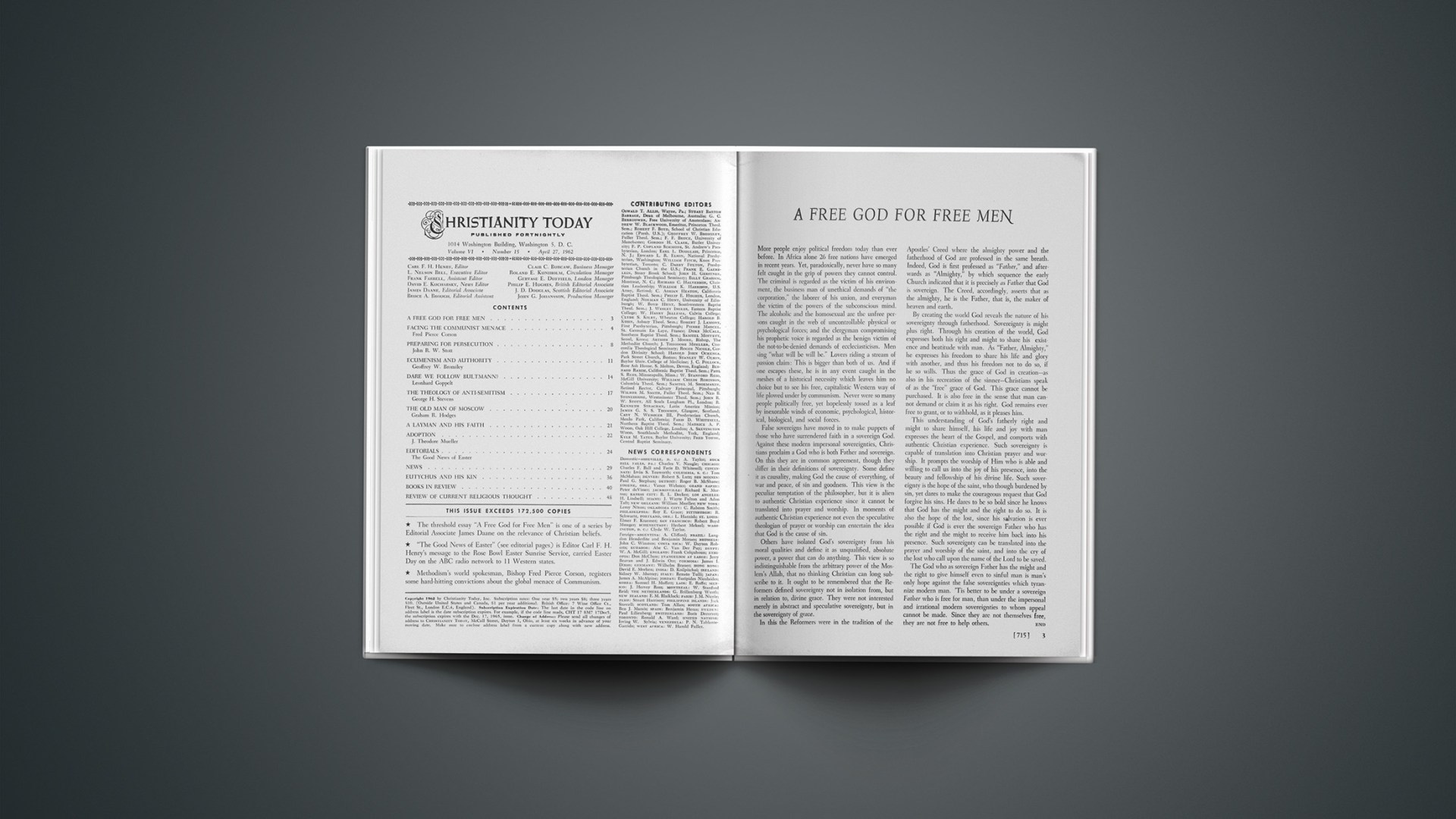
More people enjoy political freedom today than ever before. In Africa alone 26 free nations have emerged in recent years. Yet, paradoxically, never have so many felt caught in the grip of powers they cannot control. The criminal is regarded as the victim of his environment, the business man of unethical demands of “the corporation,” the laborer of his union, and everyman the victim of the powers of the subconscious mind. The alcoholic and the homosexual are the unfree persons caught in the web of uncontrollable physical or psychological forces; and the clergyman compromising his prophetic voice is regarded as the benign victim of the not-to-be-denied demands of eccleciasticism. Men sing “what will be will be.” Lovers riding a stream of passion claim: This is bigger than both of us. And if one escapes these, he is in any event caught in the meshes of a historical necessity which leaves him no choice but to see his free, capitalistic Western way of life plowed under by communism. Never were so many people politically free, yet hopelessly tossed as a leaf by inexorable winds of economic, psychological, historical, biological, and social forces.

False sovereigns have moved in to make puppets of those who have surrendered faith in a sovereign God. Against these modern impersonal sovereignties, Christians proclaim a God who is both Father and sovereign. On this they are in common agreement, though they differ in their definitions of sovereignty. Some define it as causality, making God the cause of everything, of war and peace, of sin and goodness. This view is the peculiar temptation of the philosopher, but it is alien to authentic Christian experience since it cannot be translated into prayer and worship. In moments of authentic Christian experience not even the speculative theologian of prayer or worship can entertain the idea that God is the cause of sin.

Others have isolated God’s sovereignty from his moral qualities and define it as unqualified, absolute power, a power that can do anything. This view is so indistinguishable from the arbitrary power of the Moslem’s Allah, that no thinking Christian can long subscribe to it. It ought to be remembered that the Reformers defined sovereignty not in isolation from, but in relation to, divine grace. They were not interested merely in abstract and speculative sovereignty, but in the sovereignty of grace.

In this the Reformers were in the tradition of the Apostles’ Creed where the almighty power and the fatherhood of God are professed in the same breath. Indeed, God is first professed as “Father,” and afterwards as “Almighty,” by which sequence the early Church indicated that it is precisely as Father that God is sovereign. The Creed, accordingly, asserts that as the almighty, he is the Father, that is, the maker of heaven and earth.

By creating the world God reveals the nature of his sovereignty through fatherhood. Sovereignty is might plus right. Through his creation of the world, God expresses both his right and might to share his existence and beatitude with man. As “Father, Almighty,” he expresses his freedom to share his life and glory with another, and thus his freedom not to do so, if he so wills. Thus the grace of God in creation—as also in his recreation of the sinner—Christians speak of as the “free” grace of God. This grace cannot be purchased. It is also free in the sense that man cannot demand or claim it as his right. God remains ever free to grant, or to withhold, as it pleases him.

This understanding of God’s fatherly right and might to share himself, his life and joy with man expresses the heart of the Gospel, and comports with authentic Christian experience. Such sovereignty is capable of translation into Christian prayer and worship. It prompts the worship of Him who is able and willing to call us into the joy of his presence, into the beauty and fellowship of his divine life. Such sovereignty is the hope of the saint, who though burdened by sin, yet dares to make the courageous request that God forgive his sins. He dares to be so bold since he knows that God has the might and the right to do so. It is also the hope of the lost, since his salvation is ever possible if God is ever the sovereign Father who has the right and the might to receive him back into his presence. Such sovereignty can be translated into the prayer and worship of the saint, and into the cry of the lost who call upon the name of the Lord to be saved.

The God who as sovereign Father has the might and the right to give himself even to sinful man is man’s only hope against the false sovereignties which tyrannize modern man. ’Tis better to be under a sovereign Father who is free for man, than under the impersonal and irrational modern sovereignties to whom appeal cannot be made. Since they are not themselves free, they are not free to help others.

Review of Current Religious Thought: April 13, 1962

Hans Urs Von Balthasar, along with men like Jean Danielou, Henri de Lubac and others, is one of the more prominent representatives of the “new theology” wing of the Roman Catholic Church. He is famous for a great number of publications, not the least of which is his important work on Karl Barth, to say nothing of a more recent book about Martin Buber, George Bermanos and Karl Barth. Von Balthasar leaves no doubt about his love and respect for the Roman Catholic Church. But there is also no doubt that his sober and even critical views of Roman tradition stem from his profound study of the Bible and his contact with Reformed theology and his fellow Baselian Dr. Barth.

Like other figures in the “new theology” movement, he feels that the development of Roman theology, especially since Trent, has been crippled by an attitude of reaction. This reactionary stance has, in Von Balthasar’s thinking kept Roman theology from seeing the fullness of the Catholic faith. He seeks, in his own way, to develop a consistent Christocentric theological viewpoint. It is this that has kept the door open for a rich personal and theological dialogue between Von Balthasar and Barth.

Barth, as everyone knows, has kept up a steady criticism of the Roman church, particularly for its serious sympathy with the natural man, natural theology, natural law, etc. But Von Balthasar wants to show that at heart Rome is not concerned with natural man and natural law as things in themselves, but from a basically Christological concern. We may say that when one genuinely seeks to do this, as in the case of Von Balthasar, he is bound to view any static theological tradition in a critical light and is equally bound to bring everything into a clearer evangelical perspective.

Recently Von Balthasar published the first volume of a triology on Beauty, beauty in the theological sense. This volume is on Glory. He seeks to show that the Beauty of God is diminished by theology whenever theology becomes a neat package of true propositions and practical statements. The quality of amazement is choked out of theology when theology becomes a system in which one has the truth in his complete control. In this respect, too, Von Balthasar manifests his sympathy with Barth. For Barth likewise has had a great deal to say about theologies which have lost the sense of the beauty of God, a loss which too long has empoverished both the church and its theology.

Theological reflection has indeed to do with “the depths of the riches of the wisdom and knowledge of God” (Rom. 11:33), with the riches of Christ’s wisdom which, “if they could be written every one, I suppose that even the world itself could not contain the books that should be written” (John 21:25). I have thought about an expression in Psalm 50 as I read Von Balthasar’s book, the phrase which goes, “Out of Zion, the perfection of beauty, God hath shined.”

Von Balthasar’s book is unapologetically Roman Catholic. But it is a great work of a brilliant theologian warning us against superficiality, against rationalistic theology, against every temptation to reduce the mystery of God to a human vision.

Back in 1917 Rudolph Otto wrote his famous book, The Idea of the Holy, in which he too called attention to the element of mystery in man’s apprehension of God. Now, about 40 years later, Von Balthasar’s work appears, also seeking, without Otto’s mysticism, to lay full emphasis on the “mystery of godliness,” God manifest in the flesh, and the truth that in Christ “dwelleth all the fulness of the Godhead bodily” (Col. 2:9). In spite of much decisive difference between it and Reformed theology, we have in this book a witness to the glory of God that is of great significance not only for theology but for preachers of the Gospel as well.

Von Balthasar sets before us the question whether we are, in our preaching, facing men with the “Glory of God” and the great deeds of God, with the love of Christ “which passeth knowledge,” the love of him who “can do exceeding abundantly above all that we ask or think” (Eph. 3:19, 20). Against all the horrible superficiality of rationalism, a thing which can invade Christian theology, it is wonderful to be reminded once again of the glory of the Gospel. Before the judgment of human thought, the Gospel remains foolishness. Before the judgment of pure aesthetics, such as that of the Greeks, the Cross is ugly. But “the foolishness of God is wiser than men; and the weakness of God is stronger than men” (1 Cor. 1:25). The theology of our century depends on whether we have understood anything of this or whether we still depend for the glory of the truth of God upon our own rational predications.

We must watch out that we do not attempt to lock up the truth in our little systems. We must open the windows and keep them open so that we are always reminded that our talking and thinking must have something of Job in them. Recall Job saying of God that “he hangeth the world upon nothing” and adding, “Lo, these are parts of his ways, but how little a portion is heard of him but the thunder of his power who can understand?” (Job 26:14).

Job was speaking of the power of God, but the same thought is relevant for what Paul calls the “weakness” of God. Church and theology must always remember that they are not talking about important truths and practical wisdom of men. They are talking about the mysteries of Godliness. The men of both the chancel and the academy must capture something of the demeanor of the disciples of our Lord on their way to the city. “And they were in the way going up to Jerusalem; and Jesus went before them and they were amazed” (Mark 10:32).

Love’s Commendation

God commendeth his love toward us, in that, while we were yet sinners, Christ died for us (Rom. 5:8).

I shall have nothing new to tell you. The message will be as old as the everlasting hills, and so simple that a child can understand. God’s commendation of himself and his love is not in words, but in deeds. Now for that mighty act whereby God commendeth his love. The truth here is twofold.

I. The First Commendation. “Christ died for us.” Note here both the Person and the deed. When men first sinned the angels felt helpless. No one of them could have dreamed that God himself would assume flesh and die. If you would have right ideas of God in splendor, think how he best commended his love for us, in that he gave his Son.

When Christ became man for a while he stripped himself of the glories of the Godhead. He gave us a perfect example by his spotless life. But the commendation of love lies here: He died for us. All that death could mean Christ endured. For as many of you as have not yet believed I pray that you may look to him for the expiation of all your guilt, as the key that opens heaven to all believers.

II. The Second Commendation. He died for us while we were yet sinners. Consider how many of us have been continual sinners, not once, nor twice, but ten thousand times, in our outward acts, the thoughts of our hearts, and the words from our mouths. Again, he has died for us though our sins were aggravated. When you sin against the convictions of your conscience, the warnings of your friends, the admonitions of your minister, you sin more grossly than others do. The Hottentot sinneth not as the Briton doth. But do not despair. Christ died for you.

Reflect again. We were sinners against the very Person who died for us. There is an old tradition that the man who pierced Christ’s side was converted. My master said, “Begin at Jerusalem,” because there lived those who had crucified him, and he wanted them saved.

There is this other commendation of love. Unasked, he died for us. God’s amazing work surpasses thought. Love itself died for hatred. Holiness did crucify itself to save sinful men. Unasked for and unsought, like a fountain in the desert, sparkling spontaneously with its healing waters, Christ came to die for men who would not seek his grace.

Sinner, I commend Christ to thee for this reason: thou needest him. A day is coming when thou wilt feel thy need of him. Dost thou believe there is a hell, and that thou are going thither? Let me tell you how to be saved. “Believe on the Lord Jesus Christ, and thou shalt be saved.” To believe is to give up trusting in self and to trust in Christ as thy Saviour. “What,” you say, “no good works?” Works will follow after, but first come to Christ, not with good works, but with thy sins.

Remember the striking words of Martin Luther: “Satan once came to me, and said, ‘Thou art lost, for thou art a sinner.’ Then said I, ‘I thank thee for telling me I am a sinner. If Martin Luther is a sinner, Christ died for me’.” Canst thou lay hold on that, by the authority of God? Even if thou be the chief of sinners, thou shalt be saved, if thou believest.

Sermons of the Rev. Charles H. Spurgeon, second series, Sheldon and Co., New York, 1865. The Preface is dated January, 1857. Sermon, “Love’s Commendation” (pp. 410–425).

Liberty, Law And License

CHRIST AND FREEDOM—We owe the entire conception of freedom as a human birthright to the coming of Christ. Until that time “absolutism held unbounded sway,” to use the phrase employed by Lord Action in his study of Freedom in Antiquity. Slavery was the universal condition of the great majority of mankind and was nowhere regarded as an improper social order. Even the Greek civilization, at its finest flowering, was based on slavery. It was the same with the Hebrews, to whom we also owe so much. A formal recognition of slavery introduces the long calendar of minute ordinances listed in Exodus 21, 22, and 23.…

The great problem of politics is how to reconcile the theoretically desirable condition of freedom with the fundamentally essential condition of order. Establishment of Christianity provided the formula whereby this difficult adjustment could be made. The devout Christian ipso facto led a law-abiding life. So laws forbidding offenses which we would not in any case commit were, in his case, superfluous. As the number of Christians multiplied, law enforcement, wherever they concentrated, thus became easier. The moral argument for slavery, resting on the assumption that the common man is untrustworthy, lost its validity, the more so because the particular appeal of Christianity was to the oppressed.…

This thesis that liberty is a human birthright … made headway slowly, and only among people with centuries of organized Christian experience behind them. For the same reason the concept of liberty will weaken, and eventually disappear, wherever and whenever men place their faith in political rulers rather than in God.

Americans are singularly fortunate in having the New Testament as the wellspring of their political thought. On the virgin soil of what is now the United States it was not utopian to plan a governmental system actively conducive to Christian practise.”—FELIX MORLEY, “Freedom and the Laity,” (1961), published by the General Division of Laymen’s Work, National Council of the Episcopal Church.

CONFUSION ON RIGHTS—President Kennedy’s message on protecting consumers drives the last nail in the coffin of the quaint notion, once expressed by Mr. Kennedy, that the citizen should ask, not what his country can do for him, but what he can do for the country.

A quick review does not reveal that the President has as yet proposed that the National Association of Manufacturers and the American Medical Association should be brought under the sheltering wing of the Federal Government. But he has spread Uncle Sam’s umbrella far enough to cover just about every other group in the country—the farmers, the aged, the workers, the students, the urbanites, and now that most comprehensive of all groups, the consumers.

With respect to the latter, Mr. Kennedy wants Congress to get on the ball and do something to protect four consumer rights. These, as he defines them, are the right to safety, the right to be informed, the right to choose and the right to be heard.

We would like to suggest that there should be a fifth right. This right would be for the benefit of those Americans, if any, who would like to know what they can do for the country, as well as for those who merely do not want the Federal Government to take care of everything for them. What we have in mind, simply stated, is the right to be let alone.—Editorial in The Evening Star, Washington, D. C.

SECULAR MATERIALISM—There is the militant atheistic Communist; there is militant Islam; there is a revival of non-Christian religions on a major scale; there is above all—and this is far more dangerous than openly hostile Communism—the secular materialism that has invaded every part of Western life, the subtle, insidious influences that lead to business without principle.—DENIS DUNCAN, Editor of the British Weekly, addressing Scottish Christian Youth Assembly.

FINANCIAL INTEGRITY—Intellectual dishonesty … has characterized the mental attitude in this country for some time toward the national debt. Even were the various administrations able to live up to their perennial pledges of balanced budgets, there would be no hope of getting out of the red.… With an evermounting national debt, we in this country may ultimately find ourselves beyond redemption. Meanwhile, the American taxpayer digs deeper for the money to pay the cost of a government which is directly responsible for the declining value of the dollar.—Editorial, “The Bitter Heritage We Leave our Children,” Florida Times-Union, Jacksonville.

TAX BURDEN—The average American workman currently is paying out some 31 per cent of his income in the form of taxes. About 10 per cent is withheld for income tax. Other taxes, direct and indirect, are estimated at 15 per cent. Social Security takes 6 per cent (while the employer pays half of this item, it is a part of payroll costs and might be available for workers if not taken by taxes). And according to The New York Times of January 19, the fastest growing item in our national budget is the interest which the Federal government must pay on the national debt. This interest will cost American taxpayers over $9 ½ billion in the 1961 fiscal year which begins July 1, 1960. To carry this load and other national government expenditures, the Tax Foundation recently pointed out that the average worker in an 8-hour day spends 2 hours and 16 minutes working for the Federal government.”—Dateline (March, 1960), Clergy-Industrv Relations Department, National Association of Manufacturers.

STILL MUNCHING CANDY—At the Village Church in Kalinovka, Russia, attendance at Sunday school picked up after the priest started handing out candy to the peasant children. One of the most faithful was a pug-nosed, pugnacious lad who recited his scriptures with proper piety, pocketed his reward, then fled into the fields to munch on it. The priest took a liking to the boy, persuaded him to attend church school. This was preferable to doing household chores from which his devout parents excused him. By offering other inducements, the priest managed to teach the boy the four gospels. In fact, he won a special prize for learning all four by heart and reciting them non-stop in church. Now, 60 years later, he still likes to recite scriptures but in a context that would horrify the old priest. For the prize pupil, who memorized so much of the Bible, is Nikita Khrushchev, the Communist czar.—Parade, Feb. 11, 1962.

Apostolic Optimism

In England and later in New York City Jowett became the most popular evangelical preacher. By study of master sermons, and by ceaseless toil he mastered “the fine art of making a little go a long way.” A few critics called his preaching thin, but common people heard him gladly. So did countless divines. As many as 300 Episcopal clergy attended his Vesper Services at Fifth Avenue Presbyterian Church. They learned to value skill in the choice of words, and repetition of things memorable. “He being dead, yet speaketh.”

“Rejoicing in hope” (Rom. 12:12).

This is a characteristic expression of the optimism of the Apostle Paul. He is a child of light, wearing an armor of light, walking in the light, as Christ is in the light. This apostolic optimism is not a thin, fleeting sentiment begotten of a cloudless summer day; not born of shallow thinking. What then is the secret of this energetic optimism?

I. The Reality of Christ’s Redemptive Work. In all the spacious reaches of the Apostle’s life the redemptive work of his Master is present as an atmosphere in which all his thoughts and purposes and labors find their sustaining and enriching breath. In this Epistle to the Romans the early stages are devoted to a massive and stately presentation of the doctrine of redemption. When the majestic argument is concluded, the doctrine appears as the determining factor in the solution of practical problems. No one can be five minutes in the companionship of the Apostle Paul without discovering how wealthy is his sense of God’s redeeming ministry.

II. The Reality of the Believer’s Present Resources. “By Christ redeemed!” Yes, but that is only the Alpha and not the Omega of the work of grace. “In Christ restored!” With these dynamics of restoration Paul’s epistles are wondrously abounding. “Christ liveth in me!” He works within me “to will and to do of his good pleasure.” This is the primary faith of the hopeful life. The Holy Spirit worketh! So sensitive is the Apostle to the wealthy resources of God that amid all the world’s evil he remains a sunny optimist, “rejoicing in hope.”

III. The Reality of Future Glory. Paul gave himself time to think of heaven. He looked for “the blessed hope and appearing of our great God and Saviour Jesus Christ.” This contemplation is largely absent from modern religious life. We have built on the erroneous assumption that the contemplation of future glory unfits us for the service of men. Richard Baxter’s labors were not impoverished by his contemplation of “the saints’ everlasting rest.” Neither are we impoverished by contemplations such as these. They take no strength out of the hand; they put much buoyancy into the heart. Contemplation of coming glory is one of the secrets of the apostle’s optimism, enabling him to labor and endure in the spirit of rejoicing hope.

Apostolic Optimism and Other Sermons, by John Henry Jowett, London, Hodder and Stoughton, 1904. Sermon, “Apostolic Optimism” (pp. 1–18).

Let Us Have Peace with God

SERMONS ABRIDGED BY DR. ANDREW W. BLACKWOOD

JOHN A. BROADUS, “Let Us Have Peace with God.”

JOHN HENRY JOWETT,“Apostolic Optimism.”

CHARLES H. SPURGEON,“Love’s Commendation.”

Therefore being justified by faith let us have peace with God through our Lord Jesus Christ (Rom. 5:1, from the Greek).

More than four centuries ago a young professor went from Germany to Rome. He was in trouble because of his sins. He could find no peace. While climbing up a stairway on his knees, pausing to pray at every step, he seemed to hear a voice: “The just shall live by faith.” With such an experience Martin Luther lived to set the world on fire with the thought of justification by faith.

I. The Meaning of Justification. The Greek word means, not to make just, but to regard as just, to treat as just. How would the Lord treat you if you were a righteous man, if all your days you had faithfully performed all your duty? He would bless you as long as you lived here and then delight to take you home. This is how the Gospel proposes to treat men who are not (yet) just, and do not deserve such treatment—if only they believe in the Lord Jesus Christ.

II. The Need of Faith in Christ. God not only proposes to deal with us now as if we were just, but in the end to make us just. This Gospel proposes to be the means by which to make men holy. It delivers us not only from the consequences of sin, but also from its power. But the Gospel can have no such effect unless we believe in Christ. What is faith? You know what faith is. Everyone knows: Let us cherish all that tends to strengthen faith in the Gospel. Let us read the Word of God, praying that we may be able to believe. Let us ask from day to day, “Lord, increase our faith.”

III. The Call for Peace with God, notwithstanding our unworthiness. We cannot have peace with him as long as we think we deserve it. Many cling to the thought that they must become worthy, and then be reconciled to God. They need to see that coming to God and being reconciled, they will be made good and become worthy, through Christ.

Peace with God, though we are still sinful and unholy. We ought to be dissatisfied with ourselves, but satisfied with our Saviour, and through him be at peace with God. Our sanctification is still sadly imperfect, but if we believe in Christ, our justification is perfect.

Peace with God, though we have perpetual conflict with sin. What a singular idea! In this conflict the Lord is on our side, and we are on the Lord’s side. And so, though we must wage battle against every form of sin, let us have peace with God.

Peace with God, though he lets us suffer a thousand forms of distress and trial. None of these things can separate us from God’s love. When we are in trouble let us take hold of this great thought. God’s peace can conquer trouble, and as in a fortress guard us against all its assaults (Phil. 4:6–7). [In the same volume, Sermons and Addresses, the next one deals with “How the Gospel Makes Men Holy” (Rom. 7:24, 25).]

Idem. Sermon, “Let Us Have Peace with God” (pp. 85–96).

On Reading the Bible by Books

Dedicated to assisting the clergy in the preparation of sermons, the feature titled The Minister’s Workshop will appear in the first issue of each month. The section’s introductory essay will be contributed alternately by Dr. Andrew W. Blackwood and by Dr. Paul S. Rees. In addition, the feature will include Dr. Blackwood’s abridgements of expository-topical sermons, outlines of significant messages by great preachers of the past, or of messages by expository preachers of our own time.—ED.

An address (here abridged) before the International YMCA.

The main support of all individual Christian life, of all high Christian work, must be the truth of God. Truth is the lifeblood of piety. Truth is always more precious and more potent when we draw it ourselves out of the Bible. The Christian work we have today in the world will be wise and strong and mighty just in proportion, other things being equal, as it is directed and controlled and inspired out of the Word of God.

The Bible is one Book, but the Bible is many books. Each of them must be read as a whole life if we would understand it well. You cannot understand any book if you read it by fragments. Take an epistle of Paul as you would take any other letter. Sit down and read an epistle from beginning to end, and see what it is about. Then take it afterwards in parts, and see what each part says about the subject.

[Here Broadus tells how in college he had heard a professor advise reading the Bible by books. Before Broadus became a professor at 32, he delivered a series of evening sermons on the Epistles of Paul, treating each in a sermon and as a whole. Thus he crowded the aisles, and led in building a new church.]

Take the Epistle to the Romans. Some people think the epistle tremendously hard to understand. I remember a time when I found it hard to believe; certain portions were the most difficult writing I knew. It seems to me now [age 54] that there never would have been any great difficulty in seeing what the Apostle meant to say if I had only let him alone, and let him say what he wanted to say. But I had my own notions as to what ought to be said, and not said, on the subject. The plainer he was in saying what he wanted, and I did not, the harder I found it to make him say something else.

As you read the epistle rapidly you find that it breaks into two parts. Eleven chapters contain doctrinal arguments and instruction. Then five chapters treat practical matters slightly connected with the doctrinal. The first eleven treat justification by faith. The first three give the whole substance of this doctrine. They show that the Gospel reveals the righteousness of God, which is by grace. Then they show that men need justification by faith, as they can not find justification in any other way. Their works will condemn them. If they find justification at all, it must be by faith.

This takes up the first two chapters, with part of the third. The remainder of the third tells about the provision God has made for justification by faith. His provision takes out of repentant souls all pride and humbles them into receiving the great salvation that God gives. The next two chapters give further illustrations of justification by faith. One whole chapter shows that Abraham was justified by faith. This whole matter of cur being justified through the effect of Christ’s salvation is paralleled by the effect of Adam’s sin on his posterity. This takes a large part of chapter five. These are merely illustrations of our being justified through faith in the Redeemer.

Chapters six, seven, and eight treat justification by faith from another point: in its bearing on sanctification, or the work of making men holy. Then the next three chapters are on the privileges of the Jews and the Gentiles. So the epistle divides into different sections about the same topic. After you have read it through a number of times, have tried to find out the line of thought, and have been willing to let the Apostle mean what he wants to mean, you will find that the subjects considered are not so very difficult. Of course, there are questions we can ask about them, questions that nobody can answer, but we must content ourselves with what is taught us.

So let us read the Bible by books, first taking each book as a whole, then seeing how it is divided up, and so coming down to details. In that way we shall learn for ourselves how to interpret the various parts of Scripture with reference to their connection. Everybody will agree that you ought to look at the connection of a Scripture passage. One day my father said that he did not like to find fault with ministers, but he wished some of them would pay more attention to the connection of a text, as the preacher of the morning had not done. I suppose that preachers have since grown wiser, and now do always pay attention to the connection.

Each of the sacred books has its special aim and practical value, and we ought to get at the practical impression that each of them is designed to make. It is easier to eulogize the Bible than to love it. I have spoken with the hope that by God’s blessing I may awaken an increased desire to read the Bible attentively, by books. I pray that we may all turn away with an earnest desire in our souls, before Him who knows the heart, that in the remainder of our lives we shall strive to know his Word more, to read it more wisely, and to live more fully according to its blessed teachings.

Sermons and Addresses, by John A. Broadus (ed. by Archibald T. Robertson), George H. Doran Co., New York, 1896, “On Reading the Bible by Books” (pp. 167–197). Address, International Convention of YMCA, Cleveland, Ohio, May 25, 1881.

The Minister’s Workshop: Getting the Layman to Read His Bible

Every pastor wishes the layman to read his Bible, both in private and at the family altar. From the pulpit why not show him how? There can be no bad way of reading the Bible, but from the pulpit show the best way. The Bible was written by books. Within each book the paragraph, or poetic strophe, serves as the literary unit. In college a layman learns to enjoy Shakespeare by living with one play, and within the play, one act, and one scene. Such a method works even better with the Bible.

Many a layman has never read a Bible book as a whole, and by paragraphs. In private and family devotions he uses a devotional manual, with a Bible verse a day, and little continuity. In church the sermons may follow a similar pattern. How long must a man attend church before he learns to enjoy such a difficult book as Romans? Today the Lord calls on every pastor to serve as a pulpit guide.

In a sermon about any book, tell the layman what to seek for. In successive messages, morning or evening, deal with chosen parts (too many for a special series). Every Lord’s Day the bulletin will give next Sunday’s topic (not the text), with a chapter or two for home reading. The list below runs too long, but it is easier to omit some parts than to add others on the same high level.

Broadus used as an example the Epistle to the Romans. He had found it difficult, but “there never would have been any great difficulty in seeing what the Apostle meant to say if I had only been willing to let him alone and let him say what he wanted to say.” Today any such pulpit explainer would delight lay hearers, and increase their number.

Before a minister starts preaching this way he should study Romans in the spirit of prayer. The stress ought to fall on reading the book as a whole, and then by paragraphs. Starting with the Greek, a man ought to use various versions. On points of difficulty he should consult a standard exegetical commentary such as that of Sanday and Headlam; also, a devotional one, as by Griffith Thomas. If the minister still does not understand a part, or see its relevance now, he may recall an old proverb: “If you can’t lift a stone, leave it alone.”

Gradually a number of golden texts will call for sermons. As R. W. Dale once learned about preaching on Christ our Contemporary, a man can keep on in the same field as long as each truth makes his own heart burn. So will the heart of the layman glow while gradually he learns to read the Bible as it was written, keeping the eye fixed on Christ, ever in meeting the heart needs of persons like us now (John 4:42).

In eight or ten years a pastor can guide a growing number of laymen in enjoying almost every major book of the Bible, and some “minor” ones. By such “cooperative preaching” from the Bible, he can present God’s way of solving every spiritual problem, and meeting every heart need of the hearers. As for the harvest, both he and the hearers will claim the promise of God about his Book (Isa. 55:10, 11).

“It is not an accident, brethren, that in this age, in which infidelity has anew become blatant and arrogant, the Bible is more studied than ever it was before. It is not an accident that there is a new demand, throughout the Christian world, springing up for Biblical, expository preaching.… People don’t know about believing the preacher nowadays, and a great many people don’t know about acknowledging the authority of a church as they once did; but the people who come to hear the gospel, if you bring them something right out of the Bible, not a broken, dead fragment, but a part of the living whole, full of the true, divine life, and show them its meaning as God has taught it, and lay that meaning, explained, upon their hearts and their lives, the people everywhere respond to that.…”—JOHN A. BROADUS, Sermons and Addresses (1886).

Under God the effectiveness of the course will depend largely on the opening sermon. Here one does not dangle the skeleton of a corpse, but introduces a living book. First, the Meaning of the Gospel as the Super-Atomic Power of God. Second, the Practical Use of this Power Today. At best, atomic energy can change only the form and the place of things. The Gospel alone can transform a sinner into a saint, a cannibal tribe into a redeemed family of God. Super-atomic power enough to transform our world!

In a message about Repentance, one could deal first with the Gospel Meaning of metanoia, a complete “change of mind” about God and one’s own sin. Then with the Gospel Reason: because the Christ of Calvary is here. Last of all, the Christian Issue. Not merely “turning a new leaf,” but starting a new life, full of joyous service and lasting hope.

So each of the messages will bring the unsaved hearer face to face with the Christ of the Cross, moving him to accept the Redeemer and King, and then to bring others, one by one, to the foot of the Cross, there to lay down the burden of sin and shame, to receive pardon, cleansing, peace, and joy, with endless hope. Hallelujah!

Because of such preaching by a pastor whom I know, a mature young man and his wife accepted the Lord. Four years later they had to move away. In bidding farewell, they thanked him for showing from the pulpit how to read and enjoy 20 Bible books, none of which they had previously read. Who can imagine the lasting impact of such pulpit work where many laymen read the Bible setting before they hear each sermon?

The Super-Atomic Power of God—1:16

The Christian Reason for Repentance—2:4b

The Bible Teaching about Sin—3:23

The Bible Teaching about Salvation—4:3

The Christian Gospel of Peace—5:1

The Gospel Gift of Salvation—6:23

The Daily Struggle in the Soul—7:15 (RSV)

The Holy Spirit as Our Guide—8:14

The Christian Basis of Optimism—8:28

The Christian Promise for Missions—10:13

The Christian Doxology about God—11:33

The Christian Treatment of the Body—12:1

The Christian Attitude toward Government—13:1

The Practical Meaning of the Kingdom—14:17

The Christian Gospel of Hope—15:13

Book Briefs: April 13, 1962

A Look At American Preaching

Best Sermons: 1962 Protestant Edition, by G. Paul Butler (Van Nostrand, 1962, 318 pp., $5.95), is reviewed by James Daane, Editorial Associate, CHRISTIANITY TODAY.

The craftsmanship of these sermons runs from acceptable to excellent. None is poorly wrought; none made late of a Saturday evening.

Evaluated in terms of evangelical content, some sound the Good News of what God had done in Christ in tones clean and clear. Many, if not most, proclaim the Gospel, but the articulation is more or less muffled. Some of these are open to objection, not for what they say, but for what they fail to say, or assert merely as undertones. Some echo no Gospel at all, a judgment that must fall on more than the productions of two Unitarians.

In general it may be said that these sermons do not reflect the old liberal optimism about man, but the situation of man in crisis. The crisis is not the perennial crisis of the individual caught in the anguish of deliverance from sin and death. It is rather that of the twentieth-century man caught in those narrows of history where the past overtakes the present in judgment. Not a single sermon is devoted specifically to sin; none to that moment in which each man dies alone—even though others die at the same time. While most acknowledge that it is God alone who can save us, none explicitly rings the bells on the theme of salvation by grace alone in the grand style of the Reformation. Some few, not yet perceiving the signs of the times, urge that while God had done his work the rest is up to man, since further action on the part of God would violate man’s freedom (assumedly to be lost!) Happily it may be said that there is more Gospel in these 42 sermons than would have been the case in such a collection 25 years ago.

It could be urged that a sermon by definition is the proclamation of the Word of God through human personality in such a fashion that the seeking soul can find wherein to take his rest and the believing soul be lifted up into an act of worship. By this definition many of these could not be classified as sermons. They are rather religious lectures on noble themes, without the sound of divine judgment on human sin, and without sounds of the divine grace of forgiveness. Yet such classification would not be fair since many were preached to special audiences, by men not engaged in the congregational ministry, and under special circumstances calling for special religious objectives. These sermons, therefore, cannot be taken as representative of what is heard on Sunday mornings in American pulpits. That so many religious lectures should be presented as sermons is, I think, indicative of the status of the American pulpit.

If, however, what claims to be a sermon is subject to the criteria of the sermon, the following observations are to the point. Most of these sermons have no text. By generous estimate a few might be called expository sermons, i.e., a proclamation of the meaning of a given text of Scripture and of its bearing on man and his life. Many are more evangelical than anything else, but even of these, few carry the design of the Cross clearly in their fabric. The best on this score is from the pen of the chaplain of Princeton University. Many evangelicals reveal no essential relationship between the theme of their sermon and the Christ they in fact want to proclaim. They choose a biblical theme but fail to relate it in meaningful fashion to the theme of the Bible: Jesus Christ and him crucified. Many evangelicals would be embarrassed if they attempted to evaluate their production in the light of Paul’s “I am determined to know nothing among you save …”

It is these considerations which give substance to Bishop Kennedy’s remark, “The messages coming from our pulpits are little, squeaking words of cheer.”

These weaknesses characterizing many of these sermons when judged by strict homiletical criteria, flow chiefly from the failure to preach expository sermons.

Constructing sermons without specific texts on large biblical themes, which call for a “cover to cover” type of exposition, should be left to the genius of the pulpit, or attempted only after considerable experience in the simpler forms of expository preaching, lest men hear the Word of God without recognizing it.

God can indeed break through our formally Crossless sermons and make the word of the Cross to be heard, but we ought not tempt the Lord our God, least of all in the pulpit.

This book is better than its sermons. Even so, almost everyone of its sermons can be read, especially by men of the pulpit, with large and lasting profit. These sermons sparkle with ideas, illustrations, factual material, biblical insights, and literary allusions. This reviewer has read them, not always with approbation, but usually with profit.

One final comment in which various men will see different orders of significance. Few sermons reveal the denominational affiliation, or the theological tradition of their makers.

JAMES DAANE

From Plato To Hegel

Divine Perfection: Possible Ideas of God, by Frederick Sontag (Harper, 1962, 158 pp., $3.75), is reviewed by Gordon H. Clark, Professor of Philosophy, Butler University, Indianapolis, Indiana.

Part I is a well-written history of some major ideas on divine perfection entertained by the great philosophers from Plato to Hegel. Part II is a cross classification of these ideas with the aim of seeing how each affects the others. Some of these chapters seem to add very little to what was said in Part I.

The entire discussion presupposes the possibility of natural theology, and no account is given of those who deny this possibility. In fact, revealed theology is apparently regarded as impossible: “Since God has no lips, he cannot speak … This means that we have much indirect but no direct word about God and by God. Were it otherwise, we would have but one religion and one doctrine of the nature of God.” Both inferences are logically invalid, are they not? The author also rules out verbal revelation by asserting “the natural incommensurability between our language and such a Being.”

Although the author wishes to avoid endorsing any one theory of the nature of God, he does not succeed in refraining from unsupported assertions. “Metaphysic is never born in Ethics”—Nietzsche said it always is—and “Being good himself, God was bound to recognize some but not all value standards in creation,” are two that are stated oracularly.

The main conclusion, however, is well supported, viz. that twelve concepts, infinity and unity, form and transcendence, actuality and self-sufficiency, power and motion, simplicity and division, freedom and volition, are not all consistent when defined in certain ways, but may, most of them at any rate, be made consistent by changing their meanings.

GORDON H. CLARK

Laymen Arise!

The Church and Its Laity, by Georgia Harkness (Abingdon, 1961, 208 pp., $3.50), is reviewed by Leslie Hunt, Principal of Wycliffe College, Toronto, Canada.

Few people will dispute the contention that one of the weaknesses of the church has been the inadequate role of the laity and the layman’s unawareness of what his real role is. Any effort to deal with this problem and clarify the issues is welcome. Indeed one of the themes much under study in recent times is this very matter: “What is the church?” and “What is the true role of the laity?” The new consciousness that these questions should be faced and answered may be found in all denominational groups. This growing interest is in evidence by the many requests for bibliographical guides. To meet this demand, a bibliography on the subject has been published by the Department on the Laity. It is illuminating to me how much work has been done recently on the theme.

“The Church and Its Laity” is another volume to be added to the list. The author, with a real concern for ecumenical issues, is disturbed by the fact that the movement towards ecumenicity, so important in these days, cannot really function at its best until it gets into the blood of not only the people in high places, but also of the clergy and the laity at the local level. The contention is that this will not take place until there is a real understanding of the meaning of the church, and the true place of the laity in it. The author claims that the book is not designed to be a handbook on lay activities or vocations but to help the laymen to a better understanding of the church, and through this knowledge to a better grasp of his own place in it.

Accordingly, the author is prompted to devote the first half of the book to the matter of the nature of the church—what it is, how its principal divisions came to be as they are, and what its true functions are. The second and third chapters present an historical survey of the changes that have taken place from New Testament times to the emergence of the major Protestant denominations. Chapter IV relates more specifically to the current scene, with the fifth and sixth chapters exposing some of the secular standards and practices which have made their way into the life of the church. The author elaborates on some of the channels by which the church can be a constructive force in remaking society. Chapters VII and VIII point up some hopeful projects and signs, such as the ecumenical movement, laymen’s institutes in Europe, lay centers in America. Behind all this the book presents a strong appeal for more effective action by laymen as they endeavor to be the church within the world.

Reading for Perspective

CHRISTIANITY TODAY’S REVIEW EDITORS CALL ATTENTION TO THESE NEW TITLES:

* The Council, Reform and Reunion, by Hans Küng (Sheed & Ward, $3.95). With charity, humility, and ruthless honesty, a Roman Catholic professor urges that reunion of Catholicism and Protestantism requires a renewal and reform of the church. Superbly written.

* Women Who Made Bible History, by Harold J. Ockenga (Zondervan, $3.50). Literary portraits of saintly and some not-so-saintly women of the Bible. Rich in biblical wisdom.

* Martin Buber and Christianity, by Hans Urs Von Balthasar (Macmillan, $3). In penetrating Christian-Jewish dialogue, a Swiss Roman Catholic urges that the faith of Abraham and that of Paul appear irreconcilable only because Jews reject Christ, and Christians reject Jews.

The author has written simply so that any lay reader can grasp the meaning. With clarity and some forcefulness, she has sought to clear away confused thinking on a number of relevant issues. Some may not agree with some of her definitions but there would, I am sure, be general agreement in her analysis of the factors which are preventing the church from making a greater impact upon the world. If this volume can help laymen to catch a new vision of the true function of themselves as the church, and fire them to a greater participation and service, it will be well worthwhile.

LESLIE HUNT

No Ghettos

Poems of the East and West, by Merrell Vories Hitotsuyanagi, ed. by Frederica Mead Hiltner (The Omi Brotherhood, Omi-Hachiman, Japan, 1960, 169 pp., $2.95), is reviewed by Gordon K. Chapman, Missionary to Japan, United Presbyterian Church.

One of the most romantic stories of the modern missionary movement is that of the Omi Brotherhood, founded in 1905 by the missionary-teacher and architect, Merrell Vories. From the beginning he was fully convinced that “the ghetto mentality where Christians separate themselves from those among whom they live and work, and from the culture and life of the nation,” was contrary to the mind of Christ. Thus the 400 workers of this indigenous mission have been engaged in industry, architecture, and evangelistic, educational and social activities as active Christian witnesses. Vories’ marriage to Maki Hitotsuyanagi, daughter of an ancient noble family, and his subsequent naturalization, were the natural outcome of the application of indigenous principles.

His poems are the spontaneous expression of one who has found complete fulfillment in Jesus Christ and reflect the spirit of a very consistent Christian whom God used to accomplish a unique work in a virgin field of Japan. This hook is a significant supplement to the story of the Omi Brotherhood, A Mustard Seed in japan, which should he required reading for all modern missionaries.

GORDON K. CHAPMAN

Crossed Up

The Many-Sided Cross of Jesus, by Alan Walker (Abingdon, 1962, III pp., $2), is reviewed by J. Kenneth Grider, Associate Professor of Theology, Nazarene Theological Seminary, Kansas City, Missouri.

This little book presents what an evangelically-interested (pp. 7, 89 ff.) liberal sees in the cross of Jesus.

The author might be mistaken on occasion, as when he says that the Apostles’ Creed “came out of” “the great councils” (p. 14). He might seem to switch horses, too, on the question whether the atonement does anything for God himself. To Charles Wesley’s line, “ ’My God is reconciled’ ” (p. 18), he takes exception saying this is an “error,” for “God is not reconciled by the actions of his Son.…” (p. 18). Yet he later upbraids the Abelardians for giving “a far too subjective” view, “putting emphasis on the response given to the Cross,” and thereby “transposing the center of God’s saving act from God himself to ourselves” (p. 39).

Nor may the reader look for scholarly treatment. Often, quotes are not footnoted. Scripture passages are not exegeted: he usually simply quotes, as though the meaning were obvious.

Bible-respecting Christians would take hearty exception with the author on whether the Cross was planned. According to Walker, the Father “did not intend” “the Crucifixion,” “but once it happened, … God seized upon the Cross and … made it the occasion of salvation” (p. 75). Nor did Jesus come to earth in order to “give his life a ransom” (Matt. 20:28). Instead, “As he came nearer the end of his life he believed he could do something by dying …” (p. 18).

With all this on the negative side, the book does give the laymen a general treatment of atonement views. It could be useful to the minister because of its illustrative materials and its analogies of the Cross, as, for example, the sustained comparison between Christ’s death and the suffering of a scientist on behalf of others (pp. 50–59).

J. KENNETH GRIDER

The Shape Of The Gospel

Kerygma or Gospel Tradition—Which Came First?, by Robert A. Bartels (Augsburg, 1961, 126 pp., $1.95), is reviewed by Glenn W. Barker, Professor of New Testament, Gordon Divinity School, Beverly Farms, Massachusetts.

One of the fundamental tenets in the modern study of Gospel origins is that the kerygma, the preaching of the earlier church, determined the nature and shape of the Gospel tradition. With this conclusion Professor Bartels, of Northwestern Lutheran Theological Seminary, takes issue. He proposes instead that Jesus “is not only responsible for most of the contents of the tradition, but also for the basic and general shape into which the tradition has been cast by the synoptic writers” (p. 62), and that this tradition, “largely in the shape in which we now have it,” is responsible for the form of the kerygma.

The position taken by Professor Bartels strongly fortifies the authority of the tradition, sounding a note that is sadly missing in much of the modern discussion. However, does the author prove too much? If Jesus is made responsible for both the shape as well as the content of the tradition, is it likely that the differences between the Gospels can he explained as “editorial liberties,” as Bartels seeks to do?

For its involvement with contemporary discussion the book is to be commended. The criticism raised against Bultmann is particularly effective.

GLENN W. BARKER

Into The Stream

The Layman’s Bible Commentary, Vol. 21: Romans, I & II Corinthians by Kenneth J. Foreman; Vol. 16: Matthew, by Suzanne de Dietrich; Vol. 6: Judges, Ruth, I & II Samuel, by Eric C. Rust; Vol. 13: Ezekiel, Daniel, by Carl G. Howie (John Knox Press, 1961, about 135 pp., ea. $2.00 ea., $1.75 in quantities of four or more), are reviewed by G. Aiken Taylor, Editor, The Presbyterian Journal, Asheville, North Carolina.

The Layman’s Bible Commentary represents the major effort to date to launch the Presbyterian Church, US (one of the last holdouts against neoorthodoxy and the effects of “biblical” theology among the larger denominations), into the main stream of contemporary theological thought.

Only one of the present four volumes was written by a member of the denomination publishing the Commentary.

Romans, I & II Corinthians. Here is theology indeed brought to the level of the layman’s understanding. Concisely and attractively written the weakness of this volume is the weakness of the Commentary as a whole: “positive” Christian doctrines effectively affirmed; “negative” or “hard” doctrines ignored or denied.

Thus laymen will find helpful treatments of justification and propitiation (expressed as expiation). But predestination is denied any negative application. There is no doctrine of reprobation; or of imputation; or of condemnation. The elusive shadow of a tacit universalism flits throughout.

Dealing with the “Jewish problem” of Romans 9, Dr. Foreman says that Paul is not here revealing truth, he is thinking out loud, so to speak, turning over in his mind various possibilities respecting the fate of the Jews and rejecting each possibility until he reaches the final answer upon which he settles, namely that all Israel shall be saved.

Matthew. Essentially the same theological position is reflected in this volume. There is one of the most interesting paradoxes of reverence for, and at the same time disbelief in, the supernatural that this reviewer has seen.

Not the slightest shadow of doubt is cast over the Virgin Birth. The miracles are treated respectfully. The Passion is faithfully told. The Resurrection shines forth in all its splendor. Matthew’s repeated references to judgment, rejection, casting away, are not evaded.

But in the story of Christ walking on water the author cannot refrain from suggesting that post-Resurrection traditions may have woven themselves about the story of Jesus. And certain prophecies on the lips of Jesus (as about his Passion) were “fixed in the tradition after the event.”

Miss de Dietrich’s universalism appears this way: “If the sin against the Holy Spirit is not pardoned either in this age or in the age to come, the opposite is true also—there is hope in this age and in the age to come for those who will not have been acquainted with or recognized the Son of Man here below.”

Judges, Ruth, I & II Samuel. If the major fault of the New Testament volumes in the Commentary is a tacit universalism, the major fault of the Old Testament volumes is a slavish acceptance of the findings of higher criticism.

History is only an original peg, now almost wholly obscured, about which the stories have been woven. Natural events, such as plagues, come to be embellished with theological meaning after being handed down for generations. Thus a pestilence which struck Beth-shemesh is later assigned a theological cause, namely that the people had looked into the Ark.

Ezekiel, Daniel. Surprisingly enough, Ezekiel is said to have been a historical figure, actually living among the captives, seeing in his visions the circumstances of Jerusalem back home. The book is interpreted with a fine appreciation of the theological issues of sin and redemption.

Daniel, on the other hand, is not considered a historical figure at all. The “hero” of this epic story, which is compared to the “Joseph saga,” (the “Daniel image”) was created to represent the truest and best in Israel.

The story of the fiery furnace celebrates (for the encouragement of the persecuted Jews of the Maccabean period) the historical event when “Israel was rescued from the fiery furnace of Chaldean captivity when the people were set free by the hand of Cyrus the Persian.” The story of Nebuchadnezzar’s madness is explained by reference to extra-biblical stories of Nabonidus, who ruled after Nebuchadnezzar, and who spent so much time at Tema, a resort in the desert, that he “was probably considered a ‘nature boy.’ ”

To this reviewer the marvelous thing about this sort of approach to the Bible is how the commentators can speak appreciatively of material they characterize as a deliberate lie. Scripture is said to be historically inaccurate, the stories garbled, the dates fabricated, the characters unidentifiable. Yet this is to be taken as “containing” the Word of God from which we can learn much!

One hopes that this Commentary is not designed to form the theological perspective from which the new curriculum of the Presbyterian Church, US, will be published in 1964.

G. AIKEN TAYLOR

Semantic Dilemma

The Language of Faith, by Samuel Laeuchli (Abingdon Press, 1962, 272 pp., $5.50), is reviewed by Robert H. Mounce, Associate Professor of Biblical Literature, Bethel College, St. Paul, Minnesota.

The basic dilemma of Christian language is pointed up by Irenaeus’ comparison of the Gnostics’ use of words to the disassembling and rearranging of a mosaic: the gems are the same but the two images are quite different. Dr. Laeuchli’s fascinating study introduces the reader to this semantic dilemma of the early Church. To speak meaningfully to the second century the Christian faith had to employ two languages simultaneously the canonical and the contemporary. Whether it could accomplish this without such distortion as would obscure the essential message was the crucial question of that formative period.

Two dangers lurked close by: Gnosticism (ch. I) with its imaginative language and metaphysical subtlety, and post-apostolic Christianity (ch. II) with its moralizing and legalistic distortion of the canonical language of affirmation. Of pivotal importance in this period of theological striving and semantic failure was the contribution of Irenaeus of Lyons (ch. III)—the presentation of a theological language of Christian proclamation.

This is a rewarding book. The temptation, upon finishing the last page, is to return immediately to the first and begin again. In this dialogue with the second century one cannot escape the feeling that there is a strange contemporaneity about it all. The problems of Irenaeus are still with us. To take a hard look at his course of action is to pain direction in the current discussion of religious symbolism. As Gnosticism rearranged the canonical mosaic into an image more philosophically intriging, so also is there the continuing lure to transform the kerygmatic core of revelation into whatever the current philosophy might be. As post-apostolic Christianity used the language of faith as a “handy whip for theologians who have to assert authority,” so also is there the constant danger of allowing the joyful news of New Testament proclamation to become rigid creed and the tool of ecclesiastical conformity.

Dr. Lauechli, who teaches at Garrett Biblical Institute in the field of the history of Christianity, has done us a real service. In the course of his book certain major emphases find repeated expression: that the Christian stands in the clash of two languages; that Christian communication is affirmation, not cosmic speculation or moralizing; that canonical language places man in confrontation with God. The author’s extensive knowledge of the German literature in the field has made available many valuable insights that English readers may have missed. The epilogue, “The Language of Faith,” points up a major conclusion—that relevant proclamation can take place “only when we put ourselves into both the speech of the canon and the idiom of our age.”

ROBERT H. MOUNCE

Mystery Of Life

The Meaning and Message of Lent, by Eugene R. Fairweather (Harper, 1962, 159 pp., $3), is reviewed by James D. Robertson, Professor of Preaching, Asbury Theological Seminary, Wilmore, Kentucky.

A provocative little book on how an understanding of Lent can deepen the life of the Church and of the individual Christian. Lent is seen as a time of intensive training in Christianity, calling forth serious reflection on such themes as Baptism, the Eucharist, Sunday worship, Christian instruction, penitence, and fasting. The book successfuly bodies forth three things: God’s solution of the mystery of life and death lies at the heart of the Gospel; the great observances of Christianity are designed to set it forth; and the faithful keeping of Lent and Easter can help the believer make God’s answer his own victory

JAMES D. ROBERTSON

Salvation Of Infants

From Limbo to Heaven, by Vincent Wilkin, S. J., (Sheed & Ward, 1961, 145 pp., $3), is reviewed by R. Allan Killen, Professor of Systematic Theology, Covenant Theological Seminary, St. Louis, Missouri.

The author, chaplain of Liverpool University for 12 years, who wrote his book during the last four months of his life, discusses the problem of the salvation of unbaptized children who die in infancy. A staunch Roman Catholic who believes in the infallibility of the pope and the supreme authority of his church, the immaculate conception of Mary, etc., he maintains that his church has never made any authoritative declaration on this subject, beyond saying that they go to “limbo,” and sets himself the task of solving this problem in the light of Rome’s view of baptismal regeneration.

Wilkin teaches that there are three kinds of baptism: (1) baptism of water or regular baptism “at the font”; (2) baptism with blood, namely the baptism Rome teaches which saved those Christian martyrs, and the “Holy Innocents” at Bethlehem, who died before they could receive regular baptism; (3) baptism of the Spirit which occurs to all at the second coming of Christ and coincides with the resurrection (pp. 98, 99). Wilkin’s case stands or falls with Rome’s doctrine of baptismal regeneration. He ends by declaring all the heathen and all children who die unbaptized in infancy to be saved by this “baptism of the Spirit,” and only those who willfully and knowingly reject Christ to be lost.

R. ALLAN KILLEN

Bridge Builder

Foundations for a Philosophy of Christian Education, by Lawrence C. Little (Abingdon, 1962, 256 pp., $4), is reviewed by J. Marion Snapper, Professor of Education, Calvin College, Grand Rapids, Michigan.

Professor Little presents us with a sourcebook of the raw materials out of which he believes an adequate philosophy of Christian education must be formulated. The raw materials are the behavioral sciences (e.g., psychology, sociology, anthropology) and theology, “the discipline by which man seeks to organize his religious beliefs into coherent and ordered form.” The method proposed is a “synthesis of the knowledge about human beings and the ways they learn that comes from ‘secular’ sources and that which comes specifically from the Christian heritage.”

Standing quite clearly in the theological tradition of Schleiermacher and Harnack, and impressed by Tillich and Bultmann, the author does not make theological distinctions between general and special revelation. He notes only that the different sciences deal with different aspects of reality. Nowhere is there any clear indication of which sciences are normative and which are descriptive. In fact, it may be inferred from his approach that he wants to be rid of such distinctions.

In his chapter on “The Scientific Image of Man” he includes a discussion of the worth of the individual and makes value judgments such as, “the tensions should be resolved in a spirit of compromise so that the fullest possible good for the whole may be realized.” Certainly no scientist qua scientist made these value judgments.

For theology he proposes “a reconstruction” of Christian doctrine through an intensification of Christian experience and a more realistic interpretation of this experience in terms of contemporary thought through the pooled insights of thinkers who are specialists in a variety of disciplines.”

Evidently Professor Little’s norm is human reason which first identifies Jesus as “the master student of human nature and the world’s best exemplar of high religion”; and secondly demands that the systematized insights (doctrine) derived from the historical Jesus be rescued by science (e.g., philology, archaeology) from Pauline and subsequent interpretation; and finally calls for such a reconstruction as described above.

A theology thus derived must then be synthesized with the findings of the behavioral sciences. Professor Little demonstrates a breadth of scholarship in that field as he presents us with thumbnail sketches of the more prominent theories of learning and personality. They are included to create an awareness of the broad range of insights which are afforded by the behavioral sciences and to whet the reader’s appetite for more. He is encouraged by such eclectics as Gardner Murphy, and Henry A. Murray, and by O. H. Mowrer, Gordon Allport, and others who are recognizing the spiritual dimensions of existence.

This is a consistent book. The author himself contributes to the bridge he is trying to build. He avoids using traditional theological terms; instead the reader will find that the author is continually restating his understanding of those concepts in the language of the behavioral sciences. He tries to give us the psychological concomitants of his theological constructs. It may make us uncomfortable to have the teachings of the Bible psychologized. But it also makes the psychologist uncomfortable to have his work spiritualized. Our author is trying to build a bridge and his effort deserves careful study.

It may be hoped that this book will stimulate some evangelical scholar to deal with this same problem with the sophistication and honesty which characterize Professor Little’s attempt—but without a price tag which bankrupts conservative theology.

J. MARION SNAPPER

Leading To Membership

Light from Above, Christian Doctrine Explained and Applied, by Alfred W. Koehler (Concordia, 1960, 165 pp., $1.50), is reviewed by Robert Preus, Professor of Systematic Theology, Concordia Theological Seminary, St. Louis.

This book is written as an introduction to the Christian faith. It is designed to be a help or textbook in adult classes leading to membership in the church. In this purpose it is notably successful. It is comprehensive, touching all the chief points of Christian doctrine; its style is plain and readable—and original; and its theology is eminently conservative. It is to be hoped, however, that the book will have a wider distribution than merely as a textbook. For it commends itself to any serious Christian reader. Herein the great articles of our faith are not only set forth with clarity and conviction, but the biblical basis in all cases is brought to bear to convince and strengthen the reader.

A more usable introduction to the Christian faith will be difficult to find.

ROBERT PREUS

Book Briefs

Prayer Pilgrimage Through the Psalms, by John Calvin Reid (Abingdon, 1962, 128 pp., $2.50). Written in belief many people need help in praying, Reid has written 118 short, expressive prayers, each based on a verse in the Psalms.

In the Presence of God, by O.W. Toelke (Concordia, 1962, 72 pp., $1.50). Devotions specifically intended for the newly married; relevant and recommended.

Unity in Marriage, by W. J. Fields (Concordia, 1962, 156 pp., $3). A fine, evangelical, realistic and perceptive discussion on how to achieve unity in marriage. Recommended to engaged and to most married people.

The Gospel According to St. Mark, by Alan Cole (Eerdmans, 1961, 263 pp., $3). A good substantial evangelical commentary which is neither unduly technical nor unhelpfully brief. Recommended to pastors and laymen.

The World: Its Creation and Consummation, by Karl Heim (Muhlenberg, 1962, 159 pp., $3). A substantial and scholarly consideration of the counterclaims of the scientific and biblical interpretations of the origin and destiny of the universe. For those who think.

They Came to a Place, by Robert L. Otterstad (Augsburg, 1962, 47 pp., $1.25). Lenten reflections, written on edge of personal total blindness, in which “deep answers to deep.”

Hope In Action, by Hans Jochen Margull (Muhlenberg, 1962, 298 pp., $5). The first full historical account of the ecumenical movement’s concern with evangelism in our century. Competently done by former faculty member of the university of Hamburg.

Devotional Selections from George Matheson, ed. by Andrew Kosten (Abingdon, 1962, 95 pp., $2). Forty brief devotional messages from the late nineteenth-century Scotch poet and preacher.

Suddenly from Heaven, by Carl Brumback (Gospel Publishing House, 1961, 380 pp., $3.95). A history of the Assemblies of God and of the phenomenal growth of Pentecostalism in the twentieth century.

The Ministers Manual 1962, ed. by M. K. W. Heicher (Harper, 1961, 333 pp., $3.50). Brought to date each year with entirely fresh new material.

Paperbacks

To the Golden Shore, by Courtney Anderson (Doubleday, 1961, 520 pp., $1.45). A great story of the life of Adoniram Judson, Man of Mission. (First printing 1956).

From State Church to Pluralism, by Franklin Hamlin Littell (Doubleday, 1962, 178 pp., $.95). Author explodes the categories that have shaped our vision of American church history. Early American religious unity is declared a lie to be cut down. In colonial times, America, like Europe, was officially religious, but this was in fact a “baptized heathenism.”

George Macdonald, ed. by C. S. Lewis (Doubleday, 1962, 160 pp., $.95). Lewis gleans the best from a nineteenth-century Scottish cleric he highly regards.

The Doctrine of Evolution and the Antiquity of Man, by J. D. Thomas (Biblical Research Press, Abilene, Texas, 1961, 64 pp., $.95). Christian thinker looks squarely at the theory of biological evolution and the problems involved.

A History of Biblical Literature, by Hugh J. Schonfield (New American Library of World Literature, 1962, 224 pp., $.75). An examination of the origins, authorship, and authenticity of the Bible in the light of historical events, literature, and recent documentary discoveries. An original.

According to the Scriptures, by Theodore S. Liefeld (Augsburg, 1962, 70 pp., $1.50). Brief, biblical Lenten devotions.

Curriculum Crisis in Military Sunday Schools

Next Sunday morning will find seven-year-old Johnny with a new teacher—she is a Methodist. Johnny’s last Sunday School teacher, who has just been transferred, was a Presbyterian. The department head is a Baptist. At a previous base where he lived, Johnny was taught the lesson by a Lutheran lady.

Somehow Johnny just doesn’t understand things like communion and baptism (his parents send him to Sunday School), for his is the lot of a military dependent, the child of a career serviceman. For years the Protestant military chaplains have battled inadequacies in their 180,000-member Sunday School systems. The inadequacies stemmed from these factors: (1) Protestants lumped together; (2) rapid turnover of teachers and scholars; and (3) lack of continuity in the curriculum.

In a bold effort to cope with the peculiarities of military Sunday Schools, ranking chaplains have been quietly promoting a unified curriculum which may raise more problems than it solves. The plan was worked out by the Armed Forces Chaplains Board, which invited the Protestant Church-Owned Publishers Association to administer it.

The program works this way: Each year a team of chaplains and denominational consultants meet and preview Sunday School materials planned by PCPA members. From these materials they select those which they feel are best suited to use in the armed services. The unified curriculum is therefore merely a composite subject to annual change. Only one selection is made in each category of need. The materials are the same as those used within the denominations that produce them. Cover imprints identify the materials as belonging to the “Unified Protestant Sunday School Curriculum for Armed Forces.”

The unified curriculum was first made available in the fall of 1954 as a distinct option for chaplains who at that time were purchasing supplies of their own choosing. Subsequently the PCPA set up an office in Nashville to distribute the unified curriculum.

The first big showdown came in the Air Force. A new regulation issued last summer ordered that “ ‘The Unified Protestant Sunday School Curriculum,’ ‘The Catholic Family Program of Religious Education,’ and the ‘Religious School Curriculum for Jews of the Armed Services,’ will be put into operation in the Air Force.”

Provision was made that “the curricula may be augmented with religious literature, art, symbols, maps, films, and visual aids.”

How Program Is Administered

The “Unified Protestant Sunday School Curriculum for Armed Forces” is sponsored by the Armed Forces Chaplains Board and administered by the Protestant Church-Owned Publishers Association.

The PCPA maintains an office in the Methodist Publishing House in Nashville through which orders for materials are channeled. The office is responsible for stocking and supplying materials prescribed by the Armed Forces Chaplains Board. Order blanks bear the PCPA letterhead and checks are payable to the PCPA, which reimburses member publishing houses according to material supplied.

The PCPA was organized as a trade association about 10 years ago. John C. Ribble, associate general manager of the United Presbyterian publishing house, has been coordinator of the unified curriculum. Ribble, who was elected president of PCPA in February, calls it “the most representative group in Protestantism.”1Denominational groups with member representation in the PCPA include the following: Pentecostal Holiness Church, American Baptist, Assemblies of God, Augustana Lutheran, Southern Presbyterian, Reformed Church in America, Church of the Brethren, Churches of God in North America, Christian Churches (Disciples), Missouri Lutheran, Evangelical Covenant Church of America, Cumberland Presbyterian, Evangelical United Brethren, Free Methodist, The General Baptist Press, Church of God, Reorganized Latter-day Saints, Mennonite, Methodist, United Lutheran, Nazarene, United Church of Christ, Protestant Episcopal, Southern Baptist, United Church of Canada, American Lutheran, Wesleyan Methodist, and United Presbyterian.

A number of religious leaders, including representatives of the PCPA, criticized the mandatory clause. Two months later, at a meeting in Washington between command chaplains and denominational representatives the clause was supposedly revoked by Major General Terence P. Finnegan, a Roman Catholic who is chief of Air Force chaplains.

No further word was issued, however, until November 22, when Brigadier General Robert P. Taylor, deputy chief of Air Force chaplains and a Baptist, sent an official letter to all commands saying, “The status of the Unified Protestant Sunday School Curriculum has not been changed. The Unified Protestant Sunday School Curriculum is the official Air Force curriculum.”

A regulation change dated December 27, 1961, affirmed that the curricula were now “official.”

The clause “will be put into operation in the Air Force” was deleted. A spokesman said, however, that chaplains are expected to use the material unless they give a written reason for refusing.

As for augmenting the curricula, the term “appropriate” was inserted before “religious literature.” Some observers have pointed to this passage as an escape clause for the mandatory order. Others say financial considerations rule it out.

A practical effect of the Air Force curriculum policy has been to eliminate evangelical literature. Chaplains no longer use materials from such independent publishers as Scripture Press, Gospel Light, Standard, David C. Cook, and Union Gospel Press.

A key official of the National Association of Evangelicals has denounced the unified curricula as “doctrinally and theologically unscriptural and pedagogically inferior.” He also questioned the right of the service to impose the material on chaplains. Army and Navy chaplains are not yet required to use it.

Another issue revolves on the fiscal aspect of the cooperative PCPA operation: Is the noncompetitive makeup of the arrangement a form of price-rigging?

Neither the Armed Forces Chaplains Board nor the PCPA office in Nashville have disclosed sales figures. Independent estimates, however, put total annual receipts as high as $500,000.

PCPA spokesmen vigorously deny monopolistic intent and stress that the operation is being carried out at the request of the Air Force. Military spokesmen say it is the most democratic arrangement possible, inasmuch as the PCPA is representative of virtually all denominations which supply chaplains. They point out that no contracts are involved.

Religious Issues

Two books with significant reflections of the American religiopolitical scene made their debut last month:

Richard M. Nixon, in Six Crises, accuses key associates of John F. Kennedy of contributing to and capitalizing on the religious issue in the 1960 presidential campaign.

The Rev. Robert I. Gannon, in The Cardinal Spellman Story, devotes an entire chapter to relations between the United States and the Vatican and discloses that Spellman was the first priest ever to say Mass in the White House.

Says Nixon:

“At every possible juncture and on every possible occasion, Kennedy’s key associates were pushing the religious issue, seeing to it that it stayed squarely in the center of the campaign, and even accusing me of deliberate religious bigotry.”

“They were, in short, contributing all they could to make religion an issue while piously insisting that to do so was evidence of bigotry,” he adds.

“I felt a responsibility to keep the lid on the boiling cauldron of embittered anti-Catholicism,” he says, adding that advisors had urged him to answer the attacks of Kennedy supporters.

Nixon refers to the much-publicized Citizens for Religious Freedom meeting in Washington September 7, 1960, as a “disastrous political development … over which I had no control.” However, he excuses the participation of Peale, whose church he had attended at one time while living in New York: “I know that he was heartbroken over the incident and I felt that while his judgment had been bad, his motives were above question.”

Nixon discloses that evangelist Billy Graham had been asked to write an article for Life magazine endorsing Nixon “largely on grounds of my experience in world affairs and foreign policy. He had mentioned the religious issue in the article only in order to deny explicitly that it either was or ought to be an issue at all.”

“My staff felt that a Billy Graham public statement might be very helpful in the closing days of the campaign,” Nixon says. “But I ended up vetoing the proposal because of my fear that, even though he was basing his support on other than religious grounds, our opponents would seize on his endorsement as evidence of religious bigotry, his own forthright denial notwithstanding.”

But sources close to Graham say that it was the evangelist himself, not Nixon, who made the decision to withhold the article because of the evangelist’s conviction that his is a spiritual and not a political responsibility. Both Nixon and Kennedy are reported to have said following the election that, had Graham’s article appeared, it would have swung the election.

Nixon’s book does not mention the fact that Francis Cardinal Spellman had stated publicly that he planned to vote for Nixon.

The book about Spellman makes no reference to the endorsement of Nixon either. It does contain a lengthy account of Spellman’s relations with the White House during the administrations of Franklin Roosevelt and Harry Truman.

The book by Father Gannon, a Jesuit priest and former president of Fordham University, recalls that in 1937 Spellman was invited for an overnight stay at the White House. A portion of Spellman’s diary is quoted:

“Said Mass in the Monroe Room of the White House. It was the first time Mass was ever said in the White House. Miss LeHand, Miss Tully, Miss Eben and Miss Hackmeister present. Breakfast afterwards with them. The coffee cups were as large as bowls.

“Said good-bye to the President in bed. He said he had intended to get up for Mass.”

Turning The Corner?

A definite evangelical emphasis enlivened six annual area meetings of the National Council of United Presbyterian Men, a denominational laymen’s organization which has experienced rapid growth in recent years.

Paul Moser, executive secretary, cited two reasons for re-emphasis on Christian fundamentals.

“We know as never before that we don’t make a better world,” he said. “Only the Lord does.”

Secondly, he believes that some of the featured speakers were “more able to speak on this emphasis than those in the past.”

“In the past, we’ve discussed everything from automation to the image of the church,” he continued. “Now we’ve turned the corner, and are putting more stress on the important thing—faith.”

Moser stressed, “Strength of men can count through a laymen’s movement-men with a social conscience but solid evangelical emphasis and faith in Christ.”

Area meetings were held between mid-February and early April in New York, Sacramento, Wichita, Pittsburgh, Chicago, and Evanston, each averaging more than 1,500 attendance.

Among the well-known ministers and laymen who addressed the area meetings on the theme “Show Me Your Faith,” were Drs. Charles Malik, Addison H. Leitch, Louis H. Evans, T. Christie Innes, Ralph D. Evans, and Federal District Judge Luther W. Youngdahl.

Dr. Louis H. Evans told the laymen, “Religion used to be what a layman did with his spare time—and he had very little of it,” he said. “But now it is very often what he does with his vocation. This can be a new day. I see thousands of men in all walks of life trying to weave their faith into their jobs.”

B. B.

The Big Problem

A church architecture jury aimed some well-chosen words at religious educators last month at the National Conference of Church Architecture in Cleveland.

The three-man panel said “the big problem, as yet unsolved in an enlightened and economic manner, is the 200 to 400-student educational unit, whose average occupancy is for one hour, one day a week.”

Confusion over the nature and function of the educational units, the jury declared, “might well indicate the necessity of a complete reanalysis of religious education by our churches.”

The comments were made as awards were given eight churches for the “realistic contemporary religious affirmation” of their architecture.

In giving the awards the Church Architectural Guild of America and the National Council of Churches’ Department of Church Building and Architecture said they attempted to “define some of the problems confronting church builders and architects and some of the means by which solutions might be achieved.”

Recipients of the awards, which had no order of rank, were:

University Reformed Church in Ann Arbor, Michigan; Westminster Presbyterian Church, Eugene, Oregon; Scottsdale Congregational Church (United Church of Christ), Scottsdale, Arizona; St. Anselm Roman Catholic Church, Chesterland, Ohio; Bethany Lutheran Church, Columbus, Ohio; Community Church, Chesterland, Ohio; St. Francis Cabrini Roman Catholic Church, New Orleans, Louisiana; and the Immaculate Conception Roman Catholic Church, Marrero, Louisiana.

Of the 152 churches which were entered in the contest, the jury said the majority “suffered from both the indecision of the statement of the problem and the lack of an honest interpretation and use of forms and materials by the architects.”

“The complete disregard for simplicity and obvious quest for the sensational was most apparent,” the report said.

Members of the jury were Robert Inglehart, chairman of the University of Michigan’s Department of Art; the Rev. Hugh T. Kerr, Jr., professor at Princeton Theological Seminary; and Paul Hayden Kirk, Seattle architect.

Philip A. Wills, Jr., president of the American Institute of Architects, told some 1,200 persons attending the conference that “no church, however poor in worldly goods, should settle for less than greatness.”

He said client and architect must share a mutual understanding.

“The client, however, cannot expect us to be theologians as well as architects,” he added.

Wills chided church building committees for ignoring artistic considerations.

No Review

The U. S. Supreme Court refused last month to review a Florida state court decision in a property rights dispute at the First Presbyterian Church of Miami Beach. The action climaxes an eight-year legal battle which began when the majority of the congregation withdrew in 1954 and formed the Miami Beach Independent Presbyterian Church.

The group objected to Southern Presbyterian participation in ecumenical organizations.

The case is thus decided in favor of the minority element which maintained affiliation with the Presbyterian Church in the U. S.

The local presbytery was a partner in the case, but never claimed ownership. Under denominational law, the property of a church belongs to the congregation.

The ‘Acts Of God’

So-called “acts of God” may no longer be a defense in damages arising out of storms, heavy rains, or other natural disasters, according to a decision handed down last month by the Pennsylvania Supreme Court.

Justice Michael A. Musmanno, who sat as a jurist in the post-World War II trials at Nuremberg, wrote the majority opinion of the court. He said:

“There is something shocking in attributing any tragedy or holocaust to God. The ways of the Deity so surpass the understanding of man that it is not in the province of man to pass judgment.

“There are many manifestations of nature which science has not yet been able to analyze, much less cope with.”

The decision was made in favor of a man injured by a falling telephone pole during a heavy snow. The man sued the telephone company, which argued that it was without liability because the pole fell through “an act of God.”

The courts decided otherwise, noting that the company had not inspected the pole for 15 years before it toppled.

Last month’s decision affirmed a county court award of $10,820 damages.

Aid For Religious Tv?

Should religious agencies be eligible for federal aid aimed at developing educational television? Both houses of Congress have passed bills providing for educational television grants. The House version rules out church colleges and other private agencies, but the Senate measure makes church-related agencies eligible for funds to the extent permissible by state constitutions.

If federal aid to educational television is to be forthcoming, the differences will have to be resolved by a conference committee.

The Senate bill authorizes $51,000,000 in grants to the states for distribution to nonprofit organizations concerned with educational television. The House bill authorizes $25,520,000 in matching grants to the states for organizations composed of state-supported school officials or state educational television agencies.

A Time Problem

Religious leaders in Chicago issued severe criticisms last month of the city’s absentee-owned network television stations. They charged in hearings conducted by the Federal Communications Commission that the stations failed to give adequate time to religious programs.

Among those who presented statements at the hearings were representatives of the Roman Catholic Archdiocese of Chicago, the Chicago board of Rabbis, the Protestant Church Federation of Chicago, and the Protestant Episcopal diocese.

They said that the local stations were more cooperative and responsive to the need for live, local programs. Absentee-owned network stations were charged with indifference to religious programs and of giving the smallest and most inadequate facilities at the “worst possible time.”

‘Shared Time’ Views

In Kansas City, Missouri, a Roman Catholic newspaper announced last month the results of a spot survey conducted in behalf of the “shared time” school proposal. Both Catholic and public school educators were said to have reservations about the idea but believe it deserves serious consideration.

Two Catholic educators stressed that a completely Catholic education was the ideal from their point of view. They acknowledged, however, that shared time might be an acceptable compromise if the ideal cannot he achieved.

The shared time plan provides that children may attend public schools for some subjects and religious schools for others (see CHRISTIANITY TODAY, March 30, 1962, page 29).

James A. Hazlett, Kansas City superintendent of schools, said that shared time would help the financial situation of parochial schools, improve the quality of religious education in Protestant churches, and encourage unified community support for public school bond programs or tax increases.

Hazlett said, however, that with the public school curriculum already straining at the seams, the addition of religious instruction might mean that the three-month summer vacation would be shortened.

The Last Lecture

Dr Karl Barth delivered his last lecture at the University of Basel on the subject of love. The famed Swiss theologian, now 76, is retiring after more than 27 years as professor of theology at Basel. He is due to make his first visit to the United States later this month, with lecture series scheduled at the University of Chicago and at Princeton Theological Seminary.

In his concluding lecture at Basel last month, Barth told his class that theological work is certain only where it is carried out in love, but that it is no mere chance that the Apostle Paul used the word agape, not eros.

“In both uses of the word,” he said, “love means seeking someone else with one’s whole heart, but love in the agape sense can also mean being free for that other person, because one has oneself received freedom. This love is sovereign, long-suffering and patient.”

To compare agape and eros, he added, is “like comparing Mozart and Beethoven. In theology eros cannot be the dominating principle; it can only be the servant of theology.”

Barth’s successor at Basel has not yet been named. The university board is known to have favored Dr. Helmut Gollwitzer of Berlin, but his name was withdrawn after the Basel city council of education protested the selection because of Gollwitzer’s alleged pro-Communist leanings.

Chatterley In Canada

By a five-to-four vote, the Supreme Court of Canada ruled last month that the controversial novel Lady Chatterley’s Lover is not obscene.

The decision reversed two lower court rulings which had banned the book as obscene literature because it exploited sex unduly.

The case dates back to June, 1960, when copies of the book were seized by police from three Montreal bookstands. Judge T. A. Fontaine declared the book obscene and ordered all copies in circulation confiscated.

An appeal by the three dealers was rejected by the Quebec appeal court, but Canada’s highest tribunal ordered charges against the dealers dismissed.

Dual Synods

For the first time last month, the Evangelical Church of Berlin-Brandenburg held two synods, one in East Berlin and the other in West Berlin. It was a forced move resulting from the Communist sealing of the Berlin border, a move which contributed to Red determination to split the church. Results of the synods indicated, however, that the church leaders were not about to allow their organizational unity to be destroyed.

The East synod expressed “fraternal solidarity” with Bishop Otto Dibelius of Berlin and Dr. Kurt Scharf, chairman of the Council of the Evangelical Church in Germany (EKID). In reply, the West synod deplored the circumstances which made separate synods necessary. Dibelius declared that the EKID was determined not to permit its unity to be destroyed by the Communist seal-off measures.

He stressed that the political borders “are not those of the church.”

The East synod adopted a resolution deploring the expulsion of Scharf and urging Soviet Zone authorities to permit him to return to East Berlin and maintain his office there.

At the same time, the synod spoke out against appointing a successor for Scharf in his capacity of administrator of the Berlin-Brandenburg church’s bishop’s office for East Berlin and the Soviet Zone portion of the church. As an East Berlin resident, Scharf had been appointed to the post when the Communists barred Dibelius from East Berlin subsequent to the seal-off last August 13.

Another resolution adopted by the East synod stressed the church’s determination to stand up for conscientious objectors and for those refusing to take the soviet Zone army’s conscription oath in its prescribed form.

The resolution said Christians could take the oath demanded of recruits only on the understanding that its wording would not be interpreted as obliging a soldier to fight for the victory of socialism (communism) or any other ideological objectives, because this would be irreconcilable with the Christian faith.

It said the oath should be interpreted only as “a very serious promise” by a soldier to risk his life in defense of the state in the event of military aggression.

Declaring that this understanding of the oath was the “utmost compromise the church was able to make,” the synod said that “if the state contradicts this interpretation, the church might be compelled to make a different decision.”

The conscription oath has been denounced by Roman Catholic and Protestant authorities as exceeding what was morally and ethically permissible. They criticized in particular its insistence on unconditional obedience to superiors and support of the socialist ideology.

In the West synod, a draft statement asserted that Christians have a right to resist the state if it demands anything that violates God’s commandments.

The draft was prepared by a committee set up in 1960 to find a solution to the question of “supreme authority” which had been raised that year because of a controversial booklet published by Bishop Otto Dibelius, head of the church. The draft is being sent to the church management for further consideration.

In his booklet, the bishop declared that neither the East German regime nor any other totalitarian government has a claim to the status of “supreme authority” in the biblical sense of the term.

The draft statement said that, according to the Bible, Christians are authorized willingly to submit themselves to the existing state order, since, in the Christian belief, God also governs men through the secular state power.

The obedience toward the state, the statement declared, is independent of the state’s ideology, or of the ways and means through which a state power came into existence. Christians are co-responsible, however, to see that the state makes proper use of its authority and, if necessary, must witness to the rulers that their government is wrong and warn them against passing laws and decrees seducing or coercing men to act against God’s commandments.

Protestant Panorama

• The Executive Council of the United Church of Christ urges preservation of sufficient military power “to deter Communist governments from further expansion of communism by force” in a letter issued last month to the denomination’s 6,659 churches. The letter also called for continued East-West negotiations to maintain peace. The essence of the plea was that the West maintain a position whereby it could negotiate from strength, a concept now rarely espoused in organized Protestantism.

• Only 14 new congregations were started by the Christian Church (Disciples of Christ) during 1961, according to a report made at a March meeting of the denomination’s Board of Church Extension. In January the denomination reported slight membership declines.

• Some 100 Methodist ministers in Ohio will leave their pulpits this summer to preach at county fairs, at state parks, on street corners, on church and courthouse steps, and in drive-ins and shopping centers.

• “Breakthru,” a new Methodist-produced children’s television series which utilizes a unique drama-discussion format, was unveiled last month. It is a project of the Television, Radio and Film Commission of The Methodist Church in collaboration with the Methodist General Board of Education, and the United Church of Canada. Distribution is being handled by the Broadcasting and Film Commission of the National Council of Churches. The premiere episode stars Broadway actress Patty Duke.

• The Presbyterian Church in the U. S. is curtailing missionary activities in several countries because of financial pressures. Budgetary problems are being felt most keenly in Korea, Japan, Taiwan, Brazil, and the Congo.

• Pacific Christian College is the new name of the undergraduate college previously known as Pacific Bible Seminary. The new name for the school, located in Long Beach, California, was adopted to fulfill requirements of accrediting associations. The school does not offer graduate study, with which the term “seminary” is usually associated.

• “Question Seven,” Lutheran film drama which depicts Communist pressures in East Germany, is now available as a novel in book form. The book, published by Wm. B. Eerdmans Co., includes 25 photographs from the film.

• NBC Television plans a half-hour color presentation of art masterpieces connected with Christ’s last days on earth. The program, “He Is Risen,” is an Easter sequel to a presentation of Christmas art which has been telecast for the last two years. The Easter program will be aired on Sunday, April 15.

• Among nominees for the Nobel Peace Prize are Methodist evangelist E. Stanley Jones and Bishop Rajah B. Maikam of the Tamil Church in India.

• The latest in gimmicks: The First Church of the Nazarene in Long Beach, California, offered free helicopter rides to all who bring a visitor to Sunday School. The Bellflower Community Church of Los Angeles is rewarding each family attending Sunday services with 100 trading stamps.

• The New Jersey Council of Churches voiced strong opposition last month to a proposal to extend the state racing season to help pay for rebuilding storm-devastated coastal areas.

• A confirmation service in the Lutheran Cathedral of Our Lady in Copenhagen was disrupted last month when church officials scuffled with 30 Danish students who invaded the building to stage a demonstration against nuclear testing.

• A new “floating hospital” was launched by Seventh-day Adventists in Brazil last month. The mobile clinic will provide medical care along a 300-mile stretch of the São Francisco River. The Adventists have 10 other such craft plying Brazilian rivers.

400 Years Later

“Our man in the Vatican,” said the headline in a Scottish newspaper.

What occasioned the blurb was the visit with Pope John XXIII of Dr. Archibald C. Craig, moderator of the Church of Scotland.

To a country which rebuffed Anglican overtures in 1958 and celebrated its Reformation Quatercentenary in 1960, the development in the Vatican represented a topic worthy of much discussion.

Craig arrived in Rome after a tour of the Holy Land, where he presented Israel’s national library with a 45-volume set of Calvin’s commentaries.

Referring to the presentation in a letter to The Scotsman, the Rev. Donald Mackay, a Free Church minister, said:

“If Dr. Craig’s … visit to the Pope were for the purpose of making a similar presentation … we might almost view with equanimity the moderator’s visit, instead of the intense apprehension with which we so far have been able to regard it.”

In a sermon on the eve of his audience with the pontiff, Craig declared that “the ecumenical effort must be made at a deeper level than the merely intellectual.”

Preaching at a thanksgiving service in the Scots Kirk in Rome on the occasion of its centenary, the moderator said separated churches “must learn to live in love of each other, laying aside things conflicting with love.”

“It is true,” he said, “that the ecumenical movement bristles with complexities and abounds in problems which tax the most learned thinkers and theologians. On that level, a long, laborious process of discussion must go forward between the churches in order that the issues on which they are divided may be clarified, patiently cleared of misunderstandings and prejudice, and resolved in the light of God’s Word. But meanwhile, there must be a spirit of love and mutual respect.”

A 200-member congregation attending the service included the British, Dutch and South African ambassadors to Italy, the wife of U. S. Ambassador G. Frederick Reinhardt, and leaders of the Waldensian Church and of the Methodist and Baptist churches in Italy.

Craig said the centenary of the Scots Kirk “has a special importance for us Christians, because it teaches us to forget the things which are behind and to reach for the things which are before.”

Recalling what he called the “difficult beginnings” of the church, he stressed that its congregation “adheres to the sixteenth century Reformation and to the theological and ethical tradition deriving from Calvin and Knox.”

At this point an interruption in the form of a stentorian “Amen” came from the Rev. M. A. Perkins, leading member of the National Union of Protestants in Great Britain, which took a strongly critical view of Craig’s plans to visit Pope John. Perkins had come to Rome with the professed aim of persuading Craig not to see the Pope.

Ignoring the interruption, Craig declared that “in the name of the General Assembly (of the Church of Scotland), I voice the prayer that in the future, this congregation will be more than ever illustrious and successful, both evangelcally and ecumenically.”

Following his audience with the Pope, the 73-year-old moderator disclosed that Christian unity was a major topic of discussion.

“The Pope,” said Craig, “talked about unity among the brethren of Christ. This expression recurred frequently and was enlarged at considerable length. What he said corresponded closely to what I had previously said at services in the Scots Kirk in Rome.”

Craig arrived for his audience with the Pope dressed in pulpit robes. The party accompanying him included Dr. R. S. Louden, head of the Church of Scotland’s Department of Overseas Churches, and the Rev. Alexander Maclean, chaplain of Scots Kirk.

The 80-year-old pontiff smilingly welcomed Craig at the door of his private library and escorted him inside. They were closeted together for more than a half hour while Craig’s companions waited outside. Acting as interpreter was Monsignor Igina Cardinale of the Vatican Secretariat of State.

One key layman at the Scots Kirk in Rome was so angered by Craig’s Vatican visit that he resigned his post as treasurer of the church and said he may also withdraw his membership.

John Herbison, a member of the Church of Scotland who is currently employed in Rome, said he had no quarrel with the church or its minister.

“My quarrel is with the General Assembly for permitting this visit,” he said. “I am completely against it.”

The 50-year-old Herbison has been in Rome since 1956 and has been church treasurer for three years.

He emphasized that he had many Roman Catholic friends. “It is not Catholics I dislike,” he said. “It is Catholicism.”

The Muslim View

Christian leaders in India are strongly criticizing the recent Pakistan constitution promulgated by President Ayub Khan because it states that the chief of state must be a Muslim, according to Religious News Service.

The constitution’s provision has been assailed by the New Leader, official organ of the Roman Catholic Archdiocese of Madras, as “a glaring violation of the basic principles of democracy.”

Some 80 per cent of Pakistan’s population of 90 million is Muslim. In a nationwide broadcast on the eve of Pakistan Day (March 23), President Ayub Khan said that the realization of the ideology of Islam was “the first national objective before Pakistan.”

According to Indian sources, the views of Christian leaders in Pakistan have not been published in that country because of government controls imposed on the press.

The New Leader’s editorial stated: “Under this constitution, the President, who will be the head of the executive government, should be a Muslim. A democratic government, which is among other things ‘a government by the people,’ involves the active and equal participation of all in its life and activities. The avenues of a political action should be equally free for use by all. Political equality implies that all the citizens, irrespective of their language or religion, should have an equal right to offer themselves for election to any political office, subject to the necessary minimum qualifications.

“The denial of this right to the non-Muslim citizens is a glaring violation of the basic principles of democracy.”

Netded by the criticism, Pakistan’s Foreign Minister Mazur Quadir stated in Karachi that it would have been “anomalous, even hypocritical” to have allowed a non-Muslim to hold the office of President of Pakistan in the new constitution.

At a press conference, he was asked why a non-Muslim should be barred from holding the office of President when the constitution provided “equal rights to all citizens.” He replied that Pakistan was created on the ideology of Islam and on the express wishes of the Muslims of the Indo-Pakistan subcontinent to “carve out a homeland for themselves and fashion their lives according to the tenets of Islam.”

It would be “anomalous, even hypocritical, to have a head of state who does not subscribe to that ideology,” he concluded.

Ideas

Shall We Scrap the Sermon?

Beginning in this issue and continuing hereafter in the first issue of every month, CHRISTIANITY TODAYwill feature The Minister’s Workshop, dedicated to helping the clergy in sermon preparation. This section will alternate essays by Dr. Andrew W. Blackwood, dean of American homileticians and professor emeritus of Princeton Theological Seminary, and Dr. Paul S. Rees, whose World Vision ministry to Christian workers has reached around the Free World. The feature will include abridgments of expository-topical sermons, outlines of significant sermons preached by leading ministers, and notable quotations (sometimes quotable) from the secular and religious press.—ED.

Sometime ago a writer in the Christian Herald contended that the minister’s 20-minute talk on the Lord’s Day is futile. This isn’t a day when people listen closely to pulpit discourses. The sermon could be scrapped, he suggested wryly, without doing any great damage to the Sunday worship service.

No one would be so foolhardy as to say that sermons are popular in these times, nor that some sermons would find an unhappy ending in File 13. However, the unpopularity of the sermon as such is not confined to our day. “Preaching has become a byword for long and dull conversation of any kind; and whoever wishes to imply, in any piece of writing, the absence of everything agreeable and inviting, calls it a sermon,” said Sidney Smith more than a century ago.

It might be rather distressing for a clergyman to consider that the word “preacher” appears but four times in the New Testament (King James Version); and in some versions and translations it appears less often. The word “sermon” does not occur in Sacred Writ. Yet, the primary business of the minister is preaching. In fact preaching, from a biblical viewpoint, is about as big a subject as prayer; it is probably bigger than teaching. The Gospels and Epistles assign it more stress than divine worship.

Jesus spoke in no uncertain tone: “Go, preach! Over and over the New Testament endorses this order. The theme of preaching is clearly set forth—Christ is to be preached, the Word, the Gospel, the Kingdom, the Cross.

Take from the Scriptures all the preachers, and their sermons whole and fragmentary, and you will thin the Book considerably. Noah and Nehemiah were preachers; so were the prophets. What Jesus said on the mount is a sermon—like it or not. What was Peter doing at Pentecost, Paul on Mars Hills, Phillip in Samaria? Were not the church fathers preachers?

“How shall they hear without a preacher?” demanded Paul. That seems a fair question? Will they hear through opera, the theatre, movies, television, novels? Will ritual alone give them the Gospel? Will science show them Christ, or sports bring in the Kingdom?

Paul puts a further question—“How shall they preach except they be sent?” Perhaps here is the high point of the matter. Perhaps not enough men are sent! Too many went—on their own accord. But the burning that filled the bones of Jeremiah was missing; no “woe” rang in their souls, as it rang in Paul’s. No judgment sat on the preacher’s tongue; no passion cried in his face; the look of the Lord was not in his eyes. He was a “minister,” a sermon-maker, a definer rather than a proclaimer. He was a philosopher, a poet, an orator, a scientist; but not a herald of heaven. The authority was missing, and the bugle of the Eternal.

The sermon is no longer important? Preaching is passé? What could Jesus have possibly meant when he ordered men to preach, and that he would be with them in that task, until the “end of the age”? Think of a world where no sermon had ever been preached? History would need to be altered so much! What if Moses, Amos, Jesus, and Peter had not spoken? Imagine having Paul, Savonarola, Luther, Wesley, Moody and Graham in a convention and saying to them, “Preaching is futile; sermons are outmoded!”

They changed social structures, shattered tyrannies, set the masses free from slavery and superstition, by preaching. Through the proclamation of the Word they saw millions of faces light up like a million neon-signs, faces once without a future in them. They witnessed hearts that had been bound to death rise triumphantly in life as Christ from a tomb. Tell that company that preaching was to be dropped on the refuse heap, to be replaced with only candle-burning, bell-ringing, “indirect” instructions, litanies and vespers? Or with youth centers for recreation, and ban-quests for the elders? With half a hundred committees, and unspirited “action” parleys?

“There was a man sent of God!” says the shining Chronicle. And some modern ministers will say, “What good is my 20-minute sermon on Sunday morning? All are bored. Many sleep!” Try telling that to John who came “to bear witness of the Light.” His was a strange dress, a stranger diet; his was a Judean boulder for a pulpit, a sky for a tabernacle, a muddy river for a baptistry. His messages were doubtless more than 20 minutes long. They were disturbing, and may have even sounded “dogmatic.” But somebody listened; everybody wasn’t bored, and few slept! But John was sent. He wasn’t a definer, he was a proclaimer. He had washed his soul in spiritual tides; through prayer he had confronted God; he had toughened his spirit through discipline. He harbored no thought of surrendering his granite pulpit for an “all-worship” service. Not even if angels lead the processionals and recessionals! He was resigned to the folly of the pulpit. He would deliver the sermon that was his death-knell. He would die in vast indignity, still in the holy office; but one thing he would know, when the final message was flung from his heart, when the deadly iron fell on his neck, that he was “a man sent from God … to bear witness to the Light.” Try telling him that your little 20-minute sermon is wasted on the desert air of spiritual eunni! Try telling him that a proper liturgy is more important than the proclaimed living Word of the living God!

Before we discard the sermon because of unresponsive congregations let’s have another look. We’ve heard a lot of the Judgment, justification by grace, and power of the Spirit wrapped up in some 20-minute talks! The Sermon on the Mount could be delivered in 20 minutes. You could preach Peter’s sermon at Pentecost in ten minutes. You wouldn’t need that long to give Paul’s message before Agrippa. One needs something more than time to proclaim God’s gospel; he needs the Spirit of truth. It wouldn’t take a pulpit giant to put together some of the sermons found in the New Testament. But they had something more than words. They had the Word, the sword of the Spirit. When he came to Corinth, Paul said that he came not with great expressions of human wisdom, but in demonstration of the Spirit’s dynamic, that men’s faith should stand in the power of God rather than in man’s knowledge. What he preached, he said, was Christ, and him crucified. And as for particular gifts and talents, Paul once said that he wasn’t much of a public speaker, at least in the eyes of some of his listeners. They dubbed him “contemptible.” But nearly 2,000 years later Time magazine said that Paul’s messages had in them “the bright ring of trumpets.”

“It pleased God by the foolishness of preaching to save them that believe,” said that preacher whose name is set among the stars. Preaching is not optional for messengers under orders. “Go, preach!”

African Fossil Called ‘Manlike’ And Dated 14 Million Years Old

A recent fossil discovery in Kenya, hailed as filling a “major gap in the story of human evolution,” mirrors afresh the tragic predicament of our scientific age.

First a word about the discovery. Two halves of the palate and a lower tooth of a primate hitherto unknown to science were unearthed in Kenya by British archaeologists Dr. and Mrs. L. S. B. Leakey. By applying the potassium-argon method of radioactivity dating to the encasing volcanic ash, the fossils have been pegged at an age of 14 million years. National Geographic Society, which sponsored the anthropologists and awarded them its coveted Hubbard medal, widely publicized the unearthing of “the fossil teeth of a unique creature with manlike characteristics.” The Society also quoted Dr. Leakey as saying “the fossil primate is emphatically not like man today. It would seem to be heading toward man, but it is not man.” He added that the creature seems to stand “between Proconsul and Zinjanthropus among primates, the order of mammals in which scientists include both man and apes.”

Every time field workers dig up a new batch of antique bones the secular press headlines the scientific assertion of “manlike” features. So the illusion is sustained that the essence of humanity lies primarily in anatomical structures whose similarity to animal forms narrows the distance between man and beasts.

Even a cursory reading of Genesis ought to set the interest in human origins on a sounder track. When man appears on earth, his distinguishing feature is his spiritual and moral likeness to God, not his physical likeness or unlikeness to the animals. The tragic story of human declension and destiny is tied up with the fact of man’s violated moral dignity. That tragedy is compounded in our day by the fact that on the one hand Free World science is struggling to maximize power against Communist agression, while on the other hand it offers little ideological resistance to the naturalistic evolutionary view of origins that undergirds dialectical materialism. This regrettable situation is now being compounded as huge government subsidies for scientific research enable speculative theorists simultaneously to promote their naturalistic evolutionary views.

The Gospel Of Anti-Rightism A New Ecclesiastical Fad

We could hardly believe it, but there it was—in the Methodist News press release for Arizona, Southern California and Hawaii. What surprised us was not its special attack on the national Christian Citizen committee, nor its attack on “right wingers” in general; indicting the political right coupled with silence about the left is, after all, standard headquarters formula in some denominations. The National Council of Churches reportedly employs a full-time staff member for answering right-wingers, but not left-wingers.

Our surprise was prompted by a statement by Dr. Grover Bagby, executive secretary of the Board of Education of the Southern California-Arizona Conference, discounting aspects of biblical Christianity along with radical political conservatism as quite irrelevant. On the edge of his attack on the Christian Citizen movement, Dr. Bagby disparages “ultra-conservative theological groups whose championship of the fundamentals of Christianity has long been confused with religiously irrelevant and dated features of the first century world view.”

It would help, of course, if Dr. Bagby indicated which of the historic Christian features he brushes aside in the name of modernity. One revealing element, we think, seems to characterize those who constantly attack the right wing (theological or political): they never face or meet its demand—on the basis of biblical theology—for transcendent principles and fixed truths.

Giant American Magazine Staggers At A Crossroads

A disquieting shock has come to American journalism. The Saturday Evening Post—which has appeared weekly since its birth in 1728 as Benjamin Franklin’s Pennsylvania Gazette—has cut back from 52 to 45 issues a year as part of Curtis Publishing Company’s multimillion dollar cost reduction program provoked by staggering losses.

Once the Post was America’s richest and most widely read magazine. But television, travel, emergence of the paperbacks, and significant changes in the American home have transformed America’s magazine reading habits. For many readers the Post first started down skid row with its acceptance of alcoholic beverage advertising, a program the publishers are now extending also to the long-reigning Ladies’ Home Journal (established 1883), which has lost pre-eminence to McCall’s.

By concessions to the modern mood—reflected in the growing flux of ideas, the accommodation to pragmatic political philosophies lacking fixed principles, the widening latitude toward sex—many secular magazines now gain a temporary advantage but invite their eventual undoing. They cater to expanding appetites which they can satisfy only in a limited way. Magazines that nourish the interest of the beatniks are simply drumming up readership for Mad and Playboy while they alienate subscribers who still couple an awareness of cultural changes with respect for transcendent values and for truths that endure.

We’d like to see the Post enjoy a great comeback. America has plenty of room for a popular weekly magazine that mirrors and meets grassroots life at its best, that vindicates the highest in our national outlook, that gives heart to men and women in their sacrifices for freedom, and that invigorates each succeeding generation with wholesome purpose and participation.

American Christians Neglect 60,000 Students From Abroad

Is the church stressing a missions program abroad and “fumbling the ball” for outreach at home? J. Benjamin Schmoker of the Committee on Friendly Relations among Foreign Students recently startled missionary leaders with some sobering statistics.

Publicity for Russia’s Friendship University indicates that some 40,000 applications have already been received under the five-year fully financed plan for 16,000 students from underdeveloped nations. Meanwhile the United States has enrolled in her colleges approximately 60,000 students from abroad (as contrasted with only 9,000 in 1935).

Before World War II the program of bringing students to this country was essentially a responsibility assumed by the church. Today the secular trend has all but vitiated the church’s interest. A Stanford University study shows, for example, that 56 per cent of those coming to the U. S. for studies are Christians, but less than four per cent of these Christian students feel that they are finding Christian fellowship in the churches.

Fellowship entails communication. Sunday roast beef dinners are a beginning: but only a beginning. Americans may entertain and give to students from abroad: for understanding, they must also listen to them. To busy Americans, time for such fellowship is often sacrificially given, but no time can be better expended. These students are future leaders in many lands. Genuine interest expressed now can result in understanding communication on a national level at a later date. Even more important are spiritual results for Christ in this life and eternity.

In our complex society, few Christians will seize these opportunities unaided. The local church must give the vision; it must foster the contacts; it must encourage genuine Christian fellowship, vital in meaning. When possible, churches must work together to see that the need is met. International Students with headquarters in Washington, D. C., is one interdenominational agency assisting student nationals from other lands. American Christians and America’s churches are not without responsibility in this matter. “And the King shall … say …, Inasmuch as ye have done it unto one of … these my brethren, ye have done it unto me” (Matt. 25:40).

addApple PodcastsDown ArrowDown ArrowDown Arrowarrow_left_altLeft ArrowLeft ArrowRight ArrowRight ArrowRight Arrowarrow_up_altUp ArrowUp ArrowAvailable at Amazoncaret-downCloseCloseellipseEmailEmailExpandExpandExternalExternalFacebookfacebook-squarefolderGiftGiftGooglegoogleGoogle KeephamburgerInstagraminstagram-squareLinkLinklinkedin-squareListenListenListenChristianity TodayCT Creative Studio Logologo_orgMegaphoneMenuMenupausePinterestPlayPlayPocketPodcastprintremoveRSSRSSSaveSavesaveSearchSearchsearchSpotifyStitcherTelegramTable of ContentsTable of Contentstwitter-squareWhatsAppXYouTubeYouTube