Ideas

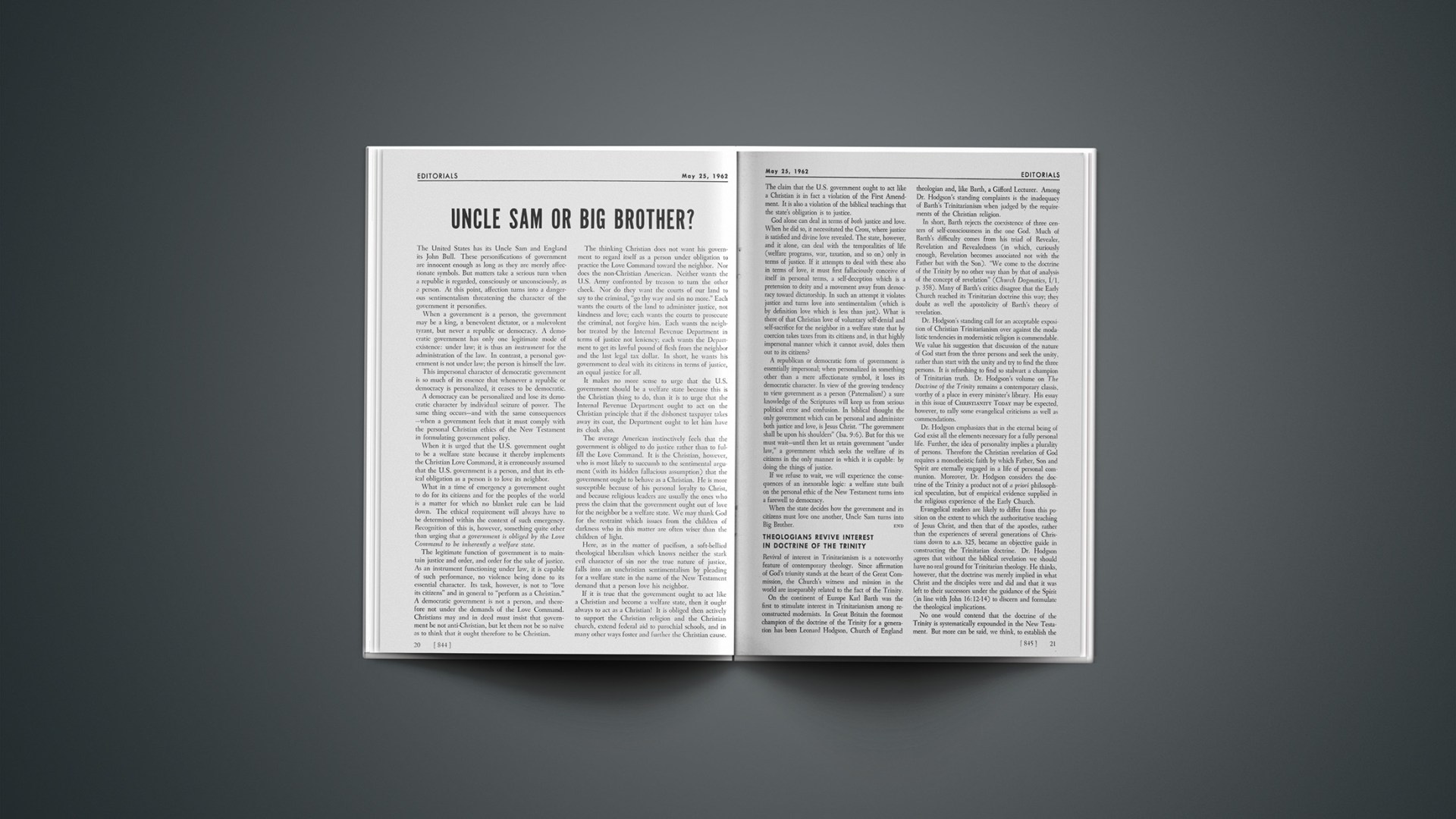
Uncle Sam or Big Brother?

The United States has its Uncle Sam and England its John Bull. These personifications of government are innocent enough as long as they are merely affectionate symbols. But matters take a serious turn when a republic is regarded, consciously or unconsciously, as a person. At this point, affection turns into a dangerous sentimentalism threatening the character of the government it personifies.

When a government is a person, the government may be a king, a benevolent dictator, or a malevolent tyrant, but never a republic or democracy. A democratic government has only one legitimate mode of existence: under law; it is thus an instrument for the administration of the law. In contrast, a personal government is not under law; the person is himself the law.

This impersonal character of democratic government is so much of its essence that whenever a republic or democracy is personalized, it ceases to be democratic.

A democracy can be personalized and lose its democratic character by individual seizure of power. The same thing occurs—and with the same consequences—when a government feels that it must comply with the personal Christian ethics of the New Testament in formulating government policy.

When it is urged that the U.S. government ought to be a welfare state because it thereby implements the Christian Love Command, it is erroneously assumed that the U.S. government is a person, and that its ethical obligation as a person is to love its neighbor.

What in a time of emergency a government ought to do for its citizens and for the peoples of the world is a matter for which no blanket rule can be laid down. The ethical requirement will always have to be determined within the context of such emergency. Recognition of this is, however, something quite other than urging that a government is obliged by the Love Command to be inherently a welfare state.

The legitimate function of government is to maintain justice and order, and order for the sake of justice. As an instrument functioning under law, it is capable of such performance, no violence being done to its essential character. Its task, however, is not to “love its citizens” and in general to “perform as a Christian.” A democratic government is not a person, and therefore not under the demands of the Love Command. Christians may and in deed must insist that government be not anti-Christian, but let them not be so naïve as to think that it ought therefore to be Christian.

The thinking Christian does not want his government to regard itself as a person under obligation to practice the Love Command toward the neighbor. Nor does the non-Christian American. Neither wants the U.S. Army confronted by treason to turn the other cheek. Nor do they want the courts of our land to say to the criminal, “go thy way and sin no more.” Each wants the courts of the land to administer justice, not kindness and love; each wants the courts to prosecute the criminal, not forgive him. Each wants the neighbor treated by the Internal Revenue Department in terms of justice not leniency; each wants the Department to get its lawful pound of flesh from the neighbor and the last legal tax dollar. In short, he wants his government to deal with its citizens in terms of justice, an equal justice for all.

It makes no more sense to urge that the U.S. government should be a welfare state because this is the Christian thing to do, than it is to Urge that the Internal Revenue Department ought to act on the Christian principle that if the dishonest taxpayer takes away its coat, the Department ought to let him have its cloak also.

The average American instinctively feels that the government is obliged to do justice rather than to fulfill the Love Command. It is the Christian, however, who is most likely to succumb to the sentimental argument (with its hidden fallacious assumption) that the government ought to behave as a Christian. He is more susceptible because of his personal loyalty to Christ, and because religious leaders are usually the ones who press the claim that the government ought out of love for the neighbor be a welfare state. We may thank God for the restraint which issues from the children of darkness who in this matter are often wiser than the children of light.

Here, as in the matter of pacifism, a soft-bellied theological liberalism which knows neither the stark evil character of sin nor the true nature of justice, falls into an unchristian sentimentalism by pleading for a welfare state in the name of the New Testament demand that a person love his neighbor.

If it is true that the government ought to act like a Christian and become a welfare state, then it ought always to act as a Christian! It is obliged then actively to support the Christian religion and the Christian church, extend federal aid to parochial schools, and in many other ways foster and further the Christian cause. The claim that the U.S. government ought to act like a Christian is in fact a violation of the First Amendment. It is also a violation of the biblical teachings that the state’s obligation is to justice.

God alone can deal in terms of both justice and love. When he did so, it necessitated the Cross, where justice is satisfied and divine love revealed. The state, however, and it alone, can deal with the temporalities of life (welfare programs, war, taxation, and so on) only in terms of justice. If it attempts to deal with these also in terms of love, it must first fallaciously conceive of itself in personal terms, a self-deception which is a pretension to deity and a movement away from democracy toward dictatorship. In such an attempt it violates justice and turns love into sentimentalism (which is by definition love which is less than just). What is there of that Christian love of voluntary self-denial and self-sacrifice for the neighbor in a welfare state that by coercion takes taxes from its citizens and, in that highly impersonal manner which it cannot avoid, doles them out to its citizens?

A republican or democratic form of government is essentially impersonal; when personalized in something other than a mere affectionate symbol, it loses its democratic character. In view of the growing tendency to view government as a person (Paternalism!) a sure knowledge of the Scriptures will keep us from serious political error and confusion. In biblical thought the only government which can be personal and administer both justice and love, is Jesus Christ. “The government shall be upon his shoulders” (Isa. 9:6). But for this we must wait—until then let us retain government “under law,” a government which seeks the welfare of its citizens in the only manner in which it is capable: by doing the things of justice.

If we refuse to wait, we will experience the consequences of an inexorable logic: a welfare state built on the personal ethic of the New Testament turns into a farewell to democracy.

When the state decides how the government and its citizens must love one another, Uncle Sam turns into Big Brother.

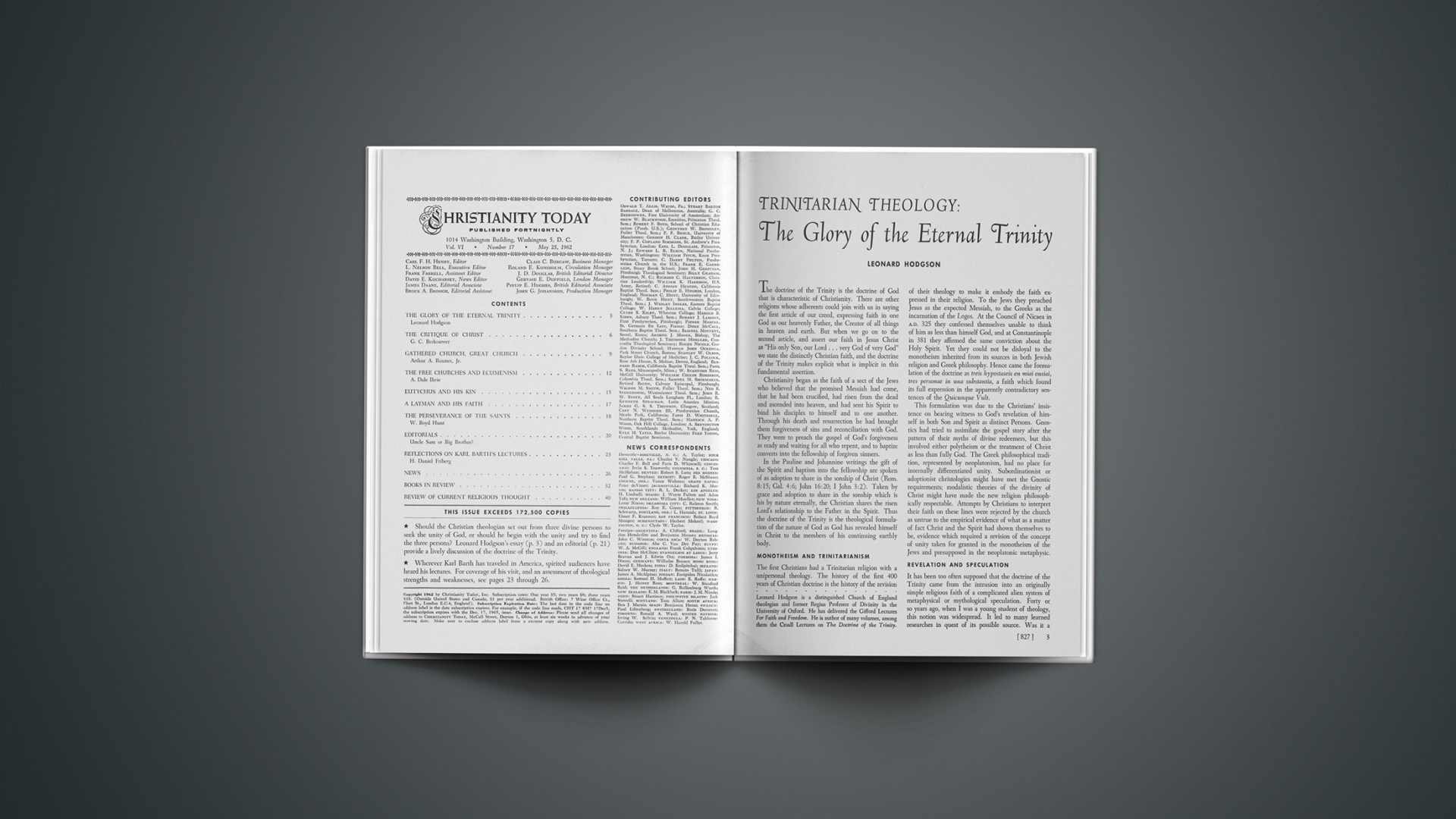
Theologians Revive Interest In Doctrine Of The Trinity

Revival of interest in Trinitarianism is a noteworthy feature of contemporary theology. Since affirmation of God’s triunity stands at the heart of the Great Commission, the Church’s witness and mission in the world are inseparably related to the fact of the Trinity.

On the continent of Europe Karl Barth was the first to stimulate interest in Trinitarianism among reconstructed modernists. In Great Britain the foremost champion of the doctrine of the Trinity for a generation has been Leonard Hodgson, Church of England theologian and, like Barth, a Gifford Lecturer. Among Dr. Hodgson’s standing complaints is the inadequacy of Barth’s Trinitarianism when judged by the requirements of the Christian religion.

In short, Barth rejects the coexistence of three centers of self-consciousness in the one God. Much of Barth’s difficulty comes from his triad of Revealer, Revelation and Revealedness (in which, curiously enough, Revelation becomes associated not with the Father but with the Son). “We come to the doctrine of the Trinity by no other way than by that of analysis of the concept of revelation” (Church Dogmatics, I/1, p. 358). Many of Barth’s critics disagree that the Early Church reached its Trinitarian doctrine this way; they doubt as well the apostolicity of Barth’s theory of revelation.

Dr. Hodgson’s standing call for an acceptable exposition of Christian Trinitarianism over against the modalistic tendencies in modernistic religion is commendable. We value his suggestion that discussion of the nature of God start from the three persons and seek the unity, rather than start with the unity and try to find the three persons. It is refreshing to find so stalwart a champion of Trinitarian truth. Dr. Hodgson’s volume on The Doctrine of the Trinity remains a contemporary classis, worthy of a place in every minister’s library. His essay in this issue of CHRISTIANITY TODAY may be expected, however, to rally some evangelical criticisms as well as commendations.

Dr. Hodgson emphasizes that in the eternal being of God exist all the elements necessary for a fully personal life. Further, the idea of personality implies a plurality of persons. Therefore the Christian revelation of God requires a monotheistic faith by which Father, Son and Spirit are eternally engaged in a life of personal communion. Moreover, Dr. Hodgson considers the doctrine of the Trinity a product not of a priori philosophical speculation, but of empirical evidence supplied in the religious experience of the Early Church.

Evangelical readers are likely to differ from this position on the extent to which the authoritative teaching of Jesus Christ, and then that of the apostles, rather than the experiences of several generations of Christians down to A.D. 325, became an objective guide in constructing the Trinitarian doctrine. Dr. Hodgson agrees that without the biblical revelation we should have no real ground for Trinitarian theology. He thinks, however, that the doctrine was merely implied in what Christ and the disciples were and did and that it was left to their successors under the guidance of the Spirit (in line with John 16:12–14) to discern and formulate the theological implications.

No one would contend that the doctrine of the Trinity is systematically expounded in the New Testament. But more can be said, we think, to establish the doctrine itself more firmly as New Testament doctrine and hence as normative and authoritative for the religious life of the Early Church. Particularly in view of the difficulty of discriminating the three persons experientially in spiritual communion is it important to place adequate emphasis on that authoritative teaching which guided believers from the very outset. No doubt they did not fully comprehend its implications and in those first transition years Jewish Christians, in enlarging their monotheistic commitment to a trinitarian content, no doubt had to expand and revise theological concepts alongside their religious experience. But the finality and objectivity of that revision, we think, rested—to a greater extent than Dr. Hodgson seems to allow—upon authoritative teaching, first orally and then in the sacred writings.

The solid basis of trinitarian teaching is to be found not only in Christ and the Spirit, but in the biblical statements concerning them. Dr. Hodgson has “event” and “experience of it” (documented in the Bible) but no authoritative, normative statements as the essential basis of the later Chalcedonian development. Great texts like Matthew 16:16; 28:19; 2 Corinthians 13:14; and Romans 1:4, which speak of the Trinity or the deity of Christ or the Spirit, are decisive for Christian doctrine.

One may also call attention to the anthropocentric or Christianocentric elements in Dr. Hodgson’s presentation. This raises the basic problem Professor Barth deals with, whether we can make the three persons of Chalcedon into three personalities according to modern usage. If God is viewed imago hominis, we then end up with tritheism, which is fully as unscriptural as modalism (“modes of existence”).

Dr. Hodgson’s final emphasis is good, that we should finish the discussion of the Trinity, not in intellectual mystification but in doxology—not paradox but doxa! In this spirit the early post-Chalcedonian church produced great hymns to the triune God.

Compulsion, Not Compassion—That Is The Question

Almost unanimously the press, radio and television have censured the medical profession in general and a group of New Jersey doctors in particular for “inhumanity” and “refusal to care for the elderly needing medical aid.”

In keeping with election year temper, factual distortions and vivid generalities were called into play by politicians trying desperately to meet hastily conceived campaign promises. Welfare Secretary Abraham Ribicoff publicly deplored the New Jersey group’s “violation of professional oaths,” and his carefully worded blasts found a favorable “slant” at the hands of sympathetic newswriters and broadcasters. President Kennedy and Labor Secretary Goldberg made similar statements.

In attacking the doctor’s threatened “boycott,” the New Frontiersmen ignored the key promise contained in the doctors’ statement which stressed one point: Rather than accepting payment from patients who would receive taxpayers’ money under the King-Ander-son bill, “we will treat them free of charge.” Whether this is all virtue or part propaganda might be questioned. There can be little doubt, however, that by ignoring this part of the statement some politicians are practicing an age-old law of propaganda: “Repeat a half-truth loud enough and long enough, and it will gain general acceptance as fact.” Is it justifiable to attack the motives of an entire profession without objective presentation of all the facts?

A recent editorial in The National Observer states, “The problem of medical care for the aged deserves careful attention. It’s not going to be solved overnight by an ill-considered election-year scheme …”

Concessions To Universalism Blunt Evangelistic Urgency

The heresy of universalism—the doctrine that Christ’s redemption automatically embraces all men—continues to show its face on the theological scene, despite all protestations that Protestant theologians now view sin and salvation seriously.

Although Karl Barth has repeatedly denied the charge of universalism (as taught by Origin), Emil Brunner’s criticism—that Barth’s doctrine nonetheless eliminates judgment, condemnation and hell as real possibilities—needs to be heard. If all men are already embraced in the election of Christ, as Barth contends, then they lack only the removal of ignorance that they are saved, not faith and decision for Christ.

Recently Dr. D. T. Niles of Ceylon, general secretary of the East Asia Christian Conference, told the U.S. Conference for the World Council of Churches in Buck Hill Falls that “the task of evangelism is to bring out Jesus Christ in every man, not to put him in.” He assailed the common Christian characterization of adherents of other religions as “unbelievers.” Proceeding to Princeton Theological Seminary, Dr. Niles said that invitations to “accept Jesus Christ and be saved distort the Gospel.”

Even after the collapse of classic liberalism many modern theories of the mercy and righteousness of God reflect speculative adjustments of scriptural positions rather than authentic biblical theology. The Apostle Paul would have been greatly surprised to learn that his invitation to the Philippian jailer distorted the Gospel. Indeed, would he not have firmly established the counterpoint that the distortion is taking place further down the line?
35: The Perseverance of the Saints

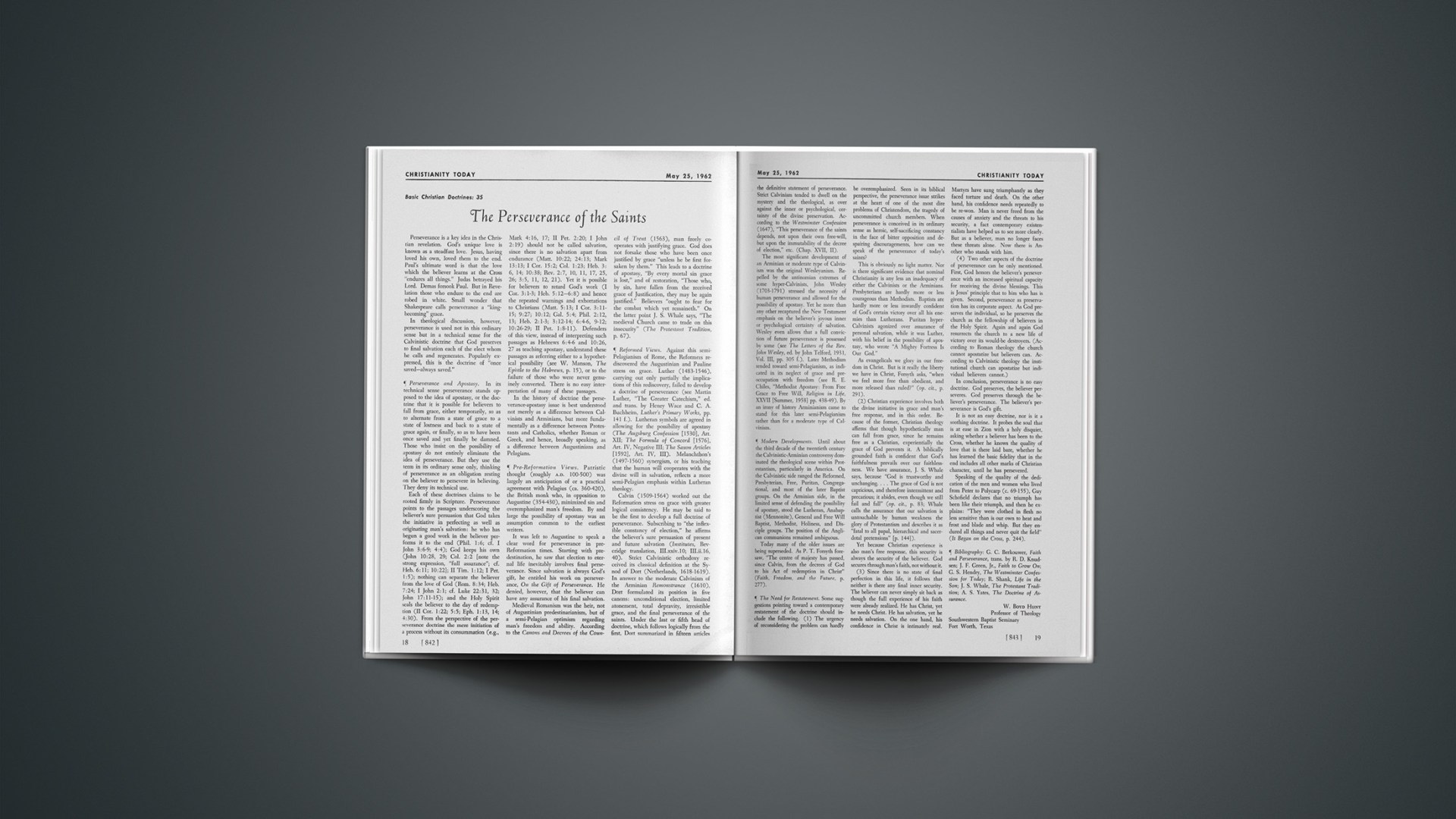
Perseverance is a key idea in the Christian revelation. God’s unique love is known as a steadfast love. Jesus, having loved his own, loved them to the end. Paul’s ultimate word is that the love which the believer learns at the Cross “endures all things.” Judas betrayed his Lord. Demas forsook Paul. But in Revelation those who endure to the end are robed in white. Small wonder that Shakespeare calls perseverance a “king-becoming” grace.

In theological discussion, however, perseverance is used not in this ordinary sense but in a technical sense for the Calvinistic doctrine that God preserves to final salvation each of the elect whom he calls and regenerates. Popularly expressed, this is the doctrine of “once saved—always saved.”

Perseverance and Apostasy. In its technical sense perseverance stands opposed to the idea of apostasy, or the doctrine that it is possible for believers to fall from grace, either temporarily, so as to alternate from a state of grace to a state of lostness and back to a state of grace again, or finally, so as to have been once saved and yet finally be damned. Those who insist on the possibility of apostasy do not entirely eliminate the idea of perseverance. But they use the term in its ordinary sense only, thinking of perseverance as an obligation resting on the believer to persevere in believing. They deny its technical use.

Each of these doctrines claims to be rooted firmly in Scripture. Perseverance points to the passages underscoring the believer’s sure persuasion that God takes the initiative in perfecting as well as originating man’s salvation: he who has begun a good work in the believer performs it to the end (Phil. 1:6; cf. 1 John 3:6–9; 4:4); God keeps his own (John 10:28, 29; Col. 2:2 [note the strong expression, “full assurance”; cf. Heb. 6:11; 10:22]; 2 Tim. 1:12; 1 Pet. 1:5); nothing can separate the believer from the love of God (Rom. 8:34; Heb. 7:24; 1 John 2:1; cf. Luke 22:31, 32; John 17:11–15); and the Holy Spirit seals the believer to the day of redemption (2 Cor. 1:22; 5:5; Eph. 1:13, 14; 4:30). From the perspective of the perseverance doctrine the mere initiation of a process without its consummation (e.g., Mark 4:16, 17; 2 Pet. 2:20; 1 John 2:19) should not be called salvation, since there is no salvation apart from endurance (Matt. 10:22; 24:13; Mark 13:13; 1 Cor. 15:2; Col. 1:23; Heb. 3:6, 14; 10:38; Rev. 2:7, 10, 11, 17, 25, 26; 3:5, 11, 12, 21). Yet it is possible for believers to retard God’s work (1 Cor. 3:1–3; Heb. 5:12–6:8) and hence the repeated warnings and exhortations to Christians (Matt. 5:13; 1 Cor. 3:11–15; 9:27; 10:12; Gal. 5:4; Phil. 2:12, 13; Heb. 2:1–3; 3:12–14; 6:4–6, 9–12; 10:26–29; 2 Pet. 1:8–11). Defenders of this view, instead of interpreting such passages as Hebrews 6:4–6 and 10:26, 27 as teaching apostasy, understand these passages as referring either to a hypothetical possibility (see W. Manson, The Epistle to the Hebrews, p. 15), or to the failure of those who were never genuinely converted. There is no easy interpretation of many of these passages.

In the history of doctrine the perseverance-apostasy issue is best understood not merely as a difference between Calvinists and Arminians, but more fundamentally as a difference between Protestants and Catholics, whether Roman or Greek, and hence, broadly speaking, as a difference between Augustinians and Pelagians.

Pre-Reformation Views. Patristic thought (roughly A.D. 100–500) was largely an anticipation of or a practical agreement with Pelagius (ca. 360–420), the British monk who, in opposition to Augustine (354–430), minimized sin and overemphasized man’s freedom. By and large the possibility of apostasy was an assumption common to the earliest writers.

It was left to Augustine to speak a clear word for perseverance in pre-Reformation times. Starting with predestination, he saw that election to eternal life inevitably involves final perseverance. Since salvation is always God’s gift, he entitled his work on perseverance, On the Gift of Perseverance. He denied, however, that the believer can have any assurance of his final salvation.

Medieval Romanism was the heir, not of Augustinian predestinarianism, but of a semi-Pelagian optimism regarding man’s freedom and ability. According to the Canons and Decrees of the Council of Trent (1563), man freely cooperates with justifying grace. God does not forsake those who have been once justified by grace “unless he be first forsaken by them.” This leads to a doctrine of apostasy, “By every mortal sin grace is lost,” and of restoration, “Those who, by sin, have fallen from the received grace of Justification, they may be again justified.” Believers “ought to fear for the combat which yet remaineth.” On the latter point J. S. Whale says, “The medieval Church came to trade on this insecurity” (The Protestant Tradition, p. 67).

Reformed Views. Against this semi-Pelagianism of Rome, the Reformers rediscovered the Augustinian and Pauline stress on grace. Luther (1483–1546), carrying out only partially the implications of this rediscovery, failed to develop a doctrine of perseverance (see Martin Luther, “The Greater Catechism,” ed. and trans. by Henry Wace and C. A. Buchheim, Luther’s Primary Works, pp. 141 f.). Lutheran symbols are agreed in allowing for the possibility of apostasy (The Augsburg Confession [1530], Art. XII; The Formula of Concord [1576], Art. IV, Negative III; The Saxon Articles [1592], Art. IV, III). Melanchthon’s (1497–1560) synergism, or his teaching that the human will cooperates with the divine will in salvation, reflects a more semi-Pelagian emphasis within Lutheran theology.

Calvin (1509–1564) worked out the Reformation stress on grace with greater logical consistency. He may be said to be the first to develop a full doctrine of perseverance. Subscribing to “the inflexible constancy of election,” he affirms the believer’s sure persuasion of present and future salvation (Institutes, Beveridge translation, III. xxiv. 10; III. ii. 16, 40). Strict Calvinistic orthodoxy received its classical definition at the Synod of Dort (Netherlands, 1618–1619). In answer to the moderate Calvinism of the Arminian Remonstrance (1610), Dort formulated its position in five canons: unconditional election, limited atonement, total depravity, irresistible grace, and the final perseverance of the saints. Under the last or fifth head of doctrine, which follows logically from the first, Dort summarized in fifteen articles the definitive statement of perseverance. Strict Calvinism tended to dwell on the mystery and the theological, as over against the inner or psychological, certainty of the divine preservation. According to the Westminster Confession (1647), “This perseverance of the saints depends, not upon their own free-will, but upon the immutability of the decree of election,” etc. (Chap. XVII, II).

The most significant development of an Arminian or moderate type of Calvinism was the original Wesleyanism. Repelled by the antinomian extremes of some hyper-Calvinists, John Wesley (1703–1791) stressed the necessity of human perseverance and allowed for the possibility of apostasy. Yet he more than any other recaptured the New Testament emphasis on the believer’s joyous inner or psychological certainty of salvation. Wesley even allows that a full conviction of future perseverance is possessed by some (see The Letters of the Rev. John Wesley, ed. by John Telford, 1931, Vol. III, pp. 305 f.). Later Methodism tended toward semi-Pelagianism, as indicated in its neglect of grace and preoccupation with freedom (see R. E. Chiles, “Methodist Apostasy: From Free Grace to Free Will, Religion in Life, XXVII [Summer, 1958] pp 438–49). By an irony of history Arminianism came to stand for this later semi-Pelagianism rather than for a moderate type of Calvinism.

Modern Developments. Until about the third decade of the twentieth century the Calvinistic-Arminian controversy dominated the theological scene within Protestantism, particularly in America. On the Calvinistic side ranged the Reformed, Presbyterian, Free, Puritan, Congregational, and most of the later Baptist groups. On the Arminian side, in the limited sense of defending the possibility of apostasy, stood the Lutheran, Anabaptist (Mennonite), General and Free Will Baptist, Methodist, Holiness, and Disciple groups. The position of the Anglican communions remained ambiguous.

Today many of the older issues are being superseded. As P. T. Forsyth foresaw, “The centre of majesty has passed, since Calvin, from the decrees of God to his Act of redemption in Christ” (Faith, Freedom, and the Future, p. 277).

The Need for Restatement. Some suggestions pointing toward a contemporary restatement of the doctrine should include the following. (1) The urgency of reconsidering the problem can hardly be overemphasized. Seen in its biblical perspective, the perseverance issue strikes at the heart of one of the most dire problems of Christendom, the tragedy of uncommitted church members. When perseverance is conceived in its ordinary sense as heroic, self-sacrificing constancy in the face of bitter opposition and despairing discouragements, how can we speak of the perseverance of today’s saints?

This is obviously no light matter. Nor is there significant evidence that nominal Christianity is any less an inadequacy of either the Calvinists or the Arminians. Presbyterians are hardly more or less courageous than Methodists. Baptists are hardly more or less inwardly confident of God’s certain victory over all his enemies than Lutherans. Puritan hyper-Calvinists agonized over assurance of personal salvation, while it was Luther, with his belief in the possibility of apostasy, who wrote “A Mighty Fortress Is Our God.”

As evangelicals we glory in our freedom in Christ. But is it really the liberty we have in Christ, Forsyth asks, “when we feel more free than obedient, and more released than ruled?” (op. cit., p. 291).

(2) Christian experience involves both the divine initiative in grace and man’s free response, and in this order. Because of the former, Christian theology affirms that though hypothetically man can fall from grace, since he remains free as a Christian, experientially the grace of God prevents it. A biblically grounded faith is confident that God’s faithfulness prevails over our faithlessness. We have assurance, J. S. Whale says, because “God is trustworthy and unchanging.… The grace of God is not capricious, and therefore intermittent and precarious; it abides, even though we still fail and fall” (op. cit., p. 83; Whale calls the assurance that our salvation is untouchable by human weakness the glory of Protestantism and describes it as “fatal to all papal, hierarchical and sacerdotal pretensions” [p. 144]).

Yet because Christian experience is also man’s free response, this security is always the security of the believer. God secures through man’s faith, not without it.

(3) Since there is no state of final perfection in this life, it follows that neither is there any final inner security. The believer can never simply sit back as though the full experience of his faith were already realized. He has Christ, yet he needs Christ. He has salvation, yet he needs salvation. On the one hand, his confidence in Christ is intimately real.

Martyrs have sung triumphantly as they faced torture and death. On the other hand, his confidence needs repeatedly to be re-won. Man is never freed from the causes of anxiety and the threats to his security, a fact contemporary existentialists have helped us to see more clearly. But as a believer, man no longer faces these threats alone. Now there is Another who stands with him.

(4) Two other aspects of the doctrine of perseverance can be only mentioned. First, God honors the believer’s perseverance with an increased spiritual capacity for receiving the divine blessings. This is Jesus’ principle that to him who has is given. Second, perseverance as preservation has its corporate aspect. As God preserves the individual, so he preserves the church as the fellowship of believers in the Holy Spirit. Again and again God resurrects the church to a new life of victory over its would-be destroyers. (According to Roman theology the church cannot apostatize but believers can. According to Calvinistic theology the institutional church can apostatize but individual believers cannot.)

In conclusion, perseverance is no easy doctrine. God preserves, the believer perseveres. God preserves through the believer’s perseverance. The believer’s perseverance is God’s gift.

It is not an easy doctrine, nor is it a soothing doctrine. It probes the soul that is at ease in Zion with a holy disquiet, asking whether a believer has been to the Cross, whether he knows the quality of love that is there laid bare, whether he has learned the basic fidelity that in the end includes all other marks of Christian character, until he has persevered.

Speaking of the quality of the dedication of the men and women who lived from Peter to Polycarp (c. 69–155), Guy Schofield declares that no triumph has been like their triumph, and then he explains: “They were clothed in flesh no less sensitive than is our own to heat and frost and blade and whip. But they endured all things and never quit the field” (It Began on the Cross, p. 244).

Bibliography: G. C. Berkouwer, Faith and Perseverance, trans. by R. D. Knudsen; J. F. Green, Jr., Faith to Grow On; G. S. Hendry, The Westminster Confession for Today; R. Shank, Life in the Son; J. S. Whale, The Protestant Tradition; A. S. Yates, The Doctrine of Assurance.

Professor of Theology

Southwestern Baptist Seminary

Fort Worth, Texas

Peace

The intensified propaganda for peace, dramatized by groups of pickets, by articles in secular magazines and religious periodicals, in resolutions by organizations both secular and church, and highlighted in political pronouncements on both sides of the iron curtain, may not be identical in motivation or objectives, but does indicate the yearning desire of many to be freed from the fear of potential atomic devastation.

Christians should study the meaning of true peace—its origin and its objectives. We say this because the word “peace” is one of the most abused and misunderstood of all words today.

It is our profound conviction that peace is a blessing conferred by God, on his terms, and available in no other way. It must be sought and defined in accordance with the divine revelation or it will prove but an elusive mirage, ever evading those who seek it.

Any movement for peace should beware of the spirit shown by the “wicked tenants” in our Lord’s parable, who, seeing the heir, rejected him and sought to seize the “inheritance” for themselves. Peace is one of God’s gifts. Can mankind seize this gift and at the same time reject the Prince of Peace? Here there may be a basic principle we all need to ponder.

Should not we heed the words of the Prophet Isaiah, ‘ “There is no peace, says the Lord, for the wicked’ ”? And, “But the wicked are like the tossing sea; for it cannot rest, and its waters toss up mire and dirt. There is no peace, says my God, for the wicked.”

In judgment God took away peace from Israel. Through the Prophet Jeremiah, he says: “… for I have taken away my peace from this people, says the Lord.” There is no reason to think that nations are more righteous today than then. We must beware of seeking peace on terms of human endeavor rather than through the God of Peace.

One must soberly envision what a man-devised peace could mean to the world; not peace with God and the peace of God, but the peace of death—spiritual death—where men would have even greater opportunities for indulging their appetites and lusts in the service of Satan. To tamper with or ignore God’s conditions can lead to disaster.

But why, some may say, did our Lord pronounce his blessing on the “peacemaker” if Christians are to refrain from participation in the peace movements current today? The answer is simple. Wherever peace is sought on God’s terms Christians should be found at the forefront. But, where peace is sought in any other way, ignoring God, the giver and sustainer of peace, and his righteousness as the sole basis of a godly peace, they should beware.

The Church has a glorious alternative: the Gospel, whereby men find peace with God through faith in his Son, and the peace of God through his indwelling presence.

The Psalmist makes a distinction between the righteous and the wicked which no man should seek to bridge. “Depart from evil, and do good; seek peace, and pursue it. The eyes of the Lord are toward the righteous, and his ears toward their cry. The face of the Lord is against evildoers, to cut off the remembrance of them from the earth.” To claim for the wicked the blessings of the righteous is to deny the redemptive work of Christ in favor of a man-made salvation.

The relationship between righteousness and peace is stated by the Psalmist: “Mercy and truth are met together; righteousness and peace have kissed each other.” To the world, peace is the absence of war; the atmosphere of nonhostility between nations. But in God’s sight these things have eternal significance only if based on the imputed righteousness of our Lord Jesus Christ.

Is the Christian then to ignore all efforts for world peace? Shall we let the unregenerate world seek after peace while we sit idly by? Of course not; but the Christian should center his main efforts on the divine basis of peace—man’s right relationship with his Creator.

This position assumes practical focus when we look at the Church’s obligation to evangelize, both at home and abroad. Who are America’s greatest ambassadors for peace? Not our diplomats, businessmen, or members of the Peace Corps, as such, but those Christians, be they diplomats, businessmen or others, who preach and live the redemptive work of Jesus Christ. This group is most consistently exemplified by Christian missionaries, who take the message of salvation and reconciliation and in so doing lay the foundation for true peace.

The whole issue of world peace becomes confused when it is projected on any terms other than the divine prescription for peace. Peace is a fruit of the Holy Spirit, not a product of human endeavor. True, open warfare may be averted at times by conferences and compromises but an armed truce is a far cry from a peace based on God’s righteous precepts.

To the worldling peace means one thing, to the Christian something entirely different. Our Lord gives peace to his own, a peace in no way related to time, place or circumstances. One may have perfect peace in the midst of chaos and destruction. “I will both lay me down in peace, and sleep: for thou, Lord, only makest me dwell in safety,” becomes a precious reality.

When God is given his rightful place in our lives peace is one result. “Great peace have they which love thy law: and nothing shall offend them,” speaks of cause and effect, of a peace of which the world can know nothing.

Our Lord, about to leave his disciples, spoke to them, and in like terms speaks to us today: “Peace I leave with you; my peace I give to you; not as the world gives do I give to you. Let not your hearts be troubled, neither let them be afraid.” To claim this peace for an unbelieving world makes a travesty of Christ’s redemptive work. Until he is acknowledged as King and Lord his peace is not available, nor can we claim it for the world.

There is a divine sequence in the attainment of peace. The Apostle James tells us: “But the wisdom from above is first pure, then peaceable.” Our Lord offers peace to a world weary of the threat of war, and of sorrow and oppression. “Come unto me,” he says, “all ye that labor and are heavy laden, and I will give you rest.”

Finally, the Christian should pray for peace and for those national leaders on whom rest those decisions which can make for peace. Unbelieving men are still under the sovereign power of God. “The king’s heart is in the hand of the Lord, as rivers of water: he turneth it whithersoever he will” is an affirmation on which Christians should lay hold, praying for peace that the Gospel may yet be preached at home and abroad.

Hot and cold wars may be held in abeyance but outside of Christ there can be no permanent peace. In him there is peace, regardless of what may happen.

It is this message which the Church must preach.

Eutychus and His Kin: May 25, 1962

Punctured Puff

Can book jackets be demythologized? Even cereal boxes now profess to “give it to you straight”—what about the puffed blurbs on the back flap of the books you read at breakfast?

A shot has been fired which will be heard around the world. The first author has taken his stand on the Common against the red-jacketed line of publishers. Alban G. Widgery is the minute-man; his tocsin is a single sheet, printed in black ink on white paper, and mailed recently to librarians and book dealers. The announcement lacks all trace of layout men and copywriters. It looks like this:

“OBJECTIONABLE ADVERTISING

The T.Y.C. Co.

in its 1961 Fall Announcement of

A PHILOSOPHER’S PILGRIMAGE

by Alban G. Widgery

made misrepresentations which the author asked to be corrected publicly in a satisfactory manner. As the publisher has not done that, the author here does it at his own expense.…

“It was asserted that the author had ‘achieved fame’ on three continents. Nothing in the book justifies such a statement. If it is supposed that he consented to it, he might rightly be exposed to ridicule. He knows, as others do, that he has achieved fame nowhere.

“It is said that the author ‘rubbed shoulders’ with Dr. Arnold Toynbee. He has never even met him.”

There is more, including a dust jacket description of which the author did approve, where we learn that he is a senior citizen of seventy-four, has studied in England, Germany, France, Scotland, India, and admires the people of Scotland.

Perhaps British understatement explains Mr. Widgery’s factual modesty; perhaps he has Scottish scruples. In any case, his courage should achieve fame for him on three continents.

Eutychus Associates wish to analyze representative “puffs” on dust jackets and in book announcements. Clip samples from your new book jackets and send them to us. We are particularly interested in the art of excerpting adjectives from book reviews.

EUTYCHUS

Evolution And Immortality

In reference to “the naturalistic evolutionary view of origins that undergirds dialectical materialism” (Editorial, Apr. 13 issue), I am as opposed to social Darwinism as you are, but I do not think that the solution lies in the rejection of modern science and a return to the theology of the Dark Ages. The assumption that immortal spiritual personalities cannot be produced by an evolutionary process is not a scientifically proven fact, but a … dogma inherited from Christianity itself. All the findings of parapsychology and psychical research indicate that animals have a psychical constitution similar to that of man, and there are several very well authenticated and documented cases of animal ghosts in the journals and proceedings of the American and British societies, as well as numerous unofficial reports.

Evolution, so far as it involves progress at all, implies, by very definition, a movement away from, not toward the animal, in beings higher than the animal, and evolutionists are as fully aware of the danger of retrogression as any fundamentalist.…

Evolution does not exclude sin and need for a Saviour if the requirements of the Divine law are higher than can be reached by any evolutionary process.

THEODORE B. DUFUR

Los Angeles, Calif.

The Church has, up till now, … been altogether too lenient toward evolution.… That is an odd position in the light of Him who died for truth, and never cut a corner for anyone.… He said God made humans in the beginning, male and female (Mark 10:6). That would not be a making of reptiles, for example, or asexual amebae, or algae, or worms, which lowly creatures then “evolved higher” till Darwin, Shakespeare, Marx, Christ, Caesar, Marconi, Ford, Huxley, and Khrushchev “arrived.”

L. VICTOR CLEVELAND

Canterbury, Conn.

Re A. M. Watts’ implications of a continuing creativity (Eutychus, Mar. 30 issue) … it need not be added that the “evolutionary process of creation” no longer stands regarded as a valid theory—either by secular or divine authority; that no man can “accept” that that is not; and that CHRISTIANITY TODAY is the medium neither of “traditional fundamentalist interpretation” nor of compromise in any fashion.

The end of the creative summary effects, in the Hebrew, a most emphatic assertion of the completedness of that creation: “Thus the heavens and the earth were finished.…” The Hebrew verb kalah is rendered in the Puàl case: to the non-Hebraist it might be explained that the Puàl is an intensive passive; our Lord’s purpose in using an intensive here is evident.…

Verse three follows with … “ceased from all his works which he had made.…” “Had made” [signifies] a completed action.

There is not space to even make mention of the numerous scriptural evidences that could be brought to bear on the hypothesis of a continuing creation.…

HENRY A. GOERTSON

Vancouver, B. C.

Front Page Of The Worker

Now that CHRISTIANITY TODAY (News, Mar. 30 issue) has reported on the United Presbyterian General Council’s … attack against conservative anti-Communist groups, will [you] also report the other side of the picture?

One of the aims of the Communist Party, U.S.A., is the destruction, abolition or reduction of anti-Communist groups.… They do not care if others transmit their line. In fact, all Communists deliberately try to get respectable groups to transmit their propaganda.… The Communist paper, The Worker, in a recent issue has congratulated these Presbyterians in a front-page editorial!…

ROGER MILLS

Paramount, Calif.

Toward Consensus—How?

How can the Christian church arrive at a consensus of conviction that will enable it to speak a prophetic and biblically valid word of witness on current issues?

The answer is fairly simple when one thinks of a local congregation where Christians can gather together for face-to-face discussion and prayerful study of the Word of God as it relates to a particular issue. The problem becomes more difficult the further one moves from the congregational situation toward the corporate agencies of church cooperation. What are the processes of brotherly admonition, correction, and counsel within the structures of inter-church cooperation?

While living in Washington, D. C., in 1954–1957, I noted that this problem was unresolved by both the National Council of Churches and the National Association of Evangelicals. The NCC Washington office was almost reduced to silence on any current issue because of their reluctance to speak without having a clear mandate from the regularly constituted channels of action within the organization or without checking back with their constituent groups.

On the other hand the NAE spokesmen in Washington sometimes made statements and public testimony about which they assumed the support of their constituency but which had not arisen out of any carefully considered consultation or staff work among the constituent groups. (Examples would be NAE statements on immigration and UMT legislation which certainly did not have the support of their Brethren in Christ and Mennonite Brethren constituents.) It seems to me that in both cases there was, and still is, a weakness in the procedures by which Christian concerns and biblical authority are made part of the actual dynamics of policy formation by interchurch groups. There is, of course, a similar problem for any denomination which tries to arrive at a consensus of conviction among the variety of congregations and area conferences, or synods.

EDGAR METZLER

Akron, Pa.

Don’T Marry The Daughter!

It seems to me that the great and good men of the last 50 years were not only evangelical but were scholarly: Machen, Riley, Gaebelein, Moorehead, Schofield, Chafer, Newell, Pierson, Torrey, Ironside, Thomas, Scroggie, Dixon, Hinson, Brooks, Fausset, Kelly, Darby, Seiss, Edersheim, Ryan, Nicholson, Liddon, Grant, Peters, Maclaren, Moule, Ryle, Anderson MacNeil, Orr, Robert Dick Wilson—surely these men were evangelical and scholarly. Yet some of our young intellectuals seem to be trying to give the impression that we have had no scholars and that the truth has not been defined and stated and clarified and classified. Somewhere there is a blind spot of arrogant pride, it seems to me. How naïve can our “New Evangelicals” get?…

I greatly fear that many of our new champions of compromise of principle and truth want the good conscience of being true to God and to the Bible but they also want that popularity, favor, fellowship and dignity that comes from the liberal camp of so-called intellectuals. There is a world of difference between being friendly, cordial, Christian and neighborly with the unenlightened modernists, and marrying their daughter and giving them that feeling and sanction that they can serve the Devil and enjoy divine favor.…

My quarrel with the New Evangelicalism is that they are no more scholarly than the leaders in the fundamental movement. Secondly, because some fundamentalists were not loving and wise and judicious, is no proof that the whole movement is false.…

MEROLD E. WESTPHAL

Lakebay Community Church

Lakebay, Wash.

Church And The Alcoholic

For the past seventy-five years and more, in the skid row sections of great cities and small towns, rescue missions have struggled to keep doors open, and extend a helping hand. What tremendous effect these could have had in the fight against alcoholism if churches had determined to provide them with proper facilities, assisted them with their finances so that trained personnel could have been brought in to take some of the load off the over-burdened superintendents, and by this shown the world that they believe Christ is the answer.

I believe there has existed a “great gulf” between these institutions and the churches. The rescue mission feels the Church just “doesn’t care.” And the churches aren’t interested, or feel that any assistance they would offer would be unwelcome. The lack of interest in some cases, without doubt, stems from conditions which the Church feels should, and could, be improved. I would remind those who feel that all missions are mere “flop houses” that we now have some great institutions, headed by qualified and dedicated men of God, that are reaching the alcoholic with the only remedy, the Gospel.

I must confess that I believe the Church has taken the easy way out. We have decided to turn the job to A.A. and others, and concern ourselves with more pleasant tasks. Since this is obviously a moral issue, how can we shirk the responsibility of dealing with it? Of course the alcoholic is an emotionally disturbed individual, but doesn’t it sound reasonable that to get him grounded in the faith is an important basic step toward helping overcome this problem? Regeneration is the only foundation upon which rehabilitation can be successfully carried out.

One of the latest problems we who are directly connected with the work among alcoholics are being confronted with results from the fact that he is now being convinced that he has an “incurable disease.” He has “tried religion” (by this he usually means he belonged to a church, or had asked God to help him). In fact, there are so many conflicting views as to the cause and cure of this problem that there is little wonder it is becoming more difficult to deal with.

Someone has summed it up in this manner: The alcoholic himself says he is “the world’s most misunderstood individual.” The professionals say he is “a maladjusted and very sick person.” Society says he is “a nuisance.” The Bible says he is “a drunkard.”

There is now strong evidence that A.A. and the Salvation Army are teaming together. The tragedy is that it is simply A.A.’s program and the Salvation Army’s facilities. I attended one of these sessions and if some of the Salvation Army workers of years gone by could have witnessed this scene, their hearts would have been broken. The room was so filled with cigarette smoke, one could hardly breathe. The guest speaker used language suited to the barroom.

A.A. is now planning to increase its public relations activities. However, it is still the same A.A. program, with an occasional mention of “The Man Upstairs,” but totally devoid of genuine spiritual help. John 14:6 speaks for itself in this connection.

However, they have put such effort into assisting these individuals, even “babysitting” with them throughout entire nights and days, that they have made those of us who profess the name of Christ bow our heads in shame over our indifference.

It is not too late to do something about this problem. Many have died a drunkard’s death in cheap hotels, alcoholic wards and flop houses across the nation. Statistics prove that the next generation will be faced with the problem of dealing with more of these individuals than we today. Raising the drinking age limit and other related laws is not the answer, but 2 Corinthians 5:17 is, for then the defeated victims of drink can say with Paul: “I can do all things through Christ which strengtheneth me.”

ROY E. HATFIELD

Superintendent

City Mission

Niagara Falls, N. Y.

The Free Churches and Ecumenism

The appeal to share in a united Christian front strikes a responsive note in the hearts of all believers. Laymen and clergymen are aware of the threats to Christendom and to Christianity as East meets West and as the socialistic trend bids for supremacy over the individualism which Christianity has both fostered and fed upon. Called upon to witness for Christ in a world which is still choosing up sides, free church members sense the folly of Christian fractionalism as clearly as their counterparts in the Reformed and Catholic segments of the church. (The term “free church” is employed here to designate those Christian groups which are locally free to choose their own affiliations and are not obligated to accept commitments made for them by any collective or hierarchial action. Such a designation will include groups which are of the Baptistic or independent or congregational polity and tradition.)

Gone are the days when false pietism could dismiss the ecumenical cloud in the sky by repeating such epithets as “modernistic idealism,” or “visionary foolishness,” or “Catholic trickery.” The cloud has moved in and has enlarged to envelop the church of Jesus Christ; it has altered the spiritual and intellectual climate in which Christians live, and its fallout of blessing or cursing is upon us all. No church—not even the most detached and independently free church—can find shelter from its effects. The question is no longer, “Will the free churches be affected by the ecumenical mood of our times?” but rather, “How will this vital force affect the life of that segment of the church whose sensitivity and theology (and strength) has been drawn from concepts widely divergent from those which bind ecumenicists into the pluralistic and yet united parcel of diversity which contemporary Christianity is attempting to become?”

The word “ecumenism” may still be a nasty word in some circles, but it is a word which those who dwell in such circles are nevertheless being compelled to use. It must also be acknowledged that in many of the free churches there has been more than casual acknowledgment of the challenge to response; even some groups whose historic emphasis has been on individual freedom have made significant concessions to the idea of limiting individualism for the sake of strengthening the whole. These concessions are not being made easily, however, and the end of internal disorder among such groups is not yet; for while their participation in ecumenical conversations may bring no serious reaction from their constituency, even a partial surrender of autonomous sovereignty tends to split the ranks wide open.

Still to be answered by the majority of free church spokesmen is the question, “Can we share in the ecumenical movement?” Their answer will have bearing on the testimony of Christ throughout the world for two reasons: 1. The free churches comprise a larger number of Christian adherents than many Reformed or Catholic church people may realize; and 2. They are vocal and influential, especially at the grass-roots level of society. Ecumenism without the inclusion of the churches born into the “free” tradition will be the testimony of a movement which is severely maimed if not actually lame.

There are some good reasons why the free churches are drawn to the very idea of visible church unity.

For one thing, even the most individualistic Christian has a doctrine of the church built into his oft-unarticulated creed. He is as embarrassed by divisions and disunity and fractionalism as are his nonfree brethren. When the spirit of criticism and negativism contaminates the air he breathes, and when believers are set against believers over issues that are on the fringe of Christian experience or theology, and when schism rends the body of Christ, his conscience burns. He knows in his heart that the prayer, “That they all may be one,” was meant to embrace living reality as well as theoretical unity. When he reads, “Can the hand say to the foot I have no need of thee?” the free Christian church member recognizes that individuality is precious only in the context of cooperation. His very loyalty to the scriptural letter speaks to him about the truth inherent in the ecumenical attitude. His doctrine of the church may be a far cry from that of either Aquinas or Luther, but it is there nevertheless. No “congregationalist” will deny this.

Furthermore, he is not uninformed about the precarious circumstance in which the visible church finds itself. An exclusively Western balance of power no longer protects his missionaries or his investments in foreign countries. He can no longer hide behind the American flag as the source of his protective strength or as the excuse for his spiritual daring. He needs something else to sustain his boldness before the world, if his boldness is to be more than an inward bravado. He needs the kind of influence which will march in strength and courage into those very realms where the enemy is strong, and he knows that one man with one voice—even a strong man with a strong voice—will not be admitted anywhere. Even David needed an army with him, as did Gideon. An army must include visible and functional unity; mere “spiritual unity” among disorganized individuals could never win a battle within a historic situation where the issues are involved with real live people, real governments, real economic obligations, and real territories. There is a strength which comes through visible, organized unity. He, the free church adherent, knows that he and his church must have that strength. This explains the strong sense of denominationalism which affects many locally free congregations. The same principle of interdependence which produces cooperation on the “board” or “fellowship” or “denominational” level cannot suddenly become wrong when it is applied on the interdenominational level, especially when the global situation is such that individual opportunities are possible only within a framework of collective influence. Even the lonely prophets of Israel depended on a social structure which made their survival possible, and in which they were loyal and devoted servants.

Such strong and valid incentives, however, do not include answers to serious questions which trouble most free churchmen as they confront ecumenism.

1. Where will the limits of visible church unity be found in the long run? More than any other Christian, the free church believer is aware that liberties are hard to secure and easily lost. He is not ignorant of history and may have a higher appreciation for the sacrifices of the reformational saints than many of the very inheritors of that tradition. He is not merely ignorant or stubborn in his insistence that his church be unhampered by hierarchical dictatorship. If he has sometimes been too conscientious at this point, it is because he has read as much church history, Roman Catholic theology, Reformation theology, and current ecumenical literature as anyone else. In a sense the free church tradition antedates the Reformation by centuries, and it is not easy to erase from the mind such martyrdoms to Christian liberty as are recorded in the testimonies of the “heretical sects.” Any threat to this liberty of conscience which the New Testament cites as a noble Christian privilege will be opposed by men who value their souls more than they value their reputation or even their “opportunities.” Until the limits of visible church unity are more settled than they are, the free church people will remain outside the ecumenical sphere on the basis that too much is at stake. If loss of liberty is the condition for the survival of a religion called Christianity, the free churches will disappear. As they die, they will be convinced that New Testament Christianity has died too.

2. How can the theological contradictions which become apparent in ecumenical studies be reconciled? This question must be answered even if the limits of visible church unity are established in a manner which safeguards and guarantees soul liberty. Unless it is answered, ecumenism is an illusion, though it cites the minimal credo of Christ’s deity and the Trinitarian concept of the Godhead. The question must be answered before the ecumenical idea can have meaning, even if Christianity is defined in nonintellectualized terms as a “common experience with God through Christ.” This is because, as free and nonfree church Christians know, all basic statements need protection from misinterpretation or abuse. The basic statement can never be separated from its implications or its applications. It may be that one branch of Christendom worships Mary as the Mother of God and accepts the infallibility of the papacy, and may do so by virtue of its acceptance of Christ’s lordship, but how this “theology” can be harmonized with diametrically opposing convictions in the name of ecumenism is more than the free church believer can see at the present time. He is as ready as anybody to express a wide latitude of grace toward Christians who disagree with him, but he cannot embrace a “fellowship of contradiction” even in the most existentialist setting of abandoned (or abandonment of) reason. The questions of biblical revelation versus dogma, of myth versus history, and of Christian particularity versus Christian adaptation will have determinative effects on any simple statement or creed cited as a basis for a world communion. Until such a world communion can become more explicit concerning these contradictions, the free churches will feel that a direct commitment to any ecumenical organization would be like buying a “pig in a poke.” They cannot afford to function under the gnawing fear that the Christianity they have thus embraced may turn out to be terribly foreign to the “faith delivered once for all unto the saints.” This is not a retreat into obscurantism; it is a sincere request for ecumenical leaders to emerge from it as soon as possible. The constant biblical caution against “false teachers” who would alter the biblical message for the sake of their own power haunts the free church member’s mind even as he searches his own soul. After all, if free churches are wrong, there is the probability of swift correction in the retaliations of other groups equally free. If a world church were wrong, it would be tragically wrong indeed. On this score alone the liberty-loving churches may be forgiven for their hesitancy during this present state of ecumenical theological ambiguity. These two questions confront them, then: How free will Christians remain in the ecumenical church? What kind of Christianity will be assumed or derived from the present theological contradictions which divide the churches?

What then? Are the free churches committed to a position which will forever cut them off from the Reformational and Roman Catholic groups? This depends on two things. First, it depends on whether these segments of the professing church are willing to be sympathetically tolerant and gracious toward those whose fears or whose sensitive consciences prevent them from “joining up.” Will the free churches be invited to share in the “conversations” which are being conducted at the various levels? Will the more “committed” groups engage in any dialogue with the “less committed” groups? Will ecumenism be pursued throughout Christendom under the principle that “we” (who belong to an organized and visible global communion) will enjoy fellowship and discussion with “you” (who represent the Christians not belonging to a global communion)? Perhaps the answer will be “no” to such possibilities on the thesis that by their very definition the free churches cannot be ecumenical, and that discussions with individuals from their number would be meaningless anyway (since presumably no single representative could speak for or speak to anyone other than himself). There is, however, a strong strain of denominationalism among the free churches, and they comprise more of a bloc or blocs than may be generally realized.

A basic question is whether the free churches are filled with enough sympathetic tolerance and Christian grace to enter into constructive dialogue with anyone unlike themselves. This is not a complimentary question. No one will ever presume to express the feelings of such churches in general, but it seems fair to assume that the free-church Christians are at least as mature and gracious as those of other traditions.

There has been some constructive exchange (both verbally and in writing) between men of ethical and intellectual caliber, representing all three strains of Christian history. If the ecumenical movement is to be what its idealizers hope, such three-way encounters would seem to be important.

Still, is free-church participation in the ecumenical movement confined to mere conversation? Are there areas of cooperation in existence where certain Christian responsibilities may be (or must be) shared by professing Christians without finalized considerations of theology or structure?

In a world desperate for help, ravaged by war, beset with injustice, starving for food, marred by crime, spawning infants by the million, harboring untold numbers of insane and indigent people, it would seem strange if people bearing Christ’s name could not find things to do together. Charity does not demand theological consistency or organic union, but Christ demands charity. Theological problems are extremely important, but the people who need food are not theologians. There is no Catholic bread or Reformational clothing or free-church medicine. There is Christian love.

This form of ecumenism points to the real common denominator among Christians and may be the ground on which the united front may be discovered and expressed. What prevents Catholic and Reformed and free-church Christians from developing a massive global testimony of mutual charity in a carefully organized and well-administered program of mercy? The ecumenical movement will then have found the common element which Christ himself underscored in word and in life: the alleviation of human need brought about by personal sacrifice. Free churches will respond to this.

Cities

Cities are more than steel and stone,

or humming wheels and towers a-drone;

or busy shops and boulevards,

or parks, or homes with well-kept yards.

Cities are more than block-long stores

with neon-signs and countless doors.

Cities have eyes afire with tears

and hearts that flee the mocking years;

ears that hear no sound of song,

feet that stumble on streets of wrong.

Cities are full of children crying,

Cities are full of people dying.

Cities are more than stone-steel towers

proudly proclaiming this time of ours.

Cities are men for whom Christ cried;

cities are souls for whom He died.

LON WOODRUM

Gathered Church, Great Church

Before an open fireplace we sat. A convivial evening meal had been eaten and now with friendly logs crackling in the great hearth we chatted amiably with one another as we waited for the discussion to begin.

The mood was relaxed. Pipes were being lit, laughter filled the room, friendly introductions were being made. The young man in the clerical collar next to me put out his hand and said with a smile, “Bob Shaughnessy is my name.” I responded with my own.

Ten young priests of the Roman Catholic Church were meeting with ten young Protestant ministers to talk about mutual concerns of the Christian faith. The young man who had introduced himself to me was a priest of the church of Rome.

It seemed a long way from Luther in Germany, and Calvin in Switzerland, and the Pilgrims at Plymouth. And it is a long way. The movement toward Christian unity is a reality. Romans and Protestants are beginning to talk to each other again. Minds that long have been closed are beginning to be open again. Hearts that long were hard are beginning to be warm again.

A new hope is sweeping the world: that the church of Christ may be One. Within the ranks of Protestantism the drive toward church unity has reached colossal proportions.

And while the great denominations are moving toward unity, the church of Christ in a thousand different places is discovering a renewal of its life. We are living in a period of great ferment.

As a free churchman of the Congregational tradition, and from an unashamedly independent point of view, I would like to ask out loud where free churchmanship stands in relation to this ecumenical movement. What part will my heritage play in the change that is coming? What do Christians of the Pilgrim tradition have to give to this new life of the Church?

The Long Road Back

For 400 years the church of western Christendom has been divided. And nobody wanted it. With heartache each division came. Martin Luther never wanted to break with the church of Rome. The Church of England had no real argument with the Holy See except papal infallibility and the willfulness of Henry VIII. It was a sword in the heart of the Scottish Covenanters and the English Separatists to be driven by conscience to break with the Church of England.

But each new division has been raised by men who cared. Men who loved the Lord and were being true to him according to such light as they had. And always they have gone their way with a yearning of the spirit, a breaking of the heart, and a homeward look toward the brethren who were left behind.

That yearning of the Spirit and that troubling of the conscience has raised the hope in this century that by some act of God, they might be one again. And so the great ecumenical councils began: Edinburgh, Amsterdam, Evanston, and now New Delhi. The World Council of Churches was formed, and in America, the National Council, and hundreds of local Councils.

Christians have hoped and dreamed—and their greatest hope has been that eventually even Rome would be included; that no more would Rome and Geneva be at swords points; no more would Catholic and Protestant be at war with each other. And the new spirit bodes well for that hope. The barest beginnings of today may fulfill the dearest dreams of yesterday.

But what will the price be for such reunion in the church? What will be the form and the nature of the reunited church? The pattern has already begun to appear and I believe that faithful men should examine it carefully.

Probably the most creative proposal for the form of the Coming Great Church made by either the Roman or Protestant side, is the proposal by the Stated Clerk of the United Presbyterian Church for a “catholic and reformed” church in America. Along with the Episcopal, Methodist and Presbyterian churches, the United Church of Christ has been invited to join.

Several important assumptions are made by Dr. Blake in his proposal. One is that the historic apostolic succession of bishops must continue in the reunited church. Episcopacy will be a basic form of its life and ministry. Another is that the reunited church “must clearly confess the historic trinitarian faith received from the apostles and set forth in the Apostles’ and Nicene Creeds.” The Coming Great Church will be creedal in its faith. A third assumption is that the church will be democratic—but in the sense simply of certain elected groups of men having authority under the Spirit, rather than individual men who have personal authority. Dr. Blake recognizes and assumes that in the Catholic and Reformed Church it will be, as he says, “necessary to have certain inequalities in status—as between members and officers, and as among deacons, presbyters, and bishops.” The reunited church will, of necessity, be hierarchial in its government.

What should free churchmen of the Pilgrim tradition say to a future like this? What should men say who also long for unity, but whose fathers died for freedom from the hand of bishops, whose ancestors went to prison rather than accept anything but the Bible as their rule of faith, who believe that in a local, gathered church of faithful men is given all the authority needed for the church of Christ?

Some ecumenical leaders insist that free churchmen have very little to say. Their day is past, they say. They live in a tradition, and base their life on an assumption which cannot adjust to the new ecumenical thrust. Indeed, these leaders would have it, their very principles and practices of free churchmanship are an obstacle to the ecumenical movement.

The “absolute congregational principle,” writes Charles Clayton Morrison, “is an obstacle that must be surmounted in preparation for a united church.… All parts of the church must be integrated on the broad principle of their ecclesiastical obligation to the whole church. It is quite unthinkable that any part of the church should set itself up as absolutely independent and autonomous. Least of all could local congregations so consider themselves.… Thus it should be plain why the theory of unqualified congregational independence and autonomy is incompatible with the ecumenical ideal” (The Unfinished Reformation, pp. 174 f.).

Have we nothing to say? Are we merely an obstacle to be gotten rid of before the ecumenical advance? Or do we in fact have something very important to say, some proposals of our own to make, and a gift of our own to give to the Great Church that is coming?

We may be free churches, but we are not churches without standards! We may be creedless churches, but we are not churches without faith! We may be churches without a historic episcopacy, but we are not churches without an apostolic succession in our ministry!

The ecumenical movement has badly underestimated the genius of the free churches. It has manifestly failed to see the historic roots of free churchmanship. It has grievously underrated the relevance of our “Way” to the spiritual hungers of a new day.

What is the free church ‘Way”? It is the way of a pilgrim people—of people who make no claim to have all the answers, no claim to be the only true church, no claim to have a more holy ministry or a purer sacrament than all other churches. It is an open way, a seeking way, a humble way—the way of people who have confessed that they are strangers and pilgrims on the earth; travelers on the highroads of life, seekers alter a truth they have not found, who declare plainly that they seek a better country. What could be truer to the best spirit of our time than a tradition free and open as this?

The Way Of Authority

But the way of the free churches is also the way of authority: the way of the only authority the Apostolic Church ever accepted—the authority of Jesus Christ. Our English brethren speak of the “Crown rights of the Redeemer”! Do some churches insist that the movement of the Spirit is too unpredictable, too fickle; that only the authority of wise men elected for their background, and ability, and prudence, can be trusted? Our tradition insists that the power of Christ, and the wisdom of Christ, and the grace of Christ are great enough for him to rule by himself. We believe him alive, we believe him present, we believe him supreme—and deserving therefore of our utter obedience in the life and government of his Church.

But ours is also the way of independence. We believe in the church universal. We believe in the church militant and the church triumphant. But we also believe that the only authority of the church on earth is the authority given where it is gathered by its Lord regularly, as one people, living week after week in common worship, in sharing of the sacraments, and in faithful life and service as a congregation. If each congregation of God’s people is under direct authority of Christ, then it is part of its birthright that it is independent of any other authority.

A free church, then, is the people’s church. If they are faithful to their Lord, and are trying to follow the leading of his Spirit, then the church belongs to the people. No one can act for them. They must act. They must make decisions. They must call their minister. They must ordain and install him. This is why the authority of our churches is not vested in the church committee, or the board of deacons, or the prudential board—but in the church meeting. These committees simply serve the meeting, they carry out its will. Free churches are meant to be churches of the people, where people are free to obey their only Lord.

What does this mean, then, for the two greatest questions of church order in ecumenical discussion: the order of the ministry, and the Lord’s Supper?

It means that our ministry is an apostolic succession of faith. My credentials to preach the Gospel are not that a bishop laid his hands on me in a physical succession back to the Apostle Peter, but that I stand in the apostolic succession of those believing men in all ages who have confessed to their Lord the same faith as Peter: “Thou art the Christ, the Son of the Living God!” My brethren in the ministry laid hands upon me and the lay people of my church shared in that act. I am ordained by the will of God, and by the gracious calling of the people of my first parish. And I protest that my orders will stand before God along with those of any pope, or any bishop or any presbyter!

And it means that with us the sacrament of the Lord’s Supper is offered at a free table to which any man may come. We do not say that only those confirmed in the Episcopal church or the Roman church or indeed a Congregational or other free church may receive the sacrament here. We believe it is not ours to judge what man may sit down at this table, and what man may not. If Christ is the Lord of each church, if he is there with his people when they worship, then it is his table to which men come, and the church asks only that a man come confessing his sins and loving the Lord Jesus.

There is a universalism, a freedom, an openness in the free church way which we beg the Great Church to recognize. It is the gift we bring to the unity of the churches.

The Free Church Heritage

But how will the other churches accept our gifts? What is there, common in the free church tradition and in the tradition of the “higher” churches, that can possibly overcome the deep differences between us?

I believe that the free churches have more in common with the Catholic branches of the Christian church than most of us realize, and that they have more in common with the free churches, than they have ever realized. Not all branches of the Christian church have bishops in a historic episcopate, nor do they all set limitations around the Lord’s Supper. And yet, no matter what their polity, every denomination has local congregations! Every denomination accepts the authority of Christ! Every denomination has people, and most have a communion service, and have baptism! And it is these basic things which the free churches exalt and treasure.

But whereas the Catholic branches have some forms of life which no other denominations have, the free churches have no form of life which is not either present or implied in every other branch of the Christian church. Why should not the Coming Great Church look for its new life in these forms which we all share?

Our fathers believed that what many Congregationalists today practice and know as the “church meeting” was the most completely democratic form of church government. And yet it is not the copyrighted invention of the Congregationalists at all, but was the practice of the Christian church at the very beginning. It is apostolic! Why should it not be basic to the life and authority of the ecumenical church?

Or take the free church view of authority. We chose to obey Christ, not men. But all churches want to obey Christ. It is just that they do not quite dare to trust him alone. They add bishops and hierarchical systems of authority, to make sure that things are done “decently and in order.” But why should not the Great Church coming take a chance and let Christ alone rule his Church?

Or take the sacraments. There is a widening conviction today that babies should no longer be baptized privately at home, or in an empty church, but in the midst of the gathered congregation where the whole church can welcome them, and share in their Baptism. But this has been a free church view from beginning to end! For generations it has been our ideal and our practice.

Something To Share

In authority, in government, in worship, in the sacraments these are all common grounds—forms of life which already are part of the free church heritage, and which the Catholic side of the church is beginning to reclaim for theirs. We are discovering each other-discovering that we stand as equals in this matter of giving new life to the church of Christ.

The call to all of us on the free church side of Protestantism is, I am sure, to face a new day. It may also be a call to give up some things which are dear to us. But what the rest of the church may not have realized is that it is a call to preserve in our “way” a direct authority, a responsible freedom, and an openness to the Spirit. It is barely possible that the free church tradition has been given something by God that the world did not know we had, and which we are meant in turn to give to the Great Church that is coming.

The Comforter

Holy Spirit, breath of Christ,

Cleanse our beings with Thy fire:

Like the wind, with love’s warm touch

Send Thy joy, our lives inspire.

Come with power, convict of sin,

Come, bring righteousness within.

Yielded to Thy love, we pray.

Come, our Comforter, today!

PAUL A. SNIDER

The Critique of Christ

Revelation 2:2, 4

The Preacher:

G. C. Berkouwer is Professor of Dogmatics and the History of Dogma in the Free University, Amsterdam. Born in The Netherlands in 1903, he was ordained in 1927 as a minister of the Reformed Church, in whose parishes he served for some years. He earned his Doctorate of Theology from the Free University in 1932, and became in 1953 a member of the Royal Academy of Sciences. Dr. Berkouwer is the author of many volumes in the field of theology, latest of which is The Image of God.

The Text:

I know thy works … but I have this against thee, that thou didst leave thy first love.

The Series

This is the fifth sermon of a series in which CHRISTIANITY TODAY presents messages by notable preachers of God’s Word from Great Britain and the Continent. Plans for future issues include sermons by President Jean Cadier of the Faculty of Protestant Theology, Montpellier, France; Principal Charles Duthie of the Scottish Congregational College, Edinburgh; Dr. Ermanno Rostan, Moderator of the Waldensian Church of Italy; and Dr. A. Skevington Wood, of Southlands Methodist Church, York, England.

Criticism of the church of Jesus Christ is often badly conceived and conspicuous for lovelessness. Without a love for the Church, one cannot grasp her true nature. The critique without love soon betrays itself, as does the voice of a man standing aloof, declining to enter, yet demanding the prerogative of criticizing those struggling within. Such a critique is loveless; therefore valueless.

In the book of Revelation we read of the churches searchlighted by the Lord’s critique. That it is a holy judgment by One who loves the Church does not make the judgment easier, the critique less sharp. Rather, love makes the judgment more honest and more severe, touching depths unreachable by a critique from without, simply because it cannot know such depths exist. The principle behind God’s judgment on each of these early churches is both consistent and timeless, constraining us to consider whether the dangers exposed in them might not threaten us also. These letters to the seven churches are not in the Bible to satisfy our curiosity about spiritual conditions prevalent in the early Church. They are significant for our time because in them we encounter the nature of Christ’s critiques.

Christ’S Admiration

When Jesus Christ expresses his judgment upon a congregation, we must acknowledge its purity. Man’s judgment is notoriously one-sided, often exaggerating someone else’s faults and playing down his good points, so that bitterness and negativism dispel any kind of fair critique.

Christ’s critique of the churches is never one-sided, much less bitter. He casts his holy and pastoral eye over the congregation and exposes with probing vision its whole life—its length, breadth, height, and depth. Things unnoticed by the world or kept secret by us never escape him. As we stand under Christ’s critique our one hope is in the purity and fairness of his exhaustive, inclusive judgment.

Note, then, the admiration Christ has for the congregation at Ephesus. “I know your works …”; he has seen the activity of this hardworking church. “I recognize your fervor, your practical outreach, your perseverance,” says our Lord. The people have understood something of a church’s struggling life; its labor and courage have been observed. Evil has not been tolerated. Those claiming to be apostles have been put to test, and some exposed as frauds, even though pain was involved in unmasking them.

Moreover, they brought the Nicolaitans before the law of God for their doctrine and sensual behavior.

Much good, then, can be said about the people of the church at Ephesus, and Christ’s praise is devoid of irony and mere flattery. He does know its works. These have been a witness to the world—it is not every congregation that resists temptation, tests the spirits, and truly hates the immoral and the offensive.

The temptation put before these people of Ephesus by the Nicolaitans was no small challenge, directed as it was to the evil inclinations of the human heart. But the Ephesians said no—a forthright rejection of temptation not always found, especially in churches whose “works” are inferior to those of Ephesus. But it is always true that “I know your works,” whatever they may be.

What is left to be said, if this congregation passes the judgment of Christ so favorably? There is more. Christ’s admiration is followed by his judgment, his severe criticism. They had done God’s will, had persevered, had surely earned that reward laid up in heaven for those who have suffered for his name’s sake. What, then, can be said against the church of Ephesus?

Christ’S Critique

The people of Ephesus may not confidently and self-righteously go home believing that everything is in order. They must stay awhile for Christ’s evaluation is not complete. Despite the good works, “I have this against you, that you have left your first love.”

Things were not right; the relationship between Christ and his congregation was strained. Many works there were, but true warmth of love was missing though the people of the congregation were probably unaware of the blighted blossom of their first love. Love cools gradually. It is cold before one realizes the gravity of the change.

Christ has something against this congregation. Loss of love is a serious matter, a radical fall. He who has ears to hear, let him hear what the Spirit is saying to the Church.

To be sure, the affairs of the church were running well; a passing stranger might have been unaware that something was radically wrong. But Christ had administered his test upon the congregation. A shadow had fallen, not over its activity, but over the attractive façade. The church had lost its first love.

In other churches, the defects were obvious, as when Christ rebuked some for allowing in their midst those who held the doctrine of Balaam, and others for tolerating Jezebel.

In Ephesus the case was different. Love was not entirely lacking; only the first love had grown cold, the burning love that had enflamed the people when they first came to know their Saviour, when release from paganism opened new doors, caught new perspectives. But now the fire had turned to embers, enthusiasm had worn thin, vibrant love had wilted to routine activity.

How did it happen? As a summer day gradually turns cool and one notices the change only after it has occurred; as a marriage imperceptibly changes when the rich joy of first love cools. Such was the situation in the church at Ephesus. A chill had penetrated the heart of the congregation.

This critique cannot be applied to every congregation of Jesus Christ. But the possibility of spiritual coldness is present within every congregation, even within every individual. Men may be busily doing good, walking in correct paths, yet they still come under the judgment of Christ. Despite all good qualities, they may have lost decisive things. The fault may lie so deep that no one may notice it. But when Christ sees it, he warns. A conflict between our works and our heart inevitably follows when love has diminished, and we may come to tolerate the works of the Nicolai-tans after all. Will the heart that has lost its first love be able to hold the line against evil? It is no accident that the letter to the church at Ephesus concludes: “To him that overcometh will I give to eat of the tree of life, which is in the midst of the paradise of God.”

An important question for any congregation is this: how is it with the springs from which all your activity flows? You know that good works must rise from faith and that faith works through love. How is it, then, with your prayers and your confidence? How is it with the love of your hearts? What a fall there is when the heart is so frozen that the Holy Spirit no longer works with it!

Christ took this possibility with terrible seriousness. Love is not an expendable thing on the fringes of life. “Remember therefore from whence thou art fallen, and repent, and do the first works; or else I will come unto thee quickly, and will remove thy candlestick out of his place, except thou repent.” The earnest appeal heard here is aimed at the very church of which Christ said, “I know your works.”

Christ is clearly not satisfied with a part of our lives. He is the Saviour of the whole, of body and soul, of the inner and outward life. He accepts no division of territory. “Give me your heart,” he demands. Not that our works are unimportant, but he fastens his attention on the heart, for out of it are the issues of life. The flame has got to burn within. Is not a candle taken away for lack of a flame?

We must not generalize here. If we listen to the Spirit’s words, we know we are being warned because of the care and love of the Saviour, to keep guard over our hearts above all else. We can fall behind in grace if gradually we close our eyes to him who gives us our joy and moves us to good works. We lose our former love if we lose our vision for the love of Christ and so dam the springs of life. Cognizant of love in some sense, we no longer experience “the love of Christ which passes knowledge.” We have snuffed out the flames of love, and the chill of lovelessness changes everything else.

What an acute testing! The judgment of men is sometimes unbalanced and unfair, but he who tests the churches is he who walks through the golden candlesticks. His judgment is true, and he judges the heart from which all works flow. Do we remember that just as there is an irrevocable relationship between faith and good works, so there is a strong link between love and good works? Are we aware that our entire lives face dangers arising from nowhere but our own hearts? Do we wonder how we can possibly lose our first love? May we watch and pray, therefore, that we enter not into temptation—it is easy to let love cool.

We may be happy that we always stand under the touchstone of Christ, and are ever confronted by the preaching of his Gospel. Though our works are crucial, our Lord constantly asks about our motivation. No secret can be kept from him, no idol hidden. Our hearts have no hiding places.

Before men we can put up a pretense, but not before our Lord. As Paul pointed out, if a man were even to give his body to be burned and his goods to the poor (what works these are!), but were without love, that man would still amount to nothing more than a clanging cymbal.

Works without love! No, the situation had not gone so far in Ephesus: only the first love had been forsaken. But the awful retrogression had begun. The question is, how far would the church fall?

Jesus wants to know about the response of the heart worked upon by the Holy Spirit. Our lives depend upon the wellsprings of Living Water. Those springs must stay open.

The churches of the New Testament were always standing amid temptation. Sometimes the struggle was hard; because of this the churches could stand only in the power of love. Is it any different with us? Without love, not even our perseverance, good works, or struggle against false apostles will amount to anything. These good things will inevitably turn sour, for the substance of divine law is still love to God and our neighbor. How can we ever withstand modern Nicolaitans if our heart is not bound by love to the Saviour?

Perhaps the situation facing your congregation and mine more nearly resembles that of Thyatira or Pergamos than of Ephesus. But still Christ’s judgment touches us today. As we recall Ephesus we can surely pray, “Search me, O God, and know my heart: try me, and know my thoughts: and see if there be any wicked way in me, and lead me in the way everlasting” (Ps. 139:23). The poet is here appealing to God’s omniscience of the dangers that lie within the heart, and praying for guidance in the everlasting paths.

Ephesus has failed to do this. So can we. Shadows often fall over the most praiseworthy works of the church, straining our bond with the Saviour. Even the basic traits of love change; our desire for the sacraments and for the Word diminishes. With the first love lost, everything else is on its way out.

One thing is still possible, however, and that is conversion. Christ preaches repentance to Ephesus, adding the warning, “or else.” This is not the final judgment. That one is yet to come. It will be very honest and, above all, fair. No one shall feel himself the victim of accident. Nothing will be overlooked. Christ knows about every cup of cold water given, every act of mercy done in his name. He knows the pure in heart, those who have hungered and thirsted after righteousness. He knows everything, forgets nothing. More than anything, he knows the heart. And the heart is the center of all else.

This need be a fearsome, upsetting thought only to those for whom Psalm 139 is strange. As we too pray for God’s guidance we shall be guided, because it is in prayer that we shall be rooted in love. And, rooted in love, we shall carry on the activities of our everyday lives. Our works will not be a glimmering of light left over in the embers of faded love. They will issue from the full flame of love restored. The light of the flame will make the way clear before us as we follow Christ wherever he leads.

Admiration And Critique

May we not forget that we stand always under the complete judgment of Christ. His touchstone applies to us always. The seven churches of Revelation were measured by it. He uses the same touchstone in forming his judgment of us. Fear of his judgment need possess us only when we stop living out of his love. His sacrifice is the source of our activity. Through it alone does our activity count as genuine. By his love does our love burn with flame. And only at the Cross of his sacrifice is first love rekindled.

Vox Populi

We are the hurrying, worrying souls;

And we are the fleet-footed fakirs on coals;

Yes, we are the fine, finny, swift-swimming shoals;

For we are the people of RUSH.

With light-hearted laughter to level the load;

And riot, and revel, and rum for the road;

And giggling, garrulous girls for a goad;

We give you a people of LUSH.

We mightily magnify sex in the state;

We learn about love, and we lust for it late;

We pander and pimp as we fashion our fate;

Behold us! A people of MUSH.

From morning ‘til midnight we pound out the pace;

Through daylight and darkness—how frantic the race!

Now onward; now downward; no God and no grace;

Forever the people of CRUSH.

We pine and we plead at the entrance of ease;

We linger and lounge on the pathways that please;

We fumble and fall at the door of demise;

Now, we are the people of HUSH.

PAUL T. HOLLIDAY

Trinitarian Theology: The Glory of the Eternal Trinity

The doctrine of the Trinity is the doctrine of God that is characteristic of Christianity. There are other religions whose adherents could join with us in saying the first article of our creed, expressing faith in one God as our heavenly Father, the Creator of all things in heaven and earth. But when we go on to the second article, and assert our faith in Jesus Christ as “His only Son, our Lord … very God of very God” we state the distinctly Christian faith, and the doctrine of the Trinity makes explicit what is implicit in this fundamental assertion.

Christianity began as the faith of a sect of the Jews who believed that the promised Messiah had come, that he had been crucified, had risen from the dead and ascended into heaven, and had sent his Spirit to bind his disciples to himself and to one another. Through his death and resurrection he had brought them forgiveness of sins and reconciliation with God. They were to preach the gospel of God’s forgiveness as ready and waiting for all who repent, and to baptize converts into the fellowship of forgiven sinners.

In the Pauline and Johannine writings the gift of the Spirit and baptism into the fellowship are spoken of as adoption to share in the sonship of Christ (Rom. 8:15; Gal. 4:6; John 16:20; 1 John 3:2). Taken by grace and adoption to share in the sonship which is his by nature eternally, the Christian shares the risen Lord’s relationship to the Father in the Spirit. Thus the doctrine of the Trinity is the theological formulation of the nature of God as God has revealed himself in Christ to the members of his continuing earthly body.

Monotheism And Trinitarianism

The first Christians had a Trinitarian religion with a unipersonal theology. The history of the first 400 years of Christian doctrine is the history of the revision of their theology to make it embody the faith expressed in their religion. To the Jews they preached Jesus as the expected Messiah, to the Greeks as the incarnation of the Logos. At the Council of Nicaea in A.D. 325 they confessed themselves unable to think of him as less than himself God, and at Constantinople in 381 they affirmed the same conviction about the Holy Spirit. Yet they could not be disloyal to the monotheism inherited from its sources in both Jewish religion and Greek philosophy. Hence came the formulation of the doctrine as treis hypostaseis en miai ousiai, tres personae in una substantia, a faith which found its full expression in the apparently contradictory sentences of the Quicunque Vult.

This formulation was due to the Christians’ insistence on bearing witness to God’s revelation of himself in both Son and Spirit as distinct Persons. Gnostics had tried to assimilate the gospel story after the pattern of their myths of divine redeemers, but this involved either polytheism or the treatment of Christ as less than fully God. The Greek philosophical tradition, represented by neoplatonism, had no place for internally differentiated unity. Subordinationist or adoptionist christologies might have met the Gnostic requirements; modalistic theories of the divinity of Christ might have made the new religion philosophically respectable. Attempts by Christians to interpret their faith on these lines were rejected by the church as untrue to the empirical evidence of what as a matter of fact Christ and the Spirit had shown themselves to be, evidence which required a revision of the concept of unity taken for granted in the monotheism of the Jews and presupposed in the neoplatonic metaphysic.

Revelation And Speculation

It has been too often supposed that the doctrine of the Trinity came from the intrusion into an originally simple religious faith of a complicated alien system of metaphysical or mythological speculation. Forty or so years ago, when I was a young student of theology, this notion was widespread. It led to many learned researches in quest of its possible source. Was it a Hellenizing of the true Hebraic belief? Or was it an infection from the mythology of the surrounding mystery cults? Or what? To satisfy examiners in theological examinations it was necessary to be able to discuss the latest theories of this kind. But later study led me to see that this was really beside the point. The doctrine grew out of the faith of the Christians themselves. It was so clearly an attempt at a creedal formulation of what in their experience Christ and the Spirit had been, and continued to be to them, that there was no need to look elsewhere for its origin. It came from the Christians’ insistence on remaining true to the full content of their religious faith, their refusal to allow it to be distorted, diminished, or explained away in order to adapt it to the philosophical spirit of the age. It was for the philosophers to consider what revision of their ways of thinking would be required by accepting the evidence which the Christians produced as given by God in his revelation of himself in Christ.

How can human thought assimilate this evidence without distorting, diminishing or explaining it away? When we try to think about the mystery of God’s being, the best we can do is to ask whether from our human experience we can draw any analogies which will help to lighten our darkness. No sooner had the doctrine received its formulation than this process began and produced what may be called the two classical analogies. Some Cappadocian theologians suggested that as three men are each a hypostasis of one ousia, manhood, so we may think of the Persons of the Trinity as each a hypostasis of the one ousia, godhead. This (which has been called the social analogy) was found inadequate as insufficiently guarding against tritheism. To avoid this Augustine, in his De Trinitate, experimented with what has been called the psychological analogy. He suggested that God should be thought of after the analogy of the human self which is a trinity of memory, intellect and will. But in the end he had to admit that this is inadequate: the apparent unity is only achieved at the cost of forgetting that in God each persona is a trinity of all the elements in the human self.

In attempting to expound the doctrine today theologians differ in the emphasis laid on one or other of these two analogies. Those who hold that we should think of each hypostasis or persona as fully personal in the modern sense of the word argue that this need not involve tritheism: by analogy from our experience of imperfectly unifying in one life the elements which should go to the making of one person we are led to see how intense must be the unifying power, how infinitely high the degree of unity in the divine life in which are unified nothing less than three complete persons. Those who, to avoid any danger of tritheism, would translate hypostasis or persona by some such phrase as “mode of existence” rather than person, and hold that it is in his ousia or substance that God should be thought of as personal in the modern sense of the word, argue that this need not involve the modalism rejected by the early Church and is consistent with all that God has revealed to us of himself in the biblical witness to his Trinitarian activity.

However difficult it may be for human thought, the mystery of the divine unity is such as to require the combination of the two analogies. The doctrine of the Trinity is best described as a trinity of Persons united in a closeness of unity characteristic of Modes of Existence. Nothing less than this will take full account of the revelation in Christ. In the Old Testament, and therefore by the first Christians for whom it was their Bible, God was thought of as unipersonal. When they found themselves worshiping Christ and the Spirit, how were they to escape the charge of being either polytheists or idolaters? I am myself convinced that this can only be done by thinking of the divine unity as having a richness of content unified by an intensity of unifying power for which we have nothing analogous on earth. This is what enables me to accept the biblical evidence for Son and Spirit being Persons in the modern sense of the word.

Barth’S View Inadequate

I cannot therefore be satisfied with the Barthian suggestion that we should do better to speak of God as revealing himself in three “modes of existence,” and ascribe personality in the modern sense of the word to his ousia or substance and not to the hypostases or personae. Apart from its distortion of the biblical evidence, there are philosophical difficulties about its consistency with the doctrine of creation. There is a well-known kinship between unitarian theology and the thought of creation as the imposing by God of form on coeternal chaotic matter. A unipersonal God is unthinkable except in relation to something or someone other than himself. To quote from what I have written in review of Dr. Claud Welch’s exposition of Barth:

The essence of the revelation is said to be that God is revealed as Lord. ‘The lordship of God … is to be equated with the essence of God.’ Lordship is a relative term and implies subjects. The revelation therefore is only concerned with God in relation to creation, with an ‘economic’ doctrine of God. Or have we here an indication of the logical connection between unipersonal doctrines of God and the necessity of the created universe to the being of God?

It may at first sight seem simpler to think of God as unipersonal and treat the revealed threefoldness as the mystery. To my mind the evidence requires us to start from his tri-personality and seek for light on the mystery of his unity. When we think it out we find that on this route the difficulties are less, not greater. There are many things in our experience which justify us in holding that, however mysterious may be a unity in which are perfectly unified three distinct persons, it is a mystery which is rationally credible. I find far greater difficulty in attempting to follow Dr. Welch’s exposition of the interrelations of his modes of existence, of which in the end he has to write: “we are ascribing to the personality of God a Threefoldness which is different from anything we know in finite personality.”

In its origin the doctrine was the doctrine of God as implied in the faith and life and worship of our Christian ancestors. If it is to have meaning for us, we must begin where they began. We must approach it from the standpoint of those who are trying to live by a Trinitarian religion, as men and women who are seeking to find and do the Father’s will in the Father’s world with the companionship of the Son in the guidance and strength of the Spirit. In our worship, moved by the Spirit, we come into the presence of our heavenly Father, brought in by the Lord Jesus whom we adore and worship as he takes us by the hand and presents us to the Father. As we rise to return to our work in the world, we look out in our mind’s eye beyond the wall of room or church, we look out into all the world around as those who are being sent forth, united with Christ and enlightened by the Spirit, that we may share in God’s joy in all that is good and true and beautiful, his grief over all that is ugly and base and sinful, his labor in overcoming the evil and building up the good. The more we practise ourselves in the habit of looking out on the world from the stand point of this understanding of God’s threefoldness, the more we find ourselves drawn onwards towards the realization of his essential unity. In the traditional language of the liturgy of the Western church we acknowledge the glory of the eternal Trinity and in the power of the Divine Majesty we worship the Unity.

We Quote

TOGETHERNESS—One of the numbers from the show (looked) at the subject of church unity (and is) called Togetherness.… Four worthies [a Roman Catholic cardinal, an Anglican archbishop, an Orthodox patriarch, and a United Church moderator] sang a song in which they preached Togetherness, though each held firmly to his individual view.

The cardinal thought that

God allows others to go in their way

While we are infallibly going in His;

the archbishop insisted that

God is a gentleman through and through

And in all probability Anglican too;

the patriarch explained that

It would take hours to chronicle all the canonical

Differences between us and the rest.

But we’ll have you recall that though God made us all

He incontrovertibly made us the best;

while the United Church viewpoint was succinct:

Our flocks are enormous, and all nonconformist;

Our virtuous conduct all others’ excels;

We’ve God’s guarantee that our conscience is free,

And we won’t take our orders from anyone else.

—John Gray, “More Laughs to the Square Review” (a feature article on the Toronto show “Spring Thaw”), in Maclean’s, May 5, 1962, issue.

THE WHOLE LINE—You were brought into existence to preserve and to promote and to defend one of the great doctrines of the Methodist Church—entire sanctification, the work of the Holy Spirit and that still needs to be preserved, promoted and defended. But when Asbury was born that was about the only article in our creed that was under severe attack. Now the whole line of evangelical Christianity needs defense and preservation.—Methodist Bishop ARTHUR J. MOORE, in a Ministers’ Conference at Asbury Seminary.

BULLETIN FROM THE DEVIL—So the Convocation of Canterbury … is graciously allowing me to stay for another seven years in the English Catechism.… Universal belief in me, horns and all! What a glorious basis for twentieth century Church unity!—“DIABOLUS,” in The Scotsman.

ORTHODOXY ON PARADE—If all the beards here were shaved off and properly stuffed, what a Holy mattress one would have.—Archbishop A. M. RAMSEY at New Delhi, quoted by the Montreal Star.

TAMPERING WITH THE HYMNS—It’s a well-known truth that you may introduce anything from the confessional to the Koran, from vestments to yogi into a church and have a very good chance of getting away with it. But try and change the hymns and you have a full-scale revolution on your hands.—DAVID WINTER,Church of England Newspaper.

KANT AND HYMNSINGERS—In Königsberg, for example, where he lived near the castle, which also served as a prison, Kant was angered by the loud and persistent hymn-singing of the prisoners, which was particularly irksome to him in the summer, when he liked to philosophize with his window open, and complained to the town-president about the “stentorian devotions of those hypocrites in the gaol,” the salvation of whose souls would certainly not be imperilled even if “they listened to themselves behind shuttered windows and then even without shouting at the tops of their voices.”—Vorlander, Life of Immanuel Kant, p. 138, quoted by Karl Barth, in Protestant Thought: from Rousseau to Ritschl.

Review of Current Religious Thought: May 11, 1962

The adjective pentecostal in our day has been generally associated in the church-going mind with a conception of noisy and unruly assemblies of those who profess an ecstatic form of religion. This conception has not been entirely false; at the same time it has not been universally accurate. After all, an observer of the noisiness and unruliness which the Apostle Paul found it necessary to rebuke in the Corinthian church would have been disposed, understandably, to dismiss these gatherings as something less than Christian. But he would have been mistaken had he concluded that there was no such thing as the spiritual gifts to which the Corinthians laid claim. Does not Paul thank God because the Corinthian believers had been enriched in Jesus Christ in all utterance and in all knowledge and because they came behind in no gift (1 Cor. 1:4 ff.)? It is precisely their misuse of these gifts that causes him to admonish them that all things are to be done decently and in order (14:40).

Today, however, the massive respectability of the old-established denominations is being invaded and in some measure disturbed by the manifestation of a pentecostal experience within the ranks of their membership. Does it not reflect on our settled ecclesiastical ways that for Episcopalians, Presbyterians, Lutherans, Methodists, and Baptists to speak in tongues should seem strange and even bizarre? Would we not have felt somewhat out of place in the church of the New Testament?—that at least is a question that should give us pause! Is it perhaps possible that in this new-old way God is breaking through the lethal formalism and superficiality of the churchanity which is all too prevalent in our Western world?

Let me quote from an article written by an Episcopal clergyman in a diocesan magazine: “Why did I have to live all of those years before someone told me that Jesus is related to life, that He is not dead, or impotent, but alive and able to help His creatures? The Sunday schools and churches never told me. The seminary I went to never told me. In fact, the least Christian environment I have ever known was that seminary. I say this in love, because, you see, they didn’t know Him either.… I thank God that He led me to seek and receive, in accordance with His Word, a pentecostal experience of my own, and that He has baptized me with His Holy Ghost.… I want to give my life to His service, every minute of it, so that other people may not be left in the dark as I was, but may know that God’s promises are true, that Jesus Christ is still alive and effective in human life, that His loving, transforming power is for everyone. I want everyone to know what a wonderful difference my Lord and Saviour Jesus Christ can make in human life.”

Writing in another magazine, a Methodist minister speaks of the hunger which for years he had for the evidence of God’s power and the reality of a living Christ in his ministry, and tells of his experience of being filled with the Holy Spirit through prayer and the laying on of hands. He testifies to the fact that now he has a rest of soul that he never dreamed was possible, that he now preaches with more freedom and power, and the Bible is now real and alive, that witnessing to his faith in Christ is now easy, that his church is now blessed with vital prayer meetings, and that in answer to the prayers of God’s people many persons have been wonderfully healed of illnesses and afflictions.

A laywoman has written to me of her years of nominal Episcopalianism and her search for spiritual satisfaction through form and ritual and daily communions. “I adhered to a strict rule of life,” she says, “and said a multiplicity of prayers, and yet deep within me there was a feeling of dissatisfaction.” The experience of conversion was followed after an interval of time by that of being filled with the Holy Spirit. “I naturally rejoiced in my experience of being indwelt by the Spirit,” she continues, “and attempted to fit the experience into my theology and my devotional practices. To my astonishment, it did not fit. To my horror my theology began to change and it was most terrifying. The Holy Bible, which I had previously considered to be a history of the Jewish people plus an interesting follow-up that my Church had written, suddenly became to me the living, breathing Word of the eternal Godhead. The Body of Christ, which I had formerly believed to consist of the Anglican Church, the Roman Catholic Church, and the Orthodox Church, became to me all those who accepted Jesus as Lord.”

I myself have had the opportunity of meeting with some of these people who claim to have this New Testament experience and of sharing in their fellowship. Those whom I encountered in this way were for the most part Episcopalians. I have heard some of them speaking in an unknown tongue: in each case it was done quietly and briefly, and was followed (as the New Testament requires) by an interpretation, which was given by someone else. The majority of the prayers, however, were offered in English. The meetings were restrained and orderly. The serene joy, love, and devotion which marked these gatherings made a profound impression on me. They adore their Lord and Saviour; they feed eagerly upon his Word; they seek in the power of the Holy Spirit to be his witnesses daily in all their living, and they testify to the most remarkable answers to their prayers in the lives of others, in bodily healing and spiritual blessing.

Dare we deny that this is a movement of God’s sovereign Spirit? Ought we not rather to hope and pray that this may be the beginning of a great spiritual revival within the Church in our time? and to rejoice over the zeal and the joy in Christ of those who testify to this experience? If we are cautious, let us heed the apostle’s admonition to “forbid not” (1 Cor. 14:39), and also the warning of Gamaliel: “if this counsel or this work be of men, it will come to nought; but if it be of God, ye cannot overthrow it, lest haply ye be found even to fight against God” (Acts 5:38 f.).

The Communion of Saints

I bow my knee unto the Father of our Lord Jesus Christ, of whom the whole family in heaven and earth is named (Eph. 3:14, 15).

In the Apostles’ Creed you often say: “I believe … in the communion of saints.” Do you so believe? “Yes, perhaps,” someone replies. “But really I do not know what it means.” For no small part of the answer turn to Ephesians, Paul’s epistle about Christ and the Church. In our text he starts with saints in glory, and we can do no better. Christians believe in communion, or fellowship, with hosts of God’s redeemed children now in glory.

I. Saints in Glory. In a first-class hymnal the 15 songs under the heading “Communion of Saints,” all have to do with the children of God in glory. Here we enter a realm of mystery, of light, also of experience. A recent novel by Agnes Sligh Turnbull, The Day Must Dawn, tells of a pioneer mother who in middle age lies down to die. Listen to the way she comforts her daughter, a comely maiden soon to become an adult.

“I’ll never be far away from you. It’s been that way with my own mother. A dozen times a day, like, it has always come to me: ‘That’s the way mother did,’ or else, ‘I can just hear mother say that!’ You never really lose your mother, my child, not when you love her. So don’t you grieve.”

II. Saints Throughout the World. As redeemed children of the God who loves the world, so do we. Many of the saints whom we know by name we never yet have seen, but as lovers of world missions we have much in common with hosts of believers now witnessing and suffering for him, among them Alan Paton in South Africa. Through current writings and in other ways, you may come to know a certain woman missionary in Pakistan even better than the good neighbor next door.

III. Saints Here at Home. Alas, at times believers in God become so farsighted as not to see the saintliness of a loved one in the family circle, nor in the home church. Not at least until the loved one falls asleep and leaves in home and church an abiding influence like that of heaven. Do you as a Protestant ever think of a saint as a holy person long ago and far away? If so, may the Lord open your eyes to behold, here and now, some of God’s most beloved holy ones.

My friend, as a member of a godly home and of a Christian church, you may here and now enter into loving fellowship with the whole family of God’s redeemed children. In this happy fellowship you will find many of earth’s purest joys, and in the world to come you will enter into eternal bliss that God has prepared for everyone who by faith belongs to God in the redeemed family of Christ Jesus.

Scripture In The Schoolroom?

RECENT U.S. DISTRICT COURT DECISION—A special three-judge Federal district court in Philadelphia … held that the Pennsylvania statute requiring the daily reading of ten verses of the Holy Bible interfered with the free exercise of religion as guaranteed by the First Amendment of the U.S. Constitution.… None of this means that the court is anti-religious. It was simply adhering to the opinion … that “both religion and government can best work to achieve their lofty aims if each is left free from the other within its respective sphere.” Pennsylvania should now be satisfied that this is the safest rule.—Pittsburgh Post-Gazette.

WHAT THE COURT SAID—The reading of the verses, even without comment, possesses a devotional and religious character and constitutes in effect a religious observance.… The fact that some pupils, or theoretically all pupils, might be excused from attendance does not mitigate the obligatory nature of the ceremony.… Since the statute requires the reading of the “Holy Bible,” a Christian document, the practice … prefers the Christian religion.—Circuit Judge Biggs in Schempp v. School District of Abington Township, Pennsylvania (1962).

OBJECTION TO NON-PARTICIPATION—An excusatory provision divides children into religious groups so that instead of being American children, they become Protestant children, Catholic children, Jewish children and non-believing children.—Dr. Leo Pfeffer, associate general counsel of the American Jewish Congress, The Philadelphia Inquirer.

EARLY ILLINOIS CASE—Christianity is a religion. The Catholic church and the various Protestant churches are sects of that religion.… Protestants will not accept the Douay Bible as representing the inspired word of God.… Conversely, Catholics will not accept King James’ version.… The reading of the Bible in school is instruction.… They cannot hear the Scriptures read without being instructed as to the divinity of Jesus Christ, the Trinity, the resurrection, baptism, predestination, a future state of punishments and rewards.… Granting that instruction on any one of the subjects is desirable, yet the sects do not agree on what instruction shall be given. Any instruction on any one of the subjects is necessarily sectarian, because, while it may be consistent with the doctrines of one or many of the sects, it will be inconsistent with the doctrine of one or more of them.—People ex rel. Ring v. Board of Education (1910).

WEIGHT OF PAST OPINIONS—In most of the jurisdictions in which the question has arisen, the courts have given judicial approval to Bible reading, without note or comment, in the public schools.—45 American Law Reports, 2d, p. 748.

EARLY MASSACHUSETTS CASE—The Bible has long been in our common schools.… It was placed there as the book best adapted from which to “teach children and youth the principles of piety, justice, and a sacred regard to truth, love for their country, humanity, and a universal benevolence, sobriety, moderation, and temperance.… To read the Bible in school for these and like purposes, or to require it to be read without sectarian explanations, is no interference with religious liberty.—Commonwealth ex rel. Wall v. Cooke (1859).

RECENT DECISION OF MARYLAND’S HIGHEST COURT—As we see it, neither the First nor the Fourteenth Amendment was intended to stifle all rapport between religion and government.… particularly because the appellant-student in this case was not compelled to participate in or attend the program he claims is offensive to him, we hold that the opening exercises do not violate the religious clauses of the First Amendment.—Judge Horney for the majority in Murray v. Curlett (1962).

A ROMAN CATHOLIC VIEW—… Mere Bible reading, like the mere reading of anything else, is … poor education. Whether it is read as literature or as an exposition of doctrine, it needs comment. That comment should be given by a teacher of the pupil’s choice, in school hours on school grounds. Otherwise, Bible reading in the public schools is purely a sectarian practice.—The Register.

EDUCATOR’S RECOMMENDATION—To exclude from the school experience all references to the Deity with reverence and belief would be to make the schools mechanistic and essentially materialistic in character. To prohibit any expression of a religious nature could ultimately destroy confidence in public education in a national community with deep religious commitments.… To prohibit reference to the Deity in any school exercise would be a restraint upon the rights and privileges of most children and their parents.—Recommendation of Carl F. Hansen, District of Columbia Superintendent of Schools, to Board of Education to retain present non-compulsory opening exercises consisting of the salute to the flag, a reading from the Bible without note or comment, and the Lord’s Prayer (April 18, 1962).

AN EDITORIAL REACTION—We fully agree with the views expressed by School Superintendent Hansen.… The values derived from the program outweigh the objections which can be cited in individual cases.—The Sunday Star (Washington, D.C.).

THE FINAL AUTHORITY—It remains for the Supreme Court to say the last word in a controversy which goes … to the philosophical deeps.—Baltimore Sun.

WHAT JESUS SAID—Blessed are they that hear the word of God, and keep it.—Luke 11:28.

THE EFFICACY OF THE WORD—The holy scriptures … are able to make thee wise unto salvation through faith which is in Christ Jesus. All scripture is given by inspiration of God, and is profitable for doctrine, for reproof, for correction, for instruction in righteousness: That the man of God may be perfect, throughly [thoroughly] furnished unto all good works.—2 Tim. 3:15–17.

addApple PodcastsDown ArrowDown ArrowDown Arrowarrow_left_altLeft ArrowLeft ArrowRight ArrowRight ArrowRight Arrowarrow_up_altUp ArrowUp ArrowAvailable at Amazoncaret-downCloseCloseellipseEmailEmailExpandExpandExternalExternalFacebookfacebook-squarefolderGiftGiftGooglegoogleGoogle KeephamburgerInstagraminstagram-squareLinkLinklinkedin-squareListenListenListenChristianity TodayCT Creative Studio Logologo_orgMegaphoneMenuMenupausePinterestPlayPlayPocketPodcastprintremoveRSSRSSSaveSavesaveSearchSearchsearchSpotifyStitcherTelegramTable of ContentsTable of Contentstwitter-squareWhatsAppXYouTubeYouTube