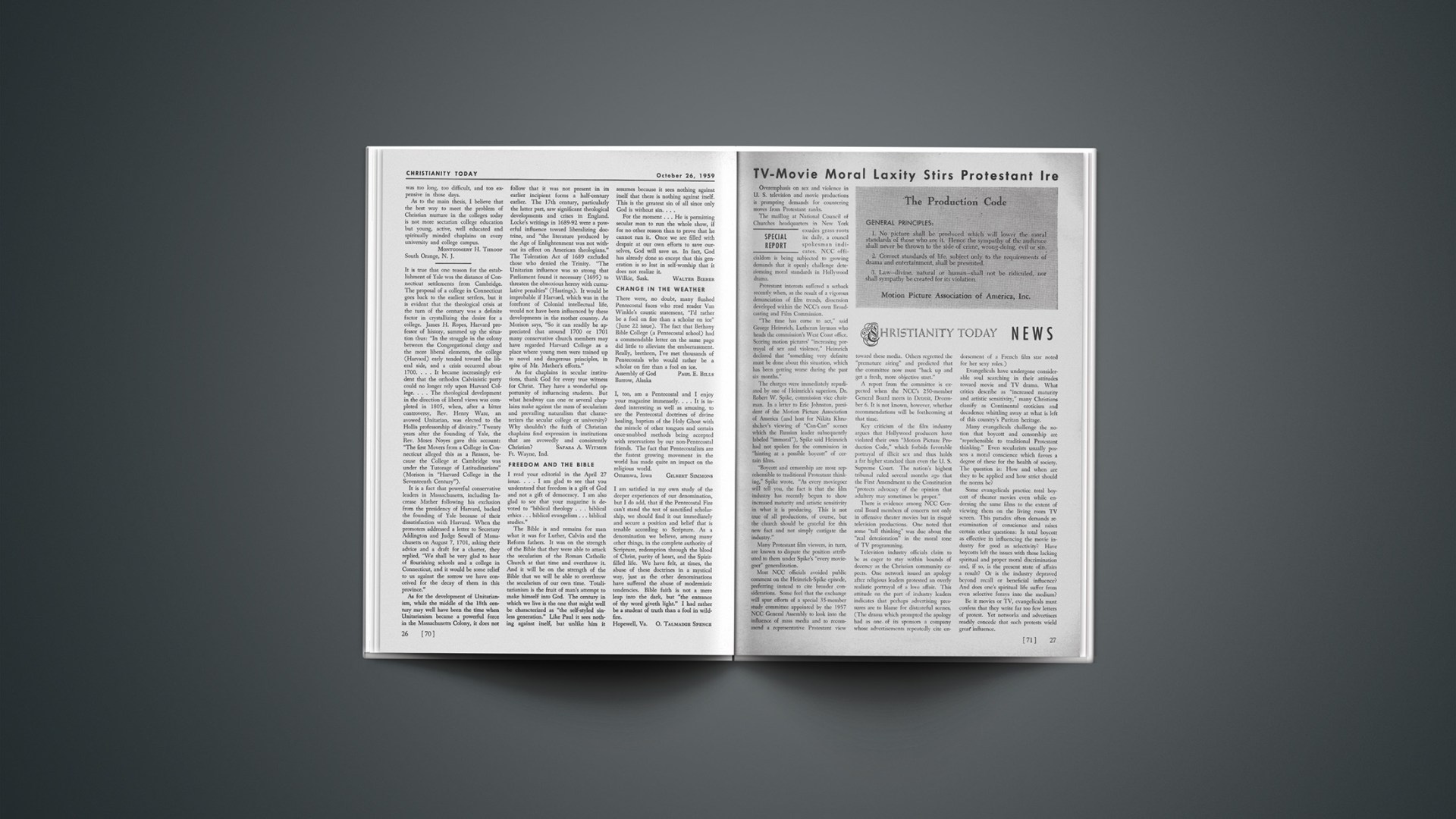
TV-Movie Moral Laxity Stirs Protestant Ire

Overemphasis on sex and violence in U. S. television and movie productions is prompting demands for countering moves from Protestant ranks.

The mailbag at National Council of Churches headquarters in New York exudes grass-roots ire daily, a council spokesman indicates. NCC officialdom is being subjected to growing demands that it openly challenge deteriorating moral standards in Hollywood drama.

Protestant interests suffered a setback recently when, as the result of a vigorous denunciation of film trends, dissension developed within the NCC’s own Broadcasting and Film Commission.

“The time has come to act,” said George Heimrich, Lutheran layman who heads the commission’s West Coast office. Scoring motion pictures’ “increasing portrayal of sex and violence,” Heimrich declared that “something very definite must be done about this situation, which has been getting worse during the past six months.”

The charges were immediately repudiated by one of Heimrich’s superiors, Dr. Robert W. Spike, commission vice chairman. In a letter to Eric Johnston, president of the Motion Picture Association of America (and host for Nikita Khrushchev’s viewing of “Can-Can” scenes which the Russian leader subsequently labeled “immoral”), Spike said Heimrich had not spoken for the commission in “hinting at a possible boycott” of certain films.

“Boycott and censorship are most reprehensible to traditional Protestant thinking,” Spike wrote. “As every moviegoer will tell you, the fact is that the film industry has recently begun to show increased maturity and artistic sensitivity in what it is producing. This is not true of all productions, of course, but the church should be grateful for this new fact and not simply castigate the industry.”

Many Protestant film viewers, in turn, are known to dispute the position attributed to them under Spike’s “every moviegoer” generalization.

Most NCC officials avoided public comment on the Heimrich-Spike episode, preferring instead to cite broader considerations. Some feel that the exchange will spur efforts of a special 35-member study committee appointed by the 1957 NCC General Assembly to look into the influence of mass media and to recommend a representative Protestant view toward these media. Others regretted the “premature airing” and predicted that the committee now must “back up and get a fresh, more objective start.”

The Production Code

GENERAL PRINCIPLES:

1. No picture shall be produced which will lower the moral standards of those who see it. Hence the sympathy of the audience shall never be thrown to the side of crime, wrong-doing, evil or sin.

2. Correct standards of life, subject only to the requirements of drama and entertainment, shall be presented.

3. Law—divine, natural or human—shall not be ridiculed, nor shall sympathy be created for its violation.

Motion Picture Association of America, Inc.

A report from the committee is expected when the NCC’s 250-member General Board meets in Detroit, December 6. It is not known, however, whether recommendations will be forthcoming at that time.

Key criticism of the film industry argues that Hollywood producers have violated their own “Motion Picture Production Code,” which forbids favorable portrayal of illicit sex and thus holds a far higher standard than even the U. S. Supreme Court. The nation’s highest tribunal ruled several months ago that the First Amendment to the Constitution “protects advocacy of the opinion that adultery may sometimes be proper.”

There is evidence among NCC General Board members of concern not only in offensive theater movies but in risqué television productions. One noted that some “tall thinking” was due about the “real deterioration” in the moral tone of TV programming.

Television industry officials claim to be as eager to stay within bounds of decency as the Christian community expects. One network issued an apology after religious leaders protested an overly realistic portrayal of a love affair. This attitude on the part of industry leaders indicates that perhaps advertising pressures are to blame for distasteful scenes. (The drama which prompted the apology had as one of its sponsors a company whose advertisements repeatedly cite endorsement of a French film star noted for her sexy roles.)

Evangelicals have undergone considerable soul searching in their attitudes toward movie and TV drama. What critics describe as “increased maturity and artistic sensitivity,” many Christians classify as Continental eroticism and decadence whittling away at what is left of this country’s Puritan heritage.

Many evangelicals challenge the notion that boycott and censorship are “reprehensible to traditional Protestant thinking.” Even secularists usually possess a moral conscience which favors a degree of these for the health of society. The question is: How and when are they to be applied and how strict should the norms be?

Some evangelicals practice total boycott of theater movies even while endorsing the same films to the extent of viewing them on the living room TV screen. This paradox often demands reexamination of conscience and raises certain other questions: Is total boycott as effective in influencing the movie industry for good as selectivity? Have boycotts left the issues with those lacking spiritual and proper moral discrimination and, if so, is the present state of affairs a result? Or is the industry depraved beyond recall or beneficial influence? And does one’s spiritual life suffer from even selective forays into the medium?

Be it movies or TV, evangelicals must confess that they write far too few letters of protest. Yet networks and advertisers readily concede that such protests wield great influence.

The Same Pattern

The World Council of Churches made public this month a 3,000-word report on birth control. In the pattern of most ecumenical pronouncements, the report was detached from official WCC policy, though prepared under commission of the WCC by a specially-constituted 21-member committee of theologians, physicians, and social science students, and distributed by the council to more than 171 member church bodies for “study and comment.”

The report was drafted at a three-day meeting of the committee at Mansfield College, Oxford, England, last April.

“Limited or spacing of children is a morally valid thesis,” the report was quoted as asserting. “There appears to be no moral distinction between the means now known and practiced.”

Appended to the report was a minority opinion representing views of the Orthodox Church: “Parents do not have the right to prevent the creative process of matrimonial intercourse.”

Preaching ‘Outlawed’

A Cleveland lay preacher was found guilty this month of violating a city ordinance by preaching the Gospel on Public Square.

The verdict against Fulton Baker of Cedar Hill Baptist Church, which included a suspended five-dollar fine, is being appealed. Baker’s attorney has wide support from even the judiciary in his contention that the pertinent ordinance is unconstitutional.

The ordinance forbids two or more people to congregate on a sidewalk without having business there.

‘Good for You’

Beer advertising, however widespread, has its limitations. U. S. law forbids the alcohol industry from making any curative and therapeutic claims about its products. Thus when the U. S. Brewers Foundation began a “good for you” pitch in magazine advertisements, temperance organizations sprang up in protest. “Misleading,” cried the executive director of the National Temperance League, Clayton M. Wallace.

This month, under government pressure, the brewers cancelled the remainder of its “good for you” series.

In the advertisements in question, a “good for you” in big type pertains in context to a feat being performed by an illustrated figure. But a casual glance at the page could easily create the impression that the phrase referred to beer.

Protestant Panorama

• A memorandum stating its views on 35 agenda items before the United Nations General Assembly has been distributed by the Commission of the Churches on International Affairs to more than 700 U. N. delegates and alternates. The commission is a joint agency of the World Council of Churches and the International Missionary Council.

• “The people could stand no more,” said the Roman Catholic episcopacy of Colombia in commenting on a destructive anti-Protestant demonstration last month. Bishops nevertheless asked Catholics in the town of La Plata to make restitution for damage done in a mob raid on an evangelical chapel construction site.

• Missouri Synod Lutherans in Canada are organizing an autonomous national religious body.

• Singer Pat Boone is turning over all royalties from his best-selling ’Twixt Twelve and Twenty to the Northeastern Institute for Christian Education, new Churches of Christ college in Villanova, Pennsylvania.

• U. S. Agriculture Secretary Ezra Benson, a Mormon leader, preached before an overflow audience at the Moscow Baptist Church on Sunday morning, October 4. Only days before, in Washington, Khrushchev’s son-in-law had invited Benson’s son “to come to Russia to do some missionary work for the Mormon church.”

• A Reformation Day dedication service was planned for the reconstructed Reformation Memorial Church in the West German city of Worms, where Martin Luther uttered his famous, “Here I stand, I cannot do otherwise.”

• The North Carolina Conference of the Methodist Church is sponsoring a year-long evangelistic campaign for 100,000 converts.

• The House Committee on Post Office and Civil Service says pornography is a major factor in increasing juvenile delinquency. “Federal legislation,” said a committee report, “will not substitute for parental guidance nor absolve parents from their obligation to guide their children by appealing to their instincts as forcefully and attractively as the ‘dirt peddlers.’ ” “The American home is the target of the pornographic attack,” it added; “the American home must also be the center of the counterattack against pornography.”

• A newly-published yearbook of the United Church of Canada, the country’s largest Protestant body, shows a communicant membership of 980,461.

• Southern Baptists plan to spend at least 3 million dollars on a weekly television program to combat juvenile delinquency.

• Mother Elizabeth Anne Seton, who is credited with founding the American Catholic parochial school system and who apparently is destined to be the first U. S. native to be “beatified” by the hierarchy, was a granddaughter of a Protestant Episcopal clergyman.

• Methodist Bishop G. Bromley Oxnam received the 1959 Upper Room Award this month for his “contribution to world Christian fellowship.”

• An addition to world-famous Pacific Garden Mission on Chicago’s Skid Row will be dedicated November 8.

• The First Hebrew Christian Church (Presbyterian) of Chicago is marking its 25th anniversary.

• The Ethiopian Orthodox (Coptic) Church plans to establish a U. S. branch. A seminary in America also is projected.

• Two Roman Catholic biblical scholars are proposing that Catholics adapt the Protestant Revised Standard Version of the Bible into a Catholic edition as a means of furthering Christian unity. The RSV, according to Benedictine Fathers Bernard Orchard and Edmund Flood, “is a scholarly rendering of Scripture which is a delight to read and with very little editing could be made entirely acceptable to English-speaking Catholics.”

Wheaton Crusade

Billy Graham’s current crusade in Indianapolis was preceded by a week-long evangelistic series in Wheaton, Illinois, a city which like its college namesake is observing its 100th birthday. Here is a report on the Wheaton meetings:

Biggest event in the city of Wheaton’s centennial celebration, and undoubtedly the most spectacular event in its history, was this fall’s evangelistic campaign with the Billy Graham party.

Pushing 25,000 population, Wheaton is now one of Chicago’s “bed-room suburbs” and one of the most evangelical and Christianized towns in America. It is the home of Wheaton College (enrollment: 1,600), famed for evangelical fervor, and the headquarters of such organizations as the National Association of Evangelicals, Scripture Press, Youth for Christ International, Conservative Baptists, the Sword of the Lord, and Baptista Films. Wheaton pastors sometimes feel that the city has a religious superiority complex, is overrun with evangelical churches, and sated with religious meetings and big-name Christian speakers. What could the Graham team do there?

Graham was a 1943 graduate of the college and a pastor in nearby Western Springs. How would Wheaton respond?

Originally planned as the college’s fall revival meeting, public pressure necessitated including the city and all neighboring towns and surrounding areas.

Despite cool, rainy weather all week (two meetings were held inside and five outdoors) the crusade was amazingly successful. Aggregate attendance totaled 101,000, the largest turnout coming on the opening Sunday when 18,000 heard Graham. On Thursday night, when teen-agers were special guests, 16,500 attended and 652 responded to the invitation. Not counting decisions at morning college chapel services, inquirers numbered 2,812. The 1,000 counsellors represented 130 churches. Delegations accounted for 7,500 people each night.

For the closing service on Sunday afternoon, October 4, rain fell steadily. Six college buildings wired for closed circuit TV were needed to accommodate the 16,000 who attended, and an estimated 5,000 to 10,000 were turned away.

Several of the evening meetings attracted crowds comparable in size to those at nightly services in New York and San Francisco. Graham preached essentially the same messages; although the emphasis was evangelism, many Christians came forward. About 62 percent of inquirers were first-time commitments to Christ—not as high as in Australia but above the U. S. average.

Wheaton churches cooperated fully. Church people forgot their differences and learned to work together as a solid phalanx for the salvation of souls. Even the more ritualistic churches backed the campaign vigorously, and their pastors took leading roles.

The crusade not only lifted the spiritual life of the college and the city, but it revived the churches, set them on the trail of many potential new members, and created spiritual hunger for a great campaign in nearby Chicago.

F.D.W.

Evangelist’s Schedule

Evangelist Billy Graham’s agenda for 1960 calls for mass meetings in Africa, Switzerland, and Germany, plus appearances in both North and South America.

On January 19, Graham plans to leave for a three-month African tour which is to include meetings in Liberia, Ghana, Nigeria, the French Cameroons, Northern Rhodesia, Southern Rhodesia, Kenya, Uganda, Tanganyika, Ruanda-Urundi, Ethiopia, and possibly in Egypt. Before returning home he hopes to visit, as a tourist, the Holy Land.

Protestant clergymen in Washington, D. C., plan a week-long crusade with Graham next June. The evangelist held a month-long crusade in the nation’s capital in 1952.

As of now, this is the way the rest of his schedule lines up:

—July 3, 1960: Closing address before the Baptist World Alliance convention in Rio de Janeiro.

—Mid-August, 1960: Series of brief crusades in cities of Switzerland.

—September–October, 1960: One-week crusades in Berlin, Hamburg, and Essen.

—November, 1960: One-week crusade among Spanish-speaking peoples of New York City.

—Early 1961: Crusade in Miami.

—Fall of 1961: Month-Ions crusade in Philadelphia.

—June, 1962: Crusade in Chicago (still tentative).

THEOLOGICAL EDUCATION

Building Programs

Out in the rolling hills north of Kansas City, Missouri, the Southern Baptist Convention’s sixth seminary is taking shape.

The Midwestern Baptist Theological Seminary began operation last fall in temporary quarters downtown. By last month, construction work on the 125-acre suburban campus site was well enough advanced so that the 274 students could move to the new location even while workmen put on finishing touches to four contemporary style buildings: an administrative center, a classroom building, a library, and an auditorium.

More buildings will be added. Enrollment goal: 1,200.

Golden Gate Baptist Theological Seminary, also Southern Baptist, was dedicated this fall at its new Strawberry Point site near San Rafael, California.

Other campus building news:

—Eastern Nazarene College at Quincy, Massachusetts, is launching a $1,500,000 development program extending over the next three years. Two more dormitories and a student union building are planned. A half-million-dollar science building was opened last month.

—Northeastern Bible Institute at Essex Fells, New Jersey, is erecting a $50,000 chapel-library. Estimated completion date: Spring, 1960.

RELIGIOUS ASSEMBLAGES

Biblical Businessmen

Alberta Premier Ernest C. Manning told delegates to this month’s convention of the Christian Business Men’s Committee International that man’s separation from God is the basis of all our problems in personal and public life, “nationally and internationally.”

“The … Bible makes clear to man that there is only one solution,” layman Manning said. “It is not by education, reform or human effort, but only by a personal, spiritual new birth.”

Delegates to the convention, held in Minneapolis, were cautioned that they must “lean over backwards” to “make every business transaction as clean as a hound’s tooth.”

“No area of a Christian businessman’s life is more vulnerable to the attack of the enemy than is his business life,” said James E. Colville, retiring vice chairman of CBMCI who is an official in a New York wholesale produce firm.

“In competition with the world,” he said, “the temptation is great oftentimes to meet competition on its level or resort to worldly practices.”

“Let us desire to be faithful rather than to be successful. Let us desire to be right rather than to be rich. Let us desire to prove the reality of Christ in the crucible of daily experience more than to prove our cleverness as businessmen.”

Colville said he was opposed to suggestions that the CBMCI liberalize its doctrinal statement: “It is my firm conviction that God has signally blessed us as a movement because of our unwavering stand.”

Prohibition Ticket

Dr. Rutherford L. Decker, pastor of Temple Baptist Church in Kansas City, Missouri, will head the Prohibition Party’s election ticket in 1960.

At a party convention in Winona Lake, Indiana, Decker won nomination for president while E. Harold Munn, assistant dean of Hillsdale (Michigan) College was named the vice presidential candidate.

Schism Threat

An open break between two rival factions disrupted the 44th General Assembly of the Presbyterian Church in Korea, last month, and threatened that church, largest Christian body in the country, with its third major schism in eight years.

Center of the controversy, ostensibly, is the church’s membership in the World Council of Churches. But the breakup of the assembly, begun in Taejon, appeared to some observers as more a power struggle than a clash of principle.

For three days a faction calling itself the “National Association of Evangelicals” party (not affiliated with the American NAE), fearing loss of power, blocked all efforts of the opposing “Ecumenical” party to carry on such business as election of new officers. Major offices of the retiring 43rd assembly had been under control of the NAE party.

The rupture broke into open violence when the retiring moderator postponed elections by adjourning the assembly for two months against the wishes of the majority. NAE commissioners walked out and Ecumenical delegates were evicted.

Denied further use of the host church, the majority group moved to Seoul, elected the Rev. Chang Koo Yi as moderator, and appointed a peace committee with instructions to seek reconcilement with dissidents. The committee reported its willingness to suspend Korean Presbyterian representation at ecumenical conferences for the sake of unity.

Earlier in Taejon, plans were cancelled for assembly ceremonies which would have marked dissolution of the 75-year-old Korea Mission of the United Presbyterian Church in the U. S. A. and its integration into the Presbyterian Church in Korea. Cancellation of the integration plans, announced by a three-man deputation from the United Presbyterian Commission on Ecumenical Mission and Relations, were prompted by the assembly’s failure to recognize a change of name in the American denominational body. Objections were raised to the word “United,” which the church picked up in its name when it merged with the United Presbyterian Church of North America in the spring of 1958. The NAE faction opposes the new name of the American church on grounds that the word “United” implies recognition of the ecumenical movement.

Back in 1951, a split in the Presbyterian Church in Korea prompted organization of the Koryu Presbyterian Church, now numbering 150,000 adherents. The 170,000 Presbyterian, R.O.K., members separated in 1954.

S.H.M.

Reunion Prospect

The National Baptist Convention, U. S. A., Inc., largest Negro church group in the world, plans steps toward eventual reunion with the National Baptist Convention of America. The groups split 44 years ago over ownership of a publishing house.

Some 20,000 delegates approved the action at an annual meeting of the 5,000,000-member U. S. A. body, held last month in San Francisco. The NBC of America, also Negro, has more than 2,000,000 communicants.

As a first step toward possible merger, a proposal was advanced which would arrange for annual meetings of the two groups to be held in the same city.

In other action, delegates adopted a resolution advocating a “go slow” national racial integration policy such as that taking place in Little Rock.
Eutychus and His Kin: October 26, 1959

REFORMATION DAY, 1959

With just a bit of hesitation I write requesting information; I find that clergy of my station Are asked to give an explanation Of reasons for the Reformation. I must confess in consternation, Lacunae in my education Create an awkward situation. I’ve heard about predestination, And even consubstantiation, (And Henry’s royal irritation About a papal dispensation Refused without consideration,) And Luther’s themes for disputation That promptly on their publication Electrified the German nation. But I must ask with trepidation, If we may speak with commendation In days of church consolidation Of worthies of the Reformation Who labored in indoctrination Were negative in altercation And horrified their generation By the crime of separation?

EUGENE IVY

LEFT HIM COLD

Dr. Edman’s praise of Youth for Christ (August 31st issue) left me as cold as have the numerous Youth for Christ meetings I have attended. Most YFC leaders seem to be expressive at the drop of a hat in condemning the “formalism” and “worldliness” of the ecumenical denominations; yet I have seen few things within Christendom more “worldly” than the Youth for Christ movement with its plush international conventions, snappy choruses, meaningless ditties, jazz rhythms, and “spectacular” rallies (the latest one in my area featured a magician for the evening’s entertainment). The movement’s general disregard of the importance of the Church was typified in a leader’s remark to me that he didn’t get a chance to go to church much—he was too busy with Youth for Christ rallies.

What is there in this frothy stuff to make the knee bow and the tongue confess? Evangelically, it is without form and void.

DONALD E. WALDEN

The Methodist Church

Deland, Ill.

The Writer’s Guide of the YFC magazine systematically sets forth a destruction of style, grammar, and good usage as being the desideratum of teen-age Christian literature.… There seems to be little stress on the … active participation in a normal church life that should lead the convert beyond his need of “shot-in-the-arm” rallies and entertainments. Naturally the weekly worship of a church is dull beside the Gospel cowboy singers and flamboyant speakers of the rally.… We in southern Ontario have also encountered a long, saddening series of attempts by YFC organizers to create internal dissent in active and effective Christian youth groups in order to establish their own program.

Certainly, the evangelistic efforts of Youth for Christ should continue—but, I feel, with less attention to “Youth” who are rapidly swamping out “Christ” in its programming; with less stress for the believer on the ease of forgiveness, and more on the reducing of our recurrent need for forgiveness by the encouragement of a personal devotional life conducive to ethical Christian living; and with a major effort at working with and supporting the local churches—becoming a feeder rather than a competitor, and hoping eventually as the churches revive, to become an unnecessary appendage that will decrease as they increase.

G. F. ATKINSON

Toronto, Ont.

UNRELATED TO NCC

The Assemblies of God have always been known to be one of “the most strictest sects” of the fundamentalists of today.… If there is any church in America that is distinctly and utterly separate from the National Council of Churches, it is the Assemblies of God. There is not a single Modernist among us anywhere as those who know us can testify. We are not and never have been associate members of the National Council of Churches (Editorials, Aug. 3 issue). As we consider engaging a suite in the so-called ecumenical building in New York, it is with the knowledge that the National Council of Churches does not own such building, and we are not leasing from them. We have contemplated such a move because it would provide us with more commodious and economical accommodations which we are greatly in need of. Surely the tenant is not responsible for the conduct or religion of his landlord, and in this case there is not even such a relationship anticipated.

R. M. RIGGS

General Council of the Assemblies of God

Springfield, Mo.

WORLD AT HIS DOOR

J. Marcellus Kik’s article, “Strengthening the Pulpit” (August 3 issue), points out one of the inherent weaknesses of evangelical preaching today. We need to apply the rule of “all things … decently and in order” to our sermon preparation. I believe the pulpit would have a far greater impact upon its hearers if more of our ministers would pray, study, and sweat over a sermon instead of relying on the shopworn clichés. Too often our evangelical preaching consists of a few stock phrases, some familiar memory verses and illustrations which fail to illustrate. This is followed by an impassioned plea for souls in an invitation that describes in minute detail everything from the furniture of heaven to the temperature of hell.

We could well profit from the statement of Ralph Waldo Emerson: “If a man can write a better book, preach a better sermon, or make a better mousetrap … though he builds his house in the woods, the world will make a beaten path to his door.”

W. NORMAN MACFARLANE

West Falmouth Free Baptist Church

West Falmouth, Me.

THE CHURCH AND THE ARMY

The article on “Why Army Churchgoing Lags” by Tracy Early (July 20 issue) compares Protestant attendance at worship services unfavorably with Roman in the armed services, but overlooks most of the reasons.

First (and most important) everyone who is not a Roman Catholic or a Jew is listed as “Protestant” statistically, whether or not he has any notion of what the word means. One of my buddies (I served three years as an enlisted man in WW II, USNR) thought it meant he had come into the service under protest! The point is, many “Protestants” might more factually be listed “secularists.”

Second, Roman worshippers find something at worship to remind them of home, in the mass, which is a stereotyped procedure that all worshippers are trained to understand. Protestants, on the other hand, come from such a variety of backgrounds that a typical service may be utterly foreign to them. Many Protestant clergy are themselves not too keenly aware of the significance of some of the acts in an “order” of worship, as anyone who has heard invocations that do not invoke and benedictions that do not bless, will readily appreciate. Romans and Protestants simply do not have the same reasons for attendance.

Third, chaplains are commissioned officers and there is a distrust of commissioned officers and their propaganda among the enlisted men, with the result that Protestant men who wish to attend services will, usually, prefer to attend a civilian service off the base, if at all possible. Romans do not have this problem, since the priest loses his human identity as he assumes the office of the Church.

Last, there is little or no connection between the life treated of in the sermons of most Protestant clergymen and the life actually lived by a young man under arms. The problems dealt with by the chaplain are not the problems they must face when celebrating a “liberty,” “shore leave” or “pass” in a city far from home. They get no help in religious services in making the kind of decisions and choices they must actually make. Romans do not face this problem, since they have never been led to expect correspondence between the religious and the secular life.

CHESTER J. HEWITT

First Evangelical United Brethren

Peotone, Ill.

Protestant denominationalism is a manifestation of rigid voluntary segregation, a unique phenomenon in our social life, not to say our religious expression. Two churches may be across the street from each other. To what extent does the one share in the joys and sorrows of the other? They may not glare at each other, but to what extent do they cooperate in promoting the Lord’s work? To what extent does each church leave with its members that feeling that Sunday worship is satisfied best, not to say only, by weekly attendance at their own church?

WALTER H. HARTUNG

Richmond, Va.

I have been a chaplain in a Veterans Hospital for fifteen years. I have noted practically the same things among veterans as he has among those in the armed services now. I went into the room of an honest young man some time ago and noted that his bed-tag had him labelled as a “Protestant.” I began to talk to him about his faith. He said, “When I was admitted they asked me what my religion was, and I told them that I was an agnostic. The clerk looked at me sort of funny and wrote down ‘Protestant’.” I suppose the clerk thought that an “agnostic” was just another of the many varieties of Protestants.

I have often wondered since, how many “Protestants” are not really agnostics, in the sense that they don’t really know what they believe. I have run across a good many such “Protestants” both in and out of the army or veterans hospitals.

Our Protestant churches will continue to have in their ranks many “agnostics” and indifferent members until our ministers and church sessions, or other examining bodies, study and apply the conditions laid down by Christ himself for church membership.

C. REES JENKINS

Fayetteville, N. C.

Our G. I. foreign baby rate is fairly stable. But it is remaining high.… The many G. I. marriages are generally based on prior intercourse. At best they are arranged with girls of completely different culture, and the lowest of backgrounds are the well from which these wives are drawn, in most cases.… When men are not under battle conditions, when they train and wait, wait and train …, there is a toll in morals, and a pull at the very best of men.… In the Armed Forces, at all levels, beer or hard liquors are both cheap and always available. It leaks out into native shops in such great quantities that the supply has to exceed the G. I. demand. Pusan, Korea

A. B. SPOONER

Thanks to Tracy Early for a thoughtful and perceptive article, and my sympathy and prayers for him and other chaplains in this problem, which I know from three and a half years as air force chaplain in WW II. One suggestion: positive encouragement by the home church of regular chapel attendance as normative Christian conduct for a serviceman.

WARD J. FELLOWS

Parkway United

St. Louis, Mo.

Would the chaplain not make mint by self-analysis? A soldier years ago wrote me that his chaplain spoke on the World Series just before going into a battle. Another that he received more spiritual sustenance by reading his church papers than by attending.

The Roman Catholics have the mystery of the mass irrespective of the personality of the priest. We have the mystery of the redemptive love of God in Christ also irrespective of the chaplain. Let each pastor at the home base or in the chaplaincy remember that sacred task of preaching this mystery and then a worship “must” will become a worship privilege.

J. T. HOOGSTRA

Prospect Park Christian Reformed

Holland, Mich.

SCHOLARSHIP WITH PIETY

The article of Dr. Calvin D. Linton entitled “The Service of Worship,” I read and reread. [This] was due to no lack of clarity.… Rather was it due to the fact that in my estimation, with reference to such a topic, here was biblical scholarship and spiritual piety at its best. For me, and I trust for others, the article was dynamically magnetic in its scholarship and piety.

God’s blessings upon your continued efforts to disseminate the historic faith with reference to every aspect of life.

BENJAMIN J. BOERKOEL

Second Christian Reformed Church

Randolph, Wisc.

SCHOOL OF THE PROPHETS

Dr. Safara A. Witmer states, “Because Harvard was suspect of being Unitarian and rationalistic, Yale was founded ‘to be a truer school of the prophets’ ” (May 11 issue). This statement seems to involve some chronological confusion, for the best authorities (e.g. Latourette) give 1750 as the time when Unitarianism began to become powerful in the Massachusetts Colony, while Yale was started in 1702, about half a century earlier. The main reason for its establishment was probably that for young men the journey from Connecticut to Cambridge was too long, too difficult, and too expensive in those days.

As to the main thesis, I believe that the best way to meet the problem of Christian nurture in the colleges today is not more sectarian college education but young, active, well educated and spiritually minded chaplains on every university and college campus.

MONTGOMERY H. THROOP

South Orange, N. J.

It is true that one reason for the establishment of Yale was the distance of Connecticut settlements from Cambridge. The proposal of a college in Connecticut goes back to the earliest settlers, but it is evident that the theological crisis at the turn of the century was a definite factor in crystallizing the desire for a college. James H. Ropes, Harvard professor of history, summed up the situation thus: “In the struggle in the colony between the Congregational clergy and the more liberal elements, the college (Harvard) early tended toward the liberal side, and a crisis occurred about 1700.… It became increasingly evident that the orthodox Calvinistic party could no longer rely upon Harvard College.… The theological development in the direction of liberal views was completed in 1805, when, after a bitter controversy, Rev. Henry Ware, an avowed Unitarian, was elected to the Hollis professorship of divinity.” Twenty years after the founding of Yale, the Rev. Moses Noyes gave this account: “The first Movers from a College in Connecticut alleged this as a Reason, because the College at Cambridge was under the Tutorage of Latitudinarians” (Morison in “Harvard College in the Seventeenth Century”).

It is a fact that powerful conservative leaders in Massachusetts, including Increase Mather following his exclusion from the presidency of Harvard, backed the founding of Yale because of their dissatisfaction with Harvard. When the promoters addressed a letter to Secretary Addington and Judge Sewall of Massachusetts on August 7, 1701, asking their advice and a draft for a charter, they replied, “We shall be very glad to hear of flourishing schools and a college in Connecticut, and it would be some relief to us against the sorrow we have conceived for the decay of them in this province.”

As for the development of Unitarianism, while the middle of the 18th century may well have been the time when Unitarianism became a powerful force in the Massachusetts Colony, it does not follow that it was not present in its earlier incipient forms a half-century earlier. The 17th century, particularly the latter part, saw significant theological developments and crises in England. Locke’s writings in 1689–92 were a powerful influence toward liberalizing doctrine, and “the literature produced by the Age of Enlightenment was not without its effect on American theologians.” The Toleration Act of 1689 excluded those who denied the Trinity. “The Unitarian influence was so strong that Parliament found it necessary (1695) to threaten the obnoxious heresy with cumulative penalties” (Hastings). It would be improbable if Harvard, which was in the forefront of Colonial intellectual life, would not have been influenced by these developments in the mother country. As Morison says, “So it can readily be appreciated that around 1700 or 1701 many conservative church members may have regarded Harvard College as a place where young men were trained up to novel and dangerous principles, in spite of Mr. Mather’s efforts.”

As for chaplains in secular institutions, thank God for every true witness for Christ. They have a wonderful opportunity of influencing students. But what headway can one or several chaplains make against the mass of secularism and prevailing naturalism that characterizes the secular college or university? Why shouldn’t the faith of Christian chaplains find expression in institutions that are avowedly and consistently Christian?

SAFARA A. WITMER

Ft. Wayne, Ind.

FREEDOM AND THE BIBLE

I read your editorial in the April 27 issue.… I am glad to see that you understand that freedom is a gift of God and not a gift of democracy. I am also glad to see that your magazine is devoted to “biblical theology … biblical ethics … biblical evangelism … biblical studies.”

The Bible is and remains for man what it was for Luther, Calvin and the Reform fathers. It was on the strength of the Bible that they were able to attack the secularism of the Roman Catholic Church at that time and overthrow it. And it will be on the strength of the Bible that we will be able to overthrow the secularism of our own time. Totalitarianism is the fruit of man’s attempt to make himself into God. The century in which we live is the one that might well be characterized as “the self-styled sinless generation.” Like Paul it sees nothing against itself, but unlike him it assumes because it sees nothing against itself that there is nothing against itself. This is the greatest sin of all since only God is without sin.…

For the moment … He is permitting secular man to run the whole show, if for no other reason than to prove that he cannot run it. Once we are filled with despair at our own efforts to save ourselves, God will save us. In fact, God has already done so except that this generation is so lost in self-worship that it does not realize it.

Wilkie, Sask.

WALTER BIEBER

CHANGE IN THE WEATHER

There were, no doubt, many flushed Pentecostal faces who read reader Van Winkle’s caustic statement, “I’d rather be a fool on fire than a scholar on ice” (June 22 issue). The fact that Bethany Bible College (a Pentecostal school) had a commendable letter on the same page did little to alleviate the embarrassment. Really, brethren, I’ve met thousands of Pentecostals who would rather be a scholar on fire than a fool on ice.

PAUL E. BILLS

Assembly of God

Barrow, Alaska

I, too, am a Pentecostal and I enjoy your magazine immensely.… It is indeed interesting as well as amusing, to see the Pentecostal doctrines of divine healing, baptism of the Holy Ghost with the miracle of other tongues and certain once-snubbed methods being accepted with reservations by our non-Pentecostal friends. The fact that Pentecostalists are the fastest growing movement in the world has made quite an impact on the religious world.

Ottumwa, Iowa

GILBERT SIMMONS

I am satisfied in my own study of the deeper experiences of our denomination, but I do add, that if the Pentecostal Fire can’t stand the test of sanctified scholarship, we should find it out immediately and secure a position and belief that is tenable according to Scripture. As a denomination we believe, among many other things, in the complete authority of Scripture, redemption through the blood of Christ, purity of heart, and the Spirit-filled life. We have felt, at times, the abuse of these doctrines in a mystical way, just as the other denominations have suffered the abuse of modernistic tendencies. Bible faith is not a mere leap into the dark, but “the entrance of thy word giveth light.” I had rather be a student of truth than a fool in wildfire.

O. TALMADGE SPENCE

Hopewell, Va.

Ideas

The Sons of the Reformation

When on October 31, 1517, an Augustinian friar named Martin Luther posted 95 theses on the door of Wittenberg’s Schlosskirche, he was not thereby ushering in the Reformation. But his attack on the prevalent system of indulgences, with his suggestion that the pope, whose “riches … far exceed the wealth of the richest millionaires,” could better afford to build St. Peter’s than the faithful poor, was the one step in a long process which would symbolize centuries later the fresh, cleansing wind of God which swept across 16th-century Europe much as a belated breath of Pentecost.

The Castle Church door evokes memories of Luther at bay in Worms, Zwingli on the field at Kappel, Calvin fashioning a new Geneva, and Knox thundering judgments before Mary Stuart, after sitting at Calvin’s feet in what Knox called “the most perfect school of Christ that ever was in the earth since the days of the Apostles.” These scenes were but part of the religious upheaval which shattered the face of Europe. Before it was over, Lutheranism would win from Rome the following of most of the Germans and Scandinavians; Zwingli would lead away many of the Swiss cantons; from Geneva cosmopolitan Calvinism would penetrate France, the Low Countries, Scotland, Hungary, and elsewhere; the English church would embrace certain Calvinist, Zwinglian, and Lutheran influences; and the Anabaptists would gain the allegiance of many in Switzerland, Germany and the Low Countries.

With an assist from the Renaissance, the Word of God had been loosed and the resultant impact upon the European populace was marvelous to behold. Historian M. M. Knappen describes the doctrine of the unique and complete authority of the Bible as “an acute-angled salient, wrecking the enemy’s defenses and acting as a bulwark for the prospective Protestant empire of northern Europe. Though the Catholics accepted its uniqueness, so effective was the Protestant employment of this tool that in the first heat of the conflict good Catholics equated a knowledge of the Bible with heresy and prided themselves on their ignorance of this element of their own faith.”

One is here reminded that Protestantism was not essentially a negative movement in contrast to a “positive Catholicism,” as the picture is so often drawn. The name “Protestant,” first used in connection with the protest of some German princes against decrees of the second Diet of Speyer (1529) and not adopted as a designation for a church until much later, assuredly has certain negative connotations which tend to overshadow other of its meanings such as “affirmation,” “assertion,” and “declaration.”

But the Reformation had glorious affirmations, brought forth fresh from the rediscovered treasury of the Word written. The Reformers were not seeking to build a new church or to introduce new doctrines. Theirs was not basically a departure or an innovation but rather a return—a re-formation. And in their work of renovation they leaned heavily upon Augustine, and cited often Anselm and the fathers.

The sovereignty of God was forcefully proclaimed in contrast to the Renaissance dogma of the sovereignty of man. And in contrast to Pelagian and semi-Pelagian views, man was held to be suffering from more than an untied shoelace or even spiritual sickness. Paul’s voice was heard again—man was “dead in trespasses and sins” (Eph. 2:1). And something more radical was required to revivify him than grace which needed the aid of works. The answer was an unmerited justification by faith alone, inasmuch as the sovereign God was also the sovereign Lover whose grace was fathomless. Said Luther in his Commentary on Galatians: “Everyone who seeks righteousness without Christ, either by works, merits, satisfactions, afflictions, or by the Law, rejects the grace of God, and despises the death of Christ.” Those justified, the elect of God, are called quite apart from any personal merit and, though this be humbling, they are thus raised to the dizzying eminence of personal priesthood. Jesus Christ, the God-man, remains sole Mediator and High Priest between God and man, assuring direct access to God. Man thus finds his God-endowed freedom and the motivation and power to use it responsibly.

Here is the glory of the evangelical faith. One recalls driving to Padua with a Roman Catholic professor of law in the ancient university there. A description of the Protestant faith was requested. Upon hearing of the relationship of believer to God, the professor raised his hand and said, “There is where we part company. We have our priests, you know.”

In making their affirmations, the Reformers held many things in common with their opponents. Among others there were these: the Trinity; Jesus Christ’s incarnation, deity, virgin birth, atonement, bodily resurrection, and second coming; and God’s historical purposes in effecting a kingdom for his own glory.

But the Reformers found that out of positive affirmation arose the necessity also for negative protest. They lacked a certain spirit of modernity inasmuch as the tolerance they showed was not based on doctrinal indifference. The principle of the authority of the Scriptures alone left no room for the Roman elevation of church tradition and the “living mind of the church,” nor for the papacy either. Christ as sole Mediator had no need of a system of priestcraft, Mariolatry, and hagiolatry. Justification by faith alone meant that while good works had a place in one’s salvation, they had nothing to do with his justification. (Tetzel’s papal indulgences were certainly not up to the job.)

Luther speaks of his willingness to make “concessions to the papists”—“we are willing to offer them more than we should.” “But,” he says, “we will not give up the liberty of conscience which we have in Christ Jesus. We refuse to have our conscience bound by any work or law, so that by doing this or that we should be righteous, or leaving this or that undone we should be damned. Since our opponents will not let it stand that only faith in Christ justifies, we will not yield to them. On the question of justification we must remain adamant, or else we shall lose the truth of the Gospel. It is a matter of life and death.”

Today the emphasis is on overcoming tensions between religious groups, and many tensions ought to be overcome. But too many tension fighters have such a superficial view of doctrine (quite apart from Luther’s life and death concern), that the significance of the Reformation is lost on them. They seemingly forget that whoever goes back to Rome today, or unites with it, inherits the liabilities against which the Reformers protested, and then some. For there has since been the counterreforming Council of Trent with its Roman hardening of anti-evangelical strands of the Medieval Church. And where the Reformers opposed “conciliar infallibility,” Protestants now face “papal infallibility.” Veneration for Mary has brought about the Assumption dogma as well.

But for many today, the only doctrine worth getting excited about is that of a unified visible church. The Reformers spoke from a setting of such a church, but they were concerned more for a unity in truth and doctrine than in organization, though the latter was desired as well. If the Reformation doctrines were unimportant, then Rome has had the proper answer all along.

Who are the inheritors of the Reformation? Not modernists, though they may observe Reformation Day. “Renaissance Day” would be more appropriately celebrated. For modernism was in some ways a more profound transformation for the infected part of the church than the Reformation. Its views of God and Jesus Christ were a radical departure from Roman Catholicism and Protestantism alike, not to mention the New Testament. Its view of man represented a drift to that of the Renaissance, ensnaring man in a false independence and optimism and thus enslaving him eventually to the lamentable cry of the chief priests, “We have no king but Caesar.”

Even as the Renaissance and Reformation views of life today constitute a schism in the Western soul, so also they compete even within the Church. The lights in many of the Reformation lands burn low as they suffer the blight of this latter-day revolution. Luther’s 92nd and 93rd theses shout out with a peculiar relevance: “… So let all those prophets depart who say to Christ’s people ‘Peace, peace’ and there is no peace. And farewell to all those prophets who say to Christ’s people ‘the cross, the cross’ and there is no cross.”

The inheritors of the Reformation are evangelical Christians. These are they who proclaim that Christ has “made peace through the blood of his cross” (Col. 1:20). They detect a new assault upon the priesthood of believers in the interposition, not of priests and saints this time, but of demythologizers and destructive higher critics along with a resurgent churchianity. They must protest this, for they proclaim, “Thus saith the Lord,” believing that when God spoke, he did not simply stammer. They stand with the Reformers in preaching the Bible as the Word of God and against those who would invoke some way of knowledge and of salvation other than that revealed. They share the delight of a Cambridge Reformer who gathered with others in the White Horse Inn to discuss the new theology and go with Luther behind the Scholastics to the Scriptures. The English don said that to be in that company made him feel he had been placed in the new glorious Jerusalem. Evangelicals earnestly desire a position for the Bible akin to that held in Puritan England where its study became, as British historian G. M. Trevelyan puts it, “the national education.” He says, “A deep and splendid effect was wrought by the monopoly of this book as the sole reading of common households, in an age when men’s minds were instinct with natural poetry and open to receive the light of imagination. A new religion arose, … [its] pervading spirit the direct relations of man with God, exemplified in human life.”

Modern children of the Reformation often take their heritage for granted and sometimes forget that they have much to lose, although they have yet a long way to go. But they are essentially united, despite the variety of their denominational traditions, in the conviction that it was the preaching of the Word of God, bringing men and women into direct relationship with God, which turned the apostolic world upside down and transformed the geography of Europe. This is the hope for our day. Nothing less will suffice.

APPEAL FOR THE BIBLE CARRIED TO SUPREME COURT

The U. S. Supreme Court has now been called upon to resolve the question of Bible reading in the public schools. The school board of Abington township (a suburb of Philadelphia) has appealed an adverse ruling of the Federal Circuit Court in Philadelphia, which labels as unconstitutional the Pennsylvania law requiring the reading of at least ten Bible verses in public schools, as well as the common practice of reciting the Lord’s Prayer. The court ruled that this constitutes a religious devotion odious to those of differing faiths (or of no faith at all).

A Unitarian couple whose children are enrolled in an Abington township school protested these religious observances, aided by the American Civil Liberties Union. Many citizens resented the effort of a small minority to conform majority wishes to their prejudices, and argued that separation of Church and State is being stretched to extraordinary lengths when the last vestiges of the traditional spiritual beliefs and culture of most Americans are excluded from public education. Other parents wonder why the minority were not content simply to have their youngsters excused from Bible readings. The Philadelphia Evening Bulletin asks editorially: “Will someone argue that the swearing in of Presidents and Supreme Court Justices ought to be on Webster’s Unabridged Dictionary?”

With Dr. Raymond F. Anderson, pastor of St. Paul’s English Evangelical Lutheran Church, many think it incredible that a nation so recently inserting “under God” into its pledge to the flag, and whose Declaration of Independence speaks of a supernatural Creator from whom man’s “unalienable rights” proceed, will now consider it inherently wrong for school children to hear that “the Lord is my shepherd” or to say “Our Father who art in heaven.” Dr. Anderson warns that human rights will not long be perpetuated in a society that erases the Creator from its vision.

The U. S. Supreme Court’s ruling will bear indirectly on other facets of freedom. In the name of liberty some agencies more and more oppose necessary conformity of any kind—permission of Bible reading in the schools, curtailment of obscene literature on the streets, and so on. The courts are being pressured by social forces in revolt against our traditions.

Americans will rightly resist use of the sword to enforce religious exercises. Some observers, friendly to Christian traditions, think the case for observances such as Bible reading and prayers is on less secure ground than the educational use of the Bible in the curriculum. In the enthusiasm for Bible readings they see a misdirected effort to remedy the secularization of the public school. Since public education has been infiltrated for a generation by humanistic motifs, some leaders today would restore a phantom sort of theism to its core, while others would maintain the Christian heritage on its periphery.

Yet Bible reading itself may be viewed as an educational activity as fully as a religious exercise. A religious spirit of sorts inevitably pulses through the classrooms; the religiously neutral educational program simply does not exist. The minorities will increasingly bend the majority to their prejudices, in shaping this religious climate, as long as majority indifference precludes an effective counter-emphasis: that the minority’s sectarian biases are likewise odious. To deprive children of the possibility of hearing the Bible and to militate especially against readings from this Book, seems to many parents to border on religious intolerance. The Supreme Court, it may be hoped, will take a long look at American heritage and purpose in resolving this issue. The question is worthy of full study by the nation’s highest tribunal.

SHOULD AMERICANS ELECT A ROMAN CATHOLIC PRESIDENT?

The possibility of electing a Roman Catholic to the office of President of the United States has aroused considerable debate in political as well as religious circles.

Senator John F. Kennedy of Massachusetts, Governor Edmund G. Brown of California, Governor David L. Lawrence of Pennsylvania and Ohio’s Governor Michael V. DiSalle are Catholics prominently mentioned. Kennedy in particular has denied that his religion in any way unfits him for this high office.

If the Roman Catholic church were like most denominations, all Americans would welcome a qualified Roman Catholic citizen in the White House. The U. S. Constitution imposes no religious test and the principle is sound. But the nature of the Roman Catholic church and the provisions of its canon law raise problems in considering a Catholic presidential candidate that do not arise in the case of a Protestant or a Jew.

Pope Boniface VII in 1302 in Bull “Unum Sanctum” made it clear—and Roman Catholics stand committed to papal infallibility—that the church has ultimate authority in both temporal and spiritual realms and that Roman Catholics are responsible to the Church above the State. The Bull was addressed especially to Roman Catholic rulers. In 1885 Pope Leo XIII in his Encyclical Letter “Immortale Dei” (The Christian Constitution of the State) reaffirmed “whatever the Roman Pontiffs have hitherto taught” and specifically restated the Bonifacian doctrine of “the harmony of Church and State.” Leo goes on to spell out what the Church means by “union of Church and State”: “The State should officially recognize the Catholic religion as the religion of the Commonwealth; accordingly it should invite the blessing and the ceremonial participation of the Church for important public functions, as the opening of legislative sessions, the erection of public buildings, and so forth, and delegate its officials to attend certain of the more important festival celebrations of the Church; it should recognize and sanction the laws of the Church; and it should protect the rights of the Church and the religious as well as the other rights of the Church’s members.” Then follow passages which, if implemented, would deny rights and privileges of certain kinds to Protestants and non-Catholic religions.

Dr. Sebastian Smith, eminent Roman Catholic authority on canon law, states the claims of the papacy over civil government in his three-volume work on ecclesiastical law.

Dr. John A. Ryan and Dr. Francis Boland in their volume, Catholic Principles in Politics, published by Macmillan in 1940 (ninth printing in 1958), reiterate these claims. The book bears the imprimatur of Francis Cardinal Spellman and the nihil obstat of Dr. Arthur J. Scanlan, president of the Catholic University, of Washington.

Probably the most important treatise on this issue, from the standpoint of free and democratic government, was prepared by the Honorable William E. Gladstone, nineteenth-century British prime minister. Gladstone’s treatise was titled, The Vatican Decrees and their Bearing on Civil Allegiance. On pages 28 and 29 he deals specifically with the claims of the Roman church over civil governments and over Roman Catholic citizens of such governments. Every Roman Catholic must either faithfully fulfill the canon law requirements of the church in all matters involving ecclesiastical authority or be liable to excommunication.

In view of these facts of long standing, which have never been repudiated ex cathedra by any pope or by any papal council, many observers believe that election of a Roman Catholic to the presidency of the United States sooner or later would be a threat to our freedoms and the American way of life. Many distinguished Roman Catholics in public life have a higher sense of moral concern than some Protestants and Jews aspiring to the presidency. Senator Kennedy has written a book, Profiles in Courage. In the light of his personal commitment to the principle of separation of Church and State and his profession of loyalty to the American way, it would be heartening if he would with high courage initiate a movement in his church looking toward the repudiation of those sections of its canon law which compel his American compatriots to look with uneasiness upon Roman Catholic candidates for political office.

CANADIAN VIEW OF LAST THINGS CALLS FOR RESTUDY IN DEPTH

Life and Death, an official study of “the Christian hope” by the Committee on Christian Faith of the United Church of Canada, discards eternal punishment, revises the doctrine of hell, holds out hope for the ultimate salvation of all men, approves prayers for the dead, and teaches that Christ’s second coming need not occur in a “physical manner.” The Executive of the General Council of UCC, giving “general approval,” commends the 118-page statement as “worthy of study in the church.”

The report has provoked much criticism. While the foreword states that “The Committee has tried to produce a statement, based upon the Scriptures …,” evangelical leaders point to controlling biases that compromise the biblical view of man’s final destiny with the speculative notions of our times. The study deprives Scripture of revelation-status by viewing the Bible simply as “the record” of God’s acts and revelation (p. 5). An explanatory note designates the prophets as men of special “insight” into God’s will. The doctrine of eternal punishment is held to be neither true nor false but merely an existential statement of spiritual relationship (pp. 48 ff.)—a strategem whose implications for other doctrines, if consistently applied, must be apparent to all. Christ’s bodily return is opposed on the ground that the biblical language is symbolic (p. 81).

An appendix on “Symbolism in Relation to the Interpretation of the Bible” asserts that the Bible does not depict history but rather seeks “to convey certain truths” when recording an earthquake at Christ’s death miraculously releasing saints from their tombs, or giving us word pictures of the final judgment. The report stresses Reinhold Niebuhr’s view that “it is important to take biblical symbols seriously but not literally.”

Apart from gratuitous reduction of facets of the last things to symbol, and failure to show how existential seriousness can long survive the surrender of literal truth, the study multiplies confusion by emphasizing that “all language is symbolic” (p. 80). If so, we are then back where we started. For, granted this view of the nature of language, a valid distinction surely remains between historical facts like the virgin birth of Christ and his death on the cross and figurative statements like “I am the door” (John 10:7). To excuse disbelief in the second coming on the ground that all language is symbolic otherwise shipwrecks all history.

Instead of being sent to the churches, the study might better have been returned to committee for more searching of Scripture and less exchange of opinion. Such reports tend to discourage Bible study and to finalize flexible theological speculations.

Shaking the Foundations

SHAKING THE FOUNDATIONS

A layman must be considered utterly ungracious to venture an opinion on contemporary theology. But, as an active and deeply concerned churchman, I am forced to conclude that much which goes for scholarly thinking in religion today is so far afield that effective witness, even the very life of the Church is being enervated.

Our concern is not with peripheral matters on which men of equal scholarship and piety may differ. The situation involves doctrines having to do with man; the nature and consequences of sin; the nature of God; the implications of the Cross; the motivation of the Christian witness; and, proceeding from these, the message of the Gospel. It is on these doctrines that Christianity is built. Let them be changed, and the witness of the Church becomes hazy or completely obscured.

What is Man? While man was created in the image of God, he has become by inheritance, by choice and in practice a sinner. Sin has separated him from God, and this desperate condition of the human heart, this potential for wickedness, is a matter of personal experience as well as a fact everyone can observe.

Only in the light of man’s sin and predicament can God’s remedy be understood.

What is Sin? Much in contemporary theology breaks down at this point. While we may thank those theologians who have rescued modern thought from the morass of old line rationalism, too few of them have been willing to admit that sin is an offense against the holiness of God. They have not seen it as something terrible demanding the blood of the incarnate Son of God on Calvary to make atonement for the sinner in the holy presence of God.

The Consequences of Sin. Sin separates man from God. Unatoned-for, unrepented-of, and unpardoned sin means eternal separation from God’s presence. Despite this awesome reality, there is now spreading across our land, like a blight, a neouniversalism which proclaims Christ as the “perfect pedagogue” and therefore the ultimate Saviour of all mankind.

This philosophy is cutting away the very root of Christian motivation in seeking to win the lost. It is destroying the nerve of the Church’s world-mission. It is engendering a false optimism that leads to diverted efforts and a meaningless message.

The “hell-fire and damnation” preaching of past generations is now held up to ridicule. But it was far closer to true biblical theology than much of the sermonizing heard today. Peripheral rather than central matters are being dealt with; a nonexistent hope is being implied.

The Gospel message is one of mercy against the backdrop of impending judgment. If we study Old and New Testament references to God’s judgment on sin and on unrepentant sinners, this is revealing. Sometimes we are told that the Old Testament reveals a God of judgment while the New reveals a God of love. Actually one will find more than twice as many references to judgment in the New Testament than in the Old, and some of the most frightening come from the lips of our Lord himself.

The Nature of God. No man should presume speculatively to define the nature of God. But the Holy Spirit reveals spiritual truths, and he speaks to our hearts of those things which, to the unregenerate, are foolishness.

We know that with God holiness is absolute, not relative. We know that Christ who reveals his Father to us is holy, without sin. It is this absolute holiness that must be considered in the face of sin and its sordid implications.

God is a consuming fire in whose presence no sinner can stand. For this reason, divine cleansing is necessary before man can come into His presence and live. This work of transformation was made possible by the work done on the Cross. Through it the vilest reprobate can become a pure saint in God’s sight.

The Implications of the Cross. It is true that no one theory of the atonement fully expresses the implications of our Lord’s death on Calvary. It is equally true that in omitting the vicarious and substitutionary aspects of Christ’s atoning work we make void all other theories, for only in the light of Christ’s taking on himself our guilt and punishment can we see the enormity of sin, the price of redemption, and the love of God which was willing to pay that price.

Protestations of the love of God are meaningless until we face up to what that love did. God did not send his Son to die merely to inject in us a sense of remorse and a determination to follow him as Lord. Christ died on the Cross to accomplish something we could not do for ourselves. He who was sinless was made sin for us. He whose home was in heaven suffered the penalty of hell in our place. Everything that sin has made us now, and that eternal separation from God which is the result of sin, has been taken care of by God himself so that through an act of childlike faith we become as righteous in God’s eyes as the One who died in our place.

The Motivation. It is at this point that some modern theology is dangerously weak. We are told that God is a God of love and therefore he must eventually save all men.

True—God is love, and the living evidence of that love is Calvary. This is a love not to be trifled with, but to be recognized with reverence and holy fear—for this God who is love is also a consuming fire.

The motivation for Christian witness is therefore the solemn truth that all men outside of Christ are lost souls—that there are two ways, one broad, one narrow; two gates, one wide, and the other restricted to those who will enter on God’s terms.

Permit a man-made philosophy to prevail at this point and the Incarnation, the Cross, and the Resurrection become distorted incidents of history rather than the unfolding of a divine plan worked out in the councils of eternity.

The Message. The American pulpit is woefully weak today. Entirely too much preaching is being based on the false premise that the hearers are already Christians. It is one thing to preach to those who are redeemed and to lead them on to growth as mature believers. But it is futile to try to make non-Christians act like Christians.

The basic message of the Gospel, the foundation on which all other messages must be built is found in 1 Corinthians 15: “Christ died for our sins according to the scriptures; and that he was buried, and that he rose again the third day according to the scriptures.”

Therefore, to imply that preaching is primarily bringing men to “accept the fact they are accepted of God” is true only as the condition of acceptance is also preached—repentance for sin and faith towards our Lord Jesus Christ.

Let us beware lest while we work to build the superstructure of Christianity we find that we have shaken the foundations of our glorious faith.

L. NELSON BELL

Bible Book of the Month: Proverbs

Proverbs belongs to the so-called wisdom literature of the Old Testament and cannot be fully understood without some knowledge of this literary genre. In some measure wisdom is found amongst all nations of the world, but in Israel and in the Old Testament it has a very special connotation. Here (as in the rest of the Near East) it is not the result of discursive thinking, or philosophical speculation in the Western sense, but has as its noëtic source immediate intuition based on experience in life. It can be easily explained why wisdom is of this type amongst nations of the Near East. They lived subjectively nearer to the heart and objectively nearer to (unsophisticated) life.

In the Old Testament wisdom has a threefold content according to the viewpoint from which it is seen. In the first place it has to do with the way in which man executes his professional work. It enables statesmen to govern correctly; it teaches the ordinary laborer dexterity and skill (cf. Exod. 28:3; 31:6; 35:10). Wisdom also brings strength (Prov. 24:5, 6). In addition it means common sense, level-headedness, and brightness (in German: Klugheit). Of course, every human being is born with certain talents, but wisdom enables him to use these talents with greater effect.

In the second place wisdom has an ethical content. It is closely related to uprightness and honesty. It teaches right conduct toward one’s fellowmen.

Thirdly, wisdom is of a religious nature in which the above two-named aspects merge. Wisdom teaches right conduct toward God. The fear of the Lord is the beginning of knowledge (Prov. 1:7). The word translated “beginning” in the Revised Standard Version and in the Berkeley Version can also be translated “chief part” or “choice part” (cf. The Interpreter’s Bible on the above named text). This implies that without the fear of the Lord, who has given his revelation in Scripture, no true wisdom can be attained.

THE “WISE MEN”

Together with prophet and priest the wise men formed the spiritual leaders of Israel (cf. Prov. 1:6). They did not command the same respect as prophet and priest, but must nevertheless have had great influence, especially amongst young people.

It is possible that these wise men were in some way connected with the “scribes” who were in the service of the state. Scribes are mentioned several times in the Old Testament as being in government service (cf. 2 Sam. 8:17; 20:25; 1 Kings 4:3; 2 Kings 19:2; 22:3–7; Jer. 8:8–9; 36:20, 21). Of great importance is Isaiah 29:14 where it is clear that the wise men must have existed as a class long before the middle of the eighth century B.C. and Jeremiah 18:18 where the “counsel from the wise” evidently has the same status as “the law” of the priest and the “word” of the prophet (cf. Interpreter’s Bible, IV, p. 769).

The wise man could give his instruction publicly (preferably at the town gate, the meeting-place of the people) or privately to those who came to him. Job 29:7–25 gives us a very clear picture of the significance of a wise man.

WISDOM IN THE OLD TESTAMENT

Wherever we find wisdom of this type in the Old Testament (Proverbs, Job, Ecclesiastes, and some Psalms), we can expect to see some connections with the wisdom of the Near East in general; but in the main we must be prepared to find something unique, as is the case with the whole Old Testament. The Bible presents the wisdom of God, through the medium of wise men of flesh and blood. The inspired wise men of the Bible not only studied nature and experience, but saw everything in the light of “the fear of Yahwe.” And what this fear of Yahwe is was clearly taught by law and prophets, in so far as they antedated or were contemporary with the wise men. In the Bible, therefore, we finally have the wisdom which has its source in Jesus Christ who is the Wisdom of God as against the foolishness of the world. Naturally the Old Testament can state this only implicitly, not explicitly.

We may safely assume that the wise men were fully acquainted with the religious literature of their nation, and therefore it is not surprising to find all of the Ten Commandments reflected in Proverbs.

The Old Testament itself refers to wise men who were citizens of other states. In 1 Kings 4:30, 31 it is said of Solomon that he was wiser than all other men, than Ethan, the Ezrahite, and Heman, and Chalcol and Darda, the sons of Mahol. Even Job and his friends were not of Israelite extraction but were citizens of Uz (wherever this country may have been situated). Many commentators are of the opinion that Agur and Lemuel, mentioned in Proverbs 30 and 31, were also foreigners.

It is clear, therefore, that the wise men of Israel were familiar with the wisdom of surrounding nations.

Excavations have in recent times brought to light a wealth of wisdom literature from the Babylonians, Egyptians, Canaanites, and so forth. In many cases there seems to be a very close connection between these wisdom books of pagan origin and the Old Testament. On the whole, however, one can safely say that the relation lies more on the formal side. It is quite evident that God uses the existing literary media to bring about his revelation. Thus, a close scrutiny leads to the conclusion that the similarity is greatest on the level of technical skill, less on the level of ethical maxims; and as regards the religious there is a wide gulf which is the case with the whole of the Old Testament.

In two cases there is a very close similarity, namely in that of the Egyptian proverbs of Amenemope and the original Assyrian proverbs of Achiqar. Many scholars are inclined to assume that the relevant proverbs of the Bible were borrowed from these sources. There is no consensus as yet, but we may state at the outset that there is no objection in assuming that wisdom from originally pagan sources was used (as in the case probably of Prov. 30 and 31) but purified by the inspiration of the Holy Spirit, so that we may be sure the teaching is in harmony with the rest of Scripture. In so many cases God has taken up in his revelation what was also practiced by pagans (e.g., offerings, feasts, circumcision, and so forth) but always filling the vessels with new content.

LITERARY FORM OF PROVERBS

In the Ancient Near East wisdom was presented in the form of riddle and fable. Very few instances of these two types are found in the Old Testament (cf. Judges 14:14; 9:7–21; 2 Kings 14:9). The two fables that are mentioned are found in the mouth of persons who cannot be considered as vehicles of revelation. Riddles are mentioned in Proverbs 1:6 (RV: enigmas) and in Psalm 49:4.

The most common form in which wisdom is presented in Proverbs is that of the mãshãl. There is no unanimity yet as to the exact meaning of this word. Many scholars are of the opinion that the root meaning is—to be like, from which the meaning likeness, comparison, can be derived. The difficulty is that the element of comparison is found only in a few instances in the book of Proverbs (cf. 10:26), so that one must assume that the connotation of the word was expanded in the course of time.

In the Old Testament the word mãshãl has a variety of meanings, starting from the ordinary proverbial saying in common life (cf. 1 Sam. 10:12; Ezek. 12:22–23). It can also stand for a parable or an allegory (e.g. Ezek. 17:2–10; 20:49; 24:3), a prophetic oracle (Num. 23:7, 18); Mic. 2:4), or an object of derision (cf. Deut. 28:37). In Proverbs the term means a religious and ethical aphorism with artificial form. A mãshãl may consist of one, two, or more lines. This leads to greater units, called mãshãl-chains, as those concerning the sluggard (Prov. 6:6 f.) The expanded mãshãl may even assume the form of a hymn (cf. Prov. 8:22–31) and of a great drama like the book of Job. Peculiarly interesting is the mãshãl in which a play with numbers is recognized, a form which is common to the Ancient Near East (e.g. Prov. 6:16 f.; 30:15 f.). The number is not used to designate an exact enumeration, but to express a climax.

ANALYSIS OF THE BOOK

Following the titles in the Hebrew text, the following system can be detected:

I. 1:1–9:18: Introductory collection.

II. 10:1–22:16: First Solomonic collection.

III. 22:17–24:22: First appendix.

IV. 24:23–34: Second appendix.

V. 25–29: Second Solomonic collection.

VI. 30:1–14: Third appendix.

VII. 30:15–33: Fourth appendix.

VIII. 31:1–9: Fifth appendix.

IX. 31:10–31: Sixth appendix.

At least two collections are professedly Solomonic, namely II and V, followed by the appendices which are products of other “wise men.” In 1:1 we also find the superscription “Proverbs of Solomon” which most commentators regard as the title of the whole book (if taken as a categorical concept)—the greater part of the book deriving from Solomon. It may be that the superscription only refers to collection I, in which case also this collection is of Solomonic origin. Because, however, this collection is the most advanced so far as the history of revelation is concerned, the present writer is inclined to regard it as an introductory discourse by the final editor who also wrote under inspiration.

AUTHORSHIP AND DATE

There is no reason whatever to doubt the Solomonic origin of II and V. This gives a safe terminus a quo, namely, the tenth century B.C. According to 25:1 the collection of these proverbs of Solomon took place during the reign of Hezekiah, which brings us to the eighth century. The date of origin of the appendices may be a little later, but there is no reason why the whole could not have been completed before the exile of Judah (586 B.C.).

FURTHER STUDY

An enlightening commentary is that of Oesterley, The Book of Proverbs, London, 1929 (moderately critical). Very useful is the New Bible Commentary, London, 1954. For those who can read German, the exposition of Lamparter in Die Botschaft des Alten Testaments will be of great help.

To obtain insight into the position of modern criticism in connection with wisdom literature, the article by Professor Baumgartner on the wisdom literature in Rowley, The Old Testament and Modern Study will prove to be very useful.

S. DU TOIT

Teologiese Skool

Potchefstroom, South Africa

Cover Story

Catholic Evangelicalism

The primitive Church was both evangelical and catholic. There is little point in saying that the Church was evangelical before it was catholic or catholic before it was evangelical. The Church was and has been both evangelical and catholic when it has been Christian. Catholic is an adjective, as in the title of this article, and is used throughout as a description of the relevance, appeal, worship, and unity of the Christian Church. Evangelicalism, on the other hand, is more essentially related to the being of the Church. Evangelical describes the very nature of what God did in Christ for his Church and for all men who would accept him.

The Church was born in God and in his incarnation—the gift of his Son, Jesus Christ. Men enter the Church in the personal acceptance of the revelation of God in Christ. The heart of the first Christian experience in men was their perception of hope for themselves and their world in this revelation, their acceptance of the truth of it, and their commitment to it, and especially to Him in whom they found it. Such individual experience continues and grows only as it is constantly nourished by the Holy Spirit and the cumulative treasure of Christian insight in the Church through the centuries. The birth of the Christian Church then lay: 1. in a perfect declaration and convincing demonstration of the “good news” of God in Christ, and 2. in its common acceptance through commitment by the first Christians, and 3. in the blessing of the Holy Spirit on each individual and the group. Here in essence is the nature of Christianity and its embodiment in the Christian Church. It has been evangelical in its principle and purpose and catholic in its experience and form. The nature of the Church in its essence is evangelical; the form and expression of that nature at its best have been catholic.

The matter of definition and declaration of principle becomes relevant when one seeks to understand the currently wide acceptance of this Church which once, when it was truly evangelical and catholic, made high demands, even to martyrdom, of its adherents. Many questions have recently been raised about the widely-heralded “success” of the American churches. One critic reminds us that our revival of religion has not brought with it a new birth of morality. Another suggests that in our much talking about religion we have had too many preachers and too few sinners, and that everyone is speaking the language of piety and no one is making confession. Professor Ronald E. Osborn sets out succinctly a concern we share:

The core of our problem seems to lie in the fact that the churches have succeeded in establishing themselves within the acceptable pattern of American life just at the time when the pressure to conform has become such a powerful factor in behavior. One cannot be sure whether an applicant for church membership is seeking salvation or social respectability (The Spirit of American Christianity, Harper, 1958, p. 214 f.).

That young people have learned well from their elders in seeking acceptance and respectability is attested by William Kirkland in his analysis of campus religion: “There is a ‘ghostly quality’ about the students’ religious beliefs and practices. Normally they express a “need for religion,” but they do not expect this religion to guide and govern decisions in the secular world; such decisions are to be ‘socially determined’ ” (The Christian Century, April 17, 1957, p. 490). In this ecclesiastical dilemma it is difficult to determine whether our churches aim to lead men to seek acceptance by God or by men.

A Christian need not resort to frightening men by depicting a wrathful God or the horrors of hell to be truly evangelical, nor to demanding absolute conformity in dress, posture, or liturgy to be truly catholic. We Christians stop far short of the Gospel when we fail to remember that it is to God and not to man—not even to a religious program devised by ingenuous men—that we seek to be reconciled. To lead the Christian Church toward its duty that is both evangelical and catholic may require minimal changes in the types of our programs but, perchance, major revisions in our motivations and intentions. What we have learned about the Gospel and about man is largely accurate. Our problem is whether or not we shall be able to use this knowledge in the spirit of the Gospel and for the effective salvation of man.

So, for example, educational methods may not be ignored but rather mastered in our attempt to present the “good news” of God so convincingly and so effectively that men will accept it as their only hope. If it means more than merely leading candidates to social acceptance what, then, makes religious education Christian? Guided by Jesus’ assumption that each man before God is of supreme worth, education becomes Christian when it seeks to discover those laws of growth and learning designed by man’s Creator; to use them effectively to further God’s plan revealed in Jesus Christ, in reconciling all men to himself, and so to each other; and thus to lead them toward the attainment of that abundant life in all relationships of which all men are capable.

In a similar way the Church’s program of missions, having taken into account most of the sociological and political factors discernible in our time, may need little change in its external program to make it truly Christian. Yet here, also, our inner motivations must be subject to the same critical examination and correction. A generation ago when we “rethought” Christian missions, we quickly came to see that our programs should be more catholic in order that they might appeal to all men of all national and religious backgrounds. We sought progressively to recognize that truth which might be found in other religious faiths. In so doing we set afoot the trend which has led in some circles to the acceptance of non-Christian religions as potential major contributors to the “ultimate” religion. In some cases this has led to the surrender of the faith in the unique revelation of God in Jesus Christ, which faith alone is capable of keeping the Church’s missionary program truly Christian—evangelical in its convincing effectiveness and catholic in its universal appeal.

For many of us propriety requires a similar examination of our varied approaches to worship and liturgy. Depending on our points of emphasis, our respective national bodies give varying degrees of importance to our standing committees on religious education, missions, and revision of liturgy and worship. Yet in the final analysis all these aspects of our one great effort to be a truly Christian Church come under the same scrutiny and standard of judgment. What then makes our worship Christian? To some the answer is, “When it is evangelical”; to others, “When it is catholic.” To one the answer is, “When it saves the individual”; to another, “When it objectifies and glorifies God.” Worship becomes Christian indeed when the individual senses his personal condition before God and through faith in Jesus Christ seeks and finds forgiving grace. Yet even such an experience would be something less than fully Christian were it not accompanied by a sincere catholic desire for similar forgiveness for others.

The quest for reconciliation with God may also fall far short of its full potential if it ignores the catholic Christian worship of the centuries. It is simply a presumption to assume that any man, or even a group in any generation, alone is able to realize fully the richness of Christian worship. Although both factors have significance in Christian worship, it is not enough that some individual shall have found peace with God or that others shall have dressed, sung, and prayed as did the Christians of the earlier centuries. While the way of doing things is important, it is not as important as the thing to be done. While the reconciliation of man to God is desired, it is not enough unless in it all God is glorified. In our experience before God we may be aided indeed when we learn how others were confronted by him through the centuries; but all this may be useless unless it becomes significant for living individuals and leads us today to receive the benediction of his grace. Such Christian worship is evangelical and catholic.

That the true Christian Church is catholic is second only in importance to the fact that it is evangelical. These two qualities of Christianity are mutually dependent and supportive. The “good news” of God may be heard by all men and seen by all in the record of the mighty acts of God. But a religious experience does not become a Christian experience until the Gospel, on the evidence of the mighty acts of God, is individually accepted as the truth and adopted as a personal faith by genuine commitment to it.

Our generation has observed a brilliant approach in depth to the problem of the nature of God’s revelation in Christ. Critical investigators of archaeological, biblical, and philosophical sources have made it possible for an intelligent person to know more about the truth of God’s revelation now than at any time since Jesus spoke to men. The essential message of the Gospel is clear. The Church knows enough to be really evangelical.

In similar manner we have come in the past generation to know more about the nature of man, his patterns of conduct and motivations for action, than at any time since man has been man. Though these patterns vary, and motivations run the gamut from complete and violently supported selfishness to disinterested altruism, these acts of men fall into discernible patterns and the known substructure underlying all human motivations clearly indicates our common universal need. In a word, all men are still human and, no matter what our level of achievement, we still stand before God in common need of salvation from sin through the saving grace revealed by God in Jesus Christ.

Whether the Christian Church, with her comprehensive knowledge of the Gospel, can transmit the “good news” to men, whom she understands better than ever before, and in such a fashion that we all confess our sins before God more sincerely and receive his forgiveness more effectively, remains to be seen. This may be just possible if we remember that Jesus commanded his Church to be evangelical as well as catholic. Men have usually become Christian by personal commitment to Jesus before they have discovered an expression of faith in catholic symbols, common liturgies, or accepted customs. But there is absolutely no guarantee that critical and technologically skilled approaches to biblical, symbolic, or liturgical sources will produce a more effective evangelicalism. This will depend, indeed, not upon the tools employed, or even the keenness of those tools, but rather on the persons using them. Such alert persons, who by personal commitment to Jesus Christ are possessed of a power greater than themselves, the Holy Spirit, God’s contemporary presence among men, may be able to accomplish the Christian evangelical mission in the world through the Church. The experience of personal commitment without the support of the latter stabilizing factors may indeed be reckless; the attempt to give inflexible conformity to uniform though ancient practices without a personal experience of Jesus Christ is presumptuous. Together the truly irenic evangelical and catholic spirits may yet make our churches more Christian.

Raymond W. Albright is William Reed Huntington Professor of Church History in Episcopal Theological School, Cambridge, Massachusetts. He holds the A.B. and A.M. from Franklin and Marshall College, which later conferred the D.Litt., and also the Th.D. from the Divinity School of the Protestant Episcopal Church in Philadelphia.

Preacher In The Red

NIGHT WALKER

To keep a weekend engagement, the train deposited me at a country station 11 miles from Reading on a Saturday evening in December.

I found Mrs. Green’s cottage two miles from the station.

“Take off your wet shoes and put my late husband’s slippers on. He died 12 months ago tonight.”

After supper, during which a detailed account of the good man’s homegoing was recited, Mrs. Green showed me to my bedroom from which her husband passed away 12 months ago, tonight. “I don’t sleep here since that sad occasion,” explained my hostess. “I go to my neighbors. You are not afraid?”

“No, I shall be all right.” She went with a sombre “Good night.” I heard her lock the door. Whilst in bed thinking things over, and just about to doze off, I heard shuffling footsteps on the stairs. The door opened and a tall, gauntly draped figure appeared in the pale moonlight. The bedclothes at the foot of the bed were lifted. A bony hand gripped one of my feet, released it, gripped the other, and then pulled the clothes back over and left the room. Was I dreaming? I was too dazed to speak!

How pleased I was to hear Mrs. Green humming: “Brief life is here our portion,” as she poked the fire the next morning. “Ah!” she said as I entered the kitchen, “I do hope you passed a good night.” Then she added before I could answer, “I was very concerned about you last night. I had forgotten to put a hot water bottle in your bed, so I came over and felt your feet. They were warm, so I was content.”

“Ah! Sister Green,” I said, “you are kind.”

Ye fearful saints, when so distressed, ’Tis Sister Green who’ll do her best.—The REV. J. WILLIAMS, Cinderford, Gloucester, England.

Evangelical, Catholic, and Liberal

It is strange, not to say wasteful, that evangelicals and catholics so often have been more eager to take potshots at one another than to acknowledge the valiant defense which either side can make on behalf of fundamentals acknowledged to be essential to Christianity. Can one side say, for instance, that the other has not staunchly adhered to such beliefs as the divinity of Christ, his virgin birth, his resurrection from the dead, original sin, the necessity of grace and Christ’s atonement for man’s justification and salvation, and the existence of hell? If both sides have been zealous proponents of these tenets, why should not each give the other due credit for its stand? It seems that this could be done much oftener and without prejudice to the important differences which exist between evangelical protestantism and catholicism.

There are two significant areas in which both the evangelical and the catholic are in solid agreement against the ravages of the liberal. (I employ “catholic” in the sense in which I am a catholic—one who tries to adhere to that kind of Christianity which developed and existed during the centuries before, or apart from, later unilateral subtractions from and additions to that tradition. It is the consensus of the Orthodox, the Old Catholics, and Anglo-Catholics.) One of these areas is their mutual adherence (against modernism) to such creedal essentials as those just mentioned, and the other has to do with the ecumenical movement (or their mutual protest against relativism and indifferentism). While it is true that evangelical and catholic approaches to Christianity exhibit vast differences, both at least root themselves in the historic essentials of our Lord’s life as related in the Bible, and both at least acknowledge the nonrelativity of truth. In a word, both are “dogmatic” (here to be clearly distinguished from “doctrinaire”). Moreover, they believe missionary activity to be the primary call of the Church with regard to the unchurched—a stark contrast with the liberal view which holds that Judaism and other religions are good enough for their adherents, and that medical and social missions are quite enough for the more primitive heathens. These agreements are important, and even impressive.

Of course, the very different orientations of evangelicalism and catholicism are not to be overlooked nor disregarded. It will perhaps be worthwhile to mention them. Protestants are more psychologically oriented than catholics, whose thought tends strongly toward the category of substance. The preaching of the evangelical, the sacramental life of the catholic, and the activism of the liberal all stem from their differing orientations.

Without any intention of committing evangelicalism to the vagaries of Barthianism, I would say it is nonetheless true that Karl Barth’s threefold Word—revealed, written, preached—emphasizes the difference of protestantism, especially evangelicalism, from catholicism, with its emphasis on Christ’s threefold Body—incarnate, eucharistic, and mystical. The focal point of protestant edifices has traditionally been the pulpit, and this has put the emphasis on the parallelism of revelation, Scripture, and proclamation (for the evangelical; moral teaching, for the liberal) centered in Christ crucified. Conversely, the catholic sees incarnation, sacrament, and mystery as synonymous for very real, if paradoxical, marriages of heaven with earth, Spirit with matter, eternity with time: these are central for him, just as the altar is the center of a catholic church.

Naturally, great conflicts arise out of such differing viewpoints. But cannot the honest evangelical view be appreciated by the catholic, and the honest catholic view by the evangelical, in the face of a relativism which would make any dogmatic position meaningless? At least, evangelical and catholic doctrines all trace themselves back to Holy Writ.

The second area, which was mentioned above, wherein evangelicalism and catholicism stand together against liberalism is their common rejection of the heterodox notions that either the largest sum of tenets or the least common denominator of them equals the truth. Thus, while longing passionately for the reunion of Christendom, both groups disdain that kind of ecumenism which is based on such errors. Why, then, should not an evangelical proponent of “faith alone” be just as adamant as the Anglo-Catholic in opposing schemes to ordain clergy who have no intention of fulfilling their vows? There seems, therefore, to be no reason why the true evangelical and the true catholic should completely distrust each other; why they should not respect sincerely held, though incompatible, theories of the ministry. Again, this can be done without abetting views which one holds to be erroneous in the other. At the same time, a vigorous witness is borne to the nonrelativity of religious truth.

Relativism in the religious field has enervated the United States. This was clear from the reports on the brainwashing of American servicemen captured by the enemy in Korea. Orthodox believers showed a much better record of integrity than those whose steadfastness had been vitiated by inroads of liberalism. Here evangelical and catholic could establish a solid front against liberalism were they to forsake their wasteful attacks on one another in certain areas.

We may summarize the matter by saying that while the catholic agrees with the liberal more than with the evangelical in respect to the place of reason in religious thinking, the catholic’s conclusions and his premises accord far more with those of evangelicalism than liberalism. Evangelical and catholic alike reject the relativism of liberals; they do differ, however, insofar as the former stresses the psychological aspects (“the Word”) of Christianity and the latter stresses the substantial—he would say “the incarnational”—phases of Christianity. Each stands together in his emphasis upon sin, grace, retribution, and Christ’s divinity, humanity, crucifixion, and resurrection.

Charles-James N. Bailey has been Rector of Christ Church, Richmond, Kentucky, and Chaplain of Episcopal students at Berea College and Eastern Kentucky State College since 1956. He holds the A.B. and S.T.B. degrees from Harvard, and has pursued further studies at Basel University and Cambridge. Shortly he expects to leave for Portuguese East Africa where he will serve as missionary in the Diocese of Lebombo.

Final Arbiter

I call on reason but to no avail. There is no key to fit this lock. Like Job I seek an answer. There is none. Thoughts circle endless as a clock.

The will is arbiter of fate, I thought. Here is man’s glory and his shame. This sovereign power crowns him as a king. Sole source of triumph and of blame.

The arrogant delusion is exposed. The pride expires that made the boast. God is the final arbiter, not man. I bow before the Holy Ghost.

MILDRED ZYLSTRA

Cover Story

Who Are the True Catholics?

A common feature of modern evangelical speech and writing is to surrender the great word “catholic” to the Roman church, and to fear that patristic support may perhaps be found for Romanist innovations even though they obviously have no biblical or apostolic sanction. This mistake was not made by the sixteenth century Reformers. From the time of Zwingli onwards the doctrines of the Middle Ages were rejected not merely as nonbiblical but also as noncatholic, that is, as innovations which had no authority even in the early centuries. If the primary appeal was very rightly to Scripture, it was commonly agreed by all the Reformers that even by the test of catholicity the doctrinal and practical errors of the day could not stand.

JEWEL’S CHALLENGE TO ROME

Nowhere, perhaps, was this more dramatically and emphatically stated than at the Paul’s Cross sermon of November 26, 1559, in the early and critical days of the English Elizabeth. The preacher was John Jewel, Bishop-designate of Salisbury. A disciple of Ridley and Cranmer, and one of the most learned patristic scholars of his time, as well as a warm admirer and friend of Peter Martyr, Jewel had recently returned from Swiss exile during the fierce persecution in the days of Mary. His exile had been passed happily and profitably enough under the hospitable roof of Peter Martyr in Zurich, and Jewel had devoted himself to perfecting his knowledge of the Fathers by reading and conference. Already in the earlier part of the year he seems to have preached a first sermon at Paul’s Cross, but it was in November, 1559, and again in March, 1560, that he flung out the famous challenge which was to determine the course of most of his future writing.

The key point in the sermon came when Jewel stated a number of specific articles in the current sacramental theology of Romanism, and then made the bold offer that “if any learned man alive were able to prove any [such articles] … by any one clear or plain sentence of the scriptures, or of the old doctors, or of any old general council, or by any example of the primitive church, for the space of six hundred years after Christ, he would give over and subscribe unto him” (Works, Parker Society Ed., Vol. I, pp. 20, 21). In other words, Jewel offered to accept any or all the articles if they could be unequivocally supported by even a single sentence from any one father or council of the first six centuries, quite apart from the statements of the Bible itself.

Even the friends of Jewel, who knew of his learning, seemed to fear he had overreached himself, for, after all, the fathers had written so much that support for almost any opinion could be found somewhere or at some time in their works. Yet the response to his challenge was meager. Supporters of the medieval positions treated it with disdain. The facts were supposedly so obvious that there was no point in attempting to prove the antiquity of these or other articles. Yet no actual statements were adduced. Hence in March, 1560, first at court and then before a vast and expectant crowd at Paul’s Cross, Jewel repeated and enlarged his challenge. Quoting first some of the false doctrines in relation to Holy Communion, he showed that they were plainly contrary to “so many old fathers, so many doctors, so many examples of the primitive church, so manifest and plain words of the holy scriptures,” and that “not one father, not one doctor, not one allowed example of the primitive church doth make for them.” He then recalled the original challenge which he had made, increased the number of the articles which he was willing to take into account, and confessed again his willingness to yield to them if in any one they could provide “such sufficient authority of scriptures, doctors, or councils as I have required” (ibid., pp. 21, 22).

On this occasion the challenge was taken up by two main supporters of the old order. The first was Dr. Cole, and it is noticeable that he made no attempt whatever to produce the evidence which Jewel demanded. He simply argued that the articles concerned relatively minor matters, and that it was for Jewel himself to produce the evidence for his own views, since he was the innovator. The second disputant was Dr. Harding, and he introduced a wide range of subsidiary matters which inevitably entangled Jewel in one of those prolonged theological disputes for which the latter part of the sixteenth century was famous. But the interesting feature is that Harding is no more successful than Cole in pointing to a single sentence or canon from the early days of the Church, let alone a verse or passage of Scripture, in support of the articles of medieval sacramental teaching and practice which Jewel had cited.

The full ramifications of the challenge and the ensuing controversy cannot be pursued, of course, in the present context. But there are features of it which call for notice and which may perhaps help us to see our way a little more clearly and firmly in relation not only to the errors but also to the spurious claims advanced by the Roman church right up to the present.

INNOVATION AND SCHISM

The first is quite simply that the Roman church itself is historically the church of innovation and therefore of schism from catholic and apostolic doctrine. We see this most clearly today in such new formulations as papal infallibility and the assumption of Mary. With our longer historical perspective, we do not quite appreciate as did the sixteenth century Reformers the comparative newness of compulsory confession and transubstantiation. But the Reformers were very conscious that in these and in a host of matters the medieval church had been guilty of the most serious departure from the catholic as well as the scriptural norm. It needs to be said quite bluntly that so long as she maintains these new positions the Roman church forfeits her claim to be catholic, and should not be allowed to appropriate to herself this honorable description.

TRUE CATHOLICISM

But this leads us to the second point, namely, that the Protestants themselves were conscious of being the true catholics in their very protest against Romanist innovation. Their main appeal was naturally to Holy Scripture as the supreme norm. But they realized that the first fathers were witnesses and commentators who deserved careful and respectful study, and that, so far as Scripture allows, the doctrine and practice of the present should also conform to that of the earliest days of the Church. In other words, the struggle for evangelical teaching is the struggle for true catholicism as opposed to a perverted and schismatic pseudo catholicism; and the most careful searching of the first centuries revealed that, while there were many things which did not stand the test of Holy Scripture, no clear support could be found for the medieval innovations. Protestant churches, following the example of the Reformation fathers, ought boldly to maintain their true catholicity to the extent that they are still true to their original confessions.

It is to be remembered, however, that neither Jewel nor any of the Reformation leaders gave to the fathers or councils of the first centuries an authority equal to that of Holy Scripture. For the purpose of the challenge Jewel declared himself ready to accept either fathers or Scriptures, but his own writings make it plain that for him as for all Reformers the Bible was the supreme norm. In other words, no doctrine or practice can be truly catholic unless it is apostolic. Even the teaching or practice of the first centuries ceases to be catholic to the extent that it is not plainly apostolic, that is, to the extent that it has no basis in the writings of the apostles. The catholic church is the church which is subject to and therefor reformable by the Word of God in Holy Scripture, which is for her the supreme rule of faith and conduct. Appeals to antiquity or to judgments or precedents are no substitute for this final guarantee. To be truly catholic, it is essential to be apostolic and therefore to be scriptural. Those whose norm is the Bible are the true catholics.

Geoffrey W. Bromiley is Professor of Church History in Fuller Theological Seminary, Pasadena, California, and author of several published volumes on the Reformation period.

Preacher In The Red 1For each report by a minister of the Gospel of an embarrassing moment in his life, Christianity Today will pay $5 (upon publication). To be acceptable, anecdotes must narrate factually a personal experience, and must be previously unpublished. Contributions should not exceed 250 words, should be typed double-spaced, and bear the writer’s name and address. Upon acceptance, such contributions become the property of Christianity Today. Address letters to: Preacher in the Red, Christianity Today, 1014 Washington Building, Washington 5, D. C.

HE LOOKED TOO YOUNG

As everyone knows, there are some individuals who look younger than their years. I am one of those. Some years ago I held a private Communion service for a dear old lady of my congregation whose years had not only confined her to her home, but also had left her with a mind which often became confused. The following Sunday two women visitors reported to me that they had called on the shut-in and found her feeling very sorry for the minister because he was ill. “Poor dear,” she told them, “he is terribly ill and is having a lot of trouble.” “Oh, I don’t think so,” replied one of the visitors who was unfamiliar with her condition. “Indeed,” insisted the old lady, “he is very sick, but he did not forget me.” Realizing her mental confusion and deciding to “go along” with her, the spokesman said, “It’s too bad the minister is sick. We must go to visit him too; but tell me, why do you say he did not forget you?” “Well,” replied the old lady, “he sent his son to have communion with me, and I thought it was so considerate of him with all that trouble of his own.”—The Rev. R. C. TODD, Kitchener Street United Church, Niagara Falls, Canada.

Values of Corporate Worship

It is one of the ironies of our day that while Sunday church attendance in America is at an all-time high, the majority of Protestants attend no divine services regularly. The situation is tragic too in that for Christians the hour of public worship is the most eventful hour of every week. The anonymous author of Hebrews intimated as much when he solemnly warned his readers about “neglecting to meet together as is the habit of some.” What then are the primary values of corporate worship which make its faithful observance on the part of Christians so imperative and its neglect so perilous?

COMMUNION WITH GOD

First, in the worship services of the Church we have personal communion with the living God in Jesus Christ who is present in his Spirit.

Some years ago the secret police broke in on a group of Russian peasants who, in open defiance of the law, had assembled for worship. The police carefully recorded the identity of each offender and then made ready to leave. But at the door an elderly man stopped the commanding officer and said, “There is one name you missed.” The agent confidently assured him that he was guilty of no oversight. But when the Christian continued to disagree, the officer said: “All right, we shall count again.” The second count verified the first—30 names—and he shouted, “See, I told you I have them all!” Still the peasant insisted that one name was missing. “Well, what is it then?” snapped the agent. “The Lord Jesus Christ,” answered the old man. “He is here too!” And he was.

Jesus said, “where two or three are gathered together in my name, there am I in the midst of them.” It is true, of course, that our risen and glorified Lord is present with us as individuals at all times, in all places, and under all circumstances. He also said to his disciples as individuals: “I am with you alway, even unto the end of the world.” But this former promise suggests that in the services of worship the presence of Christ is somehow qualitatively different from and more perceptible than that same presence in our lives under other circumstances. We may not be able to define that difference, but if our spiritual senses are on pitch on the Lord’s Day we know it to be so.

A man who wished greatly to hear Robert Murray McCheyne preach attended his church one Sunday in Dundee. Upon his early arrival, he anxiously inquired of a member of the congregation, “Can you tell me for certain whether Mr. McCheyne will be here today?” The parishoner answered, “I do not know whether our preacher will be here, but I do know Jesus Christ will be here.” That was a fitting rebuke and may be addressed to many of us today. Sunday services are not occasions for paying tribute to the man behind the pulpit. Rather, they are gracious invitations and sacred opportunities to enter the presence of the living God who condescends to meet with us in Jesus Christ.

Communion with Deity is a universal need of man. Unlike the brutes, we were created for intimate fellowship with our Creator. This is one of the fundamental truths of which Adam in Paradise is symbolic. Before his fall, Adam enjoyed perfect bliss. In his garden sanctuary he had free access to the revealed and immediate presence of God. Man’s soul is homesick until he makes his home in God. Communion with Deity is not merely our privilege; it is the foremost reason for our existence. With profound insight Augustine prayed, “Thou hast made us for thyself, and our hearts are restless till they find their rest in thee.”

Obviously, one can best commune with God where the divine Presence is most perceptible. The patriarchs erected their altars and returned again and again to worship at those places where God had appeared to them and opened the windows of their souls to his Presence. Thus, for example, after many years Jacob came back to Bethel where, as a fugitive from Esau, he dreamed his immortal dream of the ladder stretched from earth to heaven. The descendants of the patriarchs congregated at the tabernacle, and later at the temple, because it was here in the Holy of Holies that God took up his special abode among men and manifested his glory. Likewise in the Christian dispensation, the divine Presence is mediated to us through Christ most fully in the midst of his worshiping people. Here our communion with God reaches its highest intensity. Because our spiritual faculties are what they are, we need this particular experience each Lord’s Day to keep alive our sense of God’s presence with us through the rest of the week.

Divine worship is of inestimable value because it provides the setting in which we meet the risen Christ who unites us to the living God.

A MEANS OF GRACE

It follows, therefore, that services of worship are also a means of grace. We use this expression frequently, but it may be helpful to define it. Grace is God’s free and unmerited gift of salvation and the dynamic whereby we are enabled to live the new life in Christ. The means of grace are those special media through which God communicates to us his abundant, saving and sanctifying grace.

Worship is one of these media. Moreover, its composite character brings together three basic means of grace, namely, the Word, the sacraments, and prayer. Whenever our communion with the living God in worship is consummated, something significant transpires within us. On the one hand, we come into judgment. Before One who is infinite and terrible in his holiness, our hearts can no longer hide their dark secrets. We feel the penetrating power of his searching eyes and know that to him we are as open books. We perceive the frightful contrast between what we ought to be and what we actually are. We become conscious of sins of which we were long ignorant, but which have cast their shadows across our souls and robbed us of our peace. We sense more keenly the justness of divine wrath.

But mercy is added to judgment, and so we also feel the impact of our Lord’s purifying, transforming, and energizing power. Like Isaiah in the temple, we are at once cleansed and renewed. We pass from death into life. The archbishop Richard Trench wrote these immortal lines:

“Lord, what a change within us one short hour
Spent in Thy presence will avail to make,
What heavy burdens from our bosoms take,
What parched grounds refresh as with a shower!”

Our renewal prompts us to respond to divine overtures of love with further decisions and commitments which deepen our discipleship, expand our spiritual capacities, advance us in holiness, and enlarge our service. It was in such a moment that Isaiah heard and answered the call to prophetic office in Israel. And with each repetition of this experience we enter more fully into the joy of our Lord.

Viewed from a slightly different perspective, what we are now discussing may be designated the therapeutic value of corporate worship. Because there is such value in worship, the results of absenteeism are spiritually disastrous. A member, living next door to a church I once served, and having attended it only three times during my pastorate, was taken to the hospital and confined there for one week. Nearly that whole week passed before I learned of her illness, and when I made my first visit, she was convalescing at home. As I entered her room, she startled me with the greeting, not spoken in jest, “Where the devil have you been?” Then she explained how she had succumbed to such a state of spiritual depression while in the hospital that she summoned the resident clergyman, a Roman priest. Now if this woman had included divine services in her regular Sunday schedule, she would have had at least a minimum of inner spiritual resources to fall back on in her hour of crisis. Preachers who are eager to help people whenever spiritual crisis arise in their lives agree that those who make the greatest private demands on their time, pester them with petty problems, and crave spiritual pampering, are for the most part the very ones who neglect regular public worship.

Corporate worship is a means of grace. And it is a mistake to suppose we can derive its full benefits via radio or television. There is a mystical something which the air waves never pick up nor transmit, but which is reserved for those who make their way to the sanctuary.

AN OPPORTUNITY FOR WITNESS

Again, the worship services of the Church afford us an opportunity to witness in public to our faith in Jesus Christ. Both the apostles and our Lord himself make it clear that witnessing is not optional, but obligatory. It is a duty of the Christian life none of us can evade. But unfortunately many of us stereotype this witness and restrict it to the spoken word. It cannot be denied that verbal testimony is the primary mode in which our Christian witness finds its expression. A professing Christian whose lips remain sealed to open declaration of his Redeemer’s grace and who never says to anyone, “Hear what my Lord has done for me!” is at best an enigma. Our words may not be eloquent, but like Andrew we must tell others about Jesus.

Nevertheless, witnessing is not to be limited to the spoken word alone. Other types of testimony are equally valid, and attendance at divine worship is among them. Every time we walk or drive our cars to church, we are saying in effect to those about us: “We believe in Jesus Christ. We are citizens of his Kingdom. In his Gospel we have found deliverance from sin in this life and hope for eternity. Surely this kind of witnessing everyone of us can do without hesitation. We may not be at liberty to press the claims of Christ verbally on a certain unregenerate neighbor, friend, or relative, but we can work toward the same goal in this unoffensive way.

We ought not to underestimate the effectiveness of such witness. The blatant skeptic whose blasphemous ridicule of the Church and her Lord chills our souls, the practicing atheist who carelessly devours even the Lord’s Day in materialistic pursuits, and the shameless violator of moral law, are taking note, perhaps unconsciously, of our habitual attendance at services of worship. Over a period of time the totality of this weekly impact may drive a wedge into people’s lives for the Gospel. More likely will this happen if, upon returning from church, our faces reflect the joy and peace that worship is designed to impart. The Lord Christ has walked into many hearts and homes simply because some devout believer walked down the street and up the steps to his church every Sunday in fair weather and foul.

Corporate worship gives us an excellent opportunity to witness of our Saviour and Lord.

ULTIMATE FUNCTION OF THE CHURCH

Furthermore, corporate worship is the ultimate function of the Church. The Westminster Shorter Catechism opens with the affirmation: “Man’s chief end is to glorify God, and to enjoy Him forever.” This is equally definitive with reference to the Church. The best way we can glorify God is to worship him humbly, adoringly, and reverently.

In the present world the Church is essentially a redemptive community. Each member shares the divine commission to confront the world with the Gospel, to pursue the lost wherever they have strayed, even to the uttermost regions of the earth. We are to proclaim to men God’s good news of reconciliation through the Cross of his Son. We are to dispel their gloom and fear with the message of Bethlehem, Calvary, and the Empty Tomb. In the face of the universal human predicament we have been commanded by our Lord and constrained by his redeeming love to take up the evangelistic burden.

But toward God the Church, even now in the context of this world, is a worshiping community. Whereever a group of persons have embraced the Gospel they have erected a sanctuary, often at great personal sacrifice. The crowning attraction of not a few communities is their beautiful churches. Cathedrals in Europe annually draw thousands of tourists to their doors because of their grandeur and magnificence. These buildings, the objects of lavish care and maintained at tremendous expense, were dreamed into being only because public worship was essential to Christian faith, love, and life in this world.

Moreover, corporate worship is prophetic of and preparatory to the Church’s vocation in eternity. When the last page of history has been written and the dawn of eternal day breaks over all creation, the temporary redemptive toil of the Church shall come to an end. Then she shall remain the risen and exalted Body of Christ to worship everlastingly in the Holy of Holies not made by human hands. The most stirring scenes of the Apocalypse are those which vivify this theme. They fix our eyes on the Church Triumphant, in the glory of heaven, assembled in reverent worship before the throne of the holy and triune God. Then with one swelling voice the Church shall praise the Father who conceived her in his wondrous love, and the Son who purchased her with his precious blood, and the Spirit who established her by his quickening power. That is why we sing:

“Unnumbered choirs before the shining throne
Their joyful anthems raise
Till heaven’s glad halls are echoing with the tone
Of that great hymn of praise.
And all its host rejoices,
And all its blessed throng
Unite their myriad voices
In one eternal song.”

Corporate worship is the ultimate function of the church of Jesus Christ.

The most eventful hour of every week is that of public worship, when Christians across the world gather in the earthly sanctuaries of the Most High God. As ministers of the Lord, we have a solemn responsibility to make our services as spiritually rich and meaningful as possible. And as true believers, we need to make the sanctuary our Sabbath home.

Richard Allen Bodey is Minister of Third Presbyterian Church, North Tonawanda, New York. He holds the A.B. degree from Lafayette College and the B.D. from Princeton Theological Seminary. Books are his special interest; in his library of 2,200 works are many volumes bearing the autographs of giants from the past such as Liddon, Stalker, and Alexander.

We Quote:

DECLINE OF THEOLOGY—“Liberalism dealt much more drastically with the corpus of Christian theology than any movement since the Reformation. Indeed it was several times more violent a rupture than the Reformation. It threw orthodox theology into such disorder, and replaced its formulae with such irrelevant truisms or distortions, that theology as a reputable body of knowledge threatened to disappear. It is this destruction of organized theology that made the inter-denominational cooperation of the ecumenical movement possible. The integration of Reformed and Congregational theologies was unthinkable in any other generation. It is only the death of theological formulations in both denominations that makes such a union as the present Congregational-Reformed merger feasible.” —PAUL B. DENLINGER, Professor, Tunghai University, Taichung, Taiwan.

Cover Story

The Essence of the Church

The essential nature of the Church eludes precise definition. If formulated from a particular perspective, any definition of the Church can miss what makes the Church a living reality. When it is defined, for instance, from the perspective of its ministry (apostolic succession), or of election (the Church as the gathering of the elect), or of experience (the Church as a voluntary association of those who can testify to conversion), its definition loses something of the wholeness of the New Testament Church.Smedes

THE FULNESS OF CHRIST

It should be clearly understood that the Church is what it is only through a living relationship with the living Lord. When we seek to inquire into the nature of the Church we must ask what Jesus Christ is to the Church and what the Church is to Jesus Christ. As an entity in itself, the Church is of no ultimate significance and of no genuine power.

The Church becomes significant and speaks with genuine power only through a living relationship with Jesus Christ. Ecclesiology is not Christology to be sure, but ecclesiology is never but a hair’s breadth removed from Christology. The Church is the fulness of him that filleth all in all; this is the New Testament view. The Fathers put it this way: ubi Christus, ibi ekklesia. But for this reason, the Church’s nature is not something we can capture in a few sentences of definition. The Church is what she is created to be by the relationship she has to her Lord, a relationship that looks to the past, labors and worships in the present, and anticipates the future—all in Jesus Christ. We cannot confine the nature of the Church within a precise definition; we can only enter further and further by our study and service into her many-sided and mysterious inner life.

I would not want now to betray what I have just said by proceeding to delineate the Church’s relationship to Christ with dogmatic precision. We do well if we are able to suggest something that will help us get our bearings for future excursions into the mystery. An etymological study of the word ekklesia gives us little to go on. A pagan Greek, who had known and used the word before Paul, would not have known what Paul meant by its Christian meaning. The Hellenists of Alexandria adopted it as translation for the Hebrew Qahal, although the reason for this is not clear. That they did and that Paul continued the use of ekklesia for the New Testament Church underscores the continuity of the New with the Old Testament Church. Both ekklesia and Qahal designate the people called of God for his service, a distinct people set apart from the peoples of the world. But in the New Testament ekklesia becomes the ekklesia of Jesus Christ as well as the ekklesia of God (Rom. 16:16; 1 Cor. 1:2). The ekklesia becomes the habitation of God and of Christ through the Spirit. While continuity of the Qahal in the ekklesia indeed exists, there is a difference between the two: in the former Christ is promised and anticipated, in the latter Christ has come, is remembered, proclaimed, experienced, and anticipated again. The new relationship to Jesus Christ creates the fuller realization of the nature of the Church. And this relationship must hold our attention now.

RELATIONSHIP TO CHRIST

We may describe this relationship, first of all, as retrospective. As the Old Testament Church lived by promise, so the New Testament Church lives by memory. The Church is called out of the world by the proclamation of what happened in the past. The Good News of the event that took place once and for all in time past is the evangel for the world proclaimed by the Church, but is at the same time the kerygma that calls the Church into existence. Those who have been obedient to the Word that called them to faith in the Cross and Resurrection of Christ make up the Church. Whatever else shall be said about the Church’s relationship to Christ, this comes first: the living Lord of the Church is the Servant who bought the Church with his blood on the tree. What was done back there outside the gate is what makes the Church what she is. And the Church lives by faith in the memory of that unrepeatable sacrifice made for her atonement. The fact that the Church has a memory gives her a Word to proclaim, not of ideals or ideas, but of something done in history by the God of history.

Secondly, the relationship is anticipatory. The Church expects her Lord, and her expectation defines the nature of the Church. Eschatology is not a set of propositions about the ending of the world; the Church does not hope merely for a future golden age. The Church’s expectation of Christ and his completion of what he has begun through his Spirit in the Church constitutes her hope. The Church is what she is and does what she does because of what she looks forward to in Christ. Understood in this way, eschatology is the accelerated heartbeat of the Church that looks for the consummation of what she already is in Christ. Christ is in us, the hope of glory! And the Holy Spirit of Christ, given to the Church and creating the Church, is the down payment or earnest of her future (Eph. 1:14; Rom. 8:23; 2 Cor. 1:22).

Thirdly, the Church’s relationship to Christ is one of subordination. Jesus Christ is Lord of the Church. Not only is he that Lamb once slain, but he is the slain Lamb now become the living Lion, the Monarch, King, and Head. These words may paint different shadings in the picture, but they all mean that the Church lives in obedience, service, and total subjugation to him. The Church is his Kingdom, his domain, his creation. No matter what we say later of the intimacy of her union with him, the union of the Church with Christ is a union of the Lord with his subordinate people. Any Church which sets up rules, regulations, autonomy, or hierarchy that detract from the exclusive Lordship of Jesus Christ has become a sect. The true Church is that body which continually listens to and obeys the Word of the Lord.

BODY OF CHRIST

The Church’s relationship to Jesus Christ is made up of all these characteristics and more, yet these are all associated with and in a sense dependent upon the Church’s fundamental relationship to Christ—a relationship which we may call life-union. This is partly what Paul means by his metaphor—the Body of Christ. Jesus Christ has, as it were, put himself into a living union with the Church by virtue of which his life creates the inner essence of the Church. In the Church, “as in His body, the fullness of His life and glory come to existence and development” (Van Leeuwen on Eph. 1:23). “God has given to the Church the great honor of forming one entity with the Lord Christ, in other words of completing and filling Him” (Greydanus on Eph. 1:23). Jesus Christ is in heaven, the Church is on earth. Yet an umbilical cord allows the Church to live off the life of Christ though already his offspring. That cord is the Spirit of Christ, of whom our Lord said: It is the Spirit that giveth life. Whose life? Whose life but the life of him who said: “I am the bread of life … so he that eateth me, even he shall live by me” (John 6:48, 57). The Church and Jesus Christ are as closely united, as organically joined, as the body to its head.

THE CREATIVE SPIRIT

We may recall that in the New Testament, being a Christian and being a member of the Church are shown to be two sides of the same coin. Only the modern “individualistic” mind can conceive of a Christian outside the Church. To the New Testament mind, however, becoming a Christian and joining the fellowship were parts of the same thing. A Christian, being what he was, and the Church, being what it was, made up together essentially the same thing. They comprised one body because of their common possession of the Lord Jesus Christ.

A Christian was a person born again of the Spirit. He was a new creature with new life, the life of Christ, the second-Adam, Head of the new race. This life which the Spirit generated was the life of Him from whom the Spirit came. Thus, when the Spirit is in a man it is virtually the same as Christ being in a man. Paul confirms this truth when in Romans 8:10 and 11 he makes no distinction between the Spirit and Christ. For Christ has become, as it were, the life-giving Spirit (1 Cor. 15:42–47). Hence, though Paul uses a variety of expressions—Christ in you, I in Christ, Christ dwelling in our hearts by faith, and having the Spirit—he has one intent and that is to show that the new life of Christ in the believer turns the old man into a new man, the new creature in Christ.

The same Spirit indwelling the Christ is the Spirit that informs the Church. He does not dwell in the Church as an abstraction. He indwells her as she indwells the members. As members share Christ’s life, therefore, they form one body, Christ’s body. Conversely, each has a share in the life only as each is a member of the body. We are one body because we are all baptized into one Spirit. We partake of one loaf which is Christ. The Spirit brings Christ into the body; and the members become organs of the body because of the one life which they share. The body as a whole and the members as organic parts have life-union with the incarnate Lord in heaven through the Spirit that has taken permanent residence in them. Christ is the essence of the Church. Aside from her transitory, historical, and often tattered appearance, the essence of the Church, her inner selfhood and identity, is nothing less than the life of Jesus Christ crucified and living in heaven, but translated into the Church through his creative Spirit.

EXTERNAL MANIFESTATION

What we often call the institutional Church is the tangible embodiment of this her inner life. The institutional aspects of the Church—her dogmas, her ministry, sacraments, and mission—are concrete, earthly expressions of her heart, the center of her existence which is spiritual and heavenly. But these external things are not less than essential to the inner life of the Body. They are the Body in its outward manifestation. Paul never makes a clear distinction between the spiritual life and its tangible expression. He never divides the inner, organic life from the outward, institutional life of the Church. There is only one ekklesia. It may come to expression as the ekklesia of Jerusalem, the ekklesia of Ephesus, the several ekklesiae in all parts of Judea, or the tiny ekklesia in the house of Nymphas or of Philemon. But all are equally the Church because all share equally in the whole of Christ. The particular ekklesiae are tangible expressions of the one Spirit who brings the one Life into the Body.

TENSION OF DIVISION

The oneness of the Church’s inner life with the institutional expression of that life brings us into almost unbearable tension today. The tension is caused by our institutional divisions. On one hand, we confess that the Church cannot be divided in its inner, spiritual life, for there is only one indivisible life of Christ shared by all. On the other hand, the painful disunity of the outward manifestation of that life is all too real. Yet, the essence, we have said, is inseparable from its manifestation. How is it possible for the essential life of the Church to be one, while the manifestation of that life is grotesquely divided? One way to escape this tension is to live in the illusion that the outward forms or institutions are not significant and therefore can be divided without disrupting the inner life. But this is not the apostolic way; to the apostles, the inner life and outward form are inseparable as the essence and its manifestation. Another way to escape the tension is to say that, since the inner life is the essential thing, we can heal the divisions even at the sacrifice of what we feel to be necessary to the true manifestation of the inner life. (For instance, we can heal the divisions, according to this method, at the cost of doctrinal integrity.) But this is not the apostolic way either; to the apostles, the outward expressions are to be kept pure simply because they are the manifestation of the Church’s inner life.

HEALING THE WOUND

Neither comfortable acceptance of institutional divisions nor compromising solutions to them will do as ways to ease our tension. We shall have to live with our terrible contradiction and never allow its painfulness to tempt us to take the easy way out. The tension is terrible; in seeking the purity of our Lord’s Church we seem involved in a denial of the Church’s real and essential self. We shall have to seize every opportunity of healing the wound. We shall have to be much in prayer that our Lord will hasten the day of restoration. Meanwhile, we are able to take courage in the faith that our divisions are not the last word about the Church. The last word will be said when our Lord brings the institutional life of the Church into harmony with the essence of the Church. And the essence of the Church is Jesus Christ in us, our hope of glory and our hope of unity.

Lewis B. Smedes is Professor of Bible at Calvin College. He holds the Th.B. from Calvin Theological Seminary, and Th.D. from the Free University of Amsterdam. He is author of The Incarnation: Trends in Modern Anglican Theology.

addApple PodcastsDown ArrowDown ArrowDown Arrowarrow_left_altLeft ArrowLeft ArrowRight ArrowRight ArrowRight Arrowarrow_up_altUp ArrowUp ArrowAvailable at Amazoncaret-downCloseCloseellipseEmailEmailExpandExpandExternalExternalFacebookfacebook-squarefolderGiftGiftGooglegoogleGoogle KeephamburgerInstagraminstagram-squareLinkLinklinkedin-squareListenListenListenChristianity TodayCT Creative Studio Logologo_orgMegaphoneMenuMenupausePinterestPlayPlayPocketPodcastprintremoveRSSRSSSaveSavesaveSearchSearchsearchSpotifyStitcherTelegramTable of ContentsTable of Contentstwitter-squareWhatsAppXYouTubeYouTube