Cover Story

American Protestantism: Does It Speak to the Nation?

American Protestantism has not yet learned how to speak to the nation. Individual churchmen, both clergy and lay, sometimes speak a telling word incisively and constructively. But the churches as organizations have not learned—and this is increasingly clear—how to speak effectively to the Federal government or helpfully to national leaders.

Protestantism gives the general impression that it is anti-Washington, anti-government, sometimes even anti-patriotic. Rarely does it voice affirmation or approbation. Most often it is heard when there is something to condemn or oppose. Then Protestantism is loud and clamorous in rebuke.

This attitude plays into the hands of Protestantism’s historic defamers who have always said Protestantism exists only on negatives—that it is simply anti-Catholic, or that it is against the established order. Indeed, this vitiates the true meaning of Protestant, which is “to speak for,” “testify to,” or “in behalf of.” Yet too often the impression we make upon the nation’s Capitol is that history and social conditioning have made us chronic critics and perpetual protesters.

I make this observation from within the Church as a servant who loves the Church, as one who believes in church councils, and in the National Council of Churches and serving on one of its committees. I say it as a two-term president of the Washington Council of Churches.

A BRACING MINISTRY

During a pastorate in Washington covering seven Congresses and four presidential terms, I have concluded that Protestantism must find a way to speak to its own people in loving solicitude and with strong affirmations. When men of Christian character and conviction come to Washington, they are spurred to deeper dependence upon God and tend to an accelerated growth in spiritual understanding. What they miss, and what Protestantism has not learned to convey, is the shepherding word of love and concern for these sons of the Reformed faith, the pastoral word of confirmation and faith in her own sons, the bracing word of commendation where it is merited, the assuring word of identification with believers everywhere, and the life-giving note of the Gospel.

Some will say that many messages of affection and concern are dispatched. But these are often concealed in private, or do not “get through” because the dominating motif in the Protestant accent is negative. The churches are “against this”; they “denounce” that; they “deplore” so and so; they “condemn” something else. Social action “experts” peddle pronouncements from door to door and spy on the voting records of Congressmen as to whether the votes are based upon the expressions of the church convention’s most recent resolutions (as though this kind of vote were ever possible), or if possible, could be a dependable assessment of the Congressman’s Christian commitment.

I do not mean to imply that the Church should remain silent and induce quietude or acquiescence. Nor do I mean that individual leaders should vacate the prophetic ministry. Far from it! What I lament is that the Church is too often regarded as simply another secular political pressure group, and is so evaluated because she does not speak the higher word of the eternal Gospel and the word of pastoral care. Protestantism is not heard nor heeded seriously in its many notes of rebuke and condemnation because it has not uttered effectively, if at all, the prerequisite word of pastoral concern. It has not established itself sufficiently as the shepherd of souls to be regarded as discerning and authoritative in other areas.

Much of this pervasive negativism derives from the Church’s participation in political study and action without prior pastoral solicitude. In the days of the War for Independence, devoted Americans were political zealots out of religious conviction. Today, churches themselves take part in politics without the grass-roots consent of individual church members.

A new “fundamentalism” has arisen which shapes much of this activity. I do not refer to the biblical fundamentalism of the late nineteenth and early twentieth centuries. This new “fundamentalism” has arisen as successor to the now-decadent social gospel in the pulpit. Its prophet is the social education and action “expert.” The “orthodox” persons are those who conform to the processed pronouncements guided through church bodies by the “experts.”

The expert’s vocation is presumably to direct research, to speak and write on the application of the Christian ethic to social, economic, and political concerns of the age. He prepares materials for study, evaluation, and declaration. He can also omit research in areas unattractive to him. It is asking too much of such an individual or of small groups to refrain from projecting their own social, economic, and political philosophy into the processing of resolutions and proposed actions. Such would be contrary to human nature—even redeemed human nature. It is not difficult, therefore, to see how the views of a committee or small group of “experts” to whom a project has been delegated can become the expressed views of major groups or whole denominations.

What happens in the new “fundamentalism” is that processed pronouncements in the name of the whole body tend to be asserted as the Christian view, the only authentic, valid Christian view on some social or-political topic. Then follows the hardening of these views, their investment with sacrosanct qualities, the promulgation of socio-economic views on the level of theological doctrine. The “orthodox” person then is the individual who accepts and espouses these views; the “heterodox” person is the one who challenges the social and political pronouncements—even if only because he wants to arrive at his own convictions in his own way. Too readily the “deviant” (easily stigmatized as a social and economic heretic) is then isolated from the main stream of life where these declarations are forged. Soon the views of the deviants are not spoken, because they feel their convictions will not be respected by the “experts.” They feel the resolution-framing group is closed to them, or that they will not be taken seriously by “the professionals.” Yet sometimes, as the Cleveland China declaration demonstrated, the promulgations of experts may be radically wide of the views held by the church membership. The deviant is ignored, lumped with a miscellaneous assortment of malcontents, anti-National Council maniacs, and chronic critics of everything in organized religion.

It is a fatal mistake to group perceptive and knowledgeable persons who differ with the substance and timing of certain declarations with reactionary fundamentalists or carping critics of standard brand Protestantism and to dismiss them as on the “fringe” of the Church. This can be tragic for the Church. In recent months the question has arisen with new force as to who is on the “fringe” of the Church, and who really says what the Church thinks and wants said to the nation and to the world.

A PATRIOTIC STEWARDSHIP

To say the wrong thing in the wrong way at the wrong time can be calamitous. Therefore it is all-important that there be no confusion in anybody’s mind about who is speaking, and for whom he speaks.

The Cleveland China declaration is a case in point. The Cleveland document, on the whole, had many notable passages and doubtless expressed what some able thinkers had concluded ought to be a Christian view of the various subjects. Most of this was lost to the world by the colossal tactical blunder on the Red China issue. To meet the Ambassadors of friendly Far-Eastern nations after that episode was embarrassing. For within 24 hours after publication of that passage of the report all Communist and leftist radios throughout the Far East were proclaiming that the American people had repudiated their government. Their line was: “America is a Protestant nation. The Protestants have said that the People’s Republic of China ought to be recognized by the U. S. government and admitted to the U. N.” Apart from any evaluation of substance, to provide that propaganda weapon at that time was tactically a great misfortune. And Mr. Dulles was obliged to correct the world’s false impression in his first address on his return from Mexico. The plain truth is that this statement represented the thoughtful considerations of some 600 persons and (according to dependable opinion polls) was the converse of the dominant majority of Protestant people. When declarations are made and there is the possibility of attributing the views to large groups, we Christians have a patriotic stewardship, as well as a Christian responsibility, which should restrain us from providing ideological weapons for our nation’s enemies. What is said, by whom it is said, for whom it is said, and to whom it is said ought to be made certain to the public.

We need to learn to listen as well as to speak. Sometimes a discerning, dedicated Christian in government, with the best channels of information available to him, hesitates to communicate with churchmen because we are more disposed to speak than to listen. There are responsible and dedicated Christians whose words ought to be evaluated and heeded by any who aspire to speak for the Church.

In our age churchmen have great difficulty in coming to agreement on doctrinal matters such as the nature of the Church or the validity of the ministry. They tend instead to be authoritarian in international affairs, to dogmatize in politics and to absolutize in referring to matters of social and economic doctrine.

Some of us, evangelical in our theological commitment, were interested in CHRISTIANITY TODAY, not to revive fundamentalism but because its columns were open to leaders uncommitted to this new “fundamentalism.” One useful purpose of a journal like this is to provide open columns for vast numbers of people whose views of the world, of society, and of the Church may not be fully consonant with the growing “neo-fundamentalism” of our day. The right of private judgment still rests at the heart of Protestantism.

I do not want to be misunderstood, though experience suggests that “guilt by association” is as lively inside the Church as in the secular order. I am not here despising or even minimizing social studies or political inquiry. I happen to be a sociology major who long ago discovered that sociology is essentially humanistic. And I will always have an avid interest in politics and international affairs. Many of my parishioners are politicians and diplomats. I want my concern and the concern of the Church always to be in religious terms. That is why it seems to me that when anybody or any group speaks in the name of the Church, the message must issue from an unmistakable spiritual base and that base must be erected and maintained by constant pastoral attention long before the Church speaks on the controversial theme. Only upon this well-established spiritual prerequisite can the Church expect to be heeded when it speaks to the common order of man.

The authentic prophetic role need not be neglected. The light of the gospel message should shine undimmed. The place where the true prophet stands is never congested in any age. Rarely has the prophetic word represented composite views or processed declarations. When there is utterance it must be clear who speaks, for whom he speaks, and to whom he speaks. The prophets for the most part have been lonely men who were sure in the depths of their being from whence came their message, for whom they spoke, and to whom the “Thus saith the Lord” was directed.

Edward L. R. Elson is Minister of The National Presbyterian Church in Washington, D. C. Among the members are President and Mrs. Eisenhower, several cabinet members, Supreme Court justices, and diplomats. He is author of several books; And Still He Speaks, will appear next Spring.

Review of Current Religious Thought: October 12, 1959

Percy Williams Bridgman has come out with a volume this year called The Way Things Are. Bridgman is a physicist, a Harvard Nobel laureate, who has produced such books as The Logic of Modern Physics, The Intelligent Individual and Society, and a collection of articles, Reflections of a Physicist. The review in The New York Times Book Review (Mar. 1, 1959) is by T. V. Smith, recently retired from the philosophy faculty of Syracuse University, who writes with great approval not only of Bridgman but of the thesis of Bridgman’s book. He calls Bridgman the “philosopher’s scientist of our generation.” He describes Bridgman as a man “who has outgrown physics by following the argument where it led him.” It is a nice thought—outgrowing physics, especially when suggested by a Syracuse philosopher commenting on a Harvard professor.

The first part of Bridgman’s book reviews the situation today in the field of physics. Bridgman uses the findings of physics to work over the fields of methodology and logic with particular interest in probability. He is, indeed, “the philosopher’s scientist” and says some devastating things to fellow scientists about their overconfidence both in their findings and in their conclusions. Physicists will find this book irritating but also cathartic in Aristotle’s sense.

In the second part of the book Bridgman moves from the field of physics to the field of psychology and in the latter part of the book he turns to sociology. I think his attempt is to move in unbroken line from physics to psychology to sociology with one discipline serving as foundation for the next. I question very strenuously whether he has the right so to do, to insist, for example, that psychology can be subjected to the methods of the physics lab and that sociology is simply the multiplication of many psyches to make a society. But even if he believes he can move from the physics lab to the psychology lab to the sociological lab, it is my opinion that in his book he does so very badly. The book’s value seems to be on three levels. On the first level, as nearly as I can judge—and I cannot judge as a physicist—Bridgman is very fateful in what he finds and what this means. In psychology, less careful.

When he finally moves to sociological implications he seems to have abandoned the care with which he treated the section on physics. To a friend I suggested that in the first part of the book (which is the major portion) Bridgman is getting material out of his own lab; in the second portion he is taking careful notes from some friends down the hall who are carrying on their own researches in psychology; in the third part he has gone down to the commons room and is “shooting the breeze” about “the way things are” in government, society, and politics.

What really bothers me about this book is the complete evasion of things theological. Philosophers are happy because a physicist has to pursue truth far beyond the field of physics. But why stop with philosophy and the contemplation of logic or probability? In both title and thesis, the idea of God ought to be an idea seriously met even if, later, for necessary reasons, discarded. But in dealing with physics Bridgman touches on God ever so lightly, in the section on psychology he gives God the back of his hand, and by the end of the book you have sensed disdain toward all things religious. He is very polite on these matters, but purposely devastating in the cynical touch here and there. He may be rightly critical regarding some expressions of religion, even as one could be easily critical of uncritical physics. But knowledge and wisdom have to do with making these very distinctions. If I am to judge physics from the writings of the Nobel laureate of Harvard, then I could suggest that he judge theology at least on the level of Temple and Oman. The undercurrent attitude is that a man who turns his attention to the things of God proves himself not quite bright. Books like this tell us very clearly the assumptions of the mind of our times which must be reached and made slave to the mind of Christ.

Some other religious implications are evident. “It is the nature of knowledge to be subject to uncertainty,” says Bridgman, and he suggests the converse of this, namely, that such knowledge as we do have is highly personal and subjective. Indeed, basic to his treatment of physics are probability and relativity. Probability keeps us from knowledge in any absolute sense, and relativity keeps all knowledge relative to the observer and time of his observation. Here, with a vengeance, we have subjectivity and existentialism, and the objectivity of method or the absolutes of our findings are gone. Coming out of the physics lab with researches independent of modern theological thought, Bridgman unwittingly adds to our theological problems. Add to this his general viewpoint on man reduced to the physics of psychology, a refined behaviorism. Make this thinking machine a part of every so-called objective study, and behold “The Way Things Are”—a universe in which the subject-observer is always a part of the objective analysis, and this observer in turn a complex mechanism behavioristically determined. Then Bridgman’s high hopes for man’s good sense in sociological relationships are naive. The religious concern with man, sin, redemption, the hope of fellowship—these become totally irrelevant.

We may decry philosophical theologians of our day as over against old-line biblical or systematic theologians. But the man represented by Bridgman’s book will be reached first by the Tillichs and the Niebuhrs. If apologetics is to reach a man where he is, and bring him where we think he ought to be, then apologetics in the philosophical deeps demands such men first. The Way Things Really Are either does or does not include the possibilities of Christianity—the possibility of the spirit, the supernatural revelation, moral responsibility, knowledge of God, final judgment and hope—and the current debate is taking place there.

Book Briefs: October 12, 1959

Dispensational Theology

The Greatness of the Kingdom, by Alva J. McClain (Zondervan, 1959, 556 pp., $6.95), is reviewed by George Eldon Ladd, Professor of Biblical Theology, Fuller Theological Seminary, and author of The Gospel of the Kingdom, soon to be published by Eerdmans.

The importance of this book must be measured against the not insignificant movement within evangelical Christianity which insists that a dispensational theology alone is a truly biblical theology and that any deviation is a movement toward liberalism. Alva McClain is president of Grace Theological Seminary and has been teaching theology for 30 years. This volume is the first in a projected series of seven which will treat the entire field of theology. Here is the mature product of one of America’s leading dispensationalist theologians setting forth an exhaustive biblical exposition of the kingdom of God which is the most important doctrine for dispensationalism. The book raises the question whether dispensational theology, as represented by this volume, can lay valid claim as legitimate spokesman for evangelical Christianity.

We must first clarify the nature of dispensational theology. The heart of the system is not seven dispensations nor a pretribulation rapture of the Church. It is the notion that God has two peoples, Israel and the Church, and two programs—a theocratic program for Israel and a redemptive program for the Church. Israel is a national people with material blessings and an earthly destiny; the Church is a universal people with spiritual blessings and a heavenly destiny. The oft-used verse, “rightly dividing the Word of truth,” means to discern between the Scriptures which apply to Israel and those which apply to the Church. Judaism and Christianity: these are two biblical religions which must not be confounded or confused (L. S. Chafer, Dispensationalism, Dallas, 1951, p. 107).

This is the pattern of McClain’s theology. The mediatorial kingdom of Christ is a blessing for Israel, not for the Church. “We meet … one insuperable obstacle to the view which equates the Messianic kingdom of Christ with his work as a personal Saviour of men. As to the latter, there is no difference between Jew and Gentile; each human soul must be saved in the same way of grace, and there are no national priorities. But in the established Kingdom on earth the nation of Israel will have the supremacy” (p. 424). Christ did not come to bring a spiritual Kingdom. That which he offered Israel was the earthly Davidic Kingdom. When it was rejected, he disclosed his purpose to bring into existence a new thing—the Church. But the Kingdom was not given to the Church (as the natural exegesis of Matt. 21:43 suggests; see 1 Pet. 2:9); it was rather deferred until a new generation of Jews (“a nation bringing forth the fruits thereof”) accepts the Kingdom at the second advent of Christ. The idea of a present spiritual Kingdom is a “fiction” (p. 440); the Church is heir to salvation, not the Kingdom of God. The “mystery of the Kingdom” (Mark 4:11) is the existence of an interregnum between the arrival of the King and the establishment of the Kingdom (p. 325). The Pharisees, by their obstinate rejection of the King, shut both themselves and their contemporaries out of the Kingdom (Matt. 23:13) by causing its delay (p. 358).

McClain attempts to exegete all references to the Kingdom in Acts and the Epistles in terms of the future earthly Jewish Kingdom. In Acts 3, the Kingdom was officially reoffered to Israel. Throughout Acts, the Kingdom is proclaimed as “an impending possibility, contingent upon the attitude of Israel toward the King” (p. 423). Such apparently clear passages as Colossians 1:13 which says that the saved have already been brought into the kingdom of Christ cannot be taken at face value but must be interpreted “judicially.” Believers are now de jure in the Kingdom; the reality awaits the establishment of the earthly Kingdom (p. 439 f.).

McClain achieves this structure not from an inductive exegesis of the New Testament but from the Old Testament. The prophets picture an earthly Kingdom with Israel as the favored nation under a Davidic King. This Old Testament concept McClain takes as the basic idea of the Kingdom, and the New Testament data are interpreted in light of the Old Testament pattern.

This brings us to the fundamental dispensational hermeneutic in contrast with that of classical theology. Classical theology recognizes progressive revelation and insists that the final meaning of the Old Testament is to be discovered as it is reinterpreted by the New Testament. McClain does indeed give lip service to this hermeneutic (p. 261) but he does not practice it. The natural exegesis of Colossians 1:13 places Christians in the present spiritual kingdom of Christ; but McClain’s hermeneutic will not tolerate this exegesis because the Kingdom, by definition (derived from the Old Testament) is an earthly kingdom with Israel at its center, and such a kingdom must await the return of Christ. Therefore Colossians 1:13 must have reference to this future Kingdom.

This hermeneutic leading to the definition of the Kingdom as the earthly Davidic Kingdom raises two problems which McClain has failed to solve. The first is the relation of the Church to Israel and to the Davidic Kingdom. He admits that some kind of relationship exists. The Church is already experiencing the spiritual blessings of this future Kingdom—forgiveness, justification, regeneration, the gift of the Holy Spirit (p. 440), and the Church will be the spiritual nucleus of the future Kingdom (pp. 423, 429). McClain fails to explain by what logic the Church can experience the blessings of the Kingdom when the Kingdom itself is future. If the kingdom of God, as Paul says, is righteousness and peace and joy in the Holy Spirit (Rom. 14:17), and if such blessings are the present fruit of the Spirit (Gal. 5:22–23), then in some sense of the word the Kingdom itself must be present. The exegesis by which McClain tries to relegate such verses as Romans 14:17 (p. 434) and Col. 1:13 (p. 439 f.) to the future is unnatural and artificial; and he fails to discuss Luke 16:16 altogether. Furthermore, McClain fails to establish an intelligible relation between the Church and Israel in the future Kingdom. Israel will be the favored nation and will reign over the Gentiles (p. 149 ff.). The Church is to be the spiritual nucleus in the Kingdom (p. 429) and will occupy the place of honor (p. 330). The Church will not only be the spiritual nucleus in the Kingdom; but from its residence in heaven it will rule with Christ over the earth (pp. 496–499) much as a business man commutes to the city from his home in the suburbs (p. 500). How can the Church be both the “spiritual nucleus” of the Kingdom and yet rule from heaven over the earth? What is to be the relationship between Israel and the Church, both of whom are to reign over the earth during the Millennium? We look in vain for solutions to these problems.

An even more serious problem is that of the relation of the death of Christ to the Mediatorial Kingdom. Christ did not speak of his death until his offer of the Kingdom to Israel had been firmly rejected, and he disclosed his purpose to bring the Church into existence by his death. McClain places great stress on the fact that Jesus at first proclaimed the gospel of the Kingdom with no word about his death and resurrection (p. 332). The conclusion is unavoidable: in McClain’s system, the Cross is relevant to the Church but not to the Kingdom. The proclamation of the gospel of the Kingdom needed no work of the Cross. McClain dismisses the question of what would have happened if the Jews had received their Messiah as speculative and deserving no final answer. “The objector might well be reminded, however, that there was once in Old Testament history a Theocratic Kingdom on earth before Messiah died, and therefore the possibility [of a Kingdom without a cross] need not he rejected on a priori grounds” (p. 333, n. 21).

This theological confusion stems from a basic failure to understand the nature of Christ’s mediatorial ministry; and this in turn derives from an unwillingness to accept the New Testament definition of the kingdom of God and to reinterpret the Old Testament in light of the New Testament definition. McClain does indeed recognize verbally the New Testament concept of the Kingdom. “When the last enemy of God has been put down by our Lord, acting as Mediatorial King, the purpose of His Mediatorial Kingdom will have been fulfilled. As the Apostle Paul wrote, ‘He must reign, till he hath put all enemies under his feet’ (1 Cor. 15:25)” (p. 512). Just so! And Paul adds, “The last enemy that shall be destroyed (katargeo) is death” (1 Cor. 15:26). The kingdom of God is the reign of God in Christ to “destroy” or “put down” his enemies, the last of which is death. When death, Satan, sin, and all the evil which goes with them have been subdued, God’s kingdom will come. Indeed, the coming of the Kingdom means their destruction. The Kingdom is indeed future, awaiting the return of Christ.

But Scripture is clear that the death and resurrection of Christ have already begun the “destruction” of these enemies. By his death, Christ has “destroyed” (katargeo) him that has the power of death, that is, the devil (Heb. 2:14). Our Saviour, by his appearing, has “abolished” (katargeo) death and brought life and immortality to light through the Gospel (2 Tim. 1:10). Furthermore, the believer shares spiritually Christ’s death “that the body of sin might be destroyed” (Rom. 6:6) (katargeo). The “destruction” of Christ’s enemies is not a single act but two acts. By death and resurrection, Christ has won an initial victory over his enemies; by his Second Coming, he will finish the conquest of evil. Both are redemptive acts of Christ’s mediatorial reign. Therefore the kingdom of God, the redemptive rule of God, is both future and present. It has manifested itself in history, and it will manifest itself again at the end of history. We enjoy its blessings, and yet we look forward to its blessings. Fulfillment and consummation: these are the two stages in the accomplishment of God’s Kingdom.

McClain’s system leads him to further difficulties. He recognizes that Christ is now enthroned at God’s right hand; but “this was not the throne of David transferred somehow from earth to heaven, as some have mistakenly supposed, but God the Father’s own Throne in the Universal Kingdom” (p. 34). But if, as McClain admits, the Mediatorial Kingdom means the subduing of such enemies as death, then the present session of Christ at God’s right hand by which he has been exalted over the powers of evil is at the heart of his mediatorial work. McClain fails to understand that the mediatorial work of Christ is concerned not only with the subduing of rebellion and evil on earth (p. 35) but with the subduing of rebellion and evil in the spiritual realm (Luke 10:18; John 12:31; 16:11; Eph. 1:20–22; Col. 1:15). Evil has a cosmic dimension of which McClain is not aware.

We must conclude that dispensationalism can be no substitute for classic theology because its false hermeneutic prohibits it from recognizing the true character of the kingdom of God as set forth in the New Testament. Dispensationalism is an Old Testament theology which is unable to fit New Testament theology into its system.

A final observation reflects unfavorably upon our author’s work. McClain, like most dispensationalists, has lost contact with the world of theological thought. Dispensationalism has never thrived upon dialogue with other theological points of view; it flourishes only in the hothouse of its own exclusive system. Most of the literature, exegetical and theological, cited to give support to his interpretation, is about two generations old. Alford, Lange, H. A. W. Meyer, Ellicott, and Godet are his chief New Testament authorities. Almost no modern literature on the kingdom of God is used. Certainly a theology designed to meet the needs of the twentieth century should be relevant to the issues of the hour.

GEORGE ELDON LADD

Battle Against Temptation

Between God and Satan, by Helmut Thielicke, translated by C. C. Barber (Eerdmans, 1958, 77 pp., $2), is reviewed by the Rev. Cecil V. Crabb, Pastor of Rock Island (Tenn.) Presbyterian Church.

This little volume by the professor of systematic theology at the University of Hamburg is a very timely, profound discussion of the temptation of Christ. The author does not give us a mere devotional, homiletical treatment of this great theme but a profound, theological consideration of its meaning to Jesus and to the believer. He discusses each temptation clearly and in many ways in an original manner. In the first temptation he deals with the reality of hunger, the appeal of Satan to basic instinct. As the author well points out, the adversary does not assail Christ with mere speculative doubts in “the shadow art of apologetics” but challenges him in the “realm of concrete things.” In the second temptation the author deals with the “alluring miracle of display.” The devil takes his stand upon the fact of God, but only upon his own terms; and yet he presents a deity of sheer power and not of holy, personal will. In the third the author discusses Satan’s offer of universal dominion upon his own terms in contrast with Jesus’ kingdom of the world. Upon the background of “the shining landscape,” with “the globe in the devil’s hand,” the temptation is very alluring, since one passion of the Christ is to win the world to the Father.

In these crucial times demonic power often seems manifested in a godless technology, ruthless dictatorships, dangerous ideologies, and religious myths of various kinds. Yet, after all, the real struggle is not here but goes back to that great historic mount of temptation where Christ defeated Satan decisively.

This bood will help the reader interpret world conflicts and strengthen him to meet his temptations.

CECIL V. CRABB

Anthropology And Fiction

Man in Modern Fiction, by Edmund Fuller (Random House, 1958, 165 pp., $3.50), is reviewed by Henry W. Coray, author of Son of Tears.

Here is a kind of critique of pure literary reasoning long overdue. People concerned with the decline and fall of great writing will stand up and cheer. Mr. Fuller believes that modern fiction has made a sharp break with the great literary tradition, a break that finds its roots deep in anthropology as well as in theism. What has been the result? We have lost more than we have gained.

Basically, there are three images of man: the concept of man as innately good, God-emergent, progressing toward perfection; man as lost, desperately evil but still redeemable; man as soulless, morally unresponsible, sub-human, a stark animal product of the atheistic segment of the existentialist movement. It is against the exponents of this third doctrine that Fuller releases his angriest blast. He puts the James Joyce, Norman Mailer, James Jones, Philip Wylie, and Jack Kerouac school of writers on the table, operates with a scalpel honed to razor-edge sharpness, and lets you watch the patients soak in their own malignant juices.

Edmund Fuller is master of the invective. But he does make his point; he turns on light as well as heat. There is, he argues, a terrifying split in the human family. It involves politics, ideas, art, and science. Man is divided against man. But basically it is a religious division, “for it simply is not possible to express a doctrine about the nature of man without a religious implication” (p. 6).

A serious flaw in the book is the misrepresentation of Calvin’s view of sin. One could wish that before Mr. Fuller attacked the Reformer, he had revisited the Institutes.

HENRY W. CORAY

Editor’S Note

Beginning with this October 12, 1959, issue of CHRISTIANITY TODAY, Volume IV will carry consecutive cumulative page numbering, in addition to individual issue page numbering. This new arrangement should facilitate more satisfactory use of the index for library reference and research and for general purposes.

For All?

For Whom Did Christ Die? by R. B. Kuiper (Eerdmans, 1959, 104 pp., $2), is reviewed by G. Aiken Taylor, Minister of First Presbyterian Church, Alexandria, Louisiana.

This is a serious theological treatise on the divine design of the Atonement. The author’s preoccupation, in traditional and typical Dutch Calvinistic fashion, is with the question: Did Christ die for all or for some?

Existing viewpoints generally fall within three broad categories, according to the author. Unrestricted Universalism, traceable in history as far back as Origen, preaches the ultimate salvation of all men. Its modern exponents include not only professed Universalists but an increasing number of representatives of all major denominations, such as Nels Ferré, C. H. Dodd, J. A. T. Robinson, William P. Paterson and others.

Arminian Universalism or “inconsistent” Universalism is widespread among so-called evangelicals and even fundamentalists. This view holds that the Atonement was universal in its design, but limited in its accomplishment. The Trinity are said to have purposed the salvation of all, yet somehow that purpose is frustrated by men, for plainly not all are saved. Dr. Kuiper adds Karl Barth to the company already mentioned, of “inconsistent” universalists. His view of election makes him “clearly innocent of consistency at this point.”

Particularism, identified with historic Calvinism, is the third alternative, of course. The author makes a strong case for the Reformed doctrine of limited Atonement as the Scriptural teaching. He argues that practical experience and the need for consistency as well as the overwhelming weight of all the scriptural data combine to support the conclusion that Christ died only for those who are numbered among the elect.

G. AIKEN TAYLOR

Preaching The Word

Favorite Sermons of John A. Broadus, edited by Vernon Latrelle Stanfield (Harper, 1959, 147 pp., $2.75), is reviewed by H. C. Brown, Jr., Professor of Preaching, Southwestern Theological Seminary.

The Master, the minister, the message, the members of the congregation, and the mechanics of homiletics (preparation and delivery) are the normative elements in the preaching situation. While it is not desirable or perhaps even possible to arrange these in a complete order of relative importance, one should easily recognize that the minister, next to the Lord, is the most important factor in the experience of preaching.

John Albert Broadus, according to Dr. V. L. Stanfield, ably filled the role of being a qualified man for the high calling of preaching. Stanfield closes his introduction on the life, devotion, character and preaching of John A. Broadus with a statement and quotation reflecting his estimate of the personality and preaching of Broadus: “It was … the total impact of man and message that made John A. Broadus such a tremendously popular preacher to his own generation. In Broadus, his audience sensed reality. One listener summarized and made articulate what many felt about Broadus’ preaching. ‘It was not so much what he said. It did seem that almost anyone might have said what he was saying. But it was the man behind the message. He spoke with the authority of one who tested and knew the truth.’ ”

Furthermore, Stanfield in his introduction lists four other factors responsible for Broadus’ greatness as a preacher: (1) his devotion to God’s message, (2) the simplicity of his preaching, (3) his concern for spiritual decision when he preached, (4) and his effective method of preparation and delivery of sermons.

The 24 sermons in this book, complete messages and outlines, ably demonstrate that John A. Broadus not only could write about and teach homiletics, but that he could also prepare appealing sermons. These messages are lucid, attractive, forceful, and relevant. They are worthy to be studied from the standpoint of practical homiletics, as well as for devotional and spiritual values.

H. C. BROWN, JR.

Cover Story

Did Khrushchev See America?

Minutes after his silvery TU-114 appeared on the blue Maryland horizon, Khrushchev—one of the most celebrated international visitors since the Queen of Sheba—was reflecting his high priority for economics.

“I will be glad to talk with statesmen, representatives of the business world, intellectuals, workers and farmers, and to become familiar with the life of the industrious and enterprising American people,” said Khrushchev in response to President Eisenhower’s initial welcome at Andrews Air Force Base.

“It is true that you are richer than we are at present,” the Red leader told a state dinner in the White House the same evening. “But then tomorrow we will be as rich as you are, and the day after tomorrow we will be even richer.”

The next 12 days bore out clearly what his first utterances hinted at: that Khrushchev was toeing the Marxist line which merges the dialectic with economic determinism as the comprehensive key to reality.

Preoccupation with economics characterized Khrushchev’s entire tour of the United States. Absorption in material things shaped an itinerary, moreover, which raises the question whether he really saw a true cross-section of America.

Khrushchev viewed little during his stay that was distinctively Christian or that would underscore America’s great spiritual heritage. This turn of events could be attributed largely to Khrushchev himself. U. S. State Department spokesmen said the course of the tour depended to a great extent upon decisions of the little man whose country had just placed its coat of arms upon the moon.

It was left to Eisenhower to salvage something for the cause of Christian witness, and many clergymen feel his deeds on the final day of Khrushchev’s stay represented the most devout gesture during his entire term of office. Eisenhower not only broke into top-level talks with Khrushchev to attend a Sunday morning worship service, but invited the Red leader to accompany him. Khrushchev declined, explaining that an acceptance would shock the Russian people. But the impact of the President’s spiritual priorities was firmly registered.

“I am personally an atheist,” Khrushchev had said earlier in Los Angeles. Yet nobody could deny his religion-like devotion to Red materialism. His natural religious inclinations seem diverted wholly to the thesis that man’s basic need is economic, and it was precisely this concern which dominated his interest in America.

Business leaders made up the large bulk of his private dinner guests throughout the trip. In New York it was the Economic Club which got to sponsor a banquet for him. In Washington it was the Journal of Commerce.

Economic interests vitalized many of Khrushchev’s U. S. speeches, too. In his oft-repeated mirnoe soshuschestvovanie—peaceful coexistence—the trade angle was prominent. Even when he spoke of disarmament, the Soviet chief revealed that he was thinking of its significance in channeling Soviet defense funds to consumer goods. He remarked publicly in San Jose, California, that the most amiable contacts of his U. S. tour were with business leaders.

The economic overtones were evident despite Khrushchev’s insistence that he had not come here to beg. “Trade is like a barometer,” he said in New York. “It shows the direction of the development of policy.”

One of the more surprising aspects of Khrushchev’s approach was his use of references to deity. He used far more Christian expressions than he heard from Americans. The fact that this practice contradicted his professed atheism illustrates his willingness to brush aside logic for convenience.

Clergy reaction to Khrushchev’s pious pronouncements dismissed them as (1) a tactic to establish common ground, and (2) Russian expressions which no longer imply belief in their truthfulness.

Perhaps the most important aspect of the visit—widely ignored—was its effect upon the masses who live under Communist domination against their will. Were they losing hope? Reliable reports of reaction were scarce.

Some observers feel that discontent in Iron Curtain countries is diminishing in view of Communist technological improvements. There is speculation that space conquests have stirred national pride to the extent that the government has picked up more respect from the populace.

There were sound arguments, however, for the opposite view. In testimony before the House Committee on Un-American Activities, the Khrushchev visit was characterized as a “terrific victory for communism.”

“It amounts to a body blow to the morale of resistance in the Communist world,” said Eugene Lyons, a senior editor of the Reader’s Digest and former correspondent to Russia who has written a biography of Khrushchev. “It’s a betrayal of the hopes of the enemies of communism within that world, and their numbers can be counted by the hundred million.”

Whatever the merits of his visit, many U. S. Christians seized the opportunity to promote special prayers for Khrushchev. And who can say, they will ask, that the Holy Spirit did not deal with his heart?

Some quarters nonetheless lamented the fact that, in the framework of his own preferences, the influences of American Judeo-Christian tradition were not presented in a more favorable light.

Most distressing was the episode at 20th Century Fox studios, where the Khrushchev party was exposed to three “Can-Can” scenes, featuring a wild dance with suggestive skirt-flipping climaxed when a male runs off with a leading lady’s bloomers.

The Russians were detained at the studios beyond time allotted while movie producers, eager for expanded markets, were making their impression. The bid backfired.

“We don’t want our people to see that kind of trash,” Khrushchev was reported to have remarked later. He publicly referred to the dance as “immoral” and called it a form of pornography. The development had played into his hands and Khrushchev had come out as the apparent champion of a high morality.

In a private audience with seven top labor leaders the following evening in San Francisco, Khrushchev was said to have mimicked the dancers by stooping over and flipping his coat tails.

The Press Corps

David E. Kucharsky, News Editor of CHRISTIANITY TODAY, was the only representative of the religious press to accompany Khrushchev on his U. S. tour.

To cover this significant visit for CHRISTIANITY TODAY readers, Kucharsky joined a press corps of some 250 in traveling with Khrushchev. The correspondents, officially accredited by the U. S. State Department, came from many parts of the world. Among them were 21 newsmen from Communist lands.

Protestant Panorama

• Evangelical Literature Overseas (sponsors of the second annual World Literature Sunday, October 11) is recruiting a corps of “Big Brothers”—Christian printers willing to lend technical assistance in missionary publication work.

• President Eisenhower is reported to be preparing a Thanksgiving Day proclamation based on Psalm 67.

• Alojzije Cardinal Stepinac will be permitted to resume his duties as Primate of the Roman Catholic church in Yugoslavia after completion of his prison term, according to one of the nation’s Communist leaders. The cardinal’s term, imposed for alleged wartime collaboration with German and Italian occupying forces, expires in about two years.

• A special Federal court ruled last month that Pennsylvania’s law requiring Bible reading and recitation of the Lord’s prayer in public schools is unconstitutional. An appeal is pending to the U. S. Supreme Court.

• The National Association of Evangelicals’ theme for its 1959 “NAE Week”—October 18–25—is “Standing for the Changeless Word in a Changing World.”

• Americans this year are spending almost twice as much on cigarettes as they contribute to their churches, according to a U. S. Department of Agriculture report.

• The Unitarian Universalist Church of the Reconciliation was dropped from the Council of Churches of Utica and Oneida County (New York) last month because the congregation would not acknowledge “Jesus Christ as divine Lord and Savior.”

• Simultaneous dinners in Boston, Chicago, and San Francisco launched a $7,500,000 Christian Higher Education Fund campaign last month for the General Council of the Congregational Christian Churches.

• One hundred and fifty-three representatives of major Protestant radio and literature ministries in 23 Latin American countries wound up a six-day “Congress on Evangelical Communications” in Cali, Colombia, last month by forming a new radio-TV organization to be known as DIA (Difusiones Inter-Americanas).

• First portions of a revised version of Martin Luther’s translation of the Old Testament will soon be submitted for approval to member churches of the Evangelical Church in Germany.

• A new law in Manitoba empowers the province to “step in quickly” to provide medical care for children, even if parents protest on religious grounds.

• The Anglican Synod of Sydney plans to probe the “increasing emphasis on sex in Australia.”

• The Church of England has only 9,691,000 confirmed members 13 years and over out of a total of 26,771,000 persons who have been baptized in the church, according to a Religious News Service report based on a new book of Anglican statistics.

• The Russian Orthodox Church Outside of Russia opened a high school in New York last month, its first secondary institution in America.

• International Child Evangelism Fellowship, Inc., is moving its general headquarters from Pacific Palisades, California, to Grand Rapids, Michigan.

• The United Presbyterian Board of Christian Education came out with a new magazine this month. The publication, called Hi Way, is designed for senior high youth.

• The Baptist Joint Committee on Public Affairs, with offices in Washington, is asking its seven supporting national conventions to expand its program and double its annual budget.

• Juvenile delinquency set a grim new record in 1958, according to the FBI. Arrest statistics collected from police departments in 1,558 cities with a population of more than 2,500 showed 480,615 arrests involving persons under 21 years of age.

The labor consultation itself deteriorated into what many correspondents interpreted as the worst row of the trip. Factions within the AFL-CIO appeared to be vying for the distinction of which was the more strongly anti-Communist. One group boycotted the meeting with Khrushchev while the other baited him with questions. Afterward, there was dissension even in the group that met with him over what actually was said.

Khrushchev spent Sunday, September 20, on a train travelling up the California coast and here again he failed to see the real America where some 63 per cent of the population belongs to a church. Morning church hours found hundreds of persons, most wearing leisure togs, lining the tracks for a glimpse of the Red leader. The image of families dressed in Sunday best, Bibles under arm, was conspicuously absent.

It was in San Francisco that the Premier attributed a portion of Communist philosophy to the teachings of Christ. His audience took the remark at face value and applauded him enthusiastically.

The Last Question

Of all questions publicly addressed to Khrushchev during his U. S. visit, the very last was the only one which evoked anything even approaching a serious discussion of religion under communism. It was asked by Edward P. Morgan of the American Broadcasting Company at the end of a news conference held in Washington just a few hours before Khrushchev left to return to Moscow.

MORGAN: “Those of us who went to the U.S.S.R. with Vice President Nixon were surprised at the number of young people in church. If there is an increasing interest in religion, what will be your attitude towards churches?”

KHRUSHCHEV: “Well, first of all I believe the question itself confirms the fact that we do have a full freedom of conscience and religion in our country as we have been saying all along.

“Furthermore, I would like to say that this is partly explained, the large number of young people in churches, perhaps is partly explained by the feeling of curiosity. Young people are curious. I was telling the President the other day that immediately after the war when our Marshal Tolbukhi was returning from Bulgaria, I invited him to my home in Kiev. My grandchildren were very curious to see how a real marshal looked like. They hid and looked from around the corners to see what he was like, what a live marshal was like.

“Many of our young people hear about religion, about God, about saints, about church ceremonies, and they have a curiosity about this. Even if each one of them goes to church only once, they are so numerous that the doors of our churches would never close.

“This feeling of curiosity is very important. For instance, I am sure that many people in this country ran out to see me because they wanted to see a living Communist from the Soviet Union. It is the same way in our country. If a capitalist comes to our country, our people, our young people, want to take a look, to see if he has a tail as an attribute to his person.

“So there is nothing surprising about these things.”

Though gesturing dramatically, Khrushchev replied evasively. He cited what presumably he believes is the reason for the religious interest of Russian young people, but he failed to face up to the heart of the question, which inquired of K’s attitude toward such interest.

Khrushchev, while in San Francisco, visited the Top of the Mark, “probably the world’s most famous bar,” but he made no attempt to view a church there or elsewhere or to meet any of the nation’s religious leaders. Not until he got to Pittsburgh did he hear an invocation (by Dr. Howard C. Scharfe, prominent Presbyterian minister).

Evangelical observers, assessing some of the adverse effects of the Khrushchev visit, expressed the hope that Eisenhower will seek a more objective and realistic view of the citadel of communism when he visits the Soviet Union next spring. Many hope he will press the distinction between religious freedom and religious tolerance. They would like him to take a good look, not only at the Moscow showcase, but at the Siberia so notorious for banishments.

Clergy reaction to Khrushchev’s U. N. disarmament proposal was sparse, with most realizing that the plan contained nothing new, that it was merely the restatement of an ideal with no accompanying explanation as to how it could be achieved. There was some speculation that the four-year time element might have been geared for a climax to take place during the 1964 U. S. election campaign with the Red hope that, for the sake of an issue, some politicians might be willing to pick up the Soviet line.

It was significant that Khrushchev never sought to spell out particulars of Communist philosophy. There is reason to believe that he may have attributed to Americans a lack of conviction about democracy and the Judeo-Christian tradition and felt he could well afford to evade coming to grips with the basic conflicts they have with communism. He failed to demonstrate how the free world could depend upon an agreement with powers which subordinate international commitments to the interests of their own state. There was nothing to indicate that he has changed his mind since last March, when he was reported to have told Communists at a Leipzig fair:

“You should not take too seriously the treaties made with the imperialists. Lenin, too, signed a peace treaty after World War I that remained valid only so long as it proved necessary.”

Baptist Aide

Among U. S. Air Force personnel who helped Soviet airmen fly Khrushchev’s giant four-engine turboprop to Washington and back to Moscow was Captain Harold Renegar, 35, a veteran pilot who is an active member of the Temple Hills Baptist Church in Washington, D. C.

Renegar, who speaks Russian, was converted at the age of nine in the Evans Avenue Baptist Church in Fort Worth, Texas, under the ministry of Dr. Ramsay Pollard, now president of the Southern Baptist Convention.

Renegar studied at Baylor University and while there traveled with a male quartet which sang at special church programs and conventions.

Swords into Plowshares

They shall beat their swords into plowshares, and their spears into pruning-hooks: nation shall not lift up sword against nation, neither shall they learn war any more.

The passage, found in Isaiah 2 and in Micah 4, is inscribed on a stone wall facing the U. N. building in New York, Khrushchev saw a figurative fulfillment of the prophecy when he visited the John Deere factory near Des Moines, Iowa:

The plant was built early in World War II for manufacture of machine-gun bullets. Today it produces farm implements.

Cover Story

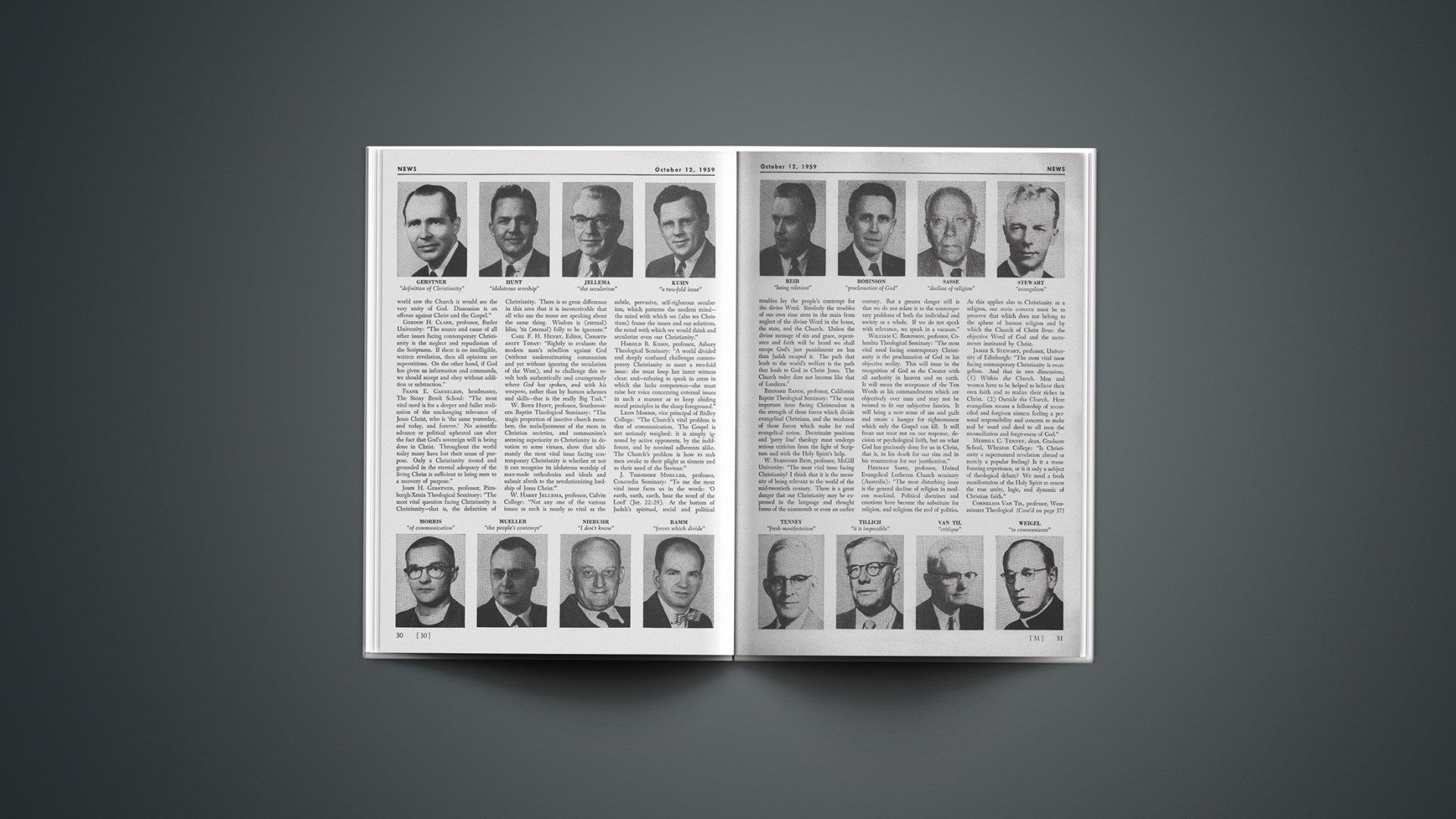
Christendom’s Key Issue: 25 Scholars’ Views

What is the most vital issue facing contemporary Christianity?

Twenty-five leading scholars responded to this query posed byCHRISTIANITY TODAY.

Some noted scholars, among them ProfessorREINHOLD NIEBUHRof Union Theological Seminary, New York, and ProfessorPAUL TILLICHof Harvard Divinity School, confessed their inability to narrow the issues to a single primary concern.

“I don’t know how to choose one vital issue among the many issues that face the Christian Church,” said Niebuhr.

Tillich said: “I feel it is impossible to reduce to one most vital issue the problems facing contemporary Christianity.”

Karl Barth, professor, University of Basel: “How do you explain the fact that the large Christian bodies cannot pronounce a definite yes or no on the matter of atom warfare? What significance has this fact: (a) in regard to the Church’s own message; (b) in regard to the world around her (the Church)?”

G. C. BERKOUWER, professor, Free University of Amsterdam, Netherlands: “I see the ‘most vital issue’ herein: That amid all kinds of evidences of secularization and antagonism toward the Christian faith, we nevertheless discover once again in the Church a new sense of the importance of the Gospel and a realization that God’s Word is manifesting itself with power and is calling for renewed attention (2 Timothy 2:9, ‘the word of God is not bound’). That gives us courage for the future, when men through the overpowering influence of the Gospel meet each other in new perspective, full of comfort and mission in this disturbed world. In one word—new attention to the Bible.”

ANDREW W. BLACKWOOD, professor emeritus, Princeton Theological Seminary: “How to put God in the forefront of Christianity today, and then keep him foremost. Call the current tendency secularism, externalism, humanism, or what not; really it is pride and selfishness. In hymns and prayers, sermons and religious books, we exalt ‘Man’—ourselves—rather than the Triune God. We need a new Christ-centered Reformation.”

F. F. BRUCE, professor, Manchester University: “Most vital is the urgent necessity for all who profess and call themselves Christians, in West and East alike, to be real Christians, wholeheartedly committed to the cause of Christ in the world and ready to embrace the conditions which he laid down for those who wished to be his disciples.”

EMILE CAILLIET, professor, Princeton Theological Seminary: “The most vital issue is that we have lost a sense of cosmic purpose secured over the ages, thanks mostly to the Gospel. We are accordingly overwhelmed by a mood of futility to the point of reverting to the very forms of doom which characterized the pagan past.”

EDWARD JOHN CARNELL, professor, Fuller Theological Seminary: “The most vital issue is the communion of the saints. Jesus prayed that his disciples would be so knit by cords of love, that when the world saw the Church it would see the very unity of God. Dissension is an offense against Christ and the Gospel.”

GORDON H. CLARK, professor, Butler University: “The source and cause of all other issues facing contemporary Christianity is the neglect and repudiation of the Scriptures. If there is no intelligible, written revelation, then all opinions are superstitions. On the other hand, if God has given us information and commands, we should accept and obey without addition or subtraction.”

FRANK E. GAEBELEIN, headmaster, The Stony Brook School: “The most vital need is for a deeper and fuller realization of the unchanging relevance of Jesus Christ, who is ‘the same yesterday, and today, and forever.’ No scientific advance or political upheaval can alter the fact that God’s sovereign will is being done in Christ. Throughout the world today many have lost their sense of purpose. Only a Christianity rooted and grounded in the eternal adequacy of the living Christ is sufficient to bring men to a recovery of purpose.”

JOHN H. GERSTNER, professor, Pittsburgh-Xenia Theological Seminary: “The most vital question facing Christianity is Christianity—that is, the definition of Christianity. There is so great difference in this area that it is inconceivable that all who use the name are speaking about the same thing. Wisdom is (eternal) bliss; ’tis (eternal) folly to be ignorant.”

CARL F. H. HENRY, Editor, CHRISTIANITY TODAY: “Rightly to evaluate the modern man’s rebellion against God (without underestimating communism and yet without ignoring the secularism of the West), and to challenge this revolt both authentically and courageously where God has spoken, and with his weapons, rather than by human schemes and skills—that is the really Big Task.”

W. BOYD HUNT, professor, Southwestern Baptist Theological Seminary: “The tragic proportion of inactive church members, the maladjustment of the races in Christian societies, and communism’s seeming superiority to Christianity in devotion to some virtues, show that ultimately the most vital issue facing contemporary Christianity is whether or not it can recognize its idolatrous worship of man-made orthodoxies and ideals and submit afresh to the revolutionizing lordship of Jesus Christ.”

W. HARRY JELLEMA, professor, Calvin College: “Not any one of the various issues as such is nearly so vital as the subtle, pervasive, self-righteous secularism, which patterns the modern mind—the mind with which we (also we Christians) frame the issues and our solutions, the mind with which we would think and secularize even our Christianity.”

HAROLD B. KUHN, professor, Asbury Theological Seminary: “A world divided and deeply confused challenges contemporary Christianity to meet a two-fold issue: she must keep her inner witness clear; and—refusing to speak in areas in which she lacks competence—she must raise her voice concerning external issues in such a manner as to keep abiding moral principles in the sharp foreground.”

LEON MORRIS, vice principal of Ridley College: “The Church’s vital problem is that of communication. The Gospel is not seriously weighed: it is simply ignored by active opponents, by the indifferent, and by nominal adherents alike. The Church’s problem is how to stab men awake to their plight as sinners and to their need of the Saviour.”

J. THEODORE MUELLER, professor, Concordia Seminary: “To me the most vital issue faces us in the words: ‘O earth, earth, earth, hear the word of the Lord’ (Jer. 22:29). At the bottom of Judah’s spiritual, social and political troubles lay the people’s contempt for the divine Word. Similarly the troubles of our own time stem in the main from neglect of the divine Word in the home, the state, and the Church. Unless the divine message of sin and grace, repentance and faith will be heard we shall escape God’s just punishment no less than Judah escaped it. The path that leads to the world’s welfare is the path that leads to God in Christ Jesus. The Church today dare not become like that of Laodicea.”

BERNARD RAMM, professor, California Baptist Theological Seminary: “The most important issue facing Christendom is the strength of those forces which divide evangelical Christians, and the weakness of those forces which make for real evangelical union. Doctrinaire positions and ‘party line’ theology must undergo serious criticism from the light of Scripture and with the Holy Spirit’s help.

W. STANFORD REID, professor, McGill University: “The most vital issue facing Christianity? I think that it is the necessity of being relevant to the world of the mid-twentieth century. There is a great danger that our Christianity may be expressed in the language and thought forms of the nineteenth or even an earlier century. But a greater danger still is that we do not relate it to the contemporary problems of both the individual and society as a whole. If we do not speak with relevance, we speak in a vacuum.”

WILLIAM C. ROBINSON, professor, Columbia Theological Seminary: “The most vital need facing contemporary Christianity is the proclamation of God in his objective reality. This will issue in the recognition of God as the Creator with all authority in heaven and on earth. It will mean the acceptance of the Ten Words as his commandments which are objectively over man and may not be twisted to fit our subjective fancies. It will bring a new sense of sin and guilt and create a hunger for righteousness which only the Gospel can fill. It will focus our trust not on our response, decision or psychological faith, but on what God has graciously done for us in Christ, that is, in his death for our sins and in his resurrection for our justification.”

HERMAN SASSE, professor, United Evangelical Lutheran Church seminary (Australia): “The most disturbing issue is the general decline of religion in modern mankind. Political doctrines and emotions have become the substitute for religion, and religions the tool of politics. As this applies also to Christianity as a religion, our main concern must be to preserve that which does not belong to the sphere of human religion and by which the Church of Christ lives: the objective Word of God and the sacraments instituted by Christ.

JAMES S. STEWART, professor, University of Edinburgh: “The most vital issue facing contemporary Christianity is evangelism. And that in two dimensions. (1) Within the Church. Men and women have to be helped to believe their own faith and to realize their riches in Christ. (2) Outside the Church. Here evangelism means a fellowship of reconciled and forgiven sinners feeling a personal responsibility and concern to make real by word and deed to all men the reconciliation and forgiveness of God.”

MERRILL C. TENNEY, dean, Graduate School, Wheaton College: “Is Christianity a supernatural revelation abroad or merely a popular feeling? Is it a transforming experience, or is it only a subject of theological debate? We need a fresh manifestation of the Holy Spirit to renew the true unity, logic, and dynamic of Christian faith.”

CORNELIUS VAN TIL, professor, Westminster Theological Seminary; “The most vital issue facing contemporary Christianity is that of a critique of historical reason. The most pressing question is as to whether and where objectivity may be found in history. The Church must preach Christ and the resurrection. Can it do so unless Christ speaks to us directly in Scripture?”

GUSTAVE WEIGEL, Jesuit theologian and author, Woodstock College: “The pressing task of contemporary Christianity is to communicate the authentically genuine message of Christ and the Church in forms proper to the cultures of our era. The substance of the message is fixed but the modes of expressing it must be those spontaneous to the minds and hearts of our place and day. Older modalities encased in polemics deriving from dead cultural situations must be buried with the situations which caused them.”

Acknowledgements: The pictures of Professors Barth, Niebuhr, Stewart, and Tillich are Religious News Service Photos.

‘Courtesy Call’

Archbishop Egidio Vagnozzi, newly-appointed Vatican “Apostolic Delegate” to the United States, paid a “courtesy call” on President Eisenhower at the White House last month. Presidential assistant Rocco Siciliano accompanied Archbishop Vagnozzi to the 25-minute conference in Eisenhower’s office.

People: Words And Events

Deaths: The Rev. Arnold H. Grumm, 65, honorary vice president of the Lutheran Church—Missouri Synod, in St. Louis … Dr. T. W. Hazlewood, minister of St. Paul’s-Avenue Road United Church in Toronto and News Correspondent for CHRISTIANITY TODAY … Dr. Charles G. Shatzer, 81, dean emeritus of Wittenberg University and former executive secretary of the Lutheran Laymen Movement, in Springfield, Ohio … D. Leigh Colvin, 79, noted prohibition leader … Dr. Charles Fama, physician who for more than 30 years was a lay preacher at the Church of the Gospel, a mission to Italian Roman Catholics associated with the Bedford Park Presbyterian Church in Brooklyn, New York.

Elections: As general secretary of the Commission on Ecumenical Mission and Relations of the United Presbyterian Church in the U. S. A., the Rev. John Coventry Smith … as president of the Seventh-day Baptist General Conference, the Rev. Victor Skaggs.

Appointments: As dean of the school of theology at New Orleans Baptist Theological Seminary, Dr. J. Hardee Kennedy; as dean of the school of religious education, Dr. John M. Price, Jr.; as dean of the school of sacred music, Dr. W. Plunkett Martin; as professor of church history, Dr. William A. Mueller … as president of Bethany Bible College, the Rev. C. C. Burnett … as guest professor of religion at Bethany College, Dr. Donald McGavran … as national chaplain and chairman of religious activities of the U. S. Junior Chamber of Commerce, Cloyd R. Croft, Jr.… as pastor of the Tremont Temple Baptist Church in Boston, the Rev. Carl J. Giers … as editor-in-chief of Forth Magazine, official monthly of American Episcopalianism, Henry L. McCorkle … as national executive director of Episcopal women’s work, Miss Frances M. Young … as superintendent of Christian Herald’s Bowery Mission and Young Men’s Home, Raymond J. Allen … as president of the newly-formed National Student Christian Federation, Allan Burry.

It was the first meeting between the President and Vagnozzi, whose predecessor was elevated to the College of Cardinals earlier this year.

How Ecumenical?

Greek Orthodox Archbishop Iakovos says that “officially” the Ecumenical Patriarchate in Istanbul “knows nothing” about reported plans for discussions in Italy next year between Roman Catholic and Orthodox representatives.

In a statement released through the World Council of Churches office in Geneva, the archbishop said the Orthodox will “never participate in any conversation with the Roman Catholic church which does not have as its eventual aim the inclusion of Protestants.”

The Orthodox prelate, recently elected a WCC president, was commenting on a report broadcast by Vatican Radio last month which said that 10 Roman Catholic representatives and an equal number from Orthodox churches would convene in Venice for “theological discussions of interest to both churches.”

Eutychus and His Kin: October 12, 1959

ON EUTYCHUS

This hasty note is past your deadline because I fell asleep while composing a letter of congratulation on the beginning of your fourth year of publication. I was reassured to read recently that chronic sleepiness can be inherited. Perhaps I share a congenital affliction with my ancient namesake at Troas.

May I suggest an article someday on the original Eutychus? Preachers, at least, should know how to spell and pronounce his name (Yew’-ti-cuss—ED.). The name meant “good luck” in an age when Lady Luck was even more fervently worshiped than at our race tracks.

Do you suppose anyone reflected on the name when Paul’s prolonged discourse was interrupted by the abrupt disappearance of “Lucky” from the window sill? Was anyone shaken by a sudden thought that the goddess Tyche was revenged on an apostate from an old cult?

At any rate, the First Church of Troas, without the benefit of centuries of jokes about sleeping in church, no doubt failed to see anything comical in the still form on the dark street. Yet their joy must have been the richer when Eutychus was restored. The sates of death could not prevail against the church of Christ. The bondage of “good luck” was broken by the Good News.

Too many Christians still live with crossed fingers, sweating out their good luck as a portent of calamity. To see them you would never guess that God’s good pleasure and not the goddess of Late rules human destiny.

No doubt Eutychus should have been listening and praying rather than sleeping, but childlike faith and deep sleep are not unconnected. Tyche’s devotees are great insomniacs; they must keep one eye on their capricious goddess. The psalmist, on the other hand, said, “In peace will I both lay me down and sleep” for the Lord who never slumbers was his Keeper.

At least Eutychus didn’t need a sleeping pill.

EUTYCHUS

INTO THE OPEN

We enjoyed Dr. Blake’s article (Aug. 3 issue), and I am sure everyone who sees what is taking place appreciates your courage and his in bringing it out into the open.

NORA COLLINS

Whittier, Calif.

The real essence of Mr. Blake’s article … is that the character of our churches has so changed and will continue to change, as to make untenable the tax relationship now existing between Church and State. Christ recognized the same characteristics in the religion of his day and plainly indicated that it was reflected in a Church no longer of God, but a synagogue of Satan. Our course should not be directed toward changes in taxation but toward obedience to Christ’s command that his house not be made a house of merchandise and a den of thieves.

WAYNE ANDERSON

Shannon City, Iowa

He has either forgotten that the power to tax is the power to destroy, or that may be what he remembers. If his suggestion were to be followed the next would be to eliminate gifts to churches from income tax exemptions. The church (his kind, that is) would then be almost entirely dependent on the state and the reunion would then be complete.

Wouldn’t it be grand if clergy would attend to spiritual matters and leave economics and politics to us sinful laymen.

W. H. EVERETT

Houston, Tex.

And shall the government also—just to be fair—reconsider … the tax-exempt status of secularistic “science”-aiding foundations all the way from Ford-Rock-efeller-Carnegie … to little humanist foundations—all of which … (or nearly all) use at least part of every dollar to destroy Christ and promote antichrist.

L. V. CLEVELAND

Westminster Church (Congregational)

Canterbury, Conn.

I think Dr. Blake’s article perceptive and courageous.

JOSEPH A. STEINER

Chicago, Ill.

With Carnell writing for The Century and Blake writing for CHRISTIANITY TODAY, the day of ecumenicity has arrived!!

FRANK LAWRENCE

Graystone United Presbyterian Church

Indiana, Pa.

YES, IT DOES

In your report of the Oberlin synod of the merging United Church of Christ you state that the Congregational Churches in a previous merger, united with some churches of the Disciples of Christ to become the Congregational Christian Churches (Aug. 3 issue).

This is a rather common misconception due to the varied nomenclature used by the Christian Churches (Disciples of Christ). There were two movements in America in the early 1800’s which emphasized Christian unity, taking the Bible and the Bible alone as a rule of faith and practice. In Kentucky, Tennessee, southern Ohio, Indiana and Illinois one movement under Barton W. Stone was known as “Christian Church.” In Virginia, Pennsylvania, Ohio and Kentucky the other movement under Thomas and Alexander Campbell was designated “Disciples of Christ.” In 1831 these groups united and became widely known as “Christian Churches.”

Some churches of the Stone movement refused to give up their original doctrines and their fellowship with similar Christian Church groups on the Eastern Seaboard with the result that a small denomination known as “The Christian Connection” was set up with headquarters at Dayton, Ohio. This is the body that united with the Congregationalists in 1931.

Does this help to keep the record straight?

JOSEPH DAMPIER

Milligan College, Tenn.

What is of greater validity, our doctrines and polity or our oneness in him who is Lord, even Jesus Christ? I do not presume to suggest that our doctrine and polity should be passed over lightly, for we recognize the part played by tradition in our fellowship, yet I believe that the Holy Spirit somehow draws us together into this merger.… I challenge you to find what God would do in this coming together of our two churches.

RICHARD E. SIMONSON

Trinity United Church of Christ (Evangelical and Reformed)

Louisville, Ky.

The article … is very revealing. The merger seems to be running into rougher and rougher weather. And I suspect there will be many “whitecaps” when the merger lawsuit comes to trial.…

HOWELL D. DAVIES

Chicago, Ill.

I realize full well that we will never have one great, all-embracing, monolithic church. Such a development would be far from desirable. However, many of us do recognize that our present division into multifarious denominations is the scandal of Christendom. When mergers take place like the present one …, then it is an occasion for rejoicing.

RODERIC W. HURLBURT

The Congregational Church

Gorham, N. H.

Betrays … utter lack of objectivity.…

A. W. KOVACS

Minersville, Pa.

I have read the account … with great interest.… I was there throughout the sessions and took very careful notes myself, and I find that your reporter did an amazingly accurate job in telling what went on.… As much as your reporter included [on] … the points at which there seemed to be friction between denominational officials … was evident from what I observed and much more might be said about serious differences of opinion.

MALCOLM K. BURTON

Chicago, Ill.

I have … appreciated your most fair reporting of conventions of my own denomination, the troubles of my own seminary at Louisville, Ky. (Southern Baptist), and on that basis assume the news of other denominational meetings to be fairly reported. To be fair in these things is not easy, we know.

“Eutychus and his kin” is worth much; to see the reactions of the brethren is often informative as well as amusing.

JAMES A. ADAMS

First Baptist

Salisbury, Mo.

AS A WAYWARD CHILD

In his report on the North American Christian Convention (July 20 issue), J. D. Murch has given an excellent thumbnail sketch of our brotherhood of churches (known as Disciples of Christ).… When diversity of opinion includes questioning the authority of Christ, and distortion of the New Testament pattern, then charity ceases to be a virtue and becomes betrayal of “contention for the faith once delivered to the saints.” This is the unhappy situation in our brotherhood today. As in the case of a wayward child who leaves his father’s house to pursue his own wilful way, the only course left to faithful members of the family is to remain true and pray for the eventual return of the prodigal. Following the usual pattern in such cases, it is the “stand-patters” who are named as the cause of division. God will be the final judge of that, and he has warned that his followers shall have no fellowship with unbelief.

It may be a little difficult for our denominational friends to understand how a body of believers can operate without a creed or discipline. The truth is, we do have both of these, but neither written by men. Our creed is Christ, and the life he lived on earth. Therefore it cannot be revised. Our discipline is found in the Word of God, given by inspiration to chosen men, who recorded it for the use of Christians, through all of time.…

VALDA H. PUGH

Louisville, Ohio

TROUBLE IN KERALA

Your magazine has been appreciated partly because I do not come from the typical liberal Protestant atmosphere of English Congregationalism. I grew up in a Gospel Mission which developed from the Sankey and Moody evangelistic campaigns.… I have felt often the shallowness of much Congregational thought. Your magazine brings the old atmosphere of boyhood days back.

… We [have] had our minds busy with the violent upsurge against the Communist Ministry in Kerala. Like the Roman Catholics (strong here since the days of Xavier) we refused to accept the Kerala Education Act, which would have reduced our control over our schools to deciding when to attend to petty repairs. The Roman Catholics offered to send men to guard our school buildings against Communist-inspired parents and (some) teachers who might break them open, defying us, and carry on the schools.… Communist attacks on the Christian Church produce strange bedfellows!

G. W. TROWELL

Trivandrum, Kerala, India

RAGING CHARIOTS

No … apology from John H. Gerstner was required for … warning against breaking auto speed laws (Aug. 3 issue).… I wonder whether he has ever preached on it from Nahum 2:4: “The chariots shall rage in the streets, they shall justle one against another in the broad ways: they shall seem like torches, they shall run like the lightnings.”

WILBUR L. CASWELL

Patterson, Calif.

Ideas

The Mission of a Magazine

With this issue CHRISTIANITY TODAY begins its fourth year of evangelical witness and ministry. Not only has CHRISTIANITY TODAY banded together an international, interdenominational scholarship dedicated to evangelical loyalties, but it is now widely recognized as the magazine with the largest circulation in the world to the Protestant ministry and lay leadership. As a venture in evangelical teamwork, we salute both our readers and our farflung staff of contributing editors and correspondents. Many influential coworkers in the mainstream of Protestant thought and life also have supplemented the magazine’s sturdy emphasis on biblical evangelism, theology, and ethics.

During the current year CHRISTIANITY TODAY presentation luncheons or banquets have been held in Boston, New York, and Los Angeles, and others are soon to be held elsewhere. Speaking at the Los Angeles banquet Dr. Wilbur M. Smith, editor of Peloubet’s Notes on the International Sunday School Lessons, and one of this magazine’s 50 contributing editors, optimistically sketched the mission and ministry of the magazine in prophetic words: “There is no reason why, in the next two decades if the Lord tarries, CHRISTIANITY TODAY cannot be the most powerful single agent in this critical hour for the defense of the faith and for the furtherance of the Gospel.” Dr. Smith’s larger comments in fact place upon all who share the opportunities of this enterprise a new and enlarging responsibility:

“Those of us who love Christ as Saviour and Lord hold three great truths which we must never compromise: 1. That there is a sovereign, omnipotent, holy and righteous God who created this world; 2. That he sent his only begotten Son, the Lord Jesus, to live and die and rise again that he might save men from sin and the wrath of God into salvation and eternal life; 3. That we have in the Bible a divinely inspired record that stands unique as the revelation of God.

“These great truths are finding enemies of increasing power in this epochal hour in which we live.

“The first is this fearful, brutal, bloody, godless thing called communism. One third of the population of this globe is under Communistic dominion. It is inevitable that the rest of the world and the Christian Church must increasingly deal with the satanic influence of 900 million people foresworn to atheism. We will feel this more keenly in days to come. The next generation will have a battle on its hands exceeding anything the world has yet experienced.

“The second is a power that is indifferent to our faith, swallowing up so many of our younger generation. I refer to naturalism. As the president of Princeton said in a recent message, ‘The explosion [I like that word] of knowledge which the past half century has brought about in science is obviously and inescapably a very important matter.’ Think what enormous areas have opened up for the first time since some of us were born: aeronautics, atomic energy, nuclear fission, the whole science of genetics, and now space exploration. But the tragedy is that 95 per cent of the leading scientists of the Western world are without the Lord Jesus Christ. Science is indifferent to our faith. We live in its atmosphere, and it is bound to have an effect upon our younger people.

“The third enemy is within the Church: this subtle, gnawing thing called liberalism.

“These three things: the animosity of communism, the indifference of naturalism, and the undermining of faith by liberalism, are enemies which must be faced if we are to do what the Apostle Paul describes in Philippians as engaging in the advance of the faith. The word prokopto means ‘to cut your way through,’ as through a great forest, to reach the enemy. The furtherance of the Gospel! That is what you and I are interested in; not only in the defense of the faith against its enemies, but in the furtherance of the faith and the winning of multitudes for the Lord Jesus Christ.

“The Christian Church has many agencies available for the defense of the faith and for the furtherance of the Gospel. I simply name some: The church and its pulpit, although it is not always in defense of the faith and the furtherance of the Gospel. Ecclesiastical pronouncements, some good and some bad. Evangelism. Alongside these stand the great missionary organizations, like the American Bible Society and the British and Foreign Bible Society; the independent youth movements such as Inter-Varsity, Young Life, Campus Crusade, and Christian Endeavor; the institutions devoted to Christian education; Christian colleges, Bible institutes, sound theological seminaries; Christian books and other literature; Christian radio and television programs; and religious periodicals.

“Spurgeon said (and he should have known because he could preach with power) that in his mind a religious periodical devoted to the Christian faith could do more for the cause of Christ than any other one agency ordained of God on this earth. We are upon sad times in this sphere of religious periodicals. We have somehow come into a desert. We have about 1,100 religious periodicals in this country. They have a paid subscription list of about 15 million, very few with over 100,000. We have not had for a quarter of a century in this country a great, powerful, well-informed evangelical periodical that can meet the intellectual problems that are confronting intelligent men and women today—a resource in which they can have confidence, that can speak with authority. And we are desperately in need of it.

“I can say some things about CHRISTIANITY TODAY that I would not be able to say about any other religious journal in this country. It is important that the Editor be able to gather around him some of the leaders of evangelical thoughts on both sides of the Atlantic. If I know anything about the history of religious journalism, the list of 50 contributing editors of CHRISTIANITY TODAY has been unmatched by any religious journal in America. This achievement is in itself a guarantee of excellence and high attainment.”

The passing year has etched its sorrows and its joys upon the list of our dedicated associates: the removal by sudden death of correspondent Dr. T. Leonard Lewis, erstwhile president of Gordon College and Divinity School, and the happy addition as contributing editors of Dean S. Barton Babbage in Australia and Dr. Kenneth Strachan in Latin America.

During our fourth publication year, the popular “Review of Current Religious Thought” will be contributed in sequence by Dr. Addison H. Leitch, Dr. Philip E. Hughes, Dr. Frank E. Gaebelein, and Dr. G. C. Berkouwer. All are gifted and discerning interpreters of contemporary theological and social trends, and their contributions may be counted upon to carry forward the high merit of this fortnightly feature.

In an era of unparalleled problems and opportunities CHRISTIANITY TODAY will continue to minister to the life of the Church, believing that the historic evangelical faith has a vital message for the times. Theological liberalism has failed to meet the moral and spiritual needs of mankind. All too frequently it finds itself adrift in speculation and dissonance which neither solves the problem of the individual nor of the society of which he is a part. Sound theological doctrine, biblical preaching, and evangelism find renewed emphasis in our columns, and there is eager and wide acceptance throughout the churches. True ecumenicity is fostered by setting forth the New Testament teaching of the unity of believers in Jesus Christ and the spiritual oneness engendered by the Holy Spirit. Beyond the Church we believe that the basic needs of the social order must meet their solution first in the redemption of the individual; that the Church and the individual have a vital responsibility to be both salt and light in a decaying and darkening world.

Concurrent with our anniversary is the observance of Protestant Press Month in America. CHRISTIANITY TODAY is happy that, along with its colleagues of the religious press, it has been able to reflect to the world a more balanced view of American life and the American vision. Beyond doubt, the original sense of national purpose and destiny has now worn thin, and in some respects it has even been frayed somewhat by the lust for material things and repatched by social changers addicted to welfare statism.

The people of the world who sample American literature in the bookstalls of airports and rail stations around the world are likely to get a blurred focus on the American ideal. “… If we are not careful and very, very selective,” cautions Carolyn Berntsen in The Australian Quarterly (June, 1959), “we may find ourselves envisioning the United States as a nation of psychopaths, sex-fiends, bored suburbanites, and juvenile delinquents. Violence, frustration, hysteria and … decay seem to be the melodies played over and over in the contemporary American novel.” The essayist urges Australian readers not to sketch the American outlook from current works “in the modern mood of earthly, cynical, often sordid realism, and written for the present commercial market which more often than not requires sex, sin, and cynicism as prerequisite to publication.

The Protestant press is doing its part to maintain the moral and spiritual heritage of “this nation under God.” The evangelical dedication of many of our early colonies survives at grass roots in the spiritual life of the nation, and although not now vitally manifested in the cultural realm, it is nonetheless being renewed and deepened by the evangelistic tide of our time. This heritage must be renewed and strengthened if national debacle is to be thwarted. We join with our fellow craftsmen in a renewed dedication to the task.

EISENHOWER, KHRUSHCHEV AND HISTORY’S INEVITABLE COURSE

Now that President Eisenhower and Premier Khrushchev have had their exchange about the sure course of modern history, some further word about its inevitabilities may be appropriate. The modern debate is not reducible simply to the options of the triumph of Marxist socialism (based on the supposition of economic determinism) nor the triumph of free enterprise (on the supposition of the inherent superiority of the philosophy of individual worth and personal liberty). The serious discussion of divine predestination and election featured elsewhere in this issue of CHRISTIANITY TODAY is not without vital implications for the discussion of the ultimate destiny of the human race and of the inevitabilities of history.

The notion that communism must supplant capitalism is, of course, nothing but the fanciful notion of the inevitability of progress now misappropriated as a coverall for dictatorial despotism. Neither the final nor the temporary triumph of communism is inherently assured. Its fundamental contradiction of family instincts, of man’s natural desire for private property, and for freedom of religion, works against its spontaneous extension. Its effective survival, in fact, depends upon support by violence and barbarian power.

Mr. Khrushchev’s farewell address was a colossal propaganda sally for communism. By oblique appeals to the Bible and to the example of Christ, the self-professed atheist perversely asked religious people to recognize the socialist system as “most humane and just” vis-a-vis capitalism. Elsewhere he suggested that the Christian teachings of brotherly love and forgiveness imply a socialist world order. Whoever has read Hobbes’ Leviathan will recall how readily materialists can misuse holy things for corrupt ends.

Champions of the free world need not reach far into fact to unmask in the Premier’s argument (that Soviet society is best, its internal relations good and brotherly) many verbal distortions: that in Soviet society the people enjoy full freedom; that freedom of religious belief prevails; that Soviet government is democratic; that private ownership means exploitation of the worker.

Compromise in the free world commitment is patent, conspicuously its concessions to socialist philosophy and its basic revolt against biblical theology and ethics that deteriorates liberty to license. Khrushchev’s dramatic exploitation of these weaknesses lent force to criticism that his visit brought dignity to a dictator. (See remarks by Commander H. H. Lippincott in We Quote, page 18, this issue.) The economic virtues of free enterprise have been compromised in our era by expanding state controls and mounting taxation. Fortunately, American uneasiness increases over welfare state programs contradictive of free enterprise. Yet vote-hungry politicians approve many programs which, while not contradictive of free enterprise, nonetheless weaken it. Inflation is being slowed, but little determination exists to curtail nondefense spending and to reduce the national debt in order actually to halt erosion of the dollar. Meanwhile, Americans become less and less coherent in articulating a consistent alternative to socialism. Their confusion is in part due to ecclesiastical compoundings of Marxism and Christianity. Free men must understand why free enterprise allows scope for individual rights and guards human persons from enslavement to government, and why revealed religion is the fount of human rights and duties, or they will soon squander their birthright.

Mr. K. emerged as international crusader for peace and disarmament. When faced by specific questions, he became evasive or abusive. He got his Big Two “summit” conference without progress at Geneva level. The West must range itself sincerely and aggressively on the side of peace rather than war in testing his proposals, and it can do so significantly only by giving international meaning to the concept of justice.

Some observers note three significant Khrushchev “changes”: his recognition of the unity of the American people with government policy; his admission that war can be averted without economic crisis; and his implicit concession (in proposing peaceful coexistence and competition) that capitalism is not evil. Yet Khrushchev clearly values only what is “useful” [favorable to the ultimate triumph of communism]. He does not repudiate the Marxian world revolution as heresy, but asks only for decreased tensions. Can Soviet “peaceful competition” in this context be anything but a propaganda interlude on the roadway to Communist hegemony—an interlude made tolerable only by the notion that the Communist system is still in transit to the final stage?

Mr. K. voiced his United Nations peace plea the same month that the National Council of Churches moved ahead its Cleveland World Order Conference peace education plan. Both call for U.S. recognition and U.N. admission of Red China, for cessation of atomic tests, for disarmament. Khrushchev shares the indifference to Christian evangelism and missions, disinterest in supernatural regeneration, and preoccupation with socio-political matters of some churchmen given to peace promotion. American churchgoers await clarification of what Khrushchev said that ecumenists repudiate, and what ecumenists say that Khrushchev rejects. What relation exists between the propagation of the Christian religion, and its extension in society, and peace in our times? What awareness survives that Christianity’s trumpet of peace to the world must distinctly sound the Saviour’s name: “… My peace I give unto you: not as the world giveth, give I unto you” (John 14:27)? Where is the sense of divine providence that once shaped America strong in spirit, dedicated to fulfillment of God’s will? Where is the conviction of American destiny, sharing with the world the bold witness of faith in the Redeemer? Where is the warning that pagan nations are maneuvering to inherit a kingdom that God has already pledged to his Son Jesus Christ? Or is America, and American churchianity too, adrift in the world current of pagan aspirations?

Babel or Pentecost?

BABEL OR PENTECOST?

The conflict in the soul of man between Babel and Pentecost is an unending one. On the one hand there is the innate desire to launch out on the plane of self-determination, to be the captain of one’s own soul. On the other there is the call to receive that which is supernatural in origin and supernatural in its effect, through the transforming work and power of the Holy Spirit.

Humanism is tremendously appealing. What a lift to the ego to feel that we are capable of rising above our immediate limitations and of accomplishing great things for ourselves and for the world in which we live!

How humiliating to concede that within us there dwells no good thing; that this heart of ours is desperately wicked; that we stand guilty and condemned before a holy and just God; that our eternal destiny depends not one whit on anything which we can accomplish of ourselves.

The conflict of Eden has never ceased. To say that Eden never existed is but to deny that which we experience every day. Confronted with a “This is the way, walk ye in it”, we are tempted to follow “the way which seemeth right to man, but the end thereof are the ways of death.”

Aware of a need and a dilemma we are told to dip in the Jordan of a simple faith in the atoning work of Christ, but we turn to the more attractive rivers of man-made philosophies.

Zealous in a religiosity into which we were born, and for which we have worked for many years, we avoid the confrontation of the risen and living Christ because we want the beauty of His life without the implications of His death.

The philosophy of Babel is as current today as in the day when men banded together to save themselves through a tower of their own making. Not only are the non-Christian religions evidence of this unending conflict but any religion which predicates man’s salvation on that which he can do for himself is but a reflection of those dramatic and tragic days on the plain of Shinar.

Although Babel is synonymous with confusion man still turns to the Babel of man-made ideas and away from divine revelation.

Although history reveals the end of those who defy God and refuse to believe His Word, the descendants of the tower builders are to be found on every hand: “Let us do this”, “Let us do that” is heard across the world. But God is not mocked. He still comes down to confuse, confound and scatter the unbelieving.

There is a dramatic antithesis between Babel and Pentecost.

Babel brings confusion of tongues and scattering of efforts. Pentecost brings a unity of expression in the Lord and an empowering to serve the Living God.

Babel was God’s judgment on a rebellious people. Pentecost was a mighty blessing on a praying people.

Babel scattered men to the oblivion of futility. Pentecost scattered men to the ends of the earth with a message and with power.

Babel divided. Pentecost united.

From Babel came no blessing. From Pentecost there came men filled with the Spirit of the living God and empowered to win others to a like precious faith.

The relevance of these philosophies to our own times is for all who will to see. Christ tells us, “For without me ye can do nothing”, while Paul cries out in triumph, “I can do all things through Christ which strengtheneth me.”

Our Lord’s illustration of the vine and the branches was no trite analogy. Only as the branches abide in the vine can they bear fruit. Detached from the vine they wither and die.

Humanism is predicated on the self-sufficiency of man. Christianity is predicated on the utter hopelessness of man.

To confront man with the love of God in Christ can inflate his ego. To confront him with his sinfulness and then with the love of God, which offers pardon and redemption through the atonement of His Son, places man in his right perspective: to his sinful self and to a holy and loving God. Only by facing the awfulness of sin and the tremendous price paid to redeem us from that sin can we rightly evaluate the cost and the implications of the Cross.

Babel minimizes sin, questions judgment, denies the eternal separation of the unrepentant sinner from God, while at the same time it by-passes the blood of Calvary and expects Christ’s “example of divine love” to spark within the heart of the unsaved the will and the power to become new creatures.

Babel looks on conversion as a process in which man has a part. Pentecost looks on conversion as a supernatural act.

Pentecost was a visible act of the sovereign grace of God whereby there was poured out on those who had humbled their minds and hearts the Third Person of the Trinity.

Wherever the Church, or individual Christians, attempt to do the Lord’s work in the arm of flesh, their efforts are doomed. Dependence on the presence and power of the Holy Spirit is a grace to be cultivated and a practice to be pursued.

The Pentecostal experience of the early Church should be the individual experience of the Christian today.

But the “old man” with his concepts is ever with us and before we know it we are erecting a 20th Century tower of Babel as an evidence of our own foolishness, a structure already destined to destruction.

Babel looks at the things which are seen; Pentecost fixes its eyes on the things which are not seen.

Babel has respect to the allurements and the values of the world; Pentecost looks to the city which hath foundations, whose builder and maker is God.

Babel tries to prove God. Pentecost simply trusts Him.

Babel lifts its head in rebellion against revealed truth and makes other plans and devises other ways. Pentecost bows its head in humility and accepts as fact those things which only the heart of faith can believe.

Babel is rationalism. Pentecost is faith. Babel is, “Who is the Lord that I should obey his voice”? Pentecost is, “Lord, I believe, help thou mine unbelief”.

Babel rejects revelation. Pentecost rejoices in it.

The conflict of which we speak is so real, so prevalent and so persistent that every Christian should cry out in prayer for forgiveness and right perspective.

We need to ask God to deliver us from the thought that we, like the men of Babel, can stand unashamed in His presence, or in any way contribute to our redemption.

We need to experience the gracious work of Pentecost,—a divine visitation whereby the Spirit of the living God comes to dwell in our hearts.

L. NELSON BELL

Bible Text of the Month: Matthew 5:10-12

Blessed are they which are persecuted for righteousness’ sake; for theirs is the kingdom of heaven. Blessed are ye, when men shall revile you, and persecute you, and shall say all manner of evil against you falsely, for my sake. Rejoice, and be exceeding glad; for great is your reward in heaven: for so persecuted they the prophets which were before you (Matthew 5:10–12).

This is the peculiar blessing of the elect of God, and it stands high up in the list of honour. The only homage which wickedness can pay to righteousness is to persecute it. Those who in the first blessing were poor in spirit, are here despised as well as poverty-stricken; and in this they get a new royal charter, which for the second time ensures to them “the kingdom of heaven.” Yea, they have the kingdom now: it is their present possession. Not because of any personal fault, but simply on account of their godly character, the Lord’s Daniels are hated.

CAUSE OF PERSECUTION

It is striking to reflect how the history of the coming ages must have stood before the Redeemer when he spoke these words. The cause of this antagonism we find expressed in John 3:20, “Every one that doeth evil hateth the light.” The Christian is, by his very appearance, a moving conscience to excuse or condemn the children of the world. On the other hand, John 7:7 discloses another reason of this enmity: the Christian, and, above all, the Apostles, must by the testimony of their word condemn the nature of the world.

A. THOLUCK

Because you are not of the world, saith Christ, the world hates you. The saint’s nature and life are antipodes to the world; fire and water, heaven and hell, may as soon be reconciled as they with it. The heretic is his enemy for truth’s sake; the profane for holiness’ sake; to both the Christian is an abomination, as the Israelite to the Egyptian. Hence come wars; the fire of persecution never goes out in the hearts of the wicked, who say in their hearts as they once with their lips, “Christians to the lions.”

WILLIAM GURNALL

But blessed be God, that although enemies have in all ages spoken all manner of evil against us, yet they have done it falsely, and for Christ’s sake; wherefore we may take up their books written against us, and “wear them as a crown.” “Do well and bear it, is written upon heaven’s gates,” said the martyr, Bradford. “Christ himself,” saith father Latimer, “was misreported, and falsely accused, both as touching his words and meaning also.” Count it not strange to be traduced, disgraced, scandalized. Austere John hath a devil; sociable Christ is a wine-bibber, and the scribes and Pharisees (whose words carry such credit) say as much. It is but a vain persuasion for any child of God to think, by any discretion, wholly to still the clamours and hates of wicked men. In the meantime, let our lives give them the lie—confute them by a real apology.

JOHN TRAPP

FOR RIGHTEOUSNESS’ SAKE

But it must be endured for righteousness’ sake, to secure the blessing promised. Men often refer to the opposition which they meet, and the persecutions they undergo, as a proof of their rectitude. But this in itself is no proof at all. The opposition must result from righteous acts, or it is no evidence of the favor of God.

JOHN J. OWEN

The necessity of suffering persecution, in order to being a true Christian, has undoubtedly by some been carried to an extreme, and the doctrine has been abused. It has been looked upon necessary to uphold a man’s credit amongst others as a Christian, that he should be persecuted. I have heard it made an objection against the sincerity of particular persons, that they were no more hated and reproached. And the manner of glorying in persecution has in some been very wrong, so as has had too much of an appearance of lifting up themselves in it, that they were very much hated and reviled, more than most, as an evidence of their excelling others, in being good soldiers of Jesus Christ. Such an improvement of the doctrine of persecution has a direct tendency to cause those that would be accounted true Christians, to behave themselves so towards those that are not well affected to religion, as to provoke their hatred, or at least to be but little careful to avoid it, and not very studiously and earnestly to strive (after the apostles’ example and precepts), to please them to their edification, and by meekness and gentleness to win them.

JONATHAN EDWARDS

BLESSEDNESS OF THE PERSECUTED

The particular reason our Lord assigns for pronouncing those who are persecuted for righteousness’ sake happy, is, that “theirs is the kingdom of heaven.” The phrase is commonly considered as equivalent to, “They shall enjoy celestial happiness.” I have no doubt this is included in it, but this is by no means all that is included in it. It is not, “Theirs shall be the kingdom of heaven” though that is true, but “theirs is the kingdom of heaven” even while suffering for righteousness’ sake. The kingdom of heaven is the new economy, the order of things under the Messiah.

JOHN BROWN

It is the nature of true grace to grow up with difficulties. As the ark rose higher with the waters, so likewise the soul grows higher and higher, it mounts up as discouragements and oppositions grow. Nay, the soul takes vigour and strength from discouragements, as the wind increaseth the flame. So the grace of God, the more the winds and waves of affliction oppose it, with so much the more violence it breaks through all oppositions, until it attains the desired hope.

RICHARD SIBBES

In Christ’s conception of the blessed life I find that even the enemy himself is made a contributor. Why, Christ shoves us how flowers grow in the nighttime, how the wilderness may rejoice and blossom as the rose, how the black devil with sharp teeth and eyes of fire is the servant of the good man, and waits upon him and ministers to his joy. O that we might enter into this meaning, then all things would be ours, life, death, height, depth—our servants would be a multitude among which would be found the angels of God.

JOSEPH PARKER

For your reward: that is, not merely the general reward of grace which in the kingdom of heaven awaits you; but in addition there shall be, for every affliction and for every wicked word which you have to endure as expedient for the confirmation of your faith to yourselves, a distinct, and precisely apportioned requital and compensation—the more ye suffer, the more the reward.… The reward is reserved in the heavens. Him whom they tolerated no longer under the heaven, heaven will receive into itself!

RUDOLPH STIER

Cover Story

The Pre-eminent Christ

“… that in everything he might be pre-eminent” (Colossians 1:18b)

Not long ago a Christian layman said to me: “I have no trouble believing in God as Creator. When I look at the moon and the stars, I just know that there is a God. But when it comes to Christ, I have to take my religion entirely on faith. Unless, he said wistfully, and it seemed hopefully, “Unless somehow Christ can be tied in with all that.”

PRE-EMINENT IN CREATION

How earnestly Paul would have talked with that man! He would have tied Christ in indeed, would have shown that he is supreme in “all that.” He would have shown him, as he showed the Colossians, what we must call, for want of a simpler term, the cosmic pre-eminence of Christ. To them he presented Christ, as pre-eminent in creation, “the firstborn,” meaning that he was himself a creature but that he holds priority and supremacy over all created things. He comes before what my friend referred to as “all that,” the wonder and immensity of the universe.

False teaching had crept into the church at Colosse. It did not ignore Christ; it simply relegated him to a position of relative unimportance. It gave chief emphasis to certain Jewish rites, to angel worship, to asceticism and severity to the body. It relied on philosophy and tradition and man’s intellectual abilities. It made a place for Christ, but a very insignificant one.

Paul, in hoping to head off these heresies, did not begin with a frontal attack on erroneous views. He simply took his readers straight to the overwhelming fact of Christ, the majesty of his Person, and the grandeur of his work. He pointed them to the central Figure of history and called him pre-eminent, meaning first in honor and dignity, chief in rank and power. If he could just help the Colossian Christians to come to grips with the overmastering truth of Christ—who he was and what he had done—they would get rid of the false teachings poisoning their belief and worship.

So, a good place to begin, as my lay friend would have agreed, was with the pre-eminence of Christ in the universe. Did they realize that this Christ was the very agent of creation? “In him all things were created, in heaven and on earth, visible and invisible.” This fact alone would give him everlasting pre-eminence. He had brought all things into being. He is Creator, not creature. Would the Colossians put angels, who were creatures, above Christ, who is Creator? Christ is also the goal of creation: “all things were created … for him.” All things must glorify him, and one purpose of creation is to make him supreme. Thus Paul “tied in” Christ with the cosmos, universal order and harmony.

But there is something else here. Christ is pre-eminent not only because he is the agent of creation and the goal of creation, but also because he is the sustainer of creation: “In him all things hold together.” It would be expected that the Colossians would feel the effects of Greek philosophy. Now the great problem of philosophy was: what is the constituent principle of the universe, the unifying cause, the coordinating force—what brings things into being and then holds them together? Thales, the father of philosophy, who lived more than five hundred years before Christ, said that water was the ultimate principle, that all things came from water, were held together by it, and returned to it. Some who came after him said that the great principle was air, and others, fire. But here was Paul, the inspired Christian thinker, saying “He (Christ) is both the First Principle and the Upholding Principle of the whole scheme of creation” (Col. 1:17, Phillips’ Letters to Young Churches). He is what the philosophers had long been searching for. He is, as John put it in his Gospel, the Logos, God’s creative wisdom in action.

The agent of creation, the goal of creation, the sustainer of creation is surely pre-eminent in the universe. If the Colossians could once grasp the over-powering idea of his greatness, they would cease stressing things of lesser import. If they could “tie him in” with the great scheme of created things, they would be delivered from dangerous doctrine. Then they, and we, would recognize Christ as Sovereign of all that we are and have. For even angels, instead of being worshiped, must worship him.

“Let angels prostrate fall;
And crown him Lord of all.”

PRE-EMINENT IN THE CHURCH

Next, Paul pointed out, Christ is pre-eminent in the Church: “He is the head of the body, the Church.” He is supreme in the universe which he made and in the Church which he purchased with his blood. He is the ruler of his Church, its guiding Spirit, the source of its life and breath. “The Church is a body in the sense that it is a living organism, composed of members vitally united to each other, each member with his own place and function, each essential to the body’s perfect health, each dependent on the rest of the body for its life and well-being, while the whole organism and all the individual members derive all their life from the Head and act under his guidance” (A. S. Peake, in The Expositor’s Greek Testament). What would happen if the church at Colosse should turn to something else than Christ, “Not holding fast to the Head, from whom the whole body, nourished and knit together through its joints and ligaments, grows with a growth that is from God?” Obviously, the Church if severed from its Head, would die. So Paul warned his readers against giving first place in their church life to questions of food and drink, to feast days and new moons and sabbaths, to visions and the worship of angels and the puffing up of the sensuous mind, to human tradition and self-abasement. Rather, if they would survive as a Christian community in a pagan society, they must cling to him who had been given pre-eminence in the Church: God’s Son, their Saviour.

In Asia Minor, the many gods and religions of the Graeco-Roman world were often combined into an hideous admixture of belief and worship. “Some who shared in pagan philosophies had also adopted some Jewish practices, and now were ready to pay reverence also to Jesus and accept parts of the Christian teaching. This they thought wise, broad-minded, and tolerant. Evidently some in the church at Colosse were tempted by this attitude. They were inclined to regard Jesus as only one of a number of divine lords to whom they could look for help” (Floyd V. Filson, Opening the New Testament, p. 147).

In every age the Church must be warned against this lenient tendency. She is never free of those who argue that one religion is as good as another, who try to fit Christianity into a grand combining scheme, who do not ignore Jesus, but who place him among religious leaders such as Moses, Confucius, Buddha, and Mohammed. Such treatment may help other religions, but it would destroy Christianity. For our faith is distinctive, it is based on unique facts, on events that never occurred before and can never occur again. It is not just a philosophy among all the world’s philosophies. We may speak of it as William Cowper, in his great hymn, speaks of the Bible:

“It gives a light to every age;
It gives, but borrows none.”

When Christianity starts borrowing it starts weakening its own case. For to borrow means to admit that something is lacking and that Christianity is incomplete and inadequate without the help it can get from other sources. I am not saying that there is nothing good in other religions, but simply that when Christianity loses its distinctiveness, and tries to become like the others, when it becomes a matter of omissions here and accretions there, it is doomed because it is “not holding fast to the Head.” Always the Church needs a Tertullian to insist that no attempt be made to square Christianity with any philosophical system. Better still, it needs a Paul to contend that Christ is all or nothing at all, the only Head of the Church.

In its better moments, the Church has accorded him pre-eminence. It has kept him at the heart of its faith and the center of its creed. Its members have been captivated by his greatness. They have not tried to think of God apart from him. They have realized that “in him are hid all the treasures of wisdom and knowledge.” They have not relied on what Paul speaks of here as “philosophy and empty deceit, according to human tradition.” They have not gloried in intellectual superiority. They have not been deluded by “beguiling speech.” They have been rightly related to the Church’s Head.

In its vital hours, Christ has been the center of the Church’s worship. He, and not angels or any other lesser beings, has received the adoration of believing hearts. If we would see the Church blessed in our day with vibrant spirituality, we must constantly strive to build our religious life on him alone. We must increasingly make him the object of our faith, the subject of our song. All of our spiritual concepts must be derived from his meaning in human history. We must not speak vaguely just of religion, but of Christianity; not just of God, but of Christ. In our hymns and anthems, in all our prayers and preaching and teaching, we must show that we have been so conquered by his greatness that we have made the grand capitulation and yielded to his grace and power.

In her good days the Church has made him the center of her whole life. The body has been fully united with the Head. Her people have realized that they “have come to fullness of life in him,” and that there can be no warmth and depth of spiritual life without him. They have made him supreme in their daily living, so that he has never been far from their thoughts and affections. Many have been overwhelmed with the pre-eminence of Christ as were Marcus Dods, the erudite scholar, and Alexander Whyte, the mighty preacher. In their long Saturday afternoon walks together they discussed many things. But Dr. Whyte said, “Whatever we started off with in our conversations, we soon made across country, somehow, to Jesus of Nazareth; to his death, and his resurrection and his indwelling.” So must the Church keep on doing, in Colosse and everywhere, if it would live. “For he is the head of the body, the Church.”

PRE-EMINENT IN SOTERIOLOGY

We cannot deal with all that Paul said in this rich passage, but we must see how he showed that Christ is pre-eminent in God’s dealings with men. First, “He is the image of the invisible God.” If Paul could get the Colossians to understand that, they would never again make Christ subordinate to angels or any other so-called intermediating spirits. Christ was the very manifestation of God among men. Surely, nothing could be supreme over that! God had sent his own Son to deal with his people. Would they scorn this fact, would they ignore the One who had come as the image of the invisible God, and would they try to win the favor of God with their monotonous observances and their severe restrictions of meat and drink?

Moreover, “in him all the fullness of God was pleased to dwell.” Once they saw this truth, could they ever put their trust in angels again? Christ is not just one of many intermediaries: he is the one Mediator between heaven and earth. He bridged the awful gulf which they saw stretching between God and man. The fullness of divine nature actually dwells in him. He possesses the totality of the divine qualities and powers. This was the manner in which God came to deal with sinful men: he sent One who is his image, in whom his fullness dwells. Could the Colossians imagine anything grander than that, anything that would make God more accessible? In all of God’s dealings with his people, Jesus Christ is pre-eminent; he occupies the chief place.

Through him God is able “to reconcile all things … making peace by the blood of his cross.” The angels could not reconcile; they had not the slightest power to make sinners right with a holy God. Christ is pre-eminent in God’s dealings with men: he made atonement, paying the price for sin, doing what man could never do for himself and what no one except Christ could ever do for him. Never is his pre-eminence more clearly seen than here. He is the only sufficient Saviour, the grand reconciler between God and men. He rightly claims love and loyalty over anyone or anything else, and the Colossians were in danger of not according Him this. In all of God’s dealings with men, the chief Person is Christ, and the chief place is a Cross. He climaxed it all by his atoning death. Nowhere else has he so forcibly demonstrated his right to pre-eminence. General Booth stated the matter succinctly and memorably when he said: “The Jews would have believed in him if he had come down from the cross. We believe in him because he stayed up” (A. M. Hunter, The Gospel According to St. Mark, p. 144). Paul wanted the Colossians to know that his staying up marked the high point in God’s great work of redemption. “He has delivered us from the dominion of darkness and translated us to the kingdom of his beloved Son, in whom we have redemption, the forgiveness of sins.” The Cross should have been so overmastering that the Colossians could never give in to the heresies that were vexing the Church.

One other matter in God’s dealings with men must not be overlooked: Christ is “the firstborn from the dead.” Indeed, it is in this connection that the words of our text occur. One purpose of the resurrection of Christ is that he might be eternally supreme: “He is the firstborn from the dead, that in everything he might be pre-eminent.” God had done this mighty deed, he had raised him from the dead, in order to make him forever first in honor and dignity, chief in rank and power. Would the church at Colosse ignore this tremendous truth? Had it heard of anything else so full of glory and might? If it wanted to be in touch with God, could it do better than join itself to the One whom God had made victorious over death, the One who is pre-eminent in all of God’s work for men? And can we do better than entrust ourselves to the risen, exalted Christ, the living Lord?

After World War I, Arthur Balfour, philosopher and former prime minister, was lecturing at Edinburgh University on pathways to a new world. He pleaded for knowledge in world affairs, for training in statecraft, and for what he vaguely called “morality.” He had no sooner finished than a Chinese student called out, “But, sir, what about Jesus Christ?”

It is bad enough when such a question must be put to a statesman in a Christian country. But must we not with shame confess that it may, with reason, be put to us churchmen and as individual Christians? Colossians, Virginians, Presbyterians—what about Jesus Christ? Why is he so often omitted in preaching, teaching, and conversation about religion? We simply cannot escape the personal note in this question which persists in pressing in upon us: what about Jesus Christ? God help us to say, with meaning, “This about him: no matter what we may have done before, from this day forward, in our theology, our worship, our witness, our daily living, he will be pre-eminent. From this day our creed and confession will be ‘Jesus is Lord.’ ”

Massey Mott Heltzel is Minister of Ginter Park Presbyterian Church, Richmond, Virginia. From 1945–55 he was Minister of Reid Memorial Presbyterian Church, Augusta, Georgia, where President Eisenhower attended during vacations. The President remarked to a friend concerning Dr. Heltzel that he “liked a minister that preaches the Gospel without frills.”

addApple PodcastsDown ArrowDown ArrowDown Arrowarrow_left_altLeft ArrowLeft ArrowRight ArrowRight ArrowRight Arrowarrow_up_altUp ArrowUp ArrowAvailable at Amazoncaret-downCloseCloseellipseEmailEmailExpandExpandExternalExternalFacebookfacebook-squarefolderGiftGiftGooglegoogleGoogle KeephamburgerInstagraminstagram-squareLinkLinklinkedin-squareListenListenListenChristianity TodayCT Creative Studio Logologo_orgMegaphoneMenuMenupausePinterestPlayPlayPocketPodcastprintremoveRSSRSSSaveSavesaveSearchSearchsearchSpotifyStitcherTelegramTable of ContentsTable of Contentstwitter-squareWhatsAppXYouTubeYouTube