News

When ICE Raided Their Community, These Churches Were Ready

Decades-long relationships helped Pasadena churches respond to wildfires—and now immigration arrests.

Federal immigration agents near MacArthur Park in Los Angeles.

Federal immigration agents near MacArthur Park in Los Angeles.

Christianity Today July 14, 2025
Carlin Steihl/Los Angeles Times via Getty Images

In the gym at Pasadena Covenant Church, local congregations met on a Saturday morning to discuss the spike of immigration arrests in their tight-knit community east of downtown Los Angeles.

Pink conchas, a Mexican sweet bread, piled up on a side table for snacks and coffee as an immigration lawyer from a Christian legal-services nonprofit answered questions from the room of about 120 people.

Attendees had seen masked immigration agents on the streets in Pasadena, California, arresting young people, older people, parents with children. So their questions were urgent and practical: If you’re in the car with your kids and you’re detained, how can you make sure your kids are cared for?

Federal authorities reported arresting more than 1,600 people in the LA area from June 6 to June 22, with some sent to a crowded basement detention facility in downtown LA. In several incidents, they made arrests on church grounds. The majority of people Immigration and Customs Enforcement (ICE) has arrested in Southern California do not have a criminal history. Some had pending asylum cases or were US citizens, according to interviews with CT.

During the Saturday meeting, pastors’ phones lit up with texts from a neighbor: A few blocks away, ICE agents had just arrested a Latina woman on a walk with her two sons, one a teenager and one 20 years old.

Video footage showed plainclothes agents attempting to put her in an unmarked Honda Accord; her sons, startled, tried to block the arrest. She was later identified as Rosalina Luna Vargas, an employee at a local assisted-living facility.

The church gym was full of people who had prepared for a moment like this.

Pastor Mayra Macedo-Nolan interrupted the summit and shared what had happened. Pastor Marcos Canales, leader of La Fuente Ministries, a bilingual Nazarene church, prayed aloud.

No mas,” he pleaded in Spanish. Then in English he said, “In the name of Jesus, who was executed without any just process, in that name we pray. Amen.”

Pasadena Covenant pastor Andrew Mark double-checked that the church’s security was in place. Macedo-Nolan began confirming details of what had happened and learned the woman was the family’s breadwinner. People began arranging carpools for anyone who felt scared to leave on their own with ICE in the neighborhood.

This rapid response is not unusual. Pasadena pastors have been showing up to sites of ICE arrests often within an hour. Alongside a local day-laborers organization called the Pasadena Community Job Center, they quickly assess who was arrested, what family members they leave behind, and what their needs might be—maybe food or an immigration lawyer.

They come together through the Clergy Community Coalition (CCC), a network of local churches established 20 years ago by Pastor Jean Burch. The coalition started small but now includes about 100 churches and nonprofits, ranging from Pentecostal to mainline.

Pasadena and nearby Altadena are places of close connection; chain stores are rare, and people recognize each other on the streets. Pasadena is also the home of Fuller Theological Seminary, and locals say the city has the highest number of nonprofits per capita in the country.

“It has a sense of place,” said John Jay Alvaro, pastor of First Baptist Church in Pasadena. “There’s also in Pasadena and Altadena a high trust for clergy.”

The pastors in the coalition, in turn, lean on Macedo-Nolan, a friendly but no-nonsense woman who knows everyone and knows how to navigate church politics and police departments. “When Mayra says to show up somewhere, we show up somewhere,” said Alvaro.

Macedo-Nolan, head of the CCC, was previously the board chair of the Christian Community Development Association and a pastor at Lake Avenue Church, an evangelical church in Pasadena.

Her phone is constantly buzzing; it’s been buzzing since the fires. 

But right now, all the buzzing is about immigration. She said she wants local Christians to see what is happening and ask themselves, “Did I allow some reformation in my heart when this was happening in my community? Was I open to what God’s Spirit wanted to do in me?”

The churches have some deep theological differences, but their readiness to band together in the face of raids came from 20 years of relationships in the community.

Pasadena mayor Victor Gordo came to the church summit in the gym, and the CCC has long met with the local police chief and sheriffs. But closeness also emerged from recent hardships.

During the COVID-19 pandemic, Macedo-Nolan from the CCC knew the job center had funding to distribute food but needed a commercial kitchen. Pasadena Covenant, right across the street from the day-laborer organization, has its own kitchen. She connected them, and they’ve been hosting a weekly food bank together ever since.

Pasadena Covenant holds the view of asset-based community development, which emphasizes looking for existing resources in the community for help.

“A local church should never think it is the net. It is part of the net,” said Steve Wong, the church’s senior pastor.

The relationship between churches and the job center deepened this year in the aftermath of the Eaton fire, which destroyed thousands of structures in Pasadena and nearby Altadena in January.

Need for food intensified after the fires, with thousands showing up to the job center food bank. Many in the immigrant community lost their homes, then they also lost jobs cleaning homes or tending to yards. Among the CCC, 8 church buildings burned down, along with 12 pastors’ homes, according to Canales. Eleven families at Pasadena Covenant lost their homes.

The fires exposed the community’s most desperate economic needs. When Pasadena Covenant received donations for wildfire recovery, it gave tens of thousands of dollars to families connected to the day laborers’ group.

The job center exists to connect residents and small businesses with reliable day laborers—bricklayers, roofers, cleaners—and ensures the workers are treated fairly. Many of the day laborers began going out in brigades to do fire cleanup, and the CCC fundraised for more protective gear to help them deal with toxic hazards in the debris.

And the job center began inviting pastors from the CCC to pray for the laborers each morning. Eventually they were doing daily “send out” prayers, said Wong. Canales did radio devotionals on the day laborers’ radio station in Spanish.

Several Black pastors also consistently came to the job center to pray workers out, including Anthony McFarland, who lost his home in the wildfires. He estimates the fires displaced 20 percent of his congregation. 

“ICE is something you cannot control. Fire is something you cannot control,” McFarland said. “It hurts when you can’t make a significant difference. You can’t call the president and say, ‘It’s ruining families.’” 

The fire cleanup meant “grief galvanized our relationship,” said Mark.

Mark grew up a missionary kid in Mexico City and switches in and out of English and Spanish. He’s been one of the clergy members leading packed vigils at the site of ICE arrests with the day-laborers group.

One recent afternoon on the porch at his home next to the church, he got a call from an unknown number: It was a family member of someone who had been detained. Mark talked through the situation in Spanish, and the caller asked him for a character reference letter for the court case.

Mark and fellow pastors from the coalition get such calls and texts constantly now. Hispanic Christians feel targeted, and they’re afraid to go to work or the grocery store. In June, six workers were arrested outside a local donut shop. Locals say the arrests are halting the fire cleanup.

Only 15 percent of Americans support deporting undocumented immigrants who have jobs, according to a recent Pew Research Center survey.

“The fear and intimidation are definitely working,” Mark said.

On Friday, a federal judge found evidence of racial profiling in the arrests of people from car washes and at Home Depots—stemming from a case involving three men arrested at a bus stop in Pasadena. 

In a statement last month, ICE said agents in LA “are on the streets every day, prioritizing public safety by locating, arresting, and removing criminal alien offenders and immigration violators from our neighborhoods.”

Pastors see their role as ministering to families of the arrested, going to vigils, but also as deescalating tensions over immigration enforcement.

At protests, they line up between demonstrators and police. And at the summit in the church gym, they helped train congregants for tense situations. They want parishioners to know how to react to an arrest, and they want them to remember that ICE agents might not be prepared to deescalate these scenarios either.

Mark Chase, associate rector of All Saints Church in Pasadena, was standing nearby when an apparent ICE agent drove up in an unmarked vehicle and pulled a gun on a young man who was taking a photo of the car’s license plate (one way some in the community tried to identify ICE vehicles).

“We said, ‘No, no, no, don’t shoot!’” Chase recounted to CT. “He got out of his vehicle with such anger and vitriol. I thought he was going to shoot. He swept [the gun] around indiscriminately.”

The tension in the community has gotten to the clergy. Mark started feeling depressed. Macedo-Nolan has had trouble sleeping. Mid-interview with her at a church in Pasadena, a siren nearby blared and zoomed past. She stopped talking to wonder aloud if it was an ambulance, police, or ICE.

“Even though it seems like things are not okay, we’re working to make things okay,” said Mark. “But the days like yesterday, I start to question it. How long before things are okay?”

For those not directly affected by the ICE threats, it’s tempting to disconnect from what is happening.

“Honestly it makes me want to hide,” said Wong, the senior pastor of Pasadena Covenant. Then he thinks of his 100-year-old church’s own immigrant history: Swedish migrants fled repression or famine or just came for a new life. He himself is Chinese American and immigrated to Singapore before returning to the US.

Two days after the ICE arrest of the woman with teenage sons, Mark and other pastors showed up for a vigil at the intersection where she had been arrested.

The day-laborer group brought instruments and played upbeat music. About 200 neighbors showed up, including her family, in tears. The woman’s two sons spoke briefly. The pastors prayed in English and Spanish.

“I’m so grateful the faith-based community is here,” said Pablo Alvarado, one of the leaders of the National Day Laborer Organizing Network—of which the Pasadena Community Job Center is a part.

The next day, La Fuente Ministries had its bilingual Sunday service. The congregation sang loudly: “May his truth have power over lies. / May our hope have power over fear.”

Alvarado, the co-executive director of the job center, attended the service and stood up to share his story with the congregation. After growing up during the Salvadoran civil war, he came to the United States and began to advocate for day laborers.

Speaking in Spanish with Canales translating into English, Alvarado said that thanks to the church leaders like Macedo-Nolan and Canales, “Pasadena has given an example of what that looks like to be entangled.” Alvarado brought up the mother who had been arrested the day before. “Because we are entangled, we are going to continue the process of helping them.”

News

Fears of a Christian Exodus after Syria’s Deadly Church Bombing

“We’ve experienced war, but not threats specifically against Christians.”

Relatives cry during the funeral of the people killed in the Saint Elias Greek Orthodox Church attack in Syria.

Relatives cry during the funeral of the victims killed in the Saint Elias Greek Orthodox Church attack in Syria.

Christianity Today July 11, 2025
Mohamad Daboul / Getty

Karam Abadi, a tour guide who works for Come Taste and See Syria, didn’t notice anything unusual when he arrived at Saint Elias Greek Orthodox Church in Damascus on the morning of Sunday, June 22.

Two of his clients spent the night at the church’s monastery, a comfortable and affordable option for travelers, he noted. That morning, Abadi met the women and walked with them to their next destination, a hotel several blocks away.

At around 6:30 p.m., Abadi was attending an evening service at a Nazarene church with his clients when he heard an explosion. He soon learned the details. A terrorist had opened fire during mass at Saint Elias Church, then detonated his explosive vest, killing 25 people and injuring at least 60 others.

Syrian authorities blamed the Islamic State for the attack, but a less prominent jihadist group, Saraya Ansar al-Sunnah, claimed responsibility days later.

Abadi said he was shocked when he heard the group targeted a church. “We’ve experienced war, but not threats specifically against Christians,” Abadi said. Christianity Today agreed not to use his real name due to the heightened risks.

The bombing was the first deadly attack targeting Christians since Islamist-led forces seized power in December from Bashar al-Assad, whose family ruled Syria for more than five decades.

Interim President Ahmed al-Sharaa promised to protect religious minority groups, but a string of deadly attacks has cast doubt on his ability to control the country’s loose network of terrorist organizations and rebel fighters. A March attack on Syria’s Alawite communities left hundreds of people dead. In April, dozens of people, including 10 civilians, died from clashes between armed rebels and the minority Druze population.

Christians were concerned they would be next. Abadi and his wife have seen signs of Islamist groups seeking influence over social norms and society in the past six months. Salafists, members of a fundamentalist revival movement within Sunni Islam, have been proselytizing in the streets of Damascus, including in the Christian quarter. Abadi has seen videos of the street preachers calling people on loudspeakers to convert to Islam, and his wife witnessed one of their recent visits.

Abadi said the men’s long beards and robes distinguish them from their more moderate Muslim neighbors, including many who asked the men to leave their neighborhood. According to the Washington Institute for Near East Policy, the Syrian government banned unauthorized proselytizing after Salafists targeted an area in front of Saint Elias Church in late March, perhaps explaining why jihadists bombed that particular church.

Meanwhile, the government is enforcing a stricter dress code than what existed when Assad was in power. In June, Damascus announced new guidelines requiring full-body swimwear for women at public beaches. Abadi has heard reports of authorities beating men wearing shorts in public. The new laws apply to both Muslims and religious minority groups, he added.

Several acts of violence have heightened the concerns. During the past seven months, armed individuals set a Christmas tree on fire, fired bullets at a church, and damaged a cross at an Orthodox church in Homs. “All the church leaders were like, ‘You should do something,’” Abadi said. “They started talking to authorities and security people and said, ‘Why don’t you act and try to do your part?’”

Sharaa was once a member of al-Qaeda and spent time in US detention facilities in Iraq for his involvement in local insurgencies. After his release, Sharaa created Jabhat al-Nusra as an al-Qaeda affiliate in 2011. The group later merged into Hayat Tahrir al-Sham, or HTS, and under Sharaa, toppled Assad’s regime late last year.

Since gaining power, Sharaa has projected a more moderate image, including appointing Hind Kabawat, a Christian woman, to his transitional cabinet. Following the bombing, Kabawat visited Saint Elias Church and met with priests and parishioners, calling the attack a “heinous crime.”

“This attack was not only against Christians, but against all Syrians,” Kabawat told the Greek newspaper Kathimerini. “Our Christian community is an essential part of Syria’s social and cultural fabric.”

Many Christians are concerned that the authorities aren’t taking the threats against them seriously. “Many people have said, ‘They don’t want us here. We should just leave,’” Abadi explained. “So there’s concerns … about a Christian exodus, which would be unfortunate.”

The Syrian Christian population has dwindled significantly in recent years, from more than a million people before the 2011 civil war to approximately 300,000 today.

Since the church bombing, some Christians have been afraid to meet for church. A group of Kurdish Christians who are currently living in Aleppo have paused their church services, according to Majeed Kurdi, a US-based Iraqi Kurdish pastor working with Freedom Seekers International to provide aid to that group.

“The pastor told me that they are really frustrated and very scared,” he said. “You know, most of the churches, they don’t dare to gather together.” He said women and children rarely attended even before the church attack due to security concerns. Now, the men only gather in small groups and without public notice.

From the northern town of Afrin, the group was originally composed of around 500 Kurdish Christians who are part of the nondenominational Good Shepherd Church. More Kurds have joined the group each time it evacuated a town or refugee camp. Currently they number around 1,200 people, including some non-Christians.

Kurdi said they have not been able to return to Afrin because the government has failed to protect them from terrorist groups ruling over their city. They are living in unfinished houses in Aleppo and facing a food shortage.

In Damascus, churches are still holding services “despite the threats and all the messages radicals are communicating,” Abadi said. The day after the bombing, Christians from different denominations gathered at Saint Elias Church and prayed together, chanting “Jesus is risen.”

This week, the Trump administration revoked sanctions on Syria and removed the foreign terrorist designation for HTS. Secretary of State Marco Rubio said the decision “recognizes the positive actions taken by the new Syrian government under President Ahmed al-Sharaa.”

Abadi said Syrians long for better relations with the West and want sanctions to be lifted but wonder whether or not the West will put pressure on Damascus to protect minority groups. “We hope and pray for positive results and impact, but I think it’s also a cautious hope,” Abadi said.

Culture
Review

Pixar’s ‘Elio’ Weeps with Those Who Weep

The new animated movie flopped at the box office. But it understands something important about grief.

A still from the movie showing Elio looking up at the night sky.
Christianity Today July 11, 2025
©Disney. Editorial use only.

Whenever I’m grieving, I find myself attached to something unrelated: a movie, a song, a walking route through my neighborhood. As fires burned through Los Angeles earlier this year, only miles from where I live, I turned to baking. (By the end of the news cycle, I had made multiple loaves of bread, two pavlovas, and at least one cake.) Getting over a breakup, I watched the movie RRR too many times to share without embarrassment. Reeling after an unexpected move that forced me to reestablish my entire community, I walked an average of five miles a day. When I lost my grandfather last year, I started crocheting. I only knew one pattern—but I made that crochet tulip bookmark again and again as if my life depended on it.

I always feel as if these hyperfixations will solve something for me. When my emotions feel uncontrollable, I grasp for control via unrelated activities—through perfecting my bread dough’s proofing time or interlocked rows of stitches.

For Elio (Yonas Kibreab), the eponymous lead in Pixar’s latest animated film, grief manifests in wanting, desperately, to be abducted by aliens. Grief makes Elio feel isolated, as if he doesn’t belong on earth. So he puts his hope in space.

Elio is classic Pixar; I was crying within 15 minutes and regretted not bringing tissues to the theater. The production design is stunning; characters done in the same cutesy animation style (known as bean mouth) as Turning Red, Bao, and Win or Lose turn what could otherwise be scary or grotesque into charming comedy. With writing that’s genuinely entertaining for children and adults, the story gives dignity to children’s inner lives in a manner similar to last year’s The Wild Robot.

After all this praise, a caveat: Elio did poorly in the box office. But as you can tell, I came out of the theater an Elio evangelist.

At the beginning of the film, Olga (Zoe Saldaña), Elio’s aunt and recently appointed legal guardian, struggles to get Elio to eat or talk. He hides under a table, then sneaks away into a closed exhibit about the Voyager spacecraft. A voiceover explains that the spacecraft’s mission is to discover whether humans are truly alone. As Elio lies on the floor, his tears imply that he too is questioning his aloneness.

Elio, it turns out, has recently lost his parents, and his life has been flipped upside down by the tragedy. So has Olga’s; she’s had to put aside her aspirations of being an astronaut to take care of Elio. Multiple coworkers ask why she is not taking advantage of career opportunities—and while Elio never acknowledges these comments, we can infer by his actions that he sees himself as the reason Olga’s life has been put on pause. At one point in the film, she sighs and says, “I didn’t ask for this,” a comment that comes from not bitterness but helplessness.

Elio, an imaginative and inquisitive boy, struggles to communicate his emotions about his loss. Instead, in his grief, he develops a love of space and focuses his energy on getting abducted by aliens. While his obsession seems outlandish at first, we come to understand it. He admits that his home is gone now that his parents are no longer with him, and he interprets Olga’s frustration and misunderstandings as her not wanting or loving him. He struggles to make friends and assumes that his only hope for a community that understands him is somewhere other than earth.

The movie follows Elio as he gets what he wants: Assumed to be the leader of earth, he is tasked with saving the universe from a galactic war. He makes a new friend who helps him feel less alone. In his desire for belonging, he lies to get his new friend’s approval—and he ends up back where he started, stuck on earth.

At last, in the most poignant moment of the film, Elio and Olga learn to grieve together.

Grief is inherently isolating. Others may have experienced a big move or a bad breakup, but their circumstances (not to mention their brain chemistry) can never be identical to yours. Even another friend or relative mourning the same person’s death had a different relationship with the departed person.

Yet while grief is always particular and individual, as Christians, we are also called to weep with those who weep (Rom. 12:15). Sometimes, in spite of the incongruities of our losses, we need others to listen, to sit with us, to share their own stories. That’s what Elio needs from Olga.

Specifically, Elio narrates grief from the perspective of a child, one of the “least of these” (Matt. 25:40) without the words or context to communicate complicated emotions. It’s only when Olga admits her grief that Elio can share his own. Her vulnerability gives him the space to know he can be vulnerable too—and maybe stay earth-side.

Grief isn’t a problem to be solved—not by homemade bread, not by good movies. Long walks and favorite music might be welcome distractions, bringing temporary comfort or control. But our ultimate comfort is Christ, the one who knows exactly each of our particularities and circumstances, the one who can fully empathize with us. As Christ cried out on the cross (Matt. 27:46), we too cry out that the cup of sorrow may pass from us.

Although Jesus, the Man of Sorrows, is the only one who can understand the entirety of our grief, we can find comfort and solace as we see his face in those around us, the people who offer their presence and reassurance. Elio is an example of this solidarity—of learning to weep with those who weep so that ultimately and eventually we can rejoice with those who rejoice.

Mia Staub is editorial project manager at Christianity Today

News

A Kenyan Memorial Protest Led to More Deaths

Church leaders near the Parliament building tried to keep more alive.

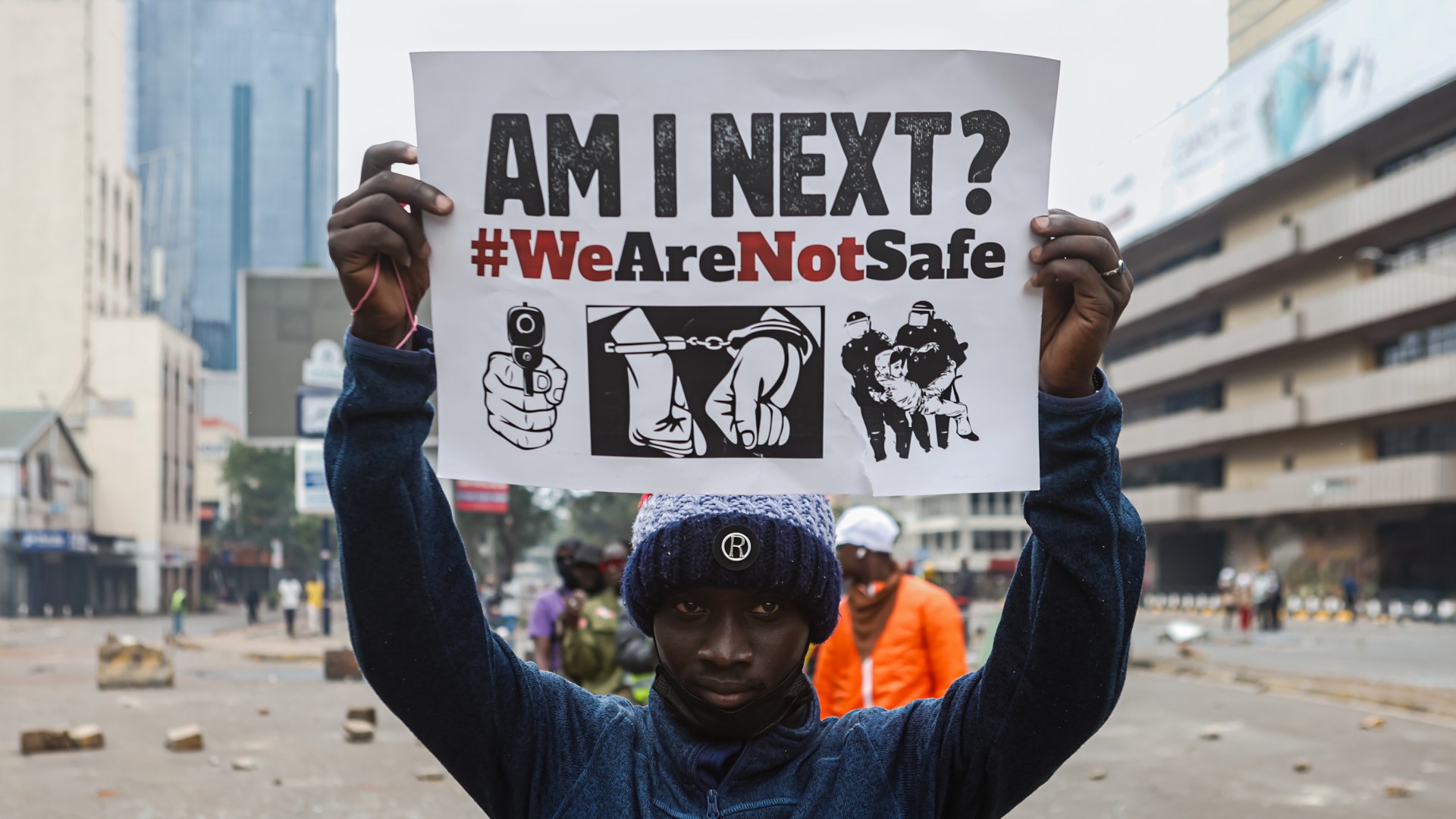
A protester holds a placard during a remembrance march in Nairobi to commemorate one year since many lost their lives in anti-tax demonstrations.

A protester holds a placard during a remembrance march in Nairobi to commemorate one year since many lost their lives in anti-tax demonstrations.

Christianity Today July 11, 2025
SOPA Images / Contributor / Getty

Police circled Kenya’s Parliament in Nairobi with barbed wire on June 25 and prepared to defend it with live ammunition and water cannons. One-third of a mile away, All Saints’ Cathedral—an Anglican church and landmark in Nairobi’s central business district—became a place of both refuge and conflict as police chased protestors into the compound that afternoon.

Two weeks later, Kenyans are still reacting to demonstrations in Nairobi and around the country that led to 19 deaths, according to the Kenya National Commission on Human Rights.

June 25 was the one-year anniversary of turmoil that led to the reported deaths of 60 Kenyans. Some protesters planned to storm State House—the home of Kenya’s president—but police barricades surrounded it. Demonstrators taunted police and threw rocks and other projectiles at them. Police hurled tear gas canisters and shot at crowds.

About 500 young people ran into the All Saints’ compound, according to provost Evans Omollo, who led the church in opening its gates to anyone who needed shelter.

“We needed to open up space for people who would be harassed,” Omollo said. “We created an elaborate plan of how to receive them. We set out an emergency medical center in partnership with the Kenya Red Cross.”

The provost said police wanted to attack the young people but priests intervened.

“We managed to hold them back and push them back,” he told CT.

Paul Otieno, who escaped into the church compound, said priests provided a buffer between protestors and the police officers who were chasing them. Otieno described how the priests organized transportation to hospitals for the injured. Priests also confronted the police head-on several times, asking them to back down.

The scene mirrored the events of the 2024 demonstrations, when the church opened its gates to 3,000 mostly Gen Z protestors and police launched tear gas canisters into the compound.

Kenyans are wondering how the protest escalated. Benard Kahiga, who protested this year and last, claimed that “police dispersed the peaceful protestors” but shielded masked “goons” wearing hoodies and carrying hoes and sticks who smashed shop windows and robbed stores. Business owners accused police of standing by during looting.

Outside Nairobi, protests that began peacefully degenerated into violent confrontations. Several parts of the country saw vandalism against businesses and police buildings. Many killings were in Nairobi and its environs.

Interior Cabinet Secretary Kipchumba Murkomen called the demonstrations part of a broader and deliberate effort to destabilize the country.

“This has nothing to do with protests, but an unconstitutional attempt to change the regime,” he said. “The police were able to foil an attempted coup.”

Kahiga disagreed, saying, “We want the cost of living to go down … and the government to cut down on public-sector expenditure by reducing the number of high-level appointments. … We will go back to the streets if things don’t add up.”

Kahiga, a father of two young children and a recent university graduate who said he is unemployed due to lack of opportunities, criticized high public debt and low governmental transparency and accountability. Kenya’s national treasury reported the ratio of public debt to gross domestic product: 63 percent production in 2025, 20 percent higher than in 2010.

Murkomen criticized churches’ response to the conflict: “No church member will speak about how the police were attacked and suffered immense pain. I also know no diplomat will defend our police, because it’s not in their interest for Kenya to be safe.”

But church leaders have spoken out against violence on both sides. The Evangelical Alliance of Kenya is calling for prayer, fasting, and “a hard stop to abductions, torture and killing of Kenyans by security agents or private individuals.”

While condemning the killings by police, Vincent Chahale, the International Justice Mission’s country director for Kenya, said, “Police need to follow guidelines laid down in law when dealing with members of the public.” 

Chahale has met with government officials about ways to strengthen community policing and increase trust between police and citizens. His proposals include reforming police service and training police in trauma-informed care. He said all perpetrators of human rights violations should be brought to account.

Limited access to news has also caused tension. During the protests, the Communications Authority of Kenya ordered Kenyan media houses to cease live broadcasts of the protests. The agency switched off television signals for three media stations—NTV, KTN, and K24—and claimed they had violated the directive.

But three civil society organizations—Law Society of Kenya, Police Reforms Working Group, and Kenya Medical Association—replied, “The live broadcast of peaceful protests, and even those that may involve sporadic acts of violence by a few individuals, does not inherently constitute propaganda for war or incitement to violence.”

The organizations said the directive violated Article 33(2) of the Kenyan Constitution, which guarantees freedom of “conscience, religion, belief and opinion.” Kenya’s High Court issued an order suspending the directive later in the day.

Kevin Kung’u, a youth pastor with Renewal Church in Nairobi, participated in both the 2024 and the 2025 protests. He said churches responded much better this year than last, calling for prayer and fasting before and after the June 25 protests: “More churches made a stand. You can see churches whose heart is tuned towards their people.”

Kung’u emphasized the need for churches to stand up to the state in ways that are legal and honoring to God. “Look at the Civil Rights Movement and Martin Luther King Jr. to really understand what our place should be.”

Back at All Saints’ Cathedral, Omollo reflected, “Like the prophets of the Old Testament, we see our role as watchdogs to political players, asking questions [such as] … ‘Why are the young people not able to have access to jobs?’ ‘Why can’t industries be created?’ ‘Why can’t resources being collected in the form of taxes be channeled to make education more affordable?’” 

Omollo said he and others in his church are “saddened by the many deaths happening in the country, and we are calling upon the police service to undertake a retraining of police officers so that the mentality of our officers can change. We also call on the general public to refrain from attacking police officers.”

This latest wave of violence happened while Kenyans were still reeling from the killing of Albert Ojwang, a 31-year-old teacher who had criticized the government. Ojwang died in a police cell in Nairobi the day after his June 7 arrest. Boniface Kariuki, a street vendor shot by police ten days later during a protest over Ojwang’s death, died on June 30. Ojwang was buried on Friday, July 4.

Theology

A Marxist and an Ayatollah Shaped Iran’s Islamic Republic

Both politicized the Shiite faith.

A mural on a street in Tehran depicting former head of state Ayatollah Khomeini.

A mural on a street in Tehran depicting former head of state Ayatollah Khomeini.

Christianity Today July 11, 2025
Kaveh Kazemi / Contributor / Getty

(This is part four of a four-part series on Shiite Islam and the Iranian regime. Please click here to read parts one, two, and three.)

While the first three parts of the series explored the history of Shiite Islam and how the lack of an earthly imam formed Shiite political culture, today we look at modern Iran and the rise of the Islamic republic.

Although other Shiite sects exist, Iran adopted the Twelver faith—based on a line of 12 imams. The last of these disappeared, and in the centuries that followed, the sect waited for the Twelfth Imam to return as Mahdi, a messiah-type figure, and establish global Islamic governance. In his absence, Shiites submitted to political authority without admitting its ultimate legitimacy.

Something began to shift in mid-19th century Iran as Western influence seeped into the still-Shiite but increasingly secular monarchy. In 1890, the shah granted an English business monopoly over the local tobacco industry, and in response, the masses protested the blow to national sovereignty and their personal economic interests.

Sitting at home, a leading Twelver scholar then issued a fatwa (legal opinion) declaring that continuing to smoke represented a war against the Twelfth Imam himself. The wave of support for the fatwa drove the shah to reverse his policy, and clerics began to sense their secular influence. Five years later, some joined the push for a national constitution.

Most clerics stayed quiet, however, focusing on ordinary religious affairs. But decades later in the 1960s, frustration with an unpopular shah led Ali Shariati, a Paris-educated sociologist from a clerical family, to apply a Marxist reading to the story of Hussein, the grandson of the prophet Muhammad.

Hailed as “Lord of the Martyrs,” Hussein gathered a small contingent of faithful followers and set out from Medina, the city of Muhammad in today’s Saudi Arabia, to oppose the unjust caliph who ruled from Damascus, Syria. Along the way in Karbala, Iraq, the caliph’s army intercepted Hussein’s approach, and a siege ensued. After ten days of negotiation, the army killed Hussein and his supporters.

The standard Twelver narrative held that as an imam, Hussein had divine foreknowledge of the massacre yet went to his death anyway. Faithful Shiites treated it as a redemptive act compensating for the failure of their ancestors to follow the imam. A Shiite tradition quotes Muhammad as saying, “[Hussein] shall die for the sake of my people.”

By visiting Hussein’s shrine and lamenting during the yearly commemoration of Ashura, they seek fulfillment of another traditional saying: “A single tear shed for Hussein washes away a hundred sins.” Extreme Shiites will even whip themselves with ropes or chains to demonstrate their remorse.

Shariati pushed back on that interpretation, calling for a “Red Shiism” that returned the faith to an activist posture against oppression and away from the “Black Shiism” of mourning. Shariati said Hussein had died valiantly. Though he had failed, in imitation Shiites might yet succeed in taking down the unjust shah. Shariati popularized a new phrase to remember: Every day is Ashura. Every land is Karbala.

The clergy dismissed Shariati’s reinterpretation. But some criticized the passivity of religious scholars in the face of perceived unjust rule and developed a narrative that merged mourning with activism. This group included Ayatollah Ruhollah Khomeini, the first supreme leader of the Islamic republic.

Marxism held no appeal to Khomeini, who went on to suppress his socialist and liberal democratic allies in the Iranian Revolution. Yet as early as the 1940s, he demonstrated political tendencies, arguing publicly against the overthrow of the monarchy in favor of reform by a just ruler. When a quietist scholar became the leading marja (clerical source of emulation), Khomeini went quiet as well out of respect. But when the marja died, the ayatollah’s activism returned—and his religious philosophy developed. In 1970, Khomeini published Islamic Government, crafting the theory of wilayat al-faqih, the rule of sharia experts.

For Khomeini the logic was obvious: Government is necessary to defend and promote Islam, at home and abroad. The political ruler is necessarily less well-versed in spiritual matters and should therefore defer to the religious scholar concerning matters of faith. In many ways, this reflected the situation during the Buyid and Safavid dynasties, when clerics legislated on the rulers’ behalf.

Khomeini cut out the middleman. It follows from the above, he believed, that the ideal ruler is a religious scholar. But the imamate exists not only to guide an individual toward righteousness but also to establish Shiite justice in society. These roles were not suspended during occultation, the disappearance of the Twelfth Imam. Rather, the imam’s eventual role as the Mahdi is now administered by the clerics. Khomeini dismissed the long-standing Shiite idea that political power is illegitimate absent the imam.

Khomeini’s Islamic republic established an elected president and parliament. But these operate under the authority of the supreme guide—the senior cleric. Article 5 of the constitution declares that the leadership rights of the Hidden Imam “devolve upon” him. Per Article 111, the elected Assembly of (religious) Experts can dismiss him if they view him as unjust or impious. And the constitution’s preamble calls for progress toward “the establishment of a Divine order” and “the formation of a single world community.”

Yet it makes no mention of when this will happen, nor what the role of the Twelfth Imam is in bringing it to completion. The constitution includes the words Shiites repeat when speaking about the Hidden Imam, “May Allah hasten his reappearance.”

Shiite Muslims esteemed Khomeini as a marja, but there are many maraji. Some are in Qom, the preeminent center of learning in Iran. Others are in Najaf, its rival center in Iraq. From there, fellow Iranian Ayatollah Abolqasem al-Khoei opposed wilayat al-faqih as an innovation in Shiite doctrine. And today, the aged Ayatollah Sistani, also Iranian and widely reputed as the Shiites’ foremost scholar, does the same.

These three figures provide a template for Shiite politics. Khoei represents the traditional Shiite posture of waiting for the Twelfth Imam, in which the role of scholars is to issue religious rulings and to guide society by moral example.

Sistani, however, mediated the democratic transition in Iraq during US occupation by advising Shiites to vote and helping shape their political orientation. But he, much like the Buyid and Safavid dynasties, left governance to the politicians.

Khomeini also awaited the Twelfth Imam. But in the imam’s absence, he encouraged people to strive to create the ideal society envisioned by the 12 imams—including government. Once established, the rule of religious scholars would prevent the nation from veering from Islam.

Within any religion, scholars disagree all the time. But they tend to be united on the essentials—the foundational doctrines and practices of faith. Wilayat al-faqih does not qualify.

Is such rule by sharia scholars consistent with the core concerns of Shiite Islam? It runs counter to the principle of quietism long established by Twelver teaching. But it is an answer—within the development of rare political power—for how Shiites pursue leadership and justice during the Mahdi’s occultation.

Shiites must judge. Christians have a different standard in Jesus.

Theology

Buddhism Imagines There’s No Heaven

How the ancient faith teaches the transmigration of souls and nonattachment to everything.

Buddhist meditating
Christianity Today July 11, 2025
Illustration by Christianity Today / Source Images: Getty, Unsplash

In this series

(For the previous article in this series, see here.)

The one Buddhist word many people know is karma. Some say it means good things happen to good people and bad to bad. Payback. Destiny. What goes around comes around. Maybe, but in Buddhism everyone is reincarnated. We are born, we die, we recycle into another life, and whatever we do in this life won’t come around until the next.

Most Buddhists note that we almost never have consciousness of what happened in our previous lives. We have no guarantee of being reborn as human, they say, and we probably won’t be. While Buddhism has many strands, in its classic form people can be reborn into six realms: The top three are gods, demigods, and humans, and the bottom three are ghosts, animals, and creatures in hell.

The bad news is that most people have negative emotions that lead to negative actions that lead to negative karma that can result in rebirth as fish, dogs, or cockroaches. But if we are reborn as humans, what then? Recycling ends only when a person attains nirvana, the extinction of individuality and entrance into the cosmic all.

The cycle may take millions of lives. Individuals progress by dropping all worldly attachments and emphasizing extensive meditation, strenuous physical exercises, and other means of turning off our egos. Buddhism wins support on those grounds from people tired of being consumed by consumerism, but it’s important to note that many Buddhists condemn not only attachment to houses and cars but also attachment to others. The Buddha himself named his son Rahula, which means “obstacle.”

Two Buddhist parables illustrate the sweeping nature of the nonattachment principle. One concerns a man fleeing a tiger. He comes to the edge of a cliff, finds a vine, and climbs down it. When almost down, he discovers that a second tiger awaits him at the bottom while mice chew the vine above him. Instead of trying to concoct a means of escape, he notices a wild strawberry growing on the face of the cliff and eats it. Then the vine breaks, and the tiger gobbles up the man. End of story.

Non-Buddhists might see this tale as one of horror or might wonder why the man didn’t desperately try to distract the tiger by tossing the strawberry to him. But the primary point is that as strawberry is to man, so man is to tiger: We should not be attached to our own lives. Furthermore, we are all part of the whole, and if we think rightly, we will not fear death.

The second Buddhist story concerns a monk, Kātyāyana, who walked through a forest; saw a man, a woman, and a baby joyfully eating lunch; and burst out laughing at the deluded family values of the diners. Kātyāyana told his disciples, “They’re eating a fish that they caught from the lake. That fish was the grandfather in a former life. The dog who is now barking and begging for the fish was the grandmother. The baby the mother is holding to her breast was the husband’s enemy, a man he had killed for assaulting his wife.”

At the core of Buddhism is a sense that our attachments are foolish and that if we get rid of them, we will control our emotions and avoid creating additional suffering for ourselves in this life and future ones. We can beat attachment through meditation. For example, a Buddhist monk told one of the students in my Journalism and Religion class to defeat attachment to a girlfriend’s appearance by looking past her skin and visualizing veins, organs, bacteria, and so on. As one Thai cleric stated, “Lust should be balanced by contemplation of loathsomeness. … Examine the body as a corpse and see the process of decay.”

That animosity toward the body is frequent in parts of Buddhism that depict the body as merely bones, flesh, and fluids in a bag of skin. That view doesn’t note that we are fearfully and wonderfully made; it misses trees and emphasizes gloom about the forest. Some Buddhists oppose spending time to enjoy beauty, since they see matter as illusion. Their standard goal is to concentrate on individual enlightenment and to break out of the cycle of transmigration that Buddhists call samsara—endless wandering.

Some Buddhists say those attached to someone or something should reflect on the impermanence of whatever they love. If Buddhists admire a bell, they should remember all the things that could go wrong with it: It could lose its sound, crack, be dropped and broken. Nonattachment may demand a distancing even from love for ideas.

In practice, it’s important to keep in mind that Buddhism is sometimes based more on tradition than on philosophy. Christians tend to think of religions in terms of doctrine, but Buddhism in Southeast Asia and elsewhere is powerfully shaped by history and culture.

Still, some fundamental things apply as time goes by. In Christian understanding, God changes us. In Buddhist understanding, we change ourselves. Buddhism is full of tips on how to do that through breathing exercises and other means. Many would-be Buddhists find such techniques do not work, but Buddhist leaders often emphasize perseverance and a refusal to be agitated.

Ideas

Great Falls of Fire

How Jimmy Swaggarts legacy of scandal shaped the evangelical landscape.

Jimmy Swaggart preaching.
Christianity Today July 11, 2025
Thomas S England / Contributor / Getty / Edits by CT

On July 13, Jimmy Swaggart, a prominent Pentecostal televangelist of the 1980s, will be laid to rest in Baton Rouge, Louisiana, leaving behind a legacy of scandal. His ministry was marked by two prostitution-related incidents—first in 1988, when he tearfully confessed on television, and again in 1991, when he defiantly told his congregation, “The Lord told me it’s flat none of your business.” Swaggart’s denomination, the Assemblies of God, defrocked him, but his congregation proved to be remarkably forgiving. Although the televangelist’s work never reached its pre-1988 heights, Swaggart remained in the pulpit and on television until the day of his death at age 90.

Swaggart’s sex life was big news, especially in televangelist circles. Other Christian TV stars of the ’80s and ’90s, like Jerry Falwell and Pat Robertson, were using their media platforms to promote conservative political policies and rigorous personal standards of holiness when it came to human sexuality. But while Swaggart’s “fall from grace” was salacious, it was certainly not unique. He joined a long line of American celebrity preachers who lived and died (and then were often resuscitated) by the sword of American celebrity culture.

Swaggart’s distinct contribution to American Christianity and culture is interwoven with the legacy of his tight-knit Pentecostal family from Ferriday, a small Delta town in north-central Louisiana. In the 1950s, Ferriday would have seemed like an unlikely place to find figures who would shape mainstream American culture; the town was characterized by deep Pentecostal roots, entrenched poverty, limited educational access, and stark racial and economic divides that marginalized both working-class white people and African Americans.

Yet those seemingly inauspicious factors combined to change the trajectory of American popular culture when figures like Jimmy Swaggart’s cousin Jerry Lee Lewis brought the sights and sounds of Ferriday’s Pentecostal revivals to national audiences. Emerging from a wave of young Southern musicians in the 1950s, Jerry Lee embodied the ecstatic energy of Pentecostal and Holiness church services—both Black and white—and brought it to mainstream American airwaves.

Lewis and others introduced to the nation and then to the world a flamboyant performance style marked by driving rhythms, fervent vocals, and gyrating dance moves rooted in Southern Pentecostalism from places like Macon, Georgia; Tupelo, Mississippi; and Ferriday. As a son of Pentecostalism, Lewis caused a pop culture sensation—and quite a bit of public consternation—when he transformed the Pentecostal exclamation “great balls of fire,” used to describe encounters with the Holy Spirit from Acts 2 that led to the signature practice of speaking in tongues, into a provocative anthem with unmistakable sexual undertones.

Like Jerry Lee Lewis, Swaggart was an accomplished musician—but he was also among those who condemned rock as the “Devil’s music.” Conservative white Protestant critiques of rock-and-roll in the 1950s often reflected anti-Black racism, portraying the sounds of the genre, rooted in African American music forms like jazz and boogie-woogie, as especially distasteful, occult, and morally corrupting. And Pentecostals like Swaggart—both Black and white—were deeply frustrated that the sounds of their churches were used by “worldly” rock-and-rollers. Rock was, for them, a particular spiritual threat, mocking God and desecrating what was holy.

Jimmy Swaggart may have decried rock. But in the end, the same environment that helped birth the Devil’s music fostered the spiritual intensity, commercialism, celebrity, and populist appeal that would later define his Pentecostal preaching.

Like the equally infamous Assemblies of God televangelists Jim and Tammy Faye Bakker, Swaggart commodified Pentecostal culture by packaging its emotional fervor, miracle narratives, and apocalyptic urgency into polished, watchable television. As Christian television expanded globally, Swaggart translated the ecstatic worship of backwoods Southern revival tents into a mass-media empire that reached millions. His broadcasts featured fiery sermons, gospel music, altar calls, and plenty of opportunities to purchase merchandise.

In this way, both Swaggart and Lewis helped turn a once-marginal religious tradition into one of the largest, fastest-growing forms of Christianity in the United States and beyond. In fact, recent research funded by the Public Religion Research Institute (PRRI) reveals that charismatic and Pentecostal Christianity is rapidly growing within the population of self-identified “born-again” or evangelical Christians, reshaping both the religious and the political landscape in the US.

Historically marginalized by evangelical leaders, charismatic practices that Swaggart promoted, such as speaking in tongues, prophecy, and divine healing, have gained broad acceptance, especially among younger generations. Gen Z and millennial Christians are more likely to attend charismatic or Pentecostal services, which suggests that the future of evangelicalism may be increasingly charismatic. As traditional evangelical denominations decline and nondenominational charismatic congregations ascend, the rise of charismatic Christianity may increasingly shape the future of Christian conservative activism in America.

Like Swaggart’s congregation in Louisiana, some charismatics and Pentecostals have shown a high tolerance for disgrace. Assemblies of God, the denomination that defrocked Swaggart, is now the denomination most supportive of President Donald Trump, a man with his own lengthy history of defying the traditional moral claims of conservative white Protestantism. In charismatic church circles, Swaggart’s return to Christian ministry after public embarrassment has been imitated by celebrity preachers like Ted Haggard, Carl Lentz, and many others who endure public embarrassment and find their way back to the spotlight, albeit often in diminished fashion.

Eventually, in spite of critiques from church gatekeepers, Pentecostals and charismatics found a way to create rock music that conservative white Protestants could enjoy and endorse. Evangelical media makers turned that music into a profitable market niche known as contemporary Christian music, which became the soundtrack for evangelical activism in the late 20th century. Through their knack for utilizing the power of media and the marketplace, Pentecostal and charismatic musicians now create a significant portion of new church music in America.

The story of Jimmy Swaggart, then, is not only the story of one famous Christian leader’s lasciviousness. It is also the story of how celebrity culture and mass media are shaping the American evangelical landscape. If evangelical voters had been of the Moral Majority ilk, for instance, Trump’s political career probably would have been quite short. But for communities shaped by Swaggart’s legacy, scandal does not have to be an end. It can also be a beginning.

Leah Payne is professor of American religious history at Portland Seminary and an affiliated scholar at the Public Religion Research Institute, as well as host of the podcast
Spirit and Power: Charismatics and Politics in American Life. Her book, God Gave Rock & Roll to You: A History of Contemporary Christian Music, won Christianity Today’s 2024 book award for history and biography.

Ideas

Disdain, Dallas Willard, and Donald Trump

“Anger is the most fundamental problem in human life,” Willard taught. Last summer’s assassination attempt was a vivid illustration.

Trump yelling in front of a protesting crowd
Christianity Today July 10, 2025
Illustration by Christianity Today / Source Images: Getty

“Anger is the most fundamental problem in human life.” So said Dallas Willard. Yet despite my admiration for Willard, whose books I’ve dutifully kept on my shelves if not always before my eyes, this particular conclusion was one I long questioned. Perhaps that was because I could internally categorize my own anger as righteous, a trick I couldn’t manage with my lust and pride.

Last July, when a would-be assassin fired on Donald Trump in a field in Butler, Pennsylvania, Willard’s words sprang to mind again. I began to question my prior skepticism anew. At that moment, mismanaged anger certainly presented itself as a fundamental problem, and the sadly successful assassination of a Minnesota state lawmaker and her husband this June has only amplified my concern.

After the Butler shooting, I reengaged with Willard’s sweeping classic work The Divine Conspiracy and sought to uncover the story of the man behind it. Willard’s biography involves an unlikely journey from undergoing family tragedy in rural Missouri to becoming a philosophy professor at the University of Southern California. There, he argued for the reality of reality in an academic milieu often content with declaring all to be a mere illusion.

But beyond any biographical detail, the true source of Willard’s declaration about the problematic primacy of anger was Jesus, whom Willard asserted was not just nice or good but smart—really smart. “My hope is to gain a fresh hearing for Jesus,” Willard boldly wrote at the opening of his book, “especially among those who believe they already understand him.”

Willard argued that in the Sermon on the Mount, Jesus was not just pulling marbles from a bag, presenting individual gems of wisdom that could be considered independently. Instead, the order of the presentation mattered greatly. “It is the elimination of anger and contempt,” he asserted, “that [Jesus] presents as the first and fundamental step toward the rightness of the kingdom heart.”

Conversely, today it is the systematic elevation of anger and contempt that is often rewarded across the political spectrum. One can argue whether Trump is a symptom, a cause, a catalyst, or a victim (or some combination of all those), but doubtless he is today’s central figure in America’s political culture of anger.

Trump’s famous fist-pumping response in Butler—plus a well-placed American flag and photographer—may have cemented his 2024 victory. His cry of “Fight! Fight! Fight!” would be emblazoned on the minds of millions and on the front of nearly as many T-shirts. In May, Trump replaced a White House portrait of former president Barack Obama with a canvas depicting the moment.

For me, though, the most-lasting memory from watching the events at Butler unfold on television was seeing a gray-haired man who, with his middle finger extended and cheeks flushed with rage, turned his face away from Trump, who was being loaded into an SUV behind him, and toward the cameras. From behind sunglasses, he yelled at the top of his lungs with words that matched his sign language. (You can catch a glimpse of him, in a red shirt and dark ball cap, on the right side of this video at the 2:15 mark.)

Were his curses directed toward the media, the would-be assassin, or just an amorphous them? Whatever his answer might be, from that moment, it seemed our national anger would only rise.

Though some of Trump’s supporters have declared him a changed man since the shooting, sadly he remains a contributor to that bitterness and mutual contempt, routinely calling people who pose obstacles to his agenda “fool,” “scum,” and “sleazebag.” These are not the words of a man who has absorbed the meaning of Jesus’ preaching on anger, where he taught that “anyone who says, ‘You fool!’ will be in danger of the fire of hell” (Matt. 5:22). Jesus was not prescribing a new, pick-your-insults-carefully legalism here, Willard explained, but “giving us a revelation of the preciousness of human beings.”

In fairness to Trump, this kind of contempt has been with us since the days of Cain. The president is far from alone in missing the enormity of the fact that every person on the planet is created in the image of God. As C. S. Lewis put it, “There are no ordinary people. You have never talked to a mere mortal.” 

Still, the Christian conviction is that the dignity of the imago Dei is universal and must be extended not only to those holding the levers of power but also to those on the lowest rungs of influence and respectability. The imago Dei must be extended to Trump himself, and it must be extended to people like Kilmar Abrego Garcia, the man whose legal saga—a wrongful deportation to an El Salvador prison, followed by court battles, then weeks of administration foot-dragging, and finally a return to the US to face freshly minted criminal charges that reportedly led one prosecutor to resign—has come to symbolize a larger debate around due process and individual rights.

That dignity is not tied to any special merit Abrego Garcia may boast. Indeed, some enthusiasm for his cause waned as evidence emerged that Abrego Garcia may have beaten his wife and been involved in human trafficking. Members of the Trump administration and their allies have pointed to those allegations to speak of Abrego Garcia in angry, dehumanizing terms. 

Harsh comments from White House Press Secretary Karoline Leavitt and Attorney General Pam Bondi have been particularly striking to me, as both women prominently wear crosses around their necks. “With the tongue we praise our Lord and Father, and with it we curse human beings, who have been made in God’s likeness. Out of the same mouth come praise and cursing. My brothers and sisters, this should not be” (James 3:9–10).

Willard described contempt as “a kind of studied degradation of another.” For those of us dismayed by that degradation in our politics, however, the task at hand is resisting the temptation to degrade the degraders. I’ve fallen prey to this myself in moments of anger at the president and his policies, and I have nothing good to show for it. “The delicious morsel of self-righteousness that anger cultivated always contains comes at a high price in the self-righteous reaction of those we cherish anger toward,” as Willard warned. “And the cycle is endless as long as anger has sway.”

Breaking that cycle is not easy, but it is essential for our personal and communal well-being. “To cut the root of anger,” Willard wrote, “is to wither the tree of human evil.” That is not a call to ignore injustice or, worse yet, to embrace evil under a cultish loyalty masquerading as love. Rather, according to Willard, “the answer is to right the wrong in persistent love.”  We do so recognizing, as Willard also observed, that if you “find a person who has embraced anger, … you find a person with a wounded ego.”  

This is the orientation that can produce a book title like I Love Idi Amin from the Anglican bishop Festo Kivengere, who in the 1970s opposed the Ugandan dictator without demonizing him. Kivengere expressed love and concern for one called “Africa’s Hitler”—and he is far from being the only model available to us. I have met the Nassar family of Bethlehem, Christians who, facing anger from every side, nevertheless live by the motto “We refuse to be enemies.” 

Last summer, the assassination attempt in Butler reminded me of the great challenge of anger. I prayed then and still pray today that the experience will change Trump himself, helping him understand anger’s sheer destructiveness to those who wield it and those it targets. But at least for now, the cycle of anger continues in America. As individuals, we can’t quickly change that national dynamic. But we can take steps to address that cycle in our own hearts.

“Nothing can be done with anger that cannot be done better without it,” Willard concluded. We do not need bitterness and contempt to oppose evil well. Kivengere looked to Jesus forgiving his unrepentant executioners from the cross and realized what that example meant for his own thinking about the dictator who had killed his friends and forced him into exile. “As evil as Idi Amin was,” he asked, “how can I do less [than forgive] him?”

Christ called his disciples to “take up their cross” (Matt. 16:24–26), and Paul wrote of his desire to know “the fellowship of his sufferings” (Phil. 3:10, NASB). In that vein, Willard taught, “Jesus did not die on the cross so that we wouldn’t have to die on the cross. He died on the cross so that we could join him in his death on the cross.” Willard called this the “meaning of the cross in spiritual growth.” And one way that we join with Jesus is by surrendering our will to God and rejecting the anger we coddle in our hearts.

John Murdock is an attorney who writes from Texas.

Theology

Shiites Await a Savior. How Should They Govern Now?

Rule by the minority Muslim sect is rare in history, but two premodern dynasties help explain Iran.

Shiite Muslim devotees reach to receive a blessing from the tomb of Imam Hussein, the Prophet Mohammed's grandson, at the Imam's shrine in the holy city of Karbala, Iraq.

Shiite Muslim devotees reach to receive a blessing from the tomb of Imam Hussein, the Prophet Mohammed's grandson, at the Imam's shrine in the holy city of Karbala, Iraq.

Christianity Today July 10, 2025
HUSSEIN FALEH / Contributor / Getty

(This is part three of a four-part series on Shiite Islam and the Iranian regime. Please click here to read parts one and two.)

The previous articles centered on the origins of Shiite Islam and its political history to examine the Shiite basis for Iran’s vision of government, one that is based on the central concept of wilayat al-faqih, translated literally as “guardianship of the jurist,” meaning the rule of a sharia expert. 

A brief recap: The two primary theological concerns of Shiism are Islamic justice and leadership, both represented in the figure of the imam. The large majority of Shiites, including most in Iran, are called Twelvers since they follow the line of 12 imams beginning with Ali, Muhammad’s cousin, whom they believe should have immediately inherited the prophet’s political position—but was wrongly denied.

Iran returned Shiites to power. Prior to the Islamic Republic, the ruling shah belonged to the sect but was a secular and modernizing leader. But does the restoration of religious government honor or betray the Shiite heritage? To evaluate, we will now examine the end of the lineage of imams and the two rare instances when Twelver dynasties ruled in Iran—without a rightful imam.

Ali did eventually lead the Islamic community as the fourth caliph, and Sunni Muslims agree his governance was just. Yet when civil war and assassination ended Ali’s rule, Sunnis controlled the empire and often persecuted Shiites as rival claimants to Muhammad’s mantle. The imams counseled patience to the Shiite community, knowing they were a vulnerable political minority. They focused on religion, guiding their followers in the right understanding of Islam.

But in AD 874, the Twelfth Imam, a five-year-old boy, disappeared.

This threw the Twelver community into confusion, and many drifted toward a rival Shiite sect called Ismailism, which had broken off from the Twelvers in AD 765 and ruled a powerful dynasty from Cairo. But Twelvers said that the child did not simply vanish but that Allah had preserved his life in occultation.

In astronomy, the term refers to one celestial body passing in front of another and blocking its view. Here Shiites said that Allah was hiding the imam from public view—especially from the Sunni authorities—until he could grow up and restore Shiites to Islamic political leadership. In the immediate aftermath, the treasurer of the deceased 11th imam continued to collect the Shiite tithe and answer believers’ questions, claiming to communicate with the child in secret.

After nearly 70 years passed without the imam’s reappearance, this “minor” (or short-term) occultation gave way to a “major” occultation that lasts to this day. Twelver scholars held that Allah has preserved the Twelfth Imam for centuries at the peak of his physical power. He is popularly believed to appear in dreams and visions to advise and encourage the community.

But one day, Shiites say, he will return in power as the Mahdi, the awaited one who would lead Muslims back to the just practice of their religion. Jesus, they believe, will appear at his side in assistance, and all the world will submit to Islam. The scholars counseled Shiites to endure patiently their place in the Sunni caliphate until then but not admit to its religious legitimacy.

In AD 934, however, a Shiite revolt led by Zaydis succeeded in the Caspian region of what was then Persia. Zaydis differed from Twelvers, as they believed the imam’s legitimacy rested less on his spiritual heritage and more on his commitment to confront injustice. They established the Buyid dynasty and switched religious orientation to adopt a Twelver position as their territory expanded to Baghdad, in modern-day Iraq. Some scholars say that once in power, Buyid leaders preferred subjects without a religious heritage of revolt.

Perhaps recognizing the limitations of regional geopolitics, they reached an accord with the Sunni Abbasid caliphate and sided with it against the rival Ismailis in Egypt. Tolerant toward their Sunni-majority population, the Buyids defended the religious legitimacy of their dynasty by supporting Shiite scholars. Otherwise, why should they be independent of the Sunni caliph?

Twelvers were confused. But also privileged. The Mahdi had not returned, yet Shiites held sway. Scholars deduced that ultimate political authority was still illegitimate absent the Twelfth Imam. Participation in government, however, no longer felt treasonous. Cooperation was possible as long as the authorities ruled consistently with Shiite conceptions of justice and protected their community.

In time, both the Buyid and the Ismaili dynasties collapsed, and Sunnis resumed control over the Arab and Persian worlds. But it was the Ottoman Turks who eventually rose in strength, creating a sultanate that absorbed the Sunni caliphate in 1517.

At the turn of the century, however, a different Turkish clan emerged from the Caucasus highlands to found the Safavid Empire in Iran. During the centuries in between, Shiites did not have a state of their own. Sometimes they faced persecution and had to hide their faith. Other times, if they did not rebel, the Sunni caliphs left them alone. The heritage of Ali, representing the family of Muhammad, protected them somewhat since it held great symbolic religious weight.

The Safavids also adopted a Twelver identity and, during their two-century rule, forcefully imposed it to create a Shiite majority. The shah—or king—defined his dynasty in opposition to Sunni powers and to minimize internal opposition.

But Shiism took hold. It appealed to Iranians as a national faith against the dominance of Arabs and Turks. The shah claimed to descend from Ali and to rule as the Hidden Imam’s representative. This accorded with the Iranian political culture that had viewed the leader as semi-divine since its origins in the ancient Zoroastrian religion. Iranians also cherished the tradition of a social contract that upholds the ruler’s legitimacy. The Safavids preached the example of Ali and brought prosperity to the nation. Constantly at odds with stronger Sunni powers, the people also resonated with the idea of a Mahdi who would lead them to eventual victory.

Both Buyids and Safavids faced the same problem, however: How should they legislate their state without an imam? The original 12 imams could directly interpret the Quran and Muslim traditions. In their absence, scholars now had to do the work—supported officially by the governing regime. 

The leading experts ruled that multiple sharia scholars could produce different but equally valid verdicts. A system developed akin to peer review in Western academia. Seminaries trained the religiously inclined, who were licensed and rose in clerical rank as senior scholars recognized their aptitude. And in the late 18th century, Twelvers developed a position for the top Shiite scholar: the marja al-taqlid, meaning the source of emulation for other to follow.

The prestige of the marja al-taqlid is comparable to that of the Catholic pope. Islam, however, lacks an authoritative religious establishment, so the idea developed that individual Shiites could follow a legitimate sharia scholar of their choice. While the marja al-taqlid was undoubtedly a senior cleric, others felt inclined to follow other figures. Several maraji (the Arabic plural of marja) emerged as their students multiplied in number and esteem. Some lived in Sunni areas, others in Twelver domains. But all recognized that ultimate governance rested solely with the Mahdi.

Christians and Jews are no strangers to the idea of waiting for the return and ultimate rule of a Messiah and living in the tension of what is not yet here. The political nature of Islam complicates it further for Shiites. Is wilayat al-faqih the best solution? Part four of this series concludes with modern-day Iran’s supreme leader, Ayatollah Khomeini.

Ideas

God Is Jealous, but Never Envious

Columnist; Contributor

We often treat these words as synonyms. In Scripture, they’re near opposites.

A broken heart and golden calf.
Christianity Today July 10, 2025
Illustration by Elizabeth Kaye / Source Images: Getty, Wikimedia Commons

In Deuteronomy, as Moses addresses Israel on the eve of entering the Promised Land, he makes regular mention of God’s jealousy. This must be one of the least celebrated of God’s attributes. It is certainly one of the most misunderstood.

In our culture, jealousy is almost always portrayed as a bad thing. “O, beware, my lord, of jealousy,” says Iago to Othello in Shakespeare’s play. “It is the green-eyed monster which doth mock / The meat it feeds on.” Or think of the chorus of “Mr. Brightside”by The Killers, with its wails against “jealousy, / Turning saints into the sea, / Swimming through sick lullabies, / Choking on your alibis.” Many even use the word—wrongly, I think—to describe the seething resentment that rival siblings might feel over each other’s toys.

In this context, proclaiming God’s jealousy can feel like an embarrassing reminder of the overweening pettiness of Bronze Age religion. A jealous God? How primitive! This awkwardness leaves noticeable gaps in our worship services and our private spiritual lives. When was the last time you sang a song praising God for being jealous? When did you last hear a sermon on the subject? When did you last mention it in prayer?

Yet God’s jealousy is integral to the way Scripture describes him. It appears in the Ten Commandments: “For I, the Lord your God, am a jealous God” (Ex. 20:5). It is revealed as part of God’s name: “Do not worship any other god, for the Lord, whose name is Jealous, is a jealous God” (34:14). It is repeated several times in Deuteronomy, and it undergirds the theology of Ezekiel, Nahum, and Zechariah in particular. There is no getting away from it.

Here is the problem. In modern English, most people do not distinguish between jealousy and envy. The two words sound identical. Yet in reality they are near opposites. Envy is a fierce desire for something that rightly belongs to someone else. In Scripture, we see it exposed as a disorder-sowing (James 3:16), bone-rotting (Prov. 14:30), Christ-killing (Matt. 27:18) work of the flesh. Jealousy, by contrast, is a fierce desire for something that rightly belongs to you. Envy is when you want to sleep with someone else’s husband or wife. Jealousy is when you don’t want anyone else to sleep with yours.

When we grasp that, we can see why a perfectly faithful lover would feel jealous when jilted by a loved one. In fact, no other response would be fitting. If I did not feel jealous about someone else having an affair with my wife or taking my children from me, I would only be showing how little I loved them.

The point is much sharper when we consider things from God’s perspective. Having taken the Israelites out of Egypt and carried them through the wilderness, how could he greet his people building idols and worshiping foreign gods with anything but fierce jealousy? That is how lovers react when they are betrayed—and the greater the love, the greater the betrayal and the greater the jealousy.

This is personal for Moses in Deuteronomy 4. He has experienced the consequences of God’s jealousy for Israel: “The Lord was angry with me because of you, and he solemnly swore that I would not cross the Jordan. … I will die in this land” (vv. 21–22). But he is not bitter. Rather, he urges the people to learn from his experience. “Be careful not to forget the covenant of the Lord your God that he made with you; do not make for yourselves an idol” (v. 23), because “the Lord your God is a consuming fire, a jealous God” (v. 24).

Happily, Moses’s sermon does not end there. Granted, it immediately mentions the possibility—later a reality—that Israel may provoke God’s jealousy by falling into idolatry after settling in the land (v. 25) and face destruction and exile as a result (vv. 26–27). But then comes hope. If, after all this has happened, Israel comes to its senses in the pigsty of exile and seeks the Lord, then “you will find him if you seek him with all your heart and with all your soul” (v. 29).

This is a prophecy, not a mere possibility (v. 30). Because, besides being a jealous God, “the Lord your God is a merciful God” (v. 31). His jealousy brings judgment, but his mercy brings restoration. His jealousy will take his people into exile, and his mercy will bring them back again. And ultimately, the consuming fire of God’s jealousy and the overflowing waters of his mercy will meet at the cross.

Andrew Wilson is teaching pastor at King’s Church London and author of Remaking the World: How 1776 Created the Post-Christian West.

Apple PodcastsDown ArrowDown ArrowDown Arrowarrow_left_altLeft ArrowLeft ArrowRight ArrowRight ArrowRight Arrowarrow_up_altUp ArrowUp ArrowAvailable at Amazoncaret-downCloseCloseEmailEmailExpandExpandExternalExternalFacebookfacebook-squareGiftGiftGooglegoogleGoogle KeephamburgerInstagraminstagram-squareLinkLinklinkedin-squareListenListenListenChristianity TodayCT Creative Studio Logologo_orgMegaphoneMenuMenupausePinterestPlayPlayPocketPodcastRSSRSSSaveSaveSaveSearchSearchsearchSpotifyStitcherTelegramTable of ContentsTable of Contentstwitter-squareWhatsAppXYouTubeYouTube