Inkwell

A Theology of Your 20s

The chiasms used in Scripture helped me see the eternal significance of the in-between.

Inkwell June 12, 2025
"Les joueurs de jacquet backgammon" by Jean Béraud

At 27 (almost 28) on a quiet Monday morning, living at home with my parents, I find myself pondering all that has led me to this present moment. Pulling on a college sweatshirt from the floor of my childhood bedroom. Tiptoeing downstairs for a cup of coffee my dad has already brewed. Staring absentmindedly at the fridge, now a collage of save-the-dates and baby shower invitations. 

The routine feels eerily similar to life at 17, save for a few differences. For one, those hand-lettered envelopes are addressed to me, sent by my friends rather than those of my parents. And for another, I feel far less certain now than I did back then.

At 17, I was absolutely convinced of how life would unfold. I had the resolute conviction that everything—career, marriage, purpose—would fall into place exactly as it should, and on time. I assumed I’d naturally stumble into meaningful work, that I would fall in love effortlessly, that my calling would announce itself with unmistakable clarity. I envisioned my 20s as a decade of steady milestones shared in tandem with friends who were reaching them too.

But somewhere between growing older and the endless stream of weddings, bachelorette weekends, and baby registries slowly chipping away at my teacher’s salary, those great expectations started to unravel. 

While my peers honeymooned in Mexico, I sat through awkward, ultimately unsuccessful first dates. While they earned promotions, I was begging for a classroom with functioning air conditioning. While they bought starter homes, I hunted for discounts at department stores. And all the while, I quietly wondered: What should my life look like in my 20s? 

To complicate an already tumultuous decade, growing up in the South meant that I was raised with the cultural and religious conviction that marriage and motherhood were my destined roles. I assumed that I would be pregnant alongside my sisters, double-dating with my friends, using my late grandmother’s china at dinner parties, and passing down my baby dolls to my own children. 

But as I approached my mid-20s, still arguably young, I found myself neither married nor settled. I struggled to reconcile my present circumstances with the internalized expectations of what my life should be. Even the familiar one-liners rooted in Scripture—God will give you the desires of your heart (Ps. 37:4) or simply Pray about it! (Matt. 7:11)—felt increasingly irrelevant through the unpredictability of life. What was I supposed to do when both the china and the baby dolls lay untouched, gathering dust?

Desperate to escape this awkward in-between—this space between hoping and having—I searched everywhere for the reference photo everyone else seemed to have, the one that allowed them to piece together the puzzle of life with such certainty. But while they committed to careers, marriages, and cities with unwavering certitude, I only grew more hesitant, unsure of what to do or who to become. I kept wondering why the life I had imagined ten years ago felt so far away, and even began to question the questioning itself. I’m almost 28, after all. Shouldn’t I have some of the answers by now? It’s easy to feel like we’ve somehow fallen behind or missed a step in the elusive formula for success.

At the heart of this analysis, what we are really asking is, What do I do in this awkward middle space when the outcomes haven’t materialized yet, and maybe never will? 

Then I found The BEMA Podcast.

Its founder, Marty Solomon, is a theologian who experienced his own crisis of faith in his mid-20s. He too felt as though the spiritual spaces he was a part of offered packaged, systemized theology that didn’t address his gut-level questions. 

In search of something more, he became a student of Ray Vander Laan, an expert in biblical cultural studies. Under Vander Laan’s guidance, Solomon began to read Scripture through the lens of the Jewish perspective with which it was originally written. “I had been taught to view Scripture through a very Western classical theology,” Solomon reflects in the first episode, “and that Western lens bumping up against an Eastern world was where a lot of that dissonance was coming from.”

This notion resonated—so much had been lost when I approached God with assumptions, organizing biblical truth into neat outlines, bullet points, and lists. By attempting to let go of my Western interpretation of my very own existence, I began to embrace the evolving nature of esse—a reality rooted not in fixed outcomes but in discovery.

This framework does not mean truth becomes relative but rather that it is recognized as dynamic, constantly expanding and moving in multiple directions. It is a truth revealed through images, stories, poems, parables, songs, and shifting perspectives, one that guides us toward mastering the art of accepting the ever-unfolding process. 

A chiasm is a specific literary device used in the ancient world that emphasizes the value of this exact process. As a form of parallelism, chiasm is a mirrored structure where the first part of the narrative corresponds with the second, drawing the reader’s attention to its central point, a delicious middle. 

Solomon explains that “when the ancient audience encountered a chiasm, they knew exactly what to do with it”—they would readily identify the pattern that had been meticulously crafted by the author to point directly to the heart of the story. The chiasm is hidden within the text like a treasure waiting to be discovered, offering a richer, more intimate learning experience.

In the West, according to Solomon, we tend to focus heavily on information, emphasizing being told something rather than engaging in independent discovery. As a result, we typically regard the conclusion of a story as its most significant lesson. In contrast, the Eastern perspective understands that the author is intentionally burying something within the narrative for the reader to uncover. In this tradition, the most profound insights are often found not at the beginning or the end but in the center of the story.

A sacred treasure might just lie hidden at the heart of the narrative, waiting for curious minds to find it.

I have been thinking much of chiasms lately, the significance of the middle. There’s something profound about abandoning the need for immediate and clear answers, embracing the raw process of discovery. It’s to get our hands dirty, sinking deep into the big questions and manually unearthing layers of rich thought. It’s no longer about waiting for the end to receive revelation. It’s about tasting the juicy substance of the in-between. The chiasm, where both the beginning and the end converge, is a space brimming with purpose, discovery, and goodness.

So too are our 20s. Sandwiched between the innocence of adolescence and the maturity of later adulthood, we find ourselves frantically searching for ourselves. Rather than desperately reaching toward the milestones we all believe would thrust us to a specified destination, perhaps we gently settle into where we are right now. 

I now welcome the growing pains of this present moment. Though it is challenging, I have found solace in naming the chaos around me, in confessing my disappointments, in expressing my uncertainty. I have become as much of an observer as I am a participant, stepping into the sanctity of simply being, releasing the need for formulaic living. It has been a great wrestle and a great reward.

I’ve lived life alongside many other 20-somethings, most of them also wondering if life is supposed to feel this uncertain, this hallowed, this scarred, this true.

Despite the different phases of life we are navigating—singleness, fatherhood, wifehood, relationship-tied loneliness—we are more alike than we are different. We are all insecure about the direction of our lives; we all long for difference while simultaneously resisting change; we are satisfied and heartbroken, overwhelmed and bored out of our minds.

And if you are asking the same question as me—What should my life look like in my 20s?—welcome. I don’t guarantee that the answer will be the same for all of us, but I do hope that, as we navigate this turbulent, unpredictable decade, we can bare our hearts transparently and join our shaking hands in prayer, in accountability, in communion. In this doubt, in this joy—I’ll meet you there, every time.

Such are your 20-somethings.

Such is being human.

Chloe Rhodes is a writer and educator and a recent graduate of the Columbia Publishing Course in Oxford. She is the voice behind Tuesday/Thursday Lunch Club on Substack, where she explores the everyday and the interior with curiosity and candor.

News

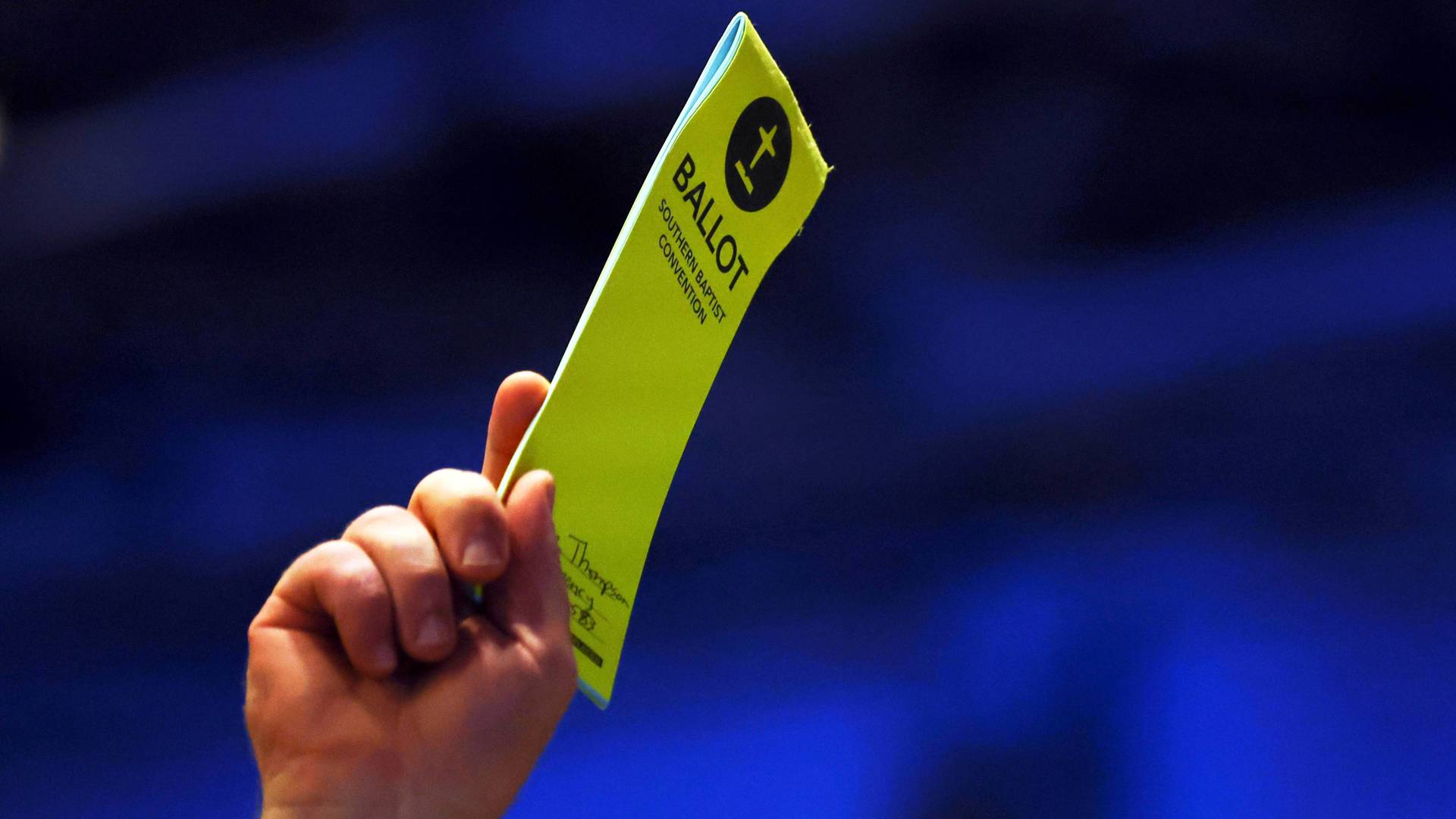
Southern Baptists Vote to Denounce Sports Betting, Endorse Bans on Online Porn

Resolutions call for stronger government regulations on social issues.

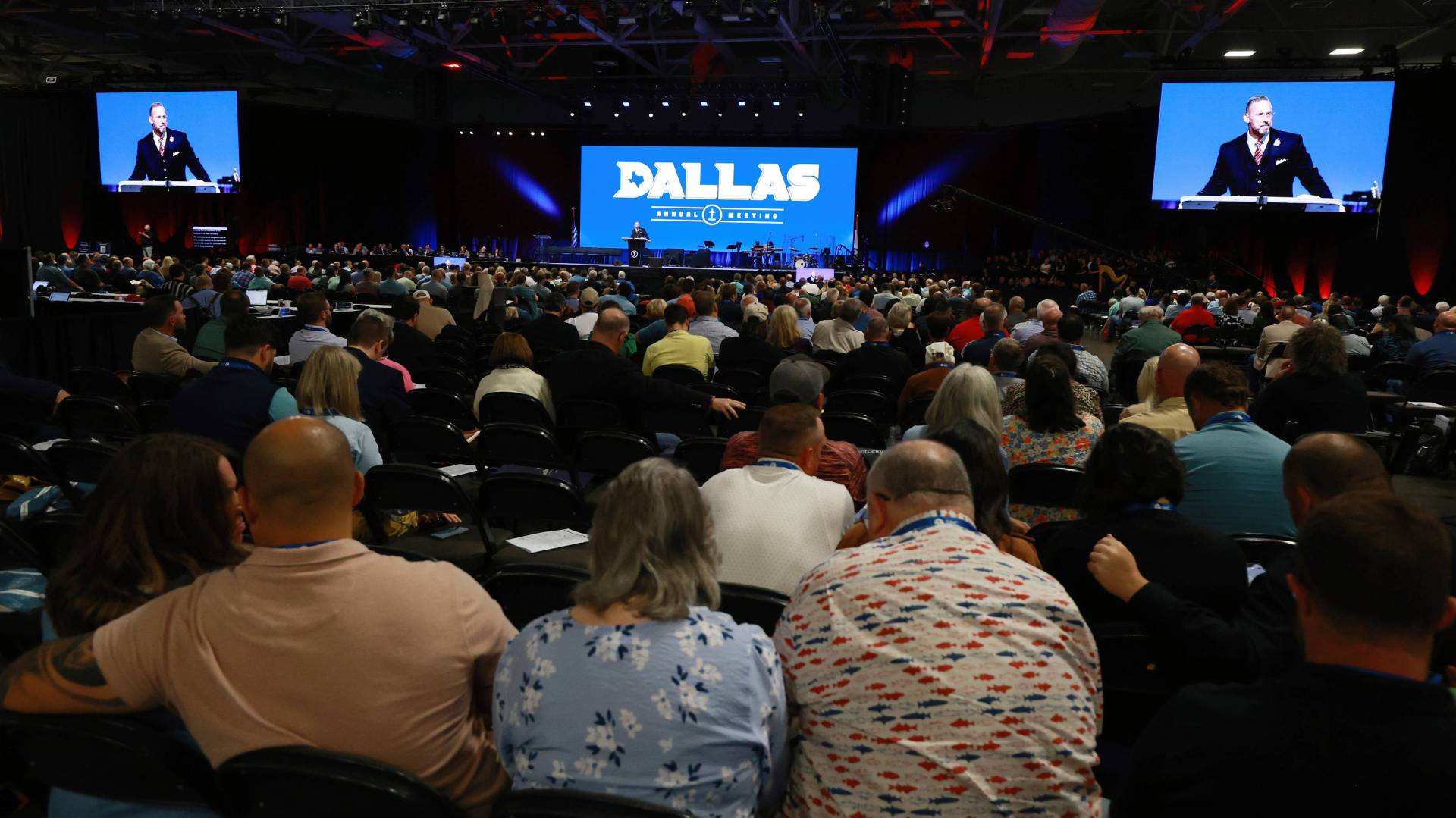
Crowd in convention center with three screens.

Southern Baptists gather in Dallas June 9–11.

Christianity Today June 11, 2025
Richard W. Rodriguez / Associated Press

Southern Baptists remain united in their long-standing opposition to gambling, pornography, abortion, and same-sex marriage, and they’re putting out stronger calls for the US government to ban what they see as sinful and harmful practices. 

On Tuesday at the annual meeting, a slate of resolutions—positional statements meant to represent the position of the Southern Baptist Convention (SBC)—all passed by huge majorities with little to no debate.

Though the SBC’s opposition to gambling dates back to the 19th century, this week marks the first time Southern Baptists voted to condemn sports betting in particular. The new statement decries sports betting as predatory, backs government regulation, and asks Southern Baptists to refuse to participate.

It says the industry “fosters a culture of greed while specifically exploiting and preying upon young adults, the impoverished, and those with addictive personality traits.”
Since a 2018 Supreme Court decision overturning federal bans on sports betting, this form of gambling has blown up to a $13.7 billion industry in the US, with ads infiltrating sports media and broadcasts. Fewer than a dozen states have yet to legalize sports betting, and Texas remains a major holdout.

“Gambling is not a new temptation, but I believe that the advent of online sports gambling raises the stakes considerably on how seriously Christian leaders should address questions around the moral and theological nature of gambling,” Kyle Worley, a Southern Baptist pastor from Texas, wrote last year.

The SBC also passed its most comprehensive call for criminalizing pornography and eliminating it from the internet entirely.

“We urge the United States Congress and state legislatures to enact comprehensive laws that ban the creation, publication, hosting, and distribution of pornographic content in all media … in the ultimate effort to eradicate pornography nationwide,” the SBC resolution read.

The move comes a few weeks after President Donald Trump signed the Take It Down Act, banning revenge porn and digitally altered deepfakes. Southern Baptists commended the law as “model legislation” on the issue and also asked government officials to protect people from future AI-generated porn.

As online pornography becomes more pervasive, more adults in surveys admit to viewing porn, and some research shows that Christians are nearly as likely as Americans overall to see it as healthy rather than harmful.

Yet conservative Christians who have long spoken out against the harms of pornography also have more company. Companies like Pornhub face swelling pushback for allowing abusive material to appear on their sites.

Another resolution favored government restrictions on abortion pills, which have become more common since the pandemic and now account for 63 percent of abortions in the country.

Southern Baptists asked for national and state bans on medication abortion and for the Food and Drug Administration to revoke its approval of the medication mifepristone for abortions. The SBC cited an Ethics and Public Policy Center study, released in April, that found that the medical risks of medication abortion are underreported.

The SBC also approved wide-ranging resolutions on marriage, gender, and sexuality, which included calling for Obergefell v. Hodges, which legalized gay marriage in 2015, to be overturned along with other laws and rulings that “defy God’s design for marriage and family.”

In a Gospel Coalition article published ahead of the Obergefell anniversary this month, SBC resolutions committee chair Andrew Walker argued that even without any political will to overturn the ruling, Christians should hope and try to.

“Secular wins are neither inevitable nor unstoppable nor permanent,” said Walker, associate theology dean at Southern Baptist Theological Seminary. He cited a leveling off in support for gay marriage and concerns around the country’s fertility crisis as “small glimmers” of hope.

Same-sex marriage was not discussed or debated when the measure passed Tuesday, though SBC president Clint Pressley praised Southern Baptists’ clear stances against same-sex marriage and transgender identity in his address to the convention earlier in the day.

The marriage, gender, and sexuality resolution also spoke out against laws that recognize transgender identity, including in sports, and in favor of government incentives for growing families “in life-affirming ways.”

Because SBC pastors and churches operate autonomously, none of the resolutions compel or require action. They are meant to reflect the consensus and convictions of the convention and help Southern Baptists to “think Christianly about urgent ethical issues,” said Walker.

The resolutions reflect some recent areas of focus for the Southern Baptist public policy arm, the Ethics and Religious Liberty Commission (ERLC), which the messengers are once again considering a move to abolish.

Earlier this year, the ERLC issued a white paper on sports gambling as well as a guide for pastors who want to address the topic with their churches. “The gambling industry is rooted in predation, greed, covetousness, and idolatry,” agency staff wrote. “Additionally, the addictive nature of gambling leads to physical, emotional, and relational harm.”

Around 80 percent of evangelical pastors oppose legalizing sports betting, though pastors under 45 are less likely to agree, according to a Lifeway Research report released last year. Over half of pastors say they haven’t felt the need to address the issue with their churches.

The new resolution on sports betting also encourages pastors to educate churches “on the deceptive sin of gambling” and to offer counseling for those who become addicted.

The ERLC also advocated around regulations for pornography, particularly age-verification laws that restrict access to explicit sites, when the issue came before the Supreme Court in January.

“Over the last several years as the ERLC has worked on various proposals and authored an original Supreme Court brief advocating for age verification laws to protect children, we have seen the destructive effects and predatory nature of pornography,” said ERLC president Brent Leatherwood, who submitted the resolution.

News

PCA Releases Results of Its ‘Jesus Calling’ Investigation

The denomination had ordered agencies to determine the “appropriateness” of the book for Christians.

The PCA gathers for a recent denominational meeting.

The PCA gathers for a recent denominational meeting.

Christianity Today June 11, 2025
Courtesy of the Presbyterian Church in America Administrative Committee

The Presbyterian Church in America’s bookstore wouldn’t recommend or sell Jesus Calling, but the denomination doesn’t need to do anything about the best-selling devotional, according to the results of an investigation submitted to the General Assembly.

Last year the Presbyterian Church in America (PCA) ordered two denominational agencies to investigate the “appropriateness for Christians” of Jesus Calling. Now, ahead of the denomination’s annual assembly June 23, the denominational agencies—Mission to the World (MTW) and the Committee on Discipleship Ministries (CDM)—have issued the results of their investigations. 

Neither agency recommended any further action or condemnation of author Sarah Young’s work, although CDM, which oversees the denomination’s bookstore and publications, said it would not recommend the book, instead allowing local pastors to evaluate it. CDM has not offered the book for sale since 2014. 

First published in 2004, Jesus Calling has sold about 45 million copies, making Young one of the most-read evangelicals of the past 20 years. She died 10 months before the PCA voted to investigate her work, but the criticisms of her work from within her denomination were not new. 

Critics said she styled her writing as direct revelation from God. Young called her work “listening prayers,” where she journaled what she heard from God in prayer. Young’s husband, PCA elder Stephen Young, has denied that she saw her work as adding to Scripture, saying she instead wanted to push people to Scripture. 

The Youngs were longtime PCA missionaries in Japan and Australia, and Stephen Young still serves with MTW. The Young family told Religion News Service last year that the proceeds from Jesus Calling went to fund new churches and overseas missions.

Stephen Young will be at the assembly this year with his daughter to see any further outcome of the reports.   

“This process has been really hard and discouraging for our family,” said Stephanie van der Westhuizen, the Youngs’ daughter, in an email to CT. She has monitored podcasts and publications about the dustup to see what might come up at the assembly. “On one hand, I’m thankful my mom did not have to live through seeing this happen. But on the other hand, we are still very much grieving her loss, and we were blindsided by the Jesus Calling overture showing up in the General Assembly last year.”

At that assembly, the PCA tasked the two agencies with investigating Young’s work. 

This month, MTW issued a report that was a few paragraphs long—notable in a denomination where similar reports can go for dozens and even hundreds of pages. MTW concluded it had no connection with the writing or publication of the book and that it therefore had no recommendations regarding the book.  

“The author did not write or publish the book at MTW’s request or with MTW’s involvement, and MTW did not review, edit, or approve the book in advance of its release,” the missions agency wrote in its report, published by the denominational news outlet byFaith. “After MTW’s good faith investigation of the matter addressed by the Overture—bearing in mind the amount of time that has passed since the book was written and published—MTW was unable to ascertain whether the author asked any individuals in MTW to give any counsel regarding the content of the book. To the best of MTW’s knowledge, the author wrote this book independently.”

The MTW report was also warm toward Young: “As an organization, we miss her dearly but rejoice that she’s in the arms of her precious Savior.”

CDM’s report was also only a few paragraphs and emphasized that local pastors should have the final say over recommending books to their parishioners. CDM said it received complaints about the book in 2014 and removed the title from the PCA bookstore.

“Since the devotional life and spiritual maturity of each person are unique, local church elders are best suited to evaluate the spiritual needs and maturity of those considering the book,” CDM’s report said. “Elders should converse with members and recommend alternative or remedial devotional materials as needed.”

Benjamin Inman, the author of the original overture to investigate the book, had wanted the PCA to investigate whether the book violated the second commandment and to potentially repent as a denomination for it—and he noted that the denomination had collectively repented for other sins like “American chattel slavery.” Inman has compared Young’s work to New Age “mediumship practices.” 

Inman’s presbytery rejected the measure, but he submitted it as an individual to the denomination, and the denomination passed an amended version last year.

Not long after the vote, it came to light that Inman had already joined a church in another denomination when he introduced the measure. PCA administration said the vote to investigate Young was still valid because the assembly had amended Inman’s measure. 

“We have had to carry the constant burden of wondering what will happen at the upcoming General Assembly,” said van der Westhuizen. “We have felt helpless, not being able to do anything, but just having to wait and see what happens.”

The book’s popularity has risen since the PCA’s investigation; it was fifth on the Christian bestsellers list when the PCA voted last year and is now number two

News
Wire Story

SBC Survivor Jennifer Lyell Left Behind Detailed Allegations of Abuse

In a deposition, Lyell alleged that her professor and mentor would coerce her into sexual activity, then tell her to repent and never speak of it.

Two demonstrators hold posters with faces of SBC abuse victims including Jennifer Lyell.
Christianity Today June 11, 2025
Peter Smith / Associated Press

In early April, Jennifer Lyell, a former Christian publishing executive, sat for a deposition in a defamation lawsuit filed by her once mentor and professor David Sills.

There she detailed alleged sexual and spiritual abuse by Sills in graphic detail—and insisted he had coerced her into sexual acts without her consent, and then asked her to join him at family meals afterward.

“But he always knew that I never, ever wanted any instance,” she said in an excerpt from her April 10 deposition. “And I always, always tried to stop it.”

Lyell died Saturday after suffering a series of strokes. She was 47. A few weeks before she died, her lawyer filed excerpts of her deposition in a federal court as part of a legal battle over discovery in the defamation lawsuit.

Attorneys for Sills had filed a motion to compel discovery of a number of things, including notes from Lyell’s counseling sessions. Lyell’s lawyers argued those notes were privileged and should not be turned over. The excerpts from Lyell’s deposition, filed as part of the response to the discovery requests, revealed additional details about the alleged abuse by Sills. In excerpts from the deposition, Lyell describes being forced to perform sexual acts despite telling Sills no.

“I resisted—attempted to resist verbally, physically squirming, reasoning, no, all these things,” she said in her deposition, adding Sills would often corner her and not allow her to get away.

The conflict over discovery is the latest chapter in the legal battle between Sills and leaders of the Southern Baptist Convention. Sills, a former seminary professor, has claimed SBC leaders defamed him by including his name in a report on the issue of sexual abuse published in 2022. Sills has admitted to misconduct but claimed it was consensual and denied in court documents that he was abusive.

Lyell, a former vice president of Lifeway, a Southern Baptist publishing arm, was also named in the lawsuit. In 2019, she went public with her allegations against Sills. But few details of the abuse had been revealed until the May 20 court filing. 

Along with abuse, Lyell also described spiritual manipulation by Sills—a longtime missionary and seminary professor—saying she was made to feel as if she had somehow tempted Sills into sexual activity. 

According to Lyell’s deposition, Sills often coerced her into sexual activity while she was visiting his home and while family members were also still in the house. Sills, a family friend and surrogate father figure, would go from being encouraging and parental to abusive and back again, Lyell alleges in her deposition, claiming that not long after forcing her to perform sex acts, Sills would lead his family and Lyell in prayers at the dinner table.

Sills would allegedly tell her to clean her face and to repent for what she had done—warning her that once she repented, she could never tell anyone about what had happened.

“And he would then—very often, when he would finish, like in that example of the oral sex, the hand would come off of my head, and he would say, now, go fix your face and repent,” Lyell alleged in the deposition.

“And then he had rules, such as that after you repent, because of 1 John 1:9, that you can never speak of whatever you’ve repented of, or that’s blasphemous. And so, I was stuck without a way to figure out how to navigate the, all of the confusing and seemingly conflicting dynamics.”

In the deposition excerpts, Lyell said that at first, she blamed herself, saying something “broken” in her was causing Sills to act in an abusive manner. She eventually realized he wanted the sexual activity and she was not causing him to sin, according to the deposition excerpts. 

A mediation session in the Sills lawsuit in late April failed to reach a resolution earlier this spring.

“David Sills denies and has always denied each and every allegation made by his accuser, including the content of the very limited deposition testimony released by counsel. We anticipate that the totality of evidence, once no longer under seal, will once-and-for-all clarify the actual facts,” Katherine Barrett Riley and Shannon McNulty, attorneys for Sills, told RNS in an email.

Court documents also mentioned claims of alleged sexual misconduct involving another woman who had sought spiritual counsel from Sills for her troubled marriage. Sills’s lawyers are attempting to block her from being deposed.

“Plaintiffs moved to prohibit the deposition of that witness, who is expected to testify that David Sills took advantage of her vulnerability after she and her husband came to him for counseling concerning their marriage and manipulated her into giving him oral sex,” according to a document filed by Lyell’s lawyers.

Lyell’s death and the excerpts from her deposition come at a time when the Southern Baptist Convention is convening in Dallas for its annual meeting. During that meeting, which ends Wednesday, SBC messengers will have to vote on how to pay ongoing legal bills from a sex abuse crisis, including Sills’s lawsuit.

The Sills lawsuit is one of three suits, filed by Southern Baptist leaders accused of alleged abuse, against the nation’s largest Protestant denomination.

Over the past four years, the Executive Committee, which oversees the Southern Baptist Convention’s business between annual meetings, has spent more than $13 million in legal fees, depleting most of its reserves.

The committee took out a $3 million loan and put its Nashville headquarters up for sale. Now the Executive Committee has asked messengers to approve a $3 million allocation from the denomination’s Cooperative Program, which funds national ministries and overseas missions for the nation’s largest Protestant denomination. 

Jeff Iorg, president of the Executive Committee, told committee members in a meeting on Monday that there is “an end in sight for these high legal costs.”

“We are not there yet,” he said. Iorg has also told SBC leaders that he hopes the lawsuits will be concluded soon.

“While many have joined me in lamenting this action,” Iorg said, referring to the allocation request submitted to the messengers, “I also believe most leaders understand the need for it and will support it.”

An investigation by the US Department of Justice, which led to about $2 million in legal fees, recently concluded with no charges filed. In March, a federal judge dismissed most of the charges in a defamation lawsuit filed by former SBC President Johnny Hunt.

The Hunt lawsuit and the Sills suit have cost more than $3 million to defend.

The SBC is also appealing a ruling by a Tennessee judge in a defamation case filed by Preston Garner, a worship leader and teacher, who says the denomination’s credentials committee told a church where he’d been hired about allegations of abuse at a former congregation. That disclosure cost Garner his job. The SBC has sought to have the suit dismissed, saying the courts have no jurisdiction over what is an internal religious debate. So far, Tennessee courts have disagreed.

Lyell’s name was not mentioned during the Executive Committee’s meeting on Monday morning nor at a panel on abuse sponsored by the committee later that day. In 2022, the Executive Committee apologized to Lyell for running a news story that referred to her allegations of abuse as an affair.

News

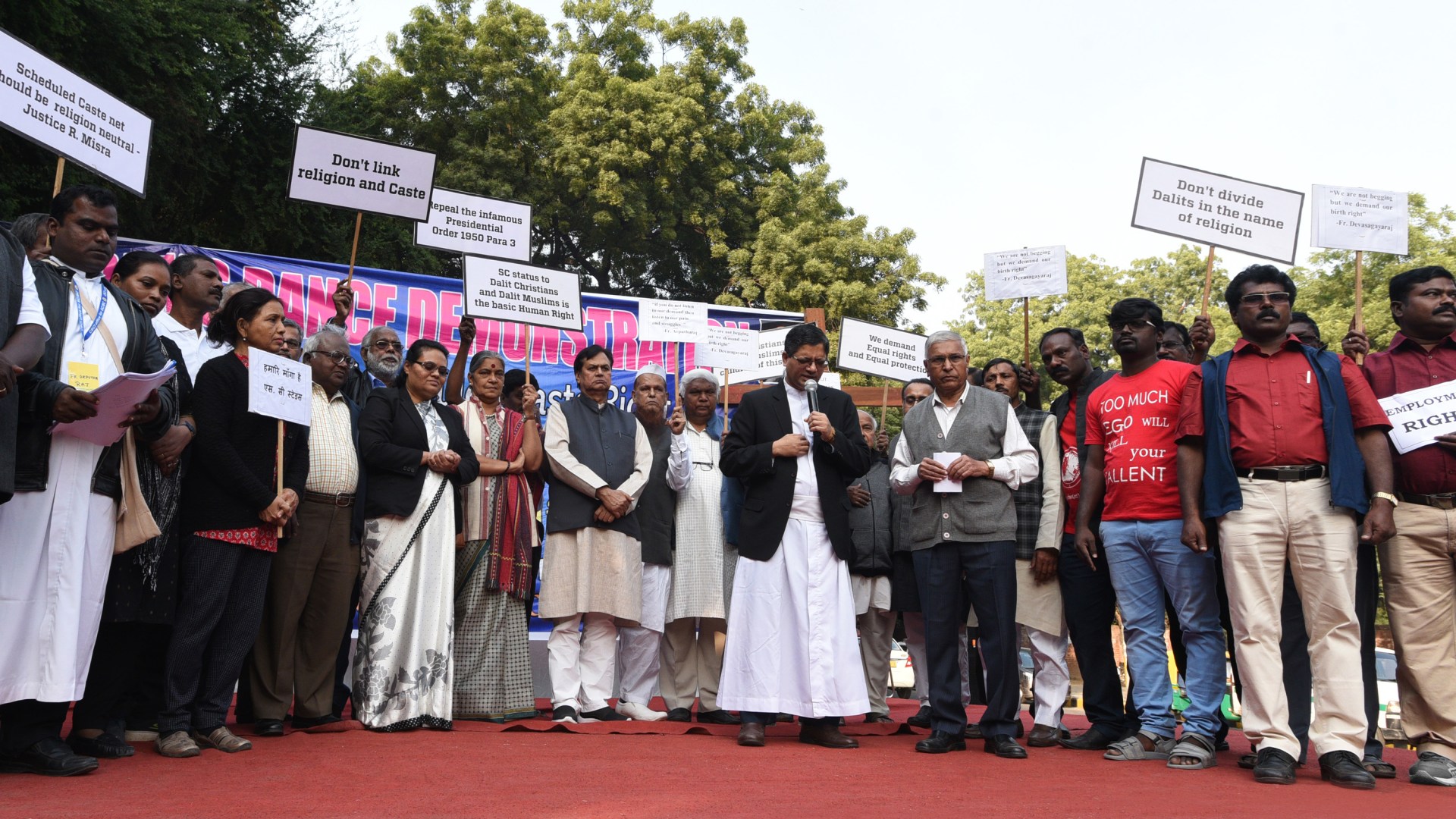
Hindu Groups Push Further Discrimination Against Christian Dalits

Converts need to choose between public faith and caste-based benefits.

Dalit Christians and other activists hold placards during a protest in New Delhi.

Dalit Christians and other activists hold placards during a protest in New Delhi.

Christianity Today June 11, 2025
Hindustan Times / Contributor / Getty

Vikrant Maheshwar, a Christian Dalit in his late 30s, worked for the Andhra Pradesh government in Southern India for 11 years. His salary from the state’s agriculture department not only allowed him to comfortably provide for his wife and children but also quietly supported his evangelism work.

Maheshwar became a Christian in primary school after his family heard the gospel from neighbors in Andhra Pradesh. The message of Jesus’ love for everyone resonated with him and his family, as they had long faced discrimination for belonging to the lowest caste in Hinduism. Christianity Today is not using Maheshwar’s real name, as Christian Dalits can face attacks from Hindu nationalist groups for speaking out.

Sunday school and daily Bible reading became part of his upbringing. By the time he was about 20, he felt a call to serve the Lord. He began preaching as an evangelist in churches across the region on Sundays while working for the government on weekdays.

But last November, Maheshwar’s life came to a halt when a fundamentalist Hindu group complained to his employer that he was a preacher and thus illegally holding a Scheduled Caste (SC) status. The status offers Dalit citizens—except for those who follow Christianity or Islam—education and employment privileges to counteract historic discrimination. Maheshwar got his government job through this protection.

Often when Dalits convert to Christianity, they keep their faith private and legally maintain their Hindu names to keep their SC status. Christian Dalits who pass as Hindu are called crypto-Christians. Until recently, authorities overlooked this practice. But as Hindu nationalism grows in India, Hindutva groups are exposing Dalit Christians and pressuring the government to act.

India’s Supreme Court ruled in November that practicing Christians who hold on to their SC certificates are committing “fraud on the constitution.” As a result, many Dalit Christians are now voluntarily giving up their SC status.

“What was not an issue earlier—or at least dormant—is now being brought to the fore to spread fear,” said Noah Simon, a researcher of Indian Christians at the University of Hyderabad.

When the government learned about Maheshwar’s Christian identity, it fired him. His family suffered, as he could no longer financially support them, and he and his wife divorced under the stress. Humiliated and burdened by debt, he withdrew from the ministry, his family, and his social life.

“Let it be. I don’t have anything to say,” Maheshwar said. “I am neither a pastor nor run a ministry now.”

Although India officially abolished the caste system decades ago, Dalits continue to face prejudice.Across large swaths of India, upper-caste people threaten or attack Dalits for reasons as simple as wearing footwear, sporting a moustache, or riding a horse. In some especially barbaric cases, Dalits are urinated upon or forced to lick the feet of upper-caste people.

Dalit women are among the most oppressed groups in the world and are often victims of sexual violence or even murder. Dalit children top the list of dropouts in India once they reach upper primary levels. About 71 percent of Dalits are agricultural laborers working on land they don’t own.

SC status, enshrined in the Constitution (Scheduled Castes) Order, 1950, allows Dalits to attend schools and get jobs at institutions that have long shut them out, and it gives them access to welfare.

The government doesn’t grant Christians and Muslims SC status; it claims the Bible and Quran don’t endorse caste-based hierarchy, so they don’t need such a requirement. Yet in Indian society, caste transcends religion.

“There is no empirical evidence to suggest that the socioeconomic standing of Dalit Christians [has changed] drastically,” said Emanual Nahar, professor of political science at Panjab University and former chairman of the Punjab State Minority Commission. “They are worse off than Hindu Dalits. They are compelled to live with a dual identity—one for faith, another for official records.”

For instance, a Christian Dalit in his 40s (who asked to remain unnamed for security reasons) and his family in the southern state of Telangana are fighting to save their ancestral land from influential upper-caste men. The family filed a case against their opponents under the 1989 Scheduled Castes and Scheduled Tribe (Prevention of Atrocities) Act, which protects Dalits against caste-based violence and punishes offenders with a prison term of up to life imprisonment. 

Most of the members in this man’s family legally retained their Hindu identity after they embraced Christianity. But his brother reported his conversion, a move that dropped him to Backward Class-C (BC-C) status, a category with fewer benefits. Although the government reserves 15 percent of positions for SC holders, that percentage drops to 1 percent for those with BC-C status. Though the family has hidden their Bibles and taken down crosses in their home, the Christian Dalit believes his opponents know his family’s religious status. 

“They know we go to church,” he said. “That alone is enough to discredit us in the court.”

If the government discovers the family is Christian, they could lose their SC status and would no longer be able to file the case under the 1989 act.

“My family and I have been praying constantly for deliverance,” the Christian Dalit said. “Every Friday, during the fasting prayer, the entire church prays for us. My brother often quotes Psalm 18:2, which is a great source of encouragement.”

Under previous administrations, some called for extending SC status to all Dalits regardless of their religion. A 2007 judicial commission said SC status should be “completely de-linked … from religion.”

Not only has Prime Minister Narendra Modi’s government dismissed that finding as “flawed,” citing a lack of empirical evidence; it has also testified before the Supreme Court that there is no way SC status would be given to Dalit Christians and Muslims. The Hindu nationalist government believes such a move would encourage conversion to Christianity and weaken Hinduism.

Under pressure from numerous appeals from Dalit Christians, the Modi administration set up another commission in 2022 to look into the issue. While it was supposed to submit its report last October, it has not yet done so.  But many believe it will support his underlying beliefs.

Due to the subhuman treatment Dalits face, many have shunned Hinduism. European and American missionaries brought Christianity to the Dalits in the 19th and 20th centuries and provided educational opportunities and health care. As a result, some Christian Dalits have experienced upward social mobility in the government and private sectors. Dalits make up an estimated 70 percent of Christians in India, according to scholars and activists.

Yet even in the church, Dalits continue to face discrimination. Separate churches—and at times separate burial grounds—exist for different caste groups. Christian marriages also fall along caste and subcaste lines.

The hunt for Christian Dalits holding SC status has escalated in recent months. Hindu right-wing activists have stationed themselves outside churches, armed with cameras, to collect evidence against worshipers, said Vijaya Raju Gaddapati, president of All India Christian Federation. Some even search for tombstones bearing crosses and Christian names. They use this to find living ancestors and “out” them as Christians to take away their SC status, he added.

Because of this, Christians have been rejecting baptism certificates and documentation for marriages held in churches, fearing the documentary trail they leave behind, said Rufus Kolikapudi, activist and journalist at Siti News Mangalagiri.

But other Christians have begun to legally change their status.

A 30-year-old Dalit Christian in Telangana, who also asked to remain anonymous for security reasons, said he and his family embraced Christianity about a decade ago after his father was miraculously healed from a chronic ailment. Yet now as more Hindu groups are disclosing crypto-Christians, he has decided to voluntarily give up his SC status so he won’t be seen as doing anything illegal. In addition, he desires to reconcile his public and private identities.

Despite objections from their father, he and his brother decided to publicly state their Christian faith, which would switch them to BC-C status. The move would make it extremely difficult for him to secure a civil service position.

“I have no choice,” he said. “If I keep holding on to my SC certificate, they will call me a fraud. If I give it up, I lose the little support I had left.”

Books
Review

We Can Debate Women in Ministry. But Not the Historical Facts.

Beth Allison Barr challenges the narrative that women have never exercised church authority.

Deborah prophesying to a crowd
Christianity Today June 11, 2025
Illustration by Christianity Today / Source Images: WikiMedia Commons

In 2021, Southern Baptist Theological Seminary president Albert Mohler reaffirmed his denomination’s stance against women in the pulpit. Mohler’s May 10 daily “briefing” quoted from the Baptist Faith and Message 2000, a statement that declares the following: “While both men and women are gifted for service in the church, the office of pastor/elder/overseer is limited to men as qualified by Scripture.”

His remarks came in response to the heated conversation swirling around Saddleback Church’s decision to ordain three female pastors. The Southern Baptist Convention (SBC) opposed this move decisively, voting in 2023 to remove Saddleback from the convention after deciding it was not in “friendly cooperation.”

Because of the convention’s size and influence, Southern Baptist theology and policies shape debates on women’s roles across the broader evangelical landscape. As a case in point, consider the mid-1980s triumph of the “conservative resurgence” within the SBC, which gave momentum to a pair of related ideas: that women can serve God in many ways but not in authority over men, and that it’s always been this way.

Baylor University history professor Beth Allison Barr wants to overturn this narrative, and as a historian she naturally looks to the past for evidence. In her latest book, Becoming the Pastor’s Wife: How Marriage Replaced Ordination as a Woman’s Path to Ministry, she illuminates the current SBC teaching—shared by much of the American evangelical movement—that women cannot serve as spiritual authorities. Barr sets this assertion against the backdrop of church history, which shows women indeed have held authoritative public positions in the church.


Barr, already well-known for her 2020 book The Making of Biblical Womanhood, is herself a Baptist pastor’s wife. She agrees that pastors’ wives can exercise positive influence on their husbands’ churches and that this role can offer a valid pathway for women to use their gifts in ministry.

In Becoming the Pastor’s Wife, however, Barr pairs her own experience with archival evidence to argue that evangelical ministry wives have lacked true authority even as they performed various leadership tasks. Any influence they have wielded has been contingent on their husbands’ authority.

Yet as a historian of the Middle Ages, Barr knew that her lived experience clashed with past reality. The struggle of many pastors’ wives to fit within the constraints of complementarian theology was unnecessary—and unsupported by history. During the first thousand years of the church, women routinely served in leadership positions based on their own calls to ministry.

But the opportunities dwindled. When the Protestant Reformers eliminated nuns and introduced the office of pastor, which came with permission for clergymen to marry, the role of pastor’s wife developed as an unofficial but influential position for women. Emphasizing what women could do in that informal role also provided a cover for prohibiting women from serving in formal positions of authority alongside men, Barr argues.

Besides boasting historical expertise, Barr knows her Bible well, and she begins her latest book by wondering why all the apostles’ wives—who obviously exist (1 Cor. 9:5)—never appear in the biblical text. Barr writes, “Given the amount of emphasis placed on ‘biblical’ womanhood in complementarian spaces (what women did or didn’t do in the biblical text dictates what women should or shouldn’t do in the modern church), it strikes me as odd that a role with such tenuous biblical evidence has become the primary role highlighted for women.”

Ironically, the New Testament offers plenty of evidence of what women were doing in response to their call to God’s service. Barr cites New Testament women such as the Bible teacher Priscilla, the apostle Junia, the deacon Phoebe, and the apostle Philip’s four daughters, who were known and approved as prophets (Acts 21:9). In each of those roles, Barr points out, women were celebrated by the biblical authors for serving as spiritual leaders in the church.

Barr’s robust historical knowledge shines through as she introduces readers to dozens of female leaders from the early and medieval church periods. Abbesses, deacons, evangelists, and preachers who were appointed and ordained to serve the church in public ministry fill her pages. Through art, inscriptions, and documents, she references presbyters, martyrs, and other female clergy members. The monastic movement produced powerful abbesses and nuns, like Hildegard of Bingen, who went on a pope-sanctioned preaching tour through Europe. Barr’s seeming favorite, an English abbess named Milburga of Mercia, ruled over a “double monastery,” in which monks and nuns lived together.

Barr notes that highlighting prominent women as proof that the church did ordain and authorize them to lead may cause readers to think of those women as extraordinary. And that would be a mistake, as she sees it. “Describing women as extraordinary is often a subtle way of reinforcing patriarchy,” she writes. If Old Testament judges like Deborah, New Testament teachers like Priscilla, or medieval leaders like Hildegard led God’s people due to extraordinary circumstances, then male rule remains normative.

No, Barr asserts, these women were not outliers; rather, the female leaders of the church’s first millennium were ordinary women called by God to serve his people through leadership. And that’s what makes them such powerful inspirations today. If God called regular women to lead in the past, why would he not do so now?

Ordination, of course, remains one of the sticking points for churches that limit women’s participation in leadership. But Barr offers helpful context: “For the first thousand years of Western church history, ordination tied a particular function (think pastoring) to a particular office (bishop, priest, deacon, abbess, etc.). While ordination could include administering the sacrament, it didn’t have to.”

But around 1100, church leaders modified the definition of ordination, connecting it more directly with sacred authority, including the ability to preside over the sacraments. Within another 200 years, the path to priesthood had become limited to ordained men.

After the Protestant Reformation, pastors abandoned Catholic sacramental practices but retained the hierarchical structure of all-male spiritual authority. Ordination remained a confirmation of God’s call upon men, because only men, it was argued, could have spiritual authority. Protestant women were left with little more than marriage as a means to spiritual influence.

When Protestant pastors began marrying, the role of pastor’s wife was born. Early on, these pastor couples modeled a variety of approaches. Some former nuns married former monks, both using their theological training to minister together (think Martin Luther and Katharina von Bora). Some wives continued their work independent of their husbands’ pastoral careers. It took centuries for the “traditional” pastor’s wife model to become the norm. And ordination, having been redefined from its original meaning, remained out of reach for most women.


Readers from faith traditions outside the SBC may be tempted to view Barr’s emphasis on SBC personalities, theology, and controversies as a mere family squabble. But the extensive reach of Southern Baptist ecclesiology and theology tends to leave an imprint upon the entire evangelical movement. When SBC leaders declare that women have never preached, taught, or led in their churches, other groups take that message to heart, concluding that it’s not biblical for women to hold spiritual authority.

But Barr’s research extends beyond the precedents set by early and medieval churches. In fact, she uncovers evidence within the SBC’s own archives that contradicts the denomination’s claims. It hasn’t always been this way, the records show.

Barr introduces readers to ordained women, female missionaries who pastored churches abroad, and female professors hired to teach the Bible at Baptist seminaries. She tells of women seeking ordination who were encouraged to find pastors to marry. We learn that women were affirmed at the Southern Baptists’ 1983 convention for their “labor for the Lord and the churches in places of special service to which God has called them.” Only one year later, Barr noted, the convention declared that God barred women from pastoral leadership “to preserve a submission God requires because the man was first in creation and the woman was first in the Edenic fall.” We meet influential wives, married to men in power, who worked to suppress other women from pursuing leadership positions.

We also meet pastor’s wives who paid a high price in a culture that promoted and protected men. The #MeToo movement exposed the SBC’s penchant for protecting pastors accused of sexual abuse. In her latter chapters, Barr lays out a dark story of serial sexual abuse left unchecked and justice denied to victims.

Barr is careful not to condemn the SBC comprehensively. To the contrary, she looks for positive examples of women being respected and honored. And refreshingly, she points to the Black church as a model for encouraging pastors’ wives to pursue their own callings. But Barr is unafraid of telling the hard stories, because the truth is what can set us free.

In the end, Barr tells a fascinating, engaging story of our common faith heritage—which means that Becoming the Pastor’s Wife, despite its title, is hardly a book for women alone. Nor is it just for pastors and their wives. Any evangelical reader can reckon with and profit from its perspective on the church’s past and present.  

Evangelicals of goodwill can reach different conclusions about women and their place in Christian ministry. But intellectual honesty requires acknowledging what actually happened in the past. Church history offers a panoramic view that transcends the narrow scope of any one denominational tradition. And history shines a light on current thoughts and practices, inviting us as believers to examine our prejudices.

Contrary to a common telling of church history, for the past 2,000 years, “pastor” has not always been an office, and “pastoring” has not been the sole purview of men. In case there’s any doubt, Becoming the Pastor’s Wife has produced the historical receipts.

Kelley Mathews earned her Master of Theology degree from Dallas Theological Seminary. A writer, editor, and New Testament doctoral student, she is also coauthor of 40 Questions About Women in Ministry.

Ideas

The Injustice of Inconsistency

Contributor

The problem isn’t that South Africans are coming to America. It’s that the door is closed to Haitians, Burmese, Sudanese, Yemenis, Venezuelans, Ukrainians, and everyone else.

Red doors closed with one green door open.
Christianity Today June 11, 2025
Illustration by Christianity Today / Source Images: Getty

Early last month, a group of 59 white Afrikaners who were given refugee status by President Donald Trump arrived in America on a chartered flight, paid for by US taxpayers, in what may be the most expeditiously processed refugee cases the United States has ever seen.

That ought to be good news, at least compared to the complicated, drawn-out, arduous process most refugees typically endure. But this particular arrival was hotly contested.

You see, on January 20, 2025, Trump signed Executive Order (EO) 14163, his 17th (of 157, and counting) executive order in his second term as president. This EO suspended the US Refugee Admissions Program (USRAP) “until such time as the further entry into the United States of refugees aligns with the interests of the United States.” Eighteen days and 41 executive orders later, he signed EO 14204, granting “admission and resettlement through the United States Refugee Admissions Program, for Afrikaners in South Africa who are victims of unjust racial discrimination.” This is necessary, the order explained, in part because South Africa is “undermining United States foreign policy” and therefore threatening “our interests.”

That was how the Afrikaners came here—and came so quickly and easily. (The average refugee resettlement to the US takes 20 years and almost always involves a long stay in a stopover country—typically in an under-resourced “temporary” camp where people sometimes live for decades with no meaningful work, little education, and few opportunities to meet their most basic needs. It’s also worth noting that, unlike the taxpayer-subsidized flight for the South Africans, refugees from other countries sometimes get travel loans from the United Nations, but they must personally repay those costs.) 

This rapid resettlement of one group of refugees while all other refugee-resettlement programs have been suspended raises a lot of questions. For instance, how was the USRAP resettling new refugees in May if the program was suspended in January? What US interests are Afrikaners able to serve that every other refugee from every other country is apparently unable to help? And what is the moral calculus that ranks the value of an Afrikaner’s life so far above the lives of people from Myanmar or Ukraine or Sudan or Afghanistan or Haiti or Venezuela? 

To be very clear, the problem is not that South Africans were granted refugee status. The problem is that no one else is receiving the same welcome.

Unfortunately, that’s not the issue under wide debate. The administration’s double standard here is so glaring that folks are busy arguing about whether the South Africans are really persecuted enough to merit our sympathy. 

On the right, you have pundits trying to explain that things really are bad in South Africa. And while there’s no denying that the country has a high violent crime rate, the idea that Afrikaners are being targeted is a point of reasonable disagreement.

Meanwhile, on the left, some refugee agencies are refusing to resettle the Afrikaners who were admitted, describing this as an act of conscientious objection. In fact, the Episcopal Church announced that it will end its four-decade refugee-resettlement partnership with the US government over this admission decision

The truth is, when we’re debating whether enough Afrikaners have been murdered to allow them to flee to our country for safety, we’ve lost the moral thread. Again, the problem isn’t that these South Africans were welcomed to America. It’s that only these South Africans were welcomed to America while people in danger of war and persecution in other countries have been categorically locked out. 

But it shouldn’t be surprising that we’re having such a misguided debate. This conversation is the natural result of an administration uninterested in due process, the rule of law, and the blind justice of Lady Liberty. Unjust systems that dispose of even the pretense of equality result in ever-escalating dehumanization. They incentivize selfish ambition instead of care for the least of these—and disregard those who have nothing to offer but their need. After all, in a dog-eat-dog world, you’d better be at the top of the pack. 

At least one recent Afrikaner arrival was willing to make that moral logic plain, even if Americans prefer to ignore it. “I kind of need to, you know, put my oxygen mask on first,” he told The Washington Post, explaining that it wasn’t for him to say whether or not the US refugee process, which had worked to his advantage, should be restored for anyone else.

Our debate is also confused by what is objectively a masterstroke of political rhetoric by the president. Trump campaigned on closing the border to illegal immigration and strengthening border security, goals that enjoy broad support among the American public. But he’s pursued that end partly by collapsing traditional distinctions between different classes of immigrants—asylum seekers, economic migrants, and refugees—to often-cruel effect. When the Trump team speaks, these words are synonyms for each other and for “illegals.” Each term is just a different way of describing people who are stealing your jobs and raping your women and destroying your culture.

And make no mistake: The Biden administration blurred lines and collapsed categories too. Under former president Joe Biden’s watch, people flooded across our southern border and wrongly claimed asylum. The asylum program is supposed to be reserved for a unique class of immigrants subject to persecution in their home countries, but it became an escape hatch for millions seeking a better life—and the Biden administration let it happen instead of seriously pursuing reform. 

Those migrants, many of whom were simply seeking economic opportunity or trying to escape gang violence, are now being demonized by conservatives angry about the border chaos—just as the Afrikaners who got a special dispensation under Trump are being demonized by progressives angry about the unfairness of this exception. In both cases, the problem is not that these people were able to come to America. The problem is the disorder and injustice of the entire system.

I vehemently oppose ending the refugee program for reasons inextricably tied to my faith in Christ. But there is a sort of utilitarian logic to Trump’s initial decision. I’ve heard reasonable arguments for beginning immigration reform with a total shutdown of migrant entries. That kind of hard-line border policy, consistently applied, strikes me as heartbreaking, impractical, and even bad for US interests due to its hits to our soft power and our economy. But it is at least consistent, and consistency is often a hallmark of justice.

As the Afrikaner admissions have made unmistakably clear, consistent reform is not what this administration is doing. If there’s consistency here, I don’t think it’s the consistency of justice. After all, what is it that makes the Afrikaners different from other prospective refugees? Even if the grimmest interpretations of South African crime statistics are true, Afrikaners are not the single-most-persecuted people group on earth.

But they are white, share many Western social and cultural values, and speak English. Put more plainly, they aren’t too foreign, and from the moment they arrive on American soil, they can pass for your average American farmer. Or in the words of a Trump administration official, Deputy Secretary of State Christopher Landau, they’re “quality seeds” who will “bloom” in the US.

Obviously we cannot give every needy person in the world refuge, but that’s precisely why the process needs to be transparent and free for all to pursue. 

Are no other people who hope to come to America “quality seeds”? I can think of a few, like Kevenson and Sherlie, the legal Haitian immigrants who live near me in West Texas and are now at risk of deportation. Or Carol Hui, a hardworking waitress who has raised her family in the US for more than 20 years. Or Sofia, the four-year-old whose life was threatened by the deportation notice her family received, because she requires constant specialized medical care. We can’t yet imagine how Sofia might blossom. 

These are all quality seeds because they are all human, all made in God’s image, all people for whom Jesus died. Many of them, including Kevenson and Sherlie and Carol, are Christians too, fellow members of the body of Christ. Why is there not more outcry from the American church on their behalf?

I know the answer, of course. Most of us live seemingly untouched by immigration. The delivery drivers who drop groceries at our doors are almost invisible. And we’re human too, with all the weakness that entails. It’s hard to care very deeply or for very long about problems we don’t experience. We’re busy and distracted and have lots of things to worry about before we get around to questioning the political rhetoric from our own side

While I can explain away our silence in a thousand innocuous ways, none sit well with my soul. And I can’t ignore how it’s perceived by people outside the church. 

Take the example of a writer named Joel Mathis, who argued in a recent essay that politically conservative, white American Christians don’t care about religious liberty protections (including refugee admissions) for people who aren’t like them. “When conservatives talk about ‘religious liberty’ what they often mean is ‘white Christian privilege,’” Mathis charged. “The MAGA right expects the U.S. government to defer to Christian sensibilities, except when those sensibilities work for the protection of brown people.”

I know, I know. We have a million objections to such a reductive assessment—not least that in recent years it seems as if everything and everyone (even algebra!) has been deemed racist at some point by someone on the left. But I think Mathis is being sincere, and though I want to tell him that he’s wrong, I can’t deny the weight of the evidence in his favor. Why only the white Afrikaners?

If Kevenson and Sherlie, whose story I told a few weeks ago at CT, are forced to return to Haiti, they will be prime targets for kidnappers because of their connection to rich American Christians. “If they don’t pay the ransom, they can expect to be covered in plastic bags or tires, which will then be set on fire,” explained my friend, Kim Snelgrooes, who sponsored their emigration to America. Why wouldn’t we welcome them too? Even on a purely utilitarian level, they are adding value—working jobs, paying rent and taxes, delivering services—not draining resources. 

Or consider the Iranian Christians who were deported by the US to Panama earlier this year. They may be sent back to Iran, where they would likely be killed for their conversion to Christianity. Are their lives worth less than mine or yours or the Afrikaners’?

When Christians do not call such injustice by its name, our silence shouts to a culture already suspicious of our faith and ethics—already primed to summon up historical examples of Christians checking our values at the door to public life, justifying injustice or rationalizing compromise.

I can’t undo Trump’s executive orders or stop anyone’s deportation or open America’s gates to refugees from more countries than one. But I think it’s important to speak up anyway, to protest compassion unequally applied. To explain why, let me tell you a story.

In May of 1939, the St. Louis, a German transatlantic liner, sailed from Hamburg to Havana. On board were 937 passengers, almost all Jews whose American visa applications were in process. The plan was to stop over in Cuba until their final approvals were issued. En route, it became clear that Cuba would not admit them. And then they were turned away from America too, denied entry while they were so close to Miami they could see the lights of the city, flickering across the dark sea. They returned to Europe, where 254 of them would die in the Holocaust.

The newspaper article written by Lilian C. Reitan for the German Jewish refugees who were turned away.Illustration by Christianity Today / Source Images: Getty,
The newspaper article written by Lilian C. Reitan for the German Jewish refugees who were denied entry in the US.

That same year, far away from the coast and the halls of power lived a Christian woman named Lilian Reitan. She could do nothing about the fate of the Jews aboard the St. Louis, but she spoke about their plight to people she knew and registered her dissent from the US decision to deny them entry in a letter to the editor of her local paper, Iowa’s Des Moines Register.

“We will either help these people or be known for what we really are, calloused, inhuman, un-Christian and un-American,” Reitan said on June 11, 1939. It’s clear that her defense of the Jews was personally costing her, for in the letter she recounted receiving threats as a result of speaking out. 

History doesn’t have much else to say about Reitan, and I suppose it could be said that her letter didn’t matter much. The Jews still were sent back to Europe to their deaths. 

But 86 years later to the day, her words stand out to me like a pinprick of light in a sea of darkness. She was among the Christians who vocally opposed the fearful, cold-hearted, and spineless decision that sent hundreds of Jews away to die. Reitan’s words are an Ebenezer to me: a wilderness signpost reminding me that God’s empowering faithfulness can help us discern the narrow way (Matt. 7:13) in a world gone mad (2 Tim. 3). The Spirit can give us the courage to speak up for and in his character and truth (2 Tim. 1:7).

As both a follower of Jesus and citizen of America, Reitan exemplified this courage. She could not have expected to change the world with her letter, yet she still felt a duty not to be silent before such rank injusticeHer dual care for the lives of the Jews in danger and the soul of her country reminds me of the prophet Isaiah’s explanation of his hard preaching to his people: “Because I love Zion, I will not keep still. Because my heart yearns for Jerusalem, I cannot remain silent. I will not stop praying for her until her righteousness shines like the dawn, and her salvation blazes like a burning torch” (62:1, NLT).

On the anniversary of her letter, I pray we carry her legacy forward. The course of history may appear to be unchanged, and innocent people—maybe even we ourselves—may be chewed up by the ungodly machines of injustice. But as one Bible paraphrase says, “Men and women who have lived wisely and well will shine brilliantly, like the cloudless, star-strewn night skies. And those who put others on the right path to life will glow like stars forever” (Dan. 12:3, MSG). That’s the example left by Lilian Reitan, and that’s what we followers of Jesus must do now for future generations.

“This is the way; walk in it,” God says to us when we are unsure where to turn (Isa. 30:21). Even if the world walks one way, we can choose to go another. Even if it seems to matter very little, we can raise our voices anyway. Even if everyone around us is falling in line to an earthly ruler, we can bow only to the King of Kings

Carrie McKean is a West Texas–based writer whose work has appeared in The New York TimesThe Atlantic, and Texas Monthly magazine. Find her at carriemckean.com.

News

Tablets Replace Textbooks in Kenya’s Village Schools

Nonprofits and a Christian university are bringing new technology to the country’s remotest areas.

A school in Kenya using tablets in the classroom.
Christianity Today June 11, 2025
Simon Maina / Stringer / Getty

Twelve-year-old Rita Lesina treks more than 1.5 miles every morning over a dusty, rugged road in Laikipia County, Kenya. The crunch of dry murram road underfoot and the occasional bird chirp break the silence of her 30-minute walk as she weaves between acacia thorns and dried riverbeds. There are no tarmac roads and no power lines.

When Rita arrives at Enai Kishomi Primary School in Timau, she adjusts the strap of her worn backpack and brushes brown dust off her uniform before taking her seat. Her hands hover slightly over the desk, not fidgeting, just ready to receive a tablet.

Before second grade, Rita had never seen a computer. But everything changed when digital learning came to her rural public school.

“The first day I saw one, I was shocked,” she said.

Enai Kishomi and a few neighboring schools have become technological oases in a tech desert. They use tablets—locally called “Specktrons”—loaded with lessons, videos, animations, and real-time quizzes. Lewa Wildlife Conservancy helps fund the initiative.

In 2020, fewer than half of Kenya’s schools had internet access. One in four primary schools had working internet connections. Only 67 percent of Kenyan children ages 12 to 17 had internet access in 2022. In contrast, the US National Center for Education Statistics reported that 97 percent of American students ages 3 to 18 had internet access at home in 2021. Enai Kishomi is the only school near Rita that has internet.

The digital gap remains wide, but Specktrons are helping change that.

Last week, Rita’s science class explored the human circulatory system, but not with textbooks. Her head teacher, Mathew Munyi, showed the students a 3D animation of blood flowing through the heart. With a tap of his finger, Munyi projected the content onto the classroom’s digital board.

“Now imagine this heart belongs to you,” he said.

According to Munyi, teachers undergo rigorous training to adapt to the technology. Teachers have to be ready to respond to glitches in the classroom.

“Teaching digitally demands more,” Munyi said. “If your system crashes or your content isn’t ready, the lesson dies.”

Digital learning takes more than just tablets—schools may also need a projector or smart board, solar-power units, and teacher training. A full technology setup can cost around $15,000 USD. One company sells classroom kits with 40 tablets and a Wi-Fi device for $5,000 USD. Solar batteries and car-battery backups supply the power to charge the tablets in areas the national electric grid hasn’t reached. However, the real challenge lies in maintaining the devices.

“When a tablet breaks, it can take weeks to fix,” Munyi said. “Donors often fund the initial equipment but rarely the repairs, and so parents are asked to contribute toward maintenance, which many can’t afford.”

Harsh rural conditions—dusty air and high heat—often cause malfunctions in the fragile technology, especially when schools lack proper storage. Schools rarely have technical support staff, so teachers are left troubleshooting devices during valuable class time.

Christian churches and nonprofits are slowly beginning to step in to help with the tech transformation. In 2022, Kenya Methodist University launched a Christian educational-technology outreach targeting rural Methodist-run schools. Some Christian nonprofits have begun handing out smart boards and virtual reality goggles to church-run schools. Still, most efforts focus on food, health, or general education, not technology.

While debates rage in the US about digital distractions in the classroom and shrinking attention spans, Kenyan teachers look to technology as a lifeline. According to Lewa Wildlife Conservancy’s director of education, Purity Kinoti, the main concern in Kenya is access, not excess.

“Digital skills have been identified by researchers as one of the most important skills that every school leaver will need to thrive in the job market,” Kinoti said.

Still, the Specktrons come with precautions. Supervisory access to the tablets allows teachers to keep the lessons moving and students on task. Parental control settings on the devices help limit the kind of content students can access. As internet access becomes more available to children, government regulations are kicking in too. In April, the Communications Authority of Kenya released new guidelines for protecting children online.

For now, Specktrons are helping Rita and her rural Kenyan classmates reach for some of the same goals that students in Nairobi (the capital) or New York are aiming for. Rita told CT her dreams don’t end with sixth grade. She wants to be a pilot.

And a few taps on a tablet can show her exactly what a cockpit looks like.

News

Michael Tait Says Drug, Assault Allegations Are ‘Largely True’

The former Newsboys frontman confessed he was living “two distinctly different lives” while leading the iconic Christian band.

Michael Tait performing with the Newsboys
Christianity Today June 10, 2025
Emmanuele Ciancaglini/NurPhoto via Getty Images

Former Newsboys frontman Michael Tait confessed Tuesday to abusing drugs and alcohol and touching men “in an unwanted sensual way.” 

The statement comes days after multiple men came forward with allegations that Tait sexually assaulted them while touring with the chart-topping Christian band. Tait said he would dispute some of the details reported by The Roys Report on June 4, but the accusations—which include accounts of cocaine, nudity, and sexual assault—“are largely true.”

“I am ashamed of my life choices and actions, and make no excuse for them,” Tait wrote in a statement posted on Instagram. “I will simply call it what God calls it—sin.”

Tait, 59, has been a mainstay of contemporary Christian music (CCM) since the 1980s, when he began DC Talk with his Liberty University classmates Kevin Max and TobyMac. The rap-rock trio took the No. 1 spot on the Billboard CCM charts with their third album, Free at Last, and held onto it for 34 weeks. The group’s next album, Jesus Freak, is considered a landmark of popular Christian music and evangelical youth culture in the 1990s.

DC Talk went on hiatus in the early 2000s, and Tait joined Newsboys as the lead singer in 2009. With him in front, the group’s 2010 album Born Again landed at No. 4 on the Billboard 200 list, and the 2011 follow-up, God’s Not Dead, hit No. 1 on the Billboard Christian Album chart, going on to sell 500,000 copies. 

The Newsboys also appeared in the 2014 film by the same name, and then God’s Not Dead 2 and God’s Not Dead: A Light in Darkness, becoming closely associated with the franchise of conservative culture-war dramas. 

“It’s not an exaggeration to say that for many evangelical teens who came of age in the nineties, the Newsboys were a core part of their evangelical Christian experience,” historian Leah Payne, the author of God Gave Rock and Roll to You, told The Roys Report. “They re-formed in some ways as an ongoing supergroup. … that sort of gives voice to American conservatism.”

At the same time, Tait now admits, he had a secret life.

“For years I have lied and deceived my family, friends, fans, and even misled my bandmates about aspects of my life,” he wrote. “I was, for the most part, living two distinctly different lives. I was not the same person on stage Sunday night that I was at home on Monday.”

Tait unexpectedly left the Newsboys in January 2025, offering a vague explanation. The group was in the midst of planning its Worldwide Revival Tour.

In early June, three young men came forward with accounts of sexual assault. The Roys Report did not release their names, in keeping with a policy of protecting the identities of abuse victims.

One of the men said he met Tait at a concert in 2004 and was invited to Tait’s home in Nashville. He went and then returned in 2005. The man, who was 22 at the time, told The Roys Report it was “just a bunch of bros drinking and playing darts and just being silly,” but that turned into skinny-dipping, and then a hot tub, and then a back massage in bed. The man claimed that Tait touched his butt and put his fingers “in his anal region,” according to The Roys Report, before he spoke up and stopped the encounter.

A second man, also 22, was part of a band touring with the Newsboys in 2010. He considered Tait his idol, he told The Roys Report, and was eager to accept overtures of friendship from the older star. 

“We went to a movie. He picked me up, and then we would usually just play darts at this bar,” he recalled.

One night at Tait’s home, he said, he drank too much, threw up, and fell asleep on the couch. He claims he woke up to find Tait kissing him on the mouth and touching his genitals.

The man said that he kept the incident secret at the time, for fear it would negatively impact his opportunities in CCM.

“I very much did not want to be excommunicated,” he said.

A third 22-year-old worked as a member of the crew in 2014. He told The Roys Report that the tour involved a lot of drinking.

“There were probably a couple days we missed, but there was pretty much always, like, a bottle of wine or some vodka. We always had cranberry vodka,” he said.

As the man recalled, he’d been drinking too much one night when Tait approached him and offered him cocaine. He went to sleep instead, only to wake up with Tait on top of him, the man claimed, rubbing his penis through his jeans.

“I just felt bad for him in that moment,” the man said. “Looking back … that was a sexual assault.”

The newest member of the Newsboys admitted on social media that there were rumors about Tait. Singer Adam Agee said the band was never able to confirm any allegations against him, however.

“Each time something came up we tried to find the source,” said Agee, who joined the Newsboys in 2023, “and no one would tell us anything.”

In an official statement released on June 5, the four remaining band members said their hearts were shattered, denied any knowledge of wrongdoing, and said they do not condone any form of sexual assault. 

A lawyer for the Newsboys said the organization was aware of an “unsubstantiated aspersions cast via internet” but warned The Roys Report against publishing anything that implied the ownership or management of the band had any knowledge of “the things you allege.”

Though Tait is no longer with the band, the allegations prompted K-Love, the largest Christian radio network in the US with more than 400 stations, to stop playing the Newsboys and DC Talk on June 9, at least temporarily.

The following day, Tait published his confession. He said that when he resigned from the band in January, he went to a treatment center in Utah and is now six weeks sober.

“To the extent my sinful behavior has caused anyone to lose respect or faith or trust in me, I understand,” Tait wrote. “But it crushes me to think that someone would lose or choose not to pursue faith or trust in Jesus because I have been a horrible representative for him.”

Tait said he’s been praying the words of Psalm 51, which says, “I know my transgressions, and my sin is always before me. … Create in me a pure heart, O God, and renew a steadfast spirit within me.”

Ideas

A Christian Mind out of Practice

For too many of us, faith is a private affair that exists largely in our own thoughts—yet those thoughts are not particularly deep.

A man shaping a mind
Christianity Today June 10, 2025
Illustration by Sergey Isakov

I spent the last year working on a book about Christians, American politics, and the challenges of faithful and nuanced Christian engagement that are unique to this moment. But as I wrote, I came to think those challenges are rooted in a larger problem for American evangelicalism that extends well beyond politics: a Christian mind out of practice. 

The brain is not literally muscle, but our minds work as if it were. There is no switch to be turned on and off when quandaries present themselves. We must always exercise our minds, or else they atrophy.

And the American evangelical mind is not in good shape. For too many of us, faith is a private affair that exists largely in our own thoughts—yet those thoughts are not particularly deep. As Mark Noll famously charged three decades ago in The Scandal of the Evangelical Mind, too many American evangelicals have little appetite for exploring with rigor our historic faith or the world around us.

We seem to come by this tendency honestly: Taking from the Tree of the Knowledge of Good and Evil is what got humanity cast from the Garden (Gen. 3). In the Gospels, Jesus’ antagonists are often the learned religious and political elite. “Have any of the rulers or of the Pharisees believed in him?” religious leaders scoff. “No!” (John 7:48–49). And Jesus himself praised a childlike faith (Matt. 18:3).

But faith does not require anti-intellectualism, and indeed anti-intellectualism is a perilous situation for our faith, especially in an era as cloudy and complex as our own. We are living in a time when divisions run deep and dangerous and distraction crowds out serious thought and engagement. As theologian John Stott once quipped, the Devil is “the enemy of all common sense, moderation and balance.” Christian confusion adds to our country’s social and political chaos and distorts the truth; cultivating a weak and disordered evangelical mind is a profitable endeavor for Old Scratch. 

My childhood in the conservative evangelical church of the 1980s was defined by focus on the personal pursuit of an individual relationship with Jesus. After accepting Christ into my heart, I understood the primary activities of the Christian life to be sharing the Good News with others so they could be saved from hell and fixing my own hope on the afterlife. The heaven I expected then was ethereal, a cloud- and harp-filled existence with little familiarity or continuity to life on earth. I tried to look forward to it, but that required the most advanced of mental leaps to make “the things of earth … grow strangely dim,” as that old hymn goes. 

This (rightful) emphasis on saving souls and (unfortunate) picture of a disembodied heaven left me—and, I think, many other American evangelicals—with a diminished version of Christian life. It encouraged private discipline but discouraged us from better stewarding a fallen creation (Matt. 25:31–46; Eph. 2:10; James 2:14–26). It cast works, no matter how biblical, as a hangover from Catholicism or else a misguided swerve into the liberal social gospel—something that might sully and distract. Private, spiritualized faith was sufficient in this model, and living a middle-class life in the land of the American dream with a historic period of peace and bipartisanship in the late 20th century made it easy to maintain that illusion.

That idea of Christianity as a one-time, soul-saving decision inadvertently deceived us. We came to think—or, at least, to act on the assumption—that our minds, having been redeemed in Christ, would be able to see all kinds of things clearly without really having to try. 

We wouldn’t apply this logic to our bodies, of course: No one thinks that in becoming Christians we immediately sprout bigger muscles and inherently enjoy good health. But we sometimes do, in hubris, behave as if becoming Christians flips a switch in our brains, ignoring all the Bible says about growing in wisdom and understanding (Prov. 2:1–4; Luke 2:52; James 1:5; Heb. 5:12–14). We rely too much on our own thoughts, imagining they can be trusted without testing because we have a Counselor (John 14:26).

This kind of naive hubris—this intellectualized anti-intellectualism—is not inherent to Christianity. In fact, it’s a significant deviation from much of church history. There is a great tradition of applied wisdom in our faith, a tradition of carefully seeking the Creator and humbly accepting his invitation to study and steward his creation. Sociologist Rodney Stark—and, more recently, historian Tom Holland—has argued that it was Christian pursuit of truth that helped to birth the scientific method. Christian intellectual curiosity developed as an act of humility and submission to God, grounded in the belief that the whole universe was marked with his fingerprints. 

Functioning rightly, that curiosity is always paired with a distinctly Christian understanding of the fallenness and dignity of each person. This combination of convictions built much of the society and government we have in the US today. Modern democratic governance, abolition, universal education, the introduction of hospitals: All this and more flowed from the people of God actively seeking understanding and taking action in the world for its flourishing. That is, they flowed from the opposite of intellectualized anti-intellectualism.

Today we must recover that older, better model. The mind needs the body, just as the body needs the mind, and I believe the recovery of the Christian mind must start with the church, the body of Christ. 

By “the church” I mean both the global church, united across eras, borders, and denominations, and the local congregation. Learning from other Christians, past and present, helps us wrestle past our assumptions and toward the truth. And the local church is a place of embodied community. The Christian mind cannot grow alone or on the empty calories of screen time. We are meant to be in community, to worship together, to encourage and exhort one another in faith and works.

A recovered evangelical mind—one infused with humility, curiosity, and love for Christ and his creation—has much to offer our confused and divided society. Christians should be, of all people, the most aware of the most insidious characteristic sins of our culture: consumerism, constant distraction, alienation, hidden exploitations. We should be committed to a biblical perspective on political and ethical issues even when it requires us to cross party lines. (And as the late theologian Tim Keller pointed out, it surely does.) We should be champions of science and fact over superstition and convenience, reliably careful and thoughtful with the information we receive and share, “as shrewd as snakes and as innocent as doves” (Matt. 10:16).

This is not a call to read a few more books in a community group—though that’s not a bad idea—any more than we can improve physical health by eating a salad or two. It’s rather about exercising our minds in allthings to become more Christlike, not for our own sake but to better love others and steward Christ’s creation. The goal, as Noll wrote 30 years ago, is “to exercise the mind for Christ,” “to think like a Christian about the nature and workings of the physical world, the character of human social structures like government and the economy, the meaning of the past, the nature of artistic creation, and the circumstances attending our perception of the world outside ourselves.”

This all takes time and discipline and practice, and it brings no guarantee of clarity for our most difficult problems, let alone a cultural or political turnaround. But deeply thoughtful Christians could be a healing salve for our divisive, angry, and anxious time. 

I believe that, in some mysterious way, the deposits of Christian thoughtfulness into the created order are not lost. They are part of the construction of a cathedral we may not live to see, part of our apprenticeship in a work yet unrecognized, part of the establishment of a future kingdom. And sometimes, as history has shown, the world responds to the work of the well-trained Christian mind.

Abby M. McCloskey is an economist, columnist, and podcast host and has directed policy on multiple presidential campaigns. She directs the Convergence Collaborative on Supports for Working Families.

addApple PodcastsDown ArrowDown ArrowDown Arrowarrow_left_altLeft ArrowLeft ArrowRight ArrowRight ArrowRight Arrowarrow_up_altUp ArrowUp ArrowAvailable at Amazoncaret-downCloseCloseellipseEmailEmailExpandExpandExternalExternalFacebookfacebook-squarefolderGiftGiftGooglegoogleGoogle KeephamburgerInstagraminstagram-squareLinkLinklinkedin-squareListenListenListenChristianity TodayCT Creative Studio Logologo_orgMegaphoneMenuMenupausePinterestPlayPlayPocketPodcastprintremoveRSSRSSSaveSavesaveSearchSearchsearchSpotifyStitcherTelegramTable of ContentsTable of Contentstwitter-squareWhatsAppXYouTubeYouTube