Ideas

Put Away Childish Narcissism

Columnist

How to out-parent the prevailing cultural mantra of “me, right now.”

Illustration by Abigail Erickson / Source Images: Getty, Unsplash

No impulses run more counter to the scriptural admonition to love our neighbor as we love ourselves than the twin cultural idols of individualism and instant gratification. Christian parents, if you’re searching for a simple way to be countercultural, here it is: Train your children toward shared identity and self-sacrifice.

Individualism says that I can and should do what’s best for me regardless of what’s best for others. Instant gratification assures me waiting is not a discipline to embrace but rather an enemy to eliminate.

At every turn, I am told that I can and should have what I want when I want it. I’m offered goods and services customized not just to my own preferences but to my values and beliefs as well.

Not surprisingly, our twin idols account for a sharp rise in narcissism, one that psychologist Jean Twenge has dubbed “the Narcissism Epidemic.”

Earlier this year, my husband and I spent two weeks with an apparent narcissist named Charlotte. From the moment we stepped into her space, it was all about her. She demanded our full attention day and night. Forget rational arguments or the needs of others; it was The Charlotte Show 24/7.

She thought only of herself and demanded loudly and often that her needs be met. Our schedules bowed to her every whim. She uttered not a word of gratitude during the entire 14 days.

And we didn’t mind one bit. Because all 7 pounds and 15 ounces of her was doing exactly what she should. Our newest grandchild’s age-appropriate focus is to declare, Me, right now! any time she is tired, hungry, or needs a clean diaper. And our age-appropriate focus as her adult caregivers is to embody the virtues of “others, not yet.”

An infant demands what it wants when it wants it, and rightly so. Babies self-advocate as a survival instinct. They understand only the immediate need. But what is appropriate in an infant is appalling in an adult. Mature adulthood is placing the needs of others before my own and delaying personal gratification because I know eventually it will come.

An adult who demands what he wants when he wants it is a costly presence in any community, prioritizing his own needs above those of others and of the group. He has not learned to “put away childish things,” as the Bible says (1 Cor. 13:11, KJV); he has managed to grow physically from a baby to an adult without shedding the childish mantra of “me, right now.”

It is our job as Christian parents to move our children from the immaturity of individualism and instant gratification to the maturity of sacrificial service and delayed gratification.

This is what it means to transition from childhood to adulthood. After all, what is maturity if not the ability to think of others before ourselves and to delay personal gratification on their behalf? Maturity is movement from me to us and from right now to not yet.

In its obsession with “me, right now,” our culture doesn’t just worship youthfulness; it worships childishness, legitimizing it into adulthood. And if we’re not vigilant, the twin idols of individualism and instant gratification may become enshrined in our homes.

Thus, Christian parents strive to model and train children in the virtue of awareness of the needs of others and our duty to meet those needs. And they strive to model and train children in the virtue of waiting. The first and most influential place where children learn these lessons is the home.

As parents, our first challenge is to meet the needs of babies crying out, Me, right now. But our greater task over the years is to train our children to mature and outgrow their entitlement, to resist the narcissistic norms of our age.

This doesn’t come naturally. We must govern our family calendars and budgets to prioritize shared identity over individualized pursuits. We must leverage opportunities for delayed gratification as our children grow.

And we must renew our own commitment to shared identity and self-denial. More than our verbal instructions, our very lives will teach our children what it means to be an adult who follows Christ.

Want to be countercultural? Train up your children to mature adulthood. Build a family identity around the Great Commandment as a strong antidote to the narcissistic spirit of the age.

Glimpses of the Kingdom

We look, with yearning and joy, toward that long-awaited dawn.

Illustration by Abigail Erickson / Source Images: Getty, Unsplash

“To be a Christian is to live every day of our lives in solidarity with those who sit in the darkness and in the shadow of death, but to live in the unshakable hope of those who expect the dawn.” These words, from Fleming Rutledge in her book Advent, seem especially poignant now.

The Christmas season is unquestionably a time of joy. We celebrate the arrival of Jesus Christ, the Son of God—an inbreaking of heaven into earth that redeems us and commences the process of making all things new. In celebration of that generous gift of God, we give gifts to one another. We gather, we reconcile, we give to those in need, we sing for our Savior, and we sing for one another. It is a glimpse of the kingdom of God.

But Advent and Christmas are also a time of painful yearning. They are, after all, only glimpses of the kingdom of God that we see here on earth. We see much more of the kingdoms of men. We see terror and destruction in the Holy Land. War and oppression in Ukraine and Myanmar. The persecution of Christians around the globe. Suicide rates resuming a decades-long climb. A culture that seems increasingly lost in chaos and confusion, aimlessness and animosity.

Even on a smaller scale, the holiday can be conflicted. We celebrate a baby’s first Christmas but mourn a parent who is gone. We praise God for the child who found her way and pray for the one who has lost it. We suffer one broken relationship and enjoy another that’s renewed.

This is the world we inhabit between the First Coming and the Second. The beauty of the kingdom of God summons us and fills us with hope but also with mourning for the world of justice, peace, and fellowship with God that has not yet fully come to be.

Christianity Today is a community for those who long for God’s kingdom. We tell stories of sin and suffering—but also of good that overcomes evil. We carry testimonies of persecution and pain—but also of flourishing and joy. We need your help to do this. As the year ends, please consider supporting our mission. Help us reach new audiences all around the world with a compelling vision of the kingdom of God.

The light dawned two thousand years ago. We still look with tears of joy on that long-awaited dawn. But the light is still growing, and we shed tears of sorrow that it’s not yet fully chased away the dark. We live in hard-won hope and in firm commitment to do our small part to advance the kingdom.

Timothy Dalrymple is CT’s president and CEO.

Ideas

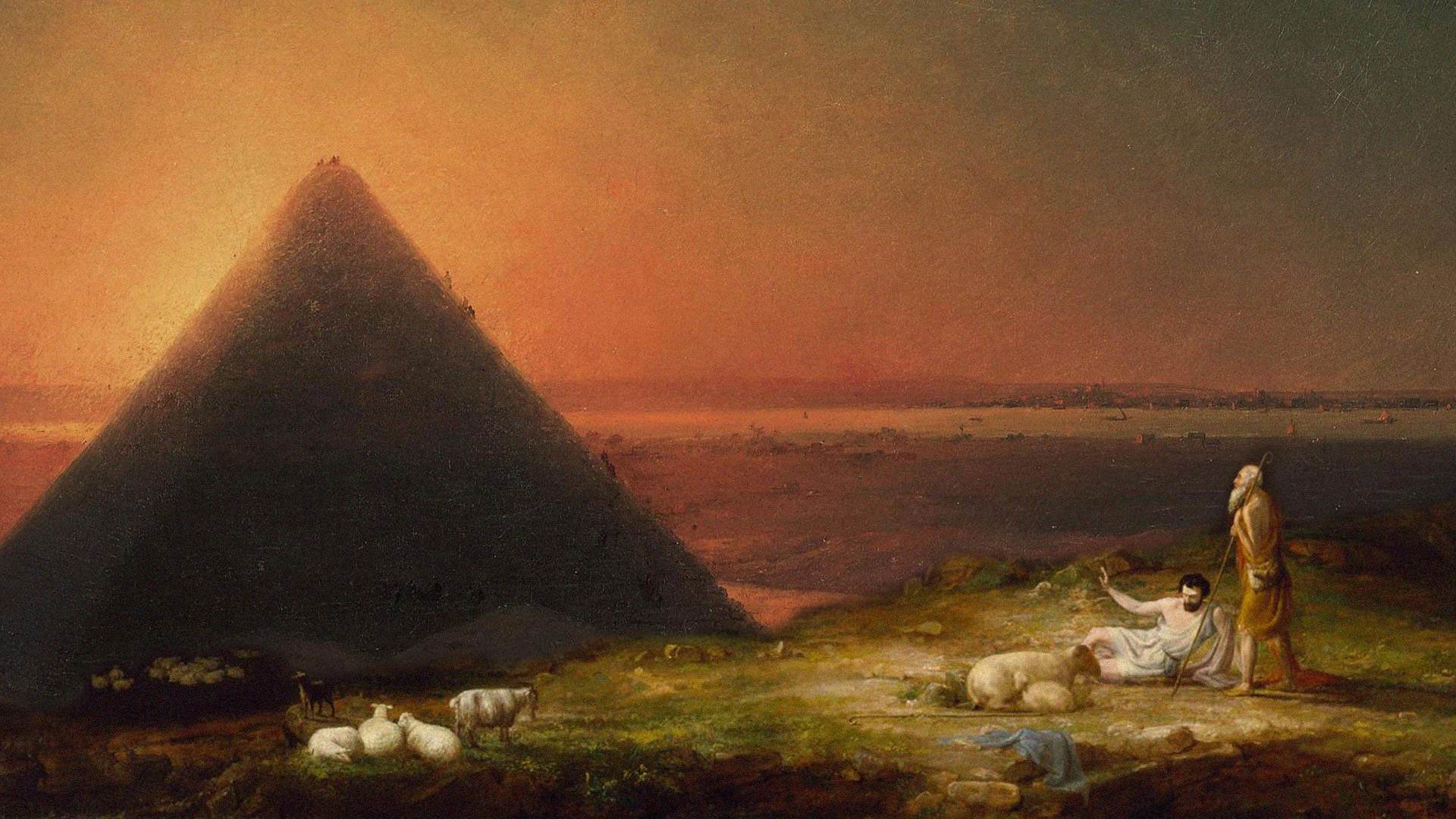
Pharaoh, Did You Know?

Columnist

How the shepherds upended Egyptian power.

Illustration by Abigail Erickson / Source Images: Wikimedia Commons

Those familiar with the Bible know how to imagine Pharaoh of Exodus: heart-hardened as he heard from Moses and Aaron, “Let my people go.” However, we don’t often think about how some words spoken centuries later may have been even more repulsive to him:

There were shepherds out in the field, keeping watch over their flock by night. And an angel of the Lord appeared to them, and the glory of the Lord shone around them. (Luke 2:8–9, ESV throughout)

Maybe what we need to understand about the Christmas story is how it would have rattled the pyramids.

The Joseph we think about this time of year is Joseph of Nazareth, the adoptive father of our Lord Jesus. But a much earlier Joseph lingers in the background of the familiar scene in Luke 2. In Genesis 46, this Joseph—a key figure in Pharaoh’s court—brought his long-lost, now-found family to Egypt to save them from famine. Joseph told them,

When Pharaoh calls you and says, “What is your occupation?” you shall say, “Your servants have been keepers of livestock from our youth even until now, both we and our fathers,” in order that you may dwell in the land of Goshen. (vv. 33–34)

Joseph seemed to be coaching them to reassure Pharaoh that they were coming not to take over, but merely to carry out their occupations without disrupting Egyptian life. The Bible tells us why: “Every shepherd is an abomination to the Egyptians” (v. 34).

This lowly occupation that was an abomination to the Egyptians becomes a recurring theme in the biblical story. Later, Moses (who, like Joseph, had been an insider in Pharaoh’s court) fled for his life and, before his encounter with God in the burning bush, spent extended time tending flocks (Ex. 3:1). Only after becoming such an abomination to the culture of Egyptian power could Moses become the human captain of God’s deliverance of his people from that empire’s grip.

Then he led out his people like sheep
and guided them in the wilderness like a flock.
He led them in safety, so that they were not afraid,
but the sea overwhelmed their enemies. (Ps. 78:52–53)

And the Davidic throne that the baby Jesus was born to inherit originated not with an aristocrat but with a shepherd (1 Sam. 16:11–13). In fact, the entire promise of salvation and renewal was described by Jesus in just these terms: a good shepherd gathering together a flock (John 10:11–18).

Reflecting on W. H. Auden’s For the Time Being, Alan Jacobs notes that the Magi’s search for the baby born king upsets Herod precisely because they “do not seek to replace him on the throne of his kingdom, but to usher in a wholly new Kingdom.” A shepherd does not lead with coercion and Darwinian strength, but with his voice (John 10:1–5). God’s choice of shepherds to hear the angelic announcement (while Herod had to get the information secondhand from a foreign delegation) only reinforces the character of this new kingdom.

Just as shepherds were seen as an abomination to the early Egyptians, the cross was an abomination to the Romans. Crucifixion was the way Caesar could dominate anyone who could challenge his rule, just as slavery was for Pharaoh of old. Those crucified were to be forgotten; their form of death was the sort of horror from which people would avert their eyes. And yet, “God chose what is low and despised in the world, even things that are not, to bring to nothing things that are” (1 Cor. 1:28).

What lasts far beyond human power is the power those “abominable” shepherds heard about as God’s glory shone around them: “good news of great joy that will be for all the people. For unto you is born this day in the city of David a Savior, who is Christ the Lord” (Luke 2:10–11). What lasts is not the wrappings of mummies but the one who was wrapped in swaddling clothes. Pyramids and colosseums crumble. What the shepherds saw in the manger—that abides. The shepherds knew a better Shepherd’s voice when they heard it, not just in the angels’ song but in a baby’s cry.

Russell Moore is CT’s editor in chief.

News

Wedding Fire Devastates Christian Community in Iraq

And other brief news stories from Christians around the world.

Ismael Adnan / AP Images

More than 100 people died in a fire at a Chaldean Christian wedding in Iraq. The initial investigation indicated the blaze was started by firework fountains that ignited flammable material on the ceiling while the bride and groom danced. The hall was filled to twice the approved capacity and had no emergency exits. The owner of the hall was arrested on charges of failing to comply with safety codes, and several city officials were dismissed, including a municipal director, a tourism director, a fire chief, and a utilities department official. The BBC said, “Safety standards are often poorly observed in Iraq, which has been plagued by decades of mismanagement and corruption.” The city was reclaimed from ISIS by US-led coalition forces in 2016.

Iran: Pentecostal begins 10 years in prison

Anooshavan Avedian, an Iranian Armenian pastor, started the 10-year prison sentence he received last year for “propaganda contrary to and disturbing to the holy religion of Islam.” He was arrested while leading a worship service in a Tehran home in 2020. The Assemblies of God meeting place was shut down 10 years ago for holding services in Farsi. Iranian security forces have arrested thousands of Christians in the past few years.

Pakistan: Pastor faked Islamist attack

A Presbyterian pastor was arrested and charged with making a false statement to police. According to authorities, Eleazar Sidhu administered anesthesia to his arm and then held a .30-caliber pistol very close, shooting himself in a way that would not damage a bone. He then told police he had been attacked by a Muslim extremist. “I did it because of stress,” Sidhu said in a recorded confession. Lazar Allah Rakha, an attorney who has defended Christians accused of blasphemy, said, “This hullabaloo over nothing has caused grave damage to all the true cases of persecution.”

Israel: Explosion hits Christian hospital

A misfired Hamas rocket exploded at the only Christian hospital in Gaza and killed more than 100 people, according to US intelligence. The Hamas-controlled health department immediately said it was part of an Israeli military airstrike, part of the bombardment ahead of an expected invasion aiming to eliminate Hamas. The terrorist organization attacked Israel on October 7. The accusation and the Israeli military’s denial were amplified on social media, roiling global debate about the justice of the conflict. The hospital was founded in the 1880s by Anglican missionaries who read the Bible with patients. It was taken over by Southern Baptists in 1954 and run by them for about 20 years before being returned to the Anglicans. “We are here as an instrument in the hands of God to show the love of Jesus Christ for all people,” the current director said. “This hospital will continue to be a place of reconciliation, of love.”

United States: Religious worker visas backlogged for 10 years

A change in the way visa applications are processed at the State Department has created a 10-year backlog for clergy applying to live and work in the United States. Religious worker applications have been put in the same queue as neglected or abused minors from Guatemala, Honduras, and El Salvador. Previously, successful applicants received visas in four to six years. The US admits about 6,000 religious workers annually.

United States: Anabaptist insurance company is insolvent

MutualAid eXchange, an insurance company “founded upon the faith-based principles of the Mennonite, Brethren, and related denominations,” has been ordered by a court to liquidate because it cannot meet its financial obligations. The insurance company covered 30,000 auto, home, farm, business, and life insurance policies. According to officials, it ran into trouble trying to cover the increase of claims involving storm damage in the South and Midwest in 2022 and 2023.

Costa Rica: Global Methodists plan first general conference

The Global Methodist Church is planning its first general conference for Costa Rica in September 2024. The denomination, formed out of a split with the United Methodist Church, has about 3,800 congregations in the US, the Democratic Republic of the Congo, Kenya, Bulgaria, Slovakia, Spain, and the Philippines. Leaders expect churches from seven more African countries to join soon. There are no Global Methodists in Costa Rica, but the conference will be hosted by the Evangelical Methodist Church, which has about 100 congregations. Beth Ann Cook, a pastor in Poseyville, Indiana, will serve as chair of the inaugural meeting.

Norway: 32 years of Methodist marriages are legally invalid

People married in a Methodist church between 1991 and 2023 are not legally wed, according to the Norwegian Directorate for Children, Youth, and Families. The denomination changed its liturgy in ’91 and did not get the new version approved. Methodist ministers reportedly performed about 800 weddings before this year’s liturgical update went through the appropriate channels. “I got a bit of a shock,” one Methodist woman said, “because I think we have been married for 30 years.” The church has officially apologized, but some pastors do not seem especially concerned. “I think this whole thing is a big joke,” said a minister in Bergen.

Germany: Pastor who spoke against war flees Russia

Yury Sipko, a Baptist pastor and previous head of the Russian Union of Evangelical Christian Baptists, fled Russia after learning he was under investigation for speaking against the war in Ukraine. Sipko, 71, arrived at one of his daughters’ homes in Germany with nothing but the clothes on this back. “The law makes it a crime to call the war a ‘war’ and does not allow anyone to call for peace in Ukraine,” he said. “But I prayed for peace.”

News

What Evangelical Scholars Found Looking at a Tiny Piece of Papyrus

From a dump in Egypt to a criminal case in Oxford to a seminary in Texas, this fragmentary record of faith traveled a strange path.

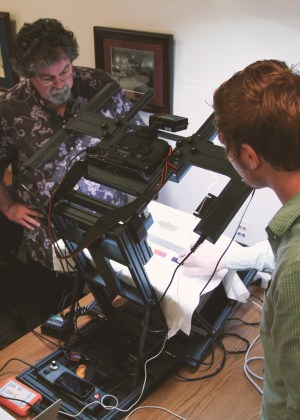
Rory Crowley studies a second-century piece of papyrus.

Rory Crowley studies a second-century piece of papyrus.

Courtesy of the Center for the Study of New Testament Manuscripts

When he finally figured it out, Rory Crowley burst into tears.

He was alone in a dark Dallas apartment with one lamp and a laptop on, hunched over a high-quality photo of a battered piece of papyrus.

There was Greek writing on it. Someone living maybe 150 years after the Crucifixion had written down the words of Jesus. Crowley and the other young men at Dallas Theological Seminary studying this papyrus with their professor, Daniel B. Wallace, had recognized some of the text immediately. It was the Gospel of Matthew—the Sermon on the Mount. And some seemed to come from a similar part of Luke, the Sermon on the Plain.

But a middle part, they couldn’t identify.

“You fast,” it said, “you will never find and unless you … the world you … the Father … the birds, how. …”

For hours and hours and weeks and months, they puzzled over it. Then Crowley suddenly saw it was a bit of the Gospel of Thomas, a noncanonical text of sayings attributed to Jesus. The words in front of him matched a passage that says to “fast from the world” or you will never find the kingdom of God and see the Father in heaven.

Whoever wrote this text wove together different sayings from different places, compiling Jesus’ teachings about worry. And Crowley—who was up at 2 a.m. because he couldn’t sleep and thought he might as well work—understood.

“I was crying,” he told CT. “I felt like I was in conversation with the mind of a believer. This is a faithful Christian, in my opinion, who knows there’s this really incredible Jesus guy.”

The scholarly report on the fragment that Crowley and others worked on in 2012 and 2013 was published this year, at the end of August, after more than a decade of rumors swirling through academia. Some once said this papyrus was from an early, early copy of Matthew. Others said it had been pried from a mummy mask. Neither turned out to be true, but according to the scholars who worked on the fragment, the truth is better: This fragment reveals something about how people in the late 100s or early 200s engaged with the teachings of Jesus.

“This gives us a glimpse,” said Michael W. Holmes, an emeritus biblical studies professor at Bethel University. He, Wallace, and Jeffrey Fish at Baylor University coauthored the report, acknowledging eight former Dallas students.

“Was it part of a larger sermon? Was it a private meditation? It’s so short that all one can do is speculate,” Holmes said. “But the canon was still taking shape at this time. Sayings were circulating in oral form, probably there were little collections in written form, and then you have written Gospels. And in the second century, these are all side by side and it’s very fluid.”

The report’s publication has caused a stir among specialists in early Christian texts. The papyrus, now known as P.Oxy. 5575, may be the oldest surviving written record of the Sermon on the Mount. It is thought to be the earliest, or one of the earliest, pieces of the Gospel of Thomas. And it is the only known text of its era that puts these sayings of Jesus in conversation with each other.

A month after the report was published, members of the North American Society for the Study of Christian Apocryphal Literature got on Zoom to discuss the fragment. They analyzed possible genre classifications, the dating, and its relationship to other early Christian texts.

Daniel B. Wallace and his students examine an ancient papyrus containing sayings of Jesus.

Some also expressed reservations about the odd history of this piece of papyrus and how it came to be studied by a bunch of evangelical grad students and three professors who are all connected to the Museum of the Bible.

The history is odd.

The scrap was originally excavated from a garbage dump in an Egyptian city with a Greek name: Oxyrhynchus. In the winter of 1897, two Oxford scholars started digging there and found papyri preserved by the sand and dry weather. Lots and lots of papyri.

Within a few months, they had extracted almost 2,000 pounds of texts. Over the next decade, they moved more than 500,000 fragments back to Oxford and stored them in the Egypt Exploration Society (EES) collection’s library.

To date, an estimated 1 percent of the Oxyrhynchus papyri have been published. The fragments include receipts, court records, tax documents, and contracts. There are ancient bits of Plato, Euclid, and Homer, a forgotten Sophocles play that involves a satyr, and lots of early Christian writings, including prayers, hymns, homilies, and Scripture.

For nearly 127 years, scholars have been slowly making their way through this trove of archaeological treasure. According to EES, however, the wealth was too tempting for one man. Dirk Obbink, a leading papyrologist who oversaw part of the collection, allegedly stole more than 100 fragments and sold some to the people planning the Museum of the Bible, obscuring their true origin.

In 2012, these fragments were sent to evangelical scholars who could train grad students while doing original research. Wallace, also the founder of the Center for the Study of New Testament Manuscripts, got a piece about an inch and a half wide and three and a half inches long, protected between panes of plexiglass. It was called “Matt Frag.”

Neither Wallace nor the eight Dallas students he recruited could have imagined it was stolen. Nor did they think it had any association with the excavation of Oxyrhynchus. They did, however, suspect the text might have been extracted from a mummy mask.

“Dirk Obbink was disassembling these mummy cartonnage, which is like papier-mâché,” said Peter Gurry, a New Testament professor at Phoenix Seminary who was one of Wallace’s students at the time. “Basically, he’d take water and liquid detergent, a very gentle liquid detergent, and it comes apart in pieces of papyri. Lo and behold, some of them have text on them.”

The students, however, didn’t worry about where it had come from. They focused on learning the skills necessary to understand their piece of papyri. They went to Wallace’s house about once a week for an intensive independent study.

“Just deciphering the text is very challenging,” Wallace told CT. “You don’t have the left margin. You don’t have the right margin. You’re looking at a fragment that’s in the middle of something. You start with just a part of a word.”

As they deciphered the Greek together, they recognized lines that were pretty close to Matthew and Luke, verses about not being anxious for anything and considering the birds. And they realized there was another bit that didn’t seem like anything in the New Testament. The papyrus wasn’t an early Gospel of Matthew. But they didn’t know what it was.

The next task for the team was figuring out the date of the document. Wallace sent them looking for other ancient manuscripts to compare different styles of handwriting until they could place their fragment in a particular generation of Greek penmanship.

“You really don’t get confident until you’ve looked at not just dozens but hundreds of papyri,” said Zach Cole, a New Testament professor at Reformed Theological Seminary who was also one of Wallace’s students at the time. “You look at how an alpha gets shaped and you really start to develop a comparative sense—but that is a conceivably endless task.”

After comparing, comparing, and comparing, all eight wrote arguments for a particular date. They each concluded that the script was closest to manuscripts that had been dated to the late second or early third century.

Then in June 2013, Crowley made the connection between the unfamiliar lines of text and the Gospel of Thomas. It happened after he’d spent hundreds of hours looking at the fragment side by side with other ancient fragments. And then all at once, there it was: A passage from the first Oxyrhynchus text, P.Oxy. 1, published back in 1898, matched.

“Lord,” Crowley said, “you’ve allowed us to find this.”

It wasn’t until a few years later that he and the other students learned the papyrus they had studied rightfully belonged to the EES and never should have ended up in Dallas. It had never been part of a mummy mask but instead sat in a box in Oxford for more than 100 years before being swiped.

The Museum of the Bible returned the stolen property, and the heads of the Oxyrhynchus collection decided, graciously, to let the evangelical scholars go forward with their research.

To those scholars, it seems in retrospect like a miracle, or at least one of the mysterious ways God moves.

Now that the fragment is published, they realize the puzzle they were working on was just a piece of a larger puzzle. Their research will provoke debate and more research, which is how it goes with scholarship.

But they also realize that, for a moment, their work connected them across millennia to another person who was deeply moved by Jesus.

“This manuscript is a reminder,” Gurry said, “that Jesus’ teaching was seen as kind of amazing. And Jesus’ teaching is kind of amazing. People have always worried, and Jesus has given us the most profound way to think about those worries.”

Daniel Silliman is CT news editor.

Let There Be Dark

Deep darkness only magnifies what it is to gaze upon the Light of the World.

Photography by Constantine Themelis

Not only are the images from the James Webb Space Telescope brilliant and beautiful, but they are also baffling. In recent months, approximately 40 pairs of a new classification of orb have been identified within pictures of the Orion Nebula. Dubbed JuMBOs—Jupiter Mass Binary Objects—these objects defy our current, conventional understanding of how planets, stars, and gravitational orbits work. Unlike normal planets, the Jupiter-sized pairs don’t orbit a star. Astronomers don’t know why—or how—they function in this way. As The New York Times put it, they are “a complete mystery.”

These images and discoveries coming back from the far reaches of space put us in our place—bringing to the forefront how expansive the universe is, how small we are, how much we don’t know, and how much there is yet to discover. When we consider the heavens—the star clusters, nebulae, black holes, and now JuMBOs—who are we? What is humankind that God is mindful of us and cares for us, as Psalm 8:3–4 says?

In “God’s Promises Are Clearest When We Turn Out the Lights,” Cort Gatliff reflects on this psalm of “doxological stargazing,” writing that “the stars provide perspective. They humble us by highlighting our finitude. Yet they also lift up our heads by reminding us of our infinite worth in the eyes of the Creator.” And while stunning images from space let us glimpse celestial realities we’d never be able to see with the naked eye, simple nighttime starscapes also invite us into awe and wonder.

Gatliff discusses the harms of pervasive light pollution—not only on creatures who are reliant on darkness or moonlight for navigation (like sea turtles and migratory birds) but also on us, as so many of us no longer have unobscured visual access to the worship-inspiring night sky. The darker the night, the more stars we can actually see.

During Advent, we often read this prophecy from Isaiah: “The people walking in darkness have seen a great light; on those living in the land of deep darkness a light has dawned” (9:2). In a spiritual and emotional sense, the recent heaviness of war, natural disasters, and other global tragedies helps us understand even more deeply what it means to be people walking in darkness. And this deep darkness only magnifies what it is to gaze upon the Light of the World. Amid it all, God is mindful of us. God does care for us. The Light of the World shines in the darkness.

Kelli B. Trujillo is CT’s print managing editor.

Cover Story

God’s Promises Are Clearest When We Turn Out the Lights

Christians have every reason to reduce light pollution.

The Dolomites, Italy

The Dolomites, Italy

Photography by Constantine Themelis

It’s hard not to be sentimental about a Northern Hemisphere December, with its snow (or in the American South, where I live, its relative cool), its coziness, and of course, the Christmas decorations. Twinkling lights transform city streets into galaxies, and an ornamented Christmas tree fills my living room with the scent of pine needles.

On top of that tree rests a star. Some people cap their trees with an angel, but for as long as I can remember, I’ve gravitated toward the star, which represents one of the more enigmatic elements of the already peculiar narratives about Jesus’ birth.

Matthew’s gospel tells us that after Jesus was born, wise men from the East traveled to Bethlehem to worship him. Unlike the shepherds, who received a divine birth announcement from a company of angels, the wise men identified a single star rising in the sky as the impetus for their pilgrimage: “We saw his star when it rose and have come to worship him” (2:2).

It’s a detail that raises far more questions than it answers. Theologians and astronomers alike continue to contemplate Yuletide mysteries like the star of Bethlehem, but a different question is at the forefront of my mind this Christmas season: If that same star appeared in the night sky today, would we even be able to see it?

I first began to think about stars and their place in our modern world while studying another passage of Scripture in which celestial bodies play a prominent role. In Genesis 12, God makes a covenant with a man named Abram.

God promises to make Abram into a great nation, a promise that seems improbable since Abram has no children and his wife is barren.

Years pass, and Abram’s nomadic household has yet to resemble anything like a nation, let alone a great one. He still has no heir and no land to call his own, so he asks God for a sign to assure him that he hasn’t believed these promises in vain.

God instructs Abram to step outside his tent and gaze into the heavens. “Look up at the sky and count the stars—if indeed you can count them,” God says. “So shall your offspring be” (15:5).

While looking up at the stars, “Abram believed the Lord, and he credited it to him as righteousness” (v. 6).

I read this passage together with members of the church I pastor, and I pictured Abram standing in the silent wilderness, craning his neck toward the vast night sky dotted with an endless sea of stars and believing in his heart that God’s promises would come to pass.

So I gave the group a homework assignment: Take a few moments out of your busy night to go outside, look up, and marvel at the glory and goodness of our Creator. One participant joked he would attempt to count the stars and report back his findings.

Pelion, GreecePhotography by Constantine Themelis
Pelion, Greece

When I stepped outside to do some stargazing of my own, though, what I saw was less than awe-inspiring. Despite it being a clear night and close to a new moon (the darkest of the moon’s phases), I actually could count the stars. There were 12.

Where did they all go? I wondered.

The answer, of course, is they’re still up there. We just can’t see them anymore.

For almost all of human history, people lived, worked, and worshiped under a sky nearly identical to the one Abram saw thousands of years ago. As the sun disappeared below the horizon, a dazzling blanket of stars, planets, and other celestial bodies would emerge from the darkness of night.

But all that has changed in the past hundred years or so. Today, light pollution, a catchall term for the negative effects of excessive (and often unregulated) use of artificial lights at night, has rendered many of the stars overhead invisible, drastically altering how humans experience the night sky.

Few people are unaffected. In 2016, physicist Fabio Falchi and his collaborators released the report “The new world atlas of artificial night sky brightness,” which found that 83 percent of the world’s population and 99 percent of Americans and Europeans live under a night sky partially obscured by light pollution. The Milky Way, that cloudy band of stars and gas that is our galaxy, is now hidden from one-third of the world’s population. People living in Singapore, the Middle East, and South Korea are least likely to see the night sky.

And the world is only getting brighter. In a 2023 study, physicist Christopher Kyba and his colleagues found that, on average, the night sky’s brightness (measured from the perspective of Earth, illuminated by any nearby artificial lighting such as streetlights) increased by nearly 10 percent each year from 2011 to 2022.

Most of us don’t realize how bright our nights actually are because we’ve never, or rarely, experienced a truly natural night, one unaffected by artificial light.

The star-spangled firmament, once an aspect of creation easily accessible to all, has become such a rare commodity that dark sky tourism is now a big business, with people traveling to national parks and other remote areas solely to catch an unadulterated glimpse of the stars. (As I write this, my wife and I are planning a trip to Zion National Park, a certified International Dark Sky Park. We’ve booked a clear-roofed glamping tent called the “Stargazer” just outside its border.)

When it comes to environmental issues, climate change tends to dominate the conversation because the stakes are so high. But there’s a growing interest in the destructive effects of light pollution, which are numerous and well documented.

For example, Swedish scientist Johan Eklöf, in his 2023 book The Darkness Manifesto, explores the evidence that our artificially lit world is harming all manner of flora and fauna, including human beings, whose health depends on a regular cycle of exposure to both light and dark. If you feel tired all the time, the reason may be related to the amount—and the type—of artificial light you’re subjecting yourself to at night.

The Smithsonian Museum of Natural History also is turning its attention to light pollution and the loss of the night sky. From now until December 2025, an exhibit titled Lights Out is asking the question “How much light at night is enough?”

Various advocates tend to focus on different consequences of light pollution when arguing against excessive illumination. Some, like Eklöf, raise the alarm about artificial light’s disastrous, and often fatal, impact on wildlife, such as migrating birds or nesting sea turtles.

Others lament the loss of a universal experience—the shimmering night sky—that has inspired countless philosophers, scientists, artists, and writers for thousands of years. Would Vincent van Gogh still paint The Starry Night if he observed the sky over Saint-Rémy, France, today? Probably not.

La Palma in the Canary Islands, SpainPhotography by Constantine Themelis
La Palma in the Canary Islands, Spain

I share these concerns. As a pastor, however, I’m most alarmed by the profound spiritual implications of a sky without stars. I’m convinced Christians have strong, biblical reasons to see preserving the night sky as a crucial aspect of both creation care and our own connection to God and his promises.

Turning out the lights is more than an eco-friendly habit—it’s a spiritual discipline.

From Genesis to Revelation, stars appear throughout the pages of Scripture. They play a subtle yet significant role in the Bible, calling us to direct our physical gaze toward the heavens and our spiritual gaze toward the God who made the “starry host by the breath of his mouth” (Ps. 33:6).

In Genesis 1, God creates the stars, along with the sun and the moon, to “serve as signs to mark sacred times” and “to give light on the earth” (vv. 14–15).

From the very beginning of the biblical story, the stars served as a declaration that God—and God alone—is the transcendent Creator of all things. But the stars also teach us that he’s not a just a creator who sets his universe in motion and then steps away. As Abram’s story reminds us, he’s a creator who wants to be in relationship with his creatures.

The God of Israel is so powerful that he speaks the stars into existence, and he’s so personal that he speaks promises to his people. The story of those promises is written in the stars.

In the Book of Numbers, as the Israelites are making their way to the Promised Land, a Moabite king hires a prophet named Balaam to curse God’s people (22:4–6). Instead, God speaks through Balaam to deliver a messianic prophecy about a coming king: “A star will come out of Jacob; a scepter will rise out of Israel” (24:17).

Hundreds of years later, that long-awaited King was born, and the aforementioned star—the one our Christmas tree toppers commemorate—led the Magi to Jesus.

Revelation 22 tells us that at the end of all things, in the New Jerusalem, we “will not need the light of a lamp or the light of the sun” (or an LED, for that matter) because Jesus, the “bright Morning Star,” will be our perfect and eternal source of light (vv. 5, 16).

Until that day, the stars above us point us toward the Star who saves us. They’re a cosmic call to worship.

The Psalms in particular contain numerous references to the stars. Psalm 19 describes celestial bodies in the night sky as declaring and proclaiming the glory of God (v. 1). The stars “reveal knowledge,” and though they do not speak, “their voice goes out into all the earth” (vv. 2–4). Creation is God’s sanctuary, and the stars participate in nature’s chorus of praise.

In Psalm 8, David engages in doxological stargazing. While surveying the sky, he contemplates the grandeur of all God has made, and it leads him to marvel, “What is mankind that you are mindful of them, human beings that you care for them?” (vv. 3–4).

Helmos Observatory, GreecePhotography by Constantine Themelis
Helmos Observatory, Greece

For David—and for us—the stars provide perspective. They humble us by highlighting our finitude. Yet they also lift up our heads by reminding us of our infinite worth in the eyes of the Creator.

Similar to how stars help orient ships navigating at sea, they orient us spiritually and existentially in the tossing waves of life. It’s as if they’re saying, Look up—you are but one tiny speck in this vast universe, and soon you will be forgotten. But look up—the same God who created and named each star in the sky knows you, loves you, and died for you.

The stars are an example of what theologians call “general revelation”—the truths about God and his character revealed through nature. Light pollution threatens to drown out this revelation, in effect muting these divinely appointed worship leaders embedded in the fabric of creation.

Not every mention of stars in the Bible is positive, however. Because of the Fall, we’re prone to worship “created things rather than the Creator” (Rom. 1:25).

In Deuteronomy, Moses warns the Israelites, “When you look up to the sky and see the sun, the moon and the stars—all the heavenly array—do not be enticed into bowing down to them” (4:19). Stars, for all their beauty, are meant to arouse worship of another, not to become the object of worship themselves.

When King Josiah sought to rid Judah of idolatry, he cast out priests who burned incense “to the constellations and to all the starry hosts” (2 Kings 23:5).

And through the prophet Isaiah, God condemns astrology, the practice of observing the movements of stars and planets to understand or predict events (47:13–14).

Prohibitions against astrology may seem like outdated warnings from a pagan past, but the practice is seeing a resurgence as part of a larger trend of Americans embracing alternative forms of spirituality. Horoscopes, once primarily found in the pages of newspapers, are now reaching massive audiences through astrology influencers on platforms like Instagram and TikTok.

Even Christians are consulting the skies for guidance. A 2018 Pew Research Center report found that more than a quarter of self-identified Christians in the United States believe in astrology, including nearly one in five evangelicals. It’s not uncommon for church members to inquire about my zodiac sign (something seminary didn’t prepare me for!).

The human tendency to look to creation rather than to the Creator for knowledge is not easily dispelled.

I recognize that a Christian appeal for a darker world may seem incongruous, given Scripture’s apparently unfavorable view of darkness. The Bible contains around 200 references to darkness (depending on the translation), most of which are negative. It also says that the Father “rescued us from the dominion of darkness” (Col. 1:13) and that “God is light; in him there is no darkness at all” (1 John 1:5).

Those are spiritual metaphors, and we must carefully learn from them in the circumscribed way the Bible presents them. Some Christians throughout history have used the Bible’s symbolic treatment of darkness as justification for prejudice against people with dark skin, a leap that not only finds no support in the text but also contradicts the message of the gospel.

Similarly, it would be misguided to assume the literal darkness of night is a result of the Fall that should therefore be overcome. The natural rhythm of day and night existed in the Garden of Eden before the fateful encounter with the Serpent—and “God saw that it was good” (Gen. 1:14–18).

The story of how we conquered the dark but lost the stars sounds a lot like a quip from Ernest Hemingway’s The Sun Also Rises about how one goes bankrupt: “gradually and then suddenly.”

People have always sought to illuminate the darkness, out of both necessity and fear. For most of human history, we’ve used incandescence after the sun went down to carry out tasks and to ward off dangers.

In the 17th and 18th centuries, European cities and American colonies began implementing basic forms of public lighting, primarily using oil lamps. The push to illuminate streets stemmed from the idea that more light would result in less crime. In a letter to John Jay, Founding Father John Adams describes darkness as a haven for “robberies, burglaries, and murders” and suggests that light from streetlamps would “chase away … all the villains” and prevent the need for hiring more police officers.

Crete, GreecePhotography by Constantine Themelis
Crete, Greece

The belief that darkness equals danger and light equals safety is deeply ingrained in the human psyche, although the evidence is mixed that light stops crime.

In 1807, London’s Pall Mall became one of the first streets to be lit with gas-powered lights, which, by some measures, burned ten times brighter than their oil predecessors. Within a few years, other major cities on both sides of the pond followed suit, and the darkness in urban areas began to fade. The race to illuminate public spaces was on.

In the late 1800s, the sudden change agent that fundamentally reshaped the way people lived is something we now take for granted: commercially viable electric lighting.

These electric lights and streetlamps were more efficient, safer (with no flame), and, most importantly, brighter. Much, much brighter.

Electricity became commonplace in cities, but in the early 20th century, many Americans still lived in relative darkness. In 1936, President Franklin Roosevelt signed the Rural Electrification Act as part of the New Deal. The act provided low-interest loans to bring electricity to farms and rural towns. Within two decades, the vast majority of American homes—rural and urban—could access electricity.

America flipped the light switch on, and the night has been getting brighter ever since.

There were early warning signs that overillumination would bring unintended consequences. In the 1930s, Pope Pius XI moved the Vatican Observatory 15 miles outside of Rome to avoid the Eternal City’s increasingly bright skyglow. A few decades later, further light pollution forced the Vatican to find another place to conduct its astronomical research. The pope’s telescope eventually found a home under the dark skies of southeast Arizona, where it remains active today.

Light pollution isn’t just a problem for the pope, of course, but that story is a microcosm of the challenge astronomers, amateur stargazers, and casual observers have faced for years: There are simply fewer and fewer places on this planet to encounter the breathtaking beauty of the stars.

This is both a scientific and a spiritual crisis. We’re not just missing out on a captivating sight; we’re losing an opportunity to experience awe.

Dacher Keltner, a professor of psychology at the University of California, Berkeley, and social psychologist Jonathan Haidt define awe as “the feeling of being in the presence of something vast that transcends your current understanding of the world.”

We tend to feel awe when we’re confronted by great beauty combined with great power or mystery. And as Keltner argues in his 2023 book Awe: The New Science of Everyday Wonder and How It Can Transform Your Life, awe is good for us. Awe hits us in all sorts of ways. Standing on the rim of the Grand Canyon; being surrounded by towering mountains; or experiencing more intimate moments, like holding a newborn or sitting in the presence of a loved one close to death, can elicit awe.

La Palma in the Canary Islands, SpainPhotography by Constantine Themelis
La Palma in the Canary Islands, Spain

Awe drives us to contemplate the big questions of life, the ones so easily drowned out by the humdrum of our everyday routines.

Keltner connects awe to wonder, a closely related yet distinct “mental state of openness, questioning, curiosity, and embracing mystery.” Wonder, he says, flows out of awe.

We see this dynamic play out in Isaiah 40:26. Speaking through the prophet, God instructs his people to look toward the heavens. Then awe excites wonder: “Who created all these?” The wonder culminates in worship, as we contemplate “he who brings out the starry host one by one and calls forth each of them by name.”

For Christians, awe leads to wonder, which leads to worship. Awe has a decentering effect that directs our attention away from the self, which is no small thing in a world awash with algorithms that cater to our every preference. When we experience awe, Keltner writes, “regions of the brain that are associated with the excesses of the ego, including self-criticism, anxiety, and even depression, quiet down.” Philosopher Iris Murdoch called this effect “unselfing”—a particularly apt term in our #selfie world.

The mental and social benefits of awe are impressive, but I’m most intrigued by awe’s ability to open us up to the possibility of believing in God. Piercarlo Valdesolo, a professor at Claremont McKenna College, and Jesse Graham, a professor at the University of Utah, found in a 2014 study that “participants’ belief in supernatural control was significantly greater” for those who experienced awe compared to those who didn’t. To put it in theological terms, awe stimulates what John Calvin called the sensus divinitatis in his Institutes—the innate sense of God deep within the heart of every person.

When we allow our artificial lights to block out God’s light, we rob the world of a source of awe. That awe has the power to draw people to Christ—or at least to inspire conversations that may allow us to share the gospel. We need such a shared sense of awe as Christianity continues to decline in the US. Unlike the Grand Canyon or an impressive mountain range, the stars are with all of us, offering the possibility for wonder and worship regardless of where we are on the planet.

It’s fitting that the development and proliferation of artificial illumination tracks closely with the spread of the Enlightenment. As human reason and scientific progress supposedly did away with the need for religious “superstition,” human technology steadily blotted out the astral reminders of our creaturely limitations.

That’s the irony of our modern moment: Remarkable technological developments allow us to peer deeper into space than ever before, yet the developments that make marvels like the James Webb Space Telescope possible also contribute to eliminating the visibility of the stars directly above us.

Many of us spend our nights inside, surrounded by light, staring at glowing rectangles that serve as portals to galaxies of information and entertainment. We’re too distracted to look up, and even if we do, we’re likely to see reminders of human achievement—airplanes and satellites—rather than an awe-inspiring canopy of stars that humbles us before God. The heavens, it turns out, can end up declaring the glory of man if we’re not careful.

So what should we do with this artificial light of ours? Hide it under a bushel?

Well, sort of.

When lamenting the artificially bright night sky, it’s easy to romanticize pre-electric life. But I have no interest in flipping off the switch to the power grid. The ability to illuminate and darken my home, without the risk of an overlooked candle burning it to the ground, is not one I want to live without. In addition to the obvious conveniences that electricity provides, artificial light has been linked to wide-ranging benefits, including lower infant mortality and higher literacy rates.

The question isn’t whether we should use artificial lights, but rather how we can use them more responsibly. How can we prevent wasting energy and limit unnecessary light pollution? What would it look like to illuminate our homes, properties, and cities to the glory of God (and our increased ability to recognize it)?

In one sense, of all the ecological and environmental problems facing our planet, light pollution has the simplest solution: fewer, dimmer lights and more-targeted use of lighting. Unlike cleaning up after an oceanic oil spill or attempting to reverse global warming, changing our lighting habits would have almost immediate results.

Christians can do some things on their own, especially if they are homeowners. The International Dark-Sky Association recommends turning off unnecessary lights, using motion sensors or timers for lights that are only sometimes needed, pointing the lights downward, and using warm-colored bulbs.

These are good and important steps, but the major sources of light pollution exist outside the home. Streetlights, overly lit commercial buildings, illuminated billboards, and other external lights that shine upward all brighten our night sky.

To address this, Christians can advocate for more restrictive lighting laws and make recommendations to their churches for buildings, grounds, and parking lots. They can also participate in public programs to regain the night sky.

Some larger cities, like Chicago, have created a Lights Out program, encouraging building owners to turn off superfluous lights that inhibit the migration patterns of birds. Christians and churches (especially ones with brightly lit steeples) could also participate in Earth Hour, an annual movement to switch off lights for one hour.

The desires for safety, modern comforts, and a glittering night sky don’t have to be in competition. We can retain the artificial lighting we need while revealing the stars overhead, so that future generations will be able to receive their faithful testimony with awe, wonder, and worship.

And as we do so, we can seek out the darkness in order to better see the light. We can look up into the night sky, remembering the power and promises of God and awaiting the dawn of the bright Morning Star.

Cort Gatliff is a pastor at South Highland Presbyterian Church in Birmingham.

News

How Abilene Christian Saw the Nuclear Light

The Church of Christ school is working with the US government to build an experimental reactor.

Illustration by Joe Gough

It didn’t sound right to Abilene Christian University president Phil Schubert.

Professor Rusty Towell was telling Schubert over lunch a few years ago about nuclear reactors that use molten salt instead of water as coolant. Towell, who teaches engineering and physics at the Church of Christ school in West Texas and has a background in nuclear engineering, certainly sounded like he knew what he was talking about. But he said this alternative technology could produce cheap, clean, reliable energy. And it was safer than other nuclear processes. And the byproducts would be clean drinking water and isotopes that are useful in medicine.

Better yet, the technology was already proven to work. American scientists built such a reactor at the Oak Ridge National Laboratory in Tennessee and operated it successfully from January 1965 to December 1969.

“Rusty, if this really is that good,” the college president said, “why isn’t somebody already doing it?”

“I don’t know,” Towell responded. “They’re just not.”

Schubert remembers thinking, There’s no chance.

But what if there were? And what if Abilene Christian could lead the way with new research on transformative technology that could help move America beyond its dependence on fossil fuels, pump clean energy into the world, make electricity available in places that currently don’t have it, and lift people out of poverty?

This is amazing technology, he thought, and we would get to be right in the center of research that fits our Christian mission to a tee.

He was persuaded enough to greenlight Towell’s research proposal.

“You know what,” Schubert told Towell, “if you guys are passionate about this, I’m willing to help you get started.”

Today, Abilene Christian, in partnership with several other universities and with support from the US Department of Energy, is developing plans to construct a molten salt nuclear reactor that are currently under review by the Nuclear Regulatory Commission.

The school has built a $23 million facility to house the reactor and expects approval to start work on it in May 2024. Building that should take about 18 months, and then the school will apply for approval to operate it. The team hopes to fire up the first reactor in late 2025 or early 2026.

It will be a prototype that can be studied. The team of engineers, which includes a group at Abilene Christian and engineers and technicians at Texas A&M University, the University of Texas at Austin, and the Georgia Institute of Technology, will work to figure out how to bring more reactors online and connect them, ultimately, to the power grid.

“‘This is exactly what the US needs to be doing so we don’t fall behind China and Russia,’” Schubert recalls a Department of Energy expert telling him in 2018 or ’19. “‘I can’t believe you guys are going after this. I love it. When can you get a team to come up to DC and brief my entire team in nuclear?’”

Nuclear energy is nothing new. About 20 percent of America’s electricity since the 1990s has been produced using the technology. But the current model is based on systems that use water to transfer the heat that produces electricity.

While water serves the intended purpose, as soon as it warms, it can flash to steam, Towell explained. As a result, the system must be able to withstand extremely high pressure.

“That’s really the danger behind the current nuclear power plants, that high pressure,” Towell said. “When you use molten salt, it doesn’t ever want to flash to steam.”

Molten salt reactor systems also promise to be cheaper. Towell envisions small modular systems that can be deployed and set up quickly, addressing needs throughout the country and around the world.

“We want to meet those basic needs of people,” Towell said. “That’s the long-term vision. Obviously you can’t meet that until you have the ability to deploy these rapidly.”

Another man who really believes in this vision is Doug Robison. A third-generation oil and gas man whose children attend Abilene Christian, Robison was a few months away from retirement from ExL Petroleum, where he was a partner and cofounder. He heard Towell’s presentation on the potential for nuclear energy in 2017.

Robison was interested in alternatives to coal and oil. But he didn’t think most were practical. He’d served on a Texas Energy Planning Council in 2004, and the subcommittee he chaired was focused on energy production. It concluded that solar and wind power couldn’t effectively replace carbon-based options.

If Texas wanted to move away from carbon fuel, he thought that the best choice—maybe the only choice—was nuclear power.

Robison approached Towell in a back room after his talk.

“If you were fully funded,” he asked, “what could you do?”

Towell asked for two weeks to come up with a research plan. At the end of two weeks, he made his proposal, and Robison agreed to give a $3.2 million donation to the school to fund the research. He told CT he thought it would be an interesting project, would be meaningful, and would make the world a better place.

“God has given us an opportunity to use wealth and to use abilities and scientific understanding and all of that to carry out what is a uniquely Christian mission,” Robison said. “This is something that is so important that we need to do everything possible to make this successful.”

Some evangelical climate activists see a Christian college pursuing nuclear power as a positive development too.

Jessica Moerman, a climate scientist and the president of the Evangelical Environmental Network, said she’s optimistic about Abilene’s research. She previously worked on science and technology policy at the Department of Energy, and her grandfather worked as a nuclear engineer.

“I think these investments are incredibly important, and I’m just really glad to see a Christian university is a part of that lead team and helping lead the way there,” she said. “We need it not only for climate but also for clean air, clean water, for our health right now.”

Carbon emissions—which a majority of scientists say are increasing the atmospheric concentrations of greenhouse gases, causing a rise in the global mean temperature—have also made it harder to breathe. Worldwide, roughly 6.7 million people die every year from air pollution.

“If we had done these investments in these technologies decades ago, we would be much further along on our path towards clean energy and ensuring that we have clean air and clean water and a safe climate,” Moerman said.

A growing share of Americans support new developments of nuclear power, but many people still worry about potential accidents, conjuring images of Chernobyl, Three Mile Island, or more recently, Fukushima. There are other ethical challenges too, such as the fair use of and compensation for resources and the disposal of waste.

According to Towell, the biggest challenge for Abilene right now is getting government approval to fire up a reactor. It’s not every day that happens at a university—not to mention a school with about 5,000 students, 272 professors, and a century-old commitment to “purposeful learning and enthusiastic devotion to Christ.”

Beyond that, there are some technical questions about how the reactor will work, since this is new technology for the regulators. But Robison, the lead donor to the project, is confident enough that he’s put more money into the project as an investor. He has founded a company, Natura Resources, and is funding the research in exchange for an agreement that gives him the option to license future discoveries for profit.

And Schubert, the once-skeptical president who says he’s heard more than his share of research proposals that don’t seem grounded in reality, has become a believer.

“I know that what these guys have envisioned can be achieved,” Schubert said, “and that we can be the ones to achieve it.”

Adam MacInnis is a reporter in Canada.

News

Salvation Army Kettles Collect Fewer Coins

The bell-ringing campaign sees 20 percent decline in giving.

Tim Mossholder / Unsplash / Edits by CT

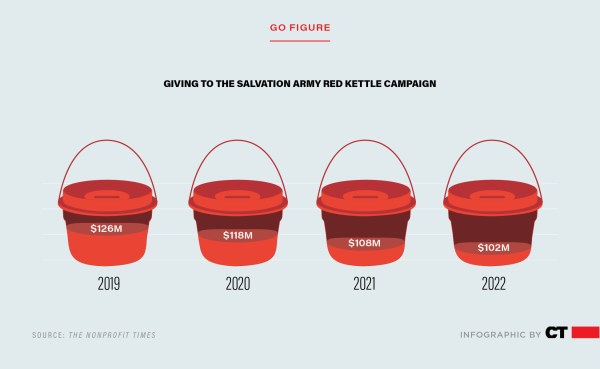
The Salvation Army bells are still ringing this Christmas, but coins don’t clink in the kettles as often as they used to. Giving to the annual fundraising campaign has dropped dramatically. Between 2019 and 2022, the decline was about 20 percent.

It is not clear why the church and charitable organization has struggled to raise as much money in recent years. Some have blamed the way people shop (online) and the way people pay for what they buy (with credit cards). But the downturn has come only in the past five years, long after these significant shifts in consumer habits.

Others have attributed the problems to culture war controversies. The Salvation Army has been accused of discriminating against LGBT people and of being infiltrated by progressivism. Still, the Salvationists have been welcomed to ring their bells in front of Albertsons, Kroger, Food Lion, Big Lots, Hobby Lobby, Dillard’s, JCPenney, Walgreens, and Walmart. There just aren’t as many people putting their change—or the occasional gold coin, diamond ring, or lottery ticket—into those Christmas kettles.

TRADING CARDSHoly Traders! Saints Get a LifeHoly Traders, a line of trading cards based on the lives of Catholic saints, soon will be going head-to-head with cards featuring baseball players, motorcyclists, and even criminals. Jim Shanley of Aziriah Company in Boynton Beach, Florida, was inspired to develop the cards after he heard about serial-killer trading cards.Shanley, a Roman Catholic, says the project has relevance for all denominations. “The purpose is to move children to Christ. Here is an opportunity for a series of cards that will have really positive, solid role models and spiritual guides for the children.”The cards, produced by Champs in Ohio, feature pictures and information about the lives and accomplishments of saints such as Mother Cabrini, Saint Francis of Assisi, and Mary the mother of Jesus. The first set was released in January and includes 40 cards for . Shanley hopes to have the second set available by Easter.MISSISSIPPIBaptists, Lesbian Campers ClashThe lesbian founders of a feminist education retreat—dedicated to fighting “homophobia, ableism, [and] fat oppression”—in rural Ovett, Mississippi, claim residents are harassing them. Locally, Baptists claim that the women intend to change their conservative community radically.In July 1993, Wanda and Brenda Henson bought 120 acres in Ovett to start Camp Sister Spirit. In December, the Hensons and three critics faced off on the Oprah WinfreyTV program.John S. Allen, pastor of nearby First Baptist Church and a participant on Oprah, says the show hurt the Hensons because they embraced a radical homosexual-rights agenda before a national audience. He says a compromise is unlikely. “The idea that there is some middle ground that we can accept that includes them going forward with their agenda in some way is just not there.”SCHOOLSBible Reading Ends Years After BanFor nearly 40 years, students in Pennsylvania’s Warrior Run School District began classes with Bible reading over the intercom system. In December, the practice stopped.Since 1955, the 1,200-student district permitted public Bible reading and excused students who did not want to listen. Even though the U.S. Supreme Court ruled in 1963 such Bible reading was “indirect coercive pressure,” the recitation continued unabated until teacher Jay Nixon condemned it recently and the Silver Spring, Maryland-based Americans United for Separation of Church and State warned school officials that “your continuance with this practice will open the school district to a lawsuit and resulting attorney’s fees.”Senior Janelle Smith read the last passage from Luke 1 in December. “It should have been ‘Jesus wept,’ ” says school board president David Hunter. He has received dozens of letters of support and is optimistic. “Now we have to see what’s possible within the law.”By Michael R. Smith in Turbotville, Pennsylvania.TELEVISIONChristians Protest Anchorman FiringA grassroots, citywide boycott against Jacksonville, Florida’s WTLV-TV is in the works to protest the firing of popular news coanchor Lee Webb—ostensively because of his Christianity. Webb, a fundamentalist Christian and an eight-year veteran of the NBC affiliate, says the decision not to renew his contract comes as no shock.As a result of the firing, Ken Dyal, pastor of Argyle Baptist Church, is calling for a boycott of TV-12 and is distributing copies of a petition asking other Christians to join. Several churches in the area as well as the Jacksonville Ministerial Association are lining up behind Dyal and Webb.Sources inside TV-12 say there were many editorial disagreements between the station and Webb leading to his dismissal. One such incident involved Webb’s reporting on a lesbian film festival in which he questioned its relevance. The station refused to air the piece. In another altercation, the station was reportedly angered at Webb’s stand against a local theater showing simulated sex acts.By Perucci Ferraiuolo.HOMOSEXUALITYJudge Rejects Amendment 2Colorado’s Amendment 2 is unconstitutional, Denver District Judge Jeffrey Bayless has ruled.Amendment 2, passed by 53 percent of voters in November 1992, prohibits laws that grant extra civil-rights protection on the basis of sexual preference or practice.It was never in force because Bayless placed a temporary injunction on it in January 1993.In his 17-page decision in December, Bayless ruled that homosexuals do not need special protections from discrimination, but that Amendment 2 was written too broadly.Bayless declined to address whether homosexuals can change their orientation, writing that “is a decision for another forum, not this court.” Tony Marco of Colorado Springs, who drafted Amendment 2, predicted the U.S. Supreme Court eventually will overturn the decision.“Judge Bayless has tried to protect one cheek of his hide from gay militant scourging, and the other cheek from scourging by the electorate,” Marco said, “and in the process has bent over backwards too far, and bitten himself on both cheeks.”By Doug LeBlanc in Colorado Springs.WASHINGTONCondom Ads Air After DelayPressure from Christian and family-advocacy groups merely delayed the start of a much-publicized condom ad campaign created by the Clinton administration.Touted as an effort to promote “safe sex” and AIDS prevention, the campaign was scheduled to start December 21, but was put off until January 4 due, in part, to pressure from Christian and family groups.Donald Wildmon, president of the American Family Association, told CHRISTIANITY TODAY that condoms are unreliable 15 percent of the time and the government should not be in the business of promoting them.ABC and CBS, however, both insisted that abstinence be mentioned somewhere in the condom ads before their networks would air the commercials, and ABC said it would not air them until after 9 P.M.In one ad, a couple is kissing passionately when the woman asks the man, “Did you bring it?” When he replies, “Uh-oh. I forgot it,” she says, “Then forget it.”By Joe Maxwell.SOUTHERN BAPTISTSPresidential Prayer by the BookSouthern Baptists throughout the United States are using a specially designed prayer pamphlet to intercede for President Bill Clinton and Vice President Al Gore this year.SBC president H. Edwin Young and executive committee chairman Morris Chapman got the idea for a 40-day season of prayer pamphlet after a meeting in September with the President and Vice President—both Southern Baptists.The pamphlet outlines 40 days of Scripture readings and suggested areas of prayer for Clinton and Gore. It was produced by the SBC’s Brotherhood Commission and is being mailed out to SBC churches that want to participate.Suggested prayers for the two leaders include petitions that they be a “model of Christian leadership” and “sensitive to the Holy Spirit,” and that they have “wisdom,” “faithfulness to Christ,” “love of liberty,” and the “peace of God.”PEOPLE AND EVENTSIn BriefA state investigator has ruled that a November fire (CT, Dec. 13, 1993, p. 65) that destroyed a dormitory and left 18 Lee College students injured in Cleveland, Tennessee, was caused by arson. The college is offering a ,000 reward for information leading to the conviction of the arsonist.• The U.S. Supreme Court in December denied a request from Hinsdale, Illinois, youth Mark Welsh, who bad sued the Boy Scouts of America claiming a required promise “to love God” amounted to religious discrimination. Welsh, now 11, and his agnostic father, Elliott, sued the Scouts in 1990. But an appeals court ruled that the Scouts is a private club and could exclude boys who did not subscribe to its pledge.• Paul D. Nelson became president of the Evangelical Council for Financial Accountability in Washington, D.C., on February 1, succeeding Clarence Reimer, who will continue in a management role. Nelson had been executive vice-president and chief operating officer of Focus on the Family for nine years.• Dennis N. Baker is the new general director of the Conservative Baptist Association of America (CBA), headquartered in Wheaton, Illinois. He was previously responsible for overseeing 150 CBA churches in Southern California.Paul F. Robinson, 83, founder in 1946 of the Missionary Aviation Training Program of Moody Bible Institute, died December 31 in Carol Stream, Illinois.• The Christian Broadcasting Network has expanded The 700 Club to a 90-minute format from one hour. The beginning of the revamped show contains 30 minutes focusing on news events of the day.• Worldwide Evangelical Crusade (WEC) missionary and author Norman Grubb died December 15 at age 98. Under Grubb’s leadership, WEC grew from 30 members in 1931 to 800 members on 20 fields in 1965.• David A. Grubbs has been appointed the new president of Cincinnati Bible College and Seminary. He served as a medical missionary in Africa for 15 years and had been director of Fellowship of Associates of Medical Evangelism.• In an effort to attract viewers, the round-the-clock VISN/ACTS channel on 1,450 cable television systems, has been renamed the Faith and Values Channel.VISN (Vision Interfaith Satellite Network) is a consortium of 59 Protestant, Roman Catholic, Eastern Orthodox, and Jewish groups, ACTS (American Christian Television System) is operated by the Radio and Television Commission of the Southern Baptist Convention.• William M. Alnor has been appointed executive director of the Evangelical Ministries to New Religions, an umbrella organization that serves evangelical cult-watching and apologetics ministries.• Robert Bollar has become executive director of the St. Paul, Minnesota-based Christians for Biblical Equality, an organization founded in 1987 “dedicated to the goal of equality for all believers.”CORRECTIONThe January 1994 news article “Homosexual Ordinations Cause Parish to Leave” (p. 44), incorrectly reported an action by the Episcopal Diocesan Convention in Rhode Island. The convention voted to ask the Episcopal General Convention to approve the blessing of same-sex unions and did not address homosexual ordinations. CT regrets the error.

News

For South Korean Christians, Christmas Is a Ministry Quandary

Some see the holiday as the perfect time for outreach to North Korean defectors. Others aren’t so sure.

South Koreans pack and wrap Christmas gifts for a charity that delivers gifts to the poor.

South Koreans pack and wrap Christmas gifts for a charity that delivers gifts to the poor.

Chung Sung-Jun / Getty Images / Edits by CT

Every Christmas, Lou Gallo dresses up as Santa Claus in Busan, South Korea.

At the school for young North Korean defectors, Gallo and his wife, Lisa, bring gifts, teach children to decorate gingerbread houses, and talk about the real meaning of Christmas. One year, the Gallos organized a pageant and guided the students through the story of the Nativity, complete with angels, shepherds, wise men, barn animals, a pregnant virgin, and a God who became a baby.

Most people who have fled North Korea, however, have never heard of Christmas. The communist regime of the Democratic People’s Republic of Korea (DPRK) does not allow Santa Claus or nativities. The North Korean government completely banned Christmas in 2016 and declared December 24 a day to commemorate Kim Jong-suk, Kim Jong-un’s grandmother.

If North Koreans do know about Christmas, they may perceive it as an American holiday. Some have had the chance to watch smuggled movies like Home Alone, said the Gallos, the founders of NK Missions. The couple, originally from Virginia, see the day of Jesus’ birth as a prime opportunity to share the gospel with those who know nothing about the good news of great joy.

It’s also a chance to help change North Korean mindsets about America, since they were taught from an early age to view the country as evil. “Wherever we can, we like to bring American culture to them,” Lou Gallo said.

So Gallo, as Santa, preaches about Christ. He tells them a bit about America and the practice of gift-giving and uses The Jesus Storybook Bible to illustrate how Jesus is the greatest gift of all.

But other ministry leaders and pastors in South Korea are less convinced they should use Christmas as an opportunity for outreach to the roughly 33,000 people who have defected from the North since 1998. Sung Eun David Choi, senior pastor of Global Mission Church in Seoul, said North Koreans who live in the South (also called “settlers”) don’t have deep resonances with the holiday that would draw them into conversations about its meaning.

They may, in fact, find it offensive. South Korean Christmas celebrations can appear consumeristic, according to Choi. And the religious aspects can seem bizarre and superstitious. They have been taught that Christianity is “a religion of the Devil” in the communist country.

Su Ok Choi, a university student who grew up in the North (no relation to Sung Eun David Choi), said she first thought Christmas was all about gifts. It wasn’t until she became a Christian that she saw it had more meaning.

“As I got to know God, I realized that that day was Jesus’ birthday. So now, when Christmas approaches, the first thing that comes to my mind is gratitude,” she said.

She tried telling that to her brother.

“So what?” he said. “What does that have to do with me?”

Global Mission Church organizes a party for settlers every year. It combines Christmas traditions with more familiar New Year’s celebrations. The church currently cares for about 100 North Koreans, including women and children who are separated from family. At the party, the North and South Koreans sing carols and hymns and also hold a talent show. The event allows them to “share their longing for family, along with a time for prayer,” Sung Eun David Choi said.

These efforts are part of the church’s vision for a reunified Korea, drawing from Ezekiel 37:17. Choi said they want to “bridge the gap between the divided North and South with our hands.”

It’s hard to say if Christmas is an opportunity or an obstacle for evangelizing to North Korean defectors, according to Stephen Cha, lead pastor of Onnuri Church’s English ministry. One has to be sensitive to the situation.

“The effectiveness of South Korean Christians in ministering to and sharing the gospel with North Korean refugees during Christmas depends on the individual stories and personal connections with defectors,” he said.

Onnuri, a Presbyterian megachurch, has run a ministry for North Korean defectors for two decades. Five of its 11 campuses have established communities where North and South Koreans come together for worship and Bible study. One campus, for example, runs two dormitories for college-aged North Korean students. Another has services in Korean and Chinese.

The Presbyterians have found other holidays better for connecting to settlers. There are more heart-level connections at Seollal (Lunar New Year) or Chuseok (Korean Thanksgiving). These are “times when family is greatly missed,” Cha said. “During these holidays, North Korean refugees often lack a place to go.”

Part of the problem with Christmas outreach, according to Eric Foley, the CEO of Voice of the Martyrs Korea (VOMK), is that it is too wrapped up in the cultural context of South Korea. Instead of communicating the message of a messianic baby born in a manger and heralded by angels proclaiming peace on earth, Christmas’s cultural trappings can make Christianity seem completely alien and inaccessible to North Koreans.

“We’re trying to help North Koreans to experience Christianity,” Foley said, “not as a South Korea cultural element but rather as something that is actually indigenous to North Korean culture.”

The DPRK is currently a hostile place for Christians—it ranked first on Open Doors’ 2023 list of countries where it’s most dangerous and difficult to be a Christ follower. But it was once a land where the Christian faith flourished. At the close of World War II, more than 90 percent of Christians on the Korean peninsula lived in the North.

“When the gospel came to Korea, it first came to people in the North, and when the Bible was first translated in Korea by the missionary John Ross, it was done in a North Korean dialect,” Foley said.

Foley believes it’s important to not create more cultural barriers to the gospel. When he meets settlers, he gives them printouts of the Ross Bible and asks them to help update the translation for modern-day readers. Whatever their beliefs, they jump at it.

“When we approach North Korean defectors, we don’t approach them from a standpoint of them having a deficit that needs to be overcome. We approach them as unique assets capable of contributing to our understanding of the Christian faith,” Foley said.

Too often, Foley said, South Korean Christians see settlers only as objects of pity.

“If you go to the home of a North Korean defector and you open their refrigerator,” he said, “what you’ll see is that they have bags and bags of kimchi. It’s because churches only know how to interact with North Koreans from a position of giving to them.”

An outreach program built around a gift-giving holiday might only underscore the inequality that settlers are already struggling with—and that the South Koreans often don’t see.

“South Korean churches are always really good at remembering North Korean defectors at every holiday,” Foley said. “[But] why do North Korean defectors kill themselves at such an alarmingly high rate? They feel useless.”

Suicidal ideation among these settlers is more than double the rate of South Koreans, according to a Seoul Institute survey.

Christmastime can, however, be a time for North Korean defectors to give instead of receive, Foley said. It just takes some cultural awareness and creativity. In the US and Europe, it is considered rude to show up at someone’s home unannounced. But among Koreans, it is often regarded as a compliment, since it demonstrates that the host is known to be so welcoming and hospitable that they don’t need any notice. They will invite you in immediately.

So Foley and others have started going to settlers’ homes during the Christmas season. They show up unannounced, “placing ourselves in a position of dependence and need,” Foley said, and recognizing the dignity and pride of their refugee hosts.

“That’s Christmas to us,” the director of VOMK told CT. “It’s not giving but it’s receiving, because that is what Jesus did. … He came to earth, and he received the hospitality of those to whom he came.”

Isabel Ong is CT’s associate Asia editor.

Apple PodcastsDown ArrowDown ArrowDown Arrowarrow_left_altLeft ArrowLeft ArrowRight ArrowRight ArrowRight Arrowarrow_up_altUp ArrowUp ArrowAvailable at Amazoncaret-downCloseCloseEmailEmailExpandExpandExternalExternalFacebookfacebook-squareGiftGiftGooglegoogleGoogle KeephamburgerInstagraminstagram-squareLinkLinklinkedin-squareListenListenListenChristianity TodayCT Creative Studio Logologo_orgMegaphoneMenuMenupausePinterestPlayPlayPocketPodcastRSSRSSSaveSaveSaveSearchSearchsearchSpotifyStitcherTelegramTable of ContentsTable of Contentstwitter-squareWhatsAppXYouTubeYouTube