Theology

The Baby Jesus Taught Us How to Scream

From the cradle to the cross, Christ in his humanity showed us how to cry out. In him, a not-so-silent night is a holy night all the same.

Christianity Today December 21, 2023
Sally Anscombe / Getty

This piece was adapted from Russell Moore’s newsletter. Subscribe here.

Before I begin, let me tell you that I hate what I am about to do. That’s because few things exasperate me more than the people who Well, actually Christmas songs. True, there was no innkeeper in the gospel Nativity accounts. We don’t know how many wise men there were, but we know they weren’t there at the same time as the shepherds. But nobody wants to be under the mistletoe with the guy arguing about how much Mary knew.

You no doubt know that the idea of a “Silent Night” is Victorian sentimentalism more than biblical reality. “The little Lord Jesus, no crying he makes” assumes that a baby’s cry is a sin rather than part of the good human nature the Son of God assumed. We shouldn’t stop singing those songs, but at the same time, maybe we should ponder exactly why the screams from the manger really do matter for us.

The Gospels reveal that the Nativity scene was in the middle of a war zone. Joseph was trekking to the City of David with Mary to participate in the very thing—a census—for which God had repudiated David himself. And he was doing so at the command of a pagan Roman government occupying the throne of David, seeming to invalidate the promise God made to his people. The puppet bureaucrat warming that seat—King Herod—was so enraged by the Davidic prophecies that would threaten his position that he, like Pharaoh of old, ordered all the baby boys of the region to be killed.

This mass murder was, Matthew reveals, a fulfillment of the words of the prophet Jeremiah: “A voice is heard in Ramah, mourning and great weeping, Rachel weeping for her children and refusing to be comforted, because they are no more” (Jer. 31:15; Matt. 2:18). The little town of Bethlehem was, like the Hebrew territory within ancient Egypt, a place of wailing and lamentation.

In the midst of all of this, an infant squirmed in swaddling clothes. And had you been there, you no doubt would have heard not just crying but screaming from that manger.

Part of the reason it’s hard for us to think this way is because it’s difficult for us to imagine the mystery of the Incarnation—that the Word became flesh and made his dwelling among us (John 1:14) in every state of human life—from embryo to adulthood. But a big part of our missing this is that we don’t see how crying is an essential aspect of both our created and our redeemed humanity. As J. Gresham Machen, almost a century ago now, put it in his defense of the virgin birth: “To that doctrine it is essential that the Son of God should live a complete human life upon this earth. But the human life would not be complete unless it began in the mother’s womb.”

At some time or other, most of us convert accidentally and haphazardly to a kind of Zen Buddhism. Without thinking about it, we assume that the goal of the Christian life is that of a guru leading us to an introspective and internal tranquility, to detachment from longing into quietude.

The gospel, though, comes with the imagery of the loudest and most tumultuous moments of any life: birth and death. You must be born again, Jesus told us (John 3:3). We must take up our crosses and follow him to die in order to live, he revealed.

That reality is bound up with one of the most important images the Bible uses for the experience of faith—that of the scream.

The apostle Paul wrote that the Spirit prompts those of us who are joined to Christ to “cry ‘Abba, Father’” (Rom. 8:15). In fact, Paul wrote, the experience of the Abba cry is the Spirit of God’s Son, crying out from our hearts (Gal. 4:6). The life of the Spirt means, he argued, that we join the groaning of the universe around us, a groaning that he calls “the pains of childbirth” (Rom. 8:22).

For Paul, prayer is much less like the carefully crafted prayers Jesus criticized from the esteemed religious leaders around him and much more like an inarticulate groping for words, through which the Spirit himself “intercedes for us with groanings too deep for words” (Rom. 8:26, ESV).

That Abba cry is a callback to a specific moment in the life of Jesus—a prayer that is not a silent night but a wail of anguish. Looking at the cup of wrath before him, crucifixion under the curse of the law, Jesus cried out, “Abba, Father” (Mark 14:36) in anguish, his sweat like drops of blood (Luke 22:44).

The disciples with him, however, no crying they made, asleep as they were on the hay. For them, all was calm, all was bright. That was the problem, not the solution.

The cross was itself a callback to those days in the manger. Jesus, in the horror of execution, screamed out, “My God, my God, why have you forsaken me?” (Mark 15:34). This was a lyric to an ancient song, meant to evoke the whole—kind of like how if I were to say, “It came upon a midnight clear,” most of you would know I was talking about Christmas.

Jesus was here quoting Psalm 22, a song of David. The entirety of the psalm speaks prophetically to the fullness of what happens at Golgotha, “the place of the skull”—from the experience of forsakenness (v. 1) to thirst (v. 15) to pierced hands and feet, the lack of broken bones, and soldiers gambling for clothes (vv. 16–18). The song, though, is not just one of lament but one of hope in the faithfulness of God to his promises.

In the same psalm, David also sings that he learned to face the horrors of death—as a baby. “Yet you brought me out of the womb; you made me to trust you, even at my mother’s breast. From birth I was cast on you; from my mother’s womb you have been my God” (vv. 9–10). The dependence of birth and infanthood was tied, David sang, to the experience of the entire people of God: “In you our ancestors put their trust; they trusted and you delivered them. To you they cried out and were saved” (vv. 4–5).

And as Jesus looked out from the cross, he could see the very one who had swaddled him back at the manger—his mother.

Biologists, psychologists, and anthropologists all tell us that the interplay between a baby crying and a parent’s response are foundational to the way they attach to one another. An infant experiences an existential need—for food, for protection, for reassurance—and cries out, finding that, when all is the way it’s supposed to be, the child is not alone in the world; someone who loves him hears him. That’s true in the life cycle for human beings because, ultimately, it’s the even more primal longing we all are created to follow—to trust a fatherly God to feed us and to protect us.

Jesus was the firstborn of the new humanity. Joined with our common human nature, he lived out the life of trust and faith from which we had been broken. When he teaches us to pray “our Father” and “give us this day our daily bread” and “deliver us from evil,” he is telling us what, in his humanity, he was taught from the manger of Bethlehem onward.

Christ calls us to once again be as little children—dependent and vulnerable, attached and loved—not by cooing and gurgling but by screaming and groaning. And, like Jesus, even in those loud cries and tears, we are heard (Heb. 5:7).

All is not always calm. All is not always bright. But because the manger and the cross are our story too, a not-so-silent night is a holy night all the same.

Russell Moore is the editor in chief at Christianity Today and leads its Public Theology Project.

Culture

Pull Together Now

George Clooney’s “The Boys in the Boat” is a nostalgic true story for a divided America.

The Boys in the Boat directed by George Clooney in theaters December 25.

The Boys in the Boat directed by George Clooney in theaters December 25.

Christianity Today December 21, 2023
Laurie Sparham © 2023 Metro-Goldwyn-Mayer Pictures Inc. All Rights Reserved.

With The Boys in the Boat, in theaters for Christmas, director George Clooney has made a flawless sports movie, telling the true story of a humble college rowing team that united Americans across class divides and the expanse of a great but troubled nation. Boys is nostalgic and grounded in history, but it speaks directly—and deliberately—to our time.

Things are hard in 1930s Washington State. The Great Depression rages, work is scarce, and hope is even scarcer. Young Joe Rantz (Callum Turner) struggles to keep himself fed as he studies at the University of Washington, sleeping at night in a wrecked car in a shantytown. By day he studies and pulls a shift at a factory—if he can get the work. When he hears that a position on the university crew team comes with a bed and a stipend, he grabs an oar.

Joe is not the only rower having a hard time making ends meet, and the crew must compete against much better-funded teams, teams with full bellies and trust funds. Harvard is a powerhouse, Yale a serious contender, and Cal-Berkeley the local rival. But something clicks in the Washington team as they start winning races, something that will eventually take them to the 1936 Olympics in Berlin. Along the way, they become a symbol of and for Americans: knocked down but ever rising again.

The movie is excellent, shot with loving attention to the sound of a blade slapping a wave, the heave of an oar, the poetry of a shell cutting through the water like a dagger. Turner plays Joe with quiet reserve, balanced by his lively love interest, Joyce (Hadley Robinson). Clooney, no stranger to vintage sports films after directing 2008’s Leatherheads, manages to make an austere and esoteric sport not just interesting but exciting.

But The Boys in the Boat, based on a 2013 book by the same name by Daniel James Brown, is never just a feel-good sports flick. The backdrop of the ongoing Depression, the Great War in the near past, and a new war on the horizon keeps national crisis perpetually in view. Part of Joe’s backstory involves his father (Alec Newman), a hard-bitten, affectionless man whose own childhood ended at 14 when war broke out in Europe. Joe must make his way in rough times, but he does so while understanding that his father had it worse.

For the audience, it’s Joe’s generation whose experience of hardship is now fading into memory. The generation that survived the Depression as adults is all but gone—the real Joe Rantz died in 2007 and would be approaching his 110th birthday were he alive today—and with them is dying many American families’ firsthand or even secondhand knowledge of what it feels like to work to the bone and still not be able to fill your stomach or put a roof over your head.

That degree of poverty is at most a hand-me-down memory for the majority of Americans alive today. Aside from recent immigrant and refugee arrivals, comparatively few of us have known real hunger. But The Boys in the Boat makes this suffering nearly tangible: You see the deprivation, can almost feel the cold, and know the burning frustration of being able and willing to work but unable to find a job.

The 1936 Summer Olympics were infamously hosted by Adolf Hitler in Nazi Berlin, the final Olympic games until after World War II. Boys’ depiction of the Nazis’ rising power and barely concealed lust for violence is chilling, not least because the audience knows what the characters do not: that in five short years, these boys, and millions like them, would be in the battlefields of Europe and the South Pacific.

Yet in the meantime, in the calm before that storm, the boys in the boat have a chance to accomplish something wonderful. Eight young men from a poor, nowhere city represent their country not only in a quest for the gold medal but in a show of strength for a flagging people.

There is a magical quality when a team clicks. Here, some credit is owed to the coach (Joel Edgerton), the wise boat builder (Peter Guinness), and the team itself, but on a deeper level, this unity is ineffable. It can be fostered but never mechanically produced, and it is precious when it does appear. It’s what drew the whole country to their radios to listen to the race in Berlin, perhaps feeling as if every American were in that boat together.

That swell of emotion is not just for the past, producer Grant Heslov said at a recent screening in Washington, DC. After all the political division and pain of the last few years, Heslov mused, he and Clooney wanted to make a movie that would not only depict but inspire unity—that would get us all in the same boat.

Even more than their hard work, courage, and sacrifice in the face of adversity, unity is what is most admirable about the boys in the boat. They could only achieve greatness by rowing as one, literally and in spirit. We are better together, the movie whispers, in hopes that Americans would understand this once again.

Rebecca Cusey is a lawyer and movie critic in Washington, DC.

Culture

Surprised by Freud

A new movie, “Freud’s Last Session,” imagines a dialogue—and a friendship—between the famed psychologist and C.S. Lewis.

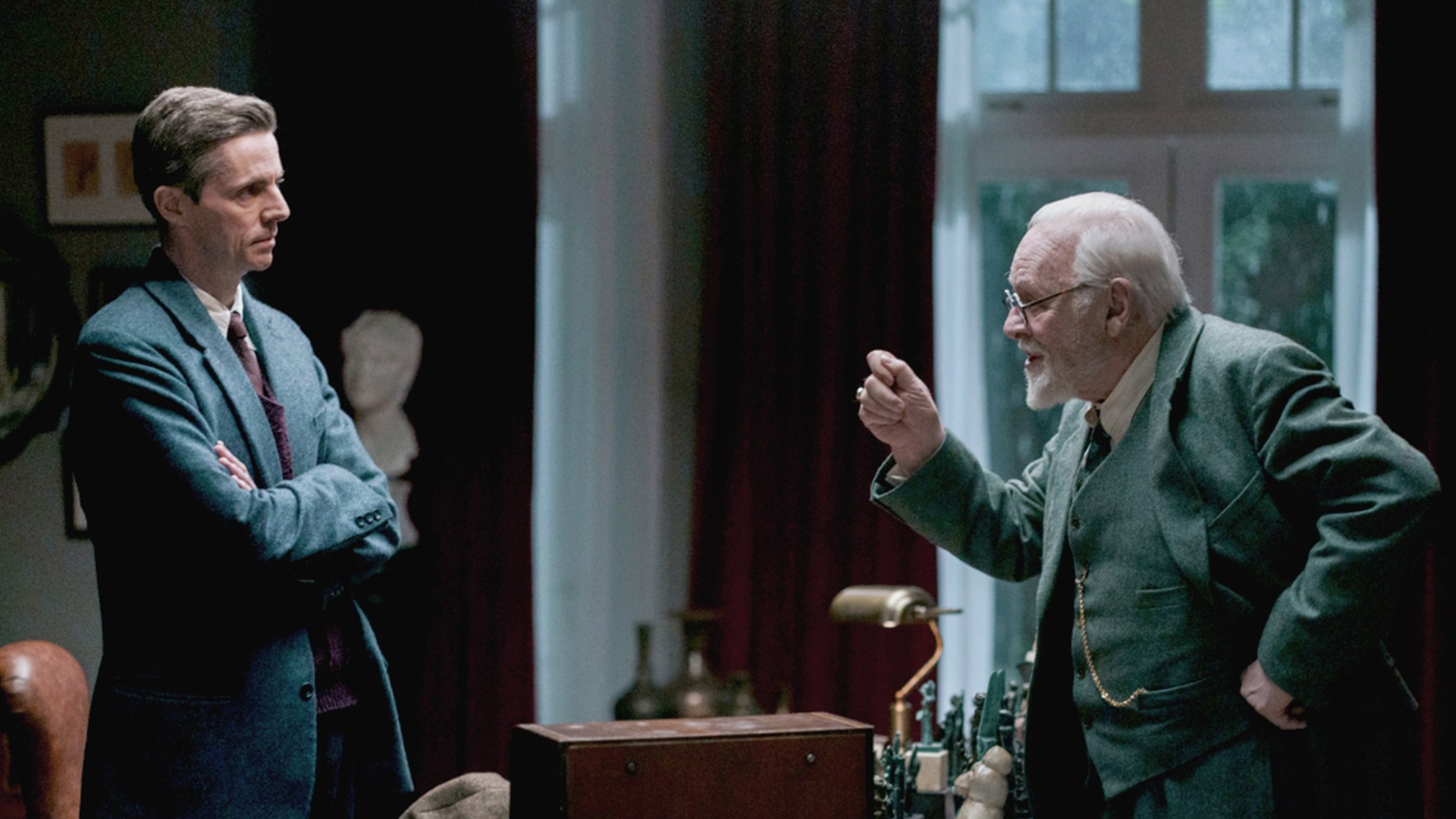
Freud's Last Session starring Matthew Goode and Anthony Hopkins in theaters on December 22.

Freud's Last Session starring Matthew Goode and Anthony Hopkins in theaters on December 22.

Christianity Today December 21, 2023
© 2023 Sony Pictures Digital Productions Inc. All rights reserved

Sigmund Freud and C. S. Lewis both lived in England when Prime Minister Neville Chamberlain declared war on Germany in 1939. Freud had recently left Nazi-controlled Austria with his family and was staying in London. Lewis, then at Oxford, was coming to prominence as a writer and theologian with the publication of The Pilgrim’s Regress and Out of the Silent Planet.

No record exists of the two men having ever met. But what if they had?

A new film, Freud’s Last Session—directed by Matthew Brown, adapted from a play of the same name by Mark St. Germain, and in select theaters beginning Friday, December 22—imagines a hypothetical house call by the Oxford don to the 83-year-old father of psychoanalysis. Anthony Hopkins (who also played Lewis in Shadowlands) brings a complex depth to Freud in his last weeks of life, and Matthew Goode (of Downton Abbey and The Imitation Game) is an earnest, younger Lewis who feels a bit awkward at having satirized Freud in Pilgrim’s Regress.

Soon, though, two of the greatest minds of the 20th century are debating everything from the existence of God to the origin of evil to the meaning of suffering. It’s a heavyweight matchup, and Freud’s Last Session offers ringside seats. One brief exchange gives the sense of the debate:

Freud: Your God who created good, or whatever that is, he must have also created the bad, the evil. He allowed Lucifer to live; he let him flourish. But logically he should have destroyed him. Am I correct? Think about it.

Lewis: God gave Lucifer free will, which is the only thing that makes goodness possible. A world filled with choice-less creatures is a world of machines. It’s men, not God, who created prisons and slavery and—bombs. Man’s suffering is the fault of man.

Freud: Is that your excuse and explanation for pain and suffering? Did I bring about my own cancer? Or is killing me God’s revenge for my disbelief?

Lewis: I don’t know. … It’s the most difficult question of all, isn’t it?

If this back and forth were the whole of the film, it would amount to a dramatized version of psychiatrist Armand Nicholi’s 2003 book, The Question of God, which set Lewis’s and Freud’s philosophies side by side in nonfiction format and inspired St. Germain’s play. But the screenplay’s inclusion of troubled pasts, familial conflicts, and personal suffering moves Lewis’s visit from an intellectual sparring match to an emotionally riveting drama—and the blooming of a friendship built not on shared values or common interests but on vulnerability and service.

As World War II progresses, air raid sirens and a bomb shelter send Lewis into a panic attack caused by PTSD from his service in World War I. Meanwhile, Freud’s inoperable oral cancer and mouth prosthesis give him constant, sometimes unbearable pain. When frustration arises, the two men shift from debating ideas to probing each other’s personal lives for weaknesses or hypocrisies—including Lewis’s much-debated relationship with a fellow soldier’s mother, Janie Moore, with whom he lived for many years.

Yet when either man sees the other suffering, he steps in to help. The climactic moments aren’t brilliant arguments, coups de gras delivered by one scholar or the other. They’re moments of pain, fear, and selflessness. They might be better proofs of God than even Lewis can muster.

Polarization has been the buzzword of our decade. We’re told it’s worse than ever before in American history (or maybe it’s not), that the problem is politics (or maybe it’s us), and that we have to become better at listening, at asking careful questions, at exposing ourselves to more viewpoints.

But what if the remedy for polarization isn’t talking or listening? What if it’s service?

We are called to “have the same mindset as Christ Jesus,” the one who “did not come to be served, but to serve, and to give his life as a ransom for many” (Phil. 2:5; Mark 10:45). We are told to “carry each other’s burdens, and in this way [we] will fulfill the law of Christ” (Gal. 6:2). Being persuasive isn’t in the instructions; in fact, many of our arguments will never make sense to nonbelievers (1 Cor. 1:18).

Freud’s Last Session doesn’t conclude with a rhetorical victory. Neither man “wins” the conversation—which is hardly a spoiler given their well-known careers and views. But they do come away changed. Freud finally opens himself up to be, as he puts it, “manipulated” by life’s beauty, and he’s willing to pursue a healthier relationship with his daughter Anna. Lewis, it’s suggested, finds new insight into his recurring fantasy of a forest that evokes awe of the divine.

Lewis labels the emotion of the forest as “joy,” and he and Freud both admit to a lifetime of longing for it. But arguing about free will and the problem of evil doesn’t bring them joy. Instead it’s found in small acts of presence and service, and we don’t need the intellect of C. S. Lewis to share that with an unbelieving world.

Caveat Spectator

This is Freud, so there will be talk of sex. He and Lewis spar on that topic along with many others, and in one scene a woman describes a dream involving sexual trauma. Some flashbacks to Lewis’s time in the trenches and hospital also contribute to the PG-13 rating.

Alexandra Mellen is senior copy editor at Christianity Today.

Theology

This Buddhist Leader’s Favorite Bible Verse

Why Budh Sharan Hans loves Colossians 3:23-24.

Christianity Today December 21, 2023
Illustration by Christianity Today / Source Images: Getty

Whatever you do, work at it with all your heart, as working for the Lord, not for human masters, since you know that you will receive an inheritance from the Lord as a reward. It is the Lord Christ you are serving.(Col. 3:23–24)

I love the concept of service in the Christian community—of being kind to each other: “Be kind and compassionate to one another, forgiving each other, just as in Christ God has forgiven you” (Eph. 4:32); honoring each other: “Be devoted to one another in love. Honor one another above yourselves” (Rom. 12:10); and serving one another: “Each of you should use whatever gift you have received to serve others” (1 Pet. 4:10).

It’s like what Buddha said; “Good work will stay; bad work will not stay.”

The service performed by Christians toward humankind is not motivated by punishment from God, but by their love for God and because they want to obey his commands.

Budh Sharan Hans, is a prominent Dalitbahujan (a leading Dalit movement) thinker and social activist from Patna, Bihar. A winner of the Ambedkar National Award that honors work with India’s marginalized, he challenges mainline Hinduism’s understanding of the caste system through public speaking and writing, including his magazine, Ambedkar Mission.

Read more about this series in the lead article, We Asked Hindu, Muslim, Sikh, Jain, and Bahá’í Leaders to Pick Their Favorite Bible Verses. (Other articles in this special series are listed to the right on desktop or below on mobile.)

Theology

Waiting for the Light in Hitler’s Prison

A reminder of God’s faithfulness amid great darkness from Hanns Lilje, a Christian leader imprisoned in Nazi Germany.

Christianity Today December 21, 2023
Illustration by Christianity Today / Source Images: Unsplash

Christmas Eve in prison is so terrible because a wave of sentimentality passes through the gloomy building. Everyone thinks of his own loved ones, for whom he is longing; everyone suffers because he doesn’t know how they will be celebrating the festival of divine and human love. Recollections of childhood come surging back, almost overwhelming some, especially those who are condemned to death, and who cannot help looking back at their past lives. It is no accident that in prison suicide attempts are particularly numerous on this special day; in our case, however, the most remarkable thing was the sentimental softness which overcame our guards.

The author of those words, Hanns Lilje, was a leader in the confessing church that boldly opposed Hitler. Imprisoned for his actions, he spent time in both the Dachau and Buchenwald concentration camps. On that memorable Christmas Eve of 1944, in a moment of “sentimental softness” the SS commandant removed the chains of a violinist awaiting execution and allowed him to play in the large vaulted hall of the prison.

Lilje paced back and forth in his cell, listening to the beautiful music so different from the usual prison sounds. He recalled the Christmas message he had given the previous year, before his arrest. Allied bombing raids were leveling Berlin, and many families, especially those with children, had left the city.

Speaking in his unheated church, he had addressed a congregation of mostly senior citizens who had nowhere else to go. He chose a passage from Isaiah 9: “The people who walked in darkness have seen a great light” (v. 2).

While preparing his sermon, Lilje had reminisced about childhood Christmases, when he would walk the streets with his playmates, excitedly peering into homes at the brightly lit Christmas trees inside. During wartime, however, all windows were darkened under strict blackout rules.

As a pastor, what light could he possibly offer in such dark and difficult times? And now, a year later, what light could he even imagine, waiting in a darkened cell for his own death sentence to be carried out?

As I read Hanns Lilje’s remembrance of a Christmas eight decades ago, my mind went to contemporaries who are walking in darkness. Ukrainians huddled around a kerosene lamp in a basement bomb shelter as Russian missiles fly overhead. Palestinian Christians in Gaza sharing a Christmas “feast” of bread and water. Members of unregistered churches in China who face arrest simply for gathering together. Nigerians wondering if terrorists will choose this night to raid their church and kidnap their children.

Then I turned to the Gospel accounts of the event that started it all. Elizabeth and Zechariah rejoiced at the news that God had at last answered their prayers for a son—but did they live long enough to learn of his decapitation for a king’s party?

Even Mary, who had confidently sung of the Mighty One bringing down rulers and scattering the proud, had to flee to Egypt in order to escape Herod’s massacre of infants. The old man Simeon had it right when he told Mary, “This child is destined to cause the falling and rising of many in Israel…And a sword will pierce your own soul too” (Luke 2:34–35).

Advent both remembers and anticipates. From the very beginning, the church has marked this season as a time to commemorate both Jesus’ birth and his promised return. We live out our days between already and not yet.

Author Fleming Rutledge marvels at the prospect: “Here is a man who was born into a poor family, who went to no university, who owns nothing, who has no bank account, no resumé or portfolio, no job or house, no title or rank, a man who is about to be judged guilty and not fit to live by the highest religious and political tribunals of his time, and here he is saying that he is going to come again, personally, at the end of the world, to determine the fate of all human beings who have ever been born.”

Does it matter, this extravagant hope that someday Jesus will return—not as a baby this time, but as a conqueror of evil who will make all sad things come untrue? Rutledge responds:

We realize that people act differently if they are convinced that there will be a definitive future action. A prisoner who knows he will be freed is a very different person from one who knows he will never get out. A group of hostages who know that the SWAT team is on its way is a very different group from the one that has no hope of rescue. If you know that your chemotherapy really might heal you, you can tolerate it a lot better than if it is just a last, desperate measure. Advent is like that. In this season, the church celebrates two things: God has already acted definitively on our behalf, and God will act definitively in the future to bring his purposes to pass once and for all. That is what it means to watch and wait for the second advent of Christ, no matter how long it takes.

Suddenly, on that Christmas Eve of 1944, Hanns Lilje heard his number loudly called—which usually meant interrogation, torture, or even worse. A guard led him from his third-floor cell directly to the commandant, who motioned for him to follow. “Bring number 212 to this cell too!” he ordered the guard.

Lilje recognized the prisoner inside as a noble count who had participated in Operation Valkyrie, a failed plot to assassinate Hitler (the same plot that led to Dietrich Bonhoeffer’s arrest). The count had asked for a pastor to hear his confession and offer Holy Communion; it being Christmas Eve, the commandant had granted his request. The guard brought in number 212, the violinist about to be executed, and then left.

This year Lilje would be addressing an audience of three: a violinist, a count, and an SS commandant. He read the Gospel account from Luke, and gathered his thoughts as the violinist played a Christmas chorale. Once again, he chose Isaiah 9:2: “The people who walked in darkness have seen a great light.”

“Our chief concern, now,” Lilje said, “is to receive this promise in firm faith and to believe that God, through Jesus Christ, has allowed the eternal light to ‘arise and shine’ upon this world which is plunged in the darkness of death, and that He will also make this Light to shine for us. At this moment, in our cells, we have practically nothing that makes the Christmas festival so familiar and so lovely, but there is one thing left to us: God’s great promise. Let us cling to this promise, and to Him, in the midst of the darkness.”

The count knelt on the hard stone floor to receive the elements of Communion, and the violinist played a final chorale. Lilje shook hands with his fellow prisoner and then the commandant, who to his surprise said, “Thank you! You cannot imagine what you have done for me this evening, in my sad and difficult daily work.”

Lilje adds that soon afterward the commandant was removed from his post for proving too humane. The count was sent to a concentration camp, and the violinist was killed by the Gestapo during the last days of Nazi rule. Lilje himself survived to become a bishop and president of the Lutheran World Federation.

John’s Gospel sets Jesus’ birth in a cosmic perspective, positioning him at the very moment of creation. “Without him nothing was made that has been made,” John declares (John 1:3). Yet the master artist who spanned the universe took on flesh and blood, and “moved into the neighborhood” (as The Message has v. 14). Like a streak of light across the darkling sky, his life brought hope to all humanity, and especially to those who walk in darkness.

“The light shines in the darkness, and the darkness has not overcome it,” (v.5). I pause to consider that John wrote these words after watching Jesus’ agonizing death, the martyrdom of his disciples, and the Romans’ ravaging of Jerusalem. But John has faith in a radiant future, and elsewhere he explains why: “God is light; in him there is no darkness at all” (1 John 1:5).

We dare not underestimate the relentless power of light. Right now, space telescopes are processing light that has been traveling nonstop, at a speed of 186,282 miles per second, for 13 billion years. Also, it turns out that John is scientifically correct: Light extinguishes darkness.

When I camp on the edge of a mountain in Colorado, darkness rules inside the tent. Yet if I flick on my LED headlamp, the darkness immediately disappears. The reverse does not hold true. If I introduce darkness into a lit room—say, by opening a sealed container—the darkness vanishes, overcome by the light.

When he later wrote about the Christmas Eve service attended by four people in a prison cell, Hanns Lilje remembered the light more than the darkness. “I praised God, and indeed, I praised Him from my whole heart that in this building, under the shadow of death, and in the face of so much trouble and distress, a Christian congregation had assembled to celebrate Christmas.”

“For it is possible,” Lilje reflects, “to have every external sign of festivity and comfort and joyful celebrations, and yet not to have a true Christmas congregation, while in the shadow of death and in much trouble of heart a real congregation can gather at Christmas. It is possible for the candles and the lights to blind our eyes, so that we can no longer see the essential element in Christmas; but the people who ‘walk in darkness’ can perhaps see it better than all who see only the lights of earth.”

Philip Yancey is the author of many books including, most recently, the memoir Where the Light Fell.

Books

My Top 5 Books for Christians on Hinduism

Recommendations for gaining a more nuanced perspective of the faith of 1.2 billion.

Christianity Today December 21, 2023
Illustration by Christianity Today / Source Images: Getty

Vijayesh Lal is general secretary of the Evangelical Fellowship of India, the central network and service organization of evangelicals and Pentecostals in India, representing over 6,5000 churches across the nation. He is also a PhD scholar at SHUATS, Prayagraj.

Hinduism, a revered and intricate spiritual tradition deeply rooted in the Indian subcontinent, is largely accepted as one of the world’s oldest religions. The encounter between this faith and Christianity, which arrived in India in the first century, has been marked by cultural exchanges, theological discussions, and the ever-evolving dynamics of religious pluralism. Early interactions were “so cordial and dialogical that Saint Thomas Christians were considered Christian in religion, Hindu in culture, and Oriental in worship,” writes Anantanand Rambachan in Pathways to Hindu-Christian Dialogue.

However, in recent times, right-wing Hindu nationalism has begun promoting a specific interpretation of Hindu identity and values, often resulting in tensions with religious minorities, including Christians. Hinduism and Christianity now meet against a backdrop that includes not only the historical interplay of diverse beliefs but also contemporary issues of religious identity and freedom.

As Hindu communities spread across the world, there is a risk that contemporary political and cultural ideologies associated with Hindutva may accompany the diaspora, potentially shaping global perceptions of Hinduism. Hence, engaging with Hinduism is essential for nurturing genuine understanding and promoting harmonious relations. By exploring authentic teachings, philosophies, and cultural expressions of Hinduism, individuals and entire societies can move beyond stereotypes and gain a nuanced perspective.

Here is a list of five books that I think will help people understand and engage with Hinduism better:

Hinduism: A Short Introduction, by Klaus K. Klostermaier

For someone looking for a relatively short but comprehensive introduction to Hinduism, I recommend Klaus K. Klostermaier’s Hinduism: A Short Introduction. This book is a good resource for both beginners and those seeking a nuanced understanding of this ancient spiritual tradition, masterfully and concisely navigating the mystical and political dimensions of Hinduism.

Klostermaier, a Catholic priest with a PhD in philosophy, served as a missionary and theology teacher in India in the 1960s. He spent ten years in India conducting primary research in many languages, and his expertise in Hinduism led to advisory roles in the papal office on non-Christian religions. He also directed academic affairs at the Oxford Centre for Hindu Studies for some time.

The book strikes a balance between accessibility and depth without overwhelmingly scholarly details. It also goes into the different strands of Hinduism, such as Vedic, Shaivism, Vaishnavism, and Shaktiism, enriching the narrative.

Klostermaier’s inclusion of short biographies adds a personal touch, offering clarity on the various movements within Hinduism. A standout feature is his exploration of Hinduism’s contemporary role in Indian society and politics.

For those willing to explore further, I would recommend A Survey of Hinduism by the same author. At 718 pages long, it is quite a longer read than this book but much more far-reaching and scholarly.

An Introduction to Hinduism, by Gavin D. Flood

Written by Gavin D. Flood, a scholar of Hinduism and comparative religions at Oxford, An Introduction to Hinduism gives readers an objective and respectful overview of Hinduism.

Secular in his approach but not condescending, Flood presents Hinduism as a set of traditions naturally evolving through interactions between various spiritual streams in India, with all their internal differences and contradictions.

The book, which can be a difficult read at times, delivers a laudable and broad overview, covering rituals, orthopraxy, common beliefs, philosophies, theologies, and the gradual evolution of Hindu thought since the Vedic period.

Flood also goes beyond the confines of traditional narratives to explore Hinduism in modern politics and its global development, from historical figures like the German idealists to contemporary theosophists. He skillfully navigates the intertwined nature of Brahmanical orthodoxy and local folk traditions, examining distinctions between householder and renouncer Hinduism. He also explains complex concepts and traditions like Vaishnavism, Shaivism, and Shaktism.

For anyone seeking a well-rounded, scholarly, and engaging exploration of Hinduism, Flood’s work is a valuable guide, offering a thoughtful journey through the complexities of this enduring spiritual tradition.

Pathways to Hindu-Christian Dialogue, by Anantanand Rambachan

Anantanand Rambachan has a distinguished profile: He’s a professor of religion at St. Olaf College, an eminent scholar, and global interfaith leader. He specializes in Advaita Vedanta (a school of Hindu philosophy) and Hindu ethics, actively contributes to initiatives like the World Council of Churches and the Pontifical Council for Interreligious Dialogue, and is the co-president of Religions for Peace. So when he writes a book about Hindu-Christian dialogue, it becomes a must-read.

I recently bought Pathways to Hindu-Christian Dialogue and found it to be thought provoking in its exploration of the intricacies of interfaith engagement. Rambachan addresses challenges such as conversion, Hindutva, and the Dalit experience, skillfully suggesting alternative starting points for dialogue while emphasizing unity, humility, and shared concerns—sound advice to readers who seek genuine understanding between Hinduism and Christianity. His insights into theological resources and the impact of Hindu nationalism provide a valuable foundation for those who are interested in the complexities of dialogue.

With the goal of promoting human dignity and decreasing inequality, Rambachan urges readers to move beyond political and theological differences, mutually learn from one another, and embrace diversity. His book is an invitation to readers to engage in meaningful conversations that transcend politics and foster compassion, understanding, and active service in the spirit of genuine interfaith dialogue.

For those looking for a compilation of exceptional scholarly work on Hindu-Christian relations, I would recommend The Routledge Handbook of Hindu-Christian Relations edited by Chad M. Bauman and Michelle Voss Roberts.

The Christ of the Indian Road, by E. Stanley Jones

Eli Stanley Jones (1884–1973) has been called “the greatest Christian missionary since St. Paul,” and I may be a bit of a fanboy putting his book here, but not without reason. Written nearly 100 years ago, Jones’s The Christ of the Indian Road is still relevant and prophetic.

A seasoned American Methodist missionary to India, Jones advocated for a newer approach than one adopted by many missionaries of the time and cautioned against imposing one’s culture on a community. Instead, he urged Christians to learn from other cultures, respecting their truths and allowing Christ to intertwine naturally with existing cultures.

Jones’s presentation of the core of the Christian faith as the person of Jesus—rather than the religion of Christianity, which was viewed as a Western import—shattered barriers and produced revivals even among those who were seemingly uninterested. Delivering more than 60,000 sermons in his lifetime, he preached Jesus in every major Indian city, portraying Christ as the one “who walks down the Indian road, sits around the village campfire, and rescues the oppressed in India.”

Amid India’s struggle for independence, Jones’s message offered a unifying force. His compelling writing style, coupled with a genuine love for the Indian people, makes this book an insightful read for any Christian with a heart for missions.

Between Hindu and Christian: Khrist Bhaktas, Catholics, and the Negotiation of Devotion in Banaras, by Kerry P. C. San Chirico

I am currently reading this book, which was released in April 2023, as India is witnessing a phenomenon of several Christward movements, especially in the northern and central parts of the country.

Christward movements are people turning to the person of Jesus Christ rather than organized Christianity and is something that happens indigenously at a fast pace. The people who choose to follow Christ do so while staying within their cultural and social milieu without adopting so-called established Christian practices in the country. Most of them are simply known as vishwasi (believers). Some of them may be called Hindu followers of Christ, while others are called Yeshu Satsangis (companions of Jesus), Yeshu Darbaris (members of the royal courthouse of Jesus), or, in this case, Khrist Bhaktas (devotees of Christ).

Between Hindu and Christian explores the community of Khrist Bhaktas, comprised predominantly of Dalits and other lower castes, with a striking 85 percent being women. Primarily situated in the villages of the Banaras (Varanasi) region, the Hindu holy heartland, the movement finds its geographical locus in the Matridham Ashram, a community established in the 1970s and led by Fr. Anil Dev. This ashram has evolved into a significant center for the indigenization of Indian Catholicism, playing a pivotal role in shaping the charismatic Catholic movement in northern India.

Contrary to traditional Christian practices, many Khrist Bhaktas refrain from receiving baptism, a choice they make strategically to avoid social and family conflicts. Despite this departure from customary rituals, their commitment to Christ remains fervent, which is expressed as they participate in various services. This distinctive approach to religious practice reflects the intricate negotiations these devotees engage in to reconcile their spiritual convictions with the societal and familial challenges they face.

The author concludes that Khrist Bhaktas can be called both Christian and Hindu. He argues that “all religious categories emerge relationally and discursively.” So “in relation to their chosen deity, the Khrist Bhaktas are Christians, but in relation to the concept of a chosen deity, they are Hindu. In relation to the baptized Catholic, they are Hindu, but when a Saiva Brahmin joins them, the relationship of each to each other changes.”

The unique practices and demographics of the Khrist Bhaktas, as outlined in San Chirico’s study, offer a compelling glimpse into the complex nature of religious identity and expression in the Banaras region. The Matridham Ashram stands not only as a physical location but as a symbolic node, representing the evolving landscape of religious movements in the northern part of the country.

Honorable mentions:

I am putting these books here since I could only choose five for the list. But these books are important as they provide a perspective on various angles associated with Hinduism, caste, Hindutva, and Hindu-Christian relationships.

Why I Am a Hindu, by Shashi Tharoor Tharoor argues for a pluralistic and inclusive Hinduism, rejecting the narrow and divisive interpretations used by Hindu nationalists. He explores the religion’s rich history and diverse philosophies, emphasizing its tolerance and adaptability.

Annihilation of Caste, by B. R. Ambedkar Ambedkar argues that the caste system is not merely a social issue but is deeply rooted in Hindu scriptures and practices. He proposes that the complete eradication of caste is necessary for true social and economic equality in India.

Hindutva: Exploring the Idea of Hindu Nationalism, by Jyotirmaya Sharma This book deep-dives into the intellectual roots of political Hindutva, examining the contributions of Dayananda Saraswati, Rabindranath Tagore, Swami Vivekananda, and Vinayak Damodar Sawarkar while also advocating for revisiting Hindu traditions that embrace inclusivity and self-criticism.

Editor’s note: Curated lists in this religious literacy series for Christians include the best books for better understanding Islam (in five regions), Hinduism, Buddhism, Sikhism, the Druze, Daoism, Confucianism, and the sinicization of Christianity in China.

CT also offers a top 5 books list on Orthodox Christianity, among scores of subjects.

Theology

From Egypt, Into Eternity

The plight of Mary and Joseph echoes through generations

Phil Schorr

When they had gone, an angel of the Lord appeared to Joseph in a dream. “Get up,” he said, “take the child and his mother and escape to Egypt. Stay there until I tell you, for Herod is going to search for the child to kill him.”

So he got up, took the child and his mother during the night and left for Egypt,where he stayed until the death of Herod. And so was fulfilled what the Lord had said through the prophet: “Out of Egypt I called my son.” — Matthew 2:13-15

When my mom was nine months pregnant with me, she and my dad had to flee their country suddenly. A war had broken out and the fighting was spilling out into the streets of the capital where they lived. Because of my dad’s line of work, he was targeted by the guerrilla fighters. Our family wasn’t safe.

I can picture my mom all those years ago, belly round with innocent life, and I wonder how she felt. I imagine she was fearful, unsure of how the situation would resolve; I imagine my parents feeling lost in the chaos, confused by the way their plans for starting a family had been upended. No one wants to become a refugee at nine months pregnant.

The story contained in Matthew 2:13–23 has become more and more vivid to me over the years as I’ve come to see its similarities to the story that my family lived through. I can picture Mary, arms wrapped around her baby. I imagine the fear, confusion, and desperation as they wonder about the implications of saying yes to what God had called them to. No one wants to become a refugee with an infant. Matthew reminds us of Hosea 11:1 in the midst of this story, full of profound prophecy: “When Israel was a child, I loved him, and out of Egypt I called my son.” Despite the dark and desperate circumstances, God had a perfect plan and a purpose that would not be thwarted. Although fleeing to escape from a murderous dictator may not seem like God’s love in action, we see the bigger, foundational plans as they are fulfilled. The experience of Jesus’ family fleeing to and then emerging from the land of Egypt is the fulfillment of Israel’s same experience in Exodus. Words that once described the experience of God’s corporate people now speak of the Messiah, the Son of God.

As I consider the plight of Mary and Joseph, and even my own mom and dad, I’m reminded of the proverb’s wisdom: “a person’s heart plans his way, but the Lord determines his steps” (Prov. 16:9, CSB). We make plans, we think we know how God will move, but only he truly knows the steps we will take. Sometimes those steps take us to a place that is comforting and familiar, and sometimes those steps take us away from the only home we know into a new land where we will come to know God as our true and only comfort. My parents were able to settle into a new home in a foreign land. They were able to raise their daughters to know and love Jesus. Mary and Joseph were able to raise Jesus himself and join God’s story of rescuing his people, fulfilling a long-awaited prophecy and emerging from that faraway land to establish a new, eternal kingdom. During this season, I am once again amazed at the way God has woven the threads of his unfolding plan, generation to generation.

Reflection Questions:


1. Reflecting on the experiences of Mary and Joseph's journey, how does this deepen your understanding of their fears, uncertainties, and the unexpected paths they had to take?

2. The fulfillment of the prophecy in Hosea 11:1 through Jesus' flight to and emergence from Egypt highlights God's perfect plan and purpose that cannot be thwarted. How does this give you hope and reassurance in your own life?

Kristel Acevedo is an author, Bible teacher, and the Spiritual Formation Director at Transformation Church just outside of Charlotte, NC.

This article is part of The Eternal King Arrives, a 4-week devotional to help individuals, small groups, and families journey through the 2023 Advent season . Learn more about this special issue that can be used Advent, or any time of year at http://orderct.com/advent.

Books

Appreciating the Art of Divine Surprise

Scripture is full of stories inspiring awe. Are we allowing ourselves to be astonished?

Annunciation by Matthias Stom

Annunciation by Matthias Stom

Christianity Today December 20, 2023
WikiArt

“Mary was surprised too,” the speaker said to a packed audience of students and families gathered for an evening Christmas carol service in Oxford’s historic Sheldonian Theatre. He was reflecting on Jesus’ birth story from Luke’s gospel, when the heavenly messenger Gabriel appeared to Mary. Upon hearing that she would soon be pregnant—with the Son of the Most High, whose kingdom will have no end—Mary asked, “How will this be … since I am a virgin?” (1:34).

At the conclusion of the Christmas service, our speaker encouraged those gathered not to dismiss this story simply because it seems unbelievable. Apparently, that’s what Mary thought too. Luke tells us that Mary’s being unexpectedly greeted by a heavenly messenger left her in awe, wondering what it all meant, even as she embraced this divine disruption. At the same time, Mary’s elder cousin, Elizabeth, was greeting her own surprise: the promise of a child, conceived amid abandoned hope for parenthood, “for no word from God will ever fail” (Luke 1:37).

The story of Jesus is bookended by surprise—from the narrative of his birth to the plot of his death, to the final scenes of his resurrection and ascension, when Jesus overcomes death in a way no one expected and his disciples are left perplexed, necks craning skyward at his sudden departure.

In fact, the whole of Scripture is riddled with surprise. The Old Testament prophets spoke and acted in ways that evoked awe. The “wrong” person always seems to be chosen by God. When there appears to be no way, God unexpectedly makes a way.

Likewise, the New Testament rarely fits readers’ expectations. Jesus’ responses befuddle religious leaders and crowds alike with topsy-turvy teachings and curveball parables that upset social norms. And the acts of his apostles continue to confuse and elicit strong reactions from everyone they meet—led, as they were, by the Holy Spirit, who intervenes and disrupts expectations.

Scripture is replete with surprises precisely because the subject of this diverse collection of narrative, historical, legal, poetic, and prophetic texts is a God who “is able to do immeasurably more than all we ask or imagine” (Eph. 3:20).

“The way you can tell a true, living God from a dead, fake god,” professor Will Willimon preached at a recent Duke University chapel service, is that “a fake god will never, ever shock you, or say anything that makes you uncomfortable.” Unlike the counterfeit gods of our own making, the living God of Scripture rarely fits neatly within our expectations. Instead, he repeatedly inspires wonder and surprise.

At the same time, the Bible is the world’s best-selling book, containing popularized narratives familiar to many readers. This presents a challenge for those seeking to be surprised by its stories. Becoming overly familiar with Scripture can, at times, make us unable to read and hear it rightly.

“Whenever we pick up the Bible, read it, put it down, and say, ‘That’s just what I thought,’ we are probably in trouble,” Old Testament scholar and author Ellen Davis writes in The Art of Reading Scripture. We must pay careful attention whenever we read this collection of holy texts—setting aside our preconceived notions or even what we recall from past readings. Like the infinitely complex individuals we interact with daily, the witness of Scripture should always be just beyond the grasp of our expectations, always ready to tell us something new about God, ourselves, and our neighbors.

At the end of a long day in late spring, I asked writer and director Dallas Jenkins about the role of surprise in his work on the television series The Chosen—specifically, how he honors the role of surprise inherent to the Gospels when telling their stories.

“That is one of the biggest tricks of the whole show,” Jenkins said. “How do we make this feel like you’re seeing it for the first time? Even in those moments when you know something’s coming, how can we get you lost in it—if not to be surprised by the story itself, to be surprised by maybe what you learned in it, or perhaps how you saw yourself in it? That’s what we’re trying to do.”

When we meet a character like Judas, Jenkins notes as an example, be it on screen or in Scripture, how do we avoid immediately anticipating what we know comes next: He’s going to betray Jesus!

“It’s about trying to find context that maybe hasn’t been explored before, because the story’s not going to change. It’s the stuff in between, it’s the context—that’s where we can surprise you. And sometimes it’s surprising to go, That’s not any different from what I read, but it feels different because I understand it better.

Sitting patiently with the stories of Scripture—which includes learning more about the context of its characters—is one way we can invite a deeper sense of wonder and surprise into our encounter with the God of the Bible. Another way is to cultivate our sense of awe itself.

Dacher Keltner, professor of psychology and founding director of the Greater Good Science Center at the University of California, Berkeley, began exploring the unique and manifold benefits of awe in the 1980s, when research on the topic was entirely untapped. Since that time, he and his colleagues have painstakingly inventoried the diverse sources of awe in human experience, what he describes as “the eight wonders of life.”

That feeling of “being in the presence of something vast that transcends your current understanding of the world” is how Keltner defines awe. We experience awe when we encounter something, or someone, that exceeds our expectations, and those experiences offer a rich variety of benefits. “Awe brings us joy, meaning, and community, along with healthier bodies and creative minds,” Keltner notes in Awe: The New Science of Everyday Wonder and How It Can Transform Your Life. “Brief moments of awe are as good for your mind and body as anything you might do.”

We can invigorate and expand our capacity for awe through various activities, disciplines, and practices—including taking in art. Art can transform us by shifting our focus away from ourselves and toward new potentialities in collaboration with others. “Visual art can provoke us to reimagine reality,” Keltner writes. “It can open us up to new ideas about who we can be and what our collective lives might be … In good art, there are so many opportunities to reach the highest part of the soul.”

To encounter the God of surprise—and to love our neighbors as God calls us to—we must cultivate a fresh curiosity and a capacious imagination. Sadly, we live in an age where individual and social imaginations alike have become impoverished. In her latest book, Karen Swallow Prior refers to our present moment as a “failure of the evangelical imagination.” As she says in a recent interview, “It’s an identity crisis. It’s a political crisis. It’s a personal crisis. It’s a church crisis. But I think it’s a moment, it’s an opportunity, for us to … renew our imaginations.”

Prior is not alone in insisting that renewed imagination is essential for a hopeful future. Calvin University philosophy professor James K. A. Smith responded to the question “What will be our future?” by offering the following response in a lecture: “If the church is going to bear witness to a different future, we need a Christianity that undergoes the crucible of unknowing … welcoming the unsettling mystery of God, and the profound mystery of our fellow human beings. Only here can we experience grace.”

Sitting patiently with art, Smith insists, is one way that we can be open to such mystery.

When our imagination becomes thin, malnourished, or even diseased, creative works of art can offer a new way of seeing God and the world—a fresh vision of ourselves, our neighbors, and even our enemies. Art can also invite us to encounter the persistent and mysterious presence of God, often where we least expect. Artists strive to tell the truth—about ourselves, others, and God—but to upend our assumptions and “tell it slant,” as Emily Dickinson famously encourages. Art, in turn, can cultivate an openness to the living Lord who likewise exceeds our expectations.

Preachers and others tasked with sharing the stories of Scripture ought to be considered awe-workers—those who encourage and nourish their congregation’s imaginations to be receptive to the often-surprising God of Scripture. Former Princeton Theological Seminary president Craig Barnes suggests that part of the pastor’s role is to be a “minor poet,” weaving stories, language, and words in ways that cultivate a congregation’s sense of wonder. He’s certainly not alone.

Before writing his Bible translation, The Message, the late pastor, translator, and professor Eugene Peterson used to fill the narthex of his church with piles of books—including works by the novelist Wallace Stegner, Charles Dickens, and poet Denise Levertov—each one carefully chosen to provoke and inspire his congregants’ imaginations. Likewise, my church in Seattle offers a steady rotation of paintings by local artists, displayed in a room just outside of the sanctuary where congregants gather after service for coffee and conversation. It is a small, intentional gesture, but an important one.

What would it look like for Christ followers to cultivate the practice of paying patient attention to art? What if Christians set a discipline of regularly engaging with creative artwork that invites a second look at the world? Shaped by such creative practices, how might we be surprised anew by God’s work in our midst, in our neighbors, and in our own lives?

The COVID-19 pandemic disrupted our individual and collective ways of being. Doing my best to live with the overwhelming uncertainty left in its wake, I’ve been turning to poetry more than ever—from listening to podcasts such as The Slowdown Show, Poetry Unbound, and Poetry for All while sipping my morning coffee, to reading poetry collections from Mary Oliver, Christian Wiman, and W. S. Merwin on unhurried Saturday mornings.

Sitting with a poem requires slowing down, attending to a sequence of words and its cadence. When I do, I often experience my soul nourished in palpable ways—much like a good shower or a satisfying meal. In these intentionally quiet moments, when the “pandemonium of blab … ceases,” Christian Wiman writes, “[we] can hear—and what some of us hear in those instances is a still, small voice.”

Returning to Mary’s unexpected encounter with a divine messenger, artists have been portraying this scene in Luke’s gospel for centuries through various mediums—including Henry Ossawa Tanner (1859–1937), whose painting, The Annunciation, is on display today in the Philadelphia Museum of Art.

Inspired on a trip to Israel, Tanner sought to capture Mary as authentically as possible. She’s shown alone in a dark, unadorned room, dressed in modest robes, and seated on a bed with crumpled linens. There are no halos, no winged angels, and no sacred identifiers adorning Mary’s body. Her hands are folded. Her gaze is one of curiosity and wonder as a vertical band of light fills the room with a soft glow. The scene holds a quiet mystery that can only be witnessed. As I patiently attend to Tanner’s work, I find myself open to surprise alongside Mary.

Moving my eyes along the lines and color left by Tanner’s paintbrush in The Annunciation shapes me in a similar way as reading Mary Szybist’s Incarnadine, especially the poem “Annunciation Overheard from the Kitchen.” In her poetic reflections, we’re invited to listen for the unhurried arrival of heavenly messengers in the everyday setting of a contemporary home, among the sounds of a vacuum next door and an airplane overhead. Both Tanner and Szybist’s creative work invite me to attend anew an unexpected encounter with sheer mystery alongside a first-century mother-to-be.

Ben McBride introduced me to the rabbinical tradition, suggesting a new perspective on Moses’ burning bush experience. “The bush was always burning,” McBride shared with our church group in Berkeley. “Moses just happened to stop and notice.” Moses allowed himself to be disrupted and offered his attention to the bush that burned without being consumed by flame, awash in God’s presence (Ex. 3). In the same way, I’ve found visual art and poetry can put me in a place where I’m more likely to notice the everyday burning bushes and abounding annunciations.

I’m no less inclined than the next person to prayerfully ask God for my preferred future for myself and for my family, for my community and for our nation—indeed, for the aching wider world. But Advent and Christmastide invite me into something grander and, ultimately, more remarkable.

These seasons invite us to cultivate a posture of expectant waiting. Yet our inherited history and tradition beckons a longing that is wholly receptive to the unexpected arrival of grace—where God’s presence is promised and declared precisely in places and voices we least expected.

Provoked by poetry and visual art alike, may our minds and hearts, our eyes and ears—and, indeed, our very lives—be stirred anew by our living God, who moves among us in these troubled days. And may we seek to embody together the in-breaking of God’s long-promised kingdom of peace.

Ryan J. Pemberton is the director of community cultivation at Image, which offers a quarterly journal and programming dedicated to art, faith, and mystery.

News

Bethlehem Cancels Christmas, But Local Pastors Still Expect a Holy Night

As war disrupts traditional festivities, Palestinian Christians see an opportunity to return to the Nativity story and share the gospel.

Bethlehem is usually bustling with tourists at Christmastime.

Bethlehem is usually bustling with tourists at Christmastime.

Christianity Today December 20, 2023
Maja Hitij / Getty Images

At Immanuel Evangelical Church in Bethlehem, instead of Christmas lights, senior pastor Nihad Salman rummaged out a banner from the church closet. The banner has a picture of a woman fleeing bomb-shelled buildings, and printed in Arabic are the words “Let us arise and worship God.”

The last time the church had the banner out was two years ago, during the May 2021 conflict between Israel and Hamas. That banner sums up Salman’s approach to Christmas during wartime this year. He sees an opportunity to preach the gospel to people who live under military occupation while grieving the deaths of their people in Gaza.

“People will be asking more questions,” he said. “We have seen that always after a crisis, people are seeking: What is the truth? Where is the truth? So we have lots of work to do.”

Church leaders in Bethlehem and across the Holy Land have decided to mute Christmas celebrations this year due to the ongoing Israel-Hamas war.

Typically, Bethlehem—a Palestinian city of about 30,000 people in the Israeli-occupied West Bank—is jammed with more than 3 million visitors coming from all over the world to celebrate the birth of the Messiah.

Marching bands and carol singers and dancers and fireworks would fill the city with loud cheer and festive energy. Thousands would pack the Church of the Nativity, golden lights would twinkle across Star Street, and a giant tree with a ruby star would illuminate Manger Square.

Instead, the streets are dark and hushed.

It will be a silent night this Christmas—but it’ll still be a holy night, according to local Christian leaders. Stripping Christmas of all its extraneous decorations and Western traditions, they say, will help them focus on the true meaning of Christmas.

Salman told the 50 children in his church, “This year, you’re not going to get a present. You’re going to give a present.” He challenged them to brainstorm ways to fundraise—whether it’s through hawking chewing gum or selling homemade cakes. However much they make, the church will match it, and they’ll use the funds to buy presents for the neighborhood’s poor children on Christmas.

Spread the gospel as you fundraise, he told the kids: “Tell everyone why you’re doing this.”

At the Evangelical Lutheran Christmas Church in Bethlehem, pastor Munther Isaac continues to draw attention to the war in Gaza and calls for an immediate ceasefire.

Instead of the traditional manger scene, his church made a mound of broken stone and concrete to represent the rubbles in Gaza, and on top of the rubble, placed a baby Jesus wrapped in a Palestinian keffiyeh.

“God is under the rubble in Gaza,” Isaac preached in the first few weeks of the war. “He is with the frightened and the refugees. He is in the operating room. This is our consolation. He walks with us through the valley of the shadow of death. If we want to pray, my prayer is that those who are suffering will feel this healing and comforting presence.”

Even if local authorities had not canceled Christmas celebrations, “nobody was going to celebrate,” Isaac told CT. “Nobody is in a mood to celebrate.” From his perspective, he sees the war as “genocide.” He pulled out his cell phone to show what he was referring to: images and videos of ashen mothers and broken bodies in Gaza.

His church is completely bare of Christmas trees, lights, and Santa. Ceasing Christmas celebrations, he said, has provided “a great opportunity to rethink the meaning of Christmas.”

The words people once associated with Christmas were Santa, tree, gifts, carols—all “romanticized” traditions from the West, Isaac said. Today, he thinks of words from the Christmas story of the Bible: Caesar, census, massacre, and refugee in Egypt—relevant to Palestinians who have to register to travel outside the West Bank and who seek safety in Egypt.

To Isaac, the Christmas story is about God in human form, present with people in their suffering. He pointed at his church’s Nativity scene, at baby Jesus in the rubbles: “That’s how Christmas is celebrated here. … But the prayers will continue. The prayers will not stop.”

Despite the heavy and tense atmosphere—or rather, because of it—at least one place has decided to continue with Christmas festivities this year.

The Jerusalem International YMCA (JIY) in West Jerusalem decided to commence their annual Christmas tree lighting ceremony, after the Patriarchs and Heads of the Churches in Jerusalem asked Christians in the region to avoid “unnecessarily festive” Christmas activities this year.

Fadi Suidan, CEO of JIY, said he and his staff carried heavy hearts even as they encircled the giant Christmas tree with lights in preparation for the event.

“We had a lot of mixed emotions,” he said. “It was hard for us to rejoice.”

But he felt it necessary and important to keep the annual tradition. “It was for the children. We had to bring hope for the children. We need to think about the sanity of the children. The children are waiting for this every year. How do you explain to children that there is no Christmas this year?”

So on December 3, the first Sunday of Advent, about 600 children and their families gathered around the Christmas tree at JIY, attending a much toned-down party. Instead of loud jingle-jangle Christmas songs projected through loudspeakers, a band of one cello and three violins played soft acoustic music.

It wasn’t just for the children. JIY was from its very beginning founded as a symbol of unity and peace, bringing Jews, Christians, and Muslims together in one space, Suidan said. It was all the more important for him to gather families from different cultures and religions, even to offer a glimpse that such peaceful coexistence is still possible, even in the most contested city on the planet.

During his speech, Suidan told the crowd that the ceremony is a beacon of much-needed hope:

At a time like this, when the world seems fragmented by conflict and strife, our coming together holds even greater meaning. … These lights represent more than just festive traditions. They are a powerful symbol of enduring faith, resilience, and the undying human spirit.

This year, the message of Christmas—the message of love, peace, and goodwill toward all—is more relevant than ever.

Just before they lit the tree, instead of counting down from 10, the crowd yelled, “Hope. Love. Peace!” And lights lit up gold and silver, glimmering around the tree, across the square, and up the towers.

Creating that kind of atmosphere might be possible in Jerusalem, but not in Bethlehem, where the mood is somber.

Eighty percent of people in Bethlehem depend on tourism for their livelihood. Christmas season is when most locals expect to make their biggest income. The war has suffocated their economy, incapacitated their freedom of movement, and increased hostility and fears toward the Israel Defense Forces soldiers and Jewish settlers, who have raided towns, detained and beaten Palestinians, and enforced more checkpoints.

If things don’t change, it’s not a matter of if but when violence explodes in the West Bank, Christians there told CT. The locals are scared, heartbroken, and aggrieved.

On a cold Thursday night in December, about 20 Christians in their teens and early 20s sat in a circle at Immanuel Evangelical Church in Bethlehem to hear the Nativity story. They had heard it hundreds of times. They shared the same birthplace as Jesus. The land and circumstances were all too familiar.

Elias Al-Najjar, their youth ministry leader, lived his own version of the Bethlehem narrative. In November 2007, he and his family fled Gaza after an Islamic militant group threatened Christians at his church and killed a fellow church member. At the time, his wife was nine months pregnant. They arrived in Bethlehem not knowing a single person, where to stay, or where to deliver the baby, with just a piece of paper scribbled with the phone numbers of several health services in the area.

He thought about his own experience that night as he retold the Christmas story.

“Imagine Mary leaning on a wall, pregnant in her last hour. Imagine Bethlehem being full, just like how it would be full now if there wasn’t a war in Gaza. Imagine not knowing where they would stay. No one to contact,” he told them in Arabic.

“And imagine Mary thinking, ‘Didn’t God tell me I’m going to give birth to the King of Kings?’ Imagine them reaching the place where she would give birth. A big shock! The stench. The animals. In the midst of all that, she delivered Jesus Christ. And they were filled with joy.”

Now think about the people in Gaza, he said. Of course, they didn’t need much imagination—they see videos of the war every day. In the midst of mayhem, children are born and children are killed.

This is the Christmas story,” Al-Najjar said. “All these small details that we don’t usually think about. On Christmas, we usually put up decorations and have fun with Christmas trees and lights. But if you look at the real story of Christmas, it was a story of pure hardship. But God didn’t leave Mary and Joseph. And they didn’t leave God.”

He looked around the room. “So why should we?”

Editor’s note: A selection of CT’s Israel-Hamas war coverage is now available in Arabic, among eight other languages.

Books
Review

Friends Are Your Family of Faith—and Your Spiritual Comrades-in-Arms

Rebecca McLaughlin takes the topic of friendship beyond warm and fuzzy feelings.

Christianity Today December 20, 2023
WikiMedia Commons

Friendship is under fire.

No Greater Love: A Biblical Vision for Friendship

No Greater Love: A Biblical Vision for Friendship

Moody Publishers

176 pages

The Survey Center on American Life recently reported that nearly half of Americans have fewer than three close friends. Twelve percent have no friends at all. In the UK, where I live, one in three men have no close friends. Forty percent of 16-to-24-year-olds say they always or often feel lonely. Young people today, living in an era of social media and digital technology, are in one sense the most connected generation in history. So, why do they struggle with one of the most fundamental human relationships?

This is especially striking given all we know about the goodness of friendship. It has profoundly positive effects on our mental, emotional, and physical well-being. Studies consistently show that those who eat badly, lack exercise, and neglect other areas of physical health but have good friends live longer in comparison to those who are socially isolated and keep themselves in shape. And friendship is vital to a life of faith.

It is therefore surprising that there should be, relatively speaking, so few books on the subject. In my own searches online, I’ve discovered more than 10,000 books with leadership in the title and just a fraction with the word friendship. For many in the church, friendship is one of the most important but least talked about relationships.

Into this void comes Rebecca McLaughlin’s beautiful contribution, No Greater Love: A Biblical Vision for Friendship. Her subject matter is both timely and timeless, and I’m delighted she has invested her creative and theological energies into exploring it. This is not a book to make us feel warm and fuzzy about our friends, as it deliberately counts the cost of fellowship and community. But it should inspire us to raise our horizons and our levels of commitment to those around us.

Relational lenses

One of the great challenges when exploring friendship is defining the term. Who is a friend? The word covers such a broad range of human connections—from the most intimate of lifelong relationships to the most casual of acquaintances. McLaughlin’s wise approach is to give readers a selection of lenses the Bible uses to describe and define friendship.

She first looks at friendship through the lens of nontraditional family, which might surprise or even unsettle some readers. Bravely, and with biblical grounding, McLaughlin challenges our habit of elevating our biological families over the family of faith. As she writes, “Our first identity as followers of Jesus is not biological. It’s theological.”

Two subsequent lenses provide inspiring images of friendship but also ask pertinent, often provocative questions. The first is that of comrades-in-arms. Scripture is clear that both individual believers and the church as a whole face a range of spiritual battles. Seen in this light, the gift of friendship is like the provision of fellow soldiers with whom one can stand shoulder to shoulder.

McLaughlin gives examples of the struggle and joy of sharing a common cause, drawing on Paul’s New Testament relationships with fellow apostles and the fictional friendship of Frodo and Sam in The Lord of the Rings. Some readers might disagree with the extent to which she stresses the relationship between Christian relational connection and Christian mission. Others, myself included, will be inspired to reflect on the fact that, as McLaughlin puts it, “our closest friendships, if we’re Christians, should be gospel-spreading partnerships.”

The second lens is that of brothers and sisters. Leaning into the strength of affection that Paul expresses for fellow workers in his letters, both male and female, McLaughlin grasps the nettle of asking how close our friendships should be with members of the opposite sex—or members of the same sex, for those who are same-sex attracted.

Beginning with the so-called Billy Graham rule, which refers to the evangelist’s commitment to never meet alone with a woman who wasn’t his wife, McLaughlin gives permission to create appropriate boundaries to guard against sexual sin, while being wary of a one-size-fits-all approach. As she argues, drawing the boundaries too tightly might rob us of “the good things that God might have for us in friendship” and the riches we gain in having brothers and sisters of the faith.

Personal and honest

One of the book’s most striking and winsome features is its inclusion of stories from McLaughlin’s life. She is disarmingly vulnerable and honest about her own insecurities and shortcomings as a friend.

For example, McLaughlin describes how feelings of insecurity sometimes create undue pressure to seem impressive or lovable to others. She shares a story of mutual accountability with a friend who challenged her in this regard, explaining that “part of loving someone is the willingness to tell them when they’re wrong.” She remembers a wake-up call that saw her shift from asking, “Who will love me?” to asking, “Who can I love?”

As a reader, this sort of candor provides encouragement as you reflect on your own disappointments over relationships that have broken down or not reached their potential. It also embodies the power of openness and integrity in building the kind of life-giving friendships McLaughlin envisions. Her deeply personal insights allow us to walk with her through the complexities of the relationships she is helping us to understand.

Another way the book provokes readers to take friendship seriously is through practical examples that go beyond theory into the realm of countercultural behaviors. One striking case in point McLaughlin shares is the practice of sitting apart from her husband at church so that newcomers and single people can feel more welcome sitting next to either party.

In another chapter, she reflects on the inclination of the New Testament writers to eagerly express love for friends not only with words but also with appropriate physical contact. She laments that, especially among men, the fear of being misinterpreted has discouraged hugs, physical bonding, and telling our friends that we love them. “We are not trespassing on romance when we use such terms,” she writes. “We’re following the Scriptures.’

A vital conversation

While No Greater Love is extremely readable and McLaughlin’s skillful use of language eases the reader through the short chapters, I could not help but want just a little bit more. The topic of friendship is so little explored, and there is such depth that remains to be plumbed. Some readers, I suspect, will be left with a longing for more practical wisdom on how to create and cultivate friendships.

Beyond the how question, I think the book could have benefited from greater attention to the intentional nature of Jesus’ time with his disciples and the investment of his relational energies. Having read McLaughlin’s previous work of apologetics, Confronting Christianity, and observed her perceptive analysis of contemporary culture, I couldn’t help thinking that she might have gone further in connecting the crisis of friendship to broader cultural trends and developments. I hope No Greater Love is not McLaughlin’s final contribution to this vital conversation.

Having said all that, it’s worth underscoring that McLaughlin’s subtitle is A Biblical Vision for Friendship. In this respect she does not let the reader down. Like a gardener with a limited patch of land, she tends lovingly and carefully to the Bible’s references to friendship and community, contextualizing them to fruitful and nourishing effect. As they progress to the book’s conclusion, most readers will feel inspired by God’s passion and mandate for friendship. And they will find themselves challenged to think and relate differently, in greater alignment with the wisdom and story of Scripture.

At one point in No Greater Love, McLaughlin recalls almost giving up on the book and backing out of her contract to write it. It was a friend who intervened—saying, “Don’t you dare!” and giving her the “pep talk” she needed to press on. This anecdote illustrates the power of encouragement we find in friendship, something all of us need amid the pressures and disappointments of everyday life. All who read No Greater Love will be grateful for this intervention and the gift that emerged from McLaughlin’s perseverance.

Phil Knox works as a missiologist and evangelist at the Evangelical Alliance in the UK. He is the author of The Best of Friends: Choose Wisely, Care Well and Story Bearer: How to Share Your Faith with Your Friends.

addApple PodcastsDown ArrowDown ArrowDown Arrowarrow_left_altLeft ArrowLeft ArrowRight ArrowRight ArrowRight Arrowarrow_up_altUp ArrowUp ArrowAvailable at Amazoncaret-downCloseCloseellipseEmailEmailExpandExpandExternalExternalFacebookfacebook-squarefolderGiftGiftGooglegoogleGoogle KeephamburgerInstagraminstagram-squareLinkLinklinkedin-squareListenListenListenChristianity TodayCT Creative Studio Logologo_orgMegaphoneMenuMenupausePinterestPlayPlayPocketPodcastprintremoveRSSRSSSaveSavesaveSearchSearchsearchSpotifyStitcherTelegramTable of ContentsTable of Contentstwitter-squareWhatsAppXYouTubeYouTube