News

Majority of French Christians Believe the Church Should Fight Climate Change

In a new study from A Rocha France, an overwhelming number of Protestant and Catholic respondents say “caring for the earth is caring for your neighbor.”

Christianity Today September 13, 2023
Francois Mori / AP Images / Edits by Christianity Today

Most French Christians—92% of Catholics and 87% of Protestants—think the environment and climate change should be more present in the life of their local parish or church community. Half of them—52% of Catholics and 58% of Protestants—believe the church should speak out on environmental issues and climate change.

That’s according to a new survey from the Institut Français de L’Opinion Publique (French Institute of Public Opinion or IFOP), the nonprofit Parlons Climat (Let’s Talk Climate), and the Christian environmental organization A Rocha France, which revealed for the first time how French believers view the current climate crisis.

The survey explored the relationship between religious practice and ecological attitudes among the French population, offering insight into personal environmental commitment, the expected role of the church, and the connection between the intensity of religious practice and the willingness to take environmental action.

While the study does not fully represent French Christian attitudes toward environmental concerns, it sheds light into how Catholics and Protestants view climate change and the church’s role in this issue, researchers said.

The results suggest that the French Protestant community is growing more and more concerned about climate change, with 80 percent of Protestant respondents agreeing that we need to “radically change our lifestyles now to combat environmental degradation and climate change.”

However, practicing Christians were divided on the role of the church in the face of climate crisis, with 42 percent of both Catholic and Protestant respondents agreeing that it would be a good idea to invite “associations or experts to discuss the subject” and only one-third (30% of Catholics, 33% of Protestants) saying climate change should be addressed “through the pastor’s sermon.”

“This type of survey, which is quite common in certain countries such as the United States, is a first in France,” said Jean-François Mouhot, director of A Rocha France. “The results … will enable us to identify the points of resistance and to better communicate the importance of ecological and climate issues amongst A Rocha France's main target audience: the Christian public.”

An overwhelming number of Christian respondents (92% of Catholics, 90% of Protestants) agreed with the statement that “caring for the earth is caring for your neighbor.” And a majority of Christian respondents (71% of Catholics, 76% of Protestants) said they had participated in climate marches and local efforts to protect the environment (73% of Catholics, 77% of Protestants).

Close to two-thirds of both Catholics and Protestants (65% and 62% respectively) believe that climate change is mainly due to human activity. And 85 percent of Catholics and 80 percent of Protestants also agree that radical change needs to occur to combat environmental degradation.

Yet the survey showed that around half of Catholics and Protestants (53% and 49% respectively) claimed that they didn’t know what to do about environmental degradation and climate change. A minority of both Catholics and Protestants (20% and 27%, respectively) also expressed that “my ecological and spiritual thoughts nourish each other.”

While the majority of participants expressed a concrete desire for environmental engagement, even within their church life, the role of humans and religious institutions on these issues seems more debated.

“What is interesting in France is that the more practicing a Christian is, the more they are susceptible to be sensitive to environmental issues,” said Mouhot. “For [practicing] Protestants, there is a demand for a clear statement from Protestant institutions, and I think that the consensus [amongst them] will be all the clearer once an official statement has been made.”

The results are “nuanced by the presence of an environmental counter-discourse among some participants, influenced mainly by a negative perspective on the relationship between ecology and religion,” A Rocha France stated. “This seems to be the major obstacle for those who resist integrating environmental concerns into their religious framework.”

Political parties and various nonprofit associations in France are often vocal on environmental issues, but this is the first quantitative study on French Christians and how they view environmental action in the context of their church life. (Catholics make up 29 percent of the French population while Protestants are only 3 percent, according to France’s National Institute of Statistics and Economic Studies and the French Protestant Federation.)

The report was carried out with three samples of respondents comprising almost 2,000 people, including a non-representative sample of Christians, which included 484 Catholics and 379 Protestants. The Christian sample comprised both non-practicing believers as well as practicing believers, which the survey defined as regular church attendance and “practicing your religion personally [through] prayer, Bible reading, worship, etc.”

IFOP noted that “the Protestant and Catholic samples cannot be considered representative in the statistical sense of the term; they are samples of convenience.” A Rocha France and Parlons Climat also admitted this, saying that the study cannot wholly describe what the general French Christian population thinks about the environment and is not necessarily a representative sample. But the study does provide a better understanding of how practicing Catholics and Protestants view these issues, said A Rocha.

The work, initiated by Parlons Climat and A Rocha France, was carried out following preparatory research involving numerous Christian organizations in France as well as previous academic studies.

“[Parlons Climat and A Rocha] are very pleased to publish this study … which has been supplemented by numerous preliminary interviews with Christian actors and academics,” said Lucas Francou Damesin, co-founder of Parlons Climat. “We feel it is essential to understand the specific ways in which Catholics and Protestants view the ecological transition.”

“We want to better communicate [on these issues] and mobilize [Christians] to take action against climate change,” said Mouhot.


News

Russian Evangelicals React to Moscow’s Most Wanted Baptist

Former head of Baptist Union flees abroad as the first Protestant charged for opposing the war in Ukraine. His level of support back home is mixed.

Yuri Sipko

Yuri Sipko

Christianity Today September 13, 2023
Andrey Dementev / WikiMedia Commons

Yuri Sipko is the first to fall.

The 71-year-old former president of the Russian Union of Evangelical Christians-Baptists has been one of the few Russian religious leaders to publicly denounce the war in Ukraine. Although secular activists and a few Orthodox priests have been imprisoned for similar opposition, until last month no evangelicals had been targeted.

But on August 8, authorities filed charges against Sipko for publicly disseminating “knowingly false information” against the Russian military. They raided his home and temporarily detained his son. One week later, he was placed on the wanted list.

Tipped off by independent legal monitors, he fled the country on August 5.

“The sun is shining, and I have been provided for,” Sipko told CT in an interview from his refuge in Germany. “Praise the Lord there have been no problems, and policemen are far away from me.”

Waxing poetic, he hoped that the aspiration of Aleksandr Pushkin, the 19th-century Russian bard, might one day be fulfilled:

The heavy-hanging chains will fall,
The walls will crumble at a word;
And Freedom greet you in the light,
And brothers give you back the sword.

Sipko attributes his courage to God. His anti-war activism is inspired by Matthew 10:28, which says to not fear those who can only kill the body. As both a minister of the Word and a citizen of Russia, he feels it was his duty to reveal criminality.

But having long anticipated his arrest, he insists he is not guilty.

“This is a lawless law imposed by a lawless regime, against lawful people,” said Sipko. “The crime is the destruction of Ukraine. Silence, also, is a crime.”

With these words, he impugns nearly all of his evangelical colleagues. In Sipko’s view, they have not only betrayed their Ukrainian brothers and sisters, but in submitting to the Russian authorities, they have betrayed the kingdom of God. Their silence, he said, is shameful.

Upon news of the charges against Sipko, Russian Baptist leadership kept its distance.

Baptist Union president Peter Mitskevich stated that information was “scant” and urged prayer for Sipko. But in encouraging “peace among the nations” and the continued proclamation of the gospel, he reminded that it was under Nero’s persecution that the Apostle Peter wrote: Honor the king (1 Peter 2:17).

Baptists in St. Petersburg were more direct. Addressing the fear that has pervaded the community since Sipko’s arrest, their statement clarified that Sipko spoke only in his personal capacity, not representing their “agreed position.” They also asked for prayer, but emphasized that “the authorities do not hinder us in the main thing for which we are called by the Lord.”

But evangelical fear in Russia was legitimate. Accompanying the charges against Sipko was an official media campaign against the broader Protestant community, alleging their status as foreign agents. According to the SOVA Center, Sipko’s sermons were called “outright enemy propaganda” that was developed by “American curators.”

CT spoke with six leaders inside Russia for their reactions. Two requested anonymity.

“It made me think full-fledged persecution of Christians will now begin,” said one ministry leader. “The government is trying to silence all the voices that do not sing along with it, so Yuri has shown tremendous courage.”

Though Sipko is more “radical” than herself, she said that she generally agrees with what he says. Relieved he is safe, she was surprised it took so long for the authorities to press charges.

Russian sources confirmed to CT that the media campaign has since died down, with no wider repression. But one leader expressed his displeasure.

“These journalists should be held accountable for their reporting,” said Vitaly Vlasenko, general secretary of the Russian Evangelical Alliance. “Those who don’t know us will be astonished, and the law prohibits incitement against religions.”

Vlasenko expressed his solidarity with Sipko as a Baptist coworker, and believed justice would uphold his cause. Freedom of speech is enshrined in Russian law, he said, and he hopes that evangelical lawyers will come to Sipko’s defense. It is lamentable in times of war that a polarized society promotes an us-against-them mentality, he said, and asks who you are with.

In March 2022—one month after the war began—Vlasenko had issued his own statement expressing “bitterness and regret” over the “military invasion” and apologizing to Ukraine. Under the criminal code used to now charge his former leader, the word “war” has been officially banned.

But he feels that Sipko possesses a similar fault to Russian society overall.

“We call Yuri a Russian prophet,” he said. “But prophets think in black-and-white and sometimes don’t see other colors.”

As Christian citizens, evangelicals need to express “critical solidarity” with their nation, Vlasenko said. He subtly critiqued Sipko’s departure, stating that it is better for church leaders to stay in their own country, working to unite brethren with different opinions. Yet he commended his former president as “always straight” and as someone even his enemies respected.

Not that this would save Sipko.

“He is very brave,” Vlasenko said. “But like John the Baptist, he might lose his head.”

One analyst differed in Sipko’s positive assessment.

“Stated crudely, he has been a loose cannon,” said Bill Yoder, a retired church journalist. “I think he is better off in the West.”

Though respected by many in the pews, Sipko has been controversial among Baptist leadership over the past decade, according to the American-born reporter. Having lived the last 21 years in Russia, Yoder became a citizen in 2021. He says Sipko is being honest and acting according to his convictions, but also said the charges are no surprise.

“It is not our task to wish victory for the other side, but Yuri went beyond this, pushing the Ukrainian cause,” said Yoder. “And theologically, he is dancing on the edge of being loyal to the authorities.”

Every day, Yoder prays for peace and reconciliation with Ukrainian believers, conceding that the Russian-led war is “against international law.” But the United States is worse, he said, in his estimation pushing eastward through NATO and complicit in dozens of armed struggles around the world. The conflict is complicated, and Ukraine is far from guiltless, said Yoder. Both sides will have to forgive each other.

“I wish Yuri and his family well,” said Yoder. “I don’t see him as a non-brother, but he has forsaken his church.”

Sipko is one of 12 children, and as a child, he witnessed the Soviet Union imprison his Baptist pastor father for five years. First elected as a deputy leader of the Russian Baptist Union in 1993, he served as its president from 2002 to 2010. He cited the 2008 Russian invasion of Georgia as the beginning of Russia’s suppression of dissent, but also said that a “doom mentality” has characterized his people for generations.

Literary figures like Tolstoy, Dostoevsky, and Pushkin were among the few to speak out. But despite a century of prayer for Russia, when freedom came in 1991 local believers turned out to be “helpless,” according to Sipko. Amid a propaganda push that portrayed the West as a land with empty churches and homosexual clergy, even the persecution of Jehovah’s Witnesses was accepted by many Russians as a defense of the true faith.

“This message found fertile ground with evangelicals,” said Sipko. “And then in humble obedience to the authorities, they turned against their brothers, and became villains.”

Roman Lunkin, head of the Center for Religious Studies at the Russian Academy of Science’s Institute of Europe, thinks Sipko has veered too far to the West. He contrasted the Baptist leader with Sergey Ryakhovsky, president of the Russian Union of Evangelical Christians-Pentecostals. Both pastors are democratic, Lunkin said, but the latter voiced patriotism and leaned consistently toward the state—much like Republicans in America.

And he suspects there is a larger power play involved.

According to Lunkin, Sipko has aligned himself with Albert Ratkin, a former Pentecostal Union vice president who was expelled from the denomination for criticizing Ryakhovsky’s support for the war. Ratkin was called in to testify against the Baptist minister, with Sipko’s messages on his social media channels used as evidence. But Lunkin believes the larger target may well be Ratkin, whose foreign support is concerning to the Kremlin, he said, and fits in with its tarnishing of evangelicals in general.

For now, he said Ratkin has been told to stay silent.

“Russian authorities don’t care about Sipko,” Lunkin said. “That’s why he was allowed to go abroad.”

But the charges against Sipko are serious. Andrey Shirin noted that, since the Baptist Union’s inception in 1944, Sipko is the first head to be indicted. While Russia likely delayed charges so as not to provoke the wider ecumenical world, whatever popularity Sipko had in the pews remained at the level of admiration, according to Shirin.

“Baptists tend to see their prophetic responsibility as limited to morality and the freedom to practice their faith,” said the Russian associate professor of divinity at Leland Seminary, a Baptist institution in Virginia. “Brother Sipko broadened this to include public policy, but few evangelical leaders are willing to follow him.”

However democratic the Pentecostal Union’s Ryakhovsky may have once been, Shirin said he now gives the impression of an opportunist looking to stay close to power. And while Sipko’s Ukraine stance resonates with the West, in many ways his cultural views would be perceived as overly traditional.

But not to Vera Izotova, who served as head of women’s ministry in the Baptist Union until 2018.

“Yuri welcomed the training and ministry of women,” she said. “He was a passionate, dedicated, and humble servant of God.”

A graduate of the International Bible Institute for Extension Education when Sipko was Baptist Union president, Izotova fondly remembered an address he gave in which he celebrated women’s escape from “the kitchen” to ministry. He loved to pray with his “Russian sisters,” she added, and supported her in her current work as director of the Wheat Grain Fund, which assists disadvantaged people and special needs children. Sipko believed the church should influence society, and preached the gospel all over Russia.

But she declined to comment about the charges against him.

“In recent years I have not communicated with him on this subject,” Izotova said. “But before writing [this reply], I prayed and fasted for God to guide me.”

Some leaders, Sipko said, have “pragmatic calculations” for not speaking out on his behalf. Others have sent him private encouragement. But in either case, he takes no offense.

“I didn’t have expectations that anyone would support me publicly,” Sipko said. “I take full responsibility for my actions.”

But one evangelical leader did support him, though through an alias.

“Sipko provides an honest and straightforward evaluation of the situation in both Ukraine and Russia,” said Ivan Pastukhov, who requested anonymity to protect his ongoing ministry. “His case serves as a stark warning of the steep price for not aligning with the government.”

From his vantage point, an estimated 40 percent of Russian evangelicals oppose the war. Pastukhov notes that the timing of the charges falls not long after the June rebellion of Yevgeny Prigozhin’s Wagner group and not long before the upcoming presidential vote in March 2024. The ground is being prepared for a seamless reelection of Vladimir Putin, while in Pastukhov’s view Sipko and evangelicals in general are being prepared as scapegoats for any potential societal unrest.

In this context, he has a plea for Western Christians.

“Move beyond prayers, and initiate a meaningful dialogue with Russian church leaders,” said Pastukhov, noting their isolation. “Numerous longstanding connections between the East and the West have worn out, requiring urgent restoration.”

Sipko agreed wholeheartedly.

“Conflicting parties cannot restore relations without a mediator,” he said in response. “Inter-church communication is vital, and patience is necessary.”

It will certainly be needed during Sipko’s self-imposed sojourn in Germany. He is at peace, and his daughter, one of ten children, is near him. But from Pushkin he turned to the Desert Fathers, paraphrasing Abba Isaiah of Scetis: Work without prayer is servitude, and prayer without work is begging. He remains active in advocacy, posting frequently on Facebook.

But will he ever return to Russia?

“Our home is above the clouds, and we are strangers and exiles here,” said Sipko, referencing 1 Peter 2:11. “I am willing to die outside my homeland.”

Editor’s note: CT now offers select articles translated into Russian and Ukrainian.

You can also join the 9,000 readers who follow CT on Telegram: @ctmagazine (also available in Russian and Chinese).

Books

How to Talk to a Christian-Curious Agnostic

A new breed of secular seeker is replacing the New Atheists. But how can we reach them?

Christianity Today September 12, 2023
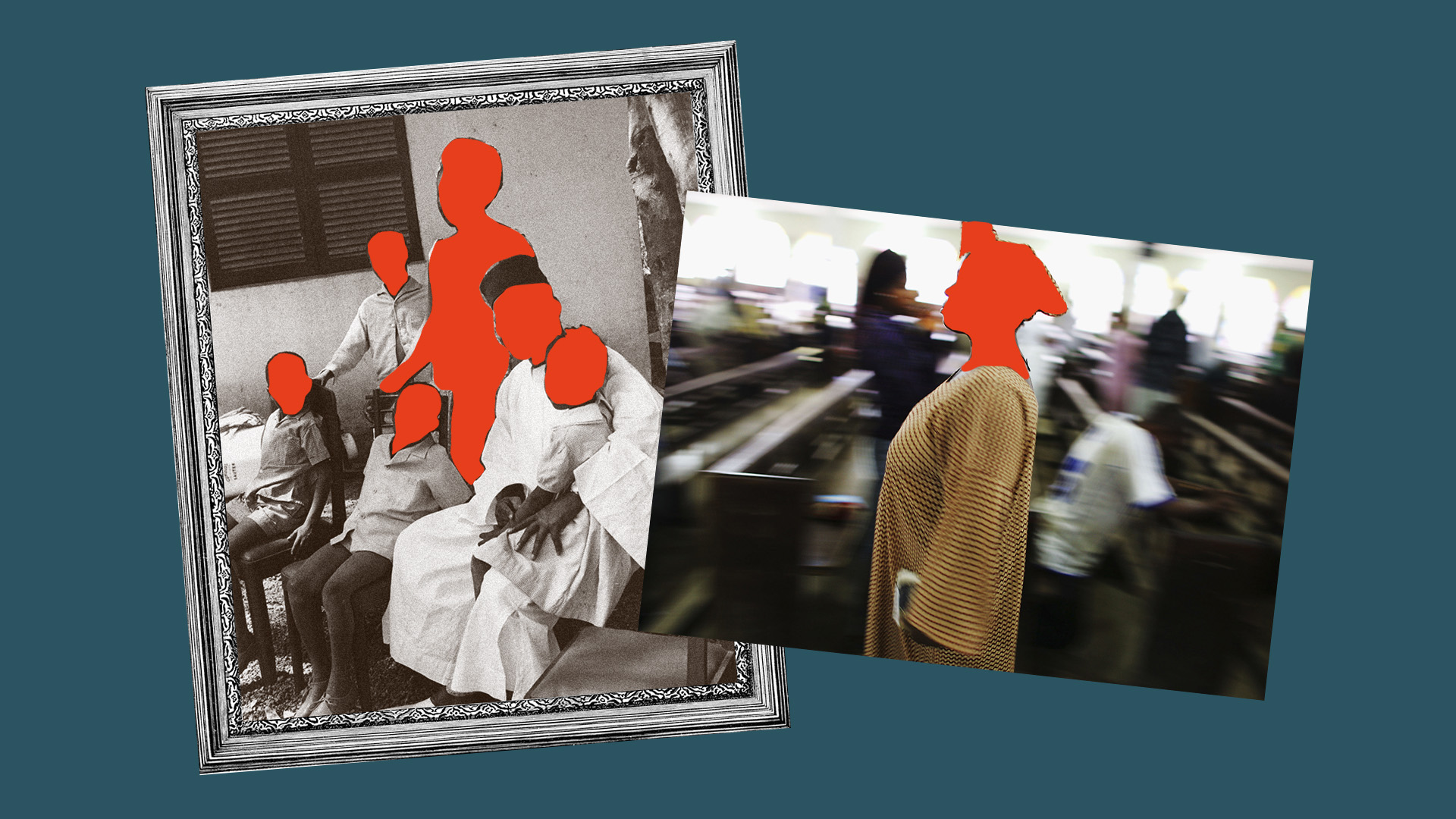
Illustration by Christianity Today / Source Images: Unsplash

The cultural ground is shifting when it comes to religion, atheism, and Christianity in the West. Three recent stories in my social media feed are a reminder how quickly it's happening.

Richard Dawkins, the world-famous atheist, has been doubling down on his criticism of the transgender movement and progressive ideologies in general. The popular podcast host Joe Rogan, whose show receives over 190 million downloads per month, featured intelligent design expert Stephen Meyer, who advocates for a creator God behind the universe and critiques evolution by natural selection.

And for the first time, less than half of people in the UK identify as Christian. The most recent UK census, taken every ten years, saw those who tick the ‘Christian’ box drop to 46%, with those identifying as ‘no religion’ rising to 37% of the population. This decline is mirrored in the United States, where almost half of millennials and Gen Z now identify as “nones” (religiously unaffiliated).

But few of those who tick the “none” box identify as materialist atheists of the Richard Dawkins variety. In fact, nones are more likely to describe themselves as agnostics who are “spiritual but not religious.” Many of them still pray occasionally, engage in New Age practices, or even dabble in the occult.

That is, modern people aren’t necessarily less religious; they are just religious about different things. When people reject institutional faith, their “God-shaped holes” will be filled by something else.

As some of the most dogmatic atheist leaders today take up the culture war as their new sacred cause, they are also demonstrating a growing interest in hearing from views outside the secular mainstream on science and the nature of reality.

In The Surprising Rebirth of Belief in God, I discuss how New Atheism has become a thing of the past and in its place is a new openness toward supernatural explanations. For instance, many secular intellectuals—such as psychologist Jordan Peterson, historian Tom Holland, and journalist Douglas Murray—are revisiting the God question.

Many of those who used to turn up for Richard Dawkins and his band of New Atheist horsemen found that the answers they gave (pursue science and reason, and banish religion) haven’t provided the light and life they hoped for. Following the lead of these new secular thinkers, many are now being inspired to tap into the ancient wisdom of Scripture, to step into an ancient church or two—or even to cross the line into faith.

Such secularists have identified a “meaning crisis” in our materialistic culture and are increasingly aware that the Christian story has shaped Western culture in ways that are not easy to ignore or reinvent. Even as they profess personal uncertainty about God’s existence, they are beginning to wonder whether any of us can really live without God.

All this has prompted the rise of the Christian-curious agnostic: the modern individual who still wonders whether there may be some truth (or at least usefulness) in the ancient Judeo-Christian story their ancestors once believed.

But how can those of us who believe in this story—of a God who became incarnate, lived, died, and rose again to bring humanity back into relationship with him—engage with a Christian-curious agnostic? Here are three lessons I’ve learned in speaking to the leaders and adherents of this new wave atheist movement:

1. Make them want the story to be true; then show them that it is.

The 17th-century mathematician-philosopher Blaise Pascal wrote, “Make religion attractive. Make good men wish it were true, and then show that it is.” It remains wise advice today.

In the past, Christian thinkers have often wielded logic-based apologetics in battle with New Atheists with varying degrees of success. But it may be too blunt a tool of reason for the sensibilities of some Christian-curious agnostics.

Instead, cultural apologetics is becoming increasingly compelling to them because, as Andrea Palpant-Dilley noted in a previous piece for CT, it “offers a framework for connecting people to those deep parts of ourselves that search for beauty in films, books, and music”—for which “the goal is not to foster a vague transcendence, but to enable an encounter with the living God.”

We are all inspired by art, literature, and beauty—by tales of heroism and sacrifice and the search for a transcendent purpose. That’s why we love Harry Potter, the Marvel films, and The Lord of the Rings (although opinions on Amazon Prime’s spinoff may vary).

Starved of meaning in a story of reality that is frequently reduced to politics, economics, and biology, we need to re-enchant the imaginations of our friends and neighbors. The justice they long for, the identity they are seeking to cultivate, and the art and music that move them deeply have their source in something deeper still. These are all echoes of an alternative and often-forgotten story of God’s image impressed upon humanity.

C. S. Lewis masterfully created the world of Narnia—a magical realm of knights, dragons, talking animals, heroism, valor, and sacrifice—ruled by a lion king called Aslan, who was loving but not tame. He made generations of children and adults wish this story were true, and then he showed us that it is true.

We can do the same with today’s seekers by engaging their imaginations, hopes, dreams, and longings. We must demonstrate why they would want such a world of value, meaning, and transcendent purpose to really exist. Only then will some be ready to hear traditional apologetic arguments for God and the historicity of Scripture.

We should show them that there really are good reasons to believe in an ultimate source of love, beauty, and justice behind this world and that he came to visit us in person.

2. Keep Christianity weird.

I speak to many secular people who seem open(ish) to Christianity, but they don’t want a church that looks the same as the culture. This especially rings true in my conversations with agnostic thought leaders, several of whom seem to possess a wistful longing to return to church.

For instance, there’s Douglas Murray, the conservative-leaning associate editor of The Spectator, who once had a faith of sorts but who now labels himself a “Christian atheist.” He recognizes the values and virtues of the Christian inheritance in the West, yet he finds himself unable to believe.

Murray once noted in a conversation with me that if he were to return to the pews, he would need to encounter something much deeper and more mysterious in church than a warmed-over version of secular humanism.

Likewise, there is a danger when churches try to mimic the values of celebrity culture and the entertainment industry to be culturally relevant. This is something journalist Ben Sixsmith—who describes himself as having an “open, curious, unsettled agnosticism”—has noted.

Sixsmith has been increasingly drawn toward the seriousness of faith and philosophy in the Catholic tradition, but he has chastised churches that water down their message to appear more inclusive or relevant, writing:

I am not religious, so it is not my place to dictate to Christians what they should and should not believe. Still, if someone has a faith worth following, I feel that their beliefs should make me feel uncomfortable for not doing so. If they share 90 percent of my lifestyle and values, then there is nothing especially inspiring about them. Instead of making me want to become more like them, it looks very much as if they want to become more like me.

Similar sentiments have been expressed by popular historian and podcast host Tom Holland as he navigates his way back to Christian faith. His research into the ancient world revealed just how radical first-century Christianity was and how much he owed his modern values and moral instincts to it—a story told in his best-selling history book, Dominion: How the Christian Revolution Remade the World.

However, Holland laments that the church often replaces its miraculous story with a “mush” of platitudinous “thought for the day” broadcasts and politically correct public announcements. He continues:

The churches need to … absolutely embrace [their beliefs] rather than being slightly embarrassed about [them]. … The churches have to lay claim to everything that is … weirdest, most countercultural, most peculiar. Don’t duck all the stuff about angels and things—major on that!

This advice may seem counterintuitive. Many churches have made it their mission to appear as “normal” and unthreatening as possible in their efforts to bring people through the doors.

But many of the Christian-curious agnostics who walk through the doors are looking for something completely different to their normal, everyday life. They want to be transported into another world, a different story.

3. Create a community that counters cancel culture.

Forgive the tongue-twisting title, but whatever the church of the next generation looks like, it must always be a place of grace—where messy people learn to get along with other messed-up people. People are hungry for meaning, but they are also hungry for a community where they can explore that meaning alongside others.

As the West becomes ever more consumeristic and individualistic, the opportunities to be part of a genuine community are constantly diminishing. But we are created to connect with each other eye to eye in the same physical space. Churches are among the few remaining places where people can do that regularly.

Those emerging from the meaning crisis are seeking to make sense of themselves and their part in a bigger story, so churches need to be places of capacious community. We need to be ready to embrace the walking wounded and make space for those at the beginning of their journeys.

The local church needs to be a place of countercultural grace in a polarized, moralistic, and unforgiving society. Grace is the antidote to an unhealthy cancel culture, and people are desperate for it.

Perhaps the greatest witness the church can offer society is that even when we disagree, we can still love each other. “By this everyone will know that you are my disciples, if you love one another,” said Jesus (John 13:35). Not by our shared political views, not even by our sound theology, but by our love.

I’m hopeful that the church still has an open door to sharing the gospel with the pagans of today. Our culture is coming apart at the seams as we try to navigate life without the overarching story that Christianity once provided for so many. Like all idols set up in place of God, the individualistic stories we often tell ourselves will never truly satisfy.

None of us can predict how the dialogue on faith, atheism, and Christianity will continue to shift in the coming years, but I believe God is always in the business of surprising us. Will we be ready to meet the questions and needs of both the New Atheists and the Christian-curious agnostics as they look for a better story?

Justin Brierley is a writer, broadcaster, and speaker in the UK. His second book The Surprising Rebirth of Belief in God: Why New Atheism Grew Old and Secular Thinkers Are Considering Christianity Again is available now.

News

Do Christians Belong in Southeast Asia? Pew Polled Buddhists and Muslims

[UPDATED] New religion survey of 13,000 adults across six nations examines conversion, karma, and compatibility with national identity.

Buddhist monks at Borobudur Temple in Indonesia

Buddhist monks at Borobudur Temple in Indonesia

Christianity Today September 12, 2023
Ulet Ifansasti / Getty Images

Among its neighbors, Singapore is a spiritual anomaly. Surrounded by deeply religious countries with overwhelming Muslim or Buddhist majorities, the island city-state is by some measures the world’s most religiously diverse society, with no single faith composing a majority.

Today, two out of three Singaporeans don’t see religion as very important. Yet the country has the region’s highest rate of conversions—including to Christianity—according to a special Pew Research Center study on religion in South and Southeast Asia released today.

Singapore’s lack of a single dominant religion coincides with more “religious switching,” Pew’s terminology for adults converting to a different religion from the one they were raised in. The percentage of Singaporeans who say they are Buddhists or followers of Chinese traditional religions has dropped, while those claiming to be Christians or religiously unaffiliated have risen.

By contrast, in the five neighboring nations included in the study—Malaysia, Indonesia, Cambodia, Thailand, and Sri Lanka—nearly all adults surveyed said they continue to identify with the religion in which they were raised. And large majorities consider religion very important in their lives.

For Pew’s latest international report, “Buddhism, Islam and Religious Pluralism in South and Southeast Asia,” researchers surveyed more than 13,000 adults from June to September 2022. The six countries Pew selected are representative of religion in the region: Three are majority Buddhist (Cambodia, Sri Lanka, and Thailand); two are majority Muslim (Malaysia and Indonesia); and one is religiously diverse (Singapore).

(Researchers explained that though Sri Lanka is typically grouped with South Asia, the island nation was included because of its ties to Southeast Asia. For example, Buddhists in Sri Lanka predominantly follow the Theravada tradition like in the other majority-Buddhist countries in the study. In addition, while Laos and Myanmar are also neighboring Southeast Asian nations with Theravada Buddhist majorities, their political realities prevented reliable surveying on religious topics.)

The report covers topics ranging from how religion is tied to national identity, the role of religion in government, the attitudes people in South and Southeast Asia have toward other religions, as well as cross-religious practices.

When religion is more than a religion

With the exception of Singapore, all the countries surveyed are highly religious: Nearly all respondents across five nations identified with a religious group, and a majority—including 98 percent in Indonesia and 92 percent in Sri Lanka—said religion is very important in their lives. In Singapore, while only 36 percent said religion was very important, 87 percent still said they believed in God or unseen beings, according to the Pew report.

This is further encapsulated in how religion is viewed as part of national identity. In Thailand, Cambodia, and Sri Lanka, more than 90 percent of Buddhist respondents say that “being Buddhist is important to being truly part of their nation.” In Cambodia, the percentage was 97 percent. This tracks with missionaries to those countries, who say their biggest struggle is combating ideas such as “to be Thai is to be Buddhist.”

In addition, Buddhism is considered more than just a religion. “The vast majority of Buddhists in Cambodia, Sri Lanka, and Thailand not only describe Buddhism as ‘a religion one chooses to follow’ but also say Buddhism is ‘a culture one is part of’ and ‘a family tradition one must follow,’” stated the Pew researchers. Most Buddhists, including 84 percent of Thai Buddhists, also see Buddhism as “an ethnicity one is born into.”

TELEVISION127 Sponsors Quit “Donahue”A Fort Worth, Texas, dentist is spending his spare time drilling Phil Donahue. Richard B. Neill has convinced 127 sponsors to stop advertising on the syndicated talk show since beginning a one-man crusade last April.Hoping to shield his six-year-old daughter from group-sex proponents, mother-daughter stripper teams, and homosexual “marriages,” Neill circulated petitions to Forth Worth-area churches demanding the local affiliate move “Donahue” from its 9 A.M. slot to after 11 P.M. Despite 9,000 signatures, the station was unmoved. So Neill began targeting the sponsors.“Many of these [advertising] executives are family people—they don’t have any idea what they’re advertising on,” says Neill, 36. Among the nationwide sponsors to stop advertising on the show are General Mills, Revlon, Woolworth, Baskin-Robbins, and Johnson’s Wax.“I do not apologize for a moment for any programs,” Donahue said in an interview published in Focus on the Family’s Citizen.Meanwhile, Neill says, “I’d love to have him off the air, but I don’t think that’s realistic. The key is getting people to write letters. Sponsors are the Achilles’ heel of the television industry.”Robert C. Turner, president of Multimedia Entertainment, which distributes “Donahue,” says the program does not “titillate” or amuse by “innuendo, smut, and exploitation.” He says Neill’s boycott has not hurt the “Donahue” show in advertising or audience ratings.LAWSUITPTL Partners Lose Yet AgainFormer PTL supporters who paid large sums of money to become “lifetime partners” at televangelist Jim Bakker’s Heritage USA may never collect on the multi-million-dollar fraud judgment handed down against Bakker. The U.S. Supreme Court has left intact a decision that said PTL’s insurance policy was not liable for paying the partners back.In civil proceedings, the bilked PTL investors had been awarded nearly 0 million. However, Bakker’s liquidated assets failed to cover the award. Now the high court has let stand a federal court’s decision that said PTL’s insurance policy against “negligent misstatement” did not cover Bakker’s fraud.Some 150,000 people paid about ,000 each to become lifetime partners in PTL. Bakker was convicted in 1989 for cheating investors out of more than 0 million in his South Carolina retreat and Christian theme park.HOMOSEXUALITYChurches Defy Rules on HomosexualsSan Francisco churches in the Southern Baptist Convention (SBC) and the Evangelical Lutheran Church of America (ELCA) are making no secret of their opposition to their denominations’ stances on homosexuality.Dolores Street Baptist Church severed ties with the SBC effective January 10, citing recent SBC action against churches that affirm homosexual lifestyles. Last year the SBC disfellowshiped two North Carolina churches—one that licensed a homosexual to the ministry and another that performed a marriage-like ceremony for two men. The SBC also amended its constitution to bar churches that affirm homosexual lifestyles. Churches in Houston and Washington, D.C., also have quit the SBC because of its newly articulated stance on homosexuality.First United Lutheran Church, however, is not giving up on its denomination quite so easily.In January, the 60-member congregation installed Jeff R. Johnson, who is openly homosexual, to serve as senior pastor. The move does not sit well with the church’s denomination, the ELCA, which bars practicing homosexuals from ordained ministry.An ELCA court earlier suspended First United when it and its sister congregation, Saint Francis Church, installed Johnson and two lesbian colleagues to staff positions. The court gave the churches until the end of 1995 to discharge the three controversial staff members or be expelled.Michael Cooper-White, an associate of Bishop Lyle G. Miller, whose synod includes San Francisco, says by its move the congregation is signaling its clear intention to disregard the deadline.If they are expelled, First Lutheran and Saint Francis would be the first since ELCA’s founding in 1988. Several San Francisco ELCA churches intend to continue to embrace the church even if it is expelled from the denomination.UPDATESamaritan’s Purse Rejoins ECFAOnce again Samaritan’s Purse (SP) and World Medical Missions (WMM) are members in good standing with the Evangelical Council for Financial Accountability (ECFA).ECFA suspended the ministries last March, citing concerns over board oversight (CT, Aug. 17, 1992, p. 47), and later rejected the groups’ June reapplication for membership, SP and WMM are headed by Franklin Graham.ECFA president Clarence Reimer said both ministries “have represented to ECFA that all matters giving rise to the suspension of their membership have been addressed.”The groups were asked for further information on the cost of fund raising as a percentage of income; board approval for Graham’s involvement in a particular charity event; and explanation of advance budgeting procedures. After receiving that information, ECFA accepted the application the groups submitted in June.PEOPLE AND EVENTSBriefly NotedFormer Vice-president Dan Quayle has secured a seven-figure sum for his account of his White House years. His memoir, to be copublished by HarperCollins and Zondervan, will describe how his family’s religious faith helped them endure harsh public scrutiny.• For every two churches started in the Southern Baptist Convention (SBC), one disbands, reverts to mission status, or for some other reason ceases to be a church, says a study by the SBC’s Home Mission Board. During the past 19 years, Southern Baptists averaged 430 church starts annually; an average of 233 churches were removed from association rolls each year. On average, all Protestant denominations lose the same percentage of churches each year, explains church consultant Lyle Schaller.• Church leaders in Florida are relieved that arsonist Patrick Lee Frank, who confessed to torching 17 churches there, was found innocent by reason of insanity and will be confined to a mental institution. Walter Horlander, executive director of the Gainesville-based council of churches, said, “We were very relieved in the way the court ruled. It means he will be institutionalized for life and treated.”• Authorities at Southern Baptist Theological Seminary will not bring heresy charges against controversial ethics professor Paul Simmons after all. Simmons had been under fire for five years because of his views on homosexuality and abortion (CT, Feb. 8, 1993, p. 55). But he resigned in January after several students complained when he showed a video on the possibility of sexual relationships for victims of spinal injuries. The video was part of coursework on pastoral care. Simmons says he told students viewing was optional.• Two groups within the Presbyterian Church (U.S.A.) have united to form the National Hispanic Presbyterian Caucus. The group will have permanent committees on congregational ministries, social-justice advocacy, and networking and communications.• Now you too can walk through the “newly created universe,” “the Garden of Eden,” and even the “regime of sin and death,” at the Institute for Creation Research’s recently opened 4,000-square-foot Museum of Creation and Earth History in San Diego.Paige Comstock Cunningham has replaced Guy Condon as president of Americans United for Life (AUL), a Chicago-based legal and educational prolife organization. Born in Brazil and raised in Latin America, Cunningham has been at AUL for 12 years.Howard W. Ferrin, chancellor emeritus of the United College of Gordon and Barrington and former president of Barrington College, died in January after a long illness.AWARDColson Wins Templeton PrizeThe 1993 winner of the Templeton Prize for Progress in Religion is Charles Colson, president of Prison Fellowship. Investor John Marks Templeton created the prize in 1972 to honor those who advance the world’s understanding of religion—an area he felt the Nobel Prizes failed to recognize. To underscore the point, Templeton stipulated that the monetary value always be larger than the Nobel’s. This year’s prize is £650,000 sterling—just under ,000,000.“When I first learned of this award,” Colson said, “I was driven to my knees, humbled and grateful to the Lord.”Colson said the funds would be used to further the work of his prison ministry.Past Templeton Prize winners include Mother Teresa, Billy Graham, and in 1992, Kyung-Chik Han, founder of the world’s largest Presbyterian church.COURTSChurch Ordered to Return GiftBruce and Nancy Young of St. Louis Park, Minnesota, are devout Christians who continued to tithe after their electrical contracting business went bankrupt.But a federal judge ruled that the couple’s 1990 contributions to the Crystal Evangelical Free Church of New Hope, Minnesota—nearly ,500—amounted to a “fraudulent transfer” and ordered the church to surrender thousands of dollars given by the Youngs.William Sisterson, executive pastor of Crystal Free, said his congregation has the choice of paying the money or appealing the decision by mid-March. He said the congregation’s board has voted to appeal because of important issues involved, such as “the increasing intrusion by the state into the affairs of the church.”It would have been more cost effective to have settled out of court early on, Sister-son said, but the board believed the case should be pursued because of the important principle involved.Legally, the Youngs may keep buying food and other necessities, but they are otherwise supposed to conserve their resources for creditors.

In Cambodia, Sarah Ardu, a missionary who has served in the country for 25 years, observes the impact of the close tie between being Buddhist and being Cambodian. While young people are the easiest to attract to Christianity, when they grow up, “a large number of them revert to being ‘real Cambodians’ and uphold the normal Cambodian Buddhist way of life.” At the same time, the vast majority of Cambodians “will not be willing to give Jesus a try because of the cultural barrier of Westernized Christian religion.” She believes that the way the gospel is being shared in Cambodia is not having a long-term impact on Cambodian Buddhists, because Western culture has become entangled with the gospel message.

“By making separation from their perception of Cambodian identity an essential part of following Jesus, we have sown the seeds of a gospel that is powerless to transform the deepest levels of life, family, and culture,” Ardu said.

Instead, missionaries need to turn from what is considered “correct Christian observance” to completely depend on Jesus and engage with Cambodian Buddhists at a heart level. Then, they can “stand in awe as the Holy Spirit brings [Cambodians] revelation and transformation without forcing conformity to Westernized Christian religion.”

Because religion and national identity are so closely linked, a majority of Buddhists in Cambodia, Sir Lanka, and Thailand also favor basing national law on Buddhist dharma, “a wide-ranging concept that includes the knowledge, doctrines, and practices stemming from Buddha’s teachings,” Pew noted. Yet the level of support varies: 96 percent of Cambodian Buddhists favor this, compared to 80 percent of Sri Lankan Buddhists and 56 percent of Thai Buddhists.

In Cambodia, the constitution states that Buddhism is the national religion and its government supports Buddhist schools. (Cambodia and Bhutan are the world’s only two countries to have Buddhism as their official religion.) In Sri Lanka, the constitution calls for its government to “protect and foster” Buddhism, giving it the “foremost place.” In Thailand, the constitution requires its government to “have measures and mechanisms to prevent Buddhism from being undermined in any form.”

Meanwhile, Muslims in Southeast Asia similarly see Islam as intrinsically linked to their national identity. Nearly all adherents in Indonesia and Malaysia say being Muslim is important to being truly Indonesian or Malaysian, and three-quarters or more view Islam as a culture, a family tradition, or an ethnicity.

A former KKK bomber, now a church pastor, finds that many racial barriers still exist.In 1967, J. Edgar Hoover ordered FBI agents to Mississippi in an all-out search for a Ku Klux Klan member of the notorious “White Knights,” who were bombing Jewish synagogues.The hunt ended a year later after a car chase and shootout left one woman dead, a police officer seriously wounded, and the bomber lying in his own blood after absorbing four shotgun blasts at close range. Few gave Tom Tarrants, who had been caught carrying a bomb to a Jewish businessman and civil-rights leader’s house, a chance to live. But the man an FBI agent once called a “mad-dog killer” not only lived, he later became a Christian with a message to the church about racism.Tarrants now serves as copastor of an interracial church in Washingon, D.C. Tarrants’s life is receiving national attention through a book by journalist Jack Nelson, Terror in the Night: The Klan’s Campaign Against the Jews.In an interview with CHRISTIANITY TODAY, Tarrants discussed his views on racism in the church:What are you and your school for urban mission doing to reach across racial barriers?We have a student program of 15 semester hours, which has 9 hours of academic and 6 hours of internship. We plug our students into ministries around the city where they get hands-on exposure. Some work with tutoring programs with inner-city kids.Our academic courses for the student interns focus on discipleship and disciple making, spiritual disciplines, and urban mission. We have a solid spiritual foundation.Are white Christians concerned about racial tensions?Whites for the most part do not really seem to be concerned about the racial issue in church. It seldom comes up. I’m not aware of a widespread move in the churches to reach out across social and cultural barriers, although there are some exceptions.Priorities are placed elsewhere. An evangelical congregation, for example, may see evangelism as a great priority. Whereas something like reconciliation and presenting a unified front to a community doesn’t seem very significant. There’s a failure to understand the implications of reconciliation with God and with one another, and the way that witnesses to a watching world.How do attitudes about race within the black churches compare with those attitudes in white churches?From what I’ve seen of black churches, and from what I know of black pastors, the black churches are not any more interested in integration than white churches. And I have good relationships with black pastors and leaders.They don’t want a bunch of white folks coming in and telling them how to do things. White people do that because they think they’ve got all the answers. Where there’s a mix, it can become a threat to the black pastor to have white folks coming in with all their high-powered ideas.What significance do the Los Angeles riots have?Your average black person does not feel like he has made a great deal of progress in terms of civil rights and getting into the mainstream of American life. He still feels like he is on the periphery.The vast majority of blacks are outside the economic mainstream, and they don’t feel like there’s any hope. They have heard all these promises of the 1960s and the Great Society. This time around there is less reason to trust the government.How close are we to seeing the L.A. riots repeated in other major cities?There’s an awful lot of bitterness, frustration, and lack of hope. The people who have no stake in anything—no home ownership, no job, and [who are] dependent on welfare—are especially volatile. We could see riots in many big cities like the Los Angeles riots.This is one area where the church could lead the way in bringing reconciliation.By Carey Kinsolving.

Islam is the official religion in Malaysia, and today the country practices a dual legal system of civil and sharia courts, with the latter only pertaining to Muslims and covering family and personal law. According to the Pew study, 86 percent of Malaysian Muslims support making sharia the basis of national law.

In Indonesia, where Islam is explicitly favored but is not the official religion, 64 percent of Indonesian Muslims say sharia should be used as the national law. Today Indonesia practices a “mild secularism,” according to Pew researchers, and its constitution states the archipelago is “based on the belief of the One and Only God.”

Hoon Chang Yau, a professor of anthropology at the Institute of Asian Studies at Universiti Brunei Darussalam, said Pew’s findings on Indonesia track with the conservative shift the country has undergone in the last two decades. “Due to the process of Islamization, Indonesian Islam no longer exhibits a ‘smiling’ or tolerant façade,” Hoon said. “This is concerning because such intolerance often translates into legislation, such as Sharia bylaws or regulations that limit the freedom and development of minority religions.”

It also raises the question of whether minority religions, such as Christianity, are seen as compatible with each Asian nation’s culture and values.

Cambodians are the least likely to be pluralistic, with only 44 percent saying Christianity is compatible with their country’s culture and values. By comparison, 60 percent of Indonesians, 65 percent of Malaysians, 68 percent of Sri Lankans, 73 percent of Thais, and 89 percent of Singaporeans say Christianity is compatible with local culture and values.

Seree Lorgunpai, former general secretary of the Thailand Bible Society, is encouraged by the high percentage of Thais who feel that Christianity has a place within Thai society. He believes that for Christianity to grow in his country, Christians need to reach out to children and young people as it takes time to see the fruit. “To share the Good News, we should not only share the message, but we should show them what we teach.”

A former KKK bomber, now a church pastor, finds that many racial barriers still exist.In 1967, J. Edgar Hoover ordered FBI agents to Mississippi in an all-out search for a Ku Klux Klan member of the notorious “White Knights,” who were bombing Jewish synagogues.The hunt ended a year later after a car chase and shootout left one woman dead, a police officer seriously wounded, and the bomber lying in his own blood after absorbing four shotgun blasts at close range. Few gave Tom Tarrants, who had been caught carrying a bomb to a Jewish businessman and civil-rights leader’s house, a chance to live. But the man an FBI agent once called a “mad-dog killer” not only lived, he later became a Christian with a message to the church about racism.Tarrants now serves as copastor of an interracial church in Washingon, D.C. Tarrants’s life is receiving national attention through a book by journalist Jack Nelson, Terror in the Night: The Klan’s Campaign Against the Jews.In an interview with CHRISTIANITY TODAY, Tarrants discussed his views on racism in the church:What are you and your school for urban mission doing to reach across racial barriers?We have a student program of 15 semester hours, which has 9 hours of academic and 6 hours of internship. We plug our students into ministries around the city where they get hands-on exposure. Some work with tutoring programs with inner-city kids.Our academic courses for the student interns focus on discipleship and disciple making, spiritual disciplines, and urban mission. We have a solid spiritual foundation.Are white Christians concerned about racial tensions?Whites for the most part do not really seem to be concerned about the racial issue in church. It seldom comes up. I’m not aware of a widespread move in the churches to reach out across social and cultural barriers, although there are some exceptions.Priorities are placed elsewhere. An evangelical congregation, for example, may see evangelism as a great priority. Whereas something like reconciliation and presenting a unified front to a community doesn’t seem very significant. There’s a failure to understand the implications of reconciliation with God and with one another, and the way that witnesses to a watching world.How do attitudes about race within the black churches compare with those attitudes in white churches?From what I’ve seen of black churches, and from what I know of black pastors, the black churches are not any more interested in integration than white churches. And I have good relationships with black pastors and leaders.They don’t want a bunch of white folks coming in and telling them how to do things. White people do that because they think they’ve got all the answers. Where there’s a mix, it can become a threat to the black pastor to have white folks coming in with all their high-powered ideas.What significance do the Los Angeles riots have?Your average black person does not feel like he has made a great deal of progress in terms of civil rights and getting into the mainstream of American life. He still feels like he is on the periphery.The vast majority of blacks are outside the economic mainstream, and they don’t feel like there’s any hope. They have heard all these promises of the 1960s and the Great Society. This time around there is less reason to trust the government.How close are we to seeing the L.A. riots repeated in other major cities?There’s an awful lot of bitterness, frustration, and lack of hope. The people who have no stake in anything—no home ownership, no job, and [who are] dependent on welfare—are especially volatile. We could see riots in many big cities like the Los Angeles riots.This is one area where the church could lead the way in bringing reconciliation.By Carey Kinsolving.

Conversely, many see the growth of Christians as a threat to Islam or Buddhism in their country, including 31 percent of Cambodian Buddhists, 35 percent of Indonesian Muslims, 47 percent of Sri Lankan Buddhists, and 52 percent of Malaysian Muslims. However, in each nation, a larger share of Muslims and Buddhists see extremism within their own faiths as a threat.

Egyptian Christians are open targets for attack as radical groups advocate discrimination, bigotry, and violence.In Egypt, the Islamic fundamentalist movement has been growing for 20 years, leaving in its turbulent wake many victims among the state security apparatus, vocal secularists, and advocates for moderation within the government. Yet it is Coptic Christians who are increasingly the focus of violent attacks, religious bigotry, and blatant discrimination.Ethnic Copts are descendants of the indigenous inhabitants of the Nile Valley, before the Muslim conquest of A.D. 642. Copts are traditionally Christian, and the largest Christian group, the 5 million-member Coptic Orthodox Church, which represents 10 percent of Egypt’s population, traces its traditions to the gospel writer Saint Mark in the first century.“Islamic extremists killed at least 27 Copts, robbed and murdered Coptic shopowners and burned scores of Copt-owned properties, including several churches,” the U.S. State Department noted in its 1992 human-rights report on Egypt. “The government does not always prevent attacks and does little to correct nonviolent forms of discrimination—including its own.”Copts driven outThe new “Islamized climate,” contends Rifaat Said, chairman of the Egyptian Committee for National Unity and secretary-general of the opposition Tagammu party, is primarily the result of intentional policies of the government in its formal dealings with the Copts.The elimination of Copts from high-level posts in the government, security police, diplomatic corps, military, and the public sector was among the offenses Said enumerated.At the same time, while extremists continue to burn churches and shops owned by Christians, the government still requires a presidential decree in order to build or even repair a church. Reportedly, Prime Minister Atef Sidky promised Coptic Orthodox officials the coveted permit for their Shandawil, Sohag, church. Yet, three years later, they are still waiting.On the harsher side, Islamic militants are specifically targeting Egyptian Christians and intellectuals for “deliberate extermination,” according to a September 1992 report by the Egyptian Organization for Human Rights (EOHR).Violent assaultsNowhere has this vicious method been clearer than in the province of Asyut, where Coptic victims, including children, have been murdered. On April 14, 1992, Badr Abdullah, 41, was killed in the daytime on the streets of Asyut.On different occasions, three individuals were beaten with iron bars in Manshiyat Nasr, Deirut. The perpetrators purposely broke both legs and the right arm, leaving compound fractures. Much of the blame for these attacks is leveled at groups such as the militant Islamic group al-Gamaa al-Islamiyya.Last May, 13 Copts were massacred in Deirut, a pastoral town of Asyut. Some had refused to pay the “protection money” demanded by Muslim militants, and some were simply Christians, according to village spokesman Riyad Masood.Subsequently, the EOHR issued a press release stating it had sent urgent warnings to the Interior Ministry, imploring immediate intervention in Deirut. Because their warnings went unheeded, the EOHR declared the government an accomplice to the crime.Attacks on touristsWhen al-Gamma al-Islamiyya militants began last fall to target foreign tourists—causing an alarming dip in Egypt’s lucrative tourism industry—the government began labeling the “militant Muslim” antagonists as “terrorists.” Interior Minister Abdul Halim Moussa’s decision to uproot them has led to hundreds of arrests since November in the Asyut region as well as the huge Ibaba slum district of Cairo.Now, a nervous peace reigns along the 100-kilometer stretch from Minya to Asyut and in Imbaba. Both areas are patrolled by heavily armed security police. “This is a temporary quiet,” said Yousuf Naim of the Church of God in Manshiyat Nasr, “while they regroup to strike again.”The villagers’ lingering fears are not unfounded. On January 4, a village mayor, Isaac Ibrahim Hanna, was shot to death by militants in front of his home in nearby Hanna township. On the same day, human-rights lawyer Fikri Habib confirmed reports that two Coptic pharmacists in the same township were wounded by hand grenades thrown into their pharmacies.“The police are doing all they can,” said Masood, “but they can’t protect us in the fields or the back streets.”Climate of extremismEven so, for most the distinction between government-sponsored extremism and that of the “terrorists” remains blurred. Moderate Muslim intellectuals and Christians agree that the “extremist climate” has virtually taken control of Egyptian television and radio, as well as the school system.According to Said, the “Islamized” groups have infiltrated the ranks of educational institutions, focusing especially on Dar al-Ulum, which provides the schools with Arabic instructors, who also teach the required religion class to Muslims.Antoun Sidhom, publisher of Watani, a Christian weekly, claims the exam for students in the Arabic language class includes the question: “What do you do when you get up in the morning?”Sidhom said the officially correct answer is: “I recite the Qur’an.” But if Coptic children answer that they do not recite the Qur’an, he said, “they are marked as having failed the question.”Christianity defamedReferring to the state-controlled media, one senior official of the Coptic Orthodox Church remarked, “Christianity is defamed on prime-time television, and we have no means of responding. They always quote Qur’anic texts like ‘The religion of God is Islam,’ ” he said, “instead of ones like ‘The people of the Book [Bible] are the closest people to you [Muslims].’ ”Imbaba Christians report that despite the recent roundup of Islamic extremists, local mosques are still leading their believers in chants against Christianity, all broadcast on the streets within earshot of government troops: “O God, may you bring their houses to ruin.” “Amen.” “O God, make their children orphans.” “Amen.”According to Chief Justice Said Al-Ashmawy, by law any Muslim who converts to another religion is to have his wife, children, and inheritance taken away.“Christianity without the cross isn’t Christianity,” Pope Shenouda III of the Coptic Orthodox Church said regarding how the church is responding to the mounting persecution. In effect, any efforts by the church to seek justice and protection from the state seem to be fruitless. But as moderate leader Said wrote a few weeks earlier in the opposition weekly Al-Ahali, all Egyptians must put a stop to the divisive policies of discrimination “before Egypt breaks apart.”By Warren Cofsky,News Network International in Cairo.

Singapore’s religious diversity

In Singapore, where no one faith makes up the majority, Pew found that 9 in 10 adults say Christianity, Islam, Hinduism, and Chinese traditional religions are all compatible with the city-state’s culture and values.

Based on the 2020 national census, 31 percent of Singaporeans identify as Buddhist, 20 percent claim no religion, 19 percent are Christians, 15 percent are Muslim, and the remaining 15 percent include Hindus, Sikhs, Taoists, and followers of Chinese traditional religions.

Christianity in Singapore has nearly doubled since 1980, while the religiously unaffiliated has also grown from 13 percent to 20 percent. Buddhism grew from 27 percent in 1980 to 42 percent in 2000 before dropping back down to 31 percent. Followers of Chinese traditional religion dropped from 30 percent in 1980 to 9 percent today.

Singapore’s “religious switching” also makes it unique. Only 64 percent of Singaporeans identify with the religion in which they were raised. In the other five countries surveyed, at least 95 percent of adults still identify with the religion in which they were raised. “Consequently, the share of people raised in each religion roughly matches the share who identify with that religion today,” Pew said.

In Singapore, while 32 percent of adults say they were raised Buddhist, only 26 percent identify as Buddhist today. Converting to another religion is also more welcomed among Singaporean Buddhists: Only 36 percent of the group believe it’s unacceptable to leave their religion for another. In comparison, 82 percent of Buddhists in Cambodia believe conversion is unacceptable, Pew found.

The percent of Singaporeans who identify as Christians today is 17 percent, while only 11 percent were raised Christian. The number of Singaporeans who say they are religiously unaffiliated today is 22 percent, while only 13 percent said they were raised with no religion.

A closer look at the data shows that these gaps between those raised in a religion and those who currently practice it don’t reveal the whole story, Pew noted. While 13 percent of adults raised Buddhist no longer identify with the religion, 7 percent of Singaporeans who were not raised in a Buddhist household now practice the religion. And while 9 percent of Singaporeans who were raised in a different religion or no religion now identify as Christian, 3 percent of people who were raised as Christians now identify with another religion.

Today only two-thirds of Buddhist parents in Singapore say they are raising their children in their faith (a quarter are raising them with no religion). In contrast, 90 percent of Christian parents in Singapore are raising their children in their faith. In other countries, “virtually all parents report that they are raising their children with a religious identity that matches their own,” stated Pew researchers.

Even though Singapore’s “nones” are an anomaly in the region, a majority still hold on to religious beliefs: 62 percent believe in God or unseen beings; 65 percent say they think karma exists; 43 percent say a person can feel the presence of a deceased family member; and 39 percent burn incense.

Roland Chia, the Chew Hock Hin Professor of Christian Doctrine at Trinity Theological College in Singapore, noted Pew’s findings that among religiously unaffiliated Singaporeans who feel personally connected to Christianity, 38 percent pray or offer respect to Jesus. It’s a sign that “disassociation with organized religion or religious institutions does not imply the full embrace of the secular mindset or worldview,” Chia said.

For Christians trying to reach this group, it’s important to try to understand their backgrounds and concerns, especially if they have left the church, he said. “However, the fact that many of those who identify as religiously unaffiliated are still pursuing some form of spirituality and nominally accept the core beliefs of Christianity—such as praying to Jesus Christ—serves as an important contact point for Christian witness,” Chia noted.

Overlapping religious practices

It’s not just the “nones” who are defying labels in their beliefs. Pew’s survey found that people of different religions believed in concepts or prayed to deities or founding figures of other religions.

For instance, three-quarters or more of adults in all six countries believe in karma, the idea that people will reap benefits for their good deeds and pay the price for bad deeds. That includes more than 60 percent of Christians in Malaysia, Indonesia, and Sri Lanka. Singapore’s Christians are the only religious group where less than half of adults (46%) believe in karma, Pew found.

Mathew Mathews, head of the Institute of Policy Studies’ Social Lab, found it surprising that so many Singaporean Christians would believe in karma, “especially when Christianity in Singapore is fairly conservative and many Christian churches are very hesitant to support syncretism of any kind.” He added that some Christians may have understood karma as the concept of “you reap what you sow,” without the notion of reincarnation.

https://datawrapper.dwcdn.net/x1wm1

Compared to Christians in the other countries, Sri Lankan Christians are most likely to pray or offer respects (which could include burning incense, making food offerings, or making wishes) to a deity of another religion. The survey found that 61 percent of Sri Lanka’s Christians do so to Buddha, 58 percent to protector spirits or guardian deities, 41 percent to Allah, and 48 percent to the Hindu god Ganesh.

In contrast in Malaysia and Singapore, about 1 in 10 Christians pay respects to Guanyin, a Bodhisattva Buddhist believed to aid the suffering.

Ivor Poobalan, president of Colombo Theological Seminary in Sri Lanka, found this contrary to his own observations, noting that Christians in both traditional churches and younger denominations generally hold to a high view of Jesus’ unique claims as Lord and Savior.

“I find it well-nigh impossible to understand how the report could have arrived at the statistic that 61 percent of Christians worship the Buddha,” he said. “While much smaller numbers could reasonably be said to practice some form of syncretism due to marriage or other social pressures, the vast majority are marked by a strong sense of religious identity, which includes an exclusive allegiance or devotion to the Christian/Catholic faith.”

He believes the Pew’s finding that 71 percent of Muslims worship or pay respect to Buddha even more unlikely.

https://datawrapper.dwcdn.net/PWTQk

The Pew report also found that a majority of Sri Lanka’s Christians have an altar or shrine in their home and burn incense. A little less than half of the country’s Christians say they practice meditation, which is higher than Christians in other countries.

The survey also found that among Christians, about half of the believers in Indonesia, Singapore, and Sri Lanka believe Christianity is the only true religion, while only 37 percent of Malaysians agree with that statement.

https://datawrapper.dwcdn.net/TAN77

Christians in these countries were split on whether a person could be a Christian and celebrate the Buddhist festival of Vesak or the Muslim festival of Eid. Most Christians in Indonesia (63%) and a third in Malaysia (35%) said a person cannot be a Christian if they celebrate Eid, while half of Christians in Singapore (50%) and a large number in Sri Lanka (38%) said the same about Vesak.

https://datawrapper.dwcdn.net/QXuOW

Across all religions, majorities agreed that a person could not be a member of their religion if they disrespect their elders or their countries.

On the topic of drinking alcohol, the region’s Christians were much more split. While 74 percent of Christians in Indonesia see drinking as disqualification from Christianity, the number drops to 62 percent in Malaysia, 60 percent in Sri Lanka, and only 18 percent in Singapore.

Religion-state integrationists less willing to accept Christian neighbors

In the surveyed countries with Buddhist or Muslim majorities, people who say it is very important to be a member of their religious group to truly share their national identity and want their country’s laws to be based on their religion were categorized by Pew as “religion-state integrationists.” They are more likely to support religious leaders becoming politicians, think religious leaders should talk about the politicians they support, and believe that if a person does not respect their country, they can’t be part of the religion.

“A majority of Muslims in Indonesia (57%) and Malaysia (69%) are religion-state integrationists, as are most Buddhists in Sri Lanka (72%) and Cambodia (75%),” the report noted. “A sizable minority of Thai Buddhists (45%) also fall into this category.”

Poobalan said the high percentage of Sri Lankan Buddhists who fall into this category is concerning. “It is this mentality that made post-independence Sri Lanka inhospitable to religious and ethnic minorities and created tensions and the likelihood of conflict between religious communities,” he noted.

Religion-state integrationists are also less likely to accept Christian neighbors. The Indonesian Muslims who fall in that category are less likely to say Christianity is compatible with Indonesian culture and values (53% versus 63%). They are also less willing to accept Christian neighbors (64% versus 77%).

“Buddhist nationalism has been linked with antagonism and violence between Buddhists and religious minorities in countries dominated by Theravada Buddhism, including during the Sri Lankan civil war,” stated Pew researchers. “Similarly, some scholars have asserted that there is a connection between rising ‘religious nationalism’ and xenophobia in Muslim-majority Indonesia.”

Religion-state integrationists are also more likely to see the growth of Christianity in their country as a threat to the majority religion. Most significantly, Sri Lankan Buddhists who fall under the term are more likely to view Christian growth as a threat compared to other local Buddhists (51% versus 37%). However, Sri Lankan Buddhists are more inclined to see Muslim growth as a threat to Buddhism in their nation.

Faced with mounting costs and tighter budgets, administrators of prisons across America are cutting back on chaplains.“At many prisons, when things get tight, chaplains are the first thing to go,” said Bryn Carlson, vice-president of the American Correctional Chaplains Association (ACCA).“We’re in a code-yellow situation, and it’s going into the red zone.”Carlson knows what he is talking about. In his home of Georgia, the state let go all its chaplains, then rehired most of them on a contract basis, which means chaplains now work without the job security or benefits of full-time employment.But Georgia is not the only state where chaplains are being cut. Consider:• In 1991, the Dallas County (Tex.) jails cut all chaplain positions. Now the county’s 6,000 prisoners have no full-time paid chaplains, says Barbara Hart Siekman, who served at the Dallas jails as a chaplain for 19 years and is the immediate past-president of the ACCA, which has 450 member chaplains.• In Colorado, two full-time equivalent-contract chaplains were let go, leaving 13 chaplains to serve the state’s 7,500 prisoners.• And in California and New York, there have been big cuts in the number of chaplains serving juvenile offenders—a group of prisoners very likely to benefit from the potentially life-changing work chaplains do.Charles Grimm is regional director of the New York State Division for Youth, which is responsible for about 2,000 New York youths 16 years old and younger who have gotten into serious legal, criminal, or other trouble.Grimm, a United Methodist chaplain, served as a chaplain from 1971 to 1991, when he was laid off along with all of the state’s other youth chaplains. The layoff was designed to save money and get volunteers involved.Grimm and two others were eventually rehired to supervise the volunteers. He and the two other regional representatives are now responsible for supervising volunteers at about five facilities each.Grimm frankly laments that “there has never really been any real concern about youth, in terms of supplying paid chaplains in the facilities throughout the state.“These kids who are in trouble, they are the ones that the community has not been able to integrate. The community agencies have failed with these kids. The judges throw up their hands and say, ‘There’s nothing we can do.’ ”The cuts worry prisoners as well as chaplains. Larry Perkins, who is serving a term for beating and robbing a passenger in his taxi, says the disappearance of Chaplain Allen Davis at the Skyline Correctional Facility in southern Colorado has hurt Perkins’s spiritual development.“Allen Davis treated you as a man, not as an inmate,” says Perkins, who was imprisoned once before as a prisoner of war in Vietnam. “When he’s not around, I hold everything in.”Some administrators are also concerned about cutting chaplaincy budgets.“I’m not even a very religious person, but I believe very strongly that the chaplain program is very important to our facilities,” says warden R. Mark McGoff of the Colorado Women’s Correctional Facility. “Chaplains help prisoners sort out a lot of things about themselves in a practical way, and no other program inside the prison does that in a broad way.”McGoff and others say that part of the reason for cuts in chaplains is chaplains’ own poor communication about their impact. Admits the ACCA’s Carlson, “We have not done a very good job of selling our story.”For instance, many know that chaplains officiate at prison religious events and pray with prisoners. But they also notify prisoners of deaths or crises in their immediate families, and they help prepare prisoners for their transition back into everyday life.Carlson says chaplains get failing grades for public relations. Few chaplains make a point of impressing administrators or politicians with the importance of what they do.

Among Buddhists in Cambodia and Thailand, only 57 percent and 58 percent, respectively, believe Christians are very/somewhat peaceful. Still, majorities in every country said they were willing to accept members of other religions as their neighbors.

In general, the survey found that a majority of Malaysians (62%), Sri Lankans (62%), and Singaporeans (56%) believe having people of different religions, ethnic groups, and cultures makes their country a better place. Half of Indonesians agree with this statement, while 41 percent believe it makes no difference. A majority of Cambodians (54%) and Thais (68%) also agree that it doesn’t make a difference.

Poobalan finds hope in the percentage of Sri Lankan adults who value diversity. “Such a sentiment provides encouragement that, free from the influence of political opportunists, average Sri Lankans greatly appreciate society’s pluralistic nature,” he said. “This shouldn’t be surprising since the country has a recorded history of 2,500 years that stands out for its religious and cultural pluralism and peaceful co-existence of traditions.”

Over in Indonesia, Hoon believes that the diverse environment provides opportunities for Christians to engage in interfaith dialogue and build bridges, while at the same time, they need to assert their constitutional rights to religious freedom. “Everyday life in the neighborhood still involves cross-cultural interactions,” Hoon said. “Therefore it is imperative for Christians to continue fostering such spaces, extending friendship and hospitality to non-Christians to promote goodwill and understanding. This way, during times of social tension, their neighbors will stand up for them.”

Pew’s other interesting findings about Christians in the six countries include:

  • Nearly all Indonesian Christians, 93 percent of Sri Lankan Christians, and 78 percent of Malaysian Christians say religion is very important in their lives. Among Singapore’s Christians, that number drops to 61 percent.
  • In Indonesia, Sri Lanka, and Malaysia, 74 percent or more of Christians believe Christianity is an ethnicity one is born into. In comparison, only 41 percent of Singaporean Christians believe that.
  • While 50 percent of Singaporean Christians see Christianity as a family tradition one must follow, that number is much higher among Christians in Malaysia (74%), Sri Lanka (88%), and Indonesia (92%).
  • Nearly half of Christians in all six countries think that spells, curses, or other magic influence people’s lives.
  • In Singapore, Malaysia, and Indonesia, 80 percent or more of Christians believe in a Judgment Day, compared to only 48 percent in Sri Lanka.
  • While a majority of Christians in Indonesia and Malaysia think religious leaders should talk publicly about the politicians or political parties they support, only a quarter of Christians in Singapore and Sri Lanka agree.
  • While most Christians in Indonesia (83%), Sri Lanka (67%), and Malaysia (61%) believe it is “unacceptable” to leave Christianity for another religion, many also believe it is unacceptable to “try to persuade others to join” Christianity—including 72 percent in Indonesia, 75 percent in Malaysia, and 87 percent in Sri Lanka. In Singapore, only about 4 in 10 Christians say either leaving Christianity (42%) or persuading others to become Christians (39%) is unacceptable.
https://datawrapper.dwcdn.net/2zidq

Rasool Berry Sees Christianity Today Making an ‘Earnest Attempt’ to Expand the Tent

“Christianity Today is a beacon of light, demonstrating what it can look like to amplify the voices of those who aren’t typically heard.”

Rasool Berry Sees Christianity Today Making an ‘Earnest Attempt’ to Expand the Tent
Photo courtesy of Rasool Berry

Several years ago, Rasool Berry traveled to five countries around the world and asked locals about their relationship with Jesus. His trip turned into a documentary with Our Daily Bread Ministries (ODBM) called In Pursuit of Jesus.

“I realized I love listening to people’s stories,” said Berry, who now serves as teaching pastor at New York City’s the Bridge Church and is ODBM’s director of partnerships and content development. “I love learning from people and seeing the expansiveness of what it looks like for faith to be influenced by engaging with culture.”

After returning from his trip, Berry reached out to a friend at ODBM and began brainstorming about a potential podcast.

“What if we addressed issues of the intersection of faith and culture, but did so in a way that was not accusatory, or adding toxicity, but in a way that you could really hear them?” Berry wondered.

This September, Where Ya From? is launching its fifth season and is produced as part of a partnership with ODBM and Christianity Today.

The show’s name comes from Berry’s first question for guests.

The majority of Where Ya From? guests are Christian theologians, thought leaders, and musicians, including Lecrae and Jemar Tisby, along with some surprises like sports analyst Chris Broussard. Berry calls the show a “slow burn” and paints it as a place where people can talk beyond their successes or the things that made them famous.

“We have hopefully modeled and encouraged and inspired people to be more empathetic about who these guests are as people, even if you don’t agree with everything that they say or how their faith was formed,” Berry said. “In our polarized times, this is a valuable spiritual discipline to develop.”

For those wondering where to start among the show’s 49 episodes, three interviews from the past season resonated deeply with Berry:

Cuban theologian Justo González: “Talk about living history! He was in seminary looking out the window when he saw Castro’s troops fighting to take over Cuba. He brings up the fact that he served in Puerto Rico as Martin Luther King Jr.’s interpreter. He kind of joked about how it was difficult to be his interpreter, because he speaks in long flowing sentences and he would have to tell him to stop so that he could break it down in Spanish.”

Rebecca McLaughlin: “Her book won Book of the Year for Christianity Today a couple of years ago. It was really cool to hear from someone so thoughtful and passionate about ideas and literature and how that more broadly fits into faith.”

Joyce Dinkins: “Her grandparents were enslaved, because her grandfather had her father late in life and her father had her late in life. It’s rare for me to meet someone from that generation who literally can recall that their grandparent was in bondage and be able to talk about how that informs her life.”

On a personal level, Berry says that hosting the podcast has “deepened my faith.”

“I’m grateful for the privilege of seeing how God meets people in so many creative and dynamic ways, both through dark moments in their life, but also to see the beautifully rich tapestry that is the kingdom of God,” he said.

Prior to settling in New York City, Berry briefly taught first grade in Philadelphia while also starting a Bible study at his alma mater, the University of Pennsylvania. Soon after, he moved to Washington, DC, to serve in campus ministry at Howard University. He continued working with students in Orlando and Indiana, often through music, and at one point even put out an album.

In 2015, he moved to New York City to join a pastoral team at a congregation in Brooklyn.

“This was in the wake of a lot of the complex conversations and tensions around race and justice and faith, postmodernism, and secularism,” he said.

In 2021, he joined ODBM, where he continues to put out music and write devotionals. His most recent project, however, was a Juneteenth documentary that PBS recently picked up.

“One of the reasons we’re so excited to partner with CT is because CT’s Big Tent Initiative also seeks to extend the invitation to those who have historically been left out of it,” Berry said. “The vision to help the church intentionally engage the thorny topics of today with grit and grace is a common ethos we share.”

“Though African Americans are statistically the most churchgoing and Bible-reading demographic in the US, sadly, much Christian literature doesn’t reflect our contributions, stories, or concerns,” he said. “CT is a rare space where I see earnest attempts to bring in Black contributors and content creators.”

Even prior to collaborating with CT, Berry was a subscriber.

“I had always appreciated the desire and the attempt to highlight stories from the global body of Christ,” he said. “This was meaningful to me and I appreciated the articles, even when they spoke to complicated issues that not everyone might have been excited about. I’ve appreciated the sense of missional integrity that I’ve seen with CT, even prior to getting involved, which is why I was excited to see that partnership develop and strengthen.”

Reflecting on CT’s other podcasts, most notably The Rise and Fall of Mars HillThe Russell Moore Show, and Heather Thompson Day’s Viral Jesus, Berry said, “I am honored to be able to share a sense of space with them. I appreciate the synergy in the mission between ODBM and CT in terms of using media in creative ways to highlight stories of faith and to inspire.”

Beyond the podcasts, Berry has also enjoyed working with Ed Gilbreath, CT’s vice president of strategic partnerships. Last year, Gilbreath and Berry worked together to organize webinars about Black History Month and why Juneteenth should matter to the church.

In March 2023, Berry, along with nearly two dozen other Christian leaders and CT employees, attended a meeting convened by CT’s new chief impact officer, Nicole Martin, to discuss CT’s Big Tent Initiative. The roundtable offered a space for many to share their opinions and feedback about the history of the ministry and its work to become more diverse.

“The Global South is now the center of Christianity, and yet Western Anglo institutions are the primary drivers of influence, money, and power,” Berry said. “Too often the loudest voices of Christianity don’t represent those people and places.”

In the midst of this reality, “Christianity Today is a beacon of light, demonstrating what it can look like to amplify the voices of those who aren’t typically heard,” he said. “Of course, there’s always room for growth. But I appreciate what I see as an earnest attempt. That’s encouraging to me.”

Theology

How Christians Can Break the Stronghold of a Curse-Informed Worldview

A Nigerian pastor refuses to live his life by this framework—and he wants to help the African church get there too.

Christianity Today September 11, 2023
Illustration by Christianity Today / Source Images: Getty

Godwin Adeboye saw something interesting where residents of Ibadan, a city in southwest Nigeria, were dumping their garbage.

At one location where people left trash, the government had posted a sign saying, “Do not drop your refuse here. If you do so, the government will charge you.”

In another spot, someone else had written a different message: “If you put your dirty material here, I curse you in the name of my family god.”

“If somebody says, ‘If you dump refuse here, you will die young, lose your fortune, or lose all your children in one day,’ nobody goes there, because they fear curses,” said Adeboye, a pastor and research director at ECWA (Evangelical Church Winning All) Theological Seminary in Igbaja, Nigeria.

The weight of curses wasn’t just something that Adeboye saw from a distance. When he experienced numerous family members die, seemingly from mysterious causes, many suggested that curses might responsible. These arguments led Adeboye to study this phenomenon from a biblical perspective and author Can a Christian Be Cursed? (Langham, 2023).

“I wrote this book out of my own experience and what I see my African brothers and sisters experiencing,” he said. “Many Africans, even Christians, sometimes believe their financial, moral, or marital failures are because a particular ‘spiritual’ curse is tormenting them, instead of taking personal responsibility.”

Further, Adeboye felt compelled to address a significant issue in African Christianity from an African Christian perspective.

“I’ve read many books written on African Christianity, and many authors are not empathetic to the African experience,” he said. “To make the Christian gospel concrete to Africans, we must dialogue with the African experience.”

Adeboye’s recent conversation with global books editor Geethanjali Tupps follows.

Tell us a little bit about where you are from in Nigeria.

I come from Kwara State, North Central Nigeria, home of hundreds of ethnocultural groups and several religious traditions, with strong interreligious tensions. The Yoruba people are a major ethnic group in Nigeria. There are deeply religious Pentecostal and charismatic African church networks founded and headed by many Yoruba people. Most Christians of Yoruba background, like me, have deep African traditional religious backgrounds.

Kwara is not only a Yoruba state but a mixed religious and cultural state comprised of Hausa, Fulani, Nupe, and Yoruba ethnic groups, as well as Muslims, Christians, traditionalists, and other religious groups.

In my community, people have metaphysical explanations for life experiences. Because I had the privilege of accepting the Lord at a very tender age, I therefore have a different answer to life issues. When I face challenging situations, I do not follow the traditional interpretation that attributes life challenges to curses or the devil.

What is a curse? How does it manifest in African daily life?

Many Africans interpret different life circumstances as expressions of curses. When a married couple can’t have a child, for example, they think their family or marriage is cursed. Someone who struggles with alcoholism might believe their parents are cursed. In addition, many believe that names can be cursed. They believe curses can be generational, so sometimes people change their names. African societies have a rich tradition of name-giving. A name reflects certain things about its bearer. Therefore, many Africans believe their name is a spiritual entity that must be purified and blessed. When some people become Christians, for example, they change the name given to them by their “un-Christian parents.” Many Christians fear curses will be transferred via family names.

In indigenous African culture, many things can be cursed: a family, a marriage, land, a building, a place of work, even a church.

African Christians become confused because the Bible teaches them that they are new creatures, but when they experience difficult situations, they wonder if what happened to their parents before they became Christians is negatively impacting their lives.

How does the Bible discuss curses?

For Christians, the response to curses must be Christological. The cross of Christ has paid all debts. However, the Bible shows us clearly that both human grace and individual free will are vital to the human end; that is, the way things will turn out for human beings [is] determined by [both] God’s grace and human response. When humans accept Christ, we are cleansed from curses or generational debt.

The first step of deliverance from generational/ancestral curses is to live a transformed life patterned on the Word of God. But the phenomenon of curses can be complicated, and my book outlines how to deal with complex issues relating to curses.

What is the relationship between curses and family?

Generational curses, or inherited curses, are a belief that negative things that happened to one’s forefathers could also happen to those who live in a family (such as sudden death, poverty, accidents, lack of a job, financial instability, family breakdowns).

I interviewed colleagues from Zimbabwe, Kenya, Malawi, Mozambique, Ghana, Benin Republic, Nigeria, and Congo, and I found that people throughout Africa fear curses, and many Christians believe they are affected by inherited curses.

Family is not just a social institution in Africa; family is also a spiritual institution. Marriage is also a spiritual institution. There is a spiritual connection between the father and son, between the mother and son, and they believe when something happens to the father, it can also happen to the son, because they are connected spiritually.

Generational curses exist today, but only for those who have not accepted the Lord Jesus. If a person is found in Christ, he or she is a new creature. This freedom in Christ does not negate Christian moral responsibility. When a genuine, born-again child of God undergoes life challenges, it is not due to curses but for the glory of the Lord and his or her spiritual growth.

What are witches?

In general, for curses to be effective, most Africans believe that the “cursed” must have offended the “curser.” However, witches are individuals whose curses may go into effect without any offense. Naturally, people fear them.

The fear of curses from witches is not only because they are witches, but many Africans also fear the negative words of any religious leader. African Christians fear their pastors cursing them in prayers. Furthermore, in the prayers in many churches in Africa, curses on enemies take priority. I call this “using curses to cure curses” in my book.

In the Old Testament, we frequently see God proclaim blessings or curses on future generations. How do you reconcile these beliefs of your fellow Africans with God’s words in the Old Testament?

At a casual glance, the African idea about curses is similar to Old Testament (OT) examples where God places curses on people. But a closer look reveals critical differences. Yahweh’s curses in the OT are largely conditional curses and related to the holiness of God. But in Africa, the majority of curses are unconditional. In my book, I argue that God does not curse his children, even in the OT. The famous Genesis 3 curses, for example, are not curses but punishment. God did not curse Adam or Eve. He cursed the ground, human work, and childbirth. And in the very pronouncement of punishment is the promise of the most significant blessing: the promise of the coming of Christ.

My book argues Yahweh’s curses and blessings in the OT are not automatic or unconditional; they invoke moral responsibility, justice, and divine holiness. Yahweh’s curses in the OT should not make us see God as a terrible Being but as a just God. They show that human actions determine their result. African society needs mental liberation on this, because many believe even when the person becomes a Christian, family curses still operate.

Do you believe that generational blessings exist today?

All over the continent, I have seen prayer mountains, prayer centers, and prayer houses all named after curses. In Nigeria, the name of the church is the center for deliverance from curses. I’ve witnessed church programs where instead of preaching the Word of God, the preacher asks members to wash their heads with water so they can be delivered from curses.

African Christians pray negatively and not positively. It is not like in the West, where people say, “May God bless you. May God provide for your needs.” Instead, Africans pray cursing the enemy, such as “God, let my enemies die. God, let my enemies sleep and never wake up.”

So I raised a question in my book: Is it good to use curses to solve curses? My answer is no; we would rather use the Word of God to explain and know God and his Word.

What do you make of the Bible’s imprecatory prayers?

In many respects, African Christians are particularly interested in using imprecatory psalms to reflect and respond to life challenges. These psalms frequently reoccur in the liturgy, sermons, and prayer books of many church denominations, especially the African indigenous churches. These psalms provide a biblical resource for reflection on existential experience and life challenges for many African Christians.

However, many of these psalms are often read, applied, and interpreted without considering their historical and theological context. These psalms are not mere “negative pronouncements” but personal reflections on divine justice by the psalmists on those [they] deemed enemies of God.

However, many Africans use these psalms as a resource for personal vengeance, like calling the name of their perceived human enemies while reciting a specific imprecatory psalm (e.g., Psalm 35) for a number of prescribed times. In many instances, if an African has a conflict with a fellow, he or she might choose some imprecatory psalms to curse his opponent.

I call this “using curses to cure curses.” In their attempt to deal with the fear of curses, they curse their cursers. Prayer books of many indigenous African churches have prayer points related to cursing one’s enemies rather than praying for blessing from God.

African Christian theologians have conceptualized the relevance of imprecatory psalms to reflect on African contextual experience, but practical guides on how to properly use these psalms [are] scarce. My book fills the gaps that exist in African Christian theology by providing theological and practical guidance and has a section with practical steps and samples on how to interpret and apply the imprecatory psalms correctly.

How do you see the idea of curses existing in a Western context?

The phenomenon of curses is not limited to the African context. First, the Western context is no longer purely West due to immigration and intercultural interactions. Second, Western institutional religious beliefs may not have the concept of curses clearly defined, but the idea of curses and their fear is discernible in the lived experiences of some people in the West. The secularism hypothesis—that as societies grow toward technological advancement, humans become less religious—has failed. Being Western is not necessarily equated with being less religious or spiritual.

I will be investigating and comparing Western notions of curses versus the African context.

How do we overcome these kinds of curses, especially as you see it in your own culture?

First, we need belief in and engagement with the Word of God. Christianity is growing in Africa. Some predict in the next few decades, the center of Christianity will be in Africa. But I have concerns.

African Christianity is growing in number, but it is not growing in quality. The quantitative growth of African Christianity must be supported by qualitative growth: knowing the Word of God.

In African Christianity the top leaders sometimes position themselves above the Word of God. This confuses church members. We must give primacy to the Word of God—not only in theory but through practices in our liturgy, in our counseling programs, other activities, and in personal study.

Second, we must emphasize the doctrine of atonement. African Christians must be reminded that the atonement of Christ is final and supreme. They must be cross-centered and Christ-centered. Moreover, Jesus told his disciples they should carry their cross and follow him.

Suffering and poverty could be part of our cross; therefore, when African Christians experience challenges, these may be a cross they must carry, not a curse.

Third, African leaders must emphasize personal contact and confessional experience. If an individual is truly regenerated by the Holy Spirit, then the possibility of being tormented by curses is unusual.

Finally, African Christian church leaders must emphasize missions, evangelism, and discipleship. We must be intentional in discipling new Christians. If we do this, then African Christians will be equipped to deal with the fear of curses.

Can a Christian be cursed?

If committed to biblical spiritual formation and Christian responsibility, a Christian cannot be cursed. Biblical spiritual formation includes continuous knowing, appreciating, accepting, and acknowledging the salvation work of Christ.

Christian victory over curses, whether they are inherited, family, [or] personal curses, is predicated on Christ because Christ is the solution to all our individual and collective challenges. Still, we have roles to play in our personal and collective Christian lives to appropriate our victory in Christ. This is where we must understand and appropriate the Christian concept of moral responsibility.

The theology of moral responsibility is not adequately entrenched in contemporary Christianity. Moral responsibility implies that we know that we must improve our spiritual life as we follow Christ. The Bible is clear on reward and punishment mechanisms for us as Christians. We must not do some things; if we do them, there could be negative repercussions. Sometimes, people refer to these repercussions as curses.

Christians cannot be cursed because Christ has become a curse for us. But if we trespass the lines of Christ’s precept, we might suffer the consequences. The Christian life has some demands, and Christians must follow these.

News
Wire Story

Dozens of North Carolina Methodist Churches Join Over 6,000 Leaving Denomination

After their lawsuit was dismissed earlier this year, the group of 36 congregations will disaffiliate in November according to the UMC’s exit plan.

Christianity Today September 11, 2023
Robert Loe / Getty Images

A group of 36 United Methodist churches in North Carolina that had sued, demanding to sever their ties to the denomination, have agreed to leave using a plan approved by church leaders in 2019, the Western North Carolina Conference announced.

The group, which includes some of the biggest churches in the conference, will formally exit the denomination at a special session of the conference, or regional geographic body, on November 4.

United Methodists across the country are mired in a messy divorce over theological differences, mostly regarding ordination and marriage of LGBT Christians.

A North Carolina Superior Court judge dismissed the churches’ case in March, but the churches and the conference continued talking and reached a resolution late last month. The churches will leave the denomination using the denomination’s exit plan. That plan allows churches to take their properties with them but requires they meet some financial obligations before doing so.

The churches were represented by the National Center for Life and Liberty, a legal ministry that is representing thousands of United Methodist churches in multiple states. In May, the center won a lawsuit on behalf of 185 churches in Georgia who challenged a decision by the North Georgia Conference to pause the disaffiliation process.

In the North Carolina case, the center’s lead counsel, David Gibbs III, had argued that some churches needed to sue because the disaffiliation plan approved by the denomination was too onerous and amounted to ransom.

Suing to leave the denomination has not been the standard practice. Most churches wanting to break away from the United Methodist Church have followed the approved plan, known as Paragraph 2553 of the Book of Discipline. That plan expires on December 31.

Since 2019, 233 churches have left the Western North Carolina Conference of the United Methodist Church, a region that spans the western half of the state and includes 757 churches. A conference spokesperson said another 100 churches—including the 36 that had unsuccessfully sued—may leave in November.

While most of the departing churches have been smaller and more rural, the 36 now breaking away include two of the conference’s larger churches, Good Shepherd in Charlotte and Weddington United Methodist in a suburb of Charlotte. Wesley Memorial United Methodist in High Point, a historic church, is also departing. Members of Long’s Chapel in Waynesville, adjacent to Lake Junaluska, a conference retreat center in the Blue Ridge Mountains are voting on disaffiliation on Sunday.

To date, 6,240 US churches have departed the United Methodist Church, the nation’s second-largest Protestant denomination with some 30,000 churches, or about 20 percent of the total number.

https://datawrapper.dwcdn.net/L4x0C

Some of the departing churches will likely join the Global Methodist Church, a new denomination formed last year with a more conservative set of beliefs. It takes a traditional view of marriage as between one man and one woman. As of July, the Global Methodist Church counted 3,100 congregations and 3,400 clergy.

The Rev. Keith Boyette, the Global Methodist Church’s chief executive, was traveling and unavailable to comment.

Theology

4 in 10 Evangelicals Say They’ve Been Visited by the Dead

Despite Scripture’s warning against communication from beyond the grave, most consider hearing from loved ones to be a comfort in their grief.

Christianity Today September 11, 2023
Illustration by Christianity Today / Source Images: Pexels

Last summer, Heather Beville felt something she hadn’t in a long time: a hug from her sister Jessica, who died at age 30 from cancer.

In a dream, “I hugged her and I could feel her, even though I knew in my logic that she was dead,” she said. She immediately texted a group chat with her close friends, including her husband and her pastor, to tell them about it.

Like fellow Christians, Beville is sure that death is not the end. But she’s also among a significant number who say they have continued to experience visits from deceased loved ones here on earth.

In a recent Pew Research Center survey, 42 percent of self-identified evangelicals said they had been visited by a loved one who had passed away. Rates were even higher among Catholics and Black Protestants, two-thirds of whom reported such experiences.

Interactions with the dead fall into a precarious supernatural space. Staunch secularists will say they’re impossible and must be made up. Bible-believing Christians may be wary of the spiritual implications of calling on ghosts from beyond. Yet more than half of Americans believe a dead family member has come to them in a dream or some other form.

The survey didn’t clarify how people processed these interactions—whether they thought they were mystical or believed they could have had natural causes. Those who responded that loved ones visited them in a dream, for example, included those who may believe their loved ones were trying to send messages to them as well as those who might have simply dreamt about a favorite memory with their family member.

Experiencing these interactions is correlated with some sense of religious faith. Sixty-three percent of people with what Pew designates as “medium religious commitment”—who may not go to church every week or pray every day but still believe—say they have sensed their dead family members.

“People who are moderately religious seem to be more likely than other Americans to have these experiences,” Pew researchers said. “This is due in part to the fact that some of the most traditionally religious groups—such as evangelical Protestants—as well as some of the least religious parts of the population—such as atheists and agnostics—are less likely to report having interactions with deceased family members.”

Beville, who is now a hospice volunteer and a Stephen Ministries lay caregiver at her church, identified with the findings. “It’s people who have the room and the space to say, ‘There might be something more’ … versus people who have more of that fundamentalist or black-and-white background,” she said.

Beville was raised Baptist, and the profound experience of witnessing her sister’s death 17 years ago cemented her belief in God. It was her faith that got her through the overwhelming grief that followed. Seeing Jessica in dreams and sensing her presence brought comfort.

Not long after Jessica died, Beville dreamed of her sister sitting in a diner, in her healthy, pre-cancer body. When Beville was in labor, praying for a second daughter, she saw her sister in a rocking chair in the delivery room, shortly before giving birth to another girl. She teared up recounting the story, which she repeats to her daughter—Elizabeth Jessica—every year on her birthday.

“She’s in heaven … but I very much feel her presence, and the sense of it brings great comfort,” said Beville.

Researchers say most people who report “after-death communications” find the interactions to be comforting, not haunting or scary.

“They’re often very valuable for people. They give them hope that their loved one is still there and still connected to them,” said Julie Exline, a professor at Case Western Reserve University who studies the psychology of religion and spirituality. “These experiences help people, even if they don’t know what to make of them.”

There are several factors that come into play for a person to turn to supernatural explanations for what they’ve experienced.

A recent Religions article by doctoral student Kathleen Pait and Exline cites “prior belief in God, angels, spirits, or ghosts, combined with a belief that these beings actually do communicate with people in the world” as one condition. The relationship between a person and their loved one—“the need for relational closure” amid prolonged grief—can also be a factor. And women are more likely to report the phenomena.

Psychologists can come off as skeptical of such experiences, and clients may be afraid to disclose them, assuming it means they’re “crazy.” Religious settings may not be much better: Evangelicals and people with high religious commitment were less likely to report interactions with dead relatives in the Pew survey.

“I think a lot of Christians are maybe afraid to talk about this or do not know what to do with it. [They] could at least take some comfort in knowing a lot of people have these experiences,” said Exline. Coming out of a fundamentalist evangelical background, she knows that some religious traditions view these experiences as “demonic” or “kind of freaky.”

The Christian faith operates around the reality of the spiritual realm, even if some of today’s believers can be tempted to downplay it. Chris Pappalardo wrote for CT one Halloween:

Our holy book contains stories of spirits being called back from the dead (1 Sam. 28:8–19), of men who thought they were seeing ghosts (Matt. 14:26, Luke 24:37), and of demons who did tremendous damage, both spiritually and physically (Matt. 8:32–34, Mark 9:20–22, Acts 19:13–16).

In fact, Jesus’ ministry can be characterized as an extended battle between his Holy Spirit and the lesser spirits of darkness, a battle that finds its dramatic conclusion in the paradoxical defeat of those spirits on Calvary (cf. Col. 2:15).

When it comes to the question of a “portal to the other side,” one night a year might be too modest. If the New Testament is any indication, that portal is never completely closed (Eph. 6:10–18). Our world has far more spirits involved in its affairs than we realize.

Inside and outside the church, Christians refer to their late family members looking down on them or going with them as guardian angels. Whether that common imagining of the afterlife is actually theologically sound may depend on who you ask; many theologians say we can’t know for sure what the previously departed are doing while we are here on earth.

John Piper wrote that Hebrews 12:1, referencing running the race before a “great cloud of witnesses,” could indicate the saints watching down to cheer us on. Yet he warns, “We should be cautioned to beware of spending too much time thinking about the saints above so that we are tempted to interact with them … rather than focusing on Christ and the throne of grace that he has opened to us.”

The spiritual realm described in Scripture comes with strong warnings. The text repeatedly advises against calling on spirits outside of God himself, with several Old Testament verses specifically addressing interactions with the dead (“necromancy” in some translations). Deuteronomy 18, for example, decries anyone who “is a medium or spiritist or who consults with the dead” as “detestable to the Lord” (vv. 11, 12).

Evangelicals who believe they have seen deceased relatives in their dreams or sensed their presence can be hesitant to come to their pastors with their experience, because they’ve likely heard a leader decry communication with the dead. (Billy Graham called it an “occult practice.”)

Still, in the past year, 26 percent of evangelical Protestants reported feeling the presence of a family member who died, and 21 percent spoke to a dead family member about events in their life, Pew found. Just 10 percent of evangelicals said they had dead family members communicate with them.

Exline and fellow scholars also group near-death experiences, “after-death communications,” and similar spiritual phenomena among the “anomalous experiences” for their study.

Visions from near-death experiences, including reports of seeing departed relatives while “visiting heaven,” have drawn skepticism from evangelicals, particularly as such accounts became popular as bestselling books around a decade ago.

When Beville describes the dreams with her sister, she also brings up the moments right before Jessica’s death, when she went from being unconscious to seemingly speaking to God. In both, she said, “there is kind of like that thin barrier between heaven and earth.”

News

Putting Christian and Missionary Alliance Theology in Song

What if worship music got a little more denominationally specific? A new artists’ collective is experimenting with that.

Alliance worship leaders composing new songs.

Alliance worship leaders composing new songs.

Courtesy of The Christian and Missionary Alliance

Josh Sadlon’s imagination was captured by a denomination’s turn of phrase. The musician and worship music producer, who had attended and served at influential megachurches including Saddleback and Hillsong London, thought the Christian and Missionary Alliance (CMA) had a great way of stating its mission-forward identity: All of Jesus for all the world.

Ultimately, that’s what drew him into the denomination.

“I’d never been a big denomination person,” Sadlon said. “But the theme ‘All of Jesus for all the world’—there was just something about that. I can get on board with that. That’s me.”

Putting the theological commitment into a worship song was harder. But Sadlon was happy to help a group of CMA musicians and songwriters—including Dove Award–winning artist Aaron Shust—try as part of a project to produce music that explicitly foregrounds CMA distinctives.

Here’s what they came up with:

May our hands no more withhold
Perfect love that we behold
May it go beyond the comfort of our walls
All of Jesus, all of Jesus
All of Jesus for all the world
For all the world

And another one:

I will go tell the world
Of all the love I’ve ever known
Jesus, Jesus
I long to share my Jesus
Jesus, Jesus
For all the world needs Jesus

“All of Jesus (For All the World)” and “All the World Needs Jesus” were two of six songs the newly formed Alliance Worship collective composed during a Colorado mountain retreat and introduced to the CMA’s 1,800 American congregations at its biannual council gathering in 2021. The group introduced some more songs this year and is working on a second album, Alliance Worship, Vol. 2, scheduled for release early in 2024.

“These are songs where we actually get to sing our theology and sing our mission,” Sadlon said. “They were songs written to worship to.”

Alliance leadership is hoping this will be the beginning of a music revival that helps their churches grow deeper in Alliance theology as they worship.

“There are thousands of worship songs being released every year that are nebulous, kind of a catchall,” said Tim Meier, vice president for development at the CMA. “What would it look like to sing our theology again?”

The CMA, like a lot of evangelical denominations, has a rich and distinct worship music tradition. But the songs sung in most of its churches on most Sundays now can not be easily distinguished from those sung in Southern Baptist, Free Will Baptist, Free Methodist, or Foursquare congregations. Most evangelical music is just nondenominational. Even when denominational distinctives are valued and theological traditions are taught, that rarely impacts the music.

This may be due to the pipeline of new worship music. Christian music production is a big business and is increasingly dominated by just a few names. Denomination-specific music publishing is struggling economically, even though 69 percent of Protestant churches report that they still regularly use hymnals, which are mostly put out by denominational publishers.

The Alliance, however, has decided to push against the tide—at least a little—by tasking songwriters with creating new music specifically for the CMA.

Meier said in some ways, they are picking up where CMA founder A. B. Simpson left off. He is credited with writing over 150 hymns—specifically gospel songs, a 19th-century subgenre of sacred music that emerged from urban revivalism. He also edited the first and second editions of the CMA hymnal, Hymns of the Christian Life.

“We have a rich history of worship music,” Meier said.

Most of Simpson’s music has fallen out of favor, though. For one thing, many of his compositions are difficult to sing. Simpson was not a trained musician and reportedly wrote most of his melodies by picking them out on the piano with one hand and then relying on others to provide harmonies and accompaniments. The results were overly complicated, often requiring an expansive vocal range.

The lyrics are another issue. Some of Simpson’s songs are overly verbose, and others have not aged well. Occasionally his lyrics reflect a 19th-century colonialism that the CMA does not want to resurrect. “Christ Is Conqueror, Hallelujah,” for example, does not speak for the modern missions movement: “Forward! Soldiers of the legion, / Win for him each hostile region, / Till the banner of salvation / Floats o’er every heathen nation.”

But Alliance leaders would love to have a few good songs about missions that churches could sing on Sunday mornings, Meier said. The most popular ones in evangelical churches today, according to Christian Copyright Licensing International, were written in the late 1800s: “I Love to Tell the Story” (1869), “Softly and Tenderly” (1880), and “We Have Heard the Joyful Sound/Jesus Saves” (1898). It’s probably time for an update.

Meier and others involved in Alliance Worship want to capture the vision of Simpson’s songwriting project and produce music that reflects the church’s mandate to spread the gospel. If they can’t teach Simpson’s music to contemporary Christians, that doesn’t mean they can’t be inspired by his work.

One song Alliance Worship wrote, “Yesterday, Today, and Forevermore,” pays homage to Simpson’s 1890 song “Yesterday, Today, Forever.” They didn’t use the exact phrasing of the original, but the lyrics clearly echo the historical hymn.

Simpson’s 1890 worship song says, “Yesterday, today, forever, Jesus is the same. / All may change, but Jesus never! Glory to His name.”

The bridge of the Alliance Worship song “Yesterday, Today, and Forevermore” goes, “Yesterday, today, and forevermore / We declare the glory of the Lord.”

Alliance worship ministers are not only looking to history for input into denomination-specific songs. They also hope this new push for CMA music will include contributions from the global church. The Alliance World Fellowship comprises congregations in 87 countries besides the US, and Americans only make up a small percentage of the total church membership.

“Not everything has to be written in a studio in Nashville,” said Sadlon, who lives in Nashville and has years of experience in the music industry. “All of us who write in the Christian realm want to see more and more people contributing.”

Sadlon believes Alliance Worship is uniquely situated to lead a push to include new and diverse voices in the worship music world.

“We want to be leading out in front of that,” Sadlon said. “We understand diversity of sound. We have churches all over the country and all over the world.”

Part of the work ahead then, according to those involved, will be learning how to serve this global but specific Christian community. Alliance Worship released Chinese and Spanish translations of its first album’s lyrics. There are plans to include non-English vocal recordings for the second.

They don’t want to just export American worship. Sadlon is hopeful that future projects will include worship music from other cultures translated into English—showing that “All of Jesus for all the world” goes in every direction at once.

“Diversity brings unity,” Sadlon said. “We have a denomination built on the idea that it’s not about us.”

Kelsey Kramer McGinnis is CT’s worship music correspondent. She is a musicologist, educator, and writer who researches music in Christian communities.

News

New Yorkers Watch as Their Only Evangelical Colleges Close

The abrupt departure of Alliance University and The King’s College leaves a hole in an influential city.

Illustration by Abigail Erickson / Source Images: Getty

Don’t you love New York in the fall?” says Joe Fox in the classic romantic movie You’ve Got Mail. “It makes me want to buy school supplies.”

But students seeking a New York City fall at an evangelical college are now out of luck. There are no more schools affiliated with the Council for Christian Colleges & Universities (CCCU) operating in the city after the closure of Alliance University (formerly Nyack College) and The King’s College.

The King’s board says the school is not officially closing, but it is not offering classes and has laid off its faculty after losing its accreditation. King’s accreditor, Middle States Commission on Higher Education, considers King’s closed because it has ceased education operations, even if it remains an organization legally. Both schools had deep financial problems and struggled for years to find a way to keep running. They join at least 18 evangelical colleges and universities that have closed since the start of COVID-19.

In the wake of the bad news, many graduates have been trying to imagine how their lives would have been different without their urban alma maters. Most King’s students came from outside the city, but many of them stayed there and built lives. They served in local churches, started careers, and had children. They ended up all over the city, living out their faith and putting their education to work.

Caleb Trouwborst, who graduated from King’s in 2017, is a music curator and DJ in the city. Megan Ristine Bellingham, in the same class, works at a hedge fund. Celina Durgin, a 2015 graduate, is a researcher at the Columbia Center for Clinical Medical Ethics. Alli O’Donnell, a singer and songwriter, said going to school in the city made it seem possible to live in the city long-term.

King’s students have documented their experiences at the school and responded to news about the crisis on TKC Letters Project, a website started by a recent grad when the school first announced it faced threat of closure.

“I came to New York City to get an education that would allow me to live comfortably for myself,” wrote Arianna Haynes, who graduated in 2021. “However, the education I received showed me the futility of a life lived for oneself and just how powerfully that contrasts against the abundance that comes from knowing the Lord, pursuing wisdom from him, experiencing his love through his people.”

King’s promoted engagement with the city as a way to enrich the educational experience.

“In my experience, many Christian colleges teach young Christian adults to withdraw from the world,” said Chris Cragin-Day, a playwright and former professor at King’s. “We … encourage them to jump right on in, bolstered by their faith in Christ.”

The Washington Post published a feature about King’s in 2008 and noted this evangelical approach. “The King’s choice of location is meant to prove a point: that the faithful do not need a moat between themselves and pop culture,” the Post said. “A few of these youngsters seem well on their way to melding the evangelical mind-set and New York City style.”

Students at the Christian and Missionary Alliance–affiliated school also had deep connections with the city. Most of them were local, from the five boroughs, and chose to stay in New York for their studies. They tended to be lower income and more racially diverse; about half were the first in their families to attend college. Those alumni also have to grapple with additional feelings of loss.

Pastor Gil Monrose, a Nyack alum who is now the head of the mayor’s faith outreach office, said he was deeply shaped by his Christian education and the fact that it took place in the city. After he graduated from Nyack, he got a degree at Alliance Theological Seminary (which is working to remain open) and worked with a community initiative to combat gun violence.

“Losing that ability to be able to go to school in the same area in which you want to do ministry—I think that is a loss,” he said.

As mayor Eric Adams’s representative at religious events around New York, Monrose, also the pastor of Mt. Zion Church of God 7th Day, visits many different faith communities. He has learned that if he mentions that he’s a Nyack graduate, he’ll always find one or two others in the room.

He recalls that the school’s diverse makeup was invigorating when he went there. It felt special. When Alliance closed, the student population was 34 percent Latino, 30 percent Black, 11 percent international, and 9 percent Asian American.

“The Black community and the Latino community, even the Asian American and Pacific Islander community—we were the majority,” Monrose said. “It was really minority students leading the charge. … That’s a big loss for the generation that is coming up.”

At the end of August, Alliance University held its last commencement ceremony—and a final farewell—at Bethel Gospel Assembly, a historic Black church in Harlem.

The senior pastor, bishop Carlton Brown, has graduate degrees from Nyack and a doctorate from Alliance Theological Seminary. Brown said that in his congregation, he can list four church leaders who have Alliance degrees, including longtime Bethel member Kyoko Uchiki, who recently graduated and is preparing for ordination, with plans to lead a Japanese ministry in the city. Brown estimates about 20 other graduates of the school attend the church.

“It was a wonderful experience for me,” he said. The school helped him develop a “sound theology” that traced the “redemptive message from Genesis to Revelation.” The curriculum was about “not just head knowledge, but practical application—classes on social justice and the church being active in the communities.”

He said there were “a lot of tears” at the final commencement ceremony.

Still, everything has its season.

“It’s leaving a gap,” Brown said, “but I think folks will find a way.”

The growth of online education may give some New Yorkers other options. Schools including Gordon-Conwell Theological Seminary have been reaching out to prospective students.

One remaining evangelical institution in the New York metro area is Pillar College in Newark, about a half hour from the city, which is one of the schools that has agreed to take Alliance transfer students. Wayne Dyer, a vice president at the school, said some are planning to transfer there for the fall semester.

Prospective students looking for an urban context will have other options, too. Los Angeles has Biola, Azusa Pacific, Hope International, and Vanguard. Chicago has Moody and North Park. Boston has Eastern Nazarene and Sattler.

Shirley Hoogstra, president of the CCCU, said the closure of any school is sad and hurts its community. But that doesn’t mean evangelical schools won’t be contributing to New York City.

“Are there graduates from all 150 CCCU members, counting Canada, remaining in New York City? There are hundreds of them,” she said. “Christian colleges are sending people to New York City to work, a countermeasure to the fact that these two campuses are not going to be operating.”

But to those who were near the New York communities that have now vanished, the costs of their demise don’t seem easy to calculate. They say it will take a while to see all the holes the schools are leaving in the life of the city.

Ed Morgan, former CEO of the Bowery Mission, knew and worked with King’s grads at Bowery and elsewhere in the city. The students had a “uniquely mature worldview,” he said, and a liberal arts education that prepared many for ministry. It’s hard to think that flow of student volunteers will just stop.

“This is not just another Christian college closing,” he said. “It’s more of a major loss than many realize.”

Emily Belz is a CT staff writer who lives in New York City.

Apple PodcastsDown ArrowDown ArrowDown Arrowarrow_left_altLeft ArrowLeft ArrowRight ArrowRight ArrowRight Arrowarrow_up_altUp ArrowUp ArrowAvailable at Amazoncaret-downCloseCloseEmailEmailExpandExpandExternalExternalFacebookfacebook-squareGiftGiftGooglegoogleGoogle KeephamburgerInstagraminstagram-squareLinkLinklinkedin-squareListenListenListenChristianity TodayCT Creative Studio Logologo_orgMegaphoneMenuMenupausePinterestPlayPlayPocketPodcastRSSRSSSaveSaveSaveSearchSearchsearchSpotifyStitcherTelegramTable of ContentsTable of Contentstwitter-squareWhatsAppXYouTubeYouTube